William Dalrymple’s book, “Return of a King” has a very interesting statement about the rulers of Afghanistan. He says early in the book that the Kings of Afghanistan, found it hard to invade Punjab and the plains of Northern India in the first half of the 19th century. Dalrymple further states that this was a time-tested strategy followed by the rulers of Central Asia and Afghanistan for many centuries to accumulate wealth.
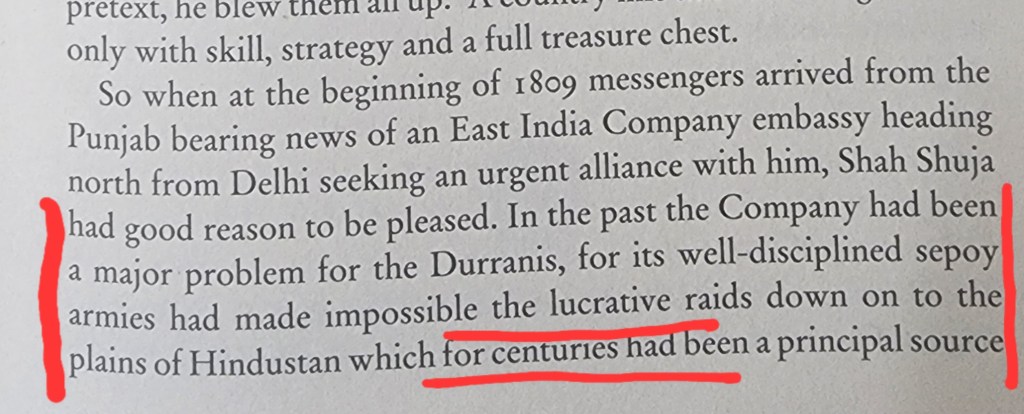
Excerpt from the book, “Return of a King”, by William Dalrymple
Northwestern India has faced invasion through what is now Afghanistan for millennia. It started with the Persian Empire and was followed by an invasion by Alexander of Macedon. These invasions were followed by the invasions of the Indo-Greeks, Indo-Sakas, Indo-Parthians, Kushanas and the Hunas. These invasions lasted from the 6th century BCE till the 6th century CE. What was characteristic of these invaders was that they assimilated into the local culture, while also making contributions of their own.
The next series of invasions, of the Arabs, began in the 8th century was not too successful. This was followed by the Ghaznavid invasions in the late 10th and early 11th centuries. These invasions ended Hindu and Buddhist control in what is today Afghanistan. This was the beginning of what can be considered the Turkic invasions. These invasions set the template for plunder and the loot of wealth.
Then came the Ghorid (Ghurid) invasion at the end of the 12th century CE, which led to the establishment of Turkic rule in Northern and Western India and was called the Delhi Sultanate. This was followed by the invasion of the Mughals (who were Turco-Mongol), Iranians and lastly, the Afghans in the mid-18th century. This was the end of the invasions of India from the Northwest, until the middle of the 20th century, after Indian independence.

Invasions from the Northwest, in chronological order
There was the British conquest in the 18th century, preceded by minor conquests by the Portuguese in the early 16th century. But the European attacks came from the South, from the seas and are not relevant to the purposes of this article.
The invasions following that of Mohammad of Ghor, were unlike those in the previous millennia. The rulers chose to impose their native culture over the local populace. Yes, this is a simplistic statement, but not entirely wrong. Even the culture they chose to emulate was that of neighbouring Persia and not that of the populace they ruled over. Their contributions were not nil, but unlike those of the previous millennia, these were not entirely positive to the conquered cultures and populations.
The geographical extent of Indian culture in the 3rd century BCE extended till modern day Southern Afghanistan and Baluchistan in the West. This was a cultural extent and not a political spread. The entire subcontinent, except for the odd century, was always split into multiple kingdoms, that warred with each other. So, the conquests of the invaders were not against a monolithic “Indian” kingdom, but against individual kingdoms, who were mostly smaller than the invaders.
Both the invasions from the North and the West and the warring of Indian political entities continues to this day. With variations of course. The modern-day republic of India is one of at least 3 political entities that exist within the historical cultural spread. If one considers just 3 countries formed out of British India*, the pattern of Indian states fighting one another and the invasions from the Northwest, both persist unabated.
India, Pakistan and Bangladesh are the modern countries most associated with British India. Pakistan, by dint of its birth and historical association with Buddhist and Hindu cultures, is India with a new and different name. So, every time Pakistan attacks India, either with conventional forces or through its terrorist proxies, it is an instance of Indians fighting Indians. Exactly like in the past few thousand years.
Pakistan is India’s western neighbour, and the union territories of Jammu and Kashmir (J&K) and Ladakh are India’s north. So, every time there is a terrorist attack in J&K or a war with Pakistan, like in Kargil in 1999, the invasion is still from the Northwest, just like in millennia past. So, the pattern holds, nothing has changed. The difference is that Pakistan now tries hard to associate its identity with Turkey & the broader region of West Asia, contrary to the facts of history.
This is not new either. The Mughals, despite having Rajput Hindu mothers, identified themselves as Timurid after Timur the Lame, who hailed from Uzbekistan. Today, Pakistan, fills the dual role of an Indian entity identifying as foreign and that of an invader from the Northwest. Neither role is something that modern Indians can be happy about.
But about the reason for the invasion/attack? In the past, it has mostly been about controlling the wealth generated from the fertile plains of the Sindhu and Ganga river systems. The Sindhu river system includes Kashmir, Punjab and Sindh, while the Ganga river system includes all of North India excluding modern day Rajasthan. Today, large parts of the Sindhu system are in Pakistan. Also, Pakistan cannot hope to plunder wealth like the invaders of the past, nor can it take over any part of North India. So, why bother with the attacks?
The answer is likely the control of wealth within Pakistan. The leadership of the Pakistan army is the leadership of Pakistan, for they control the political leadership and are strongly associated with the business elites as well. These 3 groups control a lot of the wealth in the country as they control a lot of the agricultural land, and the prime real estate used for other purposes. For the army to stay powerful, they need the enemy in India, even though India neither wants any part of Pakistan, nor a war with it, not even a minor one.
So, if there is no powerful enemy in India, a powerful army is not really needed. There is a saying I have heard from many people in India. It goes, “The Indian state has an army, while the Pakistani army has a state”. This explains the situation beautifully. The army is like a parent to the Pakistani state. Keeping this image leads to power, which fuels budgets, prestige and wealth.
So, the “wealth” that the Pakistani army hopes to earn is power at home and that is achieved every time India is demonstrated as an existential threat to the state. An attack on India triggers a counterattack, which demonstrates a threat to the state, and this leads to the importance of the army. And from this importance flows everything else mentioned earlier.
For India on the other hand, the situation is still the same, Indians are still fighting Indians called Pakistanis, who have chosen to the take on the role of the Northwestern invaders, for the original invaders have either weakened to insignificance or just disappeared altogether.
This post is different from my usual articles. I almost always describe connections between traditional martial arts, Hindu culture, Indian history and modern Indian life. This article though, is entirely focused on Indian history. This is because of thoughts I have had post the actions taken by the Indian military during Operation Sindoor between 7th May and 10th May, 2025. Including the content of this post with another post (the next one) was making the other one too long and expansive in scope. The next post after this one, will go back to the usual pattern of connecting dots.
Notes:
* Burma, Aden and parts of Somalia were also administered as parts of British India
 Mundane Budo
[…] ** https://mundanebudo.com/2025/06/19/thoughts-from-op-sindoor-part-2-nothing-has-changed/ […]
LikeLike