The martial arts are a passion for many. This passion is expressed in a multitude of ways; combat sports, gymnastics, dance & choreographed performances, weight training, obstacle races, through movies, TV & YouTube (watching, making videos), through books (reading, writing, fan fiction, narration), through video games, study of history, craftsmanship (smithy, engineering, cosplay) and of course, actual training of the martial arts (with or without weapons, with and without rules1, with physical or spiritual primacy2).
There might be several dichotomies in the range (perhaps limited) of expressions mentioned above. The means of expression of one’s passion for the martial arts by itself will create an opposition or derision for the means of expression of the same passion by another. And this is even before we even consider the range of negative opinions practitioners of one martial art form sometimes display towards the practitioners of another martial art form. We shall return to this aspect of opposition and dichotomy in a bit.
Beyond all this, each of the means of expression mentioned above itself is an offshoot of or root of another art form altogether. By this I mean that writing stems from literature and poetry, dance lends itself to music & song, video gaming stems from a multitude of visual & aural arts, spiritual martial arts are meditation with matter over mind and many other such examples.
But the one thing that is common to all of the above is that they are all forms of expression, with a myriad of objectives. And the flow of expression from inception to objective is the “ART”. This FLOW, is unique to a given space and time3, considering all the human abilities, memories, experiences and their concurrent environment (not necessarily physical). It would be appropriate to call it EPHEMERAL, to emphasize how incredibly unique an expression and the flow of the same is.
This ephemeral nature of the creation and expression of an art for is what brings us to the definition of ART. It very simply could be that “anything that once done can never be replicated (not repeated) is art”. This is one definition that my teacher Shiva once used in class that has stuck with me ever since.
This definition of art means that with each rendering of any piece of art, be it martial, musical, visual (architecture, painting, sculpture etc.) physical (dance, drama, cinema, watching a sport), even if experienced or consumed (food & beverage) multiple times, will result in the consumer or the one experiencing the art form have a different FEEL OR FEELING each time the experience occurs. The feeling itself is a melding of feedback from all human senses.
Thus, art is ephemeral at both source and sink. This opens the door to further generation of art and its experience (or consumption).
To consider the “sink” side of the arts, we see that the “feel” or “feeling left behind” due to the artwork is vital. The fact that a feeling is involved means that the senses need to be triggered, and any sensory trigger is essentially eliciting a reaction. This then could be described as the purpose of existence of any artwork. The purpose of art is to elicit a reaction. This again is something I saw a contributor to the Tor.com blog mention and it has stuck with me ever since.
With all the above in mind it should be quite clear that if we are to consider something a martial art, we need to find the “art” in it. This is circular logic, where we set out from an assumed understanding of martial artists in terms of their ways of expressing their passion, to understanding what is essential to being a martial artist.
We have seen above that all artists (practitioners of art) express themselves and elicit reactions. A painter expresses his or her vision of a snapshot in time & space, an architect designs and creates an expression of devotion, power, grandeur, passion etc. (each a subjective term) in his or her work.
A group of musicians attempt to trigger specific emotions in response to their use of sound and words with specific tones melded in harmony. Dancers, either alone or in groups attempt the same, with or without music. Writers attempt the same by allowing readers to create stories in their minds in response to words strung together in harmony. Film makers do the same using all the above! As do video game designers and gamers themselves!
Clearly then, martial artists are expressing themselves and trying to elicit a reaction, because they are creating “works of arts”, as they are practicing an “art”.
Here, we need to define the tools of the trade for martial artists (or practitioners of martial art), else all works of art they produce gets shoved under a generic term called “FIGHTING” which might lead to a reaction not different from the reaction to the word “VIOLENCE” (the rasa “BHEEBHATSA” or disgust, as the elicited reaction for a large part of the populace, comes to mind).
A martial artist begins his or her expression as a “reaction” to the attack or just any “threatening movement” of another (attacker or UKE4). The initiation of the movement could be by a single or multiple individuals.
He or she goes on to continue a series of movements, until the threat of the attacker or attackers (UKE) is nullified. The fact that no two attacks can ever be the same due to human nature, means that no two expressions of threat nullification can ever be the same! Thus, the “Art” is discovered!
Here then, comes the slight difference in the “expression” aspect where the martial arts are concerned. A martial artist with increasing experience and knowledge of the art form, is to express himself or herself seamlessly, while multiple impediments are triggered by one or many individuals to upset said expression!
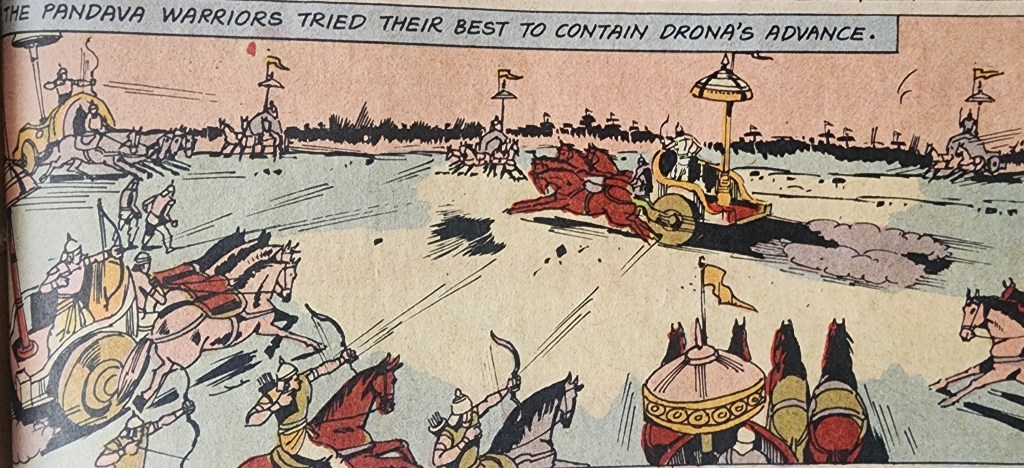
Drona moving towards his objective despite all the obstacles from the Pandava Army. Image credit – “Mahabharata 33 – Drona’s Vow” published by Amar Chitra Katha
A martial artist expresses his or her movement seamlessly despite every attempt by the attacker or attackers. The attackers try to prevent the expression as that means they have achieved their objective.
The more seamless the expression, the more AWE INSPIRING the feeling. The less seamless the expression, the more the potential of said expression being classified as “fighting”.
Thus, “seamlessness” is the objective, and hence the art itself.
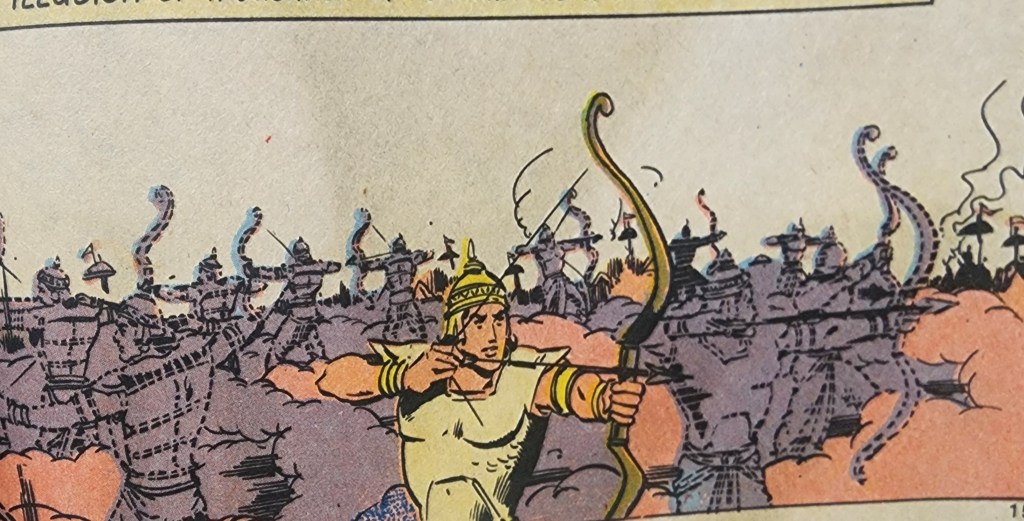
Abhimanyu in seamless flow despite being severely outnumbered. Image credit – “Mahabharata 34 – The Slaying of Abhimanyu” published by Amar Chitra Katha
Now then, we ask ourselves, how is one seamless movement distinct from another similar movement, when the end result is the same (nullification of the threat)? This in turn allows us to define the tools of the trade for a martial artist.
We saw that the initiation of expression comes from not the martial artist but from an external source, here the attacker (Uke). The response to this attack is the seamless movement. The movement can use a multitude of tools by itself. These are the environment the movement occurs in, use of implements (arms and armour) and the flow of movement (and intent) of the attacker or attackers.
The environment is nothing but the terrain and climate (indoor, outdoor, floor inclination, stairs, water, mud, rain, heat, cold, plants etc.). Terrain and climate can easily be “space and time”. Arms and armour of course include any and all weapons and their countermeasures. The last part is the use of the attacker’s/attackers’ strength, speed, desire for a specific attack and outcome, urgency, hubris and the like.
A variation in the environment, implements and attacker intent is what completes the artwork of a martial artist. It is what can be called the “flavour” or “essence” of any art work by a martial artist.
If a set technique is performed in a specific location, at night, with weapons against multiple attackers, as against the same technique in a different location, without weapons and in broad daylight, the art work comes to life! Nothing complicated there!
A secondary aspect of the art generated by a martial artist is that the feeling of awe it elicits is experienced differently by the attackers, other martial artists and everyone else. The very subtle and nuanced expressions of the movement can only be experienced by the attacker/attackers, and none other. Those who are not martial artists still do feel something, but maybe not the same as that felt by other martial artists, again bringing forth the “arts” in the martial arts!
In order to make the experience more accessible, martial arts can be choreographed, lending themselves to dance and gymnastics, but limiting the awe factor with a lack of belief as in movie, TV and video game action sequences. Alternatively, they can be bound by rules to ease the experience, as in most sports, combat or otherwise.
In both the above “constructs”, the ones creating the experience are still enduring the same awe as ever, even if to enable others to partake of the same, albeit to a considerably limited degree.
Thus then, like all arts, the greatest awe can only be truly experienced by the artist himself or herself, leading one to understand, given the ephemeral nature of all art, that there is only fresh creation, no room for derision. Also then, with enough time and experience (call the two together WISDOM) the need for any dichotomy, that was define earlier, with should itself be nullified. This closes this circle of thought and expression of wordy movement. J
Footnotes:
1 – Martial arts that are converted to sports and those that are not
2 – Consider Tai Chi and Kalari Payatt as examples at either end
3 – No speaker will ever use the same words in the same sequence in two separate renderings of the same thoughts.
No painter or sculptor can ever replicate the same colour or stroke or vision in two separate attempts.
No singer or dancer or gymnast will ever replicate the same tone or move in even consecutive attempts.
No writer will ever use the same words in the same combination in two separate renderings of the same story or situation. 4 – A reference for Bujinkan practitioners
 Mundane Budo
[…] Expression through obstacles – An exploration of the “ART” in the Martial Arts […]
LikeLike