Ahimsa & Indian Independence – Through the Eyes of Budo
I have opined in the previous part of this series, that Ahimsa is a martial arts concept where “one does not trouble the opponent”. It is a way of saying do not use force against an opponent. This is especially true if the opponent is stronger than oneself. Here strength includes access to greater resources, technical superiority, greater numbers or just greater physical strength and skill.
An extension of not using strength against a stronger opponent is generally using the opponent’s strength and skill against her or him. This generally means if an opponent is taller and larger, and thus generally stronger, one does not resist his or her strength and instead tries to maneuver to a position from where the opponent’s balance can be taken or a vulnerable opening accessed.
The same is true when one is fighting with non-projectile weapons, whether they are cut, thrust or bludgeon oriented. Here, the skill, speed, reach and favoured attack are points to consider as against strength. If the opponent uses a longer weapon, one tries to get in close to negate the reach and if the opponent favours a cut over a thrust, one tries to get to an angle where the cut becomes ineffective (or less effective at least). But if the opponent favours a thrust, one tries to get him/her to over reach or over commit or get out of line of the thrust, and thus try to get them off balance or leave an opening in the act of recovering one’s balance.
Could this way of dealing with opponents explain how Ahimsa works brilliantly as a weapon? Consider the Indian freedom struggle, the British Raj is the opponent. This opponent enjoys superiority in resource availability, economic prowess and technology. So, the opponent is “stronger” or “superior”. There was one other superiority that the Raj believed it enjoyed – moral or civilizational superiority. How does one use the opponent’s strength against itself?
Here the Raj’s knowledge of its civilizational superiority is the opening to its vulnerability. The Raj’s belief in its superiority in this sphere was so complete that it believed that it had a “duty” to civilize the Indian colony as evidenced by Kipling’s poem, “The White Man’s Burden”, among many other things.
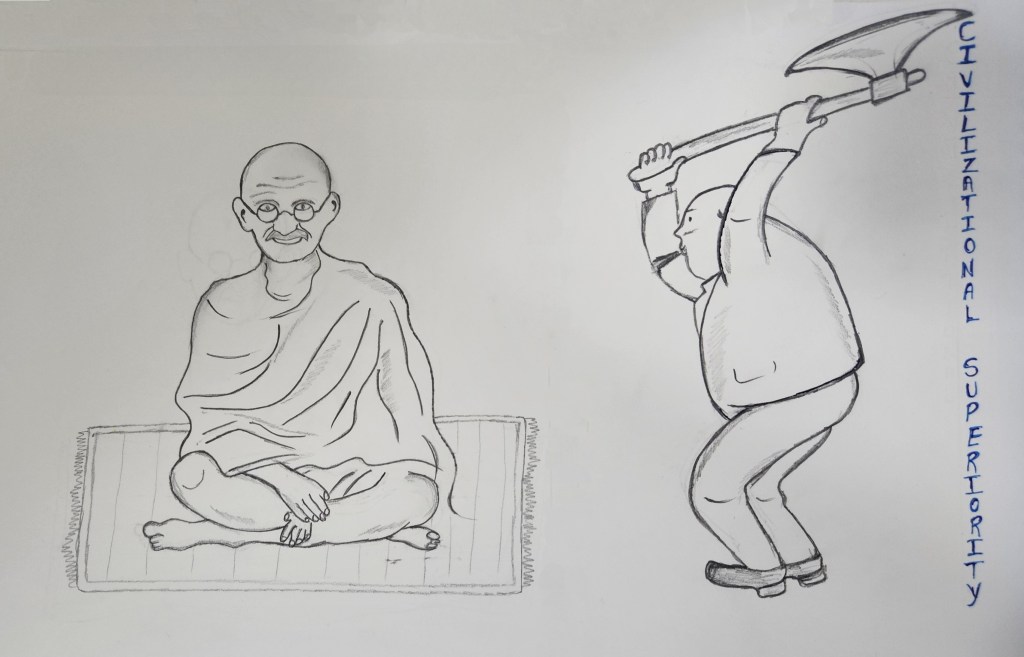
Artwork by Shushma N
All martial manoeuvres, whether with a weapon or unarmed, require a specific type of movement. Similarly, nurturing a belief in civilizational superiority requires behaviours that reinforce this belief and thus makes them similar to any martial maneuver. Once a specificity is identified, a counter can be identified or devised. And this counter was Ahimsa, to break the belief in civilizational superiority, mainly by breaking any possibility to believe in moral superiority.
Ahimsa hinged on breaking specific rules, like not paying taxes or gathering in large numbers and disrupting some simple activity like flow of traffic on roads. It might just be gathering in large numbers and showing that some activity of the Raj is wrong. Thus, the first move is actually not Ahimsa in that one causes at least a minor inconvenience (though not trouble the opponent much). This triggered the Raj into a violent reaction to disrupt the gathering. But interestingly, the violence in the reaction is what is seen as the attack, not the provocation of the gathering!
So, the gathering following Ahimsa puts the opponent, the Raj, in a quandary. Do not react and let people around the world believe that it did not care about the points being aired by the gathering and seem insensitive and thus dictatorial, or disrupt the gathering quickly with violence believing that its civilizational superiority meant the grievances aired by the crowd was inherently wrong. Over time, this violence, when repeated often enough, will trigger the same observation that the Raj is uncaring and dictatorial as all they do is resort to violence! Thus, without realizing it, the very belief in civilization superiority leads to behaviour that breaks the same belief. The strength has now become the weakness!
This is the strength of Ahimsa! The Raj was not really troubled at all. It came and occupied a land, a sacred geography, a thriving civilization, and imposed itself on it. And this mistake was shown to it by gathering in numbers that did not trouble the Raj in any way, specifically not with violence, and thus not strength or any other parameter where the Raj held superiority. The gathering just occupied a space, and it turned out to the right space, for the Raj, despite overwhelming superiority, succumbed to a weakness created by itself.
An additional observation I think is true, is that the Indian National Congress (INC) and its Ahimsa based movements acted as a safety valve and an out for the Raj in the face of growing armed resistance over the course of the Second World War (WW2) and the subsequent mutiny in the Royal Indian armed forces. This armed resistance had never stopped since almost the beginning of the 20th century.
Consider this; the British Army faced a mutiny by the Royal Indian Navy in 1946. There were similar, but smaller mutinies by the other wings of the armed forces as well. The Indian wing of the Royal Armed Forces was larger than the same from Britain itself. Additionally, the Indian forces, being trained by the British themselves, were as capable militarily and technologically as the British troops themselves. So, the larger number and home ground advantage now mattered more than in the previous century. Also, the British Raj and the Empire in general was now severely weakened economically as well. It could no longer call on resources to hold on to the Indian colony like it managed until the first couple of decades of the 20th century. Thus, British superiority in military, technological and economic terms was also no longer present or was severely degraded to the point where it did not matter anymore.
(This is actually also a martial arts concept where one matches the opponent so closely that over time the opponent does not realize where he/she is being controlled by the one he/she was attacking. This is achieved by not troubling the opponent and following his/her movements so closely as to actually learn in the moment and use it against the opponent. This then translates to Ahimsa even in armed struggle! Perhaps this concept deserves a write up of its own for deeper exploration.)
Now that their superiority no longer existed, their belief in civilizational superiority allowed the Raj a graceful exit, a face-saving if ever there was one. The Raj negotiated an exit from India by dealing with the INC and Ahimsa practitioners, thus making it appear that they were only giving in to the popular call of the people of the country. This though, never fooled anyone, only allowing the Raj alone to retain its belief in civilizational superiority. Reiterating again, this belief in civilizational superiority was the weakness exploited to make them leave in the first place! Their strength was broken without them realizing that it was broken! This is the epitome of martial arts’ abilities. To make the opponent lose without realizing that he/she has lost and achieving the objective by making the opponent retreat by their own volition, not by an act of the defender.
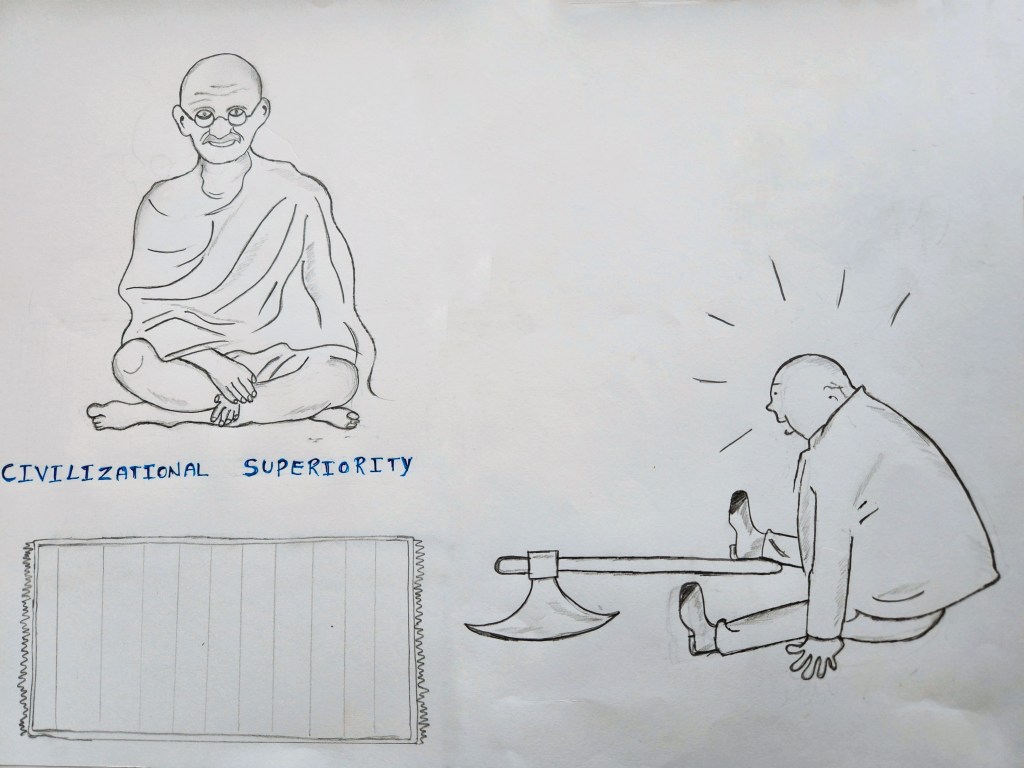
Artwork by Shushma N
Thus, Ahimsa was indeed a weapon of extraordinary abilities; a true Weapon of Mass Destruction (WMD)! It brought a global empire to its knees. It exploited the time and space with great precision (the world wars, railway technology, print media, global opinion, public opinion).
The sheer genius of this great WMD is the ability of Mohandas Karamchand Gandhi to bring in a critical mass of people in India to join in the Ahimsa movement against the Raj, making them just be in the right place at the right time to cause the Raj to react and thus damage itself a little more, until it could do nothing more than retreat. This is nothing short of an invulnerable Vyuha from the Hindu epics where the opponent gets trapped hopelessly with no hope of victory or even survival. It is exactly the same as getting into a position to expose an opponent’s vulnerability. It is almost a textbook example of using an opponent’s strength against him/herself.
Just imagine a martial arts concept designed to be demonstrated in a one on one duel being executed on a scale of the Indian population, which was around 350 million or so at the time of Indian Independence. The scale boggles the mind no end!
Add to this the fact that one man (at least in popular conception) could make a number as large as 350 million believe in one concept! Is this not social engineering on the grandest of scales? And this was done 70 odd years before social media, which brought the concept of social engineering to the fore.
In conclusion, Gandhiji, who is considered to the epitome of Ahimsa was perhaps an extraordinary martial artist! Of course, this is a statement made with the benefit of hindsight and perhaps Gandhiji did not ever consider himself a martial artist, but the notion is nevertheless worth considering. He fought and defeated the most powerful enemy ever, an evil empire that believed it was the greatest good ever. He facilitated the defeat of the empire by using the strength of empire against itself. He made the first move, but all that mattered was the empire’s counter, which, for all practical purposes became the first move that led to a devastating counter that was never sensed. The first move was a trap so effective and smart that no one ever realized that it was a martial manoeuvre at all!
Ahimsa is indeed the greatest WMD ever.
 Mundane Budo
[…] ** https://mundanebudo.com/2022/10/27/ahimsa-and-the-martial-arts-part-2/ […]
LikeLike