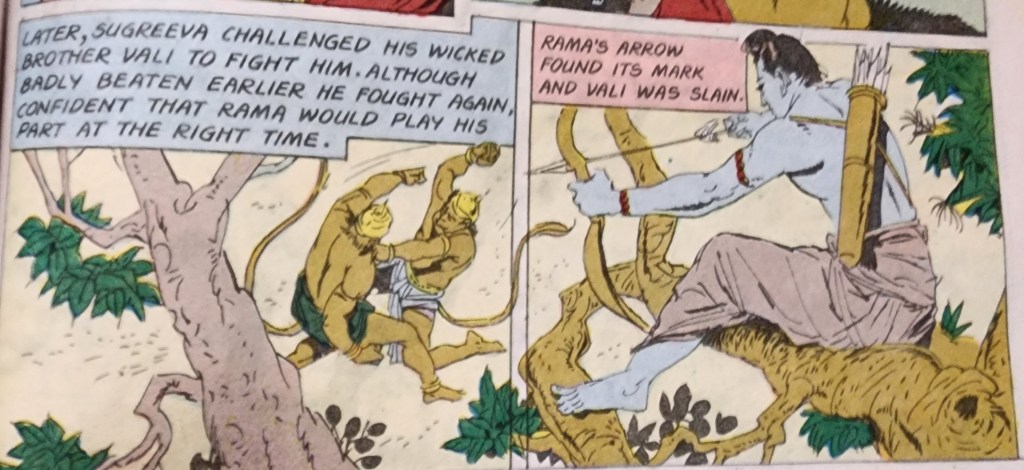
Remember that part of the Ramayana where Rama has to shoot Vali from hiding, while the latter duels Sugreeva? This sequence brings so many thoughts, what an incredible archer Rama should have been, to be able to shoot one of the duelists, while the duelists did not position themselves in any predictable manner! Or was Sugreeva moving in a specific manner in the duel so as to allow Rama a clear shot at Vali while ensuring he is out of the way of the arrow; how difficult must this have been, while fighting for one’s life and also knowing you could be shot by an arrow intended for your opponent.
A few months ago*, we were applying the feeling and concepts of the Takagi Yoshin Ryu with the Sanshin no Kata and Kunai Waza feeling. This was then added to the Japanese poem about a lack of dualities and how to keep the heart in the place of nothingness to start on the path to wisdom. This was the first time we had heard the poem in its entirety and that too in an artwork created by Nagato Sensei. We had until now only heard the first of the four lines of the poem, “Kyojaku jugo arubekarazu”.
During this training, I observed my teacher Shiva actively let go of all body tension and cause severe problems to the attacker (Uke). He was constantly dropping out of any uke nagashi or movement he made, and this caused serious impediments to the ability and will of the Uke to keep up the attack, and this was clearly visible in a Jutaijutsu like situation. This observation and learning are what prompted the train of thought I am expressing in this article.
So, back to the Ramayana. It is known (I mean from other stories in the Hindu scriptures) that Vali was a warrior of unparalleled strength and skill. He was invincible one on one, there is no doubt there at all. Vali defeated Ravana in single combat so effortlessly, it was not even a fight, just a humiliation for Ravana. And Ravana was as fearsome a warrior as one can imagine. Also, Vali had a boon which rendered his opponent at 50% of his or her fighting ability, and the remaining 50% got added to Vali’s own fighting ability. So, an opponent, the moment he or she chose to become Vali’s opponent was diminished while facing an opponent vastly superior to what one might have been prepared to face.
An aside here, a whole article can be considered to discuss how an opponent’s ability reduces by 50%, from a martial arts perspective, at least from a Bujinkan perspective as I see it.
It is also known that Sugreeva could not take on Vali in a war, where armies would be involved. Sugreeva was a fugitive in Vali’s kingdom and had a band of followers, not an army. Further, he would not have gone to war even if he could, for he did not want a civil war. He only wanted his wife back (held captive as a wife by Vali) and Vali eliminated for the person he had become post the Dundhubi episode. So, it was always going to be single combat between Sugreeva and Vali. Vali himself was never going to shrink away from a duel, such was his justified confidence in his own ability. So, he would not use his troops to cheat and eliminate or capture Sugreeva without defeating him in the duel.
Sugreeva also knew he could not defeat Vali in single combat (Dwand or Dwandwa yuddha). This situation set up the need to eliminate Vali by stealth. We also know that Rama was extraordinary as a warrior. And superlative as an archer. Of course, Vali was a fantastic archer as well, but the duel between him and Sugreeva did not involve bows and arrows. Also, Rama was also really strong, as seen from the ease with which he moved Dundhubi’s skeleton. His strength is also demonstrated when his one arrow felled seven coconut trees. His archery skill is also shown earlier in the Ramayana where he is the best at not only hitting the target but also with the speed of reloading, shooting and restringing his bow.
So, Rama is the perfect choice for taking the shot while the duel takes place. There is also an additional complexity in the situation. Vali and Sugreeva, being brothers, resemble each other very closely. In the first duel between Vali and Sugreeva, Rama cannot decide who to shoot due to this resemblance. Sugreeva has to flee for his life, abandoning the duel. Vali seems to have been satisfied with his victory and his brother’s humiliation and not expanded efforts to eliminate his brother and his band in a great way after this first duel.
With all this as background, let us look at the second duel. This time Sugreeva wore a garland to allow Rama to distinguish him from his brother. Also, I have not heard of, read of or seen any specify strategy planned ahead of the duel that would allow Rama to shoot Vali with minimal risk to Sugreeva. I also do not know if the duel was nudged by Sugreeva by his movements to maneuver Vali to a position where he would be a target while reducing risk to himself.
I also do not know what Vali’s state of mind was or his method of fighting in the second duel. With that said, imagine how incredible this shot that Rama took was. He had only one shot. Clearly the duel was far enough away that he could not distinguish Sugreeva without the garland. The shot had to ensure it hit its target in the midst of a dynamic duel. A fight between two accomplished warriors (Sugreeva was a great warrior, inferior only to Rama, Vali, Ravana and the other superlatives) sees the two always in motion. Neither stands still even if not in contact, to achieve an advantageous position or posture. In this dynamic situation, ensuring that an arrow hits its target before he moves while also being sure that that the arrow does not hit the other person, who might occupy the same position where the target was just a moment ago is scary to even think about!
If the duel was with spears or some other long weapon, the situation might have been easier for Rama because a pole weapon puts a lot of space between the duelists, more than sufficient for an archer as good as Rama. Bur from what I know, the duel was with either gadas (maces) or an unarmed fight (grappling and striking). The gada is not a long weapon and does not put the opponents at a distance that is safe for one from an archer, not to mention unarmed combat, which puts far smaller space between the two.
So, Rama had to not just take a shot, but understand Vali in this specific duel! How difficult is that! If Vali was being nonchalant and letting Sugreeva do the work and fall into strikes or locks, he would have to predict Vali’s nonchalance! If Vali was angry at a second duel in a short span of time and against an opponent who ran away the last time, would he be aggressive and go for the kill and thus ensure a short duel? If this was true, Rama had to be sure to predict Vali’s next attack to take the shot at the right time, considering any delay might spell doom for Sugreeva. And he had to do this with only one reference fight to go by! However much Rama had heard of Vali’s fighting, he had seen him fight only once! So, getting the right shot by going with the flow of a fight he was not involved in; can anyone imagine that! And in a life-or-death situation for his friend; Rama would be considered divine for this ability alone, let alone all his other qualities as a human being! Yes, I am aware of all the exclamation marks in this paragraph, this is how awesome the situation was.
Now let us look at this situation from Sugreeva’s perspective. We do not know if there was a plan beyond Rama killing Vali while he dueled Sugreeva. Sugreeva has received a hiding and barely got away with his life in the first duel. So, what levels of faith mush he have had in Rama to try the same thing again! Imagine this, he was wearing a garland to distinguish himself from Vali. But we do not know what the garland was made of. If it was any regular garland, how much effort would he have to expend to ensure it was not ripped off his neck? And worse still, the garland gave extra holding space for Vali, who was already the superior fighter. Would this be a fatal disadvantage?
Next, how did Sugreeva feel about Rama taking a shot at Vali? How nervous would even a great warrior feel knowing that the slightest error from Rama might end up killing him and not his opponent? Would this knowledge affect his fighting style? And would this change result in Vali realizing something was wrong? And if that had to be overcome, would any change he made to his fighting movement result in a fatal error? Again, this was the second time he was putting himself in harm’s way in a short span of time. If he had a plan and this was also known to Rama, would that even come to pass? What changes in Vali’s state of mind and fighting style would render their plan useless or would that be an advantage?
We can see a lot of questions come up in the mind of any martial artist as we see above. Given all this, both Sugreeva and Rama would have had to go with the flow of the duel and implicitly trust each other’s ability. “NO PRESSURE” in all caps does begin to express the extraordinary danger that Sugreeva was in and hence the expectation from Rama. Did Sugreeva have any sacrificial moves to render Vali open to Rama’s shot? We do not know. But we do know that the plan succeeded. Sugreeva survived, Rama’s shot was successful and fatal for Vali. This achievement in itself calls for reverence not just in Rama, but in Sugreeva’s judgement of people’s abilities and his own skill as a warrior (he had Hanuman in his band after all, that should have been a dead giveaway 😊). Also, as a martial artist, it kind of encompasses the meaning of the “Kyojaku jugo…” poem. Both Rama and Sugreeva had to let go of so many necessities for a PLAN to succeed and trust to just an objective (Vali’s death) and a path (there will be a duel and a shot in stealth at Vali). There could have been no option for any detailing, just a lot of faith in each other and the need to achieve the objective. How incredibly cool is that?
*This article was written back in the beginning of June 2022, before I had started a blog.
 Mundane Budo