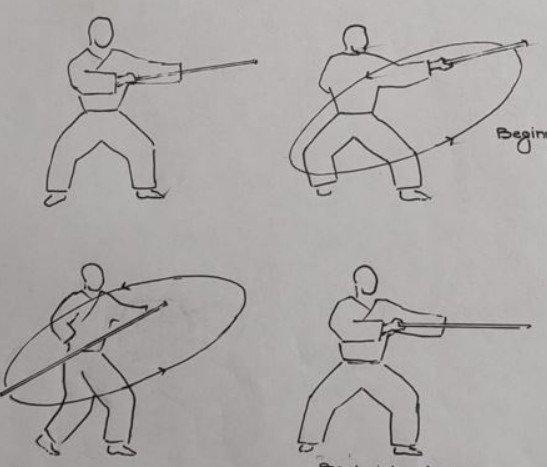
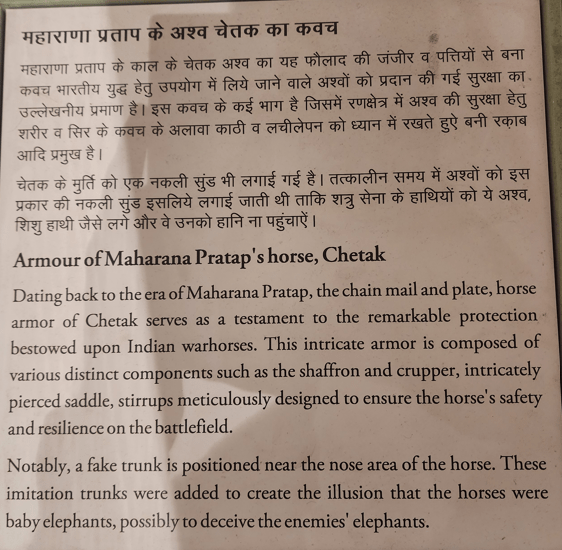
Snailesh cursed as he ran through the jungle. Well, it was the edge of the jungle and along the only road through the forest. But he was inside the treeline, and that made it seem like he was in the jungle. He did however be careful to keep an eye on the road through the gaps in the foliage. He did not want to be lost for good by going in deeper.
The twilight was rapidly giving way to the dark and the streetlights were few and far between. He used these to guide him along. He cursed himself for being late. He had traversed this road hundreds of times since he was a kid and knew well the troubles for city slickers like himself after dark. They would be hopelessly lost after dark without knowledge of the terrain or company of the locals. He had been mildly cocky going out as late as he did. He had assumed with some trepidation that he would he alright if he kept to the road after dark.
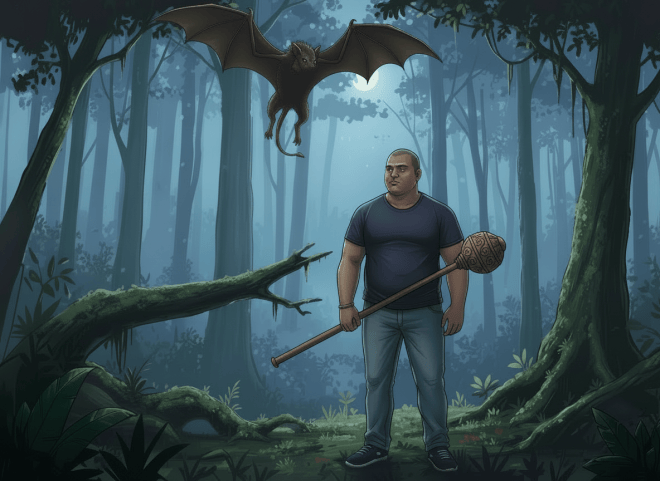
Suddenly a Betala flew low and snapped at his neck. He squealed like a frightened kid in fear as the boar like jaw snapped shut millimetres away from his jugular. He had barrel rolled without knowing it, on the jungle floor with all its detritus no less, and had not a scratch on him. “Thoo Gandu” he cursed the creature in his mind. No one had told him of these Betalas in the jungle. Maybe no one believed it, or maybe no one wanted to. Maybe they had never been seen clearly. Even he had not as yet, he had only caught glimpses. Perhaps he was the first to encounter them in a long time. After all, locals knew when and where to tread after dark, and outsiders took warnings about the darkness seriously. He needed to get away fast.
But Snailesh was feeling slow. Slow with his movements, with his thinking. He was feeling slow earlier with his Gada movements. He had been late in waking up earlier in the afternoon and late in going for his Gada practice. Goddamn it! It was like “Slow and Late” were the words of his house.
He had reached late the earlier day – driving to his family farm was always one of the great joys of his life. He had needed a break from editing, filming, gaming and planning, so much planning! He had had a systemic problem for some time now, with a lack of motivation in both work and life. He could not work out due to boredom, nor even make videos of martial training, which he loved and was quite an expert at. He had become a serial deadline killer! So, he had decided on a break; drive out to the farm in the western mountains and train the Gada. He had promised himself to make some videos of the training the Gada, and was feeling guilty at delaying the same. He wanted to get better at it in the lap of nature to the tune of birdsong, so the videos he made reflected the magic of the weapon when he wielded it for the camera.
He listened for the Betala now for he could hardly see anything. He did not know how many were out there. He gripped his Gada lightly. He felt a weird and hateful vibration deep in his chest. There was no sound, just this unsettling vibration, nothing through the ground, just a resonance in his chest. It was something he had never felt before. And then as a blur multiple Betalas came at him.
He was knocked off his feet by the wind from leathery wings. And then all was silent. He had no idea if the Betalas were playing with their food or testing his abilities. He had not been able to catch a clear view of one either. He did not even know how he knew they were to be called Betalas! Yet he knew.
He had fallen onto his back expertly, with no trace of injury. His martial skills were intact if not improved. And that made him smile involuntarily. He decided not to wait around here any longer. He decided to cross the road onto the other side to see if the creatures would follow. He intuitively felt he had to stay low as he crossed, the Betalas being creatures with flight after all.
He did a long leaping roll across the asphalt of the road, over 30 feet. His body never touched the road. As he reached the end of the diving leap, he had pivoted off into another using the mace head a as pivot on the road. He gracefully crossed the road just a few feet off its surface as Betalas raced overhead and failed to get low enough to reach him.
“Haha, take that losers!” he thought. He was a large man and had slipped his own targets at changing that recently. But now he was beginning to lose the apprehension coming from his thoughts and settled into the moment. His training was taking over and his mind quieting. And then suddenly, he let go in his mind, and sat down with his eyes closed. He became one with the jungle behind him and gave up all notion of escaping. He would let the scenario paly out, letting the Betalas move him, to their doom.
He felt the Spark in just few moments, after all that was what his real name meant. He had not felt it in his life in what seemed like an eternity, though he clearly remembered the feeling and how it had raced through his life only a few years previously.
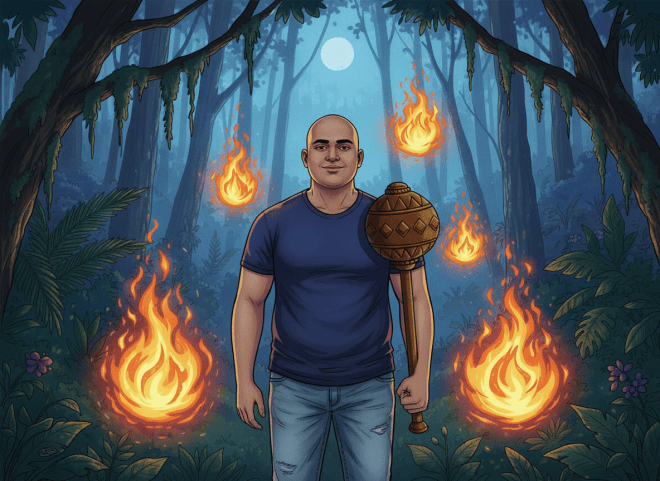
With the Spark coming back, his eyes opened involuntarily. There was now a profusion of light all around. Several balls of flame floated all around him. The Kolli Devvas had come! These nature spirits were famed to light the path for those in dire need, provided the needy ones were one with nature and had no destructive intent. In the light of the Kolli Devvas were revealed several Betalas on the trees all around him. Snailesh no longer cared for their appearance and spent no effort on committing the same to memory. He did not even believe himself to be Snailesh anymore! Perhaps he would BE his real name soon!
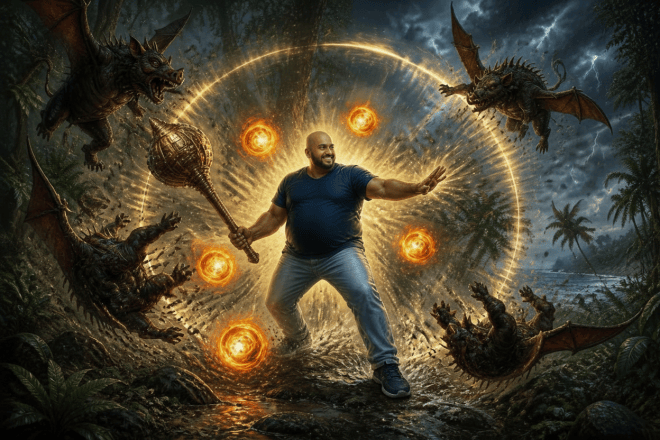
The Betalas then came at him from all around. It was like a silent vision from Hell, with a surfeit of vibration but no sound. They came at him and died or fell or fled from him. He stood up, he sat, he twirled and he rolled. All the while his Gada sang with joy, it was like a living being extending from his limbs. He used it with his arms and with his legs! When he moved it was like the Gada was always in the right place at the right time.
The Betalas seemed to rush into it and smash themselves against it in a manner suicidal. It was like they were iron filings and the mace a murderous magnet. A magnet driven by the Spark in Snailesh and flowing through his fluid motions. No observer, if there had been any, would be able to discern if Snailesh used any of his five senses, or if the jungle itself moved him through some unseen divine connection. And the Betala herd thinned, slowly at first and then evaporated as if by magic.
In a matter of many long moments, the scene turned mundane, like any other night. The Betalas were gone, leaving no evidence of their attack behind, no blood, no body parts and no cries of retreat. The Kolli Devvas faded out, their purpose fulfilled. Snailesh of the Spark, slowly resumed a normal breathing and started his confident walk back to the farmhouse.
He thought as he walked, and realized he had no clear memory of the specifics of the incidents of the last half hour or so, just an acknowledgement of it. He sensed that this was why no one would ever have a clear warning of the Betalas, or believe in the existence of Kolli Devvas. Their purpose seemed as much as a parable as a flesh and blood entity. He walked back in contentment with the Spark burning silently within.
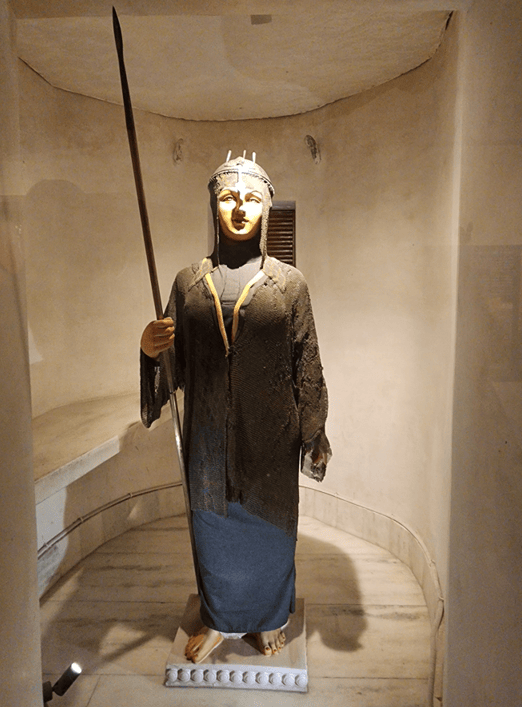
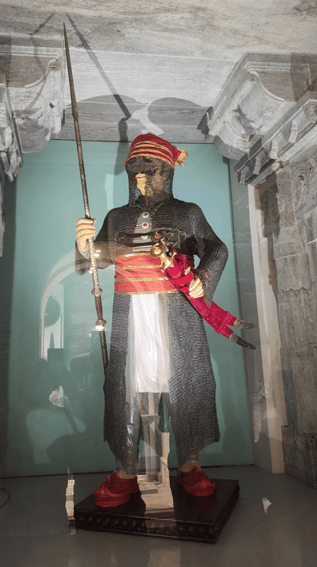
All images are generated with the WordPress AI, based on descriptions by me.The story is entirely by me, with no AI input.
++++
In 2020 when we were on lockdown due to the pandemic, a few friends of mine and I used to have calls once or twice a week to keep in touch. All of us were practitioners of the Bujinkan and we shared our thoughts on training by ourselves. Sometimes, we shared different works of art that each of us worked on. These included poetry, sketches, music compositions, vfx projects and videogame updates.
My personal contribution was short stories. I wrote one for each of the 6 who used to join regularly. These short stories can be called action sequences. I wrote these based on what each of them was going through in life at that time, their physical appearances and abilities and their professional lives.
I also wrote one sequence based on the oldest action sequence I had ever dreamed up, as a child of around 7 years of age. This was based on my regular visits to the Bannerghatta reptile exhibit section in the late 80s. There was one other story/sequence that was centered around Jallikattu. I am sharing these 8 stories over the coming 3 odd months. I am currently busy with a lot of things at work and in life. So, I am digging into old works to keep my posting discipline going. I will be unable to write detailed posts relating to Hindu culture, the Bujinkan and martial arts in general, for a month or two. So, I am sharing these stories instead. I will return to the regular theme as and when possible.
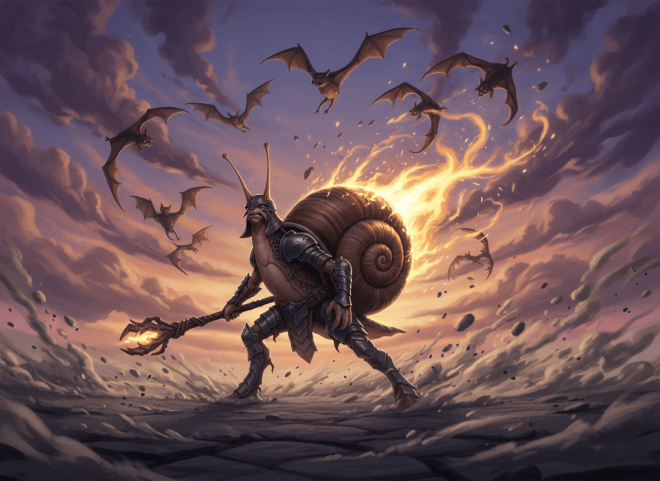
When I first asked the AI to generate images for this short story, it read the name “Snailesh” and created an anthropomorphic warrior Snail! 😁 This image is just for laughs. 😂
This article is the second part of a series of 2 where I delve into the use of “deception in the martial arts” and in conflict management in general, as can be gleaned from the life of Lord Krishna. Link to the first part is seen below. I would recommend reading the 2 parts in the chronological order, though this part can be read as a standalone post.
In part 1, I had considered in limited detail, the situations where Lord Krishna had deployed deception to manage several conflicts, both with and without the use of Maya (magic and illusions). We had looked at situations where deception and Maya as used by Lord Krishna had failed to achieve the desired outcomes and also cases where deception was used against Lord Krishna with some success. We had also looked at cases where Krishna’s use of deception had succeeded.
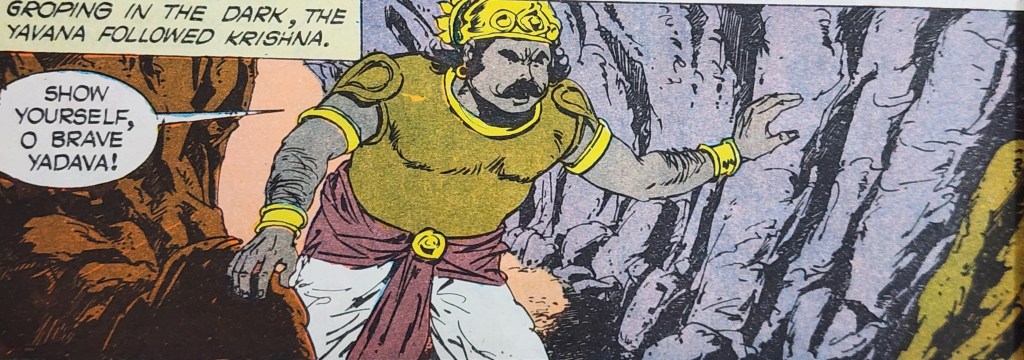
One of the situations which we looked at where deception was the key to Lord Krishna’s success was the 18th invasion of Mathura by Jarasandha, the emperor of Magadha. This invasion was accompanied by a simultaneous invasion of Mathura by Kāla Yavana. We will continue further in this article from this invasion.
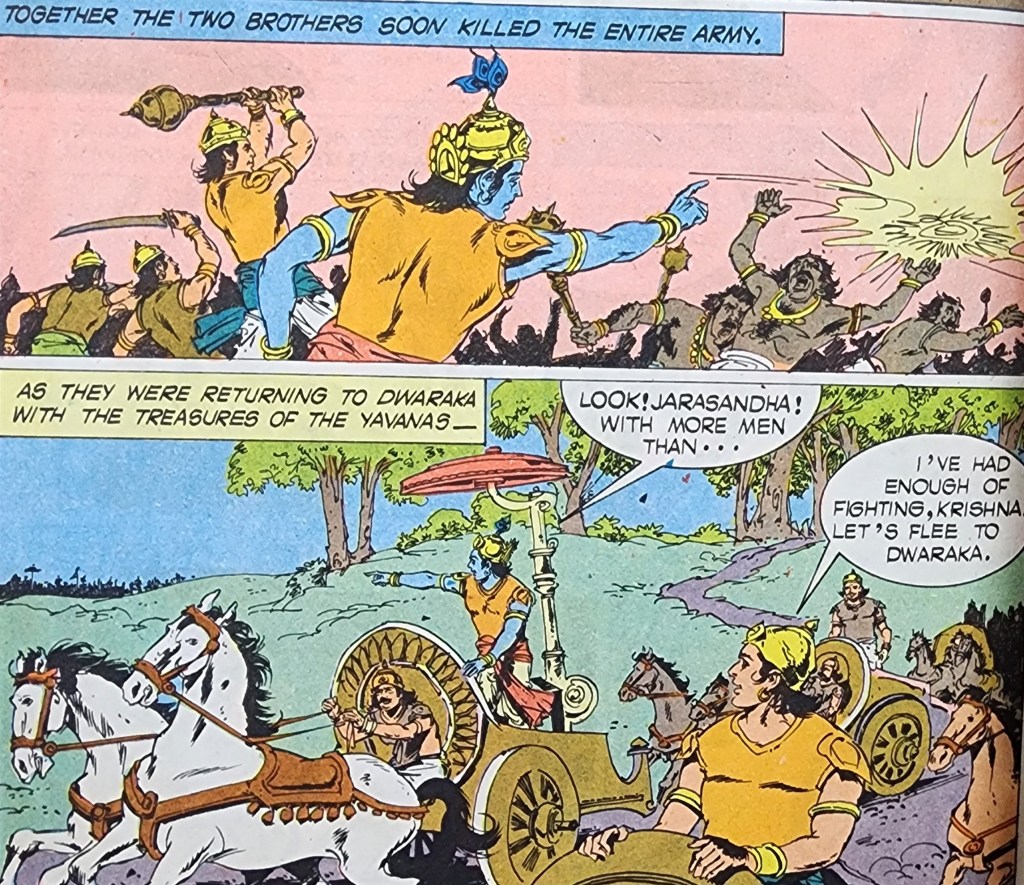
The twin invasions of Kāla Yavana and Jarasandha also led to another act of deception. While the Yavana was defeated and his army destroyed, Jarasandha was still on the war path. The forces of Mathura were exhausted and could not face a second attack. Even Balarama did not want to fight another army right away.
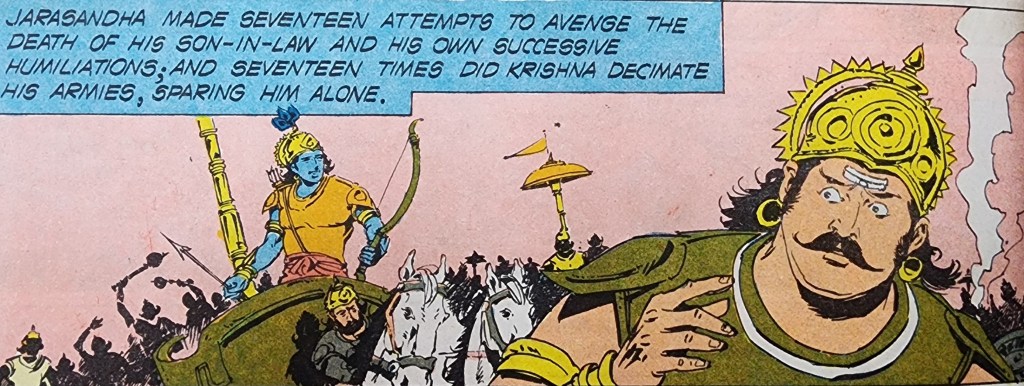
Lords Krishna and Balarama defeat the Yavana army but are exhausted to face the army of Jarasandha immediately after. Image credit – “Krishna and Jarasandha” published by Amar Chitra Katha.
This would be a situation similar to what Harold Godwinson would have faced during the twin invasions of England in late 1066. His army could overcome the Norwegian forces of Harald Hadrada but were defeated by the Norman forces of William of Normandy. Harold had to contend with the two invasions over the course of a few weeks and could not succeed.
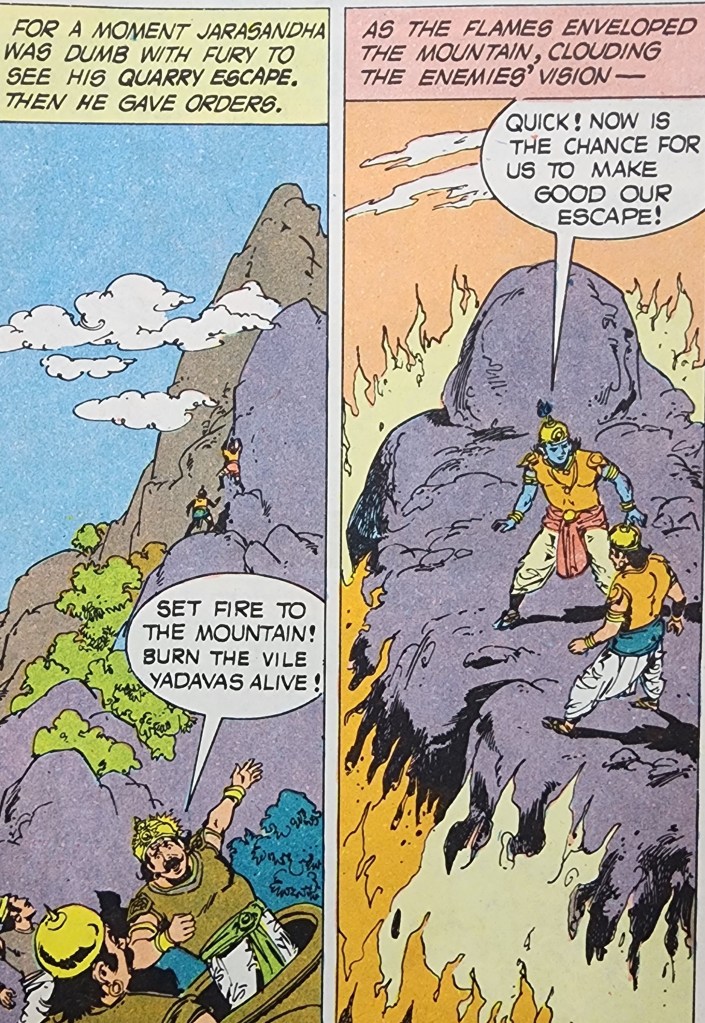
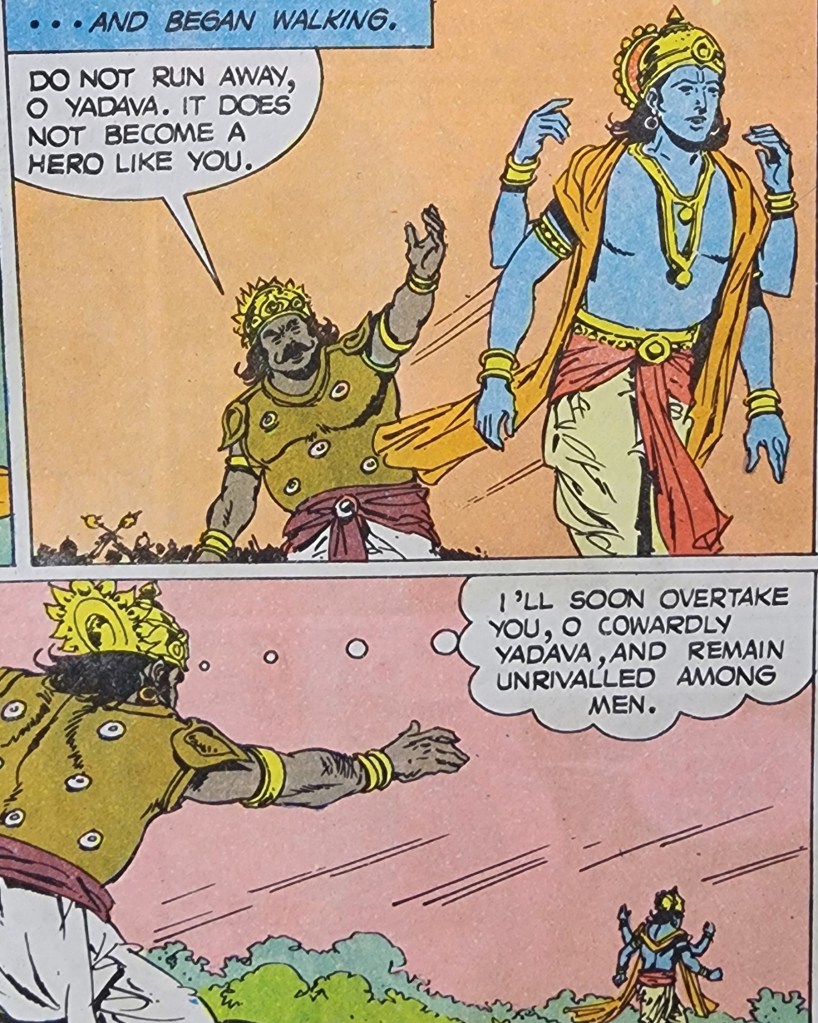
Jarasandha chases Krishna and Balarama as they retreat to Mount Pravarshana and sets fire to the mountain to kill them. Image credit – “Krishna and Jarasandha” published by Amar Chitra Katha.
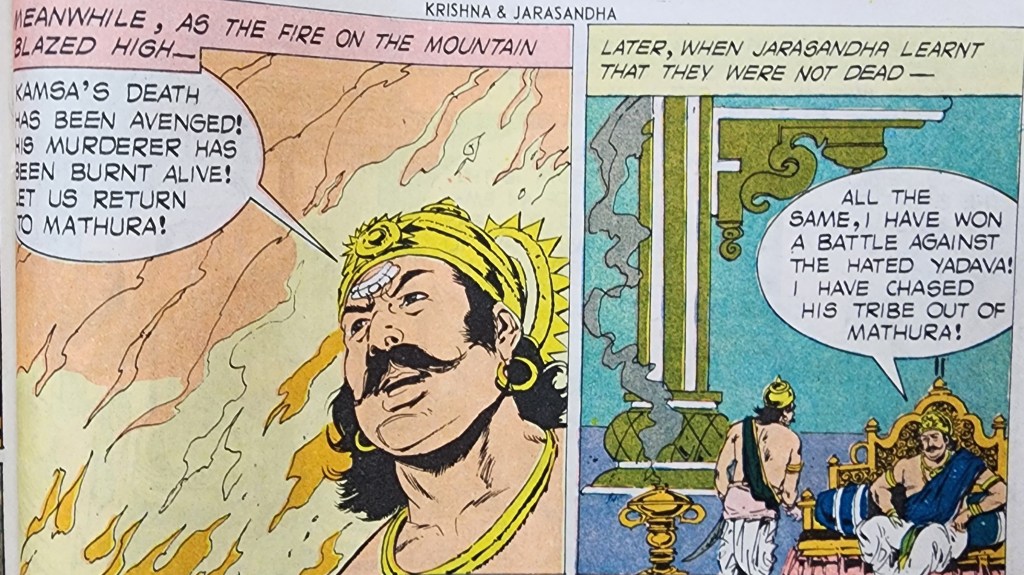
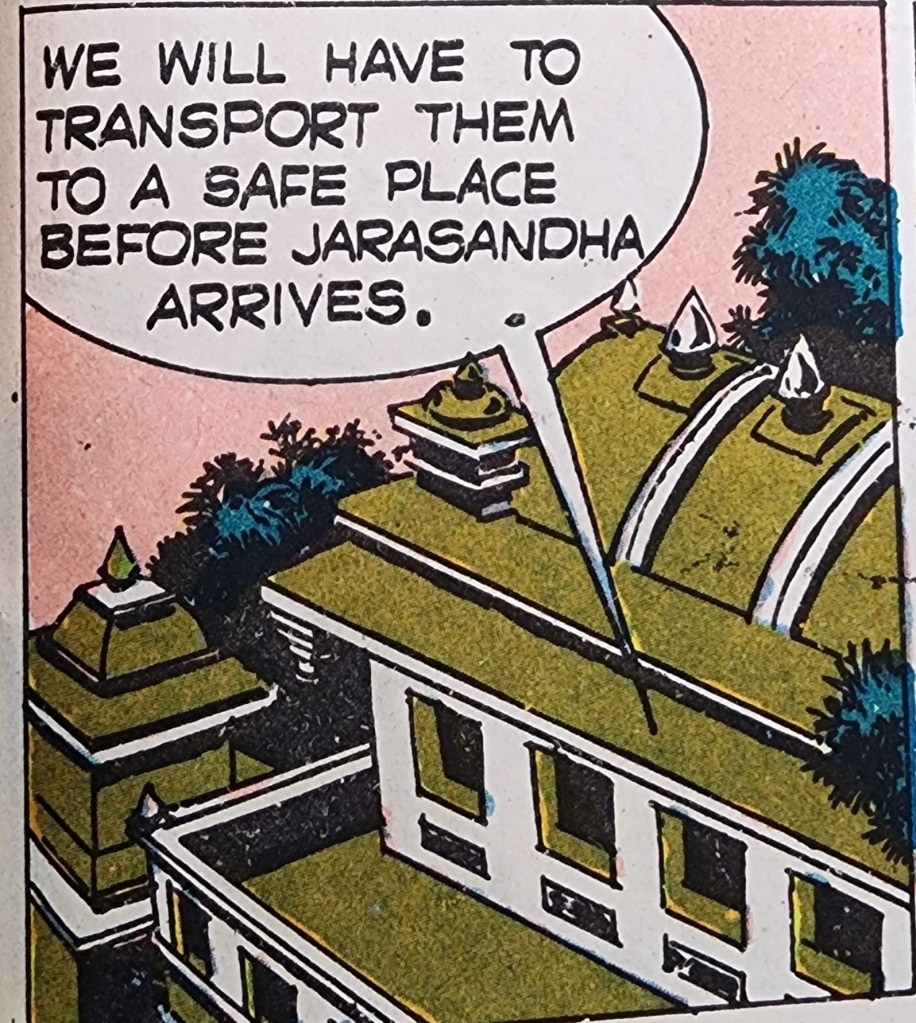
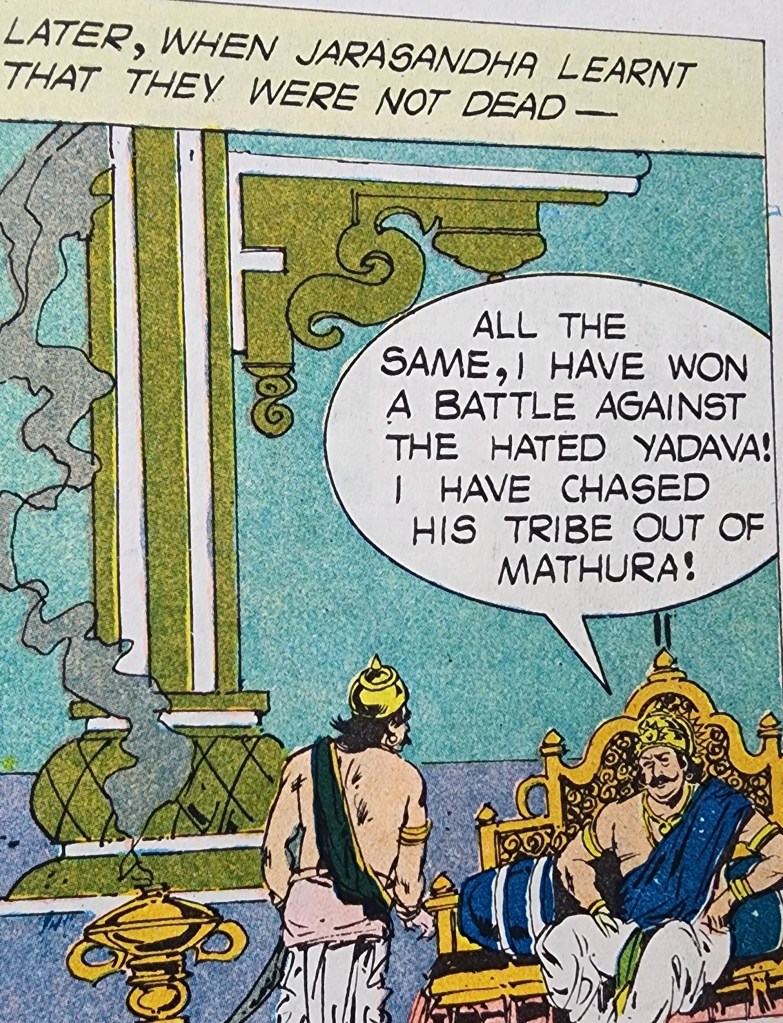
In a similar situation, the brothers Krishna and Balarama again chose escape. They retreated in the face of Jarasandha’s army, which pursued them up the mountain called Pravarshana. Assuming the brothers trapped, the army set fire to parts of the mountain. Krishna and Balarama managed a surreptitious escape, but Jarasandha believed them dead. Much later, when Jarasandha learnt that the Yadava brothers had escaped to Dwaraka, he was content with having chased them out of Mathura.
Jarasandha believes Krishna and Balarama are finished, but is satisfied at chasing them out of Mathura when he learns of his failed attempt. Image credit – “Krishna and Jarasandha” published by Amar Chitra Katha.
This bought Lord Krishna to take out Jarasandha’s vassals one by one and build alliances of his own to eventually slay Jarasandha. One of Jarasandha’s allies was the ruler of Pundra (in modern day Bangladesh) whose name was Vāsudeva. Krishna was also called Vāsudeva as his father was Vasudeva. The king or Pundra is referred to as Paundraka Vāsudeva as he was the king of Pundra. Thus, Krishna and Paundraka shared a common name.
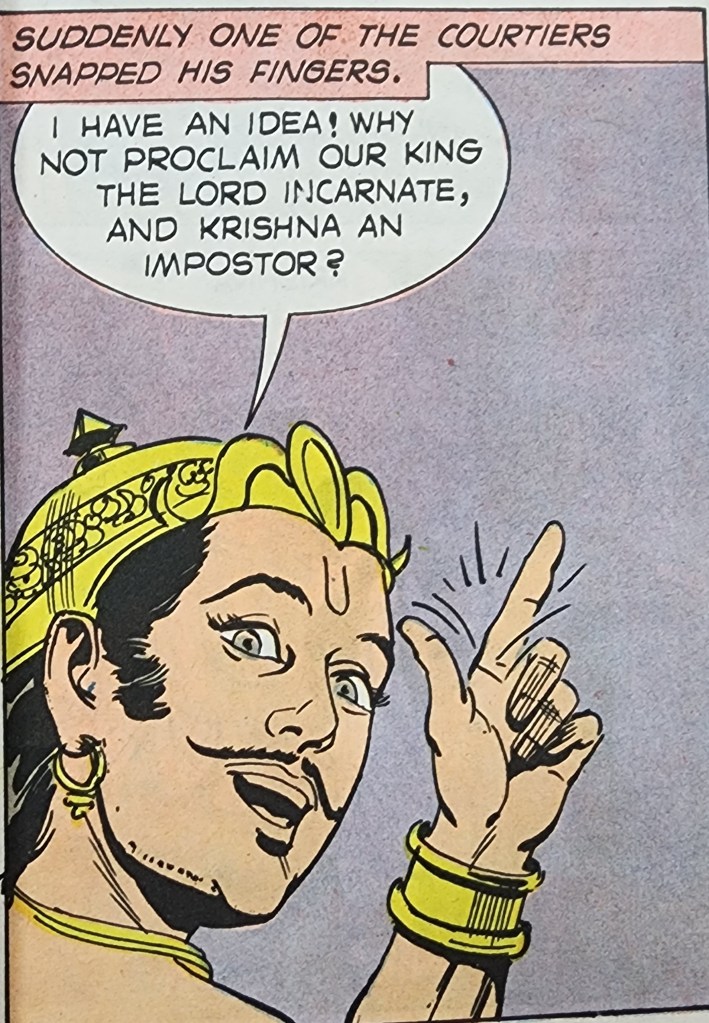
A courtier of Paundraka’s suggests that his king should proclaim himself the true incarnation of Lord Vishnu. Image credit – “Krishna and the False Vaasudeva” published by Amar Chitra Katha.
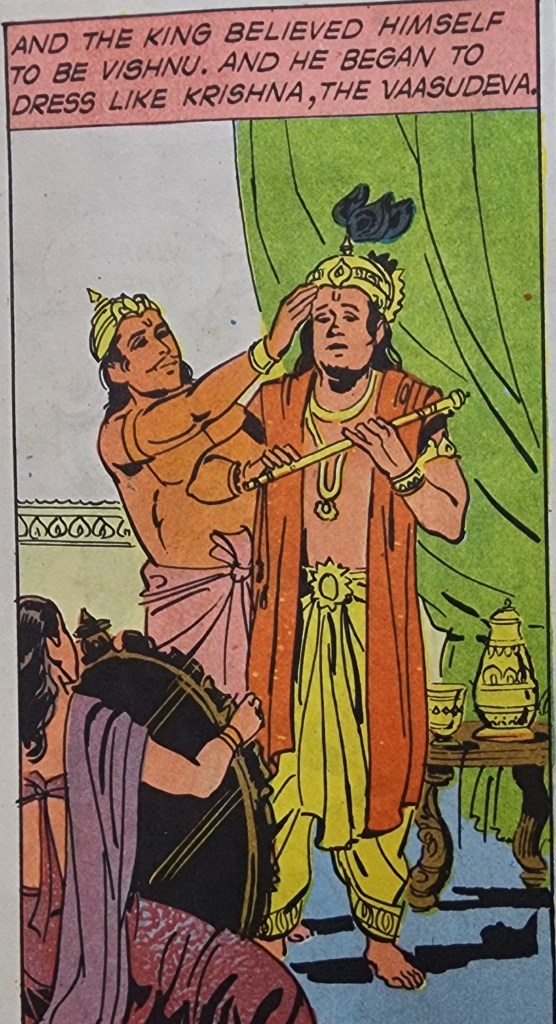
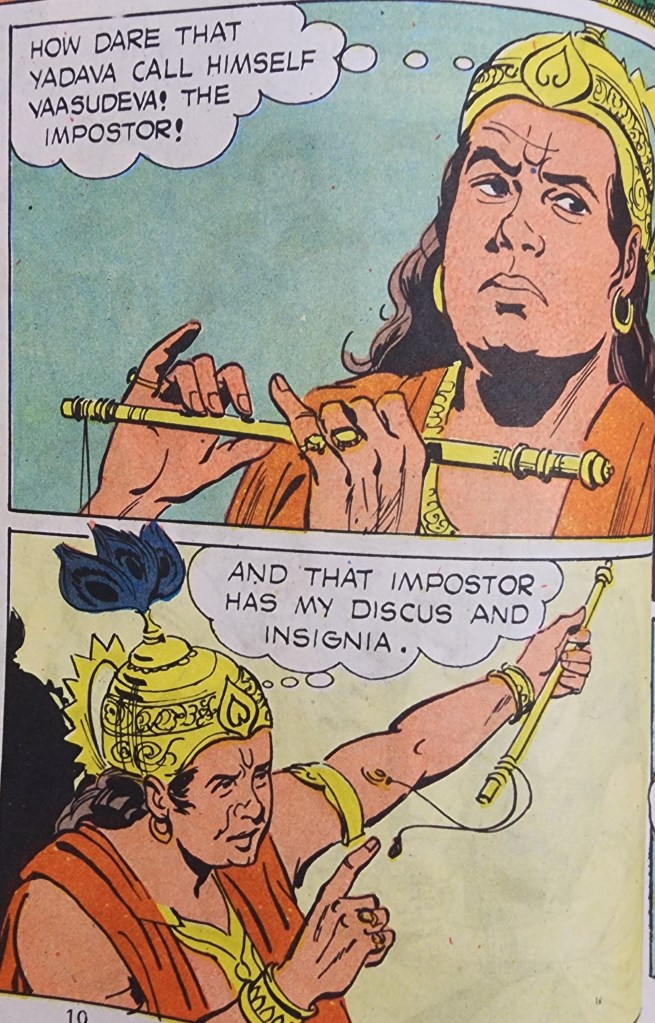
In a bizarre case of early psychological or intelligence warfare some courtiers of Paundraka convinced him to claim that he was the real Krishna! Paundraka started flaunting a peacock feather and a flute to support his claims! Some in his kingdom started believing this fiction and started worshipping Paundraka! This came to a head when Paundraka sent a messenger to Krishna asking him to handover the Sudarshana Chakra and Garuda, the divine being who was Krishna’s vāhana!
Paundraka believes himself to be the real Vaasudeva and dresses to imitate Krishna. Image credit – “Krishna and the False Vaasudeva” published by Amar Chitra Katha.
Krishna, who was in Dwaraka, acceded to the request! He agreed to come alone on Garuda and hand over the Sudarshana Chakra. The courtiers and the King of Kashi, a friend of Paundraka and another vassal of Jarasandha knew that the situation was fraught for Paundraka. But their king had started believing his own lies and waited with his own army and that of the King of Kashi.
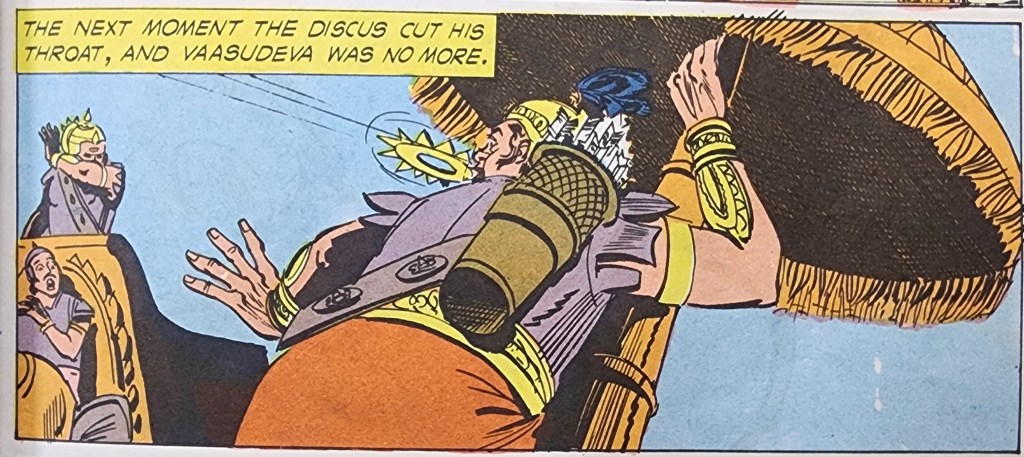
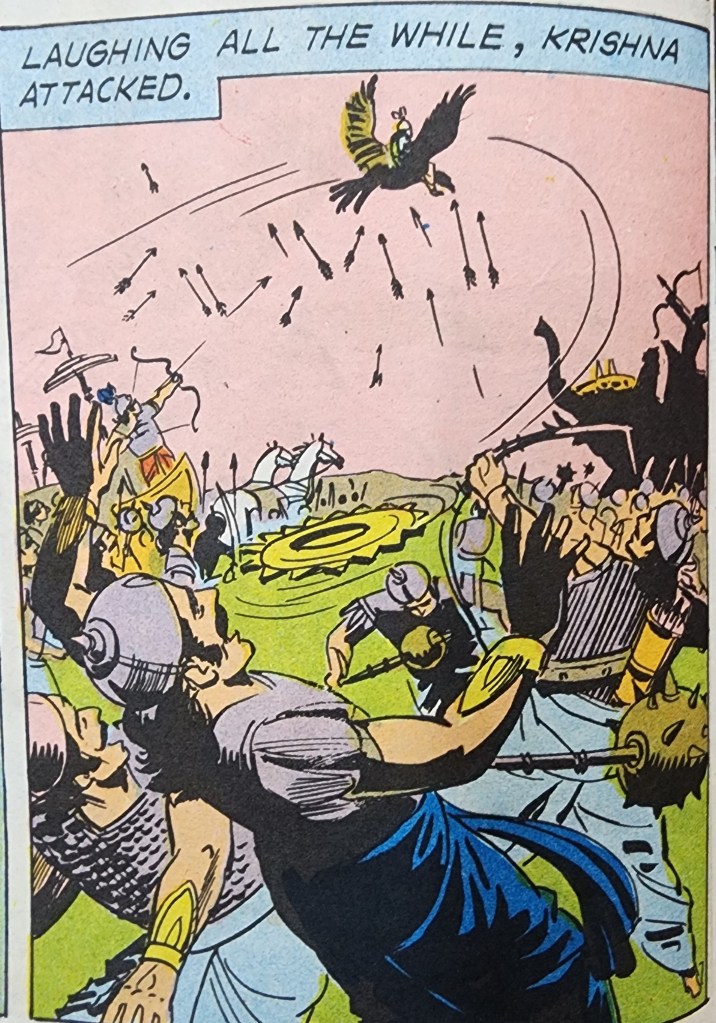
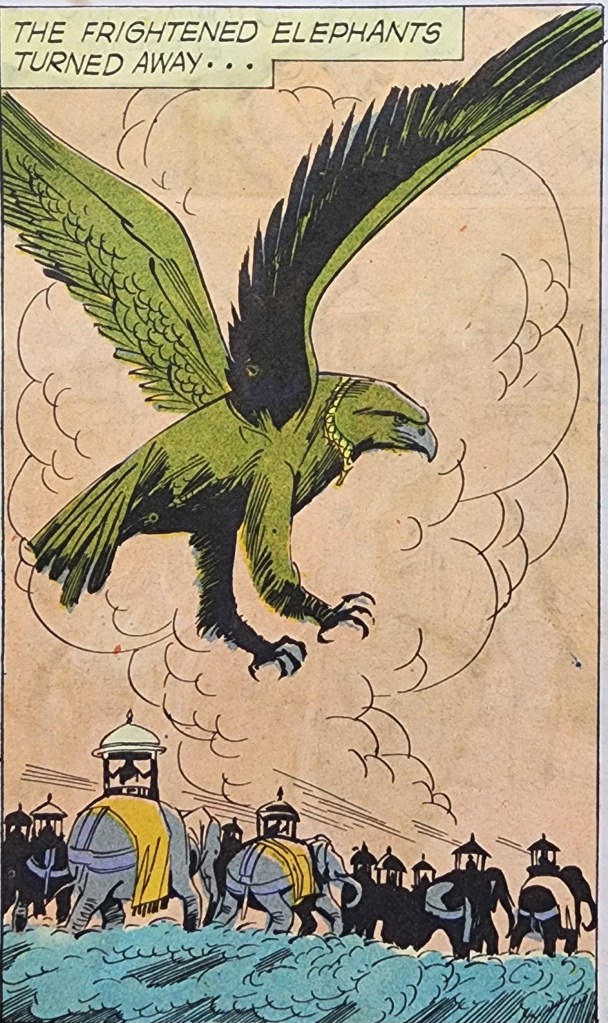
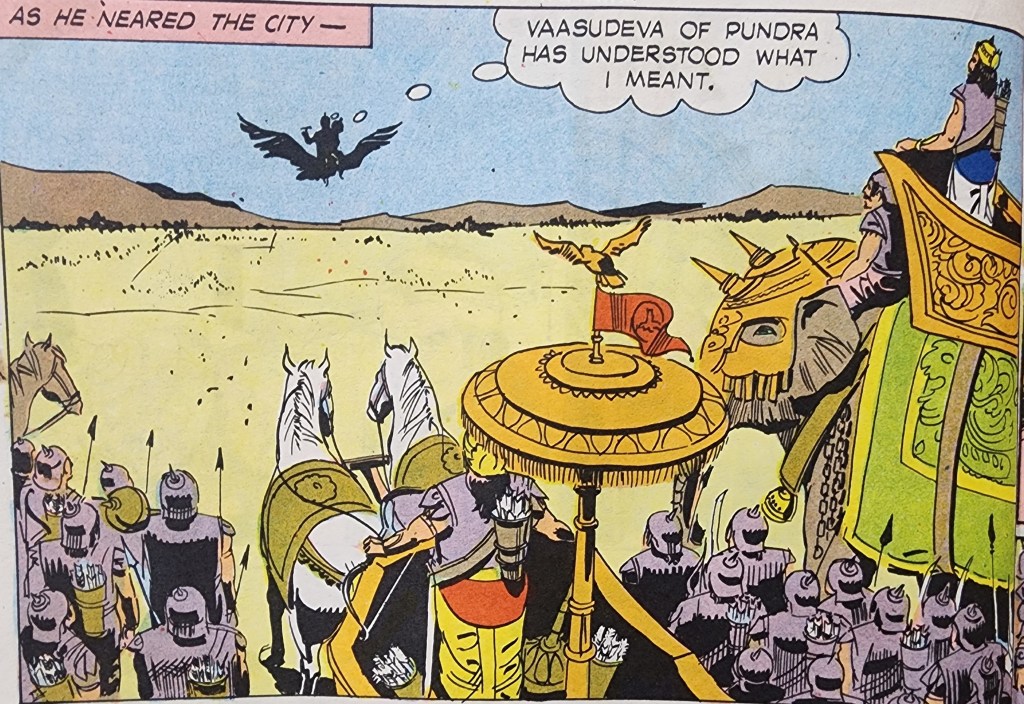
Krishna surprised (read deceived) them all by flying in on Garuda. This gave him an aerial advantage while neither of the 2 armies awaiting him on the ground had this advantage. Using this advantage, Krishna killed Paundraka with the Sudarshna Chakra and killed a large number of enemy troops. Krishna even made Paundraka drop his guard by saying he was handing over the Chakra while in reality it was discharged to kill! Paundraka foolishly hoped to catch the Chakra while it went on to behead him!
Pundraka is slain in battle by Krishna. Image credit – “Krishna and the False Vaasudeva” published by Amar Chitra Katha.
Here, Lord Krishna used deception by agreeing to submit. This was Menkyo Kaiden.He chose to receive the attack by coming alone. This was Uke Nagashi. In this case though, he did not wait for the attack, he attacked first. He chose to be Uke (attacker) rather than Tori (defender). Krishna also chose an aerial assault over a confrontation on the ground. On the ground, he would be overwhelmed with opposition numbers. This meant that he would have to bring the army along from Dwaraka. The distance between Dwaraka and Pundra, or even Kashi was large and bringing an army meant immense wasted logistics. So, he came alone. This is doing what is best in a situation. This is Issho Khemi. All of these are concepts I delved into in the previous part of this article.
The aerial aspect, where Krishna fought from the sky, brings into focus another important aspect of the martial arts. There is a concept that is regularly referred to in the Bujinkan system of martial arts called “Juppo Sessho”. This refers to fighting in 3 dimensions. While training in the dojo, there are mats on the floor and the ground is flat, most of the times. This might make practitioners lose sight of the variations in height that affect a physical conflict.
“Juppo Sessho” seeks to remedy this misconception. In reality a fight might be on a slope, on uneven ground, on a staircase, or with opponents of vastly different heights (image someone who is 5’6’ training with someone who is 6’7”). One needs to adapt their movements, postures and weapons and the forms used, depending on the terrain and variations in altitude.
This deficiency is exactly what Lord Krishna used while destroying Paundraka. He used a massive height advantage against an opponent who had no conception of what this advantage meant! Add to this the sheer stupidity of a leader and the benefit of deception, Krishna was a giant facing ants, literally!
Lord Krishna uses the advantage of an aerial attack to defeat the armies of Pundra and Kashi. Image credit – “Krishna and the False Vaasudeva” published by Amar Chitra Katha.
The advantage of height is starkly visible in modern warfare where aircraft, long range missile and drone swarms have altered the battlefields of the coming decades. The advantage of height is also very well known to every Indian even without having to consider the air force. Indian troops took the heights of Kargil back from Pakistani forces who held the heights. They had to deploy heavy artillery and fighter aircraft to nullify the height advantage.
In 2020, Indian troops carried out Operation Snow leopard during the face off against Chinese troops in Eastern Ladakh, in the aftermath of the clash at Galwan where soldiers from both sides lost their lives. Indian troops captured the heights around the Chinese positions in a rapid night operation. This forced talks and eventually calm was restored slowly, over the course of a few years. But the taking of the heights and the surprise move to attempt this was the start of the thaw between the 2 sides.
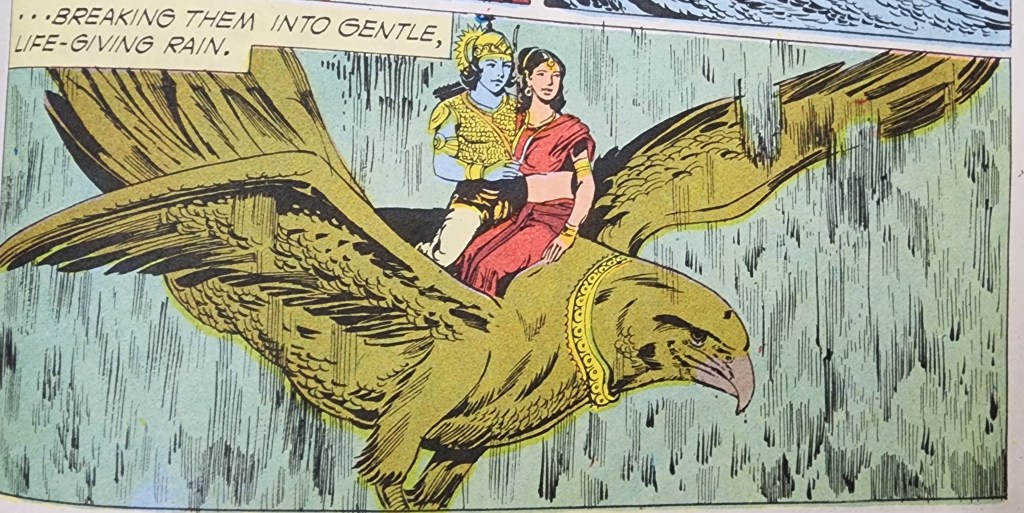
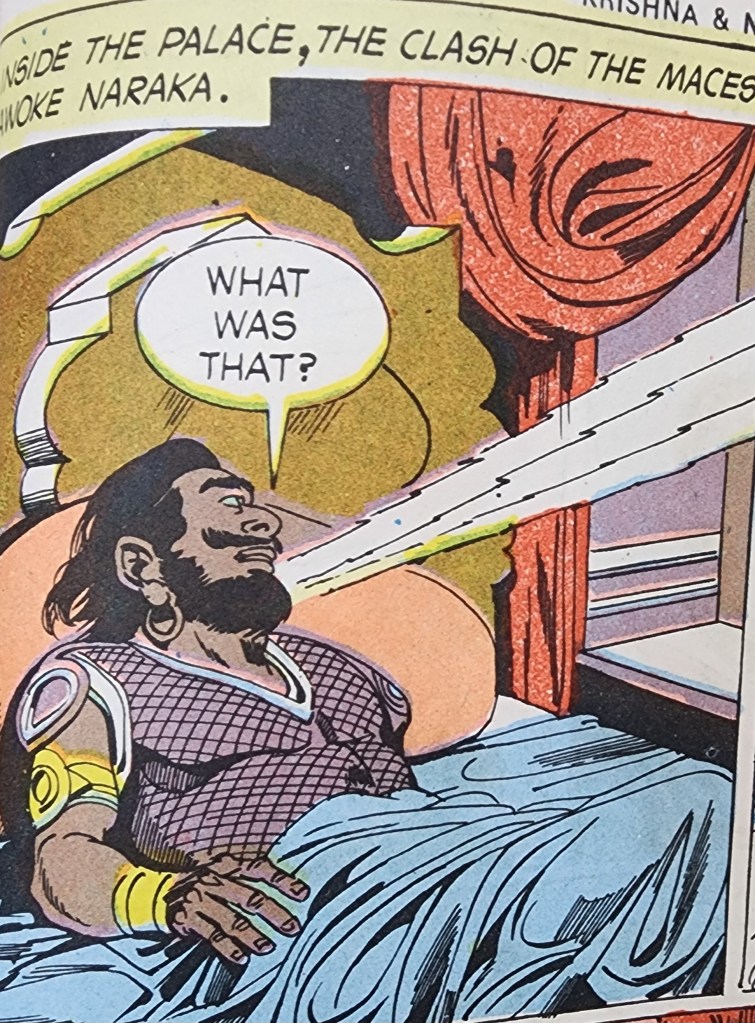
Lord Krishna used the aerial attack again when he attacked Narakāsura. This was very similar to a modern-day aerial night assault against an enemy stronghold. Krishna, with his wife Satyabhama attacked Narakāsura’s sleeping garrison. Narakāasura was also sleeping. A lot of challenges were overcome by Krishna in this attack. But the mission was a success.
Garuda fights Naraka’s army from the air. Image credit – “Krishna and Narakasura” published by Amar Chitra Katha.
The surprise attack killed Naraka. The distance between Dwaraka and Pragjyothispura (likely modern-day Assam) was great, and this also prevented the costly and time-consuming logistics of marching an army across the lands of multiple enemies! I have explored this attack in greater detail in a separate article, the link to which is seen below.
In the events following the defeat of Paundraka Vāsudeva, Krishna also killed both the King of Kashi and his successor Sudakshina. This eliminated two powerful allies of Jarasandha. Two other powerful allies of Jarasandha were Shishupāla, the ruler of Chedi and Salva, the King of Saubha. One other potential ally of Jarasandha was Vidarbha. Events that occurred in Vidarbha post the Yadava migration to Dwaraka precipitated the slaying of Paundraka and the king of Kashi.
Vidarbha was neutral. But the crown prince of Vidarbha, Rukmi wanted to ally with Jarasandha. So, he wanted his sister Rukmini to marry Shishupāla, who was also an ally of Jarasandha’s. Fortunately for the Yadavas at Dwaraka, Rukmini was in love with Lord Krishna who reciprocated her feelings. The king of Vidarbha, Bhishmaka was not certain about an alliance with Jarasandha and was quite happy to see his daughter wed Krishna. This created an opportunity for Lord Krishna to once again demonstrate his consummate use of deception.
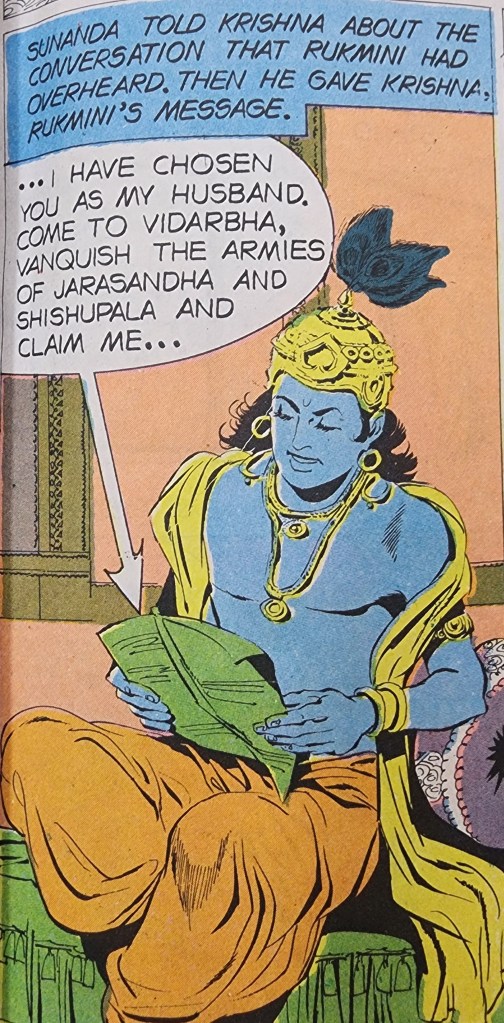
Rukmini plans her own abduction in a letter to Krishna. Image credit – “Krishna and Rukmini” published by Amar Chitra Katha.
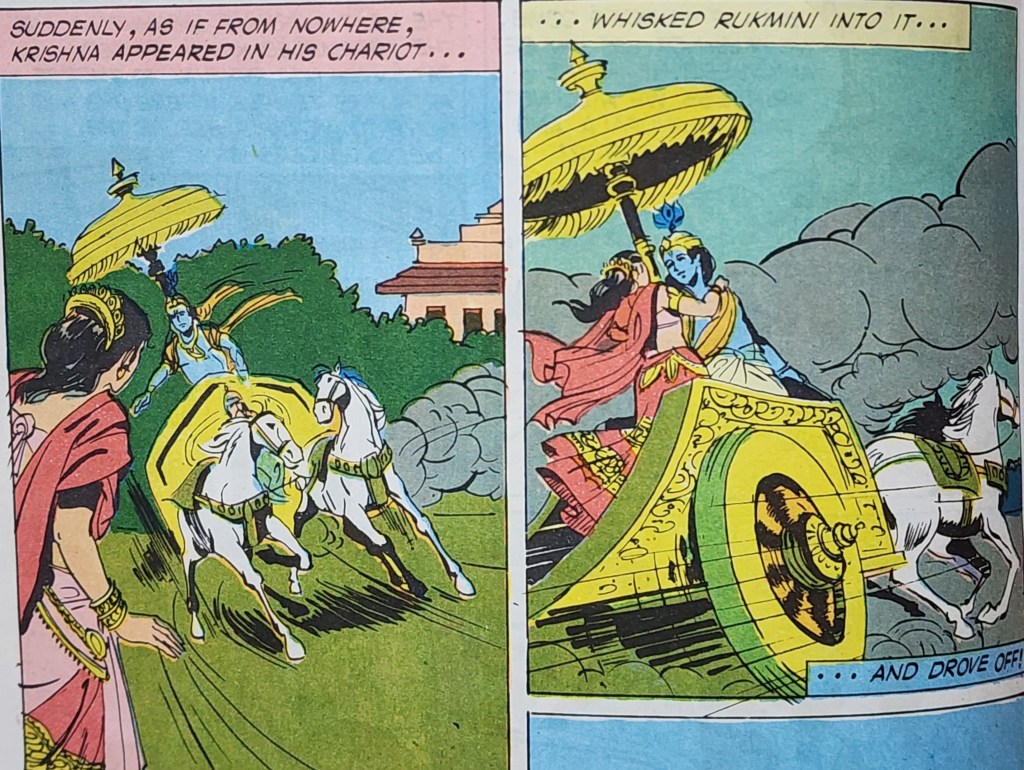
Rukmi could convince his father to get Rukmini married to Shishupala. Jarasandha and his allied kings arrived in Vidarbha with their armies as guests, and to prevent any machinations by Krishna. Krishna & Balarama too arrived in Vidarbha with some troops as guests at the wedding. But Krishna abducted Rukmini and escaped to Dwaraka where they were married. Balarama and his troops fought a rearguard action to help Krishna escape.
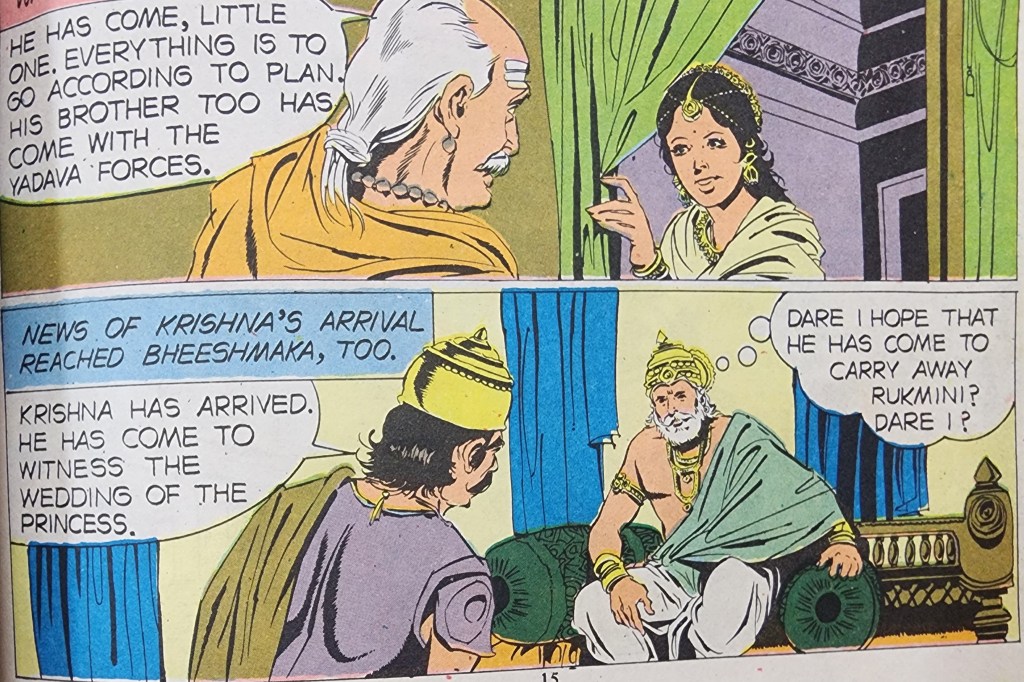
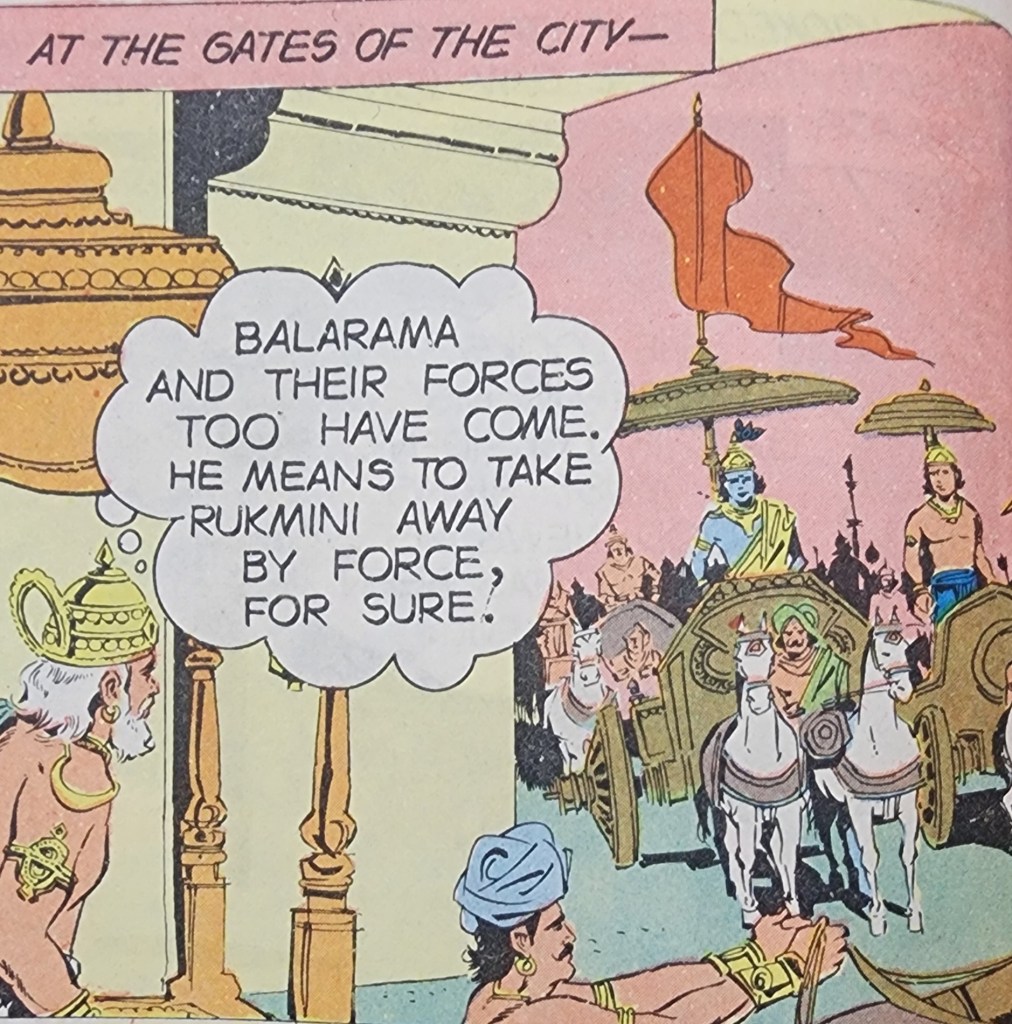
Krishna arrives in peace to attend Rukmini’s wedding. Image credit – “Krishna and Rukmini” published by Amar Chitra Katha.
Of course, the entire abduction was enabled by the actions of Rukmini herself with the tacit support of her father Bhismaka. Rukmini revealed her location and activities that enabled Krishna plan the abduction. Bhishmaka also shared information that helped the Yadava brothers plan their actions. It was more an abduction enacted by Rukmini than anyone else. But Krishna did use his status as a guest at a wedding to achieve his goal. He did deceive the bridegroom and all the other guests!
Bhishmaka helps with the abduction of Rukmini. Image credit – “Krishna and Rukmini” published by Amar Chitra Katha.
This deception is what got Paundraka to attempt usurping Krishna’s divine reputation. He was so depressed with the continued success of the Yadavas in general and Krishna in particular, that his courtiers sold him the lie of his own fake divinity. This in turn led to the events I described earlier in this article.
Krishna abducts Rukmini. Image credit – “Krishna and Rukmini” published by Amar Chitra Katha.
Krishna used the status of being a guest to eliminate the last of the allies of Jarasandha. Of course, this happened after Jarasandha himself had been slain by the Pandava Bheema. Yudishtira was performing the Rajasooya Yajna. This was to achieve the title of Chakravarthy for himself. Both Krishna & Shishupala were guests at the final event of the Yajna.
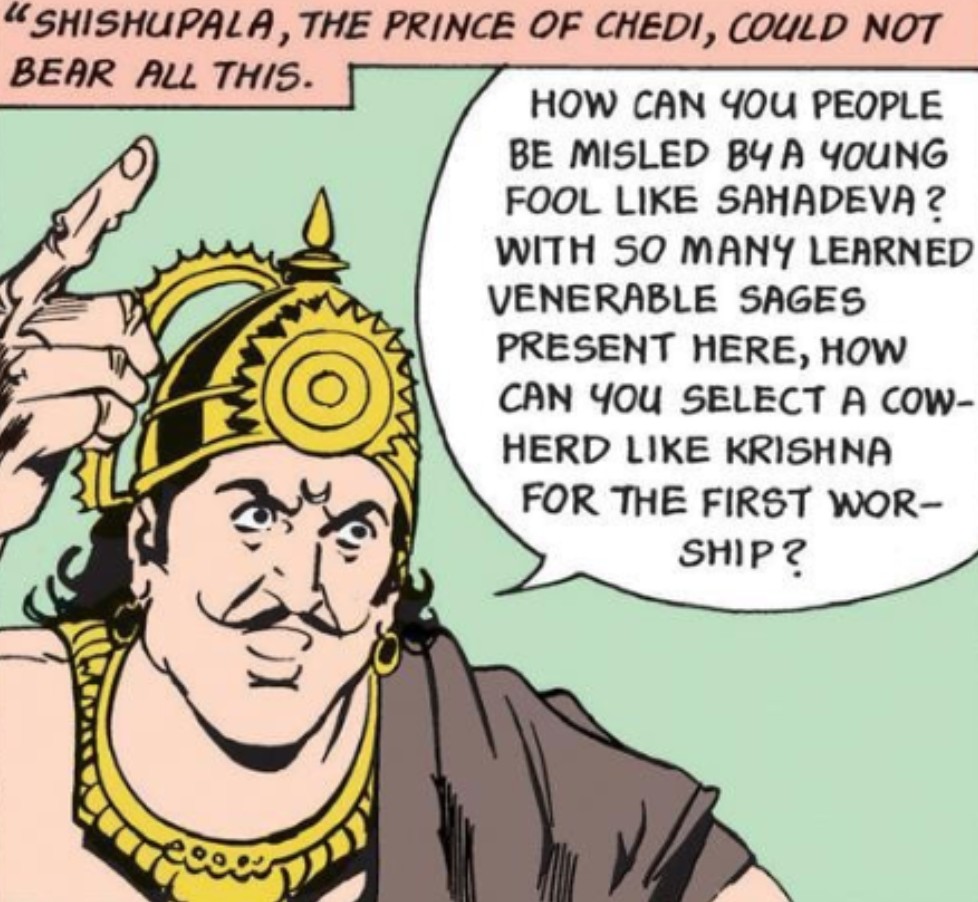
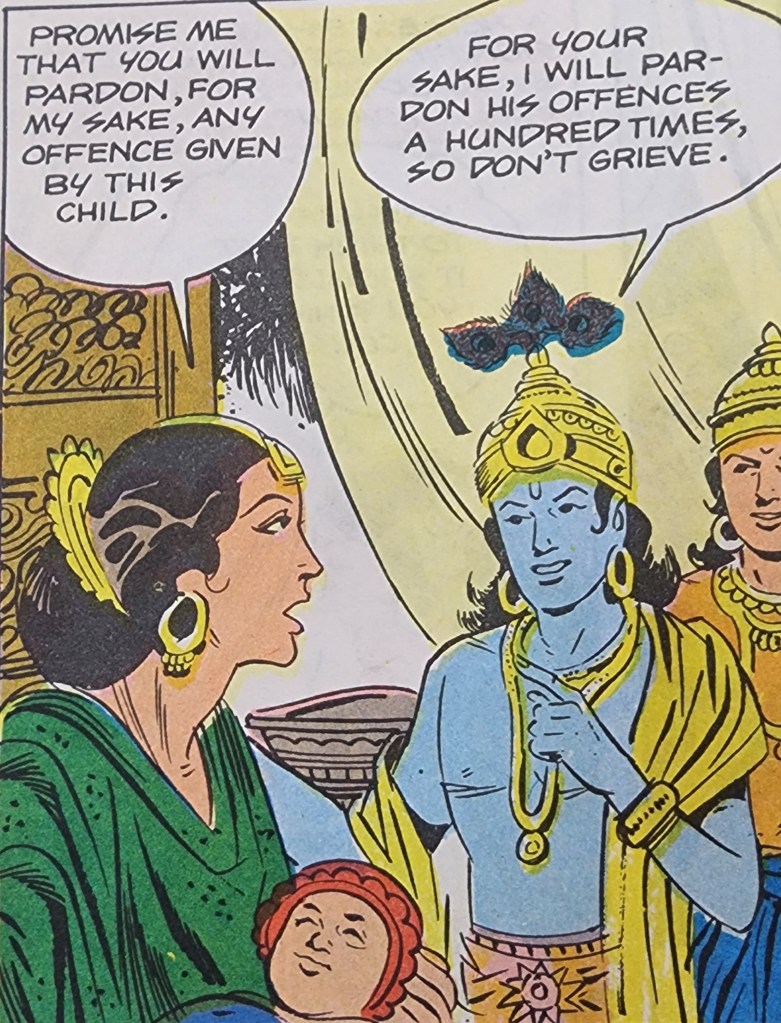
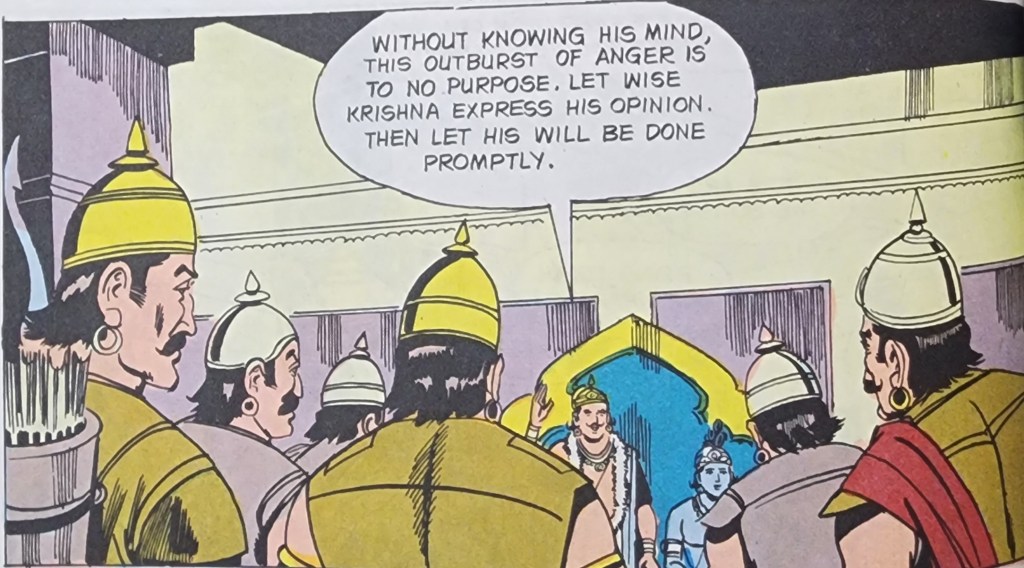
Krishna was selected as the person to receive the first honours among all the assembled kings, lords, elders and sages. Shishupala was infuriated at this choice and insulted Krishna a whole lot. Krishna forgave 100 insults according to a promise he had made to Shishupala’s mother. When this limit was crossed, he beheaded Shishupala with the Sudarshana Chakra.
Shishipala insults Krishna at Yudishtira’s Rajasooya Yajna. Image credit – “Krishna – An ally of the Pandavas” (Kindle version) published by Amar Chitra Katha.
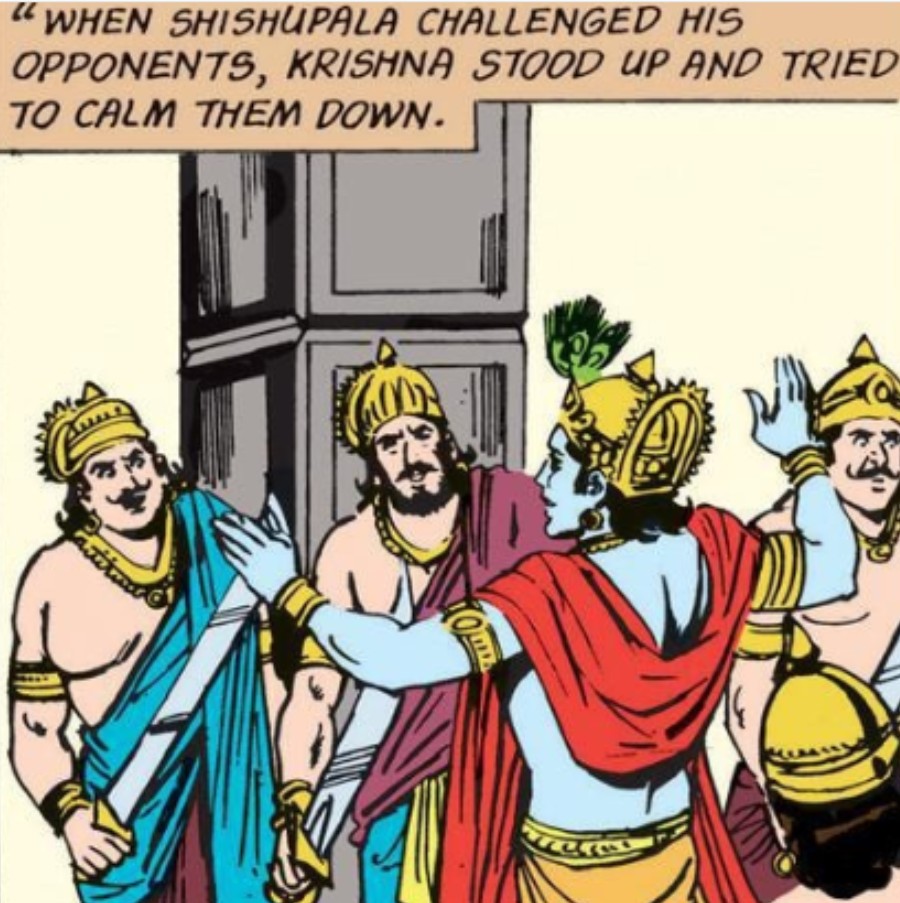
Krishna killed an unarmed Shishupala in a pious assembly and not on a battlefield. Observe this; Krishna was a master in the use of the chakra (discus). This is a small weapon that is easily concealed, unlike swords, maces and other sidearms. Of course, Krishna is supposed to have been able to summon the Sudarshana Chakra at will without having to carry it around. But even if this magical aspect is ignored, the discus would be a weapon of choice in this situation due to its size and concealability.
Shishupala challenges Krishna. Image credit – “Krishna – An ally of the Pandavas” (Kindle version) published by Amar Chitra Katha.
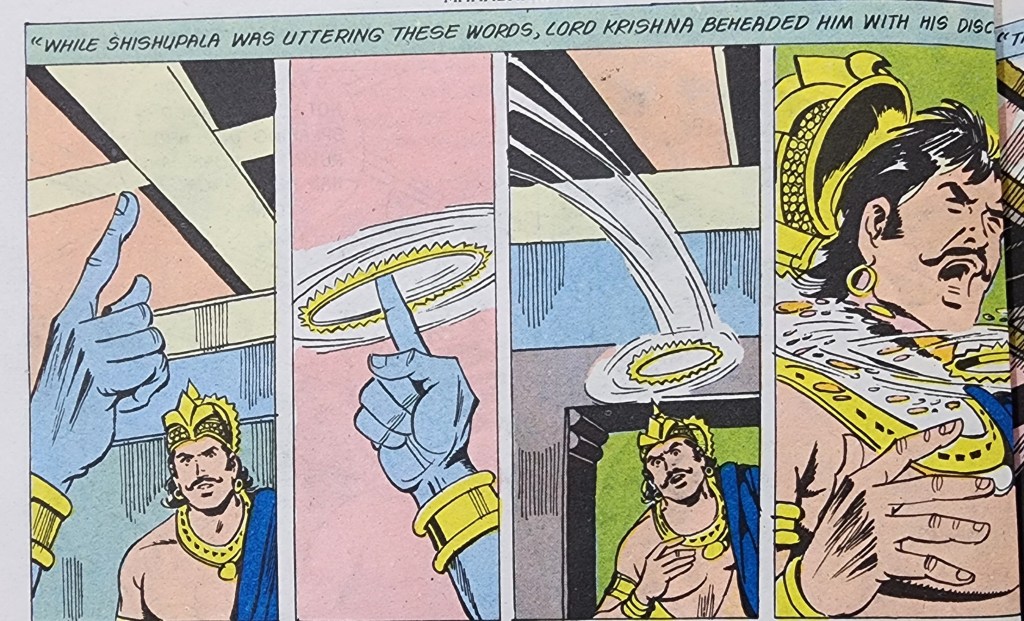
Also, Krishna did choose to accept the challenge to a duel that Shishupala threw at him in the assembly. He simply shocked Shishupala and the others in the assembly with his quick action. This was the use of surprise and deception at its best!
Shishupala is beheaded by Krishna. Image credit – “Mahabharata 17 – Yudishtira’s Rajasooya Yajna” published by Amar Chitra Katha.
In the Bujinkan, we study a concept called “Kakushi Buki”. This translates as “hidden weapons”. In my personal opinion, the discus, given its properties and dimensions, was a hidden weapon that Krishna deployed to sort out the problem of Shishupala, when he least expected it! He had thus eliminated the last of Jarasandha’s allies. The death of Shishupala resulted in the battle against Salva, the King of Saubha, which was described in part 1 of this set of 2 articles.
In the events that led to the slaying of Shishupala, it must be noted that Shishupala was doing a lot of talking, as were a lot of others in the assembly, including Lord Krishna. But Krishna was the only one who deployed a weapon. An exact reverse of this happened earlier in Krishna’s life, when he used just words to pervert others from using their weapons. We will look at this next.
The reasons Krishna was revered by the Pandavas were manifold. One of these reasons would be his contribution to their defeat of Jarasandha. The other would be that the Yadavas and Pandavas had a matrimonial alliance (apart from Krishna being a cousin of Kunti’s (the mother of the Pandavas)). Arjuna had married Subhadra, Krishna’s sister. This occurred before the Jarasandha was killed.
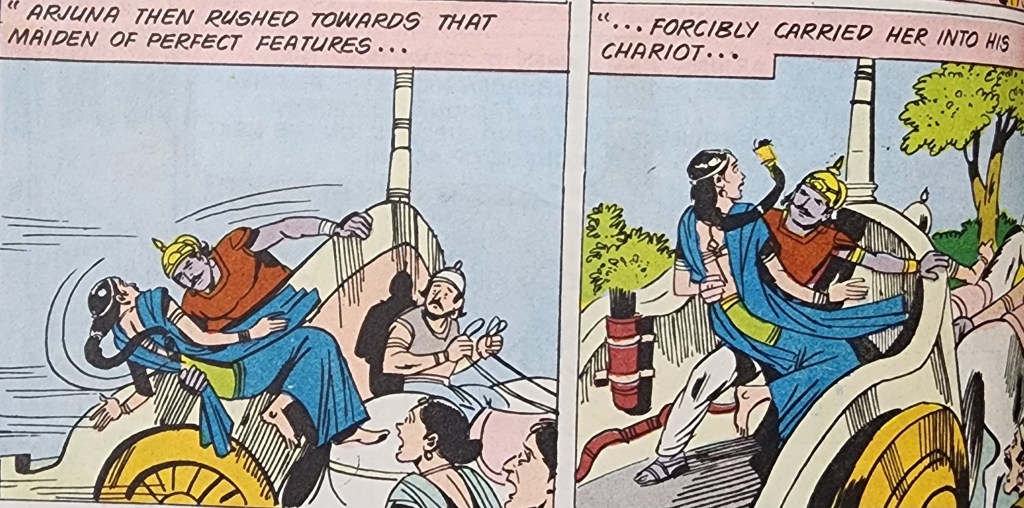
Arjuna was on exile from Indraprashta and on a pilgrimage across the lands of Bharata. His last stop was Dwaraka, where he fell in love with Subadhra, the sister of Lords Krishna and Balarama. The feeling was reciprocated by Subadhra. It is said in some stories that Balarama wanted Subadhra to marry Duryodhana. To prevent this, Krishna suggested to Arjuna that he should abduct Subadhra.
Rishi Vaishampaya narrating to King Janamejaya how Krishna instructed Arjuna to abduct Subadhra. Image credit – “Mahabharata – 14, Arjuna’s 12 year exile”, published by Amar Chitra Katha.
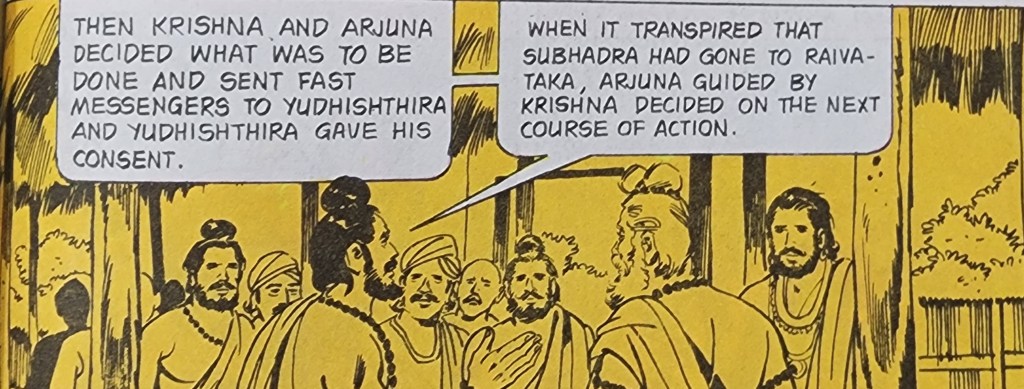
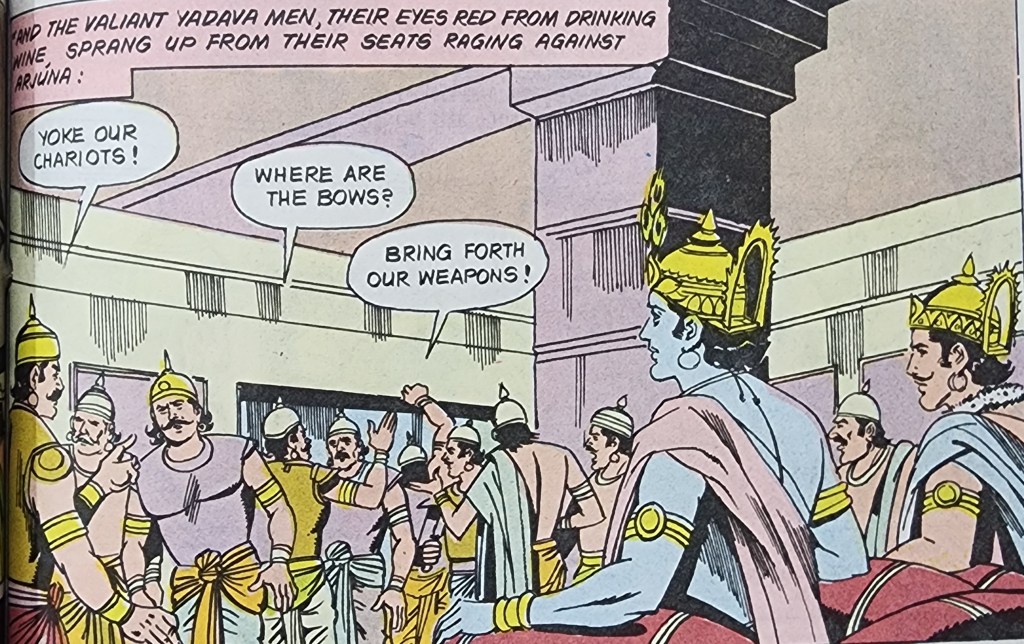
After Arjuna abducted Subadhra, the Yadavas, including Balarama were on the warpath. They wanted to defeat and punish Arjuna. But Krishna talked them out of it in an assembly meant to plan the offensive against Arjuna. In this assembly, while the Yadavas were arming themselves, Krishna used his words to prevent any war-like situation.
Arjuna abducts Subadhra. Image credit – “Mahabharata – 14, Arjuna’s 12 year exile”, published by Amar Chitra Katha.
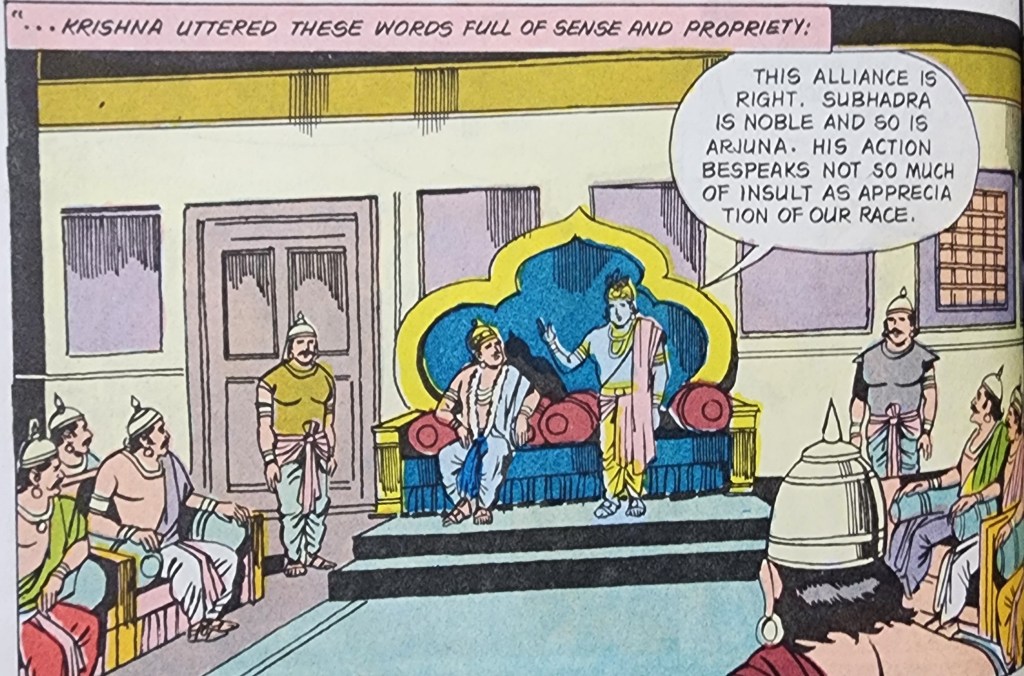
He compared Arjuna’s actions to those of his own vis-a-vis Rukmini. He also convinced the assembly that this was the best alliance possible. Of course, this alliance set the pieces needed for Krishna to destroy Jarasandha for good. Here again Krishna was using surprise to his advantage. In an assembly meant to plan a war, he shocked everyone by saying they were in the wrong and got his way. 😊
Yadavas on the warpath. Image credit – “Mahabharata – 14, Arjuna’s 12 year exile”, published by Amar Chitra Katha.
This event with Subadhra and Arjuna is an exact reverse of the events that led to Shisupala’s death. Here Krishna used words to get the Yadavas to drop their arms, while at the Rajasooya Yajna, Shishupala and everyone else was doing the talking while Krishna used arms! Krishna’s use of words to win over a situation leads to some interesting observations, which we will look at a little later in this post.
Krishna calms the Yadavas. Image credit – “Mahabharata – 14, Arjuna’s 12 year exile”, published by Amar Chitra Katha.
Similarly, Arjuna’s abduction of Subadhra is an application of deceptive means against the people of Dwaraka. Arjuna was a guest at Dwaraka and he deceived his hosts, with the help of the same people of course (namely Subadhra and Krishna). This is the same means used by Krishna against the people of Vidarbha, where he was a guest and abducted Rukmini as described earlier in this article. Krishna was thus party to deceiving his own people as he initiated the entire abduction of Subadhra!
The Yadava assembly which Krishna calmed was essentially a debate on the next course of action. Krishna’s contrarian view was a shock that won the day. I had mentioned in the first part of this series that I consider surprising an opponent to be the same as deceiving one, for in both cases, the opponent is put on the back foot.
Debates in ancient India all the way till at least the 16th century carried real consequences. The outcome of debates caused social and religious changes in society. It is said that Ramanujachārya’s victory in a debate led to a large number of the populace of the Hoysala kingdom to convert from Jaininsm to Hinduism (Vaishnavism specifically) in the 12th century CE.
Even if not all debates had such consequences, the reputational gain or loss for a court was considerable, as were the economic rewards for those involved in the debates. The story of how Tenali Rama won a debate for the court of Krishnadevaraya, the king of the Vijayanagara kingdom in the 16th century, is well known to a lot of us.
I had written an entire article dedicated to the use of deception in debates a couple of years ago. I am sharing a link below to that article. This use of deception in a debate is applicable to this day when we have meetings at work and in the corporate world, where the choice of words and the spin of narratives drive the movement of money and business outcomes. The same is true in the political arena, as we live in a world where narratives on legacy and social media move the fate of nations (read civilizations) and societies.
Krishna’s actions in ensuring a matrimonial alliance with the Pandavas gave him access to the most potent weapon against Jarasandha, Bheema, the second Pandava known for his physical prowess. Bheema was one of the few in that era who could take on Jarasandha in single combat. This set in motion the events that led to Jarasandha’s downfall at long last.
As mentioned earlier, Yudishtira, to perform the Rajasooya Yajna, needed to defeat Jarasandha. But leading an army against Jarasandha was almost impossible, even with the defeat of allies like Paundraka and the rulers of Kashi. So, Krishna again resorted to an act of deception. He travelled to Girivraja, the capital of Magadha with only Arjuna and Bheema as companions. They travelled disguised as brahmanas.
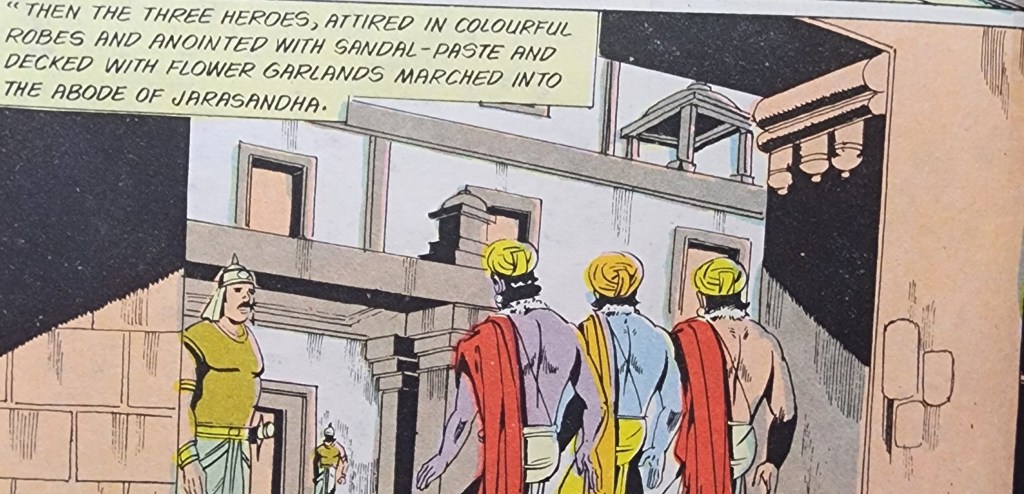
Krishna, Bhima and Arjuna disguised as brahmanas as they enter Jarasandha’s capital unmolested. Image credit – “Mahabharata – 16, The Pandavas conquer the World”, published by Amar Chitra Katha.
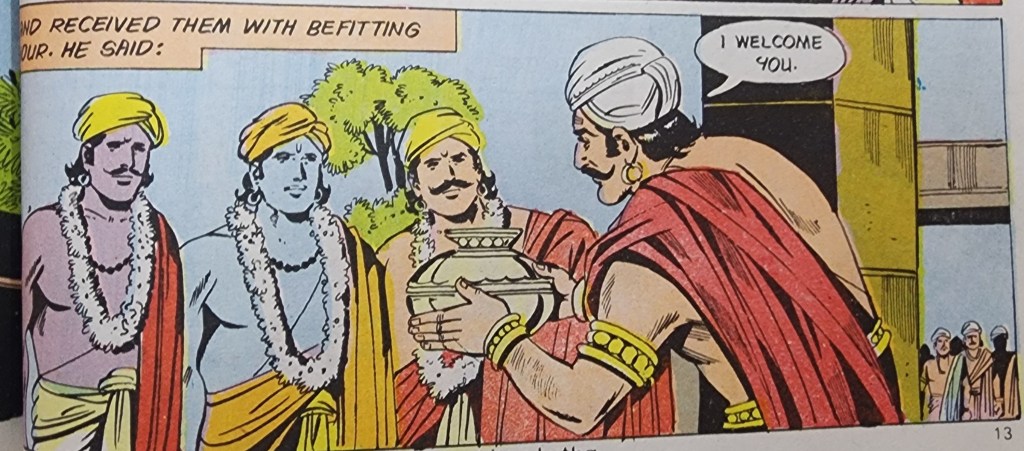
The brahmana disguise gave them an audience with the emperor Jarasandha who agreed to grant them their wish. He did this despite doubting the authenticity of the visitors being brahmanas. The confidence of Jarasandha in his own abilities and that of his forces was absolute, he had no concern for his safety and never even considered the possibility of defeat.
Jarasandha welcomes the 3 disguised heroes. Image credit – “Mahabharata – 16, The Pandavas conquer the World”, published by Amar Chitra Katha.
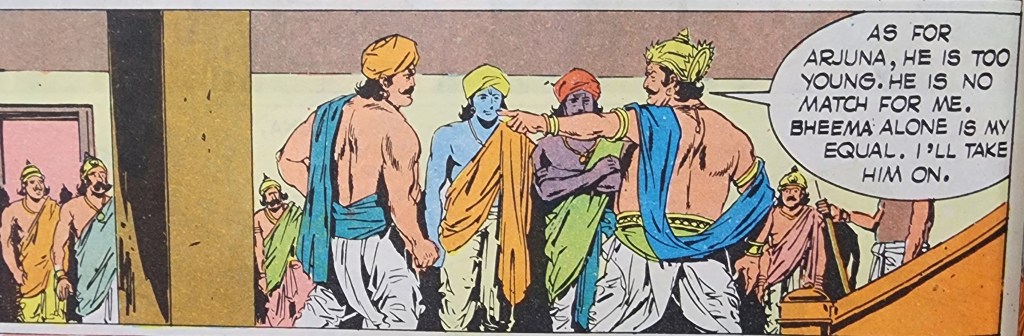
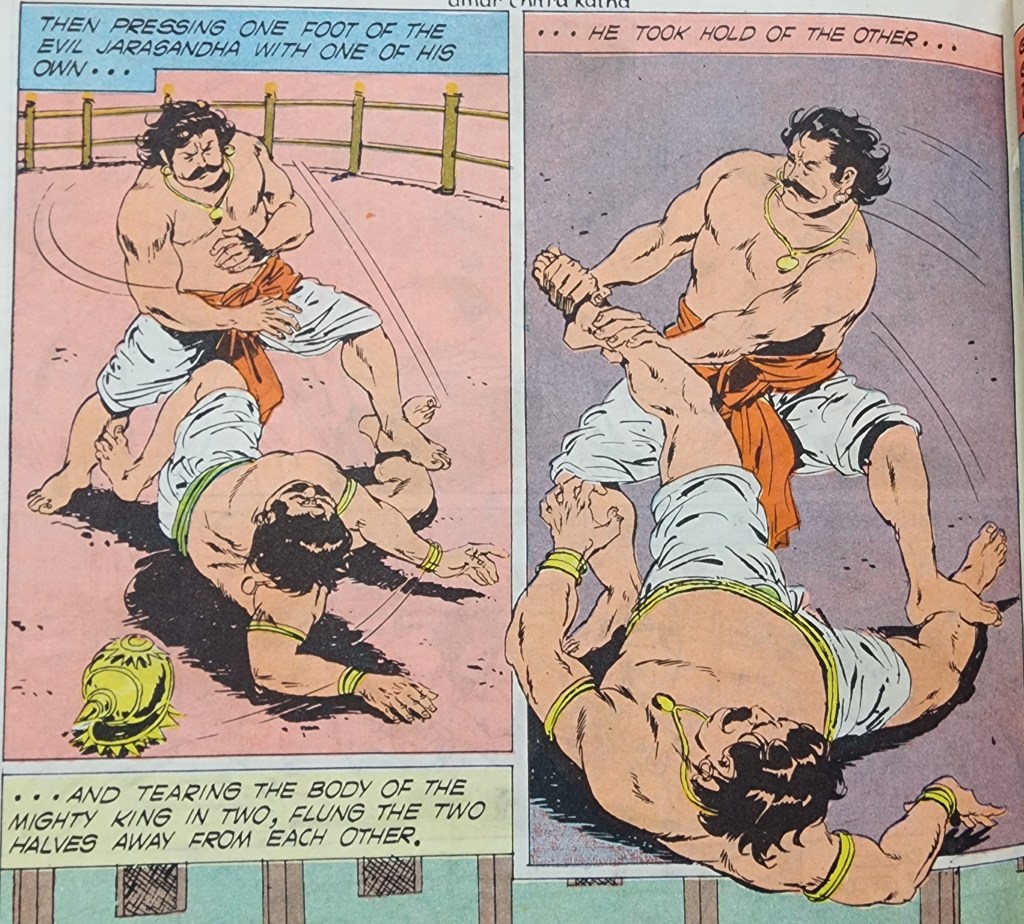
Krishna asked Jarasandha to take on one of the 3 in single combat. Jarasandha, in his supreme confidence, or perhaps arrogance, chose Bheema, the toughest opponent, even though Arjuna and Krishna were no pushovers in the art of the duel. The duel between Bheema and Jarasandha lasted days! I read in one version that it lasted 28 days and in another that it lasted 15. Either way, Bheema killed Jarasandha in the end.
Jarasandha chooses Bheema as his opponent. Image credit – “Krishna and Jarasandha” published by Amar Chitra Katha.
Krishna had used disguises to stop anyone preventing their access to Jarasandha. He had then used his knowledge of Jarasandha’s hubris to ensure that he would face off against Bheema, the one person who could defeat him. This also prevented Jarasandha’s powerful armies from getting involved and protecting the emperor.
Bheema kills Jarasandha. Image credit – “Krishna and Jarasandha” published by Amar Chitra Katha.
There are quite a few parts of the stories relating to Lord Krishna where Maya or magic is involved, situations where he can achieve things due to his divine nature. This includes the use of the divine Sudarshana Chakra and the presence of Garuda, the divine bird-like entity. But some of the actions carried out by him are simply those of an extremely capable human. These actions point to someone who is always mindful of a situation, aware of all necessary information and is a keen observer of human nature. He was also someone who believed in action and improvisation, not analysis paralysis.
Let us consider these aspects without the need for magic or anything beyond human.
When Krishna & Balarama used Mount Pravarshana to avoid fighting Jarasandha and ended up making him believe they were dead, it was knowledge of the terrain, not Maya at play.
When Krishna agreed to surrender the Garuda and Sudarshana Chakra to Paundraka, it was awareness of the character of Paundraka, not magic.
When Krishna abducted Rukmini, it was an awareness of the political machinations at play and mindfulness of the true desire of Rukmini. There was no magic.
When Krishna convinced and aided Arjuna to abduct Subadhra, it was again an awareness of his sister’s choice and the political need of the Yadavas; there was no magic involved.
When Jarasandha chose Bheema as his opponent, Krishna was working on his awareness of the emperor’s hubris, not working any illusions.
This awareness of the situation and objectives coupled with a high level of information of the terrain and people’s motivations drove a lot of Krishna’s successes and are some of the reasons we consider him a God, an avatāra of Lord Vishnu.
If we consider just mundane physical fights, a similarity is seen in some of the tactics used by Lord Krishna and in the duels of Miyamoto Musashi. Musashi is one of the most famous historical swordsmen, who lived in 17th century Japan.
Consider Musashi’s most famous duel, against Sasaki Kojiro. Musashi is supposed to have arrived very late to the designated ground for the duel. This agitated Kojiro and made him angry, perhaps causing him to be reckless. Also, Musashi is supposed to have used a very long bokken as the weapon against Kojiro.
A bokken is a wooden sword commonly used for practice. The bokken Musashi used was very long and carved out of a boat oar. Musashi knew that Kojiro fought with a blade that was considerably longer than the usual swords used by most swordsmen of that time. To overcome the reach advantage of Kojiro’s tachi (sword), Musashi used the long bokken.
Musashi won the duel and later in life, went on to become a famous martial philosopher apart from a great warrior. Now consider the event where Lord Krishna slew Shishupala. Krishna let Shishupala stew in his rage and let him insult him amply. When the number of insults reached 100, the promise he had made to Shishupala’s mother was fulfilled. He then killed Shishupala with a discus. Here, Krishna let Shishupala become agitated and reckless, exceeding the number allowed and used a weapon against which his opponent had no defence! This is much like a long bokken which can overcome the reach of the opponent’s tachi.
Krishna’s promise to Shsishupala’a mother. Image credit – “Krishna and Shishupala” published by Amar Chitra Katha.
Now consider another fight of Musashi’s, his fight against the students of the Yoshioka Ryu (Yoshioka school of swordsmanship). I am not sure if the fight I am referring to is historical or quasi-historical, but it definitely is informative. Musashi is supposed to have fought single-handedly fought against some students of the Yoshioka Ryu after he had defeated 2 of their senior teachers.
Since he was outnumbered Musashi arrived at the designated location of the fight early and waited for his opponents to arrive. Once they arrived, he attacked without any formal commencement of the fight. He caught them by surprise and gained the upper hand initially. He eventually won this fight as he used the terrain to launch repeated surprise attacks.
This fight of Musashi’s is similar to Krishna’s attack on the combined armies of Paundraka and Kashi.He had brought them to the place where he wanted to fight. He used the terrain to his advantage by taking the aerial route! He then went on to attack and destroy his enemies without any opening lines of discussion and with zero fanfare.
Krishna has the armies of Pundra and Kashi exactly where he wants them. Image credit – “Krishna and the False Vaasudeva” published by Amar Chitra Katha.
As I conclude, I must address 2 points with respect to Krishna’s successes in various conflicts. The first is LUCK and the second is a TEAM TO BACK HIM UP. Let me begin with the role played by luck.
The presence of Muchukunda near the battlefield where the forces of Mathura fought the army of Kāla Yavana was sheer luck.
That Rukmini was in love with Krishna and Subadhra with Arjuna was sheer chance having a positive impact on events.
The combined armies of Paundraka and Kashi having no counter to an aerial attack was luck. This was not the case when Salva of Saubha attacked Dwaraka. He had an aerial component in his attack.
Paundraka being narcissistic and perhaps dim-witted was happenstance.
Paundraka is narcissistic. Image credit – “Krishna and the False Vaasudeva” published by Amar Chitra Katha.
If any of these was not the case, events could have transpired very differently, or perhaps Lord Krishna would have found a different solution to the same conflicts. There is no way to tell as these are counterfactuals. But the role played by “Luck” is unquestionable. It could be a case of “fortune favouring the brave”. No one could ever accuse Lord Krishna of not always trying to resolve every conflict (this is bravery in the face of adversity).
I had written a couple of articles some time ago addressing the role of luck in conflict management, which has always been recognized by humankind. I am sharing links to these articles below.
Krishna had a team or at least one extremely capable individual backing him in many of the situations when he was managing conflicts. Consider the following events.
Balrama slows the angry Yadavas. Image credit – “Mahabharata – 14, Arjuna’s 12 year exile”, published by Amar Chitra Katha.
When Krishna led Kāla Yavana away from the battlefield, he had Balarama leading the troops of Mathura against the enemy forces.
When Krishna abducted Rukmini, Balarama fought a rearguard action to help Krishna escape to Dwaraka.
When Arjuna abducted Subadhra, Balarama slowed the Yadavas who wanted to attack Arjuna until Krishna could convince them of their folly.
When Salva attacked Dwaraka, Krishna & Balarama were away from the city. Pradyumna, Krishna’s son held off the attacks until the brothers got back.
Bheema and Arjuna were both more than ready to follow Krishna to Girivraja to execute his plans against Jarasandha.
Pradyumna fights Salva. Image credit – “Krishna and Shishupala” published by Amar Chitra Katha.
As can be seen above, his elder brother Balarama always had Krishna’s back. This allowed him to carry out some of the incredible actions he executed. I had written a post a few weeks ago about the martial abilities of Lord Balarama. I am sharing the link to the same below.
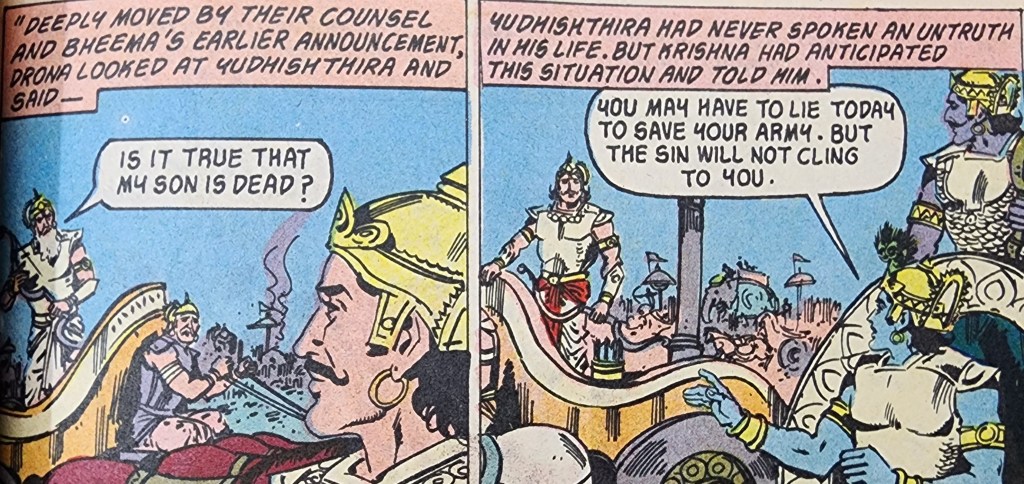
But Krishna did not always have a backup. When he was on his peace mission to Hastinapura to prevent the coming war, he had no one to rely on. Similarly, when he convinced Arjuna to pick up arms, there was no option to let someone else do the heavy lifting, he had to rely on only himself. The same was also true in the slaying of Jayadratha. If Krishna had failed in his deception, there was no Plan B, Itihāsa could have been very different.
This concludes my observations regarding Lord Krishna’s use of deception as a martial strategy, either with or without the use of Maya (magic and illusions). These are aspects we see to this day in warfare and in conflict management in life as a whole.
Sep 4th, 2026, is Krishna Janmāshtami, when we celebrate the birth of Lord Krishna. Lord Krishna’s life is full of stories which serve as case studies to learn from. Literally every aspect of his character has been written about by several people. This post will also stick to the concepts and learnings that can be gleaned from the life of Lord Krishna. I will as usual stick to the martial aspects and the learning from them that I see in the stories associated with Lord Krishna.
Even if one is to consider just the martial aspects in the several conflicts that Krishna managed over the course of his life, this article would be too long. So, I will stick to one specific attribute related to the martial arts in this article and delve into the examples of its application through stories of Lord Krishna. This attribute I am focusing on is “Deception in martial arts”, which can be read as “Deception in Conflict Management”. Even with this limited focus, this exploration will be split over 2 parts.
Lord Krishna used deception, sometimes with illusions (Maya) to get an upper hand over opponents in war and negotiations. This happened multiple times over the course of his life. Deception was used against him as well. There were times when his use of deception failed and occasions when he was deceived by the illusory means deployed by others as well.
I will list the few occasions when any of the above situations occurred, with a few observations of my own. I will attempt to layer my knowledge of deception in the Bujinkan system of martial arts to identify how the concepts in the stories related to Lord Krishna could be real world tactics, without the magic part of the Maya.
I consider “surprising the opponent” to be the same as “deceiving the opponent” when I consider examples where I believe deception was deployed against opponents.
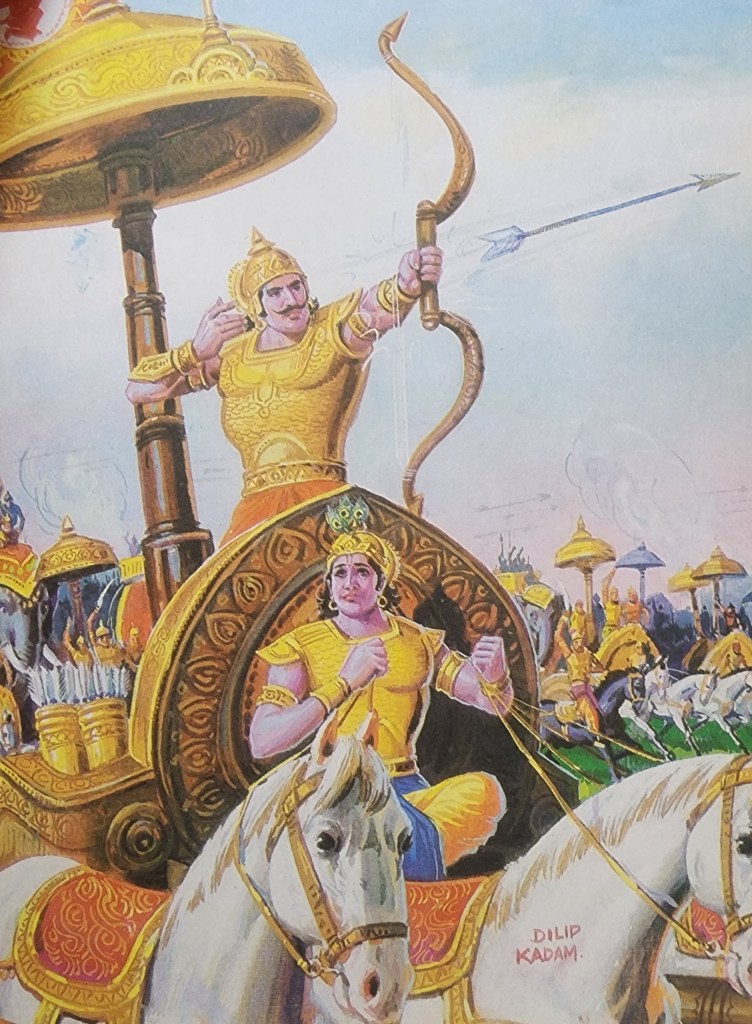
Lord Krishna in perhaps his most iconic role as Arjuna’s charioteer during the Kurukshetra War. Image credit – “Mahabharata 30 – The War Begins”, published by Amar Chitra Katha (this is the cover image).
In the Bujinkan system of martial arts, Soke Hatsumi Masaaki used to share yearly themes that used to inform the training for a given year. This practice lasted from 1992 (some say 1988) through 2019. The theme of the year for 2007 was “Menkyo Kaiden”. “Menkyo Kaiden” has 2 meanings as far as I know.
The first is the license that a Grandmaster hands out to one of his senior students. This license grants the student the license to teach and build upon the teachings of her or his teacher. The teachings that can be built upon are usually specified, like a specific weapon or a defined form of fighting and need not encompass all that a given teacher has taught.
The other meaning is the one that Hatsumi Sensei used as the theme of the year. This one referred to “transmitting falsehoods into the mind of the opponent”. This essentially meant causing confusion in the opponent however one can, in simpler terms, “deceive the opponent”. The difference in the 2 meanings of “Menkyo Kaiden” was brought about by the use of different Kanji when Sensei Hatsumi wrote the characters.
Another term that means something similar is “Kyojitsu Tenkan Ho”. This translates to “transmitting truth and falsehoods alternatively to an opponent”. The “kyojitsu” refers to alternating truth & falsehoods. “Tenkan” is a revolving door and “ho” is way or path. So, this could mean that the opponent is made to receive truth & falsehoods regarding one’s intention and movement through a revolving door, such that he or she has no idea which is the truth and which the fakery. This in essence also leads to confusion in the opponent and gives one an advantage. This is also for all practical purposes, a deception during a fight.
An example of this in a one-on-one fight could be landing a punch a little short of the impact or making a cut with a sword in the air without making contact. The opponent is drawn to block the punch or the cut. The block to the punch, gives the one who threw the “fake punch” an opportunity to take the forearm into a lock or to take the balance of the opponent. Similarly, if a “fake cut” is parried, the action reveals one or more openings in the opponent that can be exploited.
In the real world, deceiving opponents was a continuous attempt throughout the ages. A few examples of this could be the following.
Many Turkic armies used the feigned retreat to draw their opponents out to more favourable ground or to surround them or to thin out their lines.
Peshwa Baji Rao 1st convinced the Nizam of Hyderabad that he had a numerical advantage during the Battle of Palkhed in 1728, with fast cavalry movements while the truth was the opposite. The Nizam agreed to terms with very little fighting!
The Allied forces during WW2 created a phantom Third Army to convince German forces that the attack would occur on Pas de Calais while the real attack came on Normandy.
A lot of these actions have precedents in the stories relating to Lord Krishna. Let me share a few. First let us consider the cases where deception was used against Lord Krishna.
Salva, King of Saubha, uses deception against Krishna. Image credit – “Krishna and Shishupala”, published by Amar Chitra Katha.
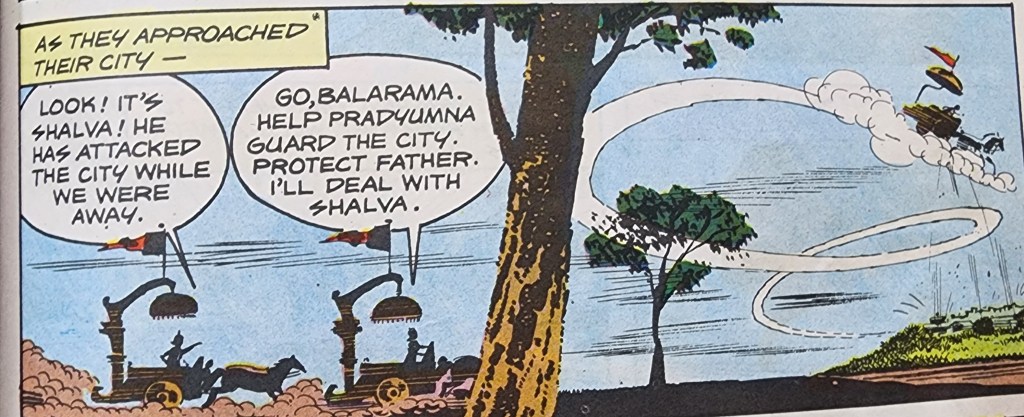
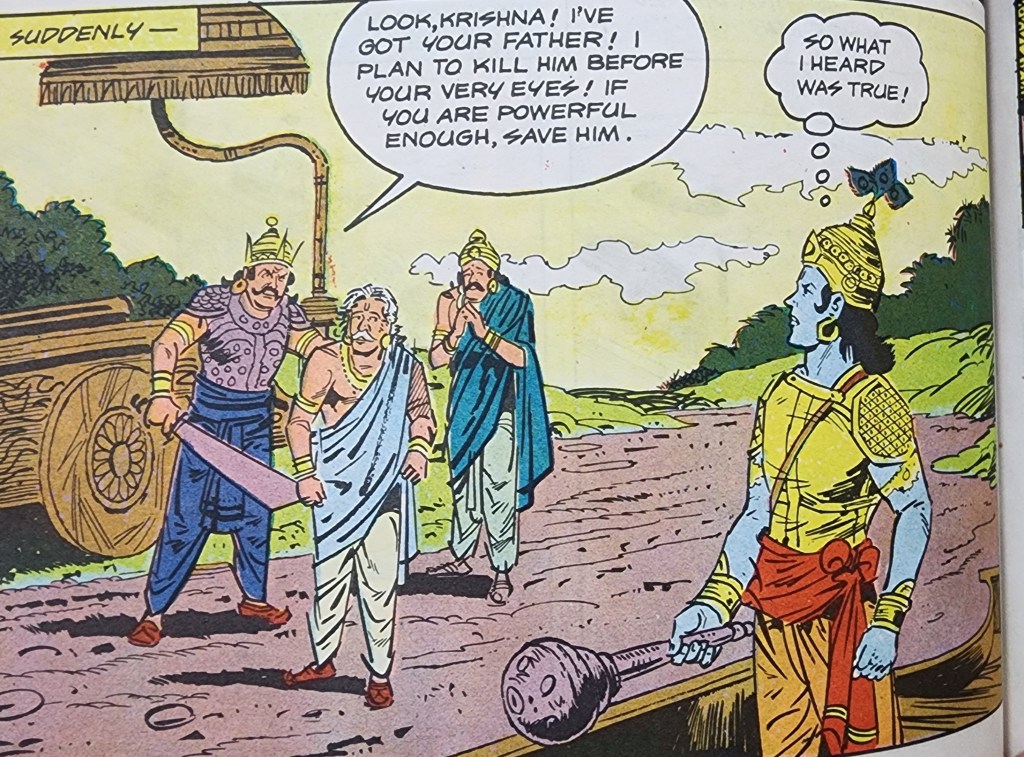
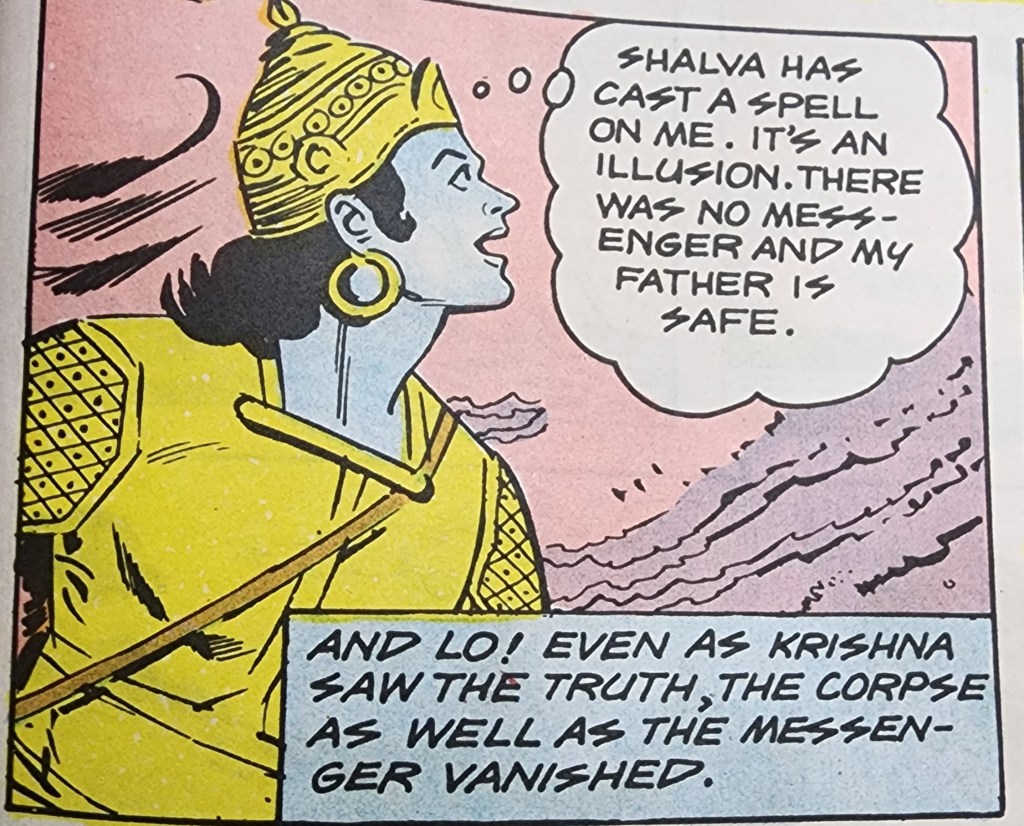
Salva, the king of Saubha was an ally of Jarasandha and an enemy of the Yadavas (and consequently their city of Dwaraka). He acquired a flying chariot to counter Krishna’s ability to use Garuda to carry out aerial attacks. But this was not the deception. When Krishna and Salva were fighting, Salva, using Maya, created an illusion of having taken Vasudeva, Krishna’s father, hostage. The trick worked and gave Krishna pause. While Krishna eventually defeated and killed Salva, the illusory deception he used gave Salva a temporary advantage.
Krishna realizes that Maya has been deployed against him. Image credit – “Krishna and Shishupala”, published by Amar Chitra Katha.
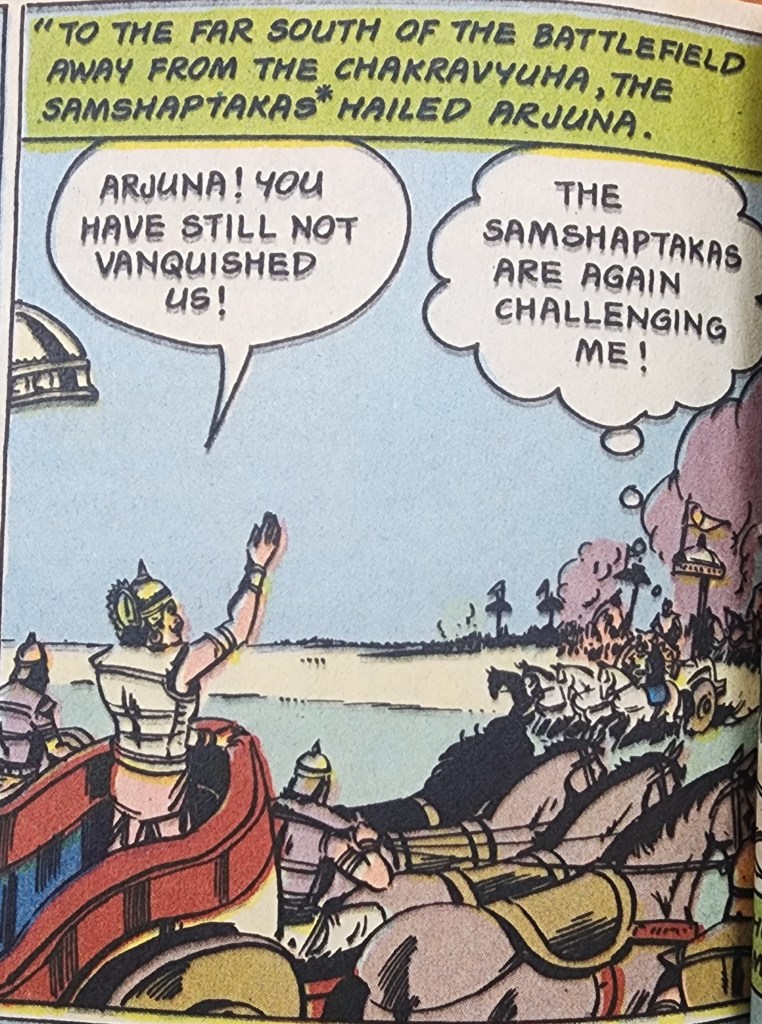
During the Kurukshetra War, the Samshaptakas of Trigarta challenged Arjuna to battle repeatedly. Arjuna had to accept and Krishna, being Arjuna’s charioteer had to go along. This distraction took Krishna & Arjuna away from the Chakrayuha, which resulted in the death of his son Abhimanyu.
The Samshaptakas distract Arjuna and Krishna from the Chakravyuha. Image credit – “Mahabharata 34 – The Slaying of Abhimanyu”, published by Amar Chitra Katha.
Now consider a case where Krishna used Maya but failed to achieve his objective.
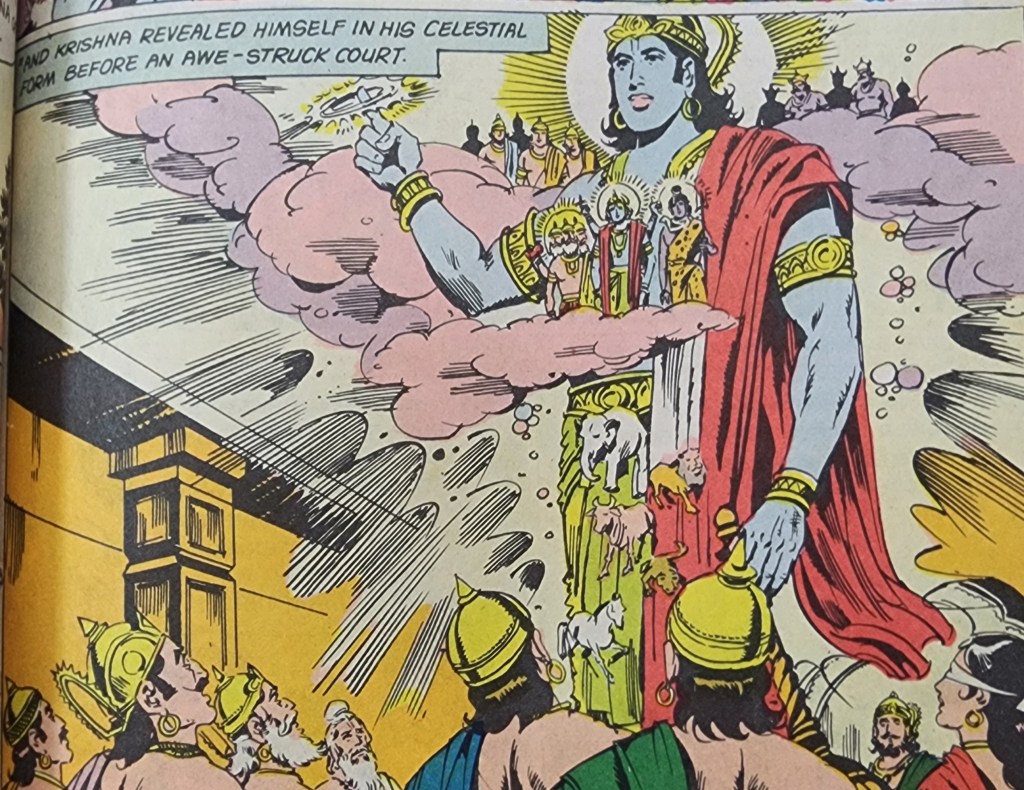
Before the Kurukshetra War, Lord Krishna visited Hastinapura in a peace mission. His objective was to avert the war by convincing Duryodhana to hand over at least 5 villages to the Pandavas, if not Indraprastha itself. During the negotiation, in an act of bad faith, Duryodhana attempted to imprison Krishna. The foolhardy act resulted in Lord Krishna revealing his divine Vishwaroopa in the court at Hastinapura.
Krishna reveals his Vishwaroopa. Image credit – “Mahabharata 29 – Krishna’s Peace Mission”, published by Amar Chitra Katha.
This form showed that Krishna was Lord Vishnu himself and the master of all creation. The converse of this revelation was a clear message – GOING AGAINST LORD KRISHNA IS FOOLHARDY IN THE EXTREME! But the message was lost on Duryodhana himself, while the elders of the Kuru court got the message and tried to convince the crown prince.
The revelation of the Vishwaroopa can be considered Maya, as it was not information mortals could otherwise visualize. It could also be considered a surprise move in a negotiation, where Krishna scared the other side to come to terms. It could also be considered a psychological weapon being deployed against an opponent to get an opening in the talks. The attempted imprisonment could have been a ruse to deploy the Vishwaroopa as a weapon.
But the Vishwaroopa failed in its objective. Peace was not achieved as Duryodhana chose war, convinced that he would win. Thus, it can be said that Krishna’s use of deception and Maya failed in this instance. But there is another aspect of learning from this part of the Mahabharata, which comes from the Bujinkan.
The theme of the year for the year 2008 in the Bujinkan was “Kuki Taishou” (sometimes spelled “Kuki Taisho” or “Kuki Taishō”). I remember this phrase being translated as “The smile of the Ninth Demon”. I am going to reproduce the description of “Kuki Taishou” by a mentor of mine, Arnaud Cousergue.
Imagine a demon who is incredibly capable in the martial arts and can destroy you at will. This demon is just hanging around, maybe guarding a place. You can choose to attack him. But he will definitely not initiate any hostilities. He also knows that you plan to attack him. He just looks at you, smiles and goes on just being. But you will dare not attack him because you know that it is suicidal. You know this because of the aura of competence and confidence he exudes.
This sense that pervades the demon is “Kuki Taishou”. It is a feeling that is caused in an opponent, which could be similar to a feeling of aggression, that prevents a fight from ever taking place. It is this exact feeling of “let’s not fight” that Krishna induced in all the elders of the Hastinapura court when he revealed the Vishwaroopa. They all realized the futility of a fight against a side Krishna was on. But Duryodhana failed to see this, the mission failed and the rest is “history” (itihāsa).
But this exact technique succeeded with Arjuna. And as we look at that example, we move into examples of cases where Krishna’s use of deception, with or without Maya, achieved its objective.
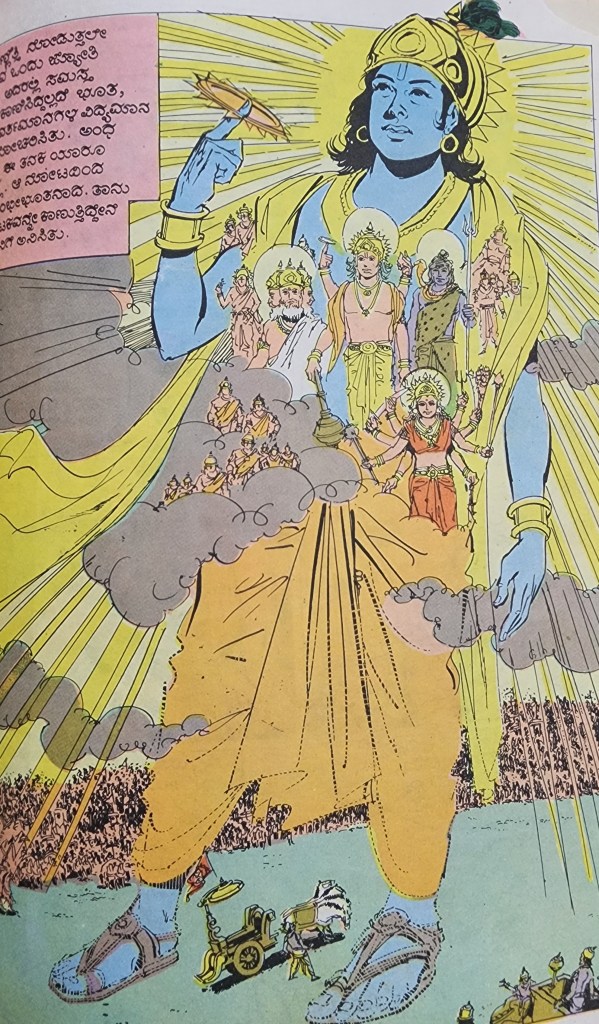
At the start of the Kurukshetra War, Arjuna lost his will to fight, when the fact that he would be trying to kill his Gurus, Grandsire and cousins hit him hard. Krishna used several methods, from inspiring him, consoling him and rebuking him to get him out of the low he had sunk to. Eventually, Lord Krishna revealed his Virātaroopa to Arjuna. This convinced Arjuna to pick up arms again and even led him to ask queries that touch every aspect of living.
This entire episode is the Geetopadesha, when Lord Krishna shared the Bhagavad Gita with Arjuna. The Virātaroopa that Arjuna witnessed showed that Krishna was Parabrahman and all creation was contained in him. The revelation of this form of Krishna was similar to the episode with the Vishwaroopa.
Krishna reveals his Virataroopa to Arjuna during the Geetopadesha. Image credit – “Bhagavadgeetha” (Kannada edition), published by Amar Chitra Katha.
Arjuna also realized the awesome power and entity that Krishna was. He also realized that Krishna was so far beyond him in knowledge that he could simply follow without question. This is the concept of Kuki Taishou at work. The revelation of the Virātaroopa itself involved Maya, for mortals could never witness this form of Krishna’s. This act of revelation was also a surprise, a jolt to Arjuna’s system. Because of the surprise element, we could say that deception was used, albeit with a positive connotation.
If we move forward in the Kurukshetra War, we have the famous episode of Arjuna slaying Jayadratha, the king of the Sindhu region, to avenge the killing of his son Abhimanyu. On the 13th day of the war, Abhimanyu has been killed in the Chakravyuha, as he singlehandedly faced multiple great warriors. Jayadratha had held off the rest of the Pandava forces from assisting Abhimanyu. All this happened as Arjuna was drawn away by the Samshaptakas (as mentioned earlier).
In the grief of the loss, Arjuna vowed to kill Jayadratha on the next day, the 14th day of the war, before the sun went down. Arjuna also declared that if he failed to kill Jayadratha, he would give up his own life! Come the 14th day and Jayadratha was very well protected. Arjuna came close to his objective, but he would not be able to kill Jayadratha before the sun set for the day.
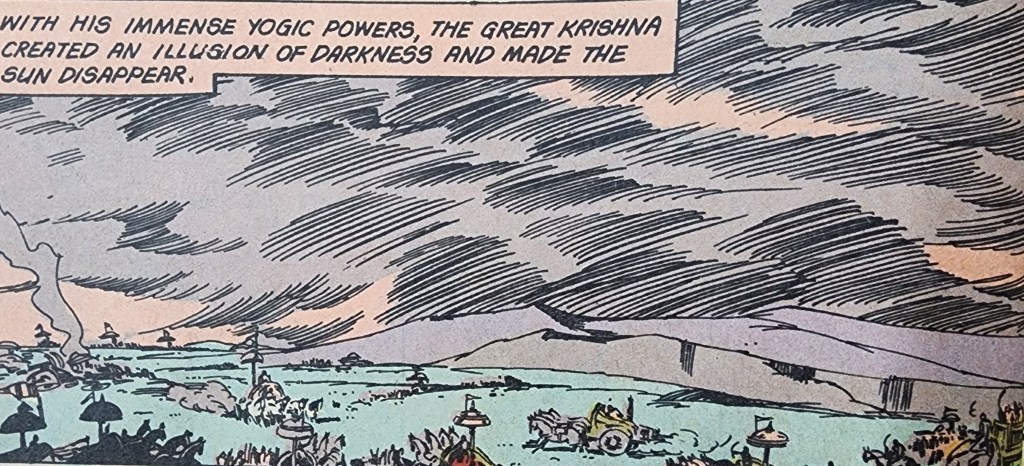
The Sun disappears before the actual sunset on the 14th day of the Kurukshetra War. Image credit – “Mahabharata 35 – Arjuna fulfills his vow”, published by Amar Chitra Katha.
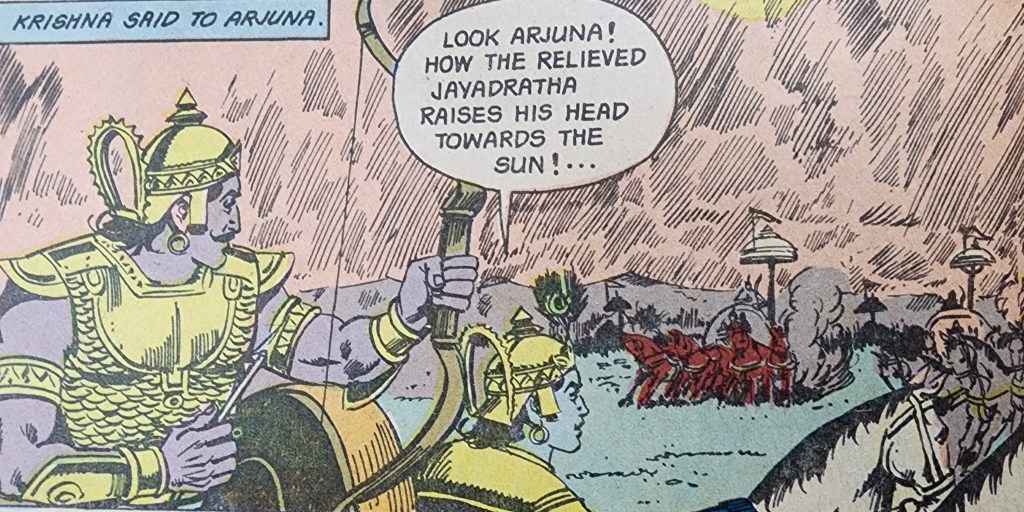
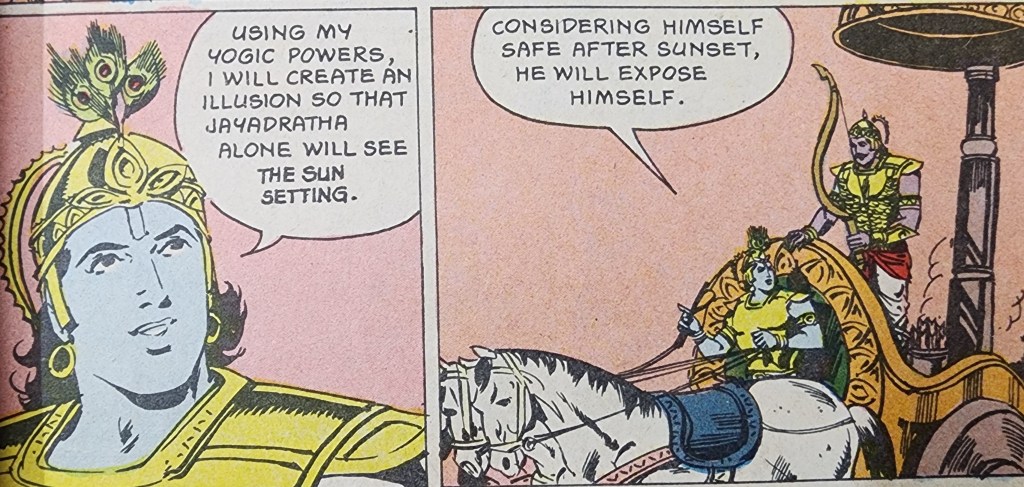
At this time, Krishna caused the sun to appear to have set. Krishna is supposed to have used his Maya to make this happen. But it is generally accepted that a total solar eclipse occurred on that day which seemed like a sun set before the actual sunset. Either way, when the sun appeared to have set, a confident Jayadratha revealed himself.
Jayadratha is deceived. Image credit – “Mahabharata 35 – Arjuna fulfills his vow”, published by Amar Chitra Katha.
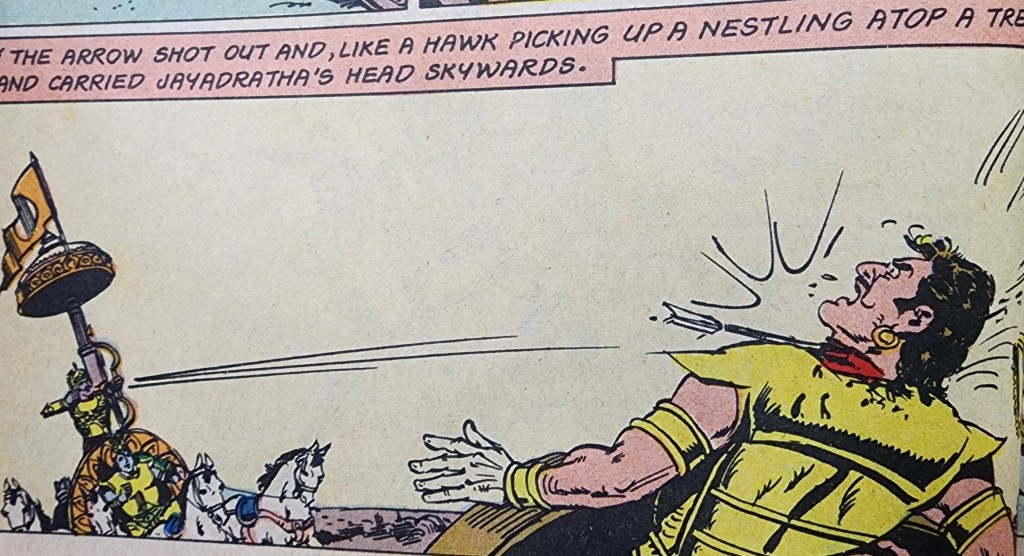
On Krishna’s suggestion, Arjuna slew Jayadratha. Once the act was done, either the Maya was lifted or the eclipse ended and the sun was visible again. Arjuna had fulfilled his vow before sunset. Irrespective of whether it was a natural phenomenon or Krishna’s powers at work, deception had been used in achieving the objective of killing Jayadratha.
If it was a natural phenomenon, it just means that Krishna’s awareness of all information that could be relevant to the war is mindboggling!His ability to possess information and do whatever it takes to achieve objectives in worthy of emulating to this day! Krishna had hidden even from Arjuna the fact that the sun would appear to have set, just to ensure Arjuna’s despair would be real, and the Kaurava forces would fall for it! This is the definition of “doing whatever it takes”.
Jayadratha is slain. Image credit – “Mahabharata 35 – Arjuna fulfills his vow”, published by Amar Chitra Katha.
“Doing whatever it takes” in encapsulated in another concept that is routinely discussed and applied to the extent possible in the Bujinkan system. This is the concept of “Issho Khemi”.I have heard 2 translations for “Issho Khemi”. One is, “do whatever is necessary”. The other is, “do just enough”. The second translation refers to not doing too much. A loose example could be overdoing an attack, for it might expose one to a counterattack.
I had explored the concept of “Issho Khemi” in greater detail in an earlier article of mine, the link to which is seen below.
The concept of “Issho Khemi” and the idea of a feigned retreat both came together with the idea of “Uke Nagashi” when Mathura was attacked by Kāla Yavana. Mathura was simultaneously attacked by both Kāla Yavana and Jarasandha. This was the 18th invasion Mathura was facing. Jarasandha had previously attacked Mathura 17 times with his vast armies and resources. Mathura led by Krishana and his elder brother Balarama had successfully led the defence and beaten back Jarasandha each time.
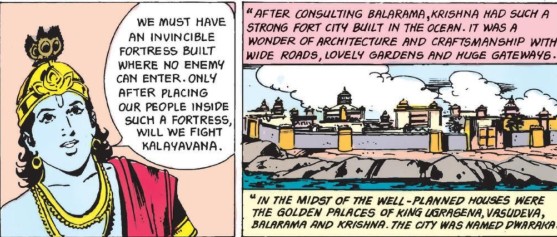
But the simultaneous attack was one step too far. Mathura could no longer take the attacks. Dwaraka was built on the coast of Gujarat and the Yadavas of Mathura moved to Dwaraka to escape the incessant spate of attacks. The population of Mathura was moving to Dwaraka when the attacks came. Krishna and Balarama led the armies of Mathura against Kāla Yavana while the people moved.
The Yadavas choose strategic retreat over perpetual war against Jarasandha. Image credit – “The Bhagawata, Special Edition” (Kindle version), published by Amar Chitra Katha.
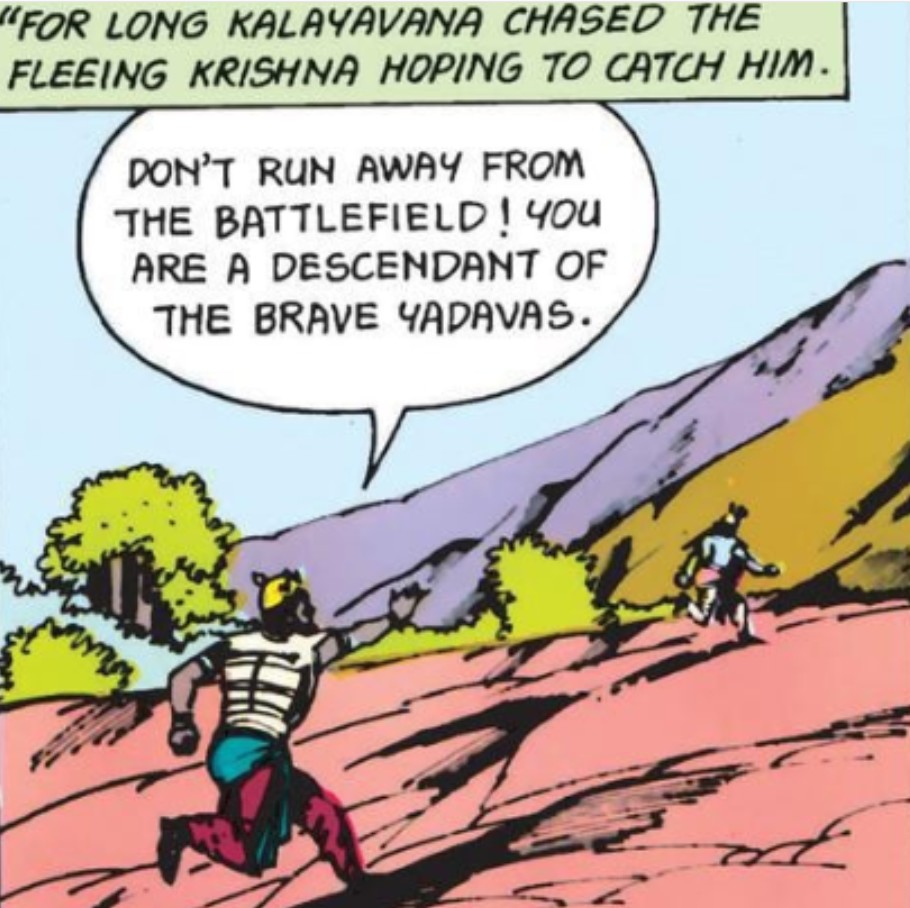
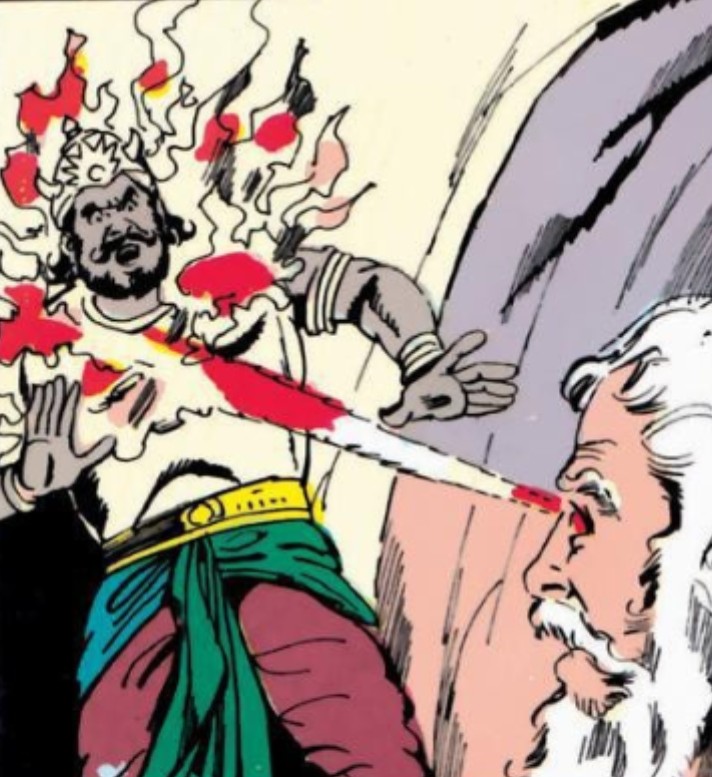
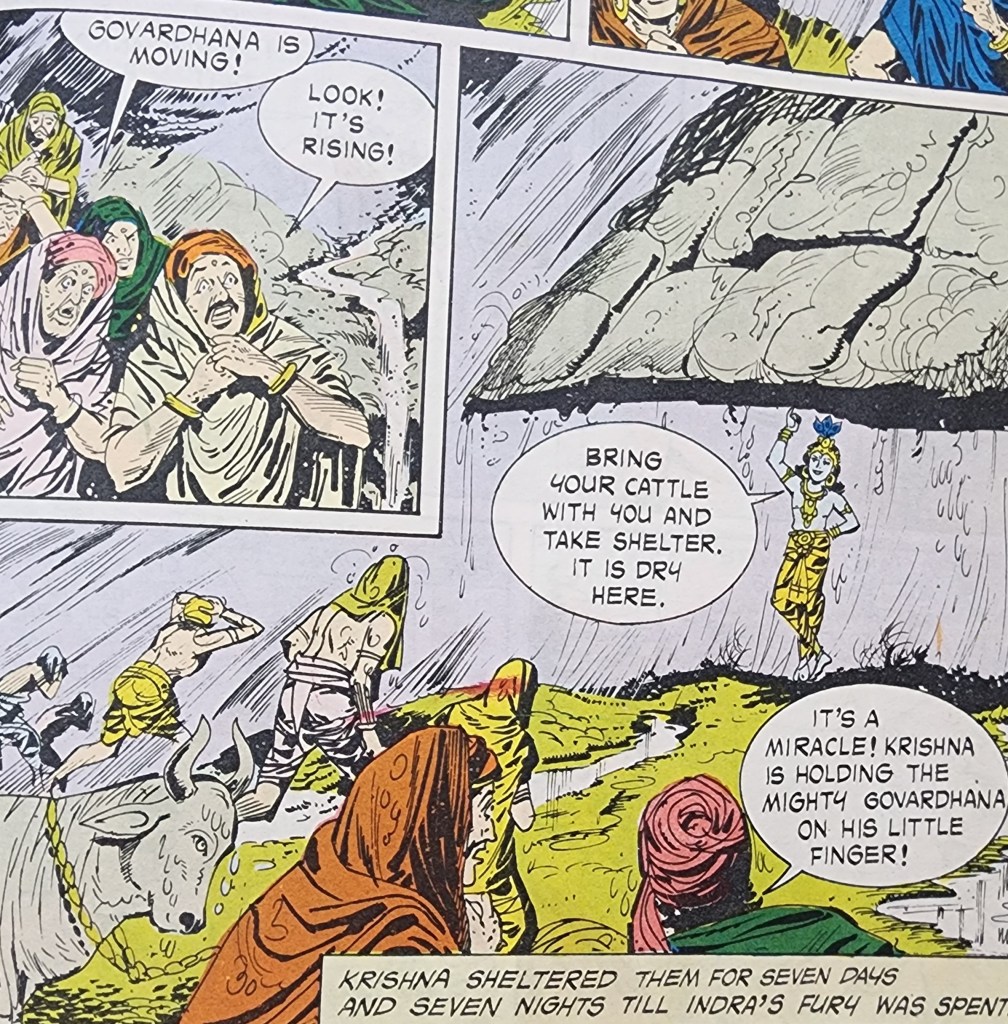
Krishna, by himself, acted like he was running away from the battlefield. Kāla Yavana gave chase alone. Krishna led him into a system of caves. In the caves Kāla Yavana was burned to a crisp when he disturbed the sleep of Muchukunda. Kāla Yavana’s armies dispersed when their leader was killed and a large number of them were killed in the retreat.
Krishna chooses to “absorb” the Yavana’s attack by feigning a retreat. Image credit – “The Bhagawata, Special Edition” (Kindle version), published by Amar Chitra Katha.
This was a classic decapitation strike where the elimination of the leadership breaks the army. Krishna running away from the battlefield gave him the moniker “Ranchod Das” or “one who runs away from the battlefield”. Leaving the field of battle was anathema to the Kshatriyas of that era! Yet, Krishna did what he had to do to protect his army and his people. This is literally what “Issho Khemi” means, doing what is necessary!
At the same time, the other translation of Issho Khemi is demonstrated by Kāla Yavana. He had no idea of what awaited him in the caves. Yet, in his hubris, he chased Krishna alone! Krishna had local knowledge and used it to his advantage. He knew what Muchukunda was capable of and where he was. He used this information to destroy Kāla Yavana.
Kaala Yavana over commits in his attack and pays the price for it. Image credit – “Krishna and Jarasandha”, published by Amar Chitra Katha.
The Yavana on the other hand, “did more than necessary”, he “over committed to the attack”. He could have brought more troops with him or let Krishna go while he led his army to victory. He did neither and pushed himself into an attack that exposed his own self to grave danger, and paid for it.
This is similar to the Luftwaffe attacking British cities during the Battle of Britain during WW2. The Luftwaffe initially targeted the RAF (Royal Air Force) but switched tactics to hurt the population of Britain by attacking cities instead. If they had stayed with attacking the RAF, the battle might have gone differently. But they extended themselves to attack cities and ended up losing focus on the main enemy, who made them pay the price for it. Britain successful defended itself in the Battle of Britain and defeated the Luftwaffe.
Muchukunda is used by Krishna to kill Kaala Yavana. Image credit – “The Bhagawata, Special Edition” (Kindle version), published by Amar Chitra Katha.
Krishna also demonstrated the classic feigned retreat in the fight against Kāla Yavana. He led the leader of the enemy force away by enacting a retreat and the technique worked perfectly. This act of retreating is similar to what is trained regularly in the Bujinkan as part of the basics. This is the concept of “Uke Nagashi”. “Uke Nagashi” refers to “receiving the opponent”.
One manner of “receiving the opponent” is to “absorb the attack”. This means that if the opponent attacks with a punch, the one being attacked cedes space by moving back. The punch lands in the space where it was supposed to, just not on the target. The target moves back, or away, to protect oneself. Once the attack has been absorbed, the defender can look for opportunities to exploit, as openings might have revealed themselves when the opponent attacks and comes into the range of the defender.
This is exactly what Krishna did with Kāla Yavana. He let the Yavana attack and retreated, ceding space, triggering the chase that changed the outcome of the battle. Similarly, when the Yadavas retreated to Dwaraka from Mathura, they were absorbing the attacks from Jarasandha by moving away from the city that was always targeted. Krishna plotted Jarasandha’s demise from the safety of greater distance. We will come to this incident in the next part of this post.
What the Yadavas did when they moved from Mathura to Dwaraka, has been seen multiple times in world history. Babur, lost Samarkand in Uzbekistan and retreated to Kabul, from where he conquered Delhi and established the Mughal empire in Northern India. If one goes back in time further, the movements of the Xiongnu in Central Asia led to the Yuezhi moving west and south, first to the Tarim Basin and then to parts of modern-day Afghanistan.
The Yadavas absorb Jarasandha’s attacks by using distance to protect themselves. Image credit – “Krishna and Jarasandha”, published by Amar Chitra Katha.
The Yuezhi later became the Saka or Shaka that invaded ancient Northwestern India. This process of people being displaced from Central Asia continued for another 700 years! The Kushanas replaced the Sakas. A few centuries later, the Hunas (Huns) were pushed out of Central Asia, and they invaded both the Gupta Empire in North India and the Roman Empire in Eastern Europe!
I will stop here in this part one of exploring the use of deception deployed by Lord Krishna several times in his life. We will look at the incidents with Paundraka Vāsudeva, Narakāsura, Jarasandha and Shishupāla in the next part. We will also look at the incidents involving Krishna & Rukmini and the Arjuna & Subhadra in the next part.
WISH YOU ALL A WONDERFUL SHRI KRISHNA JANMĀSHTAMI!
Lord Balarama is the elder brother of Lord Krishna. 27th Aug 2026 is supposed to be Balarama Jayanthi, which commemorates the birth of Balarama. Balarama is considered an incarnation of Ādi Shesha, the Naga on whom Lord Vishnu reclines. But he is also sometimes considered an avatāra of Lord Vishnu, and a part of the Dashāvatāra. He is the 8th avatāra, after Lord Rama and before Lord Krishna in this chronology, as far as I am aware.
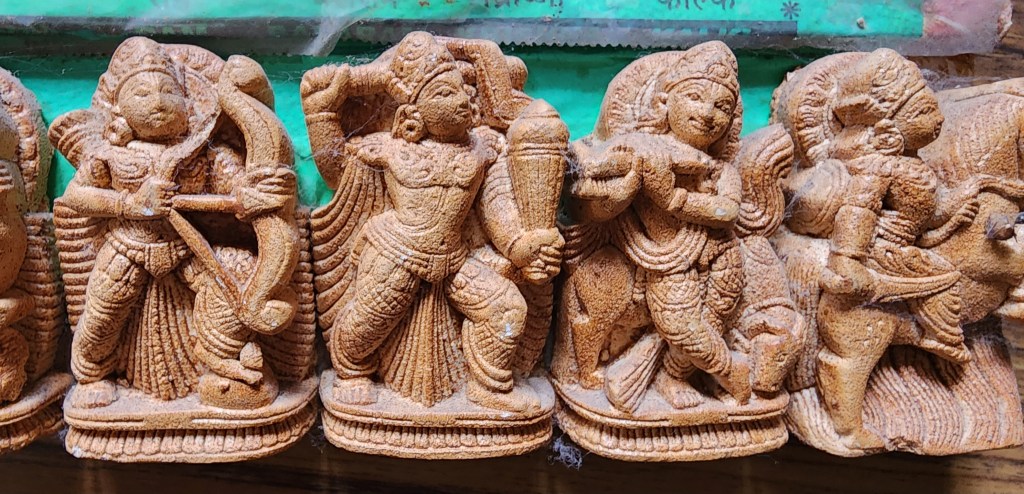
Balarama depicted as the 8th Avatāra in the Dashāvatāra. The above image shows, from left to right, Rama, Balarama, Krishna & Kalki.
Balarama is associated with 2 weapons, the plough and the gada (mace). The plough is the most iconic weapon associated with him, and this is shown in depictions of Balarama for almost 2 millennia now. The internet claims that the plough is associated with him because he evolved from originally being an agricultural God.
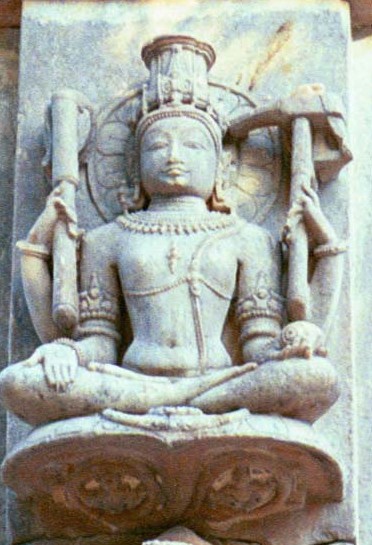
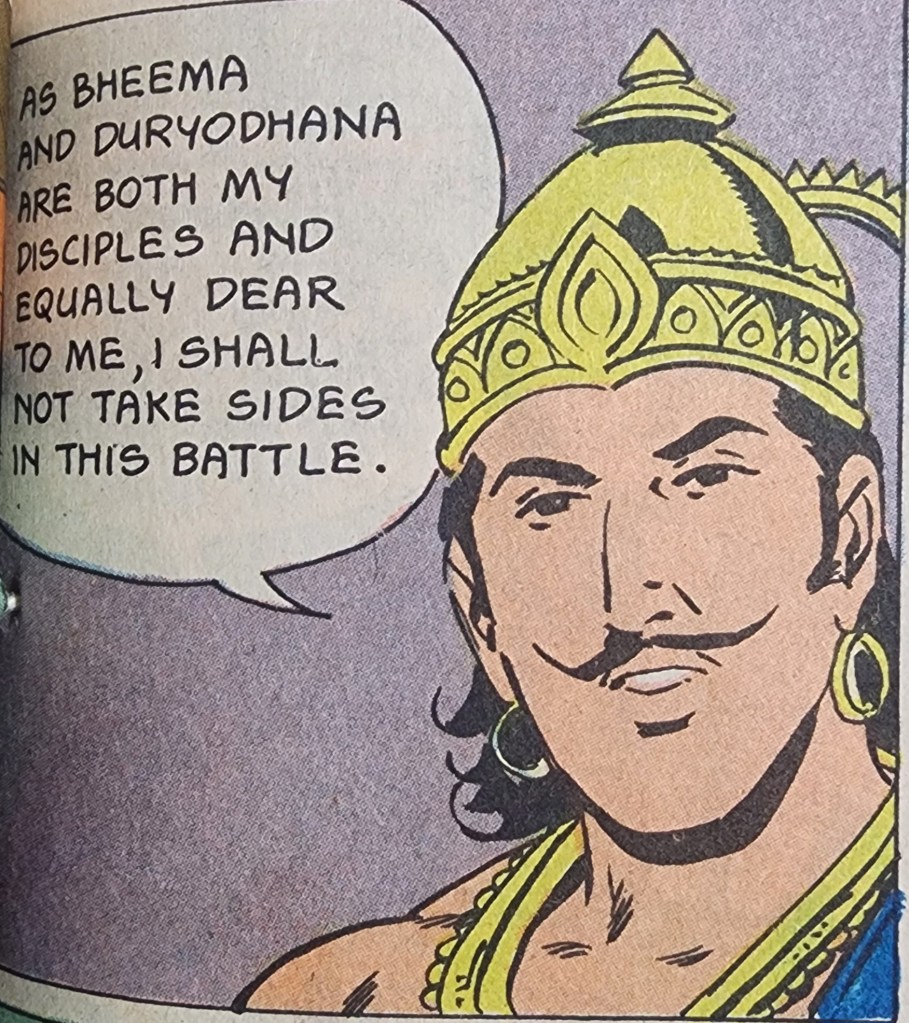
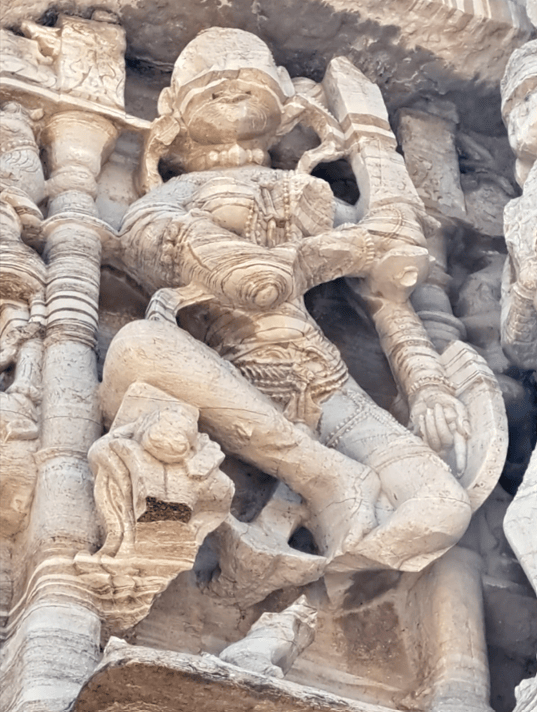
Balarama was the greatest exponent of the gada or mace of his age. He was the mentor for both Bhima & Duryodhana in the art of mace fighting. Observe the image of Balarama in the image seen below. Here he is depicted with the plough and a large staff, which is a pestle, called Musala in many Indian languages. The pestle or Musala could be considered a club or a bludgeoning weapon. A gada or a mace is an evolution of the club. So, Lord Balarama is associated with bludgeoning weapons.
Balarama depicted with the Musala/Onake/Pestle in his left hand and the Plough in his right hand. This carving is from the Sasbahu temple in Nagda, Rajasthan. Image credit – Wikimedia Commons (Michael Gunther).
Balarama’s association with the plough and to a lesser extent the mace or large staff is what inspired this article. The occasion of Balarama Jayanthi gives us an opportunity to explore the various plough-like weapons in various cultures. It also gives us an opportunity to discover the use of the Musala as a weapon in recent Indian history!
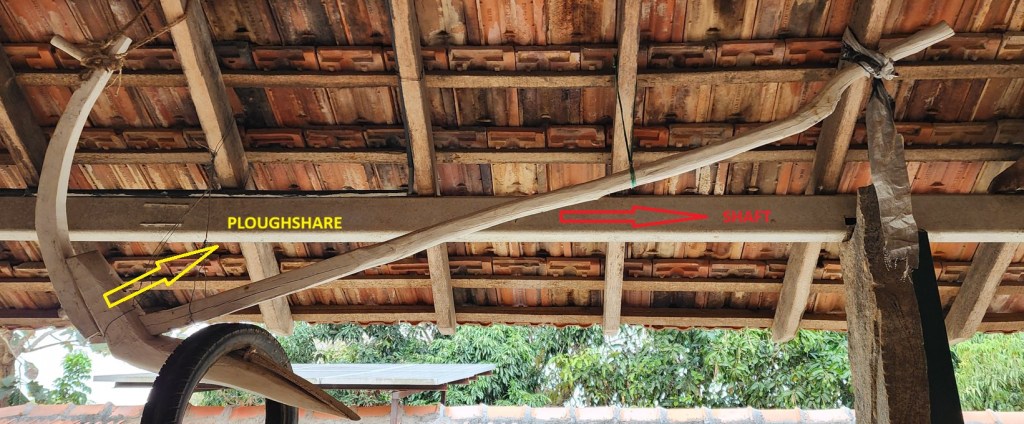
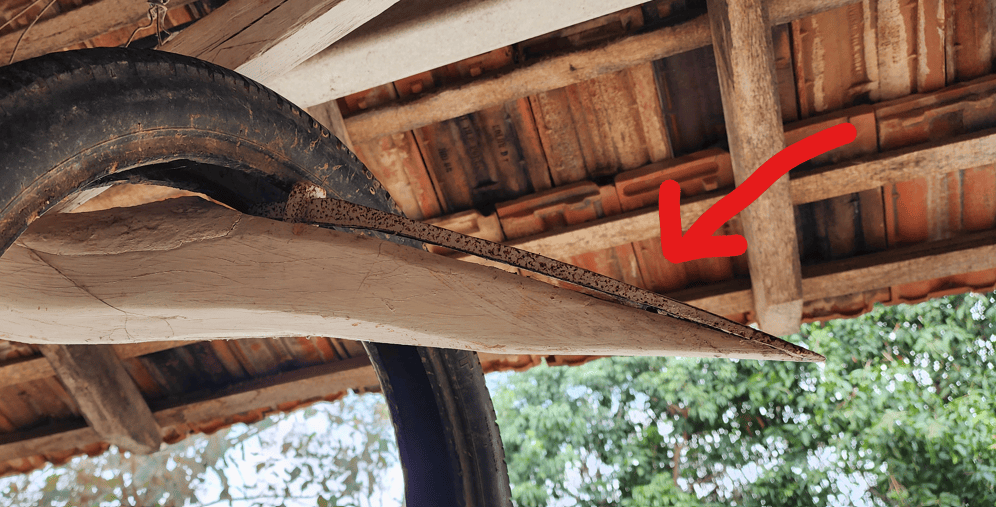
The plough is a tool used to break the earth or turn over the soil in preparation for sowing. It is an ancient tool that has been in use for several thousand years. It is iconic in its shape. It consists of a wooden shaft with another piece of wood, called a ploughshare, attached at an angle to one end of the shaft. The shaft is pulled by a beast of burden, horses or oxen for example, while the angled piece of wood is drawn through the ground to turn the soil. The tip of the ploughshare could have a piece of metal attached to it, to increase its efficiency.
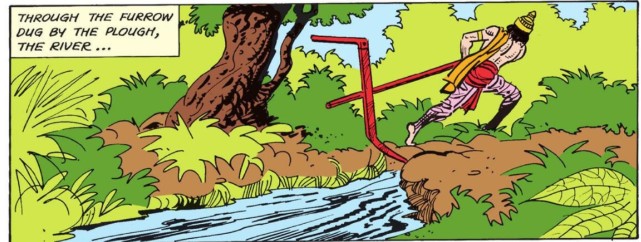
Balarama singlehandedly creating a channel for the Yamuna, using a traditional large plough. Image credit – “Tales of Balarama”, published by Amar Chitra Katha”.
The plough, sometimes spelled “plow” could be of varying sizes. Some could be large and pulled by animals while, smaller ones existed for use by humans. Of course, these days, mechanized ploughs can be much larger. Seen below are examples of a large are small ploughs.
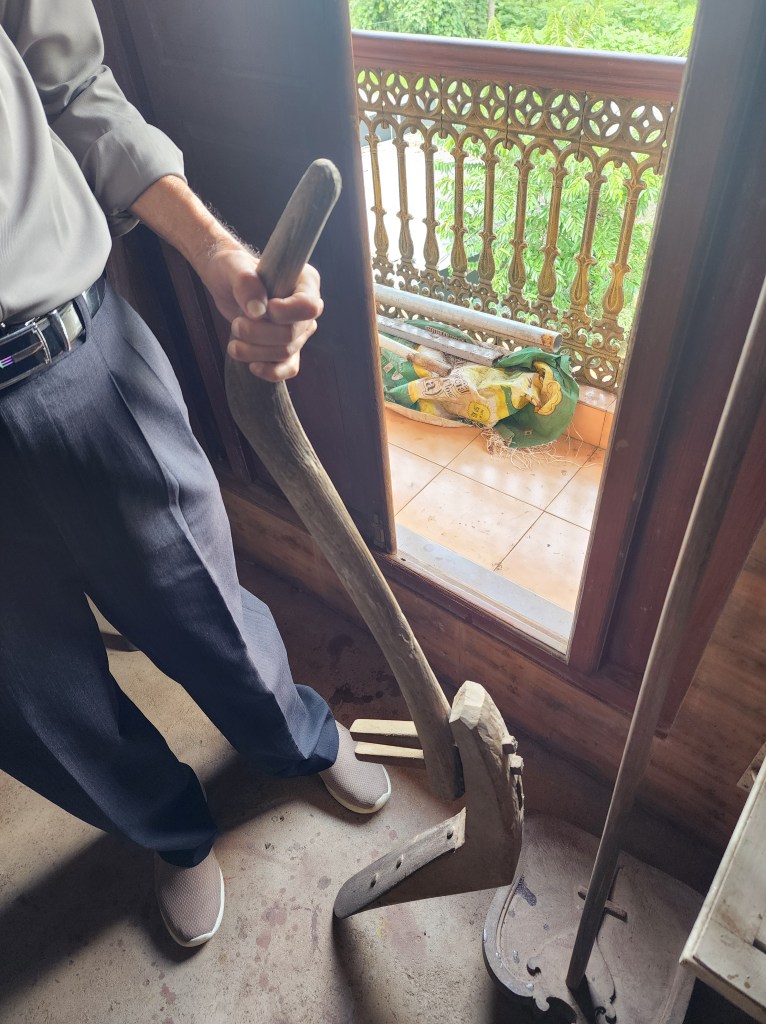
A big traditional plough. The shaft is mentioned in red, while the ploughshare is mentioned in yellow.
A closeup of the plough seen in the previous image. The metal plate affixed to the ploughshare is seen clearly in this image. It is pointed to by the red arrow.
A small traditional plough on display at the Kumarakon Heritage Museum, Vembanad, Kerala.
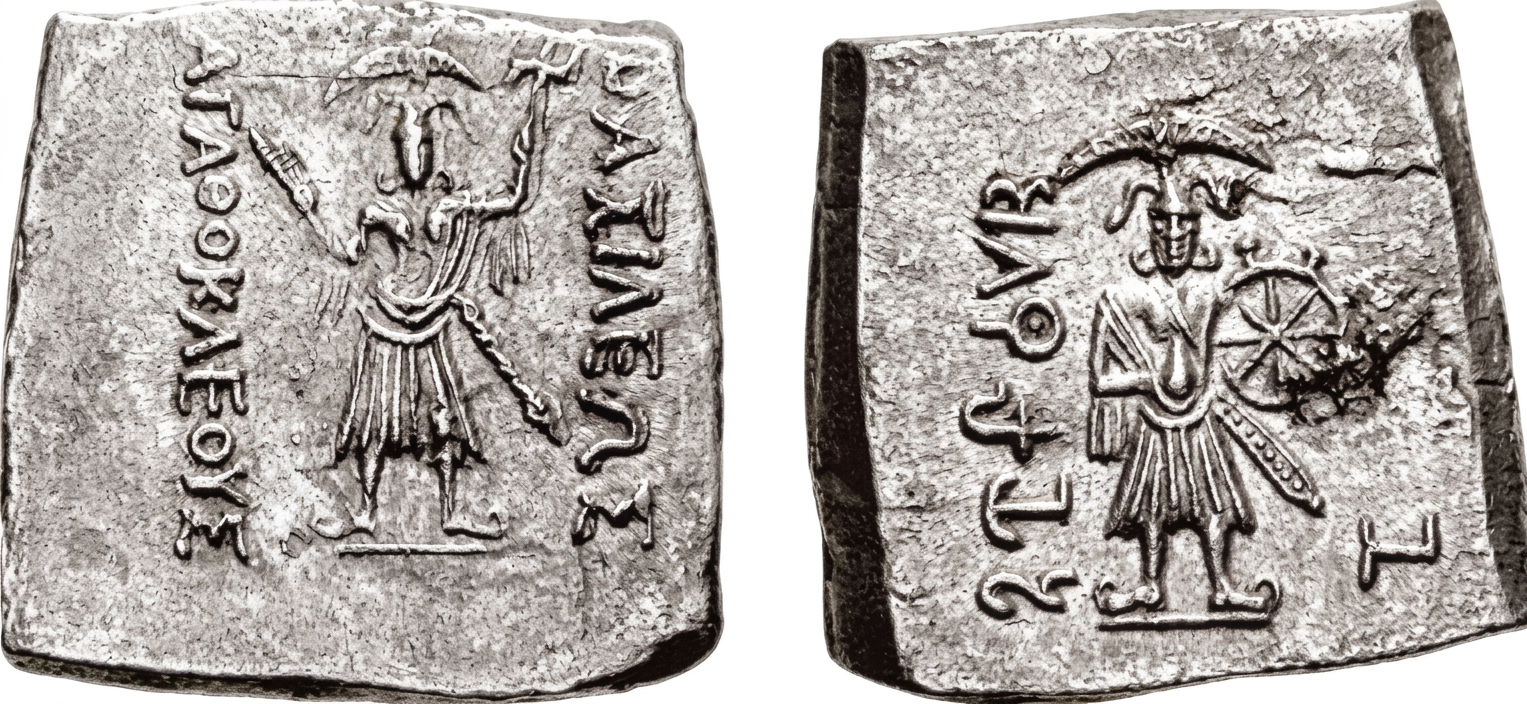
Balarama wielding a plough is seen in multiple interpretations. The oldest is perhaps a coin issued by Agathocles, an Indo-Greek king from northwestern India in the 2nd century BCE. An image of Balarama, also called Sankarshana is seen in the image below.
A coin from around 190 BCE, issued by Agathokles of the Indo-Greek Kingdom. The image on the left shows Balarama or Sankarshana. In his right hand, Balarama is holding aloft the plough. The image on the right depicts Lord Krishna. There two images are on two sides of the same coin. Image credit – Wikipedia.
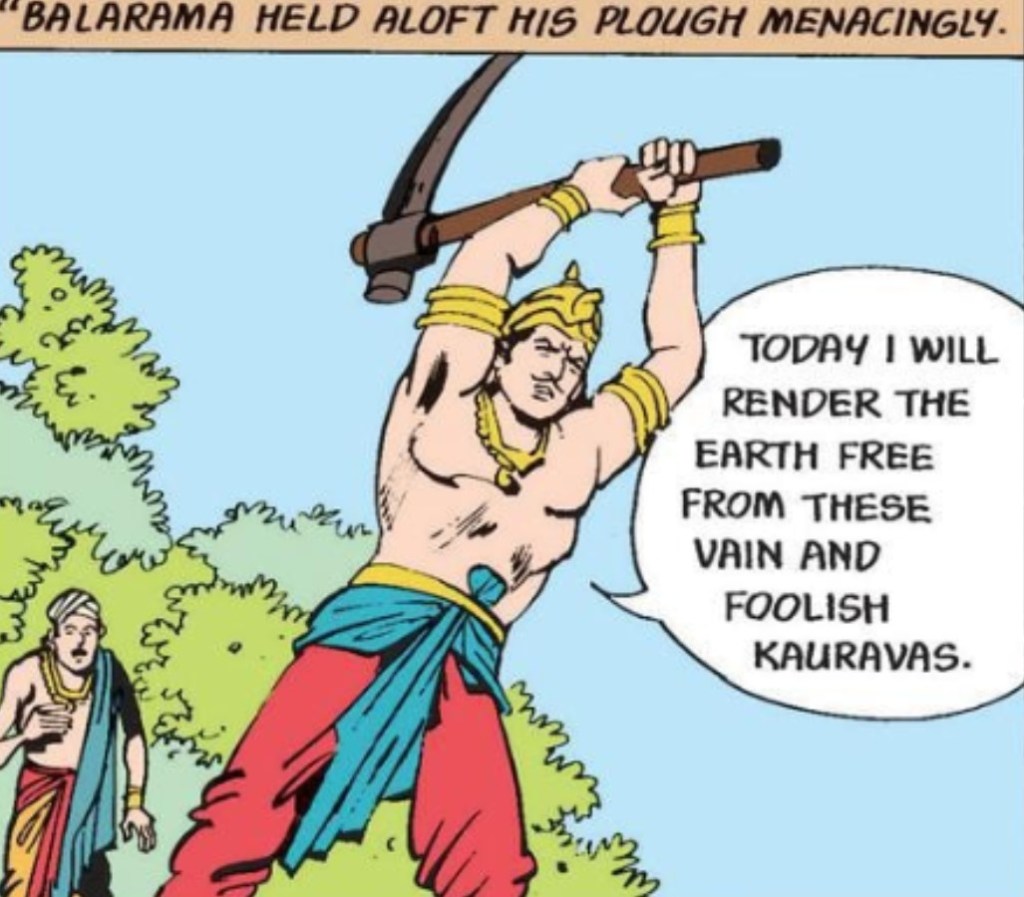
Here, the plough is held in Balarama’s right hand. It is not a large weapon. It is not dissimilar in size from a modern-day hammer that exists in tool kits in many homes to this day. But modern interpretations show the plough being a large weapon. One such interpretation is from the Mahabharata published by Amar Chitra Katha in the 1980s. This interpretation is seen in the image below.
Balarama shown wielding a large plough as a weapon. Image credit – “Mahabharata 39 – After the War”, published by Amar Chitra Katha.
In the depiction of Balarama from the Sasbahu temple in Nagda, Rajasthan seen earlier, both the plough and the musala are seen as either short or medium sized weapons at best. The musala is called the “onake” or “vonake” in Kannada. It is a large pestle that was used to grind grains into flour.
These came in multiple sizes, from about 2 to 4 feet in length. The diameter is between 2 and 3 inches. This would correspond with a Jo or an Ojo in Bujinkan parlance. The Jo and Ojo are both staffs that are about 4 feet in length, with the Jo having a diameter of about an inch and the Ojo being larger, 2 inches or more.
The musala or onake could taper from the grinding end to the end handled by the user. With this design feature, the staff starts to resemble a club. And the mace is an evolution of the club. So, Balarama being depicted with a musala and being an ace wielder of the mace could be considered the same or at least an evolution of the depiction of the same martial skill set.
Can the depiction of Balarama with a plough and a musala be a representation of his creation (agriculture through the plough) and destruction (destruction with the mace) being two sides of the same coin? I have no idea.
I had written an article last year, detailing the extraordinary action of “Onake Obavva”. Obavva is a hero for the people of Karnataka. She used an onake/musala/pestle and fought off the army of Hyder Ali until help arrived during the late. She lost her life in the process. This event is from the 18th century. I had also shared videos with the article depicting modern day women wielding a jo and ojo. A link to this article is seen below. Do refer to the same for more information about the pestle as a weapon. Now we return to Lord Balarama.
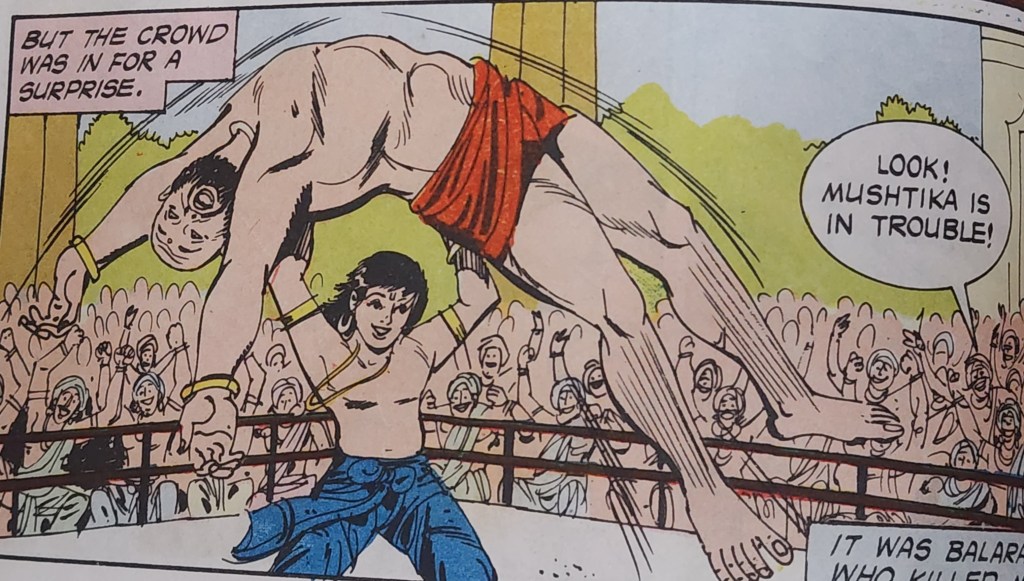
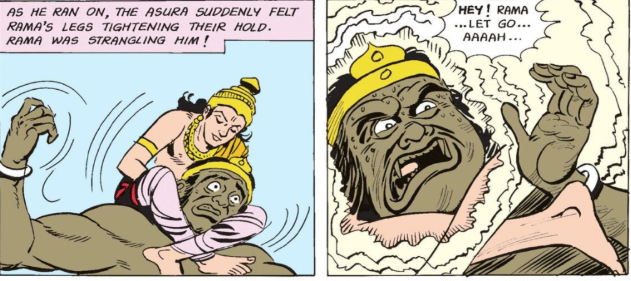
Balarama was a great warrior. He, in conjunction with his brother Krishna was responsible for holding off the armies of Jarasandha 18 times, when Mathura was invaded repeatedly. Even as a child, he killed the Asuras Dhenuka and Pralamba. He killed the mighty wrestlers Mushtika and Koota in Kamsa’s arena as a young man.
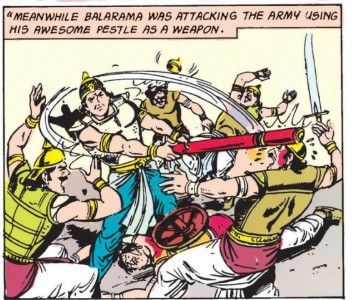
Balarama depicted using the Musala/Pestle against Jarasandha’s forces. Image credit – “The Bhagavata, Special Edition” (Kindle version), published by Amar Chitra Katha.
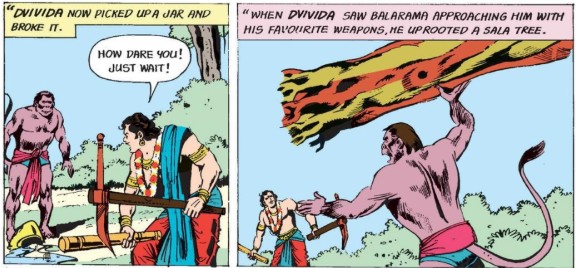
Later in his life he is said to have killed the mighty Vānara Dwivida. Dwivida was supposedly a part of the Vānara army that fought at Lanka during the Ramayana and a friend of Narakāsura, who was killed by Lord Krishna. Balarama is also supposed to have killed Rukmi, the King of Vidarbha, who was Krishna’s brother-in-law.
Balarama depicted defeating Mushtika. Image credit – “Tales of Krishna”, published by Amar Chitra Katha.
Balarama, from most depictions was a large and powerful individual. This in turn lends credence to his being an ace wrestler. Balarama killed Pralamba while being carried on the latter’s back. This could be imagined to be Balarama applying a lock on the upper body of Pralamba while choking him to death. Also, Mushtika was a dreaded wrestler who was killed in the ring in a fight with wrestling rules! Strikes were allowed in these wrestling matches; they were not purely restricted to grappling.
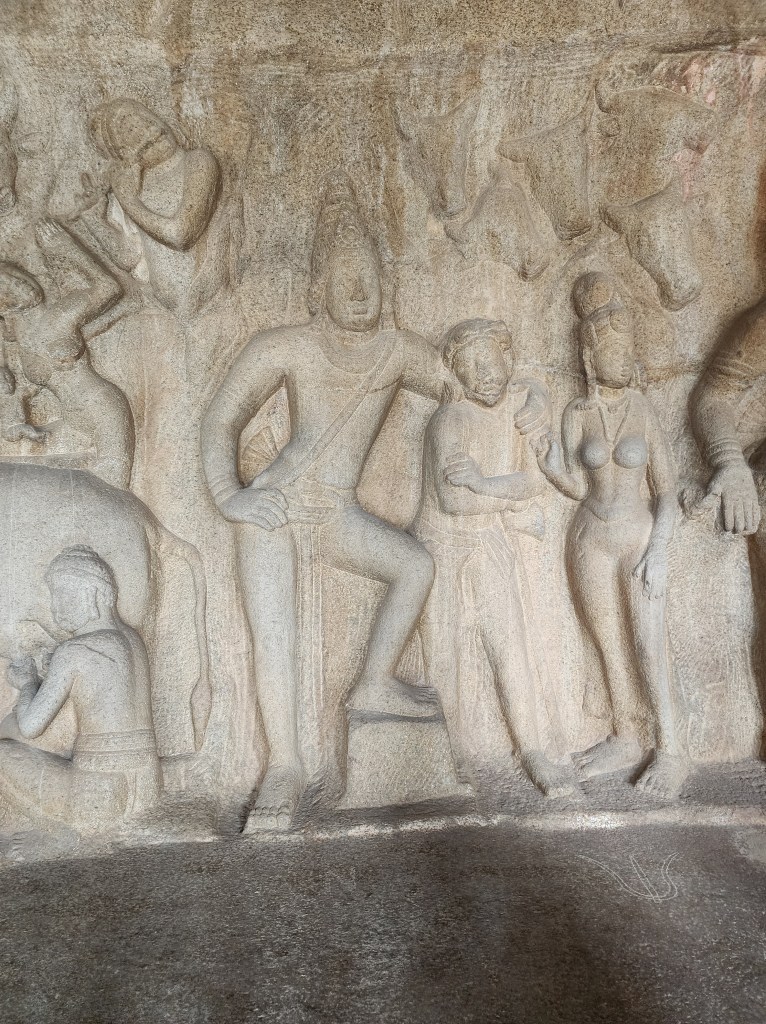
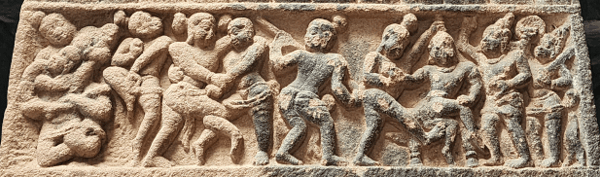
Balarma shown with a village chieftain in the Krishna Mandapam, Mahabalipuram, Tamil Nadu. Obser how Balarama is depicted as a much larger individual compared to those around him. Also, the person on whose shoulders Balarama has put his arm is depicted as being humbled at the casual gesture from the great man.
The image above shows how much larger than the regular citizens Balarama is shown to be. Of course, it could be that the size difference is showing the huge difference in the social standing of the individuals or the divine aspect of Balarama. The greater size could imply greater importance or divinity the individual. But considering the other known aspects of Balarama’s life, the size could be attributed to his strength and chosen warrior skills.
I would suspect Balarama was a great hunter as well. The Asura Dhenuka was killed while he was in the form of a donkey. Balarama was also supposed to have helped Krishna kill an elephant by the name of Kuvalayapeeda.
Balarama defeats the Asura Pralamba. Image credit – “The Bhagavata, Special Edition” (Kindle version), published by Amar Chitra Katha.
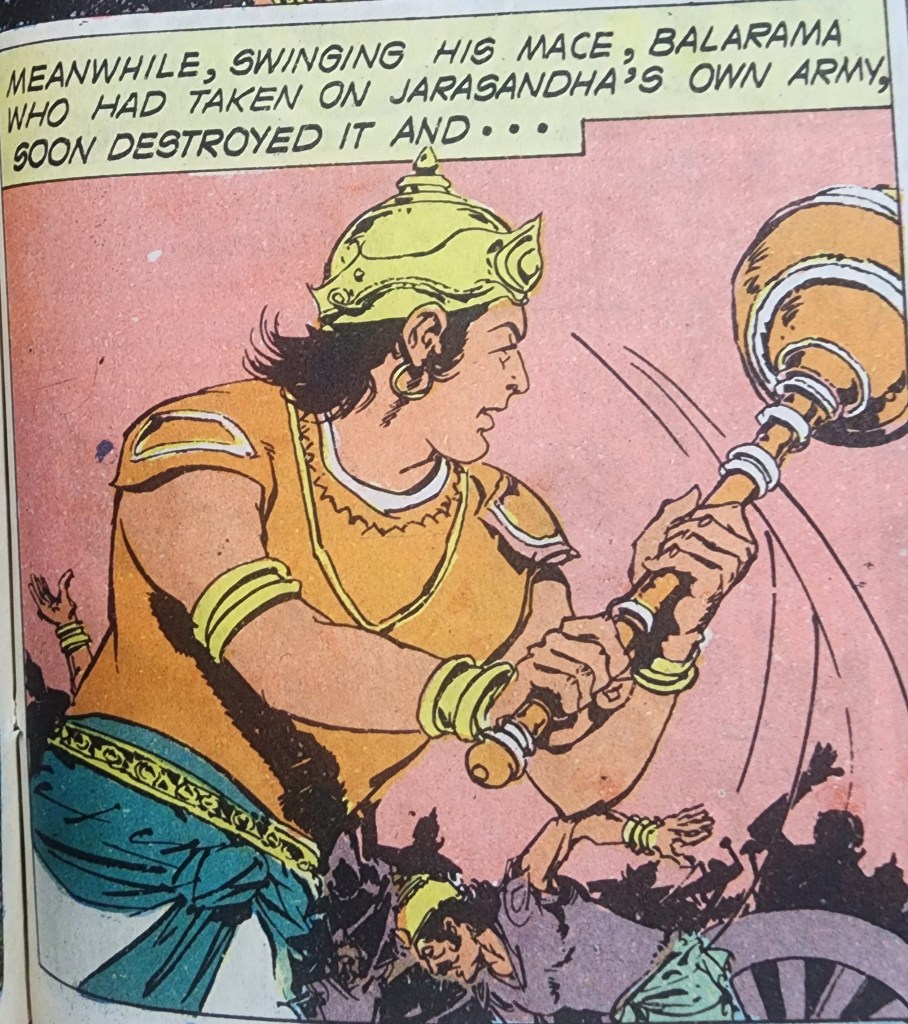
While fighting the armies of Jarasandha, Balarama used all the weapons a warrior of his class used in that era. He was proficient with the use of the bow and arrows as well. But his weapon of choice on the battlefield and his specialization was with the gada, or mace.
Balarama depicted using the Gada/Mace against Jarasandha’s forces. Image credit – “Krishna and Jarasandha”, published by Amar Chitra Katha.
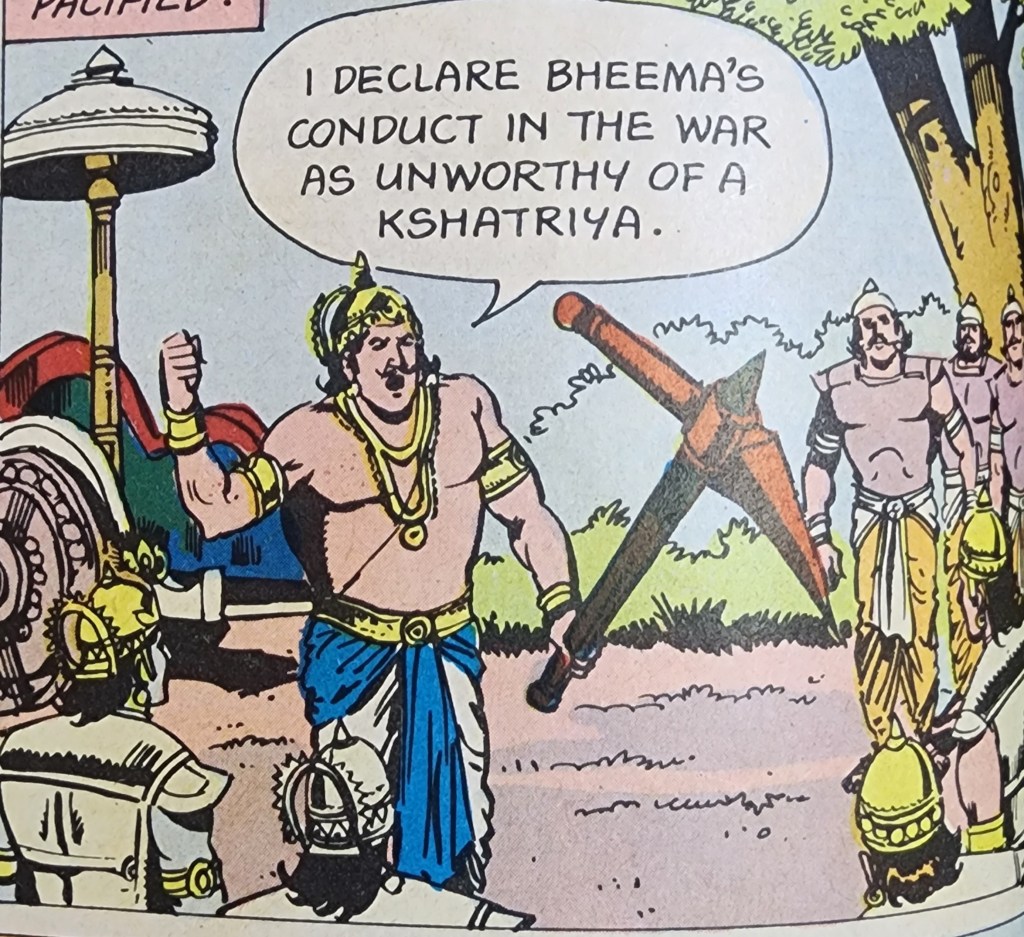
As mentioned earlier, he was a mentor to both Bheema and Duryodhana in the art of mace fighting. The fact that his students were on opposite sides of the Kurukshetra War and that Krishna was not using weapons, were what resulted in his abstaining from the fighting in the great war.
Balarama chooses to not participate in the Kurukshetra War. Image credit – “Mahabharata 27 – Sanjaya’s Mission”, published by Amar Chitra Katha.
This brings us to the plough being associated with Balarama. I have not heard of any description of how he used the plough in a fight, in any of the many conflicts he was involved with. So, I will use article to explore how the plough could have been a weapon or at least modified into one.
The plough is a tool that has a “head”, the ploughshare, that is at an angle of between 45 and 90 (or a little more) degrees to the shaft. To repeat myself, if one observes the plough depicted on the Agathocles coin and on the carving from Nagda, it is not a large weapon. It is either a short or medium sized weapon, that can be used in one hand.
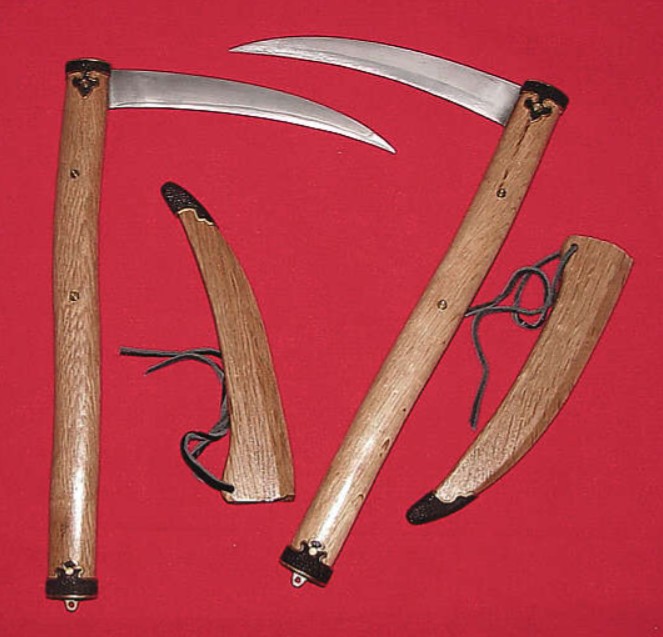
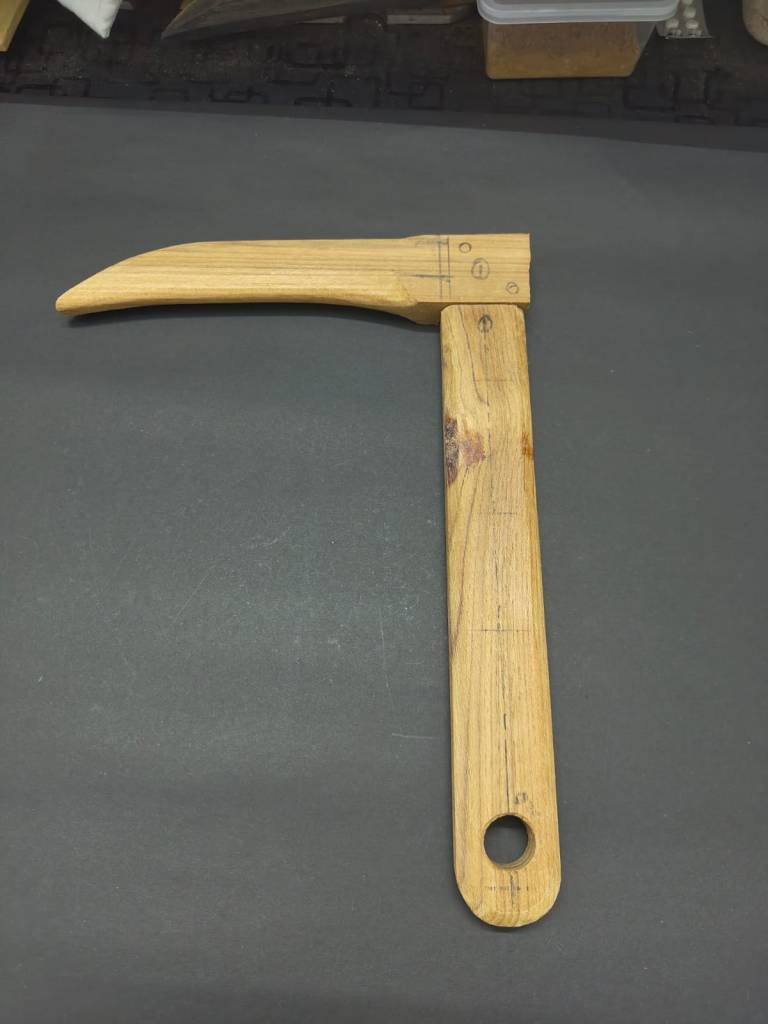
One weapon from Japanese history that comes close to the form factor of a plough, is an agricultural implement that doubled as a weapon which was used in one hand, is the Kama. It is a sickle that was used as a weapon in the past.
A pair of Kama. Image credit – Wikipedia.
A training version of the Kama. This trainer was made and photographed by Siddharth Sahu.
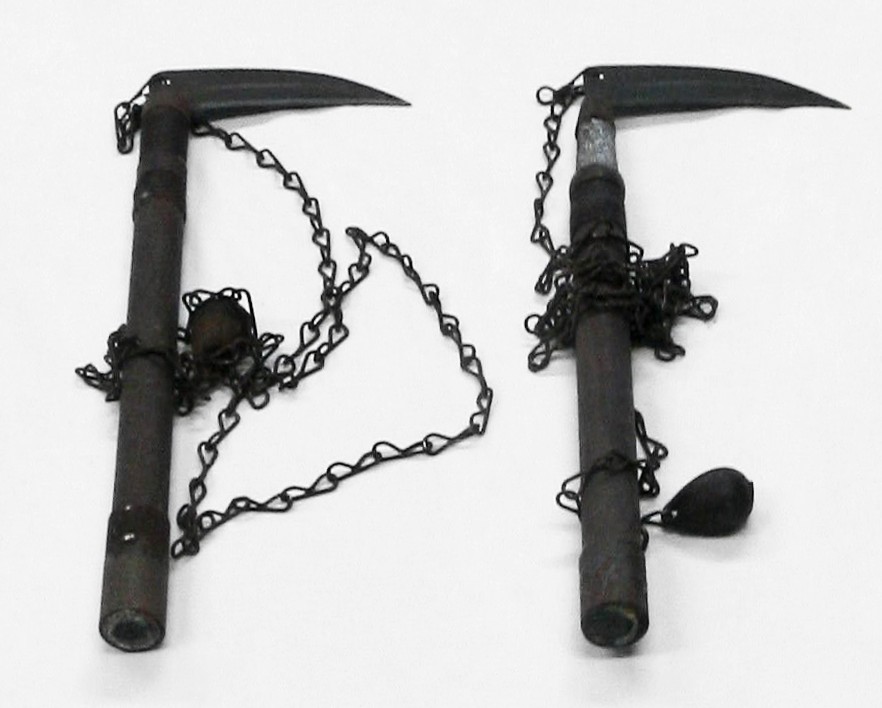
The Kama was combined with a chain and a weight at the end of said chain. This combination of weapons was called the Kusarigama (Kusari – chain, Kama – sickle). The chain and weight were used for ranged attacks and also to distract or deter opponents. The Kama came into action at close quarters while the chain could also be used to immobilize opponents if the opportunity presented itself.
A pair of Kusarigama. Observe the chain (kusari) and bulbous weight (fundo) attached to the Kama. Image credit – Wikipedia.
Observe all the versions of the Kama from the 3 images seen above. The blade is roughly at a right angle to the shaft, similar to the plough. Now observe the artistic depiction of the plough in the image below. The plough depicted is very large, but the form is very similar to that of the Kama.
Balarama depicted using a plough that looks like a very large Kama! Image credit – “The Bhagavata, Special Edition” (Kindle version), published by Amar Chitra Katha.
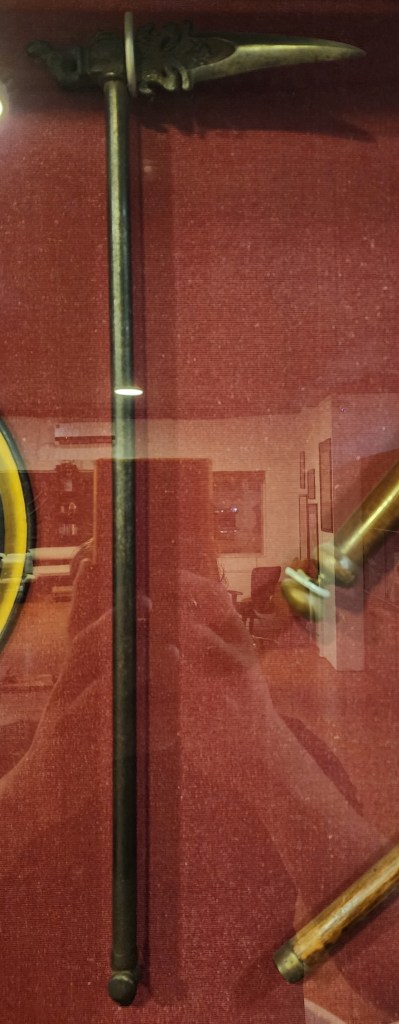
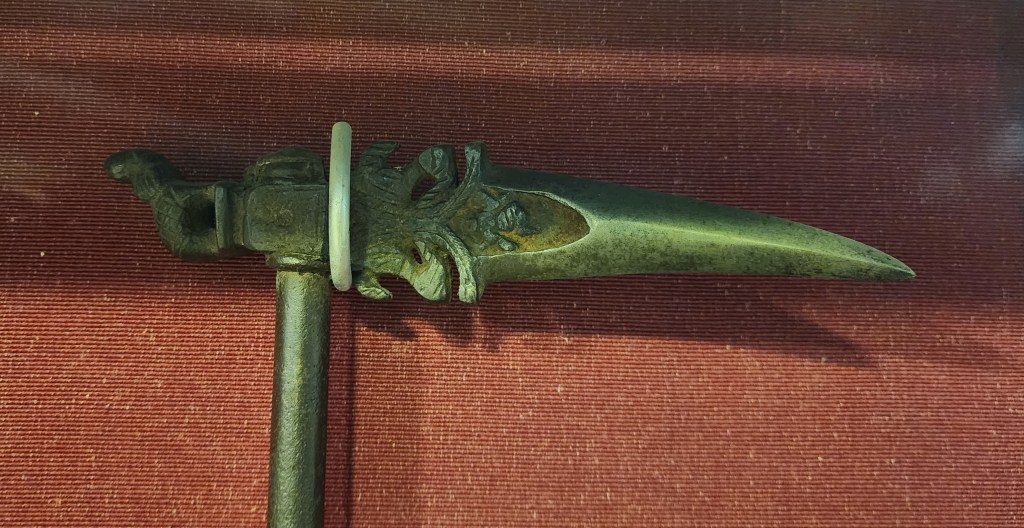
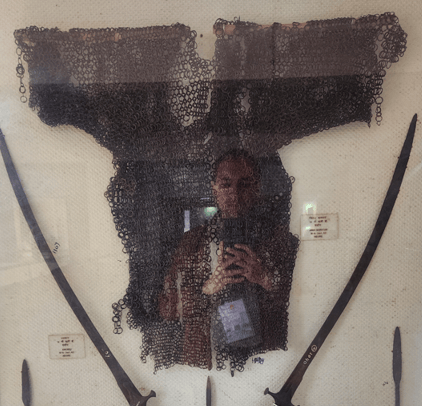
A weapon used across India, Persia and Europe is the past, that was similar in shape to the Kama and therefore the plough is the Crow’s Beak axe. This of course, was always a weapon and never an agricultural tool. The Crow’s Beak was useful against chainmail armour and to a limited extend against plate armour.
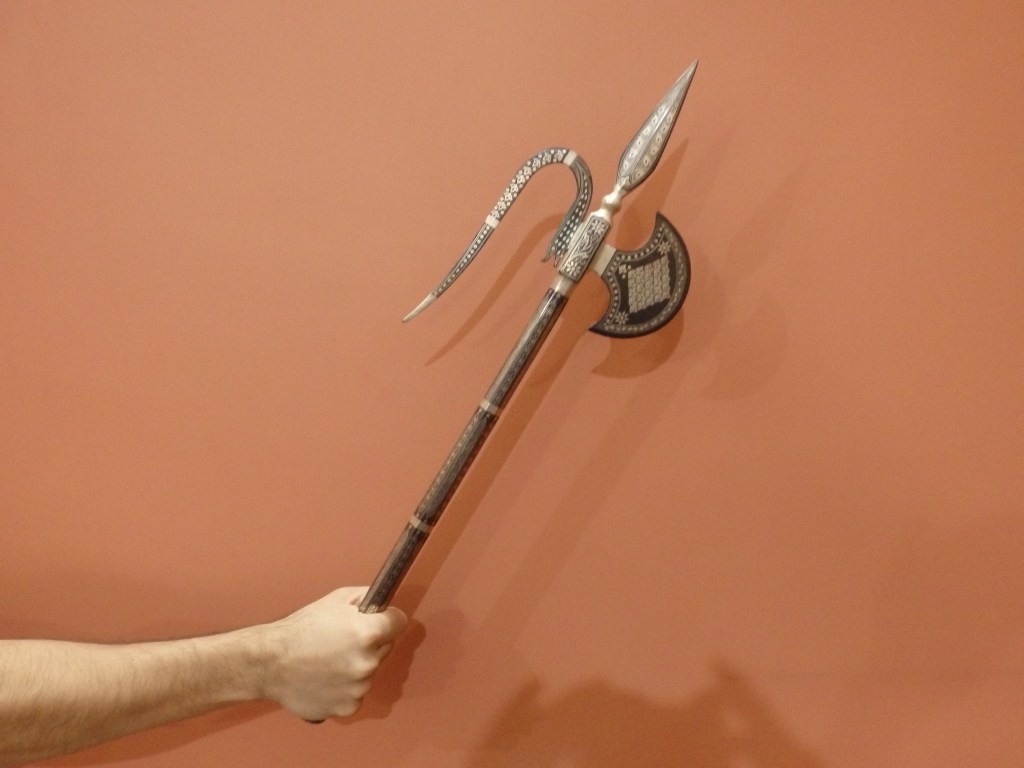
A Crow’s Beak axe, on display at the City Palace Museum, Udaipur, Rajasthan.Observe the incredible artistry on this weapon. Two elephats are depicted fighting at the base of the blade and Lord Hanuman himself is seen standing on the back!
A Crow’s Beak axe on display at a dojo.
This is a closeup of the head of the Crow’s Beak from the previous image.
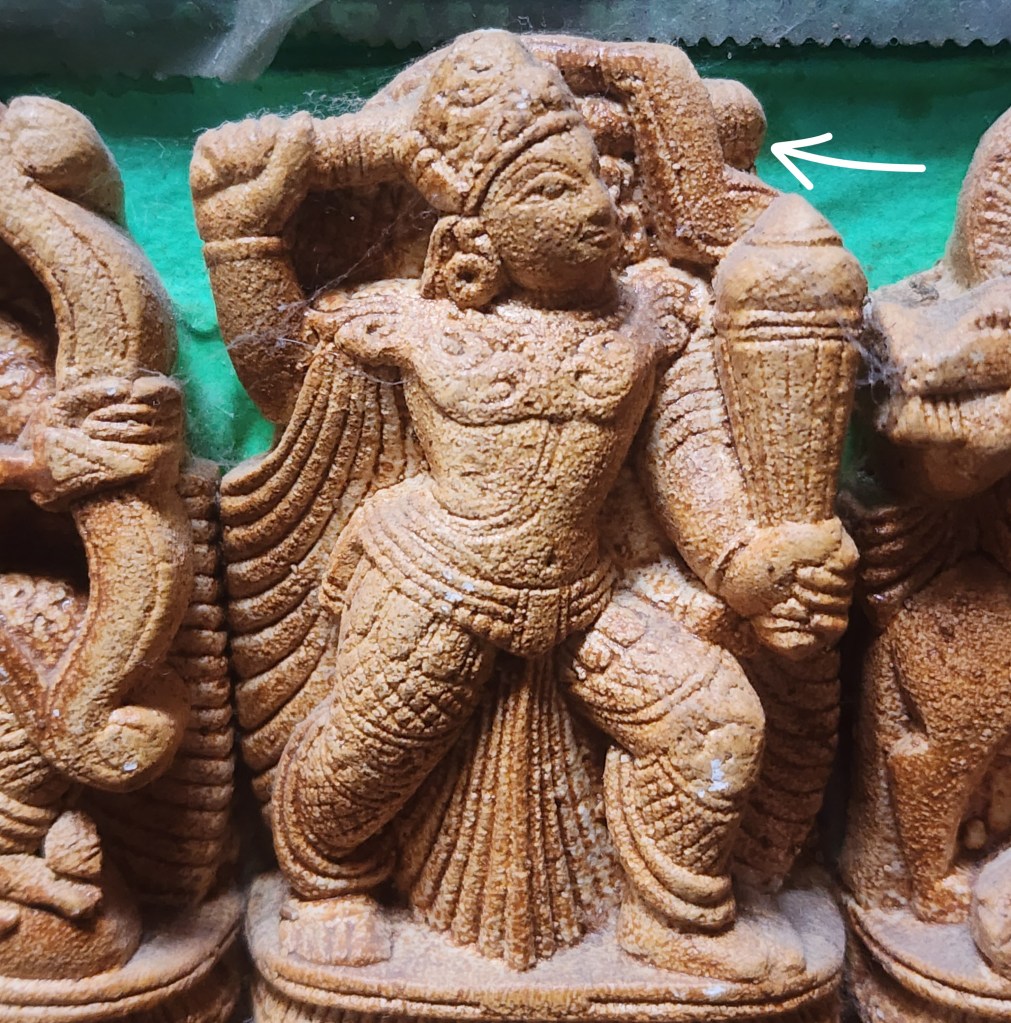
Now observe the image seen below. It is a closeup of the first image in this article. It is a modern-day depiction of Balaram in the style of ancient carvings. Here, Balarama wields the plough behind his head in his right hand and the club in his left hand. The plough is held like one would hold a Crow’s Beak axe while striking an opponent. The plough is indicated by the white arrow for clarity.
Balarama seen wielding the plough like an axe, in his right hand, while he holds a club in his left hand. The plough is indicated with the white arrow.
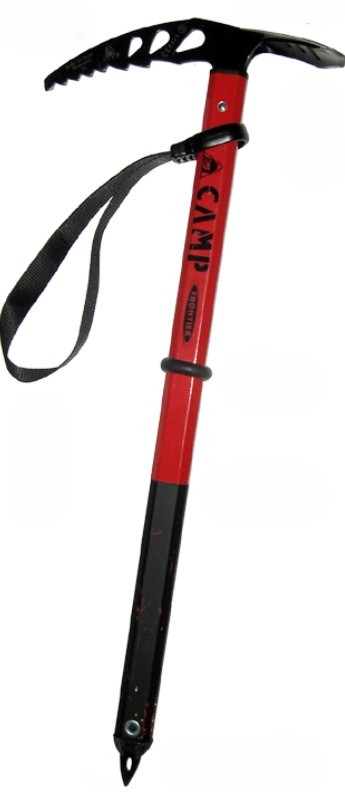
Considering this similarity to an axe, it must be noted that the depictions of the plough resemble two modern day tools. One is the modern-day Ice Axe, which resembles a plough due to the axe resembling the ploughshare in its angle to the shaft and the adze resembling the other part of the ploughshare, that farmers use to guide the plough in the right direction.
An Ice Axe. Image credit – Wikipedia.
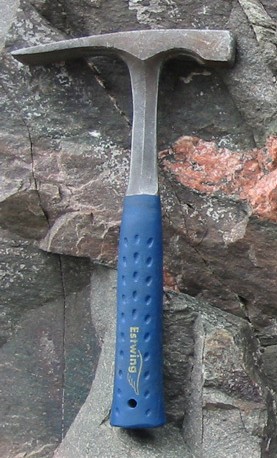
The other modern-day tool is the Geologist’s Hammer. This tool has a point or an adze on one side and the other side of the hammerhead is a regular hammer. Observe the image below and the similarity in the form factor will be obvious.
A Geologist’s Hammer. Image credit – Wikipedia.
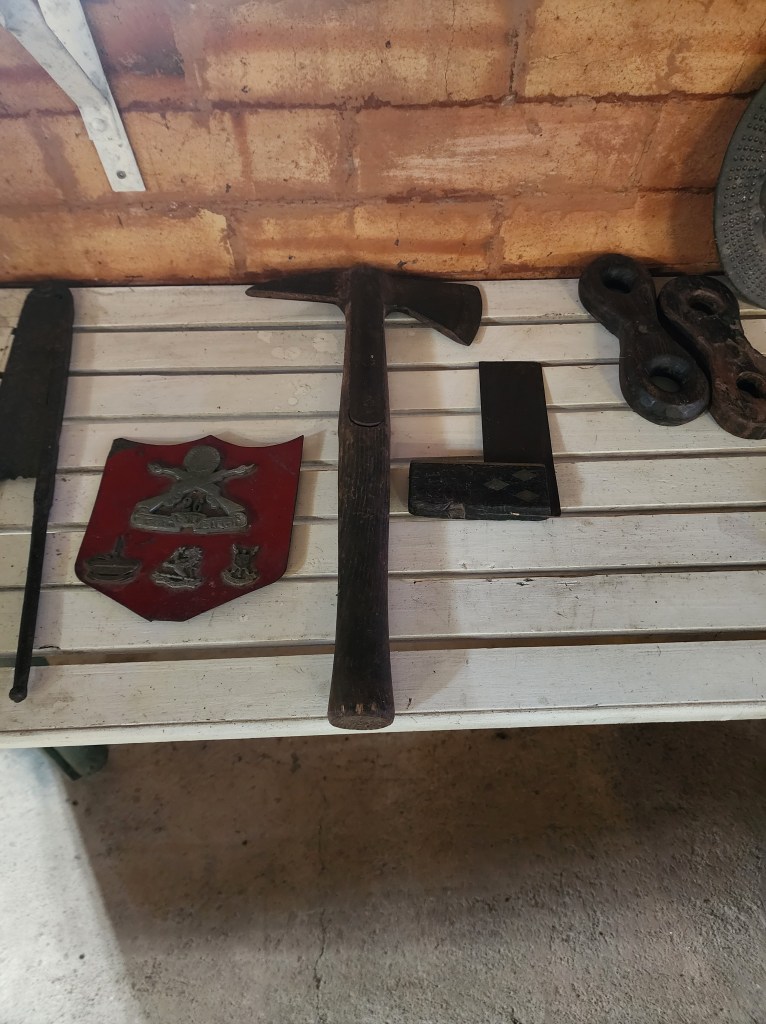
Now observe the historical tool or weapon seen in the image below. It is a one handed two headed axe which resembles both the Ice Axe and the Geologist’s Hammer! Further, it has a recognizable axe head on one side and a short sickle head similar to that of a Kama on the other side! 😊
A two-headed axe, with a normal axe head on the right and a kama sickle blade on the left. This specimen is on display at the Kumarakom Heritage Museum, Vembanad, Kerala.
Now, once again look closely at the plough depicted in the right hand of Balarama in the ancient coin. It looks very similar to another tool which also doubled up as a weapon from Indian history! I am referring to the Ankusha or the elephant goad. The Ankusha is the weapon of choice for Lord Vayu, the God of the Wind and the Guardian of the Norwest.
In the image below, ignore the axe and the spearhead. The hook attached to a shaft is the Ankusha in its basic form. This is very similar to the depiction of the plough in the coin! This weapon, while combined with a spearhead or an axe or both was used in Indian history. The Ankusha was useful in hooking & deflecting weapons, shields and the limbs of opponents when necessary.
An Ankusha. Ignore the spearhead at the tip and the axe head. The hook with the shaft depicts a basic Ankusha.If one looks closely at the plough held in Balarama’s right hand on the coin seen earlier in this article, it looks remarkably similar to an Ankusha!
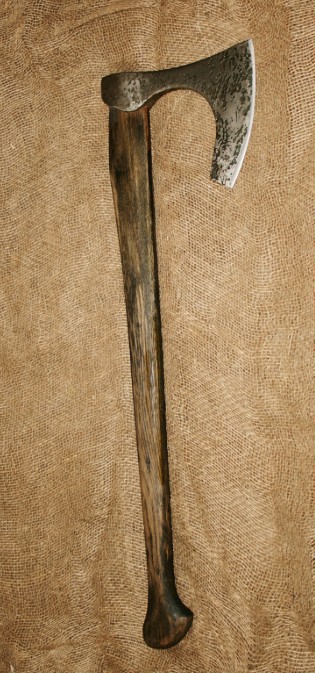
If we are speaking of an Ankusha and the plough can be held as an axe, we must mention the Bearded Axe. This is an axe that somewhat combines the utility of an axe and an Ankusha. The axe head delivers the blows while the “beard” of the axe head enables hooking weapons and the limbs of opponents. The shape of the axe head of a Bearded Axe, as seen in the image below indicates how an axe head could be constructed to function similarly to an Ankusha.
A Bearded Axe. Observe that the axe head also resembles the hook in the Ankusha in its form. Image credit – Wikimedia Commons.
Let’s now flip the plough, the smaller versions of course, that are depicted in Balarama’s hands. Imagine holding the plough depicted on the ancient coin, where the ploughshare is held near the fist and the shaft extends out beyond that. One could imagine this as the Ankusha from the image above held in reverse, with the spearhead being the handle. There did indeed exist such a weapon in Japan in the late 19th and early 20th centuries.
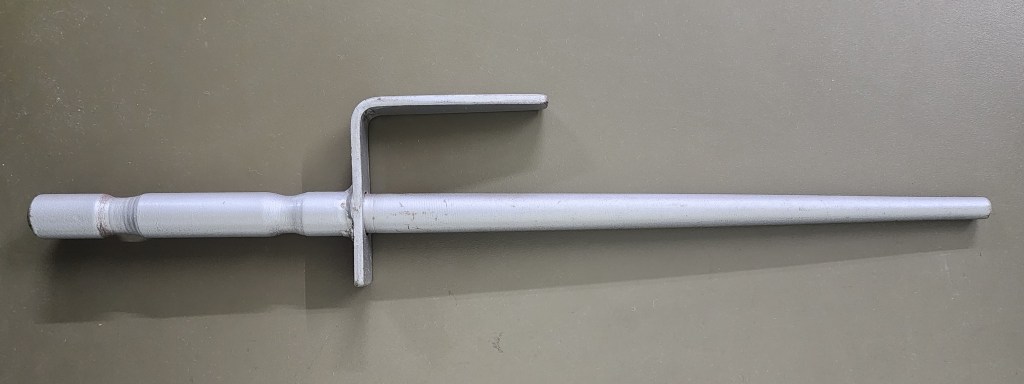
This was the Jutte. It was weapon issued to police officers in Japan when swords had been outlawed after the Meiji Restoration. The “hook” worked to catch/stop swords and redirect the attack. The protruding shaft made of metal worked efficiently as a club when necessary.
A training version of the Jutte. Observe that the slot looks similar to the hook on an Ankusha. This weapon is essentially a reversed Ankusha! Thus, it could be considered, in shape and form, a reversed plough as well!
Now let us get back to modern depictions of Balarama wielding a large plough. In the image below, while fighting the afore mentioned Vānara Dwivida, Balarama is depicted dual wielding a large pestle and a large plough! Imagine the strength that would require!
Balarama depicted dual wielding! With the plough and the pestle in each hand! Imagine the strength and skill needed to pull this off! :-) Image credit – “The Bhagavata, Special Edition” (Kindle version), published by Amar Chitra Katha.
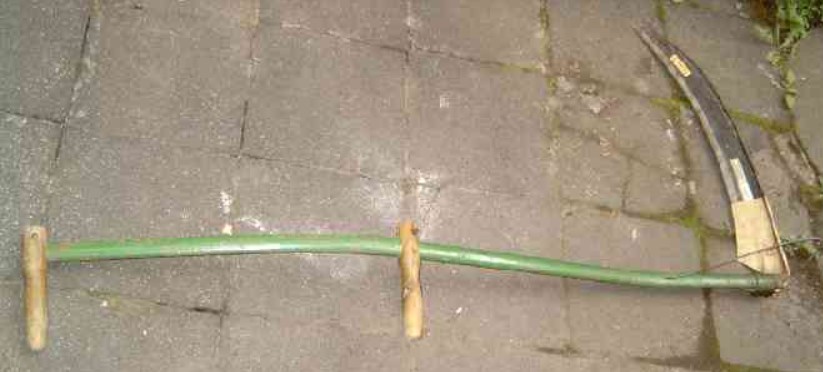
A tool that would resemble a large plough in form factor, if not in weight is the Scythe. This again, is an agricultural tool with a large sickle blade. The blade seems like an oversized blade of a Kama from Japan. This tool is also commonly associated with depictions of the Grim Reaper, who symbolizes death.
A Scythe. Image credit – Wikipedia.
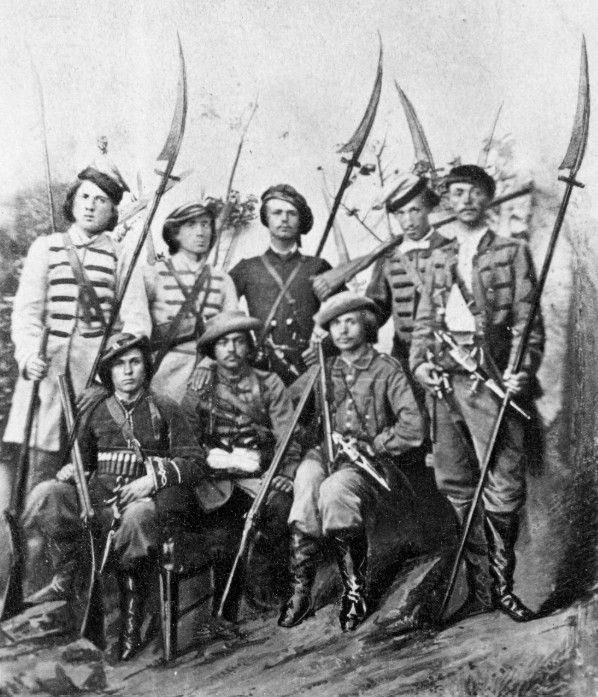
While the Scythe in its original form might not have ever been used as a weapon, there existed a weaponized version called the “War Scythe”. This was a polearm with the blade turned up 90 degrees, to be parallel to the shaft rather than the usual perpendicular. This weapon, interestingly, leads us back to Japanese weapons from history. The War Scythe resembles the Naginata, which was itself a version of a glaive. The Naginata has a short blade on top of a long shaft. The difference though is that the Naginata has the sharp edge on the outer side of the curve of the blade, while the War Scythe has the same on the inner side of the curve of the blade, just like with a normal scythe.
Troops from the Polish Lithuanian Commonwealth seen with their “War Scythes” in the mid-19th century. Image credit – Wikipedia.
I have no idea if Balarama ever used the plough like the weapons I described, but it is still worth considering, for warriors of the past, like their modern-day counterparts, could wield multiple weapons expertly, even if they had personal favourites among the tools of war. It would also not be wrong to presume that weapon designs borrowed from tools and warriors could adapt from one to the other as needed.
This concludes this article where I have tried to restrict myself to the martial aspects of Balarama that I could recollect. Balarama’s life is fascinating in many ways beyond his martial abilities. His marriage to Revathi has a sci-fi element to it, with time dilation being involved! Further, the pestle/musala/club/onake, while being a favourite weapon of Balarama’s, ended up being the implement responsible for the destruction of his entire clan! The Vrishni clan of the Yadavas literally self-destructed by killing each other with pestles! But these are points beyond the martial arts, at least for now.
I would encourage everyone to read both parts. However, if you are here, there is no need to read part one before coming to this post. To enable this, I am sharing the introduction to this series, which is also seen with part 1, below. This gives a reader a fair idea to go ahead with this post and visit part 1 later.
Over the years of training the Bujinkan system of martial arts, one will invariably study the different schools that form a part of the system. There are 9 schools that the Bujinkan is comprised of. Of the 9 schools, 6 are practiced regularly in dojos around the world. These 6 schools are mentioned below.
Togakure Ryu
Gyokko Ryu
Koto Ryu
Shinden Fudo Ryu
Kukishinden Ryu
Takagi Yoshin Ryu
When we train each of these schools, we learn the evolution of these schools. This consists of the conditions in which these schools had their origin and how they evolved over the years. The origin of the schools pertains to a region and its geography.
As an Indian, the terrain in different regions of Japan, where these schools had their origin and evolution, does not come to mind immediately. But the geography and climate which influenced and perhaps defined the schools for a very long period of time is important. To perhaps alleviate this issue, I am writing this post.
I will share images and examples from Indian history which are rough approximations of the geography and physical conditions in which the 6 schools mentioned above were created and evolved over time.
In Jan 2025, I had written a more detailed post about the schools form a part of the Bujinkan system of martial arts. The link to this post is seen below. Do refer to this link for more information about the schools.
We had looked at the Togakure Ryu, the Gyokko Ryu and the Takagi Yoshin Ryu in part 1, the link to which is seen above. We will look at the remaining 3 schools in this post.
KOTO RYU
The Koto Ryu is a sister school of the Gyokko Ryu (which we looked at in the previous part) in some ways. Over the course of history students from the two schools have been handed over the responsibility of the Soke (Inheritor – Grandmaster) for the other when there was a need. Gyokko Ryu is an expression of Kosshi Jutsu whereas Koto Ryu is an expression of Koppo Jutsu.
The Koto Ryu is not necessarily specialized towards close-quarters combat. It favours slightly greater distances between opponents, a “middle distance” if you will. The Koto Ryu also favours individuals moving in and out of the range of opponents. The distances change from short to long alternatively and as necessary. This is not unlike fighting with sword and shield. The use of the sword takes one closer to an opponent while defending with a shield allows one to move out of the range of an opponent’s attack.
The above image shows a woman wielding a sword and a shield. This is a carving that is present on the Keerthi Sthamb (Tower of Glory) in the Chittorgarh Fort in Rajasthan. This lady is wielding a short sword. So, her fighting style could be relatable to the Koto Ryu, even if this school does not specify the weapons to be used. As someone wielding a short sword and a shield, she would dart in and out of the range of an opponent, for attack and defence, movement which is emblematic of the Koto Ryu.
KUKISHINDEN RYU
The Kukishinden Ryu, based on what I have learnt, is characterized today by arms and armour. Quite some weapons we train in the Bujinkan these days come from the Kukishinden Ryu. Supposedly, a lot of the techniques in the Kukishinden Ryu are descended from situations where the opponents used armour to protect themselves. The methods used to put an opponent at a disadvantage when she or he is protected in armour differ from when opponents are unarmoured.
The Kukishinden Ryu is also supposed to have a heritage of use at sea. Sailors are supposed to have used the Kukishinden Ryu on ships, or large boats in the past. This included pirates and naval troops. This is not to say that the Kukishinden Ryu was not applied on land. I have never seen this school be practiced in modern day on boats. This aspect, while discussed, does not overly inform the manner in which the school is practiced.
The above image shows a chainmail shirt displayed in the State Museum in Bhopal, Madhya Pradesh. This is perhaps the most commonly used form of armour over several centuries across most of Eurasia. The protection chainmail provided against cuts and slashes affected the way soldiers moved since they could ignore attacks that were purely cuts. This armour did not give the same degree of protection against thrusting attacks.
The above image shows the plates worn by soldiers on top of chainmail shirts. These were worn on the front over the chest and on the back. This display is from the City Palace Museum in Udaipur, Rajasthan. These plates added protection against thrusts in addition to the protection against cuts that chainmail afforded.
This image shows chainmail leggings which also have plates for added protection. These are also displayed in the City Palace Museum, Udaipur, Rajasthan. Observe the round plates over the knees. The have wicked spikes! I wonder if kneeing an opponent with the spikes was a good idea though. If the kick is against an unarmoured part of an opponent, it would be effective. But if it was against armour, the damage would not be great.
The chance of the spike getting caught in the opponent’s armour or causing pain to the one kicking needs to be considered, before concluding that spike was a smart addition! Also, could it have been placed there for a psychological advantage over an opponent? For it looked scarier than it was effective? I guess that is food for thought.
This image is also from the City Palace Museum, Udaipur, Rajasthan. It shows a female guard of the women’s quarters (Zenana Mahal). This guard is armed with a chainmail shirt, helmet and a spear. These guards, as discussed with another image in the section for the Gyokko Ryu, also used swords, shields, daggers and early firearms. The spear forms practiced in the Bujinkan also have their roots in the Kukishinden Ryu. In a way, this image captures very well the essence of the Kukishinden Ryu, weapons and armour.
This image shows some arms and the armour used by Maharana Pratap. Pratap is perhaps the most famous ruler of Mewar and among the best-known warriors of historical India. In this display he is seen with a chainmail surcoat on top of a set of overlapping plates over his chest. The chainmail is fastened with a cummerbund.
Also seen in the image are his famous twin swords and spear, which was supposedly his favourite weapon. This display is also from the City Palace Museum in Udaipur, Rajasthan. The Kukishinden Ryu also has its own school of sword fighting. The kind of kit seen in this image is what would have been emblematic of elite warriors in India in the 16th century, which corresponds to the Sengoku period in Japan. This era was the high noon of mediaeval combat in Japan.
The above image shows a “Toothkudi Ship”. The image is from the Maritime Heritage Museum, Mahabalipuram, Tamil Nadu. This was a type of ship used historically on the East Coast of India.
This image shows a “Kottiya”. This image is also from the Maritime Heritage Museum, Mahabalipuram, Tamil Nadu. This was a type of ship used historically on the West Coast of India.
This image shows a model of a “Lakshadweep Odi”. The image is also from the Maritime Heritage Museum. This was a type of ship used historically on the on the Southwestern coast of India.
All the 3 types of ship seen above are what are classified as “Dhows”. Variants of this design of ship have been in use in Indian waters for almost 2 millennia, right up until the 20th century and were the mainstay of trade activities. The martial arts used by pirates and private guards of cargo and merchants would have likely applied their craft on boats of this kind.
SHINDEN FUDO RYU
The Shinden Fudo Ryu is a school that is supposed to have developed through combat in wooded areas. This school also has no defined physical postures (kamae), perhaps because keeping any defined physical posture in uneven terrain that forested areas present, is not practical.
The other oft observed aspect regarding the Shinden Fudo Ryu is that it uses open palm strikes. This supposedly is akin to the wings of birds which do not form fists! This attribute also harks back to the natural world which seems inextricably linked to the evolution of this school. In other words, the terrain seems to be the most important among the defining aspects of this school.
Many battles in Indian history have been defined by the terrain. One example is the Battle of Saraighat in 1671, where the river Brahmaputra played an important role in the victory of the Ahoms over the Mughals. Another example is the 3rd Battle of Panipat, in 1761, where the plain ground benefitted the use of mobile camel mounted artillery of the Afghans over the heavy artillery of the Marathas.
But one battle where the wooded terrain specifically aided one side was the Battle of Dewair in 1582, when the Rajput forces of Mewar defeated the Mughal Army in the Aravali Hills in Rajasthan. This Battle was fought in the hills and gorges of Dewair which is in the midst of the Aravali Hills, which are covered in dense scrub forest, which diminished the advantage provided by Mughal numerical superiority.
I am sharing videos and a photo of the terrain where this battle was fought. There is only a memorial built to commemorate this battle at the location. Nothing else has come up and no development has changed the terrain in nearly 450 years!
This video shows the entire area (Dewair ka Darra) where the Battle of Dewair was fought, from the top of the memorial that has been built. This shows the difficulty of the terrain for large bodies of troops to maneuver in.
This photo is from the road leading to Dewair. The density of the scrub and thorn forest on the slopes of the hills is clearly visible here.
This short video shows how poor the visibility is along paths with dense vegetation all around.
This video shows the terrain along the road close to the actual Gorge (Darra) of Dewair. Some of the sudden plunges in the rocky terrain are visible in this video.
The above photo and set of videos are a wonderful example of fighting in uneven terrain in wooded areas, very similar to the geographies that gave us the Shinden Fudo Ryu!
This brings me to the end of this two-part series of articles that show, from an Indian historical perspective, where the origins of the regularly practiced schools of the Bujinkan lie.
Over the years of training the Bujinkan system of martial arts, one will invariably study the different schools that form a part of the system. There are 9 schools that the Bujinkan is comprised of. Of the 9 schools, 6 are practiced regularly in dojos around the world. These 6 schools are mentioned below.
Togakure Ryu
Gyokko Ryu
Takagi Yoshin Ryu
Koto Ryu
Kukishinden Ryu
Shinden Fudo Ryu
When we train each of these schools, we learn the evolution of these schools. This consists of the conditions in which these schools had their origin and how they evolved over the years. The origin of the schools pertains to a region and its geography.
As an Indian, the terrain where the schools had their origin does not come to mind immediately. The terrain and climatic conditions in India are quite different (at least in large parts) from that in Japan, where these schools had their origin and evolution. But the geography and climate which influenced and perhaps defined the schools for a very long period of time is important. To help my fellow Indians identify terrain and conditions similar to the those that led to the birth of these schools, I am writing this post.
I will share images and examples from Indian history which are approximations of the geography and physical conditions in which the 6 schools mentioned above were created and evolved over time. I have used, as far as possible images and videos of places where actual combat occurred. All the images are videos in this 2-part series are taken by me during visits to these locations.
In Jan 2025, I had written a more detailed post about the schools form a part of the Bujinkan system of martial arts. The link to this post is seen below. Do refer to this link for more information about the schools.
I have heard from my teacher and mentors that the Togakure Ryu, at least in part, evolved from the way troops fought inside castles. The long deep kamae (physical posture) and linear movement in the Togakure Ryu is supposed to be an outcome of having to move linearly in narrow passageways. Castles, like many forts and palaces around the world, had narrow passages to defend them better. This same feature was true for walkways along fort walls. I am sharing images from the Udaipur City Palace the Kumbhalgarh Fort below.
The Udaipur City Palace was built with defence in mind, for the kingdom of Mewar, the capital of which was Udaipur, was at perpetual war with the Mughals, Afghans and other neighbouring Sultanates for centuries. Mewar’s earlier capital Chittorgarh was brutally sacked thrice between the 14th and 16th centuries.
Kumbhalgarh, was smaller than other major centres of Mewar, and was never held for long by her enemies. It seems to have been built mainly for defence, with a 36 km long wall (supposedly the 2nd longest in the world after the Great Wall of China). The walls have wide walkways in places, but the stairs up and down the walls are narrow and easy to defend.
The above image shows a narrow passageway in the City Palace, Udaipur, Rajasthan. Two people will have a really hard time walking next to each other in this corridor. And there are no deviations to duck into. So, anyone who enters will be at risk from the moment they enter until they exit. Of course, with sturdy and big shields one can safely traverse these passages. But the passages can be barricaded and attackers can have a hard time fighting defenders, even in small numbers, especially if they are using pole weapons, to slow down the attackers.
Seen above is another corridor from the City Palace, Udaipur. This one is much wider than the one in the previous image. Maybe 6 to 8 soldiers can walk next to each other here. But this also means a larger number of troops can hold corridors like this, in formation and full kit, like spears, swords, shields, armour and missile weapons.
This is a narrow staircase from the Kumbhalgarh Fort, Rajasthan. Not only is it narrow, one also cannot see what is on the other side of the doorway to the right at the top. This uncertainly adds to delaying attackers and gives defenders opportunities to fight back.
This image shows the entrance to another narrow staircase. Here, one needs to duck at the doorway, making one all the more vulnerable. This image is from the City Palace, Udaipur.
The above image shows the wall of the Kumbhalgarh Fort, indicated by the arrows in red. The wall stretches for 36 km, with varying widths. What is seen in the image is the widest part. It is said that 4 horsemen can ride alongside each other on the walkway. I would estimate that 8 to 10 soldiers can do the same. While this is much wider than the narrow passageways and stairways seen in the previous images, this is still not very wide. Considering that a fall off the wall would injurious, if not fatal, the lack of space is a considerable challenge to fighting on top.
This image shows the walkway on the wall from the previous image, a “ground level” view if you will. Not only is the path not wide, the occasional steps also make the ground uneven while fighting.
GYOKKO RYU
The Gyokko Ryu, from what I have heard, is perhaps the oldest school in the Bujinkan system. The Gyokko Ryu is a system of very close quarters fighting, with just about a half-arm distance between the opponents. I have heard that this was a consequence of the Gyokko Ryu evolving from fighting in small spaces, like chambers and rooms in castles and homes in historic Japan.
It is also said that this system was used by women, mainly of the court, to protect themselves in case the castle was breached and their quarters were attacked. This seems logical as the Gyokko Ryu was already adapted to be applied in small spaces.
Considering that palace passages were narrow spaces themselves, some of the concepts of the Gyokko Ryu would be applicable in the spaces where the Togakure Ryu would be applicable. Of course, there is not strict distinction in where a specific system of fighting should be applied. It depends on the opponents, the situation and what one actually is capable of or trained to do.
The above image shows a room from the Kumbhalgarh Fort. It is not very big. Even the royal chambers of this fort are not very large. The guide there said that this fort was a “fallback option” for the rulers of Mewar. When Chittorgarh was attacked or Udaipur was threatened, they retreated to Kumbhalgarh while planning a counterattack.
Kumbhalgarh was well defended by terrain, by the Aravali hills, which were forested as well. So, taking this fort was a lot harder than attacking the other 2 major centres of Mewar. Considering this “fallback” feature of Kumbhalgarh, the living quarters are small compared to other palaces. And fighting in these chambers is kind of what the Gyokko Ryu was designed for!
This image shows the walkway and watchtower at one of the higher points of the Kumbhalgarh Fort. Small cannons could also be placed here. Consider fighting in just the watchtower indicated with the red arrow. It is a confined space where fighting would be in very close quarters. While the walkway could be considered to be conducive to the Togakure Ryu and the Gyokko Ryu, the tower itself would be ideal space for the Gyokko Ryu.
This image shows the staircase up to the walkway of the main outer wall of the Kumbhalgarh Fort. It is so narrow that only one person can climb up at a time and her or his shoulder would scrape the wall doing so! I would say it is nearly impossible to fight on these stairs! It is pretty much suicide, if even a slight slip occurs.
Considering that the evolution of the Gyokko Ryu involved women in combat, here are 2 examples. Seen above is the chainmail armour of a female palace guard from the City Palace museum in Udaipur. The women’s quarters, or Zenana Mahal, had guards who were women. These fighting women wielded spears, swords, shields, early firearms, knives and bows and arrows.
This image shows a carving on the Vijay Sthamb (Tower of Victory) in the Chittorgarh Fort. It is a close up showing a woman mid-flight. She is wielding a dagger and is poised to strike at an opponent she has trapped with her legs. This is a classic example of close quarters combat. She is in grappling distance and is utilizing a short-range weapon. The dagger is seen encircled in red.
TAKAGI YOSHIN RYU
The Takagi Yoshin Ryu is another school that has a link to palace culture. I have heard it said that this school evolved, at least partially, from the skills developed by bodyguards while defending their patrons, who tended to be aristocrats and wealthy folk. The techniques in this school include those that involve taking down and restraining individuals, something akin to arresting individuals. This was supposedly to capture potential assassins, spies and similar criminals, so that they could be questioned for information later. Restraining individuals in turn involves some movements that are expressions of grappling.
The above image shows a carving on the Vijay Sthamb in the Chittorgarh Fort. This is the carving, the close-up of which was seen in the earlier image. I considered it a display of an expression of the Gyokko Ryu earlier due to the use of the dagger and the close quarter fight that is shown. However, this image can also be considered an expression of the Takagi Yoshin Ryu.
The woman in the image has restrained, or perhaps trapped, another individual with her legs. It seems like the trapped individual is struggling and using his right arm to maybe fight back. But the woman is wielding a dagger, poised to strike. What we cannot tell is if the dagger is a threat, promising injury or worse if the person does not surrender, or if it is the moment before she strikes the fatal blow. If it is indeed a threat, the trapped individual could be interrogated later!
The above image shows a panel from a temple in Pattadakal, Karnataka. This carving dates to the 8th century CE. India has a very long tradition of wresting and grappling arts. This tradition includes the martial systems of Malla Yudhha, Kushti and Pehalwani.
This panel shows people trying to trap and take done one another. Individuals are trying to restrain arms, trip the other over and grasping about the waist. In the far-left panel, one individual is attacking another from behind, using legs to apply a body choke (tai jime) and a choke on the neck with the hands.
This image also shows a panel from Pattadakal, Karnataka. This panel also shows scenes of grappling and an attack from the rear. Towards the right side is an individual either performing a head stand in celebration or has been flipped over by his opponents.
I will conclude part of this 2-part series here. We will delve into the Koto Ryu, the Kukishinden Ryu and the Shinden Fudo Ryu in the next part.
We have all seen the protests that were going on 2 weeks ago in New Delhi. The most shocking visuals were the clashes between the protesters (some of whom are students) and the security personnel, the Police and the Rapid Action Force (RAF). The tools used to cause violence were mainly stones and sticks, that we call lathis.
The police Lathi, as I have seen it, is about 3 feet long and comes up to the waist of a person. In the Bujinkan system of martial arts we would call this a Hanbo (han = half), because it is half of a rokushakubo (more commonly referred to as just a Bo), which is a 6-foot staff.
The other tool that was used is the shield, the police riot shield, which is, I think, made of a transparent polymer, which allows users to see through it. The other kind of shield that was used is the one made of cane or rattan. Apart from the shield, some security personnel, at the least the ones from the RAF seemed to have body armour.
The armour included protection for the torso in the front and the back and the same extended down to protect the groin. I think they also had protection for the elbows and knees. Some of them seemed to have shoulder pads as well, for shoulder and deltoid protection. Both Police and the RAF personnel had helmets.
A police lathi. Image credit – Wikipedia.
The clash was mainly between armoured personnel who are trained to deal with crowds against people who were, for the most part, not armoured. But some of the protestors also seemed to have acquired some kind of protection. The protection ranged from something as simple as a handkerchief, all the way to helmets, and lathis or sticks, of their own.
I’ve seen news reports say some protestors had “long lathis”. I’m presuming, this meant that some protesters had something which is longer than a baton (which is the length of a forearm or an arm at best). I don’t think anybody had 4-foot or 6-foot staffs, which would be the equivalent of a Jo or a Bo in Bujinkan parlance.
For protection against tear gas, protesters seemed to have goggles and masks of the simple kind, like N95 and simpler ones. Some seemed to have helmets of their own, apart from lathis. In some protests, not this one in Delhi, I have observed protesters use industrial gas masks!
The most prevalent form of attacks by both the security personnel and the protesters seemed to be the swing. The diagonal swing to strike perceived opponents seemed to the most one deployed by the protesters and those trying to disperse them. The diagonal swing was of two kinds, from the top right to the bottom left and from bottom right to top left. In the Bujinkan, we would call these swings “kesa kiri” (diagonal top to bottom) and “gyaku kesa kiri” (diagonal bottom to top).
The other swing that was also seen was the horizontal swing of the stick, which we would call a “do kiri” in the Bujinkan. Of course, a “kiri” is a cut an “uchi” is a strike or hit. So these would uchi and not kiri, because no one was trying to cut another person with a sword. For example, the horizontal swing would be a “do uchi” and not a “do kiri”. Fortunately, no one was trying to cause serious physical harm or kill anyone in the protests, though there were some injuries which were serious in nature. The two sides were trying to either hold ground or clear ground that was held. Any serious injuries seem to be due to a lack of control and not willful acts of harm.
Police riot sheilds. Image credit – Wikipedia.
The sticks or lathis used seemed to be made of rattan or bamboo. Some of lathis seemed to be made of polypropylene. The lathis made of both materials are pretty light. Back in the 2010–2014-time range, my teacher had gifted Hatsumi Sensei, the then Soke (Grandmaster/Inheritor) of the Bujinkan, a police lathi, because it was one of the most prevalent tools of law enforcement in India.
Some internet searching back then suggested that some 3 million police men and women in India were wielding lathis. This number is likely to be similar to this day. That is a lot of individuals utilizing what is essentially a hanbo in modern times! in India, it has always been the lathi that has been used and not the baton unlike in the USA. The baton is shorter, with a length that is similar to one’s forearm or arm at best, but greater girth. When police or other security personnel resort to charging a crowd with lathis, it is called a “lathi charge”, where as it might be called a “baton charge” elsewhere.
Both the Police and the RAF are trained in how to swing a stick, both when they have protection like a shield and/or body armour. In cases where personnel had no shield the lathi was being swung with 2 hands in some cases. Protesters are just common people, some with sticks, so I am presuming they have no training.
But it is being reported that some protesters were brought in only to cause trouble and add to the violence. It is not easy to tell these days if this was the case, and if true, could some of these individuals have had a modicum of training? There really is no way to tell, simply because they also seemed to be swinging sticks exactly like everyone else, with no clear difference in the form of the swing.
The fact that everyone was only swinging the stick to strike is interesting. This means that only one or two of the techniques of the hanbo, or even that of the jo, that we train in the dojo, were deployed. Even though there are some armoured and some unarmoured opponents, which makes a somewhat ideal case for the use of the forms we practice in the dojo.
Top – A 6-foot staff called a Bo. Bottom – A 3-foot staff called a Hanbo.
I suspect this is mainly because of the objectives of the protesters and the security personnel. The objective of the security personnel is likely only to clear the area of protesters. Therefore, they’re just going on the offensive, which does not give much room for maneuver. Forms that help in taking down and restraining people with a lathi were not needed here. In any case there are simpler ways to put unarmed and unarmoured protesters on the ground without needing to lock them with the lathi.
When the protesters swung the lathi, it seemed more retaliatory than defensive. Also, could it be that they knew that their fellow protesters might not be able to help them in subduing security personnel by using locking and restraining methods with a stick? I suspect it is likely, for they are very likely to had very little training in working as a group, especially with lathis as tools.
The other factor is perhaps the crunch, with the large numbers of people. When protesters build up and they try to break through the barricades that were placed in their path, the points of ingress and the width of the lanes meant that there was a need for constant quick movement of many people. This does not favour any restraining or locking techniques, those will only slow down crowds. If specific individuals are employing these techniques, they become targets, so it seems unlikely anyone will ever consider the forms we train in the dojo.
I don’t think the space constraint was an issue. If one can swing a stick, one can use restraining methods because they take lesser space. Both security personnel and protesters seemed to find niches and spaces where they could swing the sticks without striking fellow group members.
Time constraint was perhaps more of an issue. Restraining individuals and subduing them takes time, and nobody wanted to spend time on that since the objective was either to either occupy a space or clear one.
I suspect it is not necessary these days to arrest anybody immediately or on the spot. That can happen later if necessary. There are drones and cameras with facial recognition, which can identify specific individuals who can be arrested later.
So, it was all about offence on both sides or defensive offence where groups of people were moving back or moving forward. It seemed like a situation where groups surged forward, retreated and the entire thing was repeated multiple times. I do not think anyone has actually seen battles in the early medieval era, but could it resemble this kind of movement?
I am trying to be dispassionate in this post. It is not that I’m not political. I have my own political views. I am as political as anybody else in modern day India. I am very sad about what has happened.
But one can also dispassionately observe how actual violence and fighting seems to take place when there is a large group of people involved. If there were a much smaller number of people involved and one side had a constraint, of causing as little injury as possible to the other side, restraining and controlling techniques with the staff might have come into play. But otherwise, it was pretty much swing and swing as hard as one can.
Diagrams showing a potential way to use a Jo (4-foot staff). Specific techniques like this one were NOT observable during the clashes.
I will add a few more observations before concluding. Restraining and locking techniques we train in a dojo are designed for use against armour because one easily can’t get through the same with a strike. Additionally, even though the techniques can be executed fast, it needs the attacker to be really into an attack with no hesitation.
The criterion of the attacker “being into it” was fulfilled during the clashes that took place during the protest. And perhaps restraining techniques, if they were part of the training of the security personnel, might have been used and we might have not seen those used as they were few and far between.
It also seemed at times that the protesters had numbers on their side. The lack of numbers on the side of the security personnel side showed when both sides were aggressive. There were times when security personnel had to beat a hasty retreat, with some of them sustaining nasty injuries.
It could also be a balance between numbers and training. Training involves restraint, because nobody is trying to deliberately cause serious physical damage or death. Everybody involved in the clash was only trying to get a point across. In one case that point may be political and in the other it was situational. The entire situation was about “Control” – crowd control, or control of the narrative, or just “control of that given space, at that given time”, if nothing else.
I am not sharing any videos or photos of the clashes that took place. There are a lot of videos and reels circulating online. Anyone can go and look for them. I’m not sharing these because this article is not about the protest itself. It is about certain observations related to it. Also, at this moment I feel it is not appropriate to share the videos and photos from that tragic event. The wounds of the clashes are raw. It’s a sad situation for all of us Indians.
11th July is celebrated as “Word Horse Day”. This gives us a good opportunity to discuss horses, armour and the martial arts. The most famous horse in Indian history is likely Chetak, the mount of Maharana Pratap in the 16th century.
Seen above is a statue of Maharana Pratap astride Chetak. This statue is from the Maharana Pratap memorial, Moti Magri, Udaipur, Rajasthan. Chetak carried Pratap into many of his battles, including the famous Battle of Haldighati in 1576. Chetak also breathed its last during this battle.
The image seen above shows the armour worn by Chetak when it was ridden into battle. This image is of the exhibit in the City Palace Museum, Udaipur, Rajasthan. The armour includes a saffron tabard as the lowest layer. Over this is a combination of chain mail, overlapping lamellar armour and reinforcing circular plates to protect a lot of the horse’s body. The armour includes a protective plate to protect the front of Chetak’s head. Interestingly, a fake elephant trunk is part of the protection for the head/face.
The above image shows the combination of tabard, chain mail and the reinforcing plates from the side. The stirrup and saddle are clearly visible in this image. Could it be that the armour below the stirrup does not have lamellar plates to protect the rider’s legs from chafing?
The above image shows the lamellar part of Chetak’s armour up close. The small overlapping plates are clearly seen in this image.
The circular metal plates that protect the lower parts of Chetak’s fore and hind quarters are seen up close in the above image.
Observe the armour used by Rajput warriors in the 16th century. It also includes chain mail and lamellar protection for the torso. This shows that the armour for Chetak was remarkably similar to that designed for humans! This exhibit is also from the City Palace Museum, Udaipur, Rajasthan.
Seen above is the information shared regarding Chetak’s armour displayed at the City Palace museum in Udaipur, Rajasthan.
The 2 images above show a closeup of the protection provided to Chetak’s head and face. Also seen up close is the fake trunk. The guides at the museums say that a fake trunk was affixed to the head of a horse to confuse elephant on a battlefield. Apparently, elephants would assume the horse was a small or baby elephant and give them pause in their attack. I am not sure how true this is or how effective this strategy was. This same information is also seen in the information plaque with information regarding Chetak’s armour.
Chetak, as I mentioned earlier, gave up its live during the Battle of Haldighati in 1576. The forces of Mewar, led by Maharana Pratap fought Mughal forces led by Raja Man Singh of Amber in this battle. The forces of Mewar started very well in this battle when the battle was fought in a narrow pass. Later when the fight moved to a plain, the superior numbers of the Mughal forces took their toll and Maharana Pratap has to retreat.
During the battle, one of Chetak’s hind legs was severely injured. Yet, Chetak carried Maharana Pratap to safety. The horse is supposed to have leapt over a gorge caused by a stream to evade Mughal pursuers. Maharana Pratap escaped successfully, but Chetak was spent after the last leap and breathed its last almost immediately after.
Maharana Pratap is supposed to have been distraught at the loss of his loyal mount. A memorial or samadhi was built for Chetak near the spot where he leapt over the gorge and gave up his life. This samadhi exists to this day and is a popular tourist destination.
Seen above is the samadhi built for Chetak in Haldighati.
Seen above is the plaque describing Chetak’s samadhi.
The above 2 images show a close up of the chhatri or cenotaph dedicated to Chetak at the samadhi sthal (place of the samadhi/memorial).
The above video shows the location where Chetak is supposed to have leapt over the gorge. The stream itself is now overgrown and not visible but is clearly audible, as discernible from the video.
It is said that during the battle of Haldighati, Maharana Pratap on Chetak and Raja Man Singh on his elephant came face to face. Chetak is supposed to have reared up on its hind legs to enable its master to hurl his spear at Man Singh. Man Singh survived, but his mahout lost his life to the spear. This supposedly made the elephant go out of control and diminished Man Singh’s ability to command effectively.
But while rearing up on his hind legs, one of Chetak’s hind legs is supposed to have been badly injured by the blades attached to the elephant’s tusks. Many images I saw in Udaipur depict the elephant holding a sword in its trunk. An example of this is seen below. This image is from the Pratap Vijay Smarak, Dewair, Rajasthan.
The depiction seen above is not a one off. There are at least 3 depictions I saw of something similar in 3 different museums! Personally, I am not convinced that an elephant held a sword in its trunk. It is more likely that blades were attached to the tusks of the elephant.
The above image shows a display of a surviving sword attached to an elephant’s tusks. This image is from Wikipedia.
Another example of swords mounted on an elephant’s tusks is on display at the Royal Armouries in London. This exhibit is used as an example in the above video. This is an episode of the popular History Channel series, “Forged in Fire”. This episode challenged a couple of master blacksmiths to recreate this sword! I opine that something like this might have injured Chetak at Haldighati, unlike what is depicted in the painting shared earlier.
Another famous horse that finds mention in Indian history is Bucephalus, Alexander’s horse. Bucephalus lost its life during the battle of Jhelum (battle of Hydaspes), when Alexander’s forces fought the forces of Porus. Alexander is supposed to have built a town in memory of Bucephalus. Google Gemini tells me that this town is identified as likely being Jalapur Sharif in the Jehlum district in Pakistani Punjab.
Observe the text at the bottom of the above image, underlined in blue, which shows the numbers making up an Akshauhini. Image credit – “Mahabharata 30 – The War Begins”, published by Amar Chitra Katha.
Horses have always been vitally important in Indian history. The Mahabharata gives some staggering numbers for the total number of horses that participated in the Kurukshetra War! Some details of these numbers are shared below.
In the Kurukshetra war, there were both cavalry and chariots, both of which used horses.
18 Akshauhinis (loosely translated as a “Division”) participated in the Kurukshetra War.
Each Akshauhini consisted of 65,610 cavalry and 21,870 chariots.
Each chariot was pulled by 4 horses.
That brings the total to, {(65610 * 18) + ([21870 * 4] * 18)} = 27,55,620 HORSES IN THE WAR!
That is 27.5 lakh or 2.75 million horses! That is the current population of Jamaica or Lithuania!
Observe the text at the top of the above image, underlined in yellow, which shows the number of horses per chariot. Image credit – “Mahabharata 30 – The War Begins”, published by Amar Chitra Katha.
In recent times, the Marathas come to mind when cavalry is mentioned. The Marathas captured a very large part of India by being excellent light horsemen whose maneuverability was respected by all their opponents. Even among the Rajput warriors, I personally feel that the design of the spear they used was influenced by their cavalry habits. I had written a post about this, which is shared below. I opine that the rings or bands at different points along the length of the spear could partially be due to its intended use as a lance from horseback.
Of course, the world has seen great cavalry and equestrian cultures all over the world throughout history, starting with the Scythians and Hunas (Huns) to the Mongols and the Hussars, all of whom inspired awe. The performances of mounted horsemen to this day are special, be it with tent pegging, mounted archery or any number of stunt performances all over the world.
In current times, owning and maintaining horses is extremely expensive. So, even though equestrian sports have survived and evolved, martial arts from horseback have diminished and are not practiced much. We no longer practice fighting from horseback, let alone fighting other cavalrymen. We do not know much about the nuances of fighting with swords or spears from horseback as against using the same while on foot.
Even in the Bujinkan system of martial arts, which I am a student of, it is said that cavalry techniques were a part of the disciplines practiced historically. Of course, there was no Bujinkan back then, and cavalry techniques were a part of the Ninja Ju Hakkei which informed the Togakure Ryu.
Historically, there are 18 segments of the Togakure Ryu, of which only a few are practiced regularly in modern times. One of the 18 segments of was “Ba Jutsu” (“Ba” refers to horse and jutsu is “art/practice of”) which included horse riding and cavalry techniques. Ba Jutsu, as far as I know is not actively practiced in the Bujinkan or even just in the Togakure Ryu anymore.
2026 is the Year of the Fire Horse. I had written an article in February of this year exploring the relationship between the horse, knowledge and the martial arts from a Hindy perspective. I am sharing that post below. The earlier article juxtaposes with this one, which is purely about the physical aspects of fighting with respect to a horse.
I will conclude this article with a reference to Chetak’s enduring legacy in modern India. From the 1970s through to the late 90s, Bajaj Auto produced a scooter brand called “Bajaj Chetak”. This scooter was named from the mount of Maharana Pratap himself. It was an extremely popular model of scooter and was widely seen on Indian roads. It has not been reinvented as an electric scooter. Chetak thus lives on in collective Indian memory.
An early and iconic model of the Bajaj Chetak. Image credit – Wikipedia.
The stories in Hindu culture are case studies to understand life experiences and perhaps identify paths to follow when times of travail are experienced at various points in an individual’s life. These stories include the various tales depicting instances from the lives of Lord Rama and Lord Krishna.
Lord Rama is called “Maryada Purushōttama”. Lord Krishna is called “Leela Purushōttama”. The word “Purushōttama” is made up of the words “Purusha” and “Uttama”. “Purusha” means human or generically “man”. “Uttama” means excellent or of the highest order. So, “Purushōttama” means an extraordinary or excellent human or an individual who is of the highest calibre.
“Maryada” has multiple meanings, from “respect” and “honour” to “norms” and also “limits”. When we say “limit”, it specifically refers to “self-control”. “Leela” can mean “play (of the divinities)” or “tale” or “story”. A story is nothing but a possible (plausible?) or potential scenario.
I had written a whole post about the “Maryada” aspect of Lord Rama, a link to which is seen below. Lord Rama was a God. He needed to follow no rules that applied to the people he lived with. He was not even subject to the laws that applied to kings who were responsible to their citizens. But he followed every rule that applied to humans diligently, even when it resulted in great personal tragedy. He followed the rules even when the rules were not just, at least by modern standards.
Lord Rama could have broken every rule with absolutely no consequences to either himself or anyone dear to him. He could have protected them with divine abilities. But he CHOSE a life of hardship by foregoing the abilities of the divine. This was his SELF-CONTROL, the ability to stay human by limiting the use of the divine. This demonstrated ability throughout his life is what makes him Maryada Purushōttama.
Lord Rama’s life shows the benefits of self-control despite the pain it causes. This fact is what makes his life a case study. To demonstrate some instances from Lord Rama’s life when he chose hardship due to self-control instead of the loophole divinity provided, are seen below.
Lord Rama was going to be anointed heir apparent, but he lost this position due to a promise his father had made. He further lost his home and the company of his family in the same sequence of events when he was exiled to the forest. He accepted this loss because it was his responsibility, as he saw it, to uphold the word of his father.
Lord Rama chooses to keep his father’s word despite Bharata requesting him to change his decision. Image credit – “The Ramayana”, published by Amar Chitra Katha.
Even when his father was no more and he could have chosen to reverse the exile, as the person whose word he was upholding was no more, he did not. His brother Bharat, in whose interest he was exiled, beseeched him to return and yet he let the exile continue, for the word of his father was a sacred contract to be upheld. It was like he was the heir apparent to even his father’s promises, even if the consequences of the promise were not in his best interests, and the promise was being extracted in bad faith. Lord Rama was not obligated to do keep his father’s word, yet he did.
Lord Rama rescued Devi Sita from Ravana. But this came at the cost of a very large number of lives. And despite all the effort, Devi Sita had to endure the Agni Pariksha to satisfy the norms of society as it existed then. He did not stop this either as a God or as a man who commanded enormous respect, because this would put him above the rest of humanity.
Devi Sita has to endure the Agni Pariksha. Image credit – “The Ramayana”, published by Amar Chitra Katha.
Eventually, he had to abandon Devi Sita again, to prevent setting a wrong precedent to a society that used his life as an example to cover up their mistakes. He never tried to create an exception despite his ability and right to do so. This was despite doing so would be the right thing, as we see it today. He put the sanctity of societal norms above what we would consider the “right thing”.
These events reveal that the purpose of the Rama avatāra was not just the elimination of Rāvana; it was to render a life as a case study in restraint and self-control.
Lord Krishna is the one who shows possible situations and outcomes through the story of his life. The “possibilities” that are shown highlight how rules and norms can be challenged, especially if they seem wrong at any given time. This is despite all of society or any individual of power or even a God choosing to disagree and uphold a norm that is wrong.
Lord Rama chooses to abandon Devi Sita despite knowing it is not the right decision. Image credit – “Sons of Rama”, published by Amar Chitra Katha.
This act of identifying possibilities is the act of upholding Dharma (that which sustains) even when that results in actions that endanger one’s self, reputation and legacy. Some instances from Lord Krishna’s life when he chose to circumvent the “norms and rules” to sustain Dharma, are seen below.
Lord Krishna encouraged the worship of a mountain (Govarhdana) over the worship of Lord Indra, because the worship of Indra was carried out due to fear of retribution and not genuine devotion. This act incurred Indra’s wrath and Lord Krishna chose to employ his divinity to protect his fellow citizens. Not for him were the need to live as a human and suffer unjust retribution.
Lord Krishna suggests that Govardhana Giri (mountain) is worthy of worship over Lord Indra. Image credit – “Tales of Krishna”, published by Amar Chitra Katha.
Lord Krishna chose retreat(!) over a need for victory against Jarasandha, the mighty ruler of Magadha. Dwaraka was built on the coast, far away from the reach of Jarasandha. The people of Mathura had to endure several invasions from Jarasandha. While Krishna and his brother Balarama, with their inhuman abilities defeated each of the invasions, prosperity could only be ensured by retreating from the Jarasandha’s sphere of influence.
Lord Krishna holds up Govardhana Giri (mountain) with his little finger! Image credit – “Tales of Krishna”, published by Amar Chitra Katha.
Krishna used deception several times during warfare. This was despite his having to live by the code of the Kshatriyas and fight fair. Some instances when Lord Krishna chose deception to end conflicts are,
Running away from Kālayavana, to lead him into a trap in cave where Muchukunda inadvertently killed him. This act made him earn the epithet, “Ranchod Das”, or “one who runs from a battle”, which is not really a flattering adjective.
Krishna used the Pandavas to eliminate Jarasandha, and that was by tricking the king of Magadha into a duel against Bhima, the only person who could defeat Jarasandha, away from the battlefield.
Krishna defeated Narakāsura by bypassing his armies and carrying out an air raid on the latter’s palace at night, where Narakāsura was sleeping! Not only did Krishna violate norms by attacking at night, but he also used Garuda, who was a divine being, to circumvent a large part of Naraka’s troops.
During his peace mission to Hastinapura, in a last-ditch effort to prevent war between the Kauravas and the Pandavas, Krishna revealed his divine form (Vishwaroopa) to try and convince Duryodhana to make peace. If Duryodhana had been a bit more reasonable, he would have seen the futility of going up again a God.
Krishna used an illusion to enable Arjuna to kill Jayadratha and a lie to defeat Drona during the Kurukshetra War.
Mathura survives 17 invasions by Jarasandha! Image credit – “Krishna and Jarasandha”, published by Amar Chitra Katha.
Thus, the Krishna avatāra was a case study in the need to uphold the essence of Dharma and not just the rituals and norms that seem to lead to Dharma. Dharma evolves and this necessitates evolution in ways of life; rigidity (rules and norms) itself could become the enemy of Dharma. This vision of what evolution could lead to is perhaps what the many “Leela” of Lord Krishna demonstrate.
Krishna runs away from the battlefield despite being a Kshatriya! Image credit – “Krishna and Jarasandha”, published by Amar Chitra Katha.
The Bujinkan system of martial arts, among many other concepts, emphasizes self-control and a need to adapt. The two concepts are interlinked. In a situation of real physical conflict, one can never apply techniques as they are taught and trained in a dojo. The forms and techniques trained in class are just options that are available to a practitioner, they are “possibilities”.
The form or technique or even just a concept that can be applied in a conflict against a single or multiple opponents, is a choice to be made by the individual(s) participating in the conflict. The consequences of the choices lead to further choices and so on, until the conflict is hopefully mitigated. Each choice is like a “Leela” (though not divine) we discussed earlier in this article.
Krishna and the Yadavas retreat to Dwaraka to survive further invasions by Jarasandha. Image credit – “Krishna and Jarasandha”, published by Amar Chitra Katha.
For example, if there are multiple opponents, receiving the attack by not trying to escape might not be wise. If an opponent is unarmed, strikes against this person might be viable. If the opponent is being violent and high on substances, subduing the opponent might be the need of the hour. One needs to adapt to the situation and “THE SITUATION” changes every INSTANT. This continuous adaptation is to flow with the changing situation.
This is no different than being able to see the “possibilities” at every instant. If one can train oneself to be able to see multiple possibilities at all times and adapt, one is as close to being “limitless” as possible. I am referring to a physical conflict, but the same principles will apply even if one is involved in a verbal altercation or a tough negotiation, which is nothing but a conflict over a favourable deal.
Krishna carries out an aerial attack on Narakaasura, while mounted on Garuda. Image credit – “Tales of Krishna”, published by Amar Chitra Katha.
A key ingredient in being close to “limitless” and able to see several options at all times is SELF-CONTROL. At its simplest level, self-control could simply mean not expecting any form or technique applied in a fight to result in an expected outcome, specifically the outcome seen in a dojo during regular practice. Different opponents have vastly different physical abilities and skills based on their background, genetics and experience in different martial arts. This means doing what needs to be done to survive and not expect anything one does to work in a specific manner.
If any action does not have a desired outcome, one must adapt instantaneously. There is no room for anger at the opponent, doubt in the self because a technique did not work or any analytical paralysis. This stopping oneself at an emotional level and staying in the moment to stay alive and use all opportunities available is SELF-CONTROL. This needs to be applied at all times. SELF-CONTROL and FLOW (BEING LIMITLESS) are both equally important and two sides of the same coin in any situation that needs conflict management.
Krishna attacks a sleeping Narakaasura, violating the norms of war! Image credit – “Tales of Krishna”, published by Amar Chitra Katha.
Thus, one needs to apply the traits demonstrated by both Lord Rama and Lord Krishna during their respective lifetimes. In my opinion, the continuous application of both self-control and flow is like switching between Lord Rama and Lord Krishna incessantly!
So, practicing the Bujinkan and perhaps other martial arts as well, is akin to celebrating the interplay between Lord Rama and Lord Krisha all the time! 😊 Rama to control the self and decide when to limit one’s own “need to do” or “expect something” and Krishna to “stay limitless in going beyond form” and “seeing the endless possibilities in any movement”.
Krishna uses a deceptive illusion to enable Arjuna’s slaying of Jayadratha. Image credit – “Mahabharata 35 – Arjuna fulfills his vow”, published by Amar Chitra Katha.
Krishna convinces Yudishtira to lie, against his nature, to stop Drona. Image credit – “Mahabharata 36 – The Battle at mindnight”, published by Amar Chitra Katha.
An aside – Sanjeev Sanyal, member of the Prime Minister’s Economic Advisory Council, has spoken several times about how the core of Lord Rama’s and Lord Krishna’s lives was the debate between the letter of the law and the spirit of the law. Lord Rama’s life was about living a life as described by the law, even if the law seemed unjust at times, while Lord Krishna’s life was about not following the law when it went against the spirit of the justice or the law itself. What I have described about Lord Rama and Lord Krishna in relation to the martial arts is not very different as concepts go, from this view expressed by Mr. Sanyal. Seen below is a video where Mr. Sanyal is expressing his views.
17th June is Maharana Pratap Jayanti, a holiday in Rajasthan. This day commemorates the birth of one of Indian history’s greatest warrior heroes. This is a good opportunity to discuss and celebrate what was supposedly his favourite weapon, the spear. The spear used by the Rajputs is unique in certain ways. Let’s explore these facets.
Observe the statue seen in the image below. This is a statue of Maharana Pratap.
Image 1 – Statue of Maharana Pratap at the Govt. Museum, City Palace, Udaipur, Rajasthan
There are 2 swords worn by the warrior in the statue seen above. Maharana Pratap is almost always depicted wearing 2 swords. But this article is about the spear he is shown wielding. Observe the spear where the arrows in the image are pointing.
One will see that there are rings or bands at different points along the length of the spear. These rings or bands segregate the shaft of the spear into segments with nodes, almost like bamboo. This observation brings up the following questions for me. This article is me pondering the answers to these questions.
Why do these rings or bands exist?
How do they help in the use of the spear?
Do they show us how the weapon might have been wielded historically?
But first we need to show that these rings are not shown due to artistic license or imagination. We will do this with the image seen below.
Image 2 – Display of the arms and armour used by Maharana Pratap, at the City Palace Museum, Udaipur, Rajasthan
The above image shows the armour worn by Maharana Pratap and some weapons he wielded. Seen prominently in the image is the actual spear supposedly used by Maharana Pratap himself. The arrows in the image point to the rings or bands on this spear. There is one more ring on the lower part of the spear which is not visible in the image. Considering that this is a real historical spear attributed to the Maharana, the presence of the rings is confirmed as historical fact. The paintings and statues of Maharana Pratap show an actual spear he wielded during his lifetime.
Image 3 – Portrait of Maharana Pratap displayed at the Pratap Smarak, Moti Magri, Udaipur, Rajasthan
Now observe the image seen above. It is a portrait of Maharana Pratap, in which his spear is clearly visible unlike the original in the museum display. The rings or bands along the length of the spear are being pointed to by white arrows in the image. This shows that the size of the rings also varies along the length of the spear.
Images (L to R) 4, 5 & 6 – A Rajput Spear on display at the Pratap Smarak, Moti Magri, Udaipur, Rajasthan
Now observe the 3 images seen above. They show another historic spear on display at a museum in Rajasthan. This is a Rajput spear, though not necessarily one that was wielded by Maharana Pratap. This weapon also has the bands or rings along its length. These are distributed at more even distances to result in fairly even segments of the spear.
Image 4, on the far left shows the entire spear with arrows pointing at the rings. The 2 images to its right, show close-ups of the shaft of the spear, which show the rings better. Now observe image 6 on the far right. There is a part of the spear that is bracketed in red and pointed to by an arrow. In my personal opinion, this seems like the place where the wielder would hold the weapon if the spear would be used as a javelin, if this spear was going to be thrown at an opponent.
Image 7 – Modern day javelin used in the Olympic sport of “Javelin Throw”. Image credit – Wikipedia.
The above image shows 2 modern day javelins used in the Olympic sport of Javelin Throw. In the image, a part of both javelins is highlighted in yellow. This is where the throwers hold the javelin during the runup and the actual act of throwing.
Images (L to R) 8, 9 & 10 – These are close-ups of the spears seen in images 2, 3 & 6, showing just the “grip” of the javelin, if the spear was used as one.
Now observe the 3 images above. They are zoomed in sections of the spears seen in the images 2, 3 and 6 above. In all 3 images, the part of the spear seen, to my eyes at least, seem to serve the same purpose as the “handle” of the modern javelin, seen in image 7.
So, a part of the reason for having AT LEAST 2 rings on the spear shaft seems to be to indicate to the wielder, the best place to hold on the spear shaft if one was to hurl the spear like a javelin. This observation of mine is further strengthened by the following image.
Image 11 – A painting depicting an event from the life of Maharana Pratap, on display at the Pratap Vijay Memorial, Dewair, Rajasthan. In 1582, Maharana Pratap decisively defeated the Mughal army commanded by Sultan Khan and recaptured most of Mewar. During this battle, Amar Singh, the son of Pratap, fatally injured Sultan Khan with a thrown javelin. After the javelin impaled Sultan Khan, he was suffering in pain and was shown mercy by Maharana Pratap. He allowed him a quick death by removing the spear impaling him. This image depicts the javelin being removed.
Observe the spears seen in image 11 above. Focus on the parts of the spear highlighted in yellow. These seem to be the “handles” of the spears used as javelins as mentioned previously. What is interesting is that there are no rings on these spears apart from the ones delineating the handle of the spear!
Of course, this is a modern painting and perhaps the other rings on the spear were just left out by the artist as the story being conveyed in the painting is more important that the historical accuracy of the weapons. But could it be that such spears were indeed used by the Rajputs? Specifically, if these were intended to be used only as javelins and not as spears? I do not have an answer, but it seems likely to me.
Image 12 – A painting depicting an event from the life of Maharana Pratap, on display at the Pratap Vijay Memorial, Dewair, Rajasthan.
Now observe the image seen above. On the spears shown in this painting, there are no rings anywhere on the shaft! These are like most of the shafts seen on spears all over the world. Also, the scene depicted clearly shows the spear being deployed as a javelin.
So, is this a case of artist interpretation or were there spears and javelins used by Rajput warriors that did not have any rings or bands on them? I guess both are equally possible. There are historical spears displayed in the City Palace Museum in Udaipur that have no rings on them. But it is not mentioned if the shafts are the original ones on which the spearheads were originally mounted. For more details on such example, refer to my series of 3 articles on spears, spearheads and spearpoints from history.
Image 13 – A historical all-metal spear displayed at the Kumarakon Heritage Museum in Vembanad, Kerala
The image above shows a spear which has rings along the shaft. These bands/rings are shown with arrows. But this is not a Rajput Spear or even one displayed in Rajasthan. I saw this weapon in a museum in Vembanad, Kerala. So, the design of spear shafts incorporating rings or bands along the shaft was not exclusive to the Rajputs. Perhaps we are not aware of this design from other parts of India as historical warriors from these regions are shown more often with swords than with spears.
All the historical spears that I have shared images of, in images 2, 4 and 13 have shafts made of metal. Is this a specific design detail? I am not sure if a shaft has to be made of metal, to have the bands or rings along its length.
Were shafts made of wood incapable of taking the rings? And were shafts made of bamboo already having the natural nodes along its length to not need these artificial additions? These are also questions I have no answers to. Is this why the spear/javelin shown in image 12 has a smooth shaft? Because it is made of wood? I have no answers to these either.
These questions lead to more questions like the ones seen below.
How were these spears with rings or bands along the length of their shafts made? I have not seen any show or documentary go into this detail.
How was the weight distribution maintained along the length of the shaft? If this mattered, was there any personalization regarding the placements of the rings or bands to suit specific warriors?
Did the size and fighting styles of specific warriors matter in the design? And were there other considerations?
I have no answers to any of these questions. If any of you has any idea, I request you to share your knowledge with me.
Coming back to the spear seen in image 13, observe that there is no central portion of this weapon that is designed to allow it to be held like a javelin. This brings us back to the 3 questions I started this article, all of which boil down to identifying the purpose of these rings or bands along the shaft of the spear.
Image 14 – The lower weapon in the above image is the Japanese Yari (spear). It is similar to the same weapon used in almost all parts of the world. The other weapon in the above image is the Naginata, another polearm from Japan, similar to a glaive from other parts of the world. It is essentially a staff with a short sword on top.
As a practitioner of the Bujinkan system of martial arts, I have trained the Japanese Yari. Yari is the Japanese word for spear. In almost all the forms we train with the spear in the Bujinkan, the weapon is held with two hands. There is some sliding of the hands along the shaft of the spear while stabbing and while moving around. The moving around and sliding of the hands along the shaft is needed to parry the weapons of opponents and to strike (as opposed to stabbing) with the spearhead.
Due to this background of mine, I always think of the spear as a TWO-HANDED WEAPON. But this, I have come to realize, is not necessarily true. The javelin, which is a spear specialized for throwing is definitely a one-handed weapon. Beyond this, even as a ranged weapon that is not discharged, a spear could be a WEAPON WIELDED IN ONE HAND. This is likely when the spear is used in conjunction with a shield or when it is used by cavalry (in which case the spear would likely be called a lance).
Image 15 – A close-up of the spearhead of the weapon seen in image 14. This is a tool for practice made of wood.
It is likely that the spear could be used from horseback in conjunction with a shield. If a foot soldier used a spear with a shield, one hand would be used to wield the shield. Of course, there are ways to hold the shield and still use both hands to wield the spear, but there is a chance that the spear would have to be used in just one hand when the other holds a shield. While on horseback, one hand could be occupied with the reins, or a shield, or both.
Now consider wielding a spear one handed on a battlefield, like the Rajputs did. They would likely be wearing chainmail with armour plates on the arms and torso. Even in winter, a warrior would sweat while fighting in Rajasthan or the plains of northern and central India. The opponents of the Rajputs and their horses would also likely be using similar armour.
In such conditions, if one were to thrust with a spear, sweaty palms could weaken the grip on the spear shaft and result in a less effective thrust, due to relative motion between the palm and spear shaft. In simple terms the sweat could result in a slippery grip that could result in a less effective stab with the spear.
If a thrust came up against a hard surface like armour, it is likely that the palms would slide along the shaft, resulting in the next thrust being less effective. If the palms shifted forward along the shaft, then the next thrust would have a shorter shaft length! Similarly, while pulling the spear back for the next thrust, if the palms slip on the shaft, the spear could become unwieldy altogether.
The above video shows the practice of some Yari (spear) forms from the Bujinkan system of martial arts. As can be seen, there is sliding of the palms along the shaft of the spear. Also, pretty much all of these forms use both hands on the Yari.
All of these problems are mitigated if the spear has the rings we have been seeing! A spear wielder could choose to hold the spear between any two rings on the shaft. This allows the thrust to be more effective! When the palms slide along the shaft due to the spear point striking a hard surface or simply due to sweaty palms, the next ring will arrest the slide! This enables the wielder to push through more effectively due to the obstacle (the ring on the shaft!) that helps multiply the force of the thrust.
If the wielder needs to retract the spear for the next thrust, the ring encountered on the way back helps keep the weapon in line and in balance. The small span between 2 rings on the shaft prevents any further sliding due to slippery palms.
If the spear were used as a lance by cavalry, could the rings on the shaft allow the weapon to be more comfortably couched between the arm and the body? I do not have an answer. Cavalry in Europe, when they used heavy lances, had their armour designed specifically to couch the long unwieldy weapon. This allowed for effective thrusts against enemy formations when the cavalry unit charged.
Did the Rajputs have similar tactics and did the rings on the spear shaft serve a similar purpose? If anyone knows, please do share this knowledge with me. None of the guides I spoke to in different museums knew the reason for the presence of the rings. They all said it was forgotten knowledge. I am not aware of any specific martial art school or style practicing Rajput spear forms, specifically with rings on the spear shaft.
Interestingly, there are couple of paintings I saw in Udaipur that inadvertently support my hypothesis on the reason behind the presence of the rings on the shafts of some Rajput spears.
Image 16 – An event from the Battle of Haldighati depicted as a painting at the Pratap Smarak, Moti Magri, Udaipur, Rajasthan.
The above image is a representation of an event that occurred during the Battle of Haldighati in 1576. In this battle the forces of Mewar led by Maharana Pratap fought against Mughal forces led by Man Singh, the ruler of Amer. The image shows Maharana Pratap attacking the mahout of Man Singh’s elephant. Man Singh survived, but the mahout was killed.
Image 17 – A close-up of the image 16. Focus on the grip of Maharana Pratap on the shaft of his spear.
Seen above is a close up of the previous image. Observe the part encircled in red in the close up. Maharana Pratap is wielding the spear in ONE HAND. His hand is butted up against one of the rings of the spear! This would indeed increase his thrusting ability. So, it is likely that the rings were indeed useful while wielding a spear one handed! I am not sure if the artist who created this painting had this in mind when she or he created the artwork.
Another aspect comes to mind based the armour seen in image 2 above. If a warrior was wearing a helmet with face protection, visibility would reduce. Also, the ability to bend one’s neck to check where one’s swords were or where on the spear one’s grip was would also diminish. In such a situation, did the presence of the rings on the shaft allow the wielder of the spear to KNOW BY TOUCH which part of the spear he or she was holding? Was this important in the confusion of a battle? I would say this was a purpose of the rings, but I have no evidence to support this hypothesis of mine.
If a warrior had a personalized spear he or she would immediately be able to recognize the pattern of the rings with sufficient experience with the same design of spear. Is this why the size of the rings varied?To enable the wielder to identify the current grip instantly and know where his or her hands needed to move for the next desired grip? This is also likely in conjunction with the personalized positioning of the rings along the shaft.
To conclude, I am sharing a video of the Rajput spear seen in the images 4, 5 and 6 earlier in this article. It shows the weapon in detail and contains the commentary I gave while making the video explains my hypothesis for the presence of the rings.
A video showing the spear from image 4 in detail. My commentary in the background explains my hypothesis for the presence of the rings on the shaft. 😊