Happy New Year everyone! Considering it is the beginning of a new year, this topic seemed natural. 🙂
How often do martial artists with some experience have trouble training with beginners? Fairly often, I would think. This is especially true as you cannot hurt them initially. Add to this the fact that one is probably trying to demonstrate a defined technique with specific moves to the beginner or on a beginner, and this problem is very apparent.
In the initial years of training any martial art, we all learn set movements and movement patterns to enable us to learn further techniques and concepts of said art. These are the basic building blocks for one to learn the essence of the martial art in further years of training. The basics for any martial art are a consequence of heritage. They originate from its history and evolve over time based on the purpose of the martial art in the time during which they are trained, the societal culture they are trained in and the purpose they are trained for. This is true for both unarmed and armed martial arts.
In some ways, the basics are a form of indoctrination, and they are specific to each martial art form. And the basics for each martial art are a result of the heritage of that martial art, or a lack of it. Martial arts in their advanced stages emphasize unlearning. This is to ensure practitioners know that dependence on the basics in the exact form they were taught as beginners need not work in any real scenario or when some of the rules applied during basics training are removed. If the martial art itself does not emphasize this, many martial artists realize and practice this with experience. This is due to exposure to real life and other martial art forms and modern technology that renders basics ineffective if not downright dangerous. This is the usual antidote to the indoctrination of the basics. This is not to say that martial artists give up on the basics. They practice the same, but know what their purpose is, while also understanding the need for adaptation and not relying on the basics blindly.
An aside, real life and real fight have the same term in the Bujinkan, Jissen, in Japanese (though the Kanji might differ). This is because living a normal life is as filled with challenges as a much shorter fight may be.
One of the things that is taught as part of the basics is how to attack. Each martial art has its own specific nuances of the basic attack. And this basic attack is the initiation of the defined movement set for the basic defensive manoeuvres. This is true as most martial arts have defence as a primary motive. Beginners never get the initial attack right, for they either are not confident of doing the same, or simply do not know how to attack as expected for the basics. It is also possible that they do not want to hurt a senior or the teacher demonstrating the form, or are just not ready to accept that they might be the attacker, even if it is just practice in a safe environment.
Additionally, beginners might have already seen the end result of the set movement or kata or waza and might not want to be at the receiving end of it, for lack of faith in their own abilities to not get hurt or because they do not yet know that the demonstrator can protect them from injury or simply because they are afraid of pain and assumed humiliation (of ending up on the floor in an undignified manner or just plain defeat). It is also possible that enduring the pain in graduated levels is the lesson and they do not want that specific lesson on that particular day at that particular time. In all, a lot of mental blocks prevent beginners from carrying out the attack as expected.
Now, considering that the basic kata is designed around the attack (or a series of those) and its (or their) consequences, the lack of a “correct” attack mitigates the performance of the kata. In this way, the beginner has effectively defeated the kata by not attacking “correctly”. Not attacking correctly is another way of saying, “changing the attack”. In other words, as an advanced practitioner, since you had a preconceived set of movements to execute and could not adapt to the changed attack, the kata either failed or was less than efficient, or plain ineffective. Thus, the advanced teaching of “adapting to the situation” (read changed attack) could not be applied as the objective was to perform a defined kata and that could not happen as the defined attack was not available in the first place. This is a problem that is faced by advanced practitioners while training with or teaching beginners. This problem is also true with not just attacks, but also with basic defensive movements.
Beginners do not attack as expected, and if attacked, do not defend as defined for that specific attack. This means advanced practitioners cannot be effective against beginners without applying the concepts of adapting at all times and unlearning of set kata or waza. In other words, when the attacker has no idea how he or she is attacking (like beginners), one cannot expect to know how to defend against the attack and one must be in the moment to survive the same. This leads us to the purpose for this article.
Sakkijutsu is a key concept that advanced practitioners in the Bujinkan are expected to practice. This is to develop one’s intuitive abilities to the extent that one that does not need to analyse them or mistrust them, and more importantly to act on them. This is not magic, but more a consequence of years of training time. With a lot of experience in physical training one gains an ability for the “feel” of a fight. This in turn helps one to intuit a likely threatening movement and the need to move to mitigate the same. This is not to say one can see the future or be sure where the attack is coming from. It is more a need to change position to protect oneself. Also, this is not true just for the Bujinkan. Nor is it true just in the martial arts. It is relevant for any conflict management scenario in life, beyond physical fights. Many martial artists eventually develop the intuitive ability due to experience, even if it does not bear a specific name in said martial art.
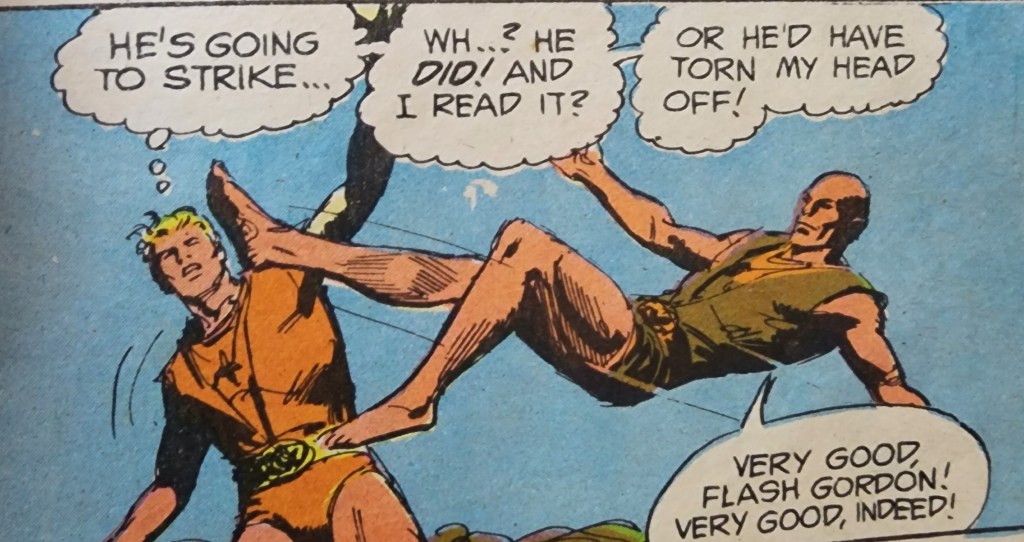
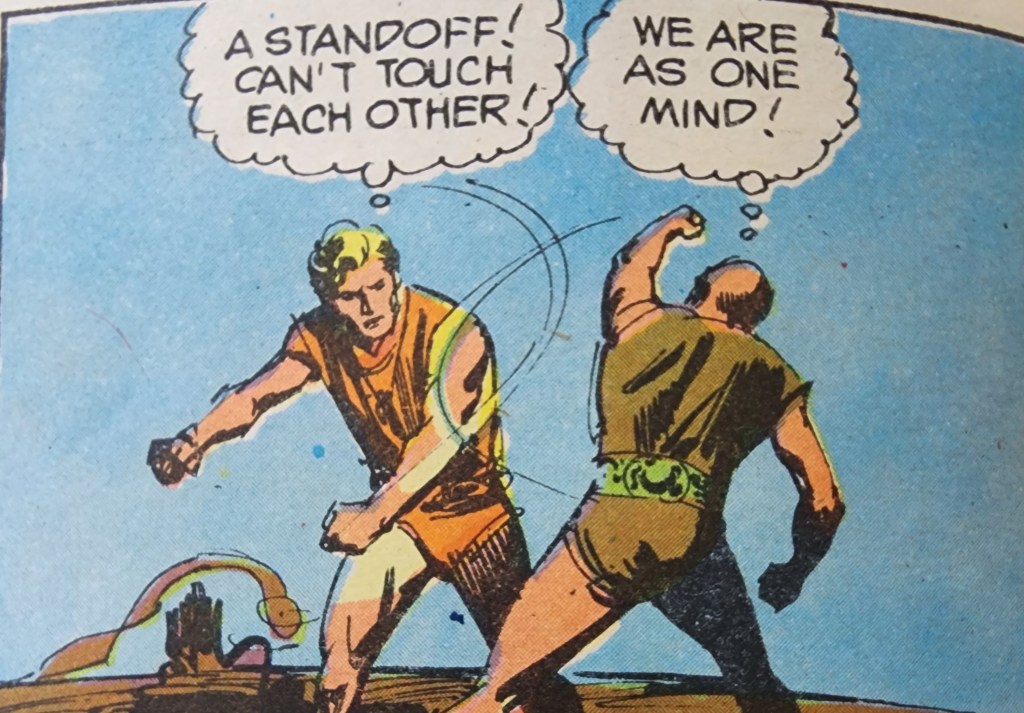
Now consider a scenario where two experienced martial artists are either fighting or training with each other. If both have developed abilities with Sakkijutsu, will they both not be able to intuit an attack from the other, even if not the exact attack, the end of the same and the time of the attack? If yes, how is this loophole to be overcome?
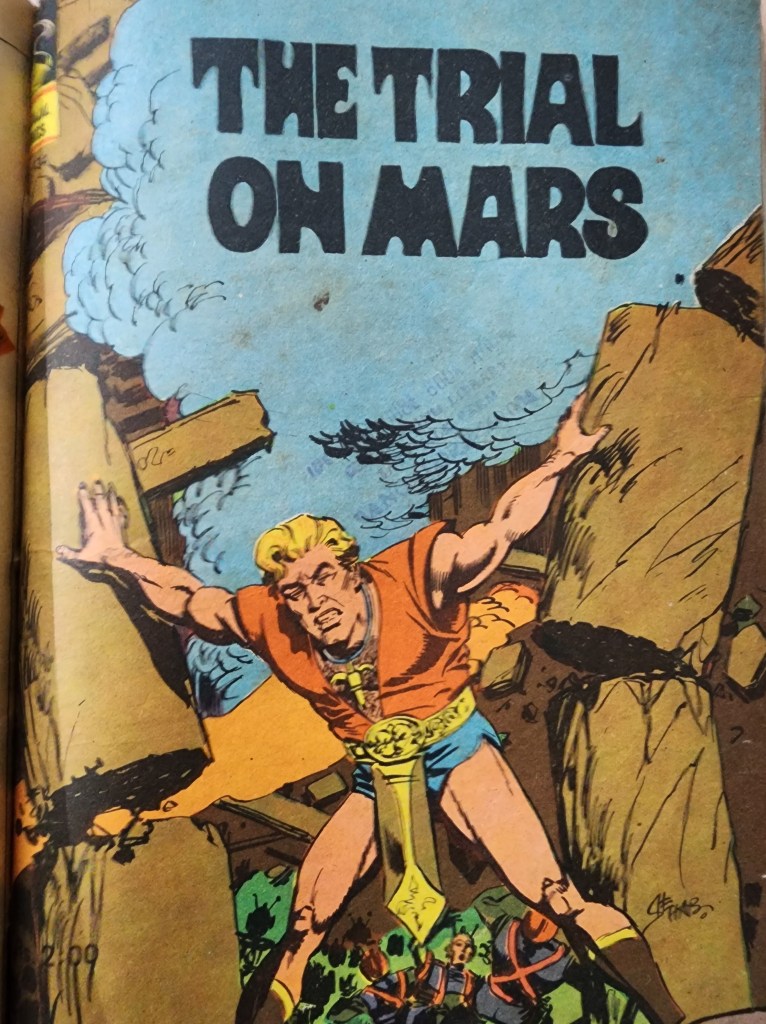
Here is a fun fact. There is story in an old Flash Gordon comic called “The Trial on Mars” which depicts this exact scenario. The image at the beginning and the two below are from that comic.
My teacher sometimes says, “Because you know it, your opponent knows it” and conversely “If Uke (opponent) knows it, you know it”. He is referring to having a specific motive or a planned kata in mind, not every random movement that might happen. This is the problem statement. As a solution, he used to state, “At the very last instant before you carry out the movement, don’t do what you were going to do, or change what you were going to do”. This idea was used as a stepping stone to learn to unlearn waza and kata. This was to overcome your Uke “realizing” what you are up to. Of course, this again is not magic. It is just a gateway to un-conditioning our training and following of the basics. My teacher’s statements are self-explanatory, but doing it in practice was and is very difficult, for it means not only being more nimble in the body, for it takes effort to change what one was doing time after time, but also to tell your mind to stop focusing on a specific action and outcome. As an example, think of all the times a practitioner was confused when you named a technique and did it very differently to what it was originally described as..
If one can achieve the ability to control oneself from doing what one had planned, even if it was a for just a few moments prior to making the move, the statement used earlier changes to, “If you do not know what you are going to do (or can do), how can Uke know what you are going to do?” This is specifically true when training with another practitioner with a lot of martial arts’ experience. And this brings us full circle.
If you can ensure that you cannot know what you are doing, you have taken yourself back to being a beginner, who also has no clue what to do. And just like a beginner can cause you trouble with weird and uncharacteristic moves (“without the indoctrination”), so can you cause trouble for the opponent, despite the years of training. This would achieve the “Way of the Beginner”!
“The way of the Beginner” is how I think of it. It encompasses “learning to unlearn” and “being in the moment” (Nakaima). Before expanding on these two points, I use a quote yet again. I have been told by my mentors that Soke Hatsumi Masaaki has stated in the past that, “techniques will get you killed in a real fight” and that “the book will not fight for you”. What Sensei means in the two statements is that one should not depend on waza or kata as they are not defined and learnt to work in a real fight. These should be used to learn to move one’s body in a manner that is safest in a given situation and perhaps also give one an edge over the opponent.
When one learns to not depend on the kata and focuses on the concepts of the same, that is unlearning and the means to do that was what I referred to when I mentioned the statements of my teacher. Once we are fine with unlearning and no longer expect kata and waza to work, we are forced to be “in the moment”. This is more about mindfulness and doing only that which is necessary in that instant.
We do not need to be in a real fight to do this. Even if we are doing Randori with fellow practitioners or more interestingly, with multiple opponents, we can experience this (as most waza and kata are defined against a single opponent). We can also experience this by training with armour on, for armour negates many attacks. One added advantage of overcoming our own plans and intentions in a movement is that we create an expectation in the Uke’s Sakkijutsu and by changing at the last instant, we are creating an opening against that expectation and perhaps a Suki (opening) in the Uke’s moves. This of course, also might cause an experienced Uke, during Randori, to do something we never thought possible and that in turn forces something that could only happen in that instant, which is the definition of “being in the moment”. This whole back and forth flow with Uke(s), is like a negotiation, which is what the objective is when applying learnings from the Bujinkan, in conflict management in life beyond the dojo.
That brings me to the end to this musing. May we all be beginners to one concept or the other all our lives, at least in the Dojo of the Bujinkan. Wishing you all a happy year ahead and also wishing we can emulate the “Way of the Beginner” in our lives.
 Mundane Budo
A highly technical subject explained beautifully for a layman and also a practitioner. Thanks. Wish you a very happy new year.
LikeLike