Paapada Koda Tumba Beku

The other day my dad and I were watching news on TV. It was bombastic bordering on self-righteous like it is quite a lot of times. But as always it did trigger a conversation about politicians in our country. One thing that is true of us Indians is that almost always people living in one state cannot understand the political choices of our fellow citizens living in another state. We cannot understand why a particular leader or party holds sway in a given state or even a given region. This is not surprising, as people in one region cannot have the context or circumstances of people in another and therefore do not understand the politics of another state.

But one thing that is true is that every party and leader faces a debacle due to an aggregation of what citizens see as mistakes. Leaders and parties are not penalized for one or two mistakes, especially not if they are seen to be a consequence of poor information availability or consequences of well-intentioned decisions that did not pan out as expected. They are voted out however when a sum of decisions of either an individual or a party result in trouble or a lack of improvement for people or when a series of actions are seen, which are seen as deliberately bad or biased.

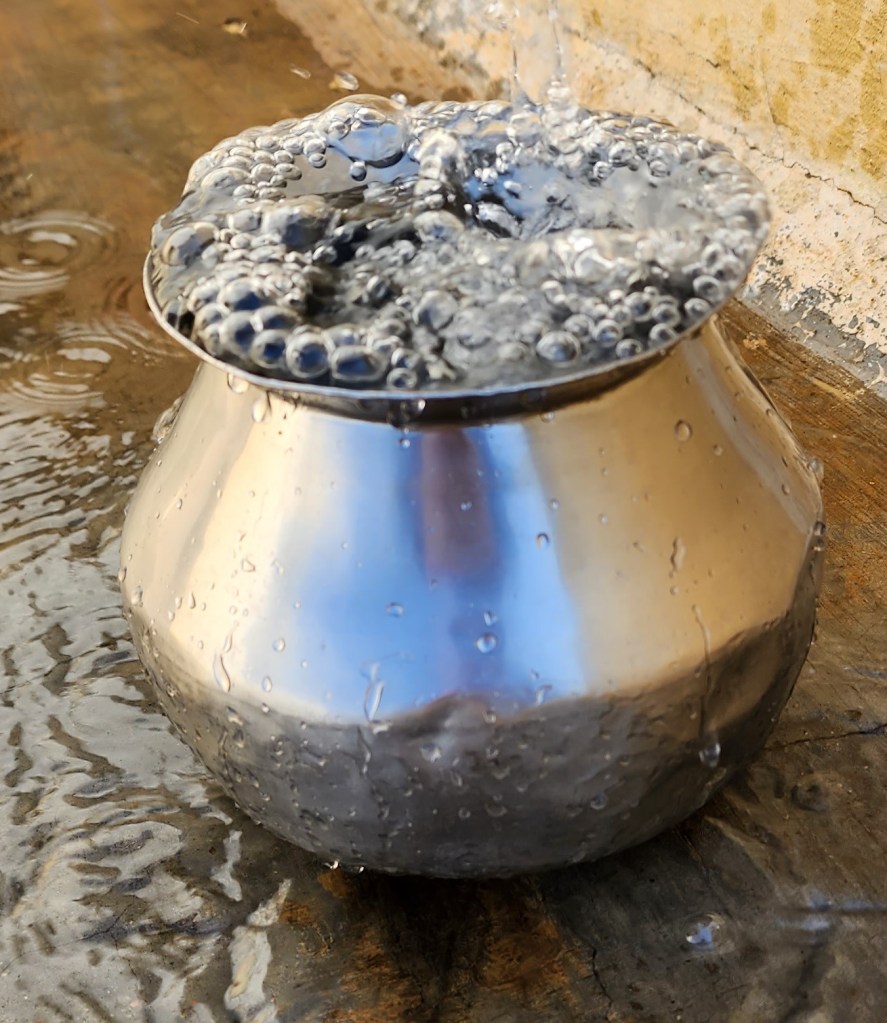
During our conversation, one proverb came up, “Paapada koda tumba beku”. This is in Kannada. The same in Hindi roughly translates to “Paap ka ghada bharna hai”. This essentially means that one’s vessel bearing one’s misdeeds needs to overflow for that person to pay for said misdeeds. This is a summation of what was expressed in the previous paragraph. Politicians and political parties in India are made to pay when a series of their wrong actions and decisions come home to roost. In other words, their “paapada koda tumba beku”.

From the little that I know this proverb is in reference to the incident in the Mahabharata during the Rajasooya Yajna by Yudishtira. Shishupaala was killed by Krishna during the Yajna. Krishna had made a promise to Shishupaala’s mother that he would forgive a hundred misdeeds of Shishupaala before he faced the consequences of the same. True to his word, Krishna accepted a hundred insults to himself and other attendees at the Yajna before he slew Shishupaala with his Sudarshana chakra. He also made Shisupaala aware of the misdeed limit running out and that he was in danger. But Shishupaala did not heed the warning and paid for it with his life. In other words, when his “paapada koda” was full, he faced the consequences of the same.
With that long winded introduction, I get to the point I was intending to make all along. When we train the Bujinkan (or any other martial art I suspect) in class, we are often shown a form by our teacher(s). As students we then replicate the form to the best of our abilities based on our experience in the dojo. A lot of the time, teachers are teaching concepts with specific forms. These concepts can be expressed with many different forms. For example, our teacher might say, “do not break connection with the uke”, or “En no Kirinai” in Japanese. When training this concept, the form shown by the teacher will almost never work for the student. For the form ends when the uke ceases to be uke, in other words, uke chooses to stop attacking and retreats or calls for an end to that particular interaction with tori. Uke will choose to call an end to the interaction when she or he can no longer take it from the tori, or if she or he realizes that the tori is incapable of protecting her or himself in a meaningful manner.

So, there is no “form” in this situation. There is a continuous flow of physical and intellectual movement until one of the two practitioners calls it off. In other words, when one has had enough. There may be no misdeeds here for a “paapada koda”, but there is a “koda” of ability and tolerance beyond which an uke or tori can take no more or do no more. Until this happens, the flow of movement does not end and one must keep going, do what needs to be done and then the next and the next and the next. And this must be done however it can be done, even if one is now beyond the original “form” that was demonstrated by the teacher to elucidate the concept in the first place.

Notes:

  1. Uke – a practitioner who initiates the attack (mostly during a training session)
  2. Tori – a practitioner who defends against an attack (mostly during a training session), so as to practice a form or concept.
  3. Both the above roles are temporary and for reference purposes only. Neither is true in a real fight or duel.
  4. Paapa / Paap – Misdeed or Sin in Kannada / Hindi, root from Sanskirt if I am not wrong
  5. Koda / Ghada – Vessel in Kannada / Hindi
  6. Tumba beku / Bharna Hai – “Should fill up” or “Should overflow” in Kannada / Hindi
Vyuha and Taijutsu

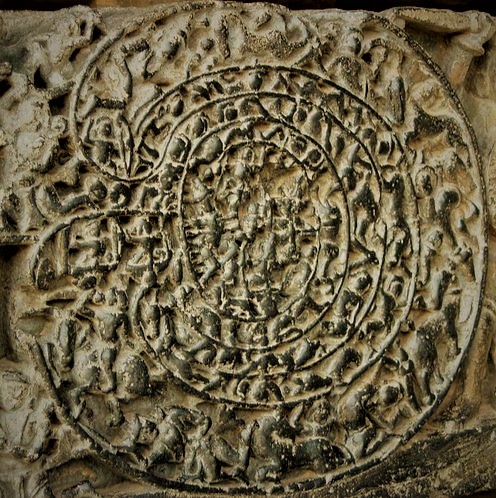
Chakravyuha (Moving spiral formation) carved on the Hoysaleshwara temple wall, Halebidu, Karnataka

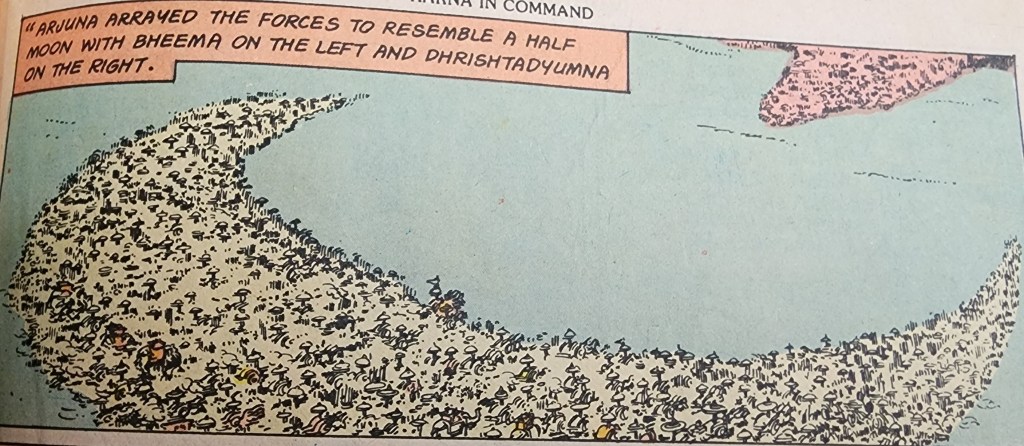
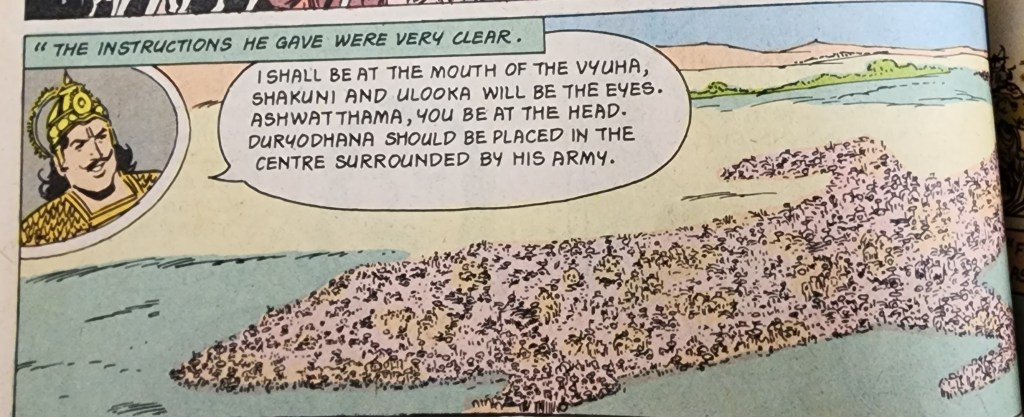
Vyuha is generally identified as a formation for battle. This is something most of us learn from our reading of Amar Chitra Katha comics as kids. We all know that the Chakravyuha was deadly from the Kurukshetra war. We have also heard the names of several other vyuha from the same war, Vajra vyuha, Shakata vyuha, Makara vyuha, Krauncha vyuha, Suchi vyuha, Sarvatobhadra vyuha and many others. What we do not know is the specific advantages and disadvantages of each of these and when they are supposed to be used. Was it at the discretion of the senapati, or raja or were other criteria considered? Like geography, the weather, number and quality of troops and equipment at hand? We do not have, or at least I have not heard of any military manual describing these aspects.

What I find mind boggling is how were these vyuha or formations achieved? How much training of troops is needed to get them into that specific formation? How long does it take? What high levels of discipline is needed to hold these vyuha? And can all troops form all vyuha or was there any specialization? For example, the most popular Chakra vyuha was supposed to be a continuously moving spiral. How was the positioning of the troops decided? And who coordinated the movement? How was communication achieved if a vyuha was fraying at some point or if reinforcements were needed at some point in the vyuha? When was the decision made to abandon a given vyuha and how was that communicated? What were the criteria to decide if the vyuha was ready and if it was successful? Was there some analysis post the use of a vyuha to see if could be improved? There are no ready answers to any of these questions that I know of.

Now, there is this concept of Taijutsu that many Japanese Martial Arts use. The different art forms might use different terms for it, but the concept is the same. In modern day parlance, it is translated for simplicity as body movement or prosaically “art of the body”. Tai meaning body and Justsu meaning “Art of”. But I have been told by my teachers that originally Tai meant a unit of troops and all their equipment like armour, weapons, rations and also their horses or beasts of burden if they had any. So, Taijutsu was meant in the past to mean “Art of a Unit” where a unit is a body of troops. I have heard it said that a Tai was generally meant to be a squad of soldiers, a squad being a smaller unit than a platoon. So Taijutsu was all about working as a team with all that they had access to. One can assume that since there was a specific term for this, it was meant for teams to work together efficiently and effectively.

In the modern day when we train traditional martial arts, we do not really use those concepts for professional fighting, but for various other purposes ranging from entertainment to personal development and everything in-between. Hence, when Taijutsu is used in a modern day martial arts class (teaching Japanese martial arts), it means move your body as one (not a unit of troops moving as one, but your body as one). That means, your core moves and your limbs, neck and head move with it, there are no twists and limb movements that are unnecessary (or stand-alone). This is taught to help keep one’s balance, so as to be more effective in any movement that is carried out, be it with or without weapons (traditional weapons in the context of a class). An example of this would be a punch where only the hand moves and the hips are not lowered or the legs are not in the correct position. This punch would be far less effective compared to one executed with correct movement of the legs and hips which make the punch a lot more devastating.

We also know that there are several martial art forms around the world and they were all used effectively at a given time and place. The fact that they were effective generally means that the practitioners of the art form were trained it its use. This means having some form of Taijutsu, irrespective of the term used for the same. And each of these were designed to give the practitioners of the art form an advantage in the purpose for the use of the art (be it in a narrow palace corridor, in a wooded area, on a boat, as a bodyguard, with large field weapons etc).

With this introduction, we can finally move ahead with what I was thinking. 😊

Each school or art form or ryuha has specific tenets relating to Taijutsu. For example, the Takagi Yoshin Ryu, which we were training when these thoughts came to mind, has among its tenets, the following principles.

  • Stacking the opponent’s hips
  • Using leverage against the opponent’s joints
  • Moving in a direction perpendicular to the opponent’s direction
  • Moving forward and not backward while facing an opponent

Also, from what I have learnt, the Takagi Yoshin Ryu was developed as a school mainly used by bodyguard. Hence, they disarmed and immobilized opponents as against killing them. Perhaps this was to gather information later or to not spill blood in the presence of one’s lord or any other reason. To disarm and immobilize opponents, the tenets mentioned above were built into their Taijutsu.

From my experience with the training of Takagi Yoshin Ryu, it is designed to use the structure of uke’s body and hence a really skilled and experienced practitioner of this Ryu can fight an opponent without the active use of eyesight. This Ryu is a Jutaijutsu and hence fighting happens in close quarters and thus, one can feel the tensions and hence intentions of the uke and counter the same by reading the uke’s joints and body movement. The right distances to achieve a strike or lock are also determined by this feeling. So, over time, the feeling and flow of the Uke (opponent) becomes the driving force for a practitioner and not just the tenets. The tenets lead to the feeling and vice versa in a virtuous cycle. Now, let us expand the same concept to a Vyuha. Was an experienced Senapati (Commander-in-chief of the army) or Raja (King) able to read an enemy’s battle tactics and his own troops requirements the same way one is supposed to read an opponent in Takagi Yoshin Ryu? This is not easy and requires a lot of training time to express successfully in one-on-one combat. So, how much skill, ability, training and natural affinity for the feeling of a battle and battlefield should a practitioner of Taijutsu at the level of a large body of troops need?! This is a question and a matter of awe at the same time. What kind of training and experience would the development of such abilities involve? Where does one begin (as it clearly happened a lot in the past and still happens today)? How did the evolution of information gathering, and technology influence this practice and its evolution? These are questions I do not have answers to, just points to ponder about.

Padmavyuha (Lotus formation), Shakatavyuha (Cart formation) and Suchivyuha (Needle formation) – 3 merged into one, top image

Notes:

  1. The above comic book images are from my personally owned books.
  2. The images of the vyuha are representative only, they are not to be considered exact.