
The other day my dad and I were watching news on TV. It was bombastic bordering on self-righteous like it is quite a lot of times. But as always it did trigger a conversation about politicians in our country. One thing that is true of us Indians is that almost always people living in one state cannot understand the political choices of our fellow citizens living in another state. We cannot understand why a particular leader or party holds sway in a given state or even a given region. This is not surprising, as people in one region cannot have the context or circumstances of people in another and therefore do not understand the politics of another state.
But one thing that is true is that every party and leader faces a debacle due to an aggregation of what citizens see as mistakes. Leaders and parties are not penalized for one or two mistakes, especially not if they are seen to be a consequence of poor information availability or consequences of well-intentioned decisions that did not pan out as expected. They are voted out however when a sum of decisions of either an individual or a party result in trouble or a lack of improvement for people or when a series of actions are seen, which are seen as deliberately bad or biased.
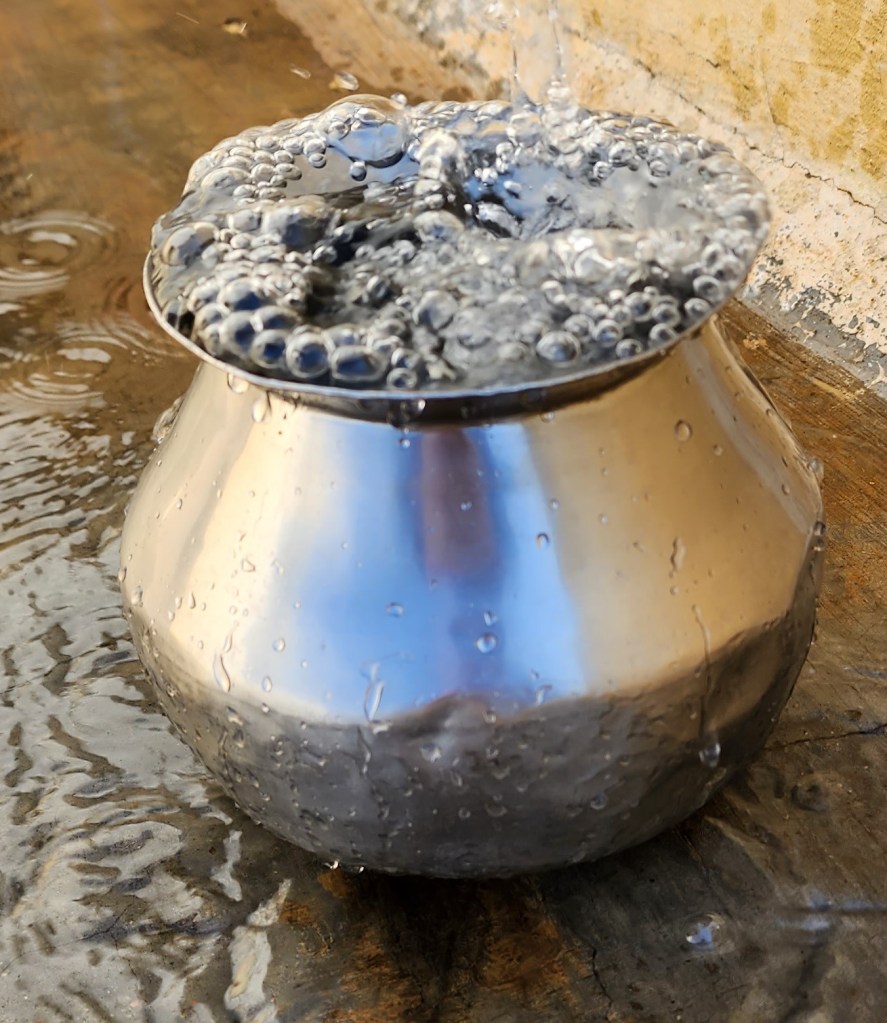
During our conversation, one proverb came up, “Paapada koda tumba beku”. This is in Kannada. The same in Hindi roughly translates to “Paap ka ghada bharna hai”. This essentially means that one’s vessel bearing one’s misdeeds needs to overflow for that person to pay for said misdeeds. This is a summation of what was expressed in the previous paragraph. Politicians and political parties in India are made to pay when a series of their wrong actions and decisions come home to roost. In other words, their “paapada koda tumba beku”.
From the little that I know this proverb is in reference to the incident in the Mahabharata during the Rajasooya Yajna by Yudishtira. Shishupaala was killed by Krishna during the Yajna. Krishna had made a promise to Shishupaala’s mother that he would forgive a hundred misdeeds of Shishupaala before he faced the consequences of the same. True to his word, Krishna accepted a hundred insults to himself and other attendees at the Yajna before he slew Shishupaala with his Sudarshana chakra. He also made Shisupaala aware of the misdeed limit running out and that he was in danger. But Shishupaala did not heed the warning and paid for it with his life. In other words, when his “paapada koda” was full, he faced the consequences of the same.
With that long winded introduction, I get to the point I was intending to make all along. When we train the Bujinkan (or any other martial art I suspect) in class, we are often shown a form by our teacher(s). As students we then replicate the form to the best of our abilities based on our experience in the dojo. A lot of the time, teachers are teaching concepts with specific forms. These concepts can be expressed with many different forms. For example, our teacher might say, “do not break connection with the uke”, or “En no Kirinai” in Japanese. When training this concept, the form shown by the teacher will almost never work for the student. For the form ends when the uke ceases to be uke, in other words, uke chooses to stop attacking and retreats or calls for an end to that particular interaction with tori. Uke will choose to call an end to the interaction when she or he can no longer take it from the tori, or if she or he realizes that the tori is incapable of protecting her or himself in a meaningful manner.
So, there is no “form” in this situation. There is a continuous flow of physical and intellectual movement until one of the two practitioners calls it off. In other words, when one has had enough. There may be no misdeeds here for a “paapada koda”, but there is a “koda” of ability and tolerance beyond which an uke or tori can take no more or do no more. Until this happens, the flow of movement does not end and one must keep going, do what needs to be done and then the next and the next and the next. And this must be done however it can be done, even if one is now beyond the original “form” that was demonstrated by the teacher to elucidate the concept in the first place.
Notes:
- Uke – a practitioner who initiates the attack (mostly during a training session)
- Tori – a practitioner who defends against an attack (mostly during a training session), so as to practice a form or concept.
- Both the above roles are temporary and for reference purposes only. Neither is true in a real fight or duel.
- Paapa / Paap – Misdeed or Sin in Kannada / Hindi, root from Sanskirt if I am not wrong
- Koda / Ghada – Vessel in Kannada / Hindi
- Tumba beku / Bharna Hai – “Should fill up” or “Should overflow” in Kannada / Hindi
 Mundane Budo
Nice
LikeLike