Bhakti and Budo

Image generated with Jasper AI

There is a term that is used every now and then in the Bujinkan, called “Kami Waza”. Typically, this is something that is trained, and an understanding attempted, after many years of training in the Bujinkan system of martial arts. Kami Waza is something I had referred to in my article on “The Ashta Siddi and Budo”, in the part about the Siddhi “Eeshitva” (the link to this article is seen at the bottom).

“Kami” could be translated as “God” or “Gods”, but I opine that the word “Deva” or “Devata” which we Indians use is a more apt translation. “Waza” can be translated as “technique”. So, “Kami Waza” can be considered to be “technique of the Gods” or maybe “Godlike technique”. This might seem to suggest that there are martial techniques that are so difficult that being able to master the same makes one a God. It might also seem to mean that one somehow needs to have the skills or abilities of the Gods to be able to pull off the same. But it is neither. To give an extreme and tongue in cheek example from Hindu traditions, “Kami Waza” does not mean the ability to invoke the Brahmastra, or uproot trees like Bhima or fly while lifting mountains like Hanuman. 😛

Kami Waza is more an adjective for a movement after the same is already completed. The movement just completed is so incredible, or sublime or elegant that it seems like the person who just executed the same might have been guided by the Devas. Or maybe, the Budoka (practitioner of Budo) channelled the Devas to execute the movement. Or maybe even that the Budoka allowed a Deva(s) to possess them for the brief instant it took to execute the movement.

From my personal realization, Kami Waza is expressed when an experienced Budoka is not specifically looking to perform a defined waza or kata (a set of defined forms). Nor is the Budoka trying to achieve a set objective. The Budoka is moving freely with perhaps the only objective being to stay alive. Of course, the movement could have started as a kata or waza and might have had an objective, like throw the opponent or pin the opponent or plain old “win” against the opponent. But the movement that could be described as Kami Waza would have occurred when the Budoka has let go of the original intent and moved in flow, even if for a fleeting instant.

The identification of the Kami Waza would be by the opponent(s) and maybe an onlooker. The Budoka who executed Kami Waza may or may not realize the same. Also, the Waza expressed as Kami Waza might be at the beginning or end or somewhere during the interaction between two or more Budoka, or more loosely put, opponents. Further, the only reward for the expression of the Kami Waza is only that the Budoka is alive at the end of the conflict situation, or suffered minimal injury or just a lack of trouble compared with what she or he started with!

It is said by Budoka with far more experience than I that Kami Waza is expressed only when there is no motive or objective in the movement, except survival. This is also defined as “being empty”. This refers to a lack of ego. This in turn is because a lack of ego is supposed to mean that there is no objective to achieve a defined success or in other words, win. It also is a lack of ego when there is no concern with failure or defeat. Thus, if there is no ego and one is “empty”, there is an opportunity for the “emptiness” to be “filled” by Kami. Therefore, one is maybe transformed into something like a Kami. It could warily be termed as allowing oneself to be controlled by the Kami, like a puppet, or as a vessel for the essence of one. So, if one is hosting a Kami, the movement expressed becomes Kami Waza, as it was driven a Kami, albeit in the form of the Budoka under consideration.

This is not unlike what Hindus call, “Avashesha avataara”. “Avataara” is a manifestation and “avashesha” is “a vestige”. So, an avataara, where a vestige or an iota of the essence (amsha) of God is channelled in an earthly form, is an “Avashesha Avataara”. It is also sometimes called “Aavesha Avatara”, where “Aavesha” is like possession, but with a positive connotation. This only happens for a short duration for a specific objective (of the Gods, not the vessel). Once the objective is complete, the human or animal vessel reverts to being a normal being and is an Avataara no more. An example of this kind of Avataara is that of Lord Parashuraama.

A few words of caution here, again based on my personal experience and what I have heard from Budoka with a lot more experience than I. The first is that, the moment the Budoka realizes the awesomeness of what was just expressed**, Kami Waza ends. The realization might be a shock for the person who expresses Kami Waza as well. It is more like, “Wow, what did I just do!” The moment this realization occurs the Kami Waza either ends, or the Budoka loses it, at least for the moment. This end or loss is irrespective of whether the expression of Kami Waza was completed or not, though the chances are that it was. Thus, the expression of Kami Waza is only realized as an afterthought, and maybe in hindsight.

The second is that Kami Waza is not magic. The definition I shared and the experience of the same might make it seem so. But it is not, and could actually be remarkably common place. We all see expressions of Kami Waza all around us, on a regular basis, even if it is not in the martial arts. There are situations at work and otherwise, among friends and family, when we see someone who seems to have a wonderful thought or epiphany, and that results in a great solution or artwork or any other achievement being accomplished. This happens many a time against the run of play at that point in time. The person who executed the action or activity would not have a realized it immediately. All of these are likely expressions of Kami Waza. And this leads to the third important observation regarding Kami Waza.

Kami Waza does not occur in a vacuum. Its expression is always a result of a very large amount of effort and experience and therefore wisdom being already in possession of the person who expresses Kami Waza. And so, it is likely that the person who expressed Kami Waza did so in a field they were already great at, but this specific expression (of anything) was extraordinary even by those already high standards. It is something like the total being considerably greater than the sum of the parts!

There is a concept which we Hindus refer to fairly often. This concept is “Bhakti”. It is usually translated as “Devotion”. But like with most Indian concepts it is not something that can be clearly translated into English. An attempt to explain the feeling associated with Bhakti can be made, but an exact translation is not really possible, in my opinion. As I understand it, Bhakti is the attempt to achieve closeness with the divine. Bhakti is also said to be one of the paths to achieve this closeness, as indicated by “Bhakti Marga” (the path of Bhakti). The other paths I know of are Gnana Marga (the path of wisdom or consciousness, sometimes spelled “Jnana”) and Karma Marga (the path of action/activity). I am also aware of the Nava Vidhi of Bhakti (the nine protocols or forms of Bhakti). These are the various means by which an individual can express Bhakti. Also, one must remember, an individual might already have Bhakti towards an expression of the divine and attempt to increase it with the above path and activities or begin to achieve Bhakti with the same.

I am not an expert in these matters nor do I have the experience and learning to opine or explain the nuances of Bhakti. I am only aware of a little and I have shared the same above as a point of reference for the other observations I will make further.

As far as I understand, according to Hindu thought, the purpose of all paths (marga) towards closeness with the Divine is Moksha. Moksha is the liberation from the cycle of death and rebirth. In other words, it is a liberation from the temporal world and hence from the trouble and sorrows associated with the same. Once Moksha is attained, the temporal world is replaced with an existence with the Divine forever, which is the same as eternal joy and contentment.

But then, based on my personal experience, Moksha is not what most of us Hindus are thinking of or even considering, when we practice Bhakti in day to day life. Many a time, before we start our daily activities, we light the lamp every morning in our Pooja Rooms and bow before our preferred expression of the Divine*. If not this, we practice our own specific ways of demonstrating Bhakti towards our preferred Divinity at the start of daily activities, based on the situation of the person. When we do this, we request for things far simpler than an attainment of Moksha. We ask for mundane things, like a good day without problems, good health for everyone, a satisfying life for those near and dear to us. It might even go onto the ability to perform well in an exam, find a solution to the problems we are facing, at work or in life, including those related to health, wealth and relationships. This is the extent of day to day expression of Bhakti for many people.

In Kannada, there was statement, or a variant of it, we were raised with. We still hear it fairly often in many homes which are even slightly traditional in upbringing. It goes something like, “Bhaktiyinda maadu, seri hogutte” or “Bhaktiyinda maadu, yella volledagutte”. This means, “Do it with Bhakti, it be alright or it (any problem) will be resolved” or “Do it with Bhakti, everything will have a satisfactory outcome”. This is roughly the same as saying in Hindi, “Bhakti se karo, sab theek ho jaayega”. We are also told, “Deveranne nenesikondu shuru maadu”. This in transliteration means, “Think of God and start”. In Hindi, it would be “Bhagvaan ka yaad karke shuru karo”. It means that you request the Gods for a positive outcome before you start something. This could be answering an exam, an activity, or just your day in general.

These two statements are emblematic of how simple the practice of and expression of Bhakti is. It might take just a few seconds in a day. It just requires one to spare a thought towards the Divine every day, but as a first priority, as a cultivated habit. Since it is a cultivated practice, it means you set aside a few moments towards the Divine regularly. This expression of Bhakti, allows one to request a desired, favourable outcome in return for the Bhakti demonstrated.

Many a time, when one who expresses Bhakti regularly achieves a favourable outcome, or just luck in day to day living, she or he spares a moment to thank the Divine as well. This is based on the feeling that, the outcome was a consequence of the Bhakti demonstrated, and gratitude is expressed to close the loop of request-granting of the same-gratitude expressed.

One thing to remember though, is that Bhakti is not an alternative to the effort one puts into any activity or targeted achievement in life. One has to put in all the efforts that are needed towards leading a good life of one’s choice. Bhakti is a request for support towards the Divine beyond the effort that has been expended. This could be due to troubles unforeseen, troubles one is not certain how to solve, missing effort due to lack of awareness of its requirement or just due to hard luck. If there is no trouble in life at all, Bhakti could be a desire towards the result being greater than the sum of the parts of the effort put in. Thus, Bhakti is expressed in hopes of a return which could be a final boost in achieving one’s desires and luck to evade unforeseen troubles.

Bhakti can also be expressed hoping to be able to overcome insurmountable problems. Imagine wanting documents to be typed telepathically 🙂 or a problem which requires societal change (beliefs, cultural values, functioning style etc.). These are not things that might happen in an individual’s lifetime. While one can do one’s best, Divine interference might be needed to solve some problems. While this might happen, there is also a possibility that the individual looking for the insurmountable solution has a realization (epiphany if you will), which gives a fresh perspective. The perspective might be anything, from knowing the solution might lie in a different geography (find your fortune in a different country) to understanding that a solution is not possible in a given time and one’s efforts need to be redirected and options reconsidered. Maybe this is epiphany was just about overcoming one’s ego to letting go of a need for a given solution; an eye-opener, if you will.

So, one does all that one can towards leading the life that one wants to and also expends time towards the Divine in one’s life. The time expended towards the Divine varies from person to person and based on one’s situation in life. This is Bhakti. BEYOND all the efforts one has expended towards one’s life if there is some support needed from the Universe for a good life, this is hoped for from the Divinities, in return for the Bhakti demonstrated over a long time.

I guess now the link between Budo and Bhakti in evident, in the concept of Kami Waza. Both Bhakti and Kami Waza are about individuals being guided by the Gods or Devata or Kami respectively. This guidance allows an individual to achieve an outcome that is favourable to her or his life. This outcome might or might not be related to a specific objective that the individual is pursuing, but is favourable nevertheless. In both cases, the expression of the result of Bhakti and Kami Waza, is only after an individual is “empty”. “Empty” by not having any motive in a conflict other than survival in a conflict situation or “Empty” by dint of having expended all one can in life or in a given situation. This “Emptiness” allows a booster to past efforts, experience, training and wisdom, which is perhaps Divine in nature.

A final word of caution here. Both in Budo and in Hindu culture, it is always said that the effort is mutually exclusive of the outcome. The training or expression of Bhakti cannot be towards a specific help or support from the Devatas. If there is no realized outcome of Bhakti, or a realization of expressed Kami Waza, it is not a case where one can question the Kami or the universe itself for betrayal. It is just that there was a lacuna in the Bhakti or the training in Budo, whether or not one realizes the same. Thus, despite understanding the concepts of Bhakti or Kami Waza, they are not crutches to look for or support systems to look out for. One can only continue training or express Bhakti, if one chooses to, and perhaps as a consequence experience Kami Waza or the fruits of Bhakti.

Notes:

  1. Link to the article about the Ashta Siddhi and Budo – https://mundanebudo.com/2022/12/22/the-ashta-siddhi-and-budo/
  2. *Mane Devru or the Gods we, in our respective families or communities, have been brought up praying to.
  3. This article is verbose because both Bhakti and Kami Waza are not easily defined. They are feelings to be experienced. So, expressing the same in a manner that leaves me satisfied with the effort, took a lot of words.
  4. **When I say “expressed”, I mean perform a martial movement, which could involve a punch, a kick, a throw, a lock etc.
  5. I use the term Budo as a synonym to “Martial Arts” in this article.

Vaali’s boon – A perspective through Budo

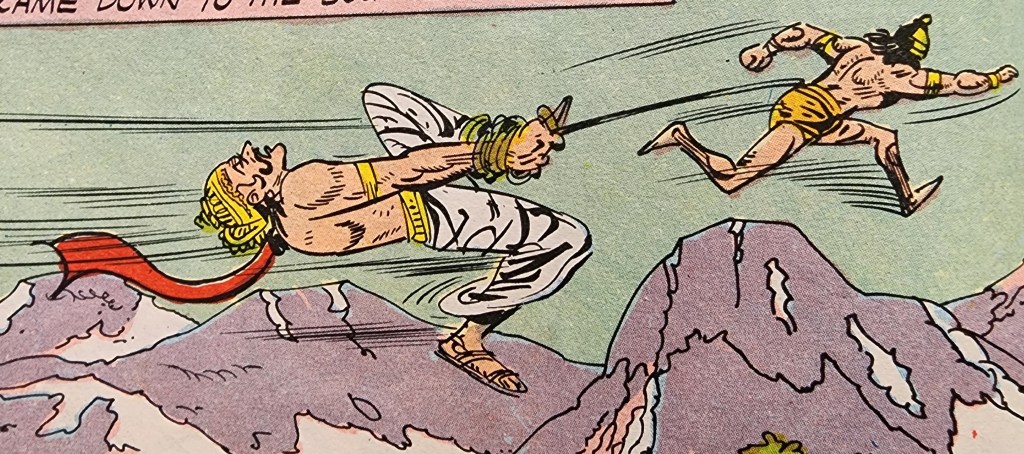
Image 1Vaali defeats Raavana

Clarification – In this article I am referring to the great Vaanara king Vaali, who is the brother of Sugreeva. It is the Vaali who is seen in the Ramayana and is killed by Rama. I am not referring to Bali, who can also be called Bali Chakravarthy, who is the grandson of Prahlad. This Bali is the person who interacts with the Vaamana Avataara of Lord Vishnu and is a great Asura king who is celebrated in the festivals of Bali Paadyami and Onam. I am explaining this since I have seen some people refer to Vaali, the brother of Sugreeva as Bali and in some television serials as Mahabali Bali. This is just a different pronunciation of Vaali, which is pronounced as Baali but written as Bali. Of course, Vaali is also written as Vali sometimes. It is assumed that the person reading the name knows that “Va” has to be pronounced as “Vaa” or “Ba” as “Baa”. But some people might not realize this and hence this clarification. Just another point here, Bali Chakravarthy is Bali, but Mahabali Bali is actually Mahabali Baali.

Vaanara king Vaali, elder brother of Sugreeva was an incredible warrior and martial artist. The very best! He had defeated in single combat three extraordinary opponents which give testament to this fact. The first and foremost of these was Ravana, who was as great a warrior as one could think of. Vaali defeated him in a manner so nonchalant and effortless that it boggles the mind.

We need to remember that Vaali was a Vaanara and therefore had a tail. Like at least some Vaanaras, he had a prehensile tail, which he could move as he preferred and use as a weapon by itself. Raavana apparently attacked Vaali with stealth, from behind, when the latter was busy in performing the Sandhavandana*. Raavana grabbed Vaali’s tail as the initiation of the attack. Vaali used his tail to fend off and defeat Raavana, while never deviating from the performance of the Sandhyavandana. Raavana was left bound and helpless by the time Vaali had finished the Sandhyavandana. Sandhyavandana is still performed by many to this day and even when performed to its fullest extent, does not take very long. Also, it is mentioned that Vaali did not realize what he had done with his tail until Raavana begged for help when Vaali had completed the Sandhyavandana. Thus, Vaali not only defeated Raavana effortlessly, he did it in a manner most humiliating and in short order. Raavana, thus defeated, sought his friendship and gained the same.

Vaali also fought and defeated a shapeshifting Asura called Dundubhi. Dundubhi was an incredible warrior and challenged all known great warriors to prove his own superiority. Dundubhi was a brother-in-law of Raavana. Dundubhi challenged Vaali to a duel when he heard of the prowess of the latter. In the great fight that ensued, when he realized that Vaali was more than a match for him, he turned himself into a massive buffalo to continue the fight. Any experienced martial artist will generally agree that martial skills are designed to fight against fellow humans, and the same skills will not work against other animals with different body types. A normal buffalo is much larger than a human and fighting one is a daunting thought. So, fighting a buffalo many times larger than a normal one would be exponentially harder. Of course, Vaali was a Vaanara and had a tail, so his skills would be different, but the task would be difficult nevertheless. Vaali of course, prevailed. If the Ramayana TV series from the 80s is to be believed, Vaali fought the gigantic buffalo unarmed, which makes the feat even more astonishing. He even hurled the massive buffalo carcass quite some distance with just his strength. The skeleton of the giant buffalo is later used as a test of Rama by Sugreeva.

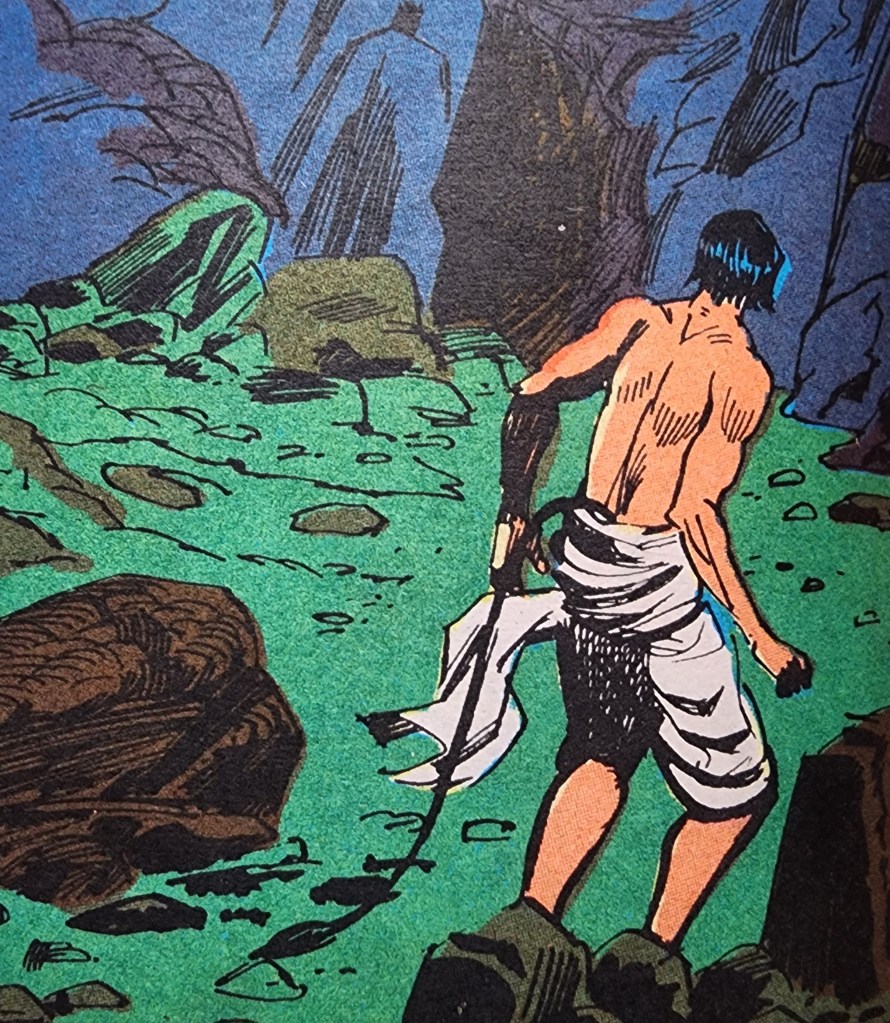
The third famous duel of Vaali’s is with Maayaavi, another extraordinarily powerful Asura who challenged him to a fight. Maayaavi was a brother of Dundubhi’s. The fight between Vaali and Maayaavi eventually moved to cave where Sugreeva stood guard at the entrance. The fight between the two lasted a year before Vaali prevailed. There are other aspects of this story that are not relevant for this discussion and hence I am leaving those out.

Image 2Sugreeva guarding the cave where Vaali and Maayaavi are fighting

One of the reasons Vaali was impossible to defeat in combat was a boon that he had. He had a boon from Indra which resulted in his gaining half the strength of anyone he is fighting. Sometimes it is said that he had a pendant gifted to him by Indra, the wearing of which resulted in same. So, the boon was the pendant. Either way, Vaali’s strength would increase while that of the opponent would decrease by half. So, apart from being a phenomenal warrior, Vaali also ensured that the opponent was diminished just by dint of being his opponent. The boon and his own skills pretty much made him invincible.

Now, there are a few points to consider here. Does, “half of the opponent’s strength” mean just physical strength or does it mean half of the skills? I do not know. Also, what constitutes a fight and what makes one an opponent? Does one have to be actually fighting Vaali for the boon to take effect? Or does just having ill intent towards Vaali result in the boon diminishing one’s strength/abilities?

If just having ill intent towards Vaali results in the opponent being diminished, then were Rama’s abilities as an archer diminished when he decided to shoot at Vaali from hiding? Is that why he could not distinguish between Vaali & Sugreeva in their first duel? Is that why Sugreeva needed to wear a distinguishing garland to identify himself during the second duel? And was Rama’s eyesight diminished due to the boon or was it just the distance and resemblance of the brothers? If all this was happening, were the two tests set by Sugreeva that Rama passed, sufficient in the first place? Or were the two tests specifically designed by Sugreeva, who knew of Vaali’s boon, to check if Rama operating at fifty percent would be able to strike the target (Vaali). I do not have the answers to any of these questions.

Next, when we consider the duel with Raavana, was Raavana an opponent just by having ill will towards Vaali? After all, he initiated the attack and with stealth, from behind. Vaali defeated him without even realizing he was in a fight! How cool is that! Based on this encounter, it does seem that Vaali does not need to be in an active fight for the boon to take effect. Any person, who puts to action a thought to cause harm to Vaali seems to be deemed to be an opponent and the boon diminishes that person while enhancing Vaali.

An aside here, this encounter gives a great opportunity to discuss Vaali’s Sakkijutsu (intuitive abilities) and perhaps as a consequence of that, his Nanigunaku Sanigunaku (natural nonchalance). Was Vaali’s enhancement by half of Raavan’s stealth (a skill by itself) his intuitive ability to sense an attack? And hence was his enhancement the ability to start a fight without his opponent realizing that it had already started (a stealth attack met with a stealthy defensive offence)? After all, if he could not know a fight was occurring, how could any opponent sense the same (Sakkijutsu of the opponent nullified)?!

Now, let us consider the fight with Maayaavi. Maayaavi supposedly ran to hide in a cave when he knew he was outmatched. But Vaali pursued him to finish him off. In this situation, if the opponent has decided to escape and thus end the fight, he is no longer an opponent right? If yes, does his diminished skill and strength return to its full potential? And does that mean Vaali’s ability to tap into this resource from the opponent also cease? Or is that added to Vaali’s own skill set for good? If yes, is Vaali potentially going to improve forever, with every fight? And can his opponents of the past, if they survive, ever go back to their full strength? And if they do, does the siphoning off due to the boon not be in effect anymore? The answer to the last question seems to be that it does not, for Raavana, was still as great and dangerous a warrior as ever.

Also, the fight between Maayaavi and Vaali lasted a year in the cave. This does seem strange, considering Maayaavi was running for his life (not a strategic retreat) according to the story. Vaali had defeated the other opponents in far shorter times. So, did it take Vaali a year to defeat an opponent who was already defeated, a year, because that Asura was not really an opponent anymore? And since he was hiding and trying to avoid a fight, was his ability not diminished anymore and therefore Vaali not enhanced any further? I would say that it definitely seems so. For trying to find a person in hiding and who is only going to fight to survive, mostly to get away is far harder than one on the attack, simply because the opponent’s movement no longer offer openings to exploit. Add to this the fact that Vaali is no longer enhanced and the opponent diminished, it would take a lot longer. So, no wonder this fight took so much longer, for Vaali as not hunting, not fighting.

In conclusion of the discussion about Vaali’s boon, it does seem that the intent of the other person towards Vaali is what triggers it. If one has malicious intent towards Vaali, the boon takes effect, if one does not, the boon not get triggered either.

Another aside here. If having no ill intent towards Vaali was the key to nullifying his boon, was Ahimsa the answer? Not the “non-violence” Ahimsa, but Ahimsa from a martial perspective. Here Ahimsa is not about not doing violence, it is about not looking to do violence. A link to my article about Ahimsa from a martial perspective is seen below**. Rama was looking to punish Vaali for stealing his brother’s wife, not trying to pick a fight with him or to hurt him otherwise. So, if he was trying to punish Vaali, does it mean he was trying to right a wrong? Was this why he was able to succeed despite the boon? Or did the boon not take effect as Rama’s intent was not to hurt Vaali but to protect Sugreeva? Or is all this just semantics on my part? Perhaps it will be explored at some future time.

In the Bujinkan, we learn three concepts that go hand in hand. These are, “Toatejutsu”, “Shinenjutsu” and “Fudo Kana Shibari”. These are detailed below.

Toatejutsu means striking from a distance. It does not necessarily mean something like shooting with a gun, but it could. It refers to the fact that one could affect the opponent before being in the striking range of the weapon on hand, irrespective of what that is.

Shinenjutsu means capturing or maybe affecting the opponents’ spirit, or the will to fight. This is not about magic, it is about being in a position or situation where an attack would leave an opponent vulnerable, making the attack not worth the attempt.

Fudo Kana Shibari means to hold the opponent in an immovable (unshakable) iron grip. This again is not necessarily about physical immobility though it could be that. It refers to leaving an opponent unable to decide what to do and how to move.

When taken together, the three concepts would mean something like “Strike from a distance at your opponent and capture her or his spirit in an unshakable iron grip”. In more mundane terms, it could mean “Leave your opponent incapable of deciding what to do by affecting her or his will to fight even before starting the fight from the expected physical distance”.

If the above situation can be created vis-à-vis the opponent, the result is that the opponent is left wondering when to attack and how to attack, and even more importantly, if there is an option to attack at all. The risk an opponent opens herself or himself to due to an attack seems great and causes hesitation in the opponent. Once this happens, the opponent can no longer have any momentum or flow in the attack and cannot press home any advantage with an initial attack. This leaves the opponent thinking about the fight as much as he or she can actually fight. Thus, the fighting ability is effectively limited and this is what can be said to be the diminishing of an opponent. Whether the diminishing is by half the ability, is up to interpretation. If we can say that the opponent has to think twice about every move, instead of moving with no need to think too much, we could say the diminishing of the opponent is by half as thinking twice means half the number of attacks. 🙂 But I indulge in semantics here, everyone can make up their own mind about this.

The words above might seem like a great solution in a fight, but are these concepts practical in a real fight, where there are no rules and the end result might be death? I will explore this with a look at a few more concepts described below.

There is a concept called “Kurai Dori” that is taught in the Bujinkan system of martial arts. It translates roughly to “strategic positioning”. It means, in response to any attack, find a position in space that, when taken, minimizes risk to oneself and makes any further attack difficult, if not impossible. In other words, when attacked, find a place where you are safe and attacking is either difficult or risky for the opponent. This is not to say that it is a finishing move. This concept is dynamic and one has to apply it continuously in any conflict situation to stay alive and over time mitigate the attack sufficiently. The individual techniques applied can be anything, but after kurai dori is achieved. Conversely, the techniques applied can be to achieve kurai dori as well.

Next, there something we are taught called “Cut Space”. It is about cutting empty space around the opponent, which is meant to discourage the opponent from making an attack. It might also force an opponent to move away from the current position, ceding more space for one to maneuver in. This concept is also applied to distract the opponent, by cutting in a space which was not an intended attack, but once the opponent’s attention is taken to the space where the cut/attack occurred, another opening might open up, which can be exploited to the detriment of the opponent. A variant of this concept can be “Put something in space” in order to deter the opponent from an attack. An example of this from the last few hundred years would be use of land and sea mines. These cause the opponents to rethink attack routes and gains times for the defender, and allows troops to be used elsewhere.

The third important concept relevant to this discussion comes from a statement that I once heard from Nagato Sensei, one of the most senior most practitioners and teachers of the Bujinkan system. He said, the concept of “Sakkijutsu” is the beginning of the Bujinkan system of martial arts. Of course, Sakkijutsu is something a student learns and comes to express after many years of training. But it is said that, only once a student can realize that she or he can express Sakkijutsu is that person a true student of the Bujinkan, and ready to explore greater details of this system of movement/fighting. Sakkijustsu refers to the ability to intuitively realize the threat that is present and how it might be manifest. Of course, this is not magic, it is a combination of lots of training hours, life experience and mindfulness/awareness of the surroundings.

Lastly, Bujinkan practitioners, are made aware over time, that in a real conflict situation, survival is vastly more important than victory. This realized, every movement is geared towards kurai dori explained earlier, but in survival mode. One only takes an opening against an opponent if he or she is fully protected. Self-protection is key. The learning of this concept is to not have any motivation towards victory, but to use kurai dori to stay protected at all times, until a safe opening to exploit, presents itself. The opening once exploited against the opponent might lead to victory, but more likely to the mitigation of the attack by the opponent.

To put the above four concepts together, consider mastering the following situation. One intuitively realizes the attack originating from the opponent (sakkijutsu) and cuts the space where it would happen. The opponent, being denied that space for the attack has to reconsider her or his moves. This moment of hesitation allows the defender to move to a safer position, applying the principle of kurai dori. This rigmarole, as experienced from the opponent, if it continues, might eventually lead to the opponent withdrawing or leaving an opening in a desperate attack (of course the defender might give out as well). The withdrawal or desperation is a consequence of having to rethink moves constantly, never being able to achieve any flow or momentum in the attack. This constant reconsideration is fatiguing to both mind and body, and leads to the diminishing of the opponent, as described earlier. On the other side, the defender, is moving at every instant towards a satisfactory outcome due to the diminishing of the opponent, and this is an enhancement of the same.

In simpler terms, all the above concepts together make the opponent uncertain of the attack and their own ability to pull it off. This creation of doubt diminishes the opponent. When one does not commit to an attack and remains nonchalant about the conflict, triggering a response to a fake movement has a greater probability of creating an opening to subdue the opponent. It also can, with sufficient maneuvering make them attack in a way that creates an opening that can be exploited. This ability to create openings in the opponent enhances one’s ability to survive and end a fight. If done correctly and for long enough, the opponent might just retreat and end the fight. This then is how to diminish an opponent while enhancing oneself (if only to survive and not necessarily to win). It cannot be said if the opponent is diminished by 50% and the other side is enhanced by the same 50%, but the idea of diminishing the other while enhancing oneself holds true.

So, a practitioner of the martial arts, with many years of experience, has access to concepts and practices which allow a replication of abilities that could mirror the boon that made Vaali impossible to defeat. I hope with the above few paragraphs I have shown the same. Considering that the Bujinkan system is a real & extant martial art, the Bujinkan system, practiced by several thousand students on a daily basis, all over the world, I hope at least a few might agree. 🙂

A few final thoughts about this exposition. If Vaali had the ability to make opponents uncertain and think a lot, and was so proficient at this that his ability came to be deemed a boon, Vaali is even more awesome than originally observed! Does the creation of the idea of a boon mean he was the only one at his time who had this ability? Or was it he who was most proficient and his expression of this seemed to be above and beyond what anyone else from that era could manage? I have no answers, just the questions.

Additionally, if the possession of the boon was indeed a story, was it cleverly used as disinformation to put people off from picking a fight with Vaali? After all, the boon was supposed to be from Indra himself. Was Vaali’s skill so out of this world that it had to originate with not just a Deva but with the King of the Devas? Vaali is also mentioned as the son of Indra (divine or spiritual son, not biological), so it all works together brilliantly in reputation development and hence in conflict management (creating an aura of invincibility to deter opponents).

Lastly, sometimes the boon is mentioned to be in effect only when Vaali wore a pendant granted by Indra. Was this a clever disinformation tactic as well? If an opponent believes in the boon and still chooses a fight, if Vaali turns up without the pendant, does that make the opponent overconfident and therefore let down her or his guard? Is the pendant theory a clever bait? Again, this is a question I have no answer to.

However one looks at the Boon possessed by Vaali, it is a wonderful opportunity to observe a large number of martial concepts/practices and how the same could have always been attempted and applied by humans over millennia.

Notes:

*A ritual performed thrice a day (but mostly once and in most cases, not at all these days) as a salutation to the Sun. It has other aspects included and need not ONLY be a salutation to the sun.

**https://mundanebudo.com/2022/10/13/ahimsa-and-the-martial-arts-part-1/

Image 1 above is from the Amar Chitra Katha comic “Ravana Humbled”

Image 2 above is from the Amar Chitra Katha comic “Veera Hanuman” (Kannada version)