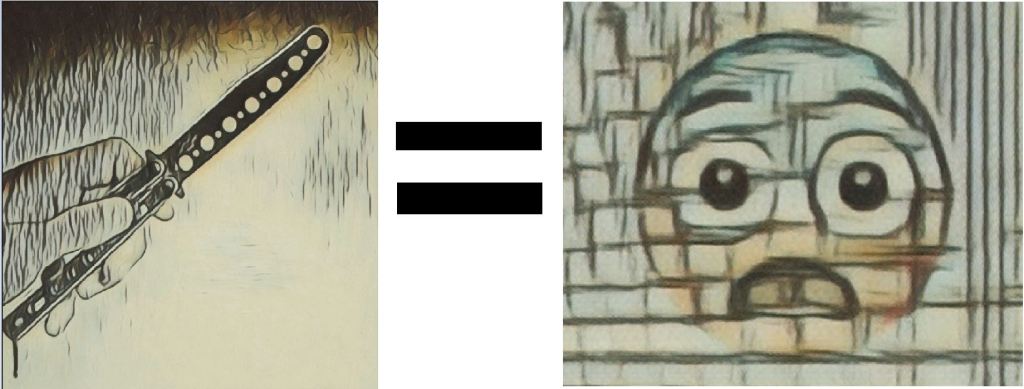
When there are no solutions..

Training with knives is scary. It is scarier than training with swords or spears or sticks. I am of course referring to traditional martial arts and not considering fire arms or even historic projectile weapons like bows and arrows, crossbows, slings and other thrown/discharged weapons. In other words, using Bharatiya terms, I mean while training with shastra and not astra.

The knife is not scarier because a knife is more dangerous than the other weapons. It is scary because, one, it can be invisible until after the attack is complete, and two, because being a close quarters weapon, a knife, even when detected gives very little time to defend or protect oneself against.

I have been told by mentors with far greater experience than I in the martial arts, and some with practical experience in fighting with and defending against knives, that the numbers bear testimony to the fear of knives.

I am going to add the numbers that I have heard, as part of the notes below. This is because I have not personally done any analysis of knife attacks. I have only read articles about the research and heard people who have done the same share their knowledge. So, what I have is secondary or tertiary knowledge at best, about the numbers and statistics related to knife attacks. Also, my personal experience is more with traditional martial arts and larger weapons that I referred to earlier in this article. Add to this the fact that there are varying views about knife attacks, and surviving the same, and that these sometimes disagree with each other, I do not want to subscribe to any one view. That decision is personal for everyone, because it involves physical injury and trauma. I apologize for this inconvenience, and also request readers to do a little back and forth scrolling while reading this article.

Another worry with knives is that a slashing attack might look ghastly but not be fatal, while a stab shows a smaller wound but is far more likely to be fatal. So, to repeat myself, knives are dangerous as everyone knows, and are scary to train with, even when they are fake (because the knowledge of the danger is real).

The numbers seen in the notes below, show that there is no clear, sure shot defence against a knife attack. So, it is a situation with no solution. What does one do in a situation like this?

What I have heard from people with knowledge and experience with the problem of the knife, state that the best solutions are one of the following. One, avoid the fight or get away from the fight, in other words, retreat and get away from the space where the knife is a threat. A large distance between the knife wielder and the potential victim is a safe solution to survive the knife. There is a drawback to this solution though. Based on what I have understood, the chances that a knife attack begins only when the assailant is very close is very high, and hence, the opportunity to either run away or put a lot of distance between oneself and the attacker might not always present itself.

The second solution is not a different one, but more an extension of the first. It is to not be in the space where a knife attack might occur. This is similar to (though may not be exactly the same) what is also called “situational awareness” by some martial art systems. Yes, this might sound philosophical. But it is based on primeval intuitive abilities of human beings, which helped avoid predators (human and otherwise).

This is not something new either. Anyone who has traveled alone and late, in the dark, will know how one’s senses and ability to expect threats are heightened. This same feeling can be accepted and hence practiced in situations that do not exude an explicit threat with atmospherics (like a pub or a festival gathering where attacks are not expected). This could also be made mundane by saying, trust your feeling and do not go someplace you do not feel like going, even if the not wanting to go is not due to a threat perception. It could be unease manifesting as fatigue, lethargy or any other “I don’t feel like going there”.

The above alternative is about trusting one’s intuition and not being afraid to retreat. It can further be said that trust in intuition is very important, not just during knife defence, but also in staying away from a situation where defence against a knife is necessary. This might seem a cop out to some because it reduces the emphasis on practice to survive against a knife. They are not wrong. Practice is perhaps the best defence. But then, several people do not have the time to expend on the requisite practice, unlike those imparting the training or those in the police, armed services and other security services.

When practice and training time is a premium for most people, focus on the ability to avoid a fight is vitally important. Also, this is not surprising, in my opinion, for this is how we deal with most problems at work as well. And work is a very important part of all our lives, while self-defence training might not be.

Consider how much all of us rely on intuition to solve problems at work. All of us, when we are applying or developing any solution to any problem at work have a “gut feel” about how difficult the development will be or how long the same will take. All planning and estimation works on this. Also, the need to be on the lookout for problems after applying said solution is also based on estimations, which are driven by intuition. After all, intuition is experience plus a sense of the context/situation/atmospherics around a problem. Hence, we know when to apply a temporary fix as against a permanent solution as well.

The use of intuition at work from what I stated above, is about not just solving problems but also about being aware of the consequences of a solution as well. Thus, we are not only working to solve a problem, but also trying to protect ourselves from the consequences of further problems that might come up due to the solution, especially if it is a temporary fix. The key phrase here is “protect ourselves”. This is using intuition and stepping back to protect oneself; not defend against a situation, but to stay protected at all times. This is akin to wearing a helmet whenever you ride a two wheeler and not only when you are on a bad road or in heavy traffic.

This is the same as trusting one’s felling about a place or situation and also about retreating when faced with a situation where there is no good defence, like against a knife. Thus, protecting oneself is as important as, if not more important than a good defence. This rings truer still when a defence might be designed with a set of assumptions (which is always the case when defensive training is based on specific situations). In other words, protecting oneself starts with trusting one’s gut feeling and the ability to retreat before the need to apply a defence.

There might be no measure to check how many times one protected oneself by not being in a place or situation where a defence against a knife might have been necessary. But then, that is the best defence anyway.

On a lighter note, at least for us Indians, retreating to protect either oneself or ones dear to any individual should come naturally. After all, one of the many names of one of our favourite Gods, Lord Krishna, is “Ranchod Das”. It means one who runs away from a battlefield. This was anathema to the warrior code of the Kshatriyas (as is common in many warrior cultures around the world). I will not go into the story here, but Krishna chose the insulting moniker over fighting an impossible battle (against Kaala Yavana). He of course, survived and won the battle as a consequence of the retreat; but the name stuck.

In conclusion then, training survival against a knife has to include training to retreat (run away) and trusting one’s intuition until a defensive solution can be found (an offensive solution might also be possible, but hurting another person brings with it a host of other problems to consider after the act).

Notes:

  • I have been told that if an unarmed individual is attacked by a knife wielding assailant, and the person being attacked knows of the attacker’s knife, the probability of surviving the attack unharmed is between 0 and 0.5%. This is if the person being attacked has no training in defence against a knife. If the person being attacked is trained in defence against a knife, the probability of surviving unharmed apparently goes up to around 2%. So, the probability of surviving unharmed against a knife is 2% AT MOST, with specific training to defend against the same. This is of course, supposedly not considering body armour to protect an individual against knife attacks. This number is undoubtedly low but 4 TIMES greater than with no training. Nonetheless, the number reinforces the worry about training with knives. Little wonder that knife training is done with fake knives only! 😛
  • A 1988 book by Don Pentecost called Put’em down, take’em out! Knife fighting from Folsom prison. – I have heard that this book is supposedly contentious and should perhaps be considered as another source of information and not as gospel truth. Also, I have not read this book myself and have only seen references to it.
  • There are many YouTube videos referring to knife attacks and what one can do in such a situation. I cannot specifically recommend any, but leave it to interested viewers to decide on the information they find most useful.
  • There are also people who opine that even screaming for help or running away need to be learnt and practiced. These two might seem to be common sense, but in a stressful situation like a physical assault, they will not manifest automatically. Practice and conditioning are what a person falls back on in such a situation and hence this suggestion. This is beyond the fact that a knife attack might not allow for the option of running away.
  • Knife training can be used for life lessons, but the vice versa need not be entirely true. This obviously, is because, a threat to life and limb is very real in a knife fight, while the same is not true at work or in others aspects of life that are not physical combat. In life and at work, the risk could be financial, to one’s health and one’s reputation. The opportunities available to fix these, can be greater for everyone, when compared with a short and intense knife fight. Hence, what I have opined here is a perspective more relevant for individuals that are not martial arts’ practitioners or students who have just begun martial arts’ training. If this was looked at from the perspective of someone who is a regular student of the martial arts, I would opine that the learnings from training the knife and protection against it, including the aspect of intuition, should be a take away to be applied in life and work.
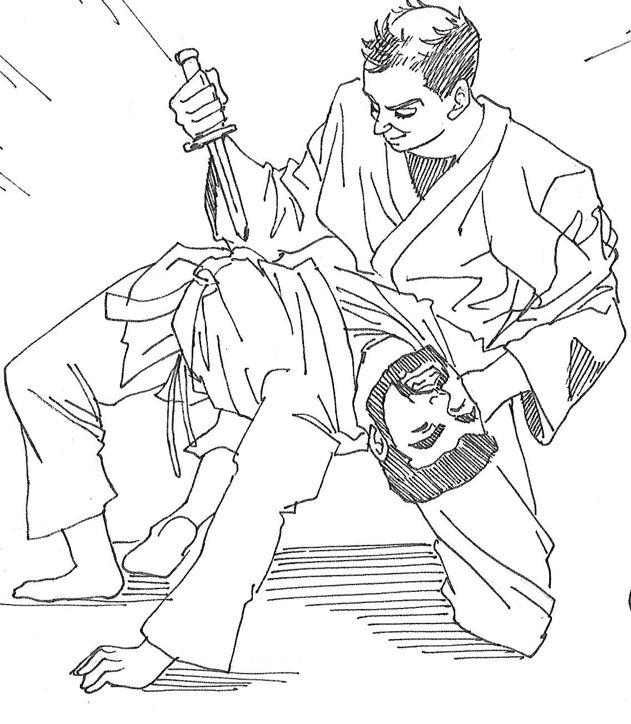
Martial Arts demonstration? – Be Uke, not Tori

One thing that all martial artists would have experienced in their training lives is having people ask them to show “something” of what they train or have learnt. This, if I am not wrong, is more often in the early part of one’s training life when you are an oddball, for being a part of something that is not common, in one’s family or social groups. When people start associating you with martial arts over the years, this reduces, with older social groups and also with older people. But one still does get asked for a demonstration, by younger people one interacts with and newer members of one’s social and familial circles. This request is also more likely with younger folk who are possibly familiar with the more popular martial arts forms like MMA or what they have seen in movies, on OTT or in video games. It is also likely that this is a situation that comes up with folks who frequent the gym regularly; of course, the older folk at the gym might again not be the ones who make this request.

The interesting part is what a practitioner of the Bujinkan should demonstrate when asked to show “something” of what he or she knows or has learnt. I am speaking here predominantly from an Indian perspective. The answer to this can be split into two parts with two segments within each. These are as seen below.

  1. Beginner is demonstrating to
    • People with no experience in the martial arts or any other physical activity (like working out at a gym, regular sports, running, dance, yoga* etc.)
    • People with experience in either martial arts (any art form) or any other physical activity
  2. An experienced Budoka is demonstrating to
    • People with no experience in the martial arts or any other physical activity
    • People with experience in either martial arts (any art form) or any other physical activity

The table below shows the same a bit better.

DemonstratorAudienceAudience
BeginnerNo experience in martial arts or physical activityExperienced in martial arts or physical activity
Experienced BudokaNo experience in martial arts or physical activityExperienced in martial arts or physical activity

Before looking at the answer for any of the above four subsets, let me lay some groundwork for how I might arrive at the answer.

In the Bujinkan, we study the Ten Chi Jin to learn all the fundamentals. We next study the 6 styles of fighting through the study of 6 different schools respectively. The Ten Chi Jin has concepts, kata and waza originating from the schools put together to allow practitioners to learn and familiarize themselves with various important concepts and movement requirements. Also, we study the weapons in the Buki Waza part of the Ten Chi Jin. We also study weapons from mainly the Kukishinden Ryu and some other schools.

In all this training, there is one common thread. In all the forms we study, there is a defined attack. Later, when we have many years of experience, we move to studying concepts and unlearn the set forms to be able to survive with attack, which need not be defined or expected. But for the initial years, for safety and to understand the martial art and our own movement, there are set forms and these set forms have defined attacks. The attacks are taught as part of the training. Even the techniques as written, from the schools have as their first line, a statement of how Uke attacks the Tori. So, first there is an Uke (attacker, for simplicity) and then there a Tori (defender, for simplicity). If there is no Uke in these forms, there is no need for a Tori (of course, there are exceptions which will referred to later).

Perhaps because we are graded as Tori and not as Uke, we think what we have learnt is the response or reaction to an attack; after all, that is what the names and forms refer to. And hence, when asked to show something or demonstrate what we know, we default to being a Tori and here begins the problem. With this background, we can get back to the four subsets defined earlier.

Let us start with a beginner demonstrating what they know. As a beginner, one might not be very comfortable with the waza or kata. This problem might be exacerbated with attacks that one is not yet familiar with. So, if the demonstration is for or on someone who is not familiar with the attacks that have been used to train the basics, one might have to end up showing someone from outside the Bujinkan, how to attack. This leads down the rabbit hole of endless “what happens if” questions regarding attacks that are not being demonstrated. And this might lead to a situation one is not sure of being able to handle.

One solution to his situation is to stop being the Tori in the demonstration and start being the Uke. We learn a plethora of attacks, ranging from punches to kicks to throws to chokes (there is a cornucopia called the Hi Ken Juroppo). Attack them and show them that this is how you can attack effectively. One does not have to be violent with the attack, it just needs to be shown that a threatening situation can be created. Also remember, the attack need not be from the front, a choke from behind or a side kick are completely legitimate, as are the kyusho points including stomping of toes and attacks to fingertips. This is a demonstration all by itself!

If this can be done, the demonstration can be switched around. You can tell the other person to respond to your attack and you can offer to attack at low speeds. Of course, make sure that there is no malice in the attack. Now, we can differentiate between the two types of audiences we considered earlier, for the demonstration of what has been learnt.

If the person you are demonstrating to or on, has no background in the martial arts or in any other physical activity, you can show them how the attack can be received and go on to show one of the simple basic waza. This is experiential demonstration. And since they cannot generally get it, you can then ask them to attack as you did and show how the waza works. You have now overcome the issue of unexpected attacks and also set the context for a waza in the demonstration by starting with and controlling the attack.

If the person you are demonstrating to has experience in a different martial art the onus is now on that person who asked for a demonstration to defend effectively against your attack. This attack will be the unexpected attack for that person and the opportunity to go with multiple attacks is open for you. You can go with the “what happens if the attack changes” conversation with that person and shift the onus for a successful demonstration onto that person. If that martial artist has specific rules about how not to attack, then the conversation moves onto the context of the attack and you can go with explaining how the Bujinkan is a battlefield martial art and has no rules. This then, can allow you to repeat what you did with the person with no martial arts background. Show the other person how to defend and demonstrate the waza in that way. All of this also can lead to a good conversation about the heritage (history, geography, technology) of different martial arts and better understanding in that way of the Bujinkan, maybe more than the waza demonstration itself.

If the other person is not a martial artist but has experience in some other form of physical activity, the way to demonstrate the waza by starting with attacking that person will fall somewhere between the method used for a fellow martial artist and someone who is not into physical activities.

If as a beginner, one has learnt the use of weapons, specifically the smaller weapons like the knife or jutte or kunai, movements with those weapons can also be considered as a valid attack to demonstrate as well. We also have the concept of kakushi buki (hidden weapons) that can be used for setting a context here. Keys and key chains are good magnification devices for boshi ken (thumb knuckle strike) and a lot of house hold devices like pens and spoons act as yawara sticks or tanbo to magnify basic shutos. And kunai movements can be wonderfully replicated with kitchen implements like rolling pins, pans, skillets and the like. On the defensive side, a bag, a helmet or a biking jacket helps reduce the effectiveness of attack, akin to armour studied in the Bujinkan. This is also a good aspect to use in an attack, by either changing the direction of attack to account for the presence of one or using these objects as additional hand holds for a choke or grabbing attack.

While being the Uke and using an attack as the initiation of a demonstration, one needs to identify and keep in mind the attitude of the person who wants the demonstration. This is apart from the martial arts background of the people who might be asking for a demonstration. The different types of people who might ask for a demonstration, based on attitude, that come to mind, are seen below.

  • It could be someone who carries fear due to some unfortunate experience, who wants to know how to defend herself or himself (telling them that self-protection is more important would be preferable to any demonstration).
  • It could be people who want to check you out, maybe people who are larger than you or just people with big egos, might be looking at the demonstration as an interview or an interrogation.
  • It could be people who like the theory and concepts from the martial arts.
  • It could be people with no ego issues and have no intention of training, but are genuinely interested in something they have no idea about; these people are glad to have someone who might be able to satisfy their curiosity.

In all of these cases except the second one above, the attack needs to be actively non-threatening and without any malice. The person consuming the demonstration should be absolutely sure that there is no risk of any injury. In the second case, the one demonstrating should be aware of protecting herself or himself.

Apart from the above, one also needs to consider the gender, size and age of the person who wants to see a demonstration. The attack, and specifically its speed, needs to be tailored based on whether the person interested is a woman, a kid, an older person, a person who is differently abled or a person physically smaller than the demonstrator.

There is one other advantage of choosing to begin a demonstration by being the Uke. There is a prevalent notion among quite a few that martial arts are all about defence. There is also a notion that martial arts are about honour. By choosing to attack first and maybe from an unexpected angle and using deception while doing the same dispels both these notions. This is a great opening to start a conversation about how the Bujinkan is a battlefield (“battlefield” can be defined in many ways) martial art and has no explicit rules, except ones based on common sense for protection in the dojo. This also helps elucidate why sport martial arts have strong rules for protection of the participating martial artists.

This in turn helps explain why self-protection is a good concept to adopt over self-defence, since the former is self-centred and perpetual while the latter tends to be more reactive and situational. It also helps explain how it is reflective of real life, where there are no rules either. Any deception you might demonstrate in an attack is how real fights and wars happen. One only needs to search about 4th generation warfare, stand-off weapons and such to see the similarities between modern warfare and deception. Deception is a concept we train called Kyojitsu. This concept brings us to the situation where an experienced Budoka demonstrates the Bujinkan to either of the two audiences defined earlier.

When an experienced Budoka is requested to demonstrate knowledge from the Bujinkan, she or he can choose to be Uke or Tori. The experience will likely guide this decision. All the above points are still valid, but the added experience gives a lot of leeway in doing something different. If one chooses to be the Tori and there is an unexpected attack/situation the same will have to be dealt with however possible. In case the Budoka faces injury, she or he can only blame herself or himself. The reason for this and the solution are the same, Sakkijutsu.

Sakkijutsu refers to intuitive abilities.  This is perhaps the most important concept to study, train, learn and experience in the Bujinkan, after years of basic training. So, if a Budoka is able to access and apply Sakkijutsu, the risk of injury due to unexpected situations while being a Tori is supposed to be mitigated. This is because using Sakkijutsu is all about being able to move to achieve safety due to an intuitive understanding of the situation. Experience also allows a demonstration to happen without a defined waza or kata. Any movement can be used to explain aspects of the Bujinkan.

Another reason an experienced Budoka can start as Tori is because he or she is expected to also be able to use Kyojitsu to achieve a favourable outcome in a demonstration. Kyojitsu is about being able to use deception in movements and intents. This also allows switching between Uke and Tori as they are not roles set in stone. Thus, Kyojitsu with Sakkijutsu is a potent mix when applied by an experienced Budoka that allows her or him to demonstrate effectively with safety to the one demonstrating and the one being demonstrated on, or to.

There are techniques in some of the schools we study, like the Takagi Yoshin Ryu and Koto Ryu, where the attacker is just walking past or just coming towards you. There is no explicit attack. You still take them down. These are techniques used when one is supposed to know that the person is the enemy or Sakkijutsu suggests there is a threat from that person. Here, the Tori is Uke because he or she initiates the movement set, and Uke is Uke just by existing! In these cases, Kyojitsu can also be applied to confuse the person being taken down to create an opening that can be exploited. Also, these are cases where the attack is the kata and there is no need for an Uke doing an expected attack for a demonstration. So, this is an option even beginners can use if they know the kata.

One final point about Kyojitsu. The very fact that even a beginner can choose to be Uke to become Tori is already an application of Kyojitsu, for by switching the onus of defence onto the person requesting the demonstration, you have already created confusion in the person, who might have expected to see you perform the same. So, becoming the Uke in the situation itself is an act of deception, which leads to great conversations as we already looked at earlier.

This is all I have on this topic at the moment. Hope I have conveyed why being an Uke, when someone asks you to “show something you have learnt in the Bujinkan”, is a good start, especially if you are not experienced and unsure of how to go about the same.

Notes:

*Here I am referring to Yoga mainly as the physical activity and not all the other aspects that are a part of it.