The test for the fifth dan in the Bujinkan is also called the “Sakki” test. Sakki here generally refers to “intuitive ability”. For those that are not a part of the Bujinkan, I am describing the test. The test involves two people, one administering the test and another who is being tested. There are other people around who determine if the person passed the test or not. The person administering the test and those determining if the test was a pass or not are all holders of the 15th dan, which is the highest rank in the Bujinkan system (there are a couple of other higher administrative ranks).
The person taking the test sits in an approximation of the Vajrasana and the person administering the test stands behind her or him. Both the individuals have their eyes closed for the duration of the test. The person in Vajrasana is hopefully in a meditative state. The person standing behind her or him cuts down at her or his head with a padded/training sword. The expectation is that the person in Vajrasana should sense the attack based on the intent of the person cutting and move out of the way just in time (not too early either). If he or she moves in time and does not get hit, the test is a pass, else it is a fail, and the person has to try again. When it is said “move”, it could be a roll, break fall, getting up in time, or anything else. The “pass or failure” in the test is determined by the other 15h Dans who are observing the test or by the Soke, Hatsumi Sensei himself.
The key for this test is to “sense the intent of the cut”. The intent is present before the action of cut and hence the person will always survive being hit if he or she moves in response to the intent and not in response to any other of the five senses. The stimulus from these five might not allow time enough to get out of the way of the sword.
From my teacher and all my seniors and mentors, who have greater experience with the Sakki test, I am given to understand that the test is for both the person cutting and the one evading the cut. While the person who passes the test is the one who evades the cut, the true challenge apparently is for the one cutting. It is the responsibility of the person cutting to establish a connection with the one taking the test. If they can establish the connection, they are also successful in transferring the intent to the person, which triggers the movement. So, the test is more to allow the person being tested to realize that he or she has the intuitive ability and can trust the same, it is not to test the extent or timing of the same. This in turn puts the responsibility of the passing or failing on the person delivering the cut. So, if the person fails, it could mean that the person cutting did not have the connection with the person taking the cut. And this is perhaps why many people who have given many cuts to different people think it is a responsibility to “give a good cut”. I have seen people tell each other that they are sorry that they could not give a good cut as well. There are a lot of videos of the Sakki Test on YouTube, which one can look for to get a sense of the same. I am not going to link any as it is impossible to decide which one is the best representation of the same. 😊
The challenge in the test is that all external disturbances which could distract one from the task at hand, the test, is removed, as are all other stimuli like sound, sight, smell and touch. Pure instinct might be triggered if one is not thinking of the same, but just thinking about it makes it very hard and the removal of the five conventional senses acts in the same way.
Thus, the key to the entire 5th dan test is the “connection” between the tester and the tested. And this important aspect of the test led to this article. I will hopefully elucidate this key concept with what has been normal behaviour in Hindu culture over a very long period of time.
Anyone who has watched even a few episodes of the many “Mythological” serials on the various TV channels would have seen one character or the other seeking the Aashirwada (or Aashirwad) of many others. An Aashirwada can be considered a “Blessing”. The act as seen on TV would generally involve one character who is either younger by age or achievements or abilities, touch the feet of another character or perform a prostrated namaskaara at the feet of the other, either in greeting, farewell or to specifically seek the blessing of the other person. The other person obviously has greater experience or wisdom in any of the attributes just mentioned and offers blessings.
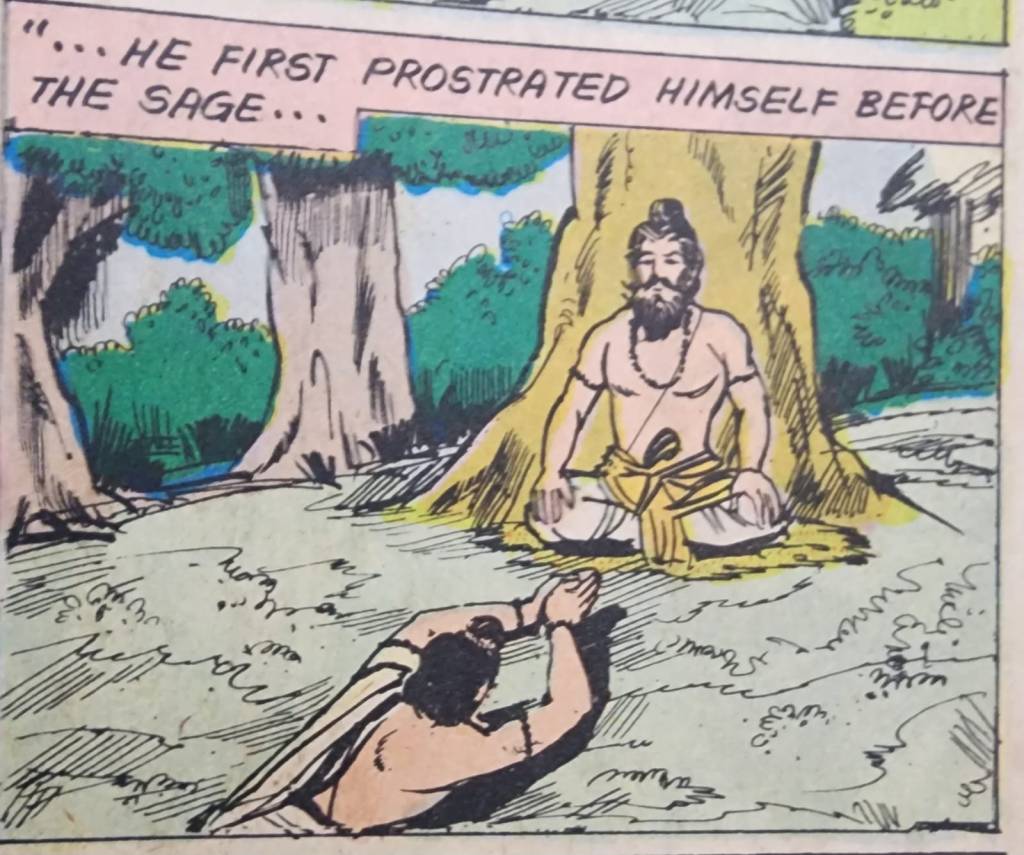
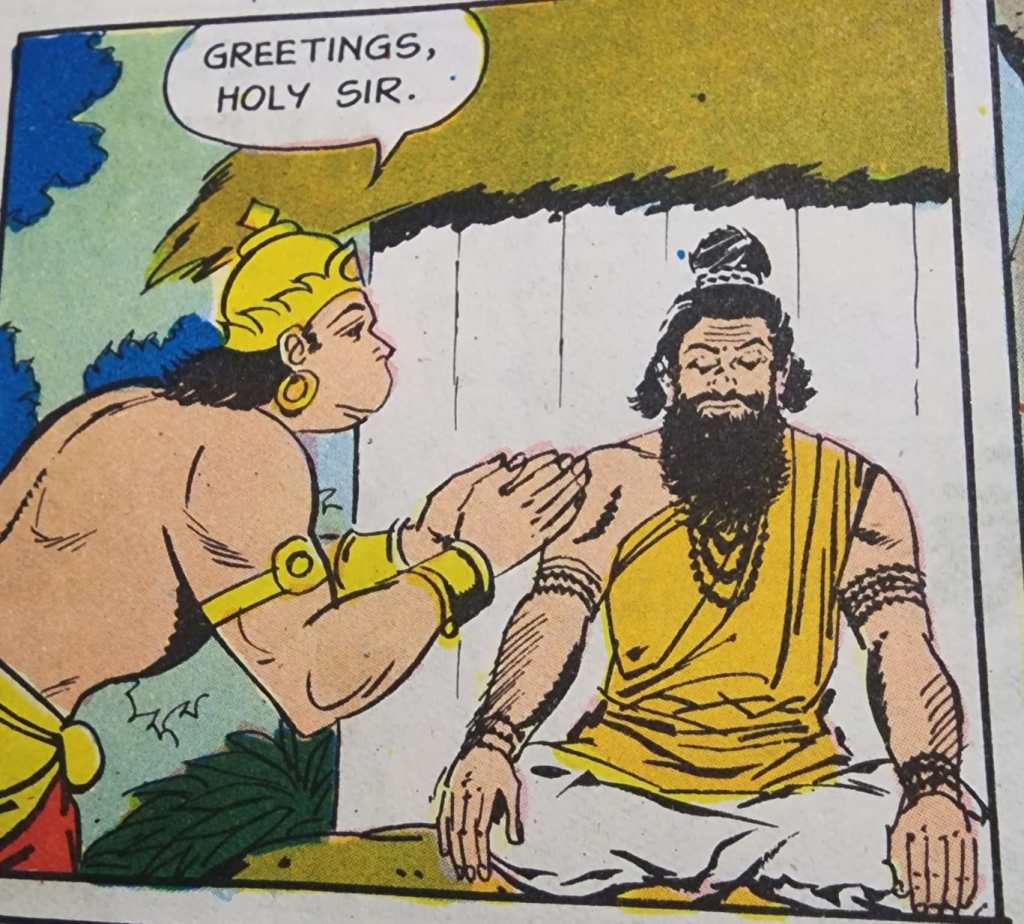
Credit for the images (left to right) – From “Enter Drona”, Mahabharata – 5 & “Hanuman to the rescue”, both published by Amar Chitra Katha
Some of the oft uttered blessings we see are (this is a very small sample set) –
- Aayushmaan / Aayushmati Bhava – Have a long life
- Vijayee Bhava – Be victorious
- Yashaswi Bhava – Be successful
- Keertiman / Keertimati Bhava – Be well known / achieve fame
These examples are from Hindi. But the same can uttered in any of the many languages in India. Most importantly, this is not an act just seen on TV or web series. Seeking the blessings/aashirwaada is an ancient practice that all of us continue with to this day. We specifically seek the blessings of elders and gurus. As we get on in our years, we might have to bless the youngsters in the family, and this need to be ready to pass on the blessings is what prompted this article.
Are the blessings just words that are uttered? Like wishing someone well? Or can they genuinely have a beneficial impact on the person who has received the blessings? And if the effect has to manifest in reality, what are the requirements on the part of the one giving the blessing and the one receiving the blessings? These are questions I do not have answers to, and any answers for the same would be welcome. But I do have some thoughts on the matter which I shall share. These are purely opinions based on personal experience, observation, and martial training.
Blessings are important to different people to varying degrees, depending on their upbringing, life experiences, association with specific individuals, association with places and objects linked to individuals and associations of many other types that people can think of. Places are considered sacred or blessed based on their association with Divinities or events that are associated with the same. Sites of old family homes are also considered blessed due to association with one’s own grandparents and ancestors. In these cases, the effort put into the journey to get to these places itself becomes achievement of an “experiential blessing”, where the experience of the journey is part of the blessing.
Either way, whether the blessing is from a person or due to a journey or a location, the connection is key. Belief is a connection, or at least the “option of giving a connection a chance”. Based on this observation, in my opinion, the blessing is no different than the ability to transmit intent in the sakki test, with the “connect” being the key aspect in both. In a conventional setting, the “intent” is the good will or desire for success of the one seeking the blessing. I opine that just as one can transmit intent in the Sakki test, the good will can be transmitted if the “connection” between the one blessing and the one seeking the same is strong. And just as the intent in the test can move a person, the will of the person blessing, can positively impact the one being blessed. This will be explored further below, with boons and curses.
Blessings of a more specific nature and perhaps of a more powerful variety can be called “Boons” and the opposite of “Boons” are “Curses”. Blessings are much simpler and seen in all human interactions where elders and teachers “wish for” or “bless” their wards, students and juniors, a favourable outcome in life. Let us consider “Boons” and “Curses” for a further exploration of connection and control.
Once again, anyone who has read stories from Hindu culture will surely have noticed the following two things. People meditate and perform penance(s) to earn “Boons” that grant them abilities beyond those of normal humans, and make the ones earning the boons almost equivalent to Gods. On the other side of the same, great Sages “Curse” people and even the Devas and Gandharvas for their indiscretions and mistakes, the consequences of which are dire and painful, and have to be endured for long periods of time.
A Boon is called a Vara in Kannada or maybe Var (if the language is closer to Hindi than to South Indian languages). Varadaana or Vardaan is the granting of a boon. A Vara is more than a Blessing in the stories. It grants the one receiving the same special abilities. These could include very long life spans, protection from harm from all but a few forms of attack, great knowledge or wisdom, incredible strength beyond that imaginable by any mortal human, or the ability to possess, use and retrieve weapons of unimaginably destructive potential.
Obtaining a Vara is no easy task. Firstly, one needs to demonstrate the eligibility to request a Vara and then also demonstrate the traits needed to wield the ability granted by the Vara. One requests the granting of a Vara by great beings that are not human or are superhuman; Varas are granted by the Devas or Lord Brahma or Lord Shiva. Even earning their presence requires expending great effort over long periods of time. Getting these divine beings to appear before one where the request for the Vara can be made is the demonstration of eligibility to ask for a Boon.
A common feature we see in many stories is that the means to request the presence of a divine being is meditation, also referred to as penance. This is shown as meditating on the God whose presence is being requested with singular focus for long durations of time, with no breaks. In the case of Arjuna when he was on a quest to acquire the Paashupataastra, Lord Shiva tested him by appearing in human form and forcing him to fight, and thus reveal his abilities, apart from just the meditation. Based on my understanding, the qualities that are demonstrated while performing Tapas (meditation) are, perseverance, dedication, focus, drive, resistance to pain, self-control and most importantly, letting go of the self **.
If the God whose presence is desired is impressed or convinced by the qualities seen, she or he appears to the person performing the meditation and grants them the opportunity to request a Vara of their choice. The letting go of the self is shown in some stories to be so complete that anthills or trees grow on the person, as if they were just a rock and not a sentient being anymore. There are also cases where there are multiple tests like with Arjuna that have to be overcome, apart from the meditation; these could be as diversions or disturbances to the meditation or something that needs to be endured in one’s life (the duration may vary).1
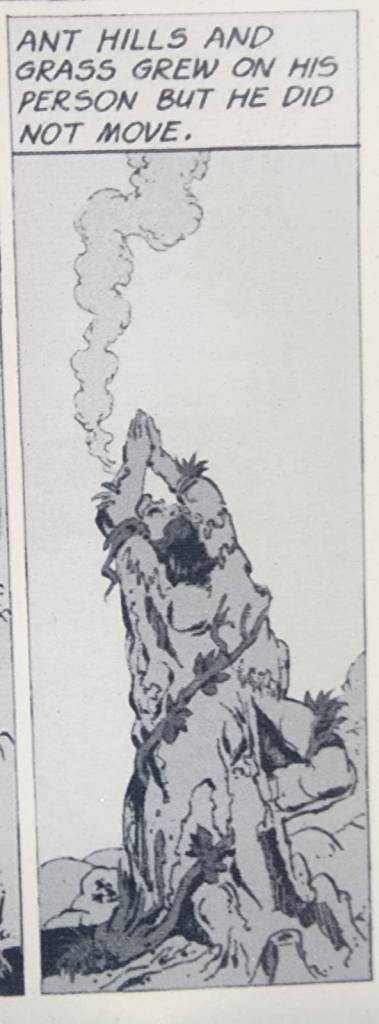
Image credit – “Dashaavatara”, published by Amar Chitra Katha (Kindle edition)
Many individuals request immortality and are denied the same as it goes against the natural order of things, and are told to request something else that will aid in the ambitions of their lives. A miniscule sample of Varas requested by individuals are mentioned below. Observe that these Boons could be granted to extraordinary individuals who went on to become “villains” in their lifetimes due to tremendous ego post the acquisition of the Vara.
- Taarakaasura requesting Lord Brahma to be unkillable by anything other than a son of Lord Shiva (when Lord Shiva a widower and in deep meditation for ages).
- Arjuna requesting Lord Shiva to grant him the ability to use the Paashupataastra.
- Hiranyakashipu requesting Lord Brahma to be unkillable by any human, animal, weapon, during the day, at night, inside or outside any structure.
- Mahishaasura requesting Lord Brahma to be unkillable by any male.

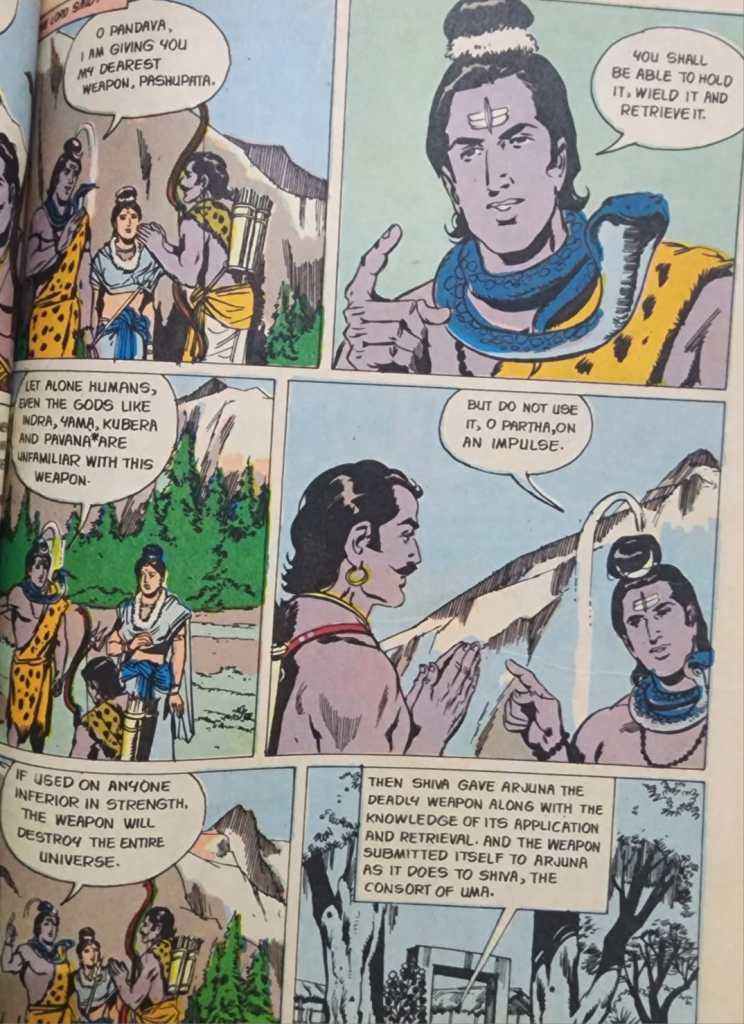
Credit for the images (left to right) – “Prahlada” and “Arjuna’s quest for weapons”, “Mahabharatha – 20”, both published by Amar Chitra Katha
A Curse is the opposite of a Boon. A Curse is a called a “Shaapa” in Kannada and Shraap or Shaap in Hindi. While a Vara bestows a specific ability or protection to an individual, a Shaapa or Curse causes a specific & severe problem to the individual who has been cursed. Many a time, once the curse is uttered, the person who is cursed is penitent and begs for forgiveness. When this happens, the person who has uttered the curse also states a remedy to the same. But there is definitely a long period of suffering involved before the curse is lifted.
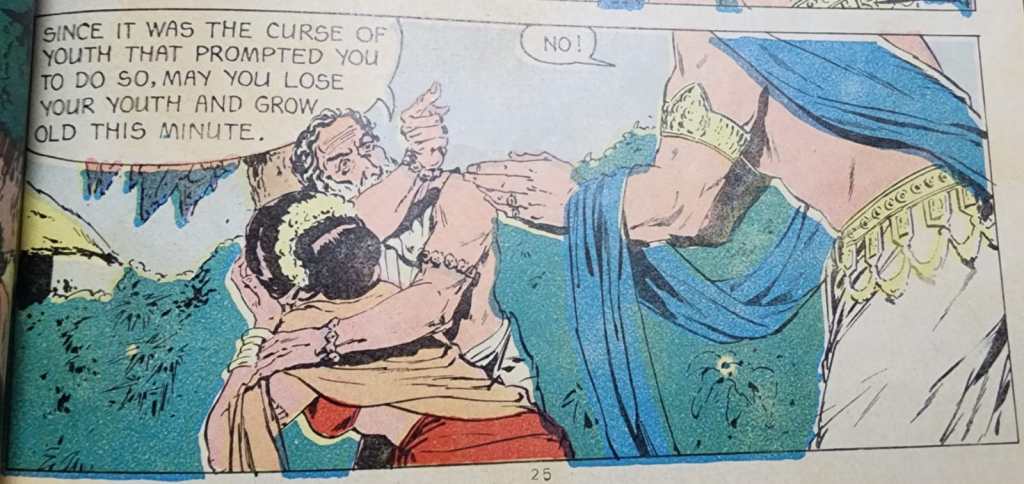

Credit for the images – “Yayati” published by Amar Chitra Katha
In this last aspect a Shaapa is like a Vara; in one case it takes a long time of repentance with inconvenience to serve out the time of the curse and in the other, one needs to endure a long time of inconvenience to be eligible to ask for a Boon. So, in either case the qualities one must acquire and demonstrate are the same, even if the origin of the demonstration is opposite in nature. Surviving a curse has a root cause beyond oneself while the effort to gain a boon lies within oneself. In a way a curse is surviving an uke’s (opponent’s) attack while a boon is being a tori (defender), voluntarily against an uke. Striving for a boon also has an aspect of the Musha Shyugyo (warrior’s journey) in that the journey begins voluntarily and the person who ends the journey is much changed from the one who started the same, due to the trials and hardships endured during the same.
From my recollection of stories from Hindu culture, curses are uttered by great Sages or Maharishis who have several years’ worth of Saadhana (practice in the right rituals, meditation and scripture) and knowledge. They utter the curse due to a grave indiscretion or blunder on the part of the person who is being cursed. These mistakes generally stem from an inflated ego after great achievement and this mistake then messes with the natural order, or rhythm of goings on in the universe. A tiny sample set of curses are mentioned below.
- Durvasa cursing Indra to lose his strength, ability and “Tejas” (radiance or vitality)
- Agastya cursing Nahusha to live on Earth as a snake until he is relived of the same
- Shukracharya cursing Yayati to perpetual old age unless one of his sons is willing to exchange his youth with him
- Apsaras and Gandharvas are cursed on many occasions for losing a sense of space and propriety while performing the arts in the presence of others
- Ahalya & Indra being cursed by Rishi Gautama for their infidelity

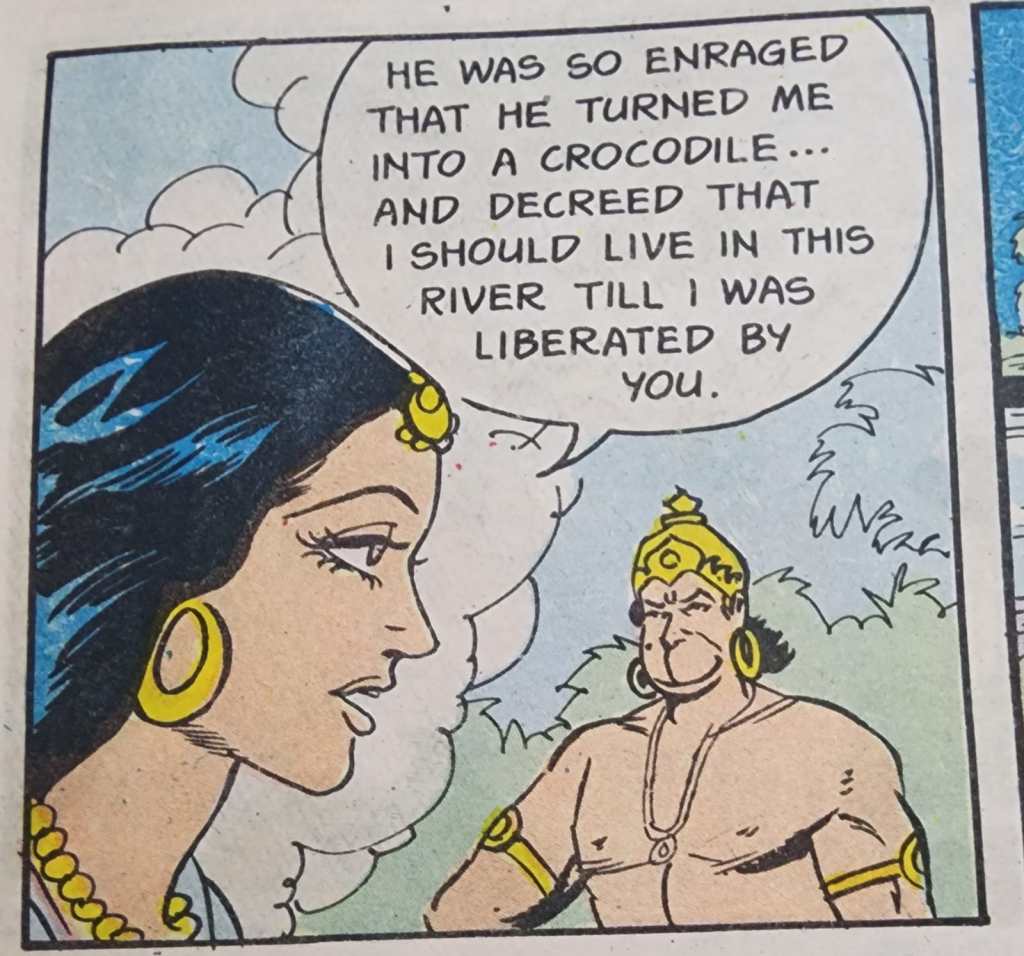
Credit for the images (left to right) – “Nahusha”, “Hanuman to the rescue”, both published by Amar Chitra Katha
A curse has consequences for both the person who utters the same and the one who is cursed. Perhaps this is true in the case of a boon as well, but may not be apparent in the stories as the entities bestowing the Vara are divine and there is no comparing such a being to a human, and so consequences are hard to identify. However, a curse, even when uttered by a Maharishi, is still by a human being acting against another human, even though the one uttering the curse is a highly evolved and accomplished human.
A case of the person cursing another and paying for the same is seen in the story of Rishi Brighu cursing Lord Vishnu for not receiving him as a good host should, when he visited Vaikunta (Lord Vishnu’s abode). Rishi Brighu, in his arrogance cursed a God! One of the Trimurthy no less! Lord Vishnu accepted the curse and touched the feet of the Rishi, but while doing so, he blinded the eye that existed in the foot of Brighu. This eye had allowed the Rishi to walk fast and almost float on the ground while not having to use his two normal eyes while moving about. But after this incident, he was forever slowed down and a great deal of his arrogance went with his extra eye.
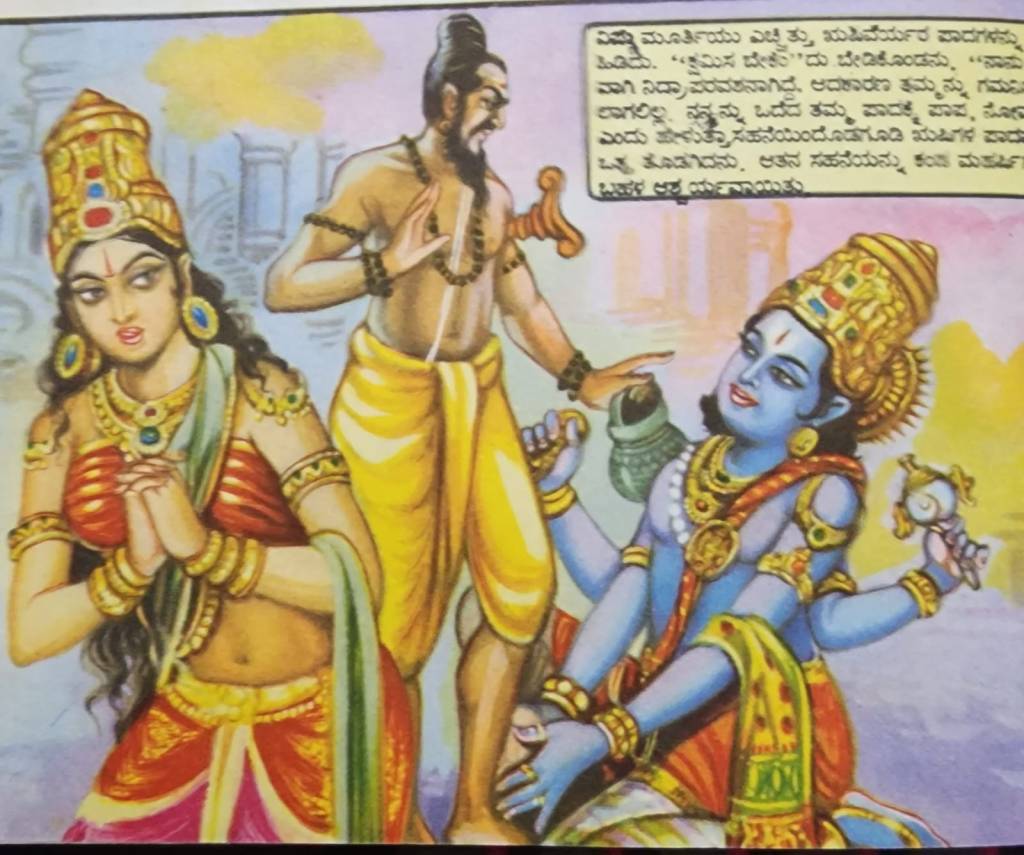
Image credit – “Venkateshwara Taanada Chitragalu”, published by Pioneer Publications – above image depicts Lord Vishnu accepting the curse by Rishi Brighu as described earlier
I have not heard of any stories other than this one that explicitly mention the consequences of uttering a curse or bestowing a boon on anyone, for the person who delivers either the boon or the curse. When I mean consequence in this case, I refer to the ability or skill or strength that is expended in making the boon or a curse a reality. But this can be inferred from the story of the great sage Vishwamitra.
Before he became the Brahmarishi Vishwamitra, he was the king Kaushika. The king Kaushika wanted to become a Brahmarishi who would be considered an equal to the Brahmarishi Vasistha. So, he performed severe penance and meditated for years to achieve the abilities of a Brahmarishi, one of which was a complete control of one’s senses and desires. On three occasions, after developing great abilities on the path to becoming a Brahmarishi, he had to expend the gained abilities to succeed in activities he indulged in.
Once, his meditative focus was broken by the extremely beautiful Apsara, Menaka, which whom he later had a daughter. This was a case of not having mastered his senses and desires. Next, after achieving great prowess through meditation, he expended the same in creating a second Swarga (roughly translated as Heaven or the abode of Lord Indra) for the King Trishanku who wanted to enter Swarga without first dying. On the third occasion, he expended the abilities developed through austere meditative penance in trying to show low, the King Harishchandra, whose values he wanted to see broken (Vishwamitra failed and Harishchandra never strayed from his values).
In all three situations, Vishwamitra lost the abilities already developed and had to start with a great deficit on the path to becoming a Brahmarishi. He eventually did succeed, but the concept is quite clear. Acting on a boon or a curse, if we can consider the creation of a second Swarga as a boon and causing hardships to Harishchandra as a curse, results in the great Sage expending abilities developed over many years. It takes equally long to develop the same abilities again. I personally think a good analogy here could be an accident endured by a sportsperson or a martial artist. A lot of time is spent in recovering from the injury first and then even more time is spent is training the body and mind back to the peak they had once scaled, if this is at all possible.
Alternatively, it can be considered as the effort one has to spend in achieving a successful attack, like a flurry of punches and kicks at great speed or relentless grappling, both of which require a vast investment in money, time and effort to execute in the first place, and then to survive with successful execution; then there is the risk of injury and failure, which require more time and energy to overcome and try again later, if necessary. In a modern context, it is like investing in an expensive weapons platform like a drone swarm; losing it in a failed mission and then having to invest in a better platform and further resource expenditure in creating or refining doctrines for the usage of the new platform.
So, the boon or the curse, requires the person who bestows either to have already achieved complete control over the self and several other aspects of the universe. An extraordinary example of this would be the boon given by Maharishi Durvasa to Kunti. He was pleased with her attention to duty when she was in charge of his hospitality when he visited her father Kunti Bhoja. So, he granted her a boon which allowed her to summon the Deva of her choice to bestow a child on her, and she could do this 5 times! So, Maharishi Durvasa could grant the ability to summon a Deva to a human being! This means that we cannot even begin to comprehend the abilities that Durvasa possessed!

Image credit – “Bheeshma’s vow”, “Mahabharata – 2”, published by Amar Chitra Katha
This example brings into focus another aspect of a boon or a curse. The person bestowing either, on another individual, can actually control multiple aspects of the universe and get them to behave differently for specific individuals for several years at a time. This of course is impossible for mortals and the examples from the stories are all of extraordinary humans who are on par with the Gods or the Gods themselves, when they are uttering the boon or the curse.
But let us look at this from a more mundane everyday aspect. But before we consider examples from our everyday life, I share an opinion of mine. Boons, curses and blessings are transactional in nature. These are received in response to specific actions. The person receiving any of these will have performed a series of actions for a duration of time, which results in the person towards whom these actions were directed, bestowing the boon, curse or blessing. But there is a difference between blessings (aashirwaada) and boons (vara). The shaapa is not something one works towards but is the result of an indiscretion and perhaps a result of not letting go of one’s ego and NOT working correctly towards whatever the objective was.
A Vara is something specific that a person wants and can be granted by a superior or divine entity. In order to gain an audience and demonstrate eligibility for the vara, she or he performs the requisite actions, which can be physical or meditative in nature. But a blessing need not be something that is specifically worked towards. One performs one’s duties or responsibilities with complete focus and attention to detail. This is a demonstration of great self-control and management of one’s reaction to given surroundings. The individual(s) who are on the receiving end of this diligent activity are greatly pleased by the same. This results in the impressed person offering a blessing as a reward in return for the services or whatever else was received.
So, an aashirwaada need not be sought after, but is received as a reaction to a job or an activity well done, where as a vara is something that is sought after and activities are performed towards that objective. Consider this, the boon bestowed on Kunti was actually a blessing. Her hospitality towards Maharishi Durvasa was not with the objective of a boon, but just a job well done. In response to this, she was blessed by Durvasa with the boon. Now consider the Tapasya performed by any great Asura, say Hiranyakashipu, this was with the specific objective of achieving a boon which bestowed great abilities on him, which would in turn allow him to defeat the Devas.
A simpler example of a blessing would be an elder blessing someone younger with a long life, when the younger person touches her or his feet. The blessing in this case is a reward for remembering that this is the right way for a youngster to greet an elder. This system is also a good positive reinforcement in preserving one’s culture and way of life.
With the above observation, we can consider a few situations from daily life, which could represent boons, blessings and curses. We have all experienced appreciations and rewards at work. These range from appreciative emails to merchandise to pictures on a “wall of fame”. These are more common compared to promotions and pay hikes. They are handed out more often as they are less expensive to organizations and also reinforce (hopefully) behaviour that is preferred. We also tip generously depending on the quality of service we receive at hotels and restaurants. These, in my opinion, are analogous to blessings as they are in response to an impressive activity.
Now consider promotions and pay hikes. These are much harder to come by and are objectives which require a plan and set activities that demonstrate eligibility. An individual spends a few years understanding what the parameters needed for either of these are, and working towards the same. It requires networking, measurable achievements and the sheer effort to achieve visible experience. So, the pay hike or promotion here is a vara/boon and the activities are the tapasya or saadhana that goes into achieving the same. This is because it is a specific objective that is worked towards.
What about shaapa and curses? The explicit situations that define these are cases where one has to leave a job or bear the cost of activity or behaviour that lead to integrity issues. These can be one misusing client data or accepting bribes at work to alter expected decisions. It is a negative consequence of errors at work. When these are inadvertent, the curse could be very minor, like a mail with an apology which smooths things over.
But a curse could also be invisible and long term, which is also realized much later. These could be situations where one’s relationships are broken due to too much self-indulgence in career related objectives, or a sportsperson suffering debilitating injury due to not enough breaks or insufficient detraining time. This is akin to the statement “the path to hell is paved with good intentions”.
A last point regarding blessings here. Many of us would have experienced situations where we receive appreciation mails or certificates and don’t really care for them and are definitely not motivated to either repeat the same kind of hard work or keep up the level of effort that resulted in the appreciation in the first place. This happens for many reasons, especially if there is a statement like “we need to do even better the next time”, which makes the appreciation more of an expectation setting. This could also be as there are blessings given when one is working towards a boon (appreciation instead of a pay hike). Why would this kind of mismatch occur? I opine that this is due to what we discussed initially about blessings, boons and curses. A distinct lack of “Connect”. Individuals know when the appreciations are just a matter of course after some time and also when they come from senior leadership who have no visible impact on their work lives. All they do is append a signature to a set of words composed by someone else. So, there is an attempt at a blessing, but the lack of connect, renders it empty of any effect. This connect I am referring to is the rapport that any leadership develops with its teams and how it is nurtured through trials and tribulations at work.
Having considered how blessings can be rendered pointless, we need to consider cases even from the stories in Hindu culture where boons could end up being curses. Remember the blessing that became a boon to Kunti by Maharishi Durvasa? Kunti after the rishi had departed, either in innocence or curiosity invoked the boon, with Lord Surya, before she was married. This resulted in the birth of her son Karna, whose life was partially responsible for the great carnage in the battle of Kurukshetra apart from being an extraordinary tragedy on a personal level. So, a blessing was a boon, the use of which with no negative intentions still became a curse not only for Kunti but for entire kingdoms!

Image credit – “Bheeshma’s vow”, “Mahabharata – 2”, published by Amar Chitra Katha
Similarly, Ashwatthama is cursed by Lord Krishna at the end of the Kurukshetra war. He is denied the release of death and is functionally immortal for the rest of the Yuga cycle. An additional point is that a wound in his forehead caused by removing a jewel that was present there would never heal. This was a jewel that always granted him good health. If one recalls, all the great Asuras asked for immortality from Brahma to compensate for the Amrita the Devas had. But when the same was not an achievable boon, they asked for other great abilities that enabled them to subjugate the Devas despite the Amrita. So, Ashwatthama was granted immortality, which was considered a desired vara by many, as a curse! An extension of this could be that the boons achieved by the great Asuras always resulted in incredible pain and hardship as a result of the wars they unleashed. So, a boon for them became a curse for many others. And this resulted in the many avataaras of Lord Vishnu to slay these Asuras. So, the line between a boon and a curse is thin, but not invisible.
The means to assuage this problem also returns to the twin concepts of connection and control. One needs to continue with the self-control one possessed before receiving the boon after the act, perhaps to a greater degree. This is because the person enhanced by the boon possesses a far greater potential to cause damage to the universe around her or him. In other words, her or his ability to control the surroundings requires an equal increase in self-control to prevent her or his boon from becoming a curse for others! And in order to keep the control of others benevolent or at least less harmful, the ability to connect with others and better feel or empathize with their motivation and desires is vitally important. So, a boon or a blessing, degenerates into a curse over time with a lack of connection and control.
A modern-day example of a boon tending towards a curse is international monetary aid. We hear terms in the media of some countries being “addicted to monetary aid from the IMF (International Monetary Fund)”. In Indian media this is used in the context of countries like Pakistan and Sri Lanka. In the case of Pakistan, the country has never developed a governance system that allows the country’s economy to expand and its populace to prosper. It has approached the IMF multiple times, every few years, to save it from economic defaults. The aid package from the IMF is a boon which is used with no connect with the needs of the country and its populace, and becomes an addiction, and this is a curse.
This observation can be expanded to the economic and military aid the USA provided to the various dictators in South and Central America, Africa and the Middle East during the Cold War years. The aid allowed friendship between the dictator (not the country) and the government of the USA, but this allowed the USA to control the dictator keep the socialist and communist rebels at bay. However, this control did not allow prevention of atrocities on the population of the countries. So, the boon of aid led to “control through benevolence”, of the dictator, but the same became a curse in the long term for the populations of several countries. This is not unlike blessings from fake spiritual Gurus who are basically conmen. They have wonderful words and can connect with people, but their intent can only generate empty blessings which are definitely not boons but could be curses, as they have no control over anything, not even themselves.
The converse of this could be true as well. And we can consider something I have heard from a very senior practitioner of the Bujinkan as an example of this. My mentor says that in all your interactions with people, try to connect with them, get a sense of their requirements, what makes them happy, what really troubles them and the like. This connect is to be done in earnest, not with an objective of studying them, like one might study bird behaviour. This kind of connection could turn to a good rapport or friendship and lead to us providing really useful suggestions while not seeming superior or overbearing. This leads to them remembering the connection and might result in their feeling responsible for helping us when we need the same. This is “control through gratitude, camaraderie and responsibility”*. The words used are the same as those used in the earlier paragraph, but the context is entirely different! My mentor says that this is an objective of all Bujinkan practitioners and should be a key goal of training. He says that one should be able to control rooms full of people with this ability to connect. But of course, a connection on this level is really hard to achieve and requires self-control abilities that sometimes seem to be just wishful thinking. 😛
One last point regarding control here, at a level simpler than the one mentioned in the previous paragraph. From being generous with tips to approving promotions to enforcing a separation from a job to sending appreciation mails, all these instances stem from a connection, but can only be enacted when there is control over multiple aspects to ensure the desired outcome, be it the situation (appreciation mails), budget (pay hikes), seniority or responsibility (promotion or separation) in organizations. When this control is employed, it could lead more connect and even better control, like a virtuous cycle.
The appreciation mail that is not of any motivational value is a case of control without connect, control of the situation where one is aware of the outcome that warrants the appreciation and the ability to send the same, but no connect that adds value to the words of appreciation.
This aspect of control is also true in the martial arts. I have discussed connect and control with respect to the martial arts in greater detail in my previous article, the link to which is seen in the notes below***.
In conclusion, it seems quite clear that the concept of self-control and connecting to others and one’s surroundings as a precursor to control over others and the environment, even in a benevolent manner is something that humans have considered and chased after for a very long time. It is something that never ends and requires perpetual reinforcement, in the form of case studies which are what the stories from Hindu culture are. And their application spans everything from fighting and conflict management to daily life.
Notes:
*One of the Gojo we are taught in the Bujinkan states “Fumetsu no fusei”. This roughly means “give and give” or “endless giving”. It could mean that one thinks of giving and not the return on investment. This is one of the paths perhaps to the point mentioned above. But then, there is also a concept called “Sente” which is roughly “not making the first move” because one might then become the Uke or attacker and present openings to the opponent/defender. These two points appear to be contradictory, but they depend on the context in which they are used. So, the intent – whether it is benevolence or malice – becomes the key factor while deciding whether “fumetsu no fusei” or “sente” is in action. I have discussed the Gojo in an earlier article, the link to which is seen below.
**I have discussed the concept of “letting go of the self” in a separate article, the link to which is seen below.
***The link to the article where I discuss in greater detail the application of connection and control in the martial arts is seen below.
1There might be other ways to achieve boons, like the story of the birth of Dattatreya. I am referring to the more common ones in this article.
 Mundane Budo
[…] * https://mundanebudo.com/2023/07/20/connect-control-part-2-boons-blessings-curses-the-sakki-test/ […]
LikeLike
[…] * https://mundanebudo.com/2023/07/20/connect-control-part-2-boons-blessings-curses-the-sakki-test/ […]
LikeLike
[…] +, **https://mundanebudo.com/2023/07/20/connect-control-part-2-boons-blessings-curses-the-sakki-test/ […]
LikeLike
[…] *https://mundanebudo.com/2023/07/20/connect-control-part-2-boons-blessings-curses-the-sakki-test/ […]
LikeLike