Nahusha was an ancestor of the Pandavas, who are the victors of the Kurukshetra War described in the Mahabharata. The Pandavas are something like the twenty second generation after Nahusha in the Chandravamsha++ (Lunar dynasty). Nahusha is one of the well-known ancestors of the Pandavas and an illustrious king during his time. He lived a storied life which involved great achievements, succumbing to ego, enduring a curse for long years followed by eventual redemption and an ascension to Heaven (Indra’s abode).
One of the stories related to Nahusha is about the Boon* (Vara) he received from Lord Brahma. This Boon made Nahusha incredibly powerful and pretty much undefeatable by anyone he could see or was anywhere in his field of vision. The Boon bestowed on Nahusha the ability to cow anyone he laid his eyes upon if they had any ill intent towards him. When Nahusha looked at them, they would be sapped of their strength and abilities, literally their “energy”, and they would come under his sway.
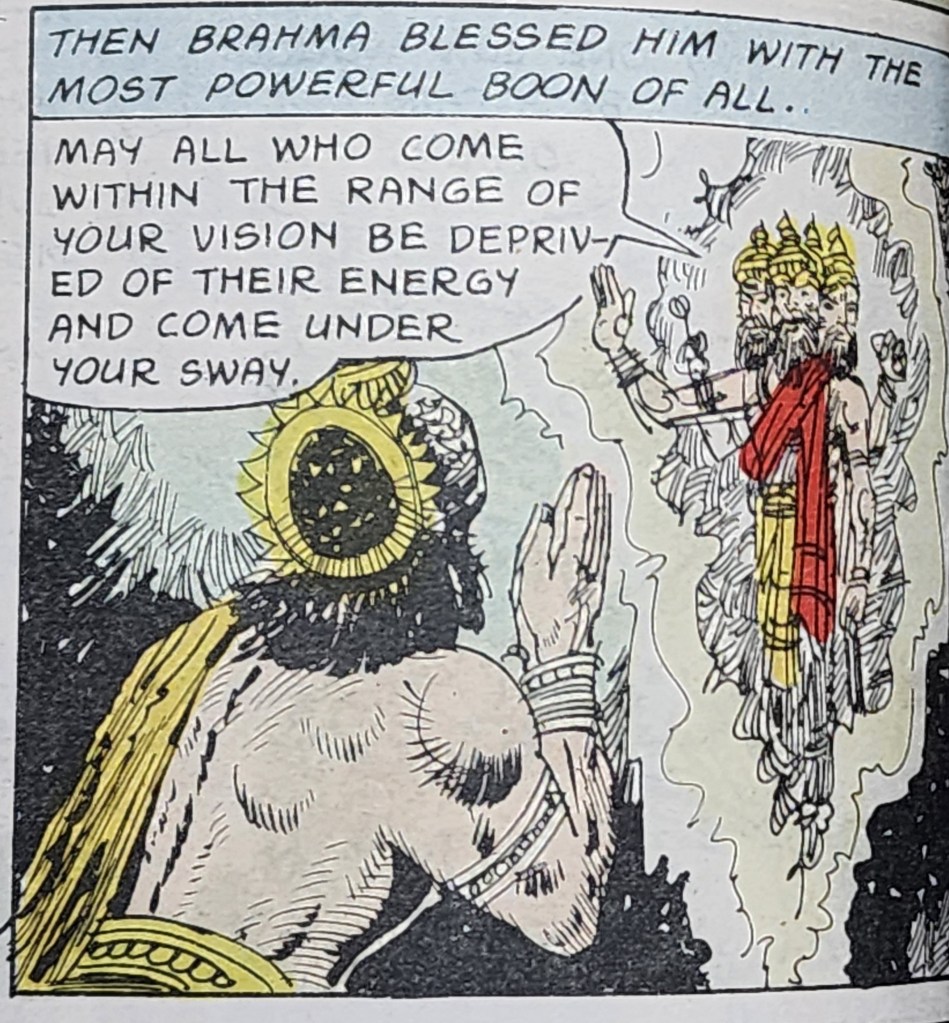
Image credit – “Nahusha”, published by Amar Chitra Katha
So, in simpler terms, if anyone had any intent to harm Nahusha in anyway, he just had to look at them to end that threat. The individuals having the ill intent would be rendered powerless and also be under the control of Nahusha as soon as they entered his field of vision. This included conspirators, not just people who would attack him physically. It is a highly desirable and badass ability even by modern standards. It is something like having drones everywhere, which know everyone’s intentions and this information can be used to control them, whether or not they know it; a very rogue AI meets 1984 type of scenario!
This Vara is bestowed on Nahusha when he is temporarily asked to be the king of Heaven (Swarga, the abode of Indra and the other Devas). This happens when Indra has lost his abilities and vitality, at a time when Nahusha is the greatest among the kings of Men (humans). This kingship of Swarga and the Vara are a reward for the virtuous life he has led until then. The Vara is a tool he can employ in his protective duties towards his kingdom and Swarga.
But like in many other cases, the great achievements and recognition goes to his head and Nahusha becomes a tyrant, turning his “Gaze” on the Devas, the great Rishis (Sages and Seers) and everyone else. He makes slaves of great people, making them do menial jobs for him simply to humiliate them and rub in the fact that they are powerless against their Lord. All these Devas and other great people are incapable of deposing Nahusha or even resisting his behaviour.
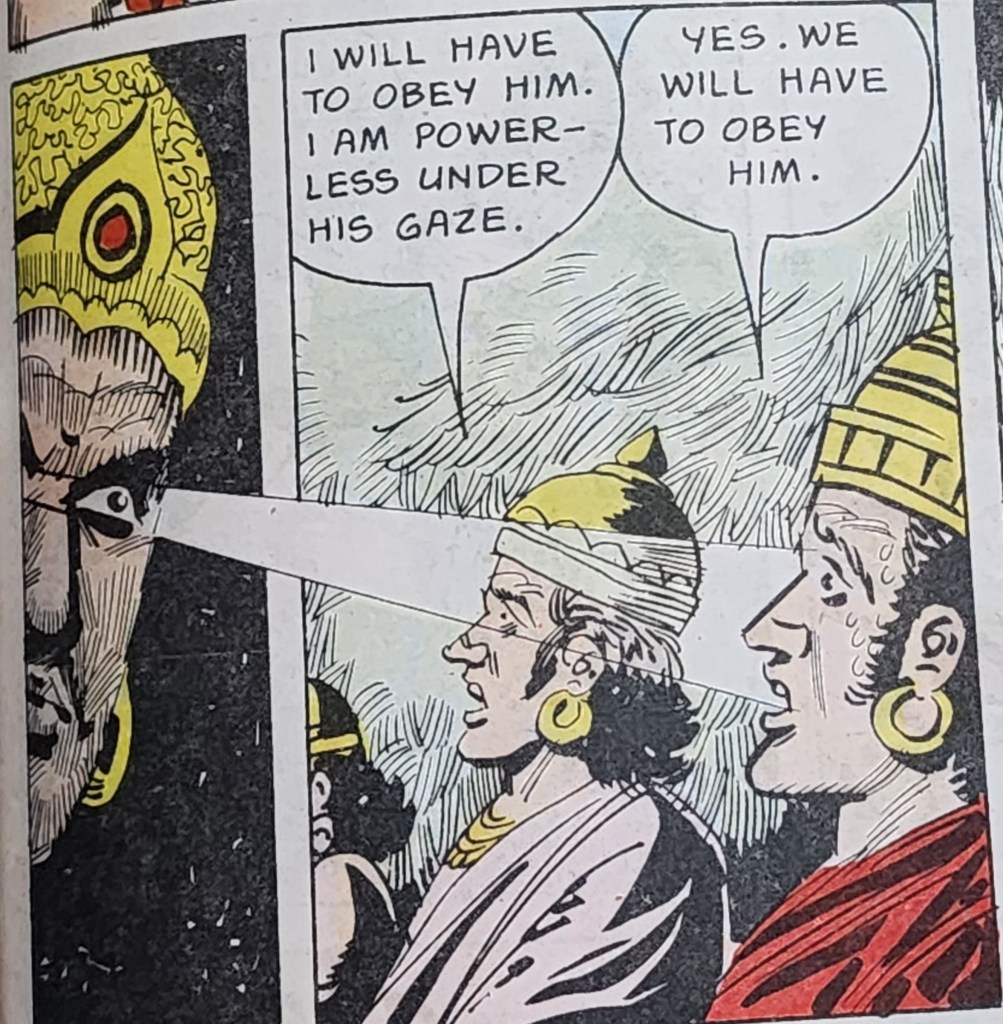
Image credit – “Nahusha”, published by Amar Chitra Katha
But, over time, a counter is devised to the “Gaze of Nahusha”. Maharishi Brighu hides in the matted locks of Maharishi Agastya, and curses Nahusha to turn into a snake and live on Earth. This causes Nahusha to lose his human form, kingship and the ability to rule. But while serving out the curse on Earth (the mortal realm) he retains the abilities of his “Gaze”. Of course, while we can think of one Rishi hiding in the locks of another as an element of fantasy, this is an ability that is possessed by great Rishis and the two Rishis involved in defeating Nahusha are two of the greatest ever. But in a more mundane situation, we can consider that the curse on Nahusha could be pronounced from any hiding place, which would keep the person uttering the curse out of sight of Nahusha.
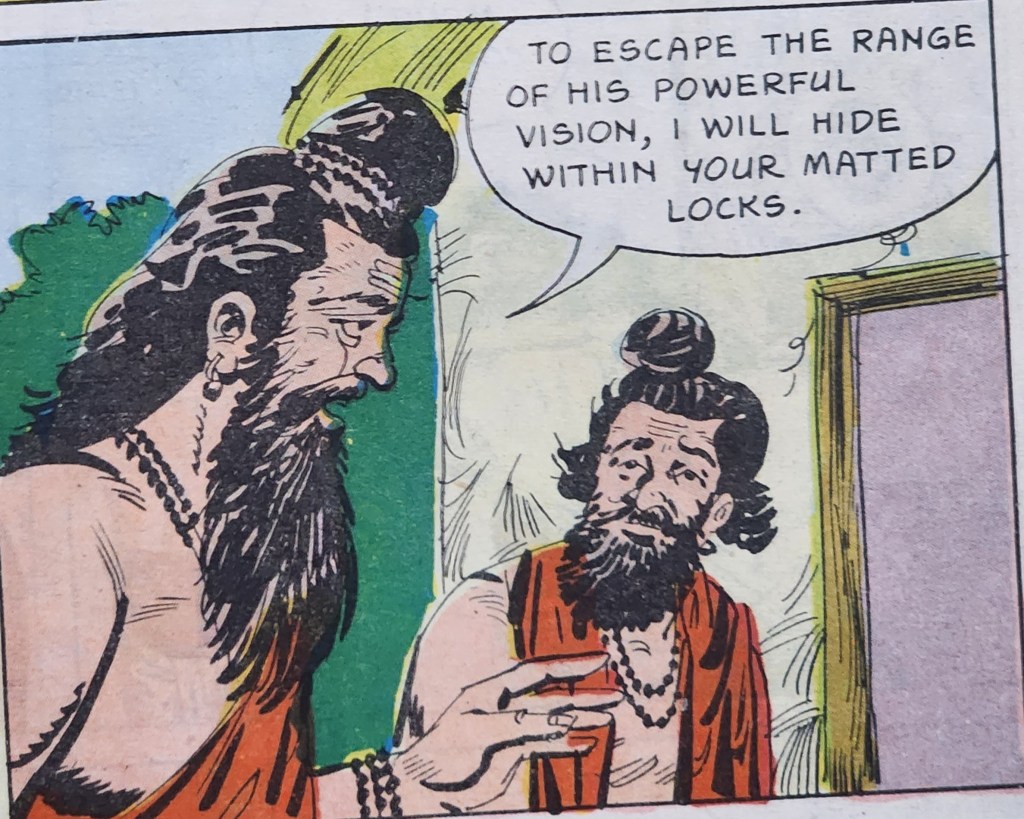
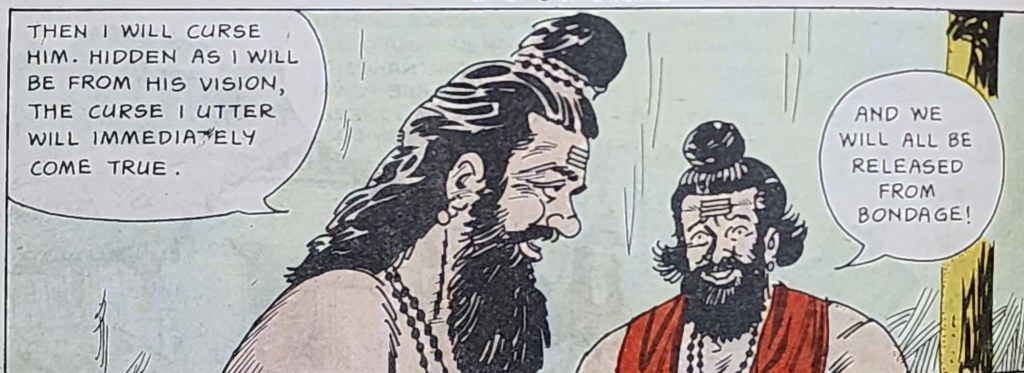
Credits for the two images above – “Nahusha”, published by Amar Chitra Katha
In the Bujinkan system of martial arts, there used to be yearly themes. These themes were concepts or forms or systems of movement and fighting that the Grandmaster used to suggest, which used to be the focus for the duration of that year apart from other general training that practitioners of this system went through. The Soke (Grandmaster, though the word means “Inheritor”), Sensei Hatsumi Masaaki, announced these themes all the way from the early nineties till the onset of the pandemic.
The theme of the year, back in 2007, was “Kuki Taishou”. This means, “Smile of the Ninth Demon”. The “Ninth Demon” referred to, is the highest of the demons with incredible martial ability. This Demon, as I recall is not evil, but more of a guardian deity, who protects sacred spaces. Any attempt to violate the Demon or what he protects will almost certainly end in the destruction of the attacker.
The Demon will not attack, only protect. Any attacker, once she or he or they (multiple attackers), see the Demon, are dissuaded from going further with the attack or even beginning the same. This is because the abilities of the Demon are obvious at a glance, as is their own defeat. So, the fight is over before it begins. This is protection because, THERE WAS NO FIGHT.
I have also heard it said by my mentors, that the Demon just looks at the potential attackers and smiles. He is just standing or sitting nonchalantly allowing them to decide the next course of action. His smile on seeing the attacker(s) and the nonchalance exudes an extraordinary confidence and demonstrates his abilities without having to do anything. This overall experience in the presence of the Demon makes the attacker(s) realize that they stand no chance and hence the situation is diffused.
In this sense, in my opinion, the “Gaze of Nahusha” and “Kuki Taishou” are very similar, if not the same. In both cases, a person just looking at another individual or set of individuals, cows the other into submission, or at least dissuades them from initiating any violent conflict (physical conflict at least).
In the case of the Gaze, it has an element of magic as it is a Boon bestowed on an individual. In the case of the Demon, he has extraordinary martial abilities, but this could also have magical overtones as he is a Demon after all. I am not aware if the Ninth Demon became a Demon because of the martial abilities that were developed. In the latter case, “Demon” would be more a title than an entity/species denomination.
If we remove the Divine and magical aspects of these abilities, they still work, just not as elegantly or simply, as in the stories. Also, the path to achieve even a semblance of these abilities takes years of practice and experience through continuous training.
If we consider usual modern-day training in the traditional martial arts, it is one on one for the most part, with a little training against multiple opponents (just 2 or 3 opponents most of the time). The training against multiple opponents is done to understand how difficult it is to survive this situation. When we train one on one, even if one is just a beginner or is doing so for the first time, one “gets a feel” of which opponent is more dangerous, more skilled, stronger or faster. Of course, with greater experience, this feel of an opponent (what I described as “Shatrubodha** in a previous article) becomes clearer and occurs even before a physical exchange. With lesser experience, this feeling might occur after one or a few physical exchanges or maybe after an interaction (I am considering an interaction as involving multiple exchanges) or two. This ability to gain a sense of the opponent, even develops based on seeing the opponent in action against others, in videos and based on reputation, or what one has heard of her or him. This “feel of an opponent” helps us avoid injury and is a very important part of the martial arts. This reading of the opponent is what is happening in the gaps in a fight, when fighters are sizing each other up and trying to understand an opponent.
The feeling of Kuki Taishou is this ability amplified. A martial artist or fighter with great ability or strength or both, refined by lots of experience, has a natural nonchalance that comes about as a result of this experience. This is something that is grasped by others, more so by other martial artists and to a lesser extent by those that are not practitioners of the martial arts. This extends further when a martial artist is seen with one’s favourite weapon on the fighting area of one’s choice.
When this non-physical interaction occurs, the urge of the one who senses greater prowess in the other, is to mitigate the risk to oneself and it might lead to a shorter fight or hopefully a lack of a fight. This situation is true in both one against many or many against one scenarios. If the one comes off as very dangerous, even the many might choose to NOT take her or him on, and of course if one is taking on many, it is just prudent to walk away intact.
Beyond the martial arts, this is also true in other aspects of life. We know that there are experts in all fields. Based on our interaction with these experts, we know when to not argue with them on specific topics. We also accept the suggestions and guidance of certain persons more readily over those of others, whether at work or in matters relating to relationships, or anything else.
This concept of avoiding conflict with specific people due to Kuki Taishou, can also be expanded to processes. There can be processes put in place to identify root causes for failures at work. If these processes are very stringent and require a lot of effort, they succeed in making people avoid failures just to not interact with the RCA (root cause analysis) process. This perhaps makes people diligent at work. There could also be a very cumbersome visa provision process put in place by some countries vis-a vis some other nations, just to discourage visitors from specific countries. If the process is very troublesome, people might just choose to visit a different country. This could be in cases where people from a specific country might be known to overstay and violate visa guidelines.
So, making another person(s) realize that an interaction, specifically one that leads to conflict, physical or otherwise, is not worth it, with respect to another individual or a group of the same, is Kuki Taishou. The “Gaze of Nahusha” did the same, thus protecting him and as an extension, his kingdom and subjects.
Kuki Taishou and the “Gaze” are specifically tools that are preventive in nature, even though the ability to gain the same is through practice of both defensive and offensive movements (even Nahusha had several battlefield victories BEFORE he was bestowed the boon of the Gaze). This preventive aspect is what gives it its association with a guardian (like the Demon) or a protector (like Nahusha). But this does not mean that someone who has developed the ability of Kuki Taishou cannot be overcome.
Kuki Taishou is preventive because it gives pause to the opponent, who realizes that an attack is inimical to herself or himself and hence is to be avoided altogether. This pause occurs only as long as the ability of the opponent is vastly greater than that of the opponent. If ever there is a slacking in the training and the gap in the abilities or strength of the defender (demon equivalent) and attacker reduces to manageable levels, Kuki Taishou is greatly diminished or lost altogether. This will result in the attacker(s) going through with the attack. The attacker might even reverse Kuki Taishou through training and development of her or his own, when the defender is the one that needs to run to not face the attack!
Lastly, Kuki Taishou as discussed above is useful mainly in a melee like situation. This means when individuals or groups of the same face off either without weapons or with weapons that are not ranged weapons, like bows and arrows, crossbows, javelins, slingshots, chakra and the like. In Bharatiya terms, Kuki Taishou is relevant when the confrontation is with Shastra and not Astra. The same is true with the Gaze of Nahusha, which would only be effective if the person he wished to subdue was in range of and in the field of his vision.
Due to this detail, countermeasures will be developed for Kuki Taishou, just as one was developed to overcome the Gaze of Nahusha. Like all boons, there was a loophole in the abilities of this one as well. And to nullify the advantage of Kuki Taishou, subterfuge and guerrilla tactics can be employed. This includes the use of Astra, or ranged weapons, which do not allow the Demon or equivalent adversary to bring to bear their superior close quarter martial arts skills. Arrows, darts and the like could even be shot by individuals from concealment (this is exactly what was done to Nahusha, albeit with a curse and not a physical weapon – a curse could qualify as a mystical weapon). Or opponents could simply overwhelm individuals with large numbers of attackers. Subterfuge includes the use of poisoned food, accidents through engineering architectural elements to fail, and the like. Alternatively, as already discussed, opponents can put off an attack and train until the advantage is nullified and then attack, when Kuki Taishou is no longer relevant due to the absence of a gap in the abilities of the adversary.
In conclusion, Kuki Taishou, in my opinion, is very like the “Gaze of Nahusha”. It is extremely useful, specifically in (perhaps only in) a close quarters combat situation, with Shastra and not Astra. Maintenance of Kuki Taishou needs continuous training, which leads to improvement and refinement of one’s martial abilities. Of course, when this concept is applied in conflict management that is not physical in nature, like we all face at work and in life, the principles are the same and work as effectively, with the added advantage that distance does not matter, as communication through any media can lead to Kuki Taishou being apparent, though after an interaction or two, as the gut feel apparent due to physical presence might be absent.
Kuki Taishou will lead to the creation of counter measures to itself if used either indiscriminately or in ways that only serve one’s ego. This is just like the “Gaze”, and cannot be rested on as the ONE laurel that it is. The ability to use it in creative ways to overcome the inevitable counter measures that are developed is vital. This was something Nahusha in his pride failed to do and paid the price for the same.
The “Gaze” and likewise the attributes of Kuki Taishou are not an ironclad insurance against an attack. They are a mitigation mechanism and protection, not unlike a great fortress or a great set of armour. Nor are they the highest level of the martial arts; they are a stepping stone that could lead to a realization that conflict management is the most important thing to avert great injury or destruction due to violent conflict, physical or otherwise. It is not a one time achievement either. Kuki Taishou is a realization after years of training and the refinement of the same. Even its retention requires continuous training, all through one’s life, while considering the abilities gained, lost, added to and diminished with age, as one’s life progresses.
One last point regarding Kuki Taishou that strikes me is this. We learn that during the Cold War years, there was this doctrine called “MAD” or “Mutually Assured Destruction”. This was specifically applied in the context of Nuclear War, where any attack by one side would lead to retaliation by the other and both would certainly face complete destruction. Is this a situation where both sides, having equal abilities exude Kuki Taishou at each other all the time? And is this why neither side wanted to turn the cold war into a hot war? And is the “Arms Race” a consequence of having to nullify the Kuki Taishou of the other side? Perhaps it is, but I do not have a certain answer. It might not be Kuki Taishou, as one thing I have heard is that “nonchalance” is a very important aspect of the concept, and the deployment of nuclear weapons does not display nonchalance+ as I see it. And if economics is what ended the cold war, was that the countermeasure to the Kuki Taishou of one side by the other? Perhaps, again, I only have the question, not the answer.
Notes:
++ https://en.wikipedia.org/wiki/Lunar_dynasty#/media/File:LUNAR_DYNASTY_(Chandravamsha).png
* https://mundanebudo.com/2023/07/20/connect-control-part-2-boons-blessings-curses-the-sakki-test/
** https://mundanebudo.com/2023/07/06/connect-control-part-1-connect-control-shatrubodha-in-flow/
+ Nonchalance here is due to awareness of abilities mastered and not in the training that leads to the development of the same.
 Mundane Budo
.png)