Kaitatsu Gairoku means “do it indirectly”. This is just a phrase from the Japanese language. But it is also a concept that is trained in the Bujinkan system of martial arts. It is understood and applied differently based on the depth and duration of experience of a practitioner in the Bujinkan. Further, this concept is not specific to the Bujinkan. Many martial arts would have this concept with differing descriptions and nomenclature.
As a very simplistic example, consider this. One wants to punch another person in the face. If one has fists raised, the other person does the same, simply to protect one’s own face. In this situation, hitting the other person in the face is difficult, especially if the other person is purely defensive and has no intention of fighting. In case one does throw a punch, the hit might end up on the hands at best, and not on the face.
If however, in this situation, one kicks the other person in the groin, the he or she might double over and also lose focus on the defence of the face. In this situation, the person who threw the kick, might not really need to throw a punch at the face, he or she just needs to keep the fist in the right place, and the other person in the act of doubling over, smashes his or her face against the fist in space. In a way, the person punched himself or herself; it could even be that the person hit the fist with his or her face (obviously, this might never be an excuse with the law! 😛 ). In short, to punch the face, one kicked the groin – the objective was achieved indirectly, by not really attacking the face at all.
Of course, if the person defending moves out of range of the kick, the situation changes. Also, one could punch the hand of the defender and that in turn hits the defender’s face. But the example above was meant to be overly simple and not an exploration of an exact situation.
If we consider this in a more generic manner with training, beginners are taught to move their entire body to effect any movement against an opponent. This is natural where there are no weight categories or rules to control a training encounter, except one’s own awareness to avoid injuring her or his training partner. It is also important as one might be training against a larger, taller, heavier individual. Each situation is unique and requires application of learnings specifically to that encounter.
In such a training scenario, in order to affect the attacker (uke), one should strive to apply minimal strength, and use body movement to cause her or him to be at a disadvantage. This is training to ensure reliance is not only on one’s strength or speed. This is also Kaitatsu Gairoku in a roundabout way. The obvious manner to disadvantage the attacker is to counter attack with strength if necessary, but one uses movement as a substitute. This therefore is doing it indirectly, even if this seems counterintuitive at that instant. Of course, in a real situation where one is in danger, this training is hopefully useful in protecting the person with the training. Also, there is no restriction against using strength or any direct action to save or protect oneself when in real danger. It serves as an added advantage.
When an experienced practitioner is training, other aspects like kyojutsu or distraction techniques, or feints could be considered. Concepts like using timing to “cut the space” to mitigate an attack can also be used. It could even extend after many years of practice to “put something in space”. This refers to doing something, but not specifically to the opponent, it is just done in space, to see if an opening can be revealed that can be exploited. This concept of Kaitatsu Gairoku for experienced practitioners goes hand in hand with concepts like, “do not try to do a technique”, “do not finish the movement”, “keep the connection” (En no kirinai*) and others.
It is essentially a reminder that one needs to stay in the moment and do what is necessary to stay protected and nullify the attack. It is also a reminder to not fall in love with one’s own abilities and knowledge and not try anything actively. This is because an experienced attacker need not leave obvious openings, and worse, he or she might do that to set a trap! It is to remind a practitioner that there is no necessary difference between attack and defence and that one should not label things with past experiences. One only does things indirectly and incompletely at this level with staying alive being the only objective. This realization becomes exaggerated when there is more than one opponent and if weapons are involved (mainly traditional weapons that are not discharged in training, but of course firearms might be involved in real situations).
This realization leads to an iterative understanding that one needs to learn to trust one’s gut feel (Sakkijutsu+), move as necessary (Taihenjutsu) without pride or ego and assimilate the idea that there is no victory or defeat, only survival, so just stay protected (Goshinjutsu). This is doing it indirectly because, now there is no fight or opponent, just a situation to avoid at best or survive at worst. One survives by not being in a fight! This is the epitome of doing it indirectly as one survived a fight by ensuring that the fight did not happen! Not by being there and doing things to survive. Of course, this is a beautiful concept which is incredibly difficult to apply in daily life, not just in training. But it is also intuitively understood by most of us, even without martial arts experience (it also reveals that luck is important in life 😀 ).
So then, how does Kaitatsu Gairoku help with influencing the Gods? In my recent articles**, I have mentioned and discussed how stories from Hindu culture show individuals performing meditation, penances, yajnas and other activities to obtain boons, mainly from Lord Brahma. This boon (vara) grants great abilities to the individual on whom it is bestowed and also protection from various life-threatening people, weapons and situations. These “Blessed” individuals many a time give in to their egos and cause havoc on the planet. Lord Vishnu manifests on Earth in one of his avataras to exploit the “opening” or “loophole” in the Vara and puts an end to the adharmic (I feel it is simplistic to use the word ”evil” instead of adharmic or non-dharmic) activities of the individual.
The path to gaining a boon is very long, hard and even torturous at times. I have gone into this in earlier articles and will not repeat the same here. Anyone who has even a faint idea of stories from Hindu culture would be aware of this. However, there is one aspect of the whole process of Tapas performed by an individual that is not considered in my earlier articles, which I will delve into here.
Many a time, when a determined individual performs severe tapasya (can also be called tapas) for a long period of time, the stories tell us that their efforts cause extreme weather events. Two examples of this would be the tapasya of Hiranyakashipu, father of Prahlad and that of Arjuna, the third Pandava. After Hiranyakashipu had performed tapas for a long time, the whole world started experiencing extreme heat. This caused the Devas, his mortal enemies, to request Lord Brahma to put an end to the tapasya by granting him an audience and hence the boon he desired. Lord Brahma acquiesced and granted Hiranyakashipu an audience and the boon he desired.
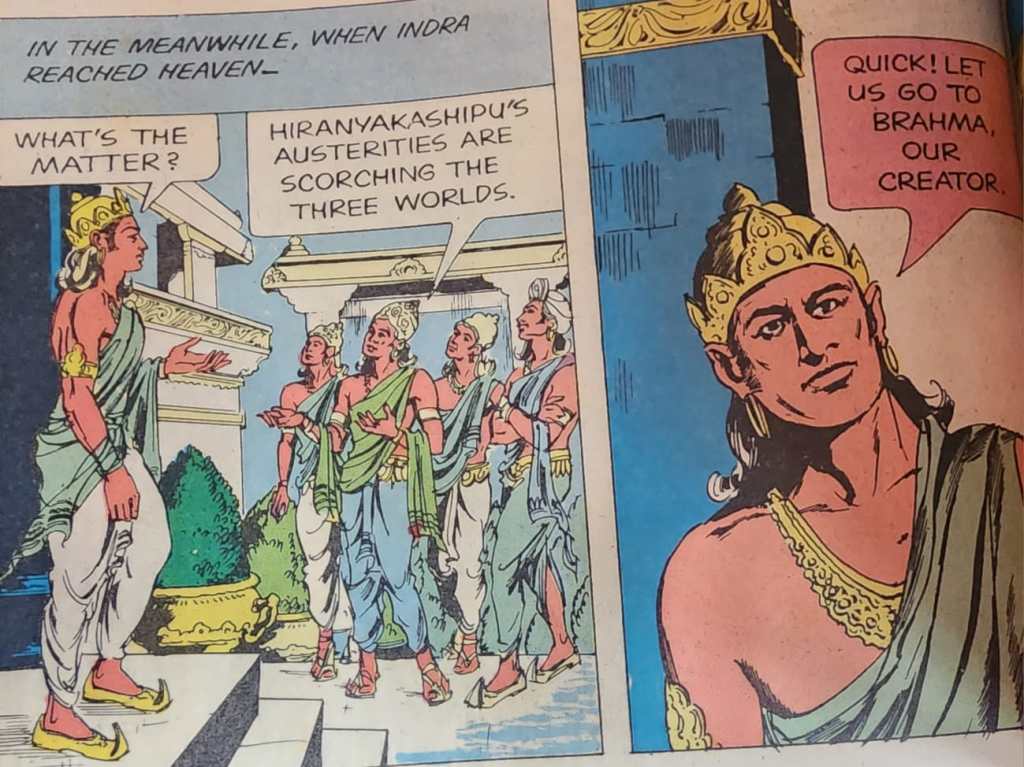
Image credit – “Prahlad”, published by Amar Chitra Katha
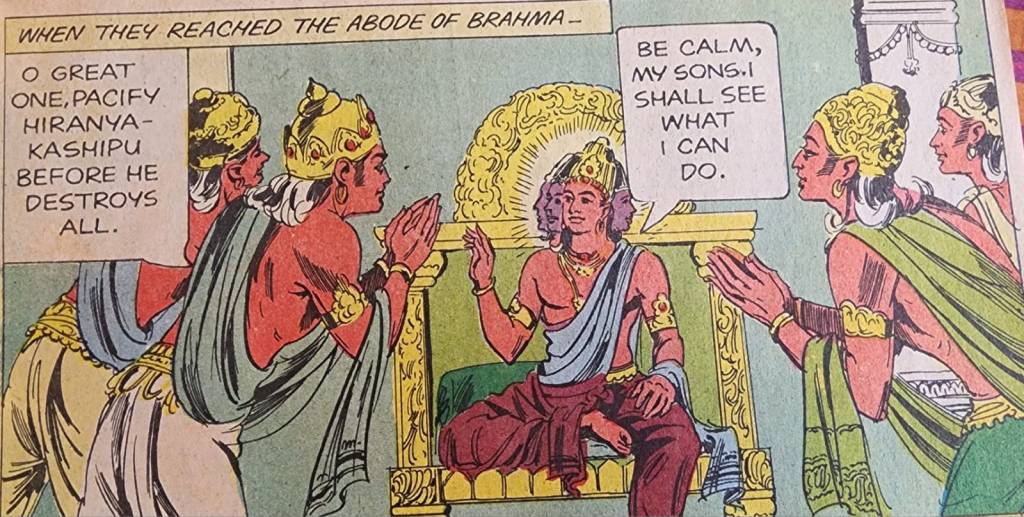
Image credit – “Prahlad”, published by Amar Chitra Katha
When Arjuna was meditating on Lord Shiva in his quest to attain the Paashupatastra, his meditation caused the areas around his place of tapas to become perpetually covered in clouds. This caused the Rishis who lived in the region to request Lord Shiva to end Arjuna’s tapasya by granting him an audience. Lord Shiva relented and stopped Arjuna’s penance with a physical test. The passing of the test led to Arjuna gaining access to the use of the Paashupatastra.
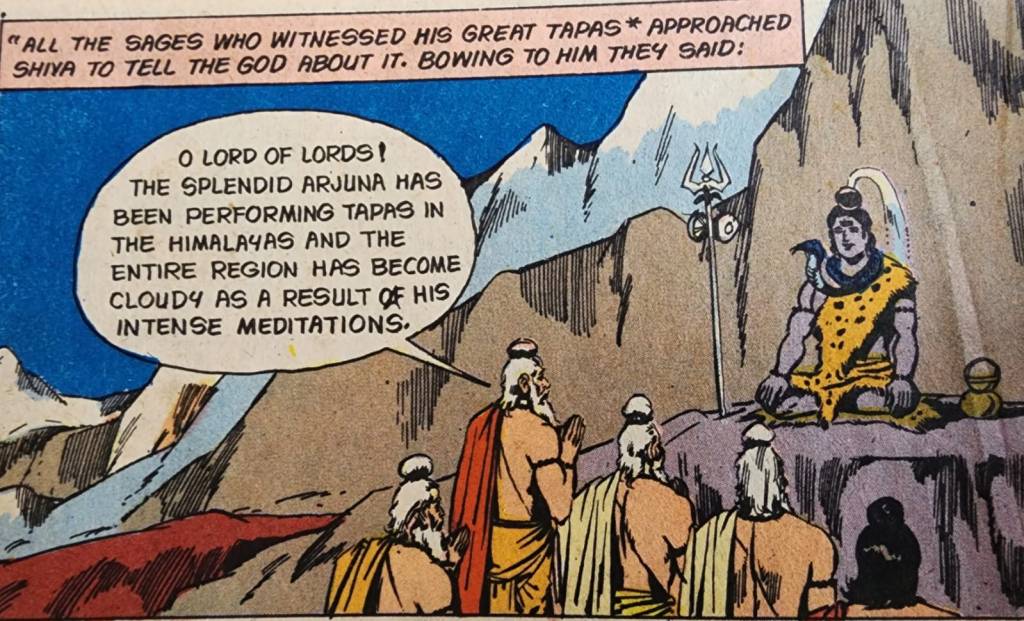
Image credit – “Mahabharata 20 – Arjuna’s quest for weapons”, published by Amar Chitra Katha

Image credit – “Mahabharata 20 – Arjuna’s quest for weapons”, published by Amar Chitra Katha
In both these cases, the Gods might not have been ready to appear before the individual performing the tapasya. But the effect their tapasya had on the weather caused those who were affected by the extreme weather to beg the Gods to get the tapasya to end. In other words, both Hiranyakashipu and Arjuna worked to affect the weather and thus got the Gods to grant them an audience. They even ensured that those who had regular access to the Gods to further their cause by requesting them to not test the person performing tapasya anymore. So, the tapasya, whose objective was to please the Gods, did so, by causing climate change which affected those who had access to the Gods. These individuals or groups either ratified or provided credibility to the tapasya with their own requests. Did this make the tapasya easy? Definitely not. But did it reduce the duration of the tapasya? And thus the duration of enduring great hardship? Perhaps yes, by a little bit at least. Either way, the demonstration of Kaitatsu Gairoku is clear. To impress the Gods, affect something else (weather) which will affect those with regular access to the Gods and get the tapasya fast tracked. 😀
A few additional points need to be considered regarding the examples mentioned above. The first is that the people who requested the Gods to stop the tapasya of the individuals in essence added their own tapasya to that of the person in question. Is this ability to gain the support of others without meaning to (indirectly 🙂 ) a criterion that the Gods would have considered? I have no idea. The second point is that the effect caused is on the weather, and this is one phenomenon that impacts all life on Earth. So, there is no way the Gods can ignore it and in their concern are given to acquiesce to the requests of the many and the tapasya of the one. This in itself could be a huge relief, as some individuals sacrificed their own body parts as part of the tapasya! &
Was the causing of extreme weather events a deliberate ploy in getting the Gods give the one desiring a Vara an audience? Was this a strategy to decrease the duration one spends in activities that allow one to be in the presence of the God one is trying to please? I have not seen or heard of any explanation that it was. But then, I might be overthinking this. So, I do not suggest that it was a deliberate ploy, nor can I assume that affecting the weather was a required demonstration of the powers of one’s tapas. It is just something that happened. But that does not take away from the fact that, there was a means to indirectly influence the Gods. 🙂
Now we must address the elephant in the room. An individual through human actions plays truant with the weather. This is not in any way possible for normal humans either today or in the past. So, it is possible to dismiss everything in the stories as pure fantasy. But all stories in Hindu culture, apart from the obvious entertainment and explicit transfer of knowledge, also serve as case studies, meant for discussion and assimilation of ideas generated from the same. This identification of Kaitatsu Gairoku in the stories is a case of such a realization, at least for me.
To expand further, this is not unlike the strategies in manuals of war and statecraft. Ideas of opening up a new front to cause the enemy to reduce strength in any theatre of war or waiting out the enemy for winter to damage them, and the use of allies or embedded sleeper agents to weaken enemies, are all known from history. All of these are about affecting an opponent(s) in ways other than a direct attack. So, the notion of Kaitatsu Gairoku is not just a part of stories. I have alluded to all asymmetric strengths in a previous article of mine called “Might is right, always”2.
A non-military or non-martial example of Kaitatsu Gairoku from recent Indian history would be the growth of ISKCON. This example is based on the video, the link to which is given in the notes below3. The video is from the YouTube channel “The Carvaka Podcast”, where the host Kushal Mehra has a conversation with author Hindol Sengupta about ISKCON. The conversation is about the book written by Mr. Sengupta called, “Sing Dance and Pray”1. The book is about the life of the founder of ISKCON, Shrila Prabhupada. According to the discussion, the founder of ISKCON Shri Shrila Prabupada was given a task by his Guru to take the word of Lord Krishna to the whole world. While Shri Prabhupada set about the objective, he apparently had little success in India. Later, he moved to the USA in 1966 and founded the ISKCON as we know it today. It found great success in the US and later this success replicated itself in India. The author and the host on the video agree that the success of ISKCON in India would not have occurred without the same in the USA.
In this scenario, ISKCON had to spread the word of Lord Krishna in the US for the same to happen successfully in India, which is the land of origin of the message sought to be spread and of Lord Krishna himself! This is counterintuitive, as one would expect the otherwise. The general thinking for this is that India at that time at least, sought (and maybe still seeks) Western validation and the USA was the epitome of all things Western. Of course, the USA was and still is a cultural powerhouse and wields enormous soft power the world over. So, ISKCON being embraced by the Americans was validation for Indian culture and hence was embraced here as well. This is perhaps the greatest instance of Kaitatsu Garoku I have come across. In simpler terms, Shri Prabhupada had to conquer foreign lands to conquer (for his ideas of course) his own! Plant a home grown idea far away from home, for the idea to take root at home!!
Of course, this extrapolation of mine relating to Kaitatsu Gairoku is not specific to Hindu tradition alone. I notice and expand more on it, with respect to India, is all. One of my current favourite examples about this concept is that mosquitoes evolved and became the human nemeses that they are, because of a change in the tilt of the Earth’s axis! This is beautifully explained in the short video seen in the link in the notes below++. It is a video from the Youtube channel “PBS Eons”.
The other one is from the movie “Django Unchained”. The character played by Christoph Waltz explains to Django (played by Jamie Foxx) how they cannot go to the slave owner played by Leonardo Dicaprio and say that they want to buy his wife’s freedom. He says that if one wants to buy a horse from a farmer, that might not be keen on selling the same, one does not go asking to buy a horse. For if the farmer refuses, all one can do is walk away. One needs to approach the farmer for something else and in the course of the transaction see if the horse can also be bought, maybe as transport for the individual or the commodity being bought. Buy the horse, but do it indirectly. Eventually they go the dastardly slave owner looking to buy a fighter and try to create a situation which would result in their “accidentally” buying his wife. Thus, buy something else to buy the lady in question, indirectly! (buying and selling people is horrifying even when used as an analogy!) Yes, I am using a fictional example from pop culture. This is just to illustrate that the concept of Kaitatsu Gairoku is considered the world over and in multiple walks of life.
Two personal notes –
With this post, I am completing a year of posting on this blog. I sincerely thank everyone who has read the posts, just visited, helped me with feedback & technical suggestions and just been a part of my life in general and budo practice in specific for making this possible. THANK YOU ALL! I hope I have several opportunities to express my gratitude related to this blog (and otherwise) in for a long time to come! 😀
This post will be go online close to my birthday, and I am someone that loves and appreciates gifts. So, while writing this article, I was wondering how I can indirectly (without actually discussing it) get people to give me gifts 😛 . As it happened, I got a gift I needed and a gift I wanted. A close relative of mine gifted me with an investment opportunity and a buyu identified a source to procure some training equipment I wanted. In both cases, the gifts just happened, with no active planning of the same. It was not magic, but in hindsight, a consequence of research, effort and communication on my part with the individuals concerned, though not with this outcome in mind. Guess the training, effort and luck really do pay off, indirectly. 🙂
Notes:
*https://mundanebudo.com/2023/07/06/connect-control-part-1-connect-control-shatrubodha-in-flow/
+, **https://mundanebudo.com/2023/07/20/connect-control-part-2-boons-blessings-curses-the-sakki-test/
+https://mundanebudo.com/2023/08/31/shabdavedi-sakkijutsu-and-why-charioteers-are-awesome/
&https://mundanebudo.com/2023/03/30/jibun-no-kesu-an-exploration/
2https://mundanebudo.com/2023/05/11/might-is-right-always/
3Video link – watch between the 15 and 18 minute mark.
1Amazon link to the book “Sing, Dance and Pray” by Hindol Sengupta
++Video regarding mosquito evolution
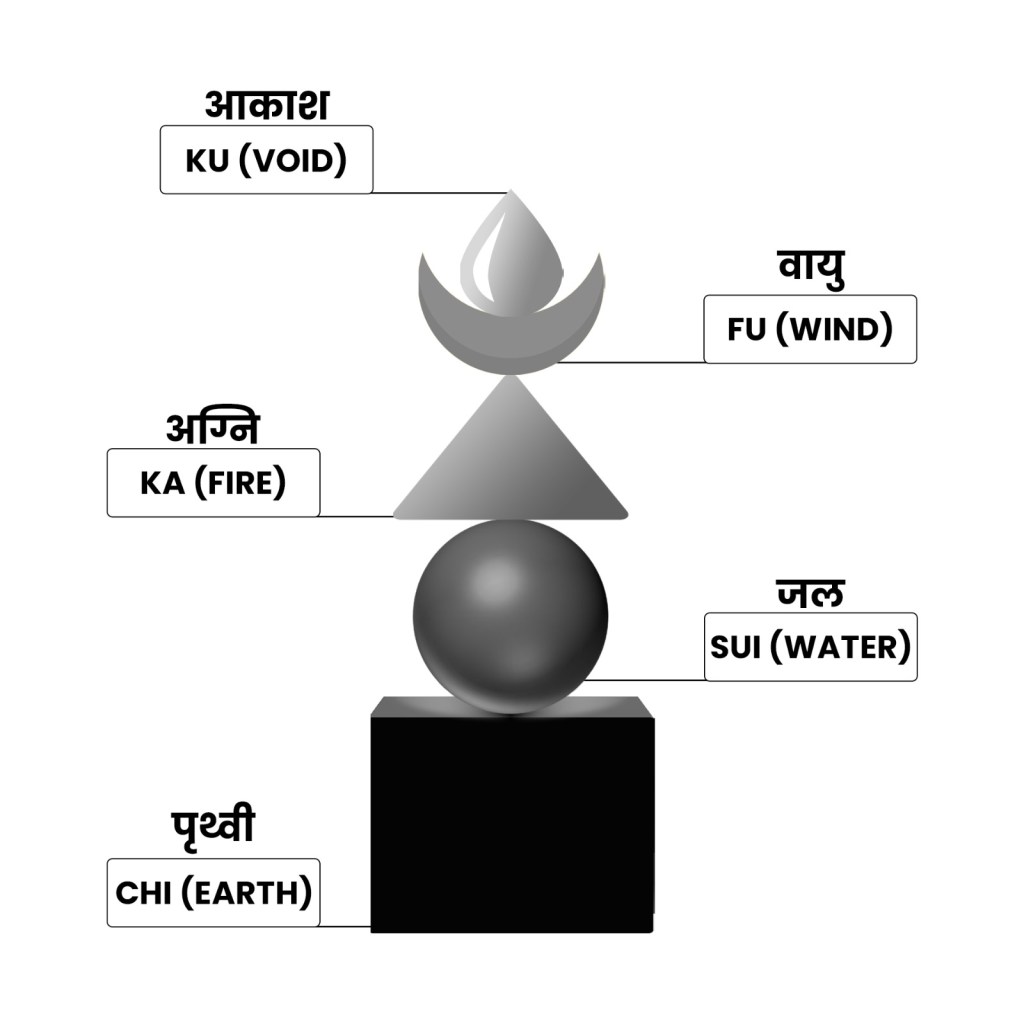
 Mundane Budo