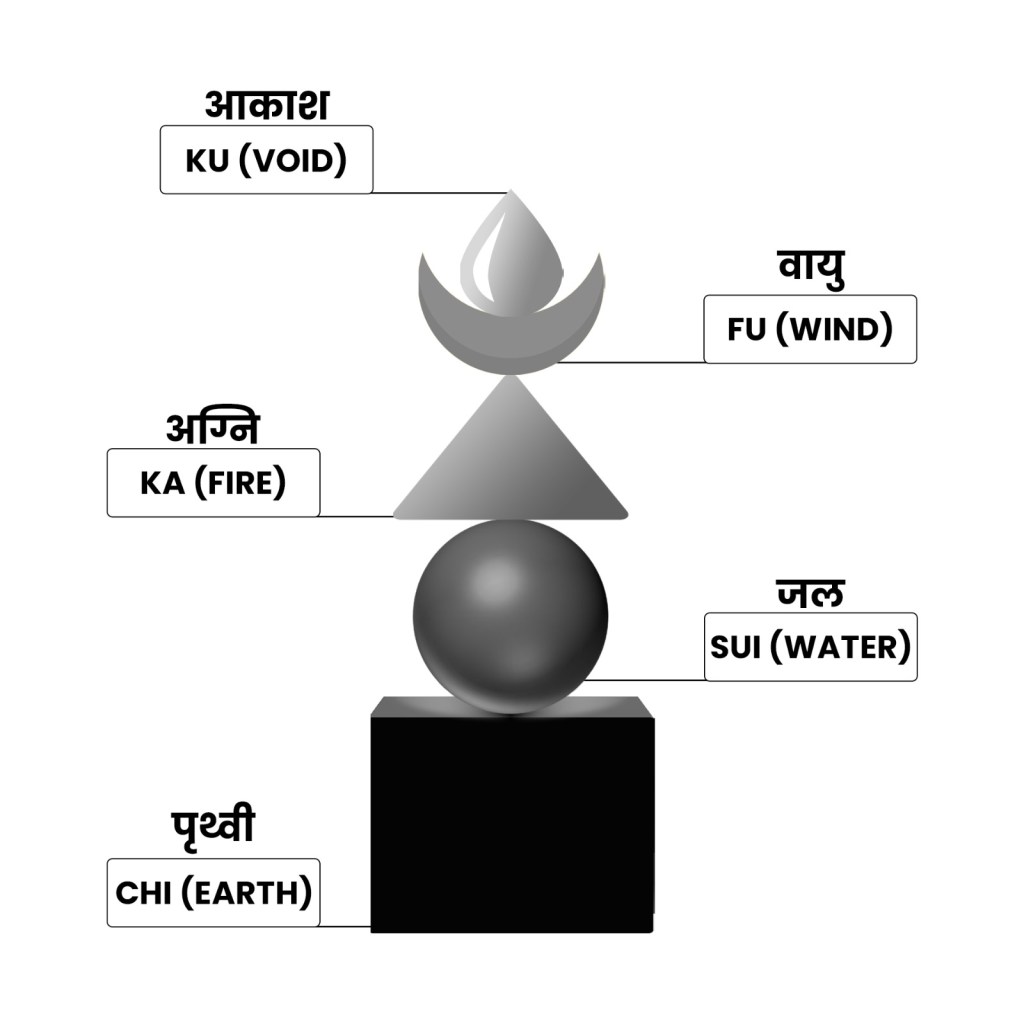
Godai – artwork by Adarsh Jadhav
During the pandemic, all of us had to deal with several changes. We all had a lot of trouble changing how we went about our regular routines due to the enforced situation and the lack of choices that allowed one to go about life without making any changes.
While living through that time, it occurred to me that just as there are five stages to handling grief, there are five stages to accepting a new normal and moving forward with that acceptance. These five stages seem to correspond with the Gogyo or the five elements that determine the five forms we practice as part of the Gogyo Sanshin no Kata (as part of the Bujinkan system of martial arts). This in turn, also seems to explain why we cannot allow emotion in a fight (perhaps also life, at least not let it be the only driving force) and how one needs to accept any situation in a fight without analysis (except in hindsight) and deal with it (the “next and the next and the next” paradigm).
A long time ago, must be sometime in 2007 or early 2008, I had asked my teacher the difference between the Ichimonji no Kata and the Sui no Kata. The answer I received was that we determine which of the two was performed based on how the Uke (attacker) is affected. This was borne out by my own later experiences. For example, Ichimonji no Kata makes the uke lose balance and maybe fall or crumple in a direction diagonally backward to the direction of the punch, while Sui no Kata causes the uke to either crumple downward or to the right of the direction of the punch.
While the above is true, I believe the Kata is also determined by the internal feeling tori (defender) has and the intent the tori has towards the uke. This relates to the earlier introduction to this article which I will try to expand on below.
Typically, the five stages of resistance to change as I see it, are as follows:
- I cannot change my way of life/living just because this “disrupting factor” has become apparent
- I can only change to a certain extent and that is all I can do, I am not going to change other aspects of my life
- How dare this other person or persons ask me to change! Don’t I know what I should do for my life!
- They may have a point, but I can’t be expected to change this way. I have been doing it differently all this time and cannot make the effort to change in this way
- I have worked hard to get where I am and put in so much effort for a lot of things. How can the universe let this happen and screw me over? It is so unfair!
Now these five obstacles we face are not so different from the Gogyo. Consider the following rewording of the five stages of resistance.
- I cannot move my roots (way of life)
- I cannot change and flow as the situation requires (limited flow)
- I cannot accept that someone else is asking me to change (my ego is hurt)
- I cannot go the way things expect me to go! (flow with the situation)
- How can everything in space (the universe) conspire against me!
The rewording above in my understanding is essentially the problem that the Gogyo Sanshin no Kata are designed to solve. Let us consider each of the elements separately, as seen below.
- Stay rooted, but let them grow deeper and move as required. This is Chi no Kata, where we strengthen our stability with necessary lowering of the core/centre of gravity, to stall the attack.
- Move and grow your roots where there is space to move it. This is Sui no Kata, where we move out of the way of the attack, to create an opening for a counterattack.
- Burn away any obstacle to the growth, even if it is yourself (your ego). This is Ka no Kata, where we receive the attack while countering at the same time; this is acceptance of the attack and surviving the same.
- You have roots and these are strong. So let yourself be blown away by a situation, since your roots will let you blow back. This is Fu no Kata, where we can let the attack move us to a point of safety, before we can move to affect an out of balance opponent.
- Use all the space to your advantage and do not focus only on the points of concern. This is Ku no Kata, where opportunities are identified as the attack has made the status quo untenable; this could be an amalgamation of the earlier four.
Now if we apply the conceptual observation regarding the five elements to the five stages of resistance we first considered and see how the words can be changed when the principle of the Kata is applied, we could see the following.
- I will change my principles to survive or use the new situation. These will be my new roots.
- I will do whatever it takes to survive and thrive in the new normal and not mourn the old, for my roots are strong.
- I will not let my ego or opinion of the source of information to trigger the change, stop me from changing. My roots need to be protected and allowed to flourish.
- I can change everything now, for I know I can change to the old or something else when this situation blows over. My strong roots will anchor me.
- The universe is what it is and I will try to see what to take from this new situation. I bear no guilt for the efforts (roots) of the past or for the fruits of the future.
After considering the solution from the Gogyo as we see above, if we apply these to the form while training the same, we will understand that the form is only the starting point and needs to be explored incessantly. It need not look a certain way.
The way it looks is the Omote of the Gogyo Sanshin no Kata. It triggers further exploration with multiple variations like terrain, weather, apparel, weapons and any other. The understanding of the concept for the self is the Ura of the Gogyo Sanshin no Kata. Perhaps this is where the “Sanshin” comes into the Gogyo no Kata!
Thus, I posit that we need to start with the impact on the uke and then shift focus to the tori (ourselves) while training, on the mats first, and whenever and wherever possible, in Life. In Life, perhaps start with hindsight and then progress to doing it in the present (without thinking about and without reservations about consequences or guilt). Hindsight is likely the Omote and the present, the Nakaima or Ura of it.
Notes:
Gogyo – the five elements (earth – chi, pruthvi; water – sui, jala; fire – ka, agni; wind – fu, vayu; space – ku, aakasha)
Sanshin – the three hearts/spirits – could be considered timing, distance, rhythm (sometimes taken as angle)
Nakaima – In the middle of now (the present – based on time)
 Mundane Budo