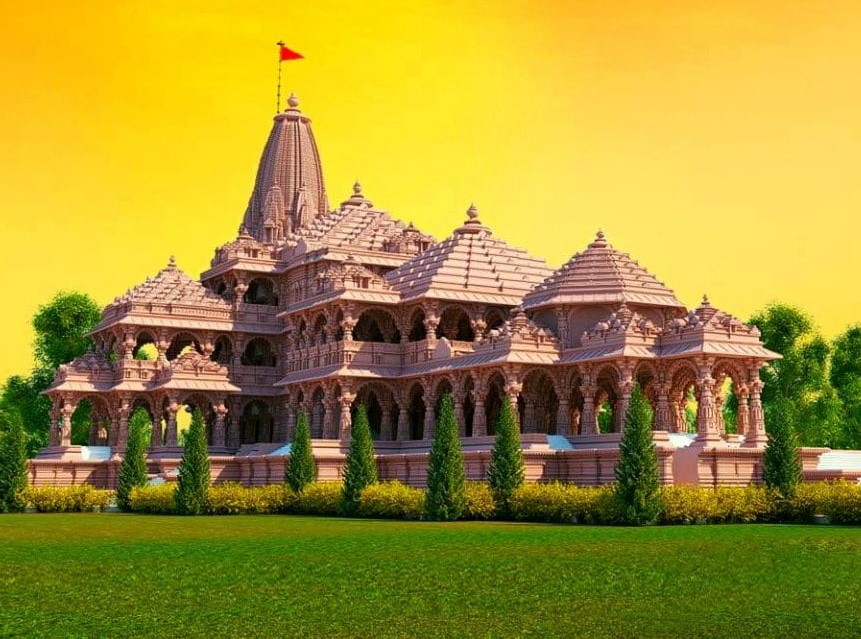
Above is a representational of the Ram temple at Ayodhya. Art created by Adarsh Jadhav.
The Prāna Pratishta (consecration) of the new Rama Mandir at Ayodhya will happen on 22nd January, 2023. This is 4 days from now, on the coming Monday. As everyone in India and anybody who is interested in India knows, this event is extremely important for a very large number of Indians. The importance is magnified for Hindus, whether or not they are devout. The importance is spiritual, social, cultural, religious, historical and most definitely, political. And for this reason, the very presence of this devālaya (mandir/temple) has its opponents, both in India and abroad. But whether they are celebrating this event or are disheartened by it, no one can ignore it or write down its significance for Modern India, or Bharat.
Lord Rama is one of the most revered Gods for Hindus. In my opinion, Rama’s character is of key significance to practitioners of the martial arts, especially the Bujinkan system of martial arts. This is revealed by one of the adjectives used for Lord Rama. Lord Rama is very often called “Maryāda Purushotham Rama”. The words “Maryāda Purushotham” are an adjective. But as far as I know, they are used ONLY for Lord Rama. Hence, they are almost an alternative name for Rama. In India if you say “Maryāda Purushotham”, no one will have any doubt regarding who you are referring to. This name/adjective of Lord Rama is where his significance for the martial arts stems from. This of course is my opinion. People are free to disagree or have other ideas.
The word “Purushotham” is formed by the sandhi (combination) of the words “Purusha” and “Uttama”. “Purusha” is “man” and Uttama is “the best”. Uttama can also be referred to as “the highest level”. Purusha is not necessarily only “man”, as in the male gender. It can also be “human”. There is another word, “Purushārtha”. This is formed by the words “Purusha” and “Artha”. The four “Purushārtha” are “Dharma”, “Artha”, “Kāma” and “Moksha”**. These are the aspects a human being pursues over the course of a lifetime. These are true for all humans, irrespective of whether they are male or female. Of course, these days, it can include any other gender one chooses to consider. Hence, “Purushothama” when used in reference to Lord Rama, means “the best human”, or “a human of the highest level/order”.
The word “Maryāda” has multiple meanings based on the context of its usage. “Maryada” is the pronunciation in Hindi. In Kannada, we say, “Maryāde”. Maryāda can mean honour or respect. In Kannada, we say, “Avarige maryāde kodu/torisu”. This means, “Show/give them respect”. We also say in Kannada, “Avaru maryādastharu”. This means “They are honourable or respected/respectable people”. So, in this context, “Maryāde” can mean honour or respect. It is generally used when referring to decent, good folk, based on one’s opinion. There is however, another meaning for the word “Maryāda”, which is more relevant to this article.
During the late 80s or early 90s, I remember hearing the following dialogue in a Hindi film; “Apni Maryāda mein raho”. Of course, it could have been “Apni Maryāda mat bhoolo” or something similar, I do not recall exactly. I suspect it was from one of the family-oriented films with actor Kader Khan in the cast, maybe “Ghar ho to aisa” or “Biwi ho to aisi”. I could be wrong, but my brain associated this dialogue with either one of these films or with a film of this genre. These were films that preached how the roles and behaviours of people in model Indian families should be.
This dialogue threw my original definition of “Maryāda” off kilter. The dialogue “Apni Maryāda mein raho” or “Apni Maryāda mat bholo” was used in a heated exchange between two characters, typically one espousing traditional values (an older individual) and another yearning for change due to the suffocation of traditions (obviously a younger individual). It was very clear while watching these movies, that these dialogues meant “Stay within your limits” or “Don’t forget your limits” respectively. So, how could “maryāda” mean “Stay within your respect/honour” or “Don’t forget your respect/honour” in the context being presented? 😀 It made no sense.
It was later that I realized that the word “Maryāda” also meant “Limit”. Apparently, this was the original meaning of the word! It was overtime also used to denote “Respect/Honour”. When maryāda can be used to be mean “limit”, it could also be to denote “boundaries, as used when we say, “do not cross boundaries”.
I suspect this could be because one deserves respect for knowing one’s limits or more appropriately not overstepping one’s limits. Of course, the limits are usually defined by social or age-based constraints. And because one has learnt to limit oneself, perhaps by being content with one’s lot, one deserves respect. So, by setting limits for oneself and following the same diligently, one earns respect. So, the same word came to be used for the two. This purely my speculation and I could be wrong about this.
So, when I was younger, when I heard “Maryāda Purushotham Rama”, I used to think “Rama, the most respected and best among humans”. But I have realized that this means “Rama, the best person who limits oneself”. It could also be, “Rama, the best person, who stays within his own boundaries”. It is as I understand it, “Rama limits himself and hence he is the greatest or first among humans”. This makes sense. Every aspect of the life Rama led can be considered exemplary. He strove to live up to his responsibilities, always keep his word and most importantly remembered that all the rules and laws that applied to his people also applied to himself. This last aspect was of paramount importance.
Rama was a king and hence above everyone else, at least in his own kingdom. So, he could have had a different set of rules for himself or exemptions to the same when compared with those for the citizenry. But he never allowed this. Further, and even more importantly, Rama was an avatāra of Lord Vishnu. This made him a God walking among mortals. So, he could have held himself above everyone else on Earth, even beyond his own kingdom. But he never let his Godliness or divine attributes show. He never used this to any advantage in the course of his life. So, Lord Rama restrained himself from using either his privileges as a king or his powers as a God to his benefit. He lived like any other mortal, going through all the trials and tribulations, if not more.
Thus, Rama LIMITED himself. He set limits on himself; from ever using his powers as king or God, except for the welfare of other people. He never succumbed to arrogance or pride. His self-imposed limits not only prevented his using his powers and abilities to his own advantage over his fellow humans, but also limited him from ever giving into extreme emotions, barring a few rare instances. Even these instances exemplify his being mortal and limiting his own abilities as either God or king. So, he is indeed the very personification of a person who has limited his own excessive use of abilities, because he decided that they would not suit the world he lived in. It was not the purpose of the avatāra either. Hence, Lord Rama is absolutely the one and only “Maryāda Purushotham”!

Above is a photo of Lord Rama from our pooja room. As far as I know, it is a framed copy of an original by Raja Ravi Verma. Many homes have this photo in their respective pooja rooms.
Rama was a God and had all the powers that earlier avatāras like Varāha, Narasimha, Vāmana or Parashurama or the later avatāra of Krishna wielded. But he did not resort to these abilities. How did Lord Rama achieve this? I opine that the answer is “Control”, and more specifically, “Self-Control”. Rama could control his emotions and his abilities. Since he could control his abilities, he could limit his use of the same. Similarly, since he could control his emotions, he could prevent extreme emotional situations that would result in his unleashing his powers. So, it was CONTROL through and through. Through SELF-CONTROL he remained just an ordinary human in his acts and this in turn led him to be able to perform extraordinary acts, demonstrating that he could also CONTROL solutions to issues facing him and those around him, at all times.
Rama lived in the forest, united a divided Vānara kingdom, gained the trust and support of Vānaras in looking for his wife Sita and later in attacking he powerful Asura Rāvana. He achieved the defeat of Rāvana, gained the support of Rāvana’a brother, caused no damage beyond necessary and eventually regained his throne. He suffered quite a bit after this as well. He was separated from his wife, never saw his twin sons in their early childhood and eventually when his children came back into his life, he lost his wife forever. So, his was a life of great achievements accompanied by extraordinary tragedy. Despite it all, he was successful in all his endeavours and remained a mere mortal. This is why he is perhaps the paragon of SELF-CONTROL and being able to find solutions to varied problems, however unsuitable they may be. This is being in CONTROL of the situation and given environments as best as a human can! It is this virtue of “CONTROL” and “SELF-CONTROL” that relates the example of Lord Rama to the Martial Arts.
Sensei Hatsumi Masaaki, the Soke of the Bujinkan focused on Muto Dori since around 2014-15 all the way till the global disruption in 2020. Muto Dori is defined with many variations by many senior practitioners. It is also interpreted with quite a few variations based on what the focus is on, in any given training session. But a common thread is that one should focus on oneself and have control of one’s own motivations and emotions in a combat situation, even while training in class.
The objective was that one should train like one is unarmed even when the opponent is armed. This is even if one has access to weapons. There could also be situations where there are multiple opponents. This is not to say that this training ensures survival in a real situation. But it demonstrates that one has no control over the initial actions of opponents, only on oneself. So, the focus is to control oneself in the best possible manner. This control hopefully allows one a modicum of control over the fight, which will allow one to survive the situation. The control over the conflict situation will vary over time as the opponent(s) are also continuously adapting.
This focus on control is exemplified by a statement that is made by my teacher every now and then, “focus on your breathing”. This statement is used to help a practitioner begin the process of self-control. One is encouraged to actively focus on, and think, of her or his breathing while in a fight, during training. This takes the mind off the other things in a fight. These include, what the opponent might do, what one can do to the opponent, what one’s objective in the fight is, how one wants it to end, what technique is working or not, worry about whether what one is doing is correct or effective, and the like. All of this is mitigated by turning inward. Hopefully, once this happens, the practitioner only moves to survive and makes the opponent do all the work.
In such a situation, if the opponent is not focusing on self-control, hopefully an opening or opportunity will present itself in due course. This opportunity can be used to end the fight. If the opponent is also exercising great self-control, the fight might just end as both (or more) are only trying to survive and not looking to fight at all. Thus, the situation is controlled either way.
A mentor of my teacher’s suggests that control is a vital aspect of the Bujinkan. He is a very large and strong individual (think WWE wrestler large) with several years of experience. He is someone who can use his strength and size to overcome most opponents. But he chooses not to, and this is enabled by his training and the skills developed to achieve control in a physical combat situation. He further emphasizes that this is NOT LIMITED to a physical fight, but to all aspects of life.
The objective is to achieve control of the situation, there need be no doubt regarding that. Control of the SELF is the starting point of the same. The result of this control is, favourable outcomes in every step and stage of life (what is needed but not what is desired). Control of the self leads to control of the situation and control of the situation has consequences which needs control of the self again. It is cyclical or maybe a spiral.
A student of a friend recently trained in Japan with this mentor. I am sharing the statement this student used to share his learning. It was a quote which I am repeating here. It is something Soke Hatsumi apparently mentioned in the past. It goes, “Nothing is supposed to work for you, the goal is control”. This statement encapsulates the importance of control. Control the self, control the situation, control everything.
I had written an article late in December 2022, describing the “Ashta Siddhi” or eight achievements mentioned in Hindu tradition. One of the last and highest of these Siddhi is “Vashitva”. This can be considered to be hypnosis. But in a more mundane situation, I consider this as “control of a situation” when performed by a highly experienced martial artist or maybe a warrior in a real fight. A link to this article is seen in the notes below*. Do refer this article for more exploration of control and its nuances.
When we say self-control, this is not a new idea. In the Arthashāstra by Kautilya (Chanakya), there is sutra which describes the root of happiness/a good life. It consists of four lines. These are seen below. The actual Sanskrit lines along with what they mean, as I understand them, are mentioned. Other cultures might have similar ideas. I am not aware of specific examples. If anyone any, please do share the same.
Sukhasya moolam dharmaha – The root of happiness/a good life is Dharma (the right actions/sustainable actions)
Dharmasya moolam arthaha – The root of Dharma is wealth/good economic condition
Arthasya moolam rājyam – The root of wealth/good economic condition is the State (well governed State)
Rājyasya moolam indriyānam vijayaha – The root of the well governed State are leaders who have conquered (have control over) their senses
Motivations and desires and emotional responses are triggered by the senses. Controlling one’s senses is what we call self-control. It is expected that a ruler or leader or administrator is one who has achieved the same. If and only if this has been achieved can a leader be expected to be able to control all the situations that affect a State. And this control of the situation is where good administration originates. It is thus the same thing as taught in the Bujinkan, even if the latter is more focused on the individual and not on the State or rulers/administrators of the same.
The path is the same; control the self, control the situation. Do this all the time to control every situation, end up with control over everything. This is the objective, not a guarantee. This brings us full circle to Lord Rama. Maryāda is “to limit/limit”, but “Control” is the key. There can be no Maryāda without control. And thus, with control our civilization got Purushothama! And “Control” is what we still strive to achieve.
JAI SHREE RAM!

Above is a photo of an interpretation of Rama by artist Varun Ram, made in 2008. I bought a copy of this artwork in the Bangalore Comic Con 2012 (the first one in Bangalore). It is not a traditional representation of Rama, but one that I greatly appreciate.
Notes:
* https://mundanebudo.com/2022/12/22/the-ashta-siddhi-and-budo/
** “Dharma”, “Artha”, “Kāma” and “Moksha” – “Right actions”, “Wealth”, “Desires”, “Liberation”
 Mundane Budo