Brain over Brawn – Deception laced with Luck

Deep Gratitude before I begin – I am extremely grateful to my parents and two of my maternal cousins for being instrumental in my acquiring the comics and book that are references for this article. These were acquired over many years when I was younger, at a time when books and comics were not readily available like they are today. Thank you so very much!

Also, I must express my thanks to Amar Chitra Katha, the publishers of Tinkle Comics. Without these, my childhood would be unimaginable in hindsight! The publications by Amar Chitra Katha (IBH) were a treasure trove of learning for a kid and a gateway to further reading as an adult.

In my previous article I discussed how deception is a valid and expected part of debates and the martial arts, specifically when it is a duel. Further, when there are debates about the martial arts, deception is likely to be used in those as well. The focus of that article was more on the tradition of debates and duels, and modern day debates (including about the martial arts). The link to the previous article is seen in the notes below1.

In this article, I will delve into how “deception” is an exalted concept which is used to express how wits, intelligence and intellectual capacities are superior to physical abilities. Also, the use of the mind (intelligence) is supposed to always prevail over the use of the body (muscles, strength, speed). In simpler terms, “Deception” is the key ingredient in “Brain over Brawn”.

There are several stories from cultures all over the world which celebrate “Brain over Brawn”. There is one key aspect that all these stories have in common, but is never highlighted. It is the presence of “LUCK”. The protagonist is always lucky though this is never explicitly mentioned. It does not need to be mentioned as the antagonist is usually physically very capable but generally stupid (even if this is not explicitly mentioned). The protagonist is vastly more intelligent compared to the antagonist while being an absolute weakling in terms of physical ability (comparatively speaking).

Let me share examples where brain over brawn is the key. In these stories, “brain over brawn” ONLY means that the opponent is deceived, nothing else.

Consider “The Brave Little Tailor” from the Grimm’s fairy tales. Here, a tailor kills seven flies and claims that he killed “Seven at one stroke”. Gullible people and giants mistake this statement to mean that he is a hero with great physical prowess. He goes on to use his wits to defeat several giants and a boar in tasks that prove him worthy of great reward, a marriage to the princess of the land and half the kingdom. In all these tasks, he talks his way out of situations. None of the giants ever looks too closely at what he is saying or doing. This is really lucky for him as even a little scratch at his statements would have meant that he was going to be crushed to pulp.
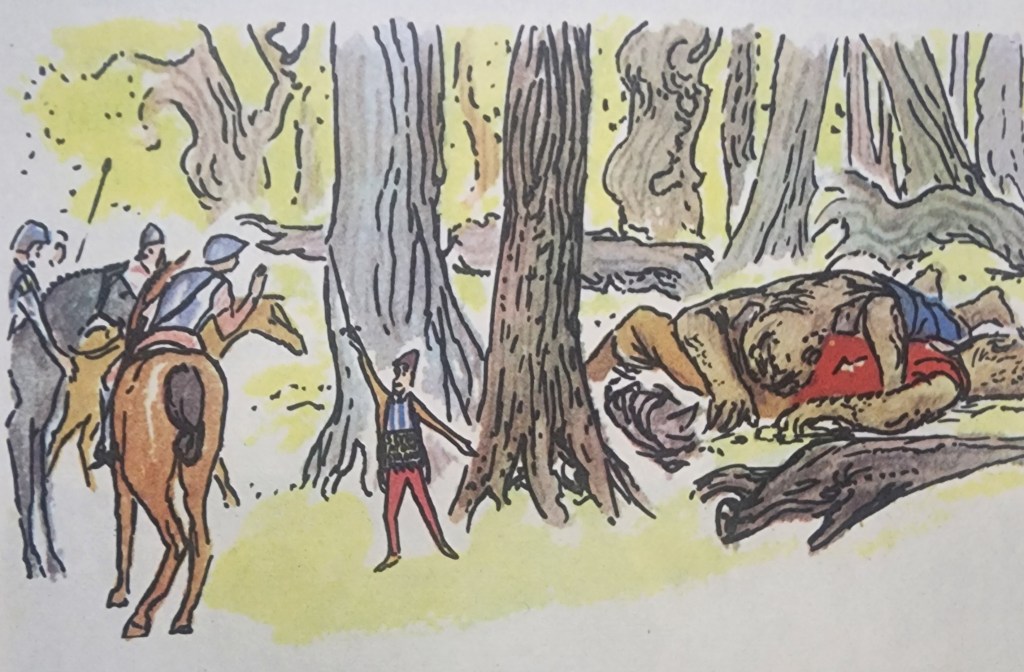
Image credits (L & R) – “The Brave Little Tailor” from “The Beacon Readers Book 6, William Tell”

Consider the Roma folktale “Stefan and the Dragon”. A Dragon which is talkative (as they happen to be!) threatens to eat Stefan, a farmer. The Dragon is supremely powerful and can fly, but of course, is stupid. Stefan outwits the dragon and also gets it give him its gold (dragons always have gold don’t they, with no economics involved). Stefan is supremely lucky, because the Dragon is stupid, for his ideas are simplistic in the extreme and would withstand no scrutiny at all!
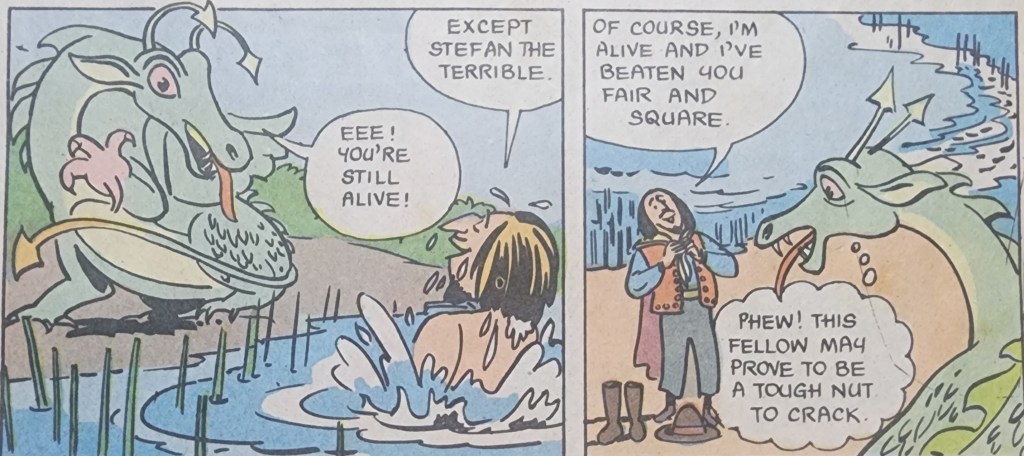
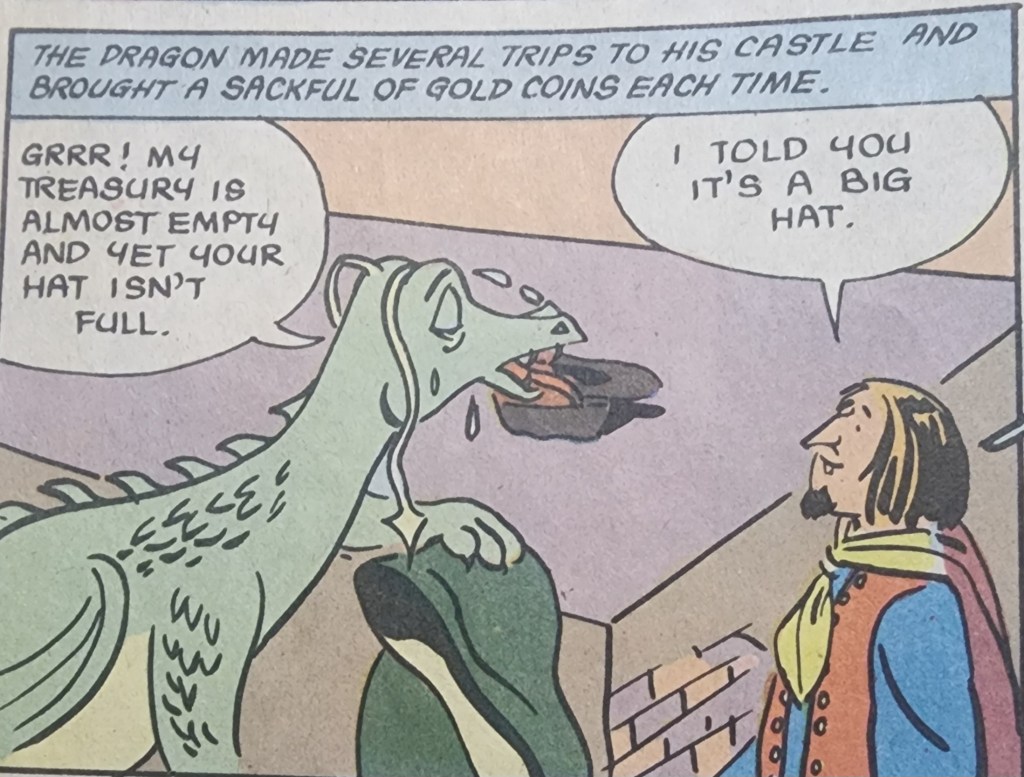
Image credits (Top & Bottom) – “Stefan and the Dragon” from Tinkle Comics 184

Consider a tale of Pandit Ramakrishna of Tenāli in the court of Vijayanagar, more commonly called Tenāli Rama. A story related to Tanāli Rama was the key for the previous article and established deception as a norm. There is another story related to him which involves wrestlers, establishing a link between a debate and a “martial debate”, a duel in other words! 🙂

A very strong and capable wrestler challenges the court of King Krishnadevaraya of Vijayanagar to a duel. The court wrestlers are not sure they can prevail over the challenger. So, the honour of king and court are at stake. As usual Pandit Ramakrishna takes up the challenge to defeat the wrestler. There are multiple versions of what he does to win the wrestling challenge. I will share the two I am familiar with. Both involve deception and luck.

Tenāli Rama identifies where the challenger is staying. A day before the duel, at a place near the residence, he sets up a charade. Rama is acting like he is training for the upcoming wrestling duel. But the wrestlers he is practicing with are in on the plan. They enact elaborate displays to show that they are in serious trouble against Rama and defeating them is child’s play for him. This whole act happens at a distance where the wrestler cannot see all the details clearly, but can get an idea of what is happening. Watching this display, he feels he is outmatched and either accepts defeat or runs away before the actual duel with Ramakrishna. Either way, the honour of Vijayanagar is saved. Rama was lucky of course. If the wrestler had stayed despite the act or moved in for a closer inspection, the deception would be rendered useless and Rama would have lost. But his luck held and he won a wrestling match with his wits! This is one version of the story.

In another version, Tenāli Rama challenges the wrestler to a feat of strength on the day of the duel before the wrestling match, to prove his strength. The wrestler accepts. Rama says that since he is supposedly far stronger than Rama is, he should perform with his eyes open what Rama does with his eyes closed (or is it that Rama is so strong that he can perform with his eyes closed what the challenger will need both his eyes for? I cannot recollect). Rama then proceeds to close his eyes and pours sand over the eyelids. 😀 He then asks the wrestler to do the same with his eyes open, which of course he cannot do. Thus, Rama wins and it is a case of brain defeating brawn. The wrestler does not think to refuse the challenge to a feat of strength as it was ONLY supposed to a wrestling duel. If he had he might have won, but maybe he was so used to challenges he accepted out of habit. So, it was a case of luck again, albeit considerably less than in the other cases; it could be more about knowing your opponent here.

This version of the story leads us to another story where “feats of strength” are required before a duel. In the story “The Clever Court Jester” (the Jester is always clever and a saviour isn’t he! (I have never heard of a she as a jester)), a Giant threatens to take over a kingdom if he cannot be defeated in a wrestling match. If he is defeated though, he will give a lot of gold to the king (Giants also always have gold, maybe they are the pioneers of protection rackets 😛 ). The Jester comes to the kingdom’s rescue as expected. He challenges the Giant to 3 feats of strength and outwits the “stupid” Giant to win the gold.
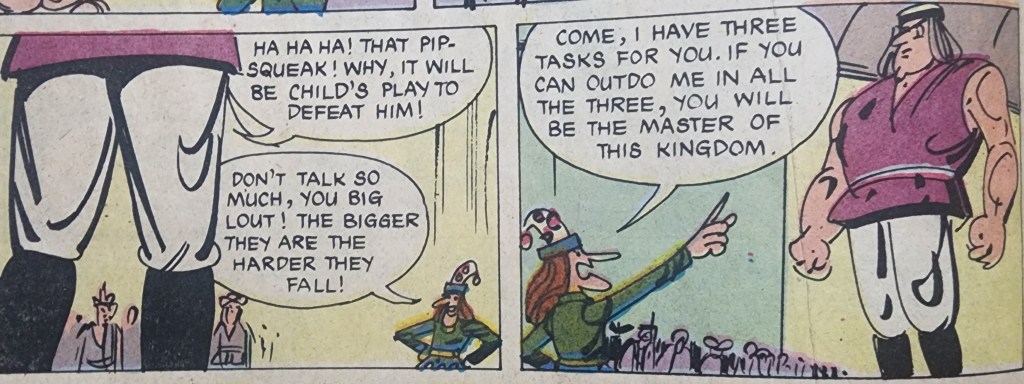
Image credit – “The Clever Court Jester” from Tinkle Comics 176

The Giant then invites the Jester to his home for further challenges. The Jester accepts, outwits the Giant some more, reinforcing the stupidity of the latter and wins even more gold. All through, the Jester is lucky because the Giant is stupid and never looks closely at what is going on. Did the Jester know the Giant was stupid and was this information available to him alone and no one else in the King’s court? We do not know, but it is possible, as everyone but the Jester is worried. We are never told that the Jester knew, so we can safely attribute his victory to deception, aided very heavily by luck.
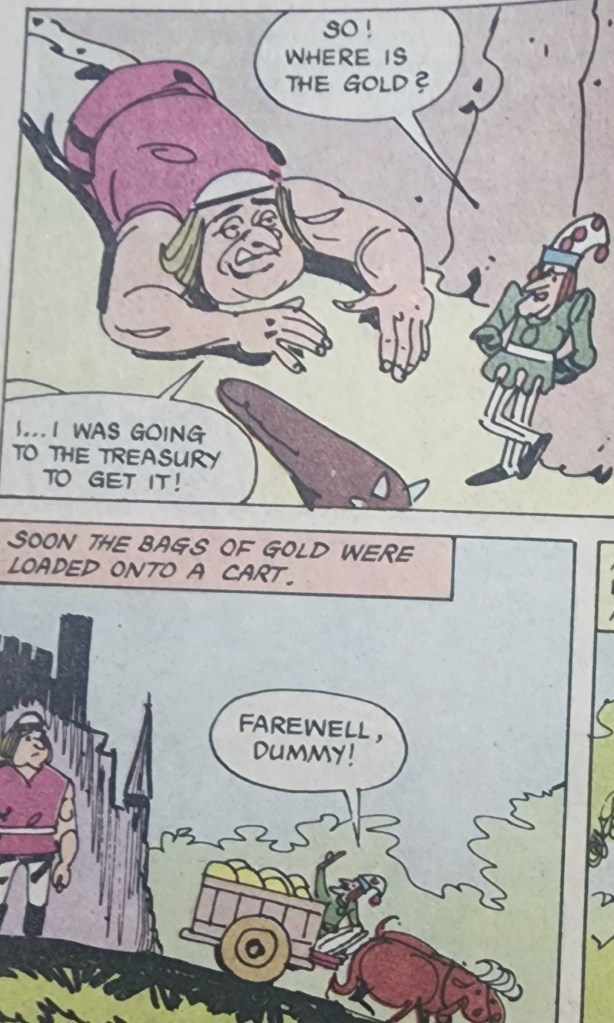
Image credit – “The Clever Court Jester” from Tinkle Comics 176

This same beat relating to a physically stronger opponent being defeated at physical challenges by a weaker individual due to the use of superior intellectual abilities goes on and on and on. I am sharing a host of additional examples below. I am not going into the details of most as the point is already made, but I would recommend reading the stories. They are short and great fun, and instructive in many ways.

In “The Dreadful Guest”, in Russia, a talkative (surprise!) and stupid (surprise surprise!) Dragon gate-crashes the Tsar’s banquet and is defeated by being outwitted (it is told a variant of “look behind you” *eye rolls*). The stupidity of the Dragon is the luck of the dragon slayer Alyosha Popovich.
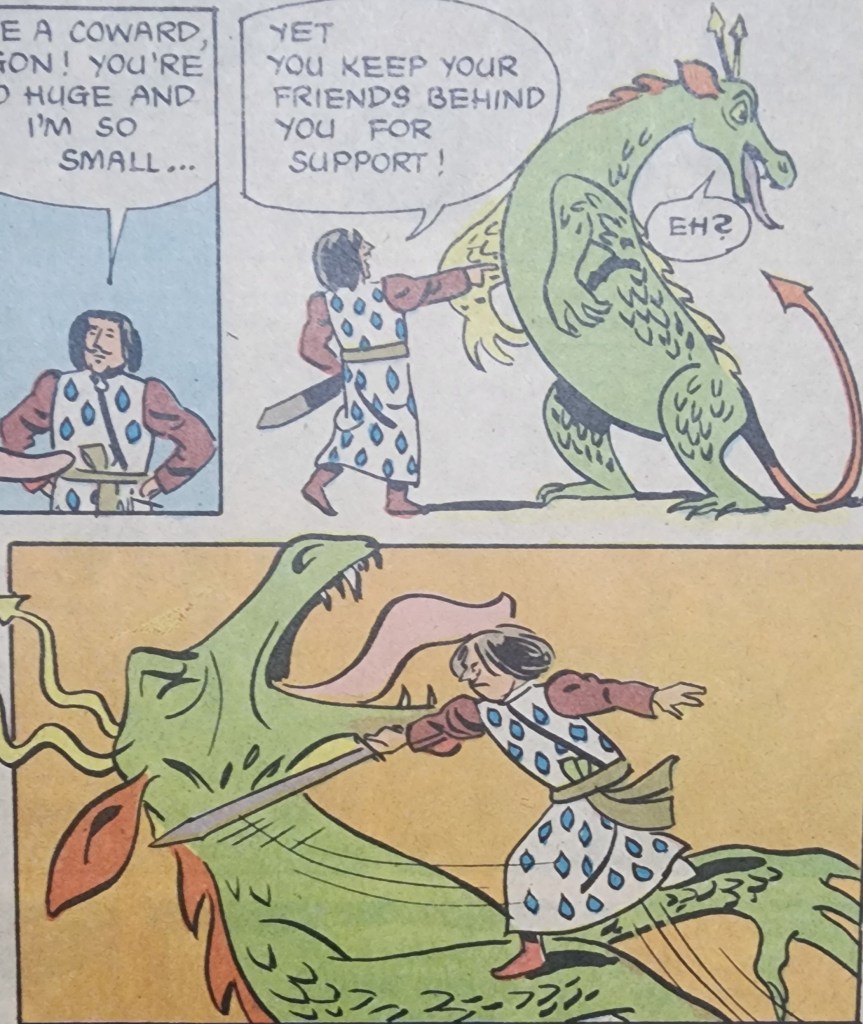
Image credit – “The Dreadful Guest” from Tinkle Comics 178

In “Smudgeface”, a story based on a fairy tale, the protagonist Smudgeface, captures two dangerous animals, a boar and a bull and becomes a minister! Based on the manner in which he captures the animals, which the people and the king call “monsters”, the lack of brains here seems not of the animals but of the humans! Smudgeface got lucky in having to be an administrator for a very simple folk!
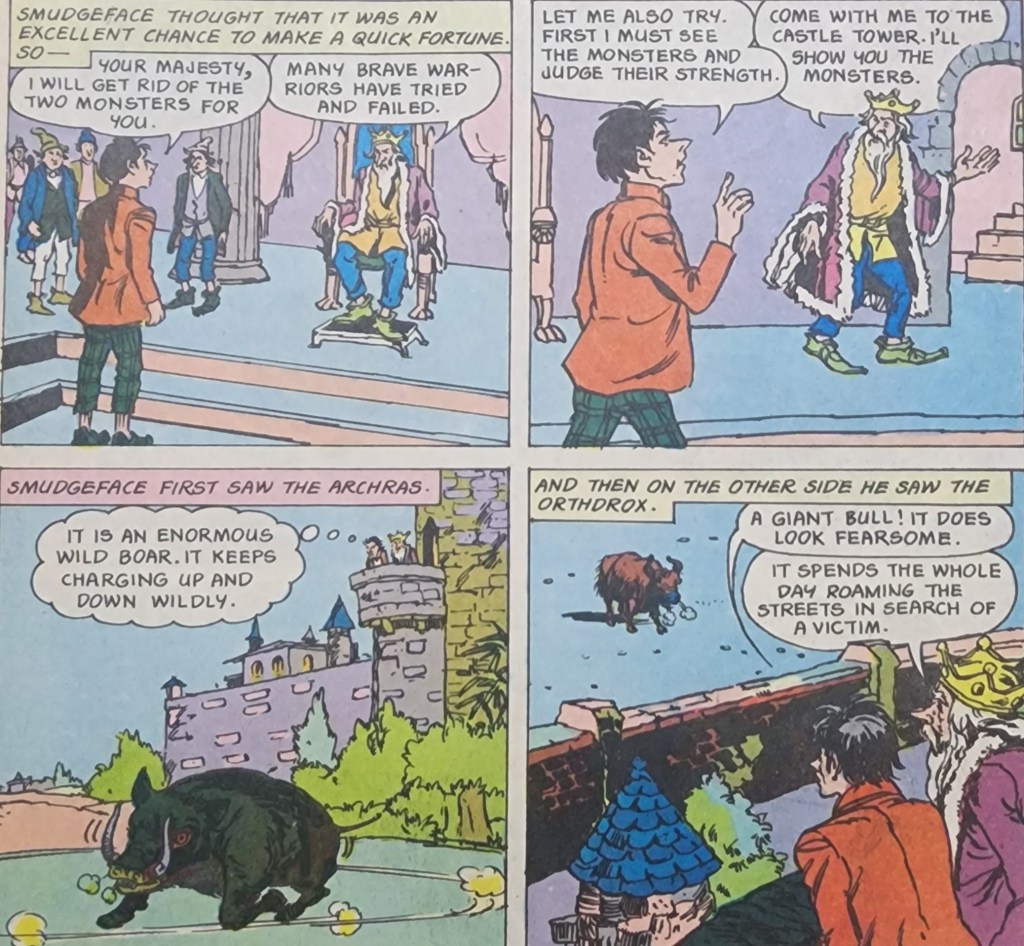
Image credit – “Smudgeface” from Tinkle Comics 299

In the Irish folktale, “The Tailor from Galway” (tailor again!), Tom, the tailor, outwits a Giant with normal siege tactics (which no one else in the Kingdom of Dublin could think of!) to build a castle in JUST THREE DAYS. 🙂 He later outwits the same Giant to scare him away from the kingdom. He receives the hand of the Princess in marriage (as one is entitled to perhaps, *eye rolls*). Tom’s luck is the stupidity of the Giant and the extreme inability of everyone else in the kingdom!

Image credit – “The Tailor from Galway” from Tinkle Comics 275

In the story, “The Resourceful Woodcutter”, Gopu the woodcutter outwits remarkably stupid bandits to escape death, gets them arrested and wins reward money. All actions happen and succeed through luck alone!

Image credit – “The Resourceful Woodcutter” from Tinkle Comics 201

Now we move on to stories where the main character does not do much, but reaps rewards. This happens due to the actions of others or a lack of ability on the part of the main character.

In the Burmese (Myanmarese) folktale “Lucky Po”, Po, a poor man, who is also hard of hearing relieves four Ogres (Giants) of their gold by scaring the living daylights out of them. He does this with no effort and due to his disability. This is perhaps the epitome of luck, as the lack of ability became an advantage compounded by the stupidity of the Ogres. Of course, where there are Giants, there is always gold to be had!

Image credit – “Lucky Po” from Tinkle Comics 189

In the story “Una and the Red Giant”, Una is the wife of Sigrun, who is the strongest Giant in the land. The Red Giant (dun dun dun) wants to challenge Sigrun, who is too gentle to fight. So, Una outwits the Red Giant with food and adjectives! Peace and gentleness reign in the end. 😀 Sigrun wins without having to fight, by literally leaving things to his wise wife (LUCKY for him)!
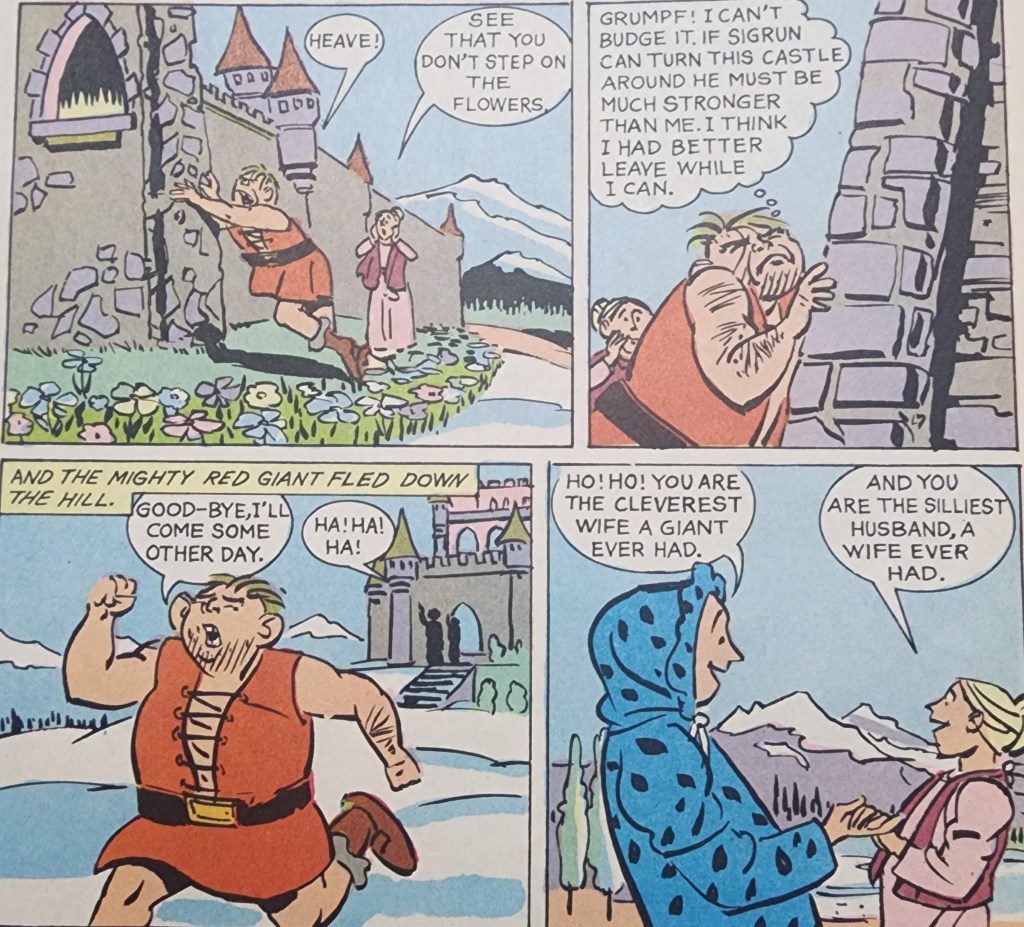
Image credit – “Una and the Red Giant” from Tinkle Comics 266

In the story “The Drummer”, based on a fairy tale, David, the drummer, has to rescue princesses from an evil Witch. To do so, he outwits, wait for it, Giants! But this is only a part of the story. Later he has to overcome the Witch. In this, one of the princesses he has to rescue, rescues him three times! The other princesses are supposed to exist but play no role in the story. So, David is rescued by the princess and in turn rescues them. 🙂 Of course, he is handsomely rewarded for his efforts. David is lucky because the Giants are stupid and the Princess already knows how to defeat the Evil Witch!
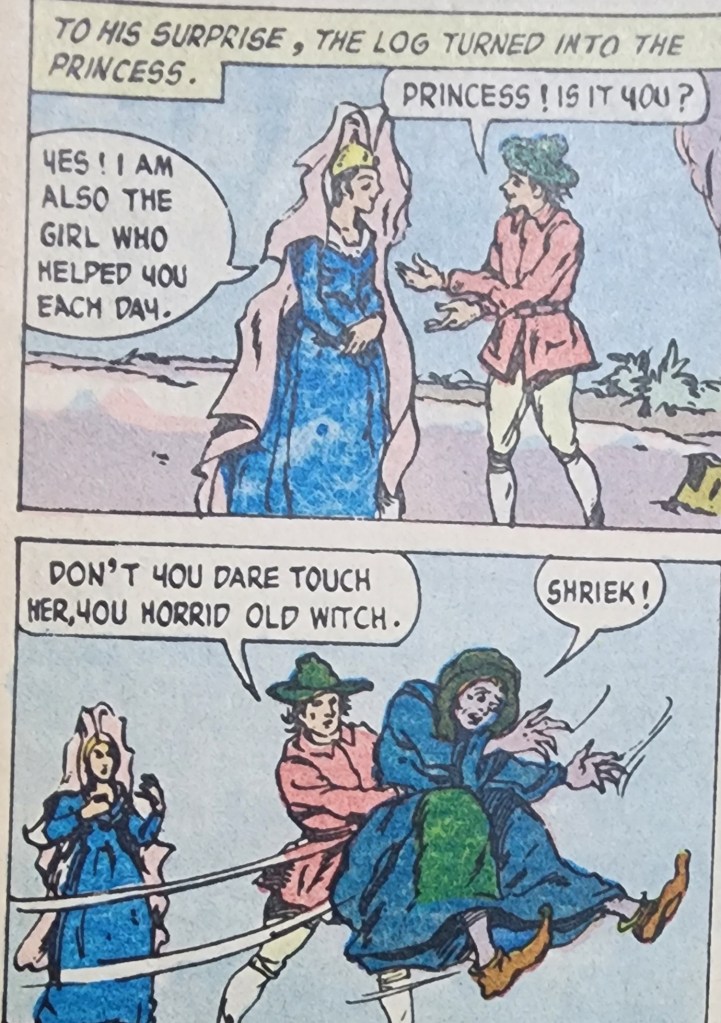
Image credit – “The Drummer” from Tinkle Comics 307

In the last two stories above, there is an interesting segue. Character and effort of an individual leads to luck. Sigrun is gentle and hence a loving wife rescues him. David is gentle and puts in a lot of effort at things he has never attempted before, which leads to luck and reward. This leads us to one more example.

Consider the story, “The Tailor and The Hunter”, based on a German folktale (of course the hero is a tailor, no spoilers there). A tailor and a hunter go on an adventure. The Tailor is kind hearted, while the Hunter is haughty. Due his kindness, the Tailor gets lucky in several instances including in slaying a Dragon (duh!). The Hunter goes home empty handed after trying to deceive his companion while the Tailor weds a Princess in the end! The Tailor accomplishes everything only with luck, while the Hunter, a physically more capable individual, is relegated to being a villain.

Image credit – “The Tailor and The Hunter” from Tinkle Comics 284

So, we have looked a dozen stories to see how deception is the key to great achievements. And the deception would never work but for a lot of luck. But we are not done yet. Stories never end, do they?

There is an Indonesian folktale, set in Sumatra, called “The Victory of the Buffalo”. In this tale, a village is facing an attack by the army of King Sanagara, unless they give in to his suzerainty. They do not want to surrender, but cannot fight the powerful army either. So, they choose to use their wits, brain over military brawn. They make an agreement with the King that a fight between buffaloes will decide the fate of the village, instead of a fight between the army and the villagers, thus staving off bloodshed. The deal is that if the King’s buffalo wins, the village will surrender, but if the buffalo from the village wins, the King will leave them alone.

The King obviously finds a large powerful animal which cannot be defeated. The villagers resort to their wits again to overcome the lack of a powerful buffalo. They find a buffalo calf which is a few days old, separate it from its mother and starve it for a few couple of days. They also attach sharp iron horns to its tiny ones.

On the day of the fight, the calf mistakes the large buffalo to be its mother and runs to it to suckle, as it is starving. The King’s buffalo sees no threat in the calf and makes no move to attack. The iron horns on the calf badly injure the larger animal when the former tries to suckle. So, the calf defeats the larger animal and the village retains its independence.

This is deception and luck on two fronts! The iron horns were neither detected nor objected to. The larger animal choose not to harm the calf. This behaviour is not always what can be expected. Lastly, the King agreed to a buffalo fight and on losing, kept his word. The villagers got lucky with King Sanagara being a man of his word. But the efforts of the villagers, the planning they put in and identification of their own weakness, all played a part and they could be said to have earned their luck. Additionally, this shows that luck can be factor even when animals fight, even if it is at the behest of humans!
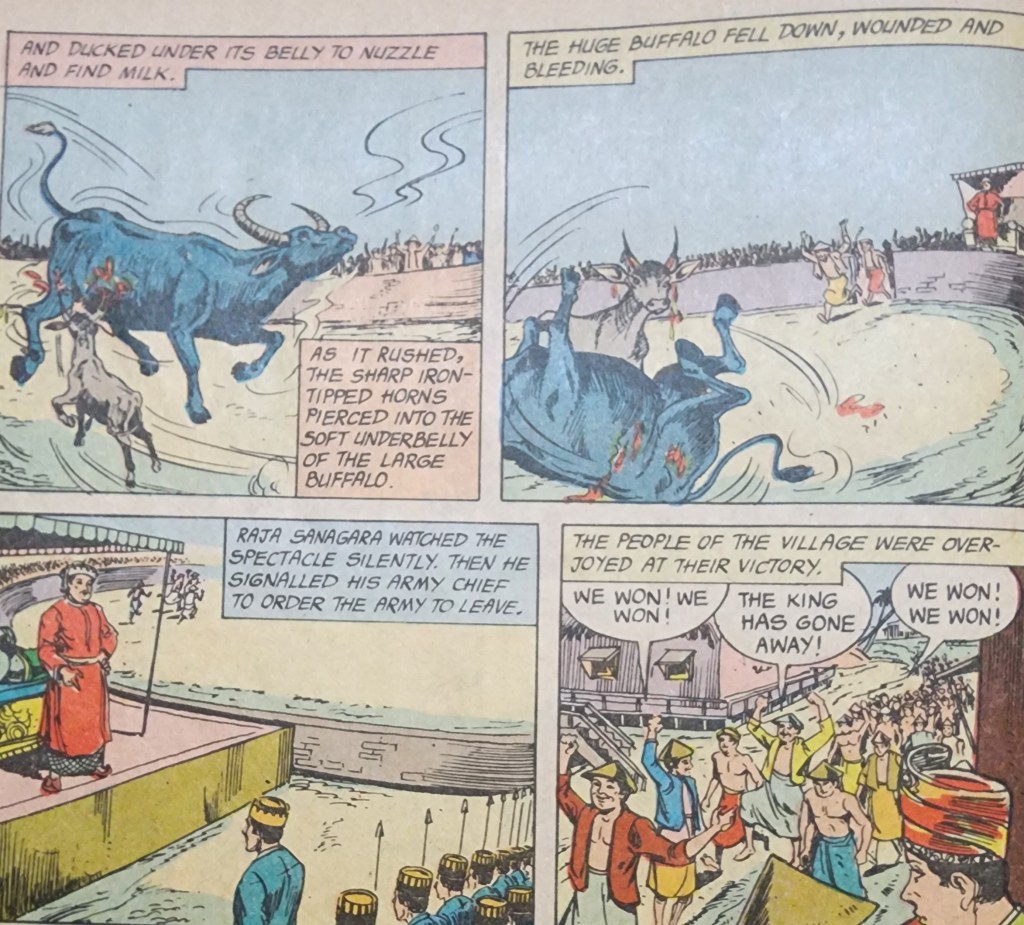
Image credit – “The victory of the Buffalo” from Tinkle Comics 225

Considering that we are discussing deception in warfare and luck saving the day, let us look at another story. The story “How the Ohias were outwitted” is based on an African folktale which describes how the gentle and outnumbered tribe of the Lumas defeated the tribe of the Ohias in the fight for the waters of the lake Lumai. The Lumas tied torches to sheep and made the Ohias think they were outnumbered during a night attack. This convinced the Ohias to surrender and retreat. This is a classic military deception trope used in many stories across cultures. The same is shown in the Hindi movie “Bajirao Mastani” and the Telugu movie “Baahubali 2”, with cattle being used instead of sheep. The side being outwitted would have won if only they had looked a little more closely. But the effort was commendable and the luck of the winning side held out, perhaps deservedly so2.
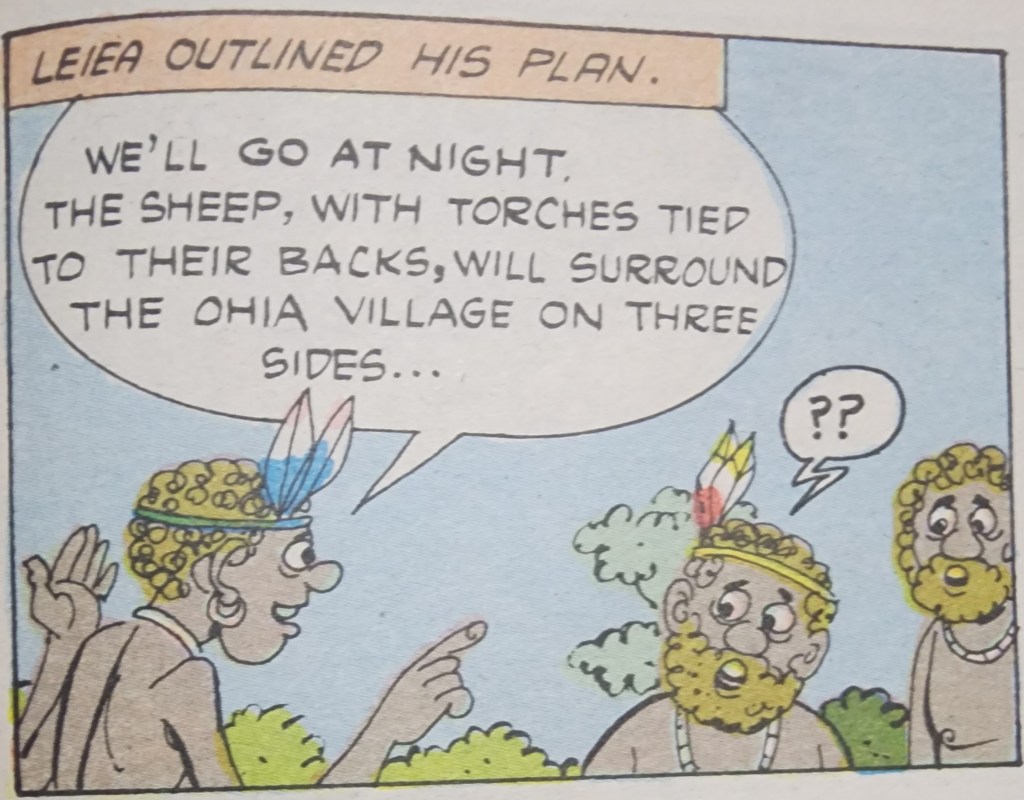
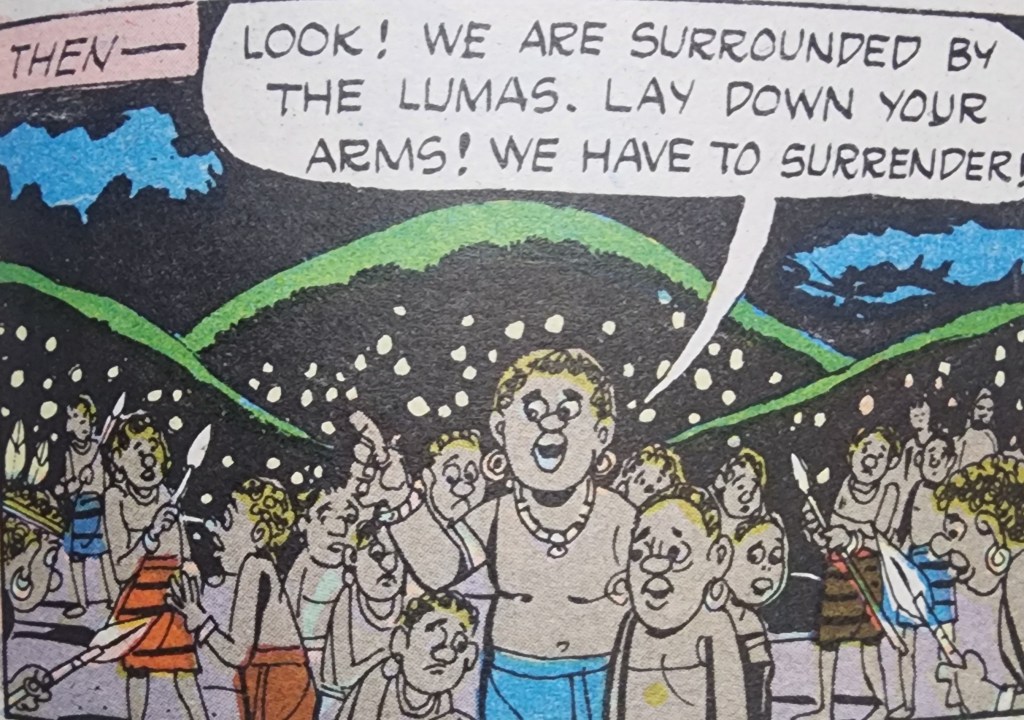
Image credits (L & R) – “How the Ohias were outwitted” from Tinkle Comics 286

So, one important aspect of overcoming an adversary is to use deception and this idea is prevalent in so many stories because it is accepted as a common sense approach to a conflict. As observed in all the examples above, deception involves the use of wits, or intellectual abilities to counter physical abilities. I had discussed this aspect in an earlier article titled “Might is Right, always”. A link to the same is seen in the notes below3.

Why is this notion of “brain over brawn” prevalent across cultures? We get a partial answer in another story. In the story titled “The Stronger Strength”, two students of Sage Vishwamitra, Madhur and Rahul have a dispute over what one should pursue, strength or intelligence. Vishwamitra settles this with a demonstration. No one can break a branch that Rahul can. But 5 students together can do what Rahul can. However, only Madhur can answer difficult questions. No matter how many other students put their heads together, they cannot replicate the same. So, strength can be overcome with numbers, but intelligence is singular and cannot be overcome by numbers. Thus “intelligence is superior to strength”. This could be why “brain over brawn” has become a truism.
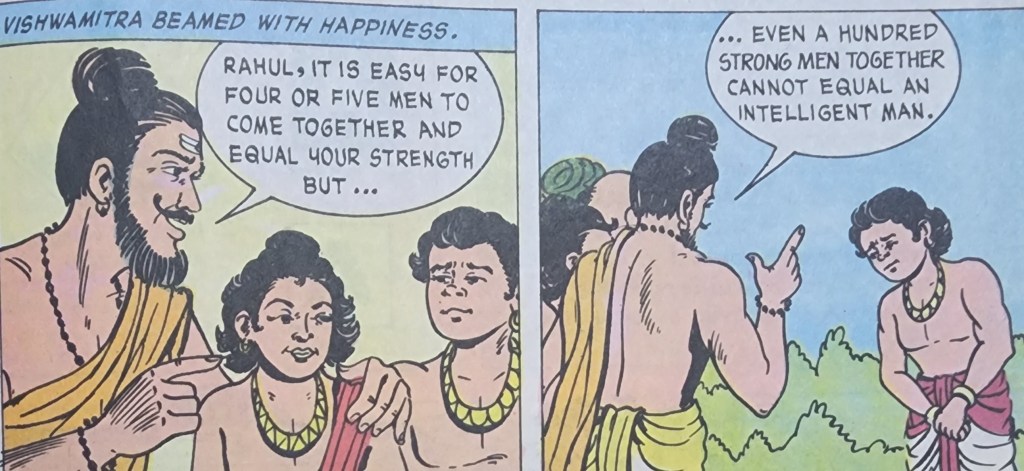
Image credit – “The Stronger Strength” from Tinkle Comics 308

The reason I mentioned that this was a partial answer is twofold. Firstly, there is a thread through all the stories that the strong individual is not very smart, to the point of having no common sense and being downright dumb. This is never true in reality. Physically capable people can be as intelligent as anyone else. Plus, being strong and physically capable requires intelligence in the real world, for that ability requires planned effort, among other things. The reason the opposite can be shown in stories is because monsters, who are born strong with no effort to build the strength, fill the role of physical superiority (Giants, Ogres, Dragons, Witches, Boars, Bulls, Big Cats, Bandits etc.).

The second reason is that in the current times we live in, technology has reached a stage where intelligence or knowledge is no longer singular. Just as brawn can be overcome with numbers, brain power can be easily overcome with technology. The story of Vishwamitra’s students might have held true in the past, but is no longer something that can be relied upon.

But one thing is true from the stories. The stories suggest deception to counter physical strength and also the strength of numbers. This is another way of saying that one should not give up and apply oneself with every ounce of knowledge (individual or collective) to overcome the adversary. This application will reveal a path that likely involves deception. It must be said, “use deception” only means doing something that the opponent(s) does not expect. If there are 10 people with a knife, bring a gun with a magazine of 15 bullets is roughly what the idea suggests. This again harks back to “Might is Right”. One needs to identify the might & weakness of the opponent and the self, then apply them appropriately to achieve the best outcome for oneself3.

There is a character named Cadsuane Melaidhrin in the popular fantasy series “The Wheel of Time” by Robert Jordan (James Oliver Rigney Jr.). In the 9th book of the series “Winter’s Heart”, this character makes an interesting observation. This observation comes after she and another of the “good” characters in the series have to be anti-heroes. Cadsuane is nearly 300 years old and worldly wise. She says something to the effect that every fight is always unfair. I do not remember the exact words she uses. But the gist of it, as I would say it is this. If a fight were fair, it would be a sport. The objective of every fight is to make it as unfair as possible to the other side, so that one’s own side wins with minimal damage to achieve what is in one’s own best interest. When this is understood, deception is par for the course. If deception is par for the course, brain and brawn become the same, for brain is just another variety of brawn. There is no difference anymore.

Once we accept that deception and intellectual abilities are just another form of strength, we can see very clearly what happens when luck is not present with the help of two stories. One story is from the Panchatantra, called “The Camel who was beguiled by his companions”. The other is a story called “The King’s Choice” from Tinkle Comics. The story from Tinkle comics is clearly inspired by the one from the Panchatantra as I see it. The ending is changed for reasons I do not know, but the two different endings perfectly demonstrate how luck is needed for deception to succeed. The “luck” might be as simple as there being no unknown factors influencing the end result. I am not stating that luck is the most important factor; just that a lack of it is detrimental to the effort that went into the deception.

In both the stories, a crow, a fox and a leopard are the close associates of their king, the lion. A camel becomes a part of their group. There comes a time when the lion cannot hunt due to an injury. This leads to all of them being close to starvation. The crow, fox and leopard conspire to make the lion kill the camel, but the lion does not like the idea. So, the trio decide to make the camel offer itself up as for the lion. To do this, they decide to offer themselves up as food, following which the camel would do the same out of propriety.

So, after the crow, fox and leopard have offered themselves up as food for the lion, the camel does the same. Here the two stories diverge. In the Panchatantra, the deception is successful. The lion accepts the camel’s offer to its horror. The camel is killed and the other four fest on it. In “The King’s choice”, the lion accepts all offers and says that he will eat them in the order in which they offered themselves up. So, the deception fails and the trio take to their feet, while the friendship between the camel and lion endures.

In the story from the Panchatantra, the fox separately convinces the lion to accept only the camel’s offer, but this detail is not there in the story from Tinkle Comics. Irrespective of this detail, the observation holds. If the camel was lucky, the conspiracy would have failed in the Panchatantra as well, if the lion had disregarded the fox even after the conversation. But luck sided with the crow, fox and leopard. The opposite happened in “The King’s choice”. Luck deserted the conspiring trio and the camel survived. This should demonstrate the importance, however limited, of luck, in the success of a deception.
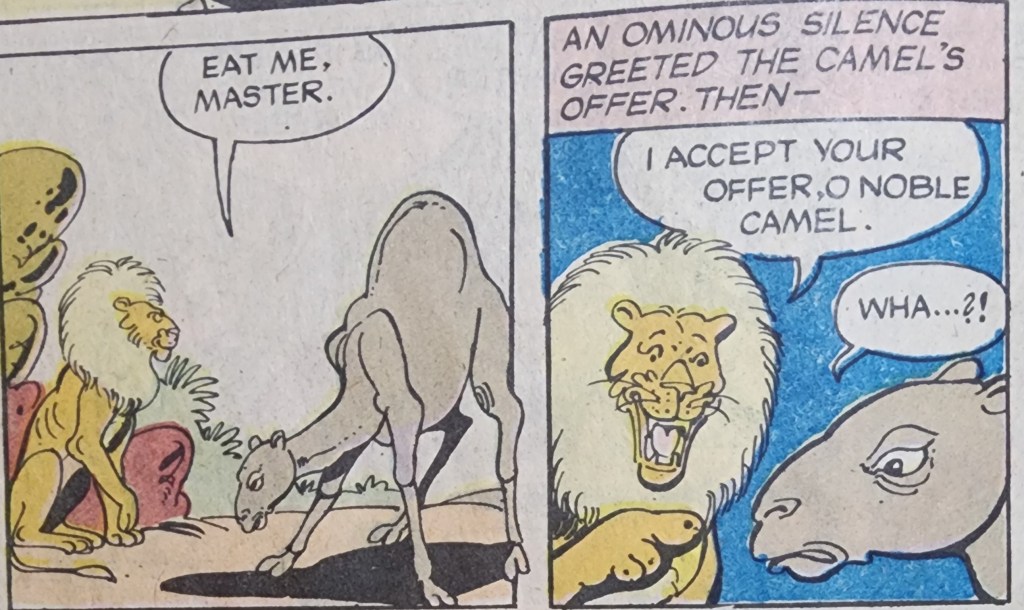
Image credit – “The Camel who was beguiled by his companions” from “Panchatantra: Crows and Owls and other stories” published by Amar Chitra Katha
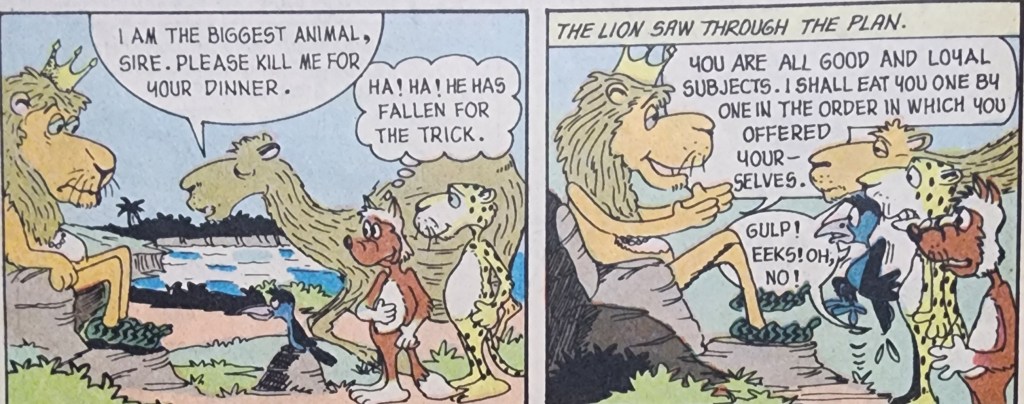
Image credit – “The King’s Choice” from Tinkle Comics 294

Mine is a blog about the martial arts (specifically the Bujinkan) and all things Indian. So, let me now bring in some information from the Bujinkan. I have heard from several senior practitioners of the Bujinkan that Soke (Grandmaster) Hatsumi Masaaki has emphasized on the importance of luck several times over the course of many years. He is supposed to have stated that luck is more important than skill, when it comes to saving one’s life. In military history, Napoleon is supposed to have said that he preferred lucky generals to skillful or good generals4. This is supposedly a reiteration of a statement from a 17th century Cardinal who was Prime Minister of France5, who is supposed to have said that one should ask if a General was lucky and not if a General was skillful. The same statement is also attributed to Dwight Eisenhower6, former US President and Allied Commander in Europe during WW2. Apparently, Eisenhower was so lucky in his career that it was called “Eisenhower’s luck”7.

This is not to say that the person who is lucky has nothing else going for her or him. Nor does it mean that the person has no skill. It is just an advantage that is being referred to. One senior practitioner in the Bujinkan system of martial arts once told me, “To be lucky, one needs to do something uncomfortable”. I think this statement sums it up brilliantly. Doing something uncomfortable is about putting in the effort and being in a situation where one needs luck (in case something goes wrong). This is when luck can manifest.

Effort is the key, effort is the king, in this context. I will elaborate on this with the structure of stories as the context, for this entire article is about stories. Consider storytelling in movies and then think of action movies. One part of action movies that everyone loves is the TRAINING MONTAGE, especially if it is accompanied by memorable and rousing music. Of course, I include the “preparing for war” segments as “training montage” because it is the final step before the fight, and had a lot of training behind it. It is that part of the movie that is watched over and over again. Remember the Rocky (Stallone) training montage? Remember the segment when Dutch (Arnold) readies himself to take on the Predator all alone?

The training montage is also a very short part of the film. Training and preparation is a lot of effort over a very long time. It is a process with incremental steps. And it is really boring to show in real time or even to make the primary focus of the movie. Hence, the montage is a great setup for an awesome climax fight. It is also a great outcome of the character motivations that were setup. After all, movies are about character actions, motivations and emotions, in flow and with action.

It is this slow, long and incremental effort and process of the same that leads to the manifestation of luck. This is what a martial artist thrives on. It is this effort that makes a martial artist akin to a scholar, a researcher or an academic, working on oneself and studying flow. This effort and its process is the lifeblood of the arts and what an artist really looks forward to.

It is this incredible effort that is uncomfortable more often than not, for it is in addition to everything else in life. It is an accepted burden, and this discomfort is what leads to luck. When “deception” is applied as a tool with practiced effort, “luck” is the final ingredient to iron out unforeseen variables. It is what adds the Brain to the Brawn, not just “over” it.

I will conclude this line of thought with one last reference to another set of stories. “Tantri the Mantri” is a beloved character from Tinkle Comics. He is a minister in the kingdom of Raja Hooja. Tantri wants to overthrow the king and become king himself. He makes elaborate plans, and fails every time. This makes Tantri a despicable yet funny character, something like the coyote in the roadrunner cartoon, with one crucial difference.

Image credit – “Tantri The Mantri” from several Tinkle Comics

Even though every plan of Tantri’s fails, the failure leads to Raja Hooja being saved by Tantri himself! So, every failed plan brings him closer to Hooja, who thinks of Tantri as his best friend and confidante, way more than just a minister. Perhaps this is the epitome in the play of luck we have discussed so far. Tantri is despicable, perhaps for this reason his luck deserts him, leading to Hooja being incredibly lucky. Tantri though puts in loads of effort, so he is always lucky in never being caught, and in being rewarded for efforts in the negative! Hooja is lucky because he puts in effort to appreciate Tantri and to also go out of his way to work with all of his suggestions. Tantri is always carrying out deception, which fail and work at the same time. He is incredibly lucky and unlucky at the same time! Stories of Tantri reinforce how effort leads to luck and luck is needed for a successful deception, for deception is a kind of brawn, where the brain takes centre stage.

This concludes this article, but there are a few points stemming from this and the previous article which I will delve into in a future article. They do not fit in here without breaking the flow. One of these points includes the complete absence of morality in many stories, for they are representative of reality, and are not just educational.

Notes:

1 https://mundanebudo.com/2024/02/18/deception-debates-martial-arts-courtly-challenges-tilakashta-mahisha-bandhana/

2 There is a beautiful story about luck written by Mark Twain, called “Thank you Mr. Shark” (I am not sure if this is the actual name or only the name of the adaptation of the story in Tinkle Comics). It does not involve a debate or a duel or a conflict. It just shows how one needs to act on the luck that has come one’s way. Indeed, this subsequent action is what shows that one was lucky, with the benefit of hindsight.

A young man in Australia catches a shark in Sydney and finds a London Newspaper in its belly, courtesy of a man it had devoured in England. This is in 1870 before the telegraph and when sharks swam a lot faster than steam ships. So, thanks to the shark and the newspaper, he is the only one in Australia who knows of the Franco-Prussian war of 1870.

He uses this information to buy Australian wool to trade in Europe, which is in high demand due to the war. So, before the newspapers in Australia can report the war in Europe, he has made a big profit for himself. Yes, there is conflict in the shape of the war in Europe, but a lucky Australian makes the most of it to further himself in life. 🙂

3 https://mundanebudo.com/2023/05/11/might-is-right-always/

4 https://www.azquotes.com/quote/1339632

5 https://www.warhistoryonline.com/instant-articles/famous-things-napoleon-said.html

6 https://www.azquotes.com/quote/568694

7 https://press.armywarcollege.edu/cgi/viewcontent.cgi?article=2542&context=parameters
Deception, Debates, Martial Arts & Courtly challenges – Tilakāshta Mahisha Bandhana

Exactly a month ago, we celebrated the festival of Makara Sankranti. This is when the Sun transits into Capricorn. This is celebrated every year in January and doubles up as a harvest festival in India. This festival is known by different names in different parts of the country, Pongal, Magh Bihu, Lohri and Sankranti being a few. One important aspect of Sankranti is the use of sesame seeds. Sesame seeds along with jaggery, dry coconut (kobri), groundnut (peanut) and few other optional ingredients are shared as a mixture. This is a mixture specific to this festival alone. The mixture, in Kannada, is called “Yellu Bella”, sometimes spelled “Ellu Bella”. “Ellu” or “Yellu” is the sesame seeds and the “Bella” is the jaggery. Sesame in Hindi is called “Til”. The word “Til” is used in a famous story relating to Tenali Rama and that is the inspiration for this article. The inauguration of the Ram Mandir in Ayodhya took up the spot I was supposed to post this article on and hence this comes a month later. 🙂

Anyone who practices any martial art in modern times would have used various social media platforms to watch practitioners of either the same or other martial art styles express their version/vision of the same. This leads to learning and the formation of opinions regarding the practitioners or the martial art style being demonstrated, irrespective of whether it is solo practice/performance or a sparring/training session or a competition.

The formation of opinions obviously leads to discussions and debates about the strengths/advantages and weaknesses/disadvantages of the different various systems of martial arts or aspects of the same. This inevitably leads to discussing the history, traditions and development of individual fighting arts. This is a stepping stone to talking about modern interpretations of the martial arts and the requirements there in. This means that practitioners discuss what martial arts offer in modern day living – “self-defence”, fitness, sports, spiritual development, personal growth etc.

All of this leads to opinions on “what works” and that means identifying specific situations and modern cultural contexts in which they are relevant. This entire process quite a few times leads to, “Which is the best martial art?”, “Which is the best martial art for me?” and of course, “Why this is not good enough or why this no longer works”. The focus on the first of these questions seems to be diminishing of late, and thankfully so.

One can call the discussions and debates about the various martial arts arguments, for they could become acrimonious at times. This aspect extends to both armed and unarmed (and armoured and unarmoured) martial arts. The great advantage of these discussions is that the martial arts are becoming more popular. Finer aspects of several of these art forms are brought to the fore in the discussions and the audience for these is made aware of the same. So, hopefully, more art forms and traditions will flourish thanks to the debates.

With the phenomenon that Mixed Martial Arts (MMA) has become, thanks to the various franchises like UFC, ONE, Cage Fighter, Bellator and the rest, the debate over “best martial art” and “what really works” is common place on social media platforms. This discussion extends, specifically while discussing historical/traditional martial arts, to which sword type or any other weapon is better in a given time frame and situation. Discussions also extend to armour, but to a lesser extent. The most common talking point is with respect to the use of any martial art in self-defence.

Videos are the medium best suited to demonstrating and discussing martial arts and hence they are most prevalent on YouTube. Instagram, as I see it, is more suited for demonstrations. Some YouTube channels that I know of, that not only share martial art related information but also discuss martial art effectiveness (the questions mentioned above) are Martial Arts Journey with Rokas, Hard2Hurt, English Martial Arts, Karate TV, Inside Fighting, Jesse Enkamp and of course, the podcast (and its snippets) by Joe Rogan, to mention just a few.

 Some channels that focus on armed martial arts are Scholagaldiatoria, Shadiversity, Skallagrim, Sanatan Shastra Vidya, Musha Shugyo, Weaponism and Let’s Ask Shogo/Seki Sensei. There are several others that I have watched from time to time and are very good as well. There are channels that focus on historical Japanese, Filipino, Indian, Chinese, Korean, Iranian (HIMA), African (HAMA) and European (HEMA) martial arts. There are also several channels that focus on modern day practices that include or focus exclusively on firearms. Discussions here include the effectiveness, modern day practicality and various other aspects. Consequently disagreements abound on quite a few of these channels.

I do not use the word “disagreements” in a negative sense here. Whether or not one agrees with the opinions and knowledge shared on these channels, they definitely further awareness about and interest regarding the martial arts and this is a great thing. But of course, disagreements lead to debate and discussions. This is the point of focus of this article.

Debates over the martial arts are nothing new. At least the need to identify if the style one practices is effective or if one is a good martial artist is not new. It has always existed. This is where the “Dojo Challenge” comes from. This is where the duels of Miyamoto Musashi come from. It is also, in the Indian context where the concept of a “court wrestler”* comes from. These “court wrestlers” were responsible for taking on challenges by wrestlers or fighters from within and without the country, in the latter case to protect the king or kingdom’s honour and show that the society in question can produce great fighters.

The concept of debates in India extends beyond the martial arts to settling differences related to philosophy, religion and perhaps many other aspects as well. From here on I will swivel between martial arts and other aspects while discussing the use of debates and discussion in the Indian context.

India over the millennia has a hoary tradition of having debates over various aspects of life. These are heard to this day as stories and many of them are well and truly historical, even if the finer points might not be totally accurate. These debates have, on occasion, led to massive socio-cultural and political changes in the landscape of Indian history. This love for debate, discussion and argument persists to this day in the modern Indian republic. Just have a look at the various forms to media to get an inkling of this&.

Seen below are some examples of some of these well-known debates/discussions from Indian history that I am aware of.

  • The Rishika Gārgi is supposed to have been instrumental in determining that the Rishi Yajnyavalkya was a great intellectual who could not be defeated in a debate based on her questioning of the latter, in the court of Janaka in Mithila. A link to the video describing the same is seen below. Watch between the 2 and 4 minute mark.
  • The discussion between the Indo-Greek king Menander I (Milinda) and the Buddhist monk Nāgasena is recorded in the ancient book “Milindapanha”. The king is supposed to have become a patron of Buddhism post this discussion.
  • The individual Ugra Tāpas lost a debate with a Buddhist Bhikshu and became a Bhikshu himself, with the name “Nava Bhikshu”. This person, is supposed to have later impressed the emperor Kanishka to become an ardent supporter of Buddhism with his expositions on the same. He earned the name Ashva Ghosha after this as his way with words was supposed to be able to mesmerize even horses. Seen below is a link to a video about governance during the Kushan era. Parts of this episode deal with the story of Ashva Ghosha.
  • Shankarācharya’s debate with Mandana Mishra where the latter’s wife was the judge is very well known. The debate as I recall was about the merits of the Karma mārga and the Jnana mārga. Shankarāchārya won the debate and Mandana Mishra became the disciple of the former. He even became his successor with the name Sureshwarāchārya at the Sringeri Mattha.
  • The debates of Rāmānujāchārya at the court of King Vishnuvardhana of the Hoysala dynasty is supposed to have convinced the king himself and several of the citizenry to convert from the practice of Jainism to that of Vaishnavism.

This practice of debates continued over the centuries. This is seen from the stories we hear as kids, specifically those of Tenāli Ramakrishna, Birbal and Gopal Bhand (of Krishna Nagar). One such story which I describe briefly is the inspiration behind this article. It appears that the courts of kingdoms had scholars, wrestlers, artists and other luminaries who added to the prestige of the court, king and kingdom. Scholars, wrestlers and artists apparently travelled around various courts to display their abilities, maybe challenge “court specialists” in their respective areas and earn awards or commissions for their achievements. Perhaps this was a way of living for at least a few.

The story goes that a scholar once came to the court of the king Krishnadevarāya of the Vijayanagara kingdom in the early 16th century. He set out a challenge for the scholars at court to debate with him over any scripture and win. He was extremely capable and everyone at court was sure they could not get the better of this individual. At this juncture, the Pandit Ramakrishna from Tenāli (in modern day Andhra Pradesh) took up the challenge and succeeded in defeating the traveling scholar. Tenāli Rama or Raman of Tenāli, as he is also called quite often is sometimes referred to as the “jester” of the court, but this seems a wrong description. From the little that I know, “Vidushaka” seems the right word.

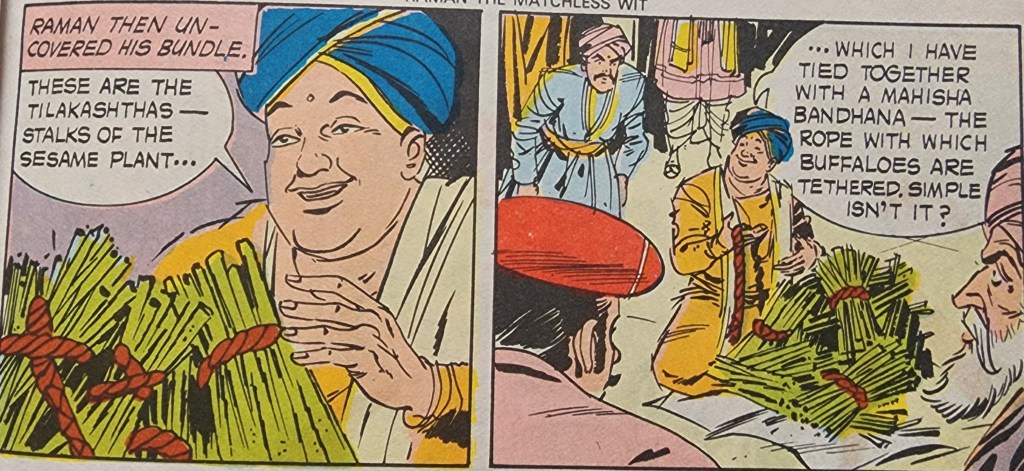
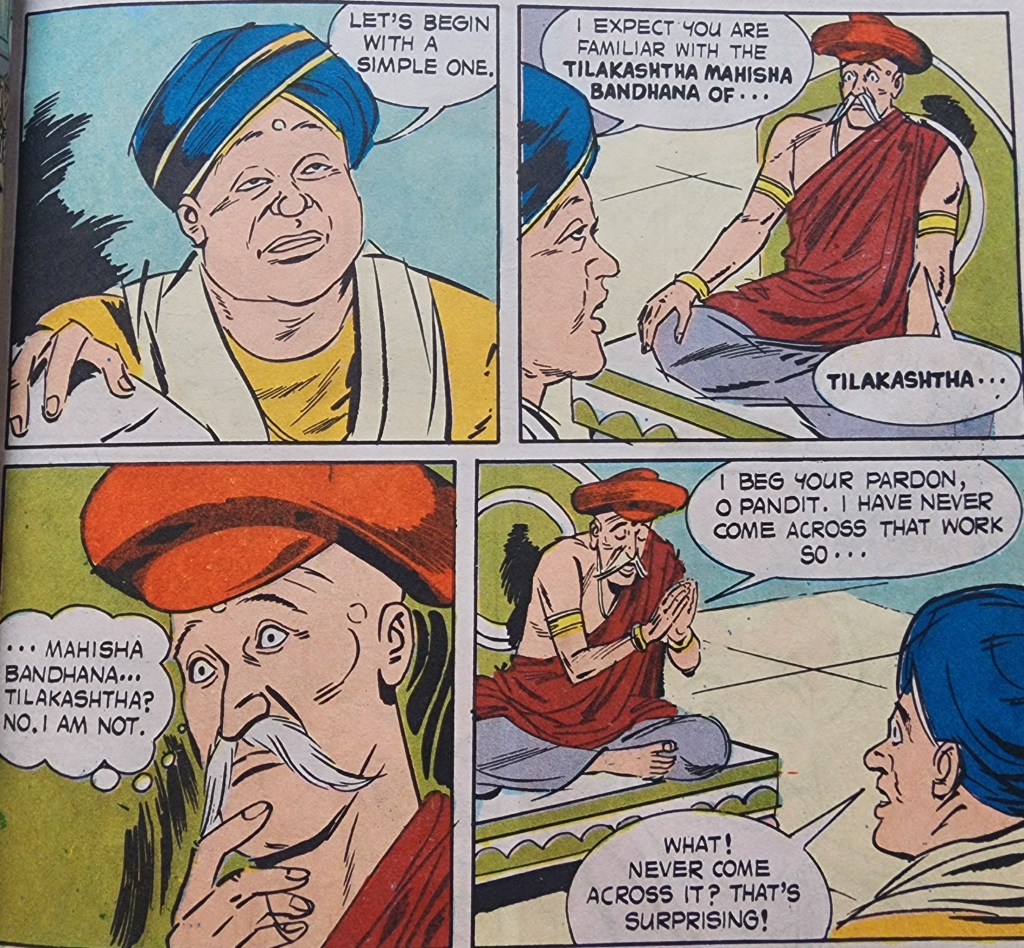
Ramakrishna came to court on the day of the debate with a large bundle of manuscripts and told the challenger that he would like to begin with a discussion of the scripture called “Tilakāshta Mahisha Bandhana”. He added that this was scripture was a simple one and known to even the cowherds of Vijayanagara. There was in reality no such scripture and this was a ruse to trick the scholar from abroad. It worked and the scholar, having not heard of the scripture, thought he was outmatched, accepted defeat and left.

Image credit – “Raman, The Matchless Wit” published by Amar Chitra Katha in “Tales of Humour”

Thus, the “prestige” of the court was saved and Ramakrishna rewarded, following which the reality of “Tilakāshta Mahisha Bandhana” was revealed. Til is the word used to refer to sesame seeds. Tilakāshta refers to the stalk of the sesame plant. Mahisha means buffalo. Bandhana is a rope or “to tie”. Ramakrishna had tied together stalks of the sesame plant with rope used to tie buffaloes in place. Multiple such bundles were placed in a bag and the scholar mistook these to be manuscripts of scriptures. So, “Tilakāshta Mahisha Bandhana” was nothing but stalks of the sesame plant tied into bundles using rope used to secure buffaloes! TENALI RAMAKRISHNA USED DECEPTION TO WIN A DEBATE!

Image credit – “Raman, The Matchless Wit” published by Amar Chitra Katha in “Tales of Humour”

Debates are not restricted to areas where ideas are shared with words, in either the spoken or written format (debates can occur through articles and op-eds). They can occur in spheres where ideas are shared with physical actions. This includes debates over music, dance or of course, the martial arts. A debate about any of these would include both conversations and actual demonstrations of music or dance or the fighting arts.

In the case of the martial arts, demonstrations can transition into an actual duel or confrontation to drive home a point. This aspect of the martial arts lends itself into the tradition of the dojo challenge** or musha shugyo*** (only a part of it). These are situations where a practitioner of a specific martial art form challenges practitioners of the same style or a different one to identify who is a superior martial artist or which is a better art form. This is exactly like a debate where one side of a notion tries to prove its validity over the other.

I will share a few examples about debates in music or dance with examples from pop culture. These situations were written into fiction only because they are well known aspects of Indian culture and hence serve sufficiently as examples to illustrate the debate.

There is sequence in the old Hindi movie “Āmrapāli” (1966) where one dancer has to prove that the performance of another is flawed. She has to do this by performing the correction version. This is a case of a debate over which is the correct dance form.  A link to this sequence from the movie is seen below.

There is a Tamil movie “Vanjikottai Vāliban” (1958), which is supposedly based on “The Count of Monte Cristo”. Here two dancers are in contest to determine who is superior. Again, this is nothing other than a duel. The link to this sequence from the movie is seen below. This movie was remade in Hindi and called “Raj Tilak”.

There is another Tamil movie called “Tillana Mohanambal” (1968) where there is a sequence related to a debate/challenge around music. Here, an expert with the Nādaswaram has to demonstrate his ability to perform Western music with an Indian instrument, to establish that his art form is not limited in any way. A link to this sequence is from the movie is seen below (watch specifically beyond the 2:30 mark).

The above three cases are not different from the duels of Miyamoto Musashi. Musashi fought 61 duels and survived (won) all of them. The duels were against martial artists who practiced weapons and styles other than his own. His own style with two swords developed from these experiences. Considering that the life of Musashi and that of his opponent(s) was at stake in quite a few of these duels, he definitely employed aspects other that just physical martial skill in these. This is no different from Tenāli Rama using deception in his debate with “Tilakāshta Mahisha Bandhana”.

Consider Musashi’s most famous duel against Sasaki Kojiro. Kojiro was famed for his use of a very long blade (perhaps a nodachi or odachi?). To counter the reach of his opponent’s weapon Musashi is said to have used a very long bokken (a sword made of wood). He apparently carved this bokken out of a boat oar. He is also supposed to have come very late to the duel, long after the agreed time. This is supposed to have made Kojiro tired and irritated, and perhaps prone to errors due to the same. So, Musashi got the better of his opponent by changing the weapon he used and the timing of the duel to gain an advantage. This is akin to Tenāli Rama bringing a bag full of fake manuscripts.

A statue depicting the duel between Miyamoto Musashi and Sasaki Kojiro in Japan. Image credit – Wikpedia

In another earlier instance Musashi is supposed to have taken on several practitioners of the Yoshioka school of sword fighting. I am not sure if the following tale is historical, but is surely made popular by the Manga based on Musashi’s life. The Yoshioka came in large numbers to kill Musashi in a situation where the fight was supposed to be a duel. So, they chose to deceive him. But, Musashi had arrived much earlier at the agreed location. He attacked without any warning and from hiding before the Yoshioka had any inkling that he was already there. Musashi ended up surviving/winning this fight as well. In this case both sides used deception. Musashi by being early and using stealth and the Yoshioka as mentioned earlier. So, deception is a known feature even in a “martial debate”; perhaps it is something that is to be expected.

Whether or not deception is used in a “martial debate”, it is a healthy aspect that has led to development of the martial arts over centuries. Consider the different styles of Boxing (English and Mexican for example), Wrestling (Greco Roman and Freestyle), BJJ, Jujutsu, Kalari Payatt (Northern & Southern), Karate and the various animal related forms of Wushu (Kung Fu). Also consider the very many styles of sword, spear and other weapon schools that exist in the various parts of the world. Some of these came about as differences of opinion and differing points of view occurred in a given style, even if these were not really a “debate” in a conventional sense. Of course, different schools have merged under a single master as well when some martial lineages did not have an heir to carry it forward.

To extend the dojo challenge to a modern day context, consider the examples where masters in traditional Chinese fighting styles were challenged and defeated by a practitioner of MMA, Xu Xiaodong&&. Xu Xiaodong also supposedly faced flak from the authorities for demeaning the traditions of China. Beyond this, consider the innumerable discussions that happen online about the pros and cons of western and eastern swords, armour and the like. Of course, these started out in a stark adversarial manner but has over the years evolved to a useful exchange of information, knowledge and experience.

The most glaring examples are of how many western content creators (who also have martial arts experience) were deeply involved in debunking the superiority of the katana over western swords. But over the years, similarities with the art forms has also been recognized and a healthy space for experience sharing has emerged. What was once only a debate has transcended to be genuine discussion.

In a non-martial context, debates and discussion have led to great development. This is very well known; consider the 1927 Solvay Conference# as an example, where Quantum Physics as field of study took shape. But the use of deception is debates has been a constant as well. Consider any of the debates in any media platform. All of them use data selectively to further specific points of view and based on personal interpretations. This gets exacerbated since these days we have fake news and more recently, deep fakes. Fake news can be deliberately edited videos to suit a purpose or morphed images and of course, blatant lies with words. These can be used to create a deception or used unwittingly by a debating side, where the deception is perpetuated by dint of being deceived!

The use of deception is not new in the martial arts. Nor are debates about which martial art or martial artist is better. And deception is par for the course in debates that have nothing to with the martial arts either, as we saw earlier. When this is the case, can the use of deception to settle debates about the martial arts be wrong? Unlikely. Especially when these debates lead to actual physical contests, sometimes life and death duels.

There is one aspect about using deception that needs to be considered. This is “luck”. I will explore this in my next post.

Notes:

* I am not an expert on court traditions in different parts of India in the past and do not claim to know for certain of how these positions worked or even if they existed for certain in the various kingdoms that have come and gone in different parts of this ancient land. I am aware of some stories and am going the same.

**Dojo challenge – A situation where a martial artist challenges practitioners in a dojo to a fight to determine if their art form or skill set is as good as or better than her or his own.

***Musha shygyo – Martial journey, or journey of a martial artist (mainly physical over a geography, but could be spiritual or intellectual) which leads to growth and development of the individual’s martial abilities (and also personal development in general).

&& Seen below are links to 2 videos which share the story of Xu Xiaodong and his story

# Seen below is a link to a video which briefly explains the 1927 Solvay Conference and its relation to Quantum Physics

& The practice of debating is thriving in modern India too. It has expanded into television media, social media and print media apart from those that take place in the offices and homes of every citizen. These debates have even incorporated platforms beyond India as a tool to gain an advantage over their “opponents”. I am adding this point in the notes as it is not directly relevant to the article. Consider the opposition to the current central Government in India. There are several critics of the government who either reside or publish mostly in platforms outside India! A few names that come to mind doing this are Suraj Yengde, Kapil Komireddi and Rana Ayyub. On the other side, people who are sometimes critical and quite often supportive of the government are Kushal Mehra, Shambhav Sharma and Sree Iyer. All of them use YouTube effectively, which in reality is not an Indian platform. The conference “Dismantling Global Hindutva” has to take the cake though, for using foreign soil to reach an Indian audience 🙂 . I am not sure this is deception, but certainly seems like a flanking move or some new BVR missile equivalent, in the intellectual sense of course.

Constant Adaptation, Dynamic Equilibrium – Martial Arts & Modern Democratic Information Flows

In the Bujinkan system, the differences that exist in points of view, perceptions, paths of learning, methods of teaching and every other conceivable difference is to be accepted. Differences that occur over time are also be expected. Consistency is not something one assumes. Every situation is dealt with as a fresh one with no expectations or motives. This was the premise of the article I posted four weeks ago. A link to this post is seen in the notes below*.

Once we can accept that we need to deal with every situation and cannot wish for a favourable one, a lot becomes simple in the mind. We can accept that consistency is not to be expected of humans. Everyone responds to a situation in a given time and space. If we encounter a favourable situation, consider it luck, be happy and move on. Do not try to replicate or analyze it, in hopes of achieving the same again.

One aspect that the above understanding leads to, in my opinion, based on training, is that we become more like our uke (attacker/opponent) and the vice versa also holds true. If one is training with an aggressive uke (opponent), who does not see the threat to such actions and is unable to realize the points of vulnerability he or she is exposing oneself to, based on the move performed by the tori (defender), a change might be required to end the conflict. It might be necessary to expose the vulnerability/opening/suki by actually striking, locking or any other act that induces at least a little pain. This hopefully, will reveal the fault of the attack and mitigate the same. Of course, this might be an iterative process with a gradual or sudden increase in the pain imposed by the tori. This could be considered as the tori becoming aggressive and more like the uke, in comparison the earlier attitude of the same person. Similarly, once the uke experiences the pain and vulnerability, the attacks might reduce in speed, power and in general the person might become wary and less aggressive. This means that the uke has become a little more circumspect and “peace-loving” 🙂 , like the tori was to start with. So, the two fighters have become more like one another, absorbing each other’s attitude.

This is something that might happen in every exchange, over many months, years or over a lifetime, when people share the same space and time together, as practitioners, friends, family, colleagues and any other relationship one can consider. I have over the years experienced this. My fellow budoka (practitioners of budo), senpai (seniors) and kohai (juniors), have changed and become more like one another.

Individuals who started out wanting to be the best, being aggressive, have over time mellowed considerably and come to rely on movement and sensitivity over speed, power and aggression. They have also lost the need to be the best. Similarly, those that started out being timid and afraid to strike or cause any pain, have absorbed some of the aggressive nature of their peers. They have lost the need to hold back all the time, they use aggression when necessary, with no reservations, but not with impunity. So, a nice equilibrium is reached with years of training.

This is even seen with how people react to practitioners of other martial arts or to those who do not practice the martial arts. Some start out trying to convince others with a zeal of why the art they are practicing is awesome. They are trying hard to be good ambassadors, or marketers at least. Others start out hiding their practice altogether and if not that, do not share much information. This also changes over time. Everyone somehow settles down to a reasonable middle ground, knowing when and whom to discuss the martial arts with and when to not worry about what others think of the same.

I personally use the analogy of a pendulum to describe the change. The more a person was aggressive, the more he or she will become sensitive and averse to physical force, before being able to do either (or both) as required. The same is true of individuals who are averse to physical contact. They start out being timid, then become used to using more physical strength than needed, before achieving the equilibrium where he or she can avoid physical contact or use excessive strength, as called for by the situation.

Now, if we expand the lack of consistency and the change in people due to circumstances and life experiences, some more aspects of our lives hopefully become clear. All of us inherently know change occurs and will likely have used the adage “change is the only constant”. But all of us are also, at least miffed or annoyed to a greater extent, by change, especially in people and the world around us. The effort to adapt to changes is not always pleasant or predictable.

If we live in democracies, all of us humans are political, irrespective of how often and with how many people we discuss our opinions, preferences, ideas and inclinations. And all of these are influenced to varying degrees by all the information we are exposed to. Now consider the data we are all swimming through every day – social media, digital media, televised media, print media, and opinions of people we know and don’t know. It is also very likely that all the information is presented to further a motive, again irrespective of how benign or indifferent to influence, the creator or distributor of that information thinks it is. The lack of a motive is perhaps a motive by itself. Another word for the motive of the presentation of information in today’s world is “Narrative”. This means we are all swimming in strong currents of narratives every day, all day, day after day. These narratives, just like water currents mingle and develop lives of their own, which need not be under anyone’s control. In my understanding this is what defines a “zeitgeist” (overarching theme/mood) of a time frame, a decade or so.

We all live through multiple decades and through varying zeitgeist and narrative sets. This is also a change related to people. After all, narratives and the zeitgeist are driven by people. But, adapting to a new zeitgeist is much harder despite knowing that change is a constant. I opine that this is because a zeitgeist is always trying to build a cult, if not a religion. How often do we hear people fondly remember the way things were or being glad that those times are done? I suspect that if you live in a democracy, it is fairly often.

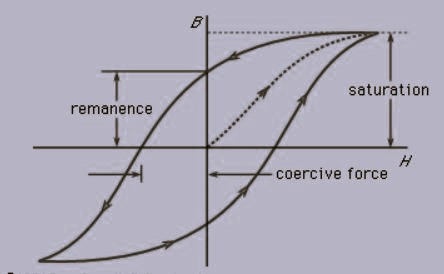
Is adaptation wrong? Never. It might be wrong to certain people and great to the rest. Both groups adapt in their own ways. But like the hysteresis curve** what we achieve with the adaptation is not what used to be achieved or an improvement of what is, it is always a bit of both added to the current situation, which is a different chimera altogether. This “chimera” will require adaption all over again, until the next and the next and the cycle goes on.

Hysteresis curve, Image credit – Encyclopedia Britannica

This concept of adaptation and becoming more like the other, holds for countries/nations, societies/civilizations and people as well. This is what I personally understand as one of either integration/assimilation or confrontation through adaptation. We see this all through history and in current affairs.

A primary driver that drives adaptation is technology. The use of the internet and all the platforms it has spawned is perhaps the latest tool that is being used to drive narratives. Narratives that are weapons used as potential equalizers whenever there is a considerable disparity in any other conventional weapon, either physical or psychological.

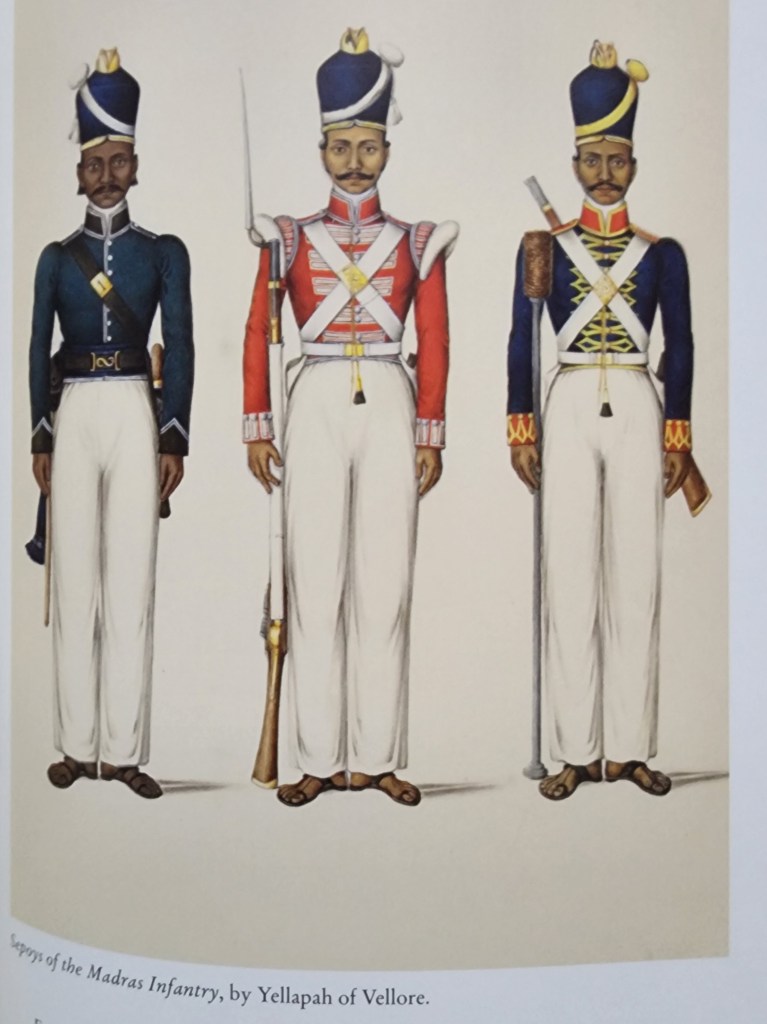
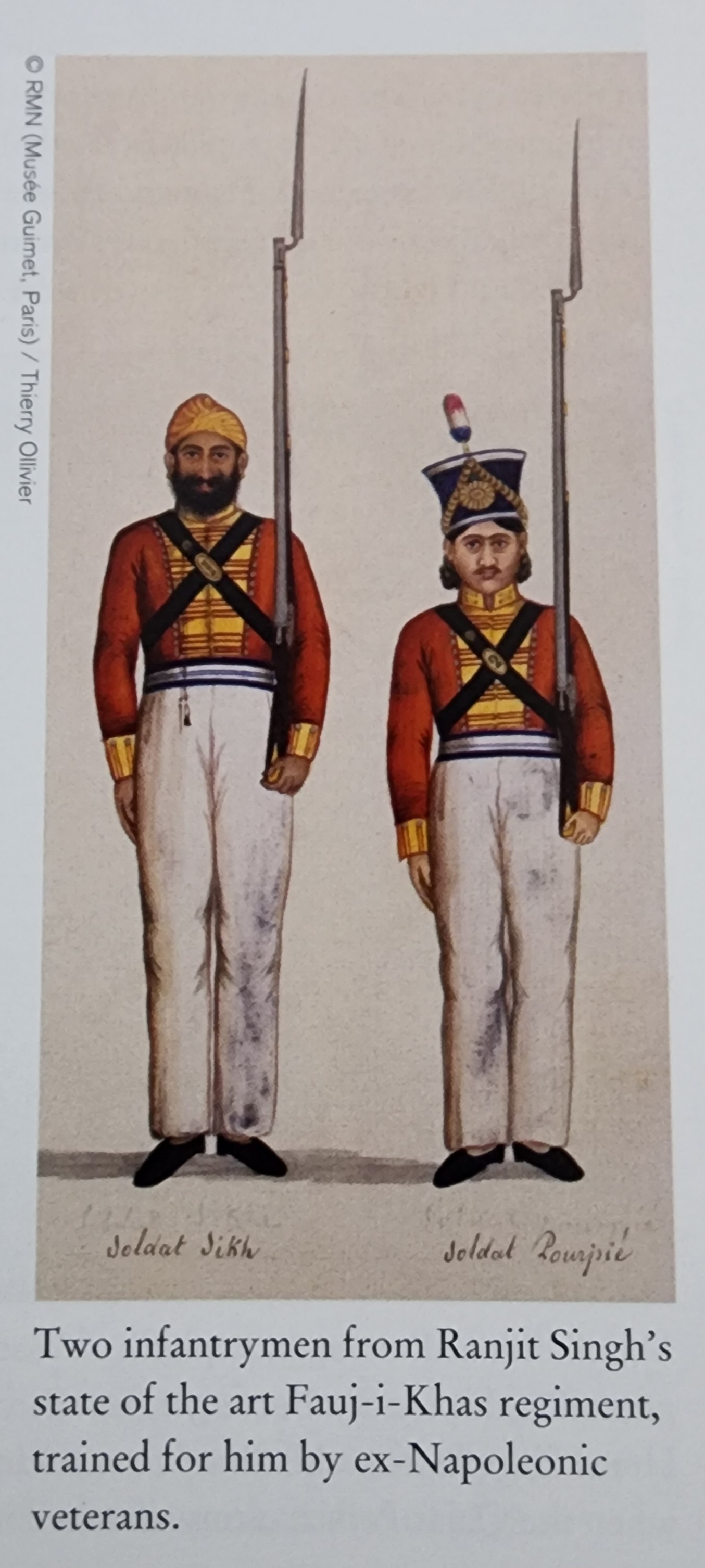
Left – Troops of the Madras Infantry (EIC soldiers), Right – Troops of Maharaja Ranjit Singh’s Fauj-i-khas. Both are modeled on Europeans armies.

Image credits – both images are from the book “Return of a King” by William Dalrymple

Based on my limited knowledge of history, this is something that has happened time and time again. In the 18th century, the East India Company (EIC) used mobile artillery and European military tactics to gain a great advantage over many Indian armies. This was overcome in a couple of decades by the local leaders hiring French military advisors to train their armies in the latest tactics and technologies. This led to the Fauj-i-khas and its guns, of Maharaja Ranjit Singh, the troops of the Holkar and Shinde factions of the Marathas and Tipu Sultan’s army. All of these troops held off the EIC successfully for decades.

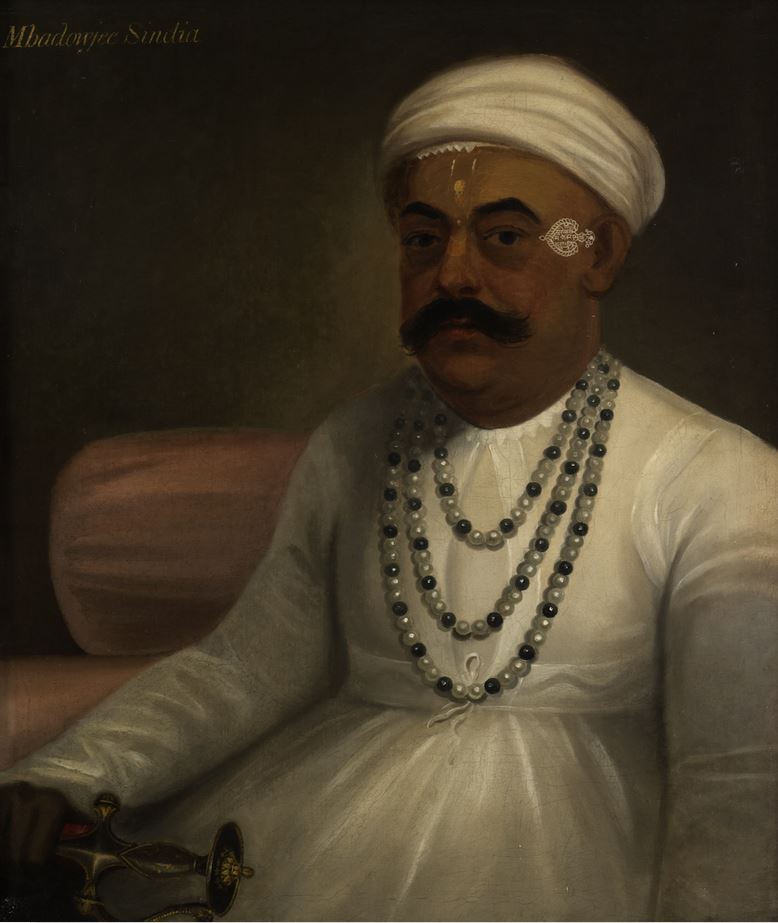
Portrait of Mahadji Shinde (Scindia) by James Wales, Source – Wikipedia

The EIC gained an upper hand with better financial management and the exploitation local rivalries. This was overturned not with better management practices by the Indians. After almost a century of learning from the British, the Indian army turned against the colonial masters and forced their exit. This effort was on two fronts. One which incessantly tried to turn the army against its own masters and the other led by Mahatma Gandhi and the Indian National Congress (INC), which turned civilians against the British and broke the moral superiority the British gave themselves.

So, first, the Indian armies became more like the EIC and other European armies. Later, Indians learned to turn the learning from the British against themselves, which is what the British had used in the first place, popularly called “Divide and Rule”.

Around the dawn of the Common Era, India was invaded by the Greeks, Shakas, Kushans and Pahalavas, and a few centuries later by the Hunas. All of them eventually assimilated into the existing native culture, religion and became locals; some even propagated Indian culture as it existed at the time to Central and East Asia, Persia, all the way to Greece. In other words, the invaders became one with the populace they attacked.

In the second millennium of the Common Era, this changed, when Islamic and Christian invaders tried to make the locals assimilate into their culture. Islamic armies that invaded had superior cavalry due to their origins in Central Asia. Indian forces over time became superior cavalry troops themselves and added guerrilla tactics to eventually break Islamic domination. This is seen in the armies of the Rajputs and the Marathas. Christian forces represented by the EIC and the British were defeated as mentioned earlier. So, the trend holds, one becomes more like the enemy to survive and overcome the same.

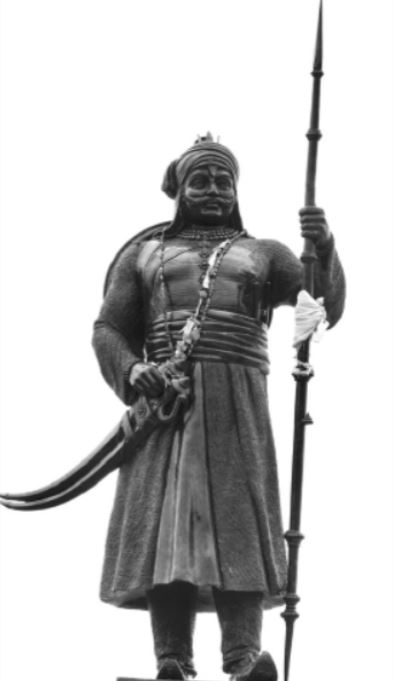
Left – Statue of Maharana Pratap, Image credit – The image is from the book “Maharanas” by Dr. Omendra Ratnu

Right – Statue of Peshwa Baji Rao I in front of the Shaniwar Wada in Pune, Image credit – Wikipedia

Fast forward to the Indian Republic and this pattern continues. The example now truly moves into the realm of narratives. Indian social sciences were taken over in the late 60s and through the 70s by a Leftist strain of thought. This led to the Hindu religion facing a lot of negative coverage the world over due to the narrative set in educational institutions, media and pop culture. This sway was broken with the coming of the internet. People who are not academic historians, from all walks of life, reset the narrative with new research and by digging up the works of historians of the past who were side-lined by the Leftist way of thought.

A Marketing Professor of mine from MBA used to say that one should never leave any subject to just the experts. He used to suggest that HR should never be left to HR professionals, Finance to Finance experts, Engineering to Engineers and so on. While studying Engineering, we had a subject called “Engineering System Design” (ESD). ESD said that while trying to solve an engineering problem one should always have an expert from a different domain. For example have a biologist while trying to solve an engineering problem.

It is this approach that has changed the narrative about the Hindu religion and Indian history over the last 15 odd years. People took narrative building ideas from Social Science professionals, added their own experience from other walks of life and used the internet to circumvent the academic strangle hold of the Leftists. Now, the Leftists and their kind in media are taking to social media to counter this, as television media has been lost to them. How this plays out in the future is yet to be seen.

Another change that is happening is in the way Ahimsa is viewed in India. Ahimsa was considered the ONLY reason for Indian Independence during my school years. This is now changing to show how the Revolutionary movement was as vital a component of the Freedom Struggle as the Ahimsa led movement was. But the Ahimsa fervour added with the negative narrative about Hinduism led to the creation of Caste and Religion based vote banks in the country. This left many feeling dissatisfied and unable to openly air their concerns about the same.

Again, the internet came as a disruption. It gave a new avenue for venting these grievances. It also led to Indians reconnecting with the past beyond Ahimsa, a past of physical conflict and valour. This has made Indians more aggressive and proud as a people. Nothing is without consequences and the fallout of this is yet to be seen. The beneficiaries of the vote bank politics were belligerent for a few decades. But the passive population has become more like them and is showing signs of aggression. In the same vein, those no longer benefiting from the old narrative have taken to the passive protests based on Ahimsa, to achieve a moral high ground. This was seen in the anti-CAA protests and the protests against the Farm Laws, at least until violence undermined both, specifically the anti-CAA protests. So, the pendulum has swung to the other extreme; those that were raised on Ahimsa narratives are now realizing forms of power other than morality, while those who formed a part of the dominant narrative are now taking to the moral capacity of Ahimsa. Again, the opponents have become like one another.

If we consider the current events in India, the Prāna Pratishta of the Rama temple occurred a few days ago. This event is widely seen as a defining moment for Indic or Dharmic or Bharatiya civilization, in a hugely positive light. But there is a sizeable opposition to the focus on the event, especially about the involvement of the Central Government. It is a criticism of the Government for being right wing, and an adherent of “Hindutva”. Hindutva is the political zeitgeist in India as I see it. It has been so since 2014 for sure and maybe since a few years before then.

In an interview on the YouTube channel of “The Wire”, the criticism is very interesting. The Wire is considered a leading “liberal”, “leftist” media outlet. The interview is of Ramachandra Guha, by Karan Thapar. Both Mr. Guha and Mr. Thapar are regular critics of the current Indian Central Government. In the interview, Mr. Guha says that the focus on the Ram temple at Ayodhya is an attempt to convert Hinduism into a congregational religion, which it never was. And this attempt is just to benefit the political party in power.

This criticism is very interesting. It suggests that Hinduism should not change from what it was in the past! Despite Hinduism being in a process of constant change! Hinduism went from being a Yajna based religion with no temples, to a religion (it is way more than a religion, but I am using this word here for simplicity) centred on temples. It also went from a ritualistic one to adding a plethora of philosophies. It has now gone from a religion focused purely on the sub-continent to one looking outward. This change has occurred over the millennia, by its acquiring influences from communities all over the Indian sub-continent. Hinduism has led to Buddhism, maybe Jainism, Sikhism and also consists of the now extinct Charvaka and Ajivija ways of thinking. Hinduism has also been changed by these religions and the several local and tribal faiths that exist in the various parts of India. This aspect of Hinduism is so pervasive that invaders adopted one or more of the Indic systems and changed their names even (look at names of later Kushans, Hunas, Indo-Greeks etc), until the invasion of the practitioners of Islam and Christianity.

So, Mr. Guha bemoans the change in Hinduism (if it really is happening) despite it being a religion of change at all times of its existence! What we can consider is that the Abrahamic religions are congregational religions and if Hinduism adopts congregational aspects that are very pervasive, it might become more like the Abrahamic faiths. This is yet to happen, if it does at all. But if it does, it would be another case of a local religion adopting facets of a faith system that is perhaps a challenge to its existence. A link to the interview I am referring to, is seen in the notes below1.

There are many other conversations happening within Hinduism relating to rediscovering its past and positives, the freedom of its temples, caste segregation and the like. There is no way to say how all of these will result in the evolution of the Dharmic systems in India and abroad. Hinduism is not yet a proselytizing religion, while its offshoot Buddhism is. Will this also change in the future as result of learning from “opponents”? There is no way to know as yet. Narratives always come up against lived experiences and face hurdles there. How the two interact defines the future of both. This is a whole different topic I am not very aware of and hence will not delve into it further.

Now for a view from the other side. Many of the people critical of the current Indian Government used to be superstars of television journalism. Now these channels are seen to be pro-government. A lot of these former superstars are no longer associated with the big media channels. They have all shifted to YouTube and use Instagram quite a bit to put out the “other side of the story”.

It was the political party currently in power that first used social media and internet platforms to reach out to citizens, during a time when the superstars still reigned. But now people supporting and criticizing the government use internet platforms and social media successfully. So, the critics of the government have learnt from and become more like those supporting it! 🙂 Seen in the notes below is an article which highlights the efforts of these critics in a positive light and obviously, goes on share how freedoms and democracy in India under threat. This article also mentions, obviously again, India’s ranking  ranking in the World Press Freedom Index. 🙂 A link to this article is seen in the notes below2. I had discussed narratives and such articles, and how they are weapons that act over time in a previous article of mine. A link to this article is also seen in the notes below3.

This change is playing out the world over. We are all citizens of Planet Earth, despite our national, communal, regional and tribal identities. Modern communication means we all have a stake in all that happens everywhere, not just our own states or countries. Also, happenings in far-away parts of the world influence the manner in which we react to local issues. This is a new Chimera we are all dealing with.

The Ukraine war was fought on digital and social media as much as on the financial and actual military fronts, at least in the initial months. Similarly, the current war in Gaza is being fought on social media, television debates, YouTube podcasts and on University campuses. University campuses that are not in Israel or even in West Asia. The fronts and non-combat participants who try to influence these wars with narratives might have no truck in the actual conflict on the ground at all! This is evidence that we are all global citizens, no matter what our identification documents state. It also shows how we are all becoming more like one another, especially if we consider someone an “opponent” or worse still, an “enemy”.

Even in the past, there are examples of this outside India. Native Americans learnt the use of horses and guns very fast when faced with the Europeans. Similarly, Texas Rangers had to learn the ways of the Natives to face the Comanche tribes. In Africa as well, troops of white colonizers in Zimbabwe and South Africa had to learn the ways of the locals to fight their resistance. In Vietnam, the local troops led by the legendary leader Vo Nguyen Giap destroyed the French at Dien Bien Phu, after learning the ways of modern warfare and communism from European colonizers. The examples are endless, enemies learn about and from each other and become like each other. Not the same, never, but a dynamic equilibrium is certainly reached where the two sides are similar enough to force a mitigation of the conflict, unless there is another disruption one of the two sides can exploit.

The world we live in is defined by conflicts, be they military, economic or ideological. Nationalism, Populism v Leftism, Supposed liberalism; Hindutva v Secularism; Immigration v Refugees; Anti-Semitism v Anti Zionism; Islamism v Modernity; Institutional democracy v Electoral/Authoritarian democracy, Israel v Palestine, Ukraine v Russia – the list goes on.

These days, all of these are fought on the narrative level as well. But be they narrative, financial or military, everyone is learning from everyone else all the time, in this super-connected world. And we will likely become more like one another, even if we learn what we consider “bad traits” of each other. This will lead to a lull in the conflicts, until a disruption, mostly technological, comes along, and things will flare up again. This is, at least for now, the way things are. But knowing that we will become more like each other, is that not a cause for hope? Because it means there is something to take away from the interaction with the “other” that we want to add to ourselves, as an improvement, or at least a protective mechanism. Can we use this aspect as means to manage conflicts? Or are we doing it already? Perhaps both. Either way, it is just a prospect for not giving into despair. Maybe the constant in the zeitgeist of every time is polarization, with an undercurrent of adaptation and disruption.

Notes:

* https://mundanebudo.com/2024/01/04/a-myriad-of-methods/

** The Hysteresis curve shows how a force might cause a displacement, but when the force reduces to zero the displacement does not go back to zero. A force in the opposite direction is needed to make that happen.

This is like a disruption causing a change in society, but the removal of that disruption (when it is no longer a disruption and has become normal) does not make society go back to its original state, which is a new normal. A different adaptation will be needed for that to happen. This adaptation will move society in a new direction beyond what was planned and that change needs a new adaptation or disruption to attempt a return to the new normal. But that in turn causes more change, and this goes on and on.

This is like the negative force causing a displacement in the opposite direction beyond the original zero. And the reversal of that causes the curve seen in the image seen earlier.

1 The interview between Mr. Guha and Mr. Thapar – the point about congregational religions is made around the 15 minute mark in the video.

2 https://restofworld.org/2023/india-youtube-journalism/?utm_source=pocket-newtab-en-intl

3 https://mundanebudo.com/2023/10/15/missile-long-range-weapon-narrative-long-time-weapon/