In the Bujinkan system, the differences that exist in points of view, perceptions, paths of learning, methods of teaching and every other conceivable difference is to be accepted. Differences that occur over time are also be expected. Consistency is not something one assumes. Every situation is dealt with as a fresh one with no expectations or motives. This was the premise of the article I posted four weeks ago. A link to this post is seen in the notes below*.
Once we can accept that we need to deal with every situation and cannot wish for a favourable one, a lot becomes simple in the mind. We can accept that consistency is not to be expected of humans. Everyone responds to a situation in a given time and space. If we encounter a favourable situation, consider it luck, be happy and move on. Do not try to replicate or analyze it, in hopes of achieving the same again.
One aspect that the above understanding leads to, in my opinion, based on training, is that we become more like our uke (attacker/opponent) and the vice versa also holds true. If one is training with an aggressive uke (opponent), who does not see the threat to such actions and is unable to realize the points of vulnerability he or she is exposing oneself to, based on the move performed by the tori (defender), a change might be required to end the conflict. It might be necessary to expose the vulnerability/opening/suki by actually striking, locking or any other act that induces at least a little pain. This hopefully, will reveal the fault of the attack and mitigate the same. Of course, this might be an iterative process with a gradual or sudden increase in the pain imposed by the tori. This could be considered as the tori becoming aggressive and more like the uke, in comparison the earlier attitude of the same person. Similarly, once the uke experiences the pain and vulnerability, the attacks might reduce in speed, power and in general the person might become wary and less aggressive. This means that the uke has become a little more circumspect and “peace-loving” 🙂 , like the tori was to start with. So, the two fighters have become more like one another, absorbing each other’s attitude.
This is something that might happen in every exchange, over many months, years or over a lifetime, when people share the same space and time together, as practitioners, friends, family, colleagues and any other relationship one can consider. I have over the years experienced this. My fellow budoka (practitioners of budo), senpai (seniors) and kohai (juniors), have changed and become more like one another.
Individuals who started out wanting to be the best, being aggressive, have over time mellowed considerably and come to rely on movement and sensitivity over speed, power and aggression. They have also lost the need to be the best. Similarly, those that started out being timid and afraid to strike or cause any pain, have absorbed some of the aggressive nature of their peers. They have lost the need to hold back all the time, they use aggression when necessary, with no reservations, but not with impunity. So, a nice equilibrium is reached with years of training.
This is even seen with how people react to practitioners of other martial arts or to those who do not practice the martial arts. Some start out trying to convince others with a zeal of why the art they are practicing is awesome. They are trying hard to be good ambassadors, or marketers at least. Others start out hiding their practice altogether and if not that, do not share much information. This also changes over time. Everyone somehow settles down to a reasonable middle ground, knowing when and whom to discuss the martial arts with and when to not worry about what others think of the same.
I personally use the analogy of a pendulum to describe the change. The more a person was aggressive, the more he or she will become sensitive and averse to physical force, before being able to do either (or both) as required. The same is true of individuals who are averse to physical contact. They start out being timid, then become used to using more physical strength than needed, before achieving the equilibrium where he or she can avoid physical contact or use excessive strength, as called for by the situation.
Now, if we expand the lack of consistency and the change in people due to circumstances and life experiences, some more aspects of our lives hopefully become clear. All of us inherently know change occurs and will likely have used the adage “change is the only constant”. But all of us are also, at least miffed or annoyed to a greater extent, by change, especially in people and the world around us. The effort to adapt to changes is not always pleasant or predictable.
If we live in democracies, all of us humans are political, irrespective of how often and with how many people we discuss our opinions, preferences, ideas and inclinations. And all of these are influenced to varying degrees by all the information we are exposed to. Now consider the data we are all swimming through every day – social media, digital media, televised media, print media, and opinions of people we know and don’t know. It is also very likely that all the information is presented to further a motive, again irrespective of how benign or indifferent to influence, the creator or distributor of that information thinks it is. The lack of a motive is perhaps a motive by itself. Another word for the motive of the presentation of information in today’s world is “Narrative”. This means we are all swimming in strong currents of narratives every day, all day, day after day. These narratives, just like water currents mingle and develop lives of their own, which need not be under anyone’s control. In my understanding this is what defines a “zeitgeist” (overarching theme/mood) of a time frame, a decade or so.
We all live through multiple decades and through varying zeitgeist and narrative sets. This is also a change related to people. After all, narratives and the zeitgeist are driven by people. But, adapting to a new zeitgeist is much harder despite knowing that change is a constant. I opine that this is because a zeitgeist is always trying to build a cult, if not a religion. How often do we hear people fondly remember the way things were or being glad that those times are done? I suspect that if you live in a democracy, it is fairly often.
Is adaptation wrong? Never. It might be wrong to certain people and great to the rest. Both groups adapt in their own ways. But like the hysteresis curve** what we achieve with the adaptation is not what used to be achieved or an improvement of what is, it is always a bit of both added to the current situation, which is a different chimera altogether. This “chimera” will require adaption all over again, until the next and the next and the cycle goes on.
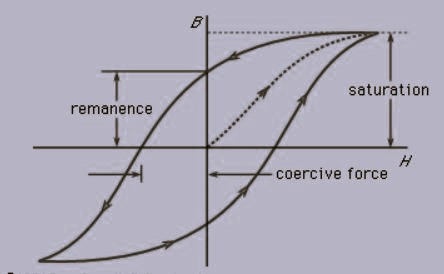
Hysteresis curve, Image credit – Encyclopedia Britannica
This concept of adaptation and becoming more like the other, holds for countries/nations, societies/civilizations and people as well. This is what I personally understand as one of either integration/assimilation or confrontation through adaptation. We see this all through history and in current affairs.
A primary driver that drives adaptation is technology. The use of the internet and all the platforms it has spawned is perhaps the latest tool that is being used to drive narratives. Narratives that are weapons used as potential equalizers whenever there is a considerable disparity in any other conventional weapon, either physical or psychological.
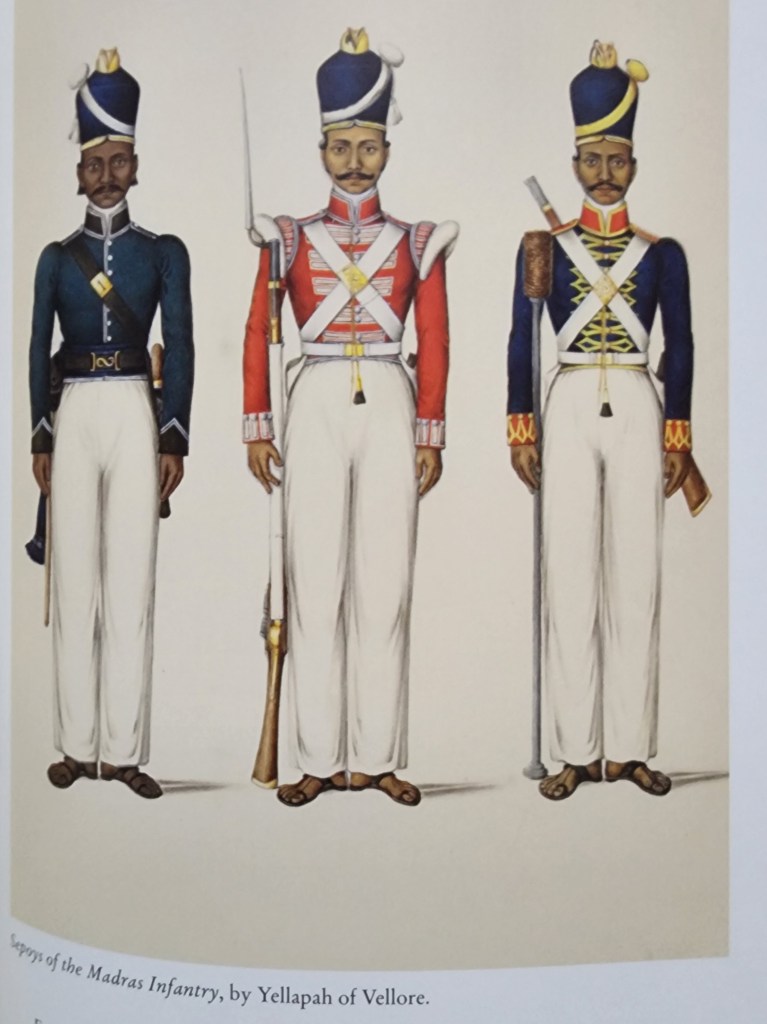
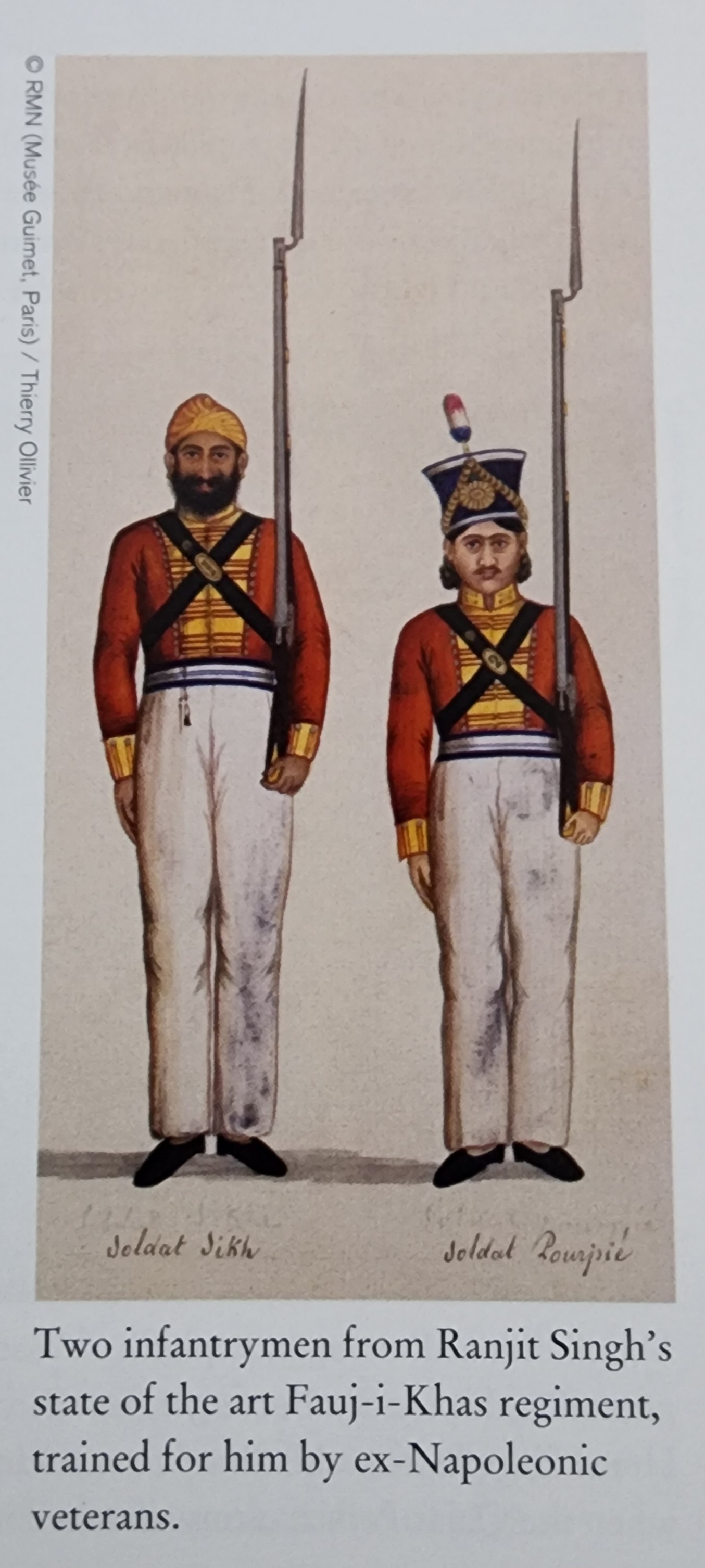
Left – Troops of the Madras Infantry (EIC soldiers), Right – Troops of Maharaja Ranjit Singh’s Fauj-i-khas. Both are modeled on Europeans armies.
Image credits – both images are from the book “Return of a King” by William Dalrymple
Based on my limited knowledge of history, this is something that has happened time and time again. In the 18th century, the East India Company (EIC) used mobile artillery and European military tactics to gain a great advantage over many Indian armies. This was overcome in a couple of decades by the local leaders hiring French military advisors to train their armies in the latest tactics and technologies. This led to the Fauj-i-khas and its guns, of Maharaja Ranjit Singh, the troops of the Holkar and Shinde factions of the Marathas and Tipu Sultan’s army. All of these troops held off the EIC successfully for decades.
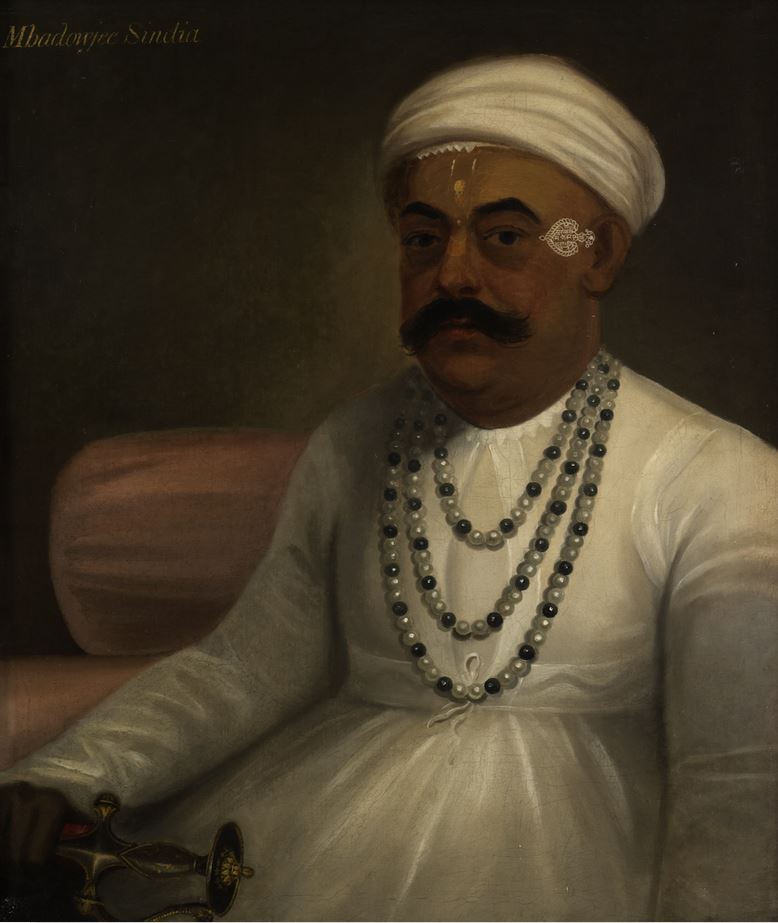
Portrait of Mahadji Shinde (Scindia) by James Wales, Source – Wikipedia
The EIC gained an upper hand with better financial management and the exploitation local rivalries. This was overturned not with better management practices by the Indians. After almost a century of learning from the British, the Indian army turned against the colonial masters and forced their exit. This effort was on two fronts. One which incessantly tried to turn the army against its own masters and the other led by Mahatma Gandhi and the Indian National Congress (INC), which turned civilians against the British and broke the moral superiority the British gave themselves.
So, first, the Indian armies became more like the EIC and other European armies. Later, Indians learned to turn the learning from the British against themselves, which is what the British had used in the first place, popularly called “Divide and Rule”.
Around the dawn of the Common Era, India was invaded by the Greeks, Shakas, Kushans and Pahalavas, and a few centuries later by the Hunas. All of them eventually assimilated into the existing native culture, religion and became locals; some even propagated Indian culture as it existed at the time to Central and East Asia, Persia, all the way to Greece. In other words, the invaders became one with the populace they attacked.
In the second millennium of the Common Era, this changed, when Islamic and Christian invaders tried to make the locals assimilate into their culture. Islamic armies that invaded had superior cavalry due to their origins in Central Asia. Indian forces over time became superior cavalry troops themselves and added guerrilla tactics to eventually break Islamic domination. This is seen in the armies of the Rajputs and the Marathas. Christian forces represented by the EIC and the British were defeated as mentioned earlier. So, the trend holds, one becomes more like the enemy to survive and overcome the same.
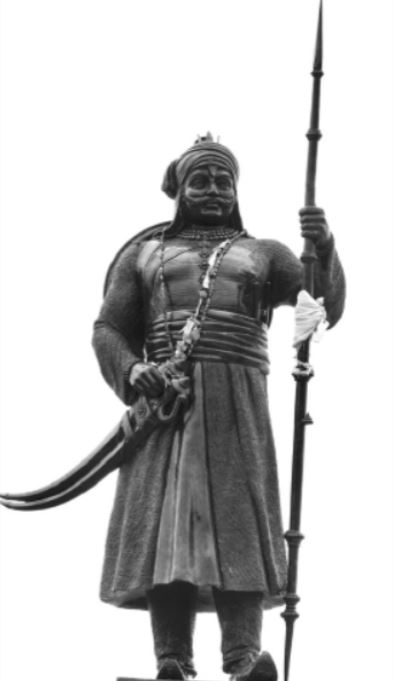

Left – Statue of Maharana Pratap, Image credit – The image is from the book “Maharanas” by Dr. Omendra Ratnu
Right – Statue of Peshwa Baji Rao I in front of the Shaniwar Wada in Pune, Image credit – Wikipedia
Fast forward to the Indian Republic and this pattern continues. The example now truly moves into the realm of narratives. Indian social sciences were taken over in the late 60s and through the 70s by a Leftist strain of thought. This led to the Hindu religion facing a lot of negative coverage the world over due to the narrative set in educational institutions, media and pop culture. This sway was broken with the coming of the internet. People who are not academic historians, from all walks of life, reset the narrative with new research and by digging up the works of historians of the past who were side-lined by the Leftist way of thought.
A Marketing Professor of mine from MBA used to say that one should never leave any subject to just the experts. He used to suggest that HR should never be left to HR professionals, Finance to Finance experts, Engineering to Engineers and so on. While studying Engineering, we had a subject called “Engineering System Design” (ESD). ESD said that while trying to solve an engineering problem one should always have an expert from a different domain. For example have a biologist while trying to solve an engineering problem.
It is this approach that has changed the narrative about the Hindu religion and Indian history over the last 15 odd years. People took narrative building ideas from Social Science professionals, added their own experience from other walks of life and used the internet to circumvent the academic strangle hold of the Leftists. Now, the Leftists and their kind in media are taking to social media to counter this, as television media has been lost to them. How this plays out in the future is yet to be seen.
Another change that is happening is in the way Ahimsa is viewed in India. Ahimsa was considered the ONLY reason for Indian Independence during my school years. This is now changing to show how the Revolutionary movement was as vital a component of the Freedom Struggle as the Ahimsa led movement was. But the Ahimsa fervour added with the negative narrative about Hinduism led to the creation of Caste and Religion based vote banks in the country. This left many feeling dissatisfied and unable to openly air their concerns about the same.
Again, the internet came as a disruption. It gave a new avenue for venting these grievances. It also led to Indians reconnecting with the past beyond Ahimsa, a past of physical conflict and valour. This has made Indians more aggressive and proud as a people. Nothing is without consequences and the fallout of this is yet to be seen. The beneficiaries of the vote bank politics were belligerent for a few decades. But the passive population has become more like them and is showing signs of aggression. In the same vein, those no longer benefiting from the old narrative have taken to the passive protests based on Ahimsa, to achieve a moral high ground. This was seen in the anti-CAA protests and the protests against the Farm Laws, at least until violence undermined both, specifically the anti-CAA protests. So, the pendulum has swung to the other extreme; those that were raised on Ahimsa narratives are now realizing forms of power other than morality, while those who formed a part of the dominant narrative are now taking to the moral capacity of Ahimsa. Again, the opponents have become like one another.
If we consider the current events in India, the Prāna Pratishta of the Rama temple occurred a few days ago. This event is widely seen as a defining moment for Indic or Dharmic or Bharatiya civilization, in a hugely positive light. But there is a sizeable opposition to the focus on the event, especially about the involvement of the Central Government. It is a criticism of the Government for being right wing, and an adherent of “Hindutva”. Hindutva is the political zeitgeist in India as I see it. It has been so since 2014 for sure and maybe since a few years before then.
In an interview on the YouTube channel of “The Wire”, the criticism is very interesting. The Wire is considered a leading “liberal”, “leftist” media outlet. The interview is of Ramachandra Guha, by Karan Thapar. Both Mr. Guha and Mr. Thapar are regular critics of the current Indian Central Government. In the interview, Mr. Guha says that the focus on the Ram temple at Ayodhya is an attempt to convert Hinduism into a congregational religion, which it never was. And this attempt is just to benefit the political party in power.
This criticism is very interesting. It suggests that Hinduism should not change from what it was in the past! Despite Hinduism being in a process of constant change! Hinduism went from being a Yajna based religion with no temples, to a religion (it is way more than a religion, but I am using this word here for simplicity) centred on temples. It also went from a ritualistic one to adding a plethora of philosophies. It has now gone from a religion focused purely on the sub-continent to one looking outward. This change has occurred over the millennia, by its acquiring influences from communities all over the Indian sub-continent. Hinduism has led to Buddhism, maybe Jainism, Sikhism and also consists of the now extinct Charvaka and Ajivija ways of thinking. Hinduism has also been changed by these religions and the several local and tribal faiths that exist in the various parts of India. This aspect of Hinduism is so pervasive that invaders adopted one or more of the Indic systems and changed their names even (look at names of later Kushans, Hunas, Indo-Greeks etc), until the invasion of the practitioners of Islam and Christianity.
So, Mr. Guha bemoans the change in Hinduism (if it really is happening) despite it being a religion of change at all times of its existence! What we can consider is that the Abrahamic religions are congregational religions and if Hinduism adopts congregational aspects that are very pervasive, it might become more like the Abrahamic faiths. This is yet to happen, if it does at all. But if it does, it would be another case of a local religion adopting facets of a faith system that is perhaps a challenge to its existence. A link to the interview I am referring to, is seen in the notes below1.
There are many other conversations happening within Hinduism relating to rediscovering its past and positives, the freedom of its temples, caste segregation and the like. There is no way to say how all of these will result in the evolution of the Dharmic systems in India and abroad. Hinduism is not yet a proselytizing religion, while its offshoot Buddhism is. Will this also change in the future as result of learning from “opponents”? There is no way to know as yet. Narratives always come up against lived experiences and face hurdles there. How the two interact defines the future of both. This is a whole different topic I am not very aware of and hence will not delve into it further.
Now for a view from the other side. Many of the people critical of the current Indian Government used to be superstars of television journalism. Now these channels are seen to be pro-government. A lot of these former superstars are no longer associated with the big media channels. They have all shifted to YouTube and use Instagram quite a bit to put out the “other side of the story”.
It was the political party currently in power that first used social media and internet platforms to reach out to citizens, during a time when the superstars still reigned. But now people supporting and criticizing the government use internet platforms and social media successfully. So, the critics of the government have learnt from and become more like those supporting it! 🙂 Seen in the notes below is an article which highlights the efforts of these critics in a positive light and obviously, goes on share how freedoms and democracy in India under threat. This article also mentions, obviously again, India’s ranking ranking in the World Press Freedom Index. 🙂 A link to this article is seen in the notes below2. I had discussed narratives and such articles, and how they are weapons that act over time in a previous article of mine. A link to this article is also seen in the notes below3.
This change is playing out the world over. We are all citizens of Planet Earth, despite our national, communal, regional and tribal identities. Modern communication means we all have a stake in all that happens everywhere, not just our own states or countries. Also, happenings in far-away parts of the world influence the manner in which we react to local issues. This is a new Chimera we are all dealing with.
The Ukraine war was fought on digital and social media as much as on the financial and actual military fronts, at least in the initial months. Similarly, the current war in Gaza is being fought on social media, television debates, YouTube podcasts and on University campuses. University campuses that are not in Israel or even in West Asia. The fronts and non-combat participants who try to influence these wars with narratives might have no truck in the actual conflict on the ground at all! This is evidence that we are all global citizens, no matter what our identification documents state. It also shows how we are all becoming more like one another, especially if we consider someone an “opponent” or worse still, an “enemy”.
Even in the past, there are examples of this outside India. Native Americans learnt the use of horses and guns very fast when faced with the Europeans. Similarly, Texas Rangers had to learn the ways of the Natives to face the Comanche tribes. In Africa as well, troops of white colonizers in Zimbabwe and South Africa had to learn the ways of the locals to fight their resistance. In Vietnam, the local troops led by the legendary leader Vo Nguyen Giap destroyed the French at Dien Bien Phu, after learning the ways of modern warfare and communism from European colonizers. The examples are endless, enemies learn about and from each other and become like each other. Not the same, never, but a dynamic equilibrium is certainly reached where the two sides are similar enough to force a mitigation of the conflict, unless there is another disruption one of the two sides can exploit.
The world we live in is defined by conflicts, be they military, economic or ideological. Nationalism, Populism v Leftism, Supposed liberalism; Hindutva v Secularism; Immigration v Refugees; Anti-Semitism v Anti Zionism; Islamism v Modernity; Institutional democracy v Electoral/Authoritarian democracy, Israel v Palestine, Ukraine v Russia – the list goes on.
These days, all of these are fought on the narrative level as well. But be they narrative, financial or military, everyone is learning from everyone else all the time, in this super-connected world. And we will likely become more like one another, even if we learn what we consider “bad traits” of each other. This will lead to a lull in the conflicts, until a disruption, mostly technological, comes along, and things will flare up again. This is, at least for now, the way things are. But knowing that we will become more like each other, is that not a cause for hope? Because it means there is something to take away from the interaction with the “other” that we want to add to ourselves, as an improvement, or at least a protective mechanism. Can we use this aspect as means to manage conflicts? Or are we doing it already? Perhaps both. Either way, it is just a prospect for not giving into despair. Maybe the constant in the zeitgeist of every time is polarization, with an undercurrent of adaptation and disruption.
Notes:
* https://mundanebudo.com/2024/01/04/a-myriad-of-methods/
** The Hysteresis curve shows how a force might cause a displacement, but when the force reduces to zero the displacement does not go back to zero. A force in the opposite direction is needed to make that happen.
This is like a disruption causing a change in society, but the removal of that disruption (when it is no longer a disruption and has become normal) does not make society go back to its original state, which is a new normal. A different adaptation will be needed for that to happen. This adaptation will move society in a new direction beyond what was planned and that change needs a new adaptation or disruption to attempt a return to the new normal. But that in turn causes more change, and this goes on and on.
This is like the negative force causing a displacement in the opposite direction beyond the original zero. And the reversal of that causes the curve seen in the image seen earlier.
1 The interview between Mr. Guha and Mr. Thapar – the point about congregational religions is made around the 15 minute mark in the video.
2 https://restofworld.org/2023/india-youtube-journalism/?utm_source=pocket-newtab-en-intl
3 https://mundanebudo.com/2023/10/15/missile-long-range-weapon-narrative-long-time-weapon/
 Mundane Budo