Today is the festival of Holi. International Women’s Day was three weeks ago. The two together, along with martial arts and pop culture are the inspiration for this article. The night before the festival of Holi is considered Holika Dahan. This is the only other “dahan” that I am aware of apart from the Ravan Dahan that happens during the festival of Dasara. A dahan is the burning of an effigy. This could be over a bonfire or by having fireworks stuffed inside the effigy. In both Holika Dahan and Ravan Dahan, the burning of the effigy signifies the destruction of adharmic forces and the victory of Dharma (simplistically translated as victory of good over evil).
Holika is a woman from stories in Hindu tradition. Her burning is nothing like the burning of women at the stake during the witch trial years in Europe and America. This is because Holika was NOT burnt by others in the story. Holika, would be classified as a “villain” by modern day storytelling standards. She was also a formidable woman in her own right. The story related to Holika and Holika Dahan can be considered to be a part of the story of Prahlad and the Narasimha Avatāra of Lord Vishnu.
Holika is also known by the name Simhika. She was the younger sister of Hiranyakashipu and Hiranyāksha. She was the wife of Viprachitti. All of them were Asuras. This means they were the enemies of the Devas. Hiranyakshipu, Hiranyāksha and Holika were the children of Rishi Kashyapa and Diti. Being the children of Diti, they were Daityās (a group within that of the Asuras). Viprachitti, Holika’s husband was a son of RIghi Kashyapa and Danu. Being a son of Danu, he was a Dānava (another group within the superset of the Asuras).
One of Vipirachitti and Holika’s sons was Svarbanu, whose daughter was Prabha. Prabha was the wife of Ayus and the mother of Nahusha. Nahusha once ruled over the Devas when the rightful ruler Indra was weakened and could not be a ruler anymore. Nahusha was also the father of Yayati, to whom both the Yādavas and Kurus (through the Purus) trace their lineage. In this manner, Holika was one of the progenitors of the Chandravamsha (Lunar dynasty) around whom the entire Mahabharata is centred.
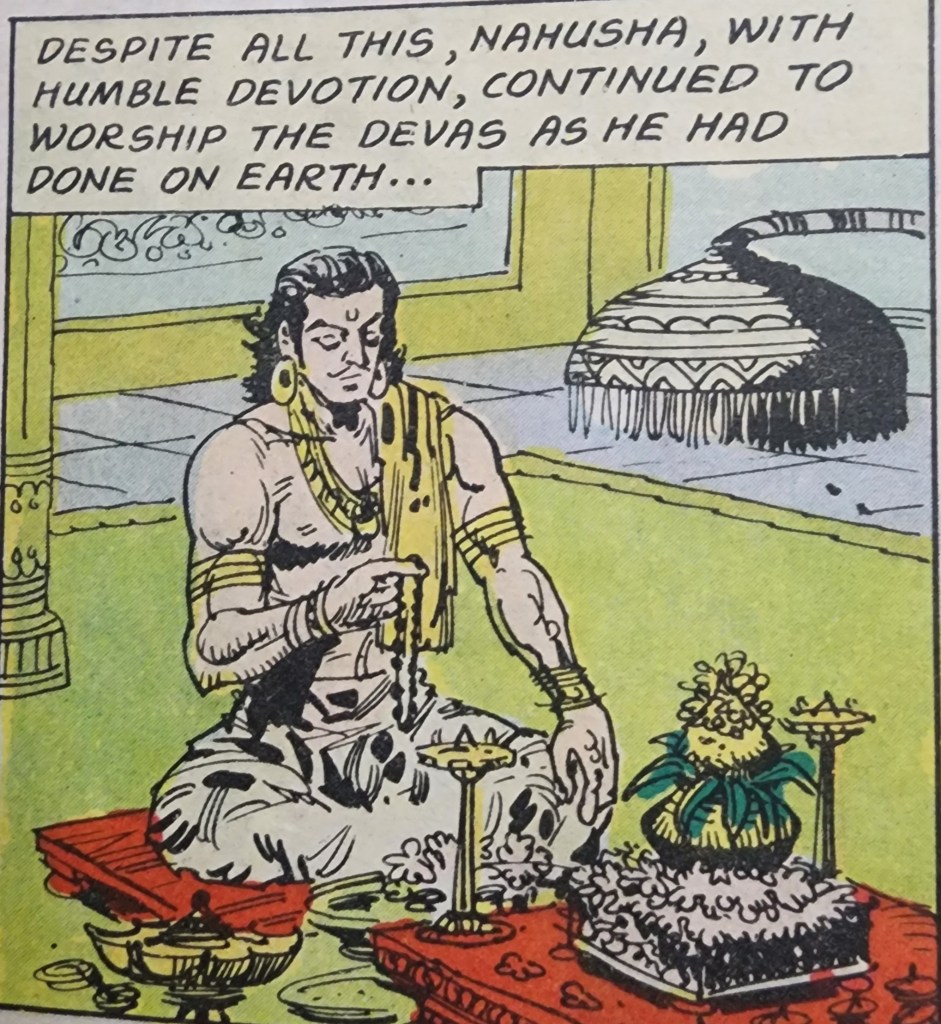
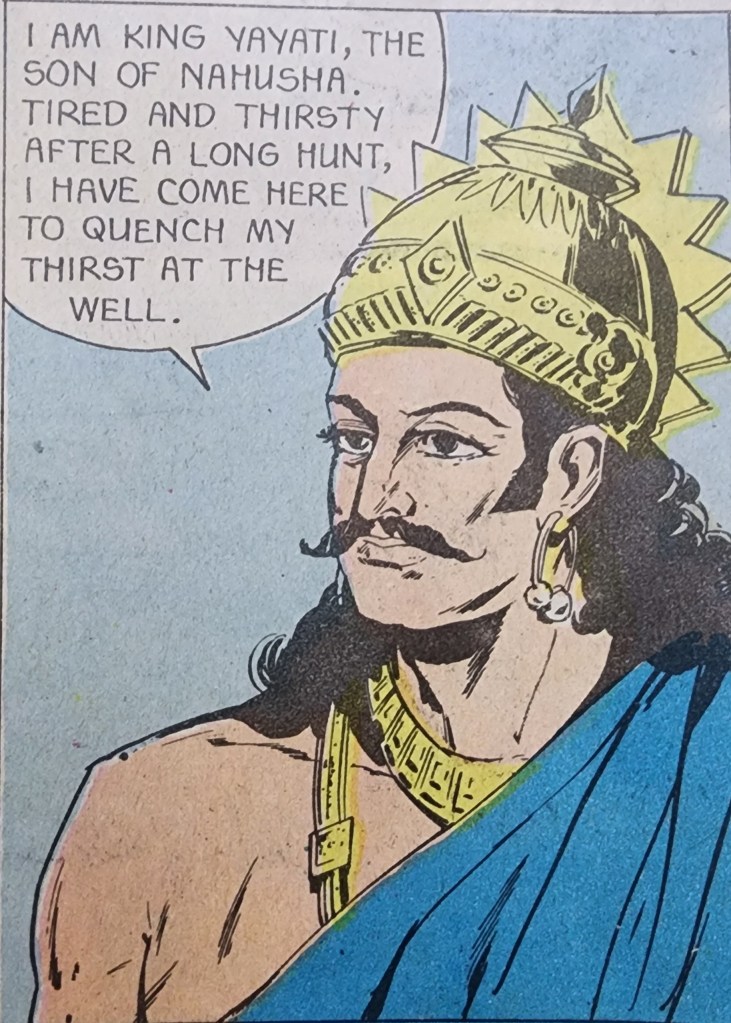
Image credits (L to R) – “Nahusha”, published by Amar Chitra Katha; “Yayati”, published by Amar Chitra Katha
However, Hiranyāksha, Hiranyakashipu, Holika and Vipirachitti would all be classified as villains today. Hiranyāksha was incredibly powerful and tried to drown the world. Lord Vishnu had to incarnate as Lord Varāha to defeat and kill him. Hiranyakashipu was equally powerful and imbued with a boon (vara) by Lord Brahma which made him invincible. Lord Vishnu had to incarnate as Lord Narasimha to kill him. Viprachitti was an incredibly capable Asura king as well. He fought the Devas and was killed by Indra after several battles, in most of which Viprachitti and Svarbanu were victorious. The war in which Viprichitti was killed is called “Dhwajapatta” or the “fall of the flags”. Each of these fights with Hiranyāksha, Hiranyakashipu and Viprachitti is considered one of the 12 wars between the Devas and Asuras.

Image credit – “Dashavatar”, published by Amar Chitra Katha, Kindle edition
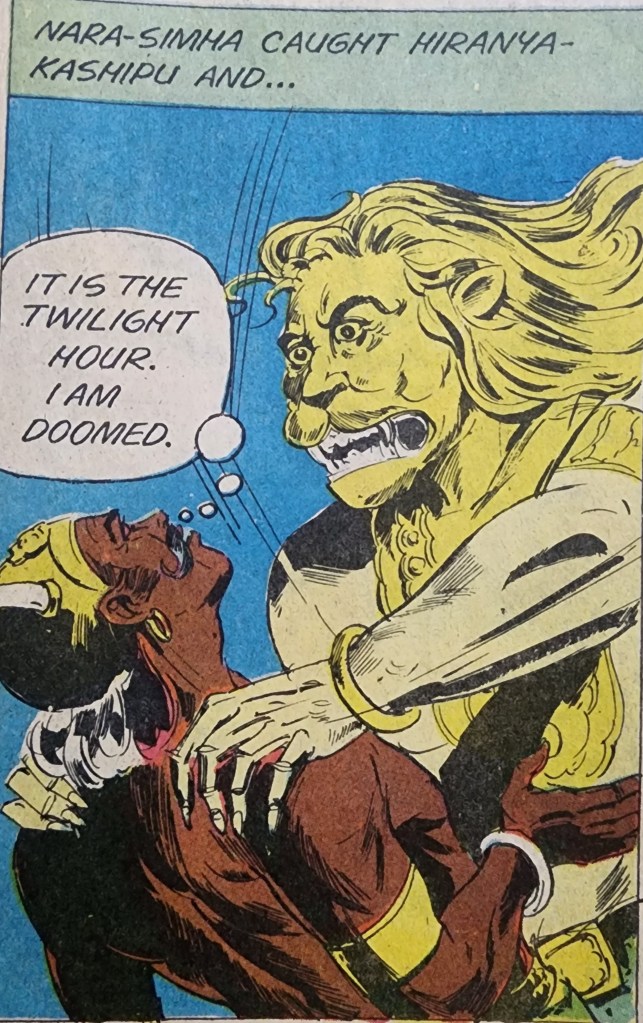
Image credit – “Prahlad”, published by Amar Chitra Katha
The only person in the family of Holika who is a “positive character” is her nephew Prahlad, the son of Hiranyakashipu and Khayādu. He is the main character in the story of the Narasimha Avatāra. This is the story which makes Hoilka a villain and also gives rise to the Holika Dahan.
Prahlad was a great devotee of Lord Vishnu. This was detested by his father, who consequently made several attempts to kill his own son. This was after all attempts at re-education failed. All the attempts on Prahlad’s life failed due to the grace of Lord Vishnu. One of the attempts on Prahlad’s life was by Holika, which also failed.
Holika wanted to help her brother get rid of his son. Holika had the ability to be immune to fire. She would not be burnt even while in a large blaze. So, she sat on a bonfire with young Prahlad on her lap. But her ability failed her. She was burnt to death, while Prahlad survived unharmed. This burning of Holika is what is replicated as Holika Dahan during the festival of Holi. Prahlad eventually became king of the Asuras and was the grandfather of King Bali, who will be the holder of the title of Indra in the next Manvantara. So, the Asuras did overcome the Devas, while the Devas did defeat the attempts of the Asura to overthrow them at that moment. The great conflict, in my opinion, was a draw, with a negotiated settlement (I am not going into my theory regarding this here 😊).

Image credit – Artwork created by Subhashini Selvaraj
How did Holika have immunity to fire? There are two stories that explain this differently. One story says that she had a boon that made her immune to fire. This is similar to her brother Hiranyakashipu having a boon which made him invulnerable to any attack by a human or animal, inside or outside, during the day or at night (he was unkillable for all practical purposes). The other story is that she was granted a scarf or shawl, which, when worn, made her impervious to harm by fire. The garment, either a scarf or a shawl was what she received as a boon.
So, why did she die in the fire and Prahlad survive? The story with just the boon suggests that since she had bad intentions toward the boy who was a devotee of Vishnu, her boon failed her and she died, while the boy was protected by Lord Vishnu. The other story says that there was a gust of wind when the bonfire was lit, which pushed the scarf or shawl onto Prahlad. So, he had the protective garment. Thus, he was protected, while Holika died in the blaze.
Personally, I prefer the story with the protective garment. Boons, once granted, never fail. A loophole has to be found to overcome its protective nature before the person on whom it is bestowed can be defeated. We do not know who Holika obtained the boon from. Nor do we know of any terms and conditions applicable for its functioning. So, to simply assume that her intention, however wrong, to harm a young lad rendered her boon worthless does not fly, in the absence of any other information. Boons are sacred blessings, which are obtained after tremendous efforts and will never fail. To suggest that is simplistic and lazy.
On the other hand, if she received a protective garment against fire in exchange for the effort she put into obtaining the boon, the story makes sense. The garment was the source of the protection and when it was transferred to Prahlad, even if through a chance factor, he would survive and Holika would die. So, I personally think Holika performed tapasya, in exchange for which she received a garment that would protect her from fire. But this garment got transferred to Prahlad, due to which he survived and Holika died in the bonfire.
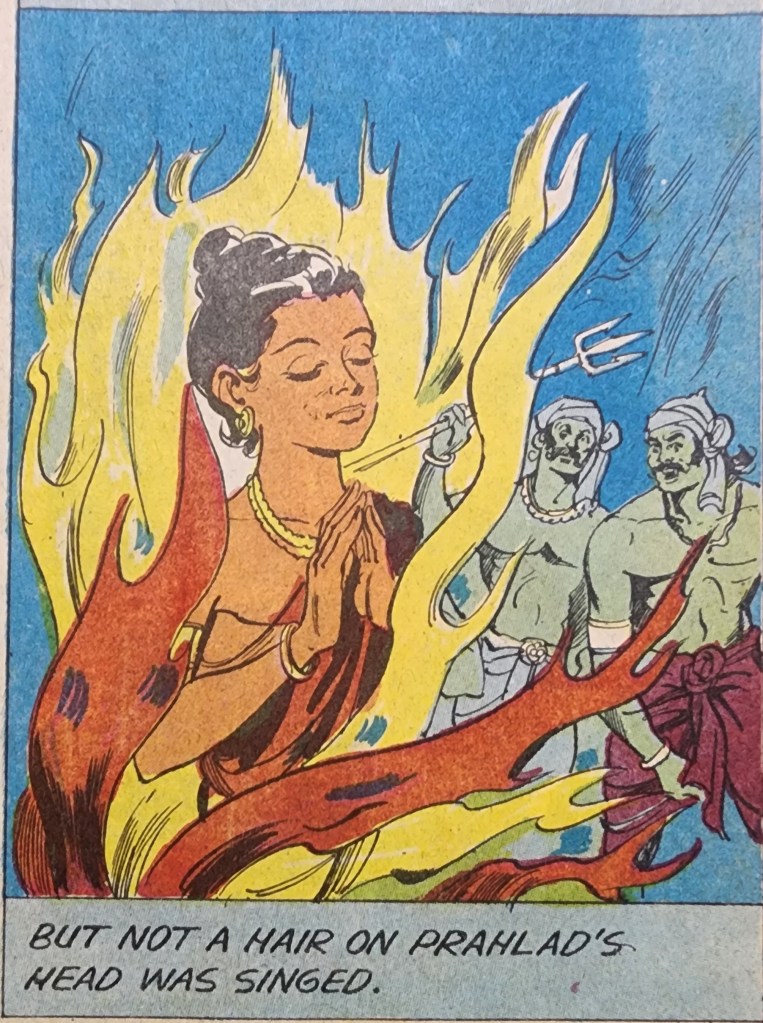
Image credit – “Prahlad”, published by Amar Chitra Katha
From all that we have seen, Holika was an incredible woman. She was a queen, from an illustrious family, which had great consequences both during and after her lifetime. Also, we know she was granted a boon against fire. This fact means she was capable of great effort to achieve a goal, for that is what it takes to achieve a boon.
Now, I will speculate based on the information that we have. I speculate that Holika was also a warrior and that was the reason that she worked towards a boon that gave her protection against fire. I will push this further and offer the following explanation for my assertion.
There have always been Special Forces and spies (undercover agents, saboteurs etc.) in any battle or war around the world, from ancient times to this day. One of the things either of these indulged in was sabotage. Fire was an oft used tool to cause sabotage, like destroying supplies, hurting forces in fortifications and forcing troops into the open. If Holika needed protection from fire, could the reason for this have been to ensure that she was safe when she carried out acts of subversion using fire? If this was the case, would that make her an operative of warfare of a covert nature? And does this not make her a warrior? I would say yes to both of these.
Consider this. Her brothers, son and husband were all involved in fighting the Devas. Lord Vishnu was considered an enemy as he protected the Devas on many occasions. It was a time of warfare all around and the stakes were life or death. In such a situation, a woman from the royal family helping with the war effort is not entirely implausible. So, perhaps she did what she could and specialized in sabotage. This led to her boon. Of course, this does not make her act of trying to kill a young lad in a bonfire any less despicable. Nor does it absolve her of her misdeeds and make her a “good” person. I am only suggesting that while still ending up a villain, she could have been quite a fantastic individual despite the negative traits, ones that she paid for with her life.
If we can accept that Holika was someone who was involved in sabotage and covert warfare and used fire to achieve her aims, this leads to an interesting parallel from Japanese history and pop-culture. This is where the “Kunoichi” come into the picture.
Everyone has heard of “Ninja”. Pop culture, in the form of movies, books and series, either animated or live action, has made the masked, black clad assassin from various eras of Japanese history an incredibly popular mainstay in stories related to martial arts action. Of course, usual consensus is that the Ninja in the cinematic form did not exist historically.
However, Japan was embroiled in warfare for many centuries and these phases of conflict involved special operatives who carried out assassination, espionage and of course sabotage. The individuals who carried out covert warfare could be called “Shinobi”, which, as far as I know, is the correct term for “Ninja”. A female Shinobi is called a Kunoichi, a female Ninja if you will. One can expect a Kunoichi to pretty much be as capable as a Shinobi, their male counterparts, and carry out similar covert activities.
There are many experts who have written about the linguistic and historic aspects of the terms Ninja, Shinobi and Kunoichi. There are also many experts on what the Shinobi really did and what evidence exists in history for specific acts carried out by them. I would recommend that people seek out and read these opinions and books. One book I would suggest is “Ninja: Ancient Shadow Warriors of Japan (The Secret History of Ninjutsu)”, by Dr. Kacem Zhougari*. I am suggesting this book because Dr. Zhougari is a very senior and long-time practitioner of the Bujinkan system of martial arts, which I practice as well. I recall at least one example of Shinobi using fire as a tool from this book.
When it comes to pop-culture like Manga (Japanese comics) and Anime (Japanese animation) there is no dearth of Kunoichi. The Kunoichi from fiction can sometimes have superpowers. Three examples that are top of the mind for me are the anime series “Basilisk” and “Samurai Champloo” and the anime movie “Ninja Scroll”. “Ninja Scroll” has a kunoichi who is a great martial artist, nothing magical, the magic is left to magical beings. In “Samurai Champloo” there is a kunoichi who is blind. She is also a terrific martial artist whose weapon of choice is a modular and hidden naginata. She defeats two great swordsmen in an episode. Most importantly, no one thinks she is a martial artist and hence is a perfect covert operative.
“Basilisk” has a whole host of kunoichi, each of whom has a different super power. Some of them are also experts at seduction, gathering information and in making warriors drop their guard. There are also kunoichi in the super popular “Rurouni Kenshin”, but I cannot recall the details at this time. There are likely many other example which I am unaware of, for I am not a hard-core fan of either Manga or Anime; I am just an admirer of the two media of storytelling.
Irrespective of the greater fictional presence of kunoichi and the somewhat questionable historicity of Shinobi, it is safe to accept that there was definitely participation of women in covert activities during times of conflict in Japan. This of course is not Japan specific, and examples are likely available from many cultures around the world. One example from Indian history that comes to mind for a real life kunoichi is the “Visha Kanya”. These women were perhaps historical. But I have not heard of any evidence that shows beyond any doubt the handiwork of Visha Kanya. The Visha Kanya were supposedly an order of women created under the watch of Acharya Chanakya during the reign of Chandragupta Maurya to further the cause of the empire using amoral and questionable methods. There are also interesting stories of how a Visha Kanya was created. I am not going into the details of those here. Interestingly, Emperor Chandragupta Maurya was also supposed to have had an all-female personal guard.
Considering that the notion of a trained female warrior exists in multiple cultures and that they likely did exist, can we say that Holika would likely be called a Kunoichi? I would say yes, based on the earlier observations. If the assumption that she chose protection against fire so that she can use the same as a weapon in covert activities, would that not make her a covert warrior? If yes, and this is exactly what a kunoichi also specializes in, Holika would likely be considered a Kunoichi in modern stories.
I must clarify one aspect here. When I am referring to a kunoichi, I am referring to women who participate in covert warfare and not in explicit warfare. Women warriors who participated in wars are known from all cultures around the world. If we consider Indian history, we see several examples. A few examples would be Queens Velu Nachiyar, Kittur Chennamma and Lakshmi Bai of Jhansi who fought the British, Rani Abbakka Chowta who fought the Portuguese, Rani Tarabai and Keladi Chennamma who fought Aurangzeb and Rani Rudramadevi who fought the Devagiri Yadavas, to name a few.
If we consider stories from Hindu tradition, we see Tataka, who was killed by Rama early during the events of the Ramayana (Bālakānda). She was an incredibly powerful Rākshasi who was also the mother of Māricha (who played a part in the kidnapping of Sita by Rāvana). She was a very capable fighter who had laid waste to entire cities. Then there is Mashishi, the wife of Mahishāsura. After Mahishāsura was killed in battle by Devi Durga, she performed tapasya in order to avenge her husband. She became a great warrior, who could not be defeated by either Lord Vishnu or Lord Shiva, thanks to her boon. She was eventually defeated and killed by Lord Ayyappa.
The women warriors I have mentioned from the stories and history are warriors, but they are not covert operatives, and hence not kunoichi. There is no information that I am aware of which shows that Holika fought in a conventional war. So, due to her likely participation in special operations, I am suggesting that she can be considered a kunoichi.
One aspect of covert operations is to be able to nudge people into carrying out specific actions to suit the needs of certain individuals or communities. If one can gather information about an individual and understand their behaviour to the point of being able to predict the same, this becomes a weapon. If an operative can, over long durations of time, become a confidante of a person in a position of power, the operative can subtly get the person to carry out actions as she or he chooses fit. If the operative is a he, then it is a shinobi and if it is a she, then it is a kunoichi. This information gathering and guiding of a person to behave as the operative prefers is absolutely covert warfare or a special operation, for it is not open warfare, but definitely subversion.
So, if a woman can bring another person to do things they might not otherwise have, that woman could perhaps be considered a kunoichi. In this context, three examples come to mind, two in a negative context and one in a positive context. The two negative examples are from the Ramayana while the positive one is from the Mahabharata.
Manthara was a maid and confidante of Queen Kaikeyi, wife of King Dasharatha of Kosala. Dasharatha was the father of Lord Rama from another Queen of his, Kausalya. When Dasharatha decided to name Rama the crown prince, Manthara brought the news to Kaikeyi. Kaikeyi was pleased as he had no ill will towards Rama. But Manthara was not pleased. She convinced Kaikeyi with her arguments and communication skill to ask that her own son Bharatha be named crown prince. She even got Kaikeyi to invoke the offer of two boons to get Dasharatha to agree.
Kaikeyi was a warrior in a conventional sense and had been Dasharatha’s charioteer in a fight against Asuras. She had saved his life in battle. So, a grateful Dasharatha offered two boons. Kaikeyi chose to request the same at a future date. Manthara knew this and used the information to not only get Kaikeyi to do things she would not have, but also gave her the means to achieve what would never have been her goals! Manthara, in my opinion, can definitely be considered a kunoichi.
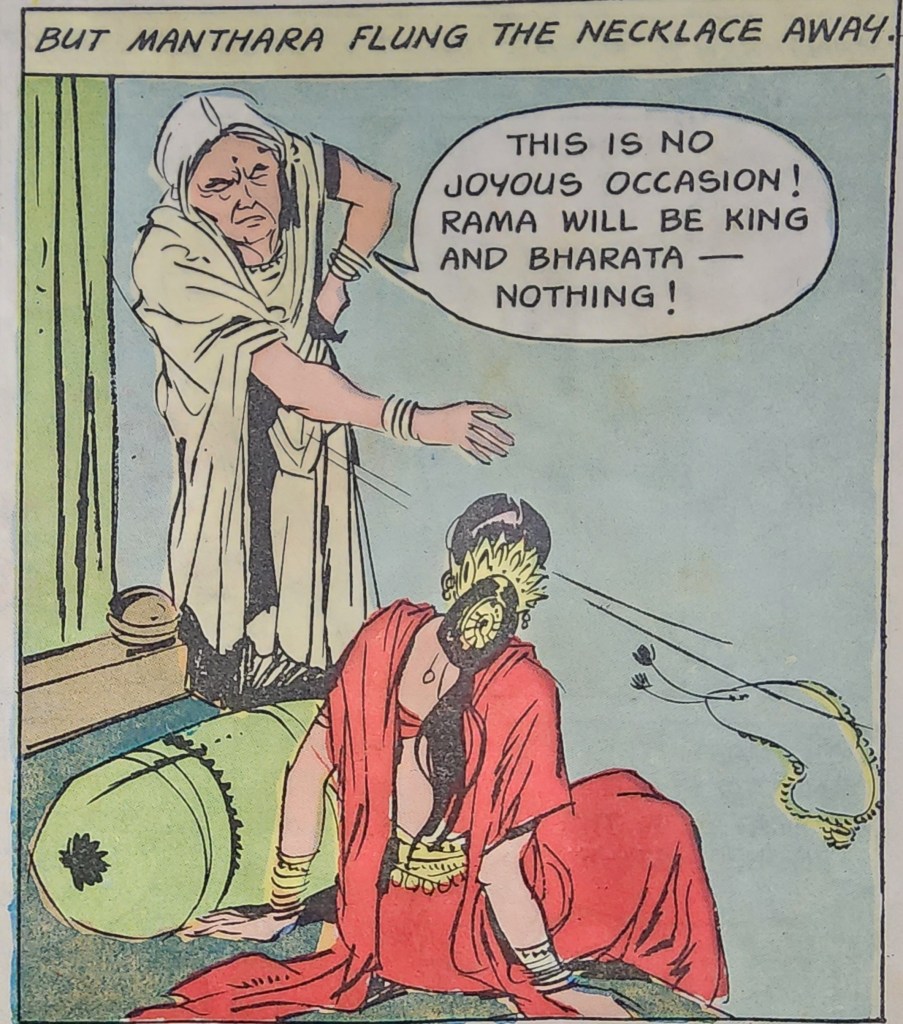
Image credit – “The Ramayana”, published by Amar Chitra Katha
Shoorpanakha was the sister of Rāvana, King of Lanka. When Rama, Lakshmana and Sita were in the forest on exile (Vanavāsa) she was enamoured with Rama and proposed to him. Rama declined saying that he was already married. So, the spurned Shoorpanakha tried to kill Sita and Lakshmana cut off her nose and ears. Shoorpanakha then goes to Rāvana and convinces him to kidnap Sita. She does so by appealing to Rāvana’s pride and ego. She suggests that Sita’s beauty was such that she could only be Rāvana’s wife. She also goes on to suggest that with Sita as his wife he would be ruler of the three worlds. She never considers the kidnapping as a means of revenge for what was done to her. So, with the clever use of words, Shoorpanakha got Rāvana to kidnap Sita, something he had no need to attempt. In doing so, she precipitated the war of the Ramayana, even if that was not her objective. I would think that Shooprpanakha is a kunoichi, for her constant use of her ability to nudge people’s behaviour. She failed with Rama and Lakshmana, but succeeded with Rāvana, perhaps because she had more information about the character of her brother than she did about the nature of the two princes from Ayodhya.
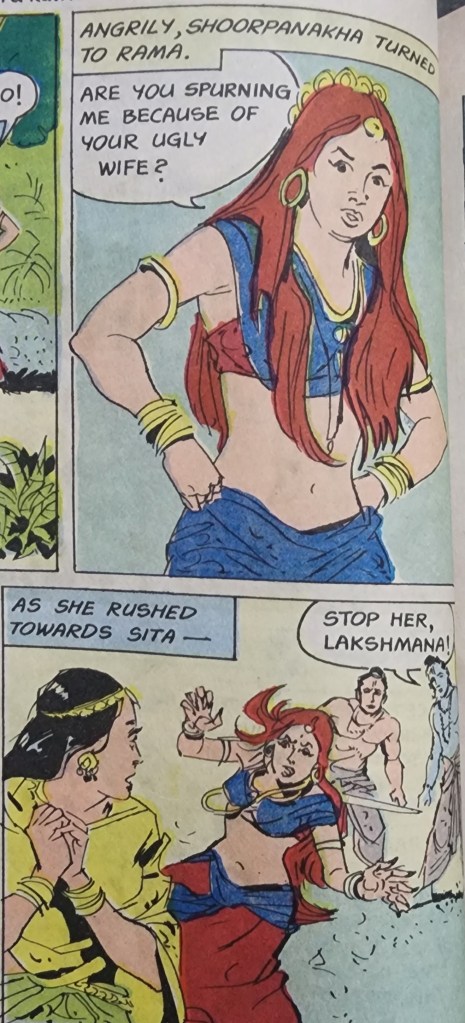
Image credit – “The Ramayana”, published by Amar Chitra Katha
Lastly, we have the positive example. In the Mahabharata, we see the story of Sāvitri and Satyavan. Satyavan is destined to die early. But Sāvitri is determined to save him. When it is Satyavan’s time, Lord Yama himself arrives to free Satyavan’s soul of its body. But Sāvitri follows Lord Yama. When she is asked to turn back, she has a conversation with Yama. She pleases Yama multiple times with her intelligence, knowledge and communication skills. He offers her boons on multiple occasions as a reward for the same. She regains the kingdom and eyesight lost by her in-laws initially. But as the conversation progresses, she gradually gets Lord Yama to offer more boons and eventually asks for the return of her husband’s life. So, with sheer fortitude, communication skills and knowledge, she gets the Lord of Death and Justice to return a soul which was completely against his mandate! I would say that Sāvitri was the greatest kunoichi ever!
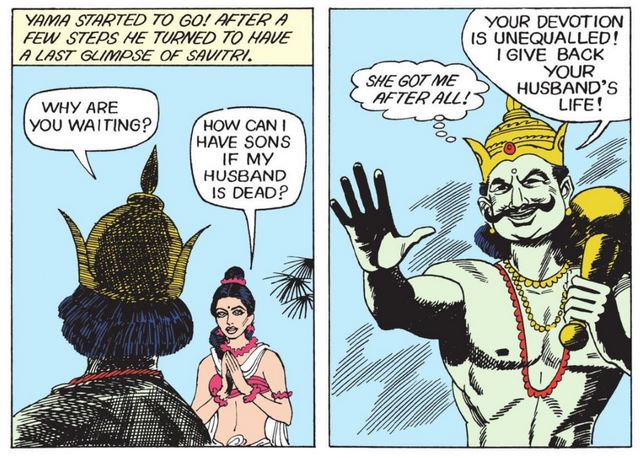
Image credit – “Savitri”, published by Amar Chitra Katha, Kindle edition
Since many of the examples I have shared are of negative characters, I will share what a contributor in the site reactormag.com wrote in her review of the book Kaikeyi by Vaishnavi Patel. The book is supposed to be a feminist retelling of the Ramayana from the perspective of Kaikeyi. She asks why a character must be cast as good and why a villain cannot have story with nuance just based on her or his demands and desires**. This is something I agree with. So, irrespective of whether or not a character in a story is considered bad or not, the traits they exhibit cannot be dismissed. So, if they can be considered kunoichi, we can still respect their abilities, even if not their intentions and actions. And one way to do that is to not dismiss their abilities due to what their lives are remembered for.
That concludes the ideas I wanted to share with this post. It is indeed fortunate to have the festival of Holi in the same month where women’s achievements are being celebrated. Even if a part of the festival is named after a villain whose destruction symbolizes the triumph of Dharma, it perhaps reveals a woman with great achievement and reminds us of the participation of women even in covert activities over millennia.
Notes:
** https://reactormag.com/book-reviews-kaikeyi-by-vaishnavi-patel/
 Mundane Budo