This is my 43rd post. I was going to call this “Post No. 42” but changed it to 43. The post is inspired by the focus on a “42-year cycle” in the Bujinkan in 2014-15. I am a practitioner of the Bujinkan system of martial arts, which is Japanese in origin. The number 42 is also considered unlucky in Japan. So, out of respect to the country of origin of the martial art which has given me so much, I changed it to “43”. “43” is after the end of bad luck, so, “All is well”. 😊 The rest of this post is just some rambling on my part, for fun. I hope readers are entertained; else they can skip this altogether.
Back in 2014 the Soke of the Bujinkan, Sensei Hatsumi Masaaki released a watch to commemorate 42 years since the passing of his teacher, Sensei Takamatsu Toshitsugu. Takamatsu Sensei passed away in 1972 at the age of 84. Hatsumi Sensei was 42 at that time. Also, Hatsumi Sensei turned 84 in 2014 and that marked 42 years since he had started training on his own and had taken over from his teacher as the Soke (inheritor) of the 9 schools of the Bujinkan system of martial arts. ++
So, it was a play on numbers and an important occasion for Hatsumi Sensei. It was important to other practitioners of the Bujinkan as it was important to their Grandmaster. An image of the watch is seen below. It has the number 42 engraved on the back.

However, the number 421 is considered unlucky in Japan as the pronunciation of the same sounds similar to “to die”. I recall that in early 2015, Hatsumi Sensei had created an artwork to signify “a good harvest” as the bad luck of “42” was now past. So, the beginning of the 43rd year was like the start of a new 42-year cycle, apart from just the symbolism of the unlucky 42 being in the past now.
The number 42 brought to mind the short story by Arthur Conan Doyle, called “Lot No. 249”. It was published way back in 1892. The story is set in the University of Oxford. It involves one student reanimating a Mummy and using the same to terrorize people he dislikes. The student acquires the Mummy by purchasing it in an auction. If I recall right, the Mummy was a part of “Lot No. 249” in the auction. I was first acquainted with this story a few years ago, when I heard it on radio as a play, in Hindi, while on a drive. The play was great fun to listen to.

An illustration of “the Mummy” from “Lot No. 249”, by Martin Van Maele. Image source – Wikipedia
The reason the story came to mind is convoluted to say the least. In the number “249” in the title of the story, the first two numerals 2 & 4 form “24”, which is a reversal of “42”. The last two numerals 4 and 9 form “49”, which is also considered an unlucky number in Japan. The pronunciation of the number is supposedly similar to “a painful death”. No wonder the reanimation of the Mummy caused such trouble, it was part of a story whose title references two unlucky numbers! Yes, all this is conjecture and an extreme stretch as far as connections go! 😀
Now, we move on to the next convoluted connection..
In the Bujinkan, we train iteratively. 6 of the 9 schools that make up the Bujinkan have defined forms/techniques. There is the Ten Chi Jin, which is the core of martial art. There are the various weapons to train with. Then there is the collective knowledge of various seniors that practitioners are exposed to. Lastly, there is personal experience from past training. All of these are trained over and over. Considering the large volume of options to train, each of those gets a turn only once in many months. Every time any of these is trained is an iteration.
Every iteration has new insights and revelations coming forth. There is refinement and fresh learning. So, every time we bring a specific school or weapon back to life in the dojo with training, there is an upgrade in the experience and addition to knowledge. This happens over and over. It is something like the Yuga cycle in Hindu tradition. Practitioners go through the same definition of the motion, but the movement that it results in is similar to the last time or the one before that, never the exact same one. This is why it is a martial art*.
This is where the convoluted connection comes forth. In the story from earlier, the Mummy is reanimated multiple times. But nothing good comes of it. There is only misery caused with every iteration of its coming to life, for the people who come in contact with it (no idea what the Mummy itself felt, or if it could feel anything at all). And hence it has to be burnt and destroyed at the end of the story, so that there is no more terror, no more iterations.
This is the exact opposite of the iterative process in the martial arts. Every reanimation of the previously experienced forms is an improvement, a rediscovery, a new series of “aha” epiphanies. So, even though “42” is not lucky, the end of it is the beginning of a new cycle, so seeing the back of it is a good thing. This brings me to the last, very happy, and much more popular reference in pop culture to “42”.
“42” is the answer to “Life, the universe, everything”. This is what Douglas Adams has shown us in the immensely popular novel series “The Hitchhiker’s Guide to the Galaxy”**. In the novel, this is the answer to the ultimate question, provided by the “greatest computer with an exception”, “Deep Thought”. But for the purposes of this article, there is reincarnation, after a fashion, in the Hitchhiker’s Guide as well.
At the beginning of the story, the Earth is destroyed. But in a later part of the story, a new Earth is made available! I cannot recall exactly, but I think it is found in the folds of space and provided by the Dolphins to Humans. This new Earth is a different one from that which was destroyed. In this aspect, it is like training iteratively. We end with up with an understanding of the martial art which is new and slightly different from the one we started with at the beginning of the iteration.

That’s all for the twisted connections. Hope you enjoyed this post. In case you did not, I will end with yet another reference. Just as the title of the post was a reference to Conan Doyle’s “Lot No. 249”, I end with a reference to the message from God as seen in Adams’ “Hitchhiker’s guide to the Galaxy” – Sorry for the inconvenience! 😛
Considering that I am apologizing for the inconvenience, I will conclude for the second time, with one last connection with 42 and Indian laws. In the Indian Penal Code, there is Section 4202. It deals with cheating and deceiving a person and the punishment for the same. Four hundred and twenty is commonly pronounced “four twenty” and this is essentially 42 multiplied by 10. This seems about right, given that it is bad luck times 10! If someone is being deceived, it means that that person is really down on her or his luck! Therefore someone really needs to be sorry for that individual’s inconvenience. 😛
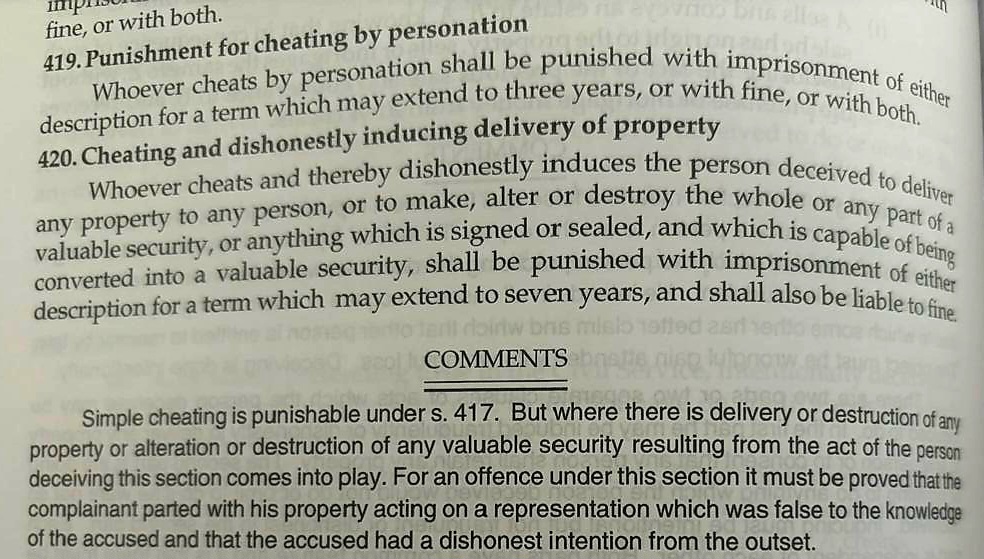
An image of Section 420
Notes:
++ A big thanks to my friend and buyu Santosh Nagasamy for the wonderful conversation where we were trying to relive 2014, 2015 and 2016 in our training while attempting to recall and relive the significance of the 42 year cycle.
1 The term “Shinigami” made popular by the Anime series “Death Note” shows why the number 42 is considered unlucky. “Shinigami”, as I understand it, is made up of 2 words, “Shini” and “Kami”. Kami is similar to “Deva” or “Devata” from Hindu culture. In English, I guess it could only be translated as “God”. Shinigami is thus, “God of Death”. But from the way the character is shown in the series, it is more like the “Yama Doota” in Hindu culture.
“Yama Doota” are those that work for Lord Yama, who is the God of Justice/Death (judgement after death). They are the ones that escort the soul when their time in a physical manifestation is at an end. Lord Yama is also the Guardian of the South.
“Shi” is 4 and “Ni” is 2. So, 4 and 2 like in 42 could be pronounced “Shini”, which is also death. Hence the association with bad luck.
* This definition of the Martial “Art” was discussed in an earlier post of mine, the link to which is seen below.
** It was a radio series before it was a series of novels.
2 Thanks a lot to my friends Sandeep Kumar and Keane Amaral for helping me with details and images of Section 420, and no, they did not cheat me. 😛
Extra note – There is an old Hindi movie called “Shree 420” (1955). The tile is a reference to Section 420 which deals fraud in the Indian Penal Code. The journey of the protagonist in the movie apparently leads him from being a fraudster to a reformed do-gooder. I have not seen this movie and hence have not considered it as one of the connections.
An afterthought – “Luck” and “being lucky” are important factors in the Bujinkan. “42” is unlucky and therefore the end of “year 42” is to be celebrated. It is like entering an era of good luck after one of potential bad luck. It is like coming back to a good life, and that is the same as destroying the reanimating mummy in “Lot No. 249” and putting it to rest, for a good life in the afterlife. 😛
 Mundane Budo