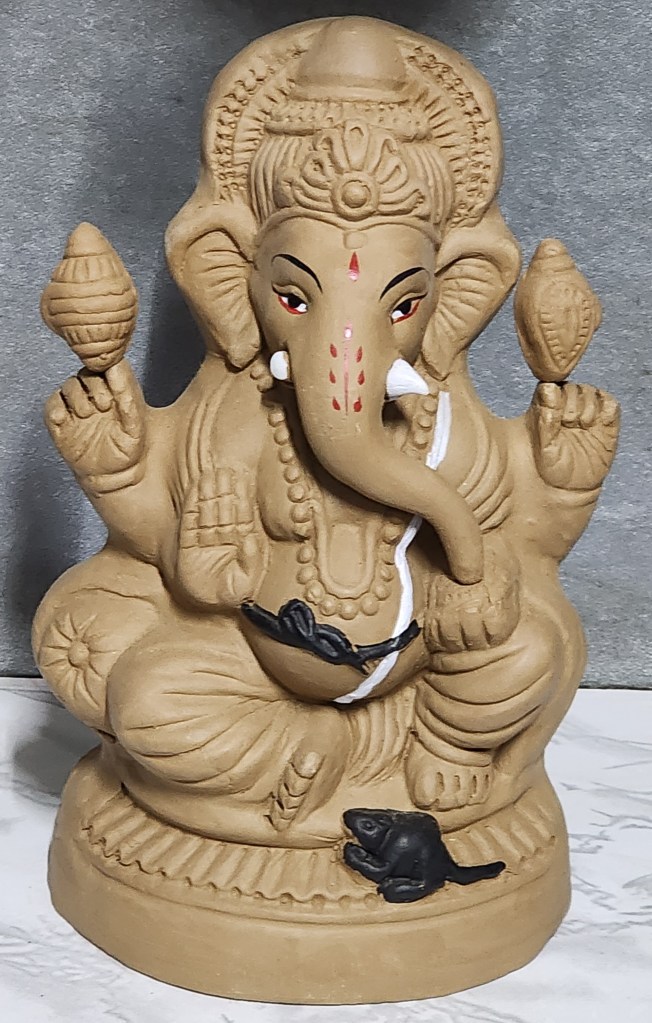
Today is Ganesha Chaturthi. As everyone knows, Lord Ganesha is most commonly referred to as “Vidya Ganapati” and as “Destroyer of Obstacles”. In the first epithet, Lord Ganesha is recognized and celebrated as someone who enables the gaining of knowledge. The titles, Vighneshwara (one who lords over obstacles), Vighnaharta (one who defeats obstacles) and Vighnaraja (one who rules over obstacles) are the ones that lead to “Destroyer of obstacles”. Lord Ganesha or Lord Ganapati is thus extremely important to us, as he is the one who facilitates the gaining of wisdom and the ability to overcome any obstacle on the path to achieving any objective.
Martial Arts, as I understand it, is about 2 things, self-preservation and conflict management. Both aspects require both physical and non-physical abilities. The non-physical abilities include intellectual and emotional abilities. All of these abilities feed into and off each other, and require practice. This is perhaps why Sensei Masaaki Hatsumi of the Bujinkan system of martial arts has said that one of the 5 points that form the essence of budo is to pursue both martial and literary skills. This statement is seen in the preface of the book “Japanese Sword Fighting – Secrets of the Samurai”. The phrase in Japanese for the pursuit of martial (physical) and literary (intellectual) abilities is the very mellifluous “Bun and Bu”. Bun is the literary or intellectual aspect and Bu is the martial/military aspect; Pen and Sword, if you will.
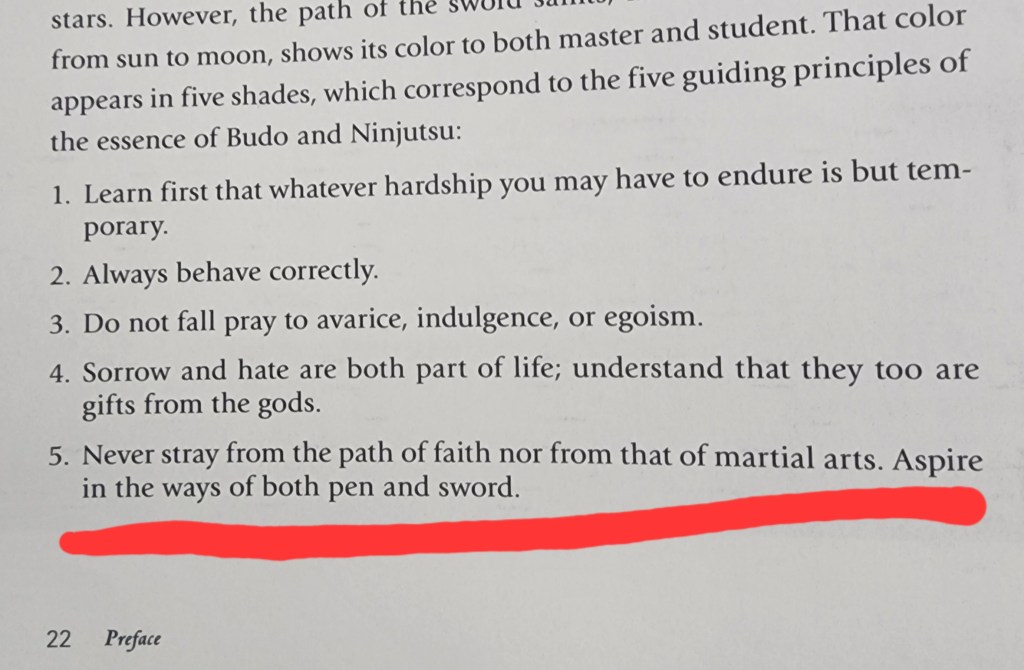
Image credit – “Japanese Sword Fighting – Secrets of the Samurai” by Soke Masaaki Hatsumi
Self-preservation obviously requires physical abilities to be able to move, if nothing else, and some knowledge (leading to experience) of how to be aware or mindful of the situation to survive. Conflict Management might require physical abilities, if the conflict can lead to physical harm, but always requires knowledge and experience of how to deal with the situation at hand and the path to the objective, even if the objective is just to manage said conflict from exacerbating.
In both cases, there is an obstacle, either to physical well-being or to the achievement of an objective. And Lord Ganesha enables both the overcoming of the obstacle(s) and the gaining of knowledge needed to do the same. This is where we see the links between Lord Ganesha and the practice of the martial arts. I shall attempt to describe both with one story respectively.
The most common story of Lord Ganesha’s birth is that Devi Parvati created a statue of a boy from saffron paste and gave life to it. This boy became Lord Ganesha. The circumstances around Lord Ganesha’s birth lead to his battling all the major Gods in Hindu culture. I am not going into the details of the story as it is quite long. But the story is fascinating and I would encourage everyone to read the same. There are comic versions of this story that bring to life the tale in a wonderful manner*.
Lord Ganesha is an incredible warrior from the get go. He can go toe to toe with all the Gods. Young Ganesha can not only fight Gods one on one, but can also take on multiple opponents effortlessly. He fights with a staff and a club and overpowers all who dare come against him. Even his brother, Karthikeya cannot defeat him.
An aside – Lord Karthikeya is usually depicted with a pole weapon, the vel or spear. Lord Ganesha also initially uses a pole weapon, the staff. Further, tile of this article begins with the word “martial”. If one keeps the pronunciation and changes the spelling, we get the word “marshal”, which is a way of referring to “Field Marshal”, the highest military rank, even above General. This is fascinating, as Lord Karthikeya is the commander of the armies of Swarga (loosely translated as Heaven), the abode of the Devas (whose king is Indra). In other words, Lord Kartikeya is Field Marshal of the Deva army. It is “Marshal Kartikeya” and “Martial Ganesha”. 🙂
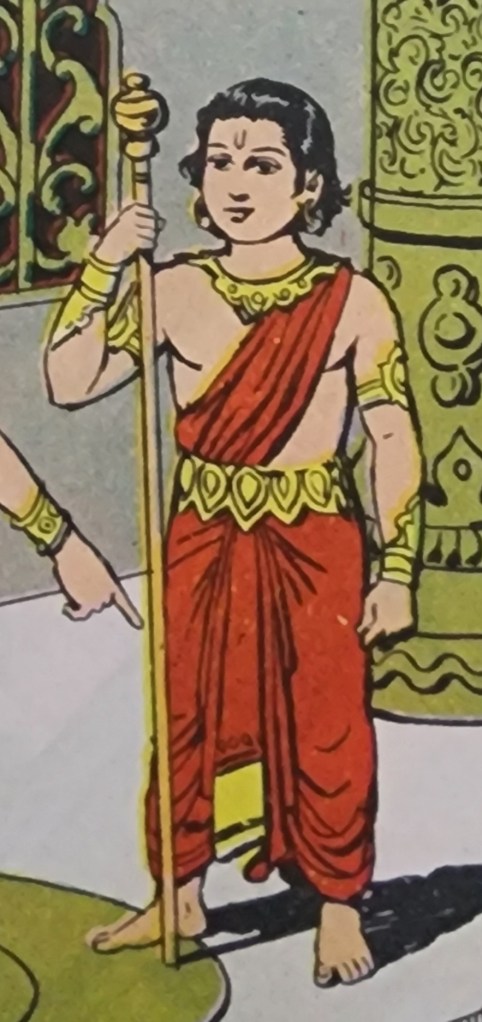
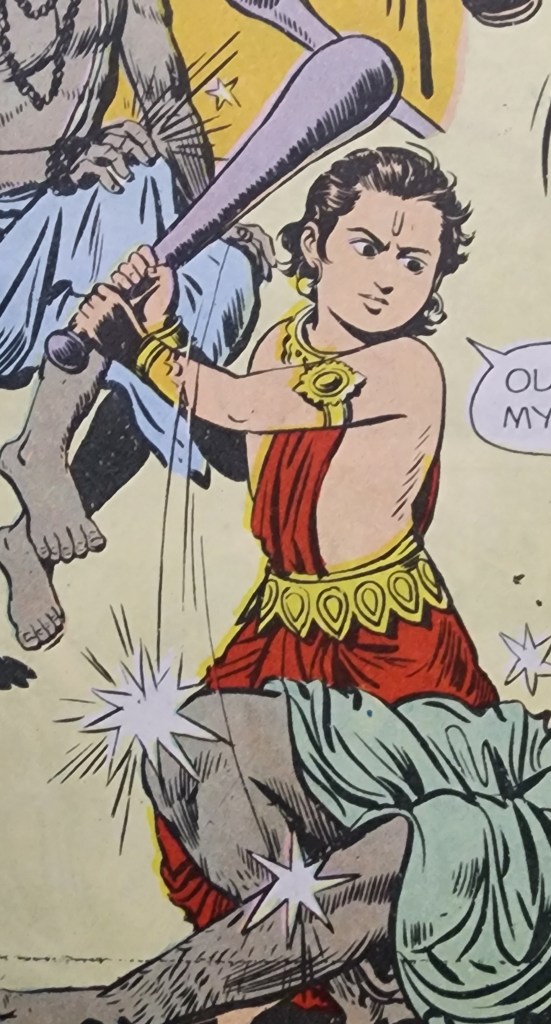
Credit for the images – “Ganesha”, published by Amar Chitra Katha
Young Ganesha is eventually defeated by Lord Shiva and Lord Vishnu by the use of subterfuge. He is beheaded by Lord Shiva during the fight and eventually gets the head of an elephant to gain the form we all know him in. Thus, Lord Ganesha was a warrior, a martial artist of the highest order! He could subdue his opponents without having to kill any of them; the story shows the defeated Gods retreat in the face of a superior opponent.
Another popular story relating to Lord Kartikeya and Lord Ganesha is the one where they compete for a mango. Lord Narada offers a mango to Lord Shiva. Lord Shiva in turn sets up a contest between his two sons, Karthikeya and Ganesha, the winner is to get the mango. The one who traverses all 3 words and returns first will win the mango. Lord Karthikeya sets off on his peacock and believes he can win. Lord Ganesha cannot hope to compete against the peacock on his mouse.
But Lord Ganesha employs wisdom to win the contest. Lord Ganesha declares that his parents signify the 3 worlds and completes a perambulation around his parents. Considering that his parents are Lord Shiva and Devi Parvati, this is literally true in his case! So, Lord Ganesha has traversed the 3 worlds without ever leaving home! He thus wins the mango.
This tale of the mango is the setting for the Tamil movie “Thiruvilayaadal” (1965). I urge everyone to watch between the 11 and 15 minute mark in the link seen below. It depicts the story mentioned above.
These two stories depict the “Bun and Bu”, or physical and intellectual abilities mentioned earlier. In the first case, Lord Ganesha deployed his formidable martial abilities to achieve the objective of defeating the Gods. In the second story, Lord Ganesha employed wisdom to win the mango. The objective was to win a contest. He could not match the physical speed of his brother and his peacock. So, he used wisdom to change the nature of the game and achieve the objective.
In the first case, the obstacle was the physical attack of the Gods and in the second, it was speed of his brother. Both obstacles were overcome, but with entirely different means!
Speaking of weapons – Even though Lord Ganesha as a boy is shown using a staff and a club, the weapon depicted very often in Lord Ganesha’s imagery is the “Ankusha”. The ankusha is the goad used by mahouts to guide elephants. This is perhaps apt. A great beast of immense power is guided by a stick with a hook on it! This requires the knowledge and experience of working with elephants, “vidya” in other words”. The word “ankusha” is also used to denote control (including over the self). The ankusha is also the weapon associated with Vayu, the Lord of the Wind. An image of one form of the ankusha is seen below.

Wish you all a blessed Ganesha Chaturthi!
Notes:
 Mundane Budo
Thanks for this amazing share!
LikeLike
Glad you liked it Yashvin!
LikeLike