
A pesiosaurid. Image credit – “The Animal World – from the Knowledge Quest series by Reader’s Digest”
I visited Lake Vembanad in Kerala some time ago. It is one of the largest lakes in India. It is extremely beautiful and allows for some great cruises. The lake is host to several species of birds which make great subjects for photographs. Considering we have great cameras on mobile phones these days, one can take a lot of snaps, which will not be of professional quality, but make for great memories. Combine this with the image search feature on Google, one can also identify the species of bird or animal photographed, which adds to the entire experience. But the identification is not perfect, and depends on the photograph. Sometimes we would expect that photo is clear enough for an identification, but Google seems to disagree, and the search result is surprising. One such surprising result is what drives this article.
While out the lake, I took a short video of a bird swallowing a fish. I also captured an image. I thought it was a purple heron or a darter (snake bird), but was not certain. To confirm, I used the image search on Google. Aaaaaannddd, Google suggested that the creature in the image was…….wait for it……drumrolls…..
A PLESIOSAUR!!!! 😀 😀 😀
It was like I had discovered the local Loch Ness Monster (Nessie)! The image I used to search and result from Google are seen in the images seen below.


The image on the left was what was used for the search. The search result is seen on the right.
Now look at another image I took of the same bird. It definitely bears a passing resemblance to the famous, and very FAKE, Surgeon’s photograph of Nessie*.



The image on the left is the one used for the search. The image on the right is another image of the same bird. The image is the centre is the famous “Surgeon’s photograph” of Nessie. Image credit for the image in the centre – “Myths, Legends and Folktales – from the Knowledge Quest series by Reader’s Digest”.
Here is a video of the bird, just to confirm that it is not a dinosaur.
This incident goes to show how, even in current times, when we have a surfeit of information and access to the knowledge of the Internet, we are saddled with information that is wrong, glaringly and obviously so. And this with absolutely no intent on anyone’s part of deceit, malice or even mischief. And if this can happen, how often can it be that the information and we have is wrong and we are oblivious to the fact? Now, if there is a deliberate intent to pass misinformation or deceive, how incredibly difficult is it to overcome the wrong knowledge emanating in such a situation? Expand this further and if the knowledge is wrong due to a case of delusion, is there any way to escape at all?
Consider the use of deception and misinformation in the world with the few examples seen below.
- The most expansive example is perhaps Operation Fortitude, the large scale endeavour carried out during World War 2, before the Normandy invasion (Operation Overlord) to hide the actual location of the landing.
- The Indian army used the fear in Pakistani soldiers of being burnt to death in tanks to get them to abandon their armoured vehicles on the western front in the war of 1971.
- Sounds of weapons were used as psychological warfare during the first Gulf War (Kuwait liberation war) to induce Iraqi soldiers to surrender.
- This last example is not historical, but is aitihāsic. In the Mahabharata, Krishna uses a solar eclipse (or magic) to get Jayadratha to reveal himself and be slain by Arjuna.
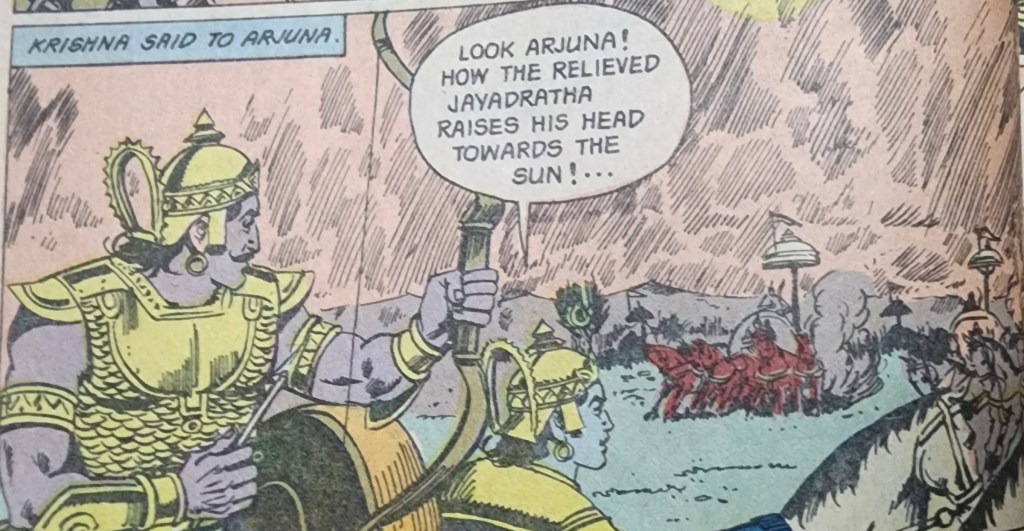

Credit for the 2 images above – “Arjuna fulfills his vow – Mahabharata 35”, published by Amar Chitra Katha
The last example above just goes to show how misinformation has always been used by humans. Could this be an evolution of ambush hunting of animals adapted to attack humans?
Now consider how we look at the use of technology in modern day democracies.
- In India, specifically during the elections, we discuss how there is a “tool kit”, which is a euphemism to suggest that specific organizations (mostly foreign with Indian allies) and foreign deep states are indulging in narrative warfare to affect the development of India and to control its regime.
- In the USA and now in Canada, there is talk of election interference and manipulation by foreign powers.
- National governments are increasingly identifying mechanisms to regulate and control digital and social media as these are the front lines in information manipulation and narrative control, 5th generation warfare, as it is called.
So, there has always been an attempt to achieve superiority through either a denial of information or through the use of misinformation. The counter to this would be to identify misinformation and the acquisition or gathering of authentic information, which might translate to knowledge. Both of these are continuous and incremental processes, not unlike the gradual application of misinformation.
This is perhaps why we have so many festivals in Hindu culture that are attributed to the celebration of knowledge. Consider the previous and coming month. There is a surfeit of opportunities to realize “knowledge is everything”.
- 22nd August, 2024 was World Folklore Day. Folklore, in many cultures, was a means of passing on knowledge, especially with oral traditions.
- 24th August, 2024 was Hayagreeva Jayanthi. Lord Hayagreeva is the incarnation of Lord Vishnu where he is depicted with the head of a horse. Lord Hayagreeva is considered the God of knowledge.
- 26th or 27th August, 2024, was Krishna Janmashtami. Lord Krishna imparted knowledge on several aspects, including through the Bhagavad Gita.
- 5th September is always Teacher’s Day in contemporary India. It is the birthday of former President Dr. S Radhakirhsnan. It is a day to celebrate teachers who impart knowledge.
- 7th September, 2024 was Ganesha Chaturthi. One of the epithets for Lord Ganesha is Vidya Ganapati. Vidya is knowledge.
- 10th October, 2024 will be Sapthami, the 7th day of Dasara. On this day, some communities celebrate Saraswati Pooja. Devi Saraswati is the Goddess of learning.
- 12th October, 2024 will be Navami, the 9th day of Dasara. On this day, apart from Āyudha Pooja, some communities perform pooja of Lord Hayagreeva as well. As mentioned earlier, Lord Hayagreeva is the God of knowledge.
So, knowledge is a key theme in several festivals of Hindu culture. Another aspect of knowledge that is celebrated in Hindu culture is the time and effort that goes into acquiring knowledge. This includes the development of expertise as well.
The time and effort in developing knowledge or expertise goes into training (including studying, practicing, interacting, experiencing etc.). In the Bujinkan system of martial arts, two Japanese terms are used in relation to training. One is Genjitsu and the other is Genjutsu. Genjitsu refers to reality or the actual truth. Genjutsu refers to using illusions or misinformation, mostly to weaken or negatively affect opponents.
Genjutsu however, could be turned inward; it then becomes a delusion. This is a result of training going bad or being in a silo for too long, when one does not realize that the training one is going through is either not of any benefit or actively detrimental to oneself or others. A mentor of mine, Arnaud Cousergue, has written about this in an article which I am linking below+. He refers to some practitioners choosing to only practice what is termed “cosmic stuff” without a firm grounding in hard training and technical aspects.
I had earlier mentioned how folklore is a means of transmitting knowledge in oral traditions. I personally feel urban legends are modern day folklore, but are not designed to transmit any knowledge. Consider the following two examples to illustrate the same.
Around the year 1990, there was a story doing the rounds in Bangalore of “Nāle Bā”. “Nāle” is “tomorrow” and “bā” is “come” in Kannada. The story was that a supernatural entity was going around parts of the city and causing harm to the residents. The entity’s means of gaining entry to a residence was to knock on the door and speak in the voice of a resident. The easiest way to deter this entity was to ask it to “come tomorrow” or “nāle bā”. This could even be achieved by putting up a board at the gate or write on the main door or the compound the same words (in Kannada). There were several homes which had done this.
In 2001, there was the menace of the “Monkey Man” in Delhi. A creature(s) or an individual(s) in the garb of a monkey/ape was attacking people on the streets of Delhi at night. In this case, there were some people who suffered injuries. These varied from serious to minor ones. There were even a few deaths reported due to the “Monkey Man”. But it was never clear if the cause of death was the attack or an accident caused out of fear and panic. There were also suggestions that some of the incidents were misreported. In the case of “Nāle Bā”, I am not aware of any case of real threat or harm of a grievous kind to anyone.
Both of these are urban legends, but did not serve to transmit any knowledge. It was just a story that gripped a city for a short duration. This is analogous to a delusion in training. One reacts to a situation that is not real or believes that the training one is indulging in is very useful, while it really is not.
So, in the world we live in, with deep fakes, fake news and “narrative setting/engineering”, it is extremely difficult to acquire or develop knowledge with real and accurate information. It is a continuous process to develop one’s ability to sense if a piece of information could be fake or partially false. It is exactly like continuous training with an awareness of whether or not it is relevant. It is the development of the ability to spot the Genjitsu and not be overcome by Genjutsu, whether it is delusions or external illusions.
Sensei Masaaki Hatsumi, the soke (inheritor) of the Bujinkan system of martial used to have themes to focus on for every year of training. This was a tradition that lasted from the 90s to the beginning of the pandemic. The theme for the year 2008 was “Menkyo Kaiden”. This phrase from Japanese can be used to illustrate how changes in the way a word is spoken and the spelling is changed can result is vastly different meanings.
Most of the times, “Menkyo Kaiden”, as far as I know, means that a person has received or learned everything a teacher has to offer, and is ready to add to that body of knowledge. One “receives a menkyo kaiden” after she or he has learnt everything a teacher has to transmit and has imbibed the same to the satisfaction of the teacher.
But when theme was mentioned as Menkyo Kaiden in 2008, Hatsumi Sensei, as far I know, wrote the theme in such a way that, while the pronunciation would remain the same, meant “transmitting falsehoods to the mind”. In practice, it meant, “confuse the opponent” or “mess with the opponent by confusing her or him”. This was all about feints and movements that caused the opponent to react in a manner that put her or him at a disadvantage.
This is literally the opposite of the original meaning! In the first case it was about giving all the knowledge possible. In the second, it is all about confusing a person with information and intentions that could be false or true, the truth of which that person is not supposed to be able to discern!
This is similar to another concept called “Kyojitsu tenkan ho”. This means that truth and falsehood are like a revolving door. It could be faking an attack or the intention to attack or the nature of the attack. The attack might be real, or a feint, which could be an opening to something else. This is something that all martial arts and martial sports teach. So, it is commonplace to want the opponent to be unsettled at all times so one can achieve an objective, which could be detrimental to the opponent.
This in itself would be a wonderful elucidation of how one needs to develop an instinct to determine if information received and knowledge gained are correct, relevant and beneficial. This aspect is also taught in the martial arts. Practitioners of the martial arts are expected to, apart from the physical techniques and abilities, also develop their intuition, awareness of situations and mindfulness of the opponent and factors like the surroundings and the atmosphere/environment of a place.
All of these are intangibles that are related to the instinct that is needed to survive a fight, or a conflict in general (like in the office where there is no physical threat). In the Bujinkan, this is taught as “Sakkijutsu” and is very important to develop over years of practice. This roughly leads to a practitioner having “a feel” of the situation, which includes the opponent, the place, the situation and most importantly, the potential for danger. This hopefully leads to either minimal conflict or hopefully the nullification of one, but in either case, the key is to escape/avoid any harm to the self.
This concept is not specific to the Japanese language either. In many Indian vernacular languages, the term for “experience” and “feeling” is the same. The word “anubhava” in Kannada and “anubhav” in Hindi are used to express this. “Anubhava” could mean quantum of experience, or what one is feeling. In the first case, the sentence in Kannada would be, “ninage yeshtu anubhava ide?” which translates to “how much experience do you have?” In the second it would be, “neenu yenu anubahisuttiddiya?” which would translate as “what are you feeling/experiencing?”
The word for expertise is “parinati”. In other words, while expertise is something that is recognized as a consequence of effort over time, the words for experience and feeling are the same, which could mean that an experience is the feeling that one can receive or gather. And when one is able to “get a feel” for anything, easily or nonchalantly, that is a sign of long experience, which is the root of expertise.
In conclusion, in contemporary times, when information is in surplus and easily accessible, knowledge, which is processed information, is not easy to come by, for the veracity of the information is hard to ascertain. With experience, one can perhaps get a feel for the correctness of information, and this skill could be knowledge unto itself.
I recently saw a video on Instagram where Eminem was discussing chemistry like a pro! It was an AI generated video**. If the maker of the video had not mentioned this, one would be left wondering if Eminem is a chemist by profession! But the video certainly “feels” off and anyone who knows of Eminem will check if this video is fake or not.
We recently had a training session with Daishihan Alex Esteve of the Bujinkan. During the class, Alex mentioned that the knowledge of biomechanics is accessible for anyone who needs it these days. But about 200 years ago, the knowledge of the use of biomechanics in martial arts would be a closely guarded secret, for the knowledge of the same was an advantage to the ones who possessed it, and this knowledge was not available to most of the populace. Go back further, by about a thousand years and the knowledge of biomechanics would have seemed mystical knowledge, for the number of people possessing the same would be a handful in any society and the effect of its use on any individual would perhaps be seen as magical.
In the case of the Eminem video I mentioned, the ability or skills to identify the video as AI generated is not commonplace, not all of us can do it. So, it does seem mystical, if someone can nonchalantly identify it, especially if that person does not know who Eminem is. But the regulation of the use of AI is beginning and an option is now provided on platforms to mark something as AI. This is likely to be the beginning of more people developing the skill to identify AI handiwork. So, as more methods to identify AI are developed, those are likely to be kept secret simply for IP reasons. Now this skill or ability is not mystical, but carefully guarded. And perhaps the ability to identify the involvement of AI without being told so will become second nature in the future. Until then, it is good to have a “feel” for something that doesn’t seem quite right, or all real.
As a last word, I will share a link to a video by Praveen Swamy, on the YouTube channel of the media organization, The Print. In the video he discusses how the conflict between cryptographers and cryptanalysts has been going on since millennia. The context in the video is about hiding information, but it is not that different from misinformation and the hiding of authentic information. This conflict between real knowledge and its duplicitous variants is eternal, all one can do is flow through this battle safely.
Notes:
* https://en.wikipedia.org/wiki/Loch_Ness_Monster – Look at the segment on the “Surgeon’s photograph”
+ https://kumablog.org/2014/07/ – The cosmic stuff that is referred to in the article is the belief that training only soft movements against slow attacks has prepared one for a real fight without having undergone rigorous training in the basics and hard training.
** The video was on the Instagram account of “yourchemistrypal.sg”, who had made the video using Parrot AI.
 Mundane Budo