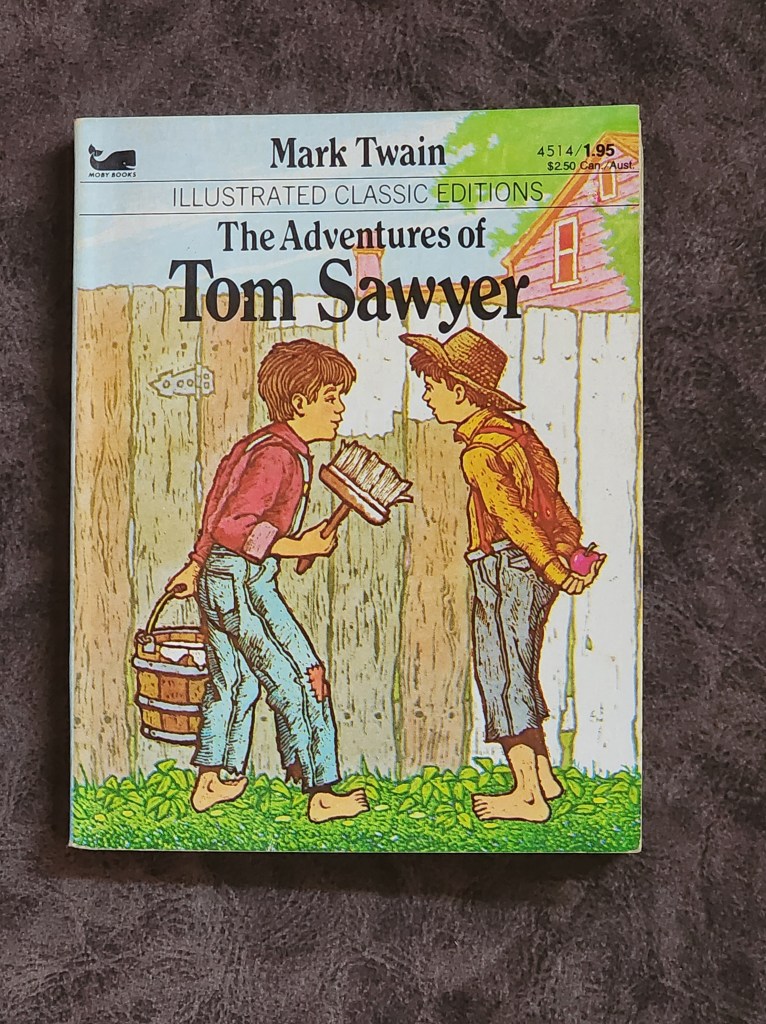
Image credit – “The Adventures of Tom Sawyer” by Mark Twain, Illustrated Classic Edition published by Moby Books
In my community, Deepavali used to be a 5 day festival until electric water boilers and modern plumbing became commonplace. That would mean the 1970s and 1980s and even the 1990s in many Indian cities. One can add modern transportation to the mix here. This is something I have heard from my parents and grandparents.
We all know of Deepavali being a 3 day festival. The first day is Naraka Chaturdashi, the second day is Amavāsya (not a festival, more like connective tissue between 2 festivals) and the third day is Bali Pādyami. This nomenclature and observance of course, is specific to my community. Every community could observe the days of the Deepavali with different festivals. The number of days celebrated as part of Deepavali could also be different among different groups of people. I am just sticking to what I know with respect to my own community.
So, I mentioned 3 days of the festival. What are the other 2 days celebrated as? Also, the 3 days I mentioned are the second, third and fourth days in the five day festival. Naraka Chaturdashi being day 2, Amavāsya day 3 and Bali Pādyami day 4. Day 1, the first day, was celebrated as “Neeru Tumbō Habba”. Day 5, the last day, was celebrated as “Varsha Todaku”. As I understand these two festivals today, they are both “trick festivals”. Let me elucidate further, starting with the “Neeru Tumbō Habba”.
“Neeru” means “water” in Kannada. “Tumbō” means “filling” or “to fill” in the same language. The filling here is like one fills a vessel or a bucket with water. “Habba” means “festival”, again in Kannada. So “Neeru Tumbō Habba” in Kannada means, “Water filling festival”. Now come the questions, why and where should water be filled and why is this “filling” a festival?
Remember that I stated early on that this was a festival at a time before modern plumbing and electric water heaters were common in Indian homes? This is the key to this festival. Naraka Charurdashi celebrations started early in the day. This required everyone to wake up early, bathe (not shower, bathe), dress in new clothes (or at least fresh ones) and be ready for pooja activities or to have fun bursting firecrackers.
Back then, joint families were a lot more common compared to current times. Also, families were larger, with more than 10 people living under the same roof being common. Imagine that all of these people have to bathe and be ready early, all using the same bathroom (again, not shower!). This takes a lot of water! Early bathing also means that hot water for bathing could be desirable.
How was water heated for bathing? In large vessels over a fire, using wood as fuel. This large vessel, in Kannada, was called “Hande” and was made of a metal that was a good conductor of heat, generally a copper alloy. These were not vessels out in the open. A vessel, the “Hande”, was built into a fireplace in the bathroom. This fireplace was kept burning continuously until everyone finished bathing. So, water was filled in the “Hande” every few minutes. People took water needed for bathing, added cold water to achieve a comfortable temperature and went about their business. This process was repeated for everyone in the family. And this meant a lot of water was used.
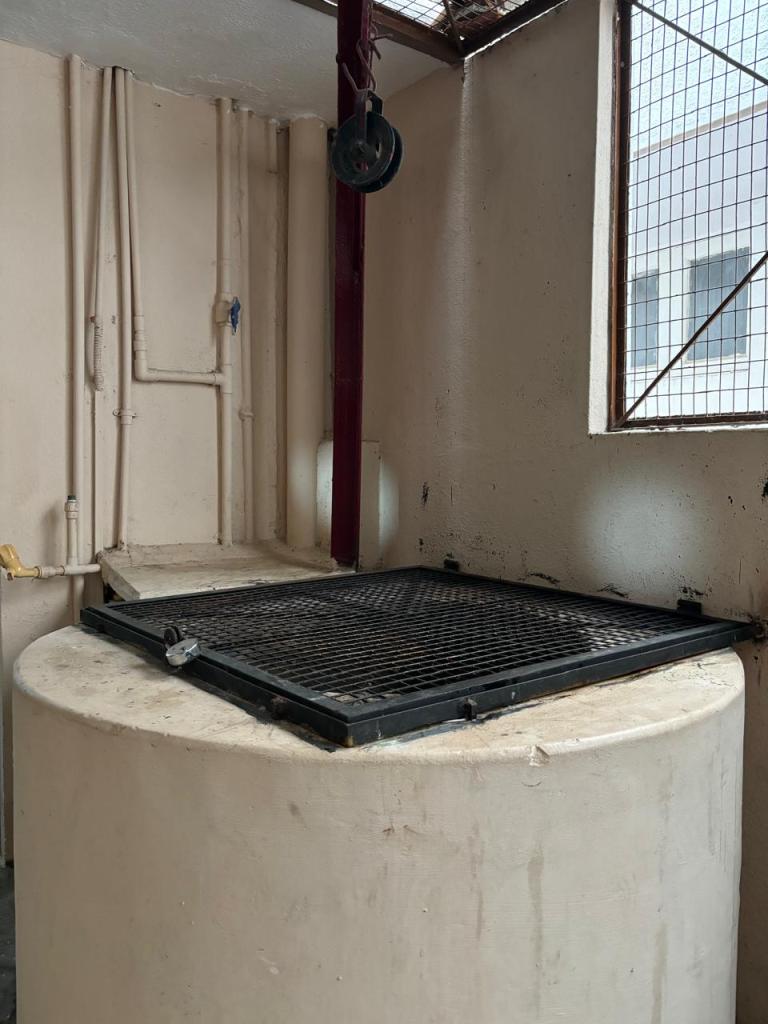
The design of a well from 80s and 90s urban India
Where did all this water come from? It is not from a tap, for modern plumbing was not yet a thing. Water was drawn from a well, usually within the household and used for the bathing. Since many people have to bathe one after the other early in the morning, several buckets and vessels were filled with water ready to be used. And this leads to the origin of the “Water Filling festival”.
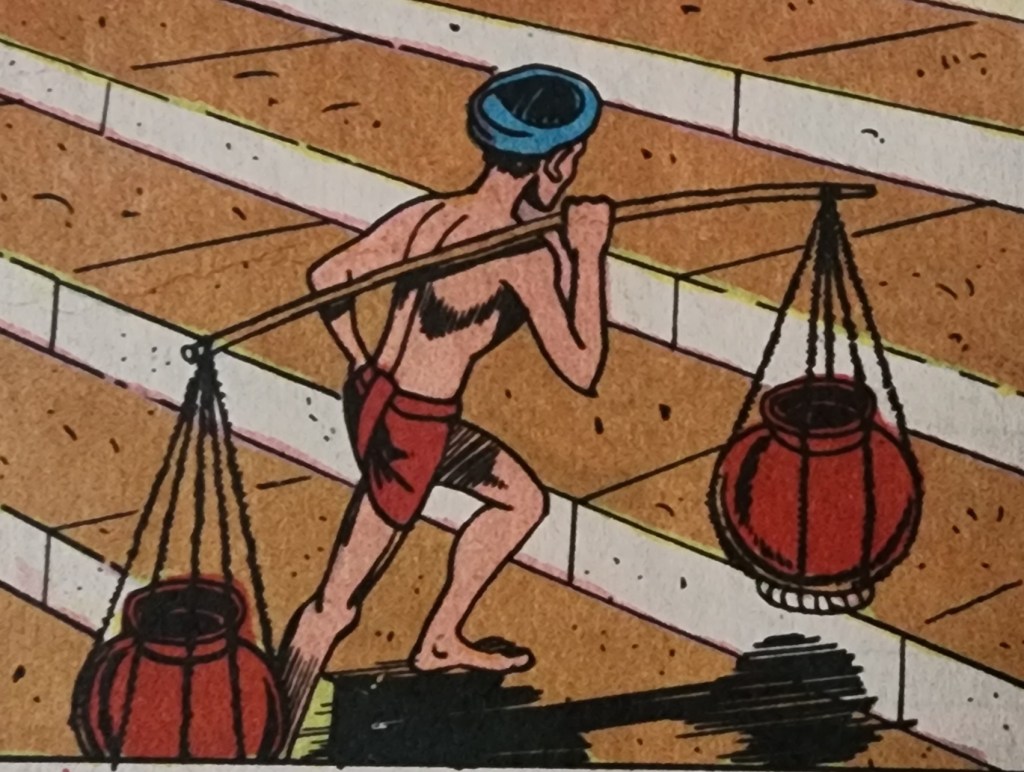
An exaggerated representation of carrying water. Image credit – “The Invaluable Treasure” from “Jataka Tales – Stories of Wisdom”, published by Amar Chitra Katha
Since everyone had to bathe early in the morning, the many vessels (called “koda” in Kannada) and buckets including the “Hande” were filled up with water the previous day or night, for immediate use the next morning. This activity took quite some time and human effort as all the water had to be drawn from a well and moved to the bathroom and wherever else it was stored for use the next day. This activity was common for the entire community and everyone knew what one would be doing on the day before Naraka Chaturdashi. So, it became a festival in its own right! And this is where Tom Sawyer comes into the picture.
“The Adventures of Tom Sawyer” is a very famous novel written by the American novelist Mark Twain (Samuel Langhorne Clemens) in 1876. Tom Sawyer is in his early teens in the novel. At the beginning of the novel, Tom is tasked with whitewashing a fence as punishment, on a beautiful summer day when he should be having fun. Tom is worried that his friends will make fun of him for working when he should be reveling in fun and leisure. But Tom overcomes this problem with ingenuity.
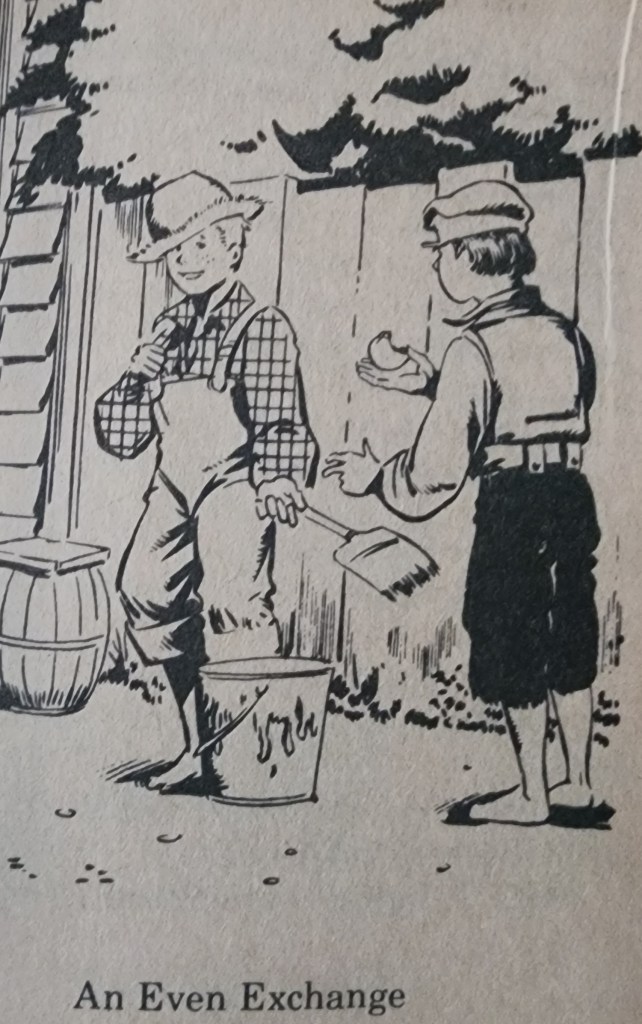
Image credit – “The Adventures of Tom Sawyer” by Mark Twain, Illustrated Classic Edition published by Moby Books
Tom, with clever use of words, convinces his friends that whitewashing the fence is “the thing to be doing”. This leads to his friends wanting to try their hand at the whitewashing. Tom makes them trade him apples and trinkets for the opportunity. In the end, Tom gets his friends to do his chore, makes a profit in trinkets and gets the whitewashing completed well ahead of time! So, he is also left with a large part of the day for fun and games, while he was originally going to spend all of it at whitewashing.
Tom Sawyer made drudgery seem like fun and everyone participated in it enthusiastically! In my opinion, this is exactly what the “Neeru Tumbō Habba” does! Call the chore of drawing and filling water a festival and everyone is enthusiastic about it! Add to this, once it is called a festival, the activity becomes a responsibility and everyone participates in it actively. Naraka Chaturdashi was always the first day of Deepavali, but some clever ancestors of ours added a day “minus one” to the festival and made sure everyone is clean and ready on the first day! Genius indeed. 😀 I am sure Tom Sawyer would flip in approval.

Image credit – “The Adventures of Tom Sawyer” by Mark Twain, Illustrated Classic Edition published by Moby Books
A small aside here. When I was in school, we had a textbook for English called the “Gulmohar English Reader”. These textbooks were used from the first standard to the sixth (I think it would be called “sixth grade” these days). If I recall right, in the Gulmohar textbook for the third standard, the story of Tom Sawyer tricking his friends was a lesson called “Work can be fun” or something like that. If I am wrong about this and anyone recalls differently, please share your information with me.
Now let us have a look at the other festival, the last day of Deepavali, called “Varsha Todaku”. “Varsha” in many Indian languages denotes “year”. “Todaku” in a dialect of Tamil means “continues”. So, “Varsha Todaku” means “The year continues”, in a dialect of Tamil. It is interesting that the first festival “Neeru Tumbō Habba” is in Kannada, while the last festival, “Varsha Todaku”, is named with a word that seems more Tamil than Kannada. This is perhaps because my community originated in what is modern day Tamil Nadu, but have lived for centuries in what is modern day Karnataka, specifically the region that formed the Old Mysore State.
Coming back to the festival, what does “The year continues” mean? How can this be a festival? What is it a celebration of? I do not have clear answers to any of these questions. I have spoken about this to the older members of my family and have no answer that is satisfying to me. I am sharing what I think is the reason for this festival.
Deepavali is an awesome time! It involves holidays filled with visiting and hanging out with family and friends. It involves new clothes, great fun with firecrackers and great food! So, the end of Bali Pādyami leaves one with a heady feeling that one does not want to let go of, and prolong if possible. Back in the early 20th century, would this feeling be more special? Perhaps, I cannot be sure. Either way, getting back to normal life would be hard, or at least leave one with a wistful feeling. Add to this, the cleaning up that might be needed after the celebrations and visitors, a tinge of “I want more” might linger. So, we make the return to normalcy yet another festival!
So, one gradually returns to normal life, starting with cleaning up and maybe a little regular work on the day of “Varsha Todaku”. This is followed by a complete return to normalcy on the next day. Thus, “the year continues”. “Varsha Todaku” then becomes a bridge to come off the festival high and ease back into the routine. If this activity is a festival, it must be important, right? And so must be the letting go of the holidays. This is what I think explains the existence of this festival. Again, if anyone knows differently, please do share what you know with me.
Very few people even in my own family seem to remember or hark back to these two festivals. And Deepavali is now not a 5 day, but a 3 day festival. I feel that this 5 day pattern might not have been followed for very long, maybe a few decades in the first half of the 20th century. If it had been a practice for longer, I opine that its memory would be more prevalent. But I could be wrong here. I request anybody who knows otherwise to please enlighten me.
These days, families are a lot smaller, early starts are not important and hot water is easily made available at all times. So, there is no need to celebrate filling water, “Neeru tumbuvudu”. Similarly, there is so much opportunity to celebrate life these days. There is not even a need to wait for a festival. So, the need of a festival to ease one back to drudgery does not exist. There is no hankering for a festival and hence, no need for a “Varsha Todaku”.
I now have to connect all of the above to the martial arts, for this blog wouldn’t exist without Budo.
Years ago, my teacher shared an anecdote from the Bujinkan. One of the people he was training with, while in Japan, was an ex-paratrooper from France. This person was well built, about 6’3” tall, fit and strong, not to mention a very experienced martial artist. He in turn was training with another individual who was larger than he was. This person was about 6’5” or 6’7” tall. He was as experienced as the paratrooper in the martial arts, specifically the Bujinkan. Most importantly, he was a lot more muscled and in general stronger than the smaller (relatively speaking) individual.
The Bujinkan is not a sport and hence has no weight categories or rules. It is an exploration of real life combat and movement. Due to this and the size difference, the ex-paratrooper had trouble dealing with the larger person in offence and defence. So, he asked one of the senior Japanese teachers, what one can do against opponents that have a considerable physical advantage. The Japanese Sensei is supposed to have said that the way to do this is to make the other, larger person your friend and use his abilities to benefit you, instead of treating the other person as an opponent.
This response is about seeing a problem in a new light, or from a different perspective. Maybe the new perspective will show one how to use the situation which is a problem to one’s own advantage. This is exactly what I think my ancestors did when the festivals of “Neeru Tumbo Habba” and “Varsha Todaku” were added to Deepavali! They changed the perspective and made drudgery fun!

Image credit – “The Adventures of Tom Sawyer” by Mark Twain, Illustrated Classic Edition published by Moby Books
In Hindi, there is a phrase, “aapada mein bhi avasar hai”. It means “there is opportunity in a crisis”. “Aaapada” is crisis and “avasar” is opportunity in Hindi. This is identical in spirit to the English phrase “Never let a crisis go waste”. This phrase usually means that one should use a crisis to make changes for the better. Perhaps these phrases also arise from situations that gave rise to new festivals and the response from our Sensei in the Bujinkan.
Deepavali (also called Diwali) is the celebration of “Light” and the triumph of Dharma over Adharma (very poorly translated as triumph of good over evil). The “light” is almost always associated with knowledge, wisdom and new experiences that help one benefit oneself in life. I guess when we throw “light” on a problem, the change in perspective leads to a solution, which might or might not have anything to do with the problem in the first place.
And finally we have the word “enlightenment”. My teacher once told me that one feels “light” when a weight is dropped. If you are carrying a heavy backpack and you set it down, you feel “enlightened”. By this definition, letting go of an existing or fixed notion is perhaps enlightenment, for the notion was a burden! And the lack of a burden allows a new perspective, which might show the lack of a problem where one previously existed. 🙂
And this perhaps allows for joyous participation in boring chores and the creation of new festivals – opportunities for the celebration of life!
Wish you all a Bright, Blessed Deepavali!

 Mundane Budo