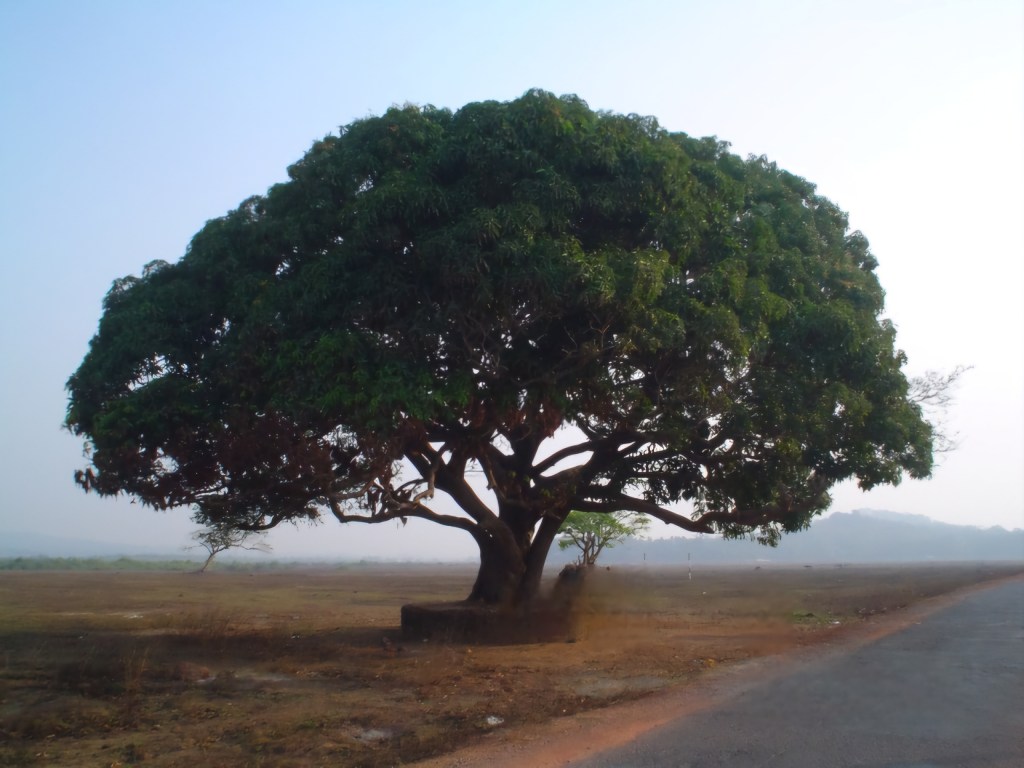
A majestic mango tree in Diwar Island, Goa
In martial arts around the world, wood is used a lot for practice weapons. These days weapons made of various polymers like nylon and polypropylene have started to replace wood as the material of choice for practice weapons. But this is not ubiquitous yet. In India, we almost never get training weapons made of anything but wood. It is too expensive due to a lack of demand. Polymer weapons need to be imported, again resulting in great costs. So, wood it is for us for now.
Recently we had a batch of wooden training weapons made and that is where the idea for this article came from. Wood comes from trees. And trees and plants have always played a major role in cultures all over the world from times immemorial, as weapons of both offence and defence. Trees are present in modern day speculative fiction, everyday news and in daily conversations as well. But I have never heard of a “Way of the Tree”.
Let us consider the presence of trees in stories from our tradition, myths from extinct religions, pop culture and modern day conversations.
- One the most popular fantasy series of recent times is “The Wheel of Time” written by Robert Jordan and later by Brandon Sanderson. In the series there is a community of nomadic people called “The Traveling people” or “Tuatha’an”. This community follows what is called the “The Way of the Leaf”. It is a completely pacifistic way of living with absolutely no violence at all. This people reminds me of some Jain groups in India, who also follow a way living which abhors violence of all sorts.
- An opposite of “The Wheel of Time” is “A Song of Ice & Fire” written by George R R Martin. In this series there is a kind of tree called a Weirwood. This tree is partially magic and has human faces carved into it. These trees might have a hive mind and also accept sacrifices, including human sacrifices!
- Who can forget the Huorns and Ents in the Lord of the Rings! The Huorns are literally trees that move! In numbers, they are a forest that moves like an army. And the Ents are called shepherds of the forest, though in my opinion, they are like Generals to the Huorns.
- In Norse mythology, mistletoe is a weapon. It is used to kill the God Baldur.
- The plant Sanjeevini is used as a medicine in the Ramayana, to save Lakshmana from a weapon deployed by Indrajit (Meghanath), the son of Ravana.
- Plant and tree produce are used for healthcare in India, as seen in the ancient Indian science of Ayurveda.
- There are Gods for wine-making in many cultures. In old Vedic rituals, sacred Soma or Somarasa, which is believed to be an intoxicating drink made from a plant, is used.
I am a Hindu, and trees are all over our culture. We celebrated the festival of Dasara (Dussehra) a few weeks ago. On the last day (10th day) of the Dasara festival, which is Vijayadashami, a tree takes centre stage. The Banni or Shami tree is worshipped on this day. “Banni Mara” is the name in Kannada and “Shami Vruksh” is the name in Hindi. Both of these supposedly refer to Prosopis Cineraria.
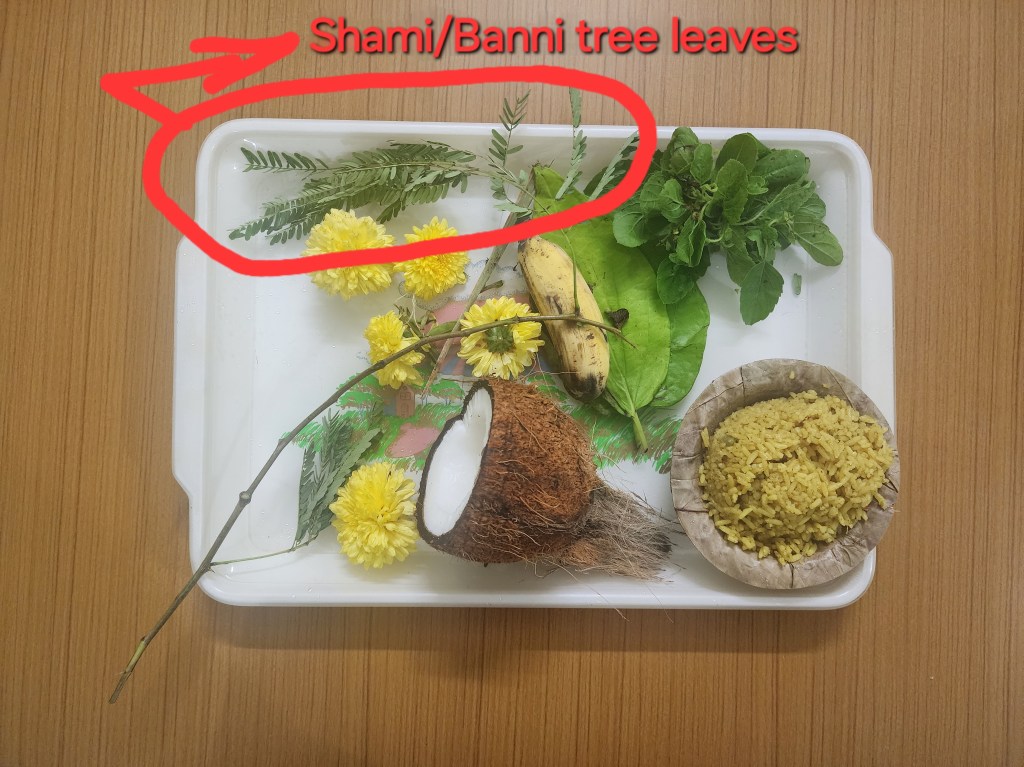
Shami/Banni leaves given as “prasada” after a pooja on the occasion of Vijayadashami
In a lot of folklore in India, ghosts are associated with the Banyan tree. On the positive side, trees are worshipped during marriage ceremonies by some communities. The Peepal tree, called the “Ashwath Mara” in Kannada receives prayers by womenfolk during a marriage ceremony. Of course, the Buddha is supposed to have achieved enlightenment under a Peepal tree. This specific tree was called the Bodhi tree.
Social gatherings under Peepal trees were important for local discussions in India and hence the place under the tree was called a “Katte”, which is the Kannada word for a platform where people can sit and discuss. This was specifically called the “Ashwath Katte” or the “Peepal Platform”! Literally a platform for people under the Peepal! Sandalwood is used to make a paste, called “Chandana” and is offered to Gods. This is also applied on the neck of devotees after the offering, as a blessing from the Gods.
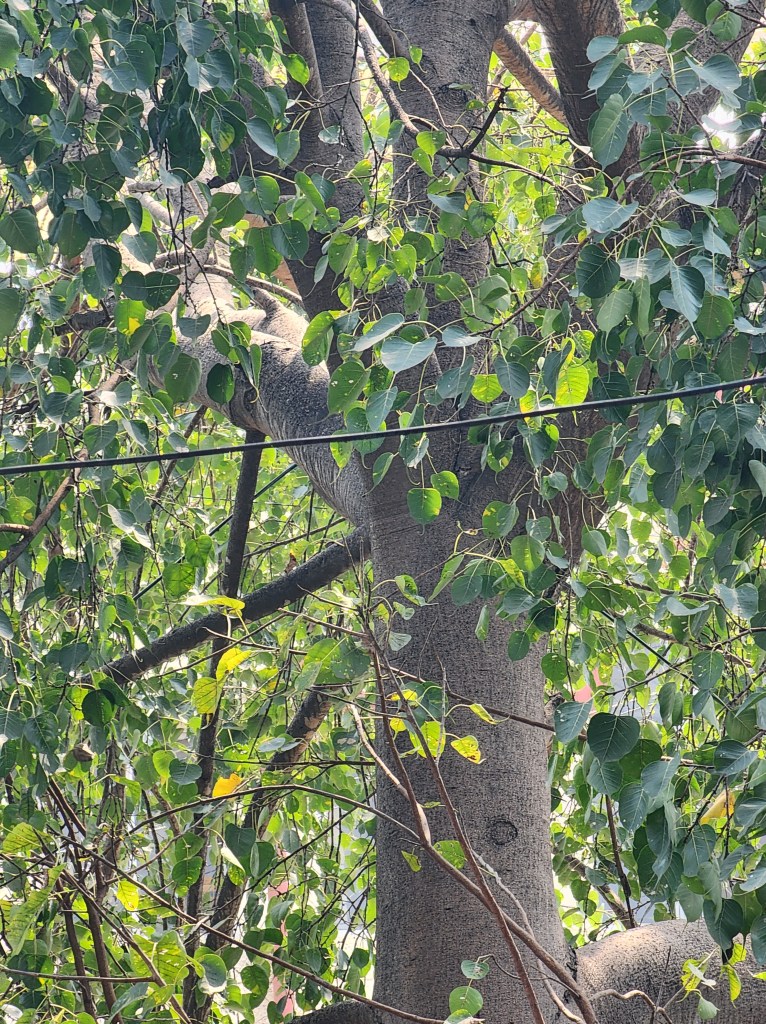
A Peepal tree
If we consider martial aspects, we can go back to the Ramayana. The bow used by Lord Rama was called the “Kodanda”. I have heard that a bow made of bamboo was called “Kodanda”. The bow of Rama was supposed to have three curves, in other words, it was a recurve bow made of bamboo. Just to expand on this point, consider the bow of Lord Vishnu. It is called the “Shāranga”. “Shāranga” is supposed to mean “horn”. So, the bow of Vishnu was made of animal horns. So, does that mean that Vishnu used a composite bow? I am not sure. I am basing this on the fact that when horn is used a material for a bow, it is usually a composite bow where sinew, glue and other materials are used to make the bow.
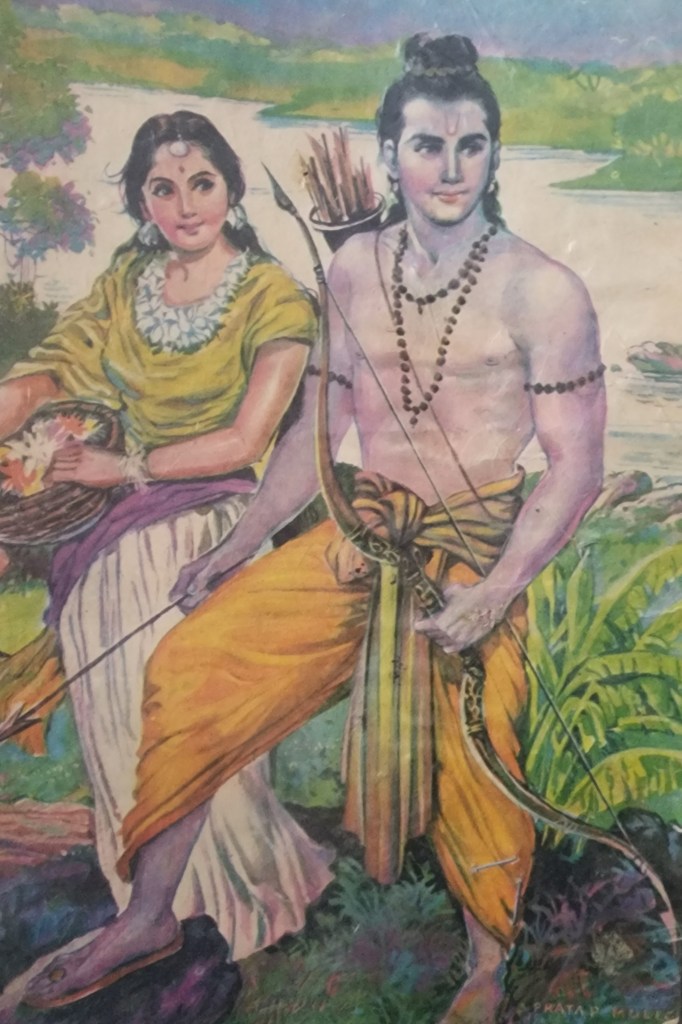
Representative image of Lord Rama with his bow, “Kodanda”. Image credit – “The Ramayana” published by Amar Chitra Katha.
There is a martial art with its origins in the modern day state of Tamil Nadu, called “Silambam”. The main weapon used in Silambam is a staff made of bamboo or rattan. I have seen it said that Silambam literally means “a staff of bamboo” or a “staff from the hills” which again refers to bamboo. And if the staff is not made of bamboo, it is made of a wood from different trees. There is a martial art called “Lathi Khela”, which focuses specifically on fighting with a staff. This martial art is famous all over the country.
Staff fighting is present in multiple martial art forms originating in India. Even as late as the 19th and early 20th century, the staff was the weapon of the enforcers employed by Landlords or Zamindars. These Zamindars used the enforcers for rent seeking and are considered “villains” in contemporary thinking. The staff is called a “Lathi” and the people who used the staff were called “Lathaith”.
Of course, staff fighting is popular all over the world. From the knobkerrie or rungu used in parts of Africa to the shillelagh in Ireland to the bo in Japan, staffs of various lengths are used in fighting all the time. Robin Hood fighting Little John is a popular story and in modern fantasy there is Matrim Couthon in the Wheel of Time series, who can defeat swordsmen with a quarterstaff.
If we consider defensive weaponry, armour made of fabric, like layers of cotton and the billowing cape used by Japanese cavalrymen to protect against a single arrow are well known examples. A cloth turban to protect the head was present in historical India. Another form of protection is the shield. Shields made of wicker were present in historical China while wooden parrying sticks were used in parts of Africa.
We can even use trees in a metaphorical or philosophical sense to expound on martial concepts.
Training the martial arts is a long term activity. It takes years of training to achieve mastery over the forms. It takes even longer to develop the expertise needed to share the knowledge / experience / wisdom gained. It requires commitment and passion for the art form. Conviction is also needed in the benefits of practice of the martial art to motivate an individual to keep at it.
This is not unlike the life of a tree. A tree takes years to grow, especially the large trees, which create a sense of awe in anyone who beholds them. Some trees live for over a thousand years! They grow from a seed or kernel or acorn into a sapling into a small tree into a giant of epic proportions. A great tree is a treasure because of the sheer time it has taken to get there, which could be centuries if not years! This is not unlike the time taken to master the martial arts, scaled down to a human lifetime of course.
Also consider the numbers game in the martial arts and trees in their early life. A very small fraction of all the students who start training reach the higher levels of any martial art. I am not sure if anyone has carried out a study on this, but a popular saying in the dojo I train with, is that less than 1% of all the students who walk into the dojo last for 10 years. Consider the trees now. How many seeds or saplings survive to grow into the giants we see? It is supposed to be a small fraction again, especially in the tropics where the evergreen forests cut-off most of the sunlight from ever reaching the ground. The fight for light space for a sapling on the forest floor in the tropics is same as the effort it takes a student to make time to practice the martial arts.
Another way of looking at this is the manner in which a forest, through its trees, reclaims land which was inhabited by humans for ages, even with monumental construction. There is the famous photo of the ruins in Cambodia, where the tree has literally taken over what was formerly a human dwelling. This is like sustained siege warfare, that is never let up! The trees are always there, surviving, waiting for an opening to take back what was likely lands they once occupied.
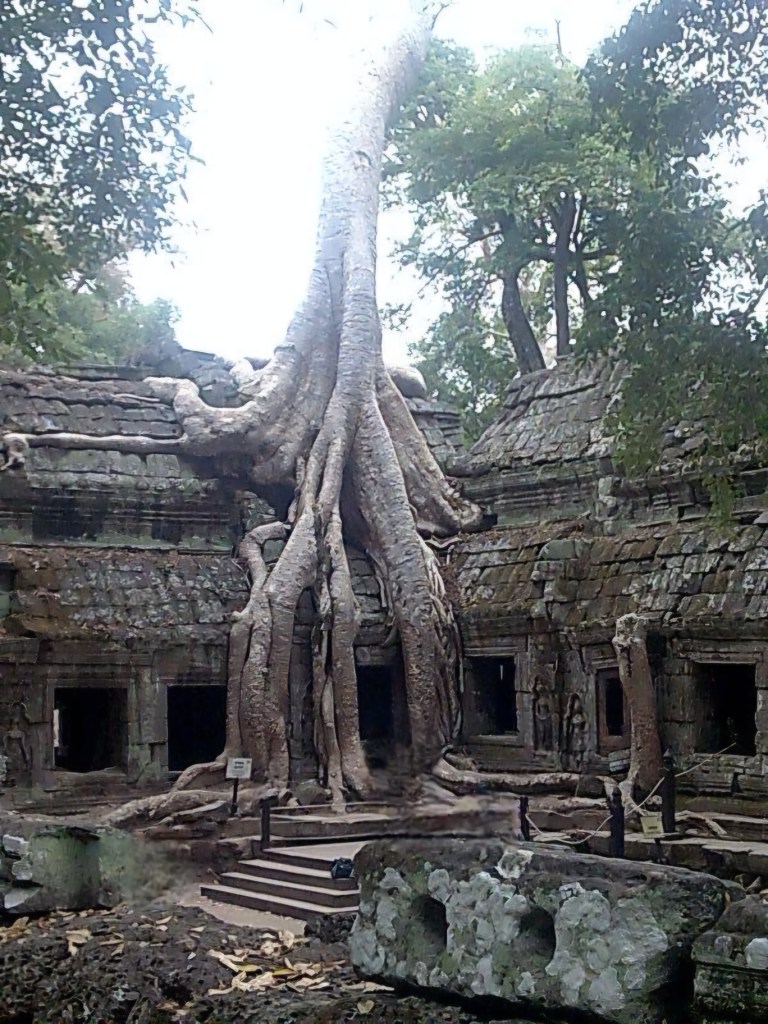
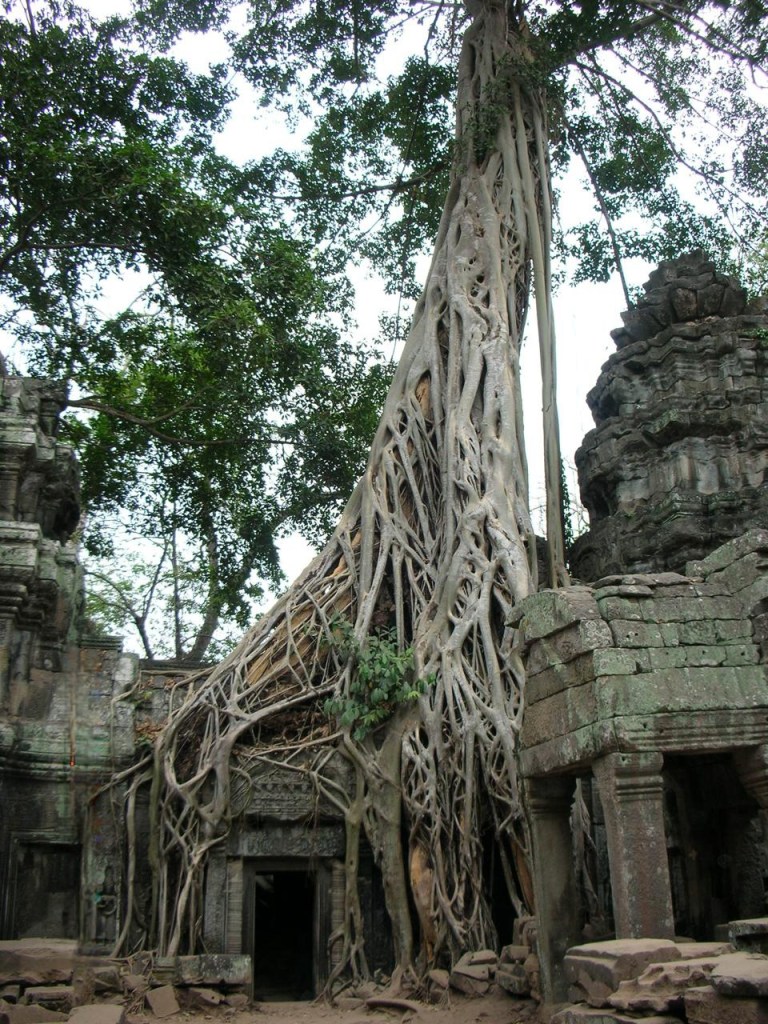
The above two images show trees taking over abandoned settlements at Ta Prohm in Cambodia. Image credit – My cousins
This is like incessant training, making time however possible. It is also like surviving against opponents without trying to win, only focusing on self-protection and self-preservation. Maybe an opening will appear in time, to mitigate the threat of the opponent. One of the senior most teachers in the Bujinkan system of martial arts, Nagato Sensei has a saying which is very popular. He says, “Leave no opening”. This saying of his has actually been put on training t-shirts! 🙂
What Sensei means by his statement, as I understand it, is that one should focus on first ensuring that one has moved to a position against an attack that fully protects oneself. There should be no opening the opponent can exploit or an opportunity to further the attack without revealing an opening in himself or herself. Unless this is achieved, looking to counterattack is counterproductive, as that might in turn give the opponent more opportunities for further attacks.
The above statement by Nagato Sensei is beautifully exemplified by how trees exploit gaps in masonry! If a sapling is not removed in the early stages when it is spotted on masonry, it can go on to crack walls over time and even spread its roots through pipes laid down for wires and plumbing.
Consider how saplings spring up with rains and sunlight in places where there is no soil at all! On concrete terraces with a little debris or construction waste. They are always there, looking for openings and opportunities to grow. This is akin to surviving a fight and to finding time and space to train. It could also be considered a metaphor in negative terms. Could the springing up of saplings on construction waste be more like the retinue of students who pass through a dojo? Like the many that are never really able to stick around to achieve any useful training? After all, a lot of the saplings that spring up are like weeds that do not last very long. Either way, “The Way of the Tree” seems a fine metaphor for the martial arts.

A representation of how flora reclaims gaps in masonry and construction debris.
There are several ways in which the martial arts are described. This includes the martial art systems as a whole, specific forms, weapons used in the art forms and the metaphors used to describe the martial arts as a whole. Top of mind to me for these descriptors are usually reminiscent of animals or geography (including metals, rocks and such), but not really based on flora, either trees or plants. Consider the following examples.
The animal forms of Shaolin Kung Fu have been made famous by the Kung Fu Panda franchise. The Tiger style, Snake style, Monkey style, Crane style, Eagle style, Mantis style are well known.
Metaphors of natural forces like water and wind are also well known, like “flow like water around your opponent”. Responding to the situation metaphorically becomes “water takes the shape of the container”. In India, strength is associated with Vayu, the God of Wind. Vayuputras (sons of the God of the Wind) Bhima and Hanuman are the epitome of strength and martial prowess.
There are representations of metals related to martial prowess as well. Consider Excalibur, which combines metal and water to bestow greatness, which includes martial skill. Another example is the “Sword of Mars” wielded by Attila the Hun. This sword is supposed to have been made of meteor iron and a marker of greatness. Of course, Attila was a great warrior king as well.
Coming to pop culture, in the world of Conan the Cimmerian (Barbarian) written by Robert E Howard and brought to life famously by Arnold Schwarzenegger, is “the riddle of steel”. Again, a metal exemplifies the martial skill embodied by Conan. Even in the world famous “Crouching Tiger Hidden Dragon”, dedication to the martial arts is called “The Iron Way” due to how hard it is and the sacrifices it supposedly entails.
There are examples of trees and plants used, but a lot fewer, and none in pop culture as I can recall. In the Bujinkan, one of the schools studied is the “Takagi Yoshin Ryu”. The name of this school translates to “School of the Weeping Willow”. Here the willow tree is representative of being flexible yet strong. I opine that it is apt, because the Takagi Yoshin Ryu is an expression of jutaijutsu. Jutaijutsu, as I understand it, could be considered a super set that also includes, wrestling, judo, malla yudha, kushti etc. All of these martial arts do need flexibility and strength.
The first 2 techniques trained with the kunai also have tree based names, though not very representative of the martial style as a whole. The first technique is called “Kiri no hito ha” which translates to “cutting the paulownia leaf”. The second technique is called “Rakka” which translates to “falling petals”!
Beyond the above examples, other plant or tree based names and metaphors in the martial arts escape me at this time, at least as “top of mind” examples. If anyone is aware, do share the same with me. This seems strange to me, considering how ubiquitous trees are in our lives. It seems strange that there is no “Way of the Tree” in the martial arts. Is it likely that we might have such a system in the future? Perhaps, as I have tried to make the case for one above.
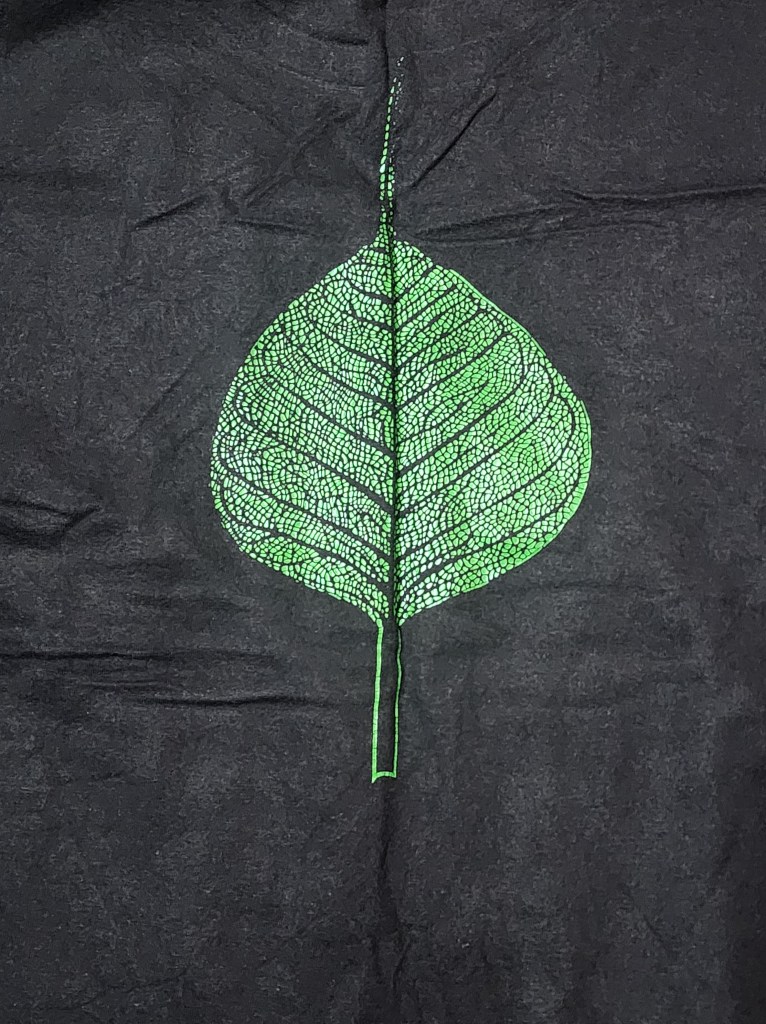
Considering the importance of the Peepal tree for us Indians, we once had a Bujinkan training t-shirt that had an image of a Peepal tree leaf on it.
 Mundane Budo