The Ten, the Chi and the Jin (TCJ)
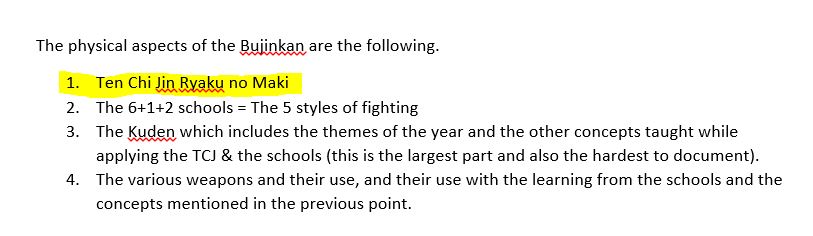
In my previous post, I had given an introduction to this series and defined some basic concepts that will be revisited time and again during this series. From this post onward, I will expand on the 4 aspects mentioned as the physical aspects of the Bujinkan. These are seen in the screenshot below from the previous post. The first of these is highlighted in the image below, and is the focus of this article.
The first thing anyone learns when they start training the Bujinkan is the Ten Chi Jin Ryaku no Maki. This is roughly translatable as “A scroll of the principles of Heaven, Earth and Man”. As the name suggests, this has three parts, the Ten, the Chi and the Jin. Each of these individually are as mentioned below.
- Ten Ryaku no Maki – The scroll of the principles of Heaven
- Chi Ryaku no Maki – The scroll of the principles of Earth
- Jin Ryaku no Maki – The scroll of the principles of Man (who is supposedly a conduit between Heaven and Earth)
The absolute basic learning from the Bujinkan and root of self-preservation is from the Ten Ryaku no Maki. This part is all about learning about oneself and one’s position in space in relation to the opponent. The Chi Ryaku no Maki is about learning about the opponent and how to affect the body of the opponent in various ways. The Ten Ryaku no Maki is about putting the learning from the Ten and the Chi sections together in various combinations and potential attack combinations (without weapons).
Ten Ryaku no Maki
The key learnings from the Ten Ryaku no Maki are, in my opinion, the following.
Kamae – This section teaches one the various postures that the body might generally need to take to protect oneself and then initiate an attack, if necessary. It specifically focuses on the legs, their angles and weight distribution between the two. The hand positions are also taught, but these are less important compared to those of the legs. This is the case as the Bujinkan is all about movement and this is effected by the legs (even if not initiated by them). This movement aspect is emphasized in the Taihenjutsu aspect of the Bujinkan. We will look at this in a later post of this series.
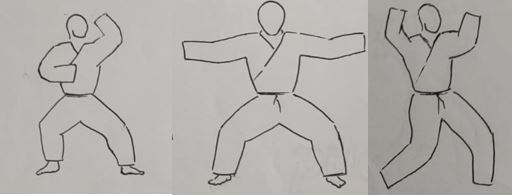
Representative kamae. Sketches by Vishnu Mohan.
Ukemi – This section teaches one how to receive the ground when one falls or has to move with a low posture in an efficient manner. This means how to roll effectively, and fall, with minimal or no pain and injury. This becomes important when one realizes that she or he will fall and get thrown during training, and maybe even during a real situation involving a fight. Protecting oneself in such a situation, not just the opponent but from the ground, is important to learn and experience.
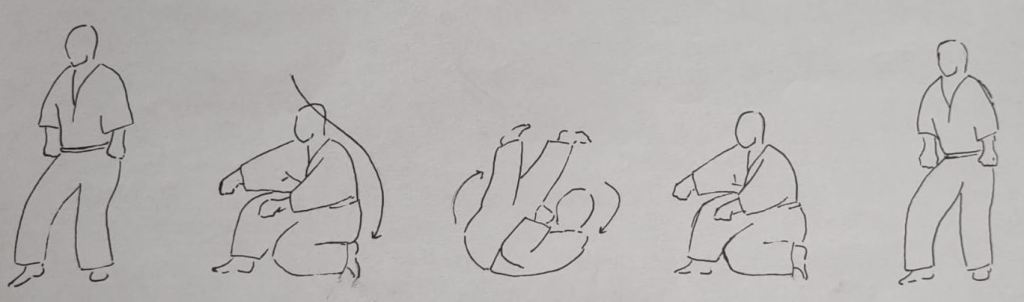
Representative ukemi flow. Sketches by Vishnu Mohan.
Uke Nagashi – This section is about receiving an attack from an opponent, a human being. One might be attacked in various ways by one or more attackers, with fists, elbows, shoulders, knees, feet, legs, fingers, head butts, grabs from all directions, chokes, joint locks, nails, teeth, throws and any other, or a combination of these. The ways to receive these attacks to nullify the objective of the attack and to do so with minimal physical harm is the objective of this section. It involves, getting out of the line of attack, and getting the right protective posture with the right angle and height to stay as safe as possible against the given attack. Of course, this is not a static or one time activity, but a dynamic aspect to be practiced all through the fight. The objective here is to stay safe, not win a fight. When we say receive, it includes, absorbing, blocking, deflecting, countering, and evading an attack (A, B, C, D, E as defined in the scroll 😊). So, this includes what is also sometimes called a “parry” to an attack.
Kihon Happo and San Shin no Kata – These two segments teach a practitioner how to move in relation to the opponent after the Uke Nagashi is executed. This initiates a practitioner in the basic ways in which one counterattack an opponent. They also expand on the application of the Uke Nagashi in different angles and directions. The ways to move in relation to an opponent include, forward, backward, right, left and from the same spot, but with a lower stance or height. These also include how to rotate around a specific joint of the opponent, like the wrist or the elbow and affect her or him with that movement. Further, the ways to attack while moving forward, backward and twisting on the same spot are also explored.
Thus, the learning from the Ten Ryaku no Maki is about receiving the ground in the best manner possible (Ukemi), using the correct posture (Kamae) to receive an attack from an opponent (Uke Nagashi) and efficient ways to move in relation to the opponent to mitigate the attack (Kihon Happo and San Shin no Kata).

Representative detail of a movement from the San Shin no Kata. Sketches by Vishnu Mohan.
There are additional segments in the Ten Ryaku no Maki which teach practitioners about the various parts of their own body they can use to strike the opponent and the points of the body which when struck cause pain (pressure points or weak points). Conversely, this also means learning which part of the body an opponent can use to attack and which parts of oneself, when struck, cause more pain, and thus need to be protected. This is the origin of the thought process related to “self-protection” and a realization of the need for the other segments in the Ten Ryaku no Maki. It also initiates a practitioner into the idea of how to begin evasion from an attack and therefore start the process of escape.
Chi Ryaku no Maki
This second part of the Ten Chi Jin is about the various ways to cause trouble to the opponent. In the Ten Ryaku no Maki the focus was all about moving the feet and legs, and consequently the lower half of the body. But now, the focus is on the entire body as one unit. Practitioners learn to move the upper body in conjunction and in unison with the lower body to pull off various moves to inconvenience opponents. This is where key features like keeping the hips and shoulders parallel, the back straight and not bending, to keep one’s balance even while sinking low with the legs, are focused on and drilled into students.
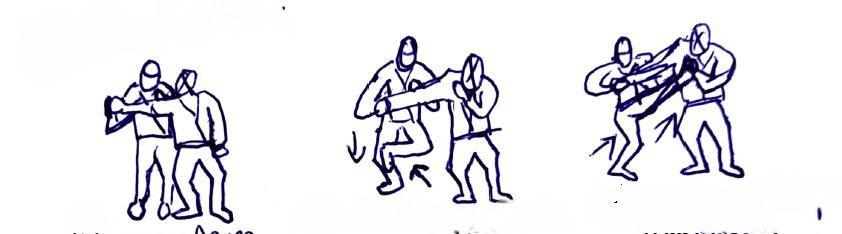
Representative form for one of the kicking options. Sketches by Keane Amaral.
The principles learnt relating to Ukemi, Uke Nagashi, Kamae, the Kihon Happo and San Shin no Kata are added to and the movements which cause opponents to lose balance, feel pain, fall over and get injured, if not worse, are learnt.
Due to this objective of the Chi Ryaku no Maki, the segments in this part of the Ten Chi Jin include, throwing opponents, joint locks, choking techniques and ways to kick opponents in the most effective manner to break their balance. Also included here are the ways to break an opponent’s hold on the arms or the upper body (bear hugs, choke attempts, nelson holds) and the ability to keep an opponent pinned (or locked) by applying pressure and causing pain at specific pressure points. Of course, this is after an opponent has been thrown or dropped to the ground due to a combination of joint locks, throws, hits and kicks.
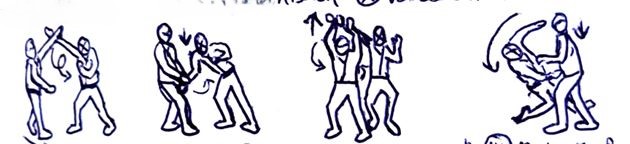
Representative form for one of the throwing options. Sketches by Keane Amaral.
Jin Ryaku no Maki
Simply put, the following is roughly true.
Jin Ryaku no Maki = Ten Ryaku no Maki + Chi Ryaku no Maki
Or more colloquially put, Jin = Ten + Chi (J = T + C)
Ten Ryaku no Maki is about learning about oneself and ways to protect the same. Chi Ryaku no Maki is about learning about the opponent and ways to cause trouble to the same. The two, when put together, form a complete fight (attack & counter) scenario and so, with set forms, practitioners can explore the various ways to apply what has been learnt in the Ten and Chi parts of their study.

Representative kata. Sketches by Keane Amaral.
Students can move as taught in the Ten and apply the principles of the Chi to defeat or mitigate the attack by an opponent. To allow a basic structure that practitioners can use to expand their knowledge and experience of the Bujinkan, set forms or Kata are described. These are recommendations and not set in stone. The basic attacks that are defined are fairly comprehensive though, and include defence against fist attacks, kicks, throws, arm and upper body grabs. These also include combination attacks, which include any or many of those mentioned previously. There is also a set of forms that allows for the exploration defence when attacked while sitting down.
The defence against the set attack forms are taught to students and it is explained how variations and other ways of these defences can be applied as required by the situation. This aspect of permitted variations is the beginning of the practitioners exploring their own strengths and weaknesses based on their physical abilities and lack of the same. It is also where students hopefully begin to realize they are learning an art form and not a precise science. This realization hopefully brings on the epiphany that in a real fight, they can and need to apply their experience however needed and there is no “defined” defence due to the many variables that are involved in life.
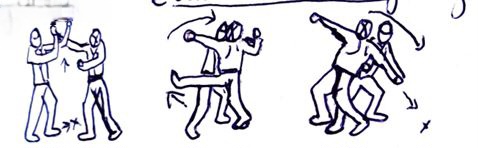
Representative kata. Sketches by Keane Amaral.
The Ten, Chi and Jin Ryaku no Maki are not necessarily learnt exclusively or linearly. They are learnt at the same time to show that the three parts are dependent on each other, though in the grading system that might be used in different Dojos, students might be expected to know the difference. This is to enable the development of an intellectual structure apart from a physical one, which enables students to add to their physical vocabulary ably aided by an intellectual one. Also, the Ten Chi Jin is something that practitioners of the Bujinkan revisit all through their life, or at least as long as they train this martial art. Each revision is likely to have fresh revelations and add nuances to their martial repertoire. This key feature of the TCJ is why its knowledge and experience are key to the awarding of a Black Belt to a student. Also, the achievement of a Black Belt is when a practitioner is accepted as a serious student.
In the next article, I will expand on the 9 schools that make up the Bujinkan system of martial arts.
I am ending the post with something I posted at the beginning of the previous one. Seen below is the reason I am posting this series of articles. This segment will be present at the end of each of the posts in this series, just as a reiteration.
The purpose of this series of posts is multi fold. Firstly, it is a resource I can share with people who are not practitioners of the martial arts. Like most of us, a majority of the people we interact with do not practice any form of martial art. Sharing ideas and practices about martial arts might require some “first principles” like definitions, overarching themes and ideas and objectives of the art form. Hopefully this series will be that resource.
Secondly, it is an opportunity for me to look back at my own thoughts about the Bujinkan. The thoughts are a document I can refer in the future to see if I think differently.
Lastly, practitioners of the Bujinkan who are relatively new to the system and longtime practitioners who might need a look back at aspects from earlier years could use this as a starting point for further discovery. There are several practitioners and Sensei of the Bujinkan with a lot more experience compared to me, who share content about the art form and the system. I strongly recommend that everyone consume the content from those sources. This series is possibly an index to search further in those sources.
So, this series in not a deep dive, more like a primer of my thoughts with scope for expansion in each. Most importantly, whatever knowledge can be gleaned from this series is a conversation starter or direction pointer at best; it does not in any way replace actual training in a dojo with fellow budoka and a teacher who can help one progress.
 Mundane Budo
[…] defined some basic concepts that will be revisited time and again during subsequent posts. In the second post, I had looked in greater detail at the “Ten Chi and Jin”. In this post, the third in the […]
LikeLike
[…] this series and defined some basic concepts that will be revisited during subsequent posts. In the second post, I had looked in greater detail at the “Ten Chi and Jin”, which is considered the “basics” […]
LikeLike
[…] this series and defined some basic concepts that would be revisited during subsequent posts. In the second post, I had looked in greater detail at the “Ten Chi and Jin”, which is considered the “basics” […]
LikeLike
[…] Bujinkan, as I see it – Series 1, Part 1 The Bujinkan, as I see it – Series 1, Part 2 The Bujinkan, as I see it – Series 1, Part 3 The Bujinkan, as I see it – Series 1, […]
LikeLike