Year of the Snake – An Indian perspective through Budo

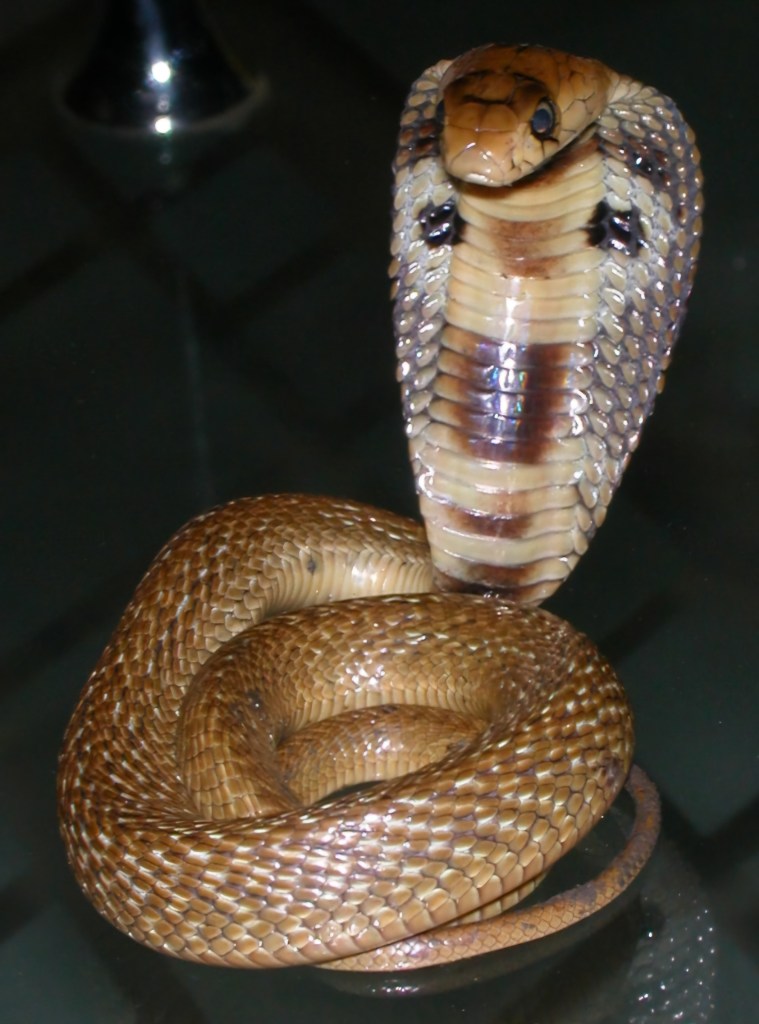
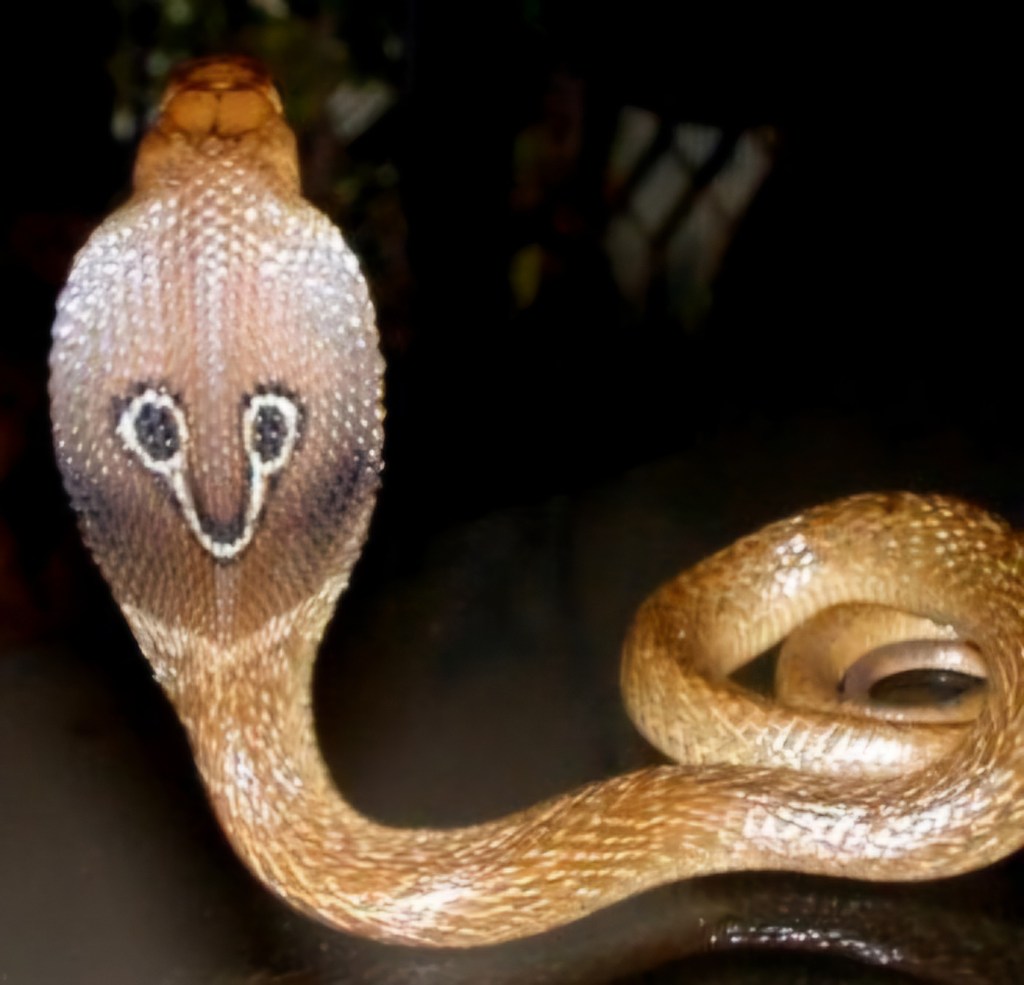
A young Spectacled Cobra

Today, 29th January, 2025, is the Chinese New Year. This year is the “Year of the Snake”. More specifically, it is the “Year of the Wood Snake”, “wood” being the element associated with the animal of the zodiac this year. Due to historical cultural connections between China & Japan, we use the zodiac animal associated with the year as inspiration for training, every now and then, in the Bujinkan (which is of Japanese origin). This is not a norm, but something that is not uncommon either. Snakes are animals that have a strong presence in Hindu culture. So, me being a Hindu, a Budoka, and someone who has a deep respect for snakes, inspired me to write this article.

Everyone knows of the main aspects that are considered advantages in the martial arts. These generally are strength, speed and agility. Skill and experience can offset some of these. But weapons mitigate the advantage physical prowess provides. This includes both offensive and defensive weapons. In my previous post, from last week, I had discussed the importance of weapons in the martial arts*. This seems like a nice follow-up. One advantage that weapons additionally provide is reach, or how far away an attack can be carried out. Modern weapons of course also have “range” which is how large an area can be affected (of course, “range” can also be used interchangeably with “reach”, when it comes to modern weapons).

While training the Bujinkan system of martial arts, one story that everyone learns is that of Ishikawa Goemon. Ishikawa Goemon is a legendary character from the Sengoku Jidai (warring states period) of Japan, which is the second half of the 16th century. Ishikawa Goemon is a shinobi from Iga who tries to assassinate either Oda Nobunaga or Hideyoshi Toyotomi, using poison. I have been told that there are stories which describe him as trying to assassinate one or the other, though neither of them are supposedly strictly historical. In both stories, the attempted assassination fails. Goemon is supposed to have been executed along with his family according to some tales while some supposedly say that he escaped.
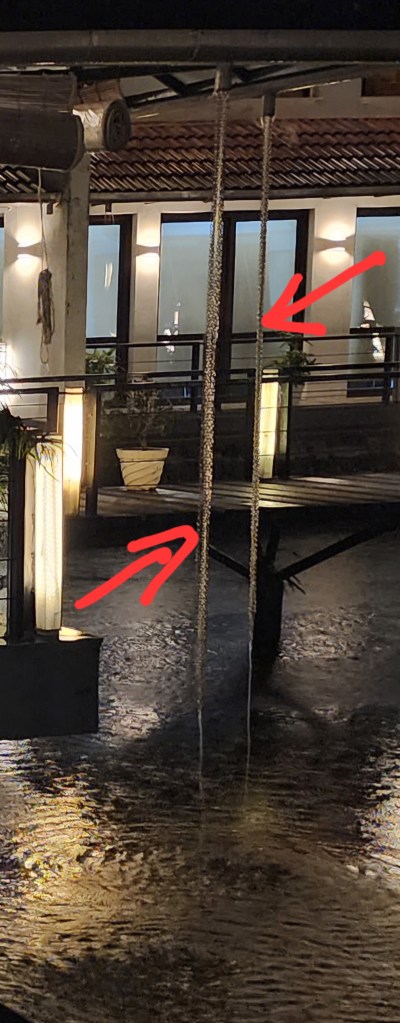
Chains that guide rain water into a harvesting area – something like Goemon used to guide poison into his quarry’s mouth?

Despite the failure of the attempt, the means he used in the assassination is fascinating! He gained access to the bed chamber of his target and hid in the rafters overhead. When the quarry was asleep, he let poison drip into the mouth of the sleeping individual over a thin rope. Think of this as the chains used to guide water into a harvesting tank below. The poison only made the target sick but was insufficient to kill the person. This legend was used in a sequence in the James Bond movie “You Live Only Twice” starring Sean Connery.

Another story related to “Ninja” using poison is something I saw in the old Discovery Channel series “Ancient Warriors”. This series showed how various groups of historical warriors fought and lived. This series ran between 1994 and 1995. One episode of this series focused on the Ninja and was titled, “The Ninja: Warrior of the Night”! This series has not aged well. The “facts” shown in the series are questioned and not considered entirely accurate.

In this episode about the “Ninja” a situation is narrated where the ninja assassinate a warlord by sprinkling poison powder on flowers in his garden. The ninjas observe that the warlord takes a stroll in his garden every morning smelling the flowers. They use this behaviour of his to kill him. Even in the episode, the name of the warlord is not mentioned, nor is any context given for the assassination. So, I am not sure if this is historical, and if it is just a story, I would request anyone else who might have heard the same, of its antecedents. Who is being referred to in the story and in what quasi-historical situation? I am attaching a link to a video of this episode in the notes below**.

Irrespective of the provenance of the second story, the two stories mentioned above show that the use of poison is certainly attributed to Shinobi. And this links the Shinobi/Ninja to snakes. Many creatures on our planet have developed “Venom” as a survival strategy. These include molluscs (e.g. snails), arthropods (e.g. scorpions), insects (e.g. wasps), amphibians (e.g. frogs) and reptiles (snakes and lizards). But snakes are undoubtedly “top of mind” when it comes to creatures that use chemical weaponry, namely venom (many a time referred to as “poison’).
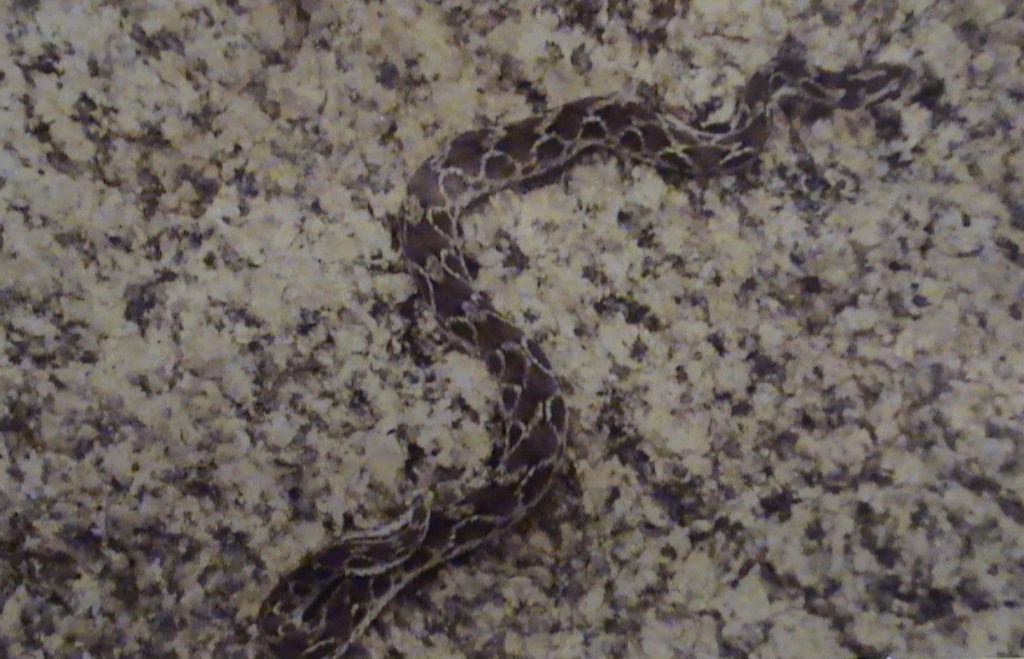
An old photo of a Saw Scaled Viper

A small tangent here. Venom is poisonous. I have heard a beautiful explanation regarding when the terms venom and poison should be used. I will repeat the same here. If a snake bites a person and the person dies, the snake is VENOMOUS. If a person bites a snake and the person dies, the snake is POISONOUS. In contrast, if a snake bites a person and the snake dies, the person is POISONOUS. If a person bites a snake and the snake dies, the person is VENOMOUS.

This is why there exist frogs referred to as “Arrow Poison Frogs”. These frogs secrete a venom from their skin. So, if any animal bites these frogs or tries to eat them, the frog is POISONOUS and hence they learn to not consider the frog food. Similarly, there are “poisonous” mushrooms, which if eaten, can kill the individuals who eat them. Now, we go back to the main article.

One of the things that a practitioner of the Bujinkan system learns in the first few months of training is the “Hi Ken Juroppo”. This refers to the 16 ways of striking/hitting an opponent, without weapons. This includes the use of the fists, fingers, elbows, knees, feet etc. Apart from this, a concept called “Shizen Ken” is taught. Shizen Ken can be translated as “natural weapons”. This generally refers to nails, teeth and spit in humans. In other words, one can scratch or bite or spit at opponents. These are not trained as a part of “striking” an opponent as these are considered to be more “natural” or something we do due to our evolutionary past.

When it comes to animals, shizen ken would be horns, claws, fangs, tongues (think chameleons), beaks, and of course, VENOM. Obviously, when we consider weapons, we need to consider defensive weaponry as well, the examples mentioned earlier being exclusively offensive in nature.

Defensive weapons in animals include armours (carapace, cuticle, shell ec) in the case of crocodiles, tortoises and crabs, secretions (like the ink used by squids and octopi and the stink raised by skunks), spikes in porcupines and of course the wide range of camouflage that exists in nature. Beyond these, we can include the warning mechanisms used by animals under shizen ken. This includes the warning sounds used by various animals and the bright display colours that poisonous animals like frogs and caterpillars sport.

If we consider protection developed by various creatures against the heat, cold and the natural elements, this list of “natural weaponry” deployed by life on earth increases manifold! Of course, the development of weaponry is not limited to the animal kingdom. Weapons, mainly defensive ones are seen even in the plant kingdom, like thorns, resins, hard shells and of course poison.

Considering just snakes, they have developed a natural weapon that gives them a huge advantage in the battle for survival. Venomous snakes are distributed all across the world, but not all snakes are venomous. Venom is one of the weapons that snakes have evolved apart from size, speed, camouflage, agility and flexibility, which are seen in many species of snakes, sometimes in conjunction with venom.

An old photo of a young Common Krait. I could be mistaken here, this could be a Wolf Snake, which looks very similar to a Common Krait.

One factor about weapons is that they nullify the advantage proffered by size and strength. This is true in all species. This means that venomous snakes can afford to evolutionarily be smaller in comparison to many other snakes. This also means that they can be ambush hunters and minimize the risk they face from prey, struggling or otherwise. Of course, nature being nature, not all venomous snakes are small. Some rattlers and bushmasters in the Americas grow pretty large. Gaboon Vipers in Africa are large as well, and then there is the King Cobra, which is a very big snake by all standards, by length if not weight and girth. But most venomous snakes can be small or medium sized. In India, the Saw Scaled Viper, the Common Krait and many of the Pit Vipers tend to be on the smaller side according to common parlance. Cobras and Russel’s Vipers are medium sized snakes.
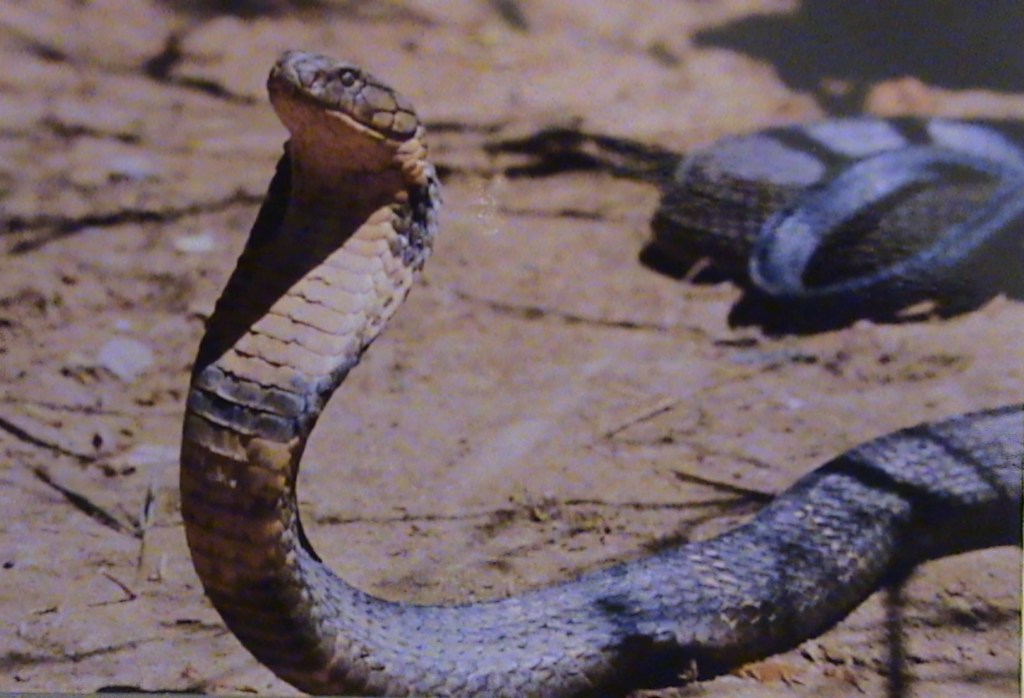
A majestic King Cobra

I have seen on some nature documentaries, the afore mentioned African Gaboon Vipers described as “docile”. This is in relation to its behaviour vis-à-vis humans. Of course, every snake has a different temperament and this is only a general characterization that I have heard. I am not even sure if this observation is correct. But assuming what I have seen is correct, I make the following observation. The Gaboon Viper has very large fangs to deliver venom, the largest of any extant snake. It can deliver a large dose of venom in a single bite. So, if I anthropomorphize the Gaboon Viper, it is so certain of its natural abilities and of course weapons, it has no need for any aggression. It knows its opponents will stay away due to fear or evolutionary knowledge of its weapons. Thus, it can AFFORD to be docile!

The Gaboon Viper also has a fantastic camouflage pattern that resembles the leaf litter on a forest floor. Lastly, it is an ambush hunter. Now consider the following traits. The Gaboon Viper can inject sufficient venom to kill its prey in a single bite – it is therefore armed with lethal weapons. Due to its camouflage, its quarry cannot see it coming. Being an ambush hunter, it can lie in wait for long durations. Consider these traits together – it is literally an Ishikawa Goemon from another species! Of course, there are several other snakes that have the same combination of traits and I am just using this as an example.
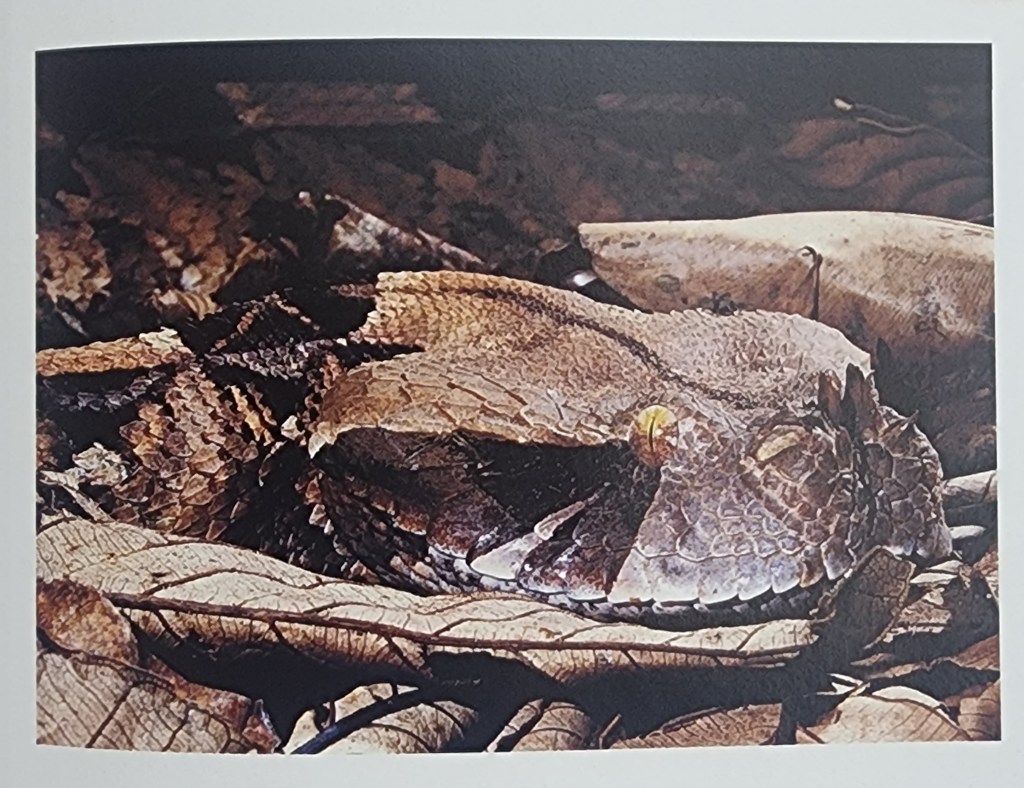
A Gaboon Viper amidst leaf litter. Image credit – “1000 Wonders of Nature”, published by Reader’s Digest

In India, in the stories from Hindu culture, there are entities called the “Nagas”. Nagas are depicted as part human and part snake in many representations. They are also depicted exactly as snakes in others. I have heard some people distinguish between Nagas and snakes. Snakes are also referred to as “sarpa” in many Indian languages. Some people suggest that Nagas are different from “sarpa” or snakes since they have traits that far exceed those of snakes, traits that far exceed those of humans as well. But the Nagas are definitely linked to snakes and in modern Indian culture, the difference is hardly ever considered. Nagas are also prevalent is South-East Asian culture.
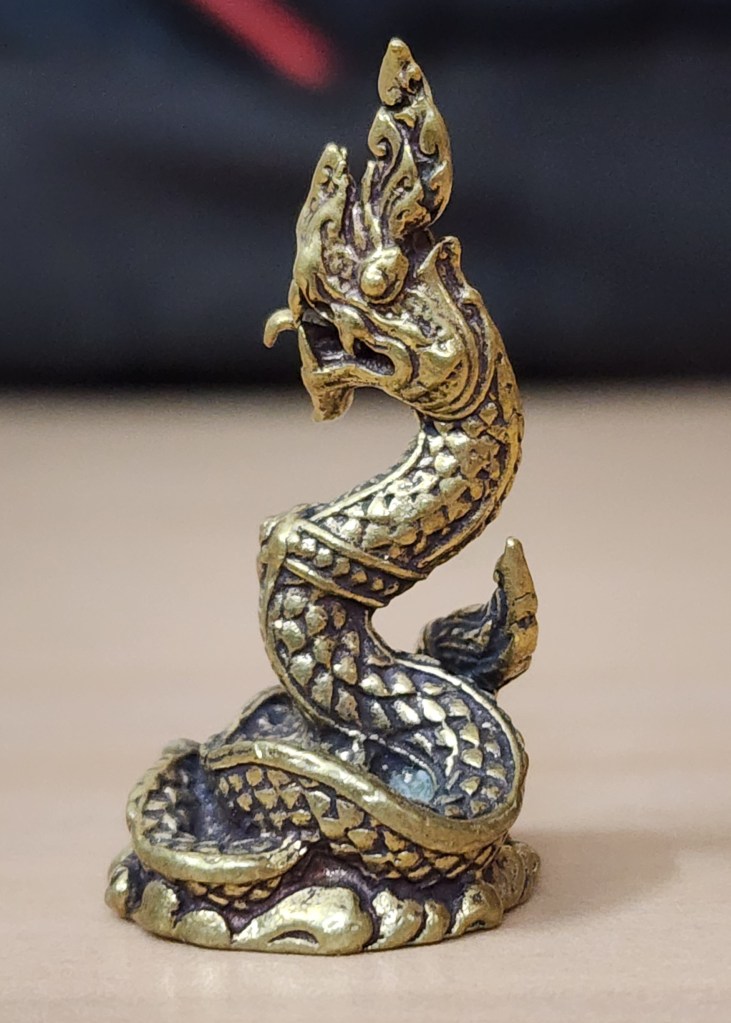
A representation of a Naga as depicted in South East Asia

The Nagas, based on my knowledge have three traits that most Hindus are commonly aware of.

  • Firstly, they are symbolic of fertility, in humans and of the land itself.
  • Secondly, Nagas and snakes in general, are considered guardians. They are depicted as guardians of material wealth, like ancient and hidden treasure. They are also symbolic of wisdom and spiritual prowess.
  • Lastly, Nagas are considered technologically superior as cultures go, which is perhaps an offshoot of their being associated with wisdom.

I will share a couple of examples of this technological superiority. In the Mahabharata, during the Ashwamedha Yajna after the Kurukshetra War, Arjuna is killed by own son Babruvāhana. He is healed and brought back to life by his wife Uloopi, who is a Naga princess. Uloopi uses a “Naga Mani” to heal Arjuna. The “Naga Mani” is a popular trope in modern Indian entertainment as well. It again links treasure (Mani is a gemstone) with the Nagas. This story shows Nagas possessing technology or knowledge that allows them to perform tasks that are beyond normal humans. It brings them closer to the divinities in this sense.

Uloopi summoning the “Naga Mani” or the Gem of the Nagas. Image credit – “Uloopi”, published by Amar Chitra Katha

The other example is the “Sarpāstra” or the “Nagāstra”. “Astra” can be translated as an arrow or a projectile weapon. Astra can be used to depict any weapon that is discharged, with a bow or any other device (the air-to-air missile developed by India for its fighter aircraft is also called “Astra”). This is a special arrow used in both the Ramayana and the Mahabharta. This arrow is supposed to never miss, unlike other arrows. Further, an adversary who is struck by this arrow is either sure to die, with no hope of recovery, or be bound for all time, as one can never escape the weapon’s clutches. In essence, this Naga weapon is more capable compared to those used by humans.
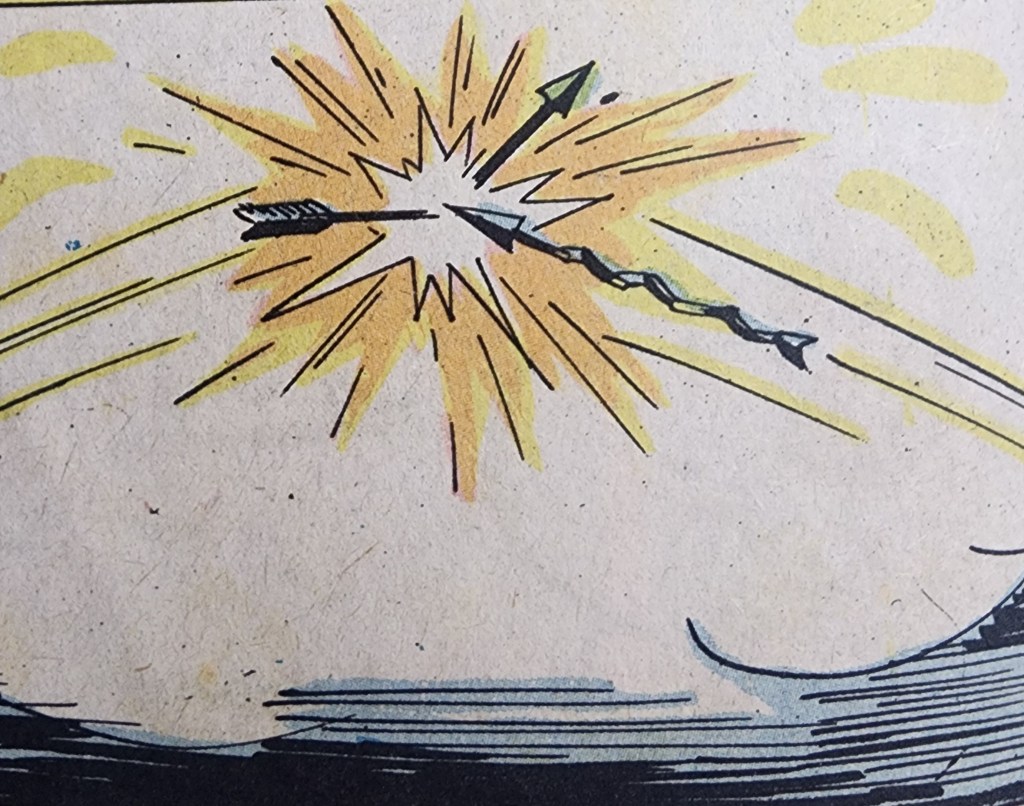
A representation of the “Sarpastra” being superior to a normal human arrow. Image credit – “Uloopi”, published by Amar Chitra Katha

These positive traits associated with Nagas results in names associated with Nagas being widely prevalent in India even today! Names like “Nagaraj”, “Nagaswamy”, Nageshwar (male version) and Nageshwari (female version) and many others associated with Nagas are encountered by all of us regularly. All of these names translate to “King / Lord/ Chief” of the Nagas. I am sure all of us can recall at least one friend or relative who has a name associated with the Nagas. This is not to mean that snakes are not feared in modern India. There is a healthy respect for snakes all across India. The association with the Nagas, and hence snakes, is not new. Many royal lines from the times of Ramayana and Mahabharata to historical times link themselves to Naga ancestry.

It might seem that Nagas, who are part of legend and folklore in India are the ones who have positive traits. It is not snakes that have positive traits. I beg to differ on this point. I will share my personal opinion on this point. Let us begin with venom again. Earlier, I mentioned the astra named after snakes or Nagas. This is literally true in snakes! Snakes have developed the mechanism to deliver venom at a “stand-off” distance. There are multiple species of Spitting Cobras that have evolved a fang with an opening through which they can spray venom on an adversary, and keep them at bay. This is a true astra indeed!

Let us now consider aspects of snakes beyond the use of venom. Let us begin with the physical trait of snakes that everyone recognizes – the forked tongue that snakes possess and flick in and out of their mouth every now and then. Snakes use their tongue to analyse the environment around them. Snakes have an organ on the roof of their mouths, on the inside, called the “Jacobson’s Organ”. The tongue collects samples from the air and deposits it onto the Jacobson’s Organ, which in turn determines what the surrounding atmosphere is like. This is like snakes carrying around a lab inside their heads that can analyse their surroundings! This is miniature technology like no other!
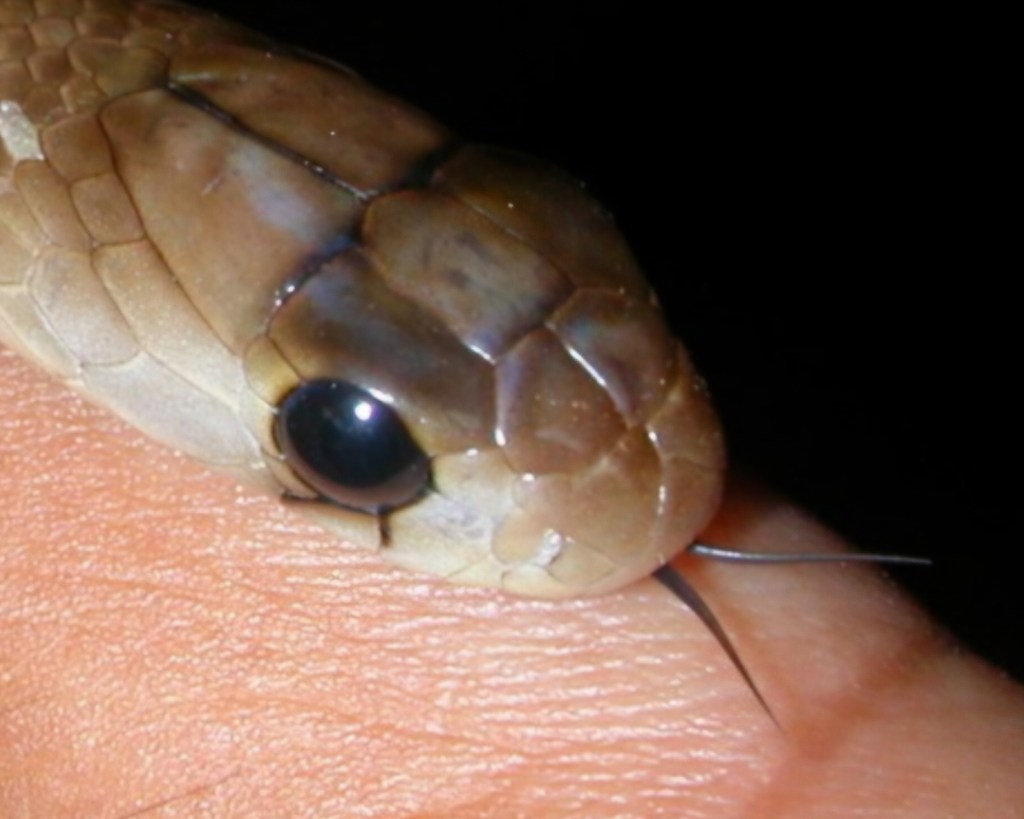
The forked tongue of a snake

Of course, this is not limited to snakes. Other species have evolutionary senses that seem like magic,  or at least marvels of technology, thanks to modern science. Some raptors (birds of prey) can see in the ultraviolet spectrum, sharks can detect the electrical signals in water to find food and elephants can communicate using infra sound. These are just a few examples from the natural world, without even considering the plant kingdom.

Considering evolutionary senses, one cannot ignore “the Pit” used by snakes. Pit vipers and some pythons have an organ called the “Pit” at the top of their heads on the outside. This pit is a sensory organ that allows the snakes that possess them to perceive their surroundings through something like “heat vision”. They can identify temperature differences to identify prey and track them.

So, considering just the two examples above, snakes carry in their heads, heat vision equipment and a lab to study their surroundings! 😛 This does indeed seem like high technology to us humans, in hindsight of course. Therefore, Nagas, who are linked to snakes and sometimes are nothing more than anthropomorphized forms of snakes, are no doubt considered wise and technologically advanced.
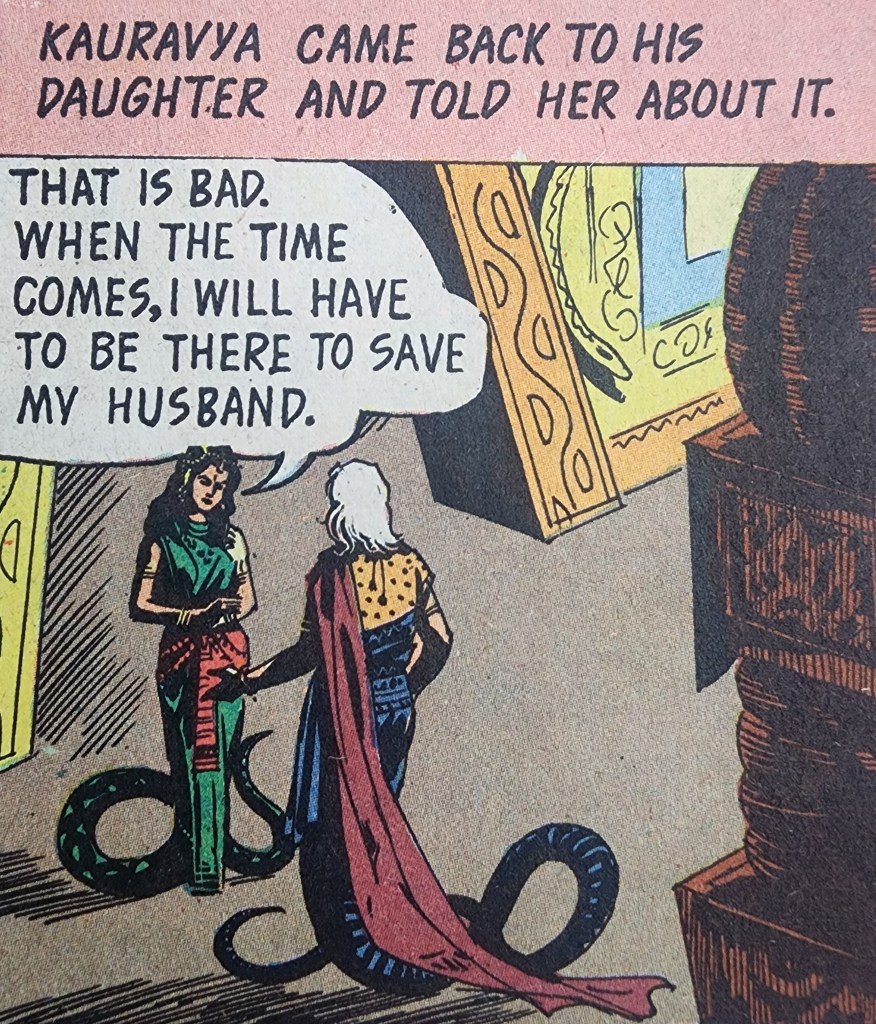
Nagas represented as part human and part snake. Image credit – “Uloopi”, published by Amar Chitra Katha

Even if one considers humans before modern science revealed all the “super senses” that snakes possess, we can still explain the fascination with snakes. In a previous article of mine***, titled “Ashta Siddhi and Budo”, I had discussed what are considered the “8 achievements” of a warrior and how they can be understood through modern budo practice. The fifth of these five achievements is called “Praapti”.

“Praapti” can be considered to be “able to receive everything”. This in modern parlance, in my opinion, refers to being able to perceive all the information in a given time and space, which in turn aids in conflict management and hopefully conflict mitigation. For practitioners of the Bujinkan, this would, again in my opinion, be nothing other than “Sakkijutsu”. Sakkijutsu, put simply, is one’s intuitive ability, which could also be termed as “awareness”, “situational awareness” or “mindfulness”.

The sensory abilities of snakes described earlier would be apparent to people in historical times, for they were keen observers of the natural world as well. The senses of snakes might not have been explained, but it would not be something unknown either. So, in a culture where, the ability to perceive the surroundings is celebrated as one of the “8 achievements” and the ability of snakes would be known, would snakes and therefore the Nagas, not be deeply respected as well? I would say that they definitely would be.

All of the above aspects I have mentioned are beyond the usual symbolism attached to snakes – that of growth. The act of moulting has made snakes a symbol of “growth” and therefore “transcendence”. The points shared above are from the perspective of a Hindu in modern India, who is also a practitioner of the Bujinkan (an expression of Budo).

I had started this post with a couple of quasi historical stories from Japanese history. I will now revert to Japan to make yet another point. During my training the Bujinkan, I have learnt from a mentor of ours, Arnaud Cousergue, that the Togakure Ryu, one of the schools of Ninpo Taijutsu (sometimes referred to as Ninjutsu) that we learn, is divided into 18 segments. Only a few of these 18 segments are trained in dojos these days. One of these 18 segments is “Kayaka Jutusu”. This refers to training the use of explosives. There is no segment that is attributed to the practice and use of poisons. But Ninjas did use poison as evidenced by the two stories mentioned earlier. So, could it be that a segment for poisons was not present in just the Togakure Ryu? Or was it subsumed under “unconventional weapons”, the chief of which was gunpowder and explosives in later centuries? I am not a historian and have no answer to this question.

In my personal opinion, this segment, “Kayaka Jutsu”, could perhaps be considered to refer to the use of unconventional weapons. A theory about the origin of the Togakure Ryu states that it originates in the 12th century. This was before Japan’s first encounter with gunpowder and explosives, which was during the Mongol invasion, in the late 13th century. So, maybe this segment among the 18 was added later during the evolution of the Togakure Ryu? Or, as mentioned earlier, was it that this segment referred to “unconventional weapons” in general and later became specific to explosives as that was the primary new weapon? I am assuming it was so. If anyone knows otherwise, please do share your knowledge with me.

While considering “unconventional weapons”, there is one trait of snakes that is truly staggering, the very definition of “unconventional”. Snakes have no ears and do not hear like other animals. Snakes sense vibrations through the bones in their head. But their “hearing” or perception of sound in comparison to humans and other animals is poor. But snakes use sound to warn potential threats.
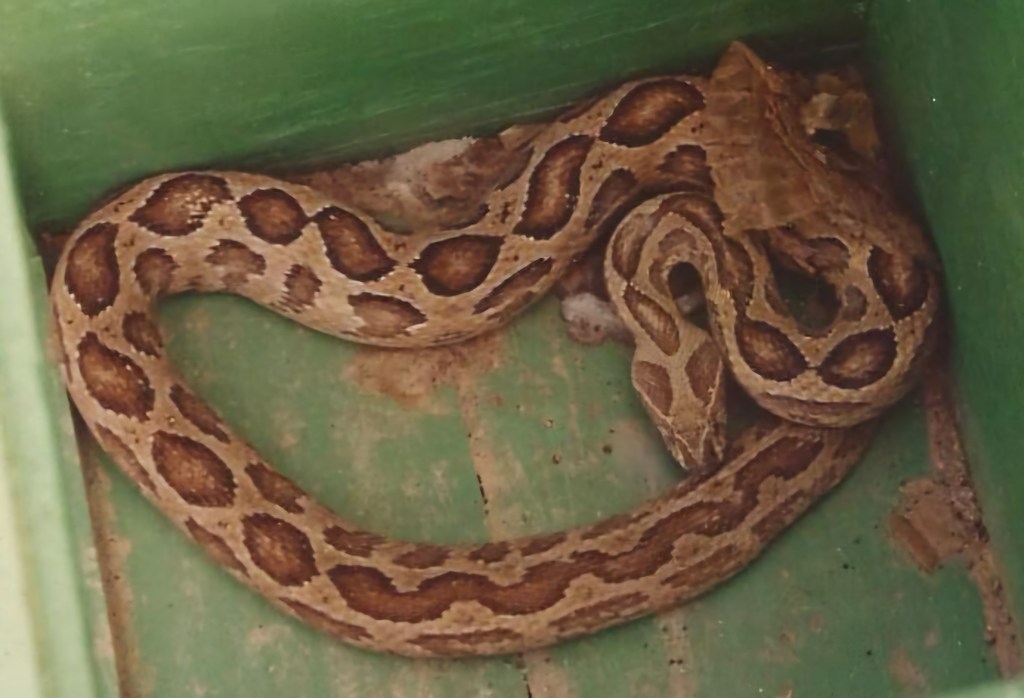
Russel’s Viper

The best example of this are rattle snakes. They have evolved a rattle to warn creatures who intrude on their habitats. Similarly, in India, if anyone has heard the warning hiss of a Russel’s Viper, it sounds like a pressure cooker about to go off! In both these cases, sound is used as a warning device. This means that snakes use a medium of perception to warn creatures, that they themselves do not possess! Snakes cannot hear but know other creatures can! And they use that sense for the benefit of both! How cool is that! It is baffling and “unconventional” to say the least.

Of course, the ability to use a medium one cannot perceive well is a product of evolution over millions of years. And evolution itself brings to mind two aspects that are expressed in the Bujinkan. These are Kami Waza and the fourth of the Gojo, “Shizen no choetsu”.

Kami Waza is a concept where one moves during a fight in such an amazing manner that it seems like one was being moved by something divine. This is exactly what evolution is! The outcome of evolution seems truly magical in hindsight. I had referred to Kami Waza in my article about the Ashta Siddhi, which is linked here. “Shizen no choetsu” could be translated as “the transcendence of nature”. It is the fourth of the 5 Gojo that is oft quoted in Bujinkan dojos. I had written an article some time ago where I have discussed my understanding of the five Gojo. The same is linked here+.

Evolution that is seen in nature is about continuous and incremental changes to overcome challenges in ways that are inconceivable at any given time. The ability of a creature that does not use sound to ward off creatures that do use it, without knowing the experience of sound is exactly that! Transcendence in its essence! First an animal realizes that other animals perceive something that it does not, and then devices a means to use that perception to its advantage, but without developing that perception in itself! 😀 I know, I am saying this a lot, because it boggles the mind!

There is another Gojo, the third of the five that goes, “Shizen no Ninniku”. This can be translated as “the forbearance of nature”. This refers to how one needs to persevere through any activity, just like nature has an abundance of ability to take any challenge and over time overcome the same. I have discussed this also in my previous article. I will use a personal experience of mine to show this trait in snakes.

My family used to run a rescue and rehabilitation centre for wild animals within the city many years ago. This centre functioned from the late 1970s through the late 2000s. Sometime in the late 90s of the early 2000s, an interesting incident took place. We got a call from a local timber yard about a snake in one of the logs at their premises. It was a log that had been transported from Malaysia to India. In the log was a clutch of eggs that had not been noticed earlier and had somehow survived the processing of the tree before transportation.

One of the eggs hatched and a live Small Banded Kukri Snake emerged from the same. It was a Malaysian species of Kukri Snake which hatched in India. Unfortunately the snake did not survive long. But this does show how snakes can survive and extend their territories. In this case an egg travelled from Malaysia to India and hatched. We hear many stories of how Burmese Pythons have successfully created a habitat for themselves in Florida, the other side of the ocean.
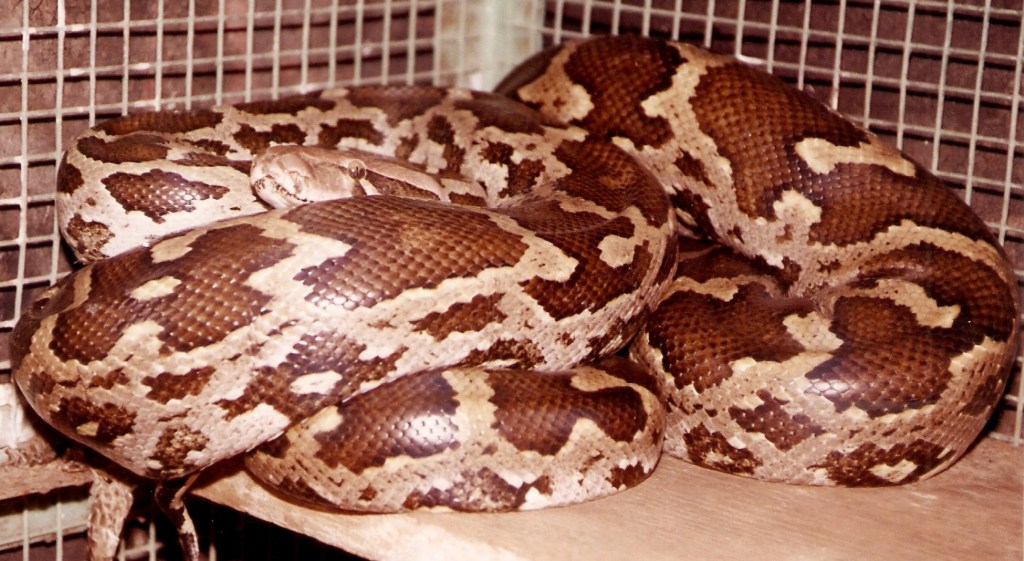
A large Indian Rock Python

Snakes can endure habitat destruction, disturbances to their nests and dwellings, human trade in exotic pets and still find new habitats to inhabit. This is a wonderful example of how nature perseveres, its forbearance is infinite. This is not unlike how one needs to spend years to train the martial arts. It is a gradual process, demanding time, effort and many resources to be expended.

That is a roundup of the fascinating connections between snakes, the martial arts and Indian culture. In conclusion, snakes are like a living breathing sensor package, much like modern day fighter aircraft and other weapons systems. This is like “Praapti” in Hindu culture and Sakkijutsu in the Bujinkan. This is also the key behind modern day 5th generation warfare, where conflicts are not kinetic and information gathering is of paramount importance and technology is a vital ingredient. Technology of a natural kind is what snakes also deploy, chemical weaponry, or venom, in a world where strength, speed and size matter. This leads back to the martial arts, where unarmed combat might be basic, but weapons are the true expression of the art. And we have not even spoken about flying snakes or the world of the sea snakes…

Acknowledgements – All images unless mentioned, were taken over the course of many years by various members of my family. I share my deep gratitude to my uncle, Dr. Shashidhar for sharing many images of the many creatures that shared our home over the decades.

This post would be incomplete without sharing a couple of images of another uncle of mine, the late Srinath. He had an innate understanding of all wild creatures and a knack for working with snakes that was, to say the least, intuitive. He could sense the temperament of any snake, or any animal for that matter, in an instant. Watching him work with wildlife will be something that I will never not miss!
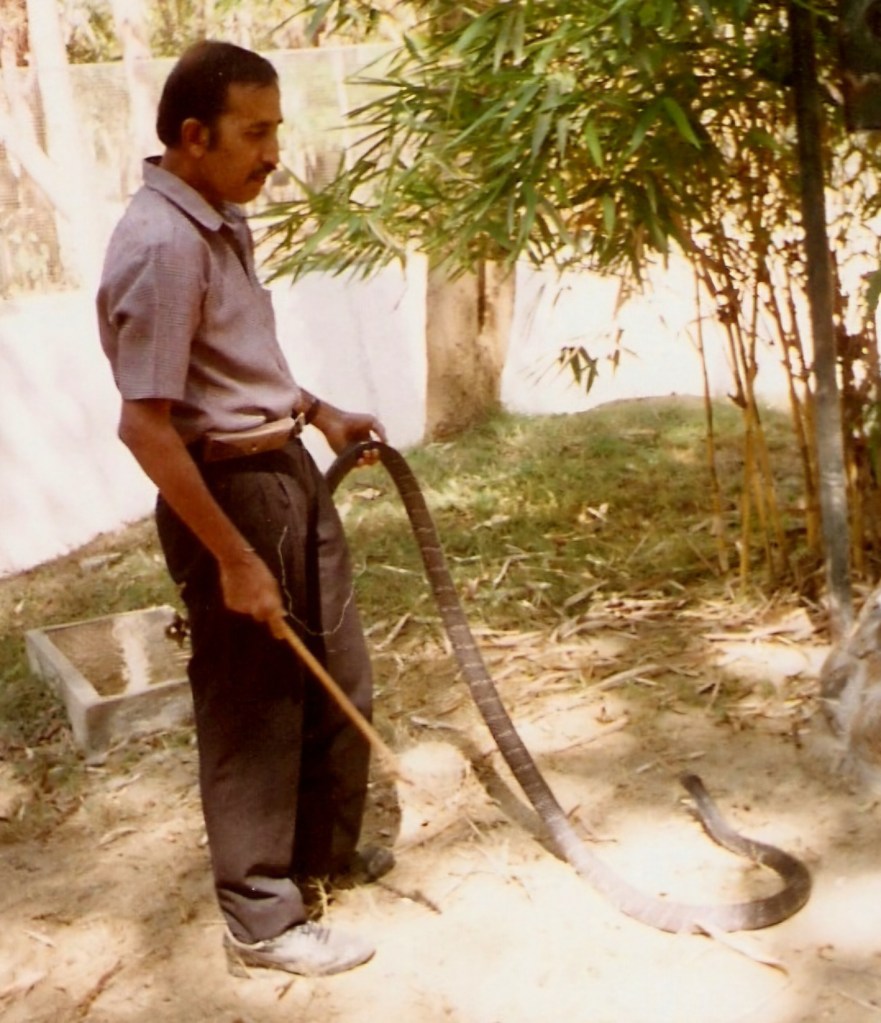
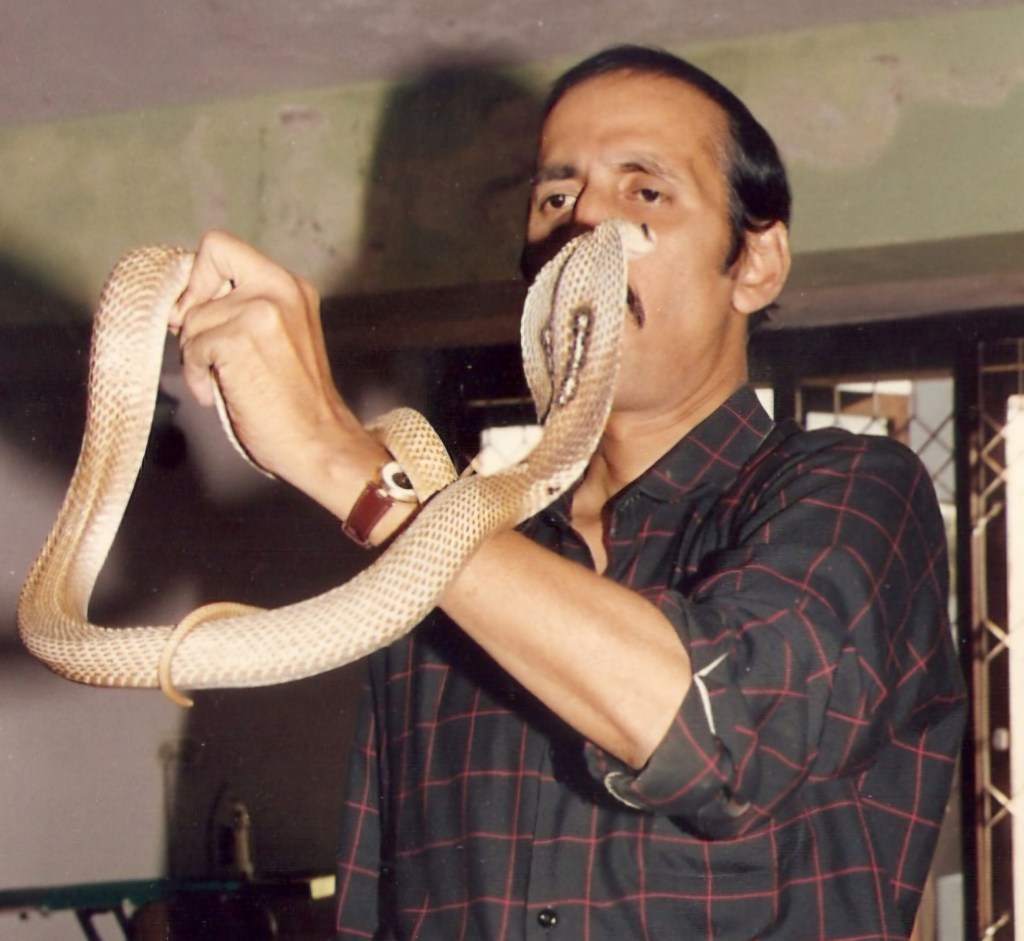
Left – With a King Cobra. Right – With a Spectacled Cobra.

Notes:

* https://mundanebudo.com/2025/01/23/the-bujinkan-as-i-see-it-series-1-part-4/

** https://www.dailymotion.com/video/x6ch45c – watch between the 10 and 12 minute mark

*** https://mundanebudo.com/2022/12/22/the-ashta-siddhi-and-budo/

+https://mundanebudo.com/2023/03/16/the-gojo-a-personal-understanding/
The Bujinkan, as I see it – Series 1, Part 4

Weapons and the feeling of armour/defensive equipment

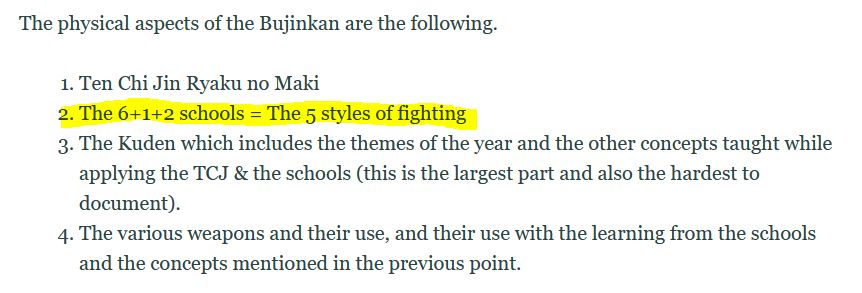
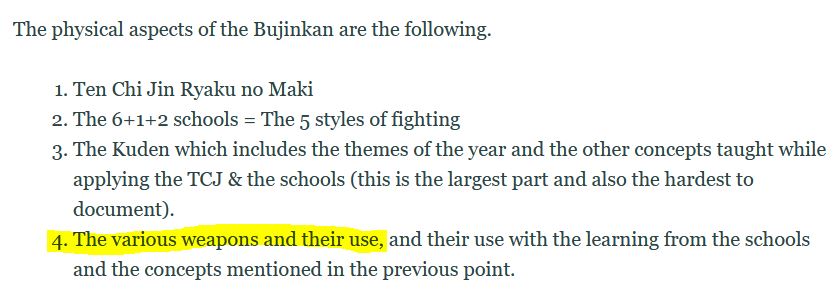
In the first post of this series, I had given an introduction to this series and defined some basic concepts that will be revisited during subsequent posts. In the second post, I had looked in greater detail at the “Ten Chi and Jin”, which is considered the “basics” of the Bujinkan. In the third post, I discussed in brief the 5 styles of fighting and the 9 schools that make up the Bujinkan system of martial arts. In this post I will discuss the use of weapons as a part of training in the Bujinkan, which in my opinion is the most important aspect of the martial arts. This is one of the 4 aspects I had referred to as the “physical aspects” of the Bujinkan. These are seen in the screenshot below. The topic highlighted is the focus of this article.

A bit of a disclaimer before we start. A better title for this post would perhaps be “Martial Art, as I see it”. This post is a brief look at weapons as considered in martial arts as a whole, and is not specific to just the weapons used in the Bujinkan system alone. I might write an article about the weapons specific to the Bujinkan (there are a lot!) at a future date.

There is another serendipitous connection for this post. Three days from today is the 76th Republic Day of India. Traditionally, the parade during Republic Day of India on Kartavya Path (previously Raj Path) is when a lot of India’s modern weapons systems are on display. They are accompanied by the marching contingents of various units of the Indian Defence Tri-services and various law enforcement organizations. So, a post about weapons so close to the annual display of India’s weapons, seems apt! 🙂

Weapons have always formed a vital part of both self-protection and evasion. All martial arts teach the use of weapons, except perhaps if they have evolved exclusively into sports. Even in this case, if there is a sport version and a traditional version of the same martial art, the traditional version tends to retain training with weapons. Of course, the weapon based fighting itself can evolve into a sport as well.

Once a practitioner has a fair knowledge of oneself and how to affect the opponent (from the Ten Chi and Jin in the case of the Bujinkan), she or he can start training with various weapons. The weapons used can generally be classified based on the range offered by the same. These are,

  • Short range weapons like the knife, kunai, wakizashi and other short swords, batons, yawara sticks, bagh nakh, katar, ankusha, war hammer and the like.
  • Medium range weapons like the walking stick, hanbo, jo, longer swords, tachi and katana, dand pata, gada and the like.
  • Long range weapons like the bo, quarter staff, spear, naginata, halberd, glaive, great sword, vita, dane axe and all the other pole arms.
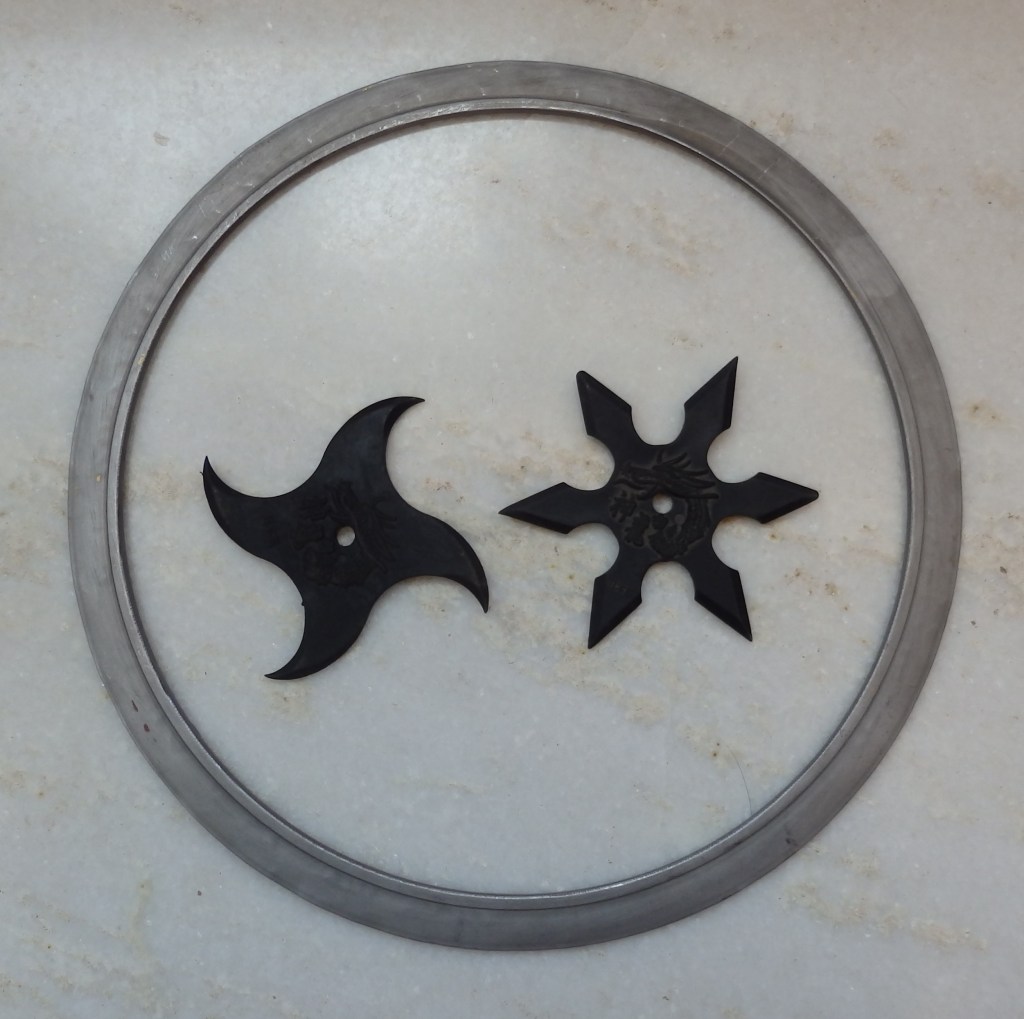
  • Projectile weapons like dart, throwing axe, bow and arrow, throwing knife, shuriken, javelin, chakra and other similar weapons that are discharged.

Projectile weapons – Chakra (on the outside) and Shuriken (on the inside)

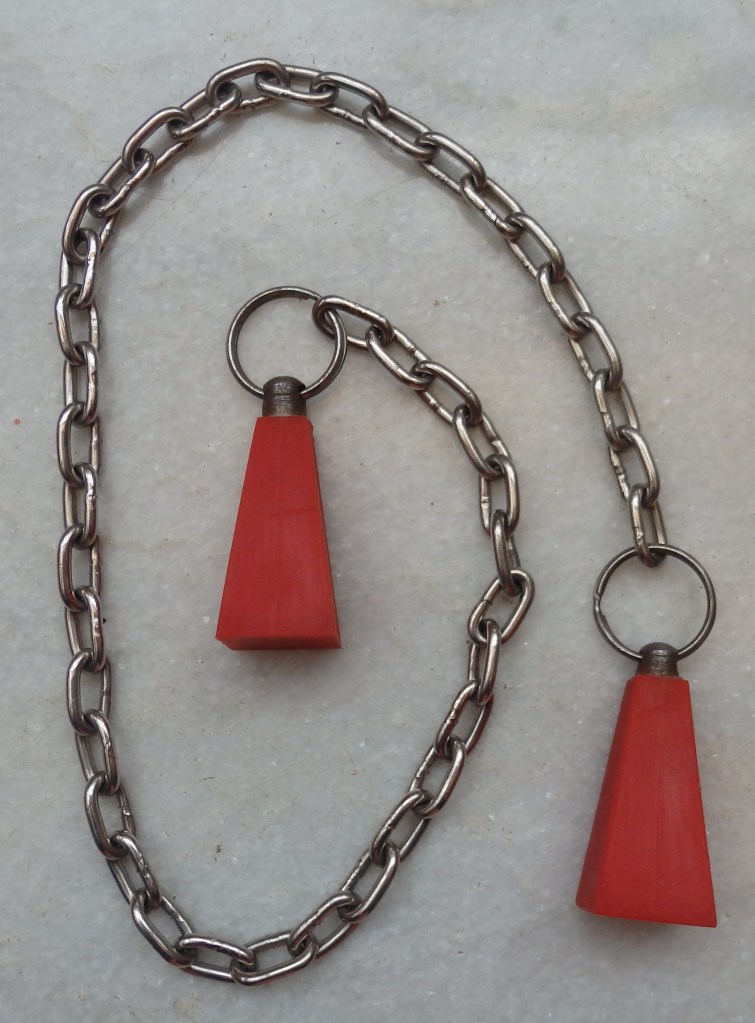
There are a few additional categories that could be considered. One category is flexible weapons. The weapons that fit into this category can be fit into one of the “ranges” based on how they are used. These include weapons like the urumi, nawa (rope), rope dart, manriki guzari, ball and chain, flails, large flails (almost pole arms), kusari gama (sickle and chain) and others that I might not even know of.

Left – Manriki Guzari, Right – Rassi Gola (Rope with Ball)

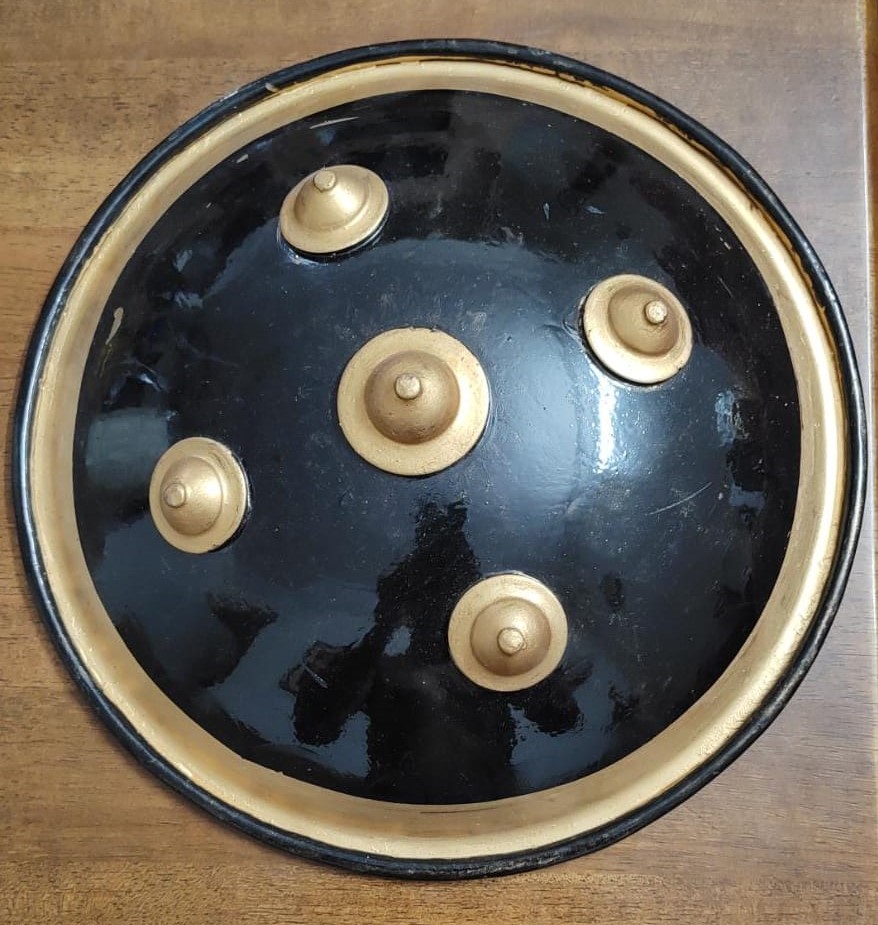
One other categorization of weapons that is very important is that between offensive and defensive weapons. The examples mentioned previously and categorizations consist entirely of offensive weapons. Defensive weapons include shields of various types, body armour and helmets of various kinds and protective clothing of any kind. This includes all protective equipment irrespective of which part of the body it protects from harm.

Defensive weapons are perhaps more important that offensive weapons as they are less likely to be illegal to either wear or carry around. Of course, they are also more important as they simply allow all practitioners to train with fewer injuries and more obviously, they are vital because they allow self-preservation with lesser experience in fighting. By this definition, bodyguards would be defensive equipment with offensive capabilities 😊 (this becomes more important I suppose for the near future, when drones take over these roles).

Dhal or Shield – this example is made of metal

Obviously, practitioners train with replica or training weapons without sharp edges and blunt or rounded points. This remains true almost always, irrespective of how experienced the people sparring or training with each other are, as the risk if injury is always to be mitigated when injuries are potentially fatal. Additionally, practitioners might wear protective equipment while training weapons (more so than with unarmed training). In cases where training happens without protective equipment, even with training weapons, practitioners learn to pull blows at the last instant or go slower with the attacks to mitigate injury and enable learning.

A student learns to first move with the weapon and then to use the weapon. Learning to move with a weapon correlates with the “Ten” aspect of unarmed combat and the “taihenjutsu” aspect of the styles of fighting mentioned in my previous article. Similarly, learning to use the weapon correlates with the “Chi” aspect of unarmed combat and the “daken taijutsu” or “jutaijutsu” aspect of the styles of fighting mentioned in my previous post.

Learning to move with the weapon is to learn of oneself with the weapon as an extension. This is very important as self-harm with a weapon is a real risk and to mitigate this, one needs to learn to be aware of or mindful of the weapon. This allows control of the weapon. In the initial stages, this awareness has to be practiced and can be tiring. Obviously, with experience, this becomes easier.

The use of the weapon is equivalent to learning how the weapon can affect an opponent. This is a reason why beginners start with shorter and lighter weapons, which are closer approximations of an extension of the human body. A knife or a kunai or a baton increases range beyond that of a fist, while still not being unwieldy for a student, in terms of momentum and weight.

To reiterate, learning to use a weapon is to realize how it can affect an opponent. A sword is not a staff with an edge, not is it as axe or a hammer where energy is concentrated. It is a device which is to be used with relative motion to cause damage. Similarly, an axe or a hammer requires momentum to cause damage. A staff on the other hand can be used as hammer if the tips of the same are deployed for the attack or it can be used to manipulate the balance of the opponent if it is used to manipulate the spinal structure or to apply joint locks on the opponent. The two can be used together in various ways. This is where one realizes that a weapon can be used with either daken taijutsu or jutaijutsu or a combination of the two (koppo justsu and kosshi jutsu).

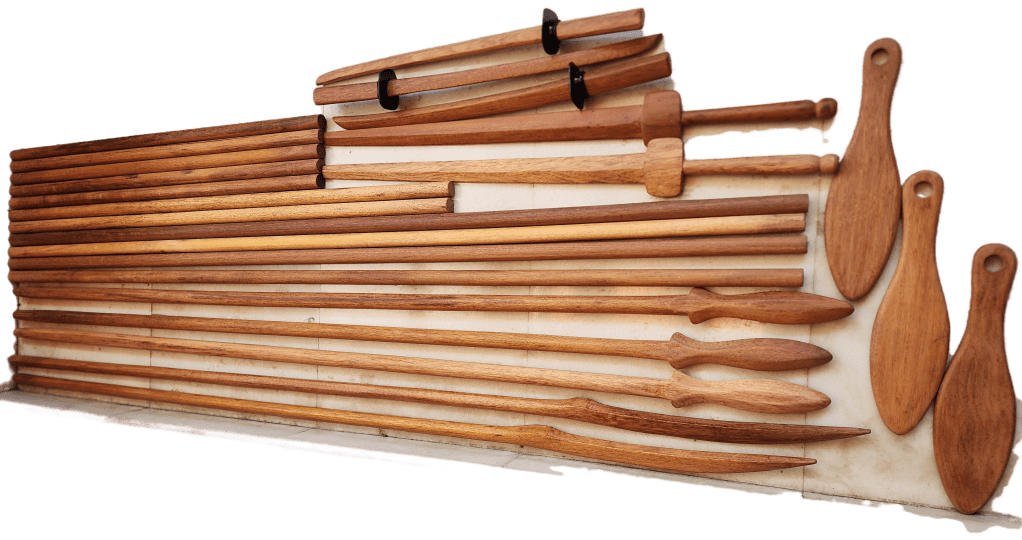
An assortment of some weapons used in the Bujinkan system of martial arts

Just as a staff of different lengths can be used in different ways, a sword can be used as something other than a cutting implement as well. A sword could be a shield, an axe, a hammer, or a knife based on the scenario. Consider an opponent who is armoured. There is no way one can cut through the armour. Stabs into gaps in the armour are possible and causing blunt force injuries through the armour are possible, but not cuts. When the tachi was taught initially, this fact was always emphasized. The tachi was an earlier iteration of the nihonto (Japanese sword) compared to the katana. The tachi had its heyday during the Muromachi** period when fighting in armour was prevalent. So, the strike with the back or the blunt edge was also used.

This brings us to the next aspect of weapons training. Armour is the key. There are several aspects of traditional fighting that evolved from the use of armour and shields. Even if one is not wearing armour, it is important to learn its influence and fight like one is wearing the same, at least sometimes. This idea is something that we were reminded of from time to time in training.

To emphasize again, even if one is using a sword or a spear, the same will be used as a shield first, especially in the absence of or the presence of light armour. Protection is always of paramount importance, especially against weapons, even if one has access to one’s own offensive weapons. So, learning the ability to receive an attack from weapons with one’s own, in a defensive manner comes before using the weapon to cause damage to the opponent (the Ten and the Chi with the weapon). This is the “uke nagashi” (ways of receiving an attack) that we described in post regarding the “Ten Chi and Jin”, with weapons of course.

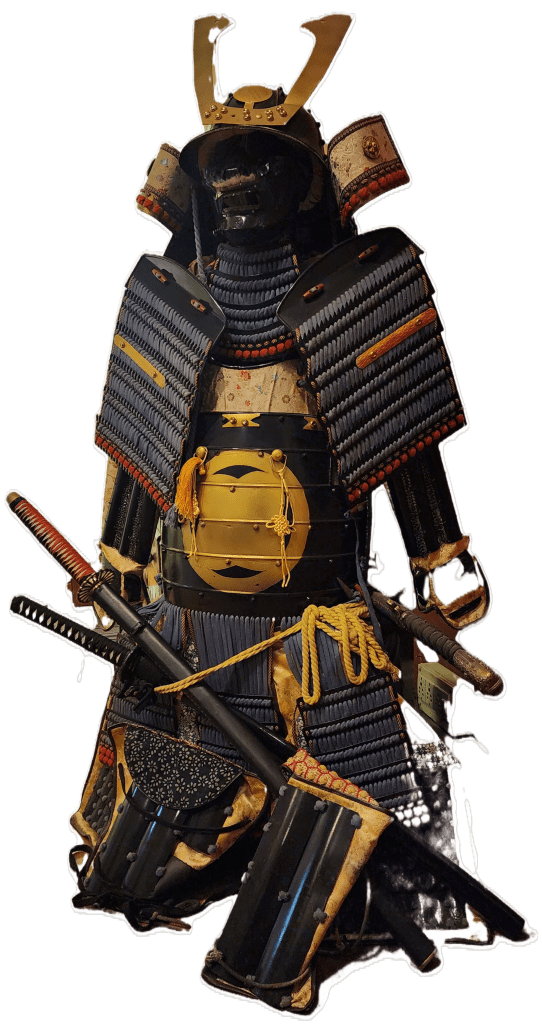
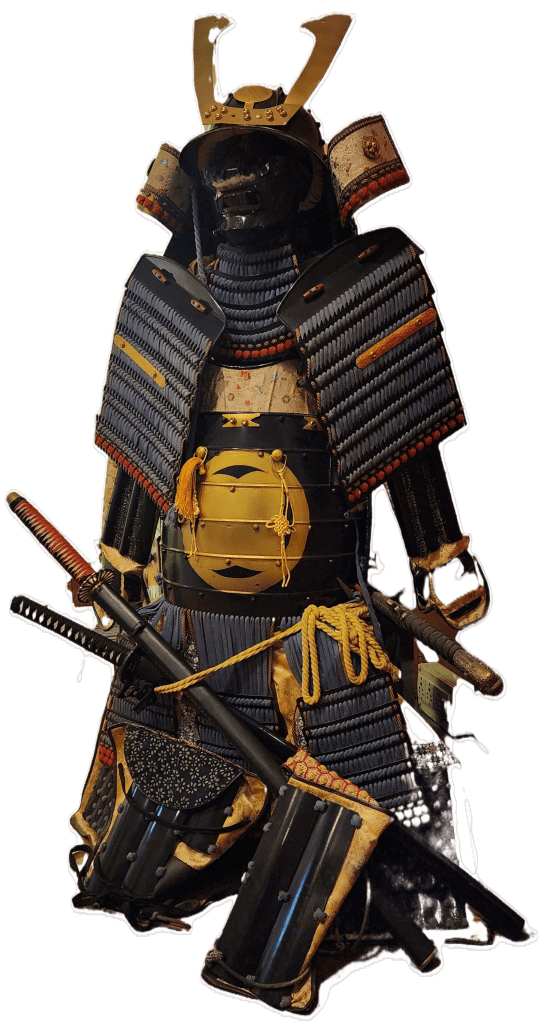
Yoroi – Japanese armour

A last point to note regarding armour and weapons is this. If an opponent is unarmoured, or at best lightly armoured, daken taitutsu would be feasible. If an opponent is well armoured, only jutaijutsu and its allied styles (kosshi jutsu) are feasible. In this context daken taijutsu refers to cutting and stabbing with a sword, stabbing with a spear or any other weapon, and of course striking with blunt force with any weapon is always feasible. If an opponent is well armoured, cuts are ineffective, stabs are only possible in openings which are not easy to access. Blunt force is viable, but is less effective than in the case of light or unarmoured opponents. Grappling is vital, even if one is using a sword or a spear against armoured opponents, as getting them on the ground or exposing openings in the armour has to be achieved only with manoeuvring the opponent’s protected frame.

The following table is a reasonable summary of the above observations.

 Armed & Armoured
Armoured & ArmedCuts are not feasibleGrappling is vitalStabs feasible only into openingsBlunt force strikes useful but less effective
Unarmoured & ArmedCuts, stabs and hits are feasibleEverything viable in armoured fighting is also feasible

There is one final point to consider regarding weapons; weapons that are not explicitly weapons. In my opinion, the most important of these are the laws of the land. These are weapons too, that are a protection if they are a deterrent to physical violence, or offensive weapons if they can cause trouble through punishment or the cumbersome legal process itself, which one has no training in. These are similar to the “generic competition” in the Porter’s Five Forces Model if that model is applied to weapons. 😛

From what I have heard, there are laws in places where a martial artist can be considered to have assaulted someone with deadly weapons, even if one did not use a real weapon. The knowledge and experience of the martial arts itself is considered a weapon! Similarly, in the case of bouncers, they are supposedly not allowed to initiate a physical encounter in some countries. There are also places, from the little that I know, where bouncers are not allowed to strike anyone, they are only allowed to use restraining and subduing techniques. In other words, they can only use kosshi jutsu or more specifically jutaijutsu even if the attack is daken taijutsu. So, awareness of laws and other such “non-weapons” might also be a part of mindfulness (or even Sakkijutsu*!) and martial artists, especially experienced ones cannot be oblivious of these aspects!

This non-weapon concept can also be expanded to using the weather and the terrain to one’s advantage, making knowledge and the ability to be mindful of the terrain and the atmosphere weapons as well. This is, in some ways, not unlike using the reflection from a sword to blind an opponent or using water gathered in the fuller of a sword to gain a moment by distracting the opponent. This then leads to using a cloak or a lantern or pocket sand/blinding powder as an accessory to weapons, which might lead to significant changes in the physical exchange.

I am ending the post with something I posted at the beginning of the first post in this series. Seen below is the reason I am posting this series of articles. This segment will be present at the end of each of the posts in this series, just as a reiteration.

The purpose of this series of posts is multi-fold. Firstly, it is a resource I can share with people who are not practitioners of the martial arts. For most of us, a majority of the people we interact with do not practice any form of martial art. Sharing ideas and practices about martial arts might require some “first principles” like definitions, overarching themes and ideas and objectives of the art form. Hopefully this series will be that resource.

Secondly, it is an opportunity for me to look back at my own thoughts about the Bujinkan. The thoughts are a document I can refer in the future to see if I my thinking has changed or evolved.

Lastly, practitioners of the Bujinkan who are relatively new to the system and long-time practitioners who might need a look back at aspects from earlier years could use this as a starting point for further discovery. There are several practitioners and Sensei of the Bujinkan with a lot more experience compared to me, who share content about the art form and the system. I strongly recommend that everyone consume the content from those sources. This series is possibly an index to search further in those sources.

So, this series in not a deep dive, more like a primer of my thoughts with scope for expansion in each aspect. Most importantly, whatever knowledge can be gleaned from this series is a conversation starter or direction pointer at best; it does not in any way replace actual training in a dojo with fellow budoka and a teacher who can help one progress.

Notes:

* Sakkijutsu – intuitive ability, awareness, mindfulness

** The Muromachi period is contemporaneous with the Vijayanagar kingdom in India

The Bujinkan, as I see it – Series 1, Part 3

The Schools and the Styles of fighting

Wish you all a happy new year and a wonderful 2025! 😀

On to the post now. 🙂

In the first post of this series, I had given an introduction to this series and defined some basic concepts that will be revisited time and again during subsequent posts. In the second post, I had looked in greater detail at the “Ten Chi and Jin”.  In this post, the third in the series, I will look at the different schools that make up the Bujinkan system of martial arts. This is the second among the 4 aspects I had referred to as the “physical aspects” of the Bujinkan. These are seen in the screenshot below. The topic highlighted is the focus of this article.

The Bujinkan system of martial arts teaches five styles of unarmed fighting. These styles are fairly universal when it comes to humans fighting humans without firearms and projectile weapons. The Bujinkan system comprises of 9 schools of combat of which six are taught routinely. Of the remaining three, no regular teaching takes place. As I understand it, the schools are less important than the styles of fighting they encompass, as multiple schools can teach similar or related concepts. So, I will focus on the fighting styles and share a few words regarding the schools later in this article.

The five styles of fighting can more realistically be considered to be two styles of fighting, one layer of fundamentals and two other styles which are a combination of the other three, to achieve interesting objectives. The five styles are mentioned below.

  • Taihenjutsu
  • Daken taijutsu
  • Jutaijutsu
  • Koppo jutsu
  • Kosshi jutsu

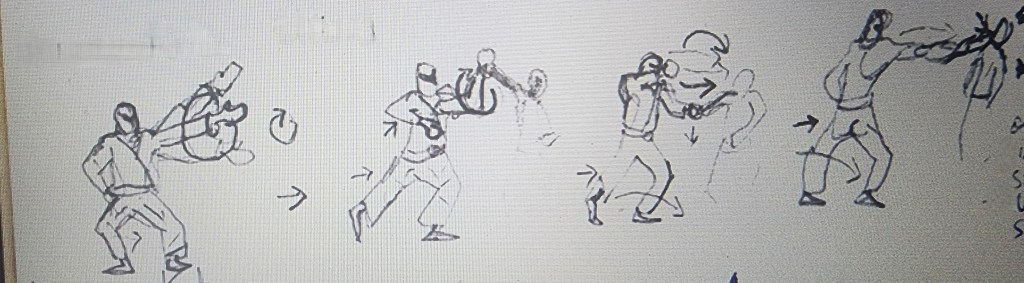
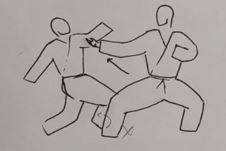
Tainhenjutsu – This is the base layer and involves learning the ability to move the body as desired to achieve favourable outcomes in a fight. It could be said that this is comprised of the Ten Ryaku no Maki and quite a bit of the Chi Ryaku no Maki which I explored in the previous article in this series.

In the martial arts, without the correct positioning of the body, nothing can be achieved in a fight. And positioning can only be achieved with the ability to move the body as required in a given situation. Since Taihenjutsu is all about body movement, this is perhaps the most important layer in the Bujinkan. I would suspect that the equivalent of Taihenjutsu is the most important layer in all martial arts around the world.

A representation of Taihenjutsu, showing movement and body positioning. Sketch by Keane Amaral

Daken taijutsu – Daken taijutsu refers to the style of fighting that involves striking. By that definition, martial arts like boxing, kick boxing, mushti yuddha, sanda, taekwondo and the like are also expressions of daken taijutsu. Striking an opponent with any part of the body would qualify as daken taijutsu. This is not to preclude locks and throws. It is just that striking takes primacy in this style of fighting.

Striking effectively of course, requires one to be in the right position to execute the strike. Also, one needs to move out of range of any strike the opponent may carry out. This part of daken taijutsu is of course, still taihenjutsu. So, daken taijutsu is an additional layer over taihenjutsu.

A representation of Daken Taijutsu, showing potential strikes. Sketch by Keane Amaral.

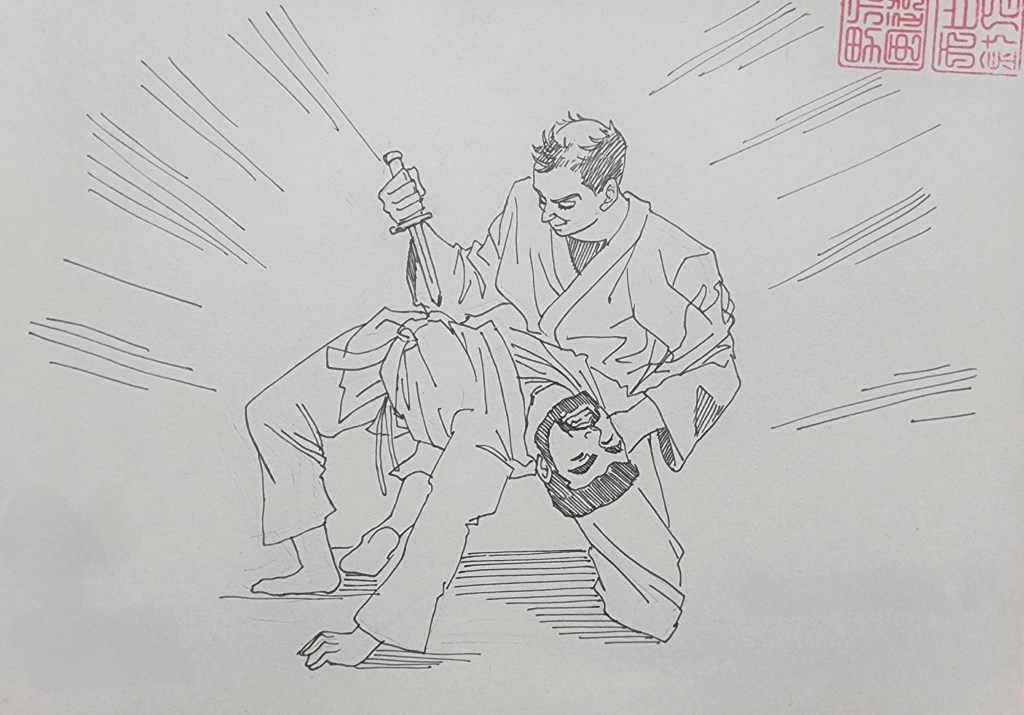
Jutaijutsu – Jutaijustsu refers to the style of fighting that involves grappling, throws and joint locks. Based on this definition, Olympic wrestling, judo, Brazilian Jiujitsu, malla yuddha, kushti, aikido, sumo wrestling and the like, are expressions of jutaijutsu. The opponent here might be grappling or striking or using a combination of both. But the defence has a primacy towards immobilising the opponent using grappling, locking and throwing the opponent. Like with daken taijutsu, jutaijutsu does not preclude striking, but the focus in not towards striking is all.

Again, taihenjutsu is the base layer with jutaijutsu, even more so than with daken taijutsu. Getting an opponent to the ground to mitigate an attack, requires far more efficient body movement and positioning than striking, as physics and leverage play a very important role in the same. So, jutaijutsu is an additional option available to a practitioner of Budo apart from daken taijutsu, after taihenjutsu has been understood and executed.

An exaggerated representation of Jutaijutsu, representing taking down an opponent . An image I commissioned in a past Comic Con in Bangalore.

The next two fighting styles are expressions of the combination of the above three layers.

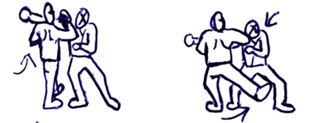
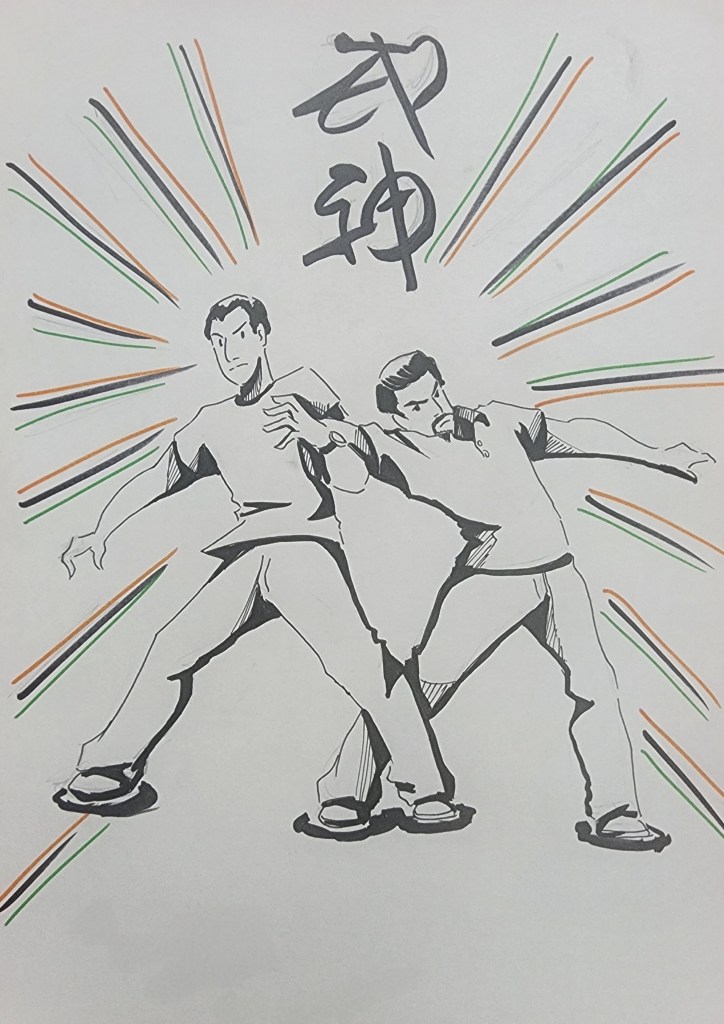
Koppo jutsu – Koppo jutsu is generally explained to be a fighting style that uses striking in a specialized manner. One strikes an opponent to affect the skeletal structure of the opponent. In other words, the strike is applied to displace an opponent from the position she or he was in. Alternatively, the strike could be to take the balance of the opponent. Once the opponent has been displaced or has lost balance, a follow through happens where additional strikes are applied, or a throw or lock can be applied as well. All of this could take the opponent down to the ground or the process could continue until the opponent ceases the attack and retreats.

In my opinion, koppo jutsu is a case of referring to taihenjutsu and daken taijutsu together. So, as a simple definition I would state the following.

Koppo jutsu = Taihenjutsu + Daken taijutsu

But in practice, koppo jutsu is as follows,

Koppo jutsu = Taihenjutsu + Daken taijutsu + Jutaijutsu

The above formulation can be explained as follows. Taihenjutsu is the basis of the movement. A strike is applied (daken taijutsu) while moving (taihenjutsu) to affect the opponent’s balance or position. This is followed with jutaijutsu to mitigate the attack effectively. This is the reason I have put jutaijutsu AFTER daken taijutsu in the above formulation.

Koppo jutsu’s defining feature is to strike with effective movement to affect the physical structure of the opponent. In other words, koppo jutsu seems to me to be designed to defeat the taihenjutsu of the opponent, or, the BASIS/ORIGIN of the opponent’s movement/attack. Any aspect of the earlier fighting styles can be used after this is achieved. So, there is no need for this fighting style to be visually different from daken taijutsu, or even jutaijutsu based on the finishing method applied. The difference can only be experienced by the people involved in the martial exchange that occurs.

A representation of Koppo Jutsu, showing a strike putting the opponent off balance. Sketch by Vishnu Mohan.

Kosshi jutsu – In simple terms, Kosshi jutsu can be termed as “specialized jutaijutsu”, in my opinion of course. The focus of this style of fighting is to affect the balance of the opponent by attacking her or his vertical or horizontal axis or the intersection of the two axes. Yes, this sounds awesome and farfetched at the same time. In reality, the attack is mitigated by attacking the hips, shoulders, knees and face of the opponent. Of course, the uke nagashi or receiving the attack without injury is very important here.

Uke nagashi occurs simultaneously with attacking the opponent’s balance. One moves the opponent’s hips or shoulders, knees or face while surviving the attack. This breaks the opponent’s balance even as the attack is being completed. The attack to the opponent’s axes (plural of axis, not the tool) can be with a strike or a push, it often is something in-between, which translates as a soft strike. Once the opponent has lost balance, she or he can be taken down with further daken taijutsu or jutaijutsu. If this is not achieved in the first move, the process continues until the attack is mitigated.

I guess it is obvious that taihenjutsu is again the origin of this fighting style. For uke nagashi has to be achieved while attacking the axes of the opponent. So, good, safe movement is the key to get into a safe position to apply an effective attack against the opponent.

In my opinion, kosshi jutsu can be explained as seen below.

Kosshi Jutsu = Taihenjutsu + Jutaijutsu

Here I use jutaijutsu to refer to “the taking of the balance” and not necessarily with a strike. In reality, the formulation could be thus,

Kosshi Jutsu = Taihenjutsu + Jutaijutsu + Daken taijutsu

Here, I add daken taijutsu AFTER jutaijutsu, as the primary objective of breaking the opponent’s axes, & hence balance, is geared more towards jutaijutsu rather than daken taijutsu. But the finishing, after the opponent’s balance is taken, can be achieved by applying additional jutaijutsu or daken taijutsu, as the situation warrants. So, in the above formulation, jutaijutsu and daken taijutsu can be interchanged or added twice! It really does not matter. Here again, a bystander might not see a visual difference between kosshi jutsu, daken taijutsu, jutaijutsu and kosshi jutsu. It is purely something experienced by those physically involved in the martial exchange.

An exaggerated representation of Kosshi Jutsu, representing taking an opponent’s balance by misaligning the vertical axis (the spine). An image I commissioned in a past Comic Con in Bangalore.

I must add a qualifier here. These explanations are based on my learning from my teacher and mentors. It is not even necessarily the opinion of my teacher and mentors. There could be other interpretations of these fighting styles from other practitioners who have a lot more experience as compared with mine. Also, people studying the history, origins and evolution of these styles within the context of even just the Bujinkan could have a different interpretation of these fighting styles.

Now we return the schools mentioned earlier. The Bujinkan system comprises of 9 different schools. I will not expound too much on these, but share a few lines about each. One has to physically train and experience the schools for a deeper understanding. Also, since description of the sighting styles fairly encompasses what could be described in brief about the schools. Also, I will revisit the schools in a future article, when we look at some of the non-physical aspects of the Bujinkan, which involves how historical context shapes what we learn in the martial arts.

There are two schools of Daken taijutsu. These are the Shinden Fudo Ryu and the Kukishinden Ryu. The difference between the two is that the Kukishinden Ryu has a lineage of fighting while wearing armour, while the lineage of the Shinden Fudo Ryu is from fighting in wooded areas. Hence, one would expect to be lightly armoured, if at all, while having more obstacles than in the case of the Kukishinden Ryu.

Representative Japanese armour, an example we have at our dojo

Koppo jutsu is represented by the Koto Ryu and the Gikan Ryu. The Koto Ryu is the source of a lot of the basics in the Ten Chi and Jin described in the previous article in this series. The Gikan Ryu supposedly has no densho (scroll/manual) or defined forms/techniques and is not explicitly taught in the Bujinkan.

Kosshi jutsu is represented by the Gyokko Ryu, which is supposed to be the oldest of the schools taught in the Bujinkan. Its historicity is supposed to be from fighting in the small spaces in the interiors of royal buildings and applied by nobles for self-protection.

Jutaijutsu is represented by the Takagi Yoshin Ryu. This school was used by bodyguards of the nobles, and they had a need to immobilize and arrest attackers for later information gathering. Killing the attacker would result in the identity of the person ordering the hit being lost. Of course, this is the objective, it does not mean that assassins were always captured alive.

Lastly, there is the style of Ninpo taijutsu. This is not mentioned in the five styles of fighting as I understand the system. The Togakure Ryu is a ninpo taijutsu school and is taught routinely in the Bujinkan. Based on my experience of the same, it has elements of taihenjutsu (surprise!) daken taijutsu and jutaijutsu.

Two other schools of ninpo taijutsu are a part of the Bujinkan system. One is the Gyokushin Ryu, which does not have a densho, but Soke taught the essence (key points) of this school to a few Daishihan who have shared the same with the rest of the practitioners. The last school of ninpo taijutsu is the Kumogakure Ryu, which also has no densho. I have heard it said that this school had teachings related to disguises, hiding and such. But I have no real knowledge about this school to comment further. This again, is not taught in the Bujinkan despite being a part of the system.

Ninpo taijutsu includes training weapons, espionage, meteorology and use of firearms and explosives, from a historical perspective. These are not commonly taught in most dojos. However, Ninpo Taijutsu is also a source of several concepts that are not just for application in a physical fight. These are aspects I will likely look at in a future article.

So, of the nine schools, six are taught and practiced routinely, while three are not. Of these, practitioners have access to the essence/key points of one, while of the last two, nothing is really known, at least by me.

I am ending the post with something I posted at the beginning of the first post in this series. Seen below is the reason I am posting this series of articles. This segment will be present at the end of each of the posts in this series, just as a reiteration.

The purpose of this series of posts is multi-fold. Firstly, it is a resource I can share with people who are not practitioners of the martial arts. For most of us, a majority of the people we interact with do not practice any form of martial art. Sharing ideas and practices about martial arts might require some “first principles” like definitions, overarching themes and ideas and objectives of the art form. Hopefully this series will be that resource.

Secondly, it is an opportunity for me to look back at my own thoughts about the Bujinkan. The thoughts are a document I can refer in the future to see if I my thinking has changed or evolved.

Lastly, practitioners of the Bujinkan who are relatively new to the system and long-time practitioners who might need a look back at aspects from earlier years could use this as a starting point for further discovery. There are several practitioners and Sensei of the Bujinkan with a lot more experience compared to me, who share content about the art form and the system. I strongly recommend that everyone consume the content from those sources. This series is possibly an index to search further in those sources.

So, this series in not a deep dive, more like a primer of my thoughts with scope for expansion in each. Most importantly, whatever knowledge can be gleaned from this series is a conversation starter or direction pointer at best; it does not in any way replace actual training in a dojo with fellow budoka and a teacher who can help one progress.