Weapons and the feeling of armour/defensive equipment
In the first post of this series, I had given an introduction to this series and defined some basic concepts that will be revisited during subsequent posts. In the second post, I had looked in greater detail at the “Ten Chi and Jin”, which is considered the “basics” of the Bujinkan. In the third post, I discussed in brief the 5 styles of fighting and the 9 schools that make up the Bujinkan system of martial arts. In this post I will discuss the use of weapons as a part of training in the Bujinkan, which in my opinion is the most important aspect of the martial arts. This is one of the 4 aspects I had referred to as the “physical aspects” of the Bujinkan. These are seen in the screenshot below. The topic highlighted is the focus of this article.
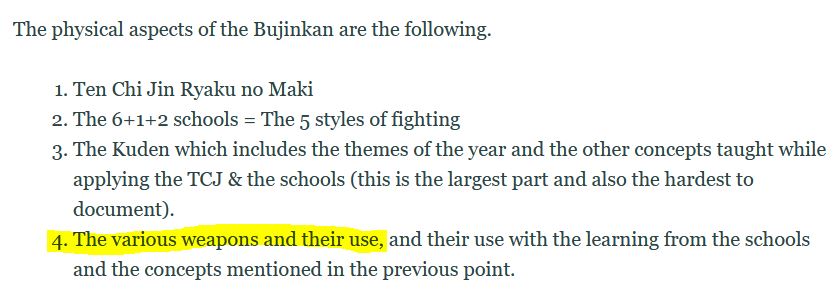
A bit of a disclaimer before we start. A better title for this post would perhaps be “Martial Art, as I see it”. This post is a brief look at weapons as considered in martial arts as a whole, and is not specific to just the weapons used in the Bujinkan system alone. I might write an article about the weapons specific to the Bujinkan (there are a lot!) at a future date.
There is another serendipitous connection for this post. Three days from today is the 76th Republic Day of India. Traditionally, the parade during Republic Day of India on Kartavya Path (previously Raj Path) is when a lot of India’s modern weapons systems are on display. They are accompanied by the marching contingents of various units of the Indian Defence Tri-services and various law enforcement organizations. So, a post about weapons so close to the annual display of India’s weapons, seems apt! 🙂
Weapons have always formed a vital part of both self-protection and evasion. All martial arts teach the use of weapons, except perhaps if they have evolved exclusively into sports. Even in this case, if there is a sport version and a traditional version of the same martial art, the traditional version tends to retain training with weapons. Of course, the weapon based fighting itself can evolve into a sport as well.
Once a practitioner has a fair knowledge of oneself and how to affect the opponent (from the Ten Chi and Jin in the case of the Bujinkan), she or he can start training with various weapons. The weapons used can generally be classified based on the range offered by the same. These are,
- Short range weapons like the knife, kunai, wakizashi and other short swords, batons, yawara sticks, bagh nakh, katar, ankusha, war hammer and the like.
- Medium range weapons like the walking stick, hanbo, jo, longer swords, tachi and katana, dand pata, gada and the like.
- Long range weapons like the bo, quarter staff, spear, naginata, halberd, glaive, great sword, vita, dane axe and all the other pole arms.
- Projectile weapons like dart, throwing axe, bow and arrow, throwing knife, shuriken, javelin, chakra and other similar weapons that are discharged.
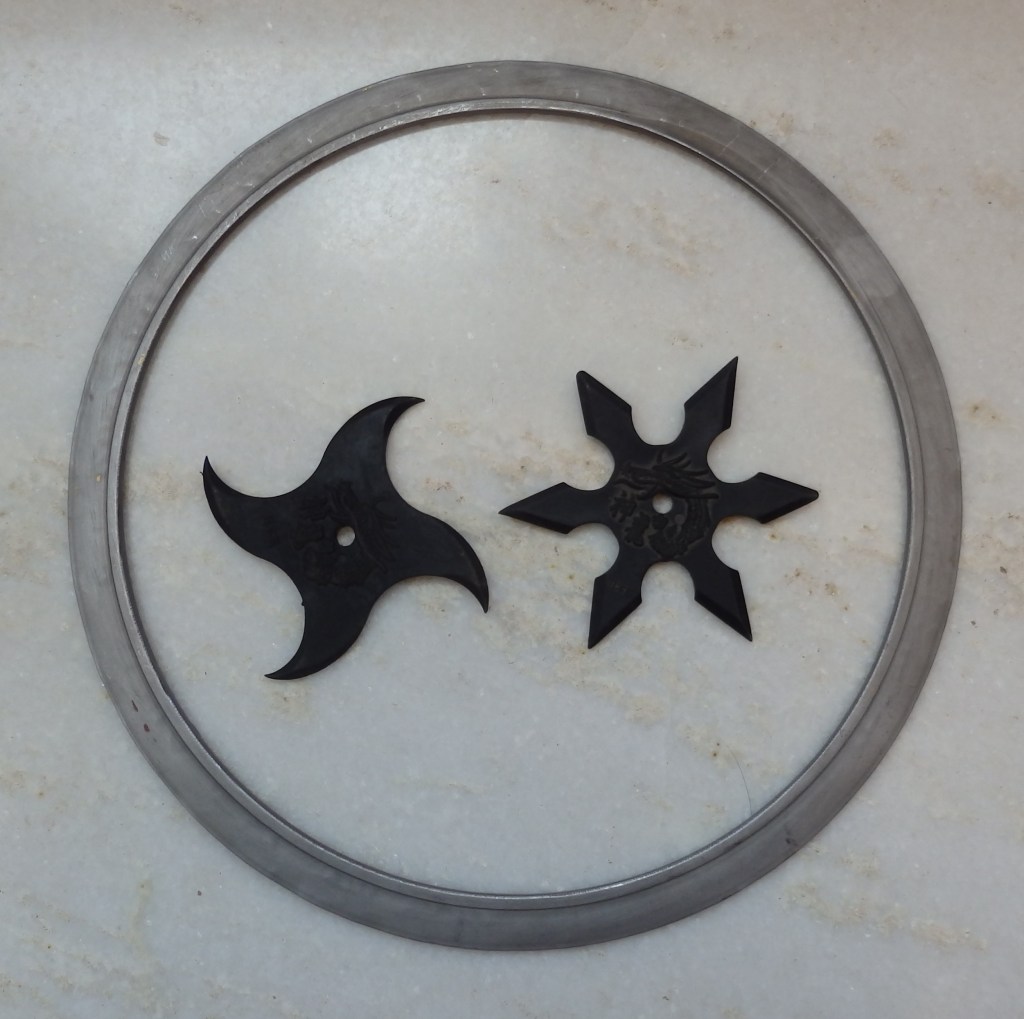
Projectile weapons – Chakra (on the outside) and Shuriken (on the inside)
There are a few additional categories that could be considered. One category is flexible weapons. The weapons that fit into this category can be fit into one of the “ranges” based on how they are used. These include weapons like the urumi, nawa (rope), rope dart, manriki guzari, ball and chain, flails, large flails (almost pole arms), kusari gama (sickle and chain) and others that I might not even know of.
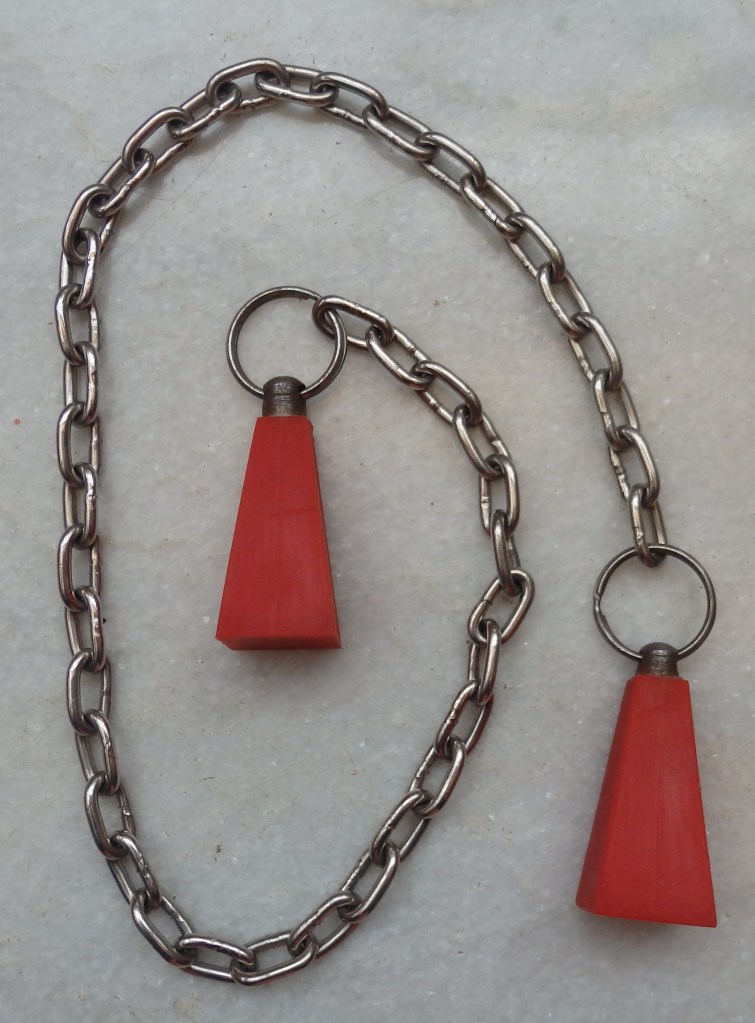

Left – Manriki Guzari, Right – Rassi Gola (Rope with Ball)
One other categorization of weapons that is very important is that between offensive and defensive weapons. The examples mentioned previously and categorizations consist entirely of offensive weapons. Defensive weapons include shields of various types, body armour and helmets of various kinds and protective clothing of any kind. This includes all protective equipment irrespective of which part of the body it protects from harm.
Defensive weapons are perhaps more important that offensive weapons as they are less likely to be illegal to either wear or carry around. Of course, they are also more important as they simply allow all practitioners to train with fewer injuries and more obviously, they are vital because they allow self-preservation with lesser experience in fighting. By this definition, bodyguards would be defensive equipment with offensive capabilities 😊 (this becomes more important I suppose for the near future, when drones take over these roles).
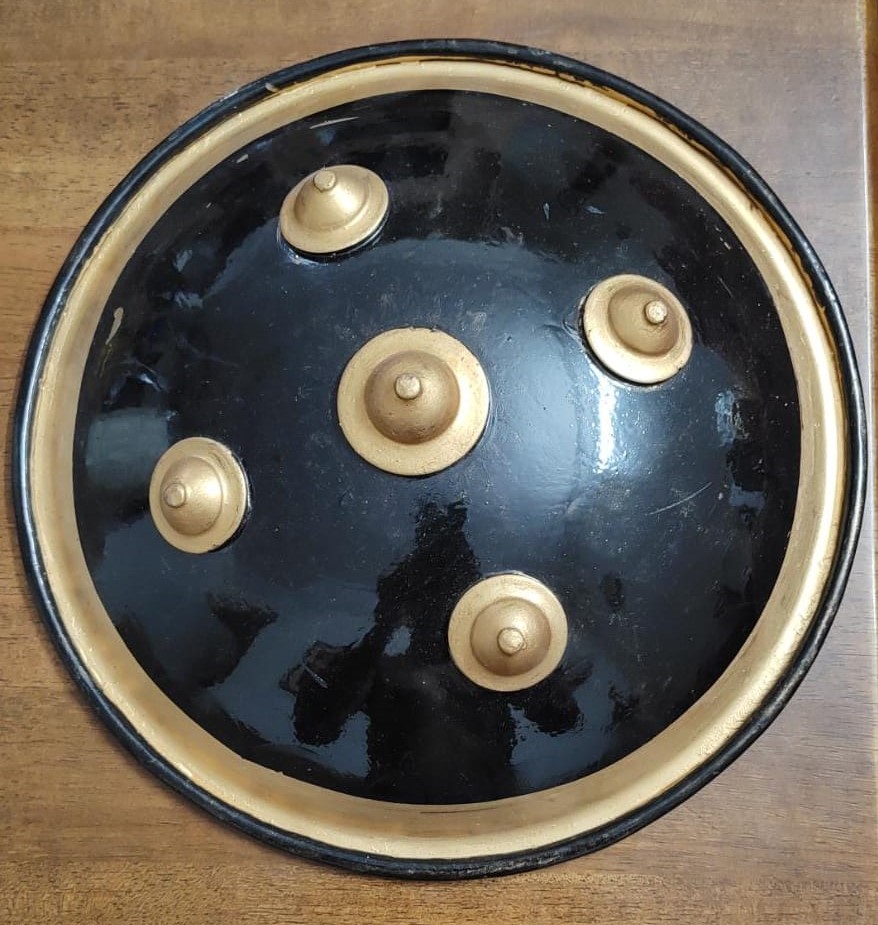
Dhal or Shield – this example is made of metal
Obviously, practitioners train with replica or training weapons without sharp edges and blunt or rounded points. This remains true almost always, irrespective of how experienced the people sparring or training with each other are, as the risk if injury is always to be mitigated when injuries are potentially fatal. Additionally, practitioners might wear protective equipment while training weapons (more so than with unarmed training). In cases where training happens without protective equipment, even with training weapons, practitioners learn to pull blows at the last instant or go slower with the attacks to mitigate injury and enable learning.
A student learns to first move with the weapon and then to use the weapon. Learning to move with a weapon correlates with the “Ten” aspect of unarmed combat and the “taihenjutsu” aspect of the styles of fighting mentioned in my previous article. Similarly, learning to use the weapon correlates with the “Chi” aspect of unarmed combat and the “daken taijutsu” or “jutaijutsu” aspect of the styles of fighting mentioned in my previous post.
Learning to move with the weapon is to learn of oneself with the weapon as an extension. This is very important as self-harm with a weapon is a real risk and to mitigate this, one needs to learn to be aware of or mindful of the weapon. This allows control of the weapon. In the initial stages, this awareness has to be practiced and can be tiring. Obviously, with experience, this becomes easier.
The use of the weapon is equivalent to learning how the weapon can affect an opponent. This is a reason why beginners start with shorter and lighter weapons, which are closer approximations of an extension of the human body. A knife or a kunai or a baton increases range beyond that of a fist, while still not being unwieldy for a student, in terms of momentum and weight.
To reiterate, learning to use a weapon is to realize how it can affect an opponent. A sword is not a staff with an edge, not is it as axe or a hammer where energy is concentrated. It is a device which is to be used with relative motion to cause damage. Similarly, an axe or a hammer requires momentum to cause damage. A staff on the other hand can be used as hammer if the tips of the same are deployed for the attack or it can be used to manipulate the balance of the opponent if it is used to manipulate the spinal structure or to apply joint locks on the opponent. The two can be used together in various ways. This is where one realizes that a weapon can be used with either daken taijutsu or jutaijutsu or a combination of the two (koppo justsu and kosshi jutsu).
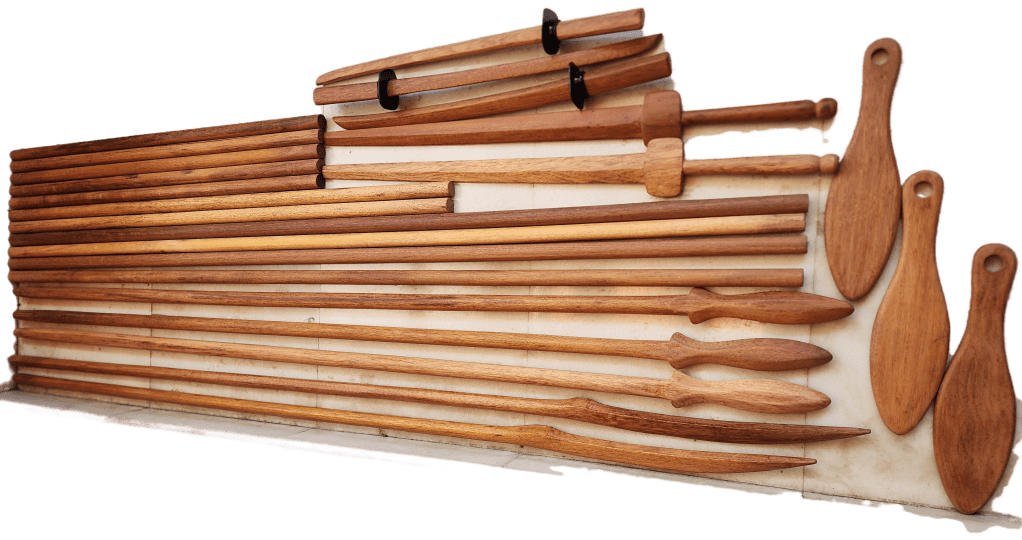
An assortment of some weapons used in the Bujinkan system of martial arts
Just as a staff of different lengths can be used in different ways, a sword can be used as something other than a cutting implement as well. A sword could be a shield, an axe, a hammer, or a knife based on the scenario. Consider an opponent who is armoured. There is no way one can cut through the armour. Stabs into gaps in the armour are possible and causing blunt force injuries through the armour are possible, but not cuts. When the tachi was taught initially, this fact was always emphasized. The tachi was an earlier iteration of the nihonto (Japanese sword) compared to the katana. The tachi had its heyday during the Muromachi** period when fighting in armour was prevalent. So, the strike with the back or the blunt edge was also used.
This brings us to the next aspect of weapons training. Armour is the key. There are several aspects of traditional fighting that evolved from the use of armour and shields. Even if one is not wearing armour, it is important to learn its influence and fight like one is wearing the same, at least sometimes. This idea is something that we were reminded of from time to time in training.
To emphasize again, even if one is using a sword or a spear, the same will be used as a shield first, especially in the absence of or the presence of light armour. Protection is always of paramount importance, especially against weapons, even if one has access to one’s own offensive weapons. So, learning the ability to receive an attack from weapons with one’s own, in a defensive manner comes before using the weapon to cause damage to the opponent (the Ten and the Chi with the weapon). This is the “uke nagashi” (ways of receiving an attack) that we described in post regarding the “Ten Chi and Jin”, with weapons of course.
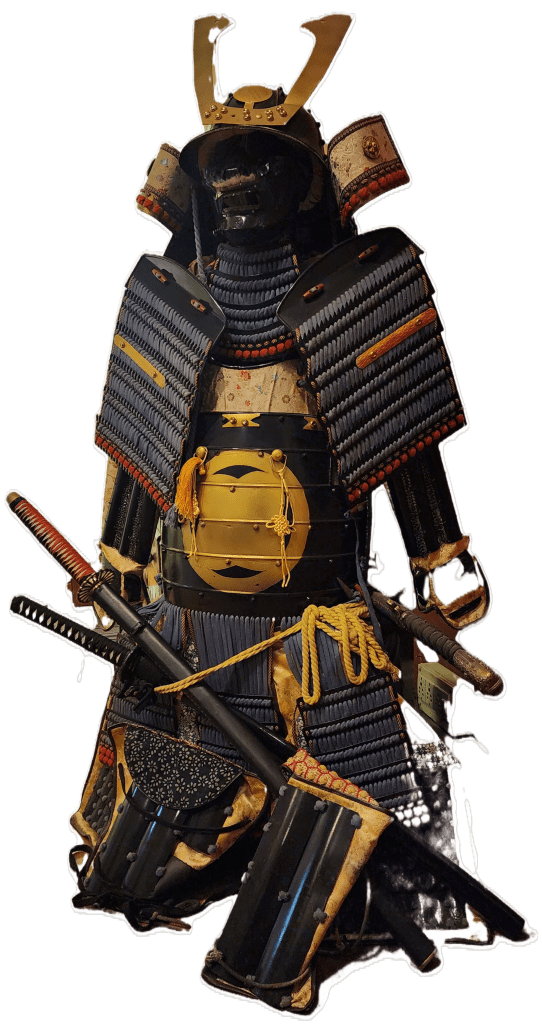
Yoroi – Japanese armour
A last point to note regarding armour and weapons is this. If an opponent is unarmoured, or at best lightly armoured, daken taitutsu would be feasible. If an opponent is well armoured, only jutaijutsu and its allied styles (kosshi jutsu) are feasible. In this context daken taijutsu refers to cutting and stabbing with a sword, stabbing with a spear or any other weapon, and of course striking with blunt force with any weapon is always feasible. If an opponent is well armoured, cuts are ineffective, stabs are only possible in openings which are not easy to access. Blunt force is viable, but is less effective than in the case of light or unarmoured opponents. Grappling is vital, even if one is using a sword or a spear against armoured opponents, as getting them on the ground or exposing openings in the armour has to be achieved only with manoeuvring the opponent’s protected frame.
The following table is a reasonable summary of the above observations.
| Armed & Armoured | |
| Armoured & Armed | Cuts are not feasibleGrappling is vitalStabs feasible only into openingsBlunt force strikes useful but less effective |
| Unarmoured & Armed | Cuts, stabs and hits are feasibleEverything viable in armoured fighting is also feasible |
There is one final point to consider regarding weapons; weapons that are not explicitly weapons. In my opinion, the most important of these are the laws of the land. These are weapons too, that are a protection if they are a deterrent to physical violence, or offensive weapons if they can cause trouble through punishment or the cumbersome legal process itself, which one has no training in. These are similar to the “generic competition” in the Porter’s Five Forces Model if that model is applied to weapons. 😛
From what I have heard, there are laws in places where a martial artist can be considered to have assaulted someone with deadly weapons, even if one did not use a real weapon. The knowledge and experience of the martial arts itself is considered a weapon! Similarly, in the case of bouncers, they are supposedly not allowed to initiate a physical encounter in some countries. There are also places, from the little that I know, where bouncers are not allowed to strike anyone, they are only allowed to use restraining and subduing techniques. In other words, they can only use kosshi jutsu or more specifically jutaijutsu even if the attack is daken taijutsu. So, awareness of laws and other such “non-weapons” might also be a part of mindfulness (or even Sakkijutsu*!) and martial artists, especially experienced ones cannot be oblivious of these aspects!
This non-weapon concept can also be expanded to using the weather and the terrain to one’s advantage, making knowledge and the ability to be mindful of the terrain and the atmosphere weapons as well. This is, in some ways, not unlike using the reflection from a sword to blind an opponent or using water gathered in the fuller of a sword to gain a moment by distracting the opponent. This then leads to using a cloak or a lantern or pocket sand/blinding powder as an accessory to weapons, which might lead to significant changes in the physical exchange.
I am ending the post with something I posted at the beginning of the first post in this series. Seen below is the reason I am posting this series of articles. This segment will be present at the end of each of the posts in this series, just as a reiteration.
The purpose of this series of posts is multi-fold. Firstly, it is a resource I can share with people who are not practitioners of the martial arts. For most of us, a majority of the people we interact with do not practice any form of martial art. Sharing ideas and practices about martial arts might require some “first principles” like definitions, overarching themes and ideas and objectives of the art form. Hopefully this series will be that resource.
Secondly, it is an opportunity for me to look back at my own thoughts about the Bujinkan. The thoughts are a document I can refer in the future to see if I my thinking has changed or evolved.
Lastly, practitioners of the Bujinkan who are relatively new to the system and long-time practitioners who might need a look back at aspects from earlier years could use this as a starting point for further discovery. There are several practitioners and Sensei of the Bujinkan with a lot more experience compared to me, who share content about the art form and the system. I strongly recommend that everyone consume the content from those sources. This series is possibly an index to search further in those sources.
So, this series in not a deep dive, more like a primer of my thoughts with scope for expansion in each aspect. Most importantly, whatever knowledge can be gleaned from this series is a conversation starter or direction pointer at best; it does not in any way replace actual training in a dojo with fellow budoka and a teacher who can help one progress.
Notes:
* Sakkijutsu – intuitive ability, awareness, mindfulness
** The Muromachi period is contemporaneous with the Vijayanagar kingdom in India
 Mundane Budo
[…] the advantage physical prowess provides. This includes both offensive and defensive weapons. In my previous post, from last week, I had discussed the importance of weapons in the martial arts*. This seems like a […]
LikeLike
[…] the 5 styles of fighting and the 9 schools that make up the Bujinkan system of martial arts. In the fourth post I discussed the use of weapons as a part of training in the Bujinkan and martial arts in general, […]
LikeLike
[…] as I see it – Series 1, Part 2 The Bujinkan, as I see it – Series 1, Part 3 The Bujinkan, as I see it – Series 1, Part 4 The Bujinkan, as I see it – Series 1, Part 5 […]
LikeLike