Learning from oral transmission and experiences in the training spaces
The purpose of this series of posts is multi-fold. Firstly, it is a resource I can share with people who are not practitioners of the martial arts. For most of us, a majority of the people we interact with do not practice any form of martial art. Sharing ideas and practices about martial arts might require some “first principles” like definitions, overarching themes and ideas and objectives of the art form. Hopefully this series will be that resource.
Secondly, it is an opportunity for me to look back at my own thoughts about the Bujinkan. The thoughts are a document I can refer in the future to see if I my thinking has changed or evolved.
Lastly, practitioners of the Bujinkan who are relatively new to the system and long-time practitioners who might need a look back at aspects from earlier years could use this as a starting point for further discovery. There are several practitioners and Sensei of the Bujinkan with a lot more experience compared to me, who share content about the art form and the system. I strongly recommend that everyone consume the content from those sources. This series is possibly an index to search further in those sources.
So, this series in not a deep dive, it is more like a primer of my thoughts with scope for expansion in each aspect. Most importantly, whatever knowledge can be gleaned from this series is a conversation starter or direction pointer at best; it does not in any way replace actual training in a dojo with fellow budoka and a teacher who can help one progress.
In the first post of this series, I had given an introduction to this series and defined some basic concepts that would be revisited during subsequent posts. In the second post, I had looked in greater detail at the “Ten Chi and Jin”, which is considered the “basics” of the Bujinkan. In the third post, I discussed in brief the 5 styles of fighting and the 9 schools that make up the Bujinkan system of martial arts. In the fourth post I discussed the use of weapons as a part of training in the Bujinkan and martial arts in general, which in my opinion is the most important aspect of the martial arts. In this part, I will discuss how learning occurs in the Bujinkan and perhaps in most martial arts around the world. This is last of the aspects I had referred to as the “physical aspects” of the Bujinkan. These are seen in the screenshot below. The topic highlighted is the focus of this article.
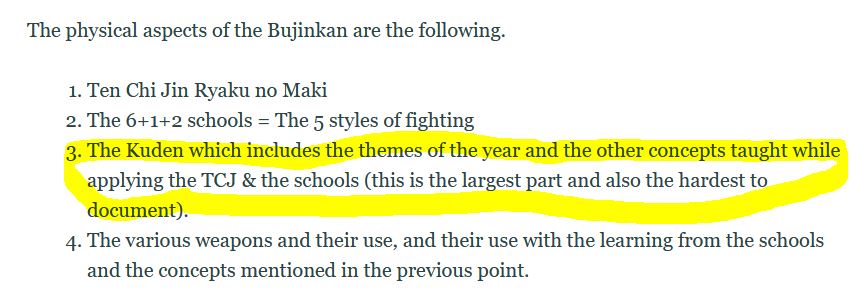
This post refers to the actual training, learning, experience, expression and realization that happens in the space where martial arts training occurs. The space of training can be called dojo, akhada, kalari, garadi mane, gym or by any other name depending on the part of the world one is training in. The finer points of the various concepts, forms, weapons and their use, and the nuances of the movement and its flow; all of these can only ever be assimilated when one actually trains physically with a teacher and fellow practitioners (hopefully both senior and junior in martial experience).
It is because of the experiential nature and perpetual flow of learning that it is impossible to document it all. It is documented at a personal level and in most cases, perhaps never. Most individuals just use the martial arts to generate wisdom and lead a good life, and never bother to document their learning and journey. This aspect will be expanded upon later in this post.

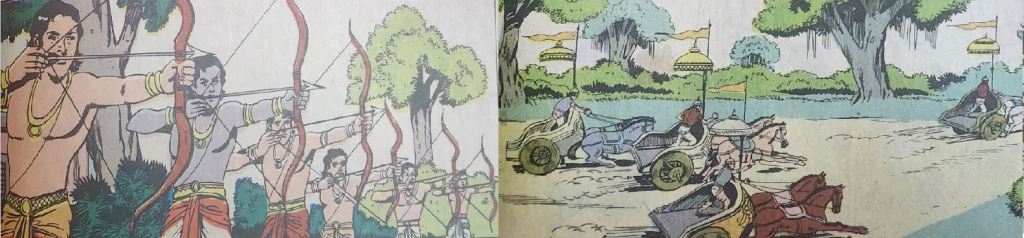
A representation of experiential learning. Credit for the images – Left & Centre – “Mahabharata 5 – Enter Drona”, published by Amar Chitra Katha, Right – “Mahabharata 16 – Pandavas conquer the World”, published by Amar Chitra Katha
The words spoken by the teacher and fellow practitioners and experiences shared while training form the oral transmission part of the training. Each person hears everything differently and develops a system of movement that works for her or him individually. This works over years of training because the objective is learning and not teaching.
A representation of learning with a teacher. Credit for the images – “Mahabharata 5 – Enter Drona”, published by Amar Chitra Katha
Again, because there are as many variations of learning as there are people, it is impossible to document in any media. To give an analogy from Hindu culture, it is said that there are 300 versions of the Ramayana. But since every person who consumes any version experiences some part of the epic differently from every other person who consumes the same, a new personalized version is created for that person. So, there are in reality, as many versions of the Ramayana as there are people who experience the same in any media. And this changes every time there is another experience depending on the media of experience or the situation of the person, in terms of age and physical, intellectual, emotional and spiritual states. So, there literally are infinite versions of the Ramayana. This same is true of actual martial arts training.
This nature of learning is why most of the training is called “Kuden”, in the Bujinkan system. The “ku” in kuden is refers to empty space and “den” comes from the word “densho”. Densho refers to the scroll or book of teachings which is more like a syllabus. So, kuden means learning that is not contained in or cannot be obtained from a written document. In the modern world, densho can extend to videos or any other media available through social media and digital technology. Thus, literally everything that is learnt ONLY from experience can be classified under kuden.
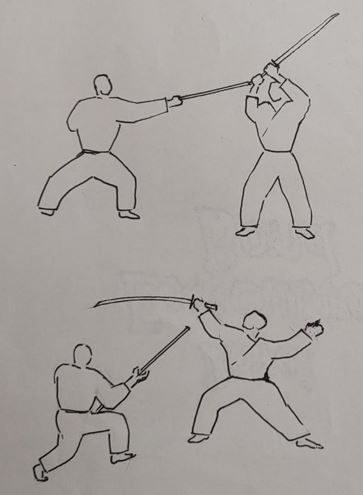
A representation of learning by practice. Sketch by Vishnu Mohan.
Another analogy here from Hindu tradition is the difference between Shruthi and Smriti. Shruti refers to that which is heard and hence is analogous to the kuden mentioned above. Smriti refers to that which is documented (in the past it was books). Many a time, Shruthi could be some knowledge created due to a wonderful revelation that has occurred in a moment of great inspiration. This adds to one’s own and also to the learning of others. Of course, the inspiration in that special moment itself could be due to earlier experiences, learning, wisdom, or exposure to some Shruthi or Smriti. Also, over time, some Shruthi could become Smriti, if it becomes commonplace and can be documented to the advantage of many practitioners. This is when a densho gets created to supplement or replace kuden. Even this article could be considered a personal Smriti of years of Shruthi on my part.
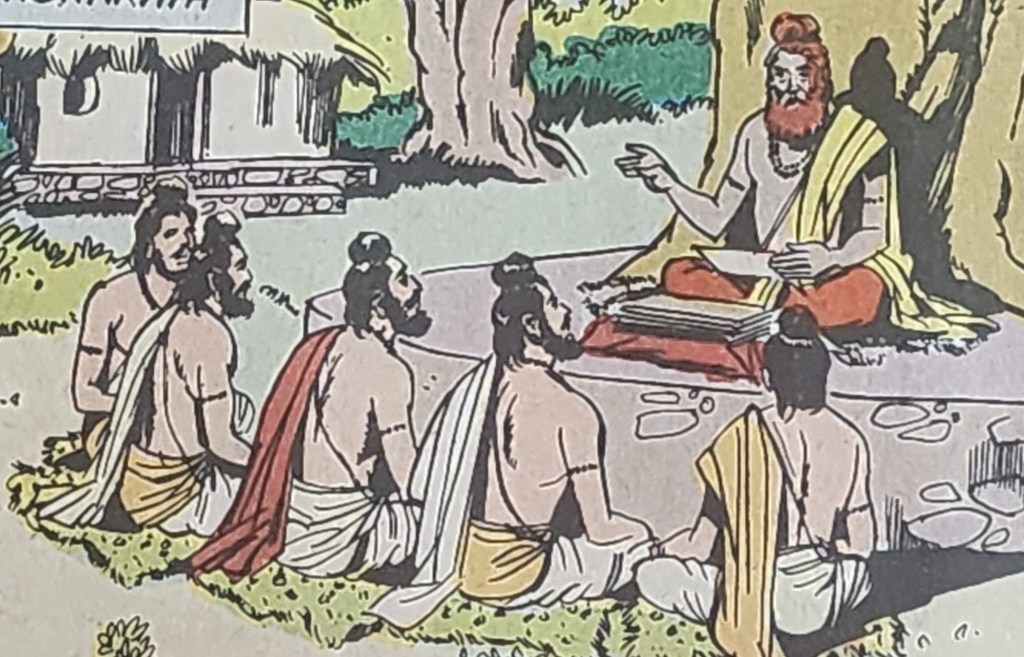
A representation of “Shruthi”, or learning from the spoken word in the presence of a teacher. Image credit – “Mahabharata 1 – Veda Vyasa”, published by Amar Chitra Katha
Going by this analogy and the defined concept, all the other 4 parts before this one, where I discuss my understanding of the Bujinkan, where I have discussed the physical aspect of martial arts training, are a broad documentation that can be used to “learn about” the Bujinkan and maybe about martial arts in general. But the information there cannot be used to “learn” either the Bujinkan or the any other martial art. It is information about the martial art form, but not a guide to learning the martial art.
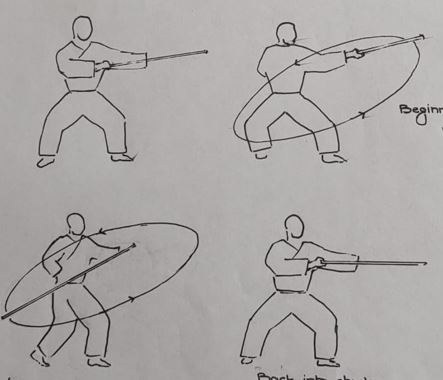
A representation of “Densho” or “Smriti”, a manual a student can use for practice. Sketch by Vishnu Mohan.
An aside here – I am adding a bit of personal opinion. I think learning happens through the skin, by means of osmosis while training in the dojo or an equivalent space. Many a time one is confused in the mind and hence learning is not active. Seeing and hearing lead to a semblance of imitation, but not learning. Also, I have never heard of anyone learn through smell and taste. Therefore based on what I have experienced and seen, learning seems to be through the skin, and passive. Maybe someone can share more details based on their knowledge & experience.
Considering that the martial arts lend themselves to learning through personal experience and not all of it is documented, an important concept takes shape. The one of the “martial journey” or “Shugyo” as it is referred to in Japanese. Over the years of training any martial art, one likely trains with multiple teachers and their respective students. These teachers contribute one’s experience and realizations through their own expressions of the art forms. These teachers might be from different countries, cultures and backgrounds, all of which adds to the learnings.
Then there is the exposure to knowledge from other media that is available today, like YouTube, books, and any other media. There are also online workshops and conferences that while not great for starting one’s martial journey, are great tools to share knowledge. All of this leads to one’s growth as a martial artist. Due to the long time this takes and perhaps the journey across many geographies, it is a journey in a very real sense. This journey is where one finds expressions of kuden by different individuals. Also, every time one finds a new set of documented experiences of kuden from a martial artist one has not trained with before, that is a new station in one’s martial journey as well.
One last point about the martial journey is that it is not necessarily a linear one. It helps one buttress one’s existing learning and add layers to one’s own experience. It also, more importantly, allows one to remember concepts that have been forgotten, basics that have not been revisited and practices that have been discontinued to one’s detriment. In this sense, it is a reminder and hence a circular journey to reconnect with basics or roots and make them stronger.
Word of caution – All of the above is my personal experience from class. It could be different from those of others, and I could be wrong in some of my perceptions. For details of specific concepts, techniques and forms, I recommend people train and experience the art form on their own. Barring that, there are several books and videos by the Soke (Hatsumi Sensei) himself, and then there is content in various media by people who have trained from around the time I was born or even before that. So, there is a lot of experience to immerse oneself in.
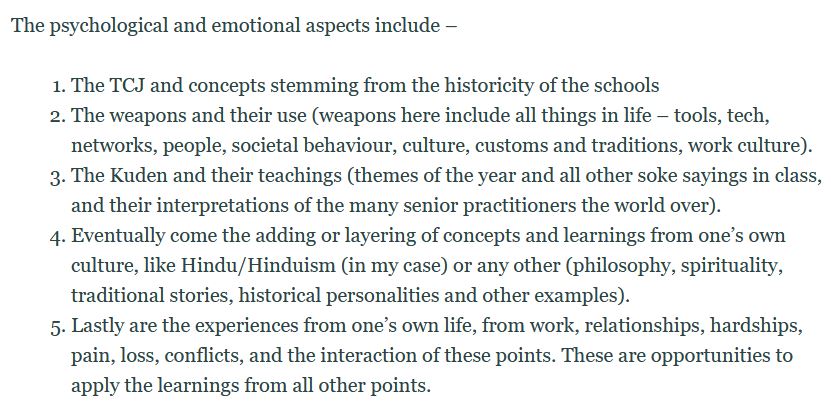
This is the last post that delves into physical aspects of the Bujinkan. The next series of 5 posts will deal with the non-physical aspects of the Bujinkan. These are seen in the screenshot seen below. I will start this series of posts in late March or April ’25.
 Mundane Budo
[…] The Bujinkan, as I see it – Series 1, Part 1 The Bujinkan, as I see it – Series 1, Part 2 The Bujinkan, as I see it – Series 1, Part 3 The Bujinkan, as I see it – Series 1, Part 4 The Bujinkan, as I see it – Series 1, Part 5 (of 5) […]
LikeLike