This post is a series of observations in hindsight. It is an identification of a set of coincidences that seem important to me personally. There is no great significance to the observations but for the experience of having them.
This article will be my 65th post. This number is what brought about the observations that are documented below. Not specifically the number sixty five, but the numbers in the “sixties” in general. My posts are about the intersection I see between Hindu culture and the martial arts, specifically the Bujinkan system of martial arts. So, here are the series of thoughts I have had, as of now.
In India, the 60th birthday of an individual is considered very special. It is called “Shashtyabdha Poorthi” or “Shashti Poorthi”. “Poorthi” means “completion”. “Shashti” is “sixty”. “Shashtyabdha” means “cycle of 60 years”. Both terms refer to the completion of sixty years of life. The significance of the 60 year cycle comes from astronomy.


Shashtyabdha Poorthi – written in Kannada (left) and in Devanagari (right) script
The cycle of 60 years refers to the time taken by three important celestial bodies, according to Hindu tradition, to cycle through the sky from and to the constellation Mesha (Aries). When Surya (Sun), Chandra (Moon) and Guru (Jupiter) are in the constellation Mesha (Aries), it is considered the year zero. The three celestial bodies move across the night sky to cycle through the 12 zodiacal constellations multiple times before all of them are in Mesha at the same time again. Since the three bodies move across the night sky at different rates of time, they do not meet in Mesha often. It takes 60 years for Surya, Chandra and Guru to meet in Mesha once they start their cycle and move away from each other.
This is the reason the 60 year cycle is considered very important. Hence, when a person turns sixty, a pooja or homa is performed at home. If nothing else a visit to the temple is almost always guaranteed when an individual turns 60. Also, in the Hindu calendar (panchānga), a year is called a “Samvatsara”. There are 60 samvatsaras, each with a specific name. There are 60 samvatsaras because they are designed to coincide with the alignment of the Sun, the Moon and Jupiter in Aries.
The Bujinkan is a system of martial arts with its origin in Japan. And interestingly, the 60 year cycle is of importance for the Japanese as well! The 60th birthday of an individual is considered important even in Japan. From what I know, this is called “Kanreki” in Japanese. The word means “return of the calendar” according to Google. So, what is “Shastyabdha Poorthi” in India is “Kanreki” in Japan.
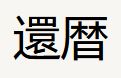
Kanji for “Kanreki”
The Japanese follow the Chinese zodiac. This zodiac has twelve animals and five elements. The five elements are Earth, Water, Fire, Wood and Metal. Every twelve year cycle is associated with an element. So, one twelve year cycle has one year for each animal and is associated with one element. For example, this year is the “Year of the Wood Snake”, wood being the element and snake being the zodiacal animal. So, a multiplication of 5 and 12 gives 60, 5*12 = 60.
Thus when a person turns 60, he or she would have lived through all the 60 years as a combination of the animals and each of the five elements. And hence, they have “returned in the calendar” to the year which is a combination of the animal and element at the time of their birth. Thus, a full cycle is complete and is a cause for celebration. The measurement of the cycle is different, but interestingly, both the Indian and Japanese (and of course Chinese) methods lead to a sacred time span of 60 years!
Even in the Western way of thinking, the 60th anniversary of an institution or an event, is considered the “Diamond Jubilee”. An individual is supposed to have entered one’s “Golden Years” when he or she turns sixty or perhaps 65 by some points of view. This seems tied to the fact that one is retiring from a regular job and has more time for leisure. It therefore seems that in many parts of the world, a sixty year cycle is considered important, if not sacred.
But can the importance of the number 60 have a reference to the martial arts? Specifically the Bujinkan system of martial arts? It seems possible, as I elucidate below.
The link with the Bijinkan is not specifically to the number 60, but more to the numbers in the sixties. This is something like the definition of the “golden years of one’s life”. Also, this absolutely is me cherry picking data to suit an idea. It could also be a case of Frequency Bias or the wonderfully named “Baader-Meinhof Effect”*. Either way, I am writing this because I enjoyed doing so and it makes sense to me. This is not an attempt to connect things for anyone else.
The core of the Bujinkan consists of the Ten, Chi and Jin Ryaku no Maki and the Buki Waza. The Buki Waza refers to training with weapons of varying lengths. “Buki” is “weapon” and “waza” is “technique”, literally, “techniques with weapons”. The Ten, Chi and Jin Ryaku no Maki (Ten Chi Jin for short) consists of training unarmed combat and in some ways is a precursor to training with weapons, for one needs to learn body movement before adding a weapon into the mix.
My mentor Arnaud Cousergue once referred to the Ten Ryaku no Maki as the “ryaku” of the Bujinkan. He also referred to the Chi Ryaku no Maki as the “waza” and the Jin Ryku no Maki as the “kata” of the Bujinkan system respectively. “Ryaku” is “principle”, “waza” is technique” and “kata” is “form”. So, a student of the Bujinkan learns the principles and techniques of the Bujinkan, followed by the forms. The forms are designed to be able to apply the principles and techniques in various combinations. These are carried on to training with weapons, with modifications where applicable.
Now for the numbers.
- The Buki Waza consists of 67 forms across 9 weapons. This is exclusive of the kamae (postures) and kotsu (key points).
- In the Ten Ryaku no Maki, 60 kyusho are listed. Kyusho are weak points or “pressure” points on the human body.
- In the Ten Ryaku no Maki, apart from the kyusho there are 61 points (or ryaku), apart from the variants for some of these.
- In the Chi Ryaku no Maki, there are 67 waza including the variants of some. If one disregards the variants, there are 57 waza.
- In the Jin Ryaku no Maki, there are 59 kata including the variants of a few, which is just short of 60.
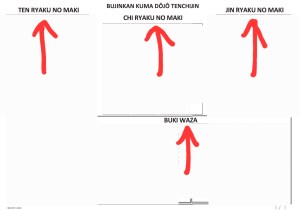
The above chart has the entire Ten Chi Jin and Buki Waza syllabus. It is a chart created by our mentor Arnaud Cousergue. I have only shown the headings for reference and hidden the actual forms and techniques, for they have to be learnt in a dojo. Also, I do not own the rights to the above chart.
As can be seen, pretty much each segment of what a student of the Bujinkan learns as part of the basics consists of roughly 60 forms/techniques/concepts. The Ten Chi Jin and Buki Waza are key learnings every practitioner has to imbibe before earning the black belt or before being considered a real student of the system.
Since we are looking at similarities between and Japan and India, there is one point that must be mentioned. And this one involves a number in the sixties as well. In ancient India, a cultured or learned individual was expected to be skilled at 64 kalas**. A kala is an art or in this case, a skill. These 64 include, singing, dancing, conversation, flower arrangement and a host of others. These are separate from the 14 vidyas, or “forms of knowledge”, which include the 4 vedas, 4 upavedas (subsidiary vedas) and 6 shāstras (branches of knowledge)***. The 64 kalas/art forms are discussed in the famous ancient Indian text, the “Kāmasutra” (yes, it has information beyond just the “positions”).

A folio of the “Kamasutra” written in Devanagari script. Image credit – Wikipedia
Now, before concluding, I would like to descend further into the rabbit hole of numbers. 😛
In the Bujinkan, there are 10 kyu levels, or more correctly, 9+1 kyu levels. Kyu levels are like standards or grades in schools, like 1st standard, 2nd grade and the like. They are levels or stages a student passes through before achieving a black belt or “shodan” level, which is a 1st dan or 1st degree black belt. After earning a black belt, there are 15 levels, which are called Dan ranks. So, before a black belt, there are kyu ranks and after a black belt, there are dan ranks.
When a student begins her or his budo journey in the Bujinkan, she or he is considered a “mu kyu”. “Mu” is “empty”. So a “mu kyu” is someone who does not have a kyu or any rank at all. This is the first level. When a student with a “mu kyu” passes the first test, she or he earns the “9th kyu”. This is the first of the numbered ranks. Over the course of training, the kyu levels reduce in descending order. So, when a student with a “1st kyu” earns the next rank, he or she becomes a “1st dan black belt” or a “shodan”.

A male student wears a green belt before earning the black belt (while holding the kyu ranks). Female students wear a red belt before the black belt is earned.
In the Bujinkan, there is a concept of the “Goho Sanshin no Kata”. Here, the word “goho” refers to “five ways”. These five ways correspond to the five elements. Here though, the five elements are, Earth, Water, Fire, Wind and Space (wood and metal are not a part of this set of five). These elements are the same as those seen in Hindu culture. In Hindu culture the five elements are called “Pancha Bhoota”. “Pancha” is five and “bhoota” is element. The five elements in many Indian languages are called, “Prithvi (Earth), “Jala (Water)”, “Agni (Fire)”, “Vāyu (Wind)” and “ākāsha (Space/Sky)”.
The forms related to the Goho are trained over and over all through one’s life as a practitioner of the Bujinkan. The learning from the training of these 5 forms is applied in armed and unarmed combat in various ways. The Goho is pretty much a foundational aspect of the Bujinkan. Hatsumi Sensei, the previous Soke or Grandmaster of the Bujinkan system, had once said that there is a sixth element beyond the five we train regularly. This is something I have heard from my teacher Shiva and other mentors.
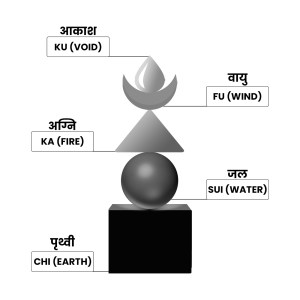
A representation of the Godai (the five elements). Artwork by Adarsh Jadhav.
Hatsumi Sensei had said that the 6th element is “Consciousness”. The Japanese term he used to refer to “consciousness” was “Shiki”. This could also be referred to as “being aware” or “being mindful”. From what I have learnt and experienced of this concept of Shiki, this is supposed to be something that one can experience when the experience with the other 5 elements are imbibed with many years of training.
Hatsumi Sensei is also supposed to have remarked upon this idea of “Shiki” in reference to the famous book “Go Rin no Sho” authored by Miyamoto Musashi, the master swordsman who lived during the 16th and 17th centuries in Japan. “Go Rin no Sho” means “The Book of Five Rings”. It is quite a popular book even in modern times in corporate circles where it supposedly teaches strategies to overcome challenges.
The five rings in the title of the book refer to the five elements that we mentioned a little earlier in this book. Sensei supposedly said that he has moved beyond the five elements referred to by Musashi, and into the sixth one, that is Shiki or consciousness. This was supposedly mentioned as a further evolution from the past and an improvement as well. He also mentioned that he was teaching this to his students and that they should imbibe Shiki as well.
Thus, there are 6 elements, the five which are analogous to the Pancha Bhoota in Hindu culture and Shiki, which is a layer on top of the five. I cannot help but think of the old cartoon series “Captain Planet” here. In the series, there were five parts to the eponymous superhero, 4 elements (earth, water, fire, wind) and “heart” (because it is what unites the other 4 elements or something like that, I cannot recall). In real world martial arts training though, Shiki enables the effective application of Chi, Sui, Ka, Fu and Ku (Earth, Water, Fire, Wind and Space).
So, there are 10 kyu levels and 6 elements. There are several other concepts and sets of concepts with different numbers in the Bujinkan. But why did I look at the two sets that had 10 and 6 respectively. Simply because this article is about 60 and the sixties. Six time ten is sixty, 6*10 = 60. 😀
Notes:
* Baader-Meinhof effect – A phenomenon where one seems to encounter a word or concept often after coming to know of its existence.
** https://artudio.net/14-vidya-techniques-64-kala-art-forms/
*** https://artudio.net/14-vidya-techniques-64-kala-art-forms/
 Mundane Budo