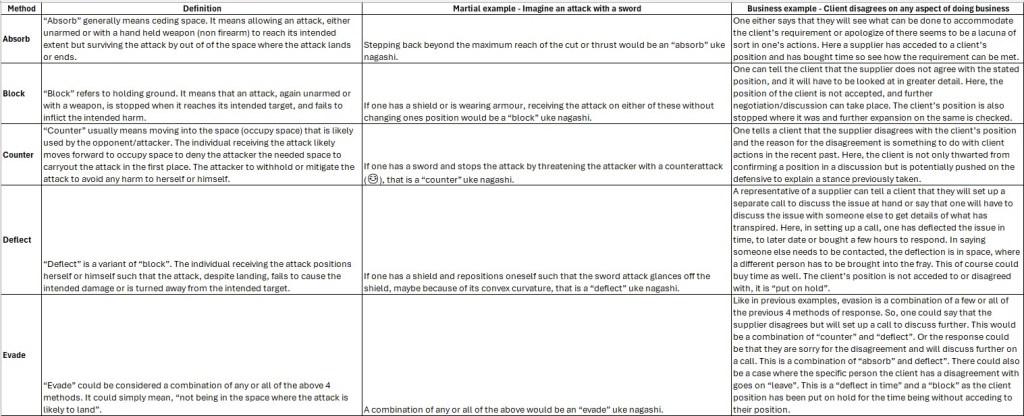
The above image summarizes the 5 methods of conflict management described further in the article, with examples
In this article I am suggesting that conflict management in human life, be it in the martial arts or at work, in different industries or in personal relationships, follows similar patterns. Hence, experience at work or in relationships or in the martial arts can bleed into one another. The experience in any is likely to be beneficial in the others.
One of the first things that a student of the Bujinkan learns is the “Uke Nagashi”. Uke Nagashi can be roughly translated as “receive the opponent in flow”. In practical terms, it means “how to respond to an attacker”. In generic terms that might be used in multiple martial art systems, “Uke Nagashi” could be called “ways to defend or block or parry”.
There are two ways in which Uke Nagashi are classified, for ease of learning by beginners. Over years of practice, the importance of Uke Nagashi does not diminish, it takes on a more central role, but is not top of mind in regular practice. One of the ways of classifying the Uke Nagashi is beautiful and simple, for it is alphabetic. Five Uke Nagashi are defined. These are,
- A – Absorb
- B – Block
- C – Counter
- D – Deflect
- E – Evade
A reasonable description of the above 5 methods of Uke Nagashi are seen below.
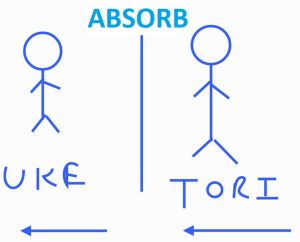
“Absorb” generally means ceding space. It means allowing an attack, either unarmed or with a handheld weapon (non firearm) to reach its intended extent but surviving the attack by out of the space where the attack lands or ends.
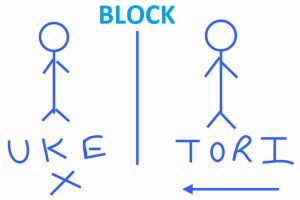
“Block” refers to holding ground. It means that an attack, again unarmed or with a weapon, is stopped when it reaches its intended target, and fails to inflict the intended harm.
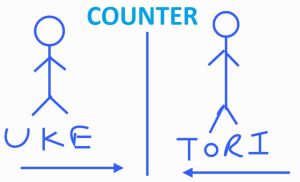
“Counter” usually means moving into the space (occupy space) that is likely used by the opponent/attacker. The individual receiving the attack likely moves forward to occupy space to deny the attacker the needed space to carryout the attack in the first place. The attacker could be forced to withhold or mitigate the attack to avoid any harm to herself or himself.
“Deflect” is a variant of “block”. The individual receiving the attack positions herself or himself such that the attack, despite landing, fails to cause the intended damage or is turned away from the intended target.
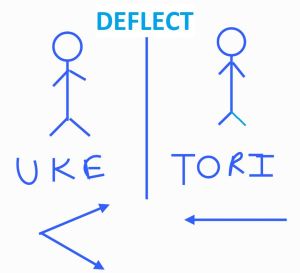
“Evade” could be considered a combination of any or all of the above 4 methods. It could simply mean, “not being in the space where the attack is likely to land”.
The above could be a hard to visualize, so an example to visualize the five Uke Nagashi could be the following. Imagine an attack with a sword.
- Stepping back beyond the maximum reach of the cut or thrust would be an “absorb” uke nagashi.
- If one has a shield or is wearing armour, receiving the attack on either of these without changing ones position would be a “block” uke nagashi.
- If one has a sword and stops the attack by threatening the attacker with a counterattack (😊), that is a “counter” uke nagashi.
- If one has a shield and repositions oneself such that the sword attack glances off the shield, maybe because of its convex curvature, that is a “deflect” uke nagashi.
- A combination of any or all of the above would be an “evade” uke nagashi.
The above are a perspective through the prism of the martial arts. I posit that the same methods of response to various conflict situations are what we use on a day-to-day basis at work. I further suggest that these five methods of responding are used at all levels of organizations, not just the entry levels or middle management or the higher echelons of leadership.
To elucidate this point, I share the following examples. Consider a scenario where a client disagrees on any aspect of doing business. The 5 five methods of responding to this would be something like those mentioned below.
- “Absorb” response – One either says that they will see what can be done to accommodate the client’s requirement or apologize if there seems to be a lacuna of some sort in one’s actions. Here a supplier has acceded to a client’s position and has bought time so see how the requirement can be met.
- “Block” response – One can tell the client that the supplier does not agree with the stated position, and it will have to be looked at in greater detail. Here, the position of the client is not accepted, and further negotiation/discussion can take place. The client’s position is also stopped where it was and further expansion on the same is checked.
- “Counter” response – One tells a client that the supplier disagrees with the client’s position and the reason for the disagreement is something to do with client actions in the recent past. Here, the client is not only thwarted from confirming a position in a discussion but is potentially pushed on the defensive to explain a stance previously taken.
- “Deflect” response – A representative of a supplier can tell a client that they will set up a separate call to discuss the issue at hand or say that one will have to discuss the issue with someone else to get details of what has transpired. Here, in setting up a call, one has deflected the issue in time, to later date or bought a few hours to respond. In saying someone else needs to be contacted, the deflection is in space, where a different person has to be brought into the fray. This of course could buy time as well. The client’s position is not acceded to or disagreed with, it is “put on hold”.
- “Evade” response – Like in previous examples, evasion is a combination of a few or all of the previous 4 methods of response. So, one could say that the supplier disagrees but will set up a call to discuss further. This would be a combination of “counter” and “deflect”. Or the response could be that they are sorry for the disagreement and will discuss further on a call. This is a combination of “absorb” and deflect”. There could also be a case where the specific person the client has a disagreement with goes on “leave”. This is a “deflect in time” and a “block” as the client position has been put on hold for the time being without acceding to their position.
I have considered a scenario which involves a business interaction. The manner of responses would apply to personal relationships as well. Consider any disagreement with a spouse, a parent, sibling, child or friend. All these disagreements are conflicts of varying scales with the consequences ranging from financial ones to reputational ones to just considerations of ego. The responses in all of the disagreements/conflicts can be classified into one of the five defined earlier in this article.
So, if the “5 methods” of responding or uke nagashi are applicable in just about any conflict, either physical or not and be it in business or in personal life, this cannot be something new. It is not an invention of mine. It is just an observation of an application in the Bujinkan system of martial arts to life beyond the dojo. The “A B C D E” seem to have always been applied by humans.
So, if the ways of responding are not new discoveries and something that we humans have always been doing, why am I writing this post? The answer is as follows.
Generally, even if an idea is well known, if we externalize it, by writing it down or making a video or picture of the same, it is easier to remember. Also, if we can rely on an external medium and not just memory to remember an idea, it is easier to express and evolve the idea from its base. This also frees up our memory without any worry of losing ideas due to focus on other pieces of knowledge.
There are also stressful times when we lose track of what we already know and an external reminder of what we could apply based on existing knowledge and experience in such a situation tends to be helpful. Consider it as having access to one’s notes or a textbook, or a manual or support webpage or just a search engine, if not AI LLMs. 😊
To take an example from popular fantasy, consider the Harry Potter series. Professor Dumbledore uses a “Pensieve”, a magical device which he uses to look at his own memories from an external perspective, that helps him with new realizations. This aspect also has a parallel in the Bujinkan. One of our mentors, Daishihan Darren Horvath, once said that to be able to improve as a martial artist, one should be able to look at one’s own movement from an external perspective.
That brings us full circle. Perhaps being able to look at our actions in life, at work and in personal relationships, should be able to help us achieve better movement and flow during practice in the dojo. The A, B, C, D and E of responses seem pervasive, likely due to their facilitation of preserving one’s life, or position or opinion at work and in life outside the dojo.
Notes:
Uke – Attacker
Tori – Defender
 Mundane Budo