20th May was “World Bee Day”. In India, Bhrāmari Devi is a form of the Devi, the Female Principle or Goddess, worshipped in many forms. “Bhramara” means a bee in some Indian languages. So, Bhrāmari Devi is the Goddess of Bees or Goddess with attributes of bees. Like with all forms of Gods and Goddesses, Bhrāmari Devi is also credited with slaying an Asura who had upended the natural order and thrown the doors open to chaos. And this brings the aspects of martial arts into the story which I shall explore further in this post.
The Asura Aruna like many other Asuras gained a boon (vara) from Lord Brahma. According to the boon, he could not be defeated or killed by any creature that was a biped or a quadruped or a combination of the two. This meant that he was invulnerable to all humans, Gods, Goddesses, other humanoid entities and also the large beasts that could harm most humans as we understand them now. This boon seems to be one that compensated for the Varāha and Narasimha avatāras. Varāha was a boar and Narasimha was a combination of man and lion.
I am making one assumption about this boon. If a biped, in other words Devatas, Mānavas (humans), Vānaras, Rkshyas (Jambavan’s kind – sometimes written as Rikshyas) and the like are prevented by the boon from killing Arunāsura, that includes any weapons wielded or discharged by them. So, a human shooting an arrow at the asura would not kill Arunāsura, nor would a warrior wielding a sword. If this was a boon in modern times, a bullet or missile fired by humans would not kill Arunāsura, nor would an AI system with human programming or input.
With this boon, Arunāsura dominated the three worlds and threw natural phenomena, the guardians of which were the Devas, into chaos. This required that he be stopped, even if it meant killing him. Since no weapon or massive beast of prey would have any success, other options needed to be explored. This is where bees and Devi Bhrāmari help resolve the problem.

Bhrāmari Devi, image credit – Wikipedia
Devi Bhrāmari unleashed a swarm of bees that stung Arunāsura. The Asura’s own attacks against the Devi were successfully defended by her. Arunāsura could not fight the bees. He eventually succumbed to the venom in the bee stings. The boon held and Arunāsura was defeated and killed by Hexapeds (creatures that walk on 6 legs), not bipeds or quadrupeds! Also, the mighty Asura was laid low by insects, among the smallest of creatures!
It is possible that Arunāsura did not include insects and other hexapods in his request for the boon since he did not consider them a threat to worry about. In this sense, a lack of awareness or incomplete threat perception did him in. He “expected” insects to not be a threat! This was an assumption, and in a conflict, assumptions and expectations are dangerous things.
I have heard a joke that has been around for at least a few decades now. A few Japanese swordsmen are competing to determine who among them is the best. The contest is to cut a fly! This joke works because everyone realizes that a sword is not what one fights a fly with. It is extremely difficult to hurt a fly with a sword. This fact holds true for bees as well!
There is a proverb I have heard, “You cannot fight smoke with a sword”. This aptly explains the situation anyone faces against a swarm of bees. When one is attacked by a swarm, all creatures know that getting away is the only option, one cannot stand and fight the swarm, unless one specifically came prepared for that eventuality. The fact that Arunāsura did not include protection from insects in his boon, shows that he was not prepared for this attack at all.
From what I know, it takes a couple of thousand or more stings to kill an adult human. Of course, if one is allergic to the venom, the number required is a lot lower. Considering we are currently in the “year of the snake”, it is apt that we are discussing a story where venom is the weapon! Venom is poisonous and fatal when injected beyond certain doses. In the case of Arunāsura, thousands of bees would have injected small doses, the sum of which was sufficient to kill him. It is a case of applying a large quantity of small solutions to a very big problem (the world ending kind!). It is the natural world equivalent of the classic adage “death by a thousand cuts”.
The story of Arunāsura is one in a long line where natural phenomena and animals are used to defeat threats to the natural order/humans and the Devatas. The stories of Varāha, the boar and Narasimha, the man-lion are well known. Another story that is pretty well known is when King Pareekshith was killed by the bite of a venomous snake. A less well-known story is Indra murdering a meditating asura by the name of Karambha. Indra committed this murder in the form of a crocodile. Indra paid for this subterfuge and assault on an innocent victim (Indra was worried that the meditation would lead to a boon which could make Karambha a threat to him in the future – a “Minority Report” kind of “pre-crime” situation).
A more interesting story of using a natural phenomenon as a weapon is that of Namuci and Indra. Namuci was an Asura of great renown and an enemy of Indra, the king of the Devas. Indra had promised Namuci that he would not attempt to kill him with anything that was either wet or dry. This seemed like a fair promise. But Indra smothered Namuci with foam on a seashore. Foam, supposedly being neither wet nor dry, allowed him to kill Namuci without breaking his promise. Indra had to face the consequences of his treachery of course.
In Hindu tradition, we celebrate a festival called “Āyudha Pooja”. This festival is celebrated on the ninth day of the 10-day long Dasara (Dussehra) festival. On this day, various tools of various trades are cleaned and receive gratitude from their users, for aiding them in living a good life. The tools that are worthy of respect in this festival include agricultural implements, weapons of war, machines in industries and even the laptops we use in the service sector.
The term “āyudha” means weapon. But it also means “tool”. Any tool that aids in life is an “āyudha”. Weapons are just tools that are used in war or any physical fight/conflict. And of course, in many cultures around the world, agricultural tools have doubled up as weapons on several occasions in history. A great example of this in Hindu culture is Balarama, the elder brother of Lord Krishna. The weapon associated with Balarama is the plough, which is most definitely an agricultural implement.
Animals have been used as tools and also as weapons of war for ages. Elephants, horses, pigeons and dogs are well known to have been used in war. If conspiracy theories are considered, even dolphins and chimps have been used as potential weapons in the 20th century, during the cold war and the 2nd world war before that. The story of Bhrāmari Devi is just an extension of this well-known teaming of humans and animals during times of conflict.
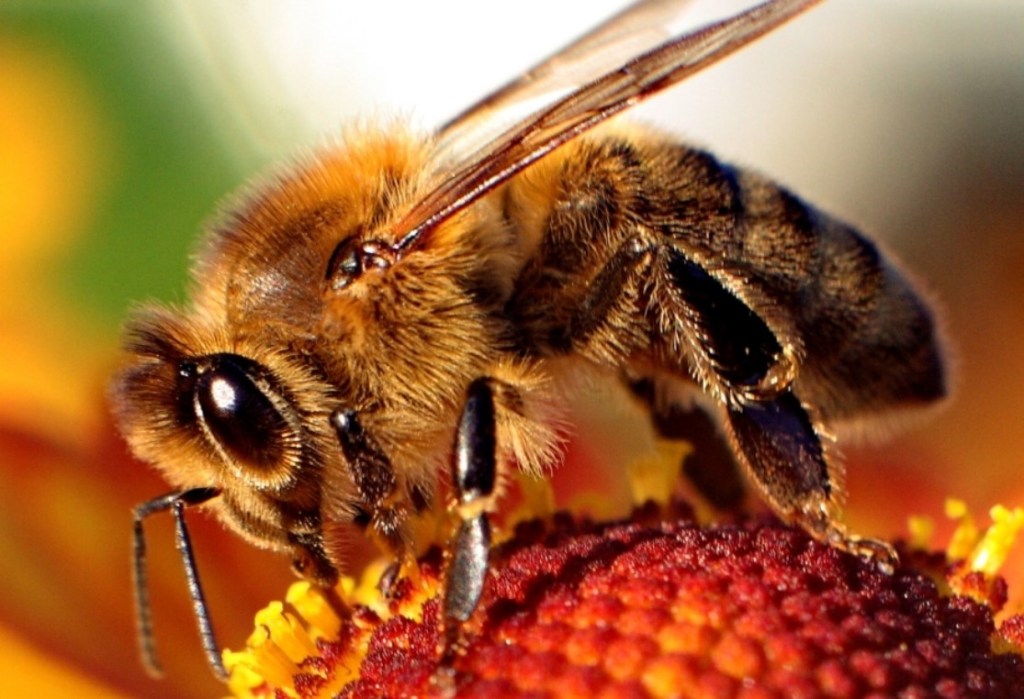
Honey Bee, image credit – Wikipedia
One instance of an animal being a tool to end a war while NOT being a weapon is the story of how Lord Muruga/Skanda/Karthikeya came to have the peacock as his vāhana. Vāhana can be translated as “vehicle” or “mount”. Most Gods we Hindus revere have animal companions, most of whom are vāhanas. The vāhana of Lord Muruga is the peacock.
Lord Muruga defeated and killed the Asura Tāraka. He also defeated another asura named Surapadman. I have heard in some stories that Surapadman is the younger brother of Tārakāsura. Surapadman eventually surrendered to Muruga. He asked for forgiveness and wanted to make amends for the harm he had caused. In return for his surrender, Lord Muruga spared his life. Surapadman then became a peacock and would serve Muruga as his vāhana. The peacock in this case is more like a peace treaty which led to the end of a war. Here, the peacock is not a weapon, but a tool, which led to peace.
This same aspect is true for bees in reality as well. That bees can kill is well known. I remember reading an article in the Reader’s Digest in the early 90s, which featured an attack by a swarm of bees. It was part of the magazine’s “Drama in real life” segment. That was the first time I read of a situation where an individual’s life was at risk due to an attack by bees. Even though we knew that bees and wasps are potentially dangerous, this article brought home to me the threat to life that they can pose. A similar article was also available in the same magazine, more recently, in 2021. I am sharing the link to that article in the notes below*.
Despite the threat bees pose, they are widely respected in the modern world. They are well known for the vital role they play in the ecosystems they inhabit and also for the wealth they can generate. The pollination services bees provide make them a keystone species in the ecosystems they have evolved to inhabit. Similarly, honey and beeswax are both sources of income for people around the world. Beeswax is used in cosmetics and honey as most would know has some medicinal properties.
Bees deploy chemical weaponry, in the form of the venom from their stings. The same biochemical abilities of the bees, results in the beeswax for the hives they build and for the honey, that is created from the nectar of flowers they visit.
I must mention a few pop culture references that come to mind due to this article. The point about bees being extremely useful and vital to the environment while being capable of threatening life has a hilarious parallel in the movie “Ninja” (2009). The movie stars Scott Adkins who is a great martial artist. The move itself is a fun watch. In the movie, the hero’s girlfriend is poisoned. The hero has inherited a katana from his teacher. The hilt of the katana has a secret chamber which has the antidote to the poison killing his girlfriend! He uses it to save her, and the antidote in the vial is the exact quantity needed to save her life! 😊
The hero does not know that there is a vial of antidote hidden in the structure of the sword until his girlfriend is poisoned. One of the teachings he has received from his teacher is that the katana of the ninja can take a life and also save a life. The hero recalls this teaching at the end and realizes that the teaching was literal! He then deduces that the antidote must be hidden in the sword! 😀 The whole scenario reeks of plot armour for the girlfriend!
The other reference has wasps** as the stars and not bees. But I am including it here since wasps are close relatives of bees and the scenario is far too amazing to ignore. There is a novel called “The Impossible Virgin” be Peter O’Donnel. It is one of the novels by the author in a series that stars the character “Modesty Blaise”. Modesty Blaise appears in 11 novels, 2 short story collections and 96 stories that appeared as newspaper comic strips.
Modesty Blaise and her friend Willie Garvin are extremely competent individuals. And they are both extraordinary martial artists with skills in unarmed combat and proficiency in many weapons, both historical and modern. In the novel “The Impossible Virgin”, they face off against a large number of gangsters while being outnumbered. This fight happens in a valley called “The Impossible Virgin” as people avoid entering it. Yes, the name is corny by modern standards, but the novel was published in 1971.

The Modesty Blaise novel, “The Impossible Virgin”, authored by Peter O”Donnel, published in 1971
Modesty and Willie are stuck without firearms against opponents who are carrying guns. But their opponents cannot use guns due to the valley. The valley is home to hundreds of active wasp nests. The sound of any gunshot will echo across the valley and trigger the wasps to attack. So, the fight is now against the machetes carried by the gangsters. Modesty and Willie use quarterstaffs to fight and defeat the gang. Fighting with a quarterstaff is basically bojutsu as we practice it in the Bujinkan system of martial arts. The sequence of bojutsu in the book is wonderful. And the reason for fighting with a staff is the presence of the wasps! The insects here are a shield without intending to be so! 😊
I included this sequence here since the wasps are responsible for some wonderful bojutsu action. But the sequence reminds us of another martial aspect of bees. Bees are quite militaristic! They have various roles and specialize in their tasks, just as modern militaries with high technology have specialists for different roles. And in conclusion I must add, a swarm of bees sounds a lot like a modern-day drone, at least the ones used by photographers at weddings and other ceremonies. So, perhaps quadcopters and similar military drones also sound like a swarm of bees on the attack! 😛
Notes:
* https://www.readersdigest.in/true-stories/story-a-thousand-stings-127356
** “World Wasp Day” is on 24th September
 Mundane Budo
very nicely composed encompassing many mythology aspects and modern science
LikeLike
Thanks!
LikeLike
Brilliant read!🙌👏😯
LikeLike
Glad you liked it!
LikeLike