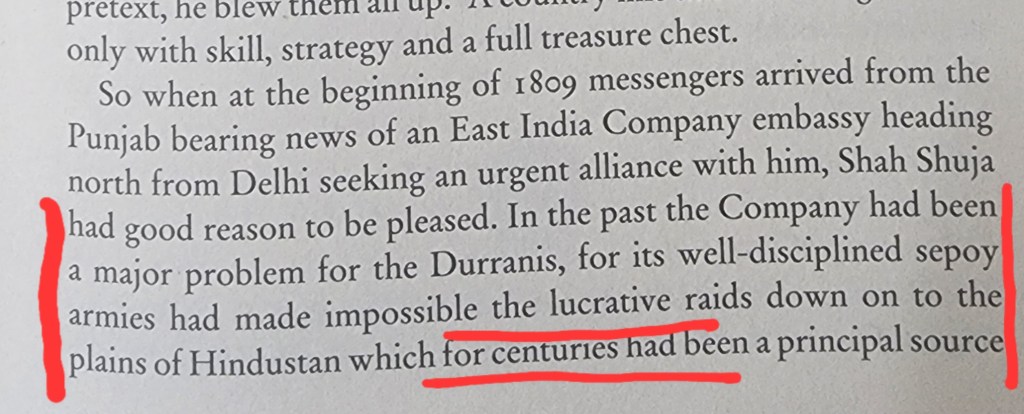
William Dalrymple’s book, “Return of a King” has a very interesting statement about the rulers of Afghanistan. He says early in the book that the Kings of Afghanistan, found it hard to invade Punjab and the plains of Northern India in the first half of the 19th century. Dalrymple further states that this was a time-tested strategy followed by the rulers of Central Asia and Afghanistan for many centuries to accumulate wealth.
Excerpt from the book, “Return of a King”, by William Dalrymple
Northwestern India has faced invasion through what is now Afghanistan for millennia. It started with the Persian Empire and was followed by an invasion by Alexander of Macedon. These invasions were followed by the invasions of the Indo-Greeks, Indo-Sakas, Indo-Parthians, Kushanas and the Hunas. These invasions lasted from the 6th century BCE till the 6th century CE. What was characteristic of these invaders was that they assimilated into the local culture, while also making contributions of their own.
The next series of invasions, of the Arabs, began in the 8th century was not too successful. This was followed by the Ghaznavid invasions in the late 10th and early 11th centuries. These invasions ended Hindu and Buddhist control in what is today Afghanistan. This was the beginning of what can be considered the Turkic invasions. These invasions set the template for plunder and the loot of wealth.
Then came the Ghorid (Ghurid) invasion at the end of the 12th century CE, which led to the establishment of Turkic rule in Northern and Western India and was called the Delhi Sultanate. This was followed by the invasion of the Mughals (who were Turco-Mongol), Iranians and lastly, the Afghans in the mid-18th century. This was the end of the invasions of India from the Northwest, until the middle of the 20th century, after Indian independence.
Invasions from the Northwest, in chronological order
There was the British conquest in the 18th century, preceded by minor conquests by the Portuguese in the early 16th century. But the European attacks came from the South, from the seas and are not relevant to the purposes of this article.
The invasions following that of Mohammad of Ghor, were unlike those in the previous millennia. The rulers chose to impose their native culture over the local populace. Yes, this is a simplistic statement, but not entirely wrong. Even the culture they chose to emulate was that of neighbouring Persia and not that of the populace they ruled over. Their contributions were not nil, but unlike those of the previous millennia, these were not entirely positive to the conquered cultures and populations.
The geographical extent of Indian culture in the 3rd century BCE extended till modern day Southern Afghanistan and Baluchistan in the West. This was a cultural extent and not a political spread. The entire subcontinent, except for the odd century, was always split into multiple kingdoms, that warred with each other. So, the conquests of the invaders were not against a monolithic “Indian” kingdom, but against individual kingdoms, who were mostly smaller than the invaders.
Both the invasions from the North and the West and the warring of Indian political entities continues to this day. With variations of course. The modern-day republic of India is one of at least 3 political entities that exist within the historical cultural spread. If one considers just 3 countries formed out of British India*, the pattern of Indian states fighting one another and the invasions from the Northwest, both persist unabated.
India, Pakistan and Bangladesh are the modern countries most associated with British India. Pakistan, by dint of its birth and historical association with Buddhist and Hindu cultures, is India with a new and different name. So, every time Pakistan attacks India, either with conventional forces or through its terrorist proxies, it is an instance of Indians fighting Indians. Exactly like in the past few thousand years.
Pakistan is India’s western neighbour, and the union territories of Jammu and Kashmir (J&K) and Ladakh are India’s north. So, every time there is a terrorist attack in J&K or a war with Pakistan, like in Kargil in 1999, the invasion is still from the Northwest, just like in millennia past. So, the pattern holds, nothing has changed. The difference is that Pakistan now tries hard to associate its identity with Turkey & the broader region of West Asia, contrary to the facts of history.
This is not new either. The Mughals, despite having Rajput Hindu mothers, identified themselves as Timurid after Timur the Lame, who hailed from Uzbekistan. Today, Pakistan, fills the dual role of an Indian entity identifying as foreign and that of an invader from the Northwest. Neither role is something that modern Indians can be happy about.
But about the reason for the invasion/attack? In the past, it has mostly been about controlling the wealth generated from the fertile plains of the Sindhu and Ganga river systems. The Sindhu river system includes Kashmir, Punjab and Sindh, while the Ganga river system includes all of North India excluding modern day Rajasthan. Today, large parts of the Sindhu system are in Pakistan. Also, Pakistan cannot hope to plunder wealth like the invaders of the past, nor can it take over any part of North India. So, why bother with the attacks?
The answer is likely the control of wealth within Pakistan. The leadership of the Pakistan army is the leadership of Pakistan, for they control the political leadership and are strongly associated with the business elites as well. These 3 groups control a lot of the wealth in the country as they control a lot of the agricultural land, and the prime real estate used for other purposes. For the army to stay powerful, they need the enemy in India, even though India neither wants any part of Pakistan, nor a war with it, not even a minor one.
So, if there is no powerful enemy in India, a powerful army is not really needed. There is a saying I have heard from many people in India. It goes, “The Indian state has an army, while the Pakistani army has a state”. This explains the situation beautifully. The army is like a parent to the Pakistani state. Keeping this image leads to power, which fuels budgets, prestige and wealth.
So, the “wealth” that the Pakistani army hopes to earn is power at home and that is achieved every time India is demonstrated as an existential threat to the state. An attack on India triggers a counterattack, which demonstrates a threat to the state, and this leads to the importance of the army. And from this importance flows everything else mentioned earlier.
For India on the other hand, the situation is still the same, Indians are still fighting Indians called Pakistanis, who have chosen to the take on the role of the Northwestern invaders, for the original invaders have either weakened to insignificance or just disappeared altogether.
This post is different from my usual articles. I almost always describe connections between traditional martial arts, Hindu culture, Indian history and modern Indian life. This article though, is entirely focused on Indian history. This is because of thoughts I have had post the actions taken by the Indian military during Operation Sindoor between 7th May and 10th May, 2025. Including the content of this post with another post (the next one) was making the other one too long and expansive in scope. The next post after this one, will go back to the usual pattern of connecting dots.
Notes:
* Burma, Aden and parts of Somalia were also administered as parts of British India
The first strike of Operation Sindoor was carried out in the early hours of 9th May 2025. This attack was carried out against 21 targets in 9 locations in Pakistan and Pakistan Occupied Jammu & Kashmir (POJK). The attacks were carried out by the Indian Air Force (IAF) and supposedly units of the Indian Army. The attack by the IAF used precision munitions.
The munitions used supposedly included the Scalp cruise missile, the Hammer, the Rampage and perhaps the Crystal Maze and Brahmos as well. The details are not officially made available as yet. The platforms that deployed these munitions include the French Rafale, the Indo-Russian Su30MKI and others, including the Russian Mig 29 and French Mirage 2000. None of the aircraft crossed into Pakistani airspace. All munitions were launched from Indian airspace.
All 21 targets were successfully destroyed with video evidence. All 9 targeted locations were terrorist bases or headquarters that were known and identified. There was no collateral damage, either civilian or military. And this LACK OF COLLATERAL DAMAGE is a VERY IMPORTANT POINT that leads to several amazing observations, from an operational perspective, from an Indian societal perspective and form learning for martial artists, specifically those are not experienced in the defence services.
Pakistan claims to have shot down 5 Indian aircraft during this strike on terrorist targets. Indian forces have not officially released any details of what the losses entailed were. It will be revealed in due course, as the Indian defence establishment does not hide its losses. This information is not revealed as Op Sindoor is not yet officially declared as completed. Unofficial sources claim that India lost 3 aircraft, one Rafale, one Mig 29 and one Su30MKI.
What is clear is that no Indian pilot was lost. The Director General of Air Operations (DGAO) has made it clear that no human life was lost during the strike on terrorist targets. This means that even if the aircraft were lost, the pilots were safe. The DGAO also made it clear that as part of achieving mission objectives, losses were to be expected and were acceptable. This statement means that AIRCRAFT WERE EXPENDABLE, THE PILOTS WERE NOT.
So, why were these losses acceptable? Could they not have been prevented?The events of the early hours of 10th May 2025 answers the second question. Yes, the losses could have been prevented. On 10th May, the IAF struck several Pakistani Air Bases and air defence installations. Between 11 and 13 bases were hit, again with precision strikes, using pretty much the same munitions as earlier, including perhaps the indigenously developed SAAW (Smart Anti Airfield Weapon).
DURING THIS SECOND PHASE, NO AIRCRAFT WERE LOST. Why was this? Because this time around, the IAF carried out what I have come to learn, is called SEAD and DEAD actions. SEAD stands for “Suppression of Enemy Air Defences” and DEAD is “Destruction of Enemy Air Defences”. Once Pakistani air defences were eliminated, the IAF could take out the air bases with no losses.
The strikes on air bases destroyed runways, command and control centres, staff waiting centres and hangars (or hardened shelters). This rendered the Pakistani Air Force incapable of any retaliation for the next few days at least. This gave the IAF air dominance. Once this was achieved, Pakistan asked for cessation of hostilities and India agreed as the objective of striking terrorists had already been achieved.
It must be said, both Pakistan and India attacked each other with several drones as well. Pakistan also used ballistic missiles of varying ranges. Pakistani drones and missiles were intercepted and destroyed by integrated Indian Air Defence systems. But Pakistani Air Defence systems failed. The defence in India was all along the Pakistani border. The strikes Pakistan endured, was along its entire length; some say the attacks inflicted damage to its nuclear weapon storage and integration facilities (this is not admitted or confirmed). The strikes were sufficient to end further hostilities after 10th May 2025.
The attacks by Pakistan on the nights of 7th and 8th mostly included various types of drones. On the night of the 9th the attack included ballistic missiles. The targets of these attacks included Indian military installations, religious sites and civilian areas along the border. This convinced the Indian side to escalate and not limit itself to terrorist targets. Pakistani military installations were now legitimate targets, WHICH THEY WERE NOT IN THE FIRST PHASE, ON THE 7TH OF MAY.
Once the military was a target, India carried out SEAD and DEAD operations, which allowed further strikes on Pakistan with NO LOSSES. This shows that the losses could have been prevented on the 7th of May as well. Why the losses were deemed acceptable earlier is also answered here.
The object on the 7th of May, as stated earlier were terrorist bases. Terrorists, in the case of those supported by Pakistan, are weapons of the state targeting India and her citizens. This makes the terrorists, tools of the Pakistani state.The state in Pakistan, is its military, specifically the Pakistan Army. The civilian Government of Pakistan, according to several commentators, is one that is selected by the Army and not elected by the people. This was done by manipulating the election results. So, a tool of the Pakistani state is essentially a tool of the Pakistan Army.
As mentioned earlier, on the 10th of May, the IAF attacked Pakistani air bases. Air bases are places from where aircraft and other weapons are launched. So, the base by itself is a weapon, or maybe a weapons platform. In this same vein, the terrorists, being tools of the Pakistan Army, are weapons of an unconventional kind. It was these “weapons” that India targeted on the 7th.
Because only these weapons (terrorists) were targeted, and not the conventional military, SEAD and DEAD actions were not conducted prior to the strikes. This gave the Pakistan Air Force an opportunity to retaliate. INDIA CHOSE TO ACCEPT LOSSES RATHER THAN ATTACK MILITARY TARGETS! THIS IS A MESSAGE THAT SHOWS RESTRAINT AND DISCRETION. This self-imposed restriction was lifted when Pakistan chose Indian military and civilian targets. The fact that potential losses of expensive aircraft was seen to be acceptable but not the lives of the pilots shown incredible foresight, planning and execution of the Indian military establishment! This fact is mind-boggling!
Why though, did India accept this possible loss of air assets? This is because India, unlike its hostile neighbour is a mature civilian democracy. India wanted to punish terrorists that murdered its citizens, not invade Pakistan or cause harm to its citizens. This maturity in the Government meant that it was willing to sacrifice its military assets. If the Government had chosen to conduct SEAD and DEAD operations on 7th May, these losses would not have occurred, but hat action would also have made India an aggressor against Pakistan, rather than a country seeking justice.
This entire episode where India accepted potential losses in aircraft and perhaps did indeed lose a few, while not sacrificing its pilots is a fantastic demonstration of a concept that many martial arts teach. The fact that it was applied in modern day aerial warfare makes it all the more incredible, giving practitioners of the traditional martial arts no excuses to not train this concept. This is the concept of SUTEMI WAZA.
I am familiar with the Bujinkan system of martial arts, so I shall explain this concept from this perspective. I expect that most martial arts, whether they train armed or unarmed combat, will have a similar concept, and methods to practice the same. Sutemi in Japanese means “sacrifice” and waza means “technique”. “Sutemi Waza” thus stands for “sacrificial techniques”. But what is being sacrificedand how is it a technique?
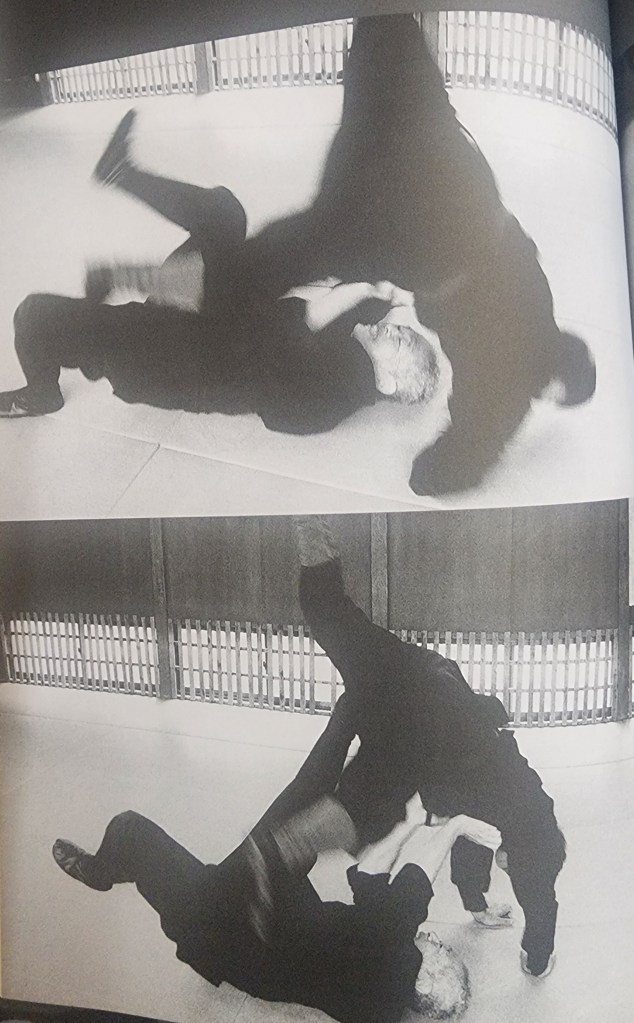
The best way to describe the concept of Sutemi Waza is with the form called “Tomoe Nage”. “Nage” here means “throw”. “Tomoe” means “comma”, like the punctuation mark. So, when one executes a “Tomoe Nage” on an opponent, one drops one’s own body to break the balance of the opponent and throws her or him over oneself. The image below shows the execution of the tomoe nage and explains the situation far better than any words can.
Hatsumi Sensei, Soke of the Bujinkan, performing a “Tomoe Nage”. Image credit – “Unarmed Fighting Techniques of the Samurai”, by Sensei Hatsumi Masaaki.
In this form or technique, the person executing the throw sacrifices her or his own balance by dropping down to the ground and this sacrifice enables the throwing of the opponent. One likely scenario where this technique is used is when both opponents are evenly matched or when other forms are not possible in the given situation. However this technique is executed, the objective is to break the opponent’s flow by sacrificing one’s own balance.
One of the martial schools (ryuha) studied as part of the Bujinkan system is the “Takagi Yoshin Ryu”. This is a school that was historically practiced by bodyguards. Hence it involves a lot of subduing and immobilization techniques. This was done in the past to capture someone for further information gathering. Of course, the techniques in this school can be used to lethal effect, but the objective was to capture wherever possible.
One of the 9 sections of the Takagi Yoshin Ryu is called the “Tai no Kata”. This can be roughly translated to “The form of the body”, “tai” being the body and “kata” being the form. There are 15 techniques as part of this section, and 10 of these end with a variation of the tomoe nage, where the opponent is thrown over oneself to nullify the threat.
The concept of sutemi or sacrifice can also be applied in a more generic manner, which is also common to all martial arts. This involves “Letting go”. Whenever there is a situation where one’s attack is successfully blocked by the opponent or if the opponent is too strong for a given attack to succeed, there is no point in continuing with the same. One has to let go. This “letting go” of the attack allows one to move around and find another opening to exploit and if nothing else conserve energy by not wasting it on pressing a fruitless attack.
In the case of Op Sindoor, this concept of “sutemi” was executed flawlessly by the Indian Military. By accepting potential losses, they gained so much more. Not only was their performance as a defence force appreciated the world over, but it also cemented India as a responsible nation that can be depended upon to not violate the peace. It also demonstrated that India could achieve any offensive mission at will, tailored to the conditions that are prevalent.
This focus on the mission brought home another interesting distinction between the Indian and Pakistani air forces. On an episode of the “Carvaka Podcast”, a YouTube channel run by Kushal Mehra, the host Kushal was discussing Op Sindoor with defence analyst Angad Singh. A link to this video is seen below. Angad Singh had an observation that is fantastic. He said that the Pakistani Air Force had a mindset of “Knights of the Air”. They are more focused on facing off against the Indian Air Force than on a given mission objective.
Video of the interaction between Kushal Mehra and Angad Singh. Watch between the 36 and 43 minute marks.
This mindset makes the Pakistanis focus exclusively on the number of aircraft lost in any given engagement. Hence, they were flaunting the fact they shot down some Indian aircraft. They completely missed the fact that the Indian Air Force successfully completed all its mission objectives, of destroying terror targets with no collateral damage and with no loss of life for itself. This was in stark contrast to the mindset of the Indian Air Force, who let go (sutemi) of the need for a “clean scoresheet” to achieve the mission objective. Of course, it is now well known that Pakistan also lost multiple aircraft, both on the 7th and on the 10th of May. So much for keeping score over achieving what their mission should been, protect targets in Pakistan.
I have one last observation to make in this article. Sutemi Waza is an old concept in the martial arts, but is visible even in modern hi-tech warfare. In this same vein, I recently understood the use of Vyuha that were used in the Mahabharta War at Kurukshetra in modern warfare. Major General G D Bakshi (Retd.) was speaking at even to launch his own book, “Indian Strategic Culture: The Mahabharata and the Kautilyan Ways of War”. The link to the YouTube video of his speech is seen below. A Vyuha is a battle formation from ancient or historical times. It is how troops are arrayed in a battle or the formation they assume as a battle progresses to achieve certain objectives.
Video of the speech by Major General (Retd.) G D Bakshi. Watch between the 19 and 21 minute marks.
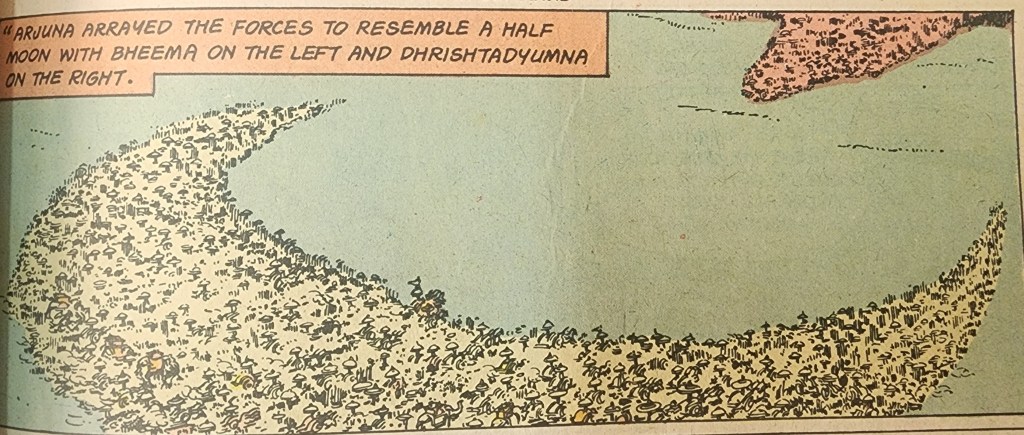
During his speech, General Bakshi explains how the Ardha Chandra Vyuha (crescent moon or half moon formation) was used in modern warfare. He mentions that this formation was used by India against Pakistan during the tank battle at the battle of Assal Uttar, in 1965. This battle was a severe defeat for Pakistan. The crescent moon formation in my understanding, is what is also called the “pincer movement”, where an enemy is enveloped and attacked from multiple sides.
A representation of the Ardha Chandra Vyha (Crescent moon formation). Image credit – “The Mahabharata – 37”, “Karna in command”, published by Amar Chitra Katha.
When I had seen a representation of the Ardha Chandra Vyuha in a comic format back in the 80s, it had seemed like a static formation. But after listening to the General, it seems that this is a formation that is formed in response to an attack. The crescent is formed as part of receiving an attack from the enemy. When the enemy is enveloped and the pincer attack happens, the formation looks like a crescent moon. It need not have started out like that!
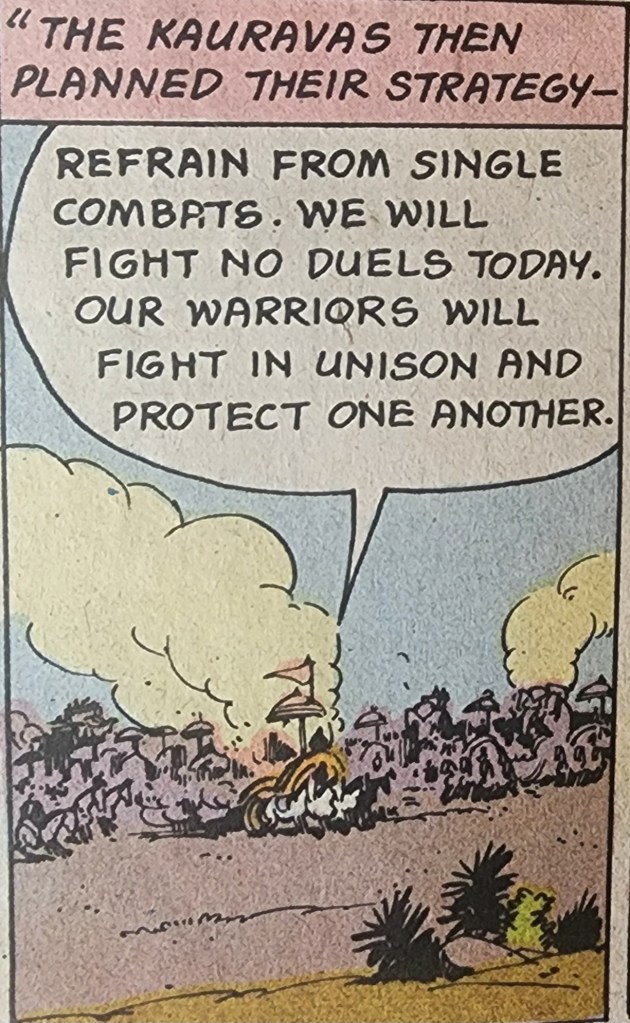
While we speak of the Mahabharata, it must be said that the epic also cautions against seeking glory and focusing on the mission objectives. This contrasts with the psyche of the Pakistan Air Force as described by Angad Singh, which I mentioned a few paragraphs earlier. The image below, of a panel from the Mahabharata published by Amar Chitra Kata, clearly illustrates this point, even if warriors back in the day did break this rule. Personal glory it seems, has always been intoxicating.
Image from the Mahabharata cautioning against duels seeking personal glory. Image credit – “The Mahabharata – 38”, “The Kurus routed”, published by Amar Chitra Katha.
In a more recent historical context, Shekhar Gupta, in a video of his mentioned that the use of massed artillery by India during the Kargil War of 1999 was inspired by the same tactic used by Maharaja Ranjit Singh in the 19th century. Maharaja Ranjit Singh was the founder of the Sikh Empire that was a major power in the 19th century. Shekhar Gupta is the Editor-in-chief of The Print, a well-respected news media organization in India. The link to the video in which Mr. Gupta mentioned this is seen below. He mentioned that this fact will be part of a soon to be released book by Major General Lakhwinder Singh (Retd.) of the Indian Army.
Video of Shehkar Gupta speaking about the use of artillery in the Kargil War being inspired by the tactics of Maharaja Ranjit Singh. Watch between the 13 and 15 minute marks.
So, modern military engagements demonstrate that concepts developed over centuries of marital practice continue to endure, while the technology used to put the concept into practice has changed continuously. I expect I will post a few more articles based on the thoughts that Op Sindoor has left me with.
These are just my thoughts as a layman with no military experience. I could be wrong about many things written in this post, including the actual events that took place and the thinking behind the same. This is partly because all details of Op Sindoor have not been officially revealed yet.
On 31st May 2025, the Chief of Defence Staff (CDS) General Anil Chauhan, in an interview with Bloomberg accepted that there were aircraft losses, but the numbers were fewer than six. The CDS also mentioned that any tactical errors on the 7th were fixed right away. This is perhaps his way of saying that Pakistani air defences were eliminated before any strike, after the 7th. This could mean that Pakistani military was a legitimate target after the 7th and not on the 7th. It could also mean that the Indian military, after the events of the 7th has decided that not only is the successful completion of the mission important but ensuring that no assets are lost is equally important. Either way, there are likely to be more aspects to learn from the operation in the weeks and months to come. A link to a snippet of the CDS’ interview is seen below.
Video which contains a snippet of CDS Genral Anil Chauhan’s interview with Bloomberg. Watch between the 3 and 4:30 minute marks.

 Mundane Budo