Thoughts from Op Sindoor, Part 4 – Celebrate War!?

Wendy Doniger has said that the “Arthashāstra”, written by Kautilya (Chanakya) is a “wicked” book. She means this with a negative connotation, as the book recommends violence. She refers to the Arthashāstra’s recommendation to wage war with neighbours and maintain friendly relations with states that are not immediate neighbours.

I agree with Wendy Doniger. The Arthashāstra is a “wicked” book. But I mean it with a positive connation. The book is “Wicked Good”! And for the same reason that Doniger gives. It does not shy away from military conflict. It advocates readiness to participate in violent conflict, if the situation so demands.

Watch between the 48 and 52 minute marks. Between the 40 and 48 minute marks Ms. Doniger expresses her opinion on how Hinduism is a violent religion.

India is a secular nation. But it has a strong Hindu civilizational character that pervades a very large part of its population. Hindu culture is NOT inherently NON-VIOLENT. The worldwide popularity of Mahatma Gandhi* and his pervasive impact on our national consciousness might make some think that Hindu culture is “non-violent”. But it definitely is not, and it most certainly is not a believer in pacifism!

Hindu culture emphasizes “ahimsa”, but that is not the same as non-violence. I have written previously about “ahimsa” from a martial perspective. I will not repeat that here but will leave links to the earlier articles*. Simply put, ahimsa is about not having malice towards anyone or any nation. But that only means that one should not go looking for a fight. If someone brings a fight to you, the threat must be nullified, there can be no doubts there.

Jainism is closer to non-violence, since it tries to avoid harming any creature. But there were kings who practiced Jainism who did participate in wars. So, even Jainism is not entirely free from practitioners who had to commit violence. The other socio-religious systems in India, including Buddhism, Christianity, Islam and tribal belief systems (these are Hindu adjacent), did not actively impose pacifism on their adherents. So, there is no historical precedent for active avoidance of military conflict in the Indian cultural sphere.

Historically speaking, from the time of Bimbisara, around the lifetime of the Buddha, in the 6th century BCE till Operation Sindoor, two months ago, there has never been a time when there was no military conflict in some part of India.

Now consider the stories from Hindu tradition. Avatāras, or incarnations of divinities are integral to several of these stories. The avatāra cycle is all about war, or violent conflict to say the least. And I am not referring to just the avatāras of Lord Vishnu. Many forms taken by the Devi Shakti also involve war. A few examples of this are seen below.

  • Lord Varāha defeated Hiranyāksha
  • Lord Narasimha defeated Hiranyakashipu
  • Lord Vāmana defeated Bali Chakravarthy to stop the war between the Devas and Asuras
  • Lord Prashurama defeated Kārtaveerya Arjuna
  • Lord Rama defeated Ravana
  • Devi Durga defeated Mahishāsura
  • Devi Kali defeated Raktabeeja
  • Devi Chāmundi defeated Chanda and Munda

In each of the example cases the defeating was at the end of a war. A war that had caused severe hardship for multitudes and brought the natural order itself to the brink of destruction. Here, “natural order” includes the way people lived (society) and the forces of nature. Also, the avatāra does not appear until all options for fighting back are exhausted.
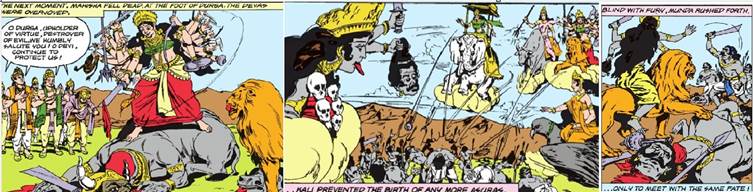
From L to R – Durga, Kali, Chamundi. Image credits – “Tales of Durga” published by Amar Chitra Katha

People, including the Rishis and the Devatās attempt to defeat the Asuras or any other adharmic or harassing entity/group by themselves. They succeed quite often. Examples of the Devas and Rishis defeating threats without an avatāra’s support are seen below

  • The fight against Vrtra
  • The fight against Viprachitti
  • The Tārakāmaya war

Only when it is clear that they cannot survive the fight does an avatāra appear. The avatāra fighting on the side of the people, Rishis and Devatas is what turns the fight in their favour.
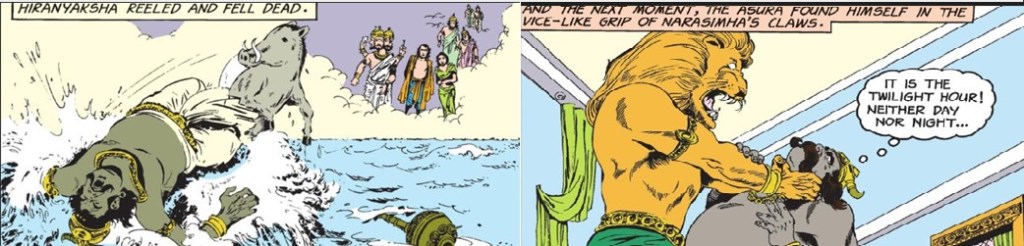
Varāha (L) & Narasimha (R). Image credits – “Dasha Avatar” published by Amar Chitra Katha

In this same vein, the Asuras are not always the ones with the upper hand. They often end up on the losing side. They have great Asura leaders who rise up, perform severe meditation/penance to achieve boons that grant them the ability to defeat all their adversaries. In all the examples above where an avatāra was needed, an Asura had acquired invincibility due to a boon, which rendered the Devas and humans powerless. If the Asura had not chosen to upend the natural order, there would have been no need for a war.
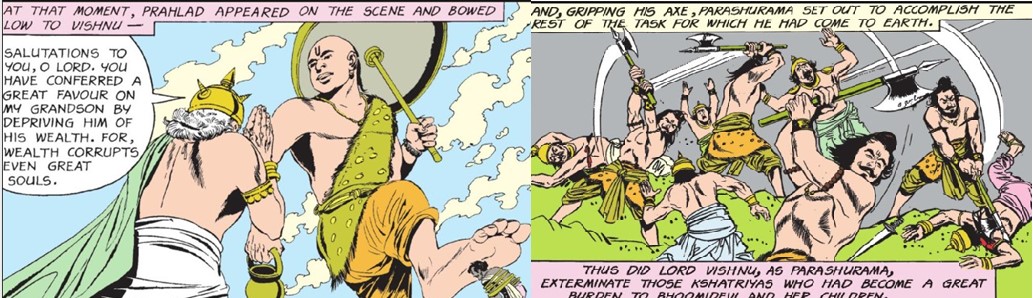
Vāmana (L), Parashurāma (R). Image credits – “Dasha Avatar” published by Amar Chitra Katha

So, it is an incessant cycle of conflict. The war that liberates the Devas and people is always celebrated. It does not mean that war is something people looked forward to. It is just that they knew that someone would want to consolidate power. This consolidation led to a reduction in the quality of life for most people. This hardship is not something that should be meekly accepted and hence a fightback is a must. This awareness that one needs to fight against unjust powers is what leads to the celebration of war, for the war destroys the injustice. Such a war can be termed a Dharma Yuddha, as against a general Yuddha (war) which is a resolution of a conflict through the use of violence. But that does not take away from the fact that even a Dharma Yuddha is a war with all the hardships accompanying one. Only when the war and hardship end is there joy, not during one.

Let’s now return to the Arthashastra by Chanakya. As a document, it had been lost for several centuries, before being rediscovered in the 20th century. But its influence over Indian political and administrative thinking has endured. I am sharing a video from the YouTube channel of the media organization “The Print”. In this video, the editor-in-chief of The Print, Shekhar Gupta, discusses a Chinese report about Indian strategic thinking.

In the report, the Chinese say that Indian actions are strongly influenced by the Arthashastra! This is some 2,300 years after the document was composed! It reinforces the influence of the Arthashastra enduring despite the original document being lost. This means that if the Arthashastra advocated constant defence preparedness, war and violent conflict were never eschewed in India at any time in her past. War was constant and preparation for it was of paramount importance as part of the duties of a king.

Watch between the 18 and 20 minute marks.

It is only in post-independence India that a collation has occurred between Gandhian Ahimsa and Pacifism. In my opinion, the Ahimsa practiced by Gandhiji was not “non-violence” and definitely not pacifism. I think Gandhiji fought a war to defeat the British belief in their civilizational superiority. This was one part of the fight for Indian independence. The other part was a violent conflict, fought by the revolutionary movement. I have written two posts in the past describing these 2 parts, where the freedom struggle is looked at through the lens of martial arts. These 2 parts together succeeded in forcing a British withdrawal, immediately after the second world war. The links to these 2 articles is seen in the notes below**.

Last, as we consider the Arthashastra, we must remember that it was NOT written by a soldier/warrior. Chanakya was a political visionary and teacher, but not a man of war. He would likely be called an “academic” if he were alive today. This shows that it is not just fighting men and women who are dangerous. Academics and people who can motivate and shape societies can be equally dangerous. These people are knowledge workers, who are dangerous because of their knowledge.

Knowledge is used in two ways. One is through the creation of technology, tactics and strategies that contribute to any war effort directly. The other is in the narrative warfare that takes places constantly and away from the fields of battle. Narrative warfare to affect the populace as a whole is a lot more important in modern times with the reach of both legacy media and social media. We all see examples of this all the time.

The use of narratives through academics and other knowledge workers, “intelligentsia” as a whole, can have a positive or a negative effect. If the communication that happens is supportive of the administration and society, the people behind it (including podcasters, influencers, journalists, reporters etc.) would be hailed as patriots. If they are conceived to be detrimental to society, these same individuals would be branded “anti-national” and that very uniquely Indian adjective, “Urban Naxals”.

The idea of both the narrative and weaponry being instrumental in a conflict, even violent ones, has always been known. This is why Turkic rulers built pyramids of severed heads and Mongols destroyed civilian populations, as a form of psychological warfare. The tales of savagery captured in documents and passed on by word of mouth induced a fear that was advantageous to the invaders.

This is also why the proverb, “The Pen is mightier than the Sword” exists. In Japanese, the pen and sword are expressed as “Bun and Bu”. “Bun” refers to knowledge and “Bu” refers to violent conflict. In modern times, we have a new term to refer to individuals who play a part in conflicts far away from any frontline. We call them “keyboard warriors”.

Notes:

* https://mundanebudo.com/2022/10/13/ahimsa-and-the-martial-arts-part-1/

** https://mundanebudo.com/2022/10/27/ahimsa-and-the-martial-arts-part-2/

** https://mundanebudo.com/2022/11/10/ahimsa-and-the-martial-arts-part-3/

I came across a clip on Instagram around the time that Operation Sindoor was going on. In the clip one individual was critiquing the video of another. The original video clip has a woman claiming that “we do not celebrate war”. This statement was being critiqued in the video, where an individual clearly stated that “we do celebrate war”. This person went to explain how in Hindu culture war is indeed celebrated, with examples. This video was the inspiration for this article of mine. The link to the video is seen below.
Guru Poornima – The many “Sensei” in Hindu culture

Today is Guru Poornima. And I guess some of you will have received a post on WhatsApp that says there are 6 or more words for “teacher” in Sanskrit*. Some of these words are “Achārya”, “Shikshaka”, “Adhyāpaka” and of course, “Guru”. But in common parlance, the word “Guru” is perhaps the most commonly used word to denote a teacher in many parts of India.

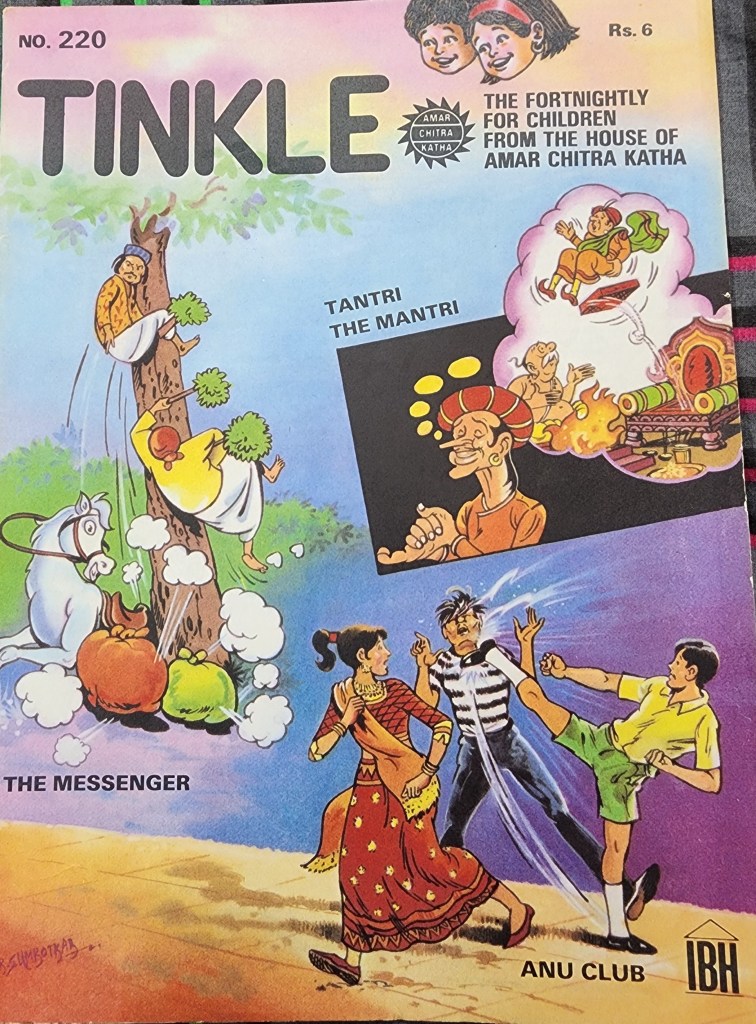
Karate featured on the cover of Tinkle No. 220. This cover was published in March 1991.

A zoomed in part of the cover from the earlier image. Tinkle comics is published by Amar Chitra Katha.

Another word that many of us in India have heard and also denotes a teacher is the Japanese word “Sensei”**. Anyone who had watched the original “The Karate Kid” (1984) surely knew the word. So did anyone who either trained karate as a kid or had a friend who trained the same. There was even an issue of the popular comic “Tinkle”, published by Amar Chitra Katha, which discussed Karate and how it used physics to perform great physical feats (this was a tale featuring the “Anu Club”).

Like most people, I too knew that the word “Sensei” can definitely be used to denote a teacher. This is not wrong. But very early during my years as a student of the Bujinkan system of martial arts, I learned that the word had a slightly different meaning, which did lead to its meaning a “teacher”.

The term “Sensei” as used in Tinkle comics. Image credit – Tinkle No. 220, published by Amar Chitra Katha (India Book House – IBH).

The word “Sensei” as I understand it, literally means “someone who was there earlier”. This is why elders and people with great expertise arising out of experience are also referred to as “Sensei”. I have also heard that “Sensei” means “someone who has gone earlier”. This phrase, as I understand it, could mean “pioneer”.

In a martial arts context, a teacher is one who has more experience than the student. The experience is because that individual walked the path of learning that the student is just starting on. In this sense, the teacher was a pioneer on this path, as far as the student is concerned. This does not mean that the teacher is a pioneer who created a new martial art system, it just means that the teacher has traversed the path before the student and hence can guide the student on the same.

This leads to an interesting outcome. Since students walk the same “path” as a teacher, or learn in a manner similar to their Sensei, they become “similar to” their teacher in the way they move. This is a common occurrence. If a martial artist who knew the teacher saw just the student move, he or she would be able to tell who the student’s Sensei was.

This is how lineages get created in the martial arts. A lineage could lead to the development of a style or school (Ryu or Ryuha (plural)) or system of martial arts. The lineage could be specific to an extended family or to a region. An example of this is the “Togakure Ryu”, one of the 9 schools studied as part of the Bujinkan. The “Togakure” in the name is supposed to be in reference to a village in the Iga province of Japan.

The concept of a lineage extends beyond the martial arts, into other art forms and sports as well. Cricket is the most popular modern sport in India. There are 3 “schools” of batting recognized in India. These are the Bombay school, the Deccan school and the Delhi school. Each of these has produced great batters.

Similarly, in Hindustani music, in north India, we hear the term “Gharana”. A Gharana refers to a lineage. The word “Ghar” in modern day Hindi also means “home”. So, a Gharana could refer to a lineage literally, as it comes from a family in a home. But then, the Gharanas are associated with regions. Some examples are the Delhi Gharana, the Lucknow Gharana and the Benaras Gharana. As the names suggest, each of these is named after a region. This concept of lineage extends to architecture, painting, weaving, pottery and any number of other arts.

The festival of Guru Poornima is observed on the first full moon day (Poornima) of the month of Āshāda (coincides with a part of July). It is observed to mark the birth anniversary of Maharishi Veda Vyasa. Veda Vyasa is also called Krishna Dwaipāyana and Bādarāyana. He is truly the ultimate Guru! This is obvious once the corpus of knowledge that is attributed to him is recognized.

Veda Vyasa is most well known as the composer of the Mahabharata (or at least the Jaya, which is the core of the 3 nested dialogues which form the Mahabharata). He is also credited with compiling the Vedas into the form we know today (hence the word “Veda” in his name). The 18 Mahapuranas are also attributed to Veda Vyasa’s authorship or compilation. In other words, according to tradition, a large volume of texts from Hindu culture owes its existence to this greatest of Gurus!

That said, it is not just teachers of knowledge that are revered in Hindu culture. There are great Gurus for the martial arts as well. I will mention just four that are top of mind for me. There are several other great Gurus, from history and culture, all of whose stories I would strongly recommend everyone to visit.

The 4 Gurus who are top of mind for me, from the Mahabharata and the Ramayana, are,

  • Parashurāma
  • Vishwāmitra
  • Drona
  • Balarama

The first 3 of the 4 mentioned above form a lineage of sorts. Let’s look at a few points about these great Gurus.

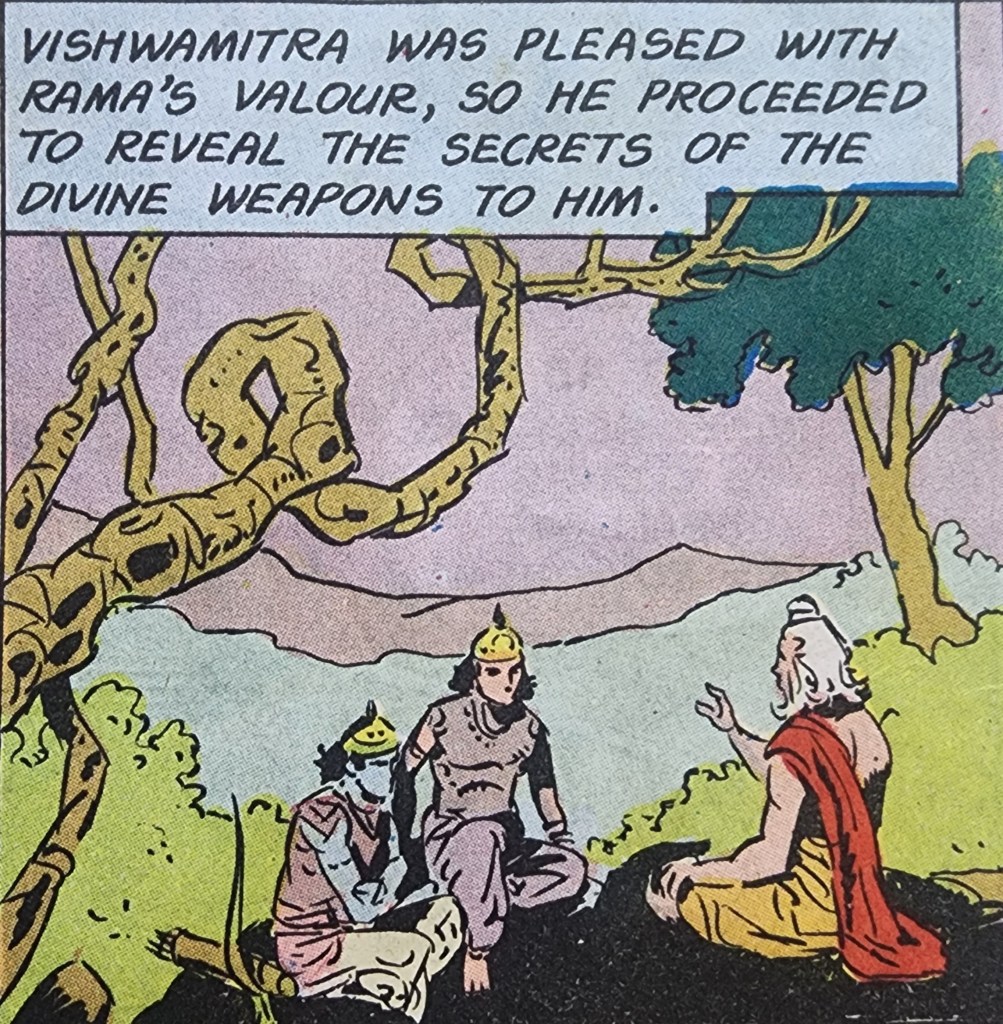
Brahmarishi Vishwāmitra imparts knowledge of celestial weaponry to Rama and Lakshmana. Image credit – “The Ramayana” published by Amar Chitra Katha.

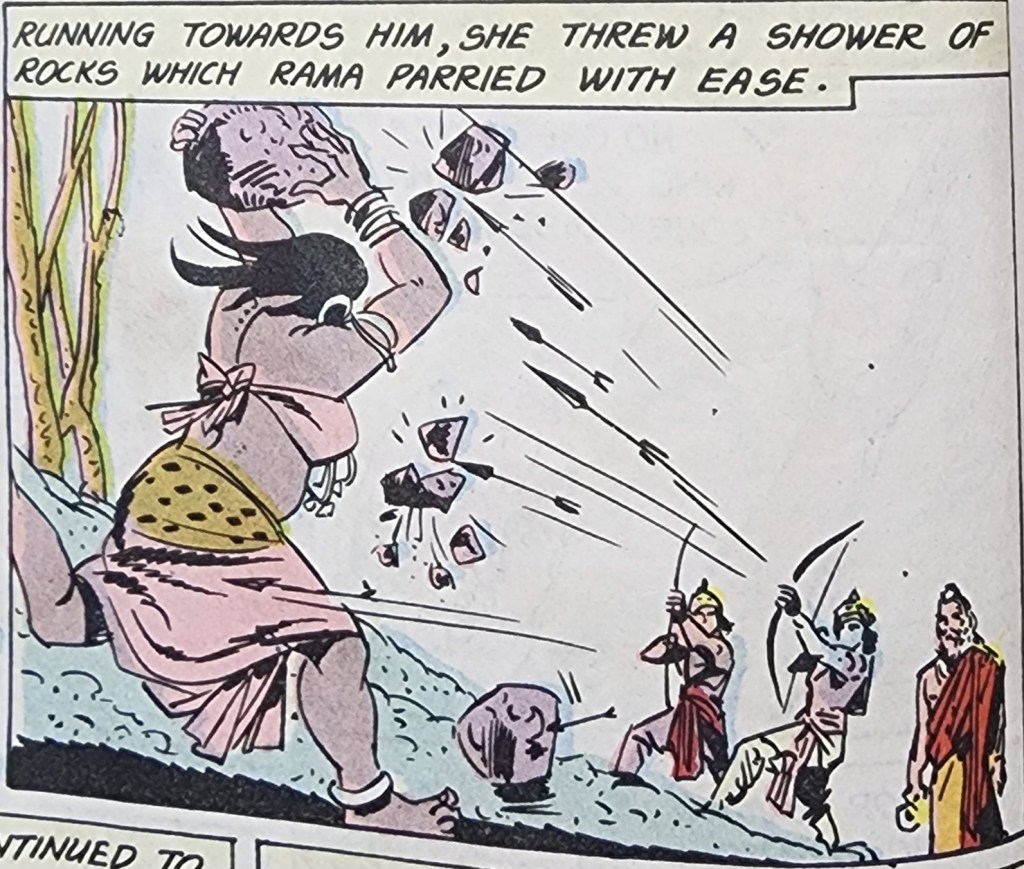
Vishwāmitra was the Guru who was a martial arts instructor of Lord Rama. It was from Vishwāmitra that Lord Rama received a lot of the celestial weapons that he would use later. Vishwāmitra, before he became a Brahmarishi, was an egotistical king named Kaushika. Kaushika obtained powerful celestial weapons to use against Vasishta, who was Rama’s first Guru at Ayodhya! Of course, the weapons were of no use against Vasishta, but they were successfully used by Lord Rama, who was a student of both Vishwāmitra and Vasishta. Vishwāmitra of course had long overcome his rivalry with Vasishta by this time.

Brahmarishi Vishwāmitra guiding Rama & Lakshmana in their fight against Tataka. Image credit – “The Ramayana” published by Amar Chitra Katha.

Parashurāma was Vishwāmitra’s grandnephew (the story of their birth is fantastic!). He was one of the greatest warriors of his time, of any time. He is also one of the 7 Chiranjeevis (immortals) who are supposedly still around during modern times, but not accessible to normal humans. Lord Parashurāma is the sixth avatāra of Lord Vishnu and the future Guru of Kalki, the tenth avatāra of Lord Vishnu expected to manifest in the future.

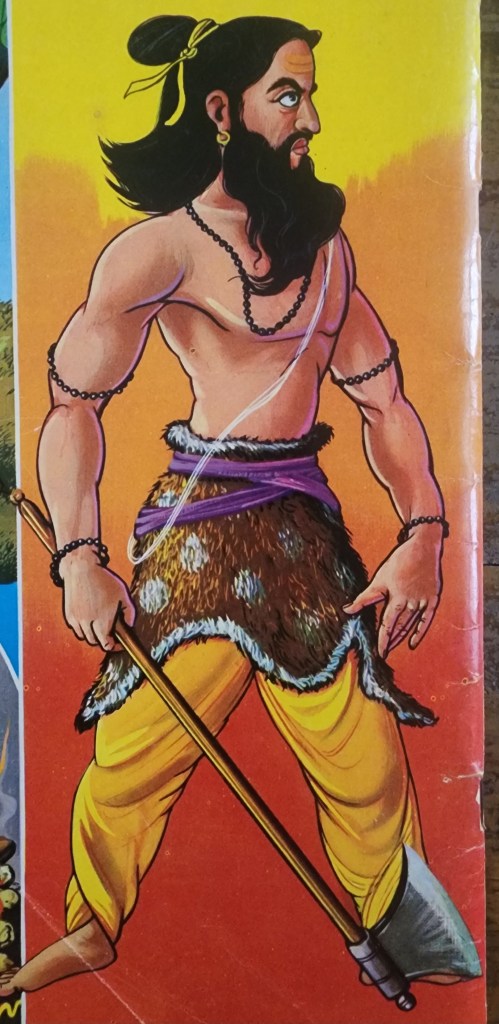
My favourite depiction of Lord Parashurāma. Image credit – “The Bhagavat for Children”, published by Anada Prakashan.

While Lord Parashurāma is best known for his mastery of the Parashu (axe), he was also a wielder of all celestial weapons. Parashurāma was the teacher of both Bheeshma and Karna, two of the greatest warriors who fought on the side of the Kauravas in the Kurukshetra War (the climactic war in the Mahabharata). He was also the Guru through whom Drona achieved his mastery of all weapons. Lord Parashurāma is someone whose legacy extends to modern India as well. He is considered the origin of the martial art of Kalari Payatt, which is famously practiced in the southern Indian state of Kerala!

Lord Parashurāma confronting Lord Rama early in the Ramayana. Image credit – “The Ramayana” published by Amar Chitra Katha.

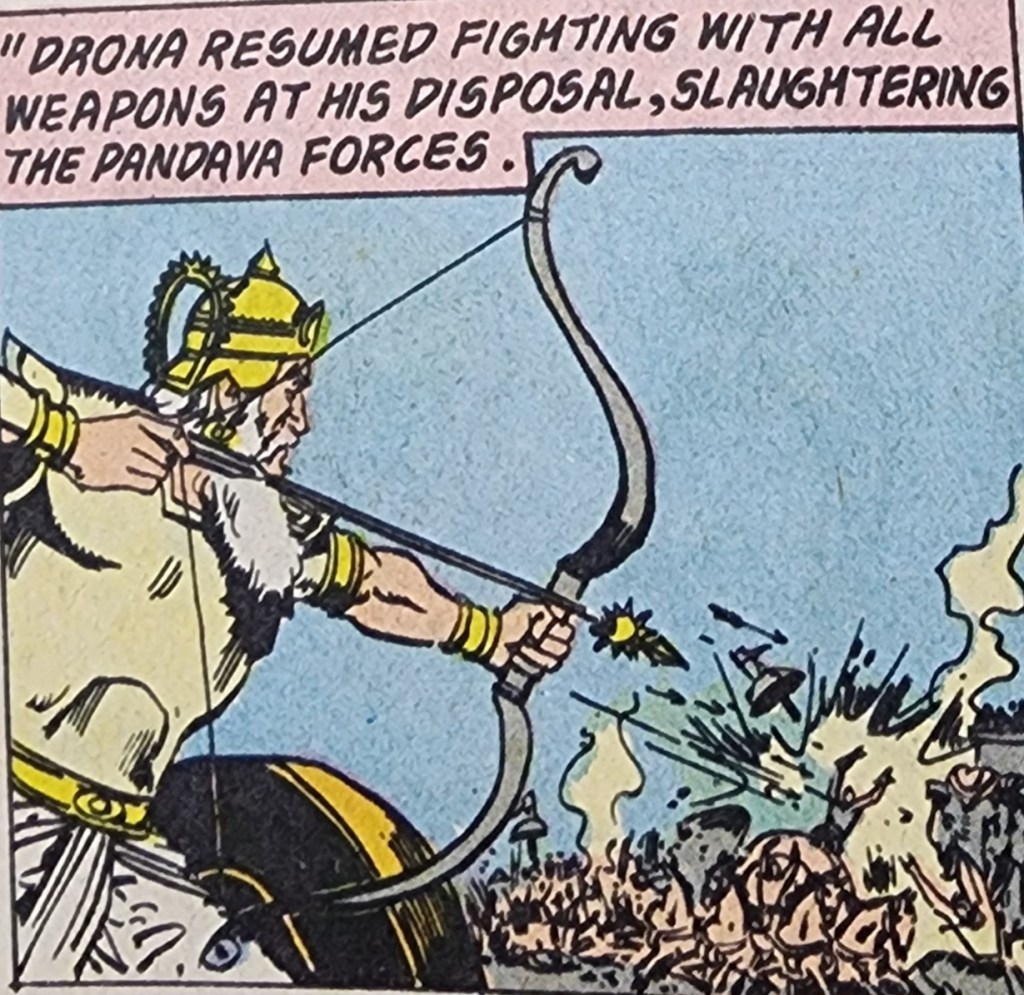
Drona, also called Dronācharya was the teacher of most of the main characters who fought in the Kurukshetra War. The “Acharya” in his name is because he was a Guru to all the Kuru princes. Drona was also one of the warriors who was invincible. He was eventually killed by a trick, which forced him to drop his weapons and give up fighting. In this sense, he is the same as Bheeshma and Karna. Both of them were also warriors of such incredible prowess that the only way to defeat them was when they either chose to or could not fight!

Drona receiving knowledge of weaponry from Lord Parashurāma. Image credit – “The Mahabharata 05 – Enter Drona”, published by Amar Chitra Katha.

Based on the described prowess of Lord Rama, Vishwāmitra was a great Guru! His grandnephew Parashurāma was a God, whose students were among the greatest warriors ever, some being invincible. One of Parashurāma’s students, Drona, became a great Guru in his own right. So Parashurāma’s school was a dream for any martial artist! Considering he and Vishwāmitra are from the same family, they could be considered to be from the same lineage.

Drona being terror incarnate towards the Pandava army. Image credit – “The Mahabharata 36 – The Battle at Midnight”, published by Amar Chitra Katha.

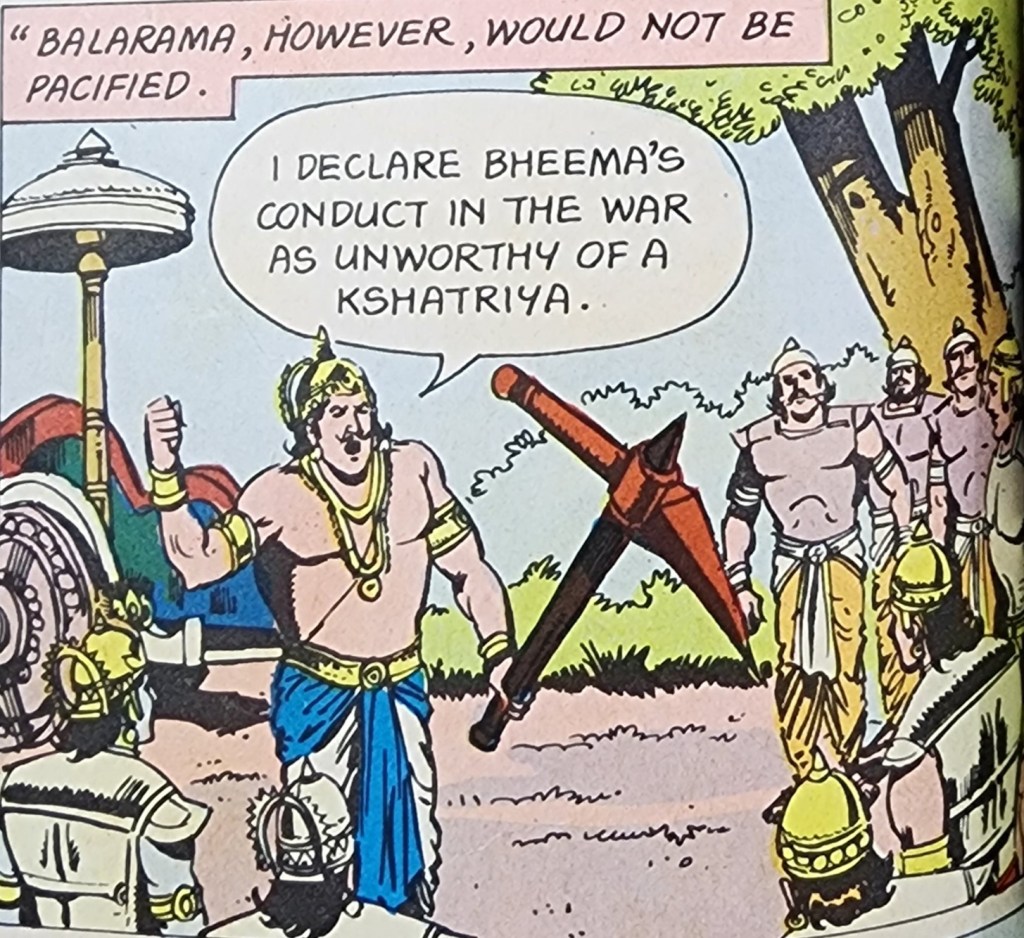
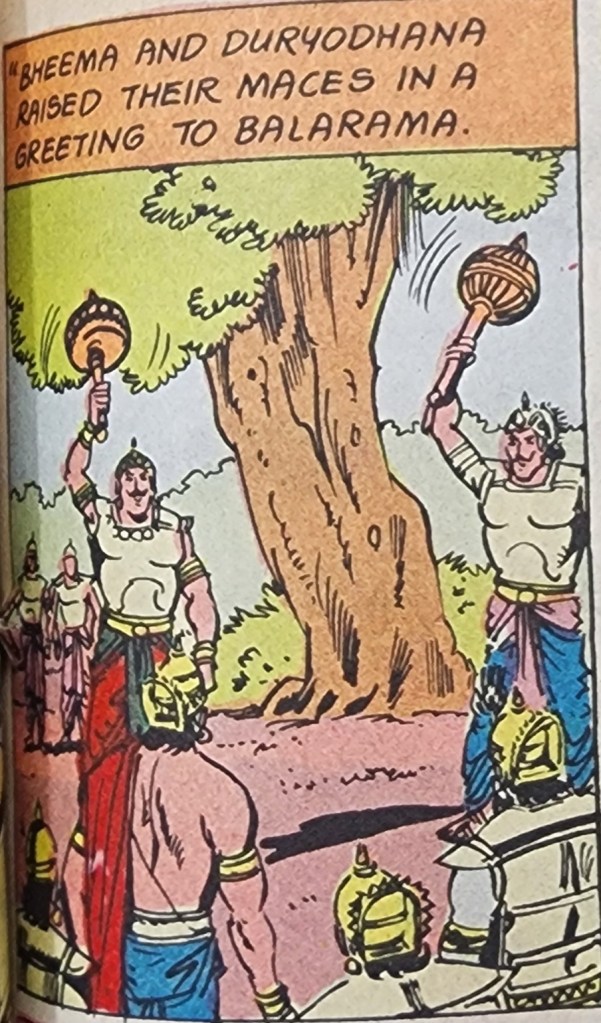
The last of the great martial Gurus I mentioned above is Balarama. He is the older brother of Lord Krishna. Balarama is considered an avatāra of Ādishesha, the serpent on whom Lord Vishnu rests. He was the greatest gada (mace) fighter ever. This was despite the weapon he is most associated with being the plough! He was the teacher to both Bheema and Duryodhana. Bheema and Duryodhana fought on opposite sides in the Kurukshetra War. Both Bheema and Duryodhana were disciples of Drona as well. They went to Balarama for specialized training in the mace (gada).

Balarama wielding the plough! Image credit – “The Mahabharata 39 – After the War”, published by Amar Chitra Katha.

Considering that all these Gurus were teachers of the martial arts, I suppose they could be considered Sensei as we understand the word today, specifically considering the lineage they were from and the one they perpetrated.

Balarama was the Guru for the Gada, for both Bheema and Duryodhana. Image credit – “The Mahabharta 38 – The Kurus Routed”, published by Amar Chitra Katha.

We in India have a culture where a Guru, or a teacher is deeply respected and that comes from listening to stories passed down in our traditions. But the fact that some of these Gurus were martial arts teachers is not specifically recognized, even though it is well known. The word Sensei, in modern times is one that inspires great respect too, thanks to Japanese culture, where expertise, experience and teachers are deeply respected as well.

Looking at the two cultures, it should be possible to recognize that we always had many Sensei in India, who were Gurus of the martial arts. And they were as respected as a Guru from any other field of knowledge or expertise. The identification of this aspect was the purpose of this article. I hope I have been successful in highlighting the martial aspect of our culture and its extension to our respect for Gurus.

Notes:

* The many words for “teacher” according to the much forwarded WhatsApp message.

The teacher who gives you information is called Adhyapak.

The one who imparts knowledge combined with information is called: Upadhyaya.

The one who imparts skills is called Acharya.

The one who is able to give a deep insight into a subject is called Pandit.

The one who has a visionary view on a subject and teaches you to think in that manner is called Dhrishta.

The one who is able to awaken wisdom in you, leading you from darkness to light, is called Guru.

** Another word for teacher that many Indians know these days is “Sifu”, thanks to movie, “Kung Fu Panda” (2008).

Thoughts from Op Sindoor, Part 3 – Money matters!

India did not have a strong martial arts culture in the last few decades, until recently. Even now, it is not prevalent in all parts of the country. In places with higher disposable incomes, interest in and practice of the martial arts is growing. In parts of the country that have a strong continuation of historical traditions, martial arts are present as well, but more as a performance art. This is not true historically though. Martial arts were a vital part of Indian culture for many centuries before diminishing in importance in the latter half of the 19th century.

Now that martial arts are making a comeback, an interesting aspect is visible. There is a cost associated with practicing the martial arts. The costs include time, effort and money. Financial costs include, tuition fees of teachers, membership fees of gyms or dojos, cost of apparel and training equipment*. Training equipment includes protective gear and training tools, which include practice weapons. Beyond this, time is spent in traveling to the place of practice and in practice itself. And then there is the effort that it takes to make time and financial resources available for martial arts practice.

The costs mentioned above were present in the past as well. For some professions, this cost was valid as it directly impacted the earning of a livelihood. This is true in modern times as well. But for individuals who are not working with law enforcement, first responders and the defence services, this cost is not necessary. The payback is not necessarily monetary. Hence, there comes a point when martial arts practice becomes discouragingly costly. This was true in the past and is true in contemporary times as well.

The cost of martial practice extends to nations too. Here the cost is justified as a nation’s sovereignty and territorial integrity are dependent on the expenditure on its martial wings, in other words, defence forces, intelligence agencies and law enforcement services. As this is vital at a national level, all nations have defence budgets.

But the defence budgets of all nations are not the same. The defence budget of the USA is almost a trillion USD! The defence budget of China is about 350 billion USD. The defence budget of India is 78 billion USD (in 2025). The cost of defence preparedness might be the defence budget but that is not the same as the cost of war.

The cost of war, depending on how long it lasted and the devastation it caused can be varying. The cost in terms of loss of life and limb of citizens is incalculable. It renders a section of the population unable to participate in any economic activity and in many cases dependent on the state, which is a necessary drain on the economy. There is also a cost associated with reconstruction and rebuilding of the economy. This is exclusive of the opportunity cost and the uncertainty of real recovery.

Unlike the cost of war, defence preparedness can have a positive effect. Over time, increasing defence budgets can lead to the creation of a military-industrial-academic complex. This complex leads to better education for large sections of a society and development of a manufacturing ecosystem. This leads to more jobs, development of advanced technologies and improved innovative abilities of a society. Defence preparedness also involves having great infrastructure in perpetuity. And then there is the boost to the economy through the export of weapons and weapon systems. All this is without even considering the benefits of the development of dual use technologies. Beyond all this there is the saying “If you want to have peace, prepare for war” (from the original Latin, “Si vis pacem, para bellum”).

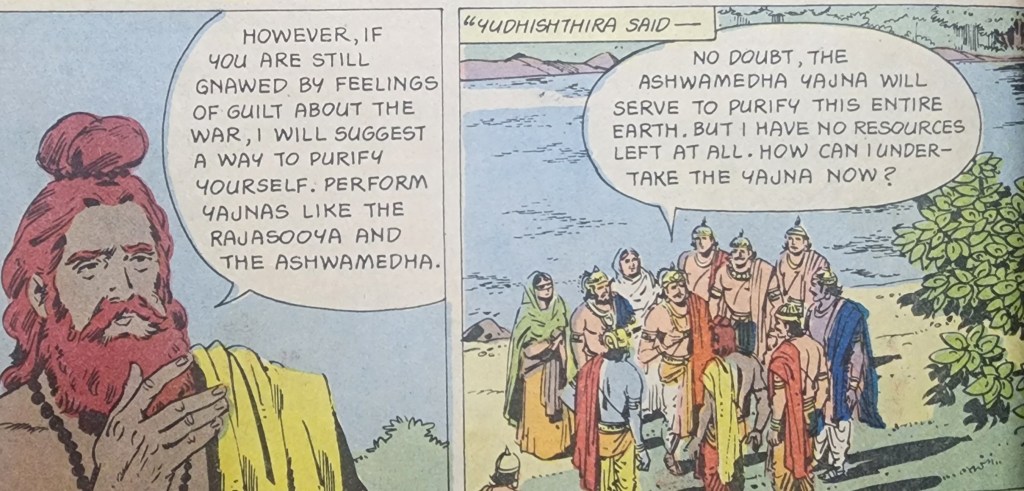
It could perhaps be said that preparation for war can lead to restarting and rebuilding of a flagging or destroyed economy. A perfect example of this is the Ashwamedha Yajna in the Mahabharata, which occurs years after the end of the Kurukshetra War. The reason the epic gives for the event is that Yudishtira performs this yajna to atone for the sins committed during the Kurukshetra war. But I opine that the reason for this yajna was to kick-start the economy of the kingdoms of Hastinapura and Indraprastha.

A very large number of males had died in the Kurukshetra war. If the numbers from tradition are considered, somewhere between 3 and 4.5 million men died in the war. This meant that a large part of the working population in Northern India was dead. The coffers of all the kingdoms that participated in the war were empty due to the logistics of the war. This meant that the economy of all the participants was in the doldrums.

The Ashwamedha Yajna requires a large investment to perform and conclude successfully. To start with, a large quantity of gold is needed in the performance of various rituals and all the participating Brahmanas have to be compensated for their part in the yajna. A strong army is needed to protect the horse, the Ashwa of the yajna.

The economy does not allow for an Ashwamedha Yajna. Image credit – “The Mahabharata, Part 41 – The Ashwamedha Yajna”, published by Amar Chitra Katha

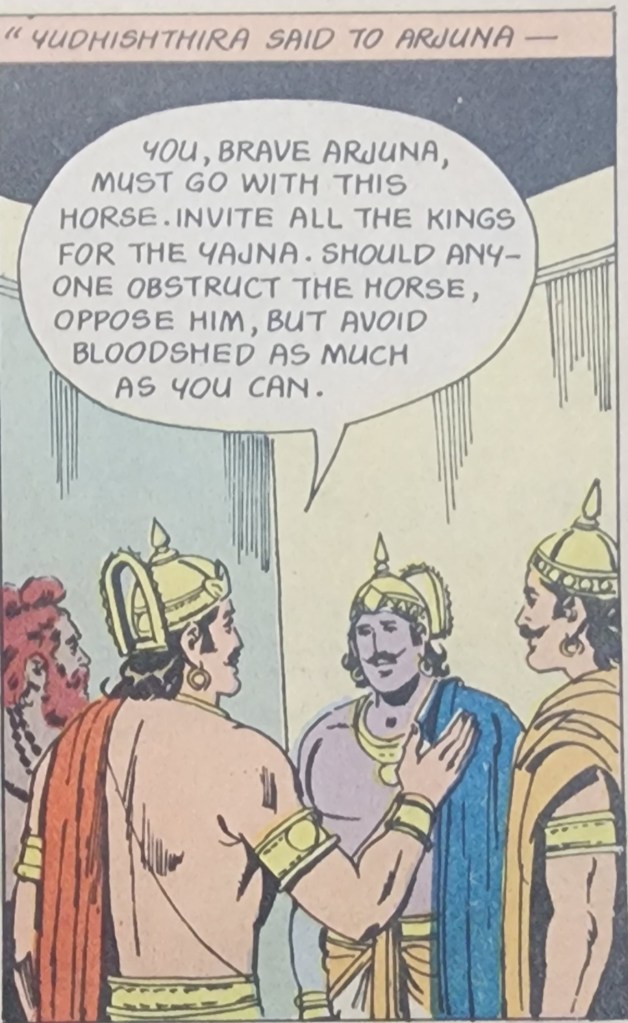
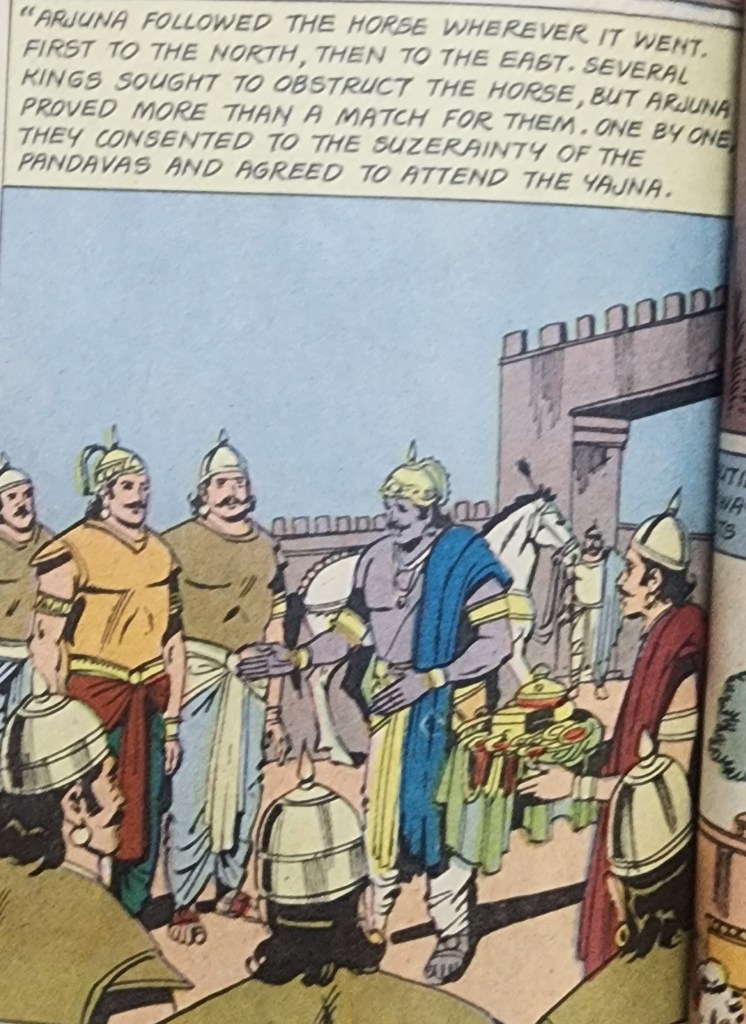
The horse would wander around for a year in various kingdoms. These kingdoms could stop the horse or let it pass through. If they let it pass through, they had to offer tribute or sign a treaty with the army of the king whose horse it was. If they stopped the horse, they kingdom that stopped the horse had to fight the army protecting it. The fact that an army was involved meant that a functioning supply chain was needed, apart from soldiers and their training.

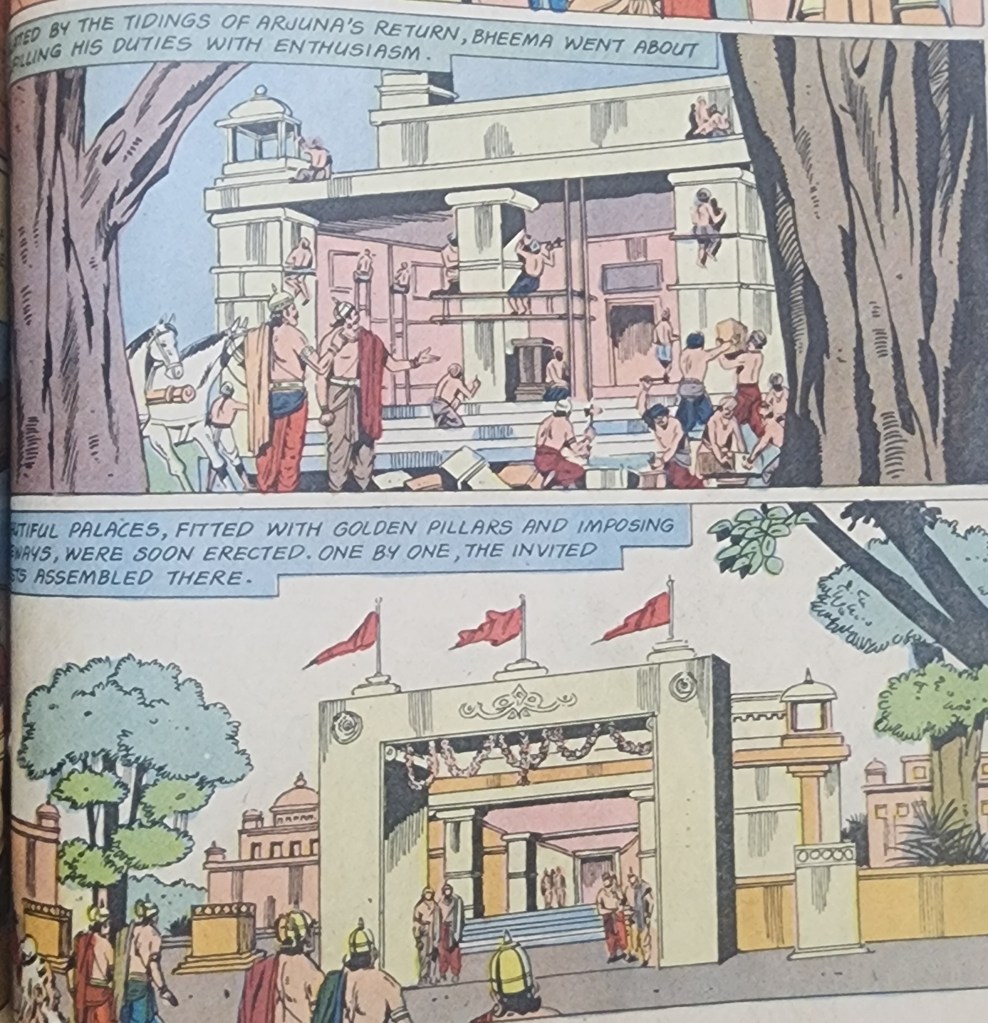
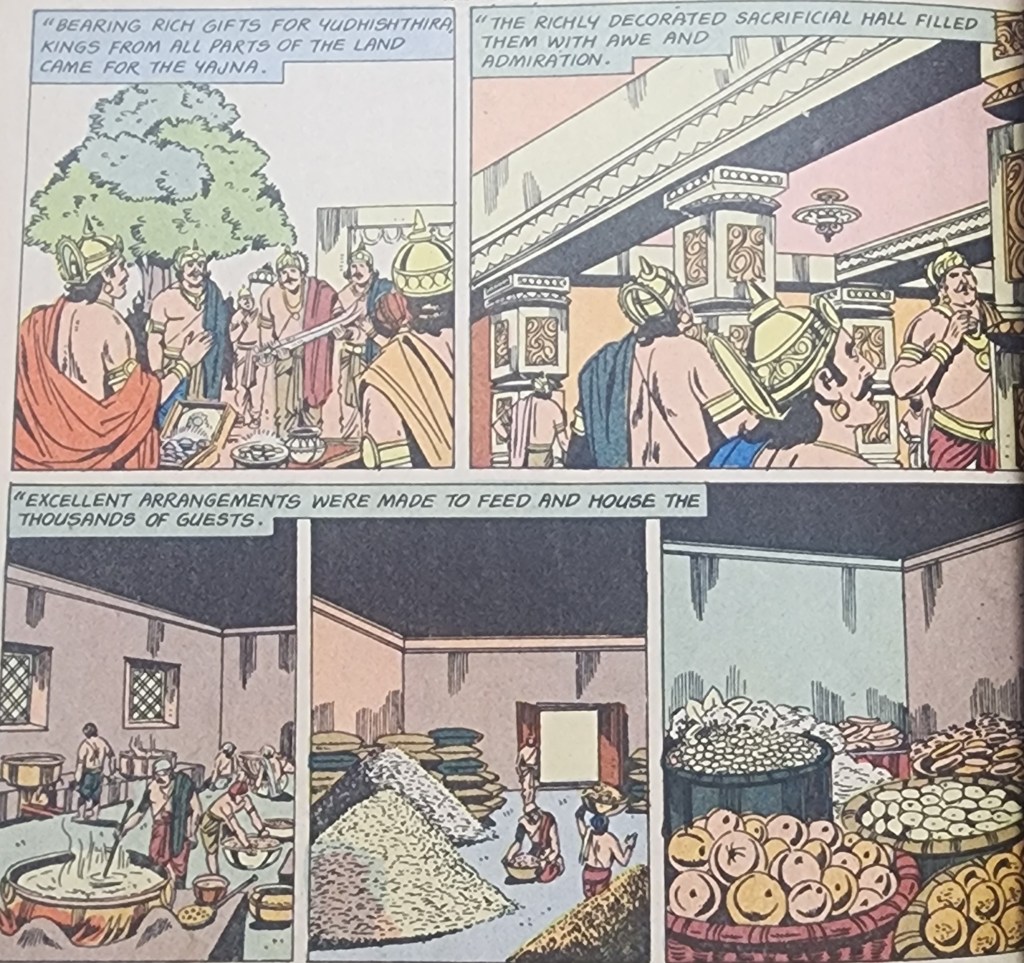
The massive logistics effort needed for the Yajna. Credit for the images- “The Mahabharata, Part 41 – The Ashwamedha Yajna”, published by Amar Chitra Katha

So, all parts of the economy have to contribute to the Ashwamedha Yajna. Food production is needed to feed the army. Industry is needed to equip the army and carry out the yajna itself. Administrative and financial bureaucracies have to be put in place to coordinate the logistics of all the activities. With all this coming up, the economy gets a jolt to restart. The tribute from the successful performance of the yajna ensures capital flows for growing the economy further.

A strong military is needed and military conflict is inevitable during the Ashwanedha Yajna. Credit for the images- “The Mahabharata, Part 41 – The Ashwamedha Yajna”, published by Amar Chitra Katha

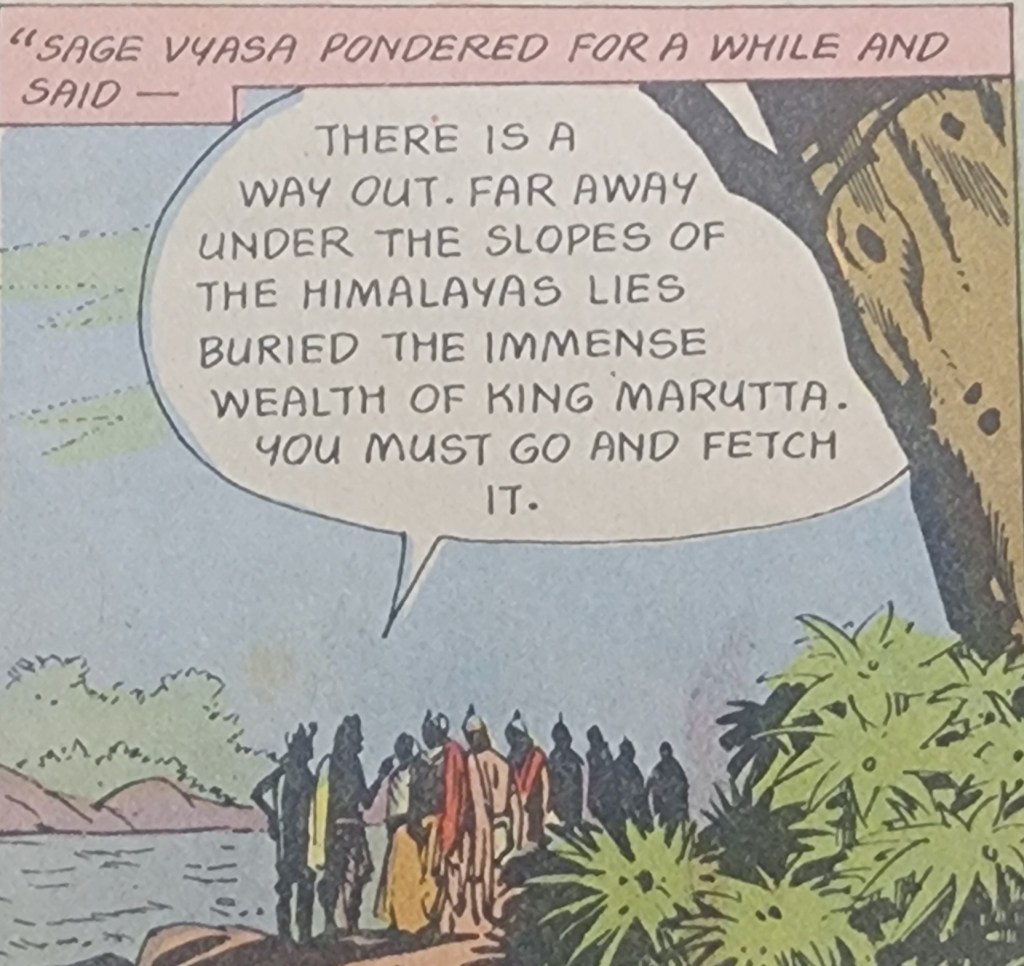
But, for a faltering/failed economy to be able to do this, an initial capital infusion is needed. This could be a loan. But in the Mahabharata, there was no institution or fellow kingdom that could afford to hand out a loan post the Kurukshetra War. So, the Pandavas dug up buried treasure. Maharishi Veda Vyasa directed them to the treasure. The treasure, a vast hoard of gold became the seed capital for the Ashwamedha Yajna and the prosperity it eventually led to.

Buried treasure is initial investment! Credit for the images- “The Mahabharata, Part 41 – The Ashwamedha Yajna”, published by Amar Chitra Katha

This wonderful segment of the Mahabharata shows how preparation for a war could lead to economic recovery. But the Kurukshetra war itself caused untold devastation. The epic is in this sense a wonderful case study for both war and its consequences and the economic recovery preparation for war can lead to (even if the defence preparedness is disguised in a sacred yajna).

Thus, it has always been about availability of resources for martial preparedness, and martial preparedness to protect and enhance economic resources and their availability. But, and it is a BIG but, this only holds where there is a democratic or a Dharmic society. A Dharmic society as I am referring to the word, is one that is defined by a clear understanding of responsibilities of the administration, even if the head of government is a king or queen who holds power due to heredity.

Wealth distribution is a must during and after the Yajna. Image credit- “The Mahabharata, Part 41 – The Ashwamedha Yajna”, published by Amar Chitra Katha

Defence preparedness is unlikely to function in the case of Palace Economies. A palace economy is one where the leader or king or dictator or the family of the same, controls all resources and distribution of the same. This control could be arbitrary, based on the will of the leadership, with no link to real world performance, hardships, challenges or threats.

A fantastic example of a palace economy is the Delhi Sultanate in India, specifically under the Mamluk dynasty and the Khaljis. All the Turkic invasions of Northern India were by palace economies. From the little history we were taught, there was no doctrine of administration that these invaders followed.

After the fall of the Delhi Sultanate, the Mughals controlled the regions of Punjab. The later Mughals, after the death of Aurangzeb, struggled to defend this region. When Ahmed Shah Abdali of the Durrani Empire centred in modern day Afghanistan invaded Punjab repeatedly, they were unable to protect the populace of this region.

Abdali was a wonderful example of a palace economy as well. He took over the regions of Afghanistan after the death of Nadir Shah of Persia, under whom he had previously served. The later Mughals were also a palace economy, but with a much smaller resource pool to go around. Abdali, on the other hand, invaded Punjab and northern India several times to acquire wealth, which was then distributed as he desired, further strengthening his palace economy. The invasions of Northern India continued until 1761 and the 3rd battle of Panipat and the invasions of Punjab continued for a few years even after that seminal event.

Abdali won the 3rd battle of Panipat, but the cost of the victory dissuaded him from ever returning to the plains of Northern India. His ravaging of Punjab is chillingly captured in the following Punjabi saying. “Khada peeta lahe da, baki Ahmed Shahe da”. It means that only what one has eaten and drunk is one’s own, the rest belongs to Abdali. It refers to the loot that ensued when Abdali attacked; people lost everything. And this kind of loot was important to keep a palace economy functioning.

The lack of this functioning in the later Mughal court required the Marathas to fight the 3rd battle of Panipat. Though they lost the battle, they successfully diminished further Afghan invasions. All further battles between Indians and the Afghans, beyond Punjab, occurred when Afghanistan was invaded by the East India Company or the British Raj. By this time, the Afghan palace economy had faltered and become dysfunctional as well. This is classic of nations where economic development did not kick off in the early modern era.

There is however a trap of exhausting one’s economy with an excessive focus on defence preparedness. I have heard a lot of people say that the USA defeated the USSR by outspending them on defence. The USSR failed economically and could not keep up with the USA. In the quest to keep itself on par with the US in defence spending, the USSR bankrupted itself.

Economic growth and development are a vital part of being able to spend on defence. The overall economy of a nation must grow continuously. When this happens, a part of the growth can benefit the defence budget. If the economy does not grow, but the defence budget keeps increasing, the country eventually ends up being a basket case. This focus on overall economic development is the reason the Ashwamedha Yajna ends up rejuvenating the national economy, because it focuses on supply chain as a whole and not just on the armed forces.

In the modern Indian context, we Indians have a threat on two fronts. Pakistan on one and China on the other. Pakistan is gradually becoming a client state of China and is being used by the latter to prevent India from becoming a competitor on the global stage for various resources. The events in Galwan in 2020 and in Pahalgam in 2025 clearly reveal that ignoring the threats will not make them go away. India will have to always be ready to militarily confront the twin threats. I include threats in the cyber and space domains when I use the term “military” here.

So, increasing defence spending is a foregone national imperative for perhaps the coming decade. This is likely what both adversaries want, to slow down India’s economic growth. China is banking on what was mentioned in my previous post, make the Indians fight themselves to keep them occupied and weakened – Pakistanis are Indians by a different name, remember**?

Will their expectation of a weaker India come to pass? Will this spending take us the way of the USSR or make our economy grow faster and become more robust? This is a question the answer to which will only become apparent in maybe 10 or 15 years. If we go about only importing technology and weapon systems, we could go either way. But if an academic, industrial military complex is developed locally, we could become a far greater economy with a stronger military and overall national power.

Notes:

* Let me elaborate with an example. We needed training katana for practice at the dojo. We could by them online, in a sports store, get a carpenter to make it or make training katanas ourselves. Back in the middle of the 2000s, an online purchase or a purchase at a sports store was out of the question. E-commerce was just beginning for only books and sports stores did not stock much martial arts equipment other than karate and taekwondo apparel and training pads. Getting a carpenter meant having a sample to go by. All of this had one serious impediment, MONEY. We did not have disposable incomes to consider this purchase lightly. We had to seriously consider if we would train the martial arts for years to come, to consider the investment feasible. Chances of continuing were always small, so the investment was unlikely as well.

That left the option of making our own training katanas. This was done with building scrap available at home, mainly small diameter PVC pipes, which were wrapped with fabric tape and held together with cellophane or insulation tape. The hardest things to make were the scabbard or saya of the sword and the tsuba or disc guard on the katana. Because these were difficult to make, the saya was given a skip and the tsuba was a piece of thermocol (polystyrene). These worked to an extent.

The drawback with the handmade equipment was twofold. The lack of a saya meant that any technique that required the drawing of a sword could never be accurately practiced. It was always an approximation. The flimsy tsuba came apart often and that led to either injured fists or to a lack of understanding of how to use the tsuba to lock the opponent’s position. So, there was pain and poor training. Both these were due to a lack of financial resources.

Our teacher back then had said that in the past, good weapons were expensive and the same was true in contemporary times as well. This was a lesson well learnt. It was as clear an elucidation of the importance of money in martial arts as any. Money leads to technology and training and both improve chances of survival.

** https://mundanebudo.com/2025/06/19/thoughts-from-op-sindoor-part-2-nothing-has-changed/