Today is Guru Poornima. And I guess some of you will have received a post on WhatsApp that says there are 6 or more words for “teacher” in Sanskrit*. Some of these words are “Achārya”, “Shikshaka”, “Adhyāpaka” and of course, “Guru”. But in common parlance, the word “Guru” is perhaps the most commonly used word to denote a teacher in many parts of India.
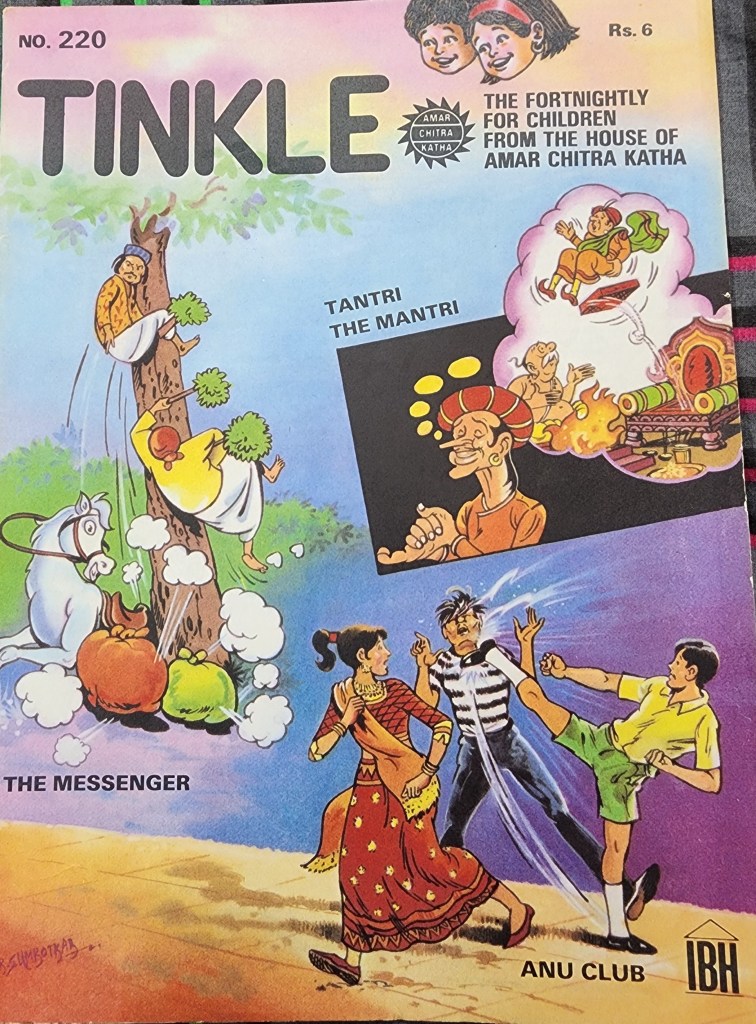
Karate featured on the cover of Tinkle No. 220. This cover was published in March 1991.

A zoomed in part of the cover from the earlier image. Tinkle comics is published by Amar Chitra Katha.
Another word that many of us in India have heard and also denotes a teacher is the Japanese word “Sensei”**. Anyone who had watched the original “The Karate Kid” (1984) surely knew the word. So did anyone who either trained karate as a kid or had a friend who trained the same. There was even an issue of the popular comic “Tinkle”, published by Amar Chitra Katha, which discussed Karate and how it used physics to perform great physical feats (this was a tale featuring the “Anu Club”).
Like most people, I too knew that the word “Sensei” can definitely be used to denote a teacher. This is not wrong. But very early during my years as a student of the Bujinkan system of martial arts, I learned that the word had a slightly different meaning, which did lead to its meaning a “teacher”.

The term “Sensei” as used in Tinkle comics. Image credit – Tinkle No. 220, published by Amar Chitra Katha (India Book House – IBH).
The word “Sensei” as I understand it, literally means “someone who was there earlier”. This is why elders and people with great expertise arising out of experience are also referred to as “Sensei”. I have also heard that “Sensei” means “someone who has gone earlier”. This phrase, as I understand it, could mean “pioneer”.
In a martial arts context, a teacher is one who has more experience than the student. The experience is because that individual walked the path of learning that the student is just starting on. In this sense, the teacher was a pioneer on this path, as far as the student is concerned. This does not mean that the teacher is a pioneer who created a new martial art system, it just means that the teacher has traversed the path before the student and hence can guide the student on the same.
This leads to an interesting outcome. Since students walk the same “path” as a teacher, or learn in a manner similar to their Sensei, they become “similar to” their teacher in the way they move. This is a common occurrence. If a martial artist who knew the teacher saw just the student move, he or she would be able to tell who the student’s Sensei was.
This is how lineages get created in the martial arts. A lineage could lead to the development of a style or school (Ryu or Ryuha (plural)) or system of martial arts. The lineage could be specific to an extended family or to a region. An example of this is the “Togakure Ryu”, one of the 9 schools studied as part of the Bujinkan. The “Togakure” in the name is supposed to be in reference to a village in the Iga province of Japan.
The concept of a lineage extends beyond the martial arts, into other art forms and sports as well. Cricket is the most popular modern sport in India. There are 3 “schools” of batting recognized in India. These are the Bombay school, the Deccan school and the Delhi school. Each of these has produced great batters.
Similarly, in Hindustani music, in north India, we hear the term “Gharana”. A Gharana refers to a lineage. The word “Ghar” in modern day Hindi also means “home”. So, a Gharana could refer to a lineage literally, as it comes from a family in a home. But then, the Gharanas are associated with regions. Some examples are the Delhi Gharana, the Lucknow Gharana and the Benaras Gharana. As the names suggest, each of these is named after a region. This concept of lineage extends to architecture, painting, weaving, pottery and any number of other arts.
The festival of Guru Poornima is observed on the first full moon day (Poornima) of the month of Āshāda (coincides with a part of July). It is observed to mark the birth anniversary of Maharishi Veda Vyasa. Veda Vyasa is also called Krishna Dwaipāyana and Bādarāyana. He is truly the ultimate Guru! This is obvious once the corpus of knowledge that is attributed to him is recognized.
Veda Vyasa is most well known as the composer of the Mahabharata (or at least the Jaya, which is the core of the 3 nested dialogues which form the Mahabharata). He is also credited with compiling the Vedas into the form we know today (hence the word “Veda” in his name). The 18 Mahapuranas are also attributed to Veda Vyasa’s authorship or compilation. In other words, according to tradition, a large volume of texts from Hindu culture owes its existence to this greatest of Gurus!
That said, it is not just teachers of knowledge that are revered in Hindu culture. There are great Gurus for the martial arts as well. I will mention just four that are top of mind for me. There are several other great Gurus, from history and culture, all of whose stories I would strongly recommend everyone to visit.
The 4 Gurus who are top of mind for me, from the Mahabharata and the Ramayana, are,
- Parashurāma
- Vishwāmitra
- Drona
- Balarama
The first 3 of the 4 mentioned above form a lineage of sorts. Let’s look at a few points about these great Gurus.
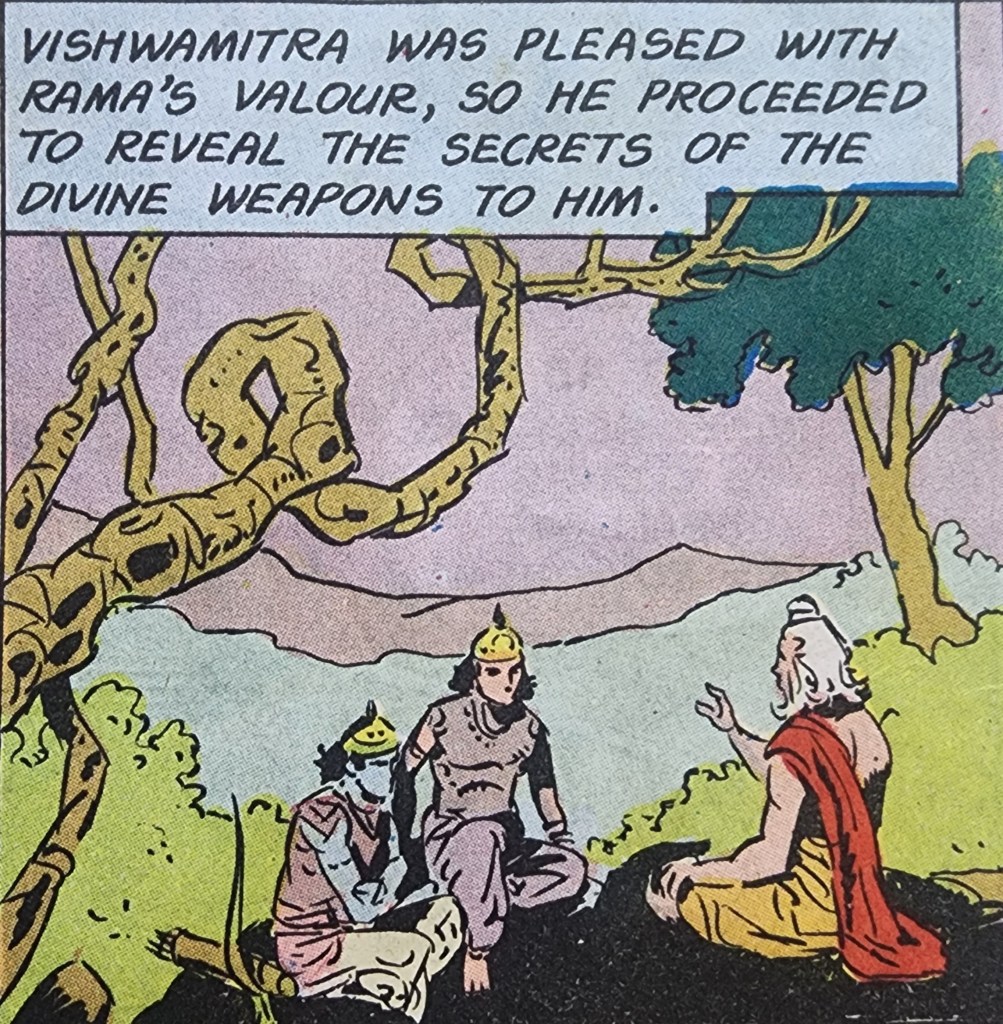
Brahmarishi Vishwāmitra imparts knowledge of celestial weaponry to Rama and Lakshmana. Image credit – “The Ramayana” published by Amar Chitra Katha.
Vishwāmitra was the Guru who was a martial arts instructor of Lord Rama. It was from Vishwāmitra that Lord Rama received a lot of the celestial weapons that he would use later. Vishwāmitra, before he became a Brahmarishi, was an egotistical king named Kaushika. Kaushika obtained powerful celestial weapons to use against Vasishta, who was Rama’s first Guru at Ayodhya! Of course, the weapons were of no use against Vasishta, but they were successfully used by Lord Rama, who was a student of both Vishwāmitra and Vasishta. Vishwāmitra of course had long overcome his rivalry with Vasishta by this time.
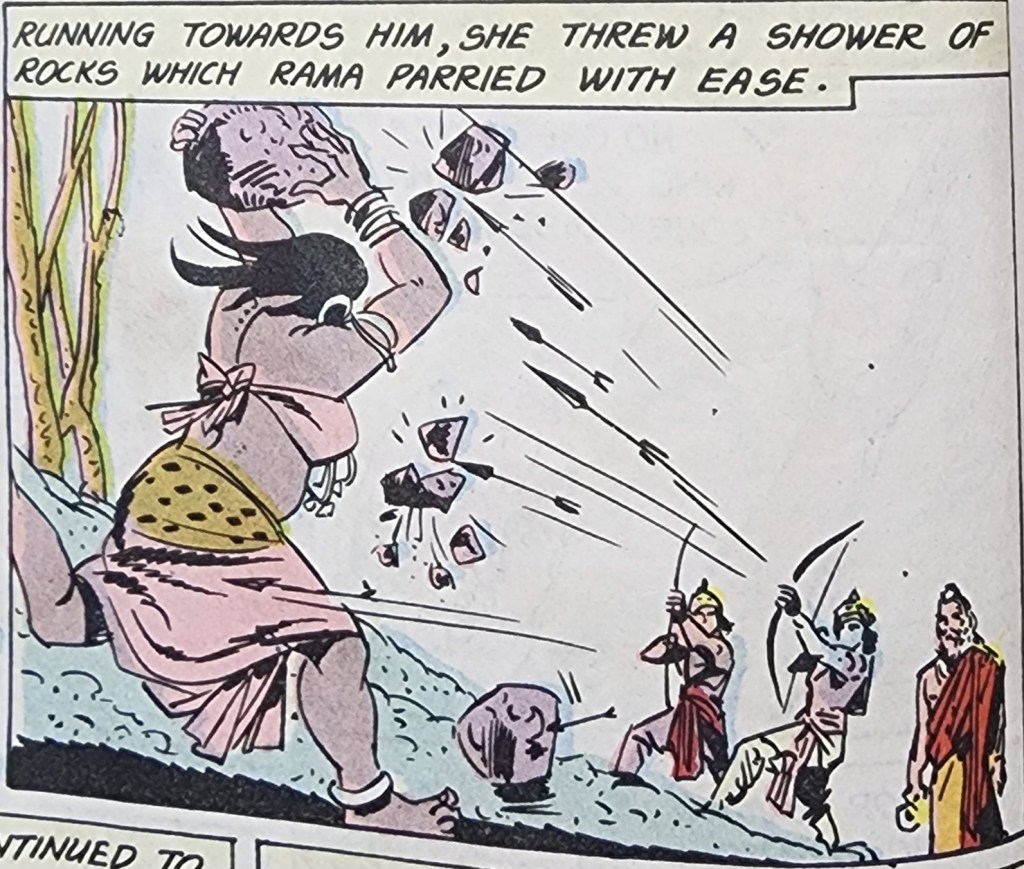
Brahmarishi Vishwāmitra guiding Rama & Lakshmana in their fight against Tataka. Image credit – “The Ramayana” published by Amar Chitra Katha.
Parashurāma was Vishwāmitra’s grandnephew (the story of their birth is fantastic!). He was one of the greatest warriors of his time, of any time. He is also one of the 7 Chiranjeevis (immortals) who are supposedly still around during modern times, but not accessible to normal humans. Lord Parashurāma is the sixth avatāra of Lord Vishnu and the future Guru of Kalki, the tenth avatāra of Lord Vishnu expected to manifest in the future.
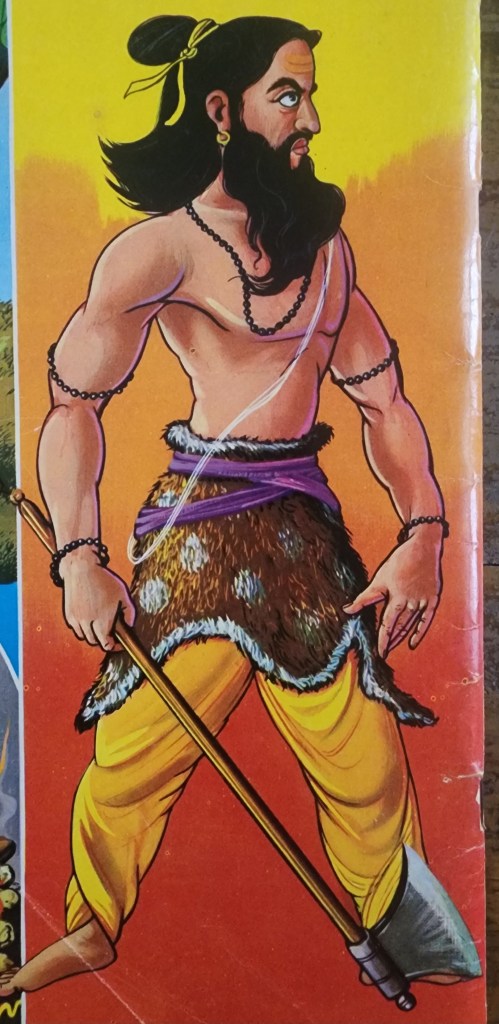
My favourite depiction of Lord Parashurāma. Image credit – “The Bhagavat for Children”, published by Anada Prakashan.
While Lord Parashurāma is best known for his mastery of the Parashu (axe), he was also a wielder of all celestial weapons. Parashurāma was the teacher of both Bheeshma and Karna, two of the greatest warriors who fought on the side of the Kauravas in the Kurukshetra War (the climactic war in the Mahabharata). He was also the Guru through whom Drona achieved his mastery of all weapons. Lord Parashurāma is someone whose legacy extends to modern India as well. He is considered the origin of the martial art of Kalari Payatt, which is famously practiced in the southern Indian state of Kerala!

Lord Parashurāma confronting Lord Rama early in the Ramayana. Image credit – “The Ramayana” published by Amar Chitra Katha.
Drona, also called Dronācharya was the teacher of most of the main characters who fought in the Kurukshetra War. The “Acharya” in his name is because he was a Guru to all the Kuru princes. Drona was also one of the warriors who was invincible. He was eventually killed by a trick, which forced him to drop his weapons and give up fighting. In this sense, he is the same as Bheeshma and Karna. Both of them were also warriors of such incredible prowess that the only way to defeat them was when they either chose to or could not fight!

Drona receiving knowledge of weaponry from Lord Parashurāma. Image credit – “The Mahabharata 05 – Enter Drona”, published by Amar Chitra Katha.
Based on the described prowess of Lord Rama, Vishwāmitra was a great Guru! His grandnephew Parashurāma was a God, whose students were among the greatest warriors ever, some being invincible. One of Parashurāma’s students, Drona, became a great Guru in his own right. So Parashurāma’s school was a dream for any martial artist! Considering he and Vishwāmitra are from the same family, they could be considered to be from the same lineage.
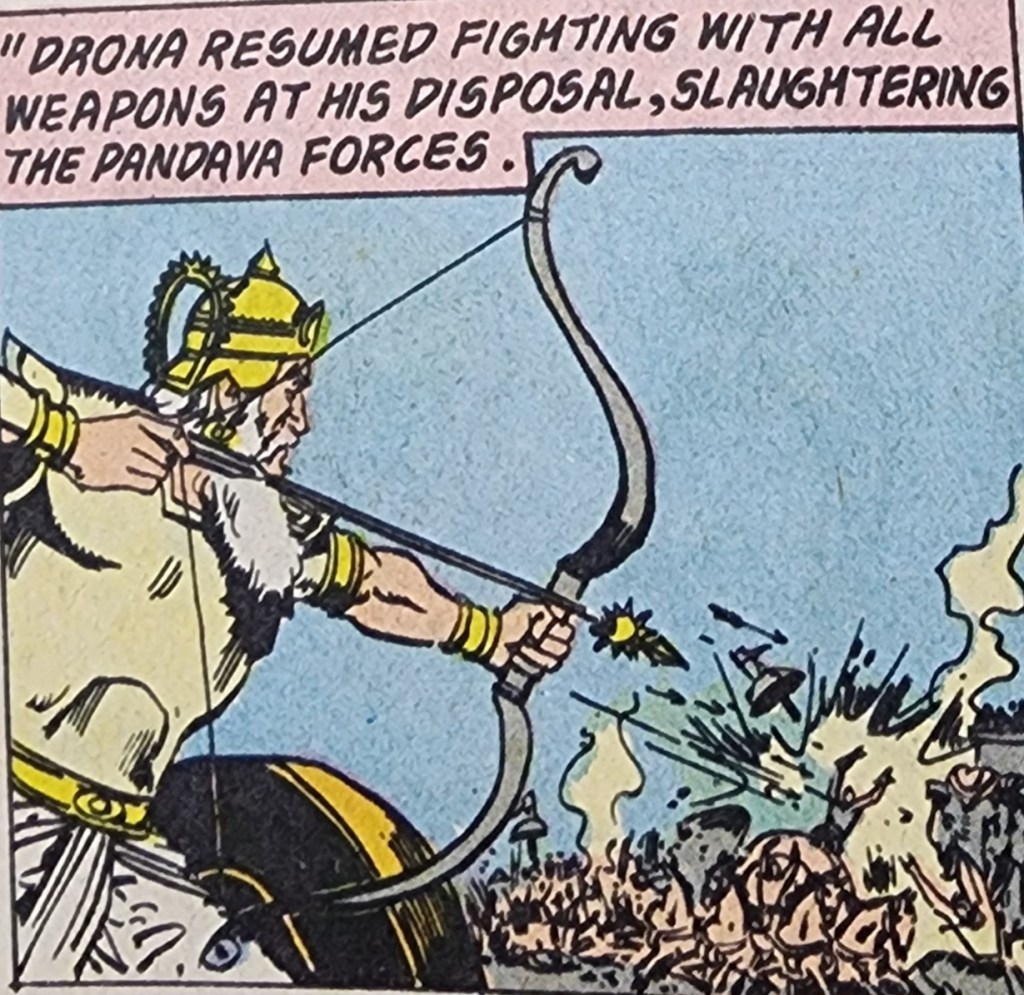
Drona being terror incarnate towards the Pandava army. Image credit – “The Mahabharata 36 – The Battle at Midnight”, published by Amar Chitra Katha.
The last of the great martial Gurus I mentioned above is Balarama. He is the older brother of Lord Krishna. Balarama is considered an avatāra of Ādishesha, the serpent on whom Lord Vishnu rests. He was the greatest gada (mace) fighter ever. This was despite the weapon he is most associated with being the plough! He was the teacher to both Bheema and Duryodhana. Bheema and Duryodhana fought on opposite sides in the Kurukshetra War. Both Bheema and Duryodhana were disciples of Drona as well. They went to Balarama for specialized training in the mace (gada).
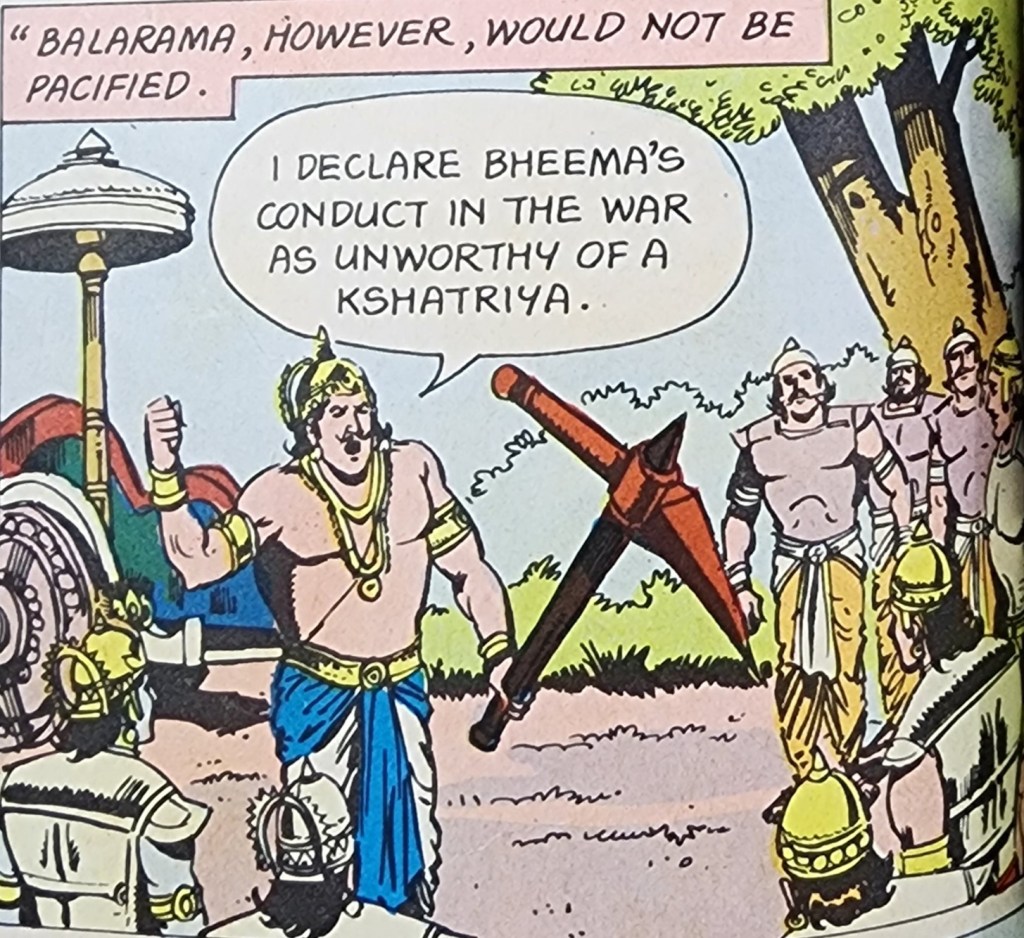
Balarama wielding the plough! Image credit – “The Mahabharata 39 – After the War”, published by Amar Chitra Katha.
Considering that all these Gurus were teachers of the martial arts, I suppose they could be considered Sensei as we understand the word today, specifically considering the lineage they were from and the one they perpetrated.
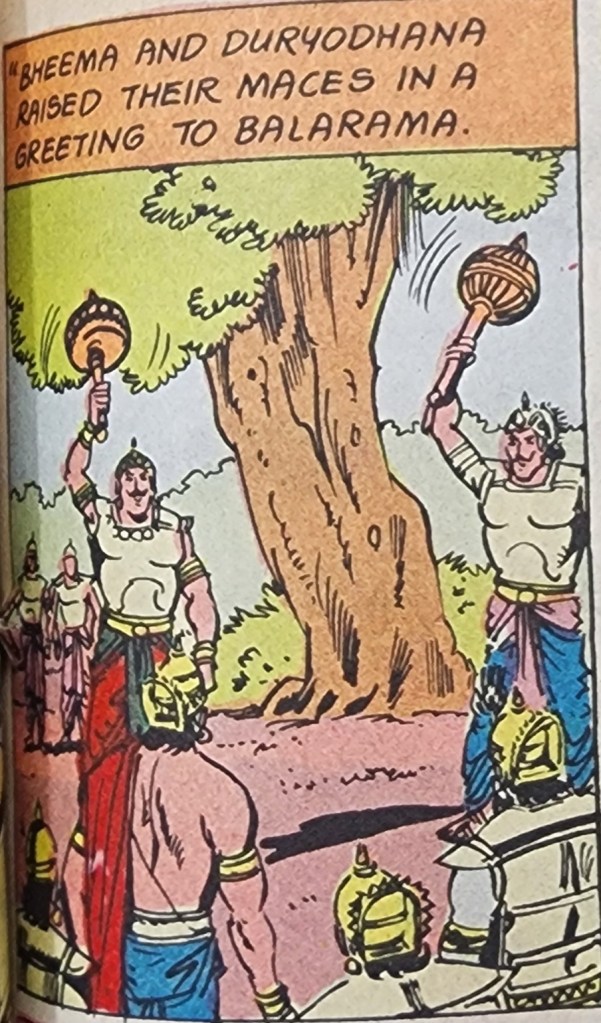
Balarama was the Guru for the Gada, for both Bheema and Duryodhana. Image credit – “The Mahabharta 38 – The Kurus Routed”, published by Amar Chitra Katha.
We in India have a culture where a Guru, or a teacher is deeply respected and that comes from listening to stories passed down in our traditions. But the fact that some of these Gurus were martial arts teachers is not specifically recognized, even though it is well known. The word Sensei, in modern times is one that inspires great respect too, thanks to Japanese culture, where expertise, experience and teachers are deeply respected as well.
Looking at the two cultures, it should be possible to recognize that we always had many Sensei in India, who were Gurus of the martial arts. And they were as respected as a Guru from any other field of knowledge or expertise. The identification of this aspect was the purpose of this article. I hope I have been successful in highlighting the martial aspect of our culture and its extension to our respect for Gurus.
Notes:
* The many words for “teacher” according to the much forwarded WhatsApp message.
The teacher who gives you information is called Adhyapak.
The one who imparts knowledge combined with information is called: Upadhyaya.
The one who imparts skills is called Acharya.
The one who is able to give a deep insight into a subject is called Pandit.
The one who has a visionary view on a subject and teaches you to think in that manner is called Dhrishta.
The one who is able to awaken wisdom in you, leading you from darkness to light, is called Guru.
** Another word for teacher that many Indians know these days is “Sifu”, thanks to movie, “Kung Fu Panda” (2008).
 Mundane Budo
a very detailed explanation of Guru starting from Ramayana and Mahabharata. Very succinctly explained all Gurus and their disciples. Good analysis
LikeLike