In 1991, there was TV series telecast on Doordarshan called “Chanakya”. Doordarshan is the state broadcaster of India and back in 1991, there was no other TV channel in most of India. The 4 metro cities had one other channel. The serial “Chanakya” was incredibly popular when it was first broadcast. It is still very popular and has great recall. The series was based on the life of Vishnugupta Chanakya, also called Kautilya, who was among those responsible for the creation of the Mauryan Empire in India in the 4th century BCE, and also the author of the “Arthashāstra”.
The series was 47 episodes long. By episode 10, the ruler of Gandhāra, Āmbhi, has submitted to Alexander of Macedon and this is not acceptable to a lot of the ruling class and the general populace. Chanakya is a teacher at the University of Takshashila (capital of Gandhāra) at this time and is worried at the turn of events. The leader of the university mentions to him at this time that if the administration is incapable of leading the society, that job falls to the teachers. This conversation is fiction of course. But Chanakya was a teacher and he did go on to cause major political upheavals in Indian history.
Watch between the 16 and 17 minute marks to see the conversation I referenced earlier.
Chanakya causes major changes by creating a capable set of people who can administer. These are led by a student of his called Chandragupta. Chandragupta Maurya is mentored to be a good ruler. An army to support Chandragupta is created, as is a political alliance, who are willing to take on the ruler of Magadha. In summary, Chanakya, is a teacher and an extraordinary intellectual who could take on the mightiest empire of its time and reset the administrative system, which echoes in Indian society and politics to this day.
Fast forward some 2300 years and we see that universities are still at the centre of attention. In India, the Jawaharlal Nehru University (JNU) is in the news often for espousing views that seem to be that of the Left. It is accused of being anti-India in some the thoughts it seems to express. These ideas seem to stem from both students and the teaching staff, particularly in the Social Sciences and Humanities areas like history, economics and political science.
In the USA, famous universities like Harvard and Columbia were in the limelight recently for causing disruptions in support of Gaza, against the actions of Israel. These universities, including both students and teaching staff were accused of being anti-Semitic. Professors from these universities and the JNU are popular in both social media and legacy media which are considered to be “Left leaning”. In the case of the JNU at least a few alumni of the JNU have tended to influence administrative policy both from within and without the Government.
So, a situation where professors are involved in politics and are shaping (or at least attempting to) national policies continues from the times of Chanakya through to contemporary times. These educators carry out their activities by shaping the minds of students over many years and decades. They can create a large section of the population that votes for governments that enact the policies vouched for by the university teachers. Barring this, they can influence a section of the population through intellectual output like papers, books, podcasts etc. to expect a government to enact policies the professors taught them to think are right.
In India, some intellectuals including professors have been branded “Urban Naxals” due to their perceived support for the Naxal movement. The Naxal movement is a violent Leftist movement that wanted to replace India’s government with a Socialist administration. The Naxal movement is currently almost over in India, having been defeated by India’s security apparatus. The “Urban” part of the pejorative comes because these intellectuals live in urban areas and sympathize with or support Naxals, who mainly operated out of rural areas.
I just mentioned that professors influence the populace through content that includes books. The main audience for teachers from primary education to universities are their students and the main tools used to influence students are textbooks. “Influencing” students can be called “Conditioning” (perhaps with a negative connotation). Students can be conditioned to think in a certain manner and accept certain events as true or concepts as correct if their textbooks say so. This is especially easy if knowledge is imbibed through rote learning.
This means that a textbook is weapon in the arsenal of teachers that can be applied against impressionable minds. It is not unlike drugs and gases than can make individuals susceptible to suggestions. But the textbooks act gradually over longer periods of time. And this has resulted in the strong opinions and heated discussions taking place in India currently, about the content in text books.
This is especially true of history textbooks. These days, people are questioning which administration is introducing what change in a history textbook for any given class. Questions are also raised about the motivations behind the changes introduced and the individuals nominated to the committees that propose or make the changes to the textbooks.
In this video, Michel Danino, the current head of the committee that is writing History textbooks for the NCERT, speaks about the process and controversy surrounding the same.
The entire conversation around history textbooks is because both the Right and the Left in our country are concerned about whose way of looking at history will be more influential with kids. In other words, the crux of the matter is, whose weapon (textbook) will be used in the conditioning of young minds?
In the Bujinkan system of martial arts, we lean of a concept, which in Japanese, is called “Jokin Hansha”. “Jokin Hansha” refers to “conditioned responses”, or the way we humans behave and react to situations as a result of the conditioning we experience in our lives. Consider a situation where someone looks at another and extends their right hand with the fingers outstretched, the other person will extend his or her own hand to shake the hand that was offered. This is not something that we think of too much. It is something that we are all conditioned to do. It has become a part of our natural behaviour. This is an example of “Jokin Hansha”.
Belief in a “certain narrative” or a specific “memory of history” is much the same. It is a “Jokin Hansha”. Every conditioned behaviour can be used to manipulate individuals and groups of individuals. Consider this, one person throws a punch at another, the person on the receiving end, will invariably move or throw up her or his own hands in defence. If the punch was a feint, the attacker can use the defensive movement of the defender to change the attack to a hand grab or move into the space vacated by the other individual in defending against the fake punch.
In this situation, the default defensive behaviour of one person was used by another person to her or his own advantage. A feint was used to capture space or an arm. This is an application of Jokin Hansha. This same situation can be replicated with textbooks.
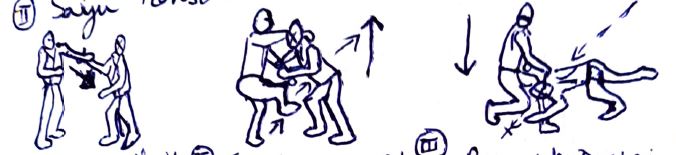
Seen above are a series of rough sketches that depict how one individual’s movement is used to the benefit of the other. Sketches by Keane Amaral.
If a student has been conditioned to believe that members of one community are disadvantaged due to a lack of financial resources and education by the vagaries of history, any action by a member of that community which could be derogatory towards another community, might be forgiven as “they do not know better”, irrespective of what the motivations of the individual might have been.
If however, a student has been conditioned to believe that members of said community have historically been conquerors and plunderers, and a member of that community behaves in a manner derogatory to another, the situation could be different. Irrespective of the economic and financial condition of the community, the feeling will be, “this is how they have always been, and deserve to be retaliated against”. This difference in response is what scares people. It is the “Jokin Hansha” of a society that is at stake! Textbooks are the weapon in making or breaking the responses of a society to future scenarios!
That said, weapons are useless without the will of the one wielding the weapon. Teachers can mitigate the success or failure of any attempt at conditioning. Which way the teachers who impart the knowledge from the textbooks direct the mind-set of kids depends on the personal brand of politics they believe in. From this point of view, the teacher is the weapon, a living one, who in turn deploys a lifeless weapon in the form of a textbook.
The notion of conditioning can be considered at a more personal level. In Eastern cultures, the teacher is greatly respected and in some cases, considered a second parent. Many kids in India start school with a prayer that explicitly equates a teacher with the Gods*. All of this is conditioning.
This results in students putting a teacher on a pedestal. This is even more so in the physical arts, like sports, dance, martial arts, music, spirituality and the like. The sense of respect is so great that students never consider that a teacher might be wrong, or might not know everything! This means that there is no questioning of what a teacher mentions or asks of the students.
But in reality, teachers are just humans who are experts (hopefully) in the subject whose knowledge or experience they are sharing. Some teachers will have human frailties and weaknesses. Put together the conditioning which results in devotion towards the teachers and teachers who are not perfect, and the creation of a cult is possible.
Teachers can exploit students. Teachers can prevent students from moving on to study with other teachers or study subjects and art forms that they are not teaching. It is also likely that teachers might not identify cases where they are of no use to a student. A student might not really enjoy what the teacher is sharing or not have an aptitude for the same.
In cases of such a mismatch, a teacher should be able to let go of a student, and encourage a student to explore other options. Not doing any of these is a failure. Numbers of students could lead to a sense of importance for a teacher which could lead to exploitation and act as an incentive to hold on to them. In the same vein, more students could mean more wealth for teachers and that is an incentive to control students as well. And then there are the horrible cases of sexual exploitation and other forms of control that a cult could possibly lead to.
All of this means that a student must find the right teacher. This is especially true in a world where education is an expensive proposition and also a business, with a lot of challenges for those involved in it. The teacher-student match needs to work for both, at least for a short duration. Let me share a few statements I have heard while training at my dojo that emphasize the need for a productive teacher-student relationship.
- I have heard from my teacher and mentors that Hatsumi Sensei, the Soke (Grandmaster) of the Bujinkan, said that one should find the RIGHT teacher. He is supposed to have mentioned this in the context of there being a lot of teachers and not all of them are a right fit for all students.
- I have heard it said that, just as teacher is present when the student is ready to learn, a student is present when the teacher is ready to teach.
- It is supposedly said that, a teacher appears when a student is ready, and when a student is really ready, the teacher disappears.
All of the above statements mean that a teacher has a huge responsibility. He or she should be able to impart knowledge and share experience, but not PRESUME responsibility for the journey that is a student’s life.
Now that I have outlined how teachers can be instrumental in making, rewiring and possibly wrecking individual lives and also affect the fate of societies and nations, I will share a story where teachers played a pivotal role in directing the fate of entire societies. The story of the Narasimha avatāra, in its nuances, explains beautifully, how teachers work in the background to affect events that change the world forever.
While Lord Narasimha and Hiranyakashipu are the main characters in the story of the Narasimha avatāra, I opine that Maharishi Nārada and Shukrachārya (the Guru of the Asuras) are the two individuals who shape the story to be what it ended up being. Both of them were teachers of Prahlad at different times and hence shaped events as they unfolded.
When Hiranyakashipu was meditating upon Lord Brahma to attain a boon that would make him an equal of Lord Vishnu, or the Devas at least, his kingdom was attacked. The Devas saw an opportunity to destroy Hiranyakashipu’s kingdom while he was away. Without Hiranyakashipu to lead them, the Asura kingdom was defeated. Indra, king of the Devas, took Hiranyakashipu’s wife Khayadu hostage. Khayadu, the queen, was pregnant with Prahlad at that time. Indra even entertained thoughts of killing Hiranyakashipu’s son as soon as he was born.
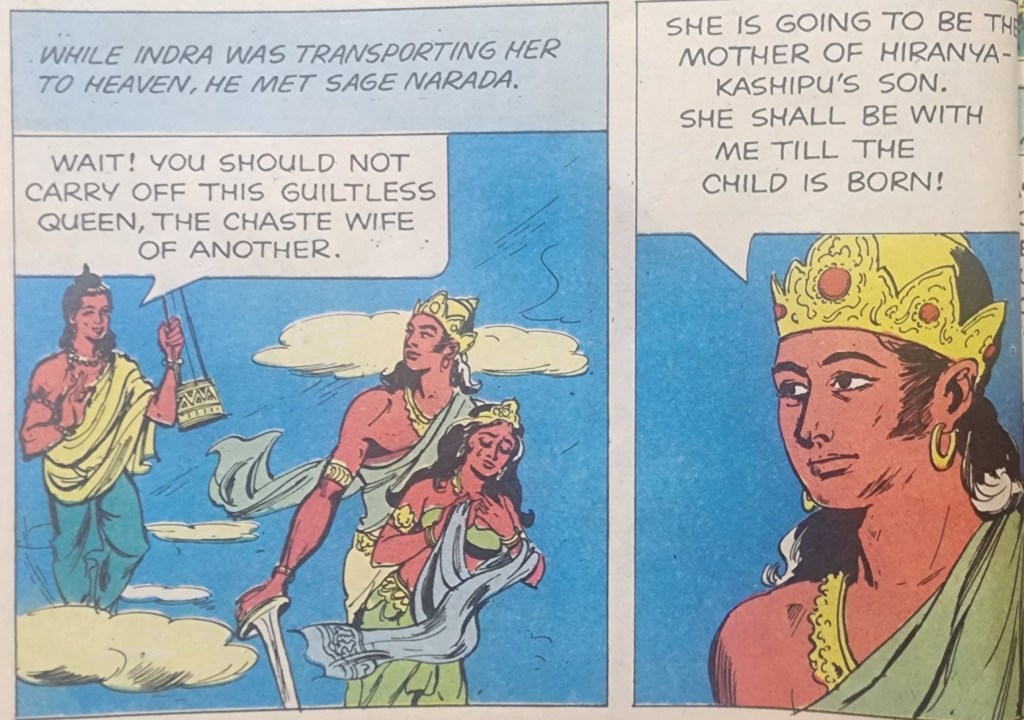
Indra decides to abduct Prahlad’s mother Khayadu, but is dissuaded by Maharishi Nārada. Image credit – “Prahlad”, published by Amar Chitra Katha.
But Maharishi Nārada intervened and prevented Khayadu from being taken hostage. He also saved Prahlad’s life by this action. Khayadu lived at the āshrama of Sage Nārada until Hiranyakashipu returned after successfully attaining the boons. Prahlad was born after his father had returned from his venture. But according to the story, while at the ashram, Sage Nārada explained the virtues and greatness of Lord Vishnu to Khayadu. Prahlad is supposed to have imbibed this knowledge while still in his mother’s womb. In this manner Maharishi Nārada was Prahlad’s first teacher.

Khayadu at the āshrama of Maharishi Nārada. Image credit – “Prahlad”, published by Amar Chitra Katha.
This knowledge gained from the Sage stayed with Prahlad after he was born, during his childhood years and even as an adult. Prahlad was a devotee of Lord Vishnu even after he became the king of the Asuras. Hiranyakashipu was outraged that his son was a devotee of someone he considered his greatest enemy, and whose worship he wanted to stamp out.
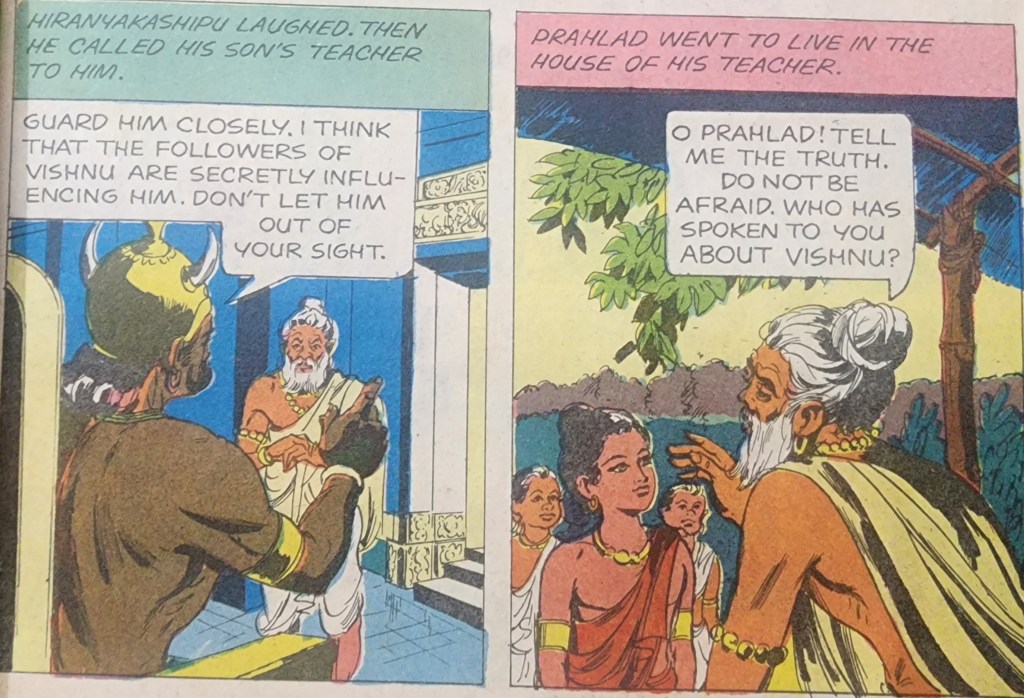
Prahlad being sent to Shukrachārya as a student. Image credit – “Prahlad”, published by Amar Chitra Katha.
Prahlad was put under the tutelage of Shukrachārya as he was the Guru of the Asuras. But Shukrachārya was unable to diminish in any manner Prahlad’s devotion towards Lord Vishnu. In fact he was concerned as Prahlad was sharing with his other pupils the knowledge received from Nārada. Since Shukrachārya failed, Hiranyakashipu attempted to kill Prahlad through various means, all of which failed. These attempts led to the arrival of Lord Narasimha to protect his devotee, Prahlad, and to the death of Hiranyakashipu.
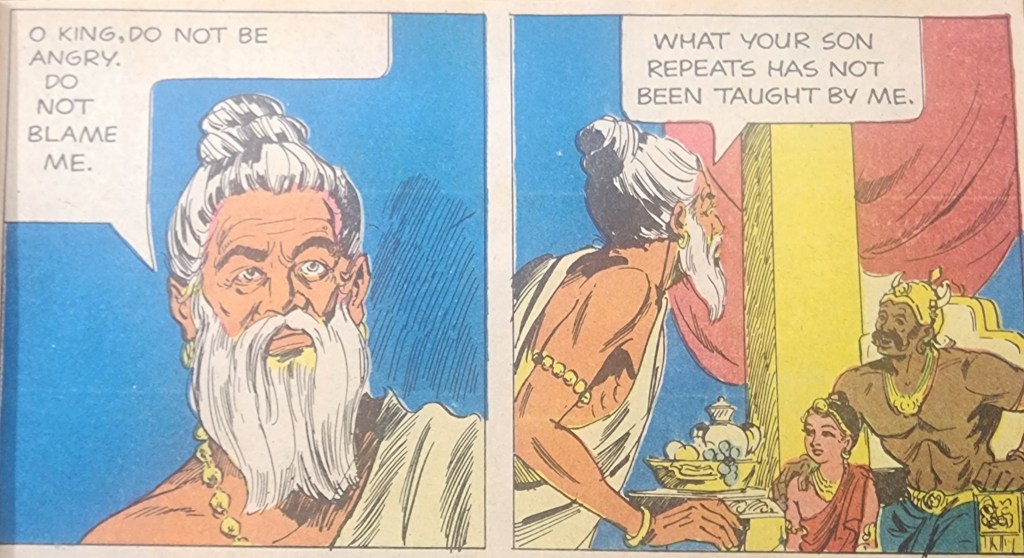
Shukrachārya fails to diminish Prahlad’s Bhakti for Lord Vishnu. Image credit – “Prahlad”, published by Amar Chitra Katha.
Since it was Prahlad’s devotion to Vishnu that led to the arrival of Narasimha, I suggest that Nārada was the cause for the avatāra. Nārada was the one who inculcated devotion** towards Vishnu in Prahlad and hence set up the events that culminated in Narasimha killing Hiranyakashipu. At the same time, is it possible that if Prahlad had been weaned away from Bhakti towards Vishnu by Shukrachārya, the Narasimha avatāra would have been different, or been postponed, or not occurred at all? It seems possible, but the story would certainly have been different.
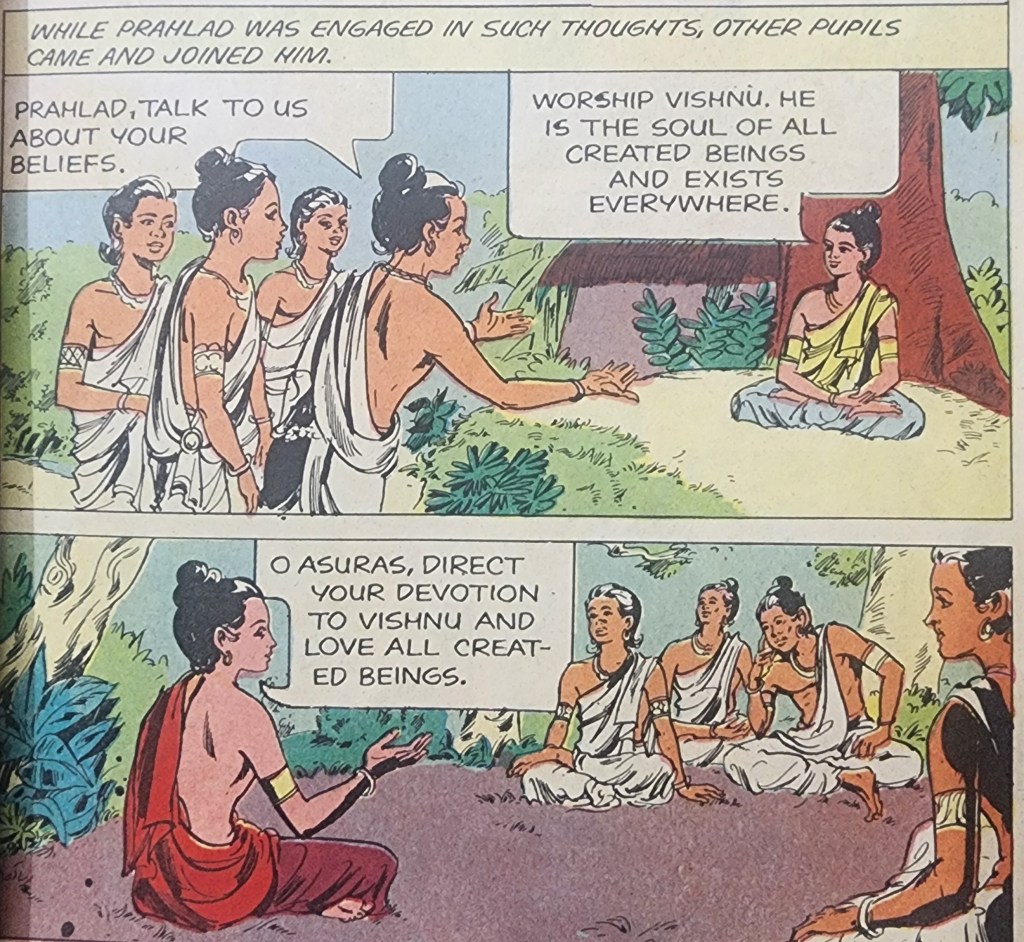
Prahlad sharing his thoughts about Vishnu with other Asura students. Image credit – “Prahlad”, published by Amar Chitra Katha.
Thus, it was Narada’s actions and Shukrachārya’s failure that led to the Narasimha avatāra occurring as it did. It was a contest between two teachers. On this occasion, Narada’s action were the ones that led to the story we know. Shukrachārya had many other successes, they are just not relevant to this article. In this manner, the actions of two teachers determined the events that led to one of the most important stories in Hindu culture.
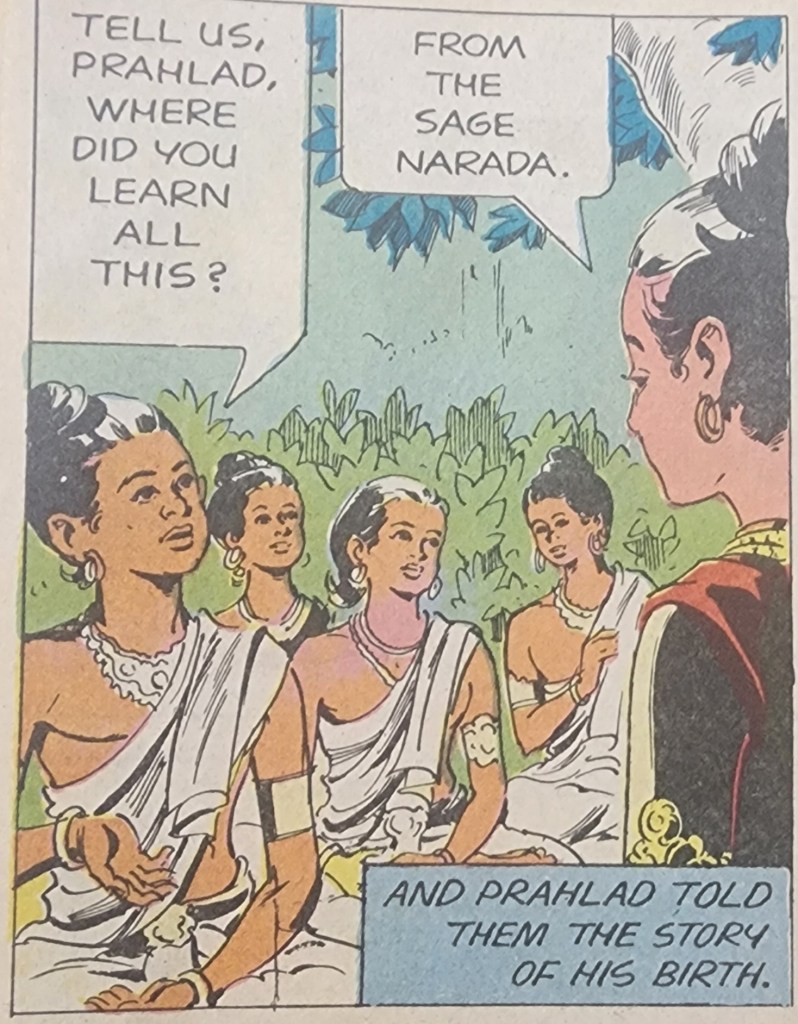
Prahlad confirms that Nārada is his teacher. Image credit – “Prahlad”, published by Amar Chitra Katha.
Before I conclude, I must add another point. Maharishi Nārada ensured that Indra released Khayadu. In doing so, he ensured that Indra would not be committing the same crime that Kamsa, Lord Krishna’s uncle would commit much later. Kamsa killed all of Vasudeva’s children with his sister Devaki as soon as they were born. Also, by ensuring that Prahlad was not killed before he was born, he ensured that Indra did not commit the same crime that Ashwatthāma would commit in the future, at the end of the Kurukshetra war in the Mahabharata. Both Kamsa and Ashwatthāma suffered severe consequences for their actions. Indra would be eligible for the same fate had he carried through with his impulsive plans.
If Indra had been deserving of divine retribution, would the Devas be eligible for Vishnu’s protection, in the form of Narasimha? Perhaps not. Thus, by ensuring Indra did not commit actions worthy of punishment, and Prahlad was a devotee of Lord Vishnu, Maharishi Nārada literally laid the groundwork for the coming of Narasimha.
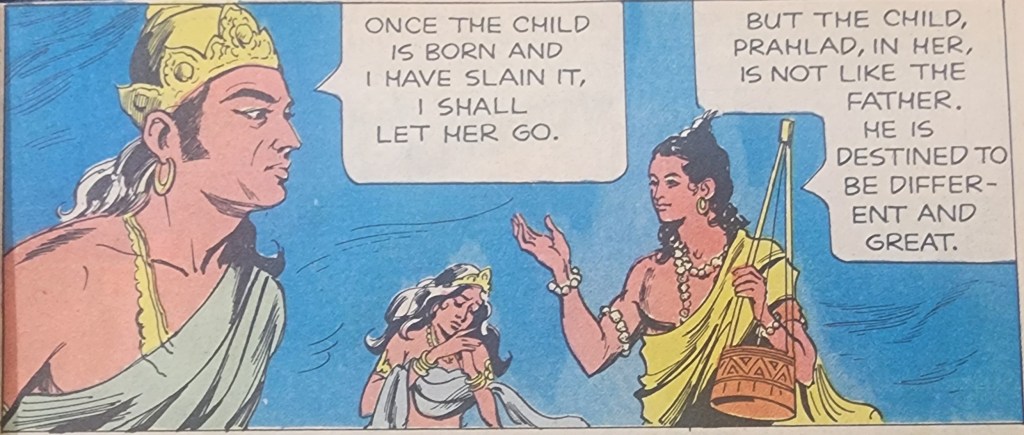
Maharishi Nārada prevents Indra from committing a grave crime. Image credit – “Prahlad”, published by Amar Chitra Katha.
Based on the above points, teachers shaped the future of empires and ensured the Gods could protect the world in the past. In current day, teachers can shape the future of individuals AND societies for better or worse as we saw in the case of university professors, creators of textbooks and martial arts instructors. Conditioning, which is one of the outcomes that actions of teachers eventually lead to, is thus a weapon. And that makes me suggest, TEACHERS ARE WEAPONS.
As some of you might have guessed, the idea for this post comes from tomorrow, September 5th, being celebrated as “Teacher’s Day” in India. September 5th is the birthday of Sarvepalli Radhakrishnan, former President of India. He was a preeminent intellectual, author and educator, whose life is celebrated by recognizing the contribution of teachers to the country.
Notes:
* The shloka (loosely translated as prayer) where teachers are equated with Gods, is seen below.
Gurur Brahma Gurur Vishnuhuh
Gurur Devo Meshwarahah
Guruhuh Sākshāt Parabrahma
Tasmai Shree Guruve Namahah
It translates to,
Guru is Brahma, Guru is Vishnu
Guru is Maheshwara (Shiva)
Guru is literally the Supreme Being
I bow/salute that Guru
** I use the words Bhakti and devotion interchangeably, though “devotion” is not a perfect translation for the word “Bhakti”.
 Mundane Budo