In Hindu culture, the Asuras are very often seen in a negative light. Asuras, sometimes conflated with Rakshasas are, from a modern perspective, the villains in most of the stories we hear. But as we know these days, they are not villains. Some of them might end up becoming villains. More often than not, they are in opposition to the Devas.
The Asuras usually include the Daityas and Dānavas. Daityas, Dānavas and Devas are cousins. They end up battling for control of various realms often. While the stories we hear and read eventually end with the destruction of one or a few specific Asuras, it does not mean that they always end up on the losing side. They end up being the victors quite often.
It must also be remembered that while the Asuras are seen conquering the realm of the Devas (Swarga and its capital Amarāvati), and the realms of humans or Mānavās, the Asura realm is shown as being attacked or conquered by the Devas (never the Mānavās) only a few times. The Asuras regroup time after time under different leaders and attempt a new conquest. They succeed in their conquests quite often and subdue the realms of Devas and Mānavās. This conquest leads to an avatāra of Vishnu or Devi or Shiva to be responsible for saving the Devas and Mānavās.
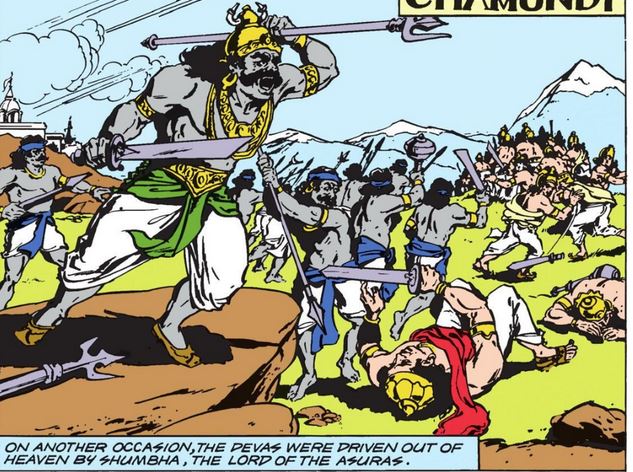
The Asura Shumbha conquers Swarga. Image credit – “Tales of Durga” (Kindle edition), published by Amar Chitra Katha.
This sequence of events leads to interesting observations. Firstly, if the Asuras were rarely invaded and only defended against, it seems that they were too powerful to face offensive action. Only one of the Trimurthy or Devi could attack them and succeed. The two instances that I am aware of when the Devas attacked and defeated the Asuras was when Vrtra was slain and then when Viprachitti was defeated.
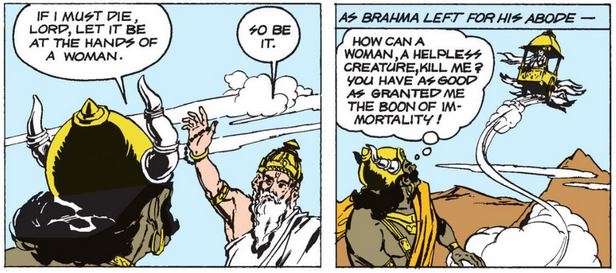
Secondly, it seems that the Asuras were the definition of resilience, innovation and perseverance. Every time they were defeated, they held out to rise in strength again. This is resilience. The next Asura leader performed great meditative penance (tapasya) to achieve a great boon from Lord Brahma. This boon nullified the advantage provided by the Amrita in the possession of the Devas. This is innovation. This process took years on end. But after this gap, the Asuras invaded again with the new leader and his or her powers and generally succeeded in defeating the Devas. They ruled Swarga for a long time after the victory before a divinity defeated them. This is perseverance.
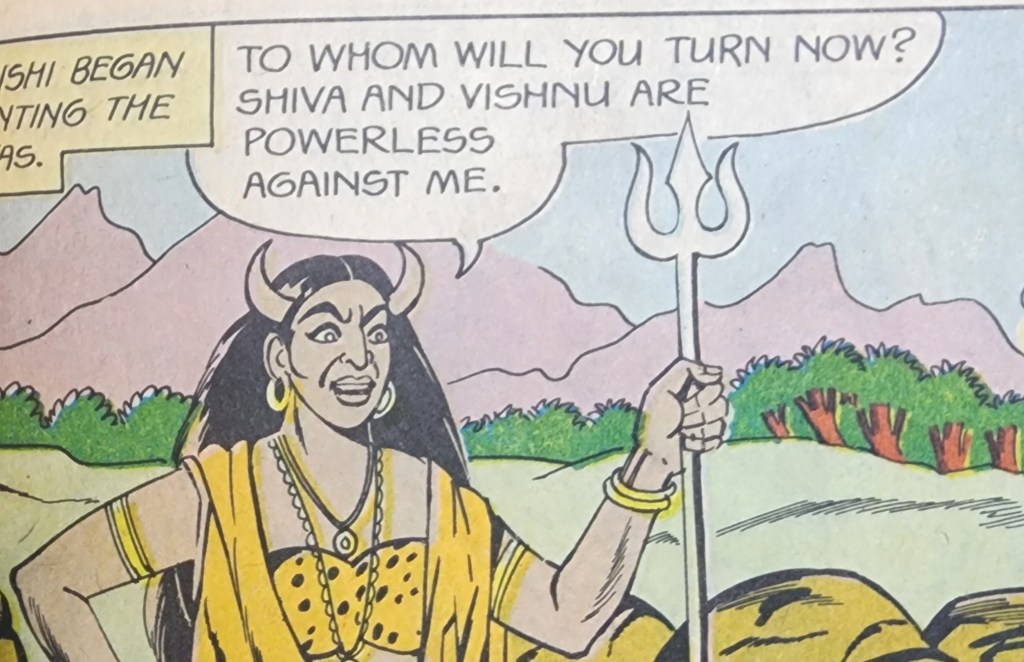
Mahishi taunts the Devas after acquiring her Boon. Image credit – “Ayyappan”, published by Amar Chitra Katha.
I mentioned the Amrita in the possession of the Devas in the previous paragraph. Amrita gave the Devas great health and immortality. This was an unbeatable technological advantage. To overcome this advantage, the boons the Asuras acquired were vital. This mitigated the advantage provided to the Devas by the Amrita, at least to a certain extent.
An aside – I have heard that this is a likely origin of the word “Asura”. During the Vedic Age when Yajnas were widely prevalent, two sacred drinks are mentioned as being offered to the Gods, Soma and Sura. These were not offered to some Gods. These Gods came to be “Asura” as “Sura” was not offered to them, the “A” indicating the lack of the offering. I am not sure if this is accepted by everyone or if it is just another theory.
The martial art I practice is the Bujinkan system of martial arts. The Bujinkan is sometimes referred to as “Ninjutsu”. But Ninjutsu, or Ninpo, is one of the facets of the martial arts practiced as part of the Bujinkan system. The “Nin” in both Ninjutsu and Ninpo, refers to “Perseverance”. So, Ninjutsu is “The Art of Perseverance” and Ninpo is “The Way of Perseverance”. And if the Asuras are the exemplars of perseverance, they are the true practitioners of Ninjutsu!
Historically speaking, the Devas in their primary roles are representative of the natural elements. Indra, the king of the Devas, is the God of Thunder and Lightning and Storms. This means that he is a personification of these natural forces. Similarly, Agni represents Fire, Vayu represents the Wind and Varuna represents water and water-bodies. Surya represents the Sun, Chandra or Soma the moon and one of the Vasus represents the Sky. The Ashvins represent healing properties, speed (horses) and safety during voyages. It seems to me like they represent the natural intelligence of humans to protect themselves.
Humans have striven from time immemorial to survive the elements. Over millennia they achieved mastery over the elements and learnt to thrive despite the elements. Now we have reached a stage where human actions are causing chaos in the elements in the form of climate change and devastating the natural world.
This flow of events over the last several thousand years suggests to me, that we are the Asuras. The Devas are nothing but the natural world as mentioned earlier. Humans initially cowered before the elements, but showed resilience to survive all ecosystems. This resilience and human expansion was facilitated by the continuous innovation demonstrated by humankind. The innovation took centuries in many instances, like the domestication of livestock, crops and most importantly, fire. The continuous flow of innovation is only possible through rugged survival. This is the perseverance of the human species as a whole.
So, humans have over several centuries demonstrated resilience, innovation and perseverance. With these traits, humankind has conquered the natural world, in other words, the Devas. This checks two boxes for humans to be the real Asuras. The third box relates to the Asura trait that led to their defeat time after time.
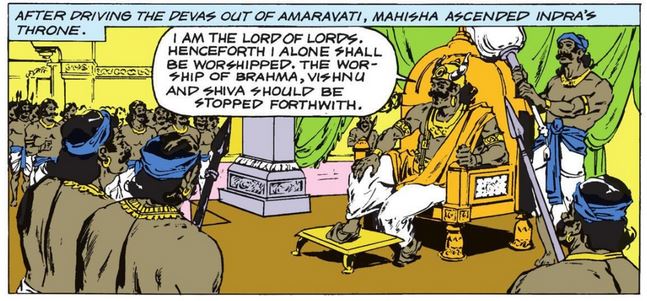
The Asuras after their successful conquests, gradually descend to being despots and cruel dictators. They end up throwing the natural order into chaos. It is at this stage that the avatāra appears to defeat the mighty Asura leader and drive the Asuras out of the realms of Devas and Mānavās. The Asuras go from being conquerors to destroyers, which leads to their downfall.
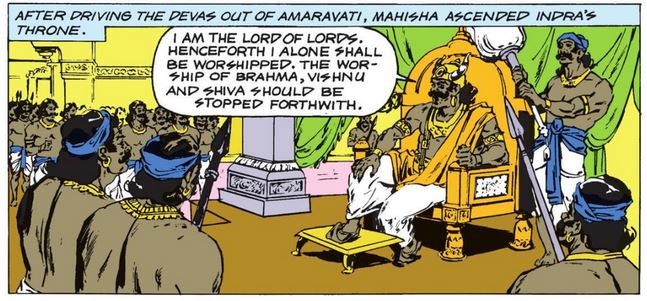
Mashisa goes full despot. Image credit – “Tales of Durga” (Kindle edition), published by Amar Chitra Katha.
Humans, as mentioned earlier are supposedly throwing all ecosystems of the Earth out of whack. All species are suffering and even among humans, there are several that are living lives whose quality is far lower than those of the rest. All of this seems like humankind is the Asura nation that has gone full despot. This is the third box to check for humans to transcend into being Asuras. This is also the event that should trigger the arrival of an avatāra.
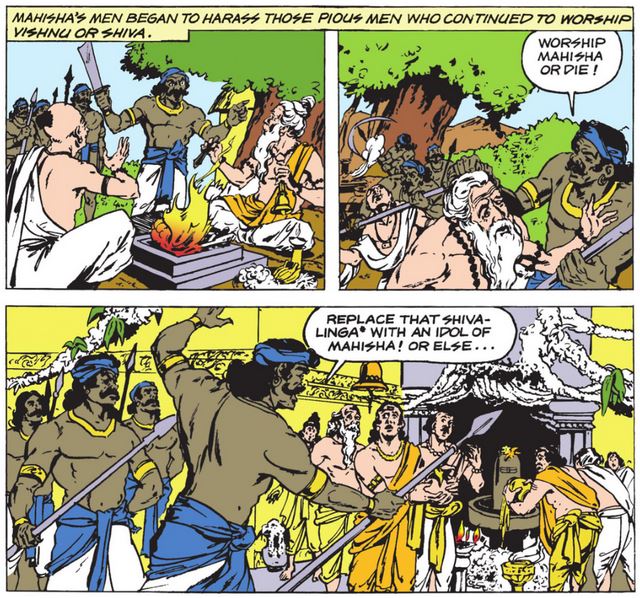
Mahisha imposes monotheism. Image credit – “Tales of Durga” (Kindle edition), published by Amar Chitra Katha.
But is the natural world itself going to be the avatāra aided by conflict within the human nations? I have no idea. But the fact that humans are the real Asuras seems clear. Perhaps humans are like Asuras on steroids. Humans strive to succeed, acquire knowledge and build technology. This is not unlike severe tapasya over a long time. This technology, which is the equivalent of the boons from the stories lets humans harness technology and change geographies, in the form of construction, mining and pollution. This is the equivalent of a conquest and its subsequent subjugation.
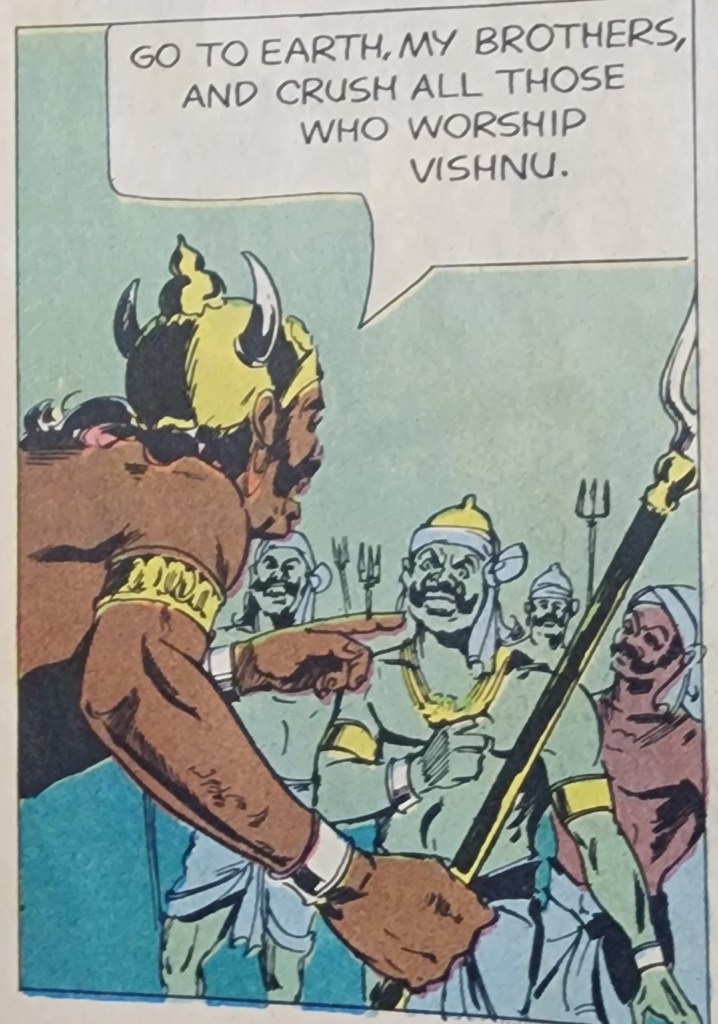
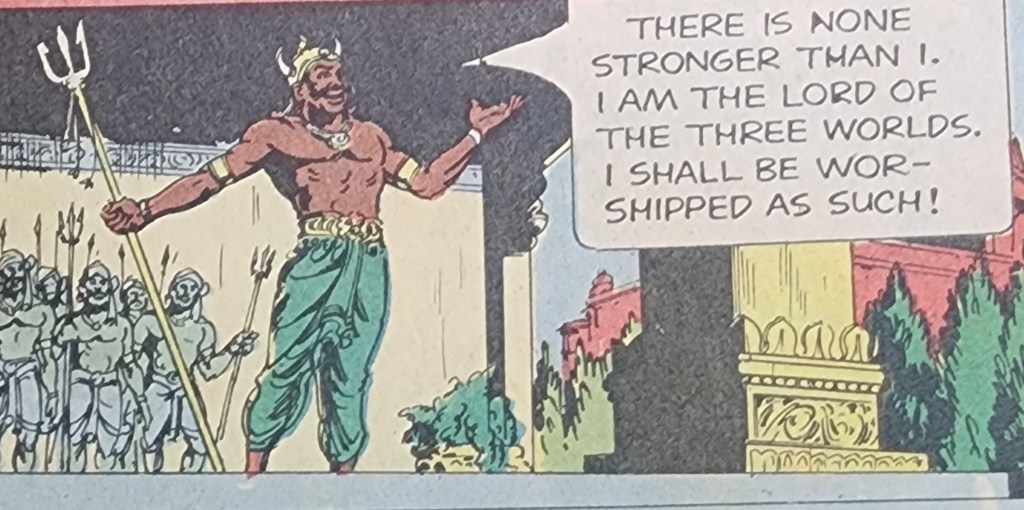
Let me elucidate with an example. Hiranyakashipu, when he became all powerful, imposed monotheism (or at least forced Viashnavās to give up their religion). He forbade the worship of Vishnu and forced people to worship him instead. This is the same as the powerful nations expecting everyone to conform to their own education, values and lifestyle. The most powerful nations can achieve this through the boons of wealth and technology. This leads me to this, we are on the cusp of becoming the Asura Planet.
Let me backtrack to the struggle between the Devas and the Asuras for a bit. I had mentioned that the Asuras were rarely invaded by the Devas and this was due to how powerful the Asuras were. Of course, it could be that the Devas did not attack the Asuras or eliminate them out of the goodness of their hearts. The Devas could have been satisfied with the life they had achieved through the use of Amrita. But then, they were all cousins and if the Devas had turned conquerors, especially after being in possession of Amrita the Asuras and Devas would simply be swapping roles, at least in the stories. That said, Devas were not entirely content with their lot and fought among themselves too.
Hiranyakashipu becomes a dictator. Credit for both images – “Prahlad”, published by Amar Chitra Katha.
Some examples of the Devas being in conflict among themselves are the following.
- Indra and Agni seem to have been in conflict multiple times. Agni took the help of Krishna and Arjuna to stop Indra from interfering when he consumed the Khāndava forest. Indra wanted to stop Agni as his Naga friend Takshaka lived in that forest.
- The Asura Rambha was saved by Agni when Indra wanted to kill him as he was meditating. Indra had already killed Rambha’s brother Karambha through deceit. Thanks to Agni’s actions, Rambha eventually reincarnated as Raktabeeja to protect his son Mahishāsura.
- The Asura Jalandhara was raised in the ocean, the abode of Varuna. Jalandhara attacked the Devas to retrieve the treasures of his adoptive father Varuna. In this manner, Varuna and Indra seemed adversarial even though they were not out to fight each other. Varuna had raised the Asura who would attack the Devas.
- The Devas and Asuras fought a war call the Tārakāmaya War in the Puranas. This war occurred because the wife of Brihaspati, Tara was either abducted by Chandra (Soma) or she eloped with him. Brihaspati was the preceptor of the Devas. This incident led to a war where the Devas sided with their Guru while the Asuras sided with Chandra.
Based on these instances, it is quite likely that the Devas were not entirely peaceful or docile. It is therefore not necessary that they did not invade the Asuras out of the goodness of their hearts.
Since we spoke of Brihaspati, I must mention Shukrācharya. Shukra or Shukrācharya was the Guru or preceptor of the Asuras. He is the personification of perseverance and innovation, which could make him the ultimate expression of Ninjutsu!
Shukra found a way to defeat death itself! He performed tapasya with Lord Shiva as the focus. Once Lord Shiva was pleased, Shukrācharya learned the “Sanjeevini Vidya (Kriya)” from the Lord. This led to his being able to resurrect Asuras who were dead! This was essentially the same as being immortal. It seems to me that the Devas had no choice but to acquire Amrita to counter the Sanjeevini Vidya!1
In the Bujinkan, we learn of the 5 Gojo (roughly translatable as “pearls of wisdom”). These are five important concepts that, taken together, can be a guide to life. The 5 Gojo are,
- Fumetsu no fusei – translatable as “give and give” or “endless giving”
- Mamichi no jikai – translatable as “following/staying on the right path”
- Shizen no niniku – translatable as “the perseverance of nature”
- Shizen no choetsu – translatable as “the transcendence of nature”
- Komyo no satori – translatable as “the light of wisdom”
I will not go into the detail about the Gojo here. I have written a separate article describing these as I understand them, the link to which is seen in the notes below*. I would however, draw an analogy between the Asura and modern human way with the Gojo.
The tapasya (meditation / penance / continuous effort) performed by the Asura and the human quest for knowledge is an outstanding example for “fumetsu no fusei”. One has to give oneself to the endeavour incessantly. This focus is the “right path”, which is tread over long periods of time. One needs perseverance to stay this path and continue the tapasya. When the tapasya reaches fructification, one transforms or transcends the current state. This could be as simple as being able to apply the newly acquired knowledge or technology as a consequence of the tapasya. These form the first four of the five Gojo.
Then comes the fifth, the one hardest to practice. At a high level, it could mean that the knowledge acquired or technology developed as a result of the tapasya is applied in the “correct” manner. Here, the term “correct” is incredibly hard to define in reality. Who can define, what is the correct way to do anything? I opine that it is nearly impossible, except at a personal level. This is why it takes “wisdom” to do the right thing with the new knowledge or technology. And if the application seems “correct” in a “given context”, one could have seen “the light of wisdom”.**
If one follows the right path with perseverance and is transformed after a long time on the path, wisdom could be the outcome of the experiences on the path. This could be another way to interpret “Komyo no satori” or “the light of wisdom”. But if the objective on the path was never “wise” or “correct”, both of which are subjective, could the outcome be any “good” of display “wisdom” in a positive manner? I have no idea. Similarly, we tend to assume “wisdom” to result in a positive outcome. But wisdom could also reveal ways and means to achieve negative outcomes.
Hiranyakashipu transforms with great abilities through perseverance and steadfast focus after overcoming great travails, but fails to gain wisdom. Image credit – “Prahlad”, published by Amar Chitra Katha.
These conundrums are perhaps what led to the defeat of many famous Asuras. They are also what cause the problems we modern humans face. The Asuras practiced the first 4 of the Gojo and became great. They defeated the Devas and made the Asura realm great. This also made them responsible for the “natural order”, which they inherited when they defeated the Devas.
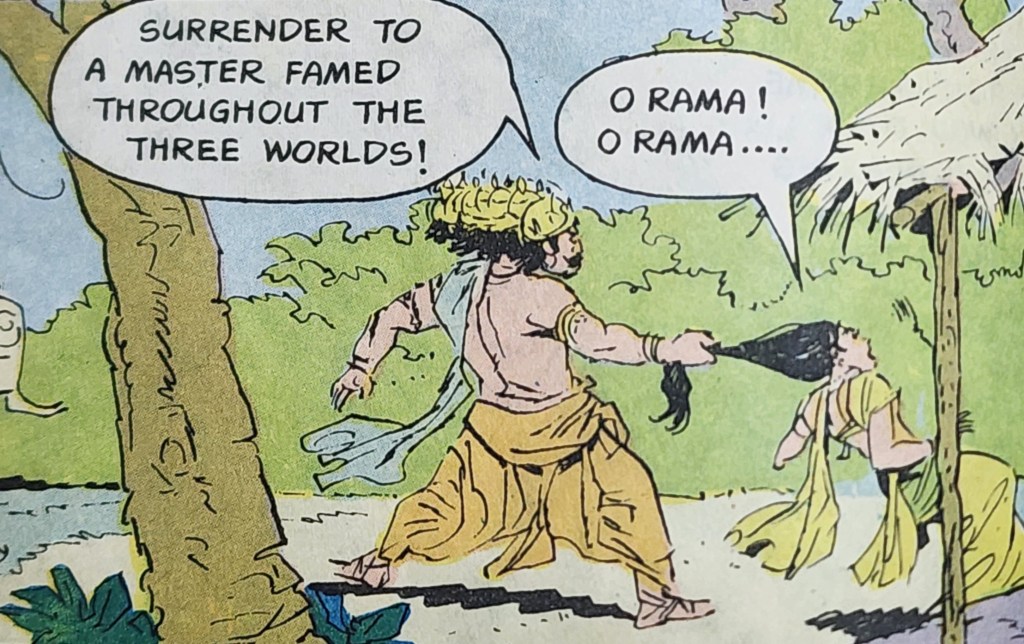
Perhaps some of them failed at this responsibility. Imposing monotheism, like Hiranyakshipu did, or turn a predator of women and molester of Rishis, like Ravana did are examples of failing to protect the natural order. This is also an example of failing the 5th Gojo after passing the first 4. These Asuras actually attempted to snuff out wisdom, let alone be guided by its light!
Ravana, despite great abilities, boons and knowledge, was a great tormentor of people and molester of women. Image credit – “The Ramayana”, published by Amar Chitra Katha.
Something similar is seen in the challenges we face in our lifetimes. Between 1900 and 2000, humans went from dreaming of flight to landing on the moon to exploring the solar system! Between 1950, when horse and bullock drawn carts were still prevalent in most parts of India, we have gone to having trouble with parking spaces for cars in most urban areas! This is a fantastic representation of a collective achievement of the first 4 Gojo.
That said, pollution and supply chain issues have come to haunt us all. Sustainable development is at loggerheads with the desire for great levels of comfort and convenience. Armed conflict is back in a big way, not that it ever went away completely. Inequality in wealth levels across the world are not diminishing as fast as citizens of the world would prefer.
But all points of view that cause these problems are correct and valid, at least to those who hold them. And this is another demonstration of how “wisdom” is hard to come by. And this is not unlike the problem with the Asuras, who failed to sustain the “natural order” (Rta). Natural Order is not too different from the climate, the change in which is yet another example of a failure of the practice “Komyo no satori”.
This again leads me to my opinion, we humans, or Mānavās, are the Asuras. This is not self-deprecation. It is just an identification of how we want to be the Devas or higher yet, the great Trinity that can fix everything. That is perhaps why we have so many stories of warning to the self, with Asuras as the antagonists!
Notes:
1 The Devas used Kacha, the son of Brihaspati, to obtain the Sanjeevini Kriya. The story of this event is incredible by itself. It has romance in a “honey pot” espionage operation. That also means, once technological parity had been achieved, the boons were the next technological disruptor.
* The Gojo – A personal understanding – https://mundanebudo.com/2023/03/16/the-gojo-a-personal-understanding/







 Mundane Budo