Onake Obavva and Jojutsu

Onake Obavva is a very important person for the people of Karnataka. She is an exemplar of courage and loyalty. Obavva is the lady who was responsible for the defeat of an attack on the fortress of Chitradurga in the 1770s. 11th November is celebrated in Karnataka as “Obavva Jayanti”. This is an event initiated by the Government of Karnataka, which shows the importance she holds to the Kannada speaking populace. Obavva is also revered through representations in pop culture.

Obavva is the name of the lady. Onake is used as a title. An onake is a large pestle (from mortar and pestle). The pronunciation of the word could sound as “Vonake”. Obavva wielded the pestle or the onake as a weapon to great effect during Hyder Ali’s attack on the fortress of Chitradurga. Due to her act of heroism, “Onake” is used as an honorific for Obavva – thus, “Onake Obavva”.

The onake is a pestle that comes in many shapes and sizes. The most popular version is made of wood. It is a staff about 4 feet in length. One or both ends of the staff are reinforced with a collar of metal. The diameter of the staff is about 2 inches. Popular depiction of Obavva shows her wielding a staff that seems to adhere to these dimensions.
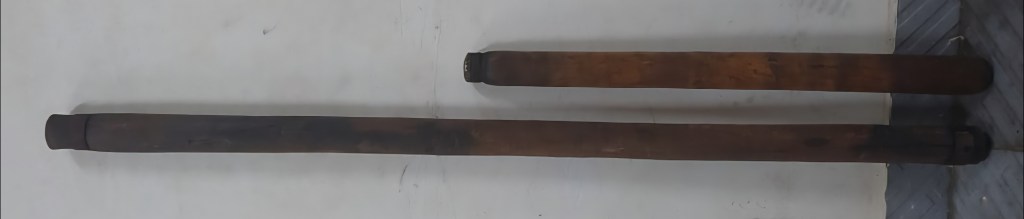
Seen above are 2 Onake (pestles made of wood). The longer one is 52.5 inches long, with a diameter of 2 inches. The shorter one is 26 inches long with a diameter of 2 inches.

Neither the length nor the diameter though, are standardized. The length varies more than the diameter. Smaller onake exist. The length could be as low as 2 feet. Pestles made entirely of metal exist as well. These tend to be on the shorter side, 2 feet or lower, to keep the weight manageable. But the diameter remains about 2 inches.
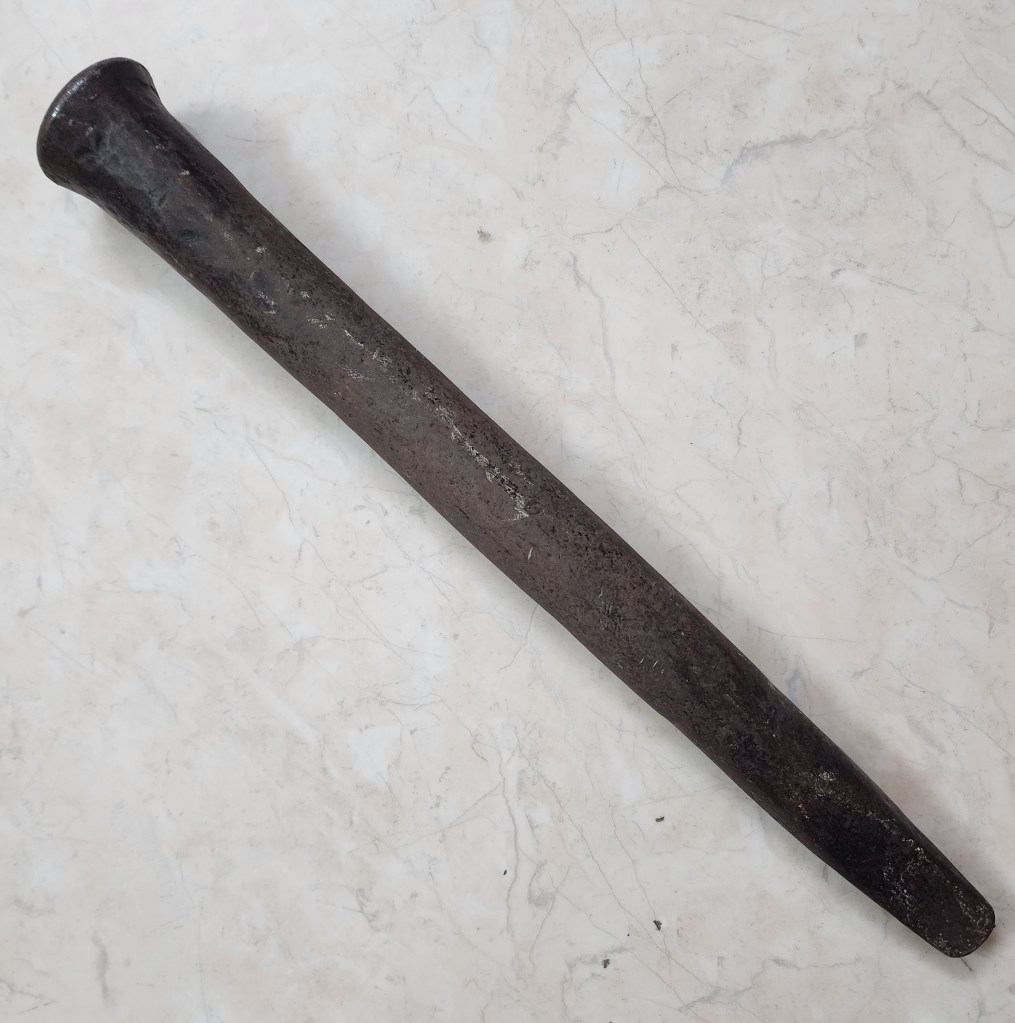
Seen above is a “haare” or “paare” or “musal”, a pestle made of metal. The example seen above is 18 inches long. The broad end is 2 inches in diameter and the width tapers down to 1 inch at the narrow end. This haare weighs 3.7 kg.

The pestles made of metal also taper downwards from a maximum diameter. They taper down to a narrow point, almost resembling a large spike, to enable easier handling and to keep the weight down. The metal ones are called “Haare” in Kannada. In Tamil, I have heard them called “Paare”. In Hindi, it is referred to as a “Musal”. The onake itself in Tamil is called “Ulakkal”.
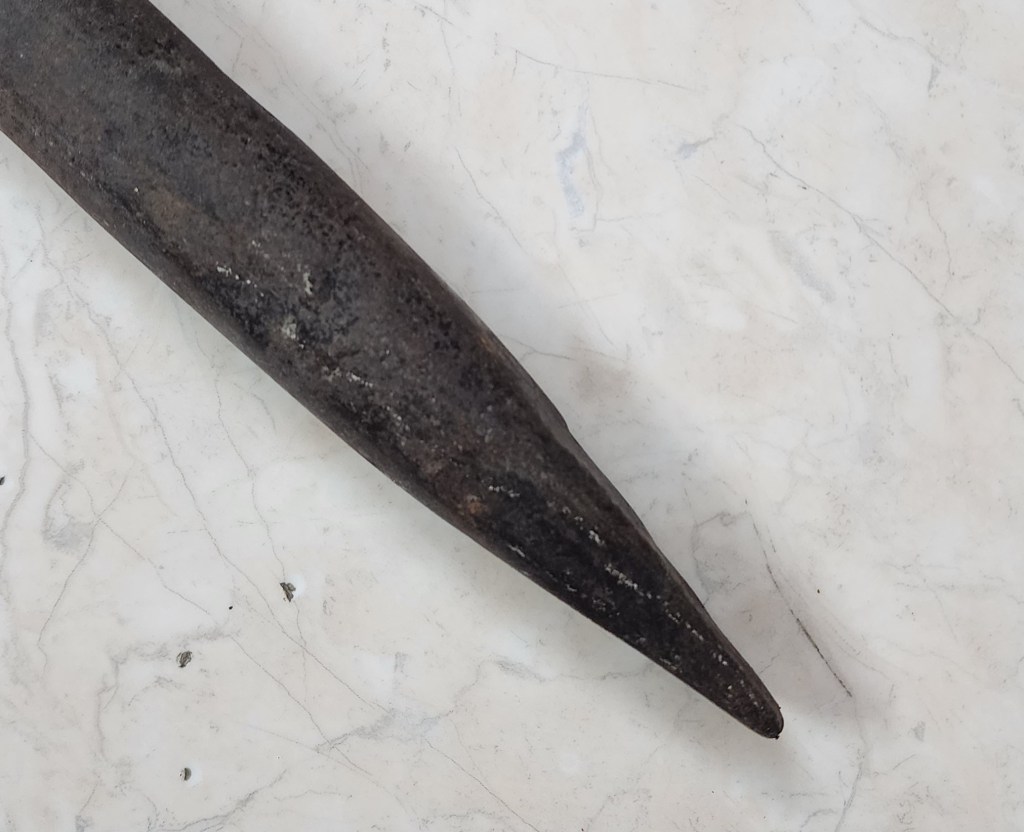
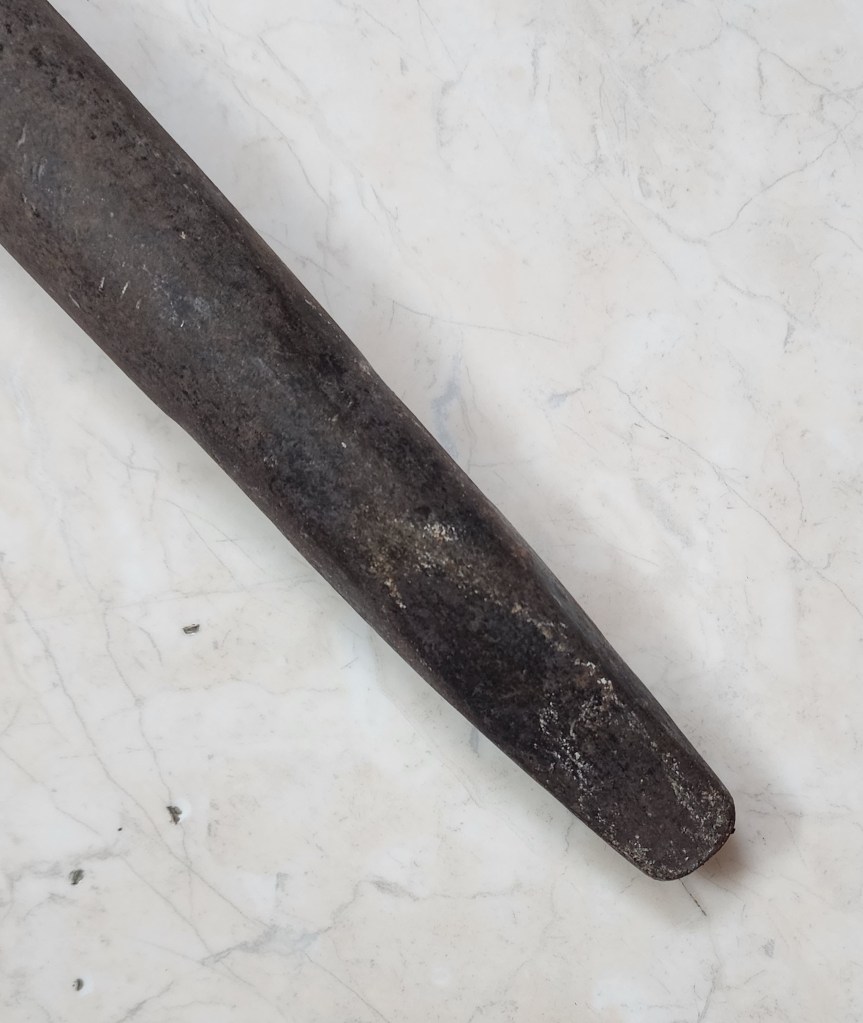
Top and side view of the “spike” end of the “haare”

The pestle, be it an onake, short or long, or a haare, is used for grinding. In the past, the onake was used to make flour out of various grains like wheat, rice and the various millets. The grinding was done by teams of people, mostly women. The metal haare was used, as far as I know, to grind down or crack harder objects like ginger or to powder jaggery. This was used by individuals for quick work in the kitchen. Both of these were still used quite often in India until the early 1990s, after which their use has diminished with greater electrification in all parts of India.

Hyder Ali, the then rule of Mysore, attacked Chitradurga twice in the 1770s. He captured the fortress in 1779. But the first attack was defeated. Obavva is credited with having played a major role in this defeat. Hyder Ali’s army could not breach the fortress. There was a narrow and secret passage into the fortress. A single individual could crawl through this hole in a prone position to enter the fortress. This was discovered by the invading army.
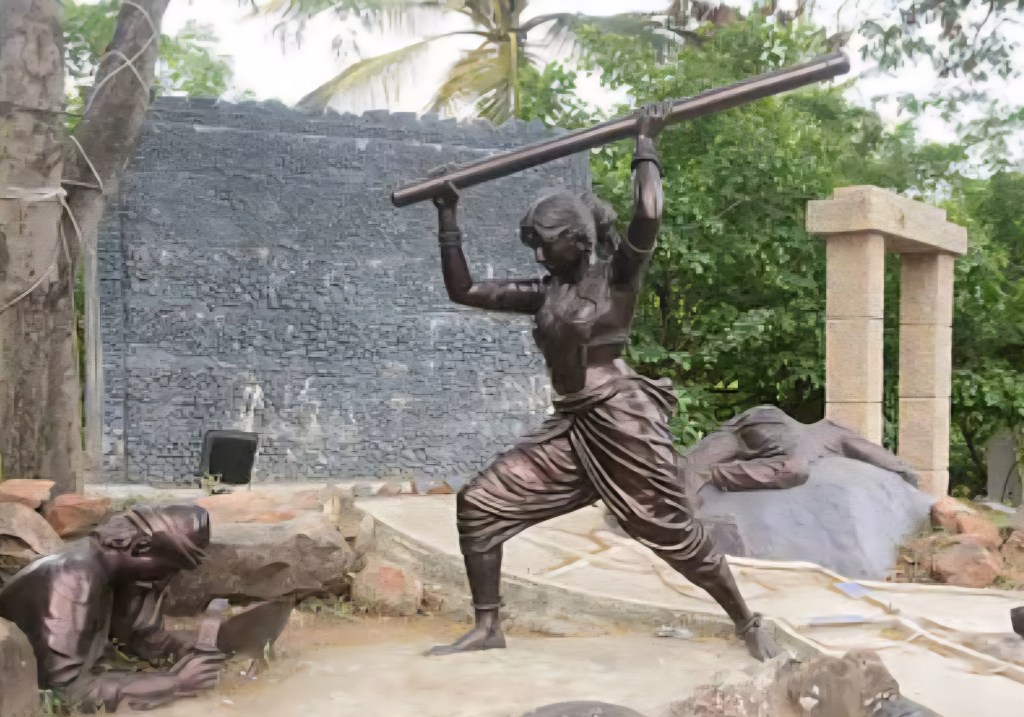
A sculpture depicting Onake Obavva destroying enemies entering through the secret passage. This is the image of a statue honouring Obavva, present at the “Veera Vanite Onake Obavva” Circle in Chitradurga. Wikipedia mentions that this statue was made by the sculptor Ashok Gudigar. Image credit – The Kannada newspaper, “Prajaa Vaani” (from the link, https://www.prajavani.net/district/chitradurga/onake-obavva-life-story-and-related-tiot-he-chitradurga-2447190)

Obavva’s husband was a sentry on the fortress wall. He was once back home during a break, having lunch. Obavva is supposed to stepped out at this time over some chores. She spotted enemy troops entering through the secret passageway. Since there was no time to raise the alarm, she equipped herself with an onake and fought the soldiers. She is supposed to have successfully killed many enemy troops.

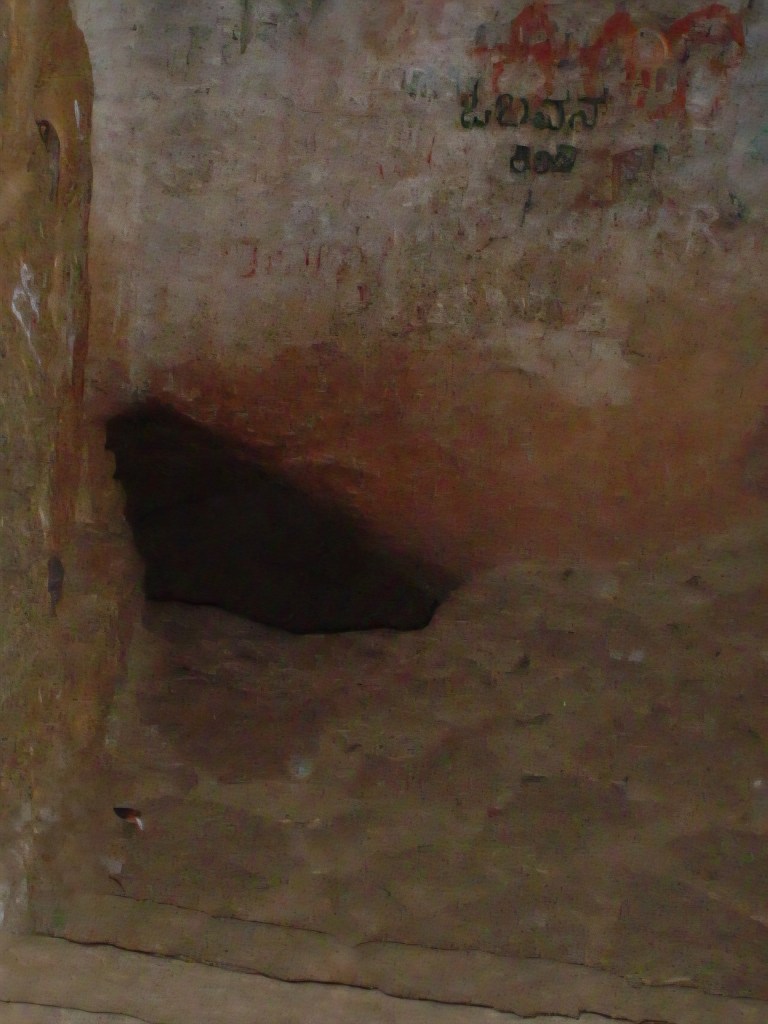
These images show the secret crawl space, “Obavvana Kindi”, and how one needs to be prone to crawl through. These are images from over 20 years ago. The place is now much better maintained.

This action of Obavva’s bought time for the alarm to eventually be raised. The defenders beat back the attackers successfully. But the lady herself lost her life during the fight, either due to exhaustion or at the hands of an enemy. This act of gallantry is what has immortalized her in Karnataka. The passageway that she defended is called “Obavvana Kindi”, which translates to “Obavva’s passage”. It exists to this day and is a major tourist attraction.

A few images of the walls of the Chitradurga Fort

The fortress of Chitradurga still stands strong and is a popular tourist destination. The most memorable depiction of Obavva for the people of Karnataka is by the popular yesteryear actress Jayanthi. She played the role of Obavva in a song in the 1972 movie “Naagarahaavu” (translates to Cobra). A link to this song is seen below.

In the Bujinkan system of martial arts, we practice a weapon called the “Jo”. This is a wooden staff. The jo is usually 4 feet in length, though this is not a mandated length. A rule of thumb is that a jo is a staff that comes up to the armpit of the wielder. So, the taller a person, the longer her or his jo would be.
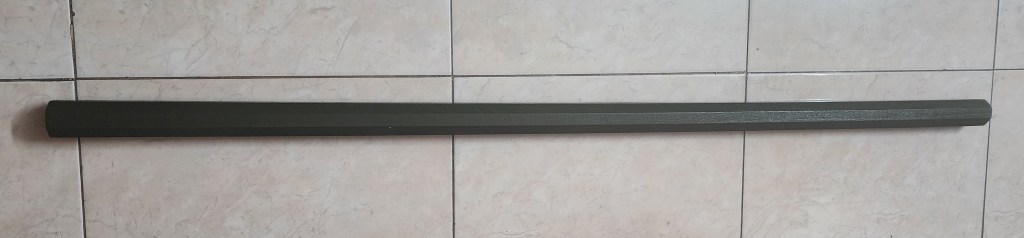
Seen above is a Jo used for training. it is made of wood (mostly Teak). It is 52 inches long, with a diameter of 1.6 inches and a weight of 1.7 kg.

The diameter of a jo is about 1 inch or a bit more. But if the wood used is light, it could be 2 inches. But during training, to learn control of the staff, practitioners could use a heavier weapon, which tends to be 2 inches in diameter. A jo with a diameter of 3 inches or more would be called an “Ōjo”, which translates to “big jo”.
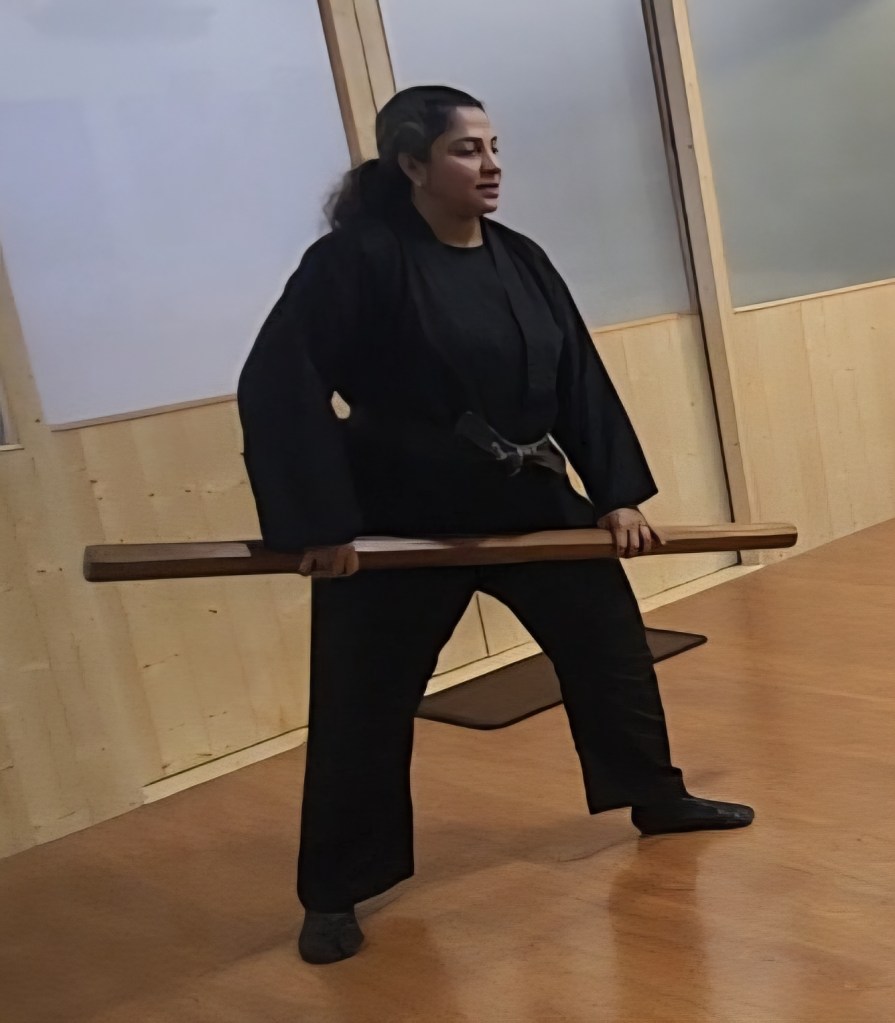
Shihan Nandita is seen wielding an Ōjo in the above image. The Ōjo seen in the picture is remarkably similar in dimensions to an Onake. This Ōjo is 51 inches long, 2.5 inches in diameter and 2.4 kg in weight, which is pretty much a replica of the long Onake seen in the first image in this article.

The jo is supposed to mimic the dimensions of a walking stick used historically in Japan. Later, as western influence spread in Japan, the length of a walking stick reduced, with the staff now coming only up to the waist of an individual, as against the armpit that was the previous benchmark. So, the walking stick in the late 19th century and after was about 3 feet in length. This staff is called a “hanbo”, which translates to “half a bo”. A bo is a staff that measures about 6 feet in length.

Seen above are Bo and Hanbo used for training. The Bo is made of wood, while the Hanbo is a padded specimen. The Bo is 6 feet long while the Hanbo is a little over 3 feet.

If the dimensions of a jo are considered to be about 4 feet in length and around 2 inches in diameter, it is very similar to an onake. The difference would be that there is no metal sleeve on either end of a jo. Considering the similarity in dimensions, fighting with a jo could be considered a rough equivalent to fighting with an onake!

Fighting with a jo is called “Jojutsu”, translated as “the art of the jo”. Of course, I am not claiming that Obavva used jojutsu! I am merely stating that the onake could be a devastating weapon, simply because a jo can be a great weapon, as anyone who has trained with a jo would attest.

This video is neither purely a demonstration nor an actual sparring session. It is just a representation of moving with a jo.

The jo, in the Bujinkan system of martial arts is used more for striking than for grappling or controlling. The latter is more specific to the use of the hanbo. Of course, there are no hard and fast rules about this and both weapons can be devastating with both strikes and in controlling opponents.

Another representation of using a jo in combat.

Obavva would most likely have been physically capable of performing the heroic deeds ascribed to her. She would have been involved in a lot of physical activity. This would include moving around a lot to fetch water, like drawing water from wells, carrying vessels filled with water, preparing the raw materials for food, which included grinding to make flour. So, she would be fit and possess great balance due to her use of her core in daily chores. And she would be proficient in the use of the onake, even if not as a weapon.

So, Obavva could have improvised, to use the onake as a fighting staff instead of just as a grinding tool. But there is no description that I am aware of that gives us details of how the onake was used as a weapon or how Obavva wielded it as a weapon. This aspect has always required imagination in any depiction of the heroic actions of Obavva.

This video shows the flow of movement that can be achieved with a jo, while the previous two show the painful strikes it can deliver.

Therefore, even though I suggest that the onake could be wielded as a jo and be used for fighting, this is not something I am claiming happened. I am only attempting to demonstrate the use of the jo and indicate that a onake could indeed be used as a weapon to devastating effect. To this end, I am sharing video clips of the use of the jo, dispersed across this article. I was fortunate in being able to get women to demonstrate the jo, hopefully reminiscent of Obavva using the onake.

This video is a representation of moving with an Ōjo. It perhaps comes close to showing a possible use of the Onake as a weapon.

Before concluding I need to add a few more points about the use of the staff and the pestle in its avatar as the haare. The staff is the weapon associated with Lord Yama, the God of Justice. He is sometimes considered the God of Death. This could be because he decides the fate of souls after their death. He is also a Dikhpaalaka, a guardian of one of the 10 directions. Yama is the Guardian of the South.

The staff, in its version as the weapon of Lord Yama is called the “Danda”. “Danda” is also the word used for the “staff” in some Indian languages. Interestingly, the word in Kannada and some other Indian languages for “punishment” or “fine” is also, “danda”. Here the word “fine” is used an in, “a fine imposed for an infraction of the law”. So, the word for the weapon of the God of Justice is the same as the word for punishment, or consequence of a mistake.

I had posted a video where I had demonstrated the use of the weapons associated with the Guardians of the 10 directions. In that video, I had demonstrated the use of staffs of varying lengths. I am sharing the same here again. Do watch between the marks 4:21 and 6:09 to see the potential uses of the hanbo and the bo.

Towards the end of the Mahabharata is the Mausala Parva. The word “mausala” is derived from the word “musal” mentioned earlier. It is the word in Hindi for the “haare” or the pestle made of metal, likely iron. This parva is the part where the destruction of the Vrishni clan of the Yadavas is detailed. The Vrishnis are the clan of the Yadavas who ruled from Dwaraka, and included Lord Krishna, his elder brother Balarama and their families.
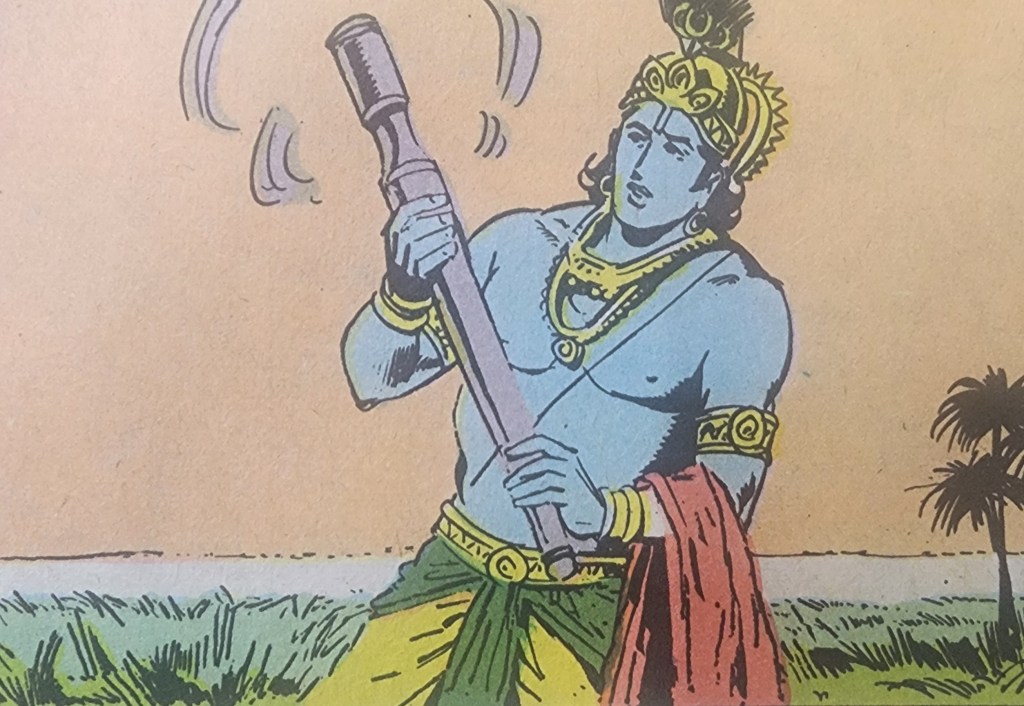
Lord Krishna wielding a pestle (musal) made of metal. Image credit – “The Mahabharata 42 – The Celestial Reunion”, published by Amar Chitra Katha.

The Vrishnis are too powerful to be defeated or destroyed by any other kingdom. So, they need to destroy themselves on account of a curse laid by Gandhari, the mother of the Kauravas, the losing side in the Mahabharata War. So, some 36 years after the great war, the Vrishnis get into a drunken brawl and kill each other. The weapon they use to kill each other is a musal (or musala), which is nothing but a metal pestle.
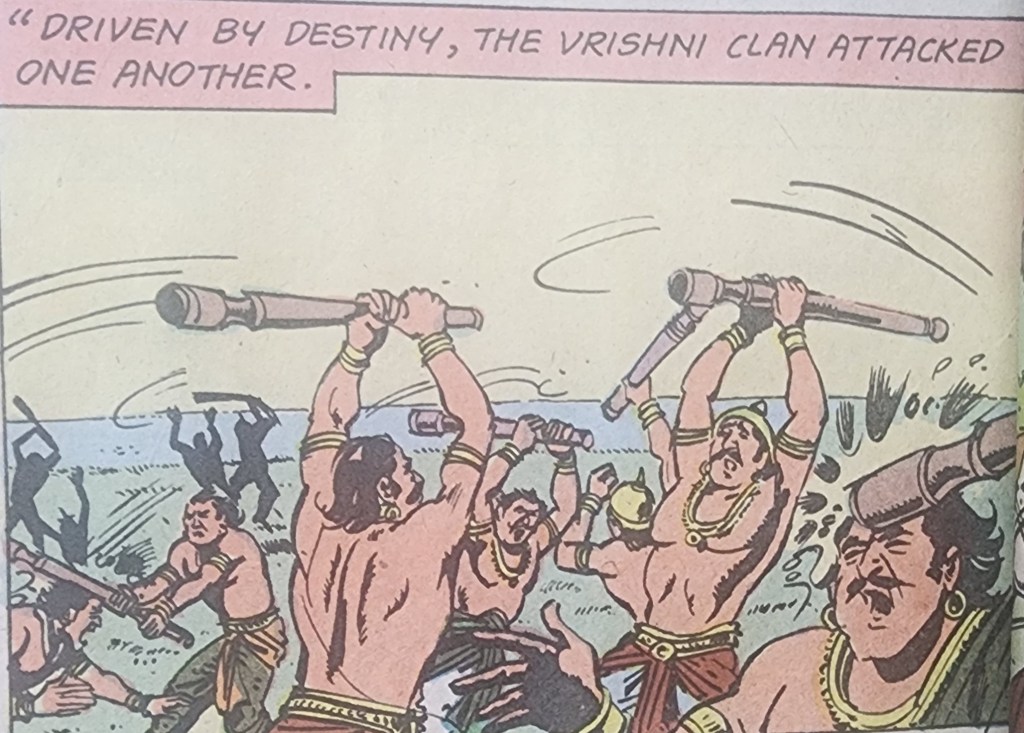
The Vrishnis killing each other using pestles (musal) made of metal. Image credit – “The Mahabharata 42 – The Celestial Reunion”, published by Amar Chitra Katha.

One popular depiction of the metal pestle is from the Amar Chitra Katha rendition of the Mahabharata. The physical dimensions of the musala shown in this version is fairly similar to the haare used in many Indian homes, used regularly until a few decades ago.

Acknowledgements –

  • The images of the 2 Onake were provided by my friend Babu Nanjappa. I thank him and his family for preserving a bit of our history and culture apart from helping with images of Onake that have seen actual use in the past!
  • I have to thank Shihan Nandita Abreo Subramanian and Shihan Priyadarshini Mahalinga Shetty for the demonstration of Jojutsu!
  • Vijay Srinivas deserves a load of thanks for helping film the demonstration of Jojutsu.
  • Lastly, I thank my teacher Daishihan Shiva Subramanian for creating this wonderful dojo space where we could capture the demonstrations embedded above.
Kantāra and the Loris at war! 😊

Animals have always been used in war. Horses, elephants, dogs and pigeons come to mind readily as examples. Horses were used with chariots and cavalry, elephants were used for logistics and as weapons of war. Dogs were used for fighting, as sentries and as guides for scouts. Dogs are still used by several armed forces. They are a key component of counter insurgency operations in India to this day.

Pigeons were used as messengers. Mules were and still are used as pack animals. Camels were used as mounts for mobile light artillery in the past! They are still used as pack animals and as mounts for patrols in the desert regions of India. Raptors have also been used in war. Kites are still used in some instances to take down drones. If strange projects are to be considered, there were attempts to use dolphins as tools of the navy! And if we consider folklore, monitor lizards were also used in war, specifically as grappling hooks*!

Apart from pack animals and fighting animals, there are also animals that historically have provided chemical weaponry! Humans have used secretions from animals and plants for hunting and in warfare. Secretions from the skin of multiple species of Arrow Poison frogs have been used in South America for hunting. Snake venom has supposedly been used as poison on projectiles, though I cannot recall specific examples at this time. Venom from certain species of snails is also supposedly extremely potent and can be used as poison.

This brings me to a recent and interesting experience. I watched the movie “Kantāra: A Legend – Chapter 1” a few days ago. The rest of this article holds spoilers for the movie. So, if anyone reading has not watched the movie and plans to do so, please decide if spoilers are fine by you. The movie depicted the use of the Loris as a weapon of war! :-O 😊

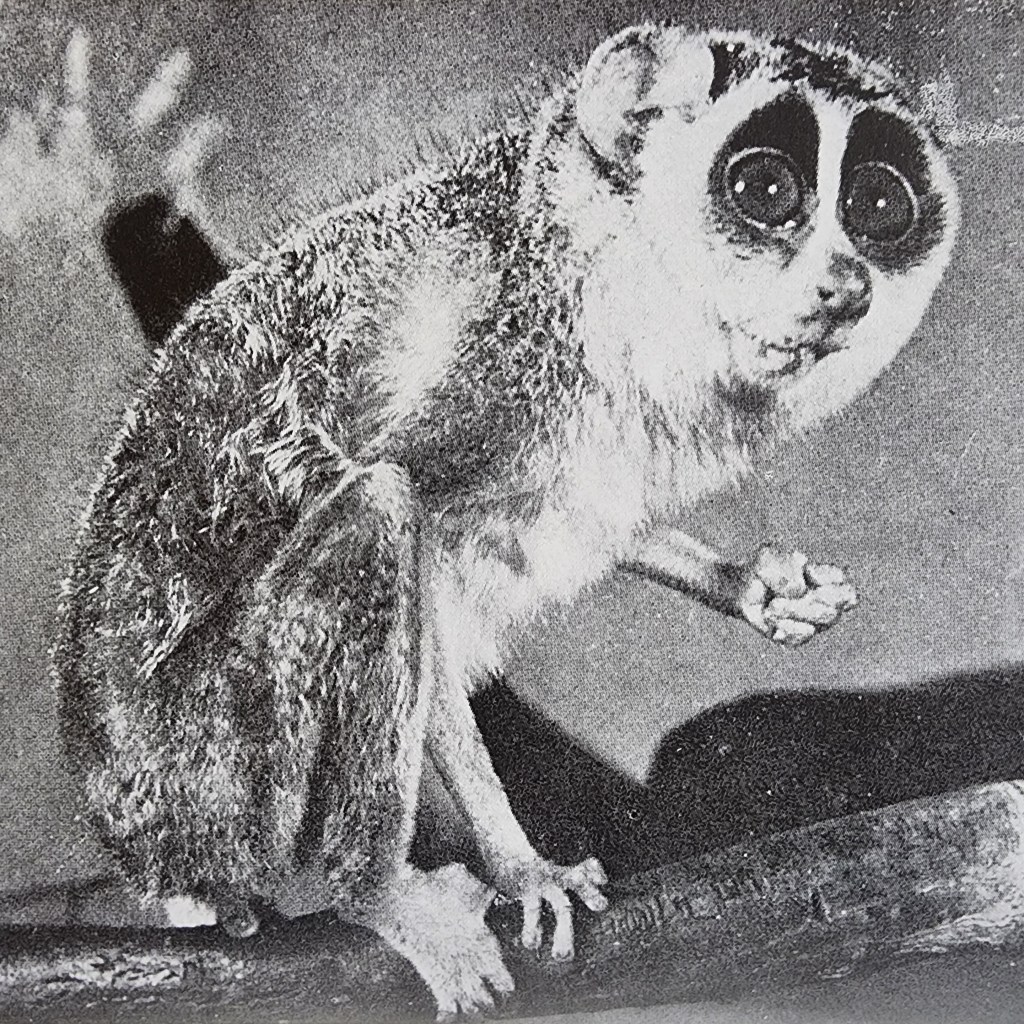
A Slender Loris. Image credit – “The Book of Indian Animals”, by S H Prater, published by Bombay Natural History Society.

There is a tribe depicted in the movie that utilizes the loris as a weapon. This tribe also uses the blood of the loris in magic rituals, which they supposedly use to render the Gods revered by other tribes, powerless. This is absolutely the very first time that I have seen the loris have a starring role in any form of media or storytelling!

Granted, the loris depicted is not as accurate as it could have been. The movie is set in Tulu Nadu, a part of the coastal region of the state of Karnataka in India. The species of loris native to this region is the Gray Slender Loris. This animal is small, nocturnal, omnivorous, has large, beautiful eyes, and is not well known. It has rarely been seen by most people, and rarely, if ever, encountered in the wild+.

The loris seen in the movie appears more like a species of Slow Loris. A species of Slow Loris, called the Bengal Slow Loris is native to the Northeastern parts of India. This animal is larger and furrier than the Slender Loris, though both are arboreal creatures. The animal depicted in the movie hisses when threatened. This is correct, as I can attest from personal experience with a Gray Slender Loris.

But the greatest drawback with the depiction of the Loris in the movie is in relation to its locomotion. The lorises on screen move very fast, and at times seems like a lemur or a meerkat. Of course, this speed can be attributed to magic in the movie, but that is not specifically explained on screen. So, I find the speed of movement of the lorises in the movie unsettling.

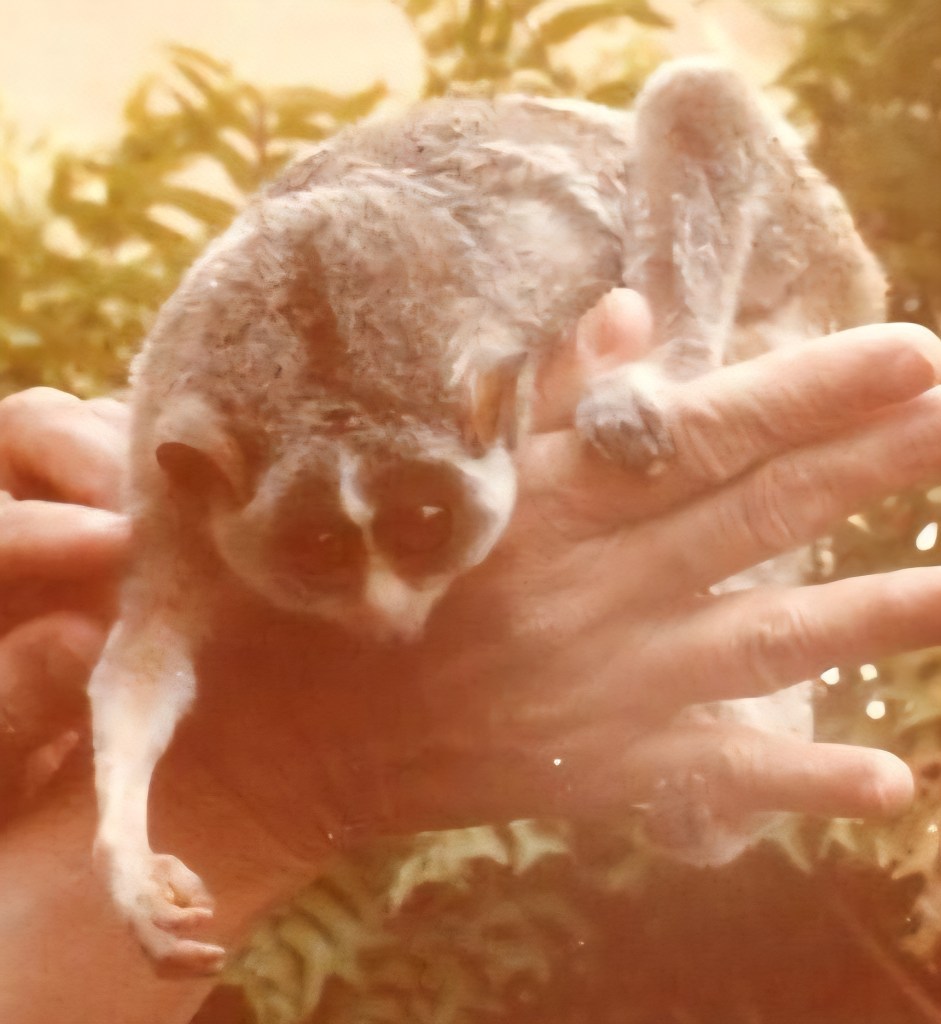
A Slender Loris I had the privilege of observing at close quarters. Image credit – “Menagerie Memoirs” by Dr. M K Shashidhar, published by Notion Press.

In reality, the Slender Loris has a slow, deliberate, cautious way of locomotion. This is part of why it is incredibly hard to spot in its natural habitat. This protects it from predators in the wild. The movement of the loris could remind one of the movements of the sloth, which inhabits South America. I personally feel the sloth is more deliberate and slower than the loris, based on my experience with the loris and what I have seen of the sloth in documentaries.

The Slender Loris used to be hunted in the past. This is supposed to have reduced considerably since the 1990s. From the 1980s through to the early 2000s, I have had the good fortune of observing closely a few Gray Slender Loris specimen. These were all rescued from attempted poaching/hunting activity or from the exotic pet trade.

One story I had heard back in the day was that there was a superstitious belief in relation to the eyes of the loris. It was supposedly believed (wrongly) by some that if one added the eyes of a loris to a potion and consumed it, one would be reunited with one’s lost love! I have not been able to ascertain if this tale is just hearsay or if there is any evidence to this belief in any local folklore.

But this potential (and untrue) attribution of a mystical quality to a loris is tangential parallel to the movie. In the movie, the tribe mentioned earlier, uses the blood of the loris as part of their magic ritual, almost like a magic potion, to capture and subdue the deities of other tribes. So, a mystical quality is attributed to the loris, to its blood if not to its eyes.

The loris is called the “Kaadu Paapa” in Kannada. “Kaadu” means “forest” and “Paapa” means “baby”. The loris is literally called “the baby of the forest”, a name this is apt, considering the cuteness of the animal. The name also exacerbates the tragedy of poaching the animal, for it is akin to abusing a child, which is what the loris is called in Kannada.

This image of a Slender Loris shows its size, in relation to a human hand. The animal is really small, much smaller than how it is depicted in the movie. Image credit – “Menagerie Memoirs” by Dr. M K Shashidhar, published by Notion Press.

The fact that the loris, a small, slow species has survived on the planet gives it a tenuous connection to the martial arts. No, there is no “Loris Style” of fighting that I am aware of. Nor is there any modern military technology that is specifically inspired by the Loris, again, as far as I know. The connection is more in the form of a bit of advice we once received.

Sometime between 2017 and 2019, a few of my Buyu (fellow practitioners of the Bujinkan system of martial arts) were attending a class by Nagato Sensei in Japan. Nagato Sensei is among the most senior teachers of the Bujinkan system and the Soke** of the Shinden Fudo Ryu. During the class, Nagato Sensei spoke of how the loris can be an inspiration during training.

Sensei was speaking of how the urge to move fast during training is not always beneficial. Speed and strength are always important in the martial arts, at least in the sport versions of martial arts, where two individuals are fighting each other. But Sensei was suggesting that one only needs to move as fast as is necessary. If one is moving to avoid an attack, moving too fast might lead to overcompensation, which can then lead to a potential opening.

Also, when training, moving slowly enables one to study one’s own movements and improve or fine tune one’s form or technique. Taking the two aspects together, he said that one must move like a loris – I think he specifically said Slow Loris – though I am not sure if he used the word “slow” to refer to the type of loris or to just drive home the point that speed is not panacea.

Sensei was referring to how a loris moves slowly and deliberately and still survives successfully. It is able to hunt and stay protected from predators. In this same manner, one needs to move just as fast as is necessary to survive, which is not slow or fast, it is just deliberate. At the same time, moving slowly, except until the last instant of the attack prevents an opponent from being defensive and overly alert. This is what I understood from what I heard of the exchange between Sensei and those who attended that class. This in a way feeds into the saying, “Slow is smooth, smooth is fast”. This then is the link between the loris and the martial arts. 😊

I will return to the reference about venom and the movie Kantāra to conclude. I recently learnt that Slow Lorises have venom glands, making them the only primates in the world to be venomous. The venom glands are on the insides of their elbows. The Lorises supposedly lick the glands to secrete the venom and mix it with their saliva. They then lick their hands and apply the now toxic saliva on their bodies. This protects them from potential predators. Also, the toxic saliva is transferred to a prey when the Loris bites it, as the saliva is transferred with the bite.

A Slow Loris. Image credit – “The Book of Indian Animals”, by S H Prater, published by Bombay Natural History Society.

Venom is a chemical weapon; there is no doubt about that. That is part of the reason why a lot of people fear snakes, and that is also why poison arrows have always existed. In the movie “Kantāra: A Legend – Chapter 1”, the lorises are controlled by the sorcerers of a tribe, and they direct the lorises to attack as a group. This more like a special forces raid than open warfare as the lorises simply do not have the strength or numbers to overwhelm large numbers of enemies.

As I mentioned earlier, the lorises depicted in the movie, due to their size, look like Slow Lorises. And if we assume that is the case, a new dimension comes into play. The sorcerers now have a number of animals that can deliver a toxic bite! They can direct the lorises to attack specific individuals to deliver a bite that will either kill or at least incapacitate high value targets, given a sufficient number of bites! This is not unlike people dying when they are subjected to a large enough number of bee stings. And this is exactly how the lorises are used in the movie!

Thus, the lorises are indeed weapons by themselves. And this is something I have never seen in any form of storytelling ever! And that made the movie experience simply fantastic. 😀

This remaining part is just an aside, not an essential part of the article. I am just sharing another observation relating to animals and warfare. We all know that horses were used in war over several centuries. In India, in the past, a yajna called the Ashwamedha Yajna used to be performed. This involved letting loose a horse which traversed many lands over the course of a year.

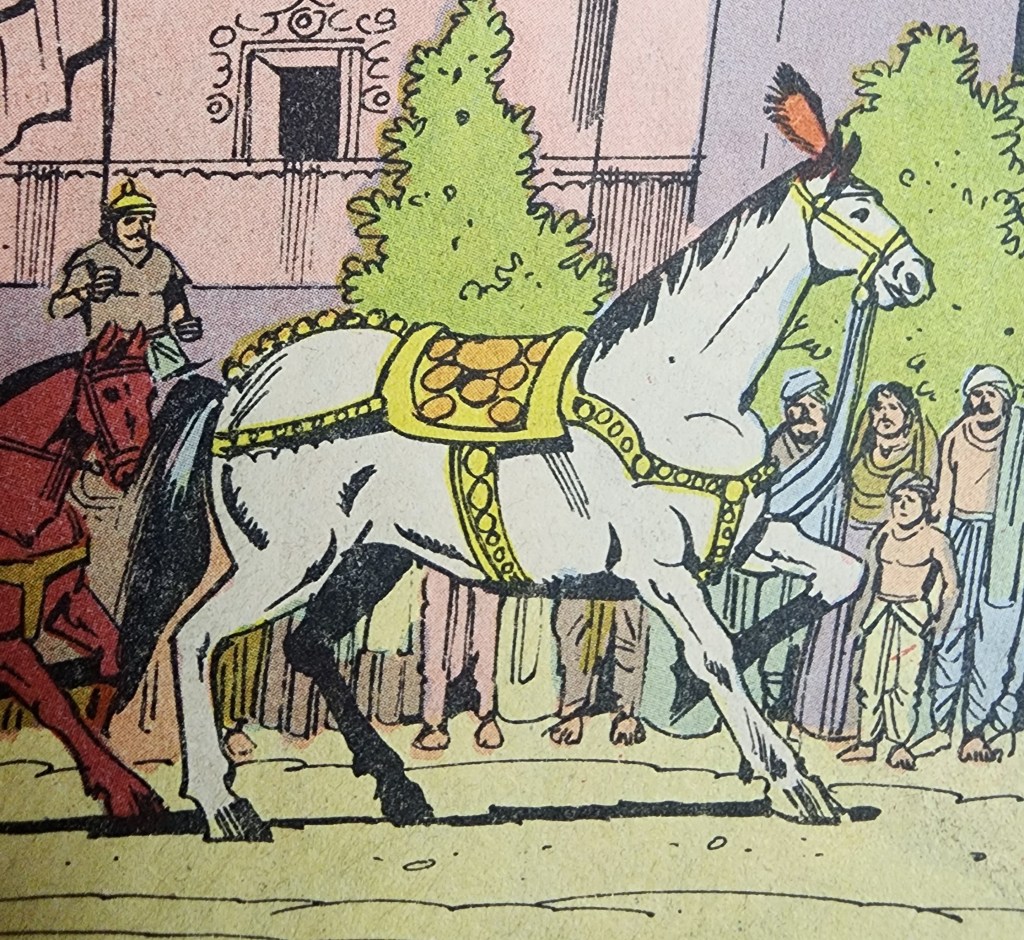
A representation of the horse from the Ashwamedha Yajna in the Ramayana. Image credit – “The Sons of Rama”, published by Amar Chitra Katha.

If the horse passed through the lands of a neighbouring kingdom, the king or leader of that kingdom could either let the horse pass or stop it from going further through his lands. If he let it pass, he would have to accept the suzerainty of the king performing the Ashwamedha Yajna, or at least accept some form of treaty, likely an unequal one.

If however, he chose to stop the horse, he would have to fight the king performing the Yajna. An army followed the horse and would fight the army of the kingdom through which the horse was passing. The war would have a natural conclusion. If the army of the king performing the yajna won, the other kingdom would be annexed. If it lost, the yajna would be over, as a failure.

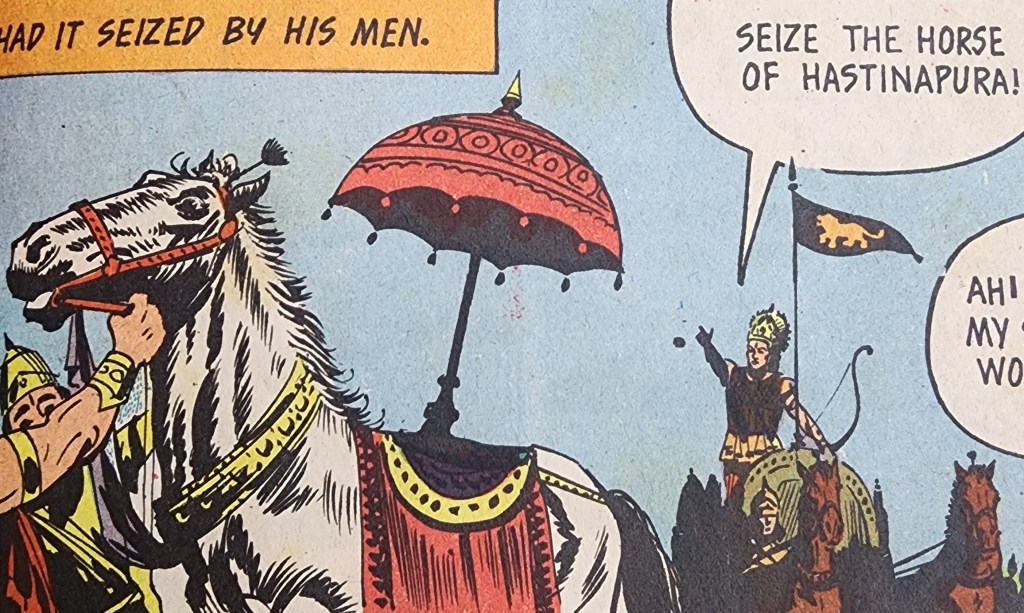
The horse from the Ashwamedha Yajna being stopped by a king whose lands it has wandered onto, triggering a war. Image credit – “Uloopi”, published by Amar Chitra Katha.

A representation of the horse from the Ashwamedha Yajna in the Ramayana. Image credit – “The Sons of Rama”, published by Amar Chitra Katha.

In popular depictions of the Ashwamedha Yajna, the horse that is let loose is always a WHITE HORSE. In the movie Kantāra – A Legend: Chapter 1, there are 2 sequences with white coloured horses. One on the port and another in the forest (the Kantāra).

On the port, a white Arab horse runs amok. This horse is subdued by the hero of the movie, a leader of the people of the forest. In this manner, the horse could be said to be his, as he is the one who restrained it. Later, the people of the forest, under the leadership of the hero capture the port. The horse is also slain by the villain of the movie. In this manner, the entire sequence is reminiscent of the Ashwamedha Yajna!

A white horse is let loose, it belongs to the leader of the people of the forest, the horse wanders to the port controlled by a different king, and the port is conquered. Add to this, the horse is killed, like in the sacrificial part of the Yajna. Thus, the Ashwamedha Yajna has been successfully completed by the hero, the leader of the people of the forest!

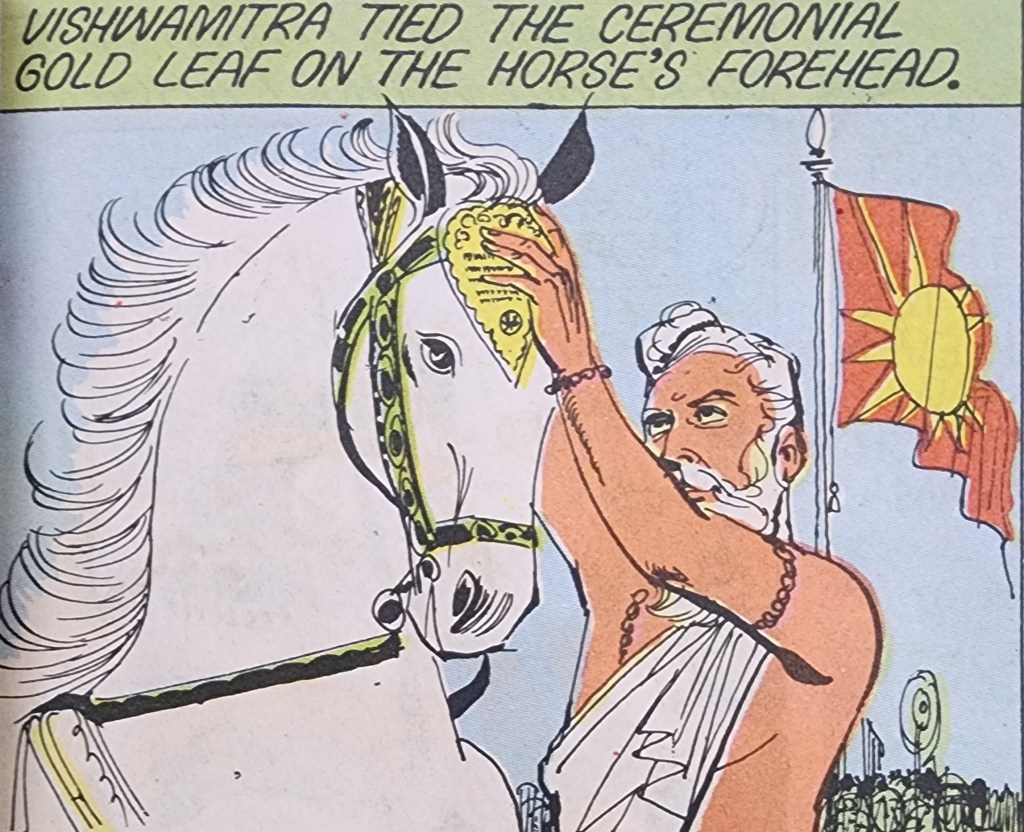
A representation of the horse from the Ashwamedha Yajna in the Mahabharata. Image credit – “The Ashwamedha Yajna – Mahabharata 41”, published by Amar Chitra Katha.

The king from whom the port was conquered, later invades the forest. He causes a lot of carnage but is eventually defeated and killed. He also rides a white horse! Of course, the horse is not let loose, but the parallel is close. In this case, the Ashwamedha Yajna fails as the king is killed, and the invasion is defeated.

The White Horse that is let loose during an Ashwamedha Yajna is an instrument of war by itself, as it can cause kings to fight and lose or accept defeat without fighting. In that way, the horse is an incredible martial tool! One that can lead armies to their death or a people to increased prosperity. Of course, this aside could be just me overthinking things. The interpretation could be completely wrong and not what the filmmakers meant at all.

Notes:

* Swaraj and the Lizard (and Ninjas?!) – Mundane Budo

+ There was a time when group walks were allowed in protected areas. This provided an opportunity to encounter and observe smaller wildlife, like gerbils, lorises and invertebrates. But as far as I know, walks are no longer allowed in forests if elephants are known to inhabit the area. So, the opportunity to spot the smaller creatures has diminished greatly.

** Soke – Grandmaster is a good understanding of this word, though it is not a literal translation