Animals have always been used in war. Horses, elephants, dogs and pigeons come to mind readily as examples. Horses were used with chariots and cavalry, elephants were used for logistics and as weapons of war. Dogs were used for fighting, as sentries and as guides for scouts. Dogs are still used by several armed forces. They are a key component of counter insurgency operations in India to this day.
Pigeons were used as messengers. Mules were and still are used as pack animals. Camels were used as mounts for mobile light artillery in the past! They are still used as pack animals and as mounts for patrols in the desert regions of India. Raptors have also been used in war. Kites are still used in some instances to take down drones. If strange projects are to be considered, there were attempts to use dolphins as tools of the navy! And if we consider folklore, monitor lizards were also used in war, specifically as grappling hooks*!
Apart from pack animals and fighting animals, there are also animals that historically have provided chemical weaponry! Humans have used secretions from animals and plants for hunting and in warfare. Secretions from the skin of multiple species of Arrow Poison frogs have been used in South America for hunting. Snake venom has supposedly been used as poison on projectiles, though I cannot recall specific examples at this time. Venom from certain species of snails is also supposedly extremely potent and can be used as poison.
This brings me to a recent and interesting experience. I watched the movie “Kantāra: A Legend – Chapter 1” a few days ago. The rest of this article holds spoilers for the movie. So, if anyone reading has not watched the movie and plans to do so, please decide if spoilers are fine by you. The movie depicted the use of the Loris as a weapon of war! :-O 😊
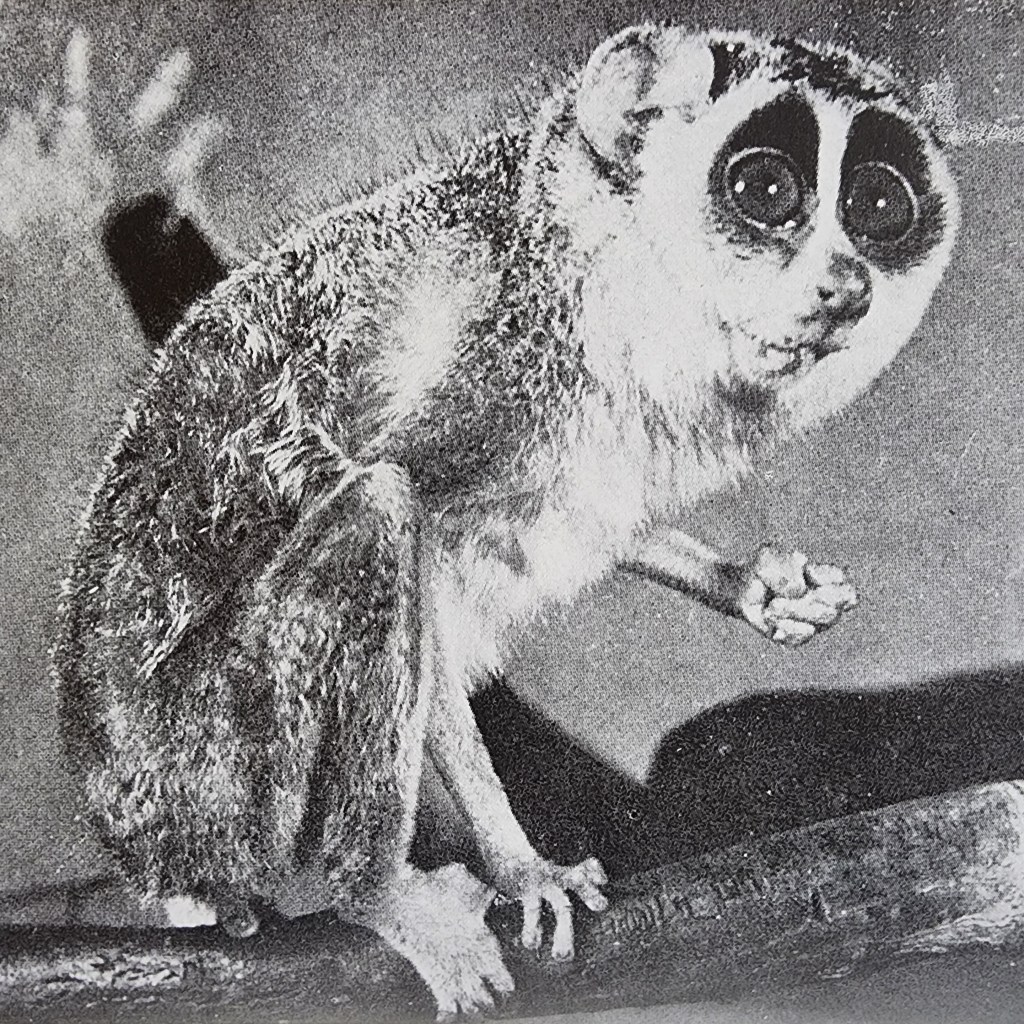
A Slender Loris. Image credit – “The Book of Indian Animals”, by S H Prater, published by Bombay Natural History Society.
There is a tribe depicted in the movie that utilizes the loris as a weapon. This tribe also uses the blood of the loris in magic rituals, which they supposedly use to render the Gods revered by other tribes, powerless. This is absolutely the very first time that I have seen the loris have a starring role in any form of media or storytelling!
Granted, the loris depicted is not as accurate as it could have been. The movie is set in Tulu Nadu, a part of the coastal region of the state of Karnataka in India. The species of loris native to this region is the Gray Slender Loris. This animal is small, nocturnal, omnivorous, has large, beautiful eyes, and is not well known. It has rarely been seen by most people, and rarely, if ever, encountered in the wild+.
The loris seen in the movie appears more like a species of Slow Loris. A species of Slow Loris, called the Bengal Slow Loris is native to the Northeastern parts of India. This animal is larger and furrier than the Slender Loris, though both are arboreal creatures. The animal depicted in the movie hisses when threatened. This is correct, as I can attest from personal experience with a Gray Slender Loris.
But the greatest drawback with the depiction of the Loris in the movie is in relation to its locomotion. The lorises on screen move very fast, and at times seems like a lemur or a meerkat. Of course, this speed can be attributed to magic in the movie, but that is not specifically explained on screen. So, I find the speed of movement of the lorises in the movie unsettling.

A Slender Loris I had the privilege of observing at close quarters. Image credit – “Menagerie Memoirs” by Dr. M K Shashidhar, published by Notion Press.
In reality, the Slender Loris has a slow, deliberate, cautious way of locomotion. This is part of why it is incredibly hard to spot in its natural habitat. This protects it from predators in the wild. The movement of the loris could remind one of the movements of the sloth, which inhabits South America. I personally feel the sloth is more deliberate and slower than the loris, based on my experience with the loris and what I have seen of the sloth in documentaries.
The Slender Loris used to be hunted in the past. This is supposed to have reduced considerably since the 1990s. From the 1980s through to the early 2000s, I have had the good fortune of observing closely a few Gray Slender Loris specimen. These were all rescued from attempted poaching/hunting activity or from the exotic pet trade.
One story I had heard back in the day was that there was a superstitious belief in relation to the eyes of the loris. It was supposedly believed (wrongly) by some that if one added the eyes of a loris to a potion and consumed it, one would be reunited with one’s lost love! I have not been able to ascertain if this tale is just hearsay or if there is any evidence to this belief in any local folklore.
But this potential (and untrue) attribution of a mystical quality to a loris is tangential parallel to the movie. In the movie, the tribe mentioned earlier, uses the blood of the loris as part of their magic ritual, almost like a magic potion, to capture and subdue the deities of other tribes. So, a mystical quality is attributed to the loris, to its blood if not to its eyes.
The loris is called the “Kaadu Paapa” in Kannada. “Kaadu” means “forest” and “Paapa” means “baby”. The loris is literally called “the baby of the forest”, a name this is apt, considering the cuteness of the animal. The name also exacerbates the tragedy of poaching the animal, for it is akin to abusing a child, which is what the loris is called in Kannada.
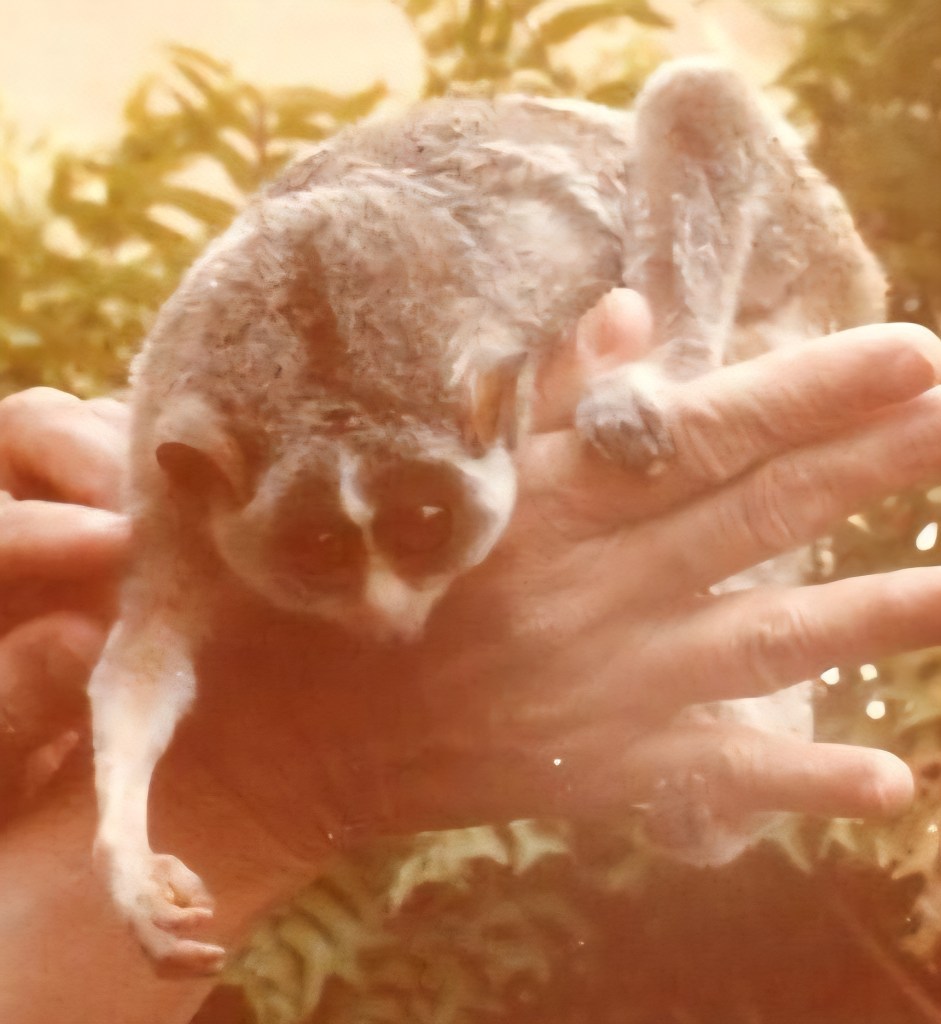
This image of a Slender Loris shows its size, in relation to a human hand. The animal is really small, much smaller than how it is depicted in the movie. Image credit – “Menagerie Memoirs” by Dr. M K Shashidhar, published by Notion Press.
The fact that the loris, a small, slow species has survived on the planet gives it a tenuous connection to the martial arts. No, there is no “Loris Style” of fighting that I am aware of. Nor is there any modern military technology that is specifically inspired by the Loris, again, as far as I know. The connection is more in the form of a bit of advice we once received.
Sometime between 2017 and 2019, a few of my Buyu (fellow practitioners of the Bujinkan system of martial arts) were attending a class by Nagato Sensei in Japan. Nagato Sensei is among the most senior teachers of the Bujinkan system and the Soke** of the Shinden Fudo Ryu. During the class, Nagato Sensei spoke of how the loris can be an inspiration during training.
Sensei was speaking of how the urge to move fast during training is not always beneficial. Speed and strength are always important in the martial arts, at least in the sport versions of martial arts, where two individuals are fighting each other. But Sensei was suggesting that one only needs to move as fast as is necessary. If one is moving to avoid an attack, moving too fast might lead to overcompensation, which can then lead to a potential opening.
Also, when training, moving slowly enables one to study one’s own movements and improve or fine tune one’s form or technique. Taking the two aspects together, he said that one must move like a loris – I think he specifically said Slow Loris – though I am not sure if he used the word “slow” to refer to the type of loris or to just drive home the point that speed is not panacea.
Sensei was referring to how a loris moves slowly and deliberately and still survives successfully. It is able to hunt and stay protected from predators. In this same manner, one needs to move just as fast as is necessary to survive, which is not slow or fast, it is just deliberate. At the same time, moving slowly, except until the last instant of the attack prevents an opponent from being defensive and overly alert. This is what I understood from what I heard of the exchange between Sensei and those who attended that class. This in a way feeds into the saying, “Slow is smooth, smooth is fast”. This then is the link between the loris and the martial arts. 😊
I will return to the reference about venom and the movie Kantāra to conclude. I recently learnt that Slow Lorises have venom glands, making them the only primates in the world to be venomous. The venom glands are on the insides of their elbows. The Lorises supposedly lick the glands to secrete the venom and mix it with their saliva. They then lick their hands and apply the now toxic saliva on their bodies. This protects them from potential predators. Also, the toxic saliva is transferred to a prey when the Loris bites it, as the saliva is transferred with the bite.

A Slow Loris. Image credit – “The Book of Indian Animals”, by S H Prater, published by Bombay Natural History Society.
Venom is a chemical weapon; there is no doubt about that. That is part of the reason why a lot of people fear snakes, and that is also why poison arrows have always existed. In the movie “Kantāra: A Legend – Chapter 1”, the lorises are controlled by the sorcerers of a tribe, and they direct the lorises to attack as a group. This more like a special forces raid than open warfare as the lorises simply do not have the strength or numbers to overwhelm large numbers of enemies.
As I mentioned earlier, the lorises depicted in the movie, due to their size, look like Slow Lorises. And if we assume that is the case, a new dimension comes into play. The sorcerers now have a number of animals that can deliver a toxic bite! They can direct the lorises to attack specific individuals to deliver a bite that will either kill or at least incapacitate high value targets, given a sufficient number of bites! This is not unlike people dying when they are subjected to a large enough number of bee stings. And this is exactly how the lorises are used in the movie!
Thus, the lorises are indeed weapons by themselves. And this is something I have never seen in any form of storytelling ever! And that made the movie experience simply fantastic. 😀
This remaining part is just an aside, not an essential part of the article. I am just sharing another observation relating to animals and warfare. We all know that horses were used in war over several centuries. In India, in the past, a yajna called the Ashwamedha Yajna used to be performed. This involved letting loose a horse which traversed many lands over the course of a year.
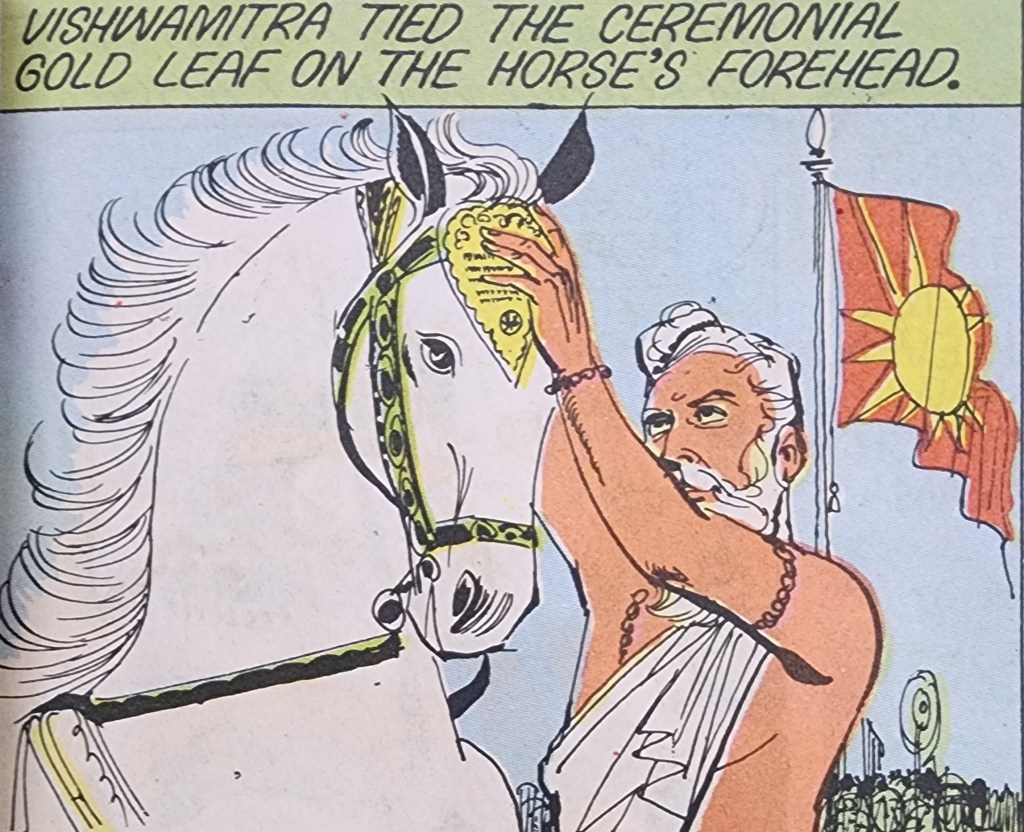
A representation of the horse from the Ashwamedha Yajna in the Ramayana. Image credit – “The Sons of Rama”, published by Amar Chitra Katha.
If the horse passed through the lands of a neighbouring kingdom, the king or leader of that kingdom could either let the horse pass or stop it from going further through his lands. If he let it pass, he would have to accept the suzerainty of the king performing the Ashwamedha Yajna, or at least accept some form of treaty, likely an unequal one.
If however, he chose to stop the horse, he would have to fight the king performing the Yajna. An army followed the horse and would fight the army of the kingdom through which the horse was passing. The war would have a natural conclusion. If the army of the king performing the yajna won, the other kingdom would be annexed. If it lost, the yajna would be over, as a failure.
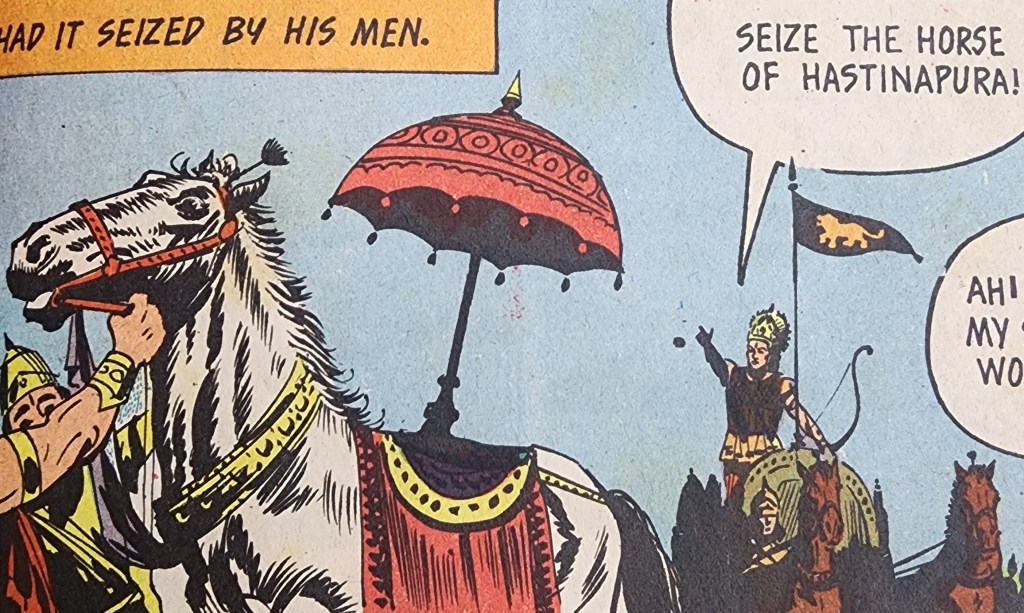
The horse from the Ashwamedha Yajna being stopped by a king whose lands it has wandered onto, triggering a war. Image credit – “Uloopi”, published by Amar Chitra Katha.
A representation of the horse from the Ashwamedha Yajna in the Ramayana. Image credit – “The Sons of Rama”, published by Amar Chitra Katha.
In popular depictions of the Ashwamedha Yajna, the horse that is let loose is always a WHITE HORSE. In the movie Kantāra – A Legend: Chapter 1, there are 2 sequences with white coloured horses. One on the port and another in the forest (the Kantāra).
On the port, a white Arab horse runs amok. This horse is subdued by the hero of the movie, a leader of the people of the forest. In this manner, the horse could be said to be his, as he is the one who restrained it. Later, the people of the forest, under the leadership of the hero capture the port. The horse is also slain by the villain of the movie. In this manner, the entire sequence is reminiscent of the Ashwamedha Yajna!
A white horse is let loose, it belongs to the leader of the people of the forest, the horse wanders to the port controlled by a different king, and the port is conquered. Add to this, the horse is killed, like in the sacrificial part of the Yajna. Thus, the Ashwamedha Yajna has been successfully completed by the hero, the leader of the people of the forest!
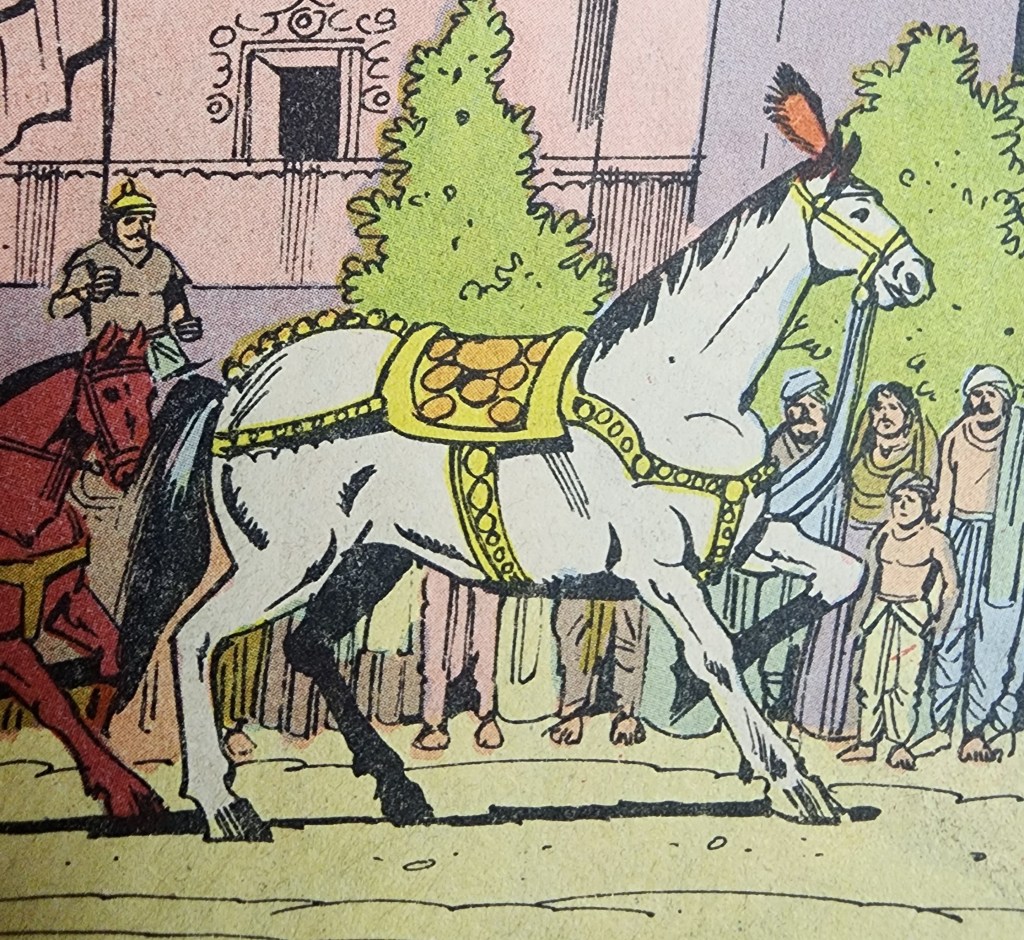
A representation of the horse from the Ashwamedha Yajna in the Mahabharata. Image credit – “The Ashwamedha Yajna – Mahabharata 41”, published by Amar Chitra Katha.
The king from whom the port was conquered, later invades the forest. He causes a lot of carnage but is eventually defeated and killed. He also rides a white horse! Of course, the horse is not let loose, but the parallel is close. In this case, the Ashwamedha Yajna fails as the king is killed, and the invasion is defeated.
The White Horse that is let loose during an Ashwamedha Yajna is an instrument of war by itself, as it can cause kings to fight and lose or accept defeat without fighting. In that way, the horse is an incredible martial tool! One that can lead armies to their death or a people to increased prosperity. Of course, this aside could be just me overthinking things. The interpretation could be completely wrong and not what the filmmakers meant at all.
Notes:
* Swaraj and the Lizard (and Ninjas?!) – Mundane Budo
+ There was a time when group walks were allowed in protected areas. This provided an opportunity to encounter and observe smaller wildlife, like gerbils, lorises and invertebrates. But as far as I know, walks are no longer allowed in forests if elephants are known to inhabit the area. So, the opportunity to spot the smaller creatures has diminished greatly.
** Soke – Grandmaster is a good understanding of this word, though it is not a literal translation
 Mundane Budo