Devi Ambika and the Kiai

Sound is a weapon, a very effective one. The application of sound is a fascinating exploration of how we humans interact with each other and the natural world. Let me begin with a story from Hindu culture. The story I am sharing forms a part of the Devi Mahatme (sometimes written as Devi Mahatmya).

There was a time when two Asura brothers, Shumbha and Nishumbha ruled the Earth. They were mighty warriors who led great armies. Even the Devas had been defeated by these brothers. Some of the famous Generals who served under Shumbha and Nishumbha were Raktabeeja, Chanda, Munda and Dhumralochana.

Once, a few Asura soldiers spotted an incredibly beautiful woman. This was the Goddess, Devi Ambika. They reported back to their rulers about the beauty of the woman. Shumbha decided that he had to have the Devi for his wife. So, he sent his General, Dhumralochana, to the Devi with the proposal of marriage. She replied that she could only marry an individual who had bested her in combat.

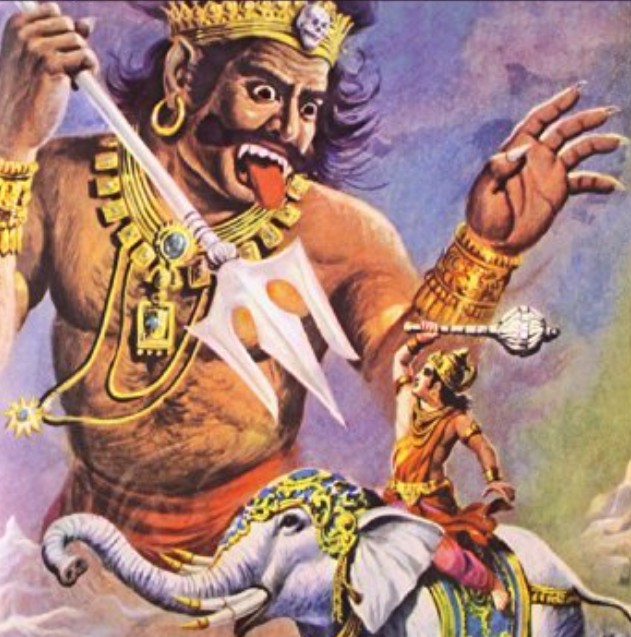
Dhumralochana believed she was a weakling as she was a woman. In his arrogance, he attempted to seize the Devi and take her back to his king. But he was sorely unaware of Devi Ambika’s abilities. When he attempted to capture her, she uttered a single syllable, “HUM”. As soon as this syllable was uttered, Dhumralochana caught fire and was burnt to death. The Asura host he had brought with him fled in terror.
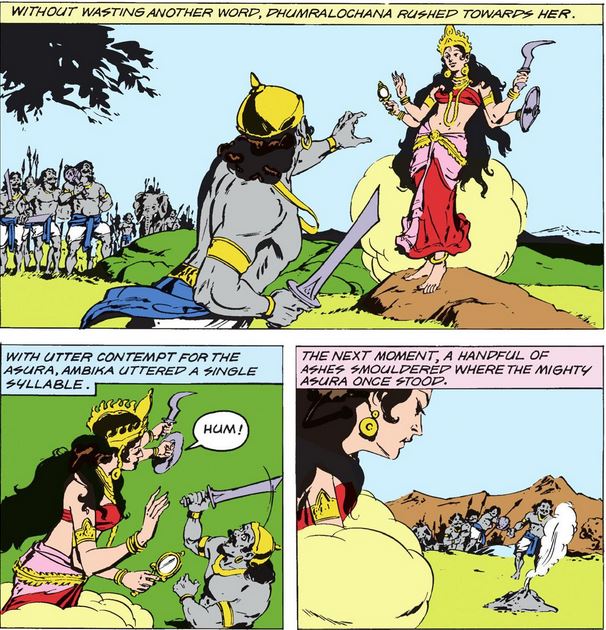
Devi Ambika burns Dhumralochana with a single syllable (Kiai!). Image credit – “Tales of Durga” (Kindle edition), published by Amar Chitra Katha.

The Devi’s abilities are demonstrated by the fact that she did not even need to move to destroy the Asura General. She did not even speak. She uttered a single syllable! And her opponent was toast, literally! This story is used to show how powerful the female Divinity is. A lot more happens in this story, when the other Generals and eventually the ruling Asura brothers themselves attack. Other representations of the Devi emerge and the scourge of this ruling coterie of Asuras is eliminated for good.

We only need the part of the story where Devi Ambika uses sound as a weapon. She utters just ONE syllable, but it is sound, nevertheless. Of course, mortal humans cannot burn anyone to death with sound, much less with just one utterance. But this does indicate that humans have always known that sound can be a weapon. Let us explore this further.

In the Bujinkan system of martial arts, we learn what is called a “Kiai”. Sometimes this is pronounced as “Kiyai”. The Kiai is a short simple shout. It is more a sharp, possibly loud expulsion of a sound than a scream. It is a single sound, much like a single syllable. It could be loud but need not be. The sound occurs when one is exhaling. The concept of the Kiai is not limited to the Bujinkan. It is found in many other martial arts around the world.

An example of a Kiai (audio only)

When we utter the “Om”, we are supposed to begin the utterance from the belly, from the core of one’s being. It is pretty much how animals utter a sharp cry or a bark. If one observes a parrot utter a sharp cry or a dog bark, one will see that their core is sucked in as the sound is expelled. This is the same for a Kiai.

The word “Kiai”, as I have heard it explained by my teacher, stands for, “a unification of energy”. In other words, there is a concentration of energy at our core, the abdominal region, that bursts forth in one instant. This “burst forth” is an expulsion of sound. In this way, the Kiai resembles a bark or any other animal sound that is delivered in a short burst.

I personally opine that what Devi Ambika is said to have used in the story, to kill Dhumralochana, is also a Kiai, with Divine attributes layered onto it. Of course, this is possible only in a story as far as normal humans are concerned, for we are not Gods, and we cannot reduce people to ashes with a sound.

Recently, we were discussing the Kiai in class and my teacher Shiva, mentioned that there are 3 types of Kiai. My teacher suggests that a Kiai could be to induce bravery or power in the person who performs the Kiai or to affect the opponent. My own classification varies slightly, as seen below.

The Kiai is of two types with one having a subcategory as I understand it. These are mentioned below and elucidated further down the article.

  1. Internal Kiai – Kiai to affect the self
    1. To generate power
    1. To let go of fear
  2. External Kiai – Kiai to affect the opponent

Imagine a weightlifter walking up to the weights on the podium or on the verge of lifting the weights. There are instances when you will hear them utter a sharp cry. This is to pump themselves up, raise self-confidence and to focus themselves. This is an example of a Kiai to generate power in the self. This is an example my teacher gave. Even when an MMA fighter walks into the cage, he or she is often times seen using a Kiai as part of the preparation routine. This is also an internal Kiai to generate power or to build oneself up.

Now imagine a situation where one is facing a wild animal. I have heard experts suggest not running from bears, boars, gaurs, tigers or even dogs to avoid triggering the chase instinct in the predator or large herbivore. They suggest making a loud noise, like a shout or a cry. In some cases, they suggest making oneself appear larger to deter an attack. The shout or loud noise they suggest is the Kiai to let go of fear, or at least to trigger the instinct of preservation.

Many years ago, I had attended a seminar conducted by Daishihan Arnaud Cousergue and Daishihan Sven-Erik Bogsater. During the seminar, Daishihan Sven-Erik had suggested using a Kiai to let go of one’s own fear. This sounded similar to using a loud voice and even saying something as simple as “Hey!” or “Stop!” to a potential attacker on the street.

The External Kiai is just a counterpart of the Internal Kiai. The same Kiai could affect both the self and the opponent. That said, it could be different. In the earlier example I mentioned an MMA fighter use a Kiai to pump oneself up. Many a time, the core team of the fighter who accompanies the fighter also use a Kiai, a shout, or a loud whoop, like “Come on!” or “You got this!”. This is a Kiai intended to affect their teammate. So, it would be an external Kiai.

In the example of using a shout to deter an animal from charging, it would be an internal Kiai when it stops the individual from panicking and turning tail to run. But the Kiai also, hopefully, stops the animal from attacking. Here, the same Kiai would be an external Kiai, as its effect was on the opponent.

This same idea also holds true when a potential attacker is deterred on the street. A shout might stop the attacker in his or her tracks, as an external Kiai. But the Kiai might also diminish the fear in the would-be victim, when it would have served as an internal Kiai.

There is another Kiai that I have experienced. This is a “Soundless Kiai”. In my experience, this is tied to one’s intuition. From time to time, while training, one of the two practitioners facing off, senses that an opponent is about strike or carryout a move that should be escaped. This makes the one who senses this to back off and put some distance between the two fighters. This happens when one “feels” that a decision has been taken by the opponent to attempt something or to change tack, which could be being more aggressive or passive.

This affecting the self or the opponent without any sound is generally more visible after years of training, where experience enables one to be more “aware” of what is going on in a fight, and if there are multiple threats. Also, if the two practitioners have trained with each other for a long time, they can read the opponent better due to sheer experience with the other, and a “soundless Kiai” is likely to be more apparent in this situation.

There is one important aspect about a Kiai that must be emphasized though. IT IS NOT MAGIC. A KIAI WILL NOT CAUSE YOUR OPPONENT(S) TO BE INCAPACITATED OR TO FAINT. A Kiai gives a short opening. This opening can be a fraction of a second or a bit longer at best. This short duration can be an opportunity to survive. The survival could be the result of,

  • One being able to escape
  • Putting the opponent(s) at a disadvantage with any move
  • Simply preventing/deterring the opponent from attacking. This deterrence could even be a result of the attention of bystanders being drawn to the situation going down.

So, it is important to learn and practice the Kiai for 2 reasons. Firstly, it is not easy for many people to make a loud noise due to a modern upbringing and simple worry about drawing attention to oneself. This could be due to avoid scrutiny. So, one needs to learn how to generate a Kiai. It might start as a simple shout or a scream. But it does get refined over time, with breath control and experience.

Secondly, one will learn with practicing a Kiai, when it is effective, and for how long. This dispenses any false notions of the Kiai being a magic pill in a dangerous situation or doubts about it ever being useful. This experience is specific to individuals, and they will hopefully apply it as applicable to their unique abilities in a given situation.

The use of a Kiai to “create an opening” is best demonstrated by its technological equivalent, a “Flashbang” grenade. These are grenades used to disorient targets and not necessarily maim or kill them. The loud bang in the flashbang could be loosely equated to a Kiai. Of course, there is no bright light in a Kiai. These grenades are used to temporarily disorient opponents, which prevents them from causing harm to an attacking force, at least for a short duration. This short duration when the opponents are temporarily incapacitated is used to gain an advantage over them by the attacking force.

Beyond a Kiai or a flashbang, which are effective for short durations, there are other cases where sound can be a weapon, or at least an effective tool. At the most mundane end, we all know how parents, teachers and guardians raise their voice to either discipline or stop mischief by kids. The change in the volume and tone of the voice causes a change in the behaviour of kids.

An extension of this is the use of whistles. PT (Physical Training) Masters, security personnel and traffic police use whistles to attract attention and initiate a change in activity. The sound of the whistle is the tool that indicates that all is not normal. On the other hand, brightly coloured whistles are used in survival kits. Rescuers can use whistles to attract the attention of people they are looking for. Similarly, people in trouble can use whistles to attract rescuers to themselves. This works as the sound of a whistle carries farther in certain environments.
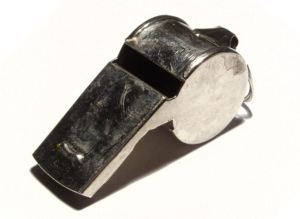
A traditional whistle. Image credit – Wikipedia

On the other side of the spectrum, sound has been used as a weapon. I remember seeing mentions of the use of sound in psychological warfare in documentaries about the First Gulf War (Kuwait Liberation War). Loudspeakers mounted on vehicles were used to play the sounds of vehicular movement and weapons. This caused confusion among Iraqi troops, who were uncertain of the numbers of the enemy they were facing and where the attack was coming from. On the darker side of things, loud music, especially of the heavy metal kind, has been used in torture and sleep deprivation, as part of enhanced interrogation methods.

Since ancient times, war cries have been a part of human warfare, where a battle cry of a unit has acted as a fillip to fighting units and caused terror on the receiving end when a savage reputation is associated with a specific battle cry. I recently watched a video on Instagram where the war cries of various tribes of the state of Nagaland are demonstrated. I am sharing that video for the sheer variety that humans are capable of!

Even music proper has been used in warfare! This includes the supposed use of drums on rowing galleys to give a rhythm to the rowers and the use of music while armies were on the march. But the most beautiful use of music, in my personal opinion, is the sound of the Carnyx, an instrument that was supposedly used by the Celts at war. Opposing troops, including Romans are supposed have been terrified of that sound emerging from misty fields on the eve of battle. Listen for yourself and tell me if you love the sound of this ancient weapon as well. Some 10 years ago when I first heard of this instrument, there was supposedly only one person in the world, John Kenny, who could play this instrument!

In the Mahabharataha, different warriors carried different conch shells. Some of these had names. The sound of these conch shells was used to identify the warrior coming forth. Krishna’s conch was called Panchajanya and the Arjuna’s conch was called Devadutta. Conch shells were also supposedly used for signalling and communication on the battlefield.
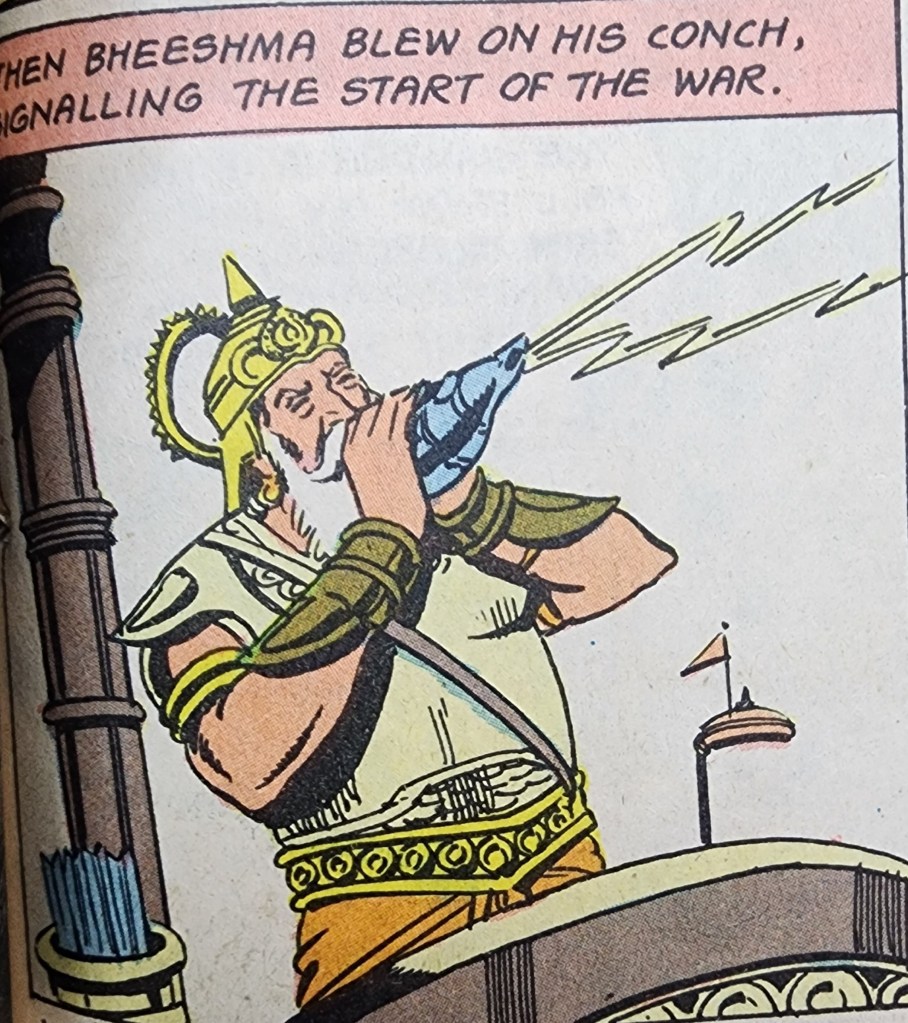
Use of the sound of a Shankha (conch shell) in the Mahabharata. Image credit – “Mahabharata – 30, The War Begins”, published by Amar Chitra Katha.

Sound is so primal that it has been used in the natural world for millions of years. Everyone knows that snakes use sound to warn predators and potential threats to warn them of their presence. Rattlesnakes with their rattles are the most popular in this category. Anyone who has heard a Russel’s Viper hiss like a pressure cooker about to go off can never forget that “stay away or else” sound. The Saw Scaled Viper rubs its scales together to cause a saw-like sound in warning.
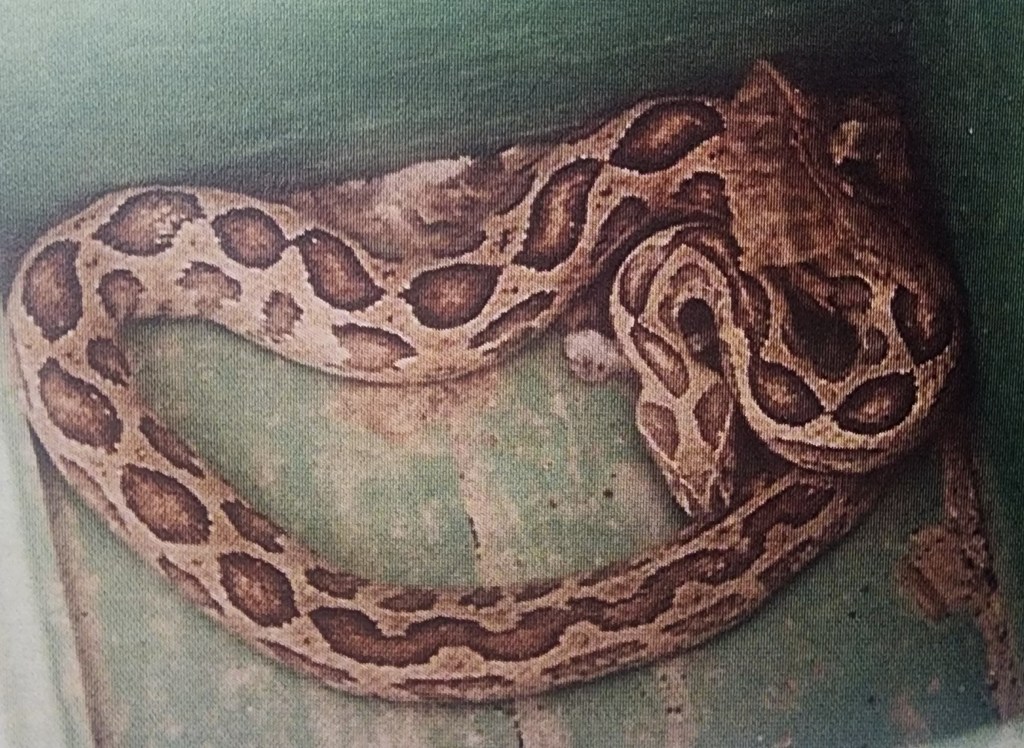
A Russel’s Viper. Image credit – “Menagerie Memoirs” by Dr. M K Shashidhar, published by Notion Press.

Beyond snakes, sound is used in mating calls and warnings against predators. Birds are most recognizable in the use of sound simply because humans find a lot of bird song extremely pleasant. Anyone who has been on safari in India knows to keep an ear out for the warning calls of langur and spotted deer (chital) to sense the potential for a sighting of a leopard or a tiger! And then there are the champions – elephants use infra sound to communicate over long distances, with humans being none the wiser, and blue whales are supposed to have a call louder than turbo jet engines, so loud that it travels across oceans.

I cannot conclude without referring to the depiction of sound as a weapon in folklore and pop culture. This is just to show that the use of sound as a weapon has always fascinated us humans. The most extreme use of sound as a weapon is with the Marvel Comics’ character, Black Bolt. This character’s voice is so dangerous that even a whisper of his can kill a person and a shout from him can cause a lot of destruction, like a bomb! This renders the character practically mute. And then there is the DC Comics’ character, Black Canary, whose scream can cause physical harm in her opponents.

In Irish folklore there is a spectral entity called the “Banshee”. This refers to a female spirit who causes a sound like a wail. This wailing sound is supposed to herald the death of someone in a family. So, it is like a warning or a precursor to a tragedy. In this vein, I must mention a 1981 movie called “The Monster Club”. This film is an anthology with tales of different supernatural entities. One of these stories refers to an entity called the “Shadmock”. This entity’s power is a whistle! Its whistle can cause the death of an individual! This seems like a connection between folklore and pop culture.

Lastly, and perhaps my current favourite depiction of sound as a weapon, is from the Dune series of books. It is the use of the “Voice” by the women who are members of the Bene Gesserit organization. This is more a case of voice modulation than specifically the use of sound, but it is close enough to the use of sound as a weapon, because their ability clearly involves frequency modulation.

The members of the Bene Gesserit can modulate their voice in a such a way that the words they utter become a command to anyone the utterance is targeted towards. The target cannot refuse the command; it is like they are held in thrall and moved like a puppet when the “Voice” is heard. The reason I like this ability is because it is very close to a martial art. It requires years of dedicated training to master. It also has its weaknesses, like does the Kiai. If it is used too often, individuals and entire populations can develop immunity to the “Voice” and render it useless. 😊

I will end with this one reference. In the Harry Potter series, in the later books, Harry learns that spells can be cast without uttering them, while he and most others he has seen have been vocalizing the spells. Is this ability to cast spells without sound similar to a soundless Kiai?
The Bones of the Vajra

The weapon wielded by Indra, the King of the Devas, is the Vajra, also referred to as the Vajrāyudha. The latter term is a combination of “Vajra” and “Āyudha”, where āyudha means “weapon”. Āyudha could also mean a tool, but in this case, it refers to a weapon. “Vayrāyudha” thus means, “the weapon Vajra”.

Indra is also the Guardian of the East and the God of Thunder and Lightning. In the latter form, Indra is similar to Thor, Zeus and Jupiter, from the Nordic, Hellenic and Roman pantheons respectively. Since Indra wields lightning, the Vajra is also analogous with lightning. The word vajra is also most commonly used to denote diamonds in some Indian languages. So, Vajra could mean both a diamond and lightning.

The diamond is the hardest substance in the world based on Scratch Hardness, which is measured on the Moh scale. Being the hardest substance, diamonds are very hard to abrade. Hence, diamond tips or diamond coating is used in machining of other hard materials. Lightning is a powerful natural force. High rise buildings have lightning conductors to protect themselves. These conductors take the electricity, or the power of lightning, away from the structure and into the ground (Earth).

Considering the act of conducting lightning away from the building, it can be said that the power of lightning is deflected more than resisted. In this way, lightning is an unstoppable force. At the same time, diamonds being the hardest substance, it is analogous to an immovable object. So, I have heard it said that the Vajra is, simultaneously, the unstoppable force and the immovable object! Thus, Indra, the King of the Devas, wields the greatest weapon!

The Vajra or Vajrāyudha was originally made from the energy of the Sun. But this Vajra is rendered incapable at times. Later, another Vajra is crafted from the backbone of the Rishi (Sage) Dadichi. Indra has to defeat an Asura called Vrtra (also spelled Vritra). But this Asura is invulnerable to all manner of weapons. At the same time, the Rishi Dadichi has bones that are invulnerable to all forces in the universe as well.

Cover image of “Indra and Vritra”, which shows Indra fighting Vritra. In this case, Vritra is not depicted as a large snake. Image credit – “Indra and Vritra”, published by Amar Chitra Katha.

So, Dadichi offers up his bones as material from which weapons can be crafted to defeat Vrtra. Dadichi gives up his life for this cause as Vrtra has captured all waters and rain bearing clouds, causing a draught that is killing life on the planet. One weapon created from Dadichi’s bones is the Vajra. The Vajra was created using the backbone or vertebral or spinal column of Dadichi.

Vrtra is usually depicted as a large snake or Naga. There are people who suggest he is representative of a Dragon, and Indra is a dragon slaying God like in many other world religions. There are 2 stories that I have heard related to the battle between Indra and Vrtra. One is supposed to be from the Rig (Rg) Veda and the other, from the Puranas.

The story from the Veda is supposed to be a story denoting natural forces, where the Snake or Asura of draught is defeated by the God of Thunder and Lightning to release life sustaining waters as rain. The story from the Puranas shows Indra in a poorer light. He has to kill Vrtra who is created by Twastha, a great Rishi, whose son Indra has killed. But in both stories, Indra uses the Vajra to kill Vrtra. And the Vajra is a weapon of incredible power. In both cases, the Vajra is made from the backbone of Rishi Dadichi.

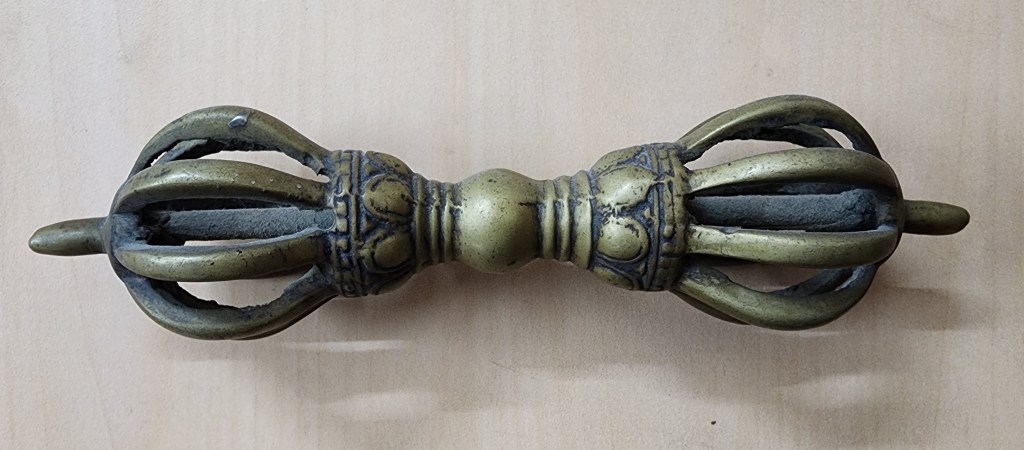
The most common visual depiction of the Vajra is common to both Hinduism and Buddhism. It is shown as a small weapon that resembles a dumbbell. It is like a short stick with symmetrical bulbous ends. The stick sits in the palm of a wielder while the bulbous ends stick out beyond the palm. By modern standards, we would call this a close quarter weapon.

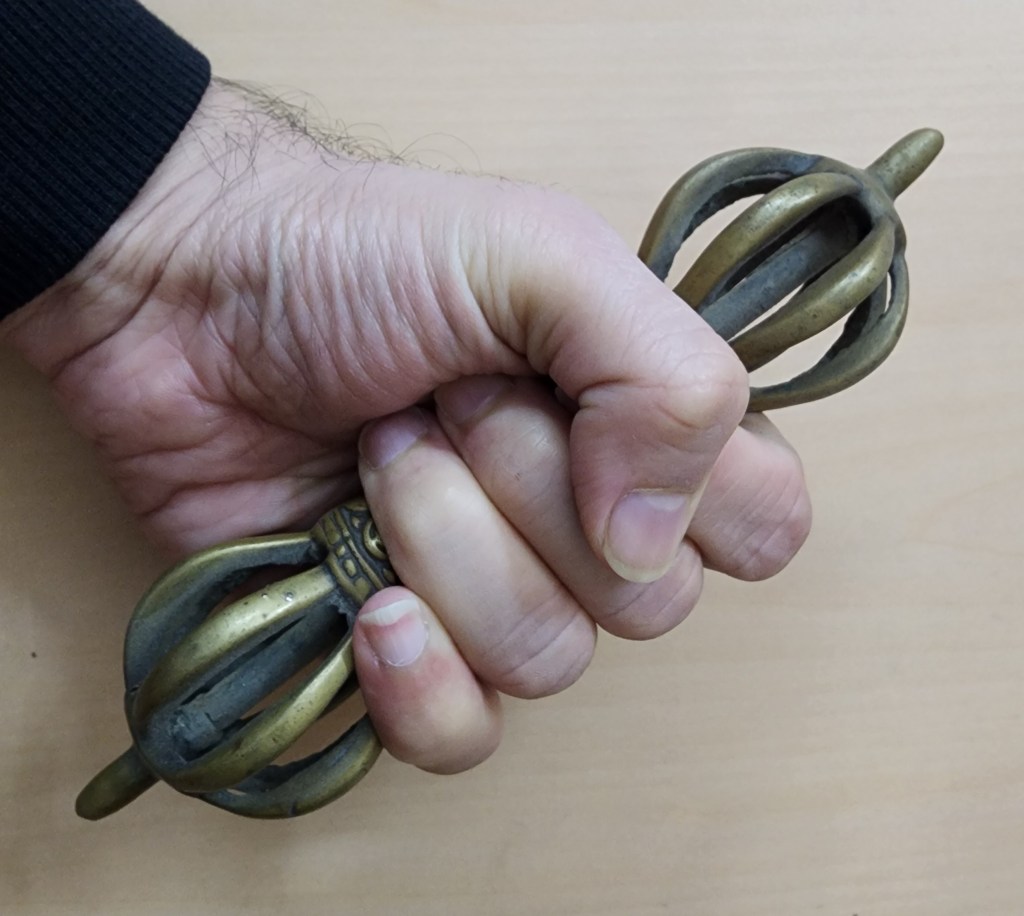
Seen below is an example of a Vajra. This is more a representation of the Vajra in Buddhism than Hinduism. I personally see the former as a progression of the latter and do not care for the origin of the representation.

Representative images of a modern-day Vajra

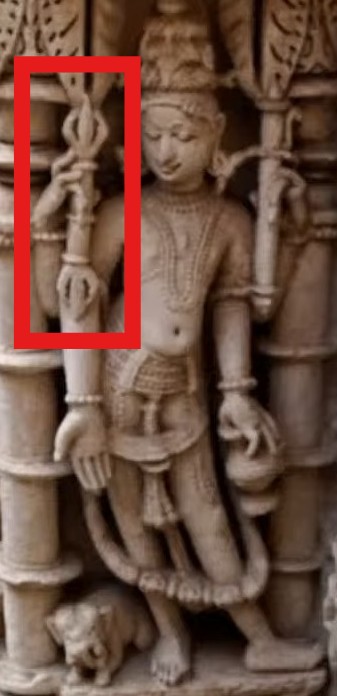
Seen below is a depiction of Indra holding the Vajra. This depiction is one of the many wonderful carvings at the Rani Ki Vav in Patan, Gujarat. The carving is from the 11th century CE. The previous and next representations are similar, though not identical. They are both two headed symmetrical weapons that are small and are held in the palm of the hand.

Image of a carving depicting Indra from “Rani ki Vav”, at Patan, Gujrat. The Vajra is seen at the top left of the image. Image credit – https://www.youtube.com/watch?v=gxT3VIH71dwDay – 1/3 Devalaya Samskruti hagu Murthyshilpa – GIPA Live Events – 10th April 2024

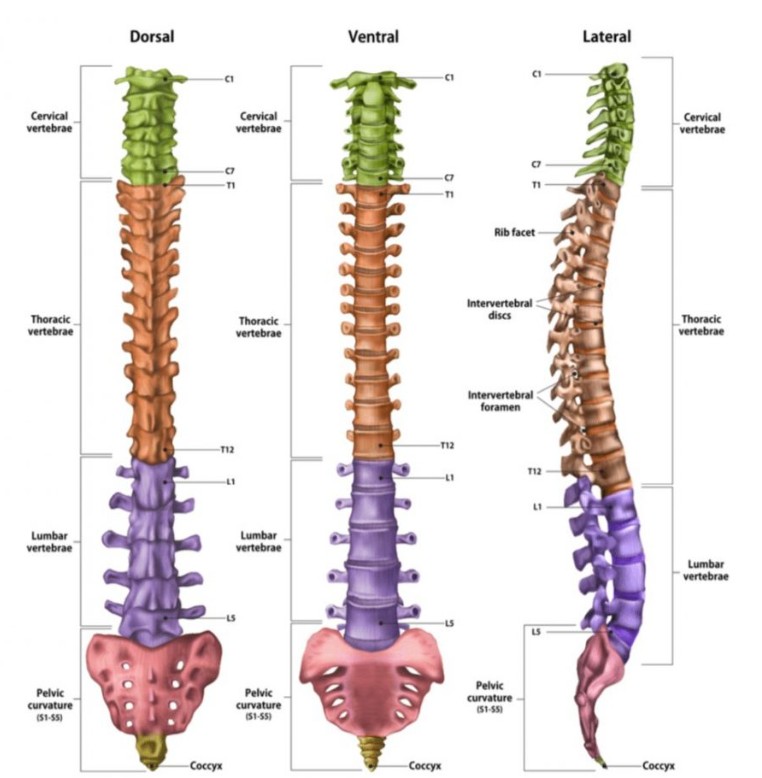
Consider the human backbone. It is a series of vertebrae one on top of the other. Now look at the images above, and the tradition that the Vajra is made from a backbone. Based on these, the following statement holds true for me. I had always imagined that the Vajra was two Lumbar Vertebrae attached to each other with a short stick, which could be made of any material. Of course, the vertebrae would be “facing away from each other”, for lack of a better description.

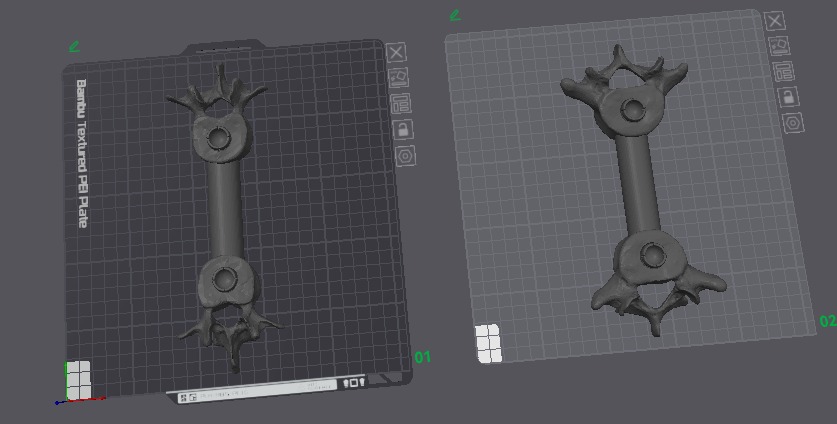
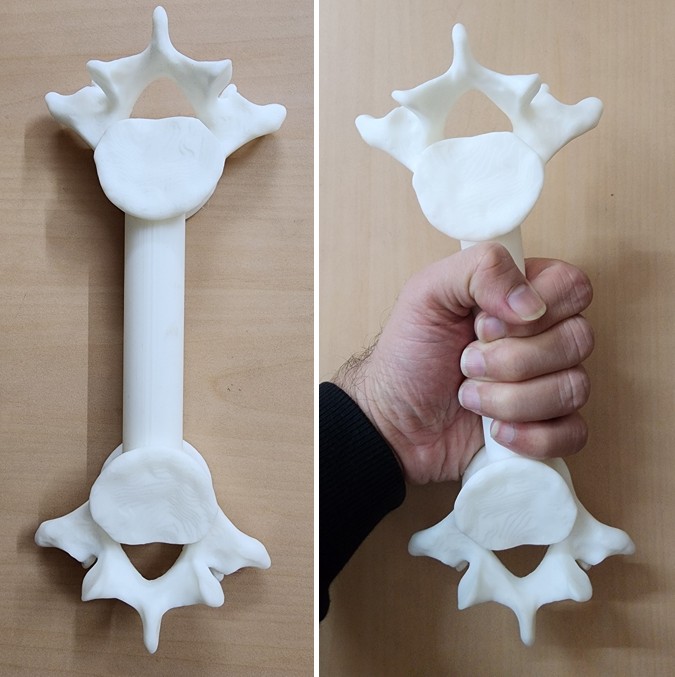
Thanks to the magic of 3D printing, a friend of mine, Siddhant Raju was able to print a Vajra as I had imagined it. We used the L5 vertebra as the best option to make the Vajra, as we felt that seemed the most robust. Of course, Rishi Dadichi would have only one L5. We decided that if we had to be accurate, we would use one L2 and one L5 to make a Vajra. As we see it, the L5 seems most robust of all the Lumbar vertebrae while L2 gives the best point to strike with.

The images below show the options with the L2 and L5 vertebrae for 3D printing, and the final Vajra that was made. We felt that the Vajra seemed very similar to the one depicted in the carving at Rani ki Vav.

The above image shows the options for 3D printing, with the L2 and L5 vertebrae.

The final Vajra that was made using 3D printing

A short video showing the 3D printing of the Vajra.

This design of the Vajra to me implies that Indra would be a master of very close quarters combat. It is almost as if he would get inside the range of any weapon an opponent would wield, to effectively deploy the Vajra depicted by tradition. I am sharing a video below that hopefully elucidates this idea.

I had created a video a few years ago that depicted the potential use of the weapons of the Guardians of the 10 directions. Along with my friend Nirvigna, we had depicted the possible use of the Vajra as well, as part of this video. Watch between the 2:02 and 3:03 minute marks of the video shared below, to see possible uses of the Vajra. We had used the Vajra seen in the image earlier in this article for the demonstration. The same moves can definitely be replicated with the design seen in the 3D printed version seen above.

All this experience suggests to me that the Vajra could definitely have been a real weapon, and it could have indeed been made with a backbone, or at least the vertebrae that make up a backbone. Of course, I cannot comment on the mystical or divine prowess of the Vajra that Indra would wield, what with his being the King of the Devas.

Since I have touched upon the Vajra being a real and practical weapon, let me share some real-world weapons similar to the Vajra, and their applications.

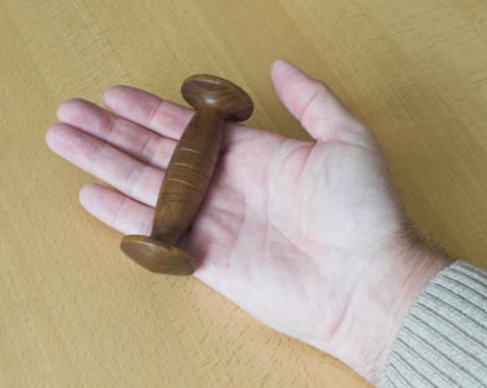
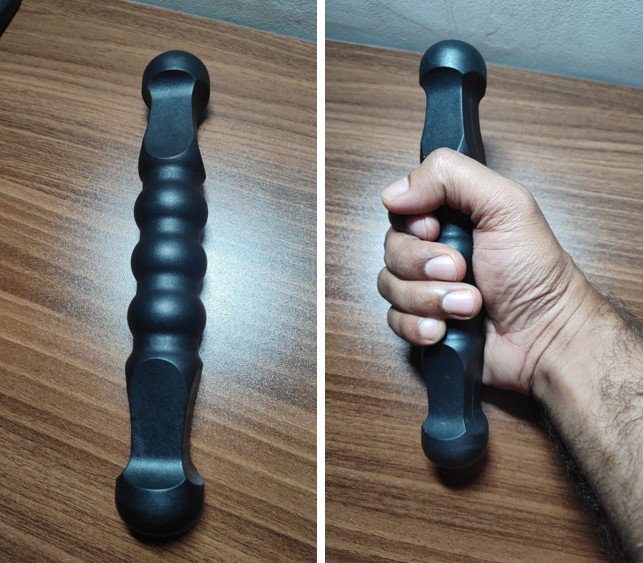
The Vajra is quite similar to a Yawara or Yawara Stick. The Yawara Stick, an example of which is seen in the image below also resembles a small dumbbell. It is used to strike opponents at very close quarters.

An image of a yawara stick. Image credit – Wikipedia

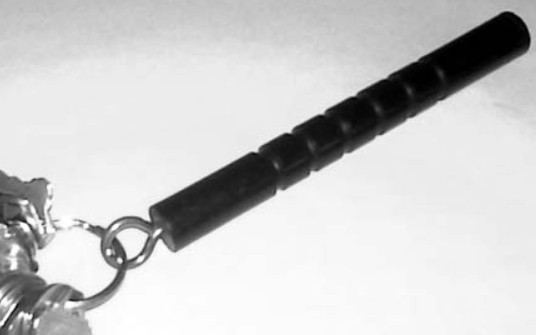
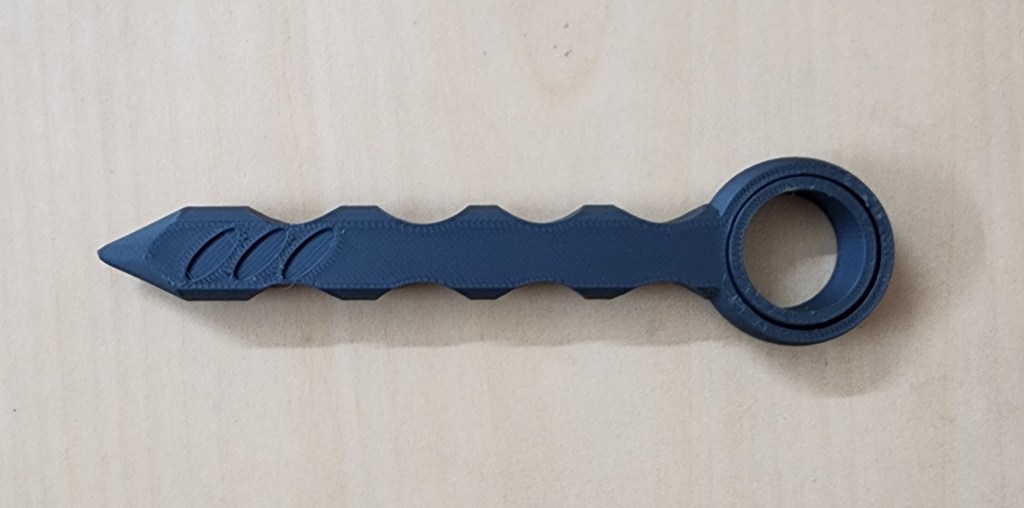
A weapon similar to the Yawara Stick is the Kubotan. Examples of this are seen in the images below. This weapon is sold as part of a keychain on many commercial e-commerce sites.

An image of a kubotan. Image credit – Wikipedia

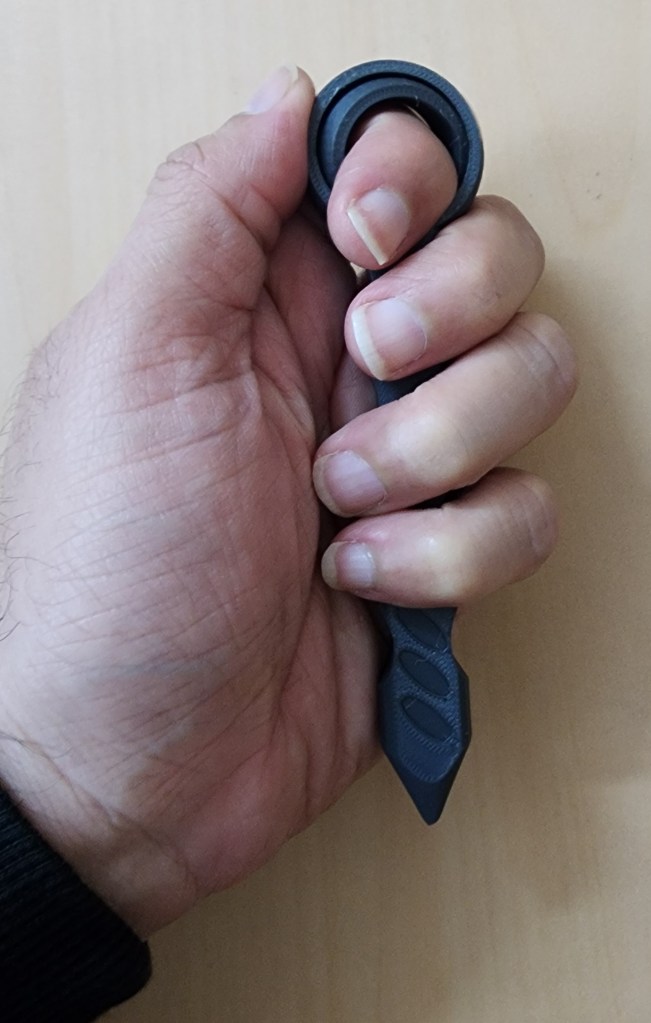
3D printed variants of the kubotan, that are only meant for training

A weapon called a Kobo Stick is also available online. An example of this is seen in the image below. From what I have heard the Yawara Stick, Kubotan and Kobo can be made of several different materials, ranging from bamboo, wood, metal and hard plastic. All of them can be used in a similar manner against opponents.

Images of a Kobo Stick

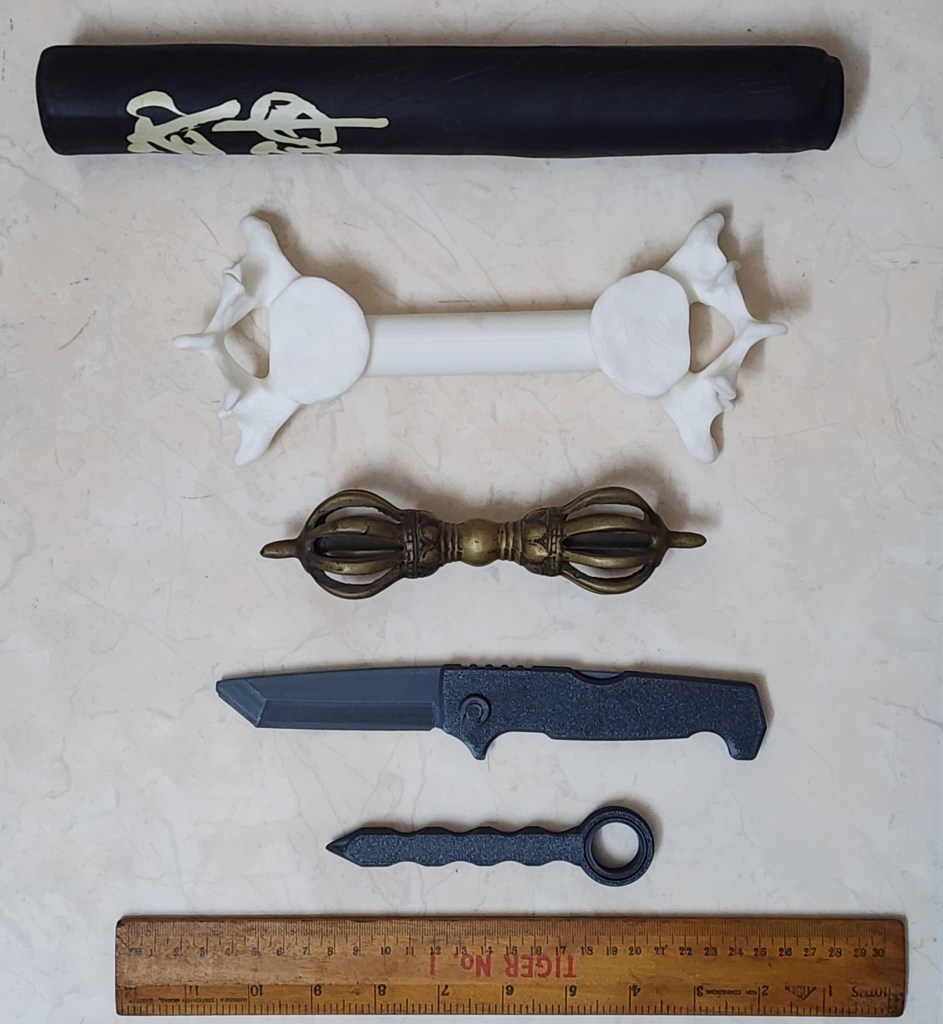
In the Bujinkan system of martial arts, we study a weapon called the tānbo (sometime pronounced tāmbo). This is nothing but a short stick. It can be used in a manner similar to the Vajra. The “tān” in the “tānbo” means “small”. “Bo” is a “staff”. So, a “tānbo” is a small stick/staff. This is not unlike a “tānto”, which refers to a knife. “To” is a bladed weapon, while “tān” is small. So, a small, bladed weapon signifies a knife.

Seen in the above image from top to bottom are, a Tānbo, the 3D printed Vajra, a traditional Vajra, a training Tānto and a training version of a Kubotan variant. The Tānbo is also a padded training version. The real weapon would be a lot leaner, the length can be variable, it is not standardized.

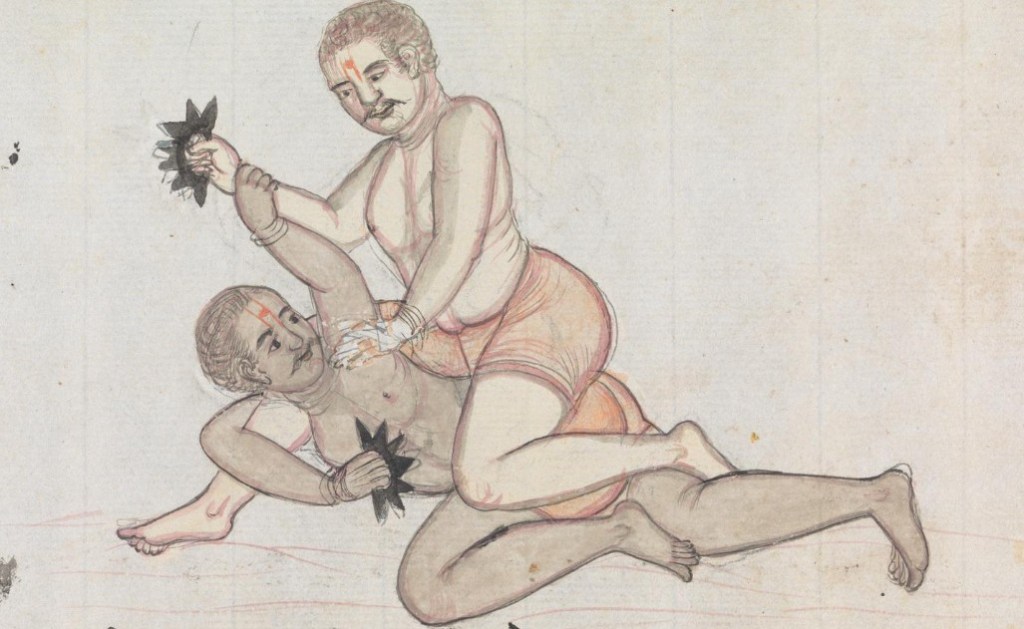
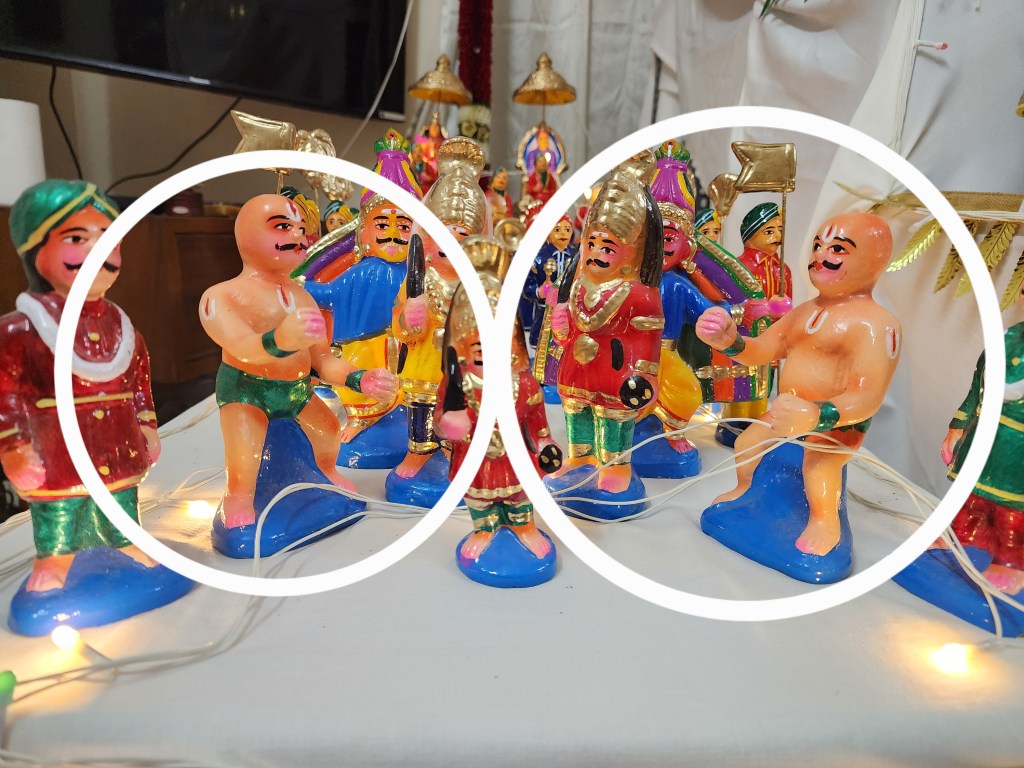
In India, there is a traditional martial art called “Vajra Mushti”. Here, “mushti” means “fist”. So, “Vajra Mushti” could mean “a fist like a vajra”, in other words, “a devastating fist”. Vajra Mushti is a close quarters martial art. The vajra in this case is closer to a knuckle duster than the traditional vajra. Vajra Mushti is demonstrated every year during the famous Dasara festival in the city of Mysore, in Karnataka.

A representative image of Vajra Mushti, from the late 18th century. Image credit – Wikipedia

The above image is from a traditional display of dolls during the Dasara festival. The two encircled individuals are the “Mallas” (roughly translated as wrestlers) who demonstrate Vajra Mushti in Mysore during the celebration of the Dasara festival.

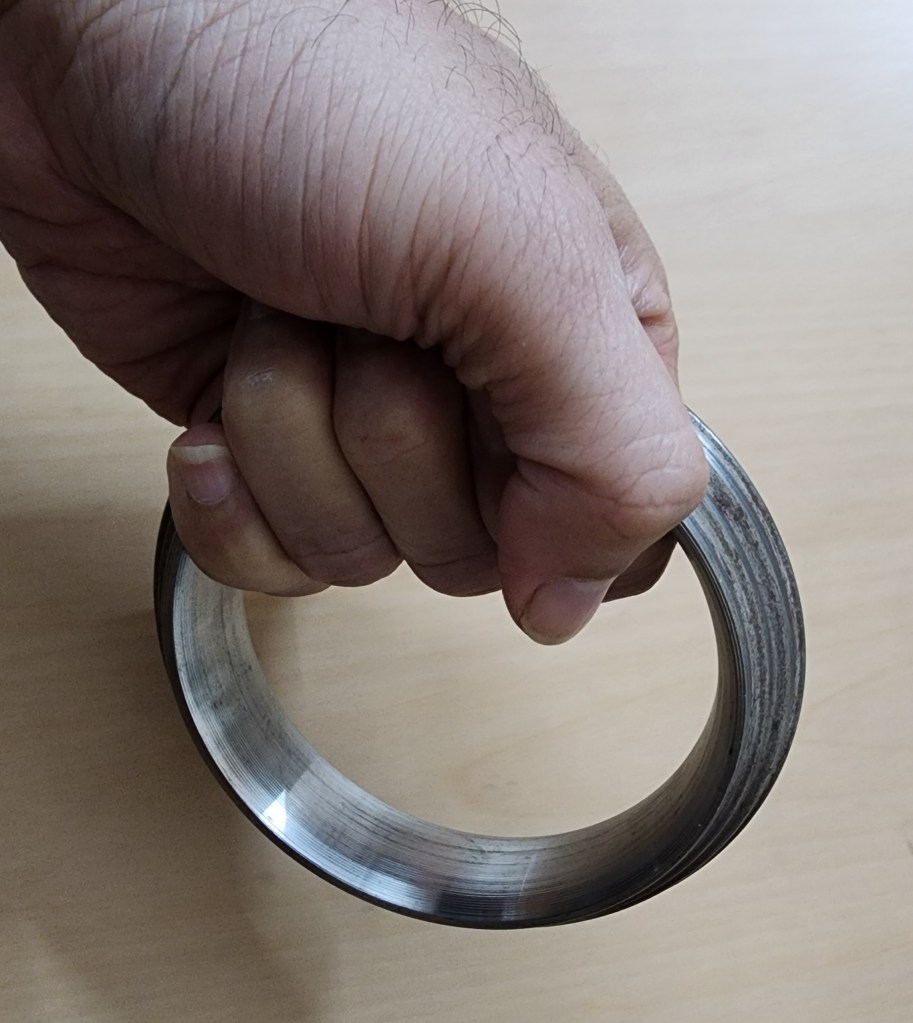
Similar to Vajra Mushti is another martial art called “Loh Mutthi”. “Loh” means “iron” and “mutthi” means “fist”. So, “Loh Mutthi” means “iron fist”. Here again, the “iron” comes from a knuckle duster used by a practitioner. Sikh troops wore (and still do wear) a “kada”, which is a metal ring akin to a bracelet on their wrists. These kada vary in dimensions. Supposedly, if all else failed, a soldier slipped off the kada and held it in his fist like a knuckle duster and used it in much the same manner.

A Kada held in a manner that enable its use as a knuckle duster. The shape and size of the Kada can vary greatly.

Since the Vajra is equivalent to a Yawara stick, which is a weapon used for fighting in very close quarters, I will share a question. The Vajra is also considered a lightning bolt, which strikes from far away, across a large distance, electrocutes and fries the lifeform it strikes. How do these two attributes fit in together? How can there be a feeling like an electric shock while fighting in close quarters with a small weapon?

I do not have a clear answer to this question, but I will hazard a guess as to how this is feasible. Imagine the feeling one goes through when one gets hit on the funny bone at the elbow. It is a jolt, something that can be said to be similar to an electric shock. There are multiple points in the human body, the striking of which can result in debilitating pain, sufficient to cause an individual to stop fighting for short durations, as small as a few seconds in some cases.

These points can be called “pressure points”. They are referred to as “marma points” in some Indian martial arts and Kyusho points in the Bujinkan system of martial arts.  These points cannot always be targeted in a dynamic fight. But the knowledge of these points is important, for when an opportunity presents itself, these points should be struck to gain an advantage.

Further, the effort needed to cause pain while striking these points is not great, this could partially be the reason martial arts around the world identify these points as known weaknesses in a human body. If one is wielding a Vajra or a Yawara stick or a Tānbo, a strike in close quarters with just a little effort will be magnified to a certain extent by the weapon. And this strike is sufficient to cause pain in the opponent.

Perhaps this pain caused by the small weapon in close quarters was considered akin to the feeling of suffering due to an electric shock, an analogue of a lightning strike! This is, in my opinion, a possible cause for the smallish Vajra being considered the lightning bolt! But does this mean that there was, sometime in the deep past, a real Indra who was a master of close quarter fighting? And does it mean he used a small striking tool? I have no idea if these are true, but there is a chance they might, considering how long the tradition of Indra wielding the Vajra has endured.

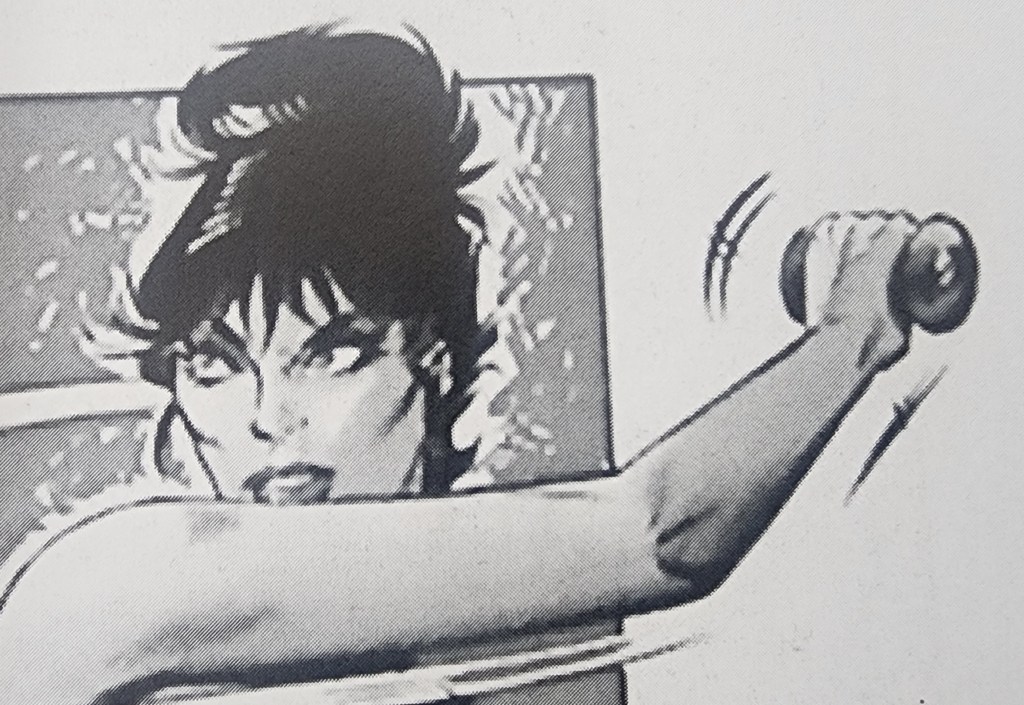
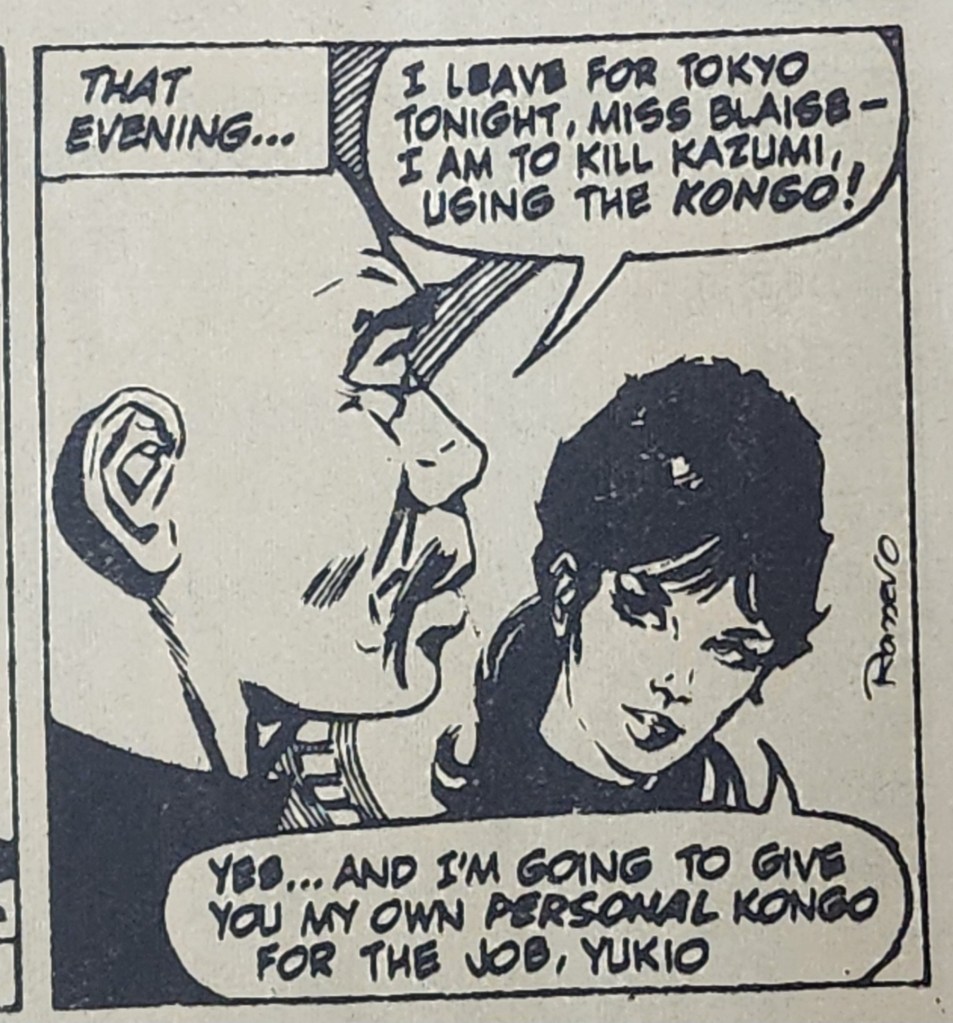
The vajra or yawara stick is also depicted in fiction. The fictional character Modesty Blaise, created by Peter Odonnel uses a weapon she calls the “Kongo”. This is Modesty’s favourite weapon. The kongo is nothing but a fictionalized version of the yawara stick. Modesty Blaise appears in 13 novels and 96 stories that achieved fame as newspaper comic strips. Modesty uses the kongo as a non-lethal weapon in close quarters. Her kongo is hollow and can also be used to hide messages if need be.

Modesty Blaise wielding the Kongo, which is a fictionalized version of the Yawara stick. Image credit – “The Art of Modesty Blaise”, published by Book Palace as part of the “IllustrationArtGallery.com presents” series.

The Kongo is Modesty’s favourite weapon. This picture is an image of a clip in an old edition of the Kannada newspaper, “Prajaa Vaani”.

The Vajra, beyond being a weapon also has cultural significance in India and beyond. The significance of the Vajra in Hinduism is through Indra as discussed earlier. The Vajra is also a revered icon in Buddhism. But apart from these historical aspects, the Vajra also has great significance in modern India, specifically in a martial or military context.

The Param Vir Chakra (PVC) is the highest gallantry award in wartime in modern India. The recipients of the PVC are held in high regard all over India. There are 21 recipients of the PVC in India. The award is a medal made of bronze. One face of the medal shows 2 Vajras which are perpendicular to one another. In this manner, the Vajra is a depiction of bravery to this day in India.

An image of the Param Vir Chakra. Image credit – Wikipedia

The Vajra is culturally significant in Japan as well. I am specifically referring to Japan because it is the country of origin of the Bujinkan system of martial arts, of which I am a practitioner. One of the deities in Japan is Fudo Myō. He is considered a very important deity for the martial arts according to the previous grandmaster of the Bujinkan, Soke Hatsumi Masaaki.

An image of Fudo Myō from an old training t-shirt we used back in the day. Observe the sword in the right hand and the noose in the left hand. Also observe the hilt of the sword, it is a Vajra.

From what I have heard, Fudo Myō can be called, in Sankskrit, Achala or Maha Achala. This can be roughly translated to “Immovable” (Achala) or “The Great Immovable One” (Maha Achala). Fudo Myō wields a noose and a sword in each of his hands. In my opinion, these two objects make him a personification of the first 2 lines of the Sanskrit shloka, “Asotōma Sadgamaya”.

The first line says, “Asotōma Sadgamaya” which translates to “move from untruth (ignorance) to truth (wisdom)”. The second line says, “Tamasōma Jyothirgamaya” which translates to “move from darkness to light”. Fudo Myō is supposed to use his sword to cut through the darkness of ignorance and use the noose to pull one into the light of wisdom. Thus, he is a personification of the two lines just mentioned!

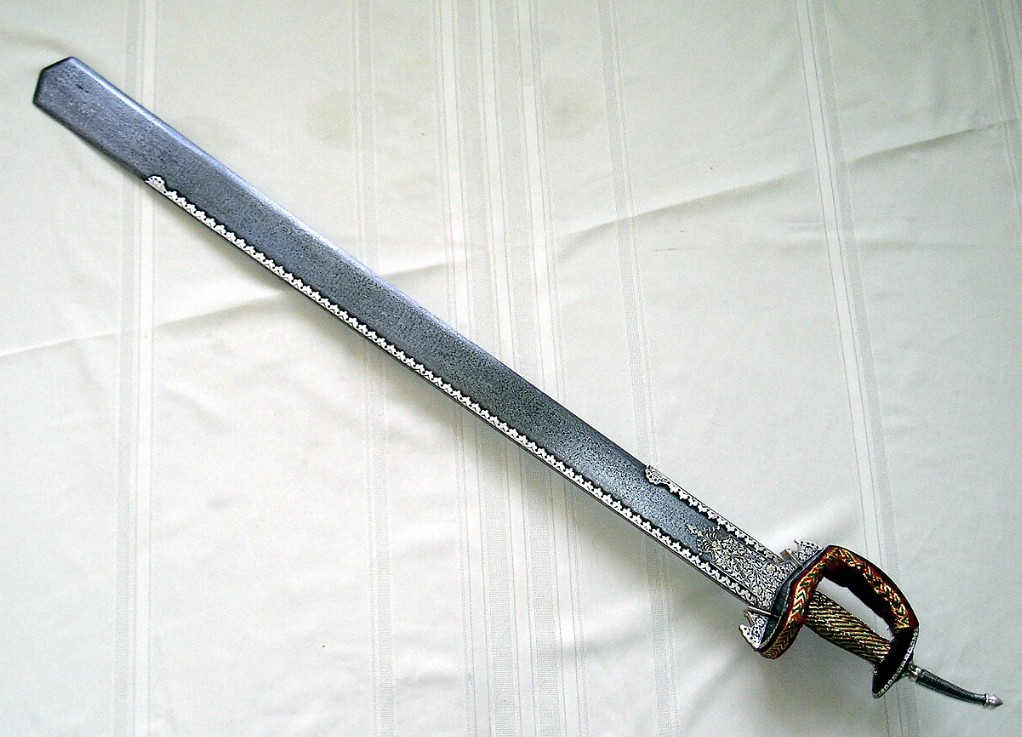
The sword that is depicted in the hand of Fudo Myō is interesting by itself! The blade of the sword is broad at the tip and resembles what is called in India, a “Khanda”. A Khanda is a straight sword with a broad tip, which lends itself very well to cutting. The blade is double edged, though the back edge need not be sharp all the way through. It is sharp only for about the top half of the blade.

A representative image of a Khanda. Image credit – Wikipedia.

The hilt of the blade wielded by Fudo Myō is a Vajra. The blade is mounted on a Vajra. This makes Fudo Myō a “Vajra Hasta” or a “Vajra Paani”. “Hasta” and “Paani” refer to the palm. Thus, a “Vajra Hasta” or a “Vajra Paani” is someone who holds a Vajra in her or his palm. Indra is also a Vajra hasta as he wields the Vajra as well.

Fudo Myō and his significance was constantly discussed in 2013 when the theme of the year in the Bujinkan required us to study the Tsurugi or Ken. The Tsurugi or Ken is the straight Japanese sword which predated the famous Tachi and Katana, both of which are iconic curved swords emblematic of Japan in the modern day. In 2013, we trained with the Ken a lot.

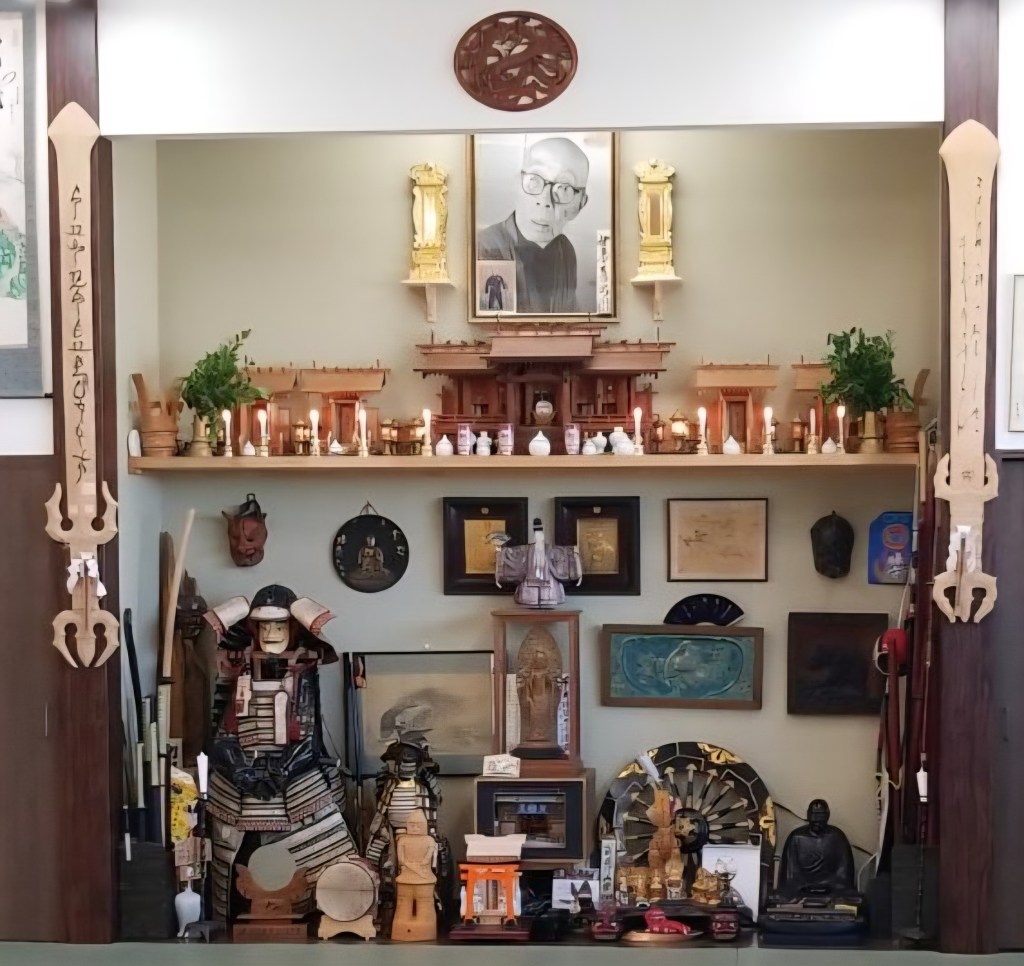
This is a picture of the Hombu Dojo (headquarter dojo) of the Bujinkan. Observe the two Tsurugi (straight sword) on either side of the Kamidana. Also observe the hilt of the two swords, they are Vajras.

This concludes the main focus of this article, the potential of the Vajra being a weapon made of vertebrae, it being a real weapon, a demonstration of its use and its cultural significance in the martial arts. But there are additional points relating to its cultural significance outside India and its depiction in modern Indian pop culture that I would like to share. If the article is too long or boring, one can choose to ignore the rest of this post.

If one searches for “Zeus” on Wikipedia, as of now, the first image seen on the page is the one seen below. This is supposedly called “Jupiter de Smyrna”. It is supposed to represent Zeus or his rough Roman equivalent, Jupiter. This statue was supposedly discovered in Smyrna, in modern day Turkey, missing an arm. It was restored by the French sculptor Pierre Granier in 1680, to show Zeus holding the Thunderbolt.

Zeus/Jupiter of Smyrna. Image credit – Wikipedia.

The Thunderbolt seen in the statue, as far as I know, is similar to older representations of the same weapon. From what I know, the Thunderbolt is representative of the lightning bolt as well. Zeus and Jupiter are both roughly equivalent to Indra in this aspect, both being Gods of Thunder and Lightning.

I have seen the Thunderbolt being depicted as a spear in some representations. In this form, it supposedly follows a kind of logic with respect to the brothers, Zeus, Hades and Poseidon. The weapon wielded by Zeus has a single point, so it is a spear. The weapon wielded by Hades has 2 points, making it something like a tuning fork or man-catcher from later centuries. This is also supposed to have influenced the “Pitchfork” wielded by the Devil in Christian tales, as that has 2 points as well. Poseidon has a weapon that has 3 points; hence he wields a Trident, or Trishoola as we Hindus refer to it. In this representation of the weapons, all of them wield pole arms.

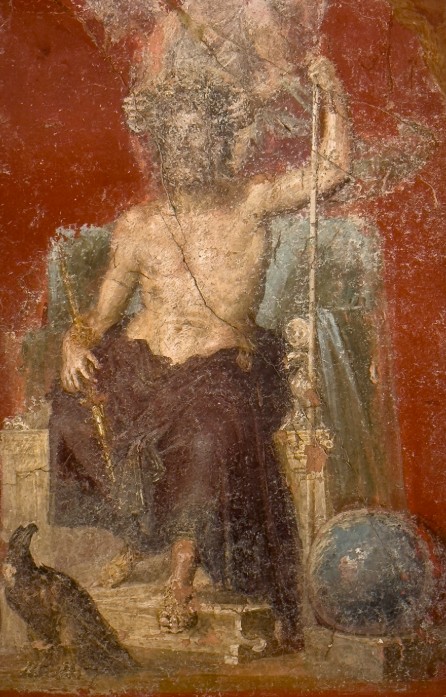
This is an image of Zeus from Pompeii. Here the Thunderbolt that is wielded by Zeus is depicted as a spear. Image credit – Wikipedia.

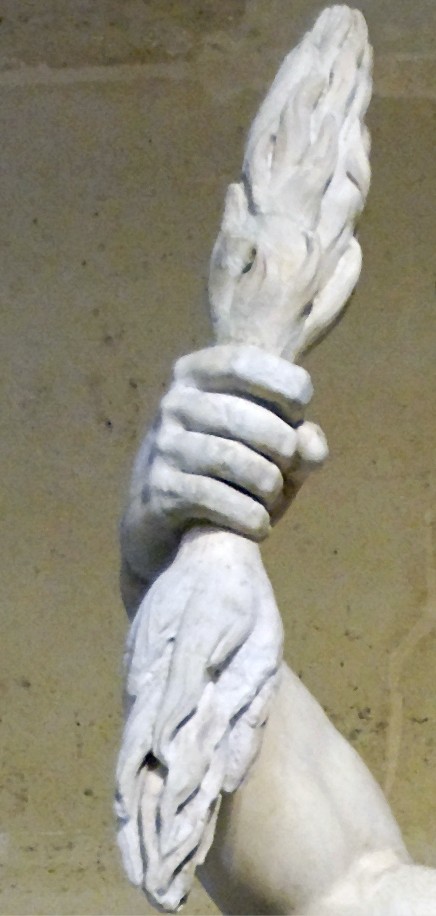
But the Thunderbolt seen in the statue above does not depict a spear. It supposedly depicts a clutch of lightning bolts that Zeus can hurl at whomever he chooses. So, it could be that Zeus is so large that a lightning bolt seems small in comparison. If a normal human was depicted wielding the same, it would perhaps be as long as a spear.

Either way, consider the depiction in the statue, a closeup of which is seen below. Does this not seem like a Vajra? The 2 ends are symmetric and wider than the centre, which is held in the palm of Zeus. Is the shape not similar to the one on the right? Does this not look like a large Yawara stick with slightly points ends? I opine that it does. With this observation, we can say that Zeus wields a Vajra as well!

That said, if the Thunderbolt was depicted as a spear, that would not, in my opinion, suggest that the Vajra could be depicted as a spear. This is because, by Hindu tradition, the weapon associated with Agni, the God of Fire and the Guardian of the Southeast, is the Shakti. The Shakti is always depicted as a spear.

I will conclude with another question to which I have no answer. I wonder why the depiction of the Vajra in modern pop culture in India is so very different from the traditional depiction. Sometimes, the Vajra is depicted like a “Z”, almost like the symbol of the DC comics superhero, The Flash. In come extreme cases, Indra is shown wielding the backbone with all the ribs still attached! I wonder how one would fight with that! 😀

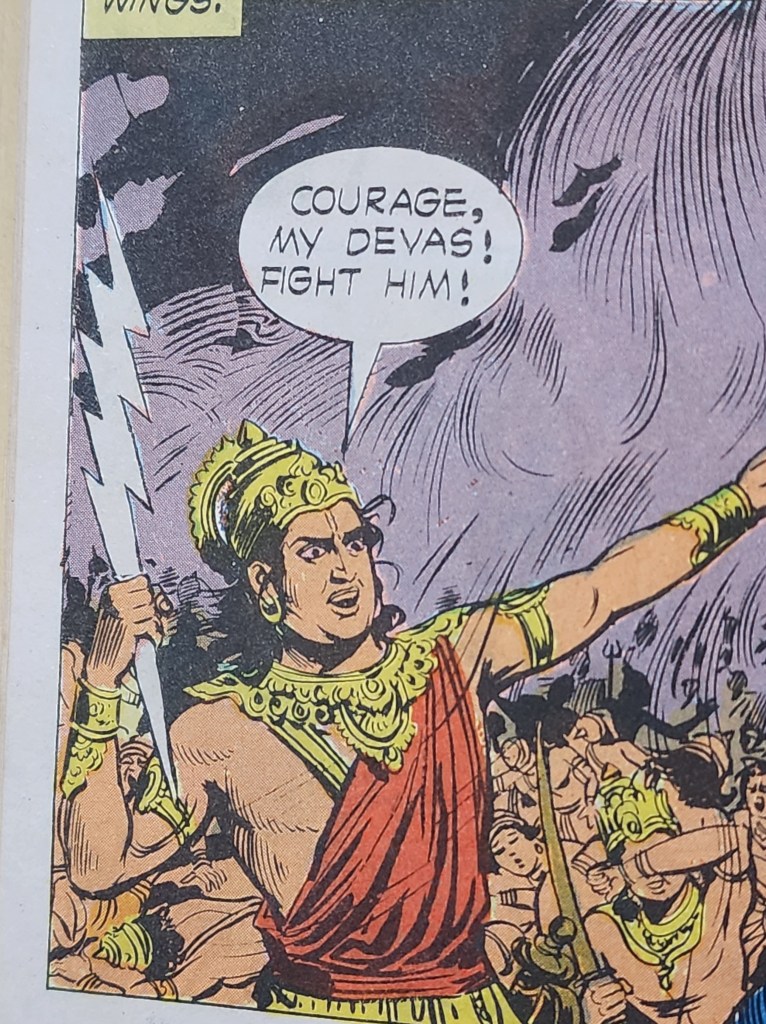
The Vajra wielded by Indra being depicted as a “Z”. Image credit – “Garuda”, published by Amar Chitra Katha.

The “Z” like depiction is seen in many Amar Chitra Katha publications. This publication has always drawn inspiration from historical depictions, and temple carvings. But I wonder why they chose a different one in the case of the Vajra, especially since there are so many depictions of the Vajra in temple carvings.

This holds true considering one of their early depictions of the Pushpaka Vimāna in the Ramayana (the aerial vehicle of Kubera stolen by Ravana and eventually passed on to Lord Rama) is remarkable similar to the depiction of the same in an approximately 1300-year-old carving in a Chalukya temple at Pattadakal in Karnataka.

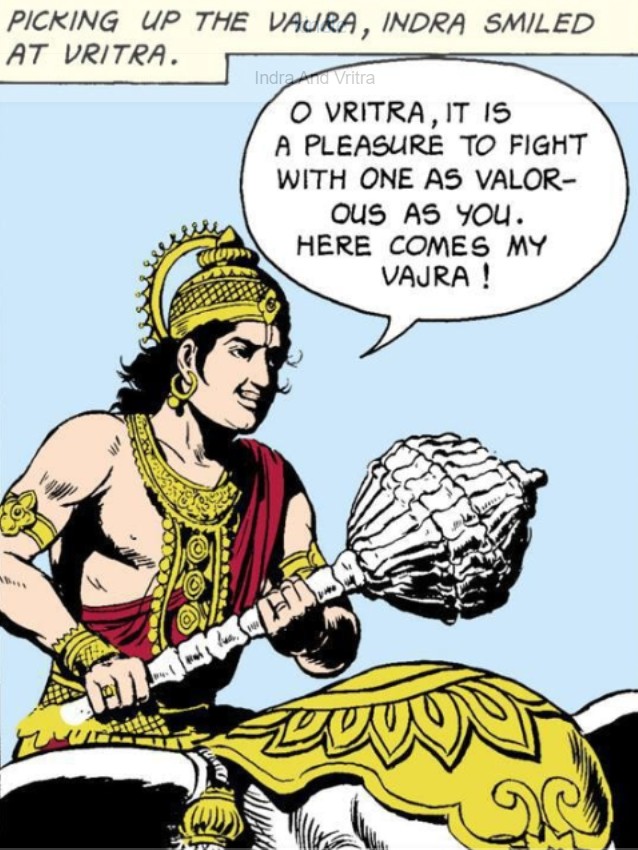
In another depiction of the Vajra, they have depicted it as a mace or a gada made from bones. This seems a far better depiction, since there is some engineering of the bones of Rishi Dadichi to convert them into a weapon. Considering that Vishwakarma, the engineer of the Devas, crafted the Vajra, this “value addition” seems necessary, at least to a modern mind like mine, that is accustomed to engineering in every aspect of life.

The Vajra depicted as a Gada (mace) made from the backbone of Rishi Dadichi. Image credit – “Indra and Vritra”, Kindle edition, published by Amar Chitra Katha.

If I were to consider a very pop culture depiction of a primitive, barbarian like Vajra, since it is from a forgotten past, I would likely make it look like an axe, a two headed axe no less. 😛 Consider the human back bone. It includes the pelvic girdle. So, if one reversed the backbone to hold up the girdle, with the rest of backbone being the handle, we would have an axe. 😊And the axe handle would have a natural curvature and a pointy end at the tip (sacrum) as well! I will end here before I run away with my imagination. 😀

Seen above is an image of the human backbone. Observe the Dorsal and Ventral images. Do they not look like a stylized axe a barbarian would use??!! 😊 Image credit – https://spinehealth.org/article/spine-anatomy/