Sound is a weapon, a very effective one. The application of sound is a fascinating exploration of how we humans interact with each other and the natural world. Let me begin with a story from Hindu culture. The story I am sharing forms a part of the Devi Mahatme (sometimes written as Devi Mahatmya).
There was a time when two Asura brothers, Shumbha and Nishumbha ruled the Earth. They were mighty warriors who led great armies. Even the Devas had been defeated by these brothers. Some of the famous Generals who served under Shumbha and Nishumbha were Raktabeeja, Chanda, Munda and Dhumralochana.
Once, a few Asura soldiers spotted an incredibly beautiful woman. This was the Goddess, Devi Ambika. They reported back to their rulers about the beauty of the woman. Shumbha decided that he had to have the Devi for his wife. So, he sent his General, Dhumralochana, to the Devi with the proposal of marriage. She replied that she could only marry an individual who had bested her in combat.
Dhumralochana believed she was a weakling as she was a woman. In his arrogance, he attempted to seize the Devi and take her back to his king. But he was sorely unaware of Devi Ambika’s abilities. When he attempted to capture her, she uttered a single syllable, “HUM”. As soon as this syllable was uttered, Dhumralochana caught fire and was burnt to death. The Asura host he had brought with him fled in terror.
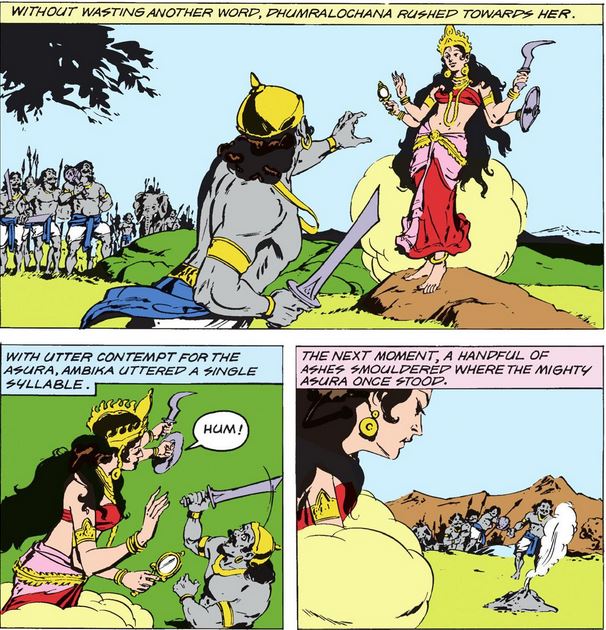
Devi Ambika burns Dhumralochana with a single syllable (Kiai!). Image credit – “Tales of Durga” (Kindle edition), published by Amar Chitra Katha.
The Devi’s abilities are demonstrated by the fact that she did not even need to move to destroy the Asura General. She did not even speak. She uttered a single syllable! And her opponent was toast, literally! This story is used to show how powerful the female Divinity is. A lot more happens in this story, when the other Generals and eventually the ruling Asura brothers themselves attack. Other representations of the Devi emerge and the scourge of this ruling coterie of Asuras is eliminated for good.
We only need the part of the story where Devi Ambika uses sound as a weapon. She utters just ONE syllable, but it is sound, nevertheless. Of course, mortal humans cannot burn anyone to death with sound, much less with just one utterance. But this does indicate that humans have always known that sound can be a weapon. Let us explore this further.
In the Bujinkan system of martial arts, we learn what is called a “Kiai”. Sometimes this is pronounced as “Kiyai”. The Kiai is a short simple shout. It is more a sharp, possibly loud expulsion of a sound than a scream. It is a single sound, much like a single syllable. It could be loud but need not be. The sound occurs when one is exhaling. The concept of the Kiai is not limited to the Bujinkan. It is found in many other martial arts around the world.
An example of a Kiai (audio only)
When we utter the “Om”, we are supposed to begin the utterance from the belly, from the core of one’s being. It is pretty much how animals utter a sharp cry or a bark. If one observes a parrot utter a sharp cry or a dog bark, one will see that their core is sucked in as the sound is expelled. This is the same for a Kiai.
The word “Kiai”, as I have heard it explained by my teacher, stands for, “a unification of energy”. In other words, there is a concentration of energy at our core, the abdominal region, that bursts forth in one instant. This “burst forth” is an expulsion of sound. In this way, the Kiai resembles a bark or any other animal sound that is delivered in a short burst.
I personally opine that what Devi Ambika is said to have used in the story, to kill Dhumralochana, is also a Kiai, with Divine attributes layered onto it. Of course, this is possible only in a story as far as normal humans are concerned, for we are not Gods, and we cannot reduce people to ashes with a sound.
Recently, we were discussing the Kiai in class and my teacher Shiva, mentioned that there are 3 types of Kiai. My teacher suggests that a Kiai could be to induce bravery or power in the person who performs the Kiai or to affect the opponent. My own classification varies slightly, as seen below.
The Kiai is of two types with one having a subcategory as I understand it. These are mentioned below and elucidated further down the article.
- Internal Kiai – Kiai to affect the self
- To generate power
- To let go of fear
- External Kiai – Kiai to affect the opponent
Imagine a weightlifter walking up to the weights on the podium or on the verge of lifting the weights. There are instances when you will hear them utter a sharp cry. This is to pump themselves up, raise self-confidence and to focus themselves. This is an example of a Kiai to generate power in the self. This is an example my teacher gave. Even when an MMA fighter walks into the cage, he or she is often times seen using a Kiai as part of the preparation routine. This is also an internal Kiai to generate power or to build oneself up.
Now imagine a situation where one is facing a wild animal. I have heard experts suggest not running from bears, boars, gaurs, tigers or even dogs to avoid triggering the chase instinct in the predator or large herbivore. They suggest making a loud noise, like a shout or a cry. In some cases, they suggest making oneself appear larger to deter an attack. The shout or loud noise they suggest is the Kiai to let go of fear, or at least to trigger the instinct of preservation.
Many years ago, I had attended a seminar conducted by Daishihan Arnaud Cousergue and Daishihan Sven-Erik Bogsater. During the seminar, Daishihan Sven-Erik had suggested using a Kiai to let go of one’s own fear. This sounded similar to using a loud voice and even saying something as simple as “Hey!” or “Stop!” to a potential attacker on the street.
The External Kiai is just a counterpart of the Internal Kiai. The same Kiai could affect both the self and the opponent. That said, it could be different. In the earlier example I mentioned an MMA fighter use a Kiai to pump oneself up. Many a time, the core team of the fighter who accompanies the fighter also use a Kiai, a shout, or a loud whoop, like “Come on!” or “You got this!”. This is a Kiai intended to affect their teammate. So, it would be an external Kiai.
In the example of using a shout to deter an animal from charging, it would be an internal Kiai when it stops the individual from panicking and turning tail to run. But the Kiai also, hopefully, stops the animal from attacking. Here, the same Kiai would be an external Kiai, as its effect was on the opponent.
This same idea also holds true when a potential attacker is deterred on the street. A shout might stop the attacker in his or her tracks, as an external Kiai. But the Kiai might also diminish the fear in the would-be victim, when it would have served as an internal Kiai.
There is another Kiai that I have experienced. This is a “Soundless Kiai”. In my experience, this is tied to one’s intuition. From time to time, while training, one of the two practitioners facing off, senses that an opponent is about strike or carryout a move that should be escaped. This makes the one who senses this to back off and put some distance between the two fighters. This happens when one “feels” that a decision has been taken by the opponent to attempt something or to change tack, which could be being more aggressive or passive.
This affecting the self or the opponent without any sound is generally more visible after years of training, where experience enables one to be more “aware” of what is going on in a fight, and if there are multiple threats. Also, if the two practitioners have trained with each other for a long time, they can read the opponent better due to sheer experience with the other, and a “soundless Kiai” is likely to be more apparent in this situation.
There is one important aspect about a Kiai that must be emphasized though. IT IS NOT MAGIC. A KIAI WILL NOT CAUSE YOUR OPPONENT(S) TO BE INCAPACITATED OR TO FAINT. A Kiai gives a short opening. This opening can be a fraction of a second or a bit longer at best. This short duration can be an opportunity to survive. The survival could be the result of,
- One being able to escape
- Putting the opponent(s) at a disadvantage with any move
- Simply preventing/deterring the opponent from attacking. This deterrence could even be a result of the attention of bystanders being drawn to the situation going down.
So, it is important to learn and practice the Kiai for 2 reasons. Firstly, it is not easy for many people to make a loud noise due to a modern upbringing and simple worry about drawing attention to oneself. This could be due to avoid scrutiny. So, one needs to learn how to generate a Kiai. It might start as a simple shout or a scream. But it does get refined over time, with breath control and experience.
Secondly, one will learn with practicing a Kiai, when it is effective, and for how long. This dispenses any false notions of the Kiai being a magic pill in a dangerous situation or doubts about it ever being useful. This experience is specific to individuals, and they will hopefully apply it as applicable to their unique abilities in a given situation.
The use of a Kiai to “create an opening” is best demonstrated by its technological equivalent, a “Flashbang” grenade. These are grenades used to disorient targets and not necessarily maim or kill them. The loud bang in the flashbang could be loosely equated to a Kiai. Of course, there is no bright light in a Kiai. These grenades are used to temporarily disorient opponents, which prevents them from causing harm to an attacking force, at least for a short duration. This short duration when the opponents are temporarily incapacitated is used to gain an advantage over them by the attacking force.
Beyond a Kiai or a flashbang, which are effective for short durations, there are other cases where sound can be a weapon, or at least an effective tool. At the most mundane end, we all know how parents, teachers and guardians raise their voice to either discipline or stop mischief by kids. The change in the volume and tone of the voice causes a change in the behaviour of kids.
An extension of this is the use of whistles. PT (Physical Training) Masters, security personnel and traffic police use whistles to attract attention and initiate a change in activity. The sound of the whistle is the tool that indicates that all is not normal. On the other hand, brightly coloured whistles are used in survival kits. Rescuers can use whistles to attract the attention of people they are looking for. Similarly, people in trouble can use whistles to attract rescuers to themselves. This works as the sound of a whistle carries farther in certain environments.
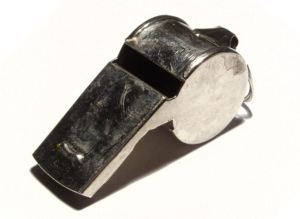
A traditional whistle. Image credit – Wikipedia
On the other side of the spectrum, sound has been used as a weapon. I remember seeing mentions of the use of sound in psychological warfare in documentaries about the First Gulf War (Kuwait Liberation War). Loudspeakers mounted on vehicles were used to play the sounds of vehicular movement and weapons. This caused confusion among Iraqi troops, who were uncertain of the numbers of the enemy they were facing and where the attack was coming from. On the darker side of things, loud music, especially of the heavy metal kind, has been used in torture and sleep deprivation, as part of enhanced interrogation methods.
Since ancient times, war cries have been a part of human warfare, where a battle cry of a unit has acted as a fillip to fighting units and caused terror on the receiving end when a savage reputation is associated with a specific battle cry. I recently watched a video on Instagram where the war cries of various tribes of the state of Nagaland are demonstrated. I am sharing that video for the sheer variety that humans are capable of!
Even music proper has been used in warfare! This includes the supposed use of drums on rowing galleys to give a rhythm to the rowers and the use of music while armies were on the march. But the most beautiful use of music, in my personal opinion, is the sound of the Carnyx, an instrument that was supposedly used by the Celts at war. Opposing troops, including Romans are supposed have been terrified of that sound emerging from misty fields on the eve of battle. Listen for yourself and tell me if you love the sound of this ancient weapon as well. Some 10 years ago when I first heard of this instrument, there was supposedly only one person in the world, John Kenny, who could play this instrument!
In the Mahabharataha, different warriors carried different conch shells. Some of these had names. The sound of these conch shells was used to identify the warrior coming forth. Krishna’s conch was called Panchajanya and the Arjuna’s conch was called Devadutta. Conch shells were also supposedly used for signalling and communication on the battlefield.
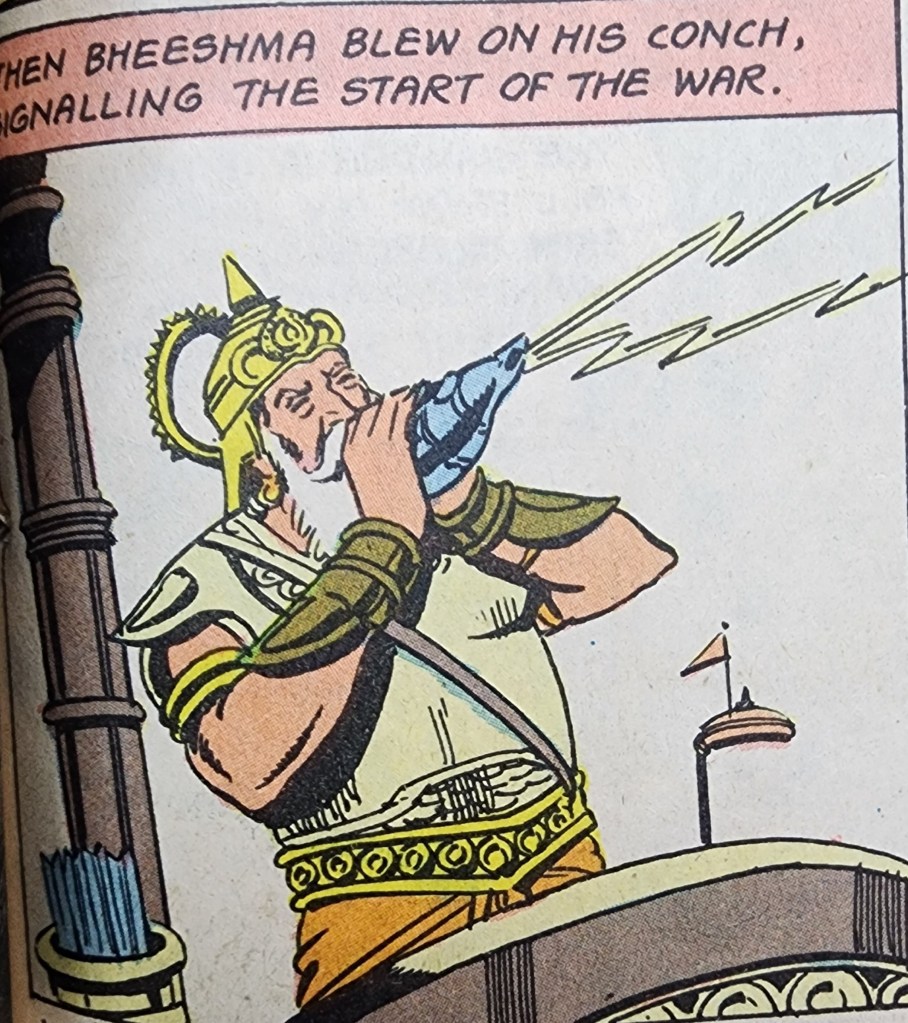
Use of the sound of a Shankha (conch shell) in the Mahabharata. Image credit – “Mahabharata – 30, The War Begins”, published by Amar Chitra Katha.
Sound is so primal that it has been used in the natural world for millions of years. Everyone knows that snakes use sound to warn predators and potential threats to warn them of their presence. Rattlesnakes with their rattles are the most popular in this category. Anyone who has heard a Russel’s Viper hiss like a pressure cooker about to go off can never forget that “stay away or else” sound. The Saw Scaled Viper rubs its scales together to cause a saw-like sound in warning.
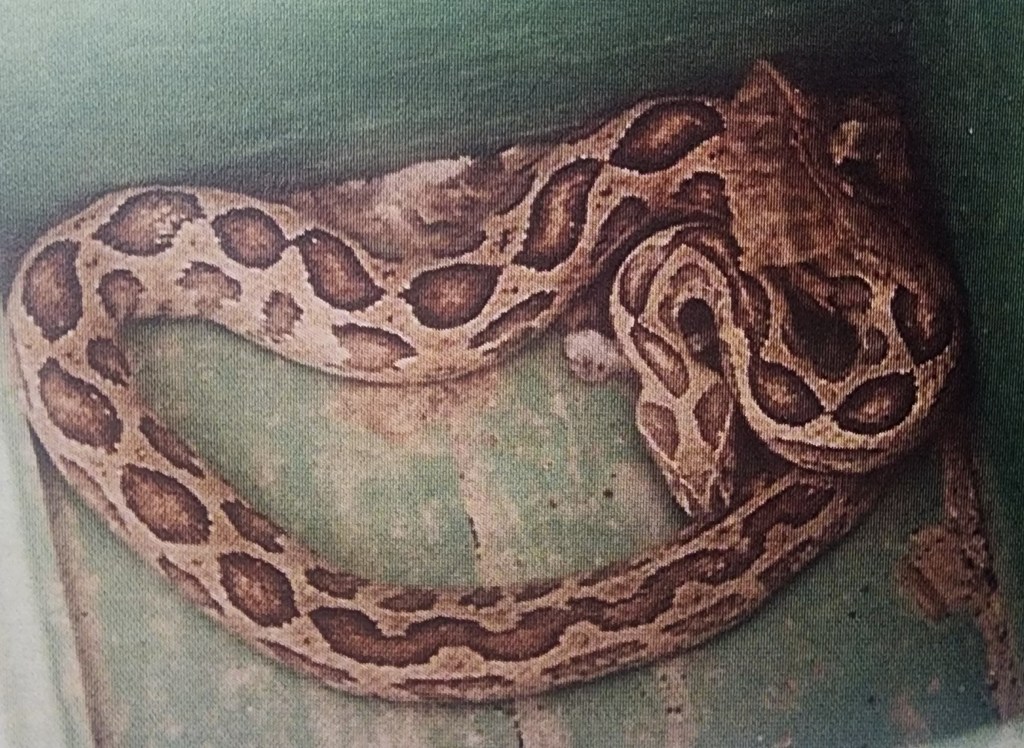
A Russel’s Viper. Image credit – “Menagerie Memoirs” by Dr. M K Shashidhar, published by Notion Press.
Beyond snakes, sound is used in mating calls and warnings against predators. Birds are most recognizable in the use of sound simply because humans find a lot of bird song extremely pleasant. Anyone who has been on safari in India knows to keep an ear out for the warning calls of langur and spotted deer (chital) to sense the potential for a sighting of a leopard or a tiger! And then there are the champions – elephants use infra sound to communicate over long distances, with humans being none the wiser, and blue whales are supposed to have a call louder than turbo jet engines, so loud that it travels across oceans.
I cannot conclude without referring to the depiction of sound as a weapon in folklore and pop culture. This is just to show that the use of sound as a weapon has always fascinated us humans. The most extreme use of sound as a weapon is with the Marvel Comics’ character, Black Bolt. This character’s voice is so dangerous that even a whisper of his can kill a person and a shout from him can cause a lot of destruction, like a bomb! This renders the character practically mute. And then there is the DC Comics’ character, Black Canary, whose scream can cause physical harm in her opponents.
In Irish folklore there is a spectral entity called the “Banshee”. This refers to a female spirit who causes a sound like a wail. This wailing sound is supposed to herald the death of someone in a family. So, it is like a warning or a precursor to a tragedy. In this vein, I must mention a 1981 movie called “The Monster Club”. This film is an anthology with tales of different supernatural entities. One of these stories refers to an entity called the “Shadmock”. This entity’s power is a whistle! Its whistle can cause the death of an individual! This seems like a connection between folklore and pop culture.
Lastly, and perhaps my current favourite depiction of sound as a weapon, is from the Dune series of books. It is the use of the “Voice” by the women who are members of the Bene Gesserit organization. This is more a case of voice modulation than specifically the use of sound, but it is close enough to the use of sound as a weapon, because their ability clearly involves frequency modulation.
The members of the Bene Gesserit can modulate their voice in a such a way that the words they utter become a command to anyone the utterance is targeted towards. The target cannot refuse the command; it is like they are held in thrall and moved like a puppet when the “Voice” is heard. The reason I like this ability is because it is very close to a martial art. It requires years of dedicated training to master. It also has its weaknesses, like does the Kiai. If it is used too often, individuals and entire populations can develop immunity to the “Voice” and render it useless. 😊
I will end with this one reference. In the Harry Potter series, in the later books, Harry learns that spells can be cast without uttering them, while he and most others he has seen have been vocalizing the spells. Is this ability to cast spells without sound similar to a soundless Kiai?
 Mundane Budo