26th January is celebrated as “Republic Day” in India. It is the day on which the Constitution was adopted in 1950 and India became a republic. Every year, there is a parade on Kartavya Path (formerly Raj Path) to celebrate this event. The event is presided over by the President of India and is accompanied a guest, who is generally a leader of another nation or a bloc of nations.
The Republic Day parade has cultural displays from many Indian states and Union Territories. Also a part of the event are marching contingents and bands from several units of India’s armed forces, police services and reserve troops. But the highlight of the event is always the display of several weapon systems, from the Army, Navy and Air Force.
The weapons and weapon systems displayed include not just offensive weapons like missiles and aircraft, but also defensive systems and force multipliers. These include radar and electronic warfare systems and also the AWACS and air to air refueling aircraft.
A little over 5 years ago, I had made a video that looks at historical weapons from an Indian perspective. That was the time of the pandemic, and we were all working from home. So, all celebrations that used to take place in the office as part of employee engagement were conducted virtually.
One of the celebrations that was done virtually was the Independence Day, on 15th August. The video I had created was as part of that event. But considering that the video was all about weapons and the display of modern Indian weapons is a part of the Republic Day parade, I am sharing that old video as a part of this post.
The purpose of this series of posts is multi-fold. Firstly, it is a resource I can share with people who are not practitioners of the martial arts. For most of us, a majority of the people we interact with do not practice any form of martial art. Sharing ideas and practices about martial arts with these individuals might require some “first principles” like definitions, overarching themes and ideas and objectives of the art form. Hopefully this series will be that resource.
Secondly, it is an opportunity for me to look back at my own thoughts about the Bujinkan. The thoughts are a document I can refer in the future to see if I think differently.
Lastly, practitioners of the Bujinkan who are relatively new to the system and longtime practitioners who might need a look back at aspects from earlier years could use this as a starting point for further discovery. There are several practitioners and Sensei of the Bujinkan with a lot more experience compared to me, who share content about the art form and the system. I strongly recommend that everyone consume the content from those sources. This series is possibly an index to search further in those sources.
So, this series in not a deep dive, it is more like a primer of my thoughts with scope for expansion in each. Most importantly, whatever knowledge can be gleaned from this series is a conversation starter or direction pointer at best; it does not in any way replace actual training in a dojo with fellow budoka and a teacher who can help one progress.
In late 2024 and early 2025 I had posted a series of 5 articles that dealt with the “physical” aspects of the Bujinkan and had an introduction to the entire series. In that sense, this next series of posts will be a “season 2” of how I currently understand the Bujinkan system.
There will be 5 posts in this series. I was supposed to post these in the middle of last year, but Operation Sindoor and the events preceding that happened. And that took up a lot of mind space for pretty much every Indian. But I am back to this series now.
In the previous series, I had mentioned 4 points as “physical aspects” and 5 as “psychological and emotional aspects” of the Bujinkan. These are seen below.
The physical aspects of the Bujinkan are the following.
Ten Chi Jin Ryaku no Maki
The 6+1+2 schools = The 5 styles of fighting
The Kuden which includes the themes of the year and the other concepts taught while applying the TCJ & the schools (this is the largest part and also the hardest to document).
The various weapons and their use, and their use with the learning from the schools and the concepts mentioned in the previous point.
The psychological and emotional aspects include –
The TCJ and concepts stemming from the historicity of the schools.
The weapons and their use (weapons here include all things in life – tools, tech, networks, people, societal behaviour, culture, customs and traditions, work culture).
The Kuden and their teachings (themes of the year and all other sayings of Soke in class, and their interpretations of the many senior practitioners the world over).
Eventually come the adding or layering of concepts and learnings from one’s own culture, like Hindu/Hinduism (in my case) or any other (philosophy, spirituality, traditional stories, historical personalities and other examples).
Lastly are the experiences from one’s own life, from work, relationships, hardships, pain, loss, conflicts, and the interaction of these points. These are opportunities to apply the learnings from all other points.
The first 4 points were covered in the previous series of articles, along with an introduction. This next series of 5 articles, starting with this one, will cover the next 5 seen above. A link to the 5 posts in “season 1” are seen below, if anyone would like to go through those before reading this series.
While I referred to them as “psychological and emotional aspects”, they are not restricted to just that. They could be referred to as “non-physical” aspects in a broader sense. This first article in this second series focuses on how the “History” of the Bujinkan traditions affect the practice of the martial arts contained within. The aspects relating to emotion and psychology are few in this case. But there are a few points to touch upon in this area. I will get to those at the end of this post, after the effect of “History” is considered in brief. As a reiteration before I begin, the first point in the second series of 5 seen above, highlighted in yellow, is the focus of this article.
Each of the 6 schools that are trained routinely in the Bujinkan system of martial arts has a tradition and unique history. This has an influence on how it is taught in modern times. Of course, since the aspects from history have no bearing or a very small one during regular training in a dojo in an urban setting, the concepts bleed into each other.
This is what is supposed to have led to the development of the Ten Chi Jin Ryaku no Maki, which is the core syllabus that every student of the Bujinkan studies before getting into the details of the various schools. When a student begins studying the different schools by themselves, the history and tradition of the schools are important and come to the fore. The expression of the same from will have differences when its origin is considered the specific school or the Ten Chi Jin Ryaku no Maki.
The Kukishinden Ryu is where a lot of the forms and details of the weapons that are trained in the Bujinkan come from. It is said that this is the school which was descended from the use of armour. I have heard from my mentors that due to this detail, a lot of the forms, either with the use of weapons or unarmed combat, supposedly assume that the practitioners are wearing armour.
This holds true even though students while practicing this school, in most dojos, do not use armour. In the case of the tori (defender), the assumption of using armour is important though, as armour takes on the responsibility of protection and leaves the individual free of some worry regarding certain attacks. Obviously, the lack of armour allows strikes and moves which would not be possible if the opponent was wearing the same and some differences will creep into the practice of this school, especially if beginners (the definition of this term is flexible 😊) are involved as, in the heat of the moment, they fail to keep the feeling of armour alive.
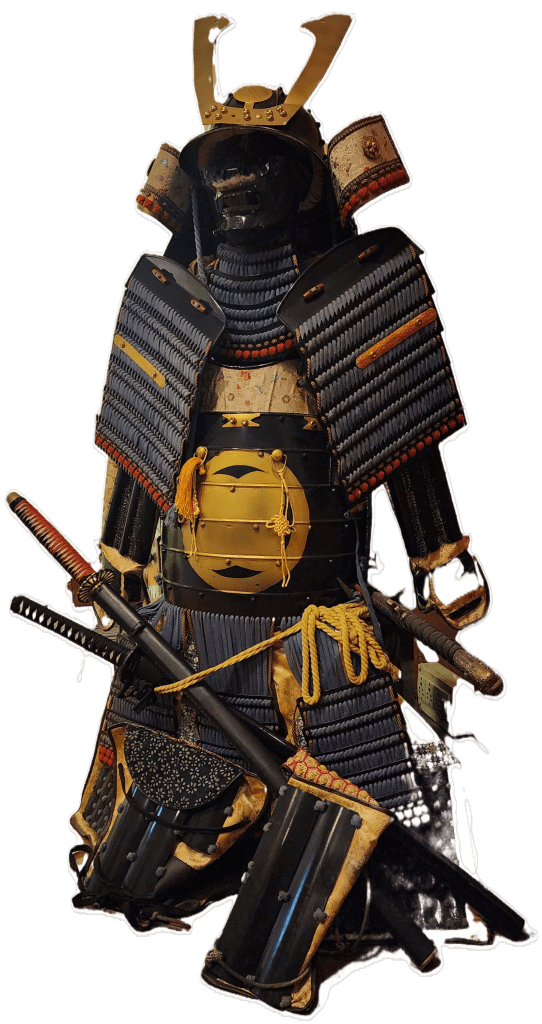
A representative image of Yoroi (Japanese armour)
Further, I have heard from a mentor of mine that Kukishinden Ryu was used by sailors on boats and ships. This is apart from the application of this school on land. This is supposedly one of the reasons for the low kamae or postures in the basics of this school. The low stances allowed for better balance on a moving vessel which is not as stable as solid ground, especially if one has the added weight of armour. I am personally not aware of how the variants of the same school applied on land and on watercraft affected each other, if at all.
The weapons which I am aware of, which have a defined system as part of the Kukishinden Ryu, are the sword, the spear, the bo and the naginata. All of these are weapons that have been used in conjunction with armour (yoroi). The points of the body that are attacked with the sword are the neck, the joints, the openings on the face and the armpits. These are all openings where the armour is minimal. Similarly, the yari is used to strike the helmet often, to rattle the person wearing it.
The above 2 points clearly show that the origin of the school is the use of yoroi and the need to overcome the same. Even the bo is considered a variant of the spear (yari) or naginata (a rough equivalent of the glaive), since the staff, or bo, is what one is left with when the head of either the yari or the naginata is broken.
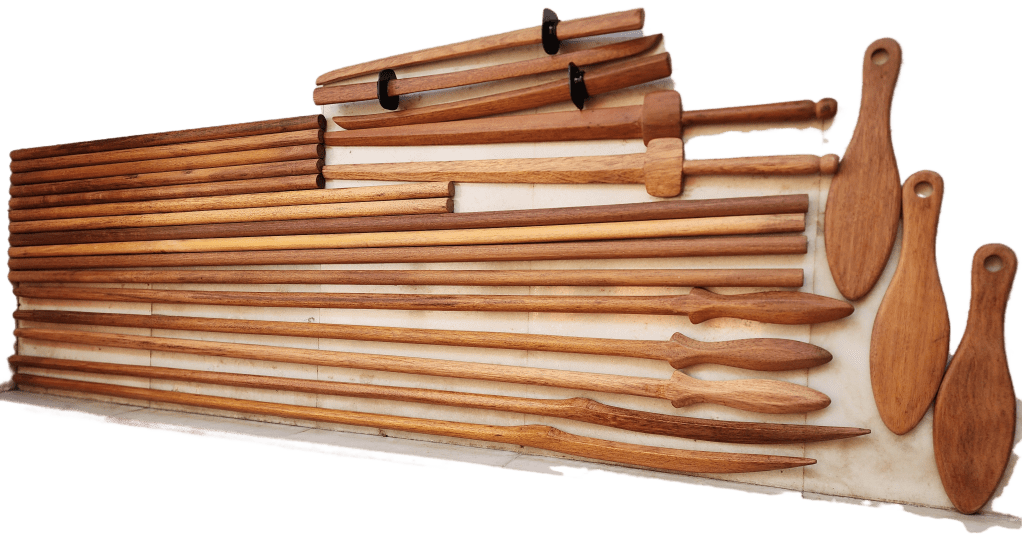
A representation of training weapons used for practice
The Togakure Ryu is supposedly what Hatsumi Sensei started with while teaching individuals from outside Japan back in the 1980s. It was called the “Ninjutsu” school back in the day, based on what I have heard from people who have been practitioners since then. What I know of the origins of this school is that it was used by defenders of castles. So, they likely fought in the long and narrow passageways of castles. This is the supposed origin of the very long and very deep kamae used with this school of fighting.
The movement in this school is a bit more linear compared to the Kukishinden Ryu. The sword kata from the Togakure Ryu can be applied with shorter blades as well, like the ninjato or the wakizashi. This perhaps helped while in conflict indoors, where the space available to manoeuvre longer weapons is limited. I learnt the shuko or claws worn on the hands while being taught this school. This was mainly used to scale castle walls. The shuko can also be used in defence against sword attacks when in a real bind.
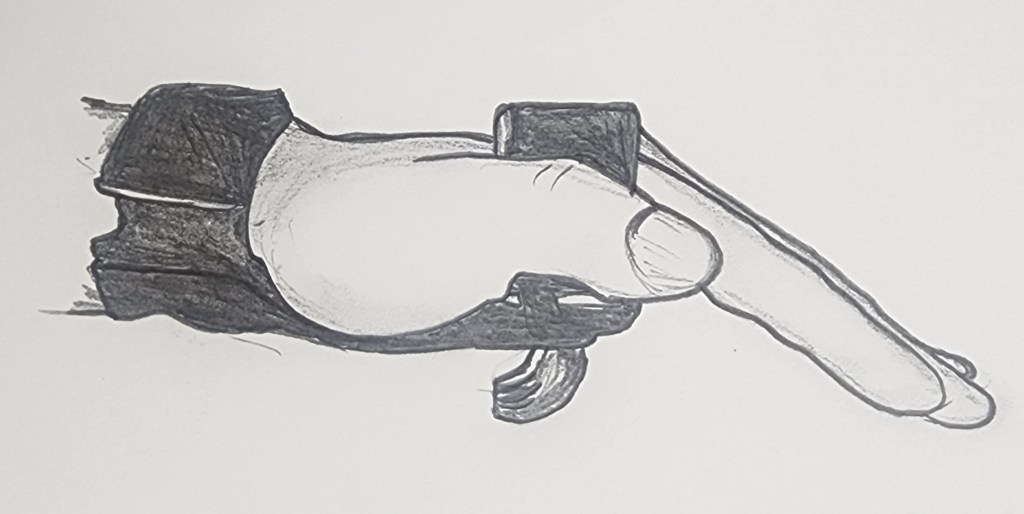
A sketch of a Shuko used for training. Sketch by Shushma N.
Another school that is supposed to have its origins from fighting indoors is the Gyokko Ryu. The origins of this school are said to be in China. The school was brought to Japan by a Buddhist monk. This style was supposedly used by the ladies of the court to protect themselves. Since they likely had to fight indoors in defence and wore garments that were flowing and not easy to move in, the Gyokko Ryu came to reflect the same. This school teaches fighting at very close quarters and with smaller body movements.
The principles of Gyokko Ryu were applied to Bojutsu by Hatsumi Sensei in one of the themes of the year (I think in 1999 when the theme was Kosshi Jutsu). This enabled the long-distance weapon that is the bo, to be applied as a medium distance weapon. My teacher also suggests that this school is a likely application for fighting with a knife and perhaps the wakizashi, as it was more likely that either of these were worn indoors.
In the year 2015, the theme of the year was Goko Goshin. During that year, Hatsumi Sensei, suggested that everyone learn the principles of Goshinjutsu. Goshinjutsu is the art of self-protection. It was said that everyone should learn these principles, by learning from the way women used to protect themselves. My personal understanding based on this, was that one should be able to apply the principles of Gyokko Ryu whenever required.
The Koto Ryu was taught along with the Gyokko Ryu as the two schools were inherited by the same Soke in the past. So, they are like sister schools. The Koto Ryu though does not seem to be specifically designed for close quarter fighting or to be used indoors. It is the movements from this school that most beginners encounter when they start their journey with the Bujinkan.
This school has a lot of emphasis on managing the distance between the attacker and the defender. Due to this, one moves close to and away from the attacker as necessary. This could even be by following the opponents’ movements if need be. This moving in and out of the space of the opponent is the characteristic of this school. Also, from what I have been told, Koto Ryu is the Karate equivalent of the Bujinkan system of martial arts.
Staying with the theme of protection, the Takagi Yoshin Ryu was supposed to have been used by bodyguards. Here, the protection is not just for the practitioner of the school, but also for the person(s) the practitioners are protecting. Hence, this school involves a lot of grappling and subduing techniques. This school includes techniques that can induce pain and lock joints to immobilize an individual. This helps if an individual needs to be arrested or restrained.
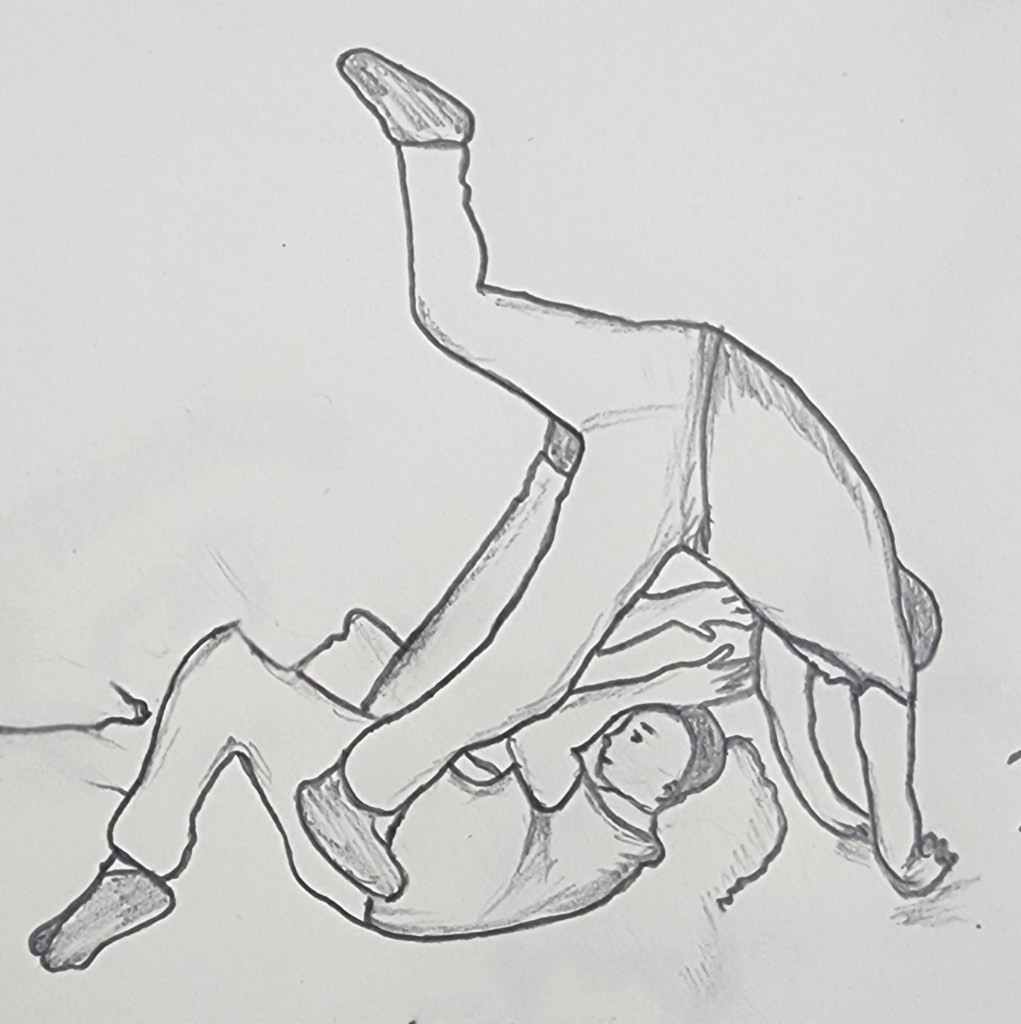
Since one is protecting someone other than oneself, the Takagi Yoshin Ryu has a section that focuses on sacrificial throws. There is also a section that deals with defending oneself when attacked with a sword or wakizashi, while being unarmed. This includes surviving attacks when one is seated, but the attacker need not be.
This idea of staying safe while being unarmed and facing an attack by an armed opponent is perhaps the origin of the idea of muto dori, which is to capture an opponent without weapons. The concept of Muto Dori has been greatly expanded over the last ten years, to add a host of teachings that include “self-control”, “being in the present” and “focus on survival and not victory”, to name a few.
A representative sketch of a sacrificial (Sutemi) throw. Sketch by Shusuma N.
The idea of self-protection and self-preservation lead to the idea of “doing whatever it takes to survive”. When one is involved in staying alive, postures, forms, concepts, values, morals, literally everything goes out the window. A small sample of this is introduced to Bujinkan practitioners through the Shinden Fudo Ryu. This school is supposed to have its origins with fighting in wooded areas. This in turn means that the terrain and space around an individual is not consistent and unpredictable.
Due to the unpredictable geography where this fighting system took shape, it has no defined postures (kamae). One uses whatever posture seems natural in a given situation. It also focuses on being adaptable to the opponent and the space and time one is in. I have also been told that this school is influenced by the behaviour of birds, specifically the use of their wings. Strikes with an open palm are used with Shinden Fudo ryu, mimicking the wingtips (supposedly). Also, the arms are used in keeping one’s own balance and in destroying the balance of the opponent(s).
There are 3 other schools in the Bujinkan system that do not have defined forms and are not trained in dojos. These are the Kumogakure Ryu, the Gikan Ryu and the Gyokushin Ryu. Of these 3, there is one depiction of the Gyokushin Ryu. Some very senior practitioners from Spain (if I recall right) were shown the principles of Gyokushin Ryu by Hatsumi Sensei and they captured the essence of the same with a demonstration.
The Gyokushin Ryu seems to have an emphasis on the Hira Ichimonji no Kamae, which is a wide low stance (likely used with armour, though I cannot be sure). The arms are held out at the sides, in a wide and straight manner. These are used to pivot the attacks of the opponents. The movements I have seen remind me of converting rotary movement of the tori’s arms into linear movement of the uke, when the tori can move her or his own legs appropriately of course. 😊
The Gikan Ryu is supposed to be similar to the Gyokko Ryu. The Kumogakure supposedly has suggestions on disguising oneself and unconventional fighting (“unconventional” from a historical perspective). This is mainly what I have heard about these 3 schools from my seniors.
Let me share a little additional information about Ninjutsu here. There are 18 branches of study which together comprise Ninjutsu. Not all of these are practised in the Bujinkan these days. Some are practiced, like fighting with the spear, use of the sword and the use of thrown weapons. Some branches like the study of meteorology, horse riding and the use of gunpowder are not a part of the curricula.
The Bujinkan does study a lot of the fighting styles of the Samurai (not just Ninja!) which includes the use of armour. From what I have been told, even in this aspect, there is specialization. The forms practiced in the Bujinkan mainly come from the Muromachi period, between 1336 and 1573. This includes the Sengoku Jidai, the warring states period made famous by the 3 unifiers of Japan. For Indians unaware of Japanese history, this period is roughly contemporaneous with the Vijayanagar Kingdom (1336 – 1646) in Southern India. It is also the time between the reigns of Mohammad bin Tuglaq and Akbar in Northern India.
The information above hopefully shows how the history of a school defines or at least influences how it is trained in modern times. Seen below is a summarization.
The Kukishinden Ryu is defined by the use of armour and weapons which were used on the battlefields of Japan over centuries.
The Togakure Ryu is defined by the passageways of castles.
The Gyokko Ryu is a continuation of close quarters fighting indoors, where the space to maneuver is limited.
The Takagi Yoshin Ryu comes alive due to the duties and objectives of bodyguards in historical Japan.
The Shinden Fudo Ryu is exemplified by wooded or forested terrain with uncertain footing and unpredictable surroundings.
This idea of historicity is not specific to the Bujinkan or even Japanese martial arts. It is true for the various martial traditions from around the world. The factors constantly influencing the development of the martial arts have been climate, terrain, population size and available resources (hence technology). A few example traditions for martial arts from around the world that demonstrate this pattern are mentioned below (a minuscule set of what the world has to offer).
The manuals of Tallhoffer, Fiore, Marey Mong and Houghton in Europe from the medieval to renaissance to early modern times, which are influenced by their respective geography and the cultures they came in contact with.
Haitian machete fighting that was used to fight French colonizers with firearms.
The various fighting systems of Southeast Asia that include shorter bladed weapons due to the terrain and climatic conditions.
The several fighting traditions of India from Kashmir to Kerala and from Sindh to Manipur. These range from systems similar to those of the Persians and Turks to those of the Southeast Asians. They also include systems originating in the hills, in the forests and on the riverine plains.
As a specific case, consider the famous art of Kalari Payattu. This originates in the state of Kerala which is not very big. Yet, this art form has two branches, the northern and the southern styles. The norther style considers Lord Parashurama as the originator while the southern style considers Maharishi Agastya as the preceptor.
The above part was about the effect of history on the martial arts as a whole. If we consider just a few weapons and the forms used with those, this idea comes through very clearly. The jo is a four-foot-long staff while the hanbo is three feet long. Both are trained in the Bujinkan. The length of the jo is generally such that it reaches the sternum or armpit of the user, while the hanbo reaches the waist of the user.
The jo was historically the staff that served as a walking stick or a travel companion for people in Japan in the past. It is only natural that an object that is used often in a society doubles up as a weapon. Once this happens, techniques are developed and traditions of using the weapon develop and diverge.
A representative image of a set of a bo (top), a jo and a hanbo (bottom)
The hanbo on the other hand, from what I was told by a mentor of mine in the Bujinkan, has a much shorter history in Japan. The hanbo, being waist-high, is akin to the walking stick used in the Europe in the 19th century. Japan, during the Meiji restoration, apparently also adopted some customs from the West, one of which was the use of western style walking sticks.
With the use of shorter walking sticks, a system to use the shorter sticks as weapons evolved. This evolution is what supposedly led to the development of hanbojutsu. So, in a way, hanbojutsu might be a relative of bartitsu, which is a British fighting system which also incorporates the walking staff & umbrellas (Sherlock Holmes was an exponent of this art form).
Due to this difference in the historic development of the use of the jo and the hanbo, in my opinion, the use of the two is also different. The jo has a lot of striking as part of its basics. This is perhaps because it had to contend with weapons like the yari, naginata and the sword as part of its developmental history and this does not leave much scope for locking and grappling.
Hanbojutsu on the other hand, if it did indeed develop during the late 19th and early 20th centuries, came into being after armour was not a factor. It was also a tool for civilian defence against threats in an urban setting, maybe against criminals and cutthroats. So, while it does have striking forms, it also uses a lot of locking and grappling forms, which help one get the better of an opponent in very close quarters and if the weapon itself or the arms are grabbed by the attacker.
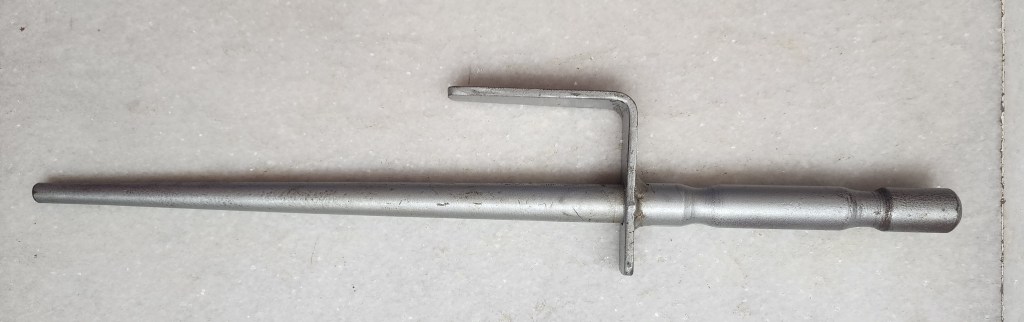
So, the history of the two weapons which look similar and can be used as alternates, led to considerably different styles of movement and fighting. Another example is with the jutte. The jutte, as far as I know, was a weapon issued to Japanese police in the late 19th and early 20th centuries. It is a short metal club with a single prong, which can act as a sword-catcher. The club of course can strike to cause quite some damage in close quarters.
As part of the Ten Chi Jin Ryaku no Maki short rage weapons are trained first. Two of these short-range weapons are the Kunai (a small shovel) and the Shoto (Wakizashi). From what I have heard from my seniors in the Bujinkan, Hatsumi Sensei adapted some of the forms used with the jutte to be used with both the kunai and wakizashi.
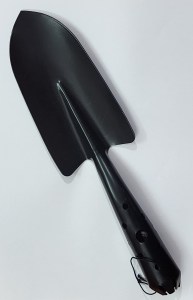
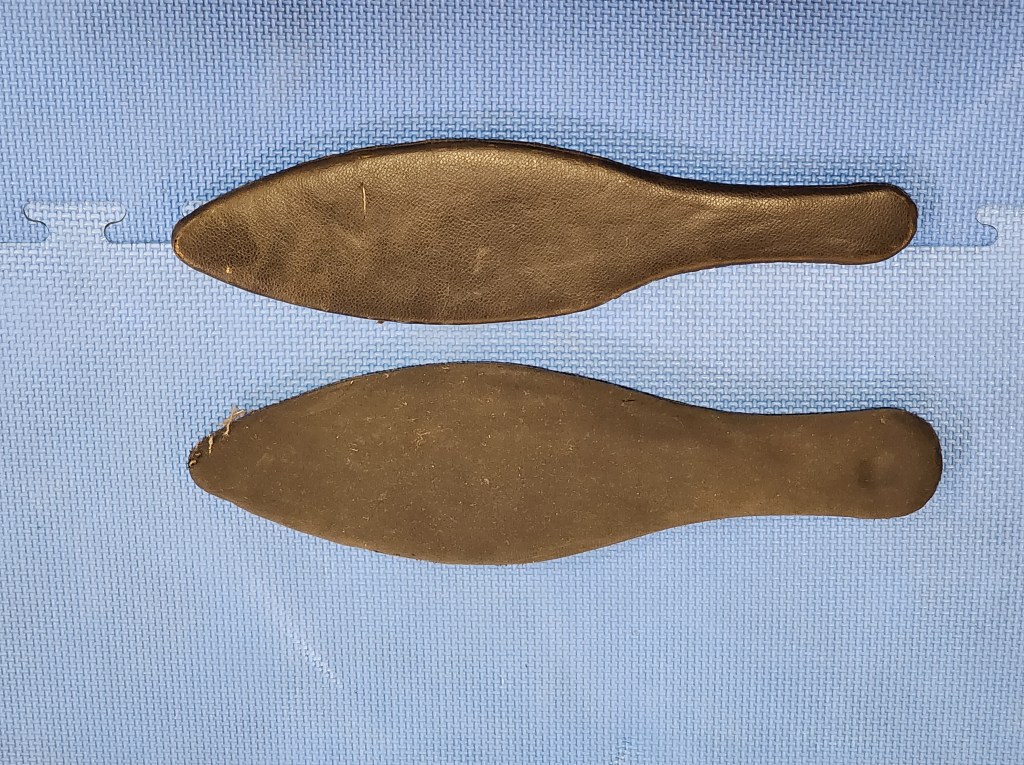
The shovel on the left represents a real life tool that could be used as a weapon. The 2 kunai on the right are training versions of the tool with padding for safety.
The kunai being a gardening tool or an agricultural implement is another everyday use object that doubles up as a weapon. The wakizashi/shoto is a short sword that could be worn by everyone, while only Samurai could wear the katana. Also, the wakizashi was what would be worn indoors and as a symbol of prestige by people who were not Samurai. So, it makes sense that the forms of the jutte, also a short-range weapon, are used with the kunai and the shoto. But the jutte forms are recent compared to the kunai and the wakizashi, which have existed as weapons far longer that the jutte. But the forms when trained, clearly demonstrate that the objective is to restrain and not kill, which would be the case if a policeman was trying to stop an assailant and maybe arrest that person, in close quarters.
Of course, this was a quirk of history. In case this was the USA of today, would a cop shoot an attacker instead of trying to restrain or arrest the person if that person was brandishing a sword and was less than 21 feet away? I have no idea. I have an opinion here, not knowledge, based on media visuals. Similarly, the time period when the jutte forms developed, they still had swords as a potential threat. Police at this time could also use “man-catchers” for restraining individuals at a greater range. The jutte likely came in only at close quarters.
An image of a training version of the jutte
This then, is another case of the history of the weapon being of consequence in how the same is trained in modern times, even if the weapons with which the concepts are trained are entirely different and from an earlier time period! That said, the jutte is still practiced as part of the Bujinkan, just not early in one’s life as a practitioner.
This would like be true even in the case of weapons that are not used in the Bujinkan or even in Japanese history. Consider the estoc, the sword used in Europe when plate armour (harness) was near its peak. Armoured knights and met-at-arms knew that they could not cut through plate, so they had a sword that had a keen point, but no cutting ability (supposedly they had a square cross-section to improve stiffness and stabbing ability). This meant half-swording was a great skill to have, as it allows one to maneuver the point into gaps in the armour. Incidentally, some forms of the hanbo that involve grappling and locks, look a lot like half-swording!
If we fast forward another century or so, when gunpowder weapons had reduced the use of armour, but civilian participation in fencing was high, long rapiers were used. These were primarily thrusting weapons as well, with lower cutting ability compared to the swords of the medieval era. But half-swording was not a practice with rapiers due to the reduced use of armour. So, a system teaching the estoc and the rapier would be considerably different.
A representative image of a rapier
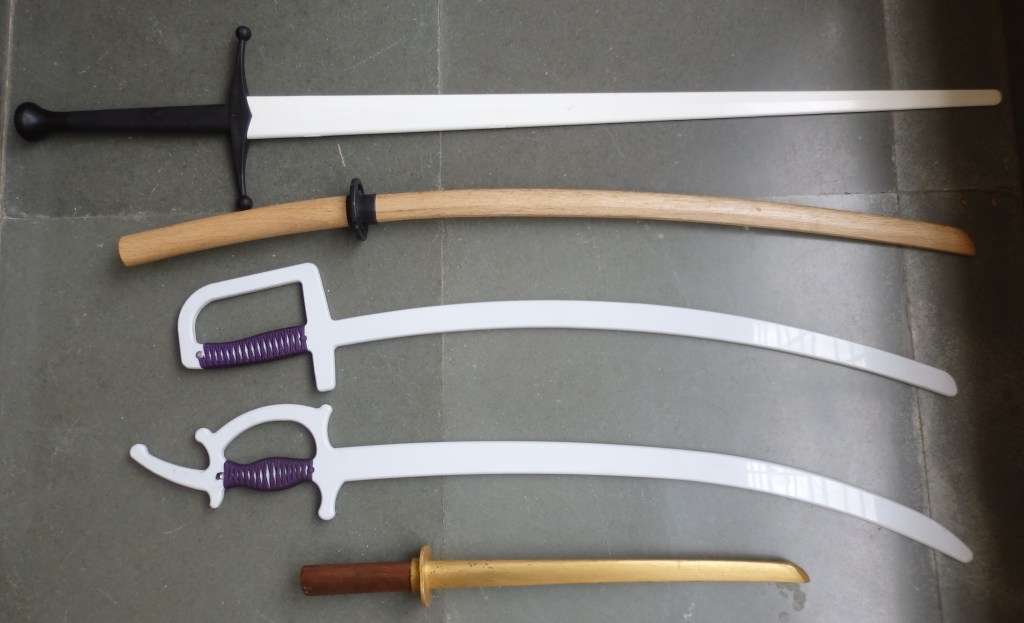
In the Indian context, the shape and thus use of the khanda and talwar would lead to differences in the forms and schools teaching the same. This would also be true with the return of the sabres in Europe in the early modern era when armour had disappeared.
Training versions of swords. The one in the middle is a talwar.
Now, before concluding, let me share some thoughts on how the manner of training has a psychological and emotional dimension. This is specific to training scenarios and not a real-life conflict, physical or otherwise.
Consider the Gyokko Ryu where fighting and training happens in extremely close quarters. This is extremely scary, even when one knows that it is just training and the opponent is not out to cause grievous physical harm. This fear is a strong emotional aspect that influences training.
If one considers the Togakure Ryu, the kamae used are very low and wide. While practicing these, there is quite some pain in the legs. Overcoming the pain is as much about psychological training as it is physical.
In the Takagi Yoshin Ryu, there is a segment focused on sacrificial throws. This move is always scary, for it fails quite often because your training partner knows what is coming many a time. 😛 And when it fails, it could lead to pain, but it sure leads to a lot of laughter at how stupid the execution was. So, this leads to a lot of fun during training! This fun is mainly emotional and leads to diminishing worry of failure.
In multiple schools, there is the concept of inducing pain in others to control them and prevent them from escaping. This could be classified as “Torite waza”. This “pain inducement” is quite a roadblock for many students. They simply cannot get themselves to hurt their training partners, even in a safe controlled environment, especially early in their training lives. The block is mainly psychological, for most of us are conditioned psychologically, to know that causing pain to others is wrong. Of course, there is also the worry that after they control their training partners with pain, it their turn to be controlled! 😛
Enduring pain is also necessary with the daken schools, or schools that focus on striking, like Shinden Fudo Ryu, Kukishinden Ryu and also the Koto Ryu. Taking the hits is painful, but necessary, to allow everyone to train effectively. This acceptance of pain again has a psychological component and is as much a mental effort as a physical one. The fear of hurting the opponent by not being able to control one’s strike is also something that has to be overcome with training time. There is no alternative.
Speaking of the Kukishinden Ryu, one must realize that training with weapons is a vital aspect of the Bujinkan. Weapons induce safety by providing distance and a shield (of sorts). But while training with weapons, until one learns to use them right and also be able to adapt with them, the safety is imaginary, all in the mind. 😀 But the pain endured while training is real.
Speaking of weapons, I mentioned earlier that some forms assume that the practitioner(s) are wearing armour (yoroi). But in reality, most of time, yoroi is not used during training. So, training these forms ASSUMING the presence of yoroi is quite an effort, with hilarious outcomes at times. It also means that one needs to IMAGINE the lack of fear from certain attacks, and also give up obvious openings in the opponent due to this IMAGINARY protection! It is a case of ARMOUR OF THE MIND. 😀
We then have the practice of Muto Dori which is the scariest of all, just as is training against multiple opponents! Muto Dori expects one to be able to move naturally despite the opponent(s) having weapons. Here, one fails so often that the acceptance of failure seems like an objective of the training! This entire situation requires one to train the mind to overcome the need to win and also give up the fear of failure. It is easy to explain, but very hard to achieve.
Lastly, I will mention one aspect based on my experience with learning and teaching. The “History of the teacher” affects the martial arts. The experiences of teachers drive them to teach in certain ways and determine what they think is important for their students to learn, imbibe and assimilate. And this “point of focus” as determined by teachers is in turn affected by their age, time spent with a given martial art, the geography in which the training occurs, the local culture that raised the teacher and recent history of the region that the teacher lives in and was born into.


 Mundane Budo