Training with knives is scary. It is scarier than training with swords or spears or sticks. I am of course referring to traditional martial arts and not considering fire arms or even historic projectile weapons like bows and arrows, crossbows, slings and other thrown/discharged weapons. In other words, using Bharatiya terms, I mean while training with shastra and not astra.
The knife is not scarier because a knife is more dangerous than the other weapons. It is scary because, one, it can be invisible until after the attack is complete, and two, because being a close quarters weapon, a knife, even when detected gives very little time to defend or protect oneself against.
I have been told by mentors with far greater experience than I in the martial arts, and some with practical experience in fighting with and defending against knives, that the numbers bear testimony to the fear of knives.
I am going to add the numbers that I have heard, as part of the notes below. This is because I have not personally done any analysis of knife attacks. I have only read articles about the research and heard people who have done the same share their knowledge. So, what I have is secondary or tertiary knowledge at best, about the numbers and statistics related to knife attacks. Also, my personal experience is more with traditional martial arts and larger weapons that I referred to earlier in this article. Add to this the fact that there are varying views about knife attacks, and surviving the same, and that these sometimes disagree with each other, I do not want to subscribe to any one view. That decision is personal for everyone, because it involves physical injury and trauma. I apologize for this inconvenience, and also request readers to do a little back and forth scrolling while reading this article.
Another worry with knives is that a slashing attack might look ghastly but not be fatal, while a stab shows a smaller wound but is far more likely to be fatal. So, to repeat myself, knives are dangerous as everyone knows, and are scary to train with, even when they are fake (because the knowledge of the danger is real).
The numbers seen in the notes below, show that there is no clear, sure shot defence against a knife attack. So, it is a situation with no solution. What does one do in a situation like this?
What I have heard from people with knowledge and experience with the problem of the knife, state that the best solutions are one of the following. One, avoid the fight or get away from the fight, in other words, retreat and get away from the space where the knife is a threat. A large distance between the knife wielder and the potential victim is a safe solution to survive the knife. There is a drawback to this solution though. Based on what I have understood, the chances that a knife attack begins only when the assailant is very close is very high, and hence, the opportunity to either run away or put a lot of distance between oneself and the attacker might not always present itself.
The second solution is not a different one, but more an extension of the first. It is to not be in the space where a knife attack might occur. This is similar to (though may not be exactly the same) what is also called “situational awareness” by some martial art systems. Yes, this might sound philosophical. But it is based on primeval intuitive abilities of human beings, which helped avoid predators (human and otherwise).
This is not something new either. Anyone who has traveled alone and late, in the dark, will know how one’s senses and ability to expect threats are heightened. This same feeling can be accepted and hence practiced in situations that do not exude an explicit threat with atmospherics (like a pub or a festival gathering where attacks are not expected). This could also be made mundane by saying, trust your feeling and do not go someplace you do not feel like going, even if the not wanting to go is not due to a threat perception. It could be unease manifesting as fatigue, lethargy or any other “I don’t feel like going there”.
The above alternative is about trusting one’s intuition and not being afraid to retreat. It can further be said that trust in intuition is very important, not just during knife defence, but also in staying away from a situation where defence against a knife is necessary. This might seem a cop out to some because it reduces the emphasis on practice to survive against a knife. They are not wrong. Practice is perhaps the best defence. But then, several people do not have the time to expend on the requisite practice, unlike those imparting the training or those in the police, armed services and other security services.
When practice and training time is a premium for most people, focus on the ability to avoid a fight is vitally important. Also, this is not surprising, in my opinion, for this is how we deal with most problems at work as well. And work is a very important part of all our lives, while self-defence training might not be.
Consider how much all of us rely on intuition to solve problems at work. All of us, when we are applying or developing any solution to any problem at work have a “gut feel” about how difficult the development will be or how long the same will take. All planning and estimation works on this. Also, the need to be on the lookout for problems after applying said solution is also based on estimations, which are driven by intuition. After all, intuition is experience plus a sense of the context/situation/atmospherics around a problem. Hence, we know when to apply a temporary fix as against a permanent solution as well.
The use of intuition at work from what I stated above, is about not just solving problems but also about being aware of the consequences of a solution as well. Thus, we are not only working to solve a problem, but also trying to protect ourselves from the consequences of further problems that might come up due to the solution, especially if it is a temporary fix. The key phrase here is “protect ourselves”. This is using intuition and stepping back to protect oneself; not defend against a situation, but to stay protected at all times. This is akin to wearing a helmet whenever you ride a two wheeler and not only when you are on a bad road or in heavy traffic.
This is the same as trusting one’s felling about a place or situation and also about retreating when faced with a situation where there is no good defence, like against a knife. Thus, protecting oneself is as important as, if not more important than a good defence. This rings truer still when a defence might be designed with a set of assumptions (which is always the case when defensive training is based on specific situations). In other words, protecting oneself starts with trusting one’s gut feeling and the ability to retreat before the need to apply a defence.
There might be no measure to check how many times one protected oneself by not being in a place or situation where a defence against a knife might have been necessary. But then, that is the best defence anyway.
On a lighter note, at least for us Indians, retreating to protect either oneself or ones dear to any individual should come naturally. After all, one of the many names of one of our favourite Gods, Lord Krishna, is “Ranchod Das”. It means one who runs away from a battlefield. This was anathema to the warrior code of the Kshatriyas (as is common in many warrior cultures around the world). I will not go into the story here, but Krishna chose the insulting moniker over fighting an impossible battle (against Kaala Yavana). He of course, survived and won the battle as a consequence of the retreat; but the name stuck.
In conclusion then, training survival against a knife has to include training to retreat (run away) and trusting one’s intuition until a defensive solution can be found (an offensive solution might also be possible, but hurting another person brings with it a host of other problems to consider after the act).
Notes:
I have been told that if an unarmed individual is attacked by a knife wielding assailant, and the person being attacked knows of the attacker’s knife, the probability of surviving the attack unharmed is between 0 and 0.5%. This is if the person being attacked has no training in defence against a knife. If the person being attacked is trained in defence against a knife, the probability of surviving unharmed apparently goes up to around 2%. So, the probability of surviving unharmed against a knife is 2% AT MOST, with specific training to defend against the same. This is of course, supposedly not considering body armour to protect an individual against knife attacks. This number is undoubtedly low but 4 TIMES greater than with no training. Nonetheless, the number reinforces the worry about training with knives. Little wonder that knife training is done with fake knives only! 😛
A 1988 book by Don Pentecost called Put’em down, take’em out! Knife fighting from Folsom prison. – I have heard that this book is supposedly contentious and should perhaps be considered as another source of information and not as gospel truth. Also, I have not read this book myself and have only seen references to it.
Some interesting articles I have read online on the topic of knife attacks and protection against the same are mentioned below. These articles refer to the book mentioned above.
There are many YouTube videos referring to knife attacks and what one can do in such a situation. I cannot specifically recommend any, but leave it to interested viewers to decide on the information they find most useful.
There are also people who opine that even screaming for help or running away need to be learnt and practiced. These two might seem to be common sense, but in a stressful situation like a physical assault, they will not manifest automatically. Practice and conditioning are what a person falls back on in such a situation and hence this suggestion. This is beyond the fact that a knife attack might not allow for the option of running away.
Knife training can be used for life lessons, but the vice versa need not be entirely true. This obviously, is because, a threat to life and limb is very real in a knife fight, while the same is not true at work or in others aspects of life that are not physical combat. In life and at work, the risk could be financial, to one’s health and one’s reputation. The opportunities available to fix these, can be greater for everyone, when compared with a short and intense knife fight. Hence, what I have opined here is a perspective more relevant for individuals that are not martial arts’ practitioners or students who have just begun martial arts’ training. If this was looked at from the perspective of someone who is a regular student of the martial arts, I would opine that the learnings from training the knife and protection against it, including the aspect of intuition, should be a take away to be applied in life and work.
One thing that all martial artists would have experienced in their training lives is having people ask them to show “something” of what they train or have learnt. This, if I am not wrong, is more often in the early part of one’s training life when you are an oddball, for being a part of something that is not common, in one’s family or social groups. When people start associating you with martial arts over the years, this reduces, with older social groups and also with older people. But one still does get asked for a demonstration, by younger people one interacts with and newer members of one’s social and familial circles. This request is also more likely with younger folk who are possibly familiar with the more popular martial arts forms like MMA or what they have seen in movies, on OTT or in video games. It is also likely that this is a situation that comes up with folks who frequent the gym regularly; of course, the older folk at the gym might again not be the ones who make this request.
The interesting part is what a practitioner of the Bujinkan should demonstrate when asked to show “something” of what he or she knows or has learnt. I am speaking here predominantly from an Indian perspective. The answer to this can be split into two parts with two segments within each. These are as seen below.
Beginner is demonstrating to
People with no experience in the martial arts or any other physical activity (like working out at a gym, regular sports, running, dance, yoga* etc.)
People with experience in either martial arts (any art form) or any other physical activity
An experienced Budoka is demonstrating to
People with no experience in the martial arts or any other physical activity
People with experience in either martial arts (any art form) or any other physical activity
The table below shows the same a bit better.
Demonstrator
Audience
Audience
Beginner
No experience in martial arts or physical activity
Experienced in martial arts or physical activity
Experienced Budoka
No experience in martial arts or physical activity
Experienced in martial arts or physical activity
Before looking at the answer for any of the above four subsets, let me lay some groundwork for how I might arrive at the answer.
In the Bujinkan, we study the Ten Chi Jin to learn all the fundamentals. We next study the 6 styles of fighting through the study of 6 different schools respectively. The Ten Chi Jin has concepts, kata and waza originating from the schools put together to allow practitioners to learn and familiarize themselves with various important concepts and movement requirements. Also, we study the weapons in the Buki Waza part of the Ten Chi Jin. We also study weapons from mainly the Kukishinden Ryu and some other schools.
In all this training, there is one common thread. In all the forms we study, there is a defined attack. Later, when we have many years of experience, we move to studying concepts and unlearn the set forms to be able to survive with attack, which need not be defined or expected. But for the initial years, for safety and to understand the martial art and our own movement, there are set forms and these set forms have defined attacks. The attacks are taught as part of the training. Even the techniques as written, from the schools have as their first line, a statement of how Uke attacks the Tori. So, first there is an Uke (attacker, for simplicity) and then there a Tori (defender, for simplicity). If there is no Uke in these forms, there is no need for a Tori (of course, there are exceptions which will referred to later).
Perhaps because we are graded as Tori and not as Uke, we think what we have learnt is the response or reaction to an attack; after all, that is what the names and forms refer to. And hence, when asked to show something or demonstrate what we know, we default to being a Tori and here begins the problem. With this background, we can get back to the four subsets defined earlier.
Let us start with a beginner demonstrating what they know. As a beginner, one might not be very comfortable with the waza or kata. This problem might be exacerbated with attacks that one is not yet familiar with. So, if the demonstration is for or on someone who is not familiar with the attacks that have been used to train the basics, one might have to end up showing someone from outside the Bujinkan, how to attack. This leads down the rabbit hole of endless “what happens if” questions regarding attacks that are not being demonstrated. And this might lead to a situation one is not sure of being able to handle.
One solution to his situation is to stop being the Tori in the demonstration and start being the Uke. We learn a plethora of attacks, ranging from punches to kicks to throws to chokes (there is a cornucopia called the Hi Ken Juroppo). Attack them and show them that this is how you can attack effectively. One does not have to be violent with the attack, it just needs to be shown that a threatening situation can be created. Also remember, the attack need not be from the front, a choke from behind or a side kick are completely legitimate, as are the kyusho points including stomping of toes and attacks to fingertips. This is a demonstration all by itself!
If this can be done, the demonstration can be switched around. You can tell the other person to respond to your attack and you can offer to attack at low speeds. Of course, make sure that there is no malice in the attack. Now, we can differentiate between the two types of audiences we considered earlier, for the demonstration of what has been learnt.
If the person you are demonstrating to or on, has no background in the martial arts or in any other physical activity, you can show them how the attack can be received and go on to show one of the simple basic waza. This is experiential demonstration. And since they cannot generally get it, you can then ask them to attack as you did and show how the waza works. You have now overcome the issue of unexpected attacks and also set the context for a waza in the demonstration by starting with and controlling the attack.
If the person you are demonstrating to has experience in a different martial art the onus is now on that person who asked for a demonstration to defend effectively against your attack. This attack will be the unexpected attack for that person and the opportunity to go with multiple attacks is open for you. You can go with the “what happens if the attack changes” conversation with that person and shift the onus for a successful demonstration onto that person. If that martial artist has specific rules about how not to attack, then the conversation moves onto the context of the attack and you can go with explaining how the Bujinkan is a battlefield martial art and has no rules. This then, can allow you to repeat what you did with the person with no martial arts background. Show the other person how to defend and demonstrate the waza in that way. All of this also can lead to a good conversation about the heritage (history, geography, technology) of different martial arts and better understanding in that way of the Bujinkan, maybe more than the waza demonstration itself.
If the other person is not a martial artist but has experience in some other form of physical activity, the way to demonstrate the waza by starting with attacking that person will fall somewhere between the method used for a fellow martial artist and someone who is not into physical activities.
If as a beginner, one has learnt the use of weapons, specifically the smaller weapons like the knife or jutte or kunai, movements with those weapons can also be considered as a valid attack to demonstrate as well. We also have the concept of kakushi buki (hidden weapons) that can be used for setting a context here. Keys and key chains are good magnification devices for boshi ken (thumb knuckle strike) and a lot of house hold devices like pens and spoons act as yawara sticks or tanbo to magnify basic shutos. And kunai movements can be wonderfully replicated with kitchen implements like rolling pins, pans, skillets and the like. On the defensive side, a bag, a helmet or a biking jacket helps reduce the effectiveness of attack, akin to armour studied in the Bujinkan. This is also a good aspect to use in an attack, by either changing the direction of attack to account for the presence of one or using these objects as additional hand holds for a choke or grabbing attack.
While being the Uke and using an attack as the initiation of a demonstration, one needs to identify and keep in mind the attitude of the person who wants the demonstration. This is apart from the martial arts background of the people who might be asking for a demonstration. The different types of people who might ask for a demonstration, based on attitude, that come to mind, are seen below.
It could be someone who carries fear due to some unfortunate experience, who wants to know how to defend herself or himself (telling them that self-protection is more important would be preferable to any demonstration).
It could be people who want to check you out, maybe people who are larger than you or just people with big egos, might be looking at the demonstration as an interview or an interrogation.
It could be people who like the theory and concepts from the martial arts.
It could be people with no ego issues and have no intention of training, but are genuinely interested in something they have no idea about; these people are glad to have someone who might be able to satisfy their curiosity.
In all of these cases except the second one above, the attack needs to be actively non-threatening and without any malice. The person consuming the demonstration should be absolutely sure that there is no risk of any injury. In the second case, the one demonstrating should be aware of protecting herself or himself.
Apart from the above, one also needs to consider the gender, size and age of the person who wants to see a demonstration. The attack, and specifically its speed, needs to be tailored based on whether the person interested is a woman, a kid, an older person, a person who is differently abled or a person physically smaller than the demonstrator.
There is one other advantage of choosing to begin a demonstration by being the Uke. There is a prevalent notion among quite a few that martial arts are all about defence. There is also a notion that martial arts are about honour. By choosing to attack first and maybe from an unexpected angle and using deception while doing the same dispels both these notions. This is a great opening to start a conversation about how the Bujinkan is a battlefield (“battlefield” can be defined in many ways) martial art and has no explicit rules, except ones based on common sense for protection in the dojo. This also helps elucidate why sport martial arts have strong rules for protection of the participating martial artists.
This in turn helps explain why self-protection is a good concept to adopt over self-defence, since the former is self-centred and perpetual while the latter tends to be more reactive and situational. It also helps explain how it is reflective of real life, where there are no rules either. Any deception you might demonstrate in an attack is how real fights and wars happen. One only needs to search about 4th generation warfare, stand-off weapons and such to see the similarities between modern warfare and deception. Deception is a concept we train called Kyojitsu. This concept brings us to the situation where an experienced Budoka demonstrates the Bujinkan to either of the two audiences defined earlier.
When an experienced Budoka is requested to demonstrate knowledge from the Bujinkan, she or he can choose to be Uke or Tori. The experience will likely guide this decision. All the above points are still valid, but the added experience gives a lot of leeway in doing something different. If one chooses to be the Tori and there is an unexpected attack/situation the same will have to be dealt with however possible. In case the Budoka faces injury, she or he can only blame herself or himself. The reason for this and the solution are the same, Sakkijutsu.
Sakkijutsu refers to intuitive abilities. This is perhaps the most important concept to study, train, learn and experience in the Bujinkan, after years of basic training. So, if a Budoka is able to access and apply Sakkijutsu, the risk of injury due to unexpected situations while being a Tori is supposed to be mitigated. This is because using Sakkijutsu is all about being able to move to achieve safety due to an intuitive understanding of the situation. Experience also allows a demonstration to happen without a defined waza or kata. Any movement can be used to explain aspects of the Bujinkan.
Another reason an experienced Budoka can start as Tori is because he or she is expected to also be able to use Kyojitsu to achieve a favourable outcome in a demonstration. Kyojitsu is about being able to use deception in movements and intents. This also allows switching between Uke and Tori as they are not roles set in stone. Thus, Kyojitsu with Sakkijutsu is a potent mix when applied by an experienced Budoka that allows her or him to demonstrate effectively with safety to the one demonstrating and the one being demonstrated on, or to.
There are techniques in some of the schools we study, like the Takagi Yoshin Ryu and Koto Ryu, where the attacker is just walking past or just coming towards you. There is no explicit attack. You still take them down. These are techniques used when one is supposed to know that the person is the enemy or Sakkijutsu suggests there is a threat from that person. Here, the Tori is Uke because he or she initiates the movement set, and Uke is Uke just by existing! In these cases, Kyojitsu can also be applied to confuse the person being taken down to create an opening that can be exploited. Also, these are cases where the attack is the kata and there is no need for an Uke doing an expected attack for a demonstration. So, this is an option even beginners can use if they know the kata.
One final point about Kyojitsu. The very fact that even a beginner can choose to be Uke to become Tori is already an application of Kyojitsu, for by switching the onus of defence onto the person requesting the demonstration, you have already created confusion in the person, who might have expected to see you perform the same. So, becoming the Uke in the situation itself is an act of deception, which leads to great conversations as we already looked at earlier.
This is all I have on this topic at the moment. Hope I have conveyed why being an Uke, when someone asks you to “show something you have learnt in the Bujinkan”, is a good start, especially if you are not experienced and unsure of how to go about the same.
Notes:
*Here I am referring to Yoga mainly as the physical activity and not all the other aspects that are a part of it.
Early in the Mahabharata, there is an incident that occurs at the ashrama of Guru Dronacharya. He sets up a test for all his students, essentially all the Kuru princes. He has a model of a bird set up on a tree and tests the ability of the students to shoot an arrow at the eye of the bird.
To even be eligible to shoot the arrow, he asks them a set of questions to check their focus on the target. He asks each student what they see, when they have nocked an arrow and drawn the bow. He is checking if they see anything other than the eye of the bird or at least, just the bird. If they say that they see anything else, he tells them that they cannot strike the target and should withdraw.
Eventually of course, only Arjuna succeeds in the test. But what is important here is the response from Yudishtira. He can see everything even while trying to shoot the target, from the bird to the tree, its nest, the leaves and the insects on the tree (the entire ecosystem on the tree) and how he needs to be aware of all that he sees while shooting the arrow, as the action could lead to repercussions that affect these. Guru Drona, while telling him that he will not be able to strike the target with the arrow, is mighty impressed with how complete his vision is, at how he can see everything, in other words, the big picture. This was Yudishtira’s primary ability.
I am not sure if Drona being impressed with Yudishtira seeing everything is part of the original Vyasa Mahabharata or any other version. I have seen this on the Star Plus version of the Mahabharata. I am not sure if they made this up for the series or if it is taken from any original source material either. But the observations of a young Yudishtira is not a fake in any case and suffices for the purposes of this article. The link to the episode where the described event takes place is seen in the notes below1.
Yudishtira was raised to be a king, as was Duryodhana, simply because they were the oldest kids of their respective fathers. The ability to see every aspect of any situation and thus to gauge the ecosystem, is a fantastic ability for a king, who needs to be able to provide prosperity generating administration to a kingdom, and to see through the reasoning and motivations behind the suggestions of the high council (samiti).
Now, a primary difference between Yudishtira and Duryodhana is that the former is always known for his adherence to Dharma (hence the epithet Dharmaraja or Dharmaraya, raya & raja being synonyms) while is the latter is primarily a great warrior, one of the greatest ever.
The thing with Dharma is that it is not an objective quantity. It is a highly subjective thing. It can be broadly defined, at least with respect to a king, as doing that which is right for the kingdom, or society in general. And this “doing right” has to be towards upholding the natural order that permits life to survive and prosper. This includes rights, duties, laws, righteous conduct and so on.
Here, Yudishtira has what is quite literally, a superpower. From his ability to see everything even when he has to focus on the bird’s eye, it is clear that he always can look at the whole picture. Add to this, his yearning, perhaps due to his upbringing, to achieve the ideals of Dharma with every decision he makes, he really is perfectly suited to be a king.
From the Mahabharata itself, we see several instances where Yudishtira reaches out to other learned people when has a query regarding his actions and morals and their adherence to Dharma. This makes him additionally suited to kingship, because he is open to suggestions when a course of action is not really clear, a hallmark of someone who is not a tyrant.
At the same time, Yudishtira never absolved himself from the consequences of his decisions, because he was the one who always took responsibility for it, irrespective of who suggested the course of action, and how justified the ends were. This is demonstrated from his visit to Bheeshma to ask how to fell him and the lie he uttered to kill Drona during the war.
Yudishtira was the best charioteer among the Kuru princes. He was also the best spearman, and perhaps a good player of dice (what we call pagade in the vernacular). All three of these provide more evidence to his ability to be “mindful” and grasp all information about a situation, completely. Observe each of these 3 traits individually.
A good charioteer has to be able to navigate the terrain, his vehicle and the horses; an ability to be aware of one’s environment. A spear is a long range weapon, whether used in a formation of soldiers or individually. In both cases, the wielder needs to be aware of one’s surroundings. To use the weapon effectively, awareness is needed of one’s fellow troops so as not to hurt them and of the space available to effectively use the long weapon. Similarly, with a chariot, the comfort and safety (especially in a war) of the person in the chariot is something a charioteer needs to be mindful of apart from the other things. This is perhaps why great charioteers are remembered by name (Daruka, Shalya, Matali etc.)
Lastly, consider the game of dice, or pagade. This is not unlike a game of cards. You have no control over the value thrown up by the dice. But you use what is given to do the best you can to try and win the game. In other words, you need to be a fine tactician which hopefully translates to strategy when a king does the same with a kingdom. The fact that these games involve gambling does not take away from the skills needed to succeed.
Yudishtira’s skill with the chariot is not really known because there are other great charioteers in the epic, the greatest being Krishna himself. Plus, he was a king and perhaps did not drive chariots around at much himself. His ability with the spear however, is pretty well known.
Yudishtira’s skill with the dice is a tricky one. His loss twice to Shakuni surely suggests he was not very good at it, and Shakuni even says that he is not very good at it. But there is information contrary to this. During the 13th year of their exile, when they are to remain hidden from the Kauravas, Yudishtira hides in the court of King Virata of the Matsya kingdom. He takes the identity of a Brahmin named Kanka. The interesting part of this is that he joins Virata’s court as someone who can instruct Virata in the game of dice! He does indeed instruct Virata and is never caught as someone who is poor at it. Does this not mean that he was good at pagade, but just not as good as Shakuni? Or was everyone else at Virata’s court so bad at pagade that they never realized Yudishtira was bad at it as well? Considering that Kshatriyas did indulge in dice, this may perhaps not be the case. Shakini taunts Yudishtira asking him if he is scared to play during their original match. Could this taunt be effective if it was not expected that a Kshatriya participate in dice without any worry? Is it not likely that this was even uttered only because all Kshatriyas used to play pagade often? I opine this is the case. Yudishtira just came up against the greatest player of that age in Shakuni and hence lost. Hence, just as he was upstaged by Krishna as a charioteer, he was no match for Shakuni at dice and hence is considered a bad player, even if he was in fact a good one. Also, perhaps Shakuni had supernatural advantages, or was very good at cheating and getting away with it (maybe he used loaded dice?).
Image credit – Amar Chitra Katha Mahabharata – Chapter 25 – The Pandavas at Virata’s Palace
Yudishtira’s greatest failure is that he gambled his wife away like an asset. He also gambles away his kingdom and his brothers. His losing his brothers is perhaps the lesser of these evils because they were willing participants in the same game of dice. The gambling away of his kingdom and his wife are equally vile. He was sworn to protect and work towards the prosperity of both. This outcome also enhances the belief that Yudishtira was a bad player of the game of dice irrespective of his skills.
Do we also see the Kryptonite to Yudishtira’s superpower in the very same abilities? If he could see everything including the grey areas clearly, did the fact that he could see it all clearly, prevent him at times from doing the right thing? Let us look at the details.
Why exactly did Yudishtira not walk out of the game of dice? Why did he not fight using arms on the spot? Why did he even place his brothers and wife as objects to be gambled away when he had already lost his kingdom? Let us see if we can arrive at reasons to explain this behaviour of his.
Yudishtira had completed the Rajasooya Yajna successfully a short while before the game of dice. This Yagna had been performed with active support and positive participation by the sons of Dhritarashtra and all the elders of Hastinapura. This list included Shakuni. Did their participation make him believe they no longer held ill will towards the Pandavas? And did he believe that this put an end to the saga of the house of Lac from their youth? Perhaps he did.
In order to perform the Rajasooya Yajna, the Pandavas had carried out military ventures in all four directions. During these, they had militarily defeated many other kingdoms and if not, at least collected tributes from all of them. This wealth was used to perform the Yajna. During this time, Hastinapura had not taken the opportunity to cause them trouble or invade Indraprastha. This despite the land on which Indraprastha stood, was originally Khandavaprastha, a part of the kingdom of Hastinapura. The Kauravas had not attempted to reclaim a now prosperous kingdom when its greatest warriors and armies were occupied elsewhere. Could this fact also have bolstered Yudishtira’s belief in a lack of malice on the part of the Kauravas? Also, perhaps after the military success before the Yajna and the victory over Jarasandha, did he feel Indraprastha was as powerful as Hastinapura? Both the beliefs seem valid based on the facts.
Vidura, an extremely wise man, and prime minister of Hastinapura was the messenger who invited Yudishtira and the Pandavas to Hastinapura for the game of dice. He did warn Yudishtira of the plan by Shakuni to win Indraprastha as a wager in a game of dice, instead of using military might to do the same. So, Yudishtira knew of the ill will and the plan to circumvent any equivalence between the two kingdoms in military capabilities. But the invitation was from Dritharashtra, Yudishtira’s uncle and father figure. Plus there were other elders at the Hastinapura court who were capable of reigning in Duryodhana and Shakuni. So, weighed against Vidura’s warning, his recent experience, and faith in the elders could have suggested to him to adhere to Dharma. And this was very important to him as we have seen. His Dharma was to neither reject the invitation to dice and lose face as a coward nor to disrespect the invitation from his father figure and be seen as one who disrespects his elders (the one who gave him half a kingdom in this case, despite the circumstances at that time).
This overall reasoning could have led him to accepting the invitation to Hastinapura and to his participation in the game of dice. Once there, he was conscious of his duties as an adherent of Dharma to hold to his word. Hence, he stayed at the game while losing everything he never had a real right to lose (at least by modern standards), lest he be considered one who fails to stay at the game, as he had given his word to do.
Now, there could be a more mundane explanation for this. At the time of the game of dice, Indraprastha was a young kingdom, which was prosperous due to the Rajasooya Yagna. Jarasandha had been defeated, and his young son Sahadeva (not to be confused with the Pandava brother) was an ally of the Pandavas. But he was only a new king and not renowned like his father. The Matsya kingdom was not an ally of the Pandavas as yet. Manipur, whose princess Arjuna has married and had a son with, was not an actual ally as there were not relations between them and Indraprastha, and Arjuna’s son there was considered an heir to Manipur, not a prince of Indraprastha. Similarly, Arjuna’s other wife among the Nagas had not earned them an ally, as there was no relation between the Nagas and Indraprastha, and Arjuna had only spent a very short time with his Naga wife Uloopi! Also, we do not know how the other kingdoms the Pandavas had confronted militarily (extracted tribute from) during the Yagna felt towards the Indraprashta. Would they not jump at the first chance to throw off the yoke of the new emperor Yudishtira? The Pandavas had saved 84 kings from certain death when they had defeated Jarasandha, but their payback had been limited to supporting the Rajasooya Yajna, not fighting Hastinapura. So, the Pandavas had no allies to rely on immediately, when they were in the heart of Kaurava power. Add to this, the Kauravas had considerable military allies of their own.
But most importantly, all of this was before Arjuna acquired the vast array of divine weapons. That happened when the Pandavas were in exile. Arjuna acquired the Paashupatastra from Lord Shiva and a host of other weapons from all the Devas while in Devaloka assisting them in the fight against the Kaalakeyas and the Nivatakavachas. Hence, the Pandavas were not really as powerful as they would later be.
So, if Yudishtira had decided to pull out of the game of dice or decided to fight the forces of Hastinapura without any army of his own at his back in a hall full of Hastinapura forces, would they have survived, let alone prevailed? It certainly is doubtful. This could perhaps be the same reason for which they did not fight back right after the events of the House of lac, when they were weaker still, with not even Panchala as an ally. Futher, we do not know if Yudishtira had sufficient troops to help him at that point in Hastinapura. Also, if a king loses a kingdom in a wager, is his army still his own or does it now belong to the victor in the game of dice? We have no idea. But considering that even the venerable Bheeshma is uncertain of what Draupadi can expect when Yudishtira is a slave of Duryodhana’s after having lost, such a doubt is warranted regarding the army of Indraprastha as well.
Thus perhaps, Yudishtira did see everything clearly and while becoming vilified down the ages, made the right decisions to survive, while putting faith in the elders of the Hastinapura court. And his faith turned out to be correct! It was the intervention of Vidura and Gandhari that saved them all. The famous elders like Bheeshma, Drona and Kripa failed to protect the Pandavas, but the women saved them. Draupadi’s conduct in the face of the worst atrocity and the strength of character of Gandhari saved the Pandavas their lives, and even got all their losses, including their freedom and kigdom restored to them! So, Yudishtira’s big picture analysis was correct. The women of his household saved them all. It was just that their rescuers were not the individuals everyone expected, a different set of people who no one imagined would be able to do it. But the fact that they, especially Draupadi, went through the worst of atrocities, is by modern standards, unforgivable. Also, it was such a close thing, that this correctness borders on luck and enduring it can be attributed to stupidity. But is the adherence to Dharma not supposed to protect one from adversity? And is it not said that steadfast practice of Dharma incredibly difficult and it is in especially hard times that its practice is really noticeable? These are questions that everyone has to answer for themselves. But the evidence for Yudishtira’s “big picture” ability does hold forth. It was his superpower and his greatest weakness at the same time, for he and the Pandavas went through the worst of times due to the same big picture reasoning of his.
This then raises the next question of why he agreed to the next game of dice. All the points mentioned in relation to the strategic situation of Indraprastha vis-a-vis Hastinapura still hold. But there are differences. He had his kingdom, its wealth, armed forces and ability to plan for a conflict. Also, the fact that the loser of the second game would have to endure an exile of 13 years (12 in the forest and the last in hiding) was established. After this, the kingdom would be returned to the losing side, if they could escape detection in the 13th year. If they were discovered, the cycle would repeat. So, the Pandavas would be divested of their kingdom and resources if they lost. So, why agree to the game?
There is no clear answer to this. But let us consider a few details. Is it again a case where a Kshatriya once invited to a game of dice cannot decline for fear of being branded a coward? Is this more of a concern for an Emperor than for a king? Yudishtira was considered an emperor after the successful completion of the Rajasooya. So, was this concern great enough to overcome the “once bitten twice shy” learning from the previous game of pagade?
The invitation for the second game was again from Dhritarashtra. We know of the relationship between Yudishtira and his uncle. Was he indebted to him for having been responsible in returning the kingdom after the first game? So, was he obliged to play as a way to repay the favour and show respect to his benefactor? Add to this the fact that this time the game was supposed to be “fair” unlike the last time, when the game was set up for the Pandavas to lose. Was this an opportunity to avenge the defeat from last time in a like manner, an offer that Yudishtira could not refuse? Was he overestimating his ability with pagade to think he could beat a master like Shakuni this time round? Perhaps it was all of these, or maybe not. But without the benefit of hindsight, imagine what would have happened if the Pandavas had won. The Kauravas would be banished to the forest for 12 years. This means a sworn enemy is taken off the board for 12 years during which to strengthen themselves. A tempting proposition, isn’t it!?
Let is now look at the episode of the two games of dice through the lens of Budo. This might reveal some interesting explanations for the same. In the Bujinkan system of martial arts, there are two very important concepts that are drilled into all practitioners from the very beginning, and are revisited all through one’s lifetime in the martial art. These two concepts are Ukemi and Uke Nagashi.
Ukemi is the ability to “receive the ground” when one is thrown or has a fall. It is all about rolls and break-falls in simplistic terms. Uke Nagashi is about receiving an attack by an enemy in different ways. This could be simplistically called parrying an attack. But these concepts go beyond the simplistic physical practice. I remember once being told of a statement by Soke Hatsumi Masaaki made in relation to Ukemi in one of his classes. This statement by Soke said that running away and hiding are also Ukemi. I would posit that if one is protecting oneself from the elements, like saying hiding indoors from the rain or running away from working in the burning summer sun, this is Ukemi. However, I further suggest that running away from a fight or hiding from an enemy would be Uke Nagashi.
So, if Yudishtira chose to survive by not fighting and expecting someone else to save them in the case of the first game of pagade, is it not instinctive Uke Nagashi on his part? Yes, it seems wrong and cowardly in hindsight, but his being mindful and aware of the big picture as we discussed earlier did save their lives and kingdom in the end, which means the Uke Nagashi paid off. Is this not like surrendering against insurmountable odds while waiting for a favourable opportunity to escape?
Now let us consider the second game of dice. Nagato Sensei, one of the senior most teachers in the Bujinkan system has a famous saying, where he states, “Leave no opening”. This is again in reference to Uke Nagashi. Based on my experience of this statement, what he means is that when you receive an attack, your position with reference to the opponent should not only mitigate the attack that was launched, but also ensure that no second attack is possible in that instant as there is no opening for the opponent to exploit. This part is a precursor to the defender being able to negatively affect the attacker due to being a safe position from where to exploit the attacker’s openings which are exposed as a result of the first attack.
Sensei also expands by adding that one needs to lead with Sakkijutsu. Sakkijutsu is the intuitive ability to sense an attack and move to a safe position before the attack lands. This is a continuous process until the attack (not attacker) ceases to exist. So, one should be aware or mindful of one’s situation and hence be able to feel/sense/intuitively know of an attack and move to a position where one is safe from the current and future attacks and then exploit possible openings revealed in the opponent.
If we look at the situation before the second game of dice with this knowledge, things change a little. If a king has to “leave no openings” while responding to an attack against his kingdom, what does that mean? Does it mean find a safe position for himself and his family or a safe situation for his kingdom? I would suggest that it is the latter, considering that Yudishtira was Dharmaraya, who put his duty to his kingdom first.
If Yudishtira’s objective is to protect his kingdom, is it not correct to accept the invitation to dice again? If he has won the same, his greatest enemy would be out of the picture for 13 years with no cost to his armed forces and no economic cost to Indraprashta. If he lost, the negative consequences were only for the royal family of the Pandavas. The Pandavas had reaped the greatest rewards from the establishment of Indraprastha. So is it not only right that they be ready to bear the greatest cost? Perhaps yes.
Next, there is no evidence that Duryodhana was a bad ruler or a tyrant who harmed the citizens of his kingdom. He had many negative qualities, but not as a bad administrator. We will consider the negatives in Duryodhana later in this article. But considering Indraprastha would not be significantly worse off under Duryodhana, if the Pandavas lost the game of pagade, is that not a better Uke Nagashi a king should consider for the sake of his kingdom? If Yudishtira had not accepted the invitation and a war had started right then, the cost to Indraprasta would be much greater.
Also consider this. If the Pandavas were exiled for 13 years, they would have 12 years to increase their strength, plan the defeat of their cousins and retrieve their kingdom, while causing least harm to their citizens. In hindsight, only a part of this happened. Indraprastha was saved at that time, but after 13 years, the Kurukshetra war that ensued was apocalyptic. The rejuvenation of Hastinapura and Indraprastha took the investments of an Ashwamedha Yajna after the war. But without the benefit of hindsight, was Yudishtira not employing his powers of being mindful and seeing the big picture to the best possible use of Indraprastha, even if not the Pandavas? It might have seemed so at the time. The fact that Yudishtira faced up to the consequences of the Kurukshetra war much later is also testament to his being willing to live with his failures and face the consequences.
Consider this; is this whole idea of protecting people until he was able to confidently fight back militarily not similar to retreating in the face of a greater enemy until one finds favourable terrain and weather to harm the enemy with minimal cost to one’s own forces? Is this not something that Wellesley used against Napoleon at Waterloo and was this not the same tactic that resulted in the defeat of Antonio Lopez de Santa Anna of Mexico at the hands of Sam Houston of the Republic of Texas? It is not the same tactic in a battle, but it does seem a similar strategy when applied to nations a whole. So, Yudishtira might have failed in his strategy (if it was that) when he accepted the invitation to the second game of dice, but based on his abilities, it might not have seemed a set result at that time.
While discussing the actions of Yudishtira, there is one aspect that we need to consider. This is more generic, with respect to the actions of all the heroes of the Mahabharatha and all their failings. This is not central to this article and not something we can go into in great detail. But it has to be acknowledged to get an idea about their perspectives, to the extent possible. This relates to the conditioning of people in positions of power during the Mahabharata age. Let us begin with Yudishtira himself.
Was Yudishtira not aware of something called “Aapat Dharma”? The rules (or lack thereof) that come into picture when one’s life and means to survival are threatened. This would have allowed him to not participate in at least the second game of dice. From the little that I know, “Aapat Dharma” or “Aapadharma” suggests that what is “Dharma” or “what is the correct thing to do” changes from when there is no threat to life and means of livelihood to when one is desperately trying to stay alive or save one’s family and means of livelihood.
When things are not life threatening, one needs to follow rules one accepts as Dharma more stringently. When one is under threat, these can be done away with, until “normalcy” is restored. Of course, definitions of “normalcy”, “threat to life” and even “Dharma” itself are subjective and change over time and geography and also with life experiences. It is just that there are some regular practices can be let go of when there is a dire situation. As an example, one might choose to be a vegetarian in one’s own civilized state/place of existence. When this civilized state is taken away, the choice can change with no guilt attached to the same. If one is stuck in a place where there is no opportunity to find vegetarian food, for a duration beyond what one can manage with less or no food, there need be no guilt associated with consuming meat. The same goes if a meat can cure one of a terminal disease.
Was the situation the Pandavas faced during the first game of dice and while reacting to the invitation to the second one not worthy of being considered commensurate with violating Dharma and invoking the escape clause of “Aapat Dharma”? At least from our modern perspective, it would seem that the answer is a resounding YES. The fact that Yudishtira did not and none of the other Pandavas did, suggests that either the situation was not “dire enough” for them to consider putting in abeyance their personal definitions of Dharma. Or, the consequences of the loss of reputation one faced by taking recourse to “Aapat Dharma” was too much to even contemplate the same.
Consider this same situation with a few other venerable characters from the Mahabharata. Bheeshma refused to break his vow of celibacy when he knew he was the best candidate to take over the throne after his half-brothers were dead without any progeny. This was despite his step mother, Satyavati, herself asking him to do so. And Satyavati was the reason for his taking the oath in the first place!
Drona fought for Hastinapura as they helped him earn half the kingdom of Panchaala. Even before this they gave him a job when he was down on his fortunes. Kripa, Drona’s brother-in-law, stuck to Hastinapura’s side in the Kurukshetra was, due to loyalty. Neither Kripa nor Drona was bound by any oath.
Lastly, Karna stuck with Duryodhana because he had stood by him when he was insulted in the demonstration arena by the Pandavas. Even after he was told that he was the eldest Pandava in secret, and this meant he could end the war before it started did not convince him to change sides. He fought the war and died without ever revealing this fact to those who mattered in the war. Also consider another event with Karna. He was known to donate anything anyone asked for after his morning Sandhyavandana. The fact that he never refused anyone at this time was very important to his reputation and he was called “Daanashoora” Karna due to his generous nature. Indra, the king of the Devas, used this firm and predictable behaviour of Karna’s to ask him for the Kavacha (armour) and Kundala (ear rings). The Kavacha and Kundala of Karna’s were divine in origin, coming from Surya, the Sun God. These made Karna impervious to any weapon. He was undefeatable as long as he possessed these. If he had not given these away, it was very likely that the Pandavas would have lost the Kurukshetra war. Yes, he gave them away as his reputation was more important. Of course, he believed he could turn the war without the same and he also believed the Kauravas would win the war. Hence his being revealed as a Pandava was likely more trouble after the victory. But with the benefit of hindsight – he died, the Kauravas lost and he passed on the chance to stop the Kurukshetra war from happening. A lot of human misery followed.
Kunti, the mother of the Pandavas and Karna, did not reveal the truth of his birth to prevent the war either. She did this as Karna asked her not to. They had another agreement which is not very important for this discussion. Similarly, Krishna knew of this secret as well and chose to not reveal the same. He only urged Kunti and Karna to do so. Of course, Krishna is divine and made choices for which he and his clan paid, through the curse of Gandhari, many years after the great war. His thinking is not something one can attempt to decipher.
There is one common thread in all of this. All these folk are terrified of breaking an oath, or a decision, once taken, even if their choice serves something terrible about to transpire. This is because they were all obsessed with their legacies. Their reputation was more important that the consequences to millions of other common folk because of their choices. This issue is seen in Greek mythology as well, where Achilles decided to participate in the Trojan war to build his legacy and fame despite being certain that he would meet his doom there.
This is an aspect Krishna demonstrates as not really Dharmic. One needs to learn to accept vilification if that serves the greater good. He chose to be called “Ranchod”, one who runs away from a battlefield, in order to defeat Kaala Yavana. He also chose to leave his city of Mathura and relocate with the entire populace to Dwaraka. This was to protect his people from Jarasandha’s wrath. He also chose to accept the curse from Gandhari as punishment for not preventing the war. He definitely tried to make people change their thoughts and ways, but did not use his divine abilities to do so. This is apparently to let things take their course with just human actions.
In the Bujinkan, we are taught a concept called “Jokin Hansha”. This refers to “weakness due to a conditioned response”. As an example, consider the fact that we do not do something even in if we realize it to be the right thing to do. This is likely because we “think twice” and decide it is wrong as it goes against what we are expected to do or is tradition (or something similar). This could lead to an adverse outcome. This is the consequence of “Jokin Hansha”. Consider a simplistic example. You do not want to shake hands with someone. Yet if that person extends a hand, we take it. We do not do a “Namaskaara” because we assume the other person might be offended. Conditioning is as pervasive as this and Jokin Hansha refers to negative consequences that occur from actions even as simple as this. Breaking conditioning and doing what one wants to in an environment where conditioned responses rule, has consequences we may not be ready to face. This, on a grander scale is what the heroes of the Mahabharta faced and failed at.
Now, we have considered the strengths of Yudishtira, his weaknesses and potential reasons for those. His adherence to Dharma, his consultative vein and abilities are demonstrated. While all this explains his actions before the war, what makes him a better candidate to be a king as compared to Duryodhana? We shall try to explore this in the following section.
As mentioned earlier, while Yudishtira was more of an introspective person focused on the big picture and adherence to Dharma, Duryodhana was primarily a warrior, who also wanted to be king. There is no indication that Duryodhana was a bad administrator. So, where is the difference between the two?
Duryodhana had one advisor in Shakuni. Duhshasana and Karna were more members of his coterie or mutual admiration society. They were not relevant to dissuading him in any action and did not specifically point out his flaws. Shakuni’s advice was driven by a motive to destroy the Kurus from the inside in order to avenge what he saw as injustice to his sister and his kingdom of Gandhara. Moreover, from what I know, Duryodhana never considered any advice that clashed with his own world view, from any of the other elders in Hastinapura. This shows that his perspectives were not as considered as those of Yuishtira’s. They were what he wanted them to be. He also had never seen the world like Yudishtira had on multiple occasions, while living among the common folk in his early childhood and after the events of the house of lac. He had not endured the hardships of the forest like the Pandavas either.
So, Duryodhana’s vision of Dharma was not exactly based on a “big picture” but what he wanted it to be. This made him a potential agent of chaos. Also, his ego prevented the chances of his ever changing his ways. The man held grudges over a long time, and was single minded in trying to achieve his objectives. While being driven towards one’s objectives is an admirable quality, a king might not have this luxury. His drive could be dangerous to those around him and the country as a whole.
It was Duryodhana’s desire to obtain Indraprastha, subjugate and humiliate the Pandavas and not return the kingdom after 13 years that was the root cause of the destruction of a very large number of lives from several kingdoms during the Kurukshetra war. Of course, it can be said that his being laughed at in the magical hall built by Mayasura in Indraprastha was the reason he wanted to take everything away from the Pandavas. But are the cause and effect commensurate? In modern thinking they are not. But, even by the standards of the day, when personal reputation was above all else, was it warranted? Even if we assume it was, his ability to not adapt to the changing scenario of the situation and being unmindful of the consequences was disastrous. This of course was due to his not being consultative. So, he was never a big picture guy, and thus, could never put his kingdom first, and thus never put Dharma first either.
Lastly, Durypdhana had no ability to “let go”. Something we are taught as martial artists is the ability to let go of anything that is not “worth it”. This can be a position, a technique or a concept we are trying to apply to any fight. An example here might be the following. If strength is not working against an opponent, let go of applying the same and try to take her or his balance with a better position. This is true in any conflict management situation. If negotiation is not working in a conflict between nations, they will let that course of action go and consider covert application of force or an overt display of forces to nudge the negotiation back on track. There need be no guilt associated with letting go of a course of action to pursue something else which has a higher probability of ending a conflict. This was something Duryodhana never could do, while Yudishtira did it all the time.
An example that comes to me vividly about this from recent history is as follows. I remember reading an article a long time ago. I think it was in the early part of the 2000s. I think it was in the newspaper, The Hindu, but I could be wrong. It was about the LTTE failing at negotiations with the Lankan government because it was beholden to the past. Apparently some members of the LTTE felt a negotiated settlement would betray their dead and their sacrifice would be shamed by the same.
In conclusion, Duryodhana, while not being a bad administrator, was a potential source for perpetual conflict. Also, his inability to consider contrarian points of view and ego mania made him an obstacle to any positive change. This is what made him an enemy of Dharma, which, in the epic, is all important. Hence a Dharma Yuddha, with Duryodhana as the antagonist. He was not a mustache twirling villain, or a specifically bad king, but a definite threat to Dharma.
Notes:
1 Mahabharat Ep 42 (watch between the 13 and 16 minute marks)
In the Bujinkan system of martial arts, one concept that we are taught every so often is “Kyojaku jyugo arubekarazu”. This roughly refers to how there is no hard or soft, and no strong or weak; in other words, it means that there is no duality to explicitly discern. This line is the first of a four line poem1. The entire poem explains how one should not focus on being hard or soft or strong or weak, but instead one should makes one’s body into nothing and replace one’s heart with air to understand enlightenment. This is in reference to a fight or a conflict in general and how one can respond to the same. It refers to the fact that one should not worry about classifying the situation or one’s response, but instead respond as required. In order to do this one should let go of one’s ego, as not doing the same might lead to motives and objectives taking centre stage and skewing what one NEEDS to do with what one HAS TO or WANTS TO do.
This is a wonderful concept. But it is also incredibly difficult to practice in life. There might be times when we all face situations where there are no good choices and hardship has to be endured, because there might be no other option. But is this not a good option by itself? Especially if it allows survival? When I say survival, I mean, not overcoming a challenge or winning over hardships being faced, but dealing with the problem by letting time solve the problem. It is impossible to agree or disagree with this and the answer depends on the actual situation one is facing.
This conundrum reminds one of the statement by the Greek historian Thucydides, “The strong do what they can and the weak suffer what they must”. This was supposedly in reference to a situation where the island of Melos suffered a massacre of all its men and the women and children were sold into slavery*. This was a case where the other option open to Melos was to surrender and agree to Athenian terms. Should they have taken it? Only the people making the decision at that time would know. The rest is all speculation with the advantage of hindsight.
When we refer to the strong and the weak in terms of nations, one aspect that is recognized is how geography is the key factor that determines the same. This concept was expounded in the book “Guns, Germs and Steel” by Jared Diamond published in 1998**. This concept has been expanded further by Ian Morris in his 2011 book “Why the west rules – For now”. There are YouTube videos with simpler explanations of both books, the links to which are seen below, where both authors explain their respective theories. In the video, Ian Morris explains how the geography that bestows an advantage to one nation or region changes over time with technological and social development. So, taken together, the might of a nation depends on the geography and the time period when the same is being considered, as that determines the technological and social level of a nation or civilization.
Once we consider technological prowess, it is obvious that it affects all conflict management in modern times. This includes both military/martial and non-military conflicts. Further, it does appear that “non-military” is itself difficult to define these days. We hear of how we live in the age of fourth generation warfare, where we never realize if a war has begun and if it has ended. It is supposedly a case where a state(s) are perpetually in a state of war, though not militarily, as understood in the conventional sense. This refers to information war that is waged to make a society weaken itself and lose without any need for actual military might being employed, or at least with minimal military effort being required.
This war is waged on multiple fronts, like trade and economic policies, disinformation and narrative warfare on social media and conventional media, social engineering and many others I am not qualified to expound on (there is a branch of economics called “Narrative Economics”!). This means that a new set of dualities is being created (technology, communication, economic ability), which must be recognized and somehow nullified, by doing what is needed (no duality remember! 😛 ).
The feeling from the above information made me consider how no real fight is ever fair. There is always a perpetual attempt to make any conflict as unfair as possible, so that one side gains the necessary advantage to move a conflict in one’s favour. This in turn leads to the aspect I am trying to explore further.
“Might is right”. This statement, many a time, is considered in a negative light. Like, “this is not how it should be! Even though it is”. But when we consider various aspects as we shall below, it is perhaps the ONLY bit of the human experience that is ETERNALLY TRUE.
What is “Might”? It is anything, an ability or technology that allows for superiority between any two objects that are being compared, mainly in the context of a conflict (a fight, for simplicity). When I say “ability” here, it could be physical, intellectual, emotional, financial, experiential (this could relate to both skill and physical ability due to experience or wisdom and knowledge due to experience) or spiritual. The objects we are comparing could be two humans, two groups of humans, multiple humans, multiple groups of humans, humans with any non-human lifeform (plant or animal), humans and technological replacements/alternatives for humans (automation enabling code or robots), two or more non-human lifeforms or two or more technologies. Also, we can comfortably, for the purposes of this article use the words “Might” and “Superiority” interchangeably.
From the list of abilities mentioned earlier, we can make a list of the different types of “Might” that can be discerned. Of course, this list can be expanded as necessary. A simplistic example accompanies each type of “Might” as seen below.
Physical might – The ability to beat up (or injure in any way) someone or threaten someone with physical violence
Intellectual might – The ability to prove someone wrong with a greater quantity or quality or knowledge or logic
Emotional might – The ability to withstand hardship better than another based on one’s upbringing or cultural antecedents
Financial might – The ability to achieve something better or faster than someone else by being able to pay others (human resource) or acquire technology (technological resource) to achieve said something
The Might of Experience (Experiential might) – The ability to either do something better than someone else due to having greater experience in the field of that something, OR simply being able to browbeat someone else by claiming greater experience (including academic antecedents like diplomas and certificates)
Spiritual Might – The ability to achieve a given goal by claiming or appearing to have greater spiritual achievements (like a guru with an initiate in a religious context)
Ethical or Moral Might – The ability to get a march over someone by claiming the moral or ethical high ground (like in a comparison between secularism and fascism)
Technological Might – The ability to be superior to someone by dint of having access to superior technology (like drones making the difference between Azerbaijan and Armenia)
Educational Might – The ability to get a march over someone by having greater knowledge due to a better education or using educational credentials to push one’s ideas through without scrutiny
Communication Might (oratory for example, or great writing ability) – The ability to communicate ideas and concepts with or without a twist so as to make them more appealing than the ideas of others
Might of the Network or Might of Association – This is how one can get ahead by virtue of knowing the right people in the right places (or just consider a trading guild of old)
Might of Numbers – The case where one side is superior simply because it has superior numbers compared to the other side
The Might of any other Skills – This is a catchall phrase for anything I might have missed!
A combination of any of the above types of “Might” – As an example, “technological might + communication might = might on social media” (I personally consider “Culture” in this category, as it is a combination of several factors)
Of course, there are a couple of points to consider when we look at the various kinds of “Might”.
Some of these “Might” could influence another type or be very similar. For example Ethical Might, Intellectual Might and Educational Might are closely related and inform one another, as one’s education and intellectual abilities might affect one’s ethical outlook.
There is the factor of LUCK that could override anyone of these “Might” and mitigate their use at a given time and space (and therefore all natural phenomena come into play as well).
Now that we have defined “Might” and its various manifestations (at least for now), let us consider how “Might” is applied.
Consider all the times that you went to a team mate with a problem at work because she/he very likely could help you solve a problem. The reason you went to your colleague is because she/he had the ability to help you solve the problem. She/he thus had a little more of the “Might” of knowledge (Intellectual Might) or experience (Experiential Might) as compared with you to solve the problem OR she/he added her/his ability (Might) to your own (Might of association or the Network) in order to resolve the problem.
Now consider all the times you went to a friend for help with anything, especially if you were new in a town where your friend was a long-time resident. Here you are using different kinds of “Might” of your friend which are greater than your own (Experience, Network, Intellect, maybe even Communication and Financial) to help yourself.
Lastly, consider how dependent a child is on the abilities of a parent, where the difference in all kinds of “Might” is too large to even consider.
In all the above cases, the ability or “Might” of one was used for the benefit of another. In almost all these cases, like in most cases in life, when we use the ability of others, it is with an implicit and unstated understanding that we will in future use our abilities to return the favour. Or it is possible that the favour, in other words the “loaning of ability (Might)” is a necessity simply to continue one’s association with the other. Either as part of a team or a family or a group of friends.
So, the key to all cases where we use each other’s abilities is, association with each other. By default if you are associated with a group of people you are not associated with some other groups. At best you are associated better with some groups and less well associated with some others.
This “association” with others is an essential trait of us humans. It is what we refer to when we routinely say, “Humans are a social creature/animal”. But since we associate more with some and less with others, we are not exactly “social creatures”. We are more “tribal creatures”. Humans are a “tribal animal” where we put some people, animals, plants, ideas, behaviours and technologies above certain others. This is how we form tribes or groups with whom we have “greater association” and by extension “greater affinity”.
Once tribes are extant, there is by default an “us and them”, just like with packs of wolves or prides of lions. Once there is an “us and them”, all the above abilities (Might) that were used for helping each other and furthering common goals for “us” will be also be used to cause trouble to and mitigate the goal achievement of the “them” or “Others”. Thus, enter CONFLICT.
Conflict is the main prism/lens through which we observe “Might”. “Conflict” as a term can be used to describe a whole host of situations. From a simple argument between two individuals to vast all-encompassing issues like man-animal conflict or wars – both military and for “hearts and minds” or to “preserve culture”. Whatever be the scale or scope of a conflict, it is decided by the “Might” of one of the participating parties overpowering the “Might” of the other.
This brings us to the crux of the hypothesis in this article, which is that “MIGHT IS ALWAYS RIGHT”. Put in other words, the mighty one is always right because that is how a conflict is decided. Also, one needs to keep in mind that “Might” is never applied fairly, like was mentioned earlier. And like (or “the same”) “Might” is not necessarily applied against the each other. For example, physical might could be met with physical might, but not necessarily. If fact, physical might is likely only met with physical might in a sport.
In almost all real world situations, it is a case of different types of “Might” applied against each other. For example in a military conflict, one side might choose to apply “Communication Might” with propaganda against the “Technological Might” of the other side(s). Hence the term “Asymmetric Warfare”, where the involved sides use different abilities to counter each other in a conflict. This is especially true when one of the sides in a conflict can bring to bear “disproportionate power” on the other side(s). This is when one side is vastly “Mightier” than the other in a specific “Might” (say conventional military strength or martial prowess).
Of course, conflicts are not always decided/resolved (they might eventually be), but for the most part they are managed; hence conflict management. A conflict might not be decided for years on end and in the interim they are only managed, where all parties involved in a conflict try to nudge it in a direction favourable to them. In this situation, “Might is Right” plays a key role, as we shall see further.
When one of the sides in a conflict (which could simply be a difference of opinion) chooses to use a said ability (Might) to nudge a conflict in a direction favourable to it, it almost always is done by ensuring that the ability it has a surplus of, is the factor that is used to further the conflict.
For example, consider a lot of the debates that happen on Television today. The conflict here is that one set of people speaks “for” a topic and the other set speaks “against” the same. The ability or “Might” that is supposed to be used by both sides is “Communication Might”, where the side that communicates its point of view better is supposed to be the winner. One cannot choose “Physical Might” against “Communication Might”. So one of the debaters cannot get irritated and beat up the other and thus win the debate as the other side is physically incapacitated to put forth a point of view.
So, by this setting of rules, it is clear that the side that carries the day is the one that can make its point of view seem correct or superior to that of the other side. Thus, even if the other side has better points or is actually correct, it loses the conflict simply because it could not communicate as effectively as the side that won. In other words, the “Communication Might” of the losing side was lower.
The example used here is of an artificial construct, much like an MMA bout, where no kicking the groin or gouging of the eyes is allowed (in a real street fight these rules do not hinder the fighters). Similarly, in the real world where people make up decisions on Government policies and performance, TV debates might not be last word, since the losing side there might be the one that gets accepted despite being low on “Communication Might”. It might get accepted because it was high on “Emotional Might” or “Might of Experience” wherein the audience connects better with the losing side at an emotional level or its experience might match more closely with the losing side as compared with the winning side. This is where the terms like “Silent Majority” and “Lack of connect” come from.
Consider debates on TV or even Social Media (Twitter, Facebook, YouTube, Instagram) on Government policies, secularism, democracy etc. The point of view that wins on the debate might be the one with “Intellectual Might”. But the one that wins in an election might be the one with greater “Emotional Might”.
Here a large majority of the population might simply not care about secularism, due to past experience (Might of Experience) or a lack of knowledge (lack of “Intellectual Might”). Individuals from this side might never be able to take a considered stand on any fora of debate and discussion for lack of communicative ability that the other side with greater intellect can comprehend. But this side knows that it has the numbers and does not need to convince the other side in a discussion, it does not even need to participate in a discussion! Thus, the side with “Communication Might” and “Intellectual Might” will end up losing against the side with “Emotional Might”, “Might of Experience” and “Might of Numbers”.
Based on this, it is important to understand that while use of a given ability to manage a conflict favourably is important, it is even more important to determine if the ability or ”Might” being used is the right one.
One side in a conflict might choose to ensure only the ability it has an abundance of is used, but it needs to recognize that if this move fails, it has an option to fall back on temporarily or develop the other abilities needed to manage the conflict in its favour.
Consider this. We usually find a lot of umbrage on various fora about the use of violence in various parts of our country (remember all the lynching and our outrage at the same?). This violence is an expression of “Physical Might” and “Might of numbers”. The outrage against this is an expression of “Emotional Might”, “Intellectual Might”, “Communication Might”, “Technological Might” (social media platforms are technology). These latter forms of Might are unable to vanquish or even mitigate the expression of the former for an extended period of time.
This is because there is an asymmetric expression of abilities here and one set of abilities comes out on top of the other set of abilities. This is despite the sides that use the respective abilities being disproportionately superior in those specific abilities, to the other side. The mobs that perpetrate the lynching can never hope to match the communication or technological ability that the ones displaying outrage can. At the same time the ones wanting an end to mob violence can never match the physical might and numerical superiority of the mobs. In the “Emotional Might” and “Intellectual Might” areas there is no telling which side is superior, both can believe the same, but the greater numbers on one side might tilt these two “Might” in their favour.
This asymmetry comes forth due to the state of our society and state. In a democratic state like ours, violence is supposed to a monopoly of the state (police, defence forces, paramilitary forces etc.). And all grievances any individuals or groups have against one another are supposed to be sorted out through dialogue, within or outside a defined legal system. This precludes “Physical Might”, and incentivizes “Communication Might”, “Intellectual Might” and “Financial Might”. But the abilities of institutions of law and order and the legal system might not be able ensure that these incentives work. This becomes exaggerated if other institutions within a democracy are not fair and robust. Thus, “Physical Might” and the “Might of Numbers” never get mitigated.
These are problems in most democracies with large and diverse populations. The law and order machinery and the legal system cannot ensure a proportionate distribution of “Might” in any conflict management. Thus, individuals and groups resort to using any “Might” that can get them ahead.
There is one aspect we must consider specifically while using examples from a civilian and societal context and not a military one. This is the issue of EGO in conflict management. Almost all of us believe we are in the right when we consider an action or argument when it comes to conflict resolution. This is obvious in any debate on TV or social media. The belief in correctness is usually associated with a belief in having “Moral or Ethical Might”. Simply put, we believe, we have the moral or ethical high ground and hence we are right.
The concern is that even though I have listed Moral or Ethical superiority separately, it is really a combination of emotional, intellectual and experiential abilities at least. It might involve technological and financial abilities as well. All of these aspects inform the information we gather and how we process it to arrive at a specific argument or action, that we consider correct and of a superior moral/ethical quality.
Unfortunately, there never need be any agreement on who is right due to moral or ethical aspects. It is not even necessary to agree on who is right in legal aspects. There only needs to be a belief in being right. This belief leads to using other forms of “Might” to ensure this belief is sustained, if the belief has any advantage attached. These advantages could be material like class/caste privilege, subsidies, reservations, or any other.
When an individual or a like-minded group is threatened in their position of correctness or moral high ground by another, they will do anything to not let that happen, so as not to lose the other benefits associated with the previously held position (even if it is just the ability to congregate in a certain way or practice a religion in a certain way). When their belief system is threatened, their EGO is threatened and in order to protect it “Moral or Ethical Might” is always either substituted or supplanted by any other form of Might. Perhaps, Moral or Ethical aspects are altogether irrelevant and only the other abilities are brought to the fore.
Based on the above observation, perhaps the best way to manage a conflict is to be perpetually adaptable. Never fall in love with your favourite “Might”. Always know when it is not working and has to be replaced with a different one. Accept that disproportionate use of any Might is the norm and the response almost always has to be asymmetric, with a different type of “Might”. In other words, like any martial system teaches, learn to overcome EGO. This brings us full circle, back to “Kyojaku jyugo arubekarazu” and the following lines in that poem. Do what it takes, and let go of ego.
One cannot afford to disparage the “Might” that the other side is using even if one feels it is wrong or despicable. That “Might” is being used because it works. See if you can use the same in a “purified” manner (for example do not sermonize the opposition in a debate, treat them as equals even if they do not do the same). And always be ready to change the ability you are using. This might help survive an onslaught or move the conflict in one’s favour.
Lastly, all this means, “MIGHT IS RIGHT, ALWAYS. ONLY THE KIND OF MIGHT USED CAN VARY”.
Notes:
Guns, Germs & Steel – Part 1
Guns, Germs & Steel – Part 2
Guns, Germs & Steel – Part 3
Why the West Rules – For Now
*I am using a common form of this statement. It is very possible that people might have an opinion that the actual Greek statement is not so simply translated and has some nuance to it. But I am using this statement as is for the purposes of this article.
**There are many who do not agree with this theory as is and have specific criticisms of this theory. I am using the theory as I understand it, as it is presented. The criticisms, as far as I can understand do not affect what I am trying to express here by much.
1The entire poem and its translation is seen in the image below. Translation is courtesy of my teacher Shiva Subramanian and my buyu Priyadarshini Mahalingashetty. They in turn translated it from a calligraphy by Nagato Sensei, one of the foremost teachers in the Bujikan system and I was told that it was translated for them by Masako Kawai. Thanks to all of them!
There is a term that is used every now and then in the Bujinkan, called “Kami Waza”. Typically, this is something that is trained, and an understanding attempted, after many years of training in the Bujinkan system of martial arts. Kami Waza is something I had referred to in my article on “The Ashta Siddi and Budo”, in the part about the Siddhi “Eeshitva” (the link to this article is seen at the bottom).
“Kami” could be translated as “God” or “Gods”, but I opine that the word “Deva” or “Devata” which we Indians use is a more apt translation. “Waza” can be translated as “technique”. So, “Kami Waza” can be considered to be “technique of the Gods” or maybe “Godlike technique”. This might seem to suggest that there are martial techniques that are so difficult that being able to master the same makes one a God. It might also seem to mean that one somehow needs to have the skills or abilities of the Gods to be able to pull off the same. But it is neither. To give an extreme and tongue in cheek example from Hindu traditions, “Kami Waza” does not mean the ability to invoke the Brahmastra, or uproot trees like Bhima or fly while lifting mountains like Hanuman. 😛
Kami Waza is more an adjective for a movement after the same is already completed. The movement just completed is so incredible, or sublime or elegant that it seems like the person who just executed the same might have been guided by the Devas. Or maybe, the Budoka (practitioner of Budo) channelled the Devas to execute the movement. Or maybe even that the Budoka allowed a Deva(s) to possess them for the brief instant it took to execute the movement.
From my personal realization, Kami Waza is expressed when an experienced Budoka is not specifically looking to perform a defined waza or kata (a set of defined forms). Nor is the Budoka trying to achieve a set objective. The Budoka is moving freely with perhaps the only objective being to stay alive. Of course, the movement could have started as a kata or waza and might have had an objective, like throw the opponent or pin the opponent or plain old “win” against the opponent. But the movement that could be described as Kami Waza would have occurred when the Budoka has let go of the original intent and moved in flow, even if for a fleeting instant.
The identification of the Kami Waza would be by the opponent(s) and maybe an onlooker. The Budoka who executed Kami Waza may or may not realize the same. Also, the Waza expressed as Kami Waza might be at the beginning or end or somewhere during the interaction between two or more Budoka, or more loosely put, opponents. Further, the only reward for the expression of the Kami Waza is only that the Budoka is alive at the end of the conflict situation, or suffered minimal injury or just a lack of trouble compared with what she or he started with!
It is said by Budoka with far more experience than I that Kami Waza is expressed only when there is no motive or objective in the movement, except survival. This is also defined as “being empty”. This refers to a lack of ego. This in turn is because a lack of ego is supposed to mean that there is no objective to achieve a defined success or in other words, win. It also is a lack of ego when there is no concern with failure or defeat. Thus, if there is no ego and one is “empty”, there is an opportunity for the “emptiness” to be “filled” by Kami. Therefore, one is maybe transformed into something like a Kami. It could warily be termed as allowing oneself to be controlled by the Kami, like a puppet, or as a vessel for the essence of one. So, if one is hosting a Kami, the movement expressed becomes Kami Waza, as it was driven a Kami, albeit in the form of the Budoka under consideration.
This is not unlike what Hindus call, “Avashesha avataara”. “Avataara” is a manifestation and “avashesha” is “a vestige”. So, an avataara, where a vestige or an iota of the essence (amsha) of God is channelled in an earthly form, is an “Avashesha Avataara”. It is also sometimes called “Aavesha Avatara”, where “Aavesha” is like possession, but with a positive connotation. This only happens for a short duration for a specific objective (of the Gods, not the vessel). Once the objective is complete, the human or animal vessel reverts to being a normal being and is an Avataara no more. An example of this kind of Avataara is that of Lord Parashuraama.
A few words of caution here, again based on my personal experience and what I have heard from Budoka with a lot more experience than I. The first is that, the moment the Budoka realizes the awesomeness of what was just expressed**, Kami Waza ends. The realization might be a shock for the person who expresses Kami Waza as well. It is more like, “Wow, what did I just do!” The moment this realization occurs the Kami Waza either ends, or the Budoka loses it, at least for the moment. This end or loss is irrespective of whether the expression of Kami Waza was completed or not, though the chances are that it was. Thus, the expression of Kami Waza is only realized as an afterthought, and maybe in hindsight.
The second is that Kami Waza is not magic. The definition I shared and the experience of the same might make it seem so. But it is not, and could actually be remarkably common place. We all see expressions of Kami Waza all around us, on a regular basis, even if it is not in the martial arts. There are situations at work and otherwise, among friends and family, when we see someone who seems to have a wonderful thought or epiphany, and that results in a great solution or artwork or any other achievement being accomplished. This happens many a time against the run of play at that point in time. The person who executed the action or activity would not have a realized it immediately. All of these are likely expressions of Kami Waza. And this leads to the third important observation regarding Kami Waza.
Kami Waza does not occur in a vacuum. Its expression is always a result of a very large amount of effort and experience and therefore wisdom being already in possession of the person who expresses Kami Waza. And so, it is likely that the person who expressed Kami Waza did so in a field they were already great at, but this specific expression (of anything) was extraordinary even by those already high standards. It is something like the total being considerably greater than the sum of the parts!
There is a concept which we Hindus refer to fairly often. This concept is “Bhakti”. It is usually translated as “Devotion”. But like with most Indian concepts it is not something that can be clearly translated into English. An attempt to explain the feeling associated with Bhakti can be made, but an exact translation is not really possible, in my opinion. As I understand it, Bhakti is the attempt to achieve closeness with the divine. Bhakti is also said to be one of the paths to achieve this closeness, as indicated by “Bhakti Marga” (the path of Bhakti). The other paths I know of are Gnana Marga (the path of wisdom or consciousness, sometimes spelled “Jnana”) and Karma Marga (the path of action/activity). I am also aware of the Nava Vidhi of Bhakti (the nine protocols or forms of Bhakti). These are the various means by which an individual can express Bhakti. Also, one must remember, an individual might already have Bhakti towards an expression of the divine and attempt to increase it with the above path and activities or begin to achieve Bhakti with the same.
I am not an expert in these matters nor do I have the experience and learning to opine or explain the nuances of Bhakti. I am only aware of a little and I have shared the same above as a point of reference for the other observations I will make further.
As far as I understand, according to Hindu thought, the purpose of all paths (marga) towards closeness with the Divine is Moksha. Moksha is the liberation from the cycle of death and rebirth. In other words, it is a liberation from the temporal world and hence from the trouble and sorrows associated with the same. Once Moksha is attained, the temporal world is replaced with an existence with the Divine forever, which is the same as eternal joy and contentment.
But then, based on my personal experience, Moksha is not what most of us Hindus are thinking of or even considering, when we practice Bhakti in day to day life. Many a time, before we start our daily activities, we light the lamp every morning in our Pooja Rooms and bow before our preferred expression of the Divine*. If not this, we practice our own specific ways of demonstrating Bhakti towards our preferred Divinity at the start of daily activities, based on the situation of the person. When we do this, we request for things far simpler than an attainment of Moksha. We ask for mundane things, like a good day without problems, good health for everyone, a satisfying life for those near and dear to us. It might even go onto the ability to perform well in an exam, find a solution to the problems we are facing, at work or in life, including those related to health, wealth and relationships. This is the extent of day to day expression of Bhakti for many people.
In Kannada, there was statement, or a variant of it, we were raised with. We still hear it fairly often in many homes which are even slightly traditional in upbringing. It goes something like, “Bhaktiyinda maadu, seri hogutte” or “Bhaktiyinda maadu, yella volledagutte”. This means, “Do it with Bhakti, it be alright or it (any problem) will be resolved” or “Do it with Bhakti, everything will have a satisfactory outcome”. This is roughly the same as saying in Hindi, “Bhakti se karo, sab theek ho jaayega”. We are also told, “Deveranne nenesikondu shuru maadu”. This in transliteration means, “Think of God and start”. In Hindi, it would be “Bhagvaan ka yaad karke shuru karo”. It means that you request the Gods for a positive outcome before you start something. This could be answering an exam, an activity, or just your day in general.
These two statements are emblematic of how simple the practice of and expression of Bhakti is. It might take just a few seconds in a day. It just requires one to spare a thought towards the Divine every day, but as a first priority, as a cultivated habit. Since it is a cultivated practice, it means you set aside a few moments towards the Divine regularly. This expression of Bhakti, allows one to request a desired, favourable outcome in return for the Bhakti demonstrated.
Many a time, when one who expresses Bhakti regularly achieves a favourable outcome, or just luck in day to day living, she or he spares a moment to thank the Divine as well. This is based on the feeling that, the outcome was a consequence of the Bhakti demonstrated, and gratitude is expressed to close the loop of request-granting of the same-gratitude expressed.
One thing to remember though, is that Bhakti is not an alternative to the effort one puts into any activity or targeted achievement in life. One has to put in all the efforts that are needed towards leading a good life of one’s choice. Bhakti is a request for support towards the Divine beyond the effort that has been expended. This could be due to troubles unforeseen, troubles one is not certain how to solve, missing effort due to lack of awareness of its requirement or just due to hard luck. If there is no trouble in life at all, Bhakti could be a desire towards the result being greater than the sum of the parts of the effort put in. Thus, Bhakti is expressed in hopes of a return which could be a final boost in achieving one’s desires and luck to evade unforeseen troubles.
Bhakti can also be expressed hoping to be able to overcome insurmountable problems. Imagine wanting documents to be typed telepathically 🙂 or a problem which requires societal change (beliefs, cultural values, functioning style etc.). These are not things that might happen in an individual’s lifetime. While one can do one’s best, Divine interference might be needed to solve some problems. While this might happen, there is also a possibility that the individual looking for the insurmountable solution has a realization (epiphany if you will), which gives a fresh perspective. The perspective might be anything, from knowing the solution might lie in a different geography (find your fortune in a different country) to understanding that a solution is not possible in a given time and one’s efforts need to be redirected and options reconsidered. Maybe this is epiphany was just about overcoming one’s ego to letting go of a need for a given solution; an eye-opener, if you will.
So, one does all that one can towards leading the life that one wants to and also expends time towards the Divine in one’s life. The time expended towards the Divine varies from person to person and based on one’s situation in life. This is Bhakti. BEYOND all the efforts one has expended towards one’s life if there is some support needed from the Universe for a good life, this is hoped for from the Divinities, in return for the Bhakti demonstrated over a long time.
I guess now the link between Budo and Bhakti in evident, in the concept of Kami Waza. Both Bhakti and Kami Waza are about individuals being guided by the Gods or Devata or Kami respectively. This guidance allows an individual to achieve an outcome that is favourable to her or his life. This outcome might or might not be related to a specific objective that the individual is pursuing, but is favourable nevertheless. In both cases, the expression of the result of Bhakti and Kami Waza, is only after an individual is “empty”. “Empty” by not having any motive in a conflict other than survival in a conflict situation or “Empty” by dint of having expended all one can in life or in a given situation. This “Emptiness” allows a booster to past efforts, experience, training and wisdom, which is perhaps Divine in nature.
A final word of caution here. Both in Budo and in Hindu culture, it is always said that the effort is mutually exclusive of the outcome. The training or expression of Bhakti cannot be towards a specific help or support from the Devatas. If there is no realized outcome of Bhakti, or a realization of expressed Kami Waza, it is not a case where one can question the Kami or the universe itself for betrayal. It is just that there was a lacuna in the Bhakti or the training in Budo, whether or not one realizes the same. Thus, despite understanding the concepts of Bhakti or Kami Waza, they are not crutches to look for or support systems to look out for. One can only continue training or express Bhakti, if one chooses to, and perhaps as a consequence experience Kami Waza or the fruits of Bhakti.
*Mane Devru or the Gods we, in our respective families or communities, have been brought up praying to.
This article is verbose because both Bhakti and Kami Waza are not easily defined. They are feelings to be experienced. So, expressing the same in a manner that leaves me satisfied with the effort, took a lot of words.
**When I say “expressed”, I mean perform a martial movement, which could involve a punch, a kick, a throw, a lock etc.
I use the term Budo as a synonym to “Martial Arts” in this article.
Clarification – In this article I am referring to the great Vaanara king Vaali, who is the brother of Sugreeva. It is the Vaali who is seen in the Ramayana and is killed by Rama. I am not referring to Bali, who can also be called Bali Chakravarthy, who is the grandson of Prahlad. This Bali is the person who interacts with the Vaamana Avataara of Lord Vishnu and is a great Asura king who is celebrated in the festivals of Bali Paadyami and Onam. I am explaining this since I have seen some people refer to Vaali, the brother of Sugreeva as Bali and in some television serials as Mahabali Bali. This is just a different pronunciation of Vaali, which is pronounced as Baali but written as Bali. Of course, Vaali is also written as Vali sometimes. It is assumed that the person reading the name knows that “Va” has to be pronounced as “Vaa” or “Ba” as “Baa”. But some people might not realize this and hence this clarification. Just another point here, Bali Chakravarthy is Bali, but Mahabali Bali is actually Mahabali Baali.
Vaanara king Vaali, elder brother of Sugreeva was an incredible warrior and martial artist. The very best! He had defeated in single combat three extraordinary opponents which give testament to this fact. The first and foremost of these was Ravana, who was as great a warrior as one could think of. Vaali defeated him in a manner so nonchalant and effortless that it boggles the mind.
We need to remember that Vaali was a Vaanara and therefore had a tail. Like at least some Vaanaras, he had a prehensile tail, which he could move as he preferred and use as a weapon by itself. Raavana apparently attacked Vaali with stealth, from behind, when the latter was busy in performing the Sandhavandana*. Raavana grabbed Vaali’s tail as the initiation of the attack. Vaali used his tail to fend off and defeat Raavana, while never deviating from the performance of the Sandhyavandana. Raavana was left bound and helpless by the time Vaali had finished the Sandhyavandana. Sandhyavandana is still performed by many to this day and even when performed to its fullest extent, does not take very long. Also, it is mentioned that Vaali did not realize what he had done with his tail until Raavana begged for help when Vaali had completed the Sandhyavandana. Thus, Vaali not only defeated Raavana effortlessly, he did it in a manner most humiliating and in short order. Raavana, thus defeated, sought his friendship and gained the same.
Vaali also fought and defeated a shapeshifting Asura called Dundubhi. Dundubhi was an incredible warrior and challenged all known great warriors to prove his own superiority. Dundubhi was a brother-in-law of Raavana. Dundubhi challenged Vaali to a duel when he heard of the prowess of the latter. In the great fight that ensued, when he realized that Vaali was more than a match for him, he turned himself into a massive buffalo to continue the fight. Any experienced martial artist will generally agree that martial skills are designed to fight against fellow humans, and the same skills will not work against other animals with different body types. A normal buffalo is much larger than a human and fighting one is a daunting thought. So, fighting a buffalo many times larger than a normal one would be exponentially harder. Of course, Vaali was a Vaanara and had a tail, so his skills would be different, but the task would be difficult nevertheless. Vaali of course, prevailed. If the Ramayana TV series from the 80s is to be believed, Vaali fought the gigantic buffalo unarmed, which makes the feat even more astonishing. He even hurled the massive buffalo carcass quite some distance with just his strength. The skeleton of the giant buffalo is later used as a test of Rama by Sugreeva.
The third famous duel of Vaali’s is with Maayaavi, another extraordinarily powerful Asura who challenged him to a fight. Maayaavi was a brother of Dundubhi’s. The fight between Vaali and Maayaavi eventually moved to cave where Sugreeva stood guard at the entrance. The fight between the two lasted a year before Vaali prevailed. There are other aspects of this story that are not relevant for this discussion and hence I am leaving those out.
Image 2 – Sugreeva guarding the cave where Vaali and Maayaavi are fighting
One of the reasons Vaali was impossible to defeat in combat was a boon that he had. He had a boon from Indra which resulted in his gaining half the strength of anyone he is fighting. Sometimes it is said that he had a pendant gifted to him by Indra, the wearing of which resulted in same. So, the boon was the pendant. Either way, Vaali’s strength would increase while that of the opponent would decrease by half. So, apart from being a phenomenal warrior, Vaali also ensured that the opponent was diminished just by dint of being his opponent. The boon and his own skills pretty much made him invincible.
Now, there are a few points to consider here. Does, “half of the opponent’s strength” mean just physical strength or does it mean half of the skills? I do not know. Also, what constitutes a fight and what makes one an opponent? Does one have to be actually fighting Vaali for the boon to take effect? Or does just having ill intent towards Vaali result in the boon diminishing one’s strength/abilities?
If just having ill intent towards Vaali results in the opponent being diminished, then were Rama’s abilities as an archer diminished when he decided to shoot at Vaali from hiding? Is that why he could not distinguish between Vaali & Sugreeva in their first duel? Is that why Sugreeva needed to wear a distinguishing garland to identify himself during the second duel? And was Rama’s eyesight diminished due to the boon or was it just the distance and resemblance of the brothers? If all this was happening, were the two tests set by Sugreeva that Rama passed, sufficient in the first place? Or were the two tests specifically designed by Sugreeva, who knew of Vaali’s boon, to check if Rama operating at fifty percent would be able to strike the target (Vaali). I do not have the answers to any of these questions.
Next, when we consider the duel with Raavana, was Raavana an opponent just by having ill will towards Vaali? After all, he initiated the attack and with stealth, from behind. Vaali defeated him without even realizing he was in a fight! How cool is that! Based on this encounter, it does seem that Vaali does not need to be in an active fight for the boon to take effect. Any person, who puts to action a thought to cause harm to Vaali seems to be deemed to be an opponent and the boon diminishes that person while enhancing Vaali.
An aside here, this encounter gives a great opportunity to discuss Vaali’s Sakkijutsu (intuitive abilities) and perhaps as a consequence of that, his Nanigunaku Sanigunaku (natural nonchalance). Was Vaali’s enhancement by half of Raavan’s stealth (a skill by itself) his intuitive ability to sense an attack? And hence was his enhancement the ability to start a fight without his opponent realizing that it had already started (a stealth attack met with a stealthy defensive offence)? After all, if he could not know a fight was occurring, how could any opponent sense the same (Sakkijutsu of the opponent nullified)?!
Now, let us consider the fight with Maayaavi. Maayaavi supposedly ran to hide in a cave when he knew he was outmatched. But Vaali pursued him to finish him off. In this situation, if the opponent has decided to escape and thus end the fight, he is no longer an opponent right? If yes, does his diminished skill and strength return to its full potential? And does that mean Vaali’s ability to tap into this resource from the opponent also cease? Or is that added to Vaali’s own skill set for good? If yes, is Vaali potentially going to improve forever, with every fight? And can his opponents of the past, if they survive, ever go back to their full strength? And if they do, does the siphoning off due to the boon not be in effect anymore? The answer to the last question seems to be that it does not, for Raavana, was still as great and dangerous a warrior as ever.
Also, the fight between Maayaavi and Vaali lasted a year in the cave. This does seem strange, considering Maayaavi was running for his life (not a strategic retreat) according to the story. Vaali had defeated the other opponents in far shorter times. So, did it take Vaali a year to defeat an opponent who was already defeated, a year, because that Asura was not really an opponent anymore? And since he was hiding and trying to avoid a fight, was his ability not diminished anymore and therefore Vaali not enhanced any further? I would say that it definitely seems so. For trying to find a person in hiding and who is only going to fight to survive, mostly to get away is far harder than one on the attack, simply because the opponent’s movement no longer offer openings to exploit. Add to this the fact that Vaali is no longer enhanced and the opponent diminished, it would take a lot longer. So, no wonder this fight took so much longer, for Vaali as not hunting, not fighting.
In conclusion of the discussion about Vaali’s boon, it does seem that the intent of the other person towards Vaali is what triggers it. If one has malicious intent towards Vaali, the boon takes effect, if one does not, the boon not get triggered either.
Another aside here. If having no ill intent towards Vaali was the key to nullifying his boon, was Ahimsa the answer? Not the “non-violence” Ahimsa, but Ahimsa from a martial perspective. Here Ahimsa is not about not doing violence, it is about not looking to do violence. A link to my article about Ahimsa from a martial perspective is seen below**. Rama was looking to punish Vaali for stealing his brother’s wife, not trying to pick a fight with him or to hurt him otherwise. So, if he was trying to punish Vaali, does it mean he was trying to right a wrong? Was this why he was able to succeed despite the boon? Or did the boon not take effect as Rama’s intent was not to hurt Vaali but to protect Sugreeva? Or is all this just semantics on my part? Perhaps it will be explored at some future time.
In the Bujinkan, we learn three concepts that go hand in hand. These are, “Toatejutsu”, “Shinenjutsu” and “Fudo Kana Shibari”. These are detailed below.
Toatejutsu means striking from a distance. It does not necessarily mean something like shooting with a gun, but it could. It refers to the fact that one could affect the opponent before being in the striking range of the weapon on hand, irrespective of what that is.
Shinenjutsu means capturing or maybe affecting the opponents’ spirit, or the will to fight. This is not about magic, it is about being in a position or situation where an attack would leave an opponent vulnerable, making the attack not worth the attempt.
Fudo Kana Shibari means to hold the opponent in an immovable (unshakable) iron grip. This again is not necessarily about physical immobility though it could be that. It refers to leaving an opponent unable to decide what to do and how to move.
When taken together, the three concepts would mean something like “Strike from a distance at your opponent and capture her or his spirit in an unshakable iron grip”. In more mundane terms, it could mean “Leave your opponent incapable of deciding what to do by affecting her or his will to fight even before starting the fight from the expected physical distance”.
If the above situation can be created vis-à-vis the opponent, the result is that the opponent is left wondering when to attack and how to attack, and even more importantly, if there is an option to attack at all. The risk an opponent opens herself or himself to due to an attack seems great and causes hesitation in the opponent. Once this happens, the opponent can no longer have any momentum or flow in the attack and cannot press home any advantage with an initial attack. This leaves the opponent thinking about the fight as much as he or she can actually fight. Thus, the fighting ability is effectively limited and this is what can be said to be the diminishing of an opponent. Whether the diminishing is by half the ability, is up to interpretation. If we can say that the opponent has to think twice about every move, instead of moving with no need to think too much, we could say the diminishing of the opponent is by half as thinking twice means half the number of attacks. 🙂 But I indulge in semantics here, everyone can make up their own mind about this.
The words above might seem like a great solution in a fight, but are these concepts practical in a real fight, where there are no rules and the end result might be death? I will explore this with a look at a few more concepts described below.
There is a concept called “Kurai Dori” that is taught in the Bujinkan system of martial arts. It translates roughly to “strategic positioning”. It means, in response to any attack, find a position in space that, when taken, minimizes risk to oneself and makes any further attack difficult, if not impossible. In other words, when attacked, find a place where you are safe and attacking is either difficult or risky for the opponent. This is not to say that it is a finishing move. This concept is dynamic and one has to apply it continuously in any conflict situation to stay alive and over time mitigate the attack sufficiently. The individual techniques applied can be anything, but after kurai dori is achieved. Conversely, the techniques applied can be to achieve kurai dori as well.
Next, there something we are taught called “Cut Space”. It is about cutting empty space around the opponent, which is meant to discourage the opponent from making an attack. It might also force an opponent to move away from the current position, ceding more space for one to maneuver in. This concept is also applied to distract the opponent, by cutting in a space which was not an intended attack, but once the opponent’s attention is taken to the space where the cut/attack occurred, another opening might open up, which can be exploited to the detriment of the opponent. A variant of this concept can be “Put something in space” in order to deter the opponent from an attack. An example of this from the last few hundred years would be use of land and sea mines. These cause the opponents to rethink attack routes and gains times for the defender, and allows troops to be used elsewhere.
The third important concept relevant to this discussion comes from a statement that I once heard from Nagato Sensei, one of the most senior most practitioners and teachers of the Bujinkan system. He said, the concept of “Sakkijutsu” is the beginning of the Bujinkan system of martial arts. Of course, Sakkijutsu is something a student learns and comes to express after many years of training. But it is said that, only once a student can realize that she or he can express Sakkijutsu is that person a true student of the Bujinkan, and ready to explore greater details of this system of movement/fighting. Sakkijustsu refers to the ability to intuitively realize the threat that is present and how it might be manifest. Of course, this is not magic, it is a combination of lots of training hours, life experience and mindfulness/awareness of the surroundings.
Lastly, Bujinkan practitioners, are made aware over time, that in a real conflict situation, survival is vastly more important than victory. This realized, every movement is geared towards kurai dori explained earlier, but in survival mode. One only takes an opening against an opponent if he or she is fully protected. Self-protection is key. The learning of this concept is to not have any motivation towards victory, but to use kurai dori to stay protected at all times, until a safe opening to exploit, presents itself. The opening once exploited against the opponent might lead to victory, but more likely to the mitigation of the attack by the opponent.
To put the above four concepts together, consider mastering the following situation. One intuitively realizes the attack originating from the opponent (sakkijutsu) and cuts the space where it would happen. The opponent, being denied that space for the attack has to reconsider her or his moves. This moment of hesitation allows the defender to move to a safer position, applying the principle of kurai dori. This rigmarole, as experienced from the opponent, if it continues, might eventually lead to the opponent withdrawing or leaving an opening in a desperate attack (of course the defender might give out as well). The withdrawal or desperation is a consequence of having to rethink moves constantly, never being able to achieve any flow or momentum in the attack. This constant reconsideration is fatiguing to both mind and body, and leads to the diminishing of the opponent, as described earlier. On the other side, the defender, is moving at every instant towards a satisfactory outcome due to the diminishing of the opponent, and this is an enhancement of the same.
In simpler terms, all the above concepts together make the opponent uncertain of the attack and their own ability to pull it off. This creation of doubt diminishes the opponent. When one does not commit to an attack and remains nonchalant about the conflict, triggering a response to a fake movement has a greater probability of creating an opening to subdue the opponent. It also can, with sufficient maneuvering make them attack in a way that creates an opening that can be exploited. This ability to create openings in the opponent enhances one’s ability to survive and end a fight. If done correctly and for long enough, the opponent might just retreat and end the fight. This then is how to diminish an opponent while enhancing oneself (if only to survive and not necessarily to win). It cannot be said if the opponent is diminished by 50% and the other side is enhanced by the same 50%, but the idea of diminishing the other while enhancing oneself holds true.
So, a practitioner of the martial arts, with many years of experience, has access to concepts and practices which allow a replication of abilities that could mirror the boon that made Vaali impossible to defeat. I hope with the above few paragraphs I have shown the same. Considering that the Bujinkan system is a real & extant martial art, the Bujinkan system, practiced by several thousand students on a daily basis, all over the world, I hope at least a few might agree. 🙂
A few final thoughts about this exposition. If Vaali had the ability to make opponents uncertain and think a lot, and was so proficient at this that his ability came to be deemed a boon, Vaali is even more awesome than originally observed! Does the creation of the idea of a boon mean he was the only one at his time who had this ability? Or was it he who was most proficient and his expression of this seemed to be above and beyond what anyone else from that era could manage? I have no answers, just the questions.
Additionally, if the possession of the boon was indeed a story, was it cleverly used as disinformation to put people off from picking a fight with Vaali? After all, the boon was supposed to be from Indra himself. Was Vaali’s skill so out of this world that it had to originate with not just a Deva but with the King of the Devas? Vaali is also mentioned as the son of Indra (divine or spiritual son, not biological), so it all works together brilliantly in reputation development and hence in conflict management (creating an aura of invincibility to deter opponents).
Lastly, sometimes the boon is mentioned to be in effect only when Vaali wore a pendant granted by Indra. Was this a clever disinformation tactic as well? If an opponent believes in the boon and still chooses a fight, if Vaali turns up without the pendant, does that make the opponent overconfident and therefore let down her or his guard? Is the pendant theory a clever bait? Again, this is a question I have no answer to.
However one looks at the Boon possessed by Vaali, it is a wonderful opportunity to observe a large number of martial concepts/practices and how the same could have always been attempted and applied by humans over millennia.
Notes:
*A ritual performed thrice a day (but mostly once and in most cases, not at all these days) as a salutation to the Sun. It has other aspects included and need not ONLY be a salutation to the sun.
There is one concept that is oft mentioned in a Budo class over the last few years. This is perhaps since focus on the essence of Muto Dori was started by Hatsumi Sensei, some seven or eight years ago. This is “Jibun no Kesu”. From what I understand, it means “throw yourself away” or “kill yourself” or “drop yourself”.
This obviously refers to dealing with the self in a combat situation. Of course, this also holds true in any conflict management situation. The concept tells anyone involved in combat to let go of one’s self. This is generally taken to refer to one’s ego. But that definition, while absolutely true, might be a bit simplistic.
The ego part is about not letting anything except the situation in the fight affect oneself. Worry about a plan that might not be going as expected, elation at a plan that is working exactly as or better than expected, thoughts about the outcome of the fight, consequences of victory or defeat, thoughts about reputation after the fight, planning for activities as a consequence of a fight; all of these could be attributed to the ego affecting the fight. Thoughts regarding all of these and maybe more, affect how completely a fighter is in the moment in a fight. It reflects on how well, or not, one can respond to and act towards an existing opportunity or threat; it might even affect being able to identify an opportunity or threat.
The other part of “Jibun no kesu”, could be regarding the physical body itself. While there is no real distinction between the body and the ego – they are the same – they can be discussed separately for learning purposes, like two subsystems of a whole. The ego is more the mental / emotional / intellectual / spiritual component which is not tangible. The physical body is tangible and more like the sensor package of a machine while also partially behaving as the mental component when it comes to reflex actions.
All the perceptions in a fight are from the physical body which houses the five (maybe six – intuition) senses. This also includes the feedback from joints, which can perceive the resistance to a fist strike, a sword cut or a spear thrust. This helps calibrate the flow into the next movement and the next and the next. The physical body also determines the possibilities of action and the limitation of what can be done despite available opportunities. Examples of this are strength in a strike, flexibility of joints, reach available to limbs and the like.
“Jibun no kesu” says both the ego and the physical body must be dropped. This is, in my understanding, an opening into the concepts of “not fighting the opponent”, “not doing anything the opponent does not want to do” and the world famous idea of “using the opponent’s strength against him/her”. These are not concepts I will attempt to explore here as such, for “Jibun no kesu” is proving to be a handful by itself. That said, these concepts and “Jibun no kesu” might seem counter intuitive, for if there is no physical body, how is the opponent to be dealt with? Or if there is no ego, is there a need for conflict management at all?
The nature of the contradiction mentioned above is partly the answer as well. If a lack of ego can lead to a lack of conflict, wouldn’t that be great? And if there is no need to deal with an opponent, is there an opponent at all? And thus, is there no conflict either? And if that is the way to deal with a conflict, isn’t that awesome? No effort, but conflict gone! It is like opponent comes to fight a rock, but realizes there is no need to and goes away. Perhaps, one can learn to be a rock for a duration of a conflict and revert to being human? Does this work?
The answer to the above question is twofold. On the mats, while training a martial art, the answer is a yes. It is not something that can be explained or taught. But is something than can be learnt and definitely experienced. The experience is mostly personal, but quite often is sensed by the opponent and fellow trainees around the person experiencing “Jibun no kesu”.
The answer to the question off the mats, in real life, which might involve conflicts not involving a physical fight, is maybe, and many a time, no. This is because, the definition of a conflict, where a conflict begins and ends and who is an opponent are not clear. What is a threat and what is an opportunity are also hazy in outline. And if the conflict is with people one cares about or at least does not wish to actively harm, all of this is magnified manifold.
With this longwinded introduction, let me get into some examples of what I perceive as examples of “Jibun no kesu” from stories (perhaps history) of Hindu culture. This perhaps adds to the answers or leads to interesting and revelatory questions.
All of us Indians have heard of severe Tapasya being performed by several individuals in stories from our Itihaasa and Puranas (Tapasya is sometimes translated as “penance” in English, but this is simplistic in my opinion and hence I shall not use this translation and stick to the original word). The reason for the Tapasya (sometimes called Tapas) is varied, as are the Gods they perform Tapasya towards. Most popularly, individuals perform Tapasya to please either Brahma or Shiva, in order to request boons that will enhance personal abilities of said individual that helps him/her achieve great personal power and glory. Examples of this would be Hiranyakashipu, Ravana, Rakthabeeja, Bhasmasura and other Asuras who wanted personal power enhancement and also revenge.
Hiranyakashipu loses himself in meditation & plants and anthills grow over him
Image credit – “Prahlad” published by Amar Chitra Katha
There are of course several Sages who not only perform yajnas but spend time in meditation and Tapasya (the two could be the same or different, for Tapasya can also be effort towards an objective) to understand the Universe and in turn achieve abilities that can be extraordinary as a consequence. Examples here would be the many great Sages/Rishis can curse commoners (Agastya cursing Nahusha), Devas (Durvasa cursing Indra) and even the Trimurthy (Bhrgu cursing all three of the Trimurthy) to great effect due to their abilities gained as a result of Tapasya, though the purpose of their Tapasya was never to be able to curse or grant boons to great effect. Examples of boons granted by Rishis would include Durvasa granting Kunti the ability to request children from the Devas and Parashara making the stench of fish disappear from Satyavati. Another interesting case here would be Gandhari, who, due to giving up her vision and being a devotee of Shiva, could turn the body of her son Duryodhana impregnable the one time she decided to use her sight, though this was never the purpose of either her sacrifice or her devotion respectively.
Maharishi Agastya curses Nahusha
Image credit – “Nahusha” published by Amar Chitra Katha
The person performing Tapasya, called a Tapasvi, can be a man or a woman and the motivation for Tapasya can also be revenge (Amba gaining the ability to reincarnate to avenge herself against Bheeshma) or simply personal help in a given situation (Satyavati remembering Veda Vyasa or Draupadi praying to Krishna during the game of dice) or consultation to address a problem (Bhima remembering Ghatotkacha to carry Darupadi while on Vanavaasa or Yudishtira remembering Veda Vyasa for help in planning the Ashwamedha Yajna).
Repentance can also be a motivation for Tapasya, like in the case of Pandu giving up the throne for a life in the forest to repent for killing an innocent Rishi or Duryodhana temporarily deciding to do the same when the Pandavas rescue him from Gandharvas. The hardship of life in a forest is the Tapasya in both these cases.
The one common thread in all of these examples of Tapasya is the ability to give up one or many things or let go of things, including “throwing oneself away” or “throwing one’s self away” (I am considering both the same). Let us consider a few examples of how Tapasya shows the extreme means in which “throwing away one’s self” is depicted in Hindu culture.
Tapasvis are usually depicted as being so completely lost in meditation that plants grow over them and anthills develop all over them. They become inanimate objects for all practical purposes. They have thrown away their physical existence, and perhaps their life itself. But they are not dead, for the object of their Tapasya is not lost and this throwing away of one’s self is what eventually brings the Gods they were meditating towards to appear to fulfil their wish. This shows how the objective of the Tapasya is not lost, even though the self might be. This is a classic case of being in the moment. The focus on Tapasya is the act of the moment and the objective is achieved by being in the middle of several moments.
The above example is throwing away of both mind and body, for all discomforts are accepted and endured, hunger is forgotten, breaths per minute are greatly reduced, heartbeats are supposedly also reduced. The body becomes an inanimate object for all practical purposes. This is an extreme example of the “transcendence of nature” gojo (shizen no choetsu). The tapasvi, while still focused on the objective and the point of focus to achieve the objective, has become inanimate. So much so that plants and ants treat her or him as a support structure, just as trees colonize abandoned buildings or anthills can grow over stones. The tapasvi is a stone with an objective, working with a strength of focus that is unimaginable.
There are also more tangible examples of throwing away one’s self, in the form of literally sacrificing body parts as offerings in a yajna (here a yajna should not be translated as a sacrifice but as a transaction, where an offering, which could be a sacrifice, is only a part).
Ravana, in one version of the Ramayana I saw on TV, performs a yajna to invoke Smashana Tara, an all-powerful form of Shakti who lords over funerary sites, to request a boon of protection against all attacks when he goes to face Rama and his army during the final battle. I am not sure which version of the Ramayana this story is from. To appease Tara and gain her audience by having her appear to him, he makes several offerings. All of these fail to appease the Goddess. So he offers his own heads as offerings in the yajna. He has offered nine of his ten heads and the Goddess still does not appear. He then chooses to offer his tenth head, even if that means ending his life, thus resulting in the failure of the yajna and his objective of winning against Rama. Tara appears to Ravana and grants him his desired boon as he is about to sacrifice his last head and thus his life. This is a case where Ravana is prepared to throw away everything, his life, meaning his body, and ego and also his objective itself, which ultimately results in his achieving the objective. That Ravana loses the fight against Rama is due to various other factors. An interesting aside is that this yajna of Ravana’s, is supposedly considered not in accordance with the Vedas. So, he was even prepared to violate his religious principles.
There is a similar tale about Rama as well in one of the versions of the Ramayana (not Valmiki Ramayana). Though this is not considered in violation of the Vedas, perhaps because it did not involving allying with aspects related to death. Rama has to offer 108 lotuses to Goddess Lakshmi to be able to successfully build a bridge to Lanka from the Indian mainland. He has gathered 108 lotuses, but when the offering is made there are only 107 for the Goddess has hidden one as a test of Rama. Rama has to take a call in the spur of the moment to prevent the offering from failing. He recalls that he is called “Kamalanayana” by Sita, which means that he has eyes like a lotus. So he decides to offer his eye as the hundred and eighth lotus. Again, this is a situation where a person with an objective is willing to throw away one’s self to achieve the same. Here again, Goddess Lakshmi stops him as he is about to pluck his own eye out and grants him his wish.
One needs to bear in mind here that in both the above examples the fact that Rama and Ravana were saved at the last minute is known only in hindsight. When they were in the act of making the sacrifice – throwing one’s self away – there was no expectation of salvation, they would have gone ahead with the throwing away of the self anyway.
Consider yet another example of a tangible letting go of one’s self. Gandhari gave up her sense of sight voluntarily for the rest of her life from the time of marriage, with no desire for anything in return. She was also a great devotee of Lord Shiva. Much later in the Mahabharata, she uses the power of her sight once, to look at Duryodhana, and the power of her unused/restrained vision combined with her devotion of Lord Shiva makes Duryodhana’s body impervious to injury. Another instance of her power is seen when she curses Krishna to have to see the destruction of his clan. This curse comes true some 32 years later. This is an instance of letting go of one’s self not for a specific objective, but gaining the ability to achieving something vitally important as a consequence of that letting go, without ever having wanted to!
Image credit – “Mahabharata 2 – Bheeshma’s Vow” published by Amar Chitra Katha
Some more examples that are as profound but mundane at the same time are the situations where parents can summon their extraordinary children from great distances with just a thought when in dire need. Satyavati, when she has lost both her sons and is facing the extinction of the royal line of Hastinapura, wishes for her other son, the great sage Veda Vyasa to appear to help consult with her and proffer solutions to her conundrum. She only has to wish his presence and he appears to help his mother. Similarly, Bhima, when he is on Vanavaasa with his brothers and their wife, only needs to wish for his son Ghatothkacha’s help and he appears to carry them with his companions. This is something that happens when the family was very tired in their travels and badly needed help. These two are instances in which the children could appear at will to help their parents due their own extraordinary abilities. But the examples are profound as the throwing one’s self away here is exemplified by what the parents gave the children in each case, both were cases where the parent had offered themselves up to another person resulting in their births. It is also exemplifying of parents letting themselves (their personal desires, time and resources) go, to raise and give kids a good life. This is mundane because parents all over the world do this all the time, since time immemorial. It is also profound because this is a “throwing away of the self” that is very well acknowledged.
Image credit – “Mahabharata 36 – The Battle at Midnight” published by Amar Chitra Katha
This idea of letting go of one’s self is not limited to just Bharatiya thinking. I quote here an interesting example I found in a book of fiction no less. This example is from the first book (I do not recall the name) of a series called “The Craw Trilogy”*. I never finished reading this book though it was interesting, and the example I am quoting is from very early in the story. The story is set in the Norse world and there is a situation which has to be answered by some spiritual women who are like leaders in the religion of the Norse before they converted to Christianity. These ladies realize that the situation facing them is dire and a new Rune needs to be created. This Rune will have the power to guide them towards a solution to the dire situation. In order to conceive the Rune, the leader of the ladies goes through a set of ordeals that I can only describe as Tapasya.
The leader of the ladies meditates while subjecting herself to extreme physical hardship for several days. I do not recall all the physical challenges, but the last one is where she submerges herself in flowing water with only her head out of water and that through a hole! And at the end of the meditation, the new rune is carved. The key point here is the meditation of the lady, which is no different from Tapasya. The lady has to let go of even the idea of staying alive to come up with a rune. While this is an example from a work of fiction, the fact that it is from a British writer shows that the idea of meditation while throwing away one’s self is not exactly a rare concept in humankind.
In the example from the novel, the tapasya lasts for several days. This allows a look at how long tapasya might have to last to achieve an objective. How long does one have to be able to let go of one’s self to achieve any objective? Or it is to be a practice that one follows all though one’s life? Or is it for the duration of any given conflict. Well, the examples from Hindu culture do not really offer any answers, except showing that the “feeling” of the passage of time is relative.
The tapasya of the Asuras looking for boons that grant supernatural abilities are depicted to take years and years, sometimes even being said to be tens or hundreds of years. But the lifespans of many of these tapasvis is also said to be extremely long. Apart from the Asuras tough, when one considers the great sages, whose life is tapasya, these large numbers are not common. But then, if plants or ants have to consider a human being an inanimate object, at least several days or weeks have to pass. So, just like time seems to flow very fast when one is solving a critical problem but when the same is considered in hindsight all of it would have happened in a short time, the duration of tapasya could be relative. The duration of tapasya would seem very long for the tapasvi, while it would be shorter for an observer on the outside or to the tapasvi himself or herself in hindsight. If one considers all tapasvis to be normal humans with the same frailties, this would make sense, for normal humans are pushed to the edge of life during tapasya and that does not take too long, even though the abilities gained post tapasya would make such a previous life for the tapasvi hard to imagine due to the sheer magnificence of the same person after the abilities granted by the tapasya.
Having discussed the prevalence of “Jibun no kesu” in Hindu civilizational memory, are there examples of what could affect the practice of the same? As everyone who has attempted to apply “Jibun no kesu” would know, the concept is fantastic and sexy, to be able to transcend one’s nature by throwing one’s self away. But difficult to the point of impossibility to apply and even harder to practice, for anything more than a few seconds, or minutes at best.
This same is shown in the stories from Hindu culture as well. Whenever one is performing tapasya, especially Asuras, their opponents, the Devas try to break the tapasya with distractions that satisfy all human senses. The tapasvi is distracted with the choices food and drink, the greatest comforts and an appeal to human lust; when Apasaras are sent to distract and break a tapasvi’s ability to throw away one’s self by bringing them back to their “senses” and the desires of the self.
What is interesting is that these distractions seem to be used mostly against tapasvis who perform tapasya with a focus towards a single objective, like revenge or the gaining of superhuman abilities to achieve power or wealth. They are not seen to be used against sages and especially not against tapasvis who are women. Perhaps because the duration of the tapasya is a lot longer and interspersed with normal life and thus leaves one less vulnerable towards catastrophic tapasya failure. However, it must be said that women tapasvis, at least in my limited knowledge are never vulnerable to distractions and seem to have greater focus. This is seen in the cases of Parvati performing tapasya to win over Shiva to be her husband or Amba performing tapasya to be able to guarantee a reincarnation in a form that ensures revenge against Bheeshma. I cannot recall if Holika (Hiranyakashipu’s sister) or Mahishi (Mahishasura’s wife) encountered distractions from the Devas in their tapasya for the ability to fight their foes. Perhaps it has something to do with female intuition (Ku no ichi factor?) that lends itself better to transcend challenges?
Image credits (L & R) – “Bheeshma” published by Amar Chitra Katha, “Ayyappan” published by Amar Chitra Katha
One question comes up when we speak of the distractions in tapasya and hence in practicing “Jibun no kesu”, or just when we say how it is difficult to practice – to the point of impossibility. Are there any examples of failed tapasya in stories in Hindu culture? I am not aware of any that explicitly do. However, perhaps the story of Sage Vishwamitra’s trails and travails on the path to becoming a Brahmarishi is nothing but a series of examples of failed tapasya, despite its ultimate success.
Vishwamitra first performed tapasya to acquire Divyastras (celestial or divine weaponry). With these, he failed to defeat Vasishta, who was the one person he wanted to show as beneath him. So, this is not a failure of his tapasya but of the goal he set out to achieve as a result of the success of the same. Next, he gave away the abilities he gained from his renewed tapasya, to build a second Swarga (loosely translated as Heaven) for Trishanku, who wanted a Swarga while still mortal.
After this, he performed further tapasya and yet again he had to give away a lot of the abilities gained when he failed to break king Harishchandra (an ancestor of Rama) into giving up his virtues. This is a case where Harishchandra could practice “Jibun no kesu” at all times in his life and therefore overcome the efforts of a Rajarishi (eventually to become a Brahmarishi). This is fascinating story by itself, in examining letting go and throwing one’s self away that cannot be delved into as it is a really long one.
Post this, Vishwamitra again set about performing tapasya on the path to becoming a Brahmarishi. This time his tapasya was successfully disrupted by the Apsara Menaka, with whom he had daughter (Shakuntala, wife of Dushyanta and mother of Bharatha). After these several failures, Vishwamitra did become a Brahmarishi and made peace with Vasishta, whom he came to deeply respect and become a friend of. Their relationship is borne out by the fact that Vasishta is the one who recommends to Dasharatha that he should send Rama and Lakshmana with Vishwamitra when the latter requests the same (Dasharatha was not keen on the same due the youth and inexperience of his sons).
The summary of Vishwamitra’s experience suggests two things. Except with the incident with Menaka, he always was successful in his tapasya on the path to becoming a Brahmarishi. But perhaps his tapasya on the road of life towards the goal of becoming a Brahmarishi, was not. He was unable to let go of his self in that he was trying to outdo Vasistha or deliberately achieve impossible goals against the will of the Universe. His extraordinary abilities did allow him to temporarily do that, but at the cost of the original objective. It was much later and after several attempts that he did become one of the greatest Brahmarishis, when he could give up his need for outdoing Vasishta. His real “throwing away of his self” was when he could eliminate is own need to be superior to someone else, and just be a Brahmarishi with his knowledge, experience and abilities.
So, from the above observations, “Jibun no kesu” has been prevalent across times in our country. But why was this the case? How did the practice of “throwing one’s self away” influence anyone other the one doing the throwing away? Some of the effects of the extreme tapasya by tapasvis is depicted in the way nature reacts to the same. Extreme weather events like gale force winds, very heavy rain, extending to earthquakes, volcanoes and even meteor showers are described as being caused by the focused power of the tapasya. The weather events are so incredible and destructive that people and even Devas pray to the God who is the object of the tapasya to please grant the boon of the tapasvi to put an end to the inclement weather. Perhaps the Devas who are responsible for the elements lose control of the same due to the effect of the tapasya and hence would rather the tapasya end and they regain control!
Perhaps because a tapasvi becomes a part of nature like a rock or a tree or ants in a colony as he or she lets go of one’s self, the ability to be one with nature and not apart from it allows the tapasvi to affect it more? Or maybe just by introducing an unexpected element to an ecosystem, like to an inanimate object with an objective (a tapasvi who is practicing “Jibun no kesu”), the whole system is thrown out of whack? Either way, this is what is described in some stories.
In reality, this perhaps works in reverse. In a plain old physical fight or a more complex conflict of the mind, if one can practice “Jibun no kesu”, he or she ceases to exist as an opponent to the other. So, instead of affecting nature, one becomes a part of it, like the aforementioned tree or rock or ants. So, the person fighting has nothing to fight against, just as one would not consider a tree an enemy. This greatly increases the probability of the conflict ending. So, just like tapasya might affect the weather and thus force Devas to force the Gods to grant a wish, here one nullifies a fight by removing the opponent, by removing the self, of the same (if the ego of the fighter or the need to fight is eliminated, why is there a fight!). As the saying goes, it takes at least two to have a fight, there can’t be a fight with just one.
Lastly, we observed that tapasvis might have a specific objective (service to a community, revenge, wealth, power, knowledge etc.) or one’s life itself might be tapasya (which leads to great acts when the time and space call for the same without this act being the objective of the tapasya). In both cases, a tapasvi achieves great things by throwing away one’s self.
Similarly, what could be the objective of practicing “Jibun no kesu” in a real fight or conflict with others. It does seem that the effect of tapasya in the stories and “Jibun no kesu” in reality are inversely proportionate – tapasya causes nature to react, while “Jibun no kesu” allows one to become an indistinguishable part of nature – the objective of “Jibun no kesu” is simple and small in real life. It allows one to survive or perhaps be happy, as the case may be, for another moment, and then another and then another. Hopefully one can survive a conflict for another second, minute, hour, maybe many years and perhaps forever.
* Wolfsangel series by M D Lachlan (Mark Barrowcliffe)
In the Bujinkan, we learn of the Gojo. Gojo, as I understand it, means “five treasures”. Here the word “treasure” could mean what we call, “pearls of wisdom”. So, the Gojo are five precepts of wisdom. In other words, they could be guiding principles of life. The five Gojo, in the order I have learnt them are as mentioned below. I am documenting how I understand these, with examples and analogies from Hindu culture and the history of life on Earth.
Fumetsu no fusei
Mamichi no jikai
Shizen no niniku
Shizen no choetsu
Komyo no satori
Fumetsu no fusei
Fumetsu no fusei is translated as “Give and give” or as “endless giving”. This generally means one needs to remember to always be ready to give away things and not hold on to them. It does not, however, relate to generosity. The giving is not exactly related to or proportionate to the need of another, though it could be, but that is neither a necessary nor a sufficient condition.
To elucidate this further, remember the story of Karna. He was tricked into giving away his divine armour, which likely would have resulted in the outcome of the Kurukshetra war being that the Kauravas won. He was made aware that he was going to be tricked and yet, chose to give away the armour, because he had made a vow to always give whatever was requested after morning oblations, and when the same was asked for, despite being aware of the motivations and the possible result, he still gave away the armour.
Indra in disguise asks for Karna’s divine armour. Image credit – “Mahabharta 32 – The Fall of Bheeshma”, published by Amar Chitra Katha
There is also the situation with Bheeshma, who had two opportunities to break his vow of celibacy. One during the episode with Amba and more importantly when his stepmother Satyavati herself asked Bheeshma to relinquish the vow. This was a case where the cause of the vow was asking the vow to be broken for the purposes of the greater good. If perhaps Bheeshma has broken his vow, the miseries of the Mahabharata might have been mitigated.
Devavrata becomes Bheeshma, Image credit – “Nahusha” published by Amar Chitra Katha
So, with these two episodes in mind, what does Fumetsu no fusei mean, or teach? This could be two-fold, one in a more generic way and one perhaps specific to the martial arts.
The first generic one is where “give” could be “give-up”, more like, “let go” or “don’t be afraid to give up”. This give up could be applied to anything. In both the episodes mentioned above, Karna and Bheeshma could have chosen to give up the vow, not the armour or the need for celibacy. They could have let go of the need to be seen to be beholden to a promise or be honourable. This of course could have been possible if they saw the need to break the vow as the best option for a suitable course of action. Did they instead choose the path of honour as that fed the ego? Does this mean endless giving is referring to always being aware of things that feed the ego and letting them go, because that could lead to a better path in life, or in a given situation?
Image credit – “Mahabharata 2 – Bheeshma’s Vow” published by Amar Chitra Katha
The second meaning a little more specific to the martial arts is where one is told to not actively resist the opponent or more expansively to “not trouble” the opponent. Here, allowing the opponent to carry through with an attack while realigning oneself to safe position or place, is giving the opponent the opportunity to do what he or set out to in the first place, which is the attack. This realignment (kamae?) gives one an opportunity to use the opponent’s movement against him or herself or at least get to a safe position which might make the opponent less sure of or less willing to commit to the next attack. So, one gives up the need to fight the strength of the opponent while giving the opponent the opportunity to go through with the attack, while still not incurring any harm to oneself, this is endless giving. And since happens perpetually in an attack and hence is analogous to all conflict in life, this is “give and give’. Of course, all of this sounds wonderful, but is unimaginably difficult to implement in a real fight, let alone life.
Mamichi no jikai
Mamichi no jikai translates to “following the right path” or “being on the right path”. I have also sometimes heard it called the “righteous path” instead of the “right path”. This second gojo seems like a reminder of the first one and a pointer to the third one, kind of like “remember the first rule, and don’t forget to read the third rule”. I say this as, perhaps the right path is to follow the principle of endless giving all through one’s life. But as already noted, practicing endless giving is so hard that it is better not attempted. Thus, maybe it is more “enduring” the first principle than “following” it. And this points to the third gojo.
Shizen no niniku
Shizen no Niniku translates to “the perseverance of nature” or “make perseverance like that of nature your armour”. To endure anything, one needs perseverance. That said, how can one perceive the perseverance of nature? Perhaps nature is the entire ecosystem of the earth or maybe the universe. If we just consider the Earth and evolution of life here, that might be an instance of perseverance, extraordinary perseverance. Consider just two of the great extinctions of life in the past. The extinction at the end of the Cretaceous era resulted in the extinction of over 70% of all lifeforms on land. The dinosaurs, pterosaurs and saurians of the seas went extinct. But a remnant of them endured and became the birds of today. Tiny mammals of that age exploded onto all environments and created the richness of life of today.
The extinction at the end of the Permian era saw the extinction of over 90% of the lifeforms on earth. Mammal like reptiles that ruled all environments during that age were replaced by the dinosaurs, until the mammals came back millions of years later. Reptiles like crocodiles have been around in all of these ages, changing their sizes and shapes to suit the environment, and eating everything from other mammal like reptile to the mammals of today!
So, life endured, never went extinct, though forms of life did. This is like letting go or giving up that which needs to be let go of, given the circumstances. The perseverance here is to do what needs to be done, survive however possible, do what can be done, and change (evolve) endlessly. So, as the second gojo points out, this relentless enduring and evolving to survive through perseverance is perhaps the right path (or is this the meaning of righteous?!).
If the perseverance is not obvious, just consider the time scales, the Permian and Cretaceous are not even encompassing of the origin of life. That is well over 2 BILLION years ago. The Permian was between 250 and 300 million years ago, and the Cretaceous was roughly between 150 to 65 million years ago! Crocodile like reptilians have thus endured for 300 MILLION years! Mammals came back after 200 MILLION years to reclaim all environments while being in the shadow of the dinosaurs for all that LONG time! Now that is what embodies perseverance and endurance!
Above – Mugger or Marsh Crocodile
Shizen no choetsu
Shizen no choetsu is translated as “transcendence of nature”. This is like a reminder to not miss out on the nuance of the third gojo. While it is easy to be impressed with the vastness of time and the awesomeness of the endurance observed in the third gojo, consider what it took to actually endure during all that time! And that is “transcendence”.
Crocodile like reptiles, or crocodilians endured for 300 million years, but not specific crocodile species (or alligator or gharial or caiman species). Some species survived, but not as the same, they evolved and changed and became new species.
Dinosaurs are gone, but birds thrive today, and they are modern dinosaurs. But they are not dinosaurs, they are descendants of descendants. They evolved through many stages into the existing forms. This is an even greater change than the crocodilians. The crocodilians of today bear a resemblance to the crocodilians of old, but the birds bear no resemblance to dinosaurs, barring a few with a handful of species of the past. But in both cases the scale (size not the scales of the skin) of the creatures has changed in ways that are hard to conceive!
Now consider the mammals. Do any of the mammals of today bring to mind the sail backed Dimetrodon, which was a mammal like reptile (synapsid) of the early Permian. Absolutely none. Considering even a smaller time scale, the ancestors of whales were amphibious, large otter sized creatures, and lived supposedly lived at the edges of swamps. They were mammals for sure and lived after the end of the Cretaceous. But between then and now, some of them became the Blue Whale. From the size of a large otter to the size of a Boeing 747. Imagine that!
Now all of this is gradual evolution over time, doing what needs to be done; eat, reproduce, hide, hunt, survive. But over time, advantages are found, niches explored and exploited, and over millions of years, the original creature has morphed into something that would never recognize its ancestor and vice versa. This evolution, where the past or original specimens are unrecognizable as being related, is transcendence. Transcendence as result of relentless endurance through perseverance to survive, all the while doing just what needs to be done.
Thus, transcending is evolving to perhaps not being able to recognize the old self, or even remembering the old one. There is no sense of achievement at having evolved, it is just a new self, suited to survive in a new ecosystem. The new form cannot remember the old one to have pride or even learn from the transcendence, for the next evolution (read transcendence) likely will have no learning or similarity to the previous iteration. So, just follow the path you see 😊 and the learning will come. The path is to just do what needs to be done and letting go of that which needs letting go of. Maybe then, is not knowing transcendence and not having the need to know fumetsu no fusei? And only this leads to the right path? For even having a need to hold on to learning, is not being able to let go. We might have to accept that it is necessary to let go of the need to remember our learning or even think learning is important! Or does just staying the path of perseverance while letting go of that which needs to be let go, lead to learning without trying and is that a transcendence by itself?
Dimetrodon, mammal-like synapsid to Elephant, modern mammal
Komyo no satori
The last gojo is “Komyo no satori”. This translates to “the light of wisdom”. This seems to be a wink to make you realize that the end is not really the end. If the path lasts all life long and at its end there is no need for wisdom, what is the purpose of wisdom, let alone a light that perhaps signifies the gaining of it (like the light bulb in comic books 😊). Perhaps this just means one realizes that there is no end, and one has to follow the other concepts that have already been realized and that realization is wisdom in itself. Maybe it just means you smile and realize that the journey was the light and wisdom is the continuation of it without any grouse at having to endure further.
The wisdom was always in one, if one had to endure and if transcendence results in the loss of that wisdom, then that is something to give away as well, and then go again. 😊
Image credit – “Tales of Humour 3”, published by Amar Chitra Katha
India won the bronze medal last week at the Asian Mixed Team Badminton Championship. Also, India won the Thomas Cup for the first time in 2022. Both of these are moments of hair-raising exhilaration! And as we rejoice in these fantastic achievements of the athletes and the women and men in their support ecosystems, I would like to share an experience from the first half of the 1990s, which in my personal opinion is the pivot that created an ecosystem that produces champion badminton players in India.
In the early to the mind 1990s, somewhere between 1993 and 1996, if I recall right, there were two badminton associations in India. One was the old BAI (Badminton Association of India) and the other was the IBF (Indian Badminton Federation), if I recall right. The IBF was an upstart rival that was formed due to the ineffectiveness of the BAI. The IBF was formed by the great Prakash Padukone.
The IBF, as I remember, was formed in protest against the BAI, which by then had become fairly ineffective and was of no use to players. It had a president emeritus at the time. Prakash Padukone formed the IBF as a rival to the BAI and almost all players supported it unanimously. Everyone became a member of the IBF and rejected the BAI.
This was well before the era of social media and though it was widely reported in the print media of the time, it was not big news on television, which had not yet seen a spurt in the number of private channels. There was only the behemoth of the old Doordarshan which I do not remember reporting this issue with any great zeal. Also, this was a time when India was not a sporting nation and had no celebrated sporting heroes. Even the men’s cricket team was having a tough time in this period. So, all this led to this epochal protest in Indian badminton not being remembered much these days, when Indian badminton is a world powerhouse.
At around this time was also formed the PPBA, the Prakash Padukone Badminton Academy in Bangalore which was based out of the Canara Union badminton courts. The construction of the KBA stadium was still in progress back then, according to some, at a glacial pace. The PPBA tutored the most promising players from many states among both men and women. This was the foundation of really good and modern training ecosystem for the game in our country. Aparna Popat, Manjusha Kanwar and many other great players who were forerunners of the champions of today were among those who were a part of the PPBA in its early days. Apart from Prakash Padukone, Vimal Kumar, another legend of Indian Badminton was also a leading light of both the PPBA and the IBF.
The success and popularity of the IBF and the PPBA led to the capitulation of the BAI. The old dinosaur went extinct. The president resigned and the post was offered to Prakash Padukone, who, if I recall right again, held the post for some time. Once this change took place, the IBF was dissolved and merged into the BAI to resume the existing continuity from before the revolt.
Also, with this change, the BAI morphed over time into the proactive organization that exists today. Whether or not it is a model sports organization, it is a huge improvement over the old one. The modern sports ecosystem that was created, nurtured and improved over time has produced the crop of champions we all know and love, from the second half of the first decade of the twenty first century. I am penning down these thoughts because as successful revolts go, I can think of no other in the sporting arena. Nor can I think of any rebellion or protest in any area of life that achieved all its objectives and changed the entire ecosystem for the better. Perhaps Prakash Padukone and Vimal Kumar, in my personal opinion, are far greater heroes of this nation for this monumental institutional reform, even more than for their sporting achievements.
The other day my dad and I were watching news on TV. It was bombastic bordering on self-righteous like it is quite a lot of times. But as always it did trigger a conversation about politicians in our country. One thing that is true of us Indians is that almost always people living in one state cannot understand the political choices of our fellow citizens living in another state. We cannot understand why a particular leader or party holds sway in a given state or even a given region. This is not surprising, as people in one region cannot have the context or circumstances of people in another and therefore do not understand the politics of another state.
But one thing that is true is that every party and leader faces a debacle due to an aggregation of what citizens see as mistakes. Leaders and parties are not penalized for one or two mistakes, especially not if they are seen to be a consequence of poor information availability or consequences of well-intentioned decisions that did not pan out as expected. They are voted out however when a sum of decisions of either an individual or a party result in trouble or a lack of improvement for people or when a series of actions are seen, which are seen as deliberately bad or biased.
During our conversation, one proverb came up, “Paapada koda tumba beku”. This is in Kannada. The same in Hindi roughly translates to “Paap ka ghada bharna hai”. This essentially means that one’s vessel bearing one’s misdeeds needs to overflow for that person to pay for said misdeeds. This is a summation of what was expressed in the previous paragraph. Politicians and political parties in India are made to pay when a series of their wrong actions and decisions come home to roost. In other words, their “paapada koda tumba beku”.
From the little that I know this proverb is in reference to the incident in the Mahabharata during the Rajasooya Yajna by Yudishtira. Shishupaala was killed by Krishna during the Yajna. Krishna had made a promise to Shishupaala’s mother that he would forgive a hundred misdeeds of Shishupaala before he faced the consequences of the same. True to his word, Krishna accepted a hundred insults to himself and other attendees at the Yajna before he slew Shishupaala with his Sudarshana chakra. He also made Shisupaala aware of the misdeed limit running out and that he was in danger. But Shishupaala did not heed the warning and paid for it with his life. In other words, when his “paapada koda” was full, he faced the consequences of the same.
With that long winded introduction, I get to the point I was intending to make all along. When we train the Bujinkan (or any other martial art I suspect) in class, we are often shown a form by our teacher(s). As students we then replicate the form to the best of our abilities based on our experience in the dojo. A lot of the time, teachers are teaching concepts with specific forms. These concepts can be expressed with many different forms. For example, our teacher might say, “do not break connection with the uke”, or “En no Kirinai” in Japanese. When training this concept, the form shown by the teacher will almost never work for the student. For the form ends when the uke ceases to be uke, in other words, uke chooses to stop attacking and retreats or calls for an end to that particular interaction with tori. Uke will choose to call an end to the interaction when she or he can no longer take it from the tori, or if she or he realizes that the tori is incapable of protecting her or himself in a meaningful manner.
So, there is no “form” in this situation. There is a continuous flow of physical and intellectual movement until one of the two practitioners calls it off. In other words, when one has had enough. There may be no misdeeds here for a “paapada koda”, but there is a “koda” of ability and tolerance beyond which an uke or tori can take no more or do no more. Until this happens, the flow of movement does not end and one must keep going, do what needs to be done and then the next and the next and the next. And this must be done however it can be done, even if one is now beyond the original “form” that was demonstrated by the teacher to elucidate the concept in the first place.
Notes:
Uke – a practitioner who initiates the attack (mostly during a training session)
Tori – a practitioner who defends against an attack (mostly during a training session), so as to practice a form or concept.
Both the above roles are temporary and for reference purposes only. Neither is true in a real fight or duel.
Paapa / Paap – Misdeed or Sin in Kannada / Hindi, root from Sanskirt if I am not wrong
Koda / Ghada – Vessel in Kannada / Hindi
Tumba beku / Bharna Hai – “Should fill up” or “Should overflow” in Kannada / Hindi
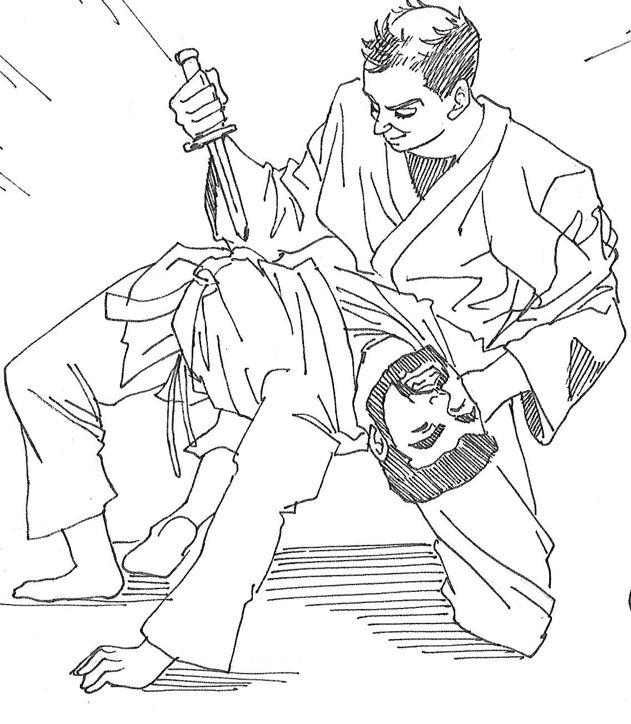
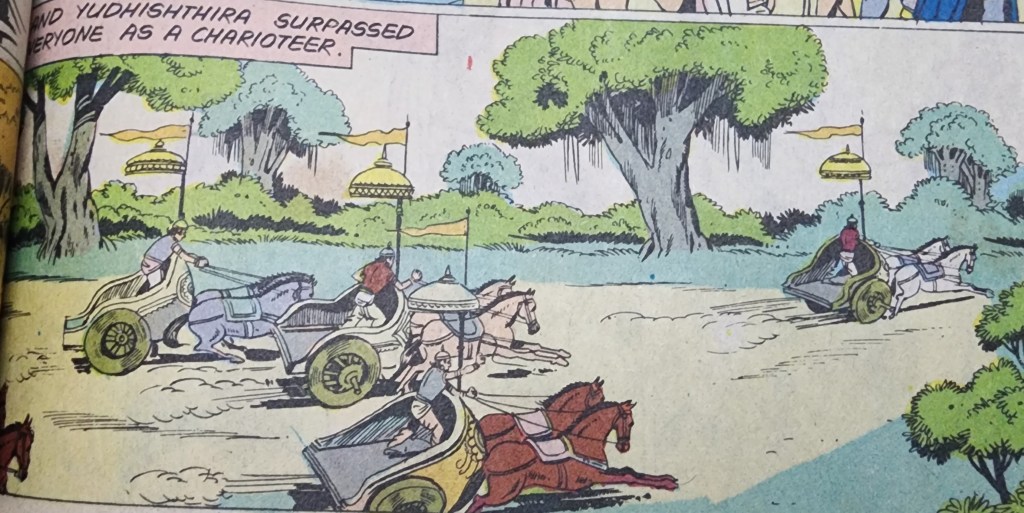

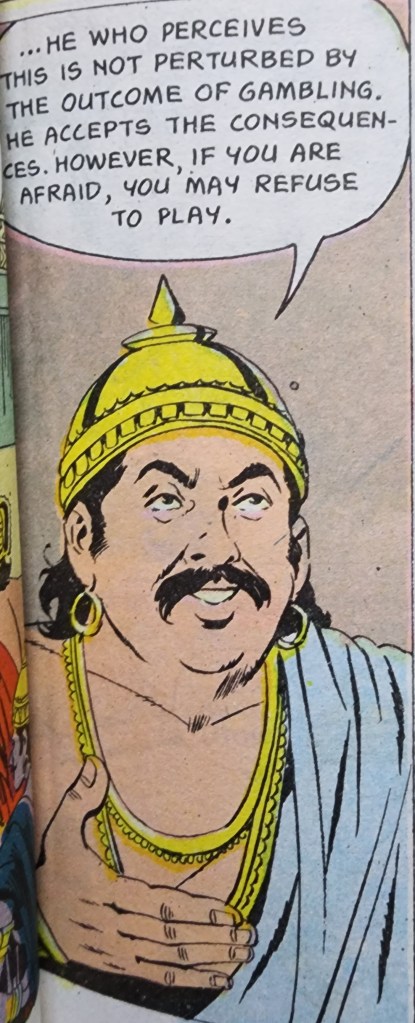
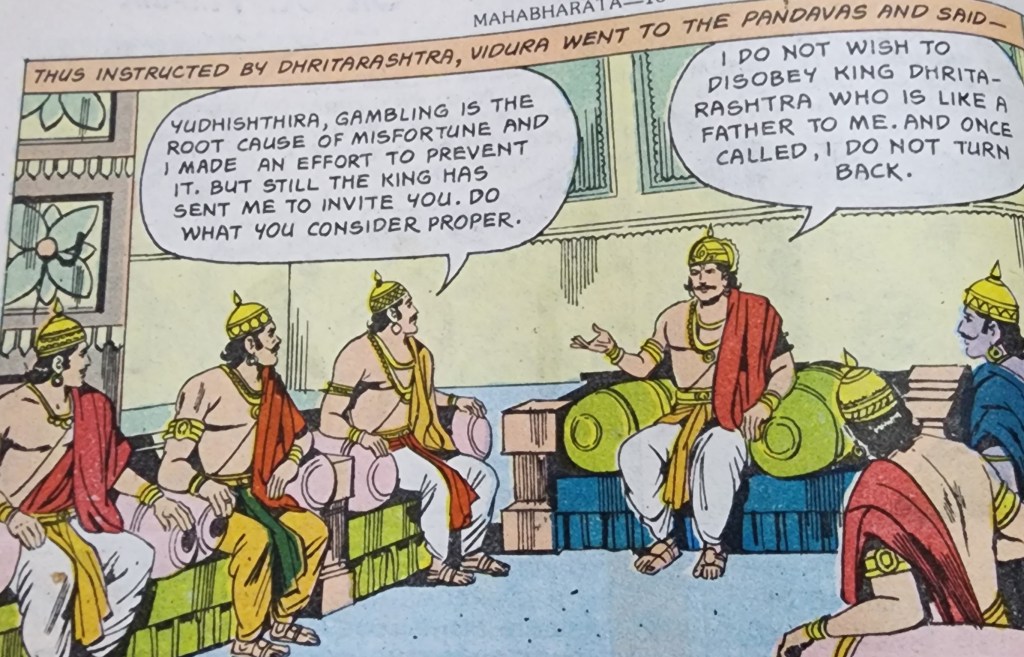
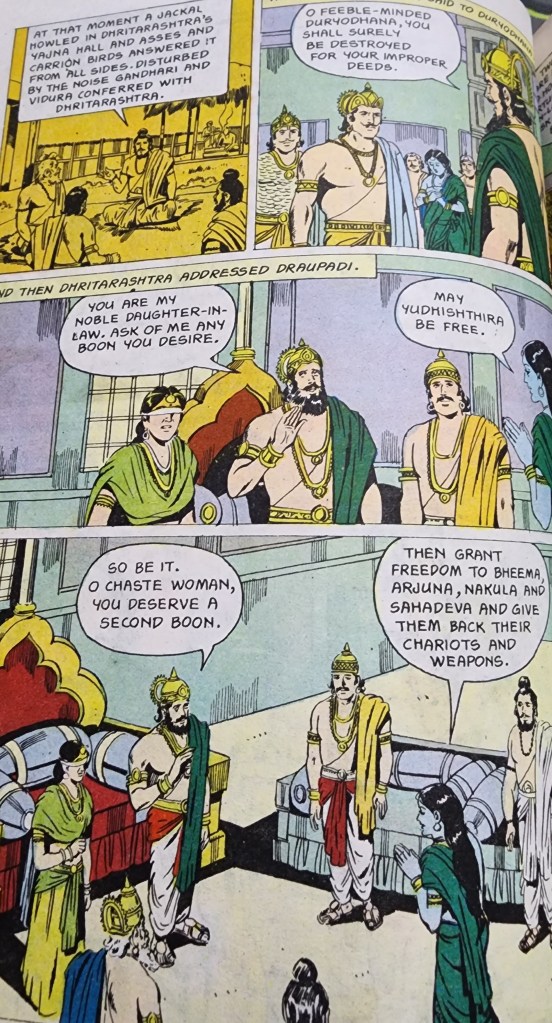

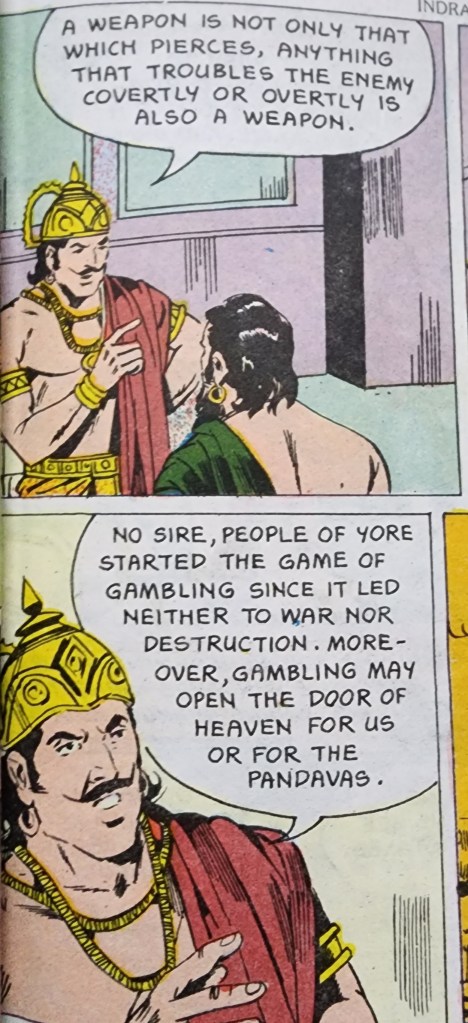
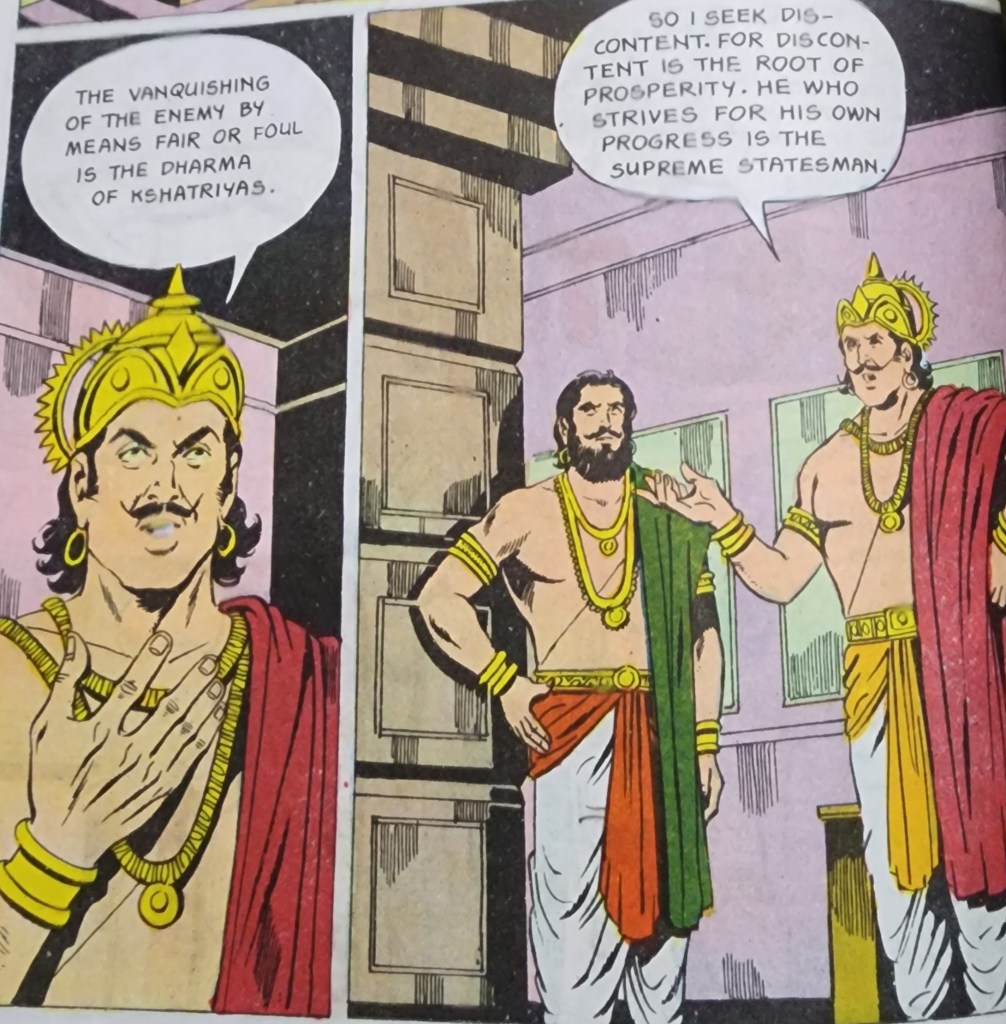

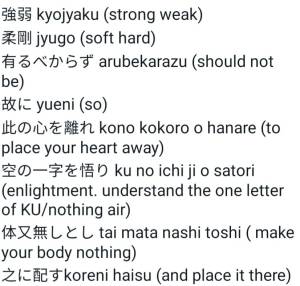

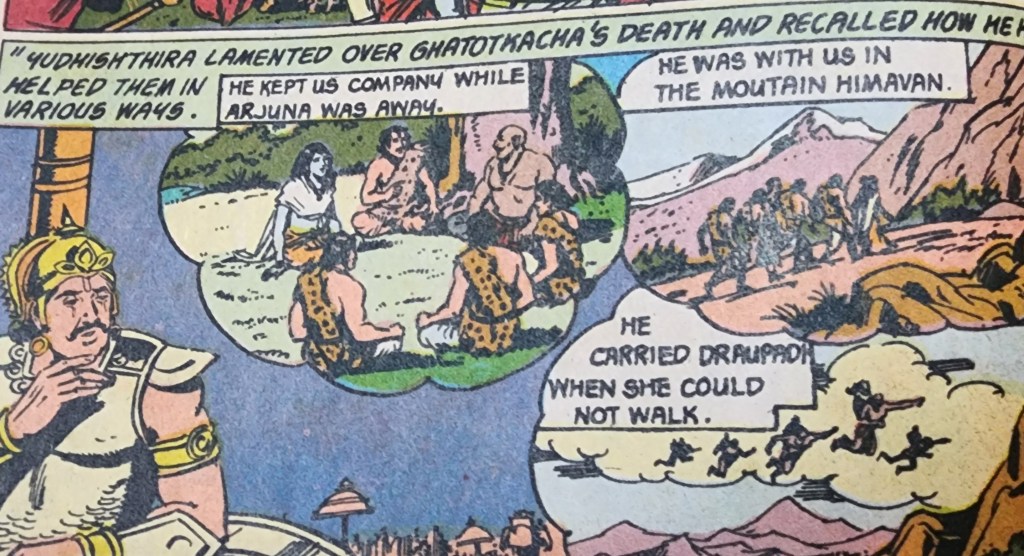

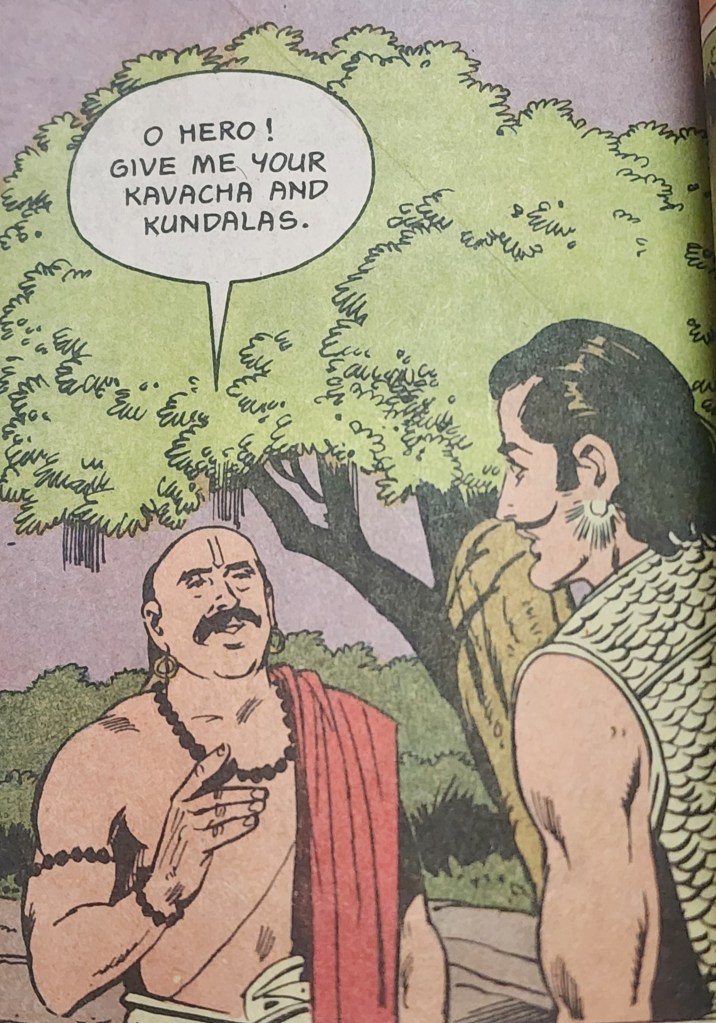
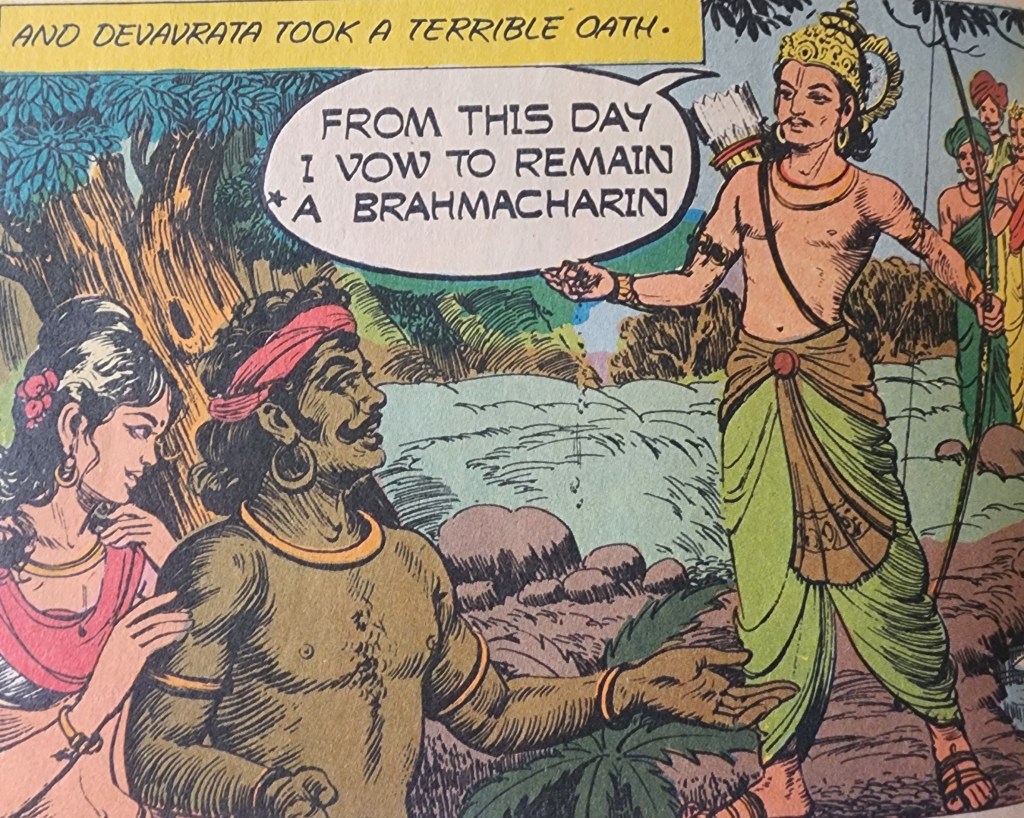
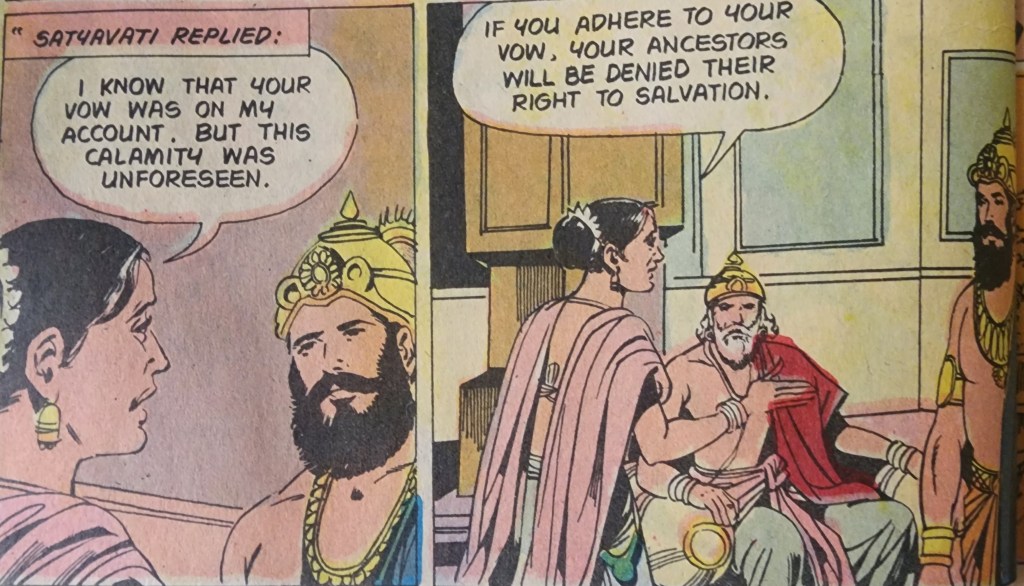
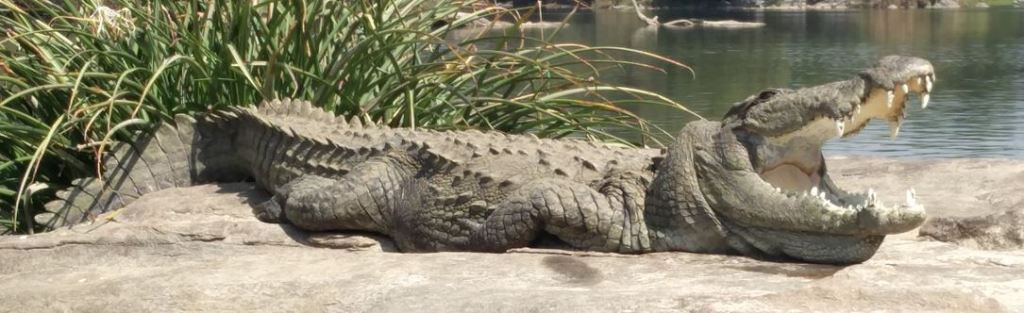

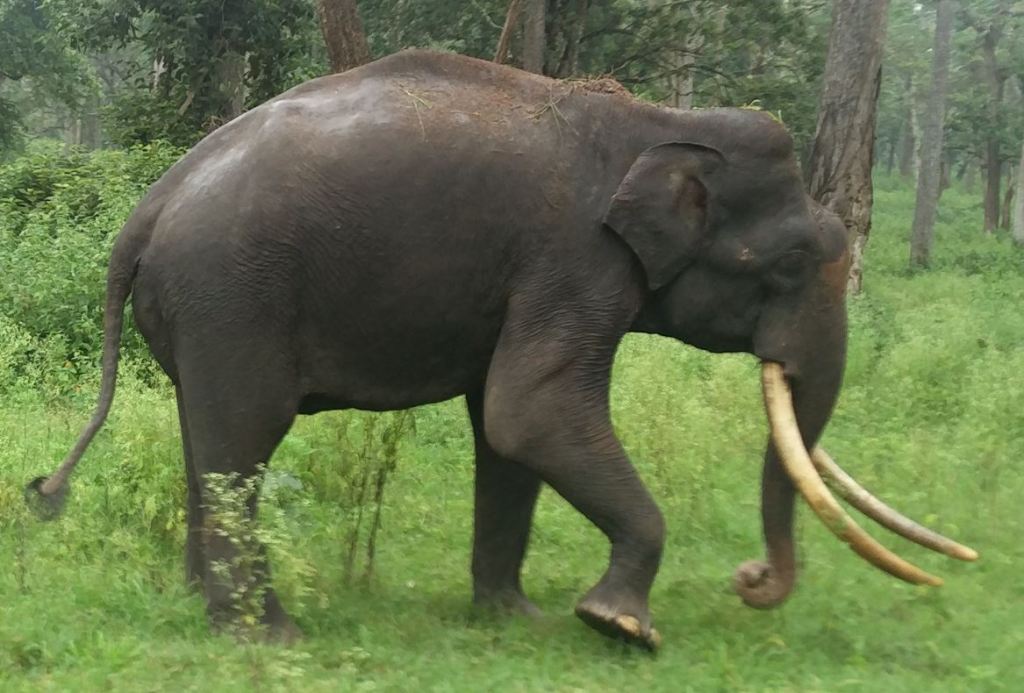



 Mundane Budo