Constant Adaptation, Dynamic Equilibrium – Martial Arts & Modern Democratic Information Flows

In the Bujinkan system, the differences that exist in points of view, perceptions, paths of learning, methods of teaching and every other conceivable difference is to be accepted. Differences that occur over time are also be expected. Consistency is not something one assumes. Every situation is dealt with as a fresh one with no expectations or motives. This was the premise of the article I posted four weeks ago. A link to this post is seen in the notes below*.

Once we can accept that we need to deal with every situation and cannot wish for a favourable one, a lot becomes simple in the mind. We can accept that consistency is not to be expected of humans. Everyone responds to a situation in a given time and space. If we encounter a favourable situation, consider it luck, be happy and move on. Do not try to replicate or analyze it, in hopes of achieving the same again.

One aspect that the above understanding leads to, in my opinion, based on training, is that we become more like our uke (attacker/opponent) and the vice versa also holds true. If one is training with an aggressive uke (opponent), who does not see the threat to such actions and is unable to realize the points of vulnerability he or she is exposing oneself to, based on the move performed by the tori (defender), a change might be required to end the conflict. It might be necessary to expose the vulnerability/opening/suki by actually striking, locking or any other act that induces at least a little pain. This hopefully, will reveal the fault of the attack and mitigate the same. Of course, this might be an iterative process with a gradual or sudden increase in the pain imposed by the tori. This could be considered as the tori becoming aggressive and more like the uke, in comparison the earlier attitude of the same person. Similarly, once the uke experiences the pain and vulnerability, the attacks might reduce in speed, power and in general the person might become wary and less aggressive. This means that the uke has become a little more circumspect and “peace-loving” 🙂 , like the tori was to start with. So, the two fighters have become more like one another, absorbing each other’s attitude.

This is something that might happen in every exchange, over many months, years or over a lifetime, when people share the same space and time together, as practitioners, friends, family, colleagues and any other relationship one can consider. I have over the years experienced this. My fellow budoka (practitioners of budo), senpai (seniors) and kohai (juniors), have changed and become more like one another.

Individuals who started out wanting to be the best, being aggressive, have over time mellowed considerably and come to rely on movement and sensitivity over speed, power and aggression. They have also lost the need to be the best. Similarly, those that started out being timid and afraid to strike or cause any pain, have absorbed some of the aggressive nature of their peers. They have lost the need to hold back all the time, they use aggression when necessary, with no reservations, but not with impunity. So, a nice equilibrium is reached with years of training.

This is even seen with how people react to practitioners of other martial arts or to those who do not practice the martial arts. Some start out trying to convince others with a zeal of why the art they are practicing is awesome. They are trying hard to be good ambassadors, or marketers at least. Others start out hiding their practice altogether and if not that, do not share much information. This also changes over time. Everyone somehow settles down to a reasonable middle ground, knowing when and whom to discuss the martial arts with and when to not worry about what others think of the same.

I personally use the analogy of a pendulum to describe the change. The more a person was aggressive, the more he or she will become sensitive and averse to physical force, before being able to do either (or both) as required. The same is true of individuals who are averse to physical contact. They start out being timid, then become used to using more physical strength than needed, before achieving the equilibrium where he or she can avoid physical contact or use excessive strength, as called for by the situation.

Now, if we expand the lack of consistency and the change in people due to circumstances and life experiences, some more aspects of our lives hopefully become clear. All of us inherently know change occurs and will likely have used the adage “change is the only constant”. But all of us are also, at least miffed or annoyed to a greater extent, by change, especially in people and the world around us. The effort to adapt to changes is not always pleasant or predictable.

If we live in democracies, all of us humans are political, irrespective of how often and with how many people we discuss our opinions, preferences, ideas and inclinations. And all of these are influenced to varying degrees by all the information we are exposed to. Now consider the data we are all swimming through every day – social media, digital media, televised media, print media, and opinions of people we know and don’t know. It is also very likely that all the information is presented to further a motive, again irrespective of how benign or indifferent to influence, the creator or distributor of that information thinks it is. The lack of a motive is perhaps a motive by itself. Another word for the motive of the presentation of information in today’s world is “Narrative”. This means we are all swimming in strong currents of narratives every day, all day, day after day. These narratives, just like water currents mingle and develop lives of their own, which need not be under anyone’s control. In my understanding this is what defines a “zeitgeist” (overarching theme/mood) of a time frame, a decade or so.

We all live through multiple decades and through varying zeitgeist and narrative sets. This is also a change related to people. After all, narratives and the zeitgeist are driven by people. But, adapting to a new zeitgeist is much harder despite knowing that change is a constant. I opine that this is because a zeitgeist is always trying to build a cult, if not a religion. How often do we hear people fondly remember the way things were or being glad that those times are done? I suspect that if you live in a democracy, it is fairly often.

Is adaptation wrong? Never. It might be wrong to certain people and great to the rest. Both groups adapt in their own ways. But like the hysteresis curve** what we achieve with the adaptation is not what used to be achieved or an improvement of what is, it is always a bit of both added to the current situation, which is a different chimera altogether. This “chimera” will require adaption all over again, until the next and the next and the cycle goes on.
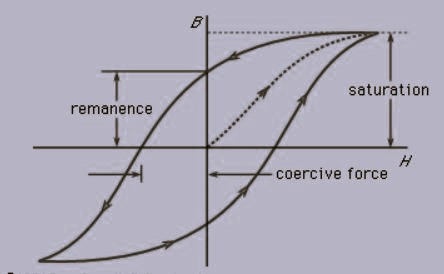
Hysteresis curve, Image credit – Encyclopedia Britannica

This concept of adaptation and becoming more like the other, holds for countries/nations, societies/civilizations and people as well. This is what I personally understand as one of either integration/assimilation or confrontation through adaptation. We see this all through history and in current affairs.

A primary driver that drives adaptation is technology. The use of the internet and all the platforms it has spawned is perhaps the latest tool that is being used to drive narratives. Narratives that are weapons used as potential equalizers whenever there is a considerable disparity in any other conventional weapon, either physical or psychological.
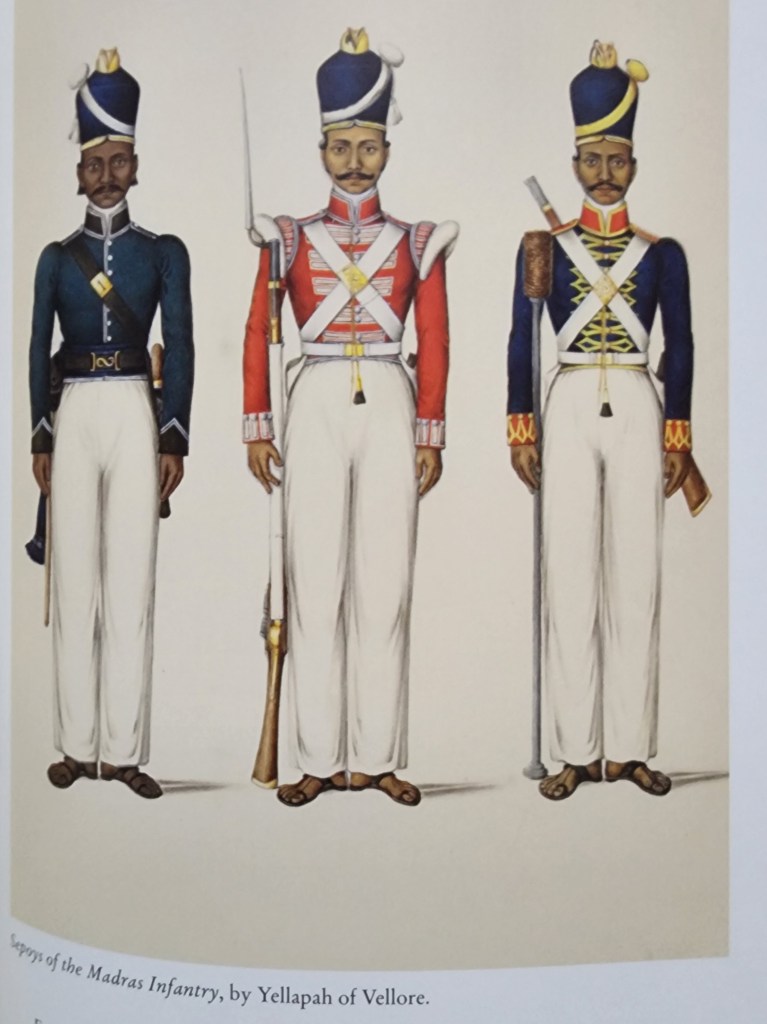
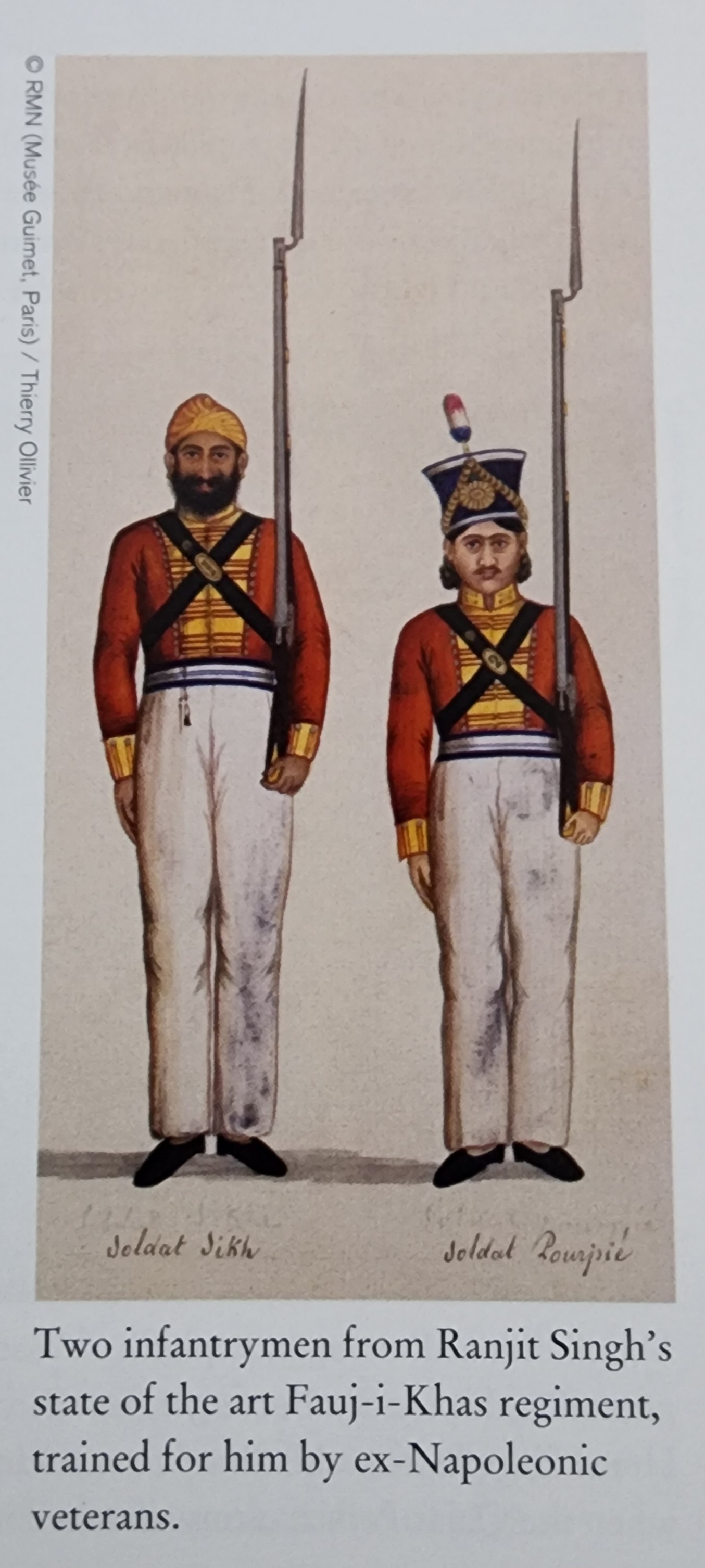
Left – Troops of the Madras Infantry (EIC soldiers), Right – Troops of Maharaja Ranjit Singh’s Fauj-i-khas. Both are modeled on Europeans armies.

Image credits – both images are from the book “Return of a King” by William Dalrymple

Based on my limited knowledge of history, this is something that has happened time and time again. In the 18th century, the East India Company (EIC) used mobile artillery and European military tactics to gain a great advantage over many Indian armies. This was overcome in a couple of decades by the local leaders hiring French military advisors to train their armies in the latest tactics and technologies. This led to the Fauj-i-khas and its guns, of Maharaja Ranjit Singh, the troops of the Holkar and Shinde factions of the Marathas and Tipu Sultan’s army. All of these troops held off the EIC successfully for decades.
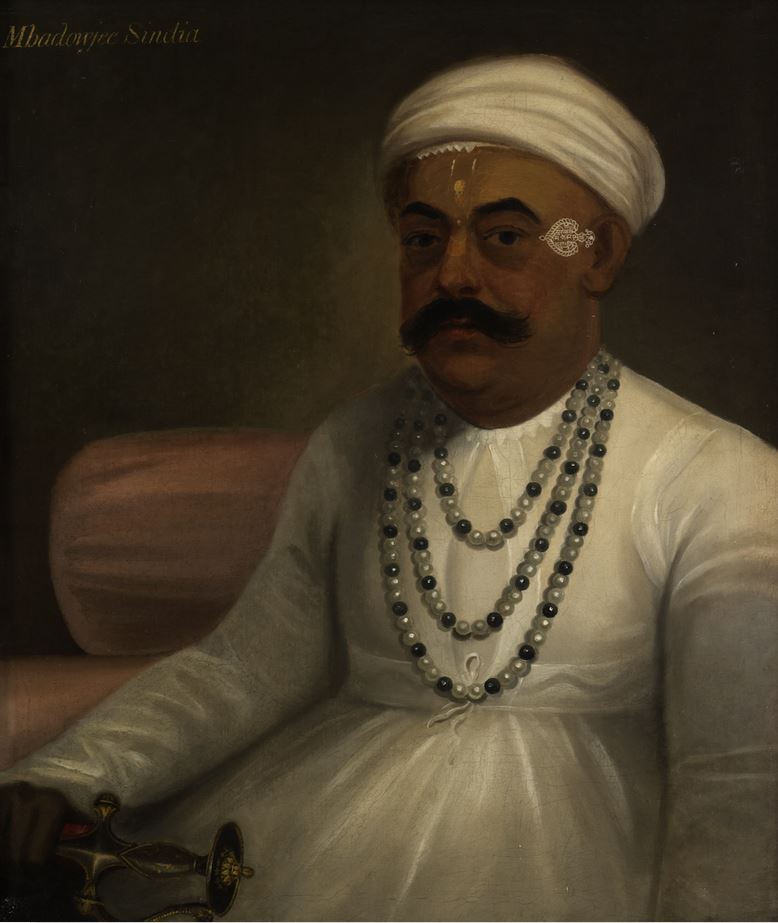
Portrait of Mahadji Shinde (Scindia) by James Wales, Source – Wikipedia

The EIC gained an upper hand with better financial management and the exploitation local rivalries. This was overturned not with better management practices by the Indians. After almost a century of learning from the British, the Indian army turned against the colonial masters and forced their exit. This effort was on two fronts. One which incessantly tried to turn the army against its own masters and the other led by Mahatma Gandhi and the Indian National Congress (INC), which turned civilians against the British and broke the moral superiority the British gave themselves.

So, first, the Indian armies became more like the EIC and other European armies. Later, Indians learned to turn the learning from the British against themselves, which is what the British had used in the first place, popularly called “Divide and Rule”.

Around the dawn of the Common Era, India was invaded by the Greeks, Shakas, Kushans and Pahalavas, and a few centuries later by the Hunas. All of them eventually assimilated into the existing native culture, religion and became locals; some even propagated Indian culture as it existed at the time to Central and East Asia, Persia, all the way to Greece. In other words, the invaders became one with the populace they attacked.

In the second millennium of the Common Era, this changed, when Islamic and Christian invaders tried to make the locals assimilate into their culture. Islamic armies that invaded had superior cavalry due to their origins in Central Asia. Indian forces over time became superior cavalry troops themselves and added guerrilla tactics to eventually break Islamic domination. This is seen in the armies of the Rajputs and the Marathas. Christian forces represented by the EIC and the British were defeated as mentioned earlier. So, the trend holds, one becomes more like the enemy to survive and overcome the same.
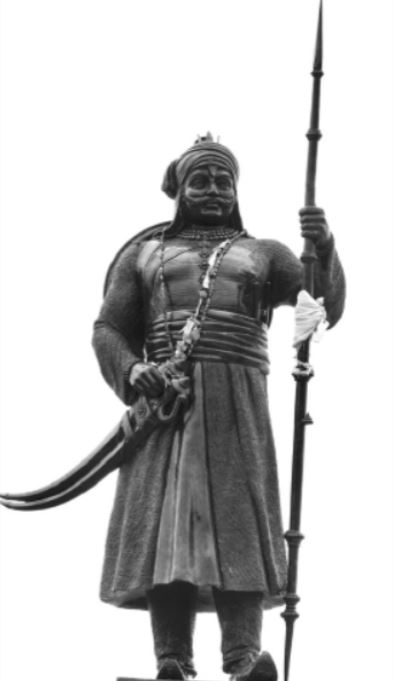
Left – Statue of Maharana Pratap, Image credit – The image is from the book “Maharanas” by Dr. Omendra Ratnu

Right – Statue of Peshwa Baji Rao I in front of the Shaniwar Wada in Pune, Image credit – Wikipedia

Fast forward to the Indian Republic and this pattern continues. The example now truly moves into the realm of narratives. Indian social sciences were taken over in the late 60s and through the 70s by a Leftist strain of thought. This led to the Hindu religion facing a lot of negative coverage the world over due to the narrative set in educational institutions, media and pop culture. This sway was broken with the coming of the internet. People who are not academic historians, from all walks of life, reset the narrative with new research and by digging up the works of historians of the past who were side-lined by the Leftist way of thought.

A Marketing Professor of mine from MBA used to say that one should never leave any subject to just the experts. He used to suggest that HR should never be left to HR professionals, Finance to Finance experts, Engineering to Engineers and so on. While studying Engineering, we had a subject called “Engineering System Design” (ESD). ESD said that while trying to solve an engineering problem one should always have an expert from a different domain. For example have a biologist while trying to solve an engineering problem.

It is this approach that has changed the narrative about the Hindu religion and Indian history over the last 15 odd years. People took narrative building ideas from Social Science professionals, added their own experience from other walks of life and used the internet to circumvent the academic strangle hold of the Leftists. Now, the Leftists and their kind in media are taking to social media to counter this, as television media has been lost to them. How this plays out in the future is yet to be seen.

Another change that is happening is in the way Ahimsa is viewed in India. Ahimsa was considered the ONLY reason for Indian Independence during my school years. This is now changing to show how the Revolutionary movement was as vital a component of the Freedom Struggle as the Ahimsa led movement was. But the Ahimsa fervour added with the negative narrative about Hinduism led to the creation of Caste and Religion based vote banks in the country. This left many feeling dissatisfied and unable to openly air their concerns about the same.

Again, the internet came as a disruption. It gave a new avenue for venting these grievances. It also led to Indians reconnecting with the past beyond Ahimsa, a past of physical conflict and valour. This has made Indians more aggressive and proud as a people. Nothing is without consequences and the fallout of this is yet to be seen. The beneficiaries of the vote bank politics were belligerent for a few decades. But the passive population has become more like them and is showing signs of aggression. In the same vein, those no longer benefiting from the old narrative have taken to the passive protests based on Ahimsa, to achieve a moral high ground. This was seen in the anti-CAA protests and the protests against the Farm Laws, at least until violence undermined both, specifically the anti-CAA protests. So, the pendulum has swung to the other extreme; those that were raised on Ahimsa narratives are now realizing forms of power other than morality, while those who formed a part of the dominant narrative are now taking to the moral capacity of Ahimsa. Again, the opponents have become like one another.

If we consider the current events in India, the Prāna Pratishta of the Rama temple occurred a few days ago. This event is widely seen as a defining moment for Indic or Dharmic or Bharatiya civilization, in a hugely positive light. But there is a sizeable opposition to the focus on the event, especially about the involvement of the Central Government. It is a criticism of the Government for being right wing, and an adherent of “Hindutva”. Hindutva is the political zeitgeist in India as I see it. It has been so since 2014 for sure and maybe since a few years before then.

In an interview on the YouTube channel of “The Wire”, the criticism is very interesting. The Wire is considered a leading “liberal”, “leftist” media outlet. The interview is of Ramachandra Guha, by Karan Thapar. Both Mr. Guha and Mr. Thapar are regular critics of the current Indian Central Government. In the interview, Mr. Guha says that the focus on the Ram temple at Ayodhya is an attempt to convert Hinduism into a congregational religion, which it never was. And this attempt is just to benefit the political party in power.

This criticism is very interesting. It suggests that Hinduism should not change from what it was in the past! Despite Hinduism being in a process of constant change! Hinduism went from being a Yajna based religion with no temples, to a religion (it is way more than a religion, but I am using this word here for simplicity) centred on temples. It also went from a ritualistic one to adding a plethora of philosophies. It has now gone from a religion focused purely on the sub-continent to one looking outward. This change has occurred over the millennia, by its acquiring influences from communities all over the Indian sub-continent. Hinduism has led to Buddhism, maybe Jainism, Sikhism and also consists of the now extinct Charvaka and Ajivija ways of thinking. Hinduism has also been changed by these religions and the several local and tribal faiths that exist in the various parts of India. This aspect of Hinduism is so pervasive that invaders adopted one or more of the Indic systems and changed their names even (look at names of later Kushans, Hunas, Indo-Greeks etc), until the invasion of the practitioners of Islam and Christianity.

So, Mr. Guha bemoans the change in Hinduism (if it really is happening) despite it being a religion of change at all times of its existence! What we can consider is that the Abrahamic religions are congregational religions and if Hinduism adopts congregational aspects that are very pervasive, it might become more like the Abrahamic faiths. This is yet to happen, if it does at all. But if it does, it would be another case of a local religion adopting facets of a faith system that is perhaps a challenge to its existence. A link to the interview I am referring to, is seen in the notes below1.

There are many other conversations happening within Hinduism relating to rediscovering its past and positives, the freedom of its temples, caste segregation and the like. There is no way to say how all of these will result in the evolution of the Dharmic systems in India and abroad. Hinduism is not yet a proselytizing religion, while its offshoot Buddhism is. Will this also change in the future as result of learning from “opponents”? There is no way to know as yet. Narratives always come up against lived experiences and face hurdles there. How the two interact defines the future of both. This is a whole different topic I am not very aware of and hence will not delve into it further.

Now for a view from the other side. Many of the people critical of the current Indian Government used to be superstars of television journalism. Now these channels are seen to be pro-government. A lot of these former superstars are no longer associated with the big media channels. They have all shifted to YouTube and use Instagram quite a bit to put out the “other side of the story”.

It was the political party currently in power that first used social media and internet platforms to reach out to citizens, during a time when the superstars still reigned. But now people supporting and criticizing the government use internet platforms and social media successfully. So, the critics of the government have learnt from and become more like those supporting it! 🙂 Seen in the notes below is an article which highlights the efforts of these critics in a positive light and obviously, goes on share how freedoms and democracy in India under threat. This article also mentions, obviously again, India’s ranking  ranking in the World Press Freedom Index. 🙂 A link to this article is seen in the notes below2. I had discussed narratives and such articles, and how they are weapons that act over time in a previous article of mine. A link to this article is also seen in the notes below3.

This change is playing out the world over. We are all citizens of Planet Earth, despite our national, communal, regional and tribal identities. Modern communication means we all have a stake in all that happens everywhere, not just our own states or countries. Also, happenings in far-away parts of the world influence the manner in which we react to local issues. This is a new Chimera we are all dealing with.

The Ukraine war was fought on digital and social media as much as on the financial and actual military fronts, at least in the initial months. Similarly, the current war in Gaza is being fought on social media, television debates, YouTube podcasts and on University campuses. University campuses that are not in Israel or even in West Asia. The fronts and non-combat participants who try to influence these wars with narratives might have no truck in the actual conflict on the ground at all! This is evidence that we are all global citizens, no matter what our identification documents state. It also shows how we are all becoming more like one another, especially if we consider someone an “opponent” or worse still, an “enemy”.

Even in the past, there are examples of this outside India. Native Americans learnt the use of horses and guns very fast when faced with the Europeans. Similarly, Texas Rangers had to learn the ways of the Natives to face the Comanche tribes. In Africa as well, troops of white colonizers in Zimbabwe and South Africa had to learn the ways of the locals to fight their resistance. In Vietnam, the local troops led by the legendary leader Vo Nguyen Giap destroyed the French at Dien Bien Phu, after learning the ways of modern warfare and communism from European colonizers. The examples are endless, enemies learn about and from each other and become like each other. Not the same, never, but a dynamic equilibrium is certainly reached where the two sides are similar enough to force a mitigation of the conflict, unless there is another disruption one of the two sides can exploit.

The world we live in is defined by conflicts, be they military, economic or ideological. Nationalism, Populism v Leftism, Supposed liberalism; Hindutva v Secularism; Immigration v Refugees; Anti-Semitism v Anti Zionism; Islamism v Modernity; Institutional democracy v Electoral/Authoritarian democracy, Israel v Palestine, Ukraine v Russia – the list goes on.

These days, all of these are fought on the narrative level as well. But be they narrative, financial or military, everyone is learning from everyone else all the time, in this super-connected world. And we will likely become more like one another, even if we learn what we consider “bad traits” of each other. This will lead to a lull in the conflicts, until a disruption, mostly technological, comes along, and things will flare up again. This is, at least for now, the way things are. But knowing that we will become more like each other, is that not a cause for hope? Because it means there is something to take away from the interaction with the “other” that we want to add to ourselves, as an improvement, or at least a protective mechanism. Can we use this aspect as means to manage conflicts? Or are we doing it already? Perhaps both. Either way, it is just a prospect for not giving into despair. Maybe the constant in the zeitgeist of every time is polarization, with an undercurrent of adaptation and disruption.

Notes:

* https://mundanebudo.com/2024/01/04/a-myriad-of-methods/

** The Hysteresis curve shows how a force might cause a displacement, but when the force reduces to zero the displacement does not go back to zero. A force in the opposite direction is needed to make that happen.

This is like a disruption causing a change in society, but the removal of that disruption (when it is no longer a disruption and has become normal) does not make society go back to its original state, which is a new normal. A different adaptation will be needed for that to happen. This adaptation will move society in a new direction beyond what was planned and that change needs a new adaptation or disruption to attempt a return to the new normal. But that in turn causes more change, and this goes on and on.

This is like the negative force causing a displacement in the opposite direction beyond the original zero. And the reversal of that causes the curve seen in the image seen earlier.

1 The interview between Mr. Guha and Mr. Thapar – the point about congregational religions is made around the 15 minute mark in the video.

2 https://restofworld.org/2023/india-youtube-journalism/?utm_source=pocket-newtab-en-intl

3 https://mundanebudo.com/2023/10/15/missile-long-range-weapon-narrative-long-time-weapon/
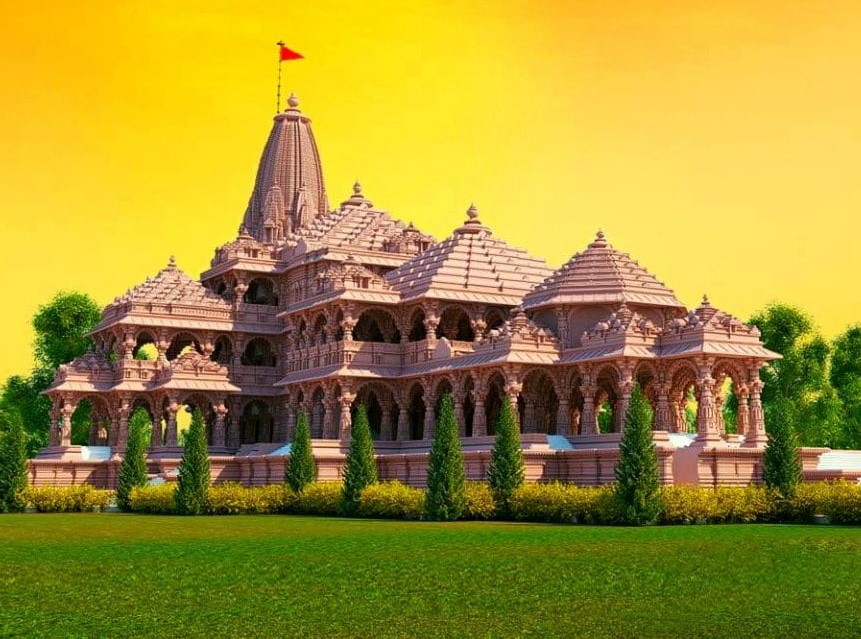
Maryāda Purushotham Rama and the Martial Arts – Control is the key

Above is a representational of the Ram temple at Ayodhya. Art created by Adarsh Jadhav.

The Prāna Pratishta (consecration) of the new Rama Mandir at Ayodhya will happen on 22nd January, 2023. This is 4 days from now, on the coming Monday. As everyone in India and anybody who is interested in India knows, this event is extremely important for a very large number of Indians. The importance is magnified for Hindus, whether or not they are devout. The importance is spiritual, social, cultural, religious, historical and most definitely, political. And for this reason, the very presence of this devālaya (mandir/temple) has its opponents, both in India and abroad. But whether they are celebrating this event or are disheartened by it, no one can ignore it or write down its significance for Modern India, or Bharat.

Lord Rama is one of the most revered Gods for Hindus. In my opinion, Rama’s character is of key significance to practitioners of the martial arts, especially the Bujinkan system of martial arts. This is revealed by one of the adjectives used for Lord Rama. Lord Rama is very often called “Maryāda Purushotham Rama”. The words “Maryāda Purushotham” are an adjective. But as far as I know, they are used ONLY for Lord Rama. Hence, they are almost an alternative name for Rama. In India if you say “Maryāda Purushotham”, no one will have any doubt regarding who you are referring to. This name/adjective of Lord Rama is where his significance for the martial arts stems from. This of course is my opinion. People are free to disagree or have other ideas.

The word “Purushotham” is formed by the sandhi (combination) of the words “Purusha” and “Uttama”. “Purusha” is “man” and Uttama is “the best”. Uttama can also be referred to as “the highest level”. Purusha is not necessarily only “man”, as in the male gender. It can also be “human”. There is another word, “Purushārtha”. This is formed by the words “Purusha” and “Artha”. The four “Purushārtha” are “Dharma”, “Artha”, “Kāma” and “Moksha”**. These are the aspects a human being pursues over the course of a lifetime. These are true for all humans, irrespective of whether they are male or female. Of course, these days, it can include any other gender one chooses to consider. Hence, “Purushothama” when used in reference to Lord Rama, means “the best human”, or “a human of the highest level/order”.

The word “Maryāda” has multiple meanings based on the context of its usage. “Maryada” is the pronunciation in Hindi. In Kannada, we say, “Maryāde”. Maryāda can mean honour or respect. In Kannada, we say, “Avarige maryāde kodu/torisu”. This means, “Show/give them respect”. We also say in Kannada, “Avaru maryādastharu”. This means “They are honourable or respected/respectable people”. So, in this context, “Maryāde” can mean honour or respect. It is generally used when referring to decent, good folk, based on one’s opinion. There is however, another meaning for the word “Maryāda”, which is more relevant to this article.

During the late 80s or early 90s, I remember hearing the following dialogue in a Hindi film; “Apni Maryāda mein raho”. Of course, it could have been “Apni Maryāda mat bhoolo” or something similar, I do not recall exactly. I suspect it was from one of the family-oriented films with actor Kader Khan in the cast, maybe “Ghar ho to aisa” or “Biwi ho to aisi”. I could be wrong, but my brain associated this dialogue with either one of these films or with a film of this genre. These were films that preached how the roles and behaviours of people in model Indian families should be.

This dialogue threw my original definition of “Maryāda” off kilter. The dialogue “Apni Maryāda mein raho” or “Apni Maryāda mat bholo” was used in a heated exchange between two characters, typically one espousing traditional values (an older individual) and another yearning for change due to the suffocation of traditions (obviously a younger individual). It was very clear while watching these movies, that these dialogues meant “Stay within your limits” or “Don’t forget your limits” respectively. So, how could “maryāda” mean “Stay within your respect/honour” or “Don’t forget your respect/honour” in the context being presented? 😀 It made no sense.

It was later that I realized that the word “Maryāda” also meant “Limit”. Apparently, this was the original meaning of the word! It was overtime also used to denote “Respect/Honour”. When maryāda can be used to be mean “limit”, it could also be to denote “boundaries, as used when we say, “do not cross boundaries”.

I suspect this could be because one deserves respect for knowing one’s limits or more appropriately not overstepping one’s limits. Of course, the limits are usually defined by social or age-based constraints. And because one has learnt to limit oneself, perhaps by being content with one’s lot, one deserves respect. So, by setting limits for oneself and following the same diligently, one earns respect. So, the same word came to be used for the two. This purely my speculation and I could be wrong about this.

So, when I was younger, when I heard “Maryāda Purushotham Rama”, I used to think “Rama, the most respected and best among humans”. But I have realized that this means “Rama, the best person who limits oneself”. It could also be, “Rama, the best person, who stays within his own boundaries”. It is as I understand it, “Rama limits himself and hence he is the greatest or first among humans”. This makes sense. Every aspect of the life Rama led can be considered exemplary. He strove to live up to his responsibilities, always keep his word and most importantly remembered that all the rules and laws that applied to his people also applied to himself. This last aspect was of paramount importance.

Rama was a king and hence above everyone else, at least in his own kingdom. So, he could have had a different set of rules for himself or exemptions to the same when compared with those for the citizenry. But he never allowed this. Further, and even more importantly, Rama was an avatāra of Lord Vishnu. This made him a God walking among mortals. So, he could have held himself above everyone else on Earth, even beyond his own kingdom. But he never let his Godliness or divine attributes show. He never used this to any advantage in the course of his life. So, Lord Rama restrained himself from using either his privileges as a king or his powers as a God to his benefit. He lived like any other mortal, going through all the trials and tribulations, if not more.

Thus, Rama LIMITED himself. He set limits on himself; from ever using his powers as king or God, except for the welfare of other people. He never succumbed to arrogance or pride. His self-imposed limits not only prevented his using his powers and abilities to his own advantage over his fellow humans, but also limited him from ever giving into extreme emotions, barring a few rare instances. Even these instances exemplify his being mortal and limiting his own abilities as either God or king. So, he is indeed the very personification of a person who has limited his own excessive use of abilities, because he decided that they would not suit the world he lived in. It was not the purpose of the avatāra either. Hence, Lord Rama is absolutely the one and only “Maryāda Purushotham”!

Above is a photo of Lord Rama from our pooja room. As far as I know, it is a framed copy of an original by Raja Ravi Verma. Many homes have this photo in their respective pooja rooms.

Rama was a God and had all the powers that earlier avatāras like Varāha, Narasimha, Vāmana or Parashurama or the later avatāra of Krishna wielded. But he did not resort to these abilities. How did Lord Rama achieve this? I opine that the answer is “Control”, and more specifically, “Self-Control”. Rama could control his emotions and his abilities. Since he could control his abilities, he could limit his use of the same. Similarly, since he could control his emotions, he could prevent extreme emotional situations that would result in his unleashing his powers. So, it was CONTROL through and through. Through SELF-CONTROL he remained just an ordinary human in his acts and this in turn led him to be able to perform extraordinary acts, demonstrating that he could also CONTROL solutions to issues facing him and those around him, at all times.

Rama lived in the forest, united a divided Vānara kingdom, gained the trust and support of Vānaras in looking for his wife Sita and later in attacking he powerful Asura Rāvana. He achieved the defeat of Rāvana, gained the support of Rāvana’a brother, caused no damage beyond necessary and eventually regained his throne. He suffered quite a bit after this as well. He was separated from his wife, never saw his twin sons in their early childhood and eventually when his children came back into his life, he lost his wife forever. So, his was a life of great achievements accompanied by extraordinary tragedy. Despite it all, he was successful in all his endeavours and remained a mere mortal. This is why he is perhaps the paragon of SELF-CONTROL and being able to find solutions to varied problems, however unsuitable they may be. This is being in CONTROL of the situation and given environments as best as a human can! It is this virtue of “CONTROL” and “SELF-CONTROL” that relates the example of Lord Rama to the Martial Arts.

Sensei Hatsumi Masaaki, the Soke of the Bujinkan focused on Muto Dori since around 2014-15 all the way till the global disruption in 2020. Muto Dori is defined with many variations by many senior practitioners. It is also interpreted with quite a few variations based on what the focus is on, in any given training session. But a common thread is that one should focus on oneself and have control of one’s own motivations and emotions in a combat situation, even while training in class.

The objective was that one should train like one is unarmed even when the opponent is armed. This is even if one has access to weapons. There could also be situations where there are multiple opponents. This is not to say that this training ensures survival in a real situation. But it demonstrates that one has no control over the initial actions of opponents, only on oneself. So, the focus is to control oneself in the best possible manner. This control hopefully allows one a modicum of control over the fight, which will allow one to survive the situation. The control over the conflict situation will vary over time as the opponent(s) are also continuously adapting.

This focus on control is exemplified by a statement that is made by my teacher every now and then, “focus on your breathing”. This statement is used to help a practitioner begin the process of self-control. One is encouraged to actively focus on, and think, of her or his breathing while in a fight, during training. This takes the mind off the other things in a fight. These include, what the opponent might do, what one can do to the opponent, what one’s objective in the fight is, how one wants it to end, what technique is working or not, worry about whether what one is doing is correct or effective, and the like. All of this is mitigated by turning inward. Hopefully, once this happens, the practitioner only moves to survive and makes the opponent do all the work.

In such a situation, if the opponent is not focusing on self-control, hopefully an opening or opportunity will present itself in due course. This opportunity can be used to end the fight. If the opponent is also exercising great self-control, the fight might just end as both (or more) are only trying to survive and not looking to fight at all. Thus, the situation is controlled either way.

A mentor of my teacher’s suggests that control is a vital aspect of the Bujinkan. He is a very large and strong individual (think WWE wrestler large) with several years of experience. He is someone who can use his strength and size to overcome most opponents. But he chooses not to, and this is enabled by his training and the skills developed to achieve control in a physical combat situation. He further emphasizes that this is NOT LIMITED to a physical fight, but to all aspects of life.

The objective is to achieve control of the situation, there need be no doubt regarding that. Control of the SELF is the starting point of the same. The result of this control is, favourable outcomes in every step and stage of life (what is needed but not what is desired). Control of the self leads to control of the situation and control of the situation has consequences which needs control of the self again. It is cyclical or maybe a spiral.

A student of a friend recently trained in Japan with this mentor. I am sharing the statement this student used to share his learning. It was a quote which I am repeating here. It is something Soke Hatsumi apparently mentioned in the past. It goes, “Nothing is supposed to work for you, the goal is control”. This statement encapsulates the importance of control. Control the self, control the situation, control everything.

I had written an article late in December 2022, describing the “Ashta Siddhi” or eight achievements mentioned in Hindu tradition. One of the last and highest of these Siddhi is “Vashitva”. This can be considered to be hypnosis. But in a more mundane situation, I consider this as “control of a situation” when performed by a highly experienced martial artist or maybe a warrior in a real fight. A link to this article is seen in the notes below*. Do refer this article for more exploration of control and its nuances.

When we say self-control, this is not a new idea. In the Arthashāstra by Kautilya (Chanakya), there is sutra which describes the root of happiness/a good life. It consists of four lines. These are seen below. The actual Sanskrit lines along with what they mean, as I understand them, are mentioned. Other cultures might have similar ideas. I am not aware of specific examples. If anyone any, please do share the same.

Sukhasya moolam dharmahaThe root of happiness/a good life is Dharma (the right actions/sustainable actions)

Dharmasya moolam arthahaThe root of Dharma is wealth/good economic condition

Arthasya moolam rājyamThe root of wealth/good economic condition is the State (well governed State)

Rājyasya moolam indriyānam vijayahaThe root of the well governed State are leaders who have conquered (have control over) their senses

Motivations and desires and emotional responses are triggered by the senses. Controlling one’s senses is what we call self-control. It is expected that a ruler or leader or administrator is one who has achieved the same. If and only if this has been achieved can a leader be expected to be able to control all the situations that affect a State. And this control of the situation is where good administration originates. It is thus the same thing as taught in the Bujinkan, even if the latter is more focused on the individual and not on the State or rulers/administrators of the same.

The path is the same; control the self, control the situation. Do this all the time to control every situation, end up with control over everything. This is the objective, not a guarantee. This brings us full circle to Lord Rama. Maryāda is “to limit/limit”, but “Control” is the key. There can be no Maryāda without control. And thus, with control our civilization got Purushothama! And “Control” is what we still strive to achieve.

JAI SHREE RAM!

Above is a photo of an interpretation of Rama by artist Varun Ram, made in 2008. I bought a copy of this artwork in the Bangalore Comic Con 2012 (the first one in Bangalore). It is not a traditional representation of Rama, but one that I greatly appreciate.

Notes:

* https://mundanebudo.com/2022/12/22/the-ashta-siddhi-and-budo/

** “Dharma”, “Artha”, “Kāma” and “Moksha” – “Right actions”, “Wealth”, “Desires”, “Liberation”

Missile – long range weapon :: Narrative – “Long time” weapon

“Kirik” in colloquial Kannada means, “deliberate mischief”, maybe with malicious intent

Training of any traditional martial art system involves learning to use weapons. Generally, practitioners learn the use of weapons based on the reach of the weapon. The range a weapon can affect is based on its reach. A simple classification of weapons based on their reach is,

  1. Unarmed combat – the human body is the weapon
  2. Short range – weapons like knives/daggers, Vajra/yawara stick, bagh nakh, loh mushti/knuckle dusters
  3. Medium range – weapons like batons, hanbo, jo, gada/mace , swords
  4. Long range weapons – bo, quarterstaff, spears, all other pole weapons
  5. Discharged weapons – weapons with a range greater than those mentioned above, including all missile weapons, like bows and arrows, javelin, slings, chakra, shuriken, and all modern weaponry

The weapons in short, medium and long range, as far as Indians are concerned, are classified as Shastra, weapons that are hand held. Discharged weapons are Astra, weapons that are discharged with either the hand (javelin, chakra) or through a device that is handheld (arrows through bows, stones through slings).

The reach of a weapon is the distance at which it can affect an intended opponent/target. The range of a weapon is the area that can be influenced by a weapon. Reach is two dimensional, whereas range is three dimensional. For example, the reach of a sword would be the length of its blade if the wielder of the same does not extend her or his arms and legs. The range of the sword would be a sphere, whose radius is the length of the blade. The sphere is generated when the sword’s wielder turns around and moves the weapon over the head and below the waist.

When we consider modern weaponry like missiles, bombs and the like, the range will be the area around the point of impact where the destruction occurs, while the reach is the distance the missile can travel. Of course, in common parlance we refer to this as the range of a missile and the area of impact or blast radius as the range of the warhead the missile was carrying. There could be even more technical terms used which I am not aware of.

In the Bujinkan system of martial arts, Soke Hatsumi Masaaki had designated as the “theme of the year” for the years 2002 and 2003 respectively, the concepts of “Sanjigen no sekai” and “Yugen no sekai”. These concepts were the point of focus in the training of practitioners for those years respectively. The result of this training would be improving the movement of budoka with the addition of these concepts to their existing abilities and experience. “Sanjigen no Sekai” is “the world of three dimensions” and “Yugen no Sekai” is “the world of elegance”.

In simpler terms, Sanjigen no sekai reminded budoka (practitioners of budo, one of the systems of which, is the Bujinkan) to remember to also use the third dimension in their movement. As beginners, we tend to focus on angles and distance to learn the basics. This is facilitated by the dojo being a flat indoor space. Over time, one needs to learn to use one’s legs better to lower one’s centre of gravity to achieve better stability and power by the use of potential energy. It also gives extra space to protect oneself when there are attacks (a diagonal requires an attacker to traverse a greater distance). An additional aspect that my mentor explained while training this concept was that a real fight need not be on a level ground. It could be on uneven terrain or even a slope (think stairs). This changes the distances and needs adaptation in one’s movement and the use of weapons. In other words, the reach and range vary with the terrain.

Yugen no sekai by its name is very poetic. But in reality, it is a lot simpler, based on my understanding. The application of sakkijutsu over Sanjigen no sekai should lead to a realization of Yugen no sekai. Sakkijutsu refers to using intuitive abilities as a guide to move, instead of only relying on the other sensory cues from opponents. It is using one’s gut feel to move in a conflict situation. So, if one can move when the intent to attack is felt and also move in 3 dimensions, perhaps then, one has experienced the concept of Yugen no sekai in the movement.

Sakkijustsu*, as described in previous articles of mine, is generally expected to help gain a fraction of time in facing an attack and this tiny bit of extra time hopefully saves one’s life or mitigates injury. Thus, Yugen no sekai introduced the element, or dimension of time into movement during a fight. This is perhaps logical as Sanjigen no sekai was all about space (three dimensions and their efficient use). Maybe if one used Sakkijustsu, the movement would appear effortless and hence seem elegant, as a consequence of being in harmony with the opponent and the surroundings, leading into the translation of Yugen no sekai in the first place. Of course, harmonizing with the opponent by nullifying one’s own motivations in a fight is a key to practicing Sakkijutsu. So, it is a virtuous cycle (when I read “The Final Empire” by Brandon Sanderson, and the main characters are fighting by using the abilities bestowed by the fictional metal “Atium”, Sakkijutsu was what I always saw+).

Now that we have brought time as a dimension in a fight, it leads us to another concept. Just as there are “long range” weapons, can there be “long time” weapons? A “long range” weapon is with respect to space; a weapon which can strike a target at a distance and maybe also one that has a destructive impact on a much larger area. These might be weapons like today’s stand-off range missiles and bombs. A “long time” weapon is with respect to time; it would be one that has an effect over a long duration of time, irrespective of the physical space where its effect is felt. It could also be a weapon that takes a longer duration to show its effect. The term “long time weapon” is something that I am using here, it is not a real, established word. The concept is relevant and any term can be applied to it.

So, what could constitute “long time” weaponry? One thing that comes to mind immediately is “narrative”. This is a term used very often in all forms of media today. There is discussion of having national narratives where a populace feels pride in its nationality and civilizational history and how this drives confidence in citizens to take risks without fear of failure. There is also talk of “foreign interference” through media to set a narrative inimical to the progress or achievements of a society by highlighting only its negative aspects.

Before exploring this further, one thing has to be said. Long range weapons have an impact over varying durations of time and “long time” weapons have impacts over varying regions of space. If a region of a city is destroyed with bombs that region is lost for the citizens until the reconstruction takes place. How long this takes depends on the duration of the conflict that caused the destruction and the nature of the weapon used for the same. So, apart from the space destroyed, there is a duration for which the effect of the destruction persists (effects of nuclear weapons being the extreme). Similarly, if a specific narrative is set, irrespective of the intentions behind the same and the correctness of it, the effect of that narrative can shape societies for many generations, lasting decades or perhaps centuries. This narrative, can spread to different regions through various means and have an effect to varying degrees. So, even “long time” weapons have a spatial impact. That said, let us return to exploring the idea of “narrative” as weaponry.

In his book, “Japanese Sword Fighting, Secrets of the Samurai” Soke Hatsumi Masaaki, states that one should “aspire to the arts of both the pen and the sword”. This is mentioned early in the book, in the preface. He is making a point about sword saints (kensai) and this is one of 5 aspects related to them. But it is not a concept intended to be relegated for use only by the sword saints of old.

This concept of “the pen and the sword” is referred to as “Bun and Bu” in Japanese, as I have heard from my teachers. The “bun” here refers to the pen or the literary arts in general. It also extends to learning and acquisition of knowledge. The “bu” refers to war and the martial arts which is represented by the sword. This concept is mirrored in Hindu culture by the phrase “Shastra and Shaastra”. Shastra as described above are handheld weapons, which represent the fighting arts. Shaastra is a collection of knowledge which leads to and is generated from wisdom through experience.

So, the idea of knowledge beyond just the martial arts has always been recognized as a necessity for survival and conflict management, which is life in general. It is also recognized that the pen and sword go hand in hand and complement each other. An additional point is that the transmission of both “bun and bu” is couched in tradition. In Hindu culture, this would be “Sampradaaya” which is tradition being the container used to transmit knowledge** (this is beautifully put by Dr. Aarati V B in the video which is linked below).

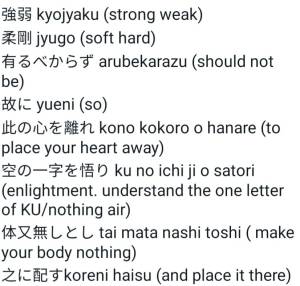
There is another concept called “Kyojaku jyugo arubekarazu” which is practiced as part of the Bujinkan system of martial arts. It states that there is no hard or soft and no strong or weak. It means that there are no dualities. This is used to remove certain misconceptions that practitioners might have after the basics are trained. One of the ways an individual receives an attack (Ukemi) is to absorb the same. This is saying that the defender moves to a position where the force of the attack is low or has been expended. Thus, that particular attack is nullified. So, a hard attack was received and mitigated by a soft response. It is also the same as keeping the joints loose while falling. This allows the impact to be absorbed and distributed instead of keeping them stiff and causing damage to the joints. After this learning, it is possible that practitioners might think of specific soft options against an attack, as against a hard option which could be a block or counter to the attack. This concept is meant to dismiss the artificial distinction. In a real situation, one does what is necessary, absorb, block or counter as the situation demands. There is no distinction or even the need to consider the same.

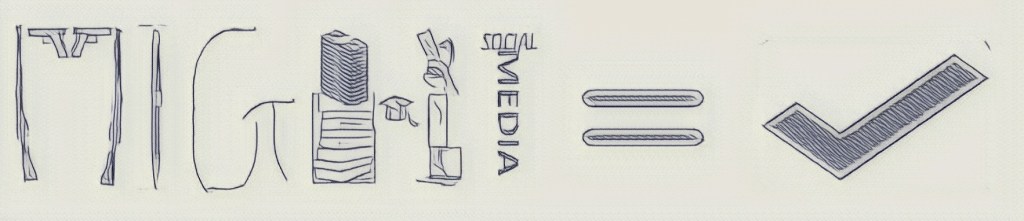
If we apply this concept to the pen and the sword, knowing that they can complement each other, it is also clear that they can be applied to oppose each other. This aspect of using the pen and the sword against each other and the concept of “kyojaku jyugo arubekarazu” is explored further in my earlier article titled “Might is Right, always”. The link to this is seen in the notes below1.

Thus, if knowledge or “bun” or “shaastra” and their medium of transmission, traditions, can be applied as weapons, will an attack on the traditions and knowledge systems not be a valid counter to the weapons? Is this not exactly like attacking the supply lines of an enemy to diminish their fighting ability over time? Just as denying food and ammunition to troops to get them to stop fighting is a long known tactic, diminishing a society by messing with its culture, identity and traditions is also a long used strategy. Culture and identity are deeply influenced by “bun” or shaastra, and affect the application of bu or shastra in defence of the same. If these can be defeated, maybe the source of the conflict can be eliminated. And the origin of the ability to use the shastra can also be defeated at the same time. In any case, knowledge and traditions are legitimate targets in a conflict and also valid and useful weapons.

Narratives are the tools of “bun” and “the pen” in the modern world we currently live in. They are vastly more acceptable, and more importantly, cheaper than actual weapons that cause physical harm. It is acceptable to attack culture and civilization as it not harming an individual’s person physically, at least in the near term. It is however unacceptable to cause physical harm in the world we live in, at least in the countries that have functioning democracies. This is true even though an attack on culture and identity might be equally devastating with effects lasting over a long time. Of course, the effect of the narrative also takes a longer time to reveal itself. And there we have it, weapons of “long time”. This is clearly visible in the points in the previous paragraph. Attacking the knowledge, traditions and identity of a society with a series of narratives, yields results only after a consistent attack of years and perhaps even decades, and might only be evident after a century. Thus, it is a weapon that shows its effects after a long time. Similarly, the effects of this weapon will last a long time, as a counter narrative has to be designed and applied to nullify it. Even realizing that an insidious narrative was at work might take time and any counter comes about only after this. So, the weapon causes damage unopposed and unmitigated for a long time before it is countered.

I have to share a point about “shastra” here. Narratives and “the pen” are tools, which can be used to cause damage. If a tool can cause damage, it becomes a weapon and can be called a “shastra” or an “astra”. There is another term we use in India, called “Aayudha”. An “aayudha” in the Kannada or “aayudh” in Hindi, is a commonly used term for “weapon” in India. But, “aayudha” can also be used to refer to “tools”, as in, “tools of the trade”. We have a festival called “Aayudha Pooja” in India. “Aayudha Pooja” is the festival celebrated on the ninth day (Navami) of the Dasara (Dussehra) festival. On this day, everyone pays their respects to the tools that allow them to earn a livelihood. All of us clean and perform rituals where out tools are considered Gods. We all clean our vehicles, engineering equipment, laptops, pumps, machines, switchboards and of course, weapons and training equipment. We then offer our gratitude to these object for their part in supporting our livelihoods. I am not going into the story about the origins of this festival here.

This shows that an “aayudha” is a tool first and a weapon, if necessary. An aayudha becomes a shastra or astra based on the objective of its use. Based on this observation, a narrative is an “aayudha” more than a “weapon”. It is a tool first; the application of the narrative to specific objectives determines if it becomes a weapon or not.

Earlier, I mentioned that using a narrative as a weapon is not entirely different from attacking the supply lines of an enemy. Achieving this could involve subversion, guerrilla warfare, militia and the like, if not conventional military means. This is classified as “unconventional warfare”. Another example of using unconventional warfare would be misinformation campaigns of various hues. One example of this is the use of the fake army by the allies to make the German troops not be sure if the invasion would begin in Pas de Calais and not Normandy. A similar method is supposedly suggested by Chanakya where one should use the bodies of dead soldiers on battlements to make the troop numbers seem larger than what they really are. Apparently Russia is currently using inflatable tanks to fool Ukranian drones.

Also falling under unconventional warfare is the use of psychological warfare. Examples of this include dropping pamphlets to make soldiers and civilians think their army or country is losing a war and break the morale of the society. If I recall right, US forces during the First Gulf War used audio recordings of artillery and tanks to make Iraqi troops abandon their positions and retreat. This allowed a faster and bloodless capture of territory.

Using narratives as weapons would fall under this category of unconventional warfare. It can be used for all of the above – misinformation, psychological assaults, subversion, misleading populations etc. An example of this that is quoted often in India these days, is how the idea devised by Thomas Babington Macaulay was used to destroy India’s traditional education system in the 19th century, first during the Company Raj and later during the British Raj. Traditional education systems being replaced by a British one with elements of it aggrandizing Western Christian culture caused the populace to gradually accept British superiority and lose pride in its own. This is a problem to this day in India and narratives are bring changed after nearly 200 years of the speech by Macaulay in 1835 in the British Parliament where this attack started. Macaulay apparently wrote in a letter in 1837 that Hindus who receive an English education rarely have reverence towards their own religion.

People who toe a line that looks down upon Indian culture as a whole (nobody says it was all hunky dory in the past or that current Indian society is perfect) are derisively called “Macaulay putras” (sons or more appropriately, Children of Macaulay) in today’s India.

Coming to contemporary times, we are currently in election season in India. Everything is political and everyone is an intense political animal whether or not they openly share their opinions. And this means an intense “war” of narratives is on in our country on all forms of media. And this media conflict includes both domestic (includes Indian media with foreign investment) and foreign media (media originating outside India).

Currently India has what many call a pro-Hindu or a “Right-wing” government. Many others say it is a “Left-wing” government with a veneer of being right-wing. Many a time, it is also called a “Hindutvawadi” or “Pro-Hindutva” government. Both sides (maybe many more than two if we consider the minutiae and nuances of the data used) are convinced they are right.

One major achievement of the current government as seen in all surveys time after time, is that it has made Indians a lot more proud of themselves, their country, their history and their culture. This also means that any doubts that Indians might have had about the positives and glory of their identity and past are diminished if not gone. Further, Indians no longer consider western culture as superior even if the quality of life as seen by various indices of human development are better for the western nations. This aspect is visible in the assertiveness of Indians in various walks of life, governance and foreign policy. Of course, all of this is built on continuous economic development.

As a counter, the outfits opposing the government say that India is not doing great. And the main aspect where India is supposedly not doing great is in “democracy”, “human rights” and “equality”. There are umpteen articles that refer to “India backsliding” in the area of democracy. It is claimed that democratic principles and institutions are under attack in India by the government and that press freedom is reducing as well.

One of the evidences quoted routinely to prove the above are the reports and ratings from Freedom House, V-Dem and the World Press Freedom Index (by Reporters without (Sans) Frontiers – RSF). It is interesting to note that the World Press Freedom Index ranks Afghanistan above India. 😛 As is to be expected, stories and articles using these three sources are considered part of a narrative with the reports being components of the same.

Considering what was just said about Indians being more assertive and confident, there is pushback to the above narrative. And the counter is not just to the articles specifically, but against Freedom House, V-Dem and RSF. The methods used by these organizations is questioned and their motives are under scrutiny. This treatment is true for all the western universities and their statements perceived as “anti-India” as well, especially those emanating from the social sciences and humanities departments (history departments receive special attention). When I say western universities, think Oxford, Harvard, Princeton and the like. Indians rarely take these reports at face value or ascribe much importance to them.

That said, the awareness of narratives and other tools of “the bun” and their potential to affect the progress of a nation is considerably higher these days in India. I am linking a few videos and an article below that exemplify this much better2. These are interviews with Mr. Sanjeev Sanyal, who is a member of the Economic Advisory Council to the Government of India. The article is also co-authored by him. He is a very respected thought leader in the country these days, not just in economics but also in aspects of history. In the video he speaks of how he does not accept the reports mentioned earlier and also how he is trying, unsuccessfully so far, to counter their methodology.

Mr. Sanyal also explains why Indians need to learn to counter the “bun” from the west as it could have an adverse impact on our economic progress. He picks out how a new narrative is being built by western think tanks to ensure that their ideas of democracy and human rights are imposed on the world. He specifically mentions the Open Society Foundation, Ford Foundation and USAid as three organizations funding efforts to impose their ways of thinking on the world. He further mentions how the notion of ESG (Environmental, Social and Governance) is one such concept they are pushing to control the direction which the world intellectual and economic progress is taking.

How exactly can think tanks influence how people think and how economic progress happens? I will quote an example from my personal experience for this. 20 years ago, I was working in the automotive industry. While there, my colleagues and I were working towards achieving the certification “TS 16949”. I am not sure if this certification is still relevant or used anymore. One of the requirements to achieve this certification was that all our suppliers (vendors) had to adhere to and achieve the certification ISO 9001. In case they were not already certified, we needed to get a confirmation from them that they would do so in a defined time.

So, not only were we as an organization committing to practice certain processes defined by an organization that is not our own, we are also ensuring that our suppliers follow certain practices defined by a certifying organization. This was all supposed to be in favour of having uniform practices that improves the industry as whole. The idea is great as a concept. But there is a hitch.

This certification process forces certain behaviours on organizations. And once an organization commits to it, its employees need to too. And to facilitate this, there are training programs that are put in place. And training is like education, it changes the behaviour and way of thinking of those who undergo the same; it makes them CONFORM. There is no guarantee that this adherence to a process does not limit progress in ways that might have happened if left unfettered.

Also, there is the question of who devised the processes defined by the certifying organizations and what their motivations were. They might have all been good and altruistic, but that is not necessary. Ulterior motivations might have existed, or not, but do we know that ulterior motives might have existed that even the ones who had those did not realize? This is the crux of how think tanks can come to control knowledge, its generation and behaviour.

Consider a think tank with massive resources. They can design processes and behaviours and get governments to subscribe to the same. They can do this with pressure through educational institutions and other “intelligentsia”. Governments can get business houses to follow these new norms. These norms can force businesses to only invest in other countries with “specific rankings” in “select reports” generated by “reputed organizations”. Also, they can mandate that businesses only partner with other businesses overseas who also adhere to these norms. And how does one know if the norms “as desired/expected” are followed? Device certifications to ensure the same. And thus, control is achieved as described in the earlier paragraph. When business do not get certified, they lose out on the potential opportunities and over time the economies of nations get affected unless they and through them their businesses fall in line. Once businesses and the economy falls in line, so does the society, if a little later.

This entire process is all about devising and delivering weapons of “the bun” or Shaastra. Once this is achieved, the tools are in place to build new narratives and deliver opinions that are more judgements, which those at the receiving end might never have asked for. Of course, the new narratives use existing ones to build and further themselves. No one has opposition to ideas like ESG. But once the process to achieving them is revealed, the weapon takes shape. Once the weapon exists, a counter to it comes into being by default.

The previous paragraphs represent the “waza” and “kata” (techniques and forms) of narrative weaponry. Before the above few paragraphs, we discussed how there is a counter in India to the narratives using the reports on Indian democracy coming from abroad. This growth of the counter is also understood by the ones peddling it. A great example of this is seen in the video linked below3. It is a video showing a well-known journalist and columnist in India, Mr. Vir Sanghvi. Mr. Sanghvi states that people on the “liberal” side should avoid making statements that provide “ammunition” to the side that espouses “Hindutva”. And there we have it again. He actually calls statements “ammunition”. Of course, he is saying this in the context of a war of narratives, with “Hindutva” on one side and “Liberalism” on the other. Do we need any further evidence that narratives are weapons and have time based outcomes, considering he wants the ammunition to not be provided while we are in election season?

I am sharing the link to two articles below that could add to the narrative of negativity towards the current government. One article speaks of how ethics in the art scene in India is troubled due to the current government and the other one speaks of why nationalism is a bad thing (based on the writer’s personal life experience). My opinion on both articles is irrelevant, these are just used as examples4 5. The links are seen in the notes below.

Coming back now to actual physical conflict, like tense standoffs and wars between nations, I will quote some examples of how narratives and in general “bun” or “shaastra” are used are weapons. Journalist Pravin Sahwney recently wrote an article on the news portal, “The Wire”. Mr. Sawhney is a well-known journalist and domain expert who writes on matters of defence and national security, specifically from an Indian perspective. He recently published a book titled “The Last War: How AI will shape India’s final showdown with China”. I have not read this book6 (link to the book is seen in the notes below). I have read and seen reviews of the book on other news portals and their respective YouTube channels. In the book, Mr. Sawhney supposedly explains how China is far ahead in terms of technology compared to India in matters of defence and will have a massive advantage in the very near future.

Mr. Sawhney, in his article on “The Wire”, was responding to an article by General Naravane on another news portal, “The Print”. General Naravana is a former Chief of the Indian Army. There is a video on the YouTube channel of “The Print” where Genral Naravane details his article7. A link is seen in the notes to this video. A link is also seen in the notes to the article8 written by Mr. Sawhney. In the article, Mr. Sawhney says that apart from the three conventional arms of the armed forces, the Army, the Navy and the Air Force, China also focuses on 3 others areas, namely, cyber, electromagnetic spectrum and outer space. He further states that in case hostilities breakout between China and India, China will severely affect data in cyberspace, to the extent that it can bring civilian life to a halt and cause extreme confusion in the political decision making sphere. This is by making everyone unsure of what data to believe, misinformation in other words. It will supposedly be impossible to trust any data online. I personally understand his observations as an exponential increase in China’s information and propaganda war.

Based on my understanding, the effect on the government and civilians will happen in a short time and the attacks on data will also happen very quickly. So, this is still using “bun” as a weapon, but it is now not necessarily a “long time” weapon. Maybe this is an evolution of narrative weaponry where it can also double up a quick use conventional weapon.

On the YouTube channel of the news portal “The Print”, the chief editor of the same, Mr. Shekhar Gupta, another very well-known journalist of India, had carried out an analysis of the report by the Special Competitive Studies Project’s (SCPI) on future war and how to confront China. The link to this video is seen in the notes below9. In this video, Mr, Gupta explains, from the report of course, that currently persistent conflicts exist below the level of armed clashes. The report essentially states that information and data warfare is constantly on in the world we live in. Perhaps then, even if the weapons Mr. Sawhney mentions are not necessarily “long time”, if they are to be applied and defended against incessantly, they do constitute a “long time” weapon, because, it is operational for a long duration, which is literally always! A link to the actual report is also seen in the notes below10. This report is truly fascinating and I would recommend that everyone, specifically martial artists, read it.

Another term that keeps coming up when looking at the use of information and data warfare is “intelligentized warfare”. It is used to refer to the use of AI and other latest information technology, which affects the understanding abilities of adversaries. This again goes back to “bun” or “shaastra” or knowledge, which evolves into technology and eventually to intelligentized warfare.

A simple example of this from Hindu tradition is when Lord Krishna used a solar eclipse during the Kurukshetra War in the Mahabharata. Arjuna was supposed to kill Jayadratha before sundown or give up his life. When the eclipse occurred, Jayadratha came out from behind the layers of warriors protecting him assuming the sun had set. But alas, it was an eclipse and not the sunset. Arjuna killed him before the actual sunset. This use of the solar eclipse is also seen in the old Tintin graphic novel, “Prisoners of the Sun”, but is a lot more condescending and racist manner. It is this use of information and a narrative that leads to the weaponization of data. In the case of the Mahabharata, the narrative was that Arjuna was doomed as he had failed, since the sun had set, and the precursor to this was spreading the information that Arjuna had taken a vow to kill Jayadratha before sunset.

In the Bujinkan, there are two concepts that are taught. One is “Kasumi no ho” or “the way of fog”. The other is “Kyojitsu tenkan ho” or “switching between truth and falsehoods like either side of a pivoting door”. Kasumi no ho was the theme of the year in the year 2004, the year after “Yugen no sekai” was the theme. Both these concepts refer to causing confusion, doubt and a lack of trust in one’s own ability to achieve an objective (like a hit or a cut or any other attack). I will not delve into these concepts in detail here. But the negative objective of narratives or “long time” weaponry is essentially the same as that seen with these two concepts.

The above examples refer to the use of “bun” or “shaastra” as weapons against “bu” or “shastra”. In other words using narratives to counter conventional war fighting or just fighting ability. This is as simple as laws (read constitution) being a deterrent against physical violence in societies. But there can be cases where “bu” or “shastra” can be applied to counter “bun” or “shaastra”. Physical violence can be used as weapons against narratives. This is especially true when physical violence can be used against individuals or groups that generate or perpetuate ideas, knowledge and narratives.

Consider that the author Salman Rushdie had to face threats of violence for several years. Also, some years ago, there was a spate of murders in Bangladesh, of bloggers. These bloggers were supposedly rationalists and promoting ideas against the dominant religion. In India a few years ago, there were murders of individuals who were considered by many to be rationalists and atheists. These individuals were promoting views against traditions by what many considered belittling the same. This hurt many who had faith. Also, these individuals were widely known to have leftist associations. In all these instances, ideas of a certain kind, which could morph into narratives were stopped or at least slowed down by applying “bu” against “bun”. For details about the example from India I mentioned, I would suggest a book titled “The Rationalist Murders” by Amit Thadani. Again, I have not read the book, but seen a discussion about the same between the author and a popular podcaster. It was a fascinating listen and I hope to get to this book soon. A link to this book is seen in the notes below11.

I have discussed the application of an ability that is different from the one possessed or used by an opponent in my previous article titled, “Might is Right, Always”. A link to this article is seen in the notes below. It could serve as a precursor to this article.

In conclusion, I opine that a narrative is an aayuda, which is “bun” in nature with characteristics from “yugen no sekai”. We humans being tribal creatures, are always looking to achieve superiority or power over the other, whether it is as and over an individual or a group. The reasons may be myriad, but usually involve personal gain or satisfaction or both. In trying to achieve superiority, I would think that the application of violence is the primal expression of us humans. So it is perhaps the very first of the arts, considering even hunting is the use of violence. This violence changed over time, starting with physical violence to being emotional violence and now, intellectual violence, which is what narratives (“bun” and “shaastra”) are fine tuning in our times. Perhaps, this will lead to spiritual violence when “intelligentized conflicts” make us doubt who we are.

Personal note: I post on alternate Thursdays. But I am posting this on a Sunday instead of a Thursday, so it coincides with the start of the Dasara (Dussehra) festival. The next couple of posts are also likely to not follow the usual Thursday pattern, as I would like them to coincide with the end of the Dasara festival and to be during the Deepavali (Diwali) festival.

Notes:

*https://mundanebudo.com/2023/07/20/connect-control-part-2-boons-blessings-curses-the-sakki-test/

**Watch between the 12 and 14 minute mark

+In the Mistborn trilogy written by Brandon Sanderson, “The Final Empire” is the first book. In the series, some characters use a magical ability called “Ferromancy”, which allows the use users to ingest different metals and this act, depending on the metal manifests differing magical abilities. The fictional metal “Atium” when used, allows the “Ferromancer” to literally see the next move an opponent makes. This makes the fight seem one-sided and also like the Atium user is dancing effortlessly and elegantly around the opponent(s). A link to the first book is seen below.

1https://mundanebudo.com/2023/05/11/might-is-right-always/

2Watch between the 30 and 38 minute mark

2Watch between the 08 and 13 minute mark

2Watch between the 1:10 and 1:18 minute mark

2This is the report that explains his stance

3Watch between the 10 and 11 minute mark

4https://artreview.com/what-is-the-future-of-indias-contemporary-art-scene-jana-shakti-modi-national-gallery-modern-art/?utm_source=pocket-newtab-en-intl

5https://www.sapiens.org/culture/india-pakistan-partition-border-ceremony/?utm_source=pocket-newtab-en-intl

6https://www.amazon.in/Last-War-Shape-Indias-Showdown/dp/9391047181/ref=sr_1_1?crid=1YMZRJ0WWC97J&keywords=pravin+sawhney&qid=1697009227&sprefix=pravin+saw%2Caps%2C236&sr=8-1

7 Full video is relevant

8https://thewire.in/security/general-naravane-is-mistaken-strategic-depth-has-no-relevance-against-china-or-pakistan

9 Full video is relevant

10https://www.scsp.ai/wp-content/uploads/2022/10/Defense-Panel-IPR-Final.pdf?utm_source=substack&utm_medium=email

11https://www.amazon.in/RATIONALIST-MURDERS-Diary-Ruined-Investigation/dp/817062357X/ref=sr_1_1?crid=3RE40KV8FW5VM&keywords=the+rationalist+murders&qid=1697048449&sprefix=the+rational%2Caps%2C251&sr=8-1

Kaitatsu Gairouku and Tapasya – How to get help with influencing the Gods

Kaitatsu Gairoku means “do it indirectly”. This is just a phrase from the Japanese language. But it is also a concept that is trained in the Bujinkan system of martial arts. It is understood and applied differently based on the depth and duration of experience of a practitioner in the Bujinkan. Further, this concept is not specific to the Bujinkan. Many martial arts would have this concept with differing descriptions and nomenclature.

As a very simplistic example, consider this. One wants to punch another person in the face. If one has fists raised, the other person does the same, simply to protect one’s own face. In this situation, hitting the other person in the face is difficult, especially if the other person is purely defensive and has no intention of fighting. In case one does throw a punch, the hit might end up on the hands at best, and not on the face.

If however, in this situation, one kicks the other person in the groin, the he or she might double over and also lose focus on the defence of the face. In this situation, the person who threw the kick, might not really need to throw a punch at the face, he or she just needs to keep the fist in the right place, and the other person in the act of doubling over, smashes his or her face against the fist in space. In a way, the person punched himself or herself; it could even be that the person hit the fist with his or her face (obviously, this might never be an excuse with the law! 😛 ). In short, to punch the face, one kicked the groin – the objective was achieved indirectly, by not really attacking the face at all.

Of course, if the person defending moves out of range of the kick, the situation changes. Also, one could punch the hand of the defender and that in turn hits the defender’s face. But the example above was meant to be overly simple and not an exploration of an exact situation.

If we consider this in a more generic manner with training, beginners are taught to move their entire body to effect any movement against an opponent. This is natural where there are no weight categories or rules to control a training encounter, except one’s own awareness to avoid injuring her or his training partner. It is also important as one might be training against a larger, taller, heavier individual. Each situation is unique and requires application of learnings specifically to that encounter.

In such a training scenario, in order to affect the attacker (uke), one should strive to apply minimal strength, and use body movement to cause her or him to be at a disadvantage. This is training to ensure reliance is not only on one’s strength or speed. This is also Kaitatsu Gairoku in a roundabout way. The obvious manner to disadvantage the attacker is to counter attack with strength if necessary, but one uses movement as a substitute. This therefore is doing it indirectly, even if this seems counterintuitive at that instant. Of course, in a real situation where one is in danger, this training is hopefully useful in protecting the person with the training. Also, there is no restriction against using strength or any direct action to save or protect oneself when in real danger. It serves as an added advantage.

When an experienced practitioner is training, other aspects like kyojutsu or distraction techniques, or feints could be considered. Concepts like using timing to “cut the space” to mitigate an attack can also be used. It could even extend after many years of practice to “put something in space”. This refers to doing something, but not specifically to the opponent, it is just done in space, to see if an opening can be revealed that can be exploited. This concept of Kaitatsu Gairoku for experienced practitioners goes hand in hand with concepts like, “do not try to do a technique”, “do not finish the movement”, “keep the connection” (En no kirinai*) and others.

It is essentially a reminder that one needs to stay in the moment and do what is necessary to stay protected and nullify the attack. It is also a reminder to not fall in love with one’s own abilities and knowledge and not try anything actively. This is because an experienced attacker need not leave obvious openings, and worse, he or she might do that to set a trap! It is to remind a practitioner that there is no necessary difference between attack and defence and that one should not label things with past experiences. One only does things indirectly and incompletely at this level with staying alive being the only objective. This realization becomes exaggerated when there is more than one opponent and if weapons are involved (mainly traditional weapons that are not discharged in training, but of course firearms might be involved in real situations).

This realization leads to an iterative understanding that one needs to learn to trust one’s gut feel (Sakkijutsu+), move as necessary (Taihenjutsu) without pride or ego and assimilate the idea that there is no victory or defeat, only survival, so just stay protected (Goshinjutsu). This is doing it indirectly because, now there is no fight or opponent, just a situation to avoid at best or survive at worst. One survives by not being in a fight! This is the epitome of doing it indirectly as one survived a fight by ensuring that the fight did not happen! Not by being there and doing things to survive. Of course, this is a beautiful concept which is incredibly difficult to apply in daily life, not just in training. But it is also intuitively understood by most of us, even without martial arts experience (it also reveals that luck is important in life 😀 ).

So then, how does Kaitatsu Gairoku help with influencing the Gods? In my recent articles**, I have mentioned and discussed how stories from Hindu culture show individuals performing meditation, penances, yajnas and other activities to obtain boons, mainly from Lord Brahma. This boon (vara) grants great abilities to the individual on whom it is bestowed and also protection from various life-threatening people, weapons and situations. These “Blessed” individuals many a time give in to their egos and cause havoc on the planet. Lord Vishnu manifests on Earth in one of his avataras to exploit the “opening” or “loophole” in the Vara and puts an end to the adharmic (I feel it is simplistic to use the word ”evil” instead of adharmic or non-dharmic) activities of the individual.

The path to gaining a boon is very long, hard and even torturous at times. I have gone into this in earlier articles and will not repeat the same here. Anyone who has even a faint idea of stories from Hindu culture would be aware of this. However, there is one aspect of the whole process of Tapas performed by an individual that is not considered in my earlier articles, which I will delve into here.

Many a time, when a determined individual performs severe tapasya (can also be called tapas) for a long period of time, the stories tell us that their efforts cause extreme weather events. Two examples of this would be the tapasya of Hiranyakashipu, father of Prahlad and that of Arjuna, the third Pandava. After Hiranyakashipu had performed tapas for a long time, the whole world started experiencing extreme heat. This caused the Devas, his mortal enemies, to request Lord Brahma to put an end to the tapasya by granting him an audience and hence the boon he desired. Lord Brahma acquiesced and granted Hiranyakashipu an audience and the boon he desired.

Image credit – “Prahlad”, published by Amar Chitra Katha

Image credit – “Prahlad”, published by Amar Chitra Katha

When Arjuna was meditating on Lord Shiva in his quest to attain the Paashupatastra, his meditation caused the areas around his place of tapas to become perpetually covered in clouds. This caused the Rishis who lived in the region to request Lord Shiva to end Arjuna’s tapasya by granting him an audience. Lord Shiva relented and stopped Arjuna’s penance with a physical test. The passing of the test led to Arjuna gaining access to the use of the Paashupatastra.

Image credit – “Mahabharata 20 – Arjuna’s quest for weapons”, published by Amar Chitra Katha

Image credit – “Mahabharata 20 – Arjuna’s quest for weapons”, published by Amar Chitra Katha

In both these cases, the Gods might not have been ready to appear before the individual performing the tapasya. But the effect their tapasya had on the weather caused those who were affected by the extreme weather to beg the Gods to get the tapasya to end. In other words, both Hiranyakashipu and Arjuna worked to affect the weather and thus got the Gods to grant them an audience. They even ensured that those who had regular access to the Gods to further their cause by requesting them to not test the person performing tapasya anymore. So, the tapasya, whose objective was to please the Gods, did so, by causing climate change which affected those who had access to the Gods. These individuals or groups either ratified or provided credibility to the tapasya with their own requests. Did this make the tapasya easy? Definitely not. But did it reduce the duration of the tapasya? And thus the duration of enduring great hardship? Perhaps yes, by a little bit at least. Either way, the demonstration of Kaitatsu Gairoku is clear. To impress the Gods, affect something else (weather) which will affect those with regular access to the Gods and get the tapasya fast tracked. 😀

A few additional points need to be considered regarding the examples mentioned above. The first is that the people who requested the Gods to stop the tapasya of the individuals in essence added their own tapasya to that of the person in question. Is this ability to gain the support of others without meaning to (indirectly 🙂 ) a criterion that the Gods would have considered? I have no idea. The second point is that the effect caused is on the weather, and this is one phenomenon that impacts all life on Earth. So, there is no way the Gods can ignore it and in their concern are given to acquiesce to the requests of the many and the tapasya of the one. This in itself could be a huge relief, as some individuals sacrificed their own body parts as part of the tapasya! &

Was the causing of extreme weather events a deliberate ploy in getting the Gods give the one desiring a Vara an audience? Was this a strategy to decrease the duration one spends in activities that allow one to be in the presence of the God one is trying to please? I have not seen or heard of any explanation that it was. But then, I might be overthinking this. So, I do not suggest that it was a deliberate ploy, nor can I assume that affecting the weather was a required demonstration of the powers of one’s tapas. It is just something that happened. But that does not take away from the fact that, there was a means to indirectly influence the Gods. 🙂

Now we must address the elephant in the room. An individual through human actions plays truant with the weather. This is not in any way possible for normal humans either today or in the past. So, it is possible to dismiss everything in the stories as pure fantasy. But all stories in Hindu culture, apart from the obvious entertainment and explicit transfer of knowledge, also serve as case studies, meant for discussion and assimilation of ideas generated from the same. This identification of Kaitatsu Gairoku in the stories is a case of such a realization, at least for me.

To expand further, this is not unlike the strategies in manuals of war and statecraft. Ideas of opening up a new front to cause the enemy to reduce strength in any theatre of war or waiting out the enemy for winter to damage them, and the use of allies or embedded sleeper agents to weaken enemies, are all known from history. All of these are about affecting an opponent(s) in ways other than a direct attack. So, the notion of Kaitatsu Gairoku is not just a part of stories. I have alluded to all asymmetric strengths in a previous article of mine called “Might is right, always”2.

A non-military or non-martial example of Kaitatsu Gairoku from recent Indian history would be the growth of ISKCON. This example is based on the video, the link to which is given in the notes below3. The video is from the YouTube channel “The Carvaka Podcast”, where the host Kushal Mehra has a conversation with author Hindol Sengupta about ISKCON. The conversation is about the book written by Mr. Sengupta called, “Sing Dance and Pray”1. The book is about the life of the founder of ISKCON, Shrila Prabhupada. According to the discussion, the founder of ISKCON Shri Shrila Prabupada was given a task by his Guru to take the word of Lord Krishna to the whole world. While Shri Prabhupada set about the objective, he apparently had little success in India. Later, he moved to the USA in 1966 and founded the ISKCON as we know it today. It found great success in the US and later this success replicated itself in India. The author and the host on the video agree that the success of ISKCON in India would not have occurred without the same in the USA.

In this scenario, ISKCON had to spread the word of Lord Krishna in the US for the same to happen successfully in India, which is the land of origin of the message sought to be spread and of Lord Krishna himself! This is counterintuitive, as one would expect the otherwise. The general thinking for this is that India at that time at least, sought (and maybe still seeks) Western validation and the USA was the epitome of all things Western. Of course, the USA was and still is a cultural powerhouse and wields enormous soft power the world over. So, ISKCON being embraced by the Americans was validation for Indian culture and hence was embraced here as well. This is perhaps the greatest instance of Kaitatsu Garoku I have come across. In simpler terms, Shri Prabhupada had to conquer foreign lands to conquer (for his ideas of course) his own! Plant a home grown idea far away from home, for the idea to take root at home!!

Of course, this extrapolation of mine relating to Kaitatsu Gairoku is not specific to Hindu tradition alone. I notice and expand more on it, with respect to India, is all. One of my current favourite examples about this concept is that mosquitoes evolved and became the human nemeses that they are, because of a change in the tilt of the Earth’s axis! This is beautifully explained in the short video seen in the link in the notes below++. It is a video from the Youtube channel “PBS Eons”.

The other one is from the movie “Django Unchained”. The character played by Christoph Waltz explains to Django (played by Jamie Foxx) how they cannot go to the slave owner played by Leonardo Dicaprio and say that they want to buy his wife’s freedom. He says that if one wants to buy a horse from a farmer, that might not be keen on selling the same, one does not go asking to buy a horse. For if the farmer refuses, all one can do is walk away. One needs to approach the farmer for something else and in the course of the transaction see if the horse can also be bought, maybe as transport for the individual or the commodity being bought. Buy the horse, but do it indirectly. Eventually they go the dastardly slave owner looking to buy a fighter and try to create a situation which would result in their “accidentally” buying his wife. Thus, buy something else to buy the lady in question, indirectly! (buying and selling people is horrifying even when used as an analogy!) Yes, I am using a fictional example from pop culture. This is just to illustrate that the concept of Kaitatsu Gairoku is considered the world over and in multiple walks of life.

Two personal notes –

With this post, I am completing a year of posting on this blog. I sincerely thank everyone who has read the posts, just visited, helped me with feedback & technical suggestions and just been a part of my life in general and budo practice in specific for making this possible. THANK YOU ALL! I hope I have several opportunities to express my gratitude related to this blog (and otherwise) in for a long time to come! 😀

This post will be go online close to my birthday, and I am someone that loves and appreciates gifts. So, while writing this article, I was wondering how I can indirectly (without actually discussing it) get people to give me gifts 😛 . As it happened, I got a gift I needed and a gift I wanted. A close relative of mine gifted me with an investment opportunity and a buyu identified a source to procure some training equipment I wanted. In both cases, the gifts just happened, with no active planning of the same. It was not magic, but in hindsight, a consequence of research, effort and communication on my part with the individuals concerned, though not with this outcome in mind. Guess the training, effort and luck really do pay off, indirectly. 🙂

Notes:

*https://mundanebudo.com/2023/07/06/connect-control-part-1-connect-control-shatrubodha-in-flow/

+, **https://mundanebudo.com/2023/07/20/connect-control-part-2-boons-blessings-curses-the-sakki-test/

+https://mundanebudo.com/2023/08/31/shabdavedi-sakkijutsu-and-why-charioteers-are-awesome/

&https://mundanebudo.com/2023/03/30/jibun-no-kesu-an-exploration/

2https://mundanebudo.com/2023/05/11/might-is-right-always/

3Video link – watch between the 15 and 18 minute mark.

1Amazon link to the book “Sing, Dance and Pray” by Hindol Sengupta

https://www.amazon.in/Sing-Dance-Pray-Inspirational-Founder-Acharya/dp/0670096733/ref=sr_1_1?keywords=sing+dance+and+pray&qid=1693629007&sprefix=sing+dance%2Caps%2C227&sr=8-1

++Video regarding mosquito evolution

Swaraj and the Lizard (and Ninjas?!)

Today is “World Lizard Day” (August 14th). Tomorrow is the Independence Day in India (August 15th). So, the two were connected (in my head) with a nice little legend from Indian history and I felt like sharing the same. This is unlike my usual posts where I explore the intersections between Hindu/Indian culture and the martial arts (mainly the Bujinkan system of martial arts). I had no idea that there was a day to celebrate lizards! I was told that today was Word Lizard Day by Windows and this new learning triggered this article. There is no specific link between this article and the Bujinkan or any other martial art. But I will definitely make a stretch and try to connect this legend with the martial arts. 😛

In India we share space with a species of monitor lizard called the “Common Indian Monitor”, also called the “Bengal Monitor” (Varanus Bengalensis). It is seen in almost all parts of the country. Along the east coast of India there is another larger species called the Asian Water Monitor (Varanus Salvator). The Common Monitor lizard grows to be between 5 and 7 kg and grows to a length of around 4 feet or a little more. The Water Monitor is almost one and a half times larger in size.

Image credit – someone from my family

The Common Monitor eats small birds, mammals, reptiles, amphibians and eggs of all of these. It is in turn eaten by many species including humans, especially when it is young or in its juvenile years. Young monitors have spots while adults are more a uniform grey. It is not a threat to humans. The largest extant monitor lizard is the Komodo Dragon that inhabits a few islands of Indonesia. The largest ever monitor to have existed, as known today is the Megalania, which once inhabited Australia, but is long extinct (early humans who entered Australia are likely to have encountered this monster).

The Indian Independence Day is celebrated to mark the occasion when the British left our country after nearly two centuries. But the notion of Independence is older as I have learnt it, as India has been invaded by outsiders several times over the last 2,500 years. Most of the invaders assimilated into the existing society and culture after capturing parts of the geography. But some over the last thousand years did not and tried to impose external culture, ideas and ways of life on the existing society. And there has always been an attempt to restore self-rule or uproot the invading powers.

During the time when the Maratha empire was being established, as modern history and popular consciousness teaches us, there was a notion of Swaraj or Swarajya, (I have heard it sometimes referred to as Hindavi Swarajya) which means self-rule or more appropriately as I understand it, “our own rule or our own kingdom”. This notion was to ensure that the lands where the Maratha lived were free from the rule of the Mughal empire and some of the Deccan sultanates. Both the Mughals (Turco-Mongol Timurids) and the Deccan sultanates were of foreign origin and Islamic in nature. The Deccan sultanates were far less foreign, but were defeated and supplanted by the Mughals and the Nizam of Hyderabad (a vassal of the Mughals, who later became independent).

The Marathas fought all these powers over several decades and emerged victorious, supplanting or at least subduing all of them. They were the pre-eminent power in India when the British East India Company started having ambitions of power and grandeur. The idea of Swaraj that the Marathas aspired to is the one I am referring to in the title of this article.

One of the great generals of the Marathas was Tanhaji Malusare, about whom a popular and successful Hindi movie was produced in 2020. He, along with his troops captured the fortress of Kondhana, but Tanhaji lost his life in this battle. The fortress is called Sinhagad today in honour of Tanhaji (he was a lion, which is a Sinh and hence Sinhgad, fortress of the lion). This battle was very hard and the Marathas scaled the sheer walls at night, an act of great daring, before defeating the garrison to take fortress.

There is a legend that Tanhaji and his troops used a monitor lizard to scale fortress walls. I am not sure if this legend is specific to the battle of Sinhgad or if they are supposed to have done so in general, in other campaigns. A monitor lizard has very powerful claws and are good climbers. This is a known fact. So, the Marathas are supposed to have tied a rope to a pet monitor (monitors are kept as pets even to this day in many parts of the world), which then scaled the fortress wall and with its strong claws held on as some soldiers scaled the walls and then helped the rest of the troops do the same. The monitor was, in essence, used as a living, trained grappling hook.

Of course, this is a legend and not real history. I have even seen a name that the pet monitor is supposed to have had! A monitor lizard is called a “Ghorpad” in Marathi. Ghorpade is also a last name used in Maharashtra to this day, and obviously it is used in other parts of India as well with migration over the last few centuries. So, from what I have learnt, it is likely that there was a group of people from the Ghorpade community, who were expert rock climbers/boulderers. This team of climbers scaled the fortress first and led the rest up. The climbers were so good that either they were compared to a monitor, or vice versa. This is an explanation for the legend. Considering that the Marathas were successful in achieving Swaraj, the legend of the monitor lizard is inextricably linked to the creation of the same 🙂 . This is the connection between “Swaraj and the lizard”.

The martial arts of the Bujinkan system are sometimes referred to as “Ninjutsu”. “Nin” refers to “perseverance”. So Ninjutsu is “the art of perseverance (or persevering)”. The Marathas, all through their existence as a power centre in India, from being a small one in the mid-17th century all the way till their fall in the early 19th century, fought in different terrain and against all odds. They mastered guerrilla warfare apart from fighting pitched battles and fighting in the forests and mountains. They also developed a very effective navy.

During the time when Mughal emperor Aurangzeb fought them for twenty six years, most of which he spent in the south, the Marathas fought a running war. Many of their commanders were examples of “living in the saddle”. To fight a numerically superior force, they were extremely mobile and fought as light cavalry, leaving behind their artillery. The Marathas eventually wore down and defeated the Mughal invasion.

There is a wonderful book called “Battles of the Maratha Empire” by Aneesh Gokhale*. In the appendix of this book, Mr. Gokhale lists the battles fought against Aurangzeb. The battles fought were from central India all the way to Tamil Nadu. The Maratha troops literally rode across peninsular India to fight battles. They did this week after week, all their lives, for multiple generations. This is the very DEFINITION of perseverance. Add to this their ability to fight in different terrain and different foes, from the Deccan sultans to the British, each in a different manner, and across two centuries, they are the very picture of the “art of persevering”. So, purely as the definition goes, they were true practitioners of Ninjutsu. Of course, this is only with the benefit of hindsight, but the concept holds as far I am concerned.

Now, I have one last point, on a lighter note. The popular image of the Ninja is that of a black clad warrior who is doing secretive activities like a spy or Special Forces operatives. The ninja is seen in a solitary manner or in small groups. One tool that is fairly often associated with the ninja is the “kagi nawa”. The kagi nawa is a rope with a hook, a grappling hook, used to scale castle walls in Japan (or elsewhere in modern movies). This tool also doubles up as a weapon if the situation demands.

Considering that this article is about a grappling hook (!) albeit a legendary live one in the form of a lizard and an oft represented ninja tool/weapon is the grappling hook (kagi nawa) as well, just revisiting a legend of how a lizard aided in the formation of Swaraj, turns the Marathas into Ninjas! 🙂 Of course, as already stated, this last bit is in a lighter vein and should only be considered inasmuch that it brings one to smile.

I usually post on alternate Thursdays. But considering the Independence Day tomorrow, I am making an exception and posting on a Tuesday, two days before schedule. I will revert to the usual Thursday posts from 31st August.

Notes:

*Link to the book mentioned above is seen below.https://www.amazon.in/Battles-Maratha-Empire-Aneesh-Gokhale/dp/8194509920/ref=sr_1_3?keywords=battles+of+the+maratha+empire&qid=1692008465&sprefix=battles+of+the+%2Caps%2C515&sr=8-3

Some absurdity – If I had to stretch the connections above further, I would link the monitor lizards to martial arts as well. Monitor lizards are found in most of Africa, West Asia, the Indian Subcontinent, South East Asia, East Asia and in Australia as well. Many Monitor species, when they need to establish a pecking order or fight over mating rights, wrestle each other. They grapple while standing on their hind legs with support from their tails. Across almost all the territories they inhabit, humans also have strong traditions of the martial arts, if not specifically unarmed wrestling itself! So, the lizards are as martial as the humans. 😀

Connect, Control – Part 1; “Connect, Control = Shatrubodha in flow”

An interesting connection between Budo and Bharatiya tradition

There are two concepts that are taught in the Bujinkan system of martial arts which are very simple to state but extremely difficult to express and achieve. The two concepts are “Connect” and “Control”. These concepts are mentioned to everyone practicing in the Bujinkan from their early days as practitioners and fairly often. But they are only expected to be practiced in earnest after several years of experience. Let me attempt to express what these concepts mean (at least to me), how they are intended to be understood and the context for the same.

I will start with the concept of “Connect”. There are four other concepts that have been shared as part of the training in the Bujinkan over the last seven or eight years. I have heard these from my teacher and mentors who in turn have heard the same from Soke Hatsumi Sensei back in Japan. These concepts are,

  • Do not use strength (Chikara Janai)
  • Do not fight (Tatakai wa Janai)
  • Match the Uke/opponent (Awaseru)
  • Do not sever the connection (En no Kirinai)

The original Japanese phrases that convey the idea are also mentioned above. There are several practitioners with vastly greater experience than I that have written about and explain each in detail. I would encourage everyone to read the same. I am not going into the etymology of the same and will stick to learning from my own personal training and experience.

When the statements “do not use strength” and “do not fight” are mentioned, they do not in any way denote or promote pacifism. They are referring to how one should not have an ego driving their actions in the fight. Using one’s physical strength might win an individual some fights. But it will not necessarily win all fights. One will always face opponents who possess greater physical strength. In a situation where there are multiple opponents, it is highly unlikely that one’s physical strength will match up to the combined strength of the opponents. Further, physical strength will wane to varying degrees for individuals with age. The well-known and obvious solution to this is the development of skill through a lot of training. Martial skills developed through training augment existing strength and also help overcome the strength of the opponent. It is also a means to reduce one’s own dependence on strength.

With the development of “skill” and a drop in the reliance on strength, one aspect that usually comes up in many martial arts, including the Bujinkan is to “use the opponent’s strength or intention against herself/himself”. This leads into the notion of “not fighting the opponent”. There are also statements that state, “Do not trouble the Uke (opponent)”, “Don’t do anything the opponent does not want to do”, “Let the opponent fight herself/himself”.  All of these lead to the same aspect relating to a physical conflict; “even when in a fight, do not fight”. So, what does this mean?

Based on what I have understood, this refers more to one’s state of mind in a fight than the physical actions in a fight. It has more to do with not looking to do violence against an opponent and not refraining from the same. I have delved deeper into this aspect in my older article, “Ahimsa and the Martial Arts – Part 1”, the link to which is present in the notes to this article, seen below. Not fighting an opponent, in simple terms, means that causing harm to the opponent should not be the objective, surviving the fight with as little damage to oneself is.

The moment the objective relates to the opponent, like “causing harm to the attacker” or “winning against the uke”, the ego takes over and becomes a motive which leads one to focus on a specific outcome. This is because winning or getting the opponent to fall or be locked or hit or get injured have specific definitions which need a series of actions, all of which the opponent will also strive to counter while trying to cause harm to the defender (tori). Getting these actions right is very difficult and leads to a slippery slope which might not be possible to overcome.

However, if survival is the only objective, one only needs to focus on not letting the attack succeed. This makes a lot more space available in a fight. Also, the attacker needs to do all the work, while the defender only needs to get into a safe space, albeit continuously. This moving to a safe position opens up the opportunity to gradually move in a way that causes the opponent to just wear out and stop the attacks or lose the ability to do so, which could be due to losing her or his balance, getting hit due to being open while attacking and the like. Either way, the danger due to the attack is mitigated. In short, while only the uke was attacking, the defender (tori) was only staying alive and not fighting, even if it does not appear so to an outside observer. It was all in the state of mind.

Thus, not using strength is about using skill in a conflict and not fighting is about not having an objective vis-a-vis the opponent, but instead moving to stay in the safest possible space during a conflict. Thus, the skills to develop are, to move oneself physically to a safe place and to not have malice towards the opponent.

There are two parts to developing the ability to move in a manner that allows one to be safe. The first of course, is a lot of training, years of practice and experimentation with different people of varying levels of experience in physical conflicts. This includes armed and unarmed fights with and without armour, depending on what is available. In the Bujinkan, this generally does not include modern day firearms and historical weapons which are discharged. But there are other martial arts that do include these, based on the little that I know of these artforms.

The second aspect is to move exactly when necessary and neither too early nor too late. Moving too early means the opponent can correct or change the attack and moving too late means facing the brunt of the attack. Moving at the right time, or more practically, moving as close to the right time as possible, depends on realizing when the attack is coming and having a sense of what the attack is aiming to do. This knowledge of course, is not exact and the prediction of the same is not a precise science. It is a feeling one gets by being in a conflict and over time becomes a “gut feel” or “intuition”. Thus, knowing the timing and danger of any attack is about being aware of the opponent with the experience of having been mindful of many other opponents in the past.

All of this, in concert, means that one should be able to get a read on the opponent while being in the fight. In simpler terms, one needs to be able to “connect” with the opponent to be able to identify when to move and where to move, to stay safe during a physical conflict. If one can largely be able to connect with the opponent and move as required to stay safe, one will have matched the movement of the opponent and thus mitigated the threat posed by one. This is what is meant by the third concept above, which is “Awaseru”, or, to match the opponent.

If one does achieve Awaseru, the next harder concept reveals itself. This is to keep the connection and not lose it. This concept of keeping the connection is called “En no kirinai”, which roughly translates to “do not sever the connection”. If one can connect with the opponent and match her or his movement, the realization of the same, as soon as it occurs, triggers the possibility of breaking the connection as well.

Awaseru, when it does happen, allows one to reduce risk to oneself while the opponent is expending efforts to reverse this and in all likelihood exposing herself or himself to an attack. This might happen over the course of two or three attacks. Once an opening is exposed, there are two possible situations. The first is to exploit the opening to end the fight if possible. But then, this exploitation of an opening might not work as expected because the opponent is very good or too tenacious. In either case, the fight might not end. This is the second situation.

When the fight does not end, the defender should not press the attack unless there is another clear option to do so. If the attack is pressed without a certainty of success (which is very difficult) the uke and tori have switched roles and the opponent can now exploit openings the defender offers. So, not only has the connection been lost, but the opponent can now apply awaseru!

So, if the opponent continues the fight despite realizing one is exploiting openings he or she is revealing, the connection needs to be maintained, matching needs to continue, until a time when the fight logically ends. The realization of awaseru being successful leads to a heady feeling and a possible superiority complex of being able to carry out a successful counterattack. This needs to be guarded against and awaseru needs to hold firm. This, is En no Kirinai in practice. Of course, all this is easy to put into words, but much harder to practice, for identifying when a fight starts or ends is entirely subjective and depends on the fighters and the situation (space and time) the fight is occurring in. The fight only ends when the combatants genuinely are no longer trying to cause physical harm to each other. The connection with the opponent needs to continue until this happens and even possibly after, to ensure that the lull in the fight is not the opponent regrouping for another attack.

This continuous connect with the opponent is Shatrubodha. And Shatrubodha allows control of various kinds, both on the self and the opponent(s). This is good segue to explore the concept of Shatrubodha in greater detail. A last observation before we switch though.

The first two concepts of not using strength and not fighting are not relevant in the context of sport combat. A fight as part of a sport has many rules to protect the fighters, like time limits, a referee, a scoring system, a defined space for the fight, emergency personnel on standby and most importantly weight categories and segregation between the fighters on the basis of gender*. So, the use of strength is completely valid and fighting is the objective. These aspects relate only to a situation where there are no rules protecting individuals. Of course, this does not preclude using skill in conjunction with strength and this happens all the time. The other two concepts of matching the opponent and keeping the connection is valid irrespective of whether the fight is a sport or not. Great sportspersons use these concepts to achieve great heights in their respective fields. These concepts are useful even in non-combat sports, like cricket, badminton, tennis etc, where matching with the opponent and realizing what they might do, due a connection, helps a great deal.

Shatrubodha is a word I have heard from time to time in India over the last year or so. It is generally used by the non-left way of thinking. I heard it on YouTube first and then saw it on a few sites online. It is said by some that it was used by Chanakya in his exposition on statecraft. But I am not sure of this and have not researched if he really used it as part of his work, the Arthashastra. Nor have I spent time verifying if there is anyone who has firmly linked this concept of Shatrubodha to Chanakya.

Shatrubodha, or Shatrubodh (as it might be pronounced by speakers of Hindi) means “a sense of the enemy”. “Shatru” means enemy and “Bodh” is a little harder to translate. It could mean “a sense of”, but I have also seen it translated as “knowledge” or “perception” or even as “information”. Based on these, I opine that “Shatrubodha” could be considered as “knowing the enemy”. It could also be worded as “having a perception of the enemy” or “being aware of the enemy”.

When Shatrubodha is used in the context of an enemy of a nation or a culture or a civilization, it is used to mean that one should always keep an eye on the enemy however possible. It also means that one should study and research the enemy in all possibly ways, irrespective of whether the enemy is an individual, a group of people, another country, an organization or even just a value system or way of thinking that is inimical to one’s own culture and way of life.

From the perspective of martial arts practice, based on my personal experience with the Bujinkan, “Shatrubodha” is the same as having a feeling for what attack might originate from the opponent and when the same might happen. This is what allows us to practice the angle or distance to use and timing to apply in any movement that is made in defence or to protect against any attack. Over time this is what manifests as “Sakkijutsu” (intuitive ability) in martial movements.

Apart from the timing and distance, one other thing that is used in the martial arts is “rhythm”. Any training session or a fight between individuals or between groups has a rhythm. This is visible even in sport fighting and non-combat sports as well. There are intervals when the fight or action on the field is intense and at other times, it is visibly tentative when the two sides are probing and testing each other. There are times when one fighter is aggressive when she or he senses fatigue or confusion in the other and this could lead to an end of the fight or a change of pace if the aggression fails and the other fighter also senses the change in rhythm and changes tack.

This rhythm is keenly influenced by an awareness of the opponent, by having a perception of her or his intentions and by the experience of what she or he can throw at the defender. This sense of the opponent is Shatrubodha and is a vital part of the martial arts. It could even be expanded to say that this is very important in all conflict management situations, even if it is not related to physical conflicts, like a contentious business meeting, a dispute between relatives or friends and the like.

The “sense of the opponent” is something that needs to be obtained by being open to the opponent, her or his movement, rhythm, intentions and like. This being open to the opponent is nothing but the “connection” or “connect with the opponent” that we discussed earlier. It is not being open to the attack without any protection and thus being open to physical injury or worse.

Also, like we discussed earlier with the concept of “En no Kirinai”, this connection or Shatrubodha has to be incessant, or at least until a given fight or conflict is mitigated to an extent where the probability of any physical or other harm is miniscule. Further, being able to connect also requires not having an intention of hurting the opponent, in other words having no intention of fighting or employing strength and being able to match the opponent. So, Shatrubodha is not about defeating an enemy, but about being aware of the enemy at all times and ensuring self-protection.

We can now consider the other aspect that is key in the Bujinkan system of martial arts, which is “Control”. And “Control” begins with “Self-control”. The concepts of not fighting the opponent and not using strength against the same, is about exercising self-control. Further, matching the opponent and connecting with her or him or them while they try to do one harm is self-control that is very difficult to achieve. The urge to fight back to cause the opponent harm is extremely difficult to overcome. Hence, the need for self-control. The ability to achieve this self-control being very difficult is the reason why it is referred to as an important concept. It is a concept that one chases all through one’s training life and comes close to achieving but never does do consistently to one’s own satisfaction. This last bit is based on personal experience and there might be practitioners out there for whom this is child’s play.

Extending this a little further, the advantage of self-control and connecting with the opponent is that one is supposed to be able to nullify a fight with minimal effort, as against using strength or violence against the opponent. This is not to say that one should desist from violence even if that can save one’s life and is the only option that seems to be available. In such a situation one is of course free to adopt that approach and survive. The objective is simply that, to the extent possible one should try to minimize effort in a conflict by avoiding a fight and strength. Instead try to connect with the opponent and get the conflict to dissolve (this is not the same as defeating the opponent).

So, by controlling oneself, one gains the opportunity to achieve the first concept of “connect with the opponent”. Connecting with the opponent in turn leads to the advantages discussed earlier. A little extension here with regard to “self-control”. In order to control oneself, one needs to know one’s own desires and the need to act at certain triggers. This is the origin of deciding where one needs to control one’s actions and motivations. This act of knowing oneself is called “Swyambodha” or “Swayambodh”. This is the opposite of Shatrubodha. It means “knowing oneself” or “being aware of oneself”. So, Swayambodha and Shatrubodha lead to one another. Awareness of oneself allows self-control which allows connection with the opponent which leads to Shatrubodha, which leads to control of the conflict and hopefully its mitigation.

Like we discussed earlier, when one can match the opponent by connecting with her or him or them, one can move in a manner that minimizes the potential harm to oneself. If this can be done in a dynamic and consistent manner, the opponent has to expend a lot of effort in trying to cause harm to the defender. This effort on the part of the opponent reveals openings that can be exploited. Over time and multiple moves, this danger becomes apparent to the opponent as does the lack of success in the expended effort and hopefully leads to a diminishing of the motivation to press on with the attack. Of course, there is also the option of attacking the openings that are revealed and ending the fight. So, by connecting to the opponent, one can stay safe while making the opponent work hard and unsuccessfully. This is achieving control of the conflict situation; where one is safe and can create opportunities to end the conflict. Connection leads to control and this leads to an even better connect. So, it is a virtuous cycle.

If one has heard many individuals and researchers associated with think tanks or evocative retired personnel from the defence services in India, they all emphasize on one thing. This is that people in defence planning need to, from time to time, research and document all the threats, both internal and external, to the country. Based on this assessment, they need to plan and devise strategies to counter each of these threats over time. Considering that these identified threats evolve continuously, one needs to cultivate and work with experts on each of these identified and potential threats. This is nothing but connecting with the enemies of the country to control the threats and identify ways to mitigate the same. The identification of the threat is Swyambodha here and gathering information about the threats, Shatrubodha. The fact that one studies the threats is the act of connecting with the opponent and devising mitigation plans is the control of the risk posed.

While the above is more of a strategic activity, practicing the same in one-on-one (maybe many-on-one) martial arts training sessions is tactical in nature. Of course, in the latter scenario, it has to happen during a fight while the former takes much longer and might last years or decades. The learning from the martial arts can be expanded to conflicts one faces in life, where it is well known that one should try putting oneself in the shoes of the other, to mitigate the conflict and this starts with a realization of one’s ego.

So, in conclusion, based on the above discussion,

Connect, Control = Shatrubodha (with Swayambodha as a precursor)

Notes:

  1. As part of Bujinkan tradition, we have a Kamidana in the dojo. The Kamidana is an equivalent of the “Mantapa” which many Hindus have in their Pooja Rooms at home. In the Kamidana is kept a mirror, the Japanese word for which is “Kagame”. One of the reasons for this mirror being present is to remind oneself when one bows to the Kagame at the beginning of every training session, that one is bowing to oneself, as the superior warrior (or at least the spirit of one) resides within and the attempt is always to reveal and express the abilities/qualities of that warrior.
  2. A SWOT analysis is similar to Swyambodha with a bit of Shatrubodha thrown in (The “T” in SWOT), while the model of Porter’s 5 Forces could be mainly Shatruboda with an element of Swayambodha thrown in (the aspects internal to the industry or the organization).
  3. *There are of course mixed gender events these days, though they are far fewer than segregated events.
  4. Some senior Budoka I have trained with feel that “self-control” is the only real control there is, for one can never control anything in this universe other than oneself.
  5. A couple of interesting observations relating to Shatrubodha that I have seen in works of fiction are mentioned below.
    • In the final book of the expansive Fantasy series, “The Wheel of Time”, called “A Memory of Light”, one of the main characters, called Matrim Cauthon tells another character that he needs to go out into the battlefield and be in the thick of things to get a sense of the fighting. Matrim Cauton is the finest General in the land and he says this as he feels that he needs to understand the flow of the battle to identify the best moves to be made. This is as good a depiction of “Shatrubodha in flow” as I have ever seen. This could be because the author of the series, Robert Jordan (pen name of James Rigney Jr.) was a veteran himself.
    • In a book written by Fredrick Forsyth, I currently cannot recall which one, a character states something on the lines of Israel’s foreign policy being that there are no countries that are friends, only enemy states and neutral states, and so they will spy on everyone. This is a wonderful expression of always having a keen focus on Shatrubodha!
  6. If one has heard Mr. Rajiv Malhotra (search his name on YouTube and Amazon to have a look at his vast body of work) speak, he often refers to how incredible the Shatrubodha of the USA is. He says that at any time, there are universities and think tanks in the US, which are generating what he calls “disaster literature” regarding other nations and cultures. Here, he refers to how closely institutions in the US study societies and nations other than themselves. They use these observations to generate data regarding the negatives of that civilization which can then be used for information and narrative warfare as and when needed, to further US interests. The above is perhaps similar to how the British back during the days of British Raj studied Indian culture with great interest and used that information not just to govern the country but also to control the populace, by dividing and ruling when necessary and by setting up narratives that showed British culture in a superior light compared to native traditions.
  7. Seen below is the link to the article where I discuss my ideas about Ahimsa in greater detail. https://mundanebudo.com/2022/10/13/ahimsa-and-the-martial-arts-part-1/
  8. Apologies for the wordiness of this article and repeating the same ideas over and over. The flow of a fight and the objectives therein were too important to not emphasize with repetition.

MIGHT IS RIGHT, ALWAYS

Image created by Adarsh Jadhav

In the Bujinkan system of martial arts, one concept that we are taught every so often is “Kyojaku jyugo arubekarazu”. This roughly refers to how there is no hard or soft, and no strong or weak; in other words, it means that there is no duality to explicitly discern. This line is the first of a four line poem1. The entire poem explains how one should not focus on being hard or soft or strong or weak, but instead one should makes one’s body into nothing and replace one’s heart with air to understand enlightenment. This is in reference to a fight or a conflict in general and how one can respond to the same. It refers to the fact that one should not worry about classifying the situation or one’s response, but instead respond as required. In order to do this one should let go of one’s ego, as not doing the same might lead to motives and objectives taking centre stage and skewing what one NEEDS to do with what one HAS TO or WANTS TO do.

This is a wonderful concept. But it is also incredibly difficult to practice in life. There might be times when we all face situations where there are no good choices and hardship has to be endured, because there might be no other option. But is this not a good option by itself? Especially if it allows survival? When I say survival, I mean, not overcoming a challenge or winning over hardships being faced, but dealing with the problem by letting time solve the problem. It is impossible to agree or disagree with this and the answer depends on the actual situation one is facing.

This conundrum reminds one of the statement by the Greek historian Thucydides, “The strong do what they can and the weak suffer what they must”. This was supposedly in reference to a situation where the island of Melos suffered a massacre of all its men and the women and children were sold into slavery*. This was a case where the other option open to Melos was to surrender and agree to Athenian terms. Should they have taken it? Only the people making the decision at that time would know. The rest is all speculation with the advantage of hindsight.

When we refer to the strong and the weak in terms of nations, one aspect that is recognized is how geography is the key factor that determines the same. This concept was expounded in the book “Guns, Germs and Steel” by Jared Diamond published in 1998**. This concept has been expanded further by Ian Morris in his 2011 book “Why the west rules – For now”. There are YouTube videos with simpler explanations of both books, the links to which are seen below, where both authors explain their respective theories. In the video, Ian Morris explains how the geography that bestows an advantage to one nation or region changes over time with technological and social development. So, taken together, the might of a nation depends on the geography and the time period when the same is being considered, as that determines the technological and social level of a nation or civilization.

Once we consider technological prowess, it is obvious that it affects all conflict management in modern times. This includes both military/martial and non-military conflicts. Further, it does appear that “non-military” is itself difficult to define these days. We hear of how we live in the age of fourth generation warfare, where we never realize if a war has begun and if it has ended. It is supposedly a case where a state(s) are perpetually in a state of war, though not militarily, as understood in the conventional sense. This refers to information war that is waged to make a society weaken itself and lose without any need for actual military might being employed, or at least with minimal military effort being required.

This war is waged on multiple fronts, like trade and economic policies, disinformation and narrative warfare on social media and conventional media, social engineering and many others I am not qualified to expound on (there is a branch of economics called “Narrative Economics”!). This means that a new set of dualities is being created (technology, communication, economic ability), which must be recognized and somehow nullified, by doing what is needed (no duality remember! 😛 ).

The feeling from the above information made me consider how no real fight is ever fair. There is always a perpetual attempt to make any conflict as unfair as possible, so that one side gains the necessary advantage to move a conflict in one’s favour. This in turn leads to the aspect I am trying to explore further.

“Might is right”. This statement, many a time, is considered in a negative light. Like, “this is not how it should be! Even though it is”. But when we consider various aspects as we shall below, it is perhaps the ONLY bit of the human experience that is ETERNALLY TRUE.

What is “Might”? It is anything, an ability or technology that allows for superiority between any two objects that are being compared, mainly in the context of a conflict (a fight, for simplicity). When I say “ability” here, it could be physical, intellectual, emotional, financial, experiential (this could relate to both skill and physical ability due to experience or wisdom and knowledge due to experience) or spiritual. The objects we are comparing could be two humans, two groups of humans, multiple humans, multiple groups of humans, humans with any non-human lifeform (plant or animal), humans and technological replacements/alternatives for humans (automation enabling code or robots), two or more non-human lifeforms or two or more technologies. Also, we can comfortably, for the purposes of this article use the words “Might” and “Superiority” interchangeably.

From the list of abilities mentioned earlier, we can make a list of the different types of “Might” that can be discerned. Of course, this list can be expanded as necessary. A simplistic example accompanies each type of “Might” as seen below.

  1. Physical might – The ability to beat up (or injure in any way) someone or threaten someone with physical violence
  2. Intellectual might – The ability to prove someone wrong with a greater quantity or quality or knowledge or logic
  3. Emotional might – The ability to withstand hardship better than another based on one’s upbringing or cultural antecedents
  4. Financial might – The ability to achieve something better or faster than someone else by being able to pay others (human resource) or acquire technology (technological resource) to achieve said something
  5. The Might of Experience (Experiential might) – The ability to either do something better than someone else due to having greater experience in the field of that something, OR simply being able to browbeat someone else by claiming greater experience (including academic antecedents like diplomas and certificates)
  6. Spiritual Might – The ability to achieve a given goal by claiming or appearing to have greater spiritual achievements (like a guru with an initiate in a religious context)
  7. Ethical or Moral Might – The ability to get a march over someone by claiming the moral or ethical high ground (like in a comparison between secularism and fascism)
  8. Technological Might – The ability to be superior to someone by dint of having access to superior technology (like drones making the difference between Azerbaijan and Armenia)
  9. Educational Might – The ability to get a march over someone by having greater knowledge due to a better education or using educational credentials to push one’s ideas through without scrutiny
  10. Communication Might (oratory for example, or great writing ability) – The ability to communicate ideas and concepts with or without a twist so as to make them more appealing than the ideas of others
  11. Might of the Network or Might of Association – This is how one can get ahead by virtue of knowing the right people in the right places (or just consider a trading guild of old)
  12. Might of Numbers – The case where one side is superior simply because it has superior numbers compared to the other side
  13. The Might of any other Skills – This is a catchall phrase for anything I might have missed!
  14. A combination of any of the above types of “Might” – As an example, “technological might + communication might = might on social media” (I personally consider “Culture” in this category, as it is a combination of several factors)

Of course, there are a couple of points to consider when we look at the various kinds of “Might”.

  • Some of these “Might” could influence another type or be very similar. For example Ethical Might, Intellectual Might and Educational Might are closely related and inform one another, as one’s education and intellectual abilities might affect one’s ethical outlook.
  • There is the factor of LUCK that could override anyone of these “Might” and mitigate their use at a given time and space (and therefore all natural phenomena come into play as well).

Now that we have defined “Might” and its various manifestations (at least for now), let us consider how “Might” is applied.

Consider all the times that you went to a team mate with a problem at work because she/he very likely could help you solve a problem. The reason you went to your colleague is because she/he had the ability to help you solve the problem. She/he thus had a little more of the “Might” of knowledge (Intellectual Might) or experience (Experiential Might) as compared with you to solve the problem OR she/he added her/his ability (Might) to your own (Might of association or the Network) in order to resolve the problem.

Now consider all the times you went to a friend for help with anything, especially if you were new in a town where your friend was a long-time resident. Here you are using different kinds of “Might” of your friend which are greater than your own (Experience, Network, Intellect, maybe even Communication and Financial) to help yourself.

Lastly, consider how dependent a child is on the abilities of a parent, where the difference in all kinds of “Might” is too large to even consider.

In all the above cases, the ability or “Might” of one was used for the benefit of another. In almost all these cases, like in most cases in life, when we use the ability of others, it is with an implicit and unstated understanding that we will in future use our abilities to return the favour. Or it is possible that the favour, in other words the “loaning of ability (Might)” is a necessity simply to continue one’s association with the other. Either as part of a team or a family or a group of friends.

So, the key to all cases where we use each other’s abilities is, association with each other. By default if you are associated with a group of people you are not associated with some other groups. At best you are associated better with some groups and less well associated with some others.

This “association” with others is an essential trait of us humans. It is what we refer to when we routinely say, “Humans are a social creature/animal”. But since we associate more with some and less with others, we are not exactly “social creatures”. We are more “tribal creatures”. Humans are a “tribal animal” where we put some people, animals, plants, ideas, behaviours and technologies above certain others. This is how we form tribes or groups with whom we have “greater association” and by extension “greater affinity”.

Once tribes are extant, there is by default an “us and them”, just like with packs of wolves or prides of lions. Once there is an “us and them”, all the above abilities (Might) that were used for helping each other and furthering common goals for “us” will be also be used to cause trouble to and mitigate the goal achievement of the “them” or “Others”. Thus, enter CONFLICT.

Conflict is the main prism/lens through which we observe “Might”. “Conflict” as a term can be used to describe a whole host of situations. From a simple argument between two individuals to vast all-encompassing issues like man-animal conflict or wars – both military and for “hearts and minds” or to “preserve culture”.  Whatever be the scale or scope of a conflict, it is decided by the “Might” of one of the participating parties overpowering the “Might” of the other.

This brings us to the crux of the hypothesis in this article, which is that “MIGHT IS ALWAYS RIGHT”. Put in other words, the mighty one is always right because that is how a conflict is decided. Also, one needs to keep in mind that “Might” is never applied fairly, like was mentioned earlier. And like (or “the same”) “Might” is not necessarily applied against the each other. For example, physical might could be met with physical might, but not necessarily. If fact, physical might is likely only met with physical might in a sport.

In almost all real world situations, it is a case of different types of “Might” applied against each other. For example in a military conflict, one side might choose to apply “Communication Might” with propaganda against the “Technological Might” of the other side(s). Hence the term “Asymmetric Warfare”, where the involved sides use different abilities to counter each other in a conflict. This is especially true when one of the sides in a conflict can bring to bear “disproportionate power” on the other side(s). This is when one side is vastly “Mightier” than the other in a specific “Might” (say conventional military strength or martial prowess).

Of course, conflicts are not always decided/resolved (they might eventually be), but for the most part they are managed; hence conflict management. A conflict might not be decided for years on end and in the interim they are only managed, where all parties involved in a conflict try to nudge it in a direction favourable to them. In this situation, “Might is Right” plays a key role, as we shall see further.

When one of the sides in a conflict (which could simply be a difference of opinion) chooses to use a said ability (Might) to nudge a conflict in a direction favourable to it, it almost always is done by ensuring that the ability it has a surplus of, is the factor that is used to further the conflict.

For example, consider a lot of the debates that happen on Television today. The conflict here is that one set of people speaks “for” a topic and the other set speaks “against” the same. The ability or “Might” that is supposed to be used by both sides is “Communication Might”, where the side that communicates its point of view better is supposed to be the winner. One cannot choose “Physical Might” against “Communication Might”. So one of the debaters cannot get irritated and beat up the other and thus win the debate as the other side is physically incapacitated to put forth a point of view.

So, by this setting of rules, it is clear that the side that carries the day is the one that can make its point of view seem correct or superior to that of the other side. Thus, even if the other side has better points or is actually correct, it loses the conflict simply because it could not communicate as effectively as the side that won. In other words, the “Communication Might” of the losing side was lower.

The example used here is of an artificial construct, much like an MMA bout, where no kicking the groin or gouging of the eyes is allowed (in a real street fight these rules do not hinder the fighters). Similarly, in the real world where people make up decisions on Government policies and performance, TV debates might not be last word, since the losing side there might be the one that gets accepted despite being low on “Communication Might”. It might get accepted because it was high on “Emotional Might” or “Might of Experience” wherein the audience connects better with the losing side at an emotional level or its experience might match more closely with the losing side as compared with the winning side. This is where the terms like “Silent Majority” and “Lack of connect” come from.

Consider debates on TV or even Social Media (Twitter, Facebook, YouTube, Instagram) on Government policies, secularism, democracy etc. The point of view that wins on the debate might be the one with “Intellectual Might”. But the one that wins in an election might be the one with greater “Emotional Might”.

Here a large majority of the population might simply not care about secularism, due to past experience (Might of Experience) or a lack of knowledge (lack of “Intellectual Might”). Individuals from this side might never be able to take a considered stand on any fora of debate and discussion for lack of communicative ability that the other side with greater intellect can comprehend. But this side knows that it has the numbers and does not need to convince the other side in a discussion, it does not even need to participate in a discussion! Thus, the side with “Communication Might” and “Intellectual Might” will end up losing against the side with “Emotional Might”, “Might of Experience” and “Might of Numbers”.

Based on this, it is important to understand that while use of a given ability to manage a conflict favourably is important, it is even more important to determine if the ability or ”Might” being used is the right one.

One side in a conflict might choose to ensure only the ability it has an abundance of is used, but it needs to recognize that if this move fails, it has an option to fall back on temporarily or develop the other abilities needed to manage the conflict in its favour.

Consider this. We usually find a lot of umbrage on various fora about the use of violence in various parts of our country (remember all the lynching and our outrage at the same?). This violence is an expression of “Physical Might” and “Might of numbers”. The outrage against this is an expression of “Emotional Might”, “Intellectual Might”, “Communication Might”, “Technological Might” (social media platforms are technology). These latter forms of Might are unable to vanquish or even mitigate the expression of the former for an extended period of time.

This is because there is an asymmetric expression of abilities here and one set of abilities comes out on top of the other set of abilities. This is despite the sides that use the respective abilities being disproportionately superior in those specific abilities, to the other side. The mobs that perpetrate the lynching can never hope to match the communication or technological ability that the ones displaying outrage can. At the same time the ones wanting an end to mob violence can never match the physical might and numerical superiority of the mobs. In the “Emotional Might” and “Intellectual Might” areas there is no telling which side is superior, both can believe the same, but the greater numbers on one side might tilt these two “Might” in their favour.

This asymmetry comes forth due to the state of our society and state. In a democratic state like ours, violence is supposed to a monopoly of the state (police, defence forces, paramilitary forces etc.). And all grievances any individuals or groups have against one another are supposed to be sorted out through dialogue, within or outside a defined legal system. This precludes “Physical Might”, and incentivizes “Communication Might”, “Intellectual Might” and “Financial Might”. But the abilities of institutions of law and order and the legal system might not be able ensure that these incentives work. This becomes exaggerated if other institutions within a democracy are not fair and robust. Thus, “Physical Might” and the “Might of Numbers” never get mitigated.

These are problems in most democracies with large and diverse populations. The law and order machinery and the legal system cannot ensure a proportionate distribution of “Might” in any conflict management. Thus, individuals and groups resort to using any “Might” that can get them ahead.

There is one aspect we must consider specifically while using examples from a civilian and societal context and not a military one. This is the issue of EGO in conflict management. Almost all of us believe we are in the right when we consider an action or argument when it comes to conflict resolution. This is obvious in any debate on TV or social media. The belief in correctness is usually associated with a belief in having “Moral or Ethical Might”. Simply put, we believe, we have the moral or ethical high ground and hence we are right.

The concern is that even though I have listed Moral or Ethical superiority separately, it is really a combination of emotional, intellectual and experiential abilities at least. It might involve technological and financial abilities as well. All of these aspects inform the information we gather and how we process it to arrive at a specific argument or action, that we consider correct and of a superior moral/ethical quality.

Unfortunately, there never need be any agreement on who is right due to moral or ethical aspects. It is not even necessary to agree on who is right in legal aspects. There only needs to be a belief in being right. This belief leads to using other forms of “Might” to ensure this belief is sustained, if the belief has any advantage attached. These advantages could be material like class/caste privilege, subsidies, reservations, or any other.

When an individual or a like-minded group is threatened in their position of correctness or moral high ground by another, they will do anything to not let that happen, so as not to lose the other benefits associated with the previously held position (even if it is just the ability to congregate in a certain way or practice a religion in a certain way). When their belief system is threatened, their EGO is threatened and in order to protect it “Moral or Ethical Might” is always either substituted or supplanted by any other form of Might. Perhaps, Moral or Ethical aspects are altogether irrelevant and only the other abilities are brought to the fore.

Based on the above observation, perhaps the best way to manage a conflict is to be perpetually adaptable. Never fall in love with your favourite “Might”. Always know when it is not working and has to be replaced with a different one. Accept that disproportionate use of any Might is the norm and the response almost always has to be asymmetric, with a different type of “Might”. In other words, like any martial system teaches, learn to overcome EGO. This brings us full circle, back to “Kyojaku jyugo arubekarazu” and the following lines in that poem. Do what it takes, and let go of ego.

One cannot afford to disparage the “Might” that the other side is using even if one feels it is wrong or despicable. That “Might” is being used because it works. See if you can use the same in a “purified” manner (for example do not sermonize the opposition in a debate, treat them as equals even if they do not do the same). And always be ready to change the ability you are using. This might help survive an onslaught or move the conflict in one’s favour.

Lastly, all this means, “MIGHT IS RIGHT, ALWAYS. ONLY THE KIND OF MIGHT USED CAN VARY”.

Notes:

Guns, Germs & Steel – Part 1

Guns, Germs & Steel – Part 2

Guns, Germs & Steel – Part 3

Why the West Rules – For Now

*I am using a common form of this statement. It is very possible that people might have an opinion that the actual Greek statement is not so simply translated and has some nuance to it. But I am using this statement as is for the purposes of this article.

**There are many who do not agree with this theory as is and have specific criticisms of this theory. I am using the theory as I understand it, as it is presented. The criticisms, as far as I can understand do not affect what I am trying to express here by much.

1The entire poem and its translation is seen in the image below. Translation is courtesy of my teacher Shiva Subramanian and my buyu Priyadarshini Mahalingashetty. They in turn translated it from a calligraphy by Nagato Sensei, one of the foremost teachers in the Bujikan system and I was told that it was translated for them by Masako Kawai. Thanks to all of them!

An Ode to the IBF (Indian Badminton Federation)

India won the bronze medal last week at the Asian Mixed Team Badminton Championship. Also, India won the Thomas Cup for the first time in 2022. Both of these are moments of hair-raising exhilaration! And as we rejoice in these fantastic achievements of the athletes and the women and men in their support ecosystems, I would like to share an experience from the first half of the 1990s, which in my personal opinion is the pivot that created an ecosystem that produces champion badminton players in India.

In the early to the mind 1990s, somewhere between 1993 and 1996, if I recall right, there were two badminton associations in India. One was the old BAI (Badminton Association of India) and the other was the IBF (Indian Badminton Federation), if I recall right. The IBF was an upstart rival that was formed due to the ineffectiveness of the BAI. The IBF was formed by the great Prakash Padukone.

The IBF, as I remember, was formed in protest against the BAI, which by then had become fairly ineffective and was of no use to players. It had a president emeritus at the time. Prakash Padukone formed the IBF as a rival to the BAI and almost all players supported it unanimously. Everyone became a member of the IBF and rejected the BAI.

This was well before the era of social media and though it was widely reported in the print media of the time, it was not big news on television, which had not yet seen a spurt in the number of private channels. There was only the behemoth of the old Doordarshan which I do not remember reporting this issue with any great zeal. Also, this was a time when India was not a sporting nation and had no celebrated sporting heroes. Even the men’s cricket team was having a tough time in this period. So, all this led to this epochal protest in Indian badminton not being remembered much these days, when Indian badminton is a world powerhouse.

At around this time was also formed the PPBA, the Prakash Padukone Badminton Academy in Bangalore which was based out of the Canara Union badminton courts. The construction of the KBA stadium was still in progress back then, according to some, at a glacial pace. The PPBA tutored the most promising players from many states among both men and women. This was the foundation of really good and modern training ecosystem for the game in our country. Aparna Popat, Manjusha Kanwar and many other great players who were forerunners of the champions of today were among those who were a part of the PPBA in its early days. Apart from Prakash Padukone, Vimal Kumar, another legend of Indian Badminton was also a leading light of both the PPBA and the IBF.

The success and popularity of the IBF and the PPBA led to the capitulation of the BAI. The old dinosaur went extinct. The president resigned and the post was offered to Prakash Padukone, who, if I recall right again, held the post for some time. Once this change took place, the IBF was dissolved and merged into the BAI to resume the existing continuity from before the revolt.

Also, with this change, the BAI morphed over time into the proactive organization that exists today. Whether or not it is a model sports organization, it is a huge improvement over the old one. The modern sports ecosystem that was created, nurtured and improved over time has produced the crop of champions we all know and love, from the second half of the first decade of the twenty first century. I am penning down these thoughts because as successful revolts go, I can think of no other in the sporting arena. Nor can I think of any rebellion or protest in any area of life that achieved all its objectives and changed the entire ecosystem for the better. Perhaps Prakash Padukone and Vimal Kumar, in my personal opinion, are far greater heroes of this nation for this monumental institutional reform, even more than for their sporting achievements.

All hail the IBF!

“Saino Tamashii Utsuwa” and Shekhar Gupta’s Bell Curve theory of insurgent violence in India

Shekhar Gupta (currently the Editor-in-Chief at “The Print”), a very experienced and eminent (according to most) journalist of India has a theory regarding the lifecycle of violence due to insurgencies. He calls it the “Bell Curve theory”. This theory of his is a part of the inspiration behind this article.

Of course, as the title suggests, this write-up is also inspired by the term “Saino Tamashii Utsuwa”. This was the “Theme of the year” in the Bujinkan system of martial arts, for the year 2009. Saino Tamashii Utsuwa translates as “Expand (or add on to – Tamashii) the vessel (Utsuwa – referring to the capacity of the vessel) of your abilities (Saino)”. In simpler terms it means expand your abilities or skill sets. Considering the Bujinkan is mainly a system of martial arts, this meant, improve your skills or fine-tune your skills, or increase your skill set. It also could mean improve your ability to withstand or endure anything (this could relate to the soul which might represent endurance, patience and other abilities that cannot be objectively measured, but subjectively assessed).

The “Bell curve” Mr.Gupta uses as part of his theory is the normal bell curve used in statistics. He observes, based on his several years of reporting on various insurgencies in India in its different parts that the violence due to these insurgencies follows a Bell Curve. These insurgencies include the ones in the North-East – in Nagaland, Tripura, Mizoram and Assam, in the North – in Punjab and Kashmir and in the South, Centre and East of the country – in the Naxal affected states.

He observes that all these insurgencies start small, when they are not yet a matter of concern for the State (central and state governments). They then grow larger and more violent and eventually a peak of their violence is reached corresponding to the peak of the Bell curve. This is when the State has recognized the threat and trouble of the insurgency but the response to it has not yet reached the peak of its efficiency and effectiveness.

The next stage is when the response of the State, with its military, paramilitary, police, intelligence agencies, media narrative, revenue enforcement and logistics deprivation through all of the above, becomes overwhelming for the insurgents to handle. This forms the falling part of the bell curve, corresponding to the reduction and tapering of the violence. It also corresponds to the State and insurgents beginning a dialogue which eventually results in the end of the bell curve, when violence ends, and a political process begins with a permanent solution taking hold over time.

Sensei Hatsumi Masaaki, Soke of the Bujinkan system of martial arts (he has since handed over the 9 schools of martial arts that comprised the Bujinkan to different and new Sokes) had a system where he would announce a theme for every year. This indicated what the focus of training would be for the next year. This was a practice from around 1993 all the way till around 2016. After 2016, the generic focus has been “Muto Dori” until the pandemic disrupted normalcy.

Some of the themes were tangible and external, like a weapon (Bo, Yari, Naginata etc.) or a style of fighting (taihen jutsu, koppo jutsu, kosshi jutsu etc). But sometimes the theme was more abstract, a concept more than a physical aspect (Saino Tamashii Utsuwa, Rokkon Shoujo, Kihon Happo etc). The theme for the year 2009 was “Saino Tamashii Utsuwa” (sometimes also called “Saino Konki”).

The expectation for the year based on the theme was that the practitioners of Bujinkan improve their skills, in scale and scope. For example, if someone was good with the sword and not the spear, he or she was expected to improve with the spear while fine-tuning their skills with the sword and also to not let it diminish while the other skill is being enhanced. It was also expected that everyone also brush-up on to what they already knew but had lost partially over time. In other words, if the practitioner of Bujinkan is a vessel and that vessel is full to a point with certain skills, they were expected to not only add to the vessel, but also ensure that the size of the vessel increases and is added to, at the same time.

There is an obvious and simplistic observation to be made here. The bell curve looks like a mountain, but when it is turned around, it looks like a vessel. And any vessel is representative of potential or opportunity, as represented by the space in a vessel which can be filled.

This vessel that is represented by the “Utsuwa” in the theme, is also representative of the ability of the Indian State to always increase and improve its own capacity, in its soul and its abilities to deal with challenges of any nature as the State grows, ages and gains collective experience and wisdom. The challenges can be anything; economic, social, political, military or climatic. But here we look at this concept with reference to the insurgencies that Mr. Gupta refers to in his theory.

One should watch the videos on the YouTube channel of “The Print”, where Mr. Gupta explains the bell curve theory. He does a wonderful job of elucidating the same very eloquently. I will try and capture the key points from the theory here.

The early part of the bell curve is one where the State is not reacting to the insurgency as it does not seem much of a problem. But the problem and violence grow in brutality and in the number of incidences of violence. Eventually it reaches a peak when it seems that there will be no end to the increase in the violence. When things are at this peak, the State has already started responding, but while successful in many instances, it does not seem to be successful in reducing the instances of violence or mitigating the cause of the insurgency. This is true in all the following examples of insurgency against the Indian State.

The militancy in Punjab started in the early 1980s and was unabated all through that decade and it peaked in the years of 1991 and 1992. But it waned to being insignificant in the years after 1993. The militancy in the erstwhile J&K state started in 1989 and was unabated through the early 1990s. After this, the violence has diminished greatly. While it still exists today, it is a single burning home (a tragedy nonetheless) compared to the conflagration of the early 1990s.

The insurgencies in the Northeast started in late 1940s and are not yet completely over. But each state in the region had separate peaks and mitigation of the violence. Each state in the region also dealt with the local issues differently and at different periods of time. The insurgency in Mizoram peaked in the 60s and 70s and ended in the 80s. The same in Tripura ended in the 2000s. The insurgency in Assam was at its peak in the late 1990s and early 2000s and has abated to a large extent since. The insurgency in Nagaland has timelines similar that in Assam.

The greatest internal security threat as described by Dr. Manmohan Singh, the activities of Naxals, is also still going on, but is much diminished from the last decade. Though extremely brutal acts still do occur against CRPF personnel, these are reducing in number. The scale of the Naxal problem is vastly greater than the other insurgencies. It encompasses several states. In the words of Mr. Modi, Naxal activities extend from Tirupati (in Andhra Pradesh) to Pashupati (the Pashupatinath temple in Nepal). But the number of districts affected by Naxal activities has reduced significantly in the 2010s.

Mr. Gupta explains that all of these have followed the bell curve and are at various stages on the downward trend currently. The reasons for this are many. Mr. Gupta explains a few of the reasons and some are evident from various media reports over the last few decades, which show the strategies deployed by the Indian State.

In many insurgencies, the Army was deployed initially to deal with the surging violence. The army itself was not trained to deal with insurgents as against conventional enemies. The Army itself had to learn the skills to deal with the problems and also put in place procedures and mechanisms to deal with the problem in different geographies of the country. This also meant they had to start schools in different parts of the country to train troops to deal with the different types of scenarios, in some cases learning from and sharing knowledge with Armed Forces of other countries. Overtime, State Police forces learned specialized skills to deal with the different types of insurgencies and the Central Reserve Police Force (CRPF) also gained a lot of the skills to free up the Army for their more conventional roles.

All of this was backed by learning, building and putting in place structures and resources for continuously improving Intelligence Agencies which led to reducing casualties in the armed response units and reducing collateral damage in any operation. This also led to a greater understanding of what steps could be taken to mitigate the causes of the militancy and also open channels of communication with the insurgents.

With this started a virtuous cycle. The Indian State started with better transport and communication infrastructure which not only helped the armed units but also started off development opportunities in the areas affected by insurgencies. It helped affected communities, specifically tribals (adivasis), interact more with their fellow citizens. It brought better primary education to areas previously left behind. And this led to a greater understanding of the causes of the militancy and a fine tuning of the strategy to counter the same.

With better infrastructure, education and out-reach came the opportunity for more commercial development in underdeveloped areas, especially in the case of Naxal areas, where mining was always a huge opportunity. With development came the challenges of equitable distribution of the benefits, which is still a work in progress, but definitely forward progress.

Another area of the fight (skill set if you will) that the Indian State had to learn and fine tune all the time was the narrative battle and the response to it on many fronts (now there is a stream of economics called “Narrative Economics”!). The State had to firstly counter the narrative of grievances that the insurgency was peddling in almost all examples. This was to break the support the militant received from the locals, who would only do that if they saw examples of development and bought into the path of progress promised by the State. Also, the State had to convince its other citizens, who lived far away from the insurgency affected areas and were not affected by violence, that they were firstly not the villains of the story and that they were taking the right steps as the situation warranted.

An aside – Could the entire arena of narrative combat be akin to the concept of “Kyojitsu Tenkan Ho” that we train in the Bujinkan?

 Once the State had better prepared armed units, intelligence gathering, infrastructure and narrative combat skills, it could choke the logistics of the militants, mainly because the support of locals in the supply chain diminished.

With all the above additions to a State’s abilities, the insurgency was now on the receiving end. This opened the door to creating amnesty and rehabilitation opportunities for militants that would surrender, give up arms and revert to the mainstream of the nation’s citizenry. Once the option of giving up arms without consequences was opened, the virtuous cycle gathered pace and led to greater interaction with inhabitants of the insurgency affected areas, and gave greater momentum to back channel communications which became full-fledged talks to end the insurgency. *This is like allowing an Uke the option of ukemi and disengagement from the fight.

Now that bringing people back from militancy has been mentioned, Mr. Gupta makes a very interesting observation. Apparently, the Indian state avoids killing the top leadership of an insurgency. It does eliminate lower level operatives when necessary, but does not go after the top leadership, because they are the ones who can be negotiated with and convinced to join mainstream politics. This method has apparently resulted in insurgent leaders in the North East, J&K and Punjab joining electoral politics and becoming ministers or even chief ministers in rare cases. Once this happens, the insurgency ends and political processes can take over. When a political process takes over, leaders are held responsible for development. This apparently leads to a populace getting addicted to peace, so long as there is a “peace dividend”.

The “peace dividend” refers to development that improves the quality of life and increases prosperity for a populace over time. This requires actions of the State that are not specific to countering an insurgency, but activities that are of great benefit to all the people in the country as a whole.

This includes activities where schemes of the State are delivered with not much leakage of benefits, and to the sections of a population that need them most. And if there is specific development like mining in an area with Naxal influence, the benefit from the mining should be visible and reach the locals of the area specifically. Of course, if this sounds like a welfare state, then the State needs continuous and large economic growth to have the resources to distribute. This should go hand in hand with protection of local cultures and the inhabitants should not be inundated with a migrant population, to alleviate fears of a way of life being threatened. This is true whether it is the North East, Punjab or J&K, for all parts of the country have a lot of pride in their respective ways of life.

These general development activities bring to mind two other concepts from the Martial Arts. One is “Rokkon Shoujo”, which means “clear laughter is the greatest reward”. This essentially means the focus should be on happiness, and the focus of a State’s activities should focus on the happiness of a populace. So, this is not specific to counter insurgency, but to general development as a whole.

The second is “Kaitatsu Gairoku”. This means “doing things indirectly”. It refers to a feint in the martial arts that could lead to creating an opening against an opponent. So, The State focuses on economic development, and its equitable distribution and this weakens insurgencies by its very nature. This is weakening an insurgency by focusing on something else. This is a classic example of defeating an insurgency with indirect actions.

Of course, Rokkon Shojo and Kaitatsu Gairoku are deeper concepts that need to be explored with separate articles with more clear examples. Nevertheless, these actions of the State go on to show that a State not only adds to its learning and experience with specific aspects relating to dealing with a violent insurgency, but also incorporates concepts that affect the solution to the violence without direct measures. This is similar to learning a concept in the martial arts as against a technique and applying it with any other weapon or technique.

In conclusion, each of the above points, is an ability learnt by a government, expanded upon with the past experience and knowledge (of previous administrations), by successive governments. To simplify, the Indian State can be considered the budoka and each of the strategies applied against an insurgency represents an increase in its Utsuwa of responses. The soft and hard strategies are the Saino, both of which are always being increased (tamashii).

Of course, all the learnings and techniques of the Indian State is not to imply that these are the only ones out there. Several countries have faced and either defeated or mitigated armed insurgencies of varying scales in the last century. These insurgencies were of both right and left wing extremists, a small number of examples of this are the Red Brigades in Italy, the Red Army Faction (Bader Meinhof Group) in West Germany, the OAS in France and the Provincial IRA in the UK. But the scale and number of violent insurgencies faced by the Indian State is vastly greater, as is its resolve (more space in the Utsuwa) to never give in, take all hits it has to (in lives, in the media, narratives, economy growth etc.) but always survive and emerge stronger – a much larger and accommodating vessel. Just living in this country, and knowing this history is a great walk through the concept of “Saino Tamashii Utsuwa” and motivation enough to practice the same, at least in the dojo.

*As mentioned in the article “Ahimsa and the Martial Arts – Part 3”