Lord Hayagreeva – An Indian perspective through Budo, of the “Year of the Horse”

February 17th is the Chinese New Year. This year is the year of the Horse, specifically, the Fire Horse. A search on the internet will reveal several pages and AI responses that mention several traits and attributes that a Horse, and more specifically a “Fire Horse” represents. But as a Hindu and a martial artist, the things that come to my mind when I think of a Horse as a symbol, are Knowledge and Martial culture.

When I think of a horse as an animal, things like speed, grace, strength, symbiosis come to mind, apart from history and, wait for it… confusion. Speed is of course synonymous with horses due to their ability to run over long distances. Modern horses, thanks to selective breeding practices, can be pretty large and therefore remind us of strength – think Shire Horses! Anyone who has watched any dressage or equestrian event will tend to agree that the gait of a horse is grace personified.

Horses have worked with humans for many millennia now and we have grown up on a staple of historical epic films and books showing horses and humans bond and participate in war and overcome travails – thus Symbiosis and History. Confusion is a trait specific to horses in Indian history I suppose. 😊There is a debate about when the horse was first present in India and if it was present during the Harappan civilization.

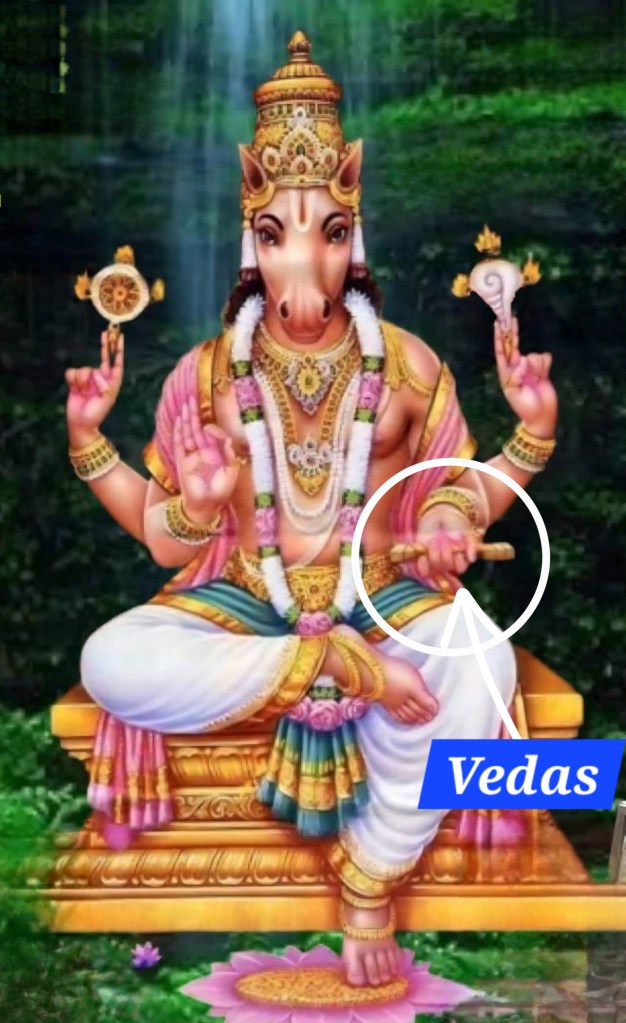
Now, when I think of the Horse as a symbol, the first thing that comes to mind is Lord Hayagreeva (sometimes spelled Hayagriva). “Hayagreeva” means “with the head of a horse”. Lord Hayagreeva is an avatāra of Lord Vishnu who is depicted with the head of a horse. Lord Hayagreeva, based on what I know, is always linked to Knowledge.

An image of Lord Hayagreeva. I unfortunately do not know who the artist of this image is.

This avatāra is not one of the well know Dashāvatāra. But Hayagreeva seems to be closely linked to the Matsya avatāra, which is the very first avatāra. The Matsya avatāra is the one when Lord Vishnu incarnated as a fish to save King Manu from the great flood at the end of a Kalpa. Some other important people, flora and fauna needed for the revival of civilization after the flood were also saved. This story is similar to other flood myths around the world.

The Fish imparted knowledge to the Rishis who were saved along with Manu so that they could use it in reestablishing civilization once the flood subsided. I have heard it said that this exchange of knowledge also became the origin of the Matsya Purana. Now there are 2 Hayagreevas I know of from the stories related to Age of the Flood.

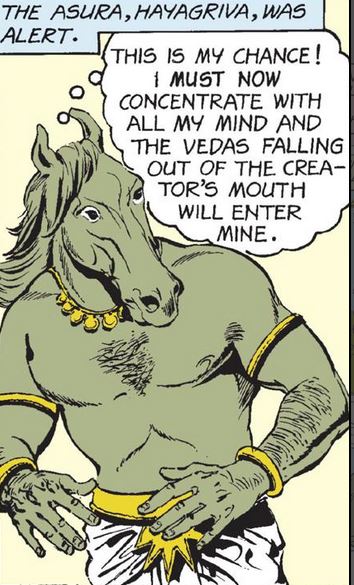
One is a an Asura named Hayagreeva, who also has the head of a horse. Hence, he can be referred to as Hayagreevāsura. The great flood was the time when Lord Brahma was resting before beginning the work of creating the new world after the flood. As he was resting, Lord Brahma yawned, and when he did so, the Vedas escaped his being. The watching Asura captured the escaped Vedas and hid himself in the waters.

The Asura Hayagreeva. Image credit – “Dasha Avatar”, Kindle edition, published by Amar Chitra Katha.

The Vedas represent knowledge and wisdom. These are invaluable and can cause havoc in the wrong hands. The Matsya that saves King Manu also kills Hayagreevāsura, ensuring that the Vedas are safe. This is one case where Vedas, or Knowledge, are associated with the Horse.

In another story, Lord Vishnu is in Yoganidra, the rest between epochs, during the time of the great flood. Two Asuras, Madhu and Kaitabha are born from his ear wax. There is a variation of this story where the 2 Asuras are created by Vishnu himself from a drop of water each. This is a callback to the fact that there is water everywhere at this time.

The Asura Madhu represents Tamas or darkness, supposed to be inertia that resists change. Kaitabha represents Rajas, the state of activity that represents restlessness tinged with darkness. These 2 Asuras gain a boon that they can only be killed when they so choose. With this protection, they go on to steal the Vedas and hide in the flood waters.

Lord Vishnu then takes the form of Lord Hayagreeva, the one with the head of a Horse to retrieve the Vedas. Even Lord Hayagreeva cannot defeat the Asuras due to the protection from their boon. In one story it is said that Lord Hayagreeva takes advice from the Devi, the original female deity on how to defeat the Asuras. Lord Hayagreeva praises the Asuras saying they are so great they even he cannot defeat them and hence would like to offer them another boon in appreciation.

But the prideful Asuras decline the offer and state that they would like to offer Hayagreeva a boon of their own. Using this opportunity, Lord Hayagreeva asks them Asuras how they can be slain. The Asuras are trapped and reveal that they can only be killed in a place where there is no water. This seems impossible to them since it was the time of the Great Flood and there was water everywhere.

But Lord Hayagreeva grows to a large size, lifts his leg out of the water, places the 2 Asuras on his thigh which is dry, and kills them. Thus, the Vedas are saved. In this story, it is again clear that the flood waters are a key component. Also, Lord Hayagreeva uses intelligence to defeat the Asuras. He tricks them to their doom, as physical effort alone will not suffice. Thus, the Horse (Hayagreeva) is again associated with Knowledge (Vedas), intelligence (get the enemy to reveal their weakness) and wisdom (ask for advice when actions are not working).

Seen above is a video from the YouTube channel, “Project Shivoham”. This video shares a lot of information about Lord Hayagreeva. There are several other videos on this channel which are very informative.

It must be noted that while knowledge is a key aspect, physical action is also vitally important in the two stories above; the Asuras have to be physically fought and defeated, there is no magic to circumvent that. And this point brings us to the other, very popular reference to the Horse in Hindu culture, that of the Ashwamedha Yajna.

The Ashwamedaha Yajna is translated as “Horse Sacrifice”, but this seems simplistic. It is an activity that kings could use to expand territory and establish their superiority over other kingdoms. This Yajna was also a major economic activity! It involved having an excellent administration, supply chain, economy and military in place.

A large starting capital was needed to even consider the Ashwamedha. A military was needed to follow and protect the horse. A supply chain was needed to equip the military and conduct the Yajna. To manage the supply chain, an efficient administration was inevitable. So, the Ashwamedha Yajna, was a culmination of all civilizational activities! Which are the consequence of the Vedas that Matsya and Hayagreeva fought to protect!

Thus, the Horse (the Ashwa in Ashwamedha) is again associated with major civilizational activity, the centrepiece of which is war! And war is decidedly a martial activity, making the Horse reminiscent of the martial arts in Hindu culture.

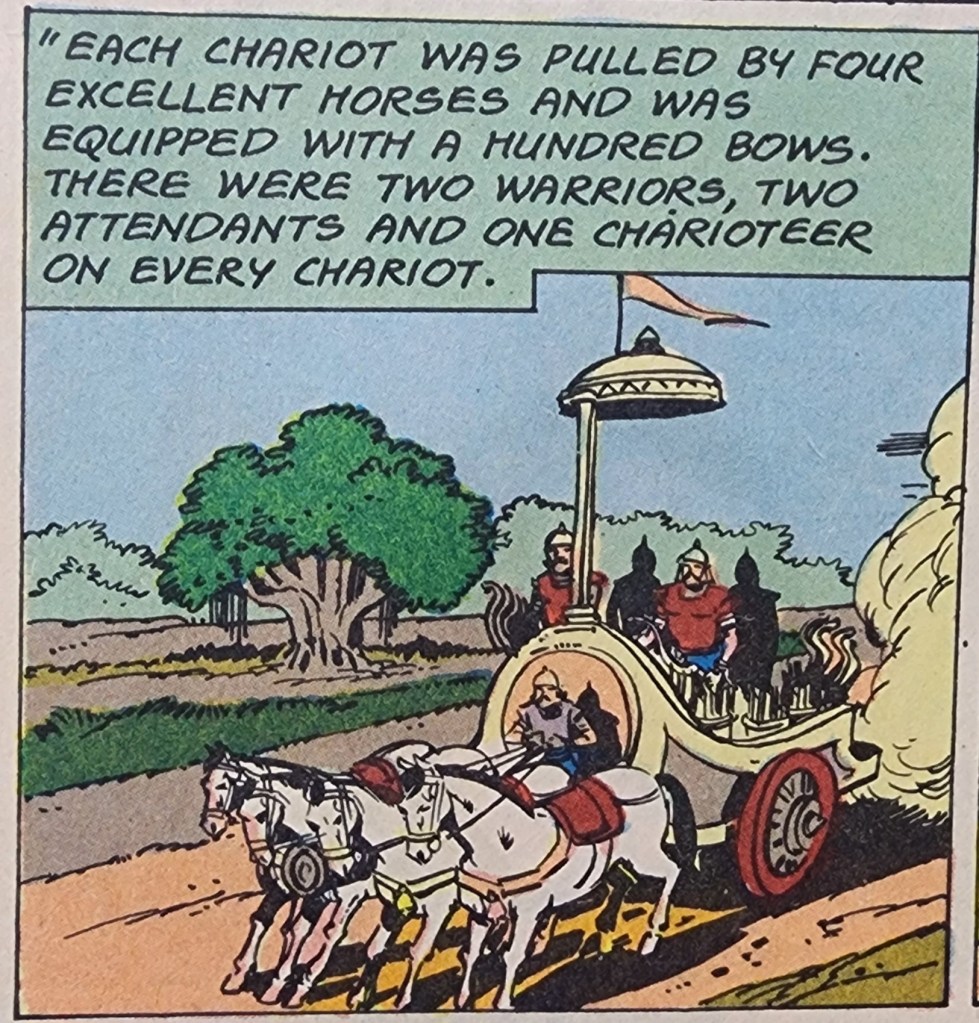
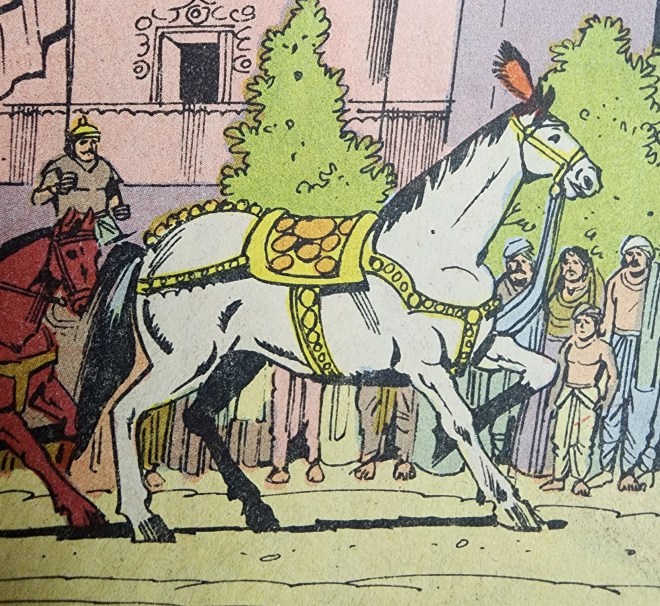
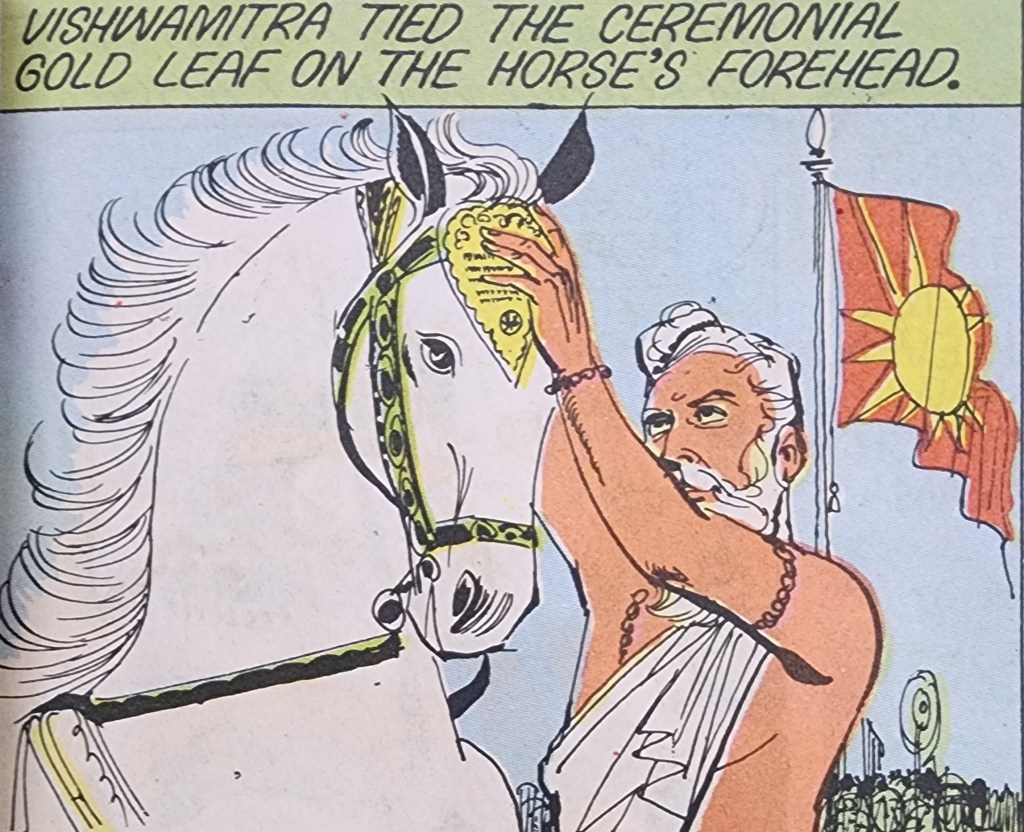
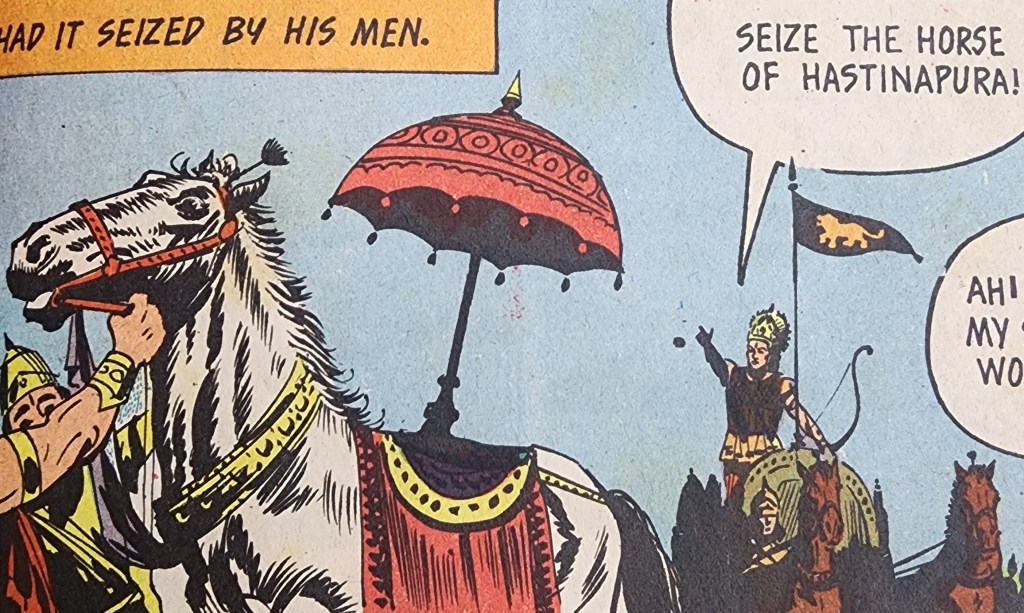
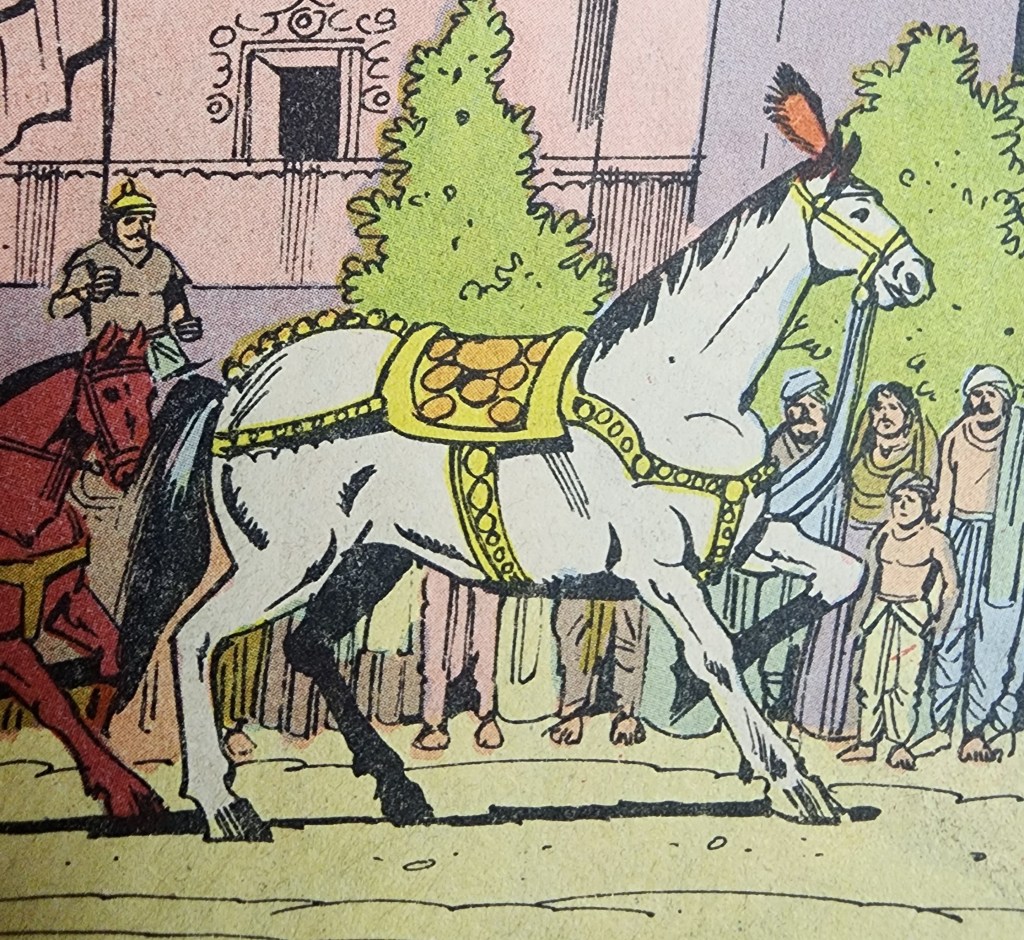
An image representing the Ashwamedha Yajna. Image credit – “Sons of Rama”, published by Amar Chitra Katha.

The Ashwameda Yajna is part of the last segments of both the Ramayana and the Mahabharata. If we go back to a time before the 2 Itihāsās (Ramayana and Mahabharata), there are a couple more references to the horse that ties it to the idea of knowledge and wisdom. These relate to the Rishi Dadichi and the Ashwini Devatas.

Rishi Dadichi is referred to as one with the “head of a horse”, or “Ashwashira” (Ashwa – horse, shira – head). This is supposed to be because he taught the Ashwini Devatas some secret knowledge. The association with knowledge and the horse is stark once again!

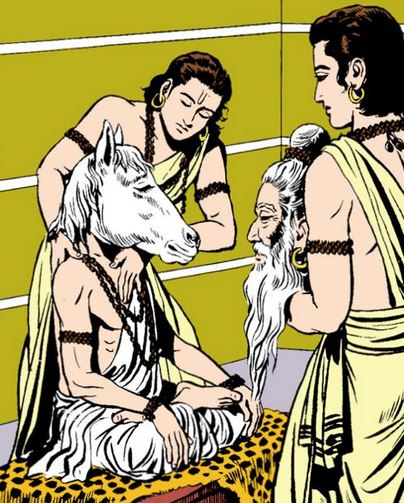
There is a one story where Indra, King of the Devas had decreed that anyone who passes on this knowledge will have their head explode. The Ashwini Devatas, wanted to learn this knowledge and Dadichi was the only one who was willing to risk Indra’s wrath. So, the Ashwins replaced Dadichi’s head with that of a horse. Once the knowledge was transmitted, his head exploded as per the decree.

But the head that exploded was that of the horse. The Ashwins, then attached the original head of the Rishi and Dadichi was brought back to life. This again shows the link between the horse, knowledge and sacrifice (like in the Ashwamedha Yajna, where the horse is sacrificed), which is a vital part of martial endeavours. In modern times, time, effort, money and other resources are expended in pursuit of the martial arts. In ancient times, all of these were still true, but more importantly, life and limb were on the line as well!

An image of a horse-headed Rishi Dadichi.Image credit – “Indra and Vritra”, Kindle edition, published by Amar Chitra Katha.

The Ashwini Devatas were twin Devas. They are considered the physicians/doctors of the Devas. This is why they were the ones that could replace the head of Rishi Dadichi with that of a horse and back. These twins, also referred to as “the Ashwins” were also historically associated with horses. I have heard it said that the “Ash” in the “Ashwins” is related to “Ash-wa”, which is the word for horse in Sanskrit, though I am not certain of this.

There is also a story from the Vedas, where the Ashwins device a prosthetic leg for Vishpala. Vishpala is generally considered a great female warrior, but there are some who say that Vishpala was a horse. Either way, they are supposed to have created a prosthetic leg all those millennia ago! And the reference is back again! 😊All of this adds to the fact that the Ashwins were indeed doctors. Doctors possess medical “knowledge” and the skills to save lives.

There is also a story where an individual on a voyage prays to the Ashwins when his ship sinks. The divine twins save his life and he returns home. Based on this story I had thought that the Ashwins were also the Gods of voyages. But the internet tells me that the Ashwins were more the deities associated with “a safe return home”! This does make sense, at least to me. The Ashwins were doctors and thus life savers, which dovetails nicely into “returning home safely”. The Ashwins, always associated with horses, possess the knowledge to save lives and get one home safely.

One last reference to horses that comes to mind from Hindu culture, considering that it is the year of the “Fire Horse” is that of Lord Surya, the Sun God. Lord Surya. Lord Surya is supposed to traverse the sky over the course of every day in a chariot. This chariot is drawn by 7 horses. These horses, drawing the fiery Lord that is the Sun, would represent the Fire Horse!

The charioteer of Lord Surya is Aruna, who is the brother of Garuda. Garuda is in turn the vāhana of Lord Vishnu. Vāhana can be translated as “vehicle” or “mount”. And we are back full circle to Lord Vishnu who we started with as Lord Hayagreeva. A horse is also a mount, either as the driving force of a chariot or as the momentum for cavalry. This detail gives a segue to the next part, where we consider the martial arts and history.

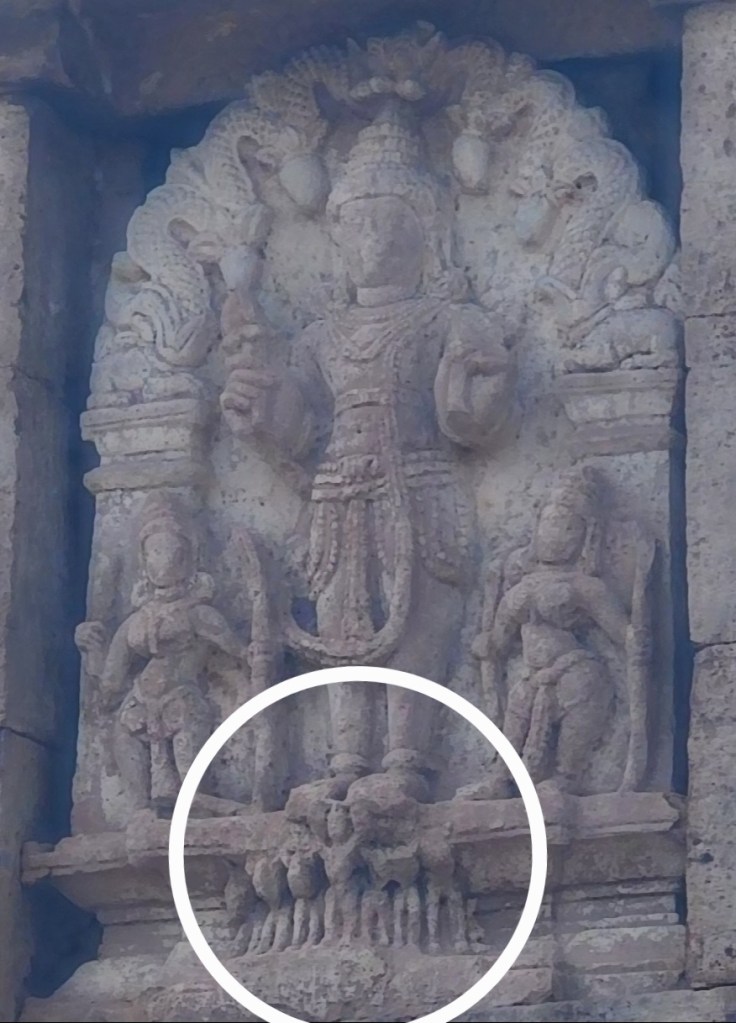
An image of Lord Surya on his chariot drawn by 7 horses, with the charioteer Aruna. This image is from Aihole, Karnataka.

What seems clear from the observations made above is that the horse is strongly associated with knowledge, and even wisdom, science and technology. But why would this be? I opine that this is because of the trait I mentioned early in this article in relation to horses – symbiosis.

When I use the word “symbiosis” here, it is more figurative than literal. I do not mean symbiosis like in the case of a lichen, where fungi and algae work together biologically. I mean symbiosis in the way a horse and its rider or handler work together as a team. Consider a show jumping event in the Olympics, where a horse, its rider and their teams work together as a single unit; that is what I am referring to.

Consider the history of the partnership between humans and horses. Horses have supposedly been domesticated for over 4000 years now. In that time horses have been used for a lot more than meat and milk unlike cattle. Horses, like oxen have also been used as beasts of burden in agriculture.

But arguably, the thing about horses that comes to mind for everyone is their use in war. Horses have been used with war chariots perhaps since the third millennium BCE. It is claimed by some that the oldest chariot found is from Sinauli in Uttar Pradesh, which dates back to between 2100 and 1900 BCE. Chariot warfare takes the centrestage in the Kurukshetra war of the Mahabharata.

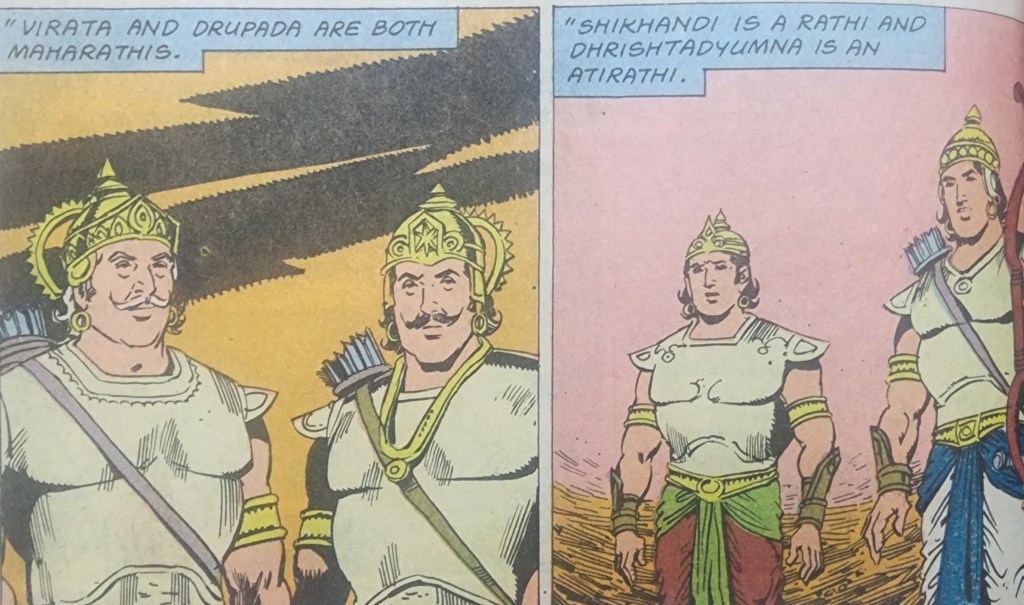
Warriors are ranked as “Rathi”, “Athirathi” and “Maharathi”, the last one being the highest rank! Ratha is the term in Sanskrit for chariot and a Rathi is one who fights in a chariot! So, the ability to fight from a chariot was a core requirement to be considered a great warrior! Charioteers were called “Sārathi”. Charioteers were held in high regard and some ended up being close confidants and advisors of the kings and nobles they served.

Image showing the categorization of warriors. Image credit – “Mahabharata 30 – The War Begins”, published by Amar Chitra Katha.

Chariots were also a key component of warfare in Mesopotamia, Egypt, Anatolia and in Europe. This is shown by the chariots of the Assyrian empire and the chariots mentioned in the Battle of Kadesh, fought between the Hittites and the Egyptians. Chariots were also used by the Celts when they fought the Romans.

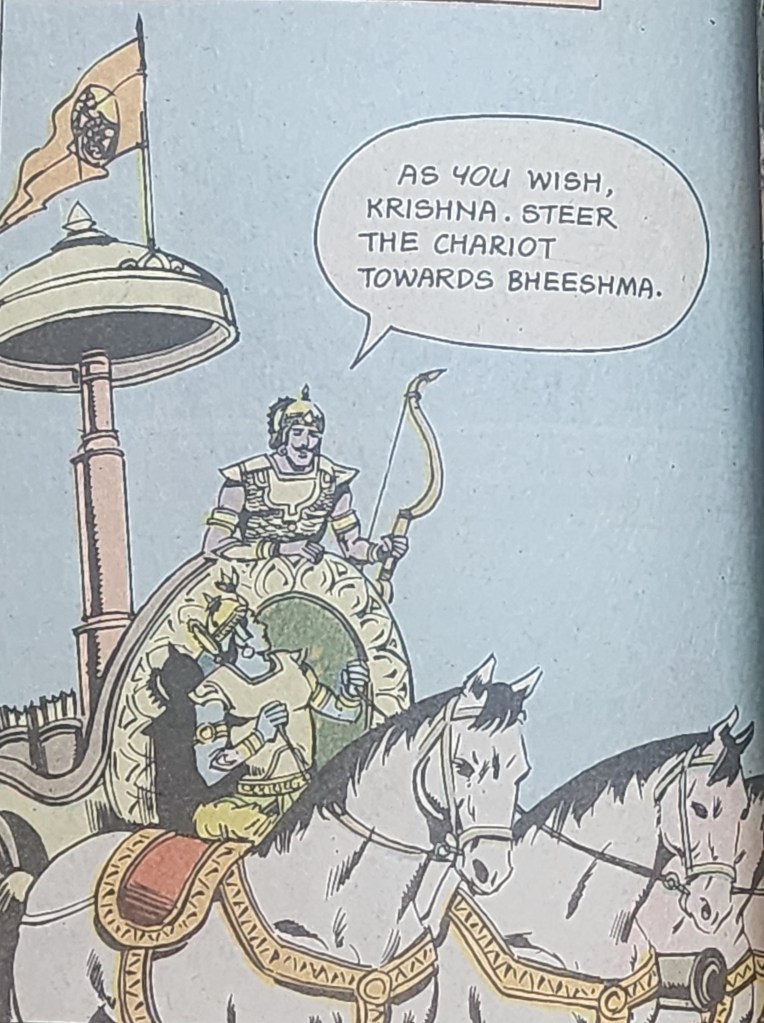
An image of Lord Krishna as a charioteer. Image credit – “Mahabharata 32 – The Fall of Bheeshma”, published by Amar Chitra Katha.

Then comes the use of the cavalry, which started around the same time as the use of chariots, but lasted until the First World War! Cavalry was an active fighting force for 4000 years! Chariots diminished in importance by the beginning of the Common Era. The importance of cavalry kept increasing with the development of the saddle and the stirrup.

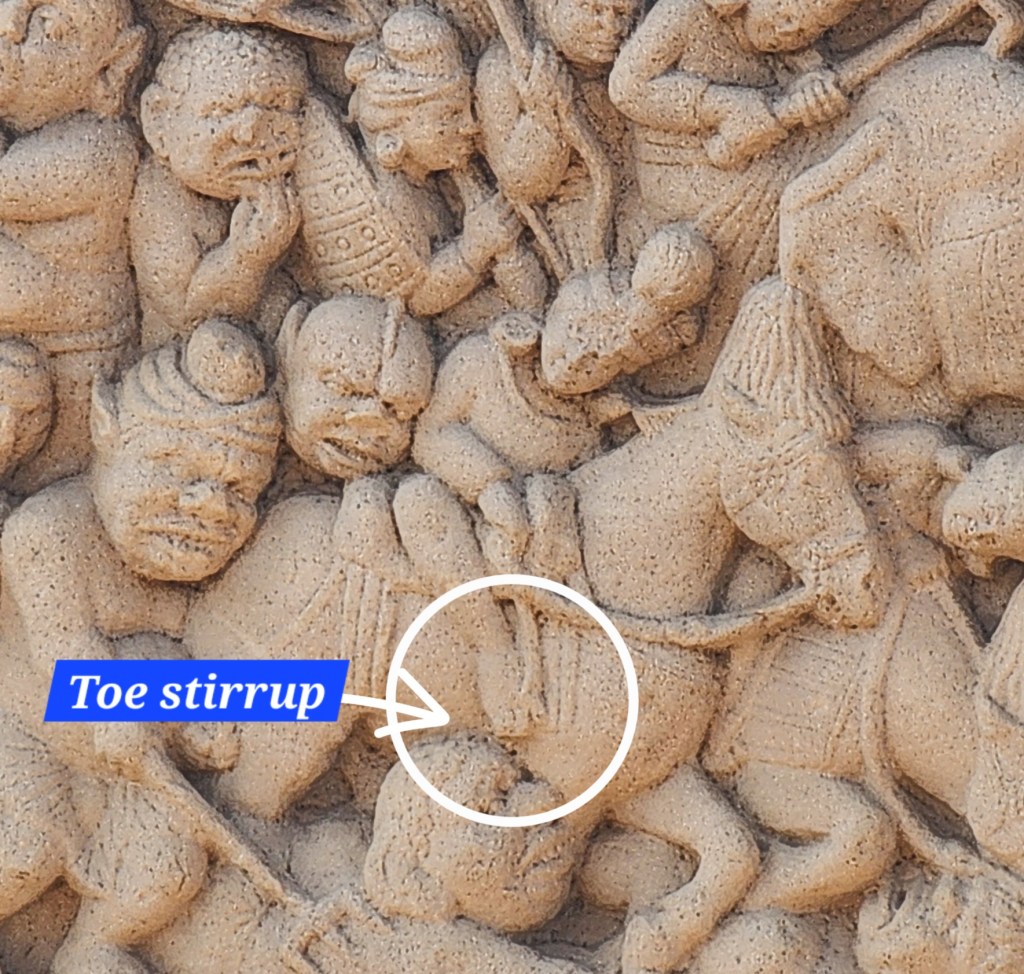
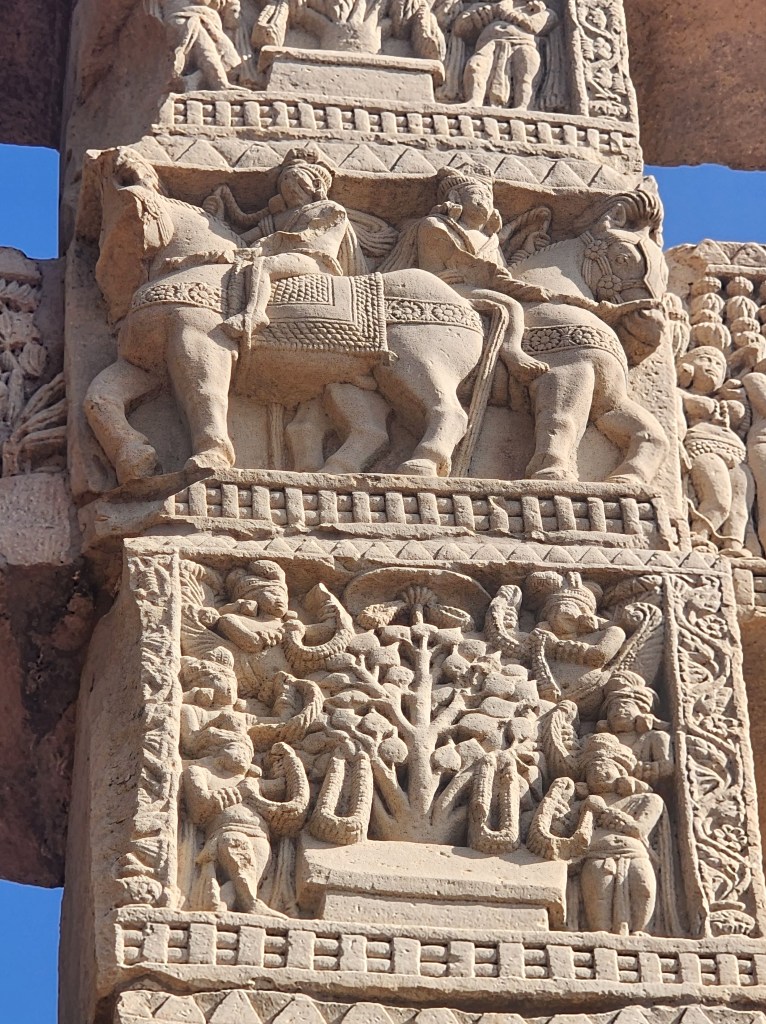
From the little that I know, the stirrup could have its origins in India around 200 BCE, in the form of a “toe stirrup”. The earliest visual representation of the stirrup is supposedly from the Toranas (gateways) of the Great Stupa at Sanchi in Madhya Pradesh, India.

Two images from the Toranas (gateways) of the Great Stupa at Sanchi, that could be representations of stirrups. The first image could be “toe stirrup”. The second image could depict a stirrup, or a person relaxing his feet, I am not sure.

With the importance of cavalry growing, the selective breeding of horses improved and developed continuously, with horses reaching the massive sizes they reach today! The combination of the composite bow with cavalry made the Central Asian peoples a superpower for more than a millennium, starting with the Scythians (Shaka in India) and gong all the way to the Mongols and then the Mughals of India.

One of the most impactful examples of the use of cavalry from Indian history is from the Second Battle of Tarain in 1192 when Prithviraj Chauhan was killed and the Delhi Sultanate was seeded. The armies of Ghori who won this battle, are supposed to have succeeded, partly due to their cavalry tactics, which they used to avoid close quarter battle against the Rajputs, which led to their defeat a year earlier in 1191, in the First Battle of Tarain.

The armies of Ghori were Turkic people (not Turkish) who used the Central Asian way of fighting. They supposedly used something called the “Parthian Shot”. Units of Turkic cavalry used to run in circular formations at the distance of a bow shot from enemy formations and rain arrows down on the enemy. This was used to grind down the enemy while denying the opportunity to close distance and engage in hand-to-hand combat. This tactic was something the Rajput army supposedly did not have a response to.

This link leads to a YouTube video which gives a lot of detail about the Second Battle of Tarain; a part of the video describes the “Parthian Shot” – https://www.youtube.com/watch?v=uHMMwLGI0xM

The last cavalry charge in world history also involved Indians. The Mysore and Jodhpur Lancers played an instrumental role in the Battle of Haifa in 1918, when Haifa was captured from Ottoman control during the last part of the First World War. I have heard that the cavalry became a ceremonial unit after this last hurrah.

The little information about cavalry in the previous paragraphs brings me to the point about the relationship between knowledge and the horse. Think of all that needs to happen for a cavalry to exist.

  • Horses are needed in considerable numbers. So, they need to be bred.
  • Horses need to be raised and cared for.
  • Horses need to be trained.

Even if states in the past expected cavalrymen to provide their own horses, raising a cavalry would require a sufficient number of the populace to have the knowledge and skills to breed, raise, train and equip horses. Each of these activities needs knowledge and experience to be accumulated over generations and passed on, even improved over time.

Let me reinforce this with an anecdote. A senior practitioner in the Bujinkan and friend of mine used to be an equestrian. He had competed at the European level and was considered a very good horse rider. He was asked how he trained the horses he rode. He said that he does not train horses. This was a surprising answer for a lot of us who had never worked with horses.

We then asked how the horses were trained. He then said that he does not know! Seeing our surprise, he explained with an analogy. He said that a great Formula 1 driver, say Michael Schumacher, would not be able to service his F1 car by himself. He would most certainly not be able to build his own car! In the same manner, a horse rider would learn to bond with, work with and achieve great feats with a trained horse, but he would not be able to train the horse by himself or herself. He would not be able to care for it by himself or herself either! The knowledge and skills required in each of the activities is extensive and always needs experience and teamwork.

I think the above anecdote demonstrates how knowledge and experience are key to working effectively with horses. This would have been far more important in the past when cavalries were vital on battlefields. Was this the reason horses came to be associated with knowledge? I would say yes, even though I do not know what mainstream history says.

I mentioned what it takes to have horses available to be a part of a cavalry. Now consider what it takes to be a cavalryman or woman.

  • One needs to ride a horse
  • One needs to be able fight on horseback
    • Be able to stand in the stirrup when needed
    • Shoot an arrow while riding
    • Twist in the saddle to shoot at different angles (imagine shooting backwards while riding full tilt!)
    • Use a lance while riding
    • Use a sword while riding
    • Use weapons while keeping formation with fellow cavalrymen! And this could be with Heavy Cavalry or Light Cavalry!
  • Lest we forget, these soldiers had to be able to use their weapons on foot if they were to lose the horse! And the manner of using a lance or a sword on foot and on horseback is vastly different!

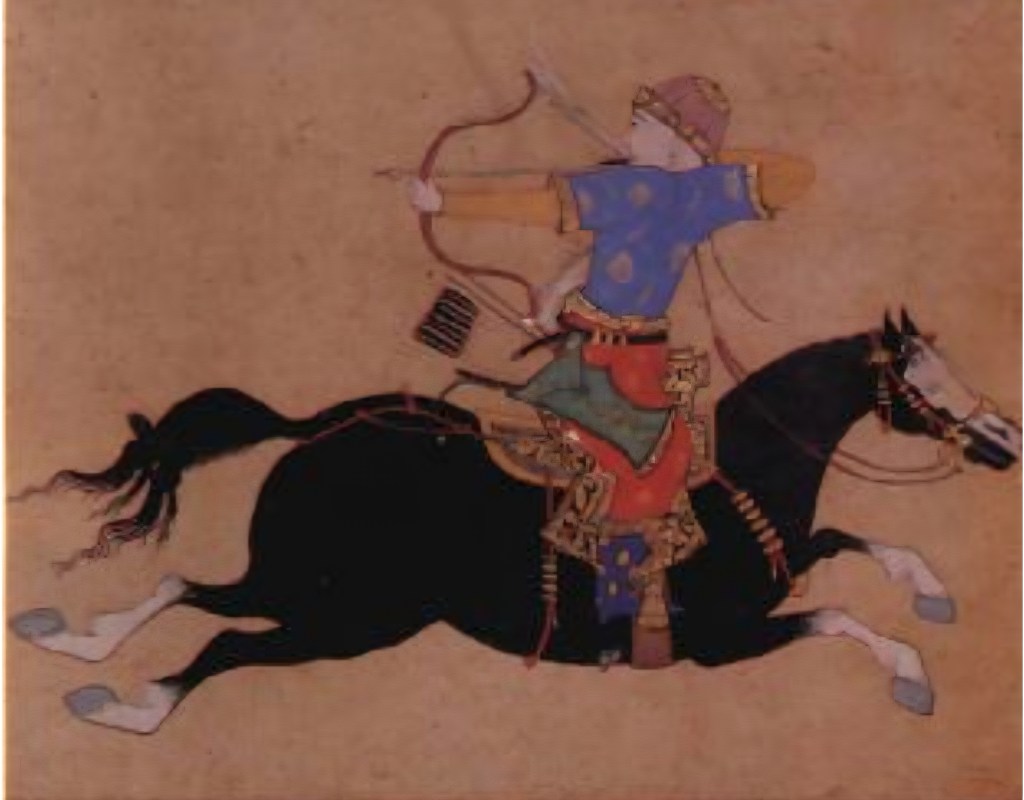
An image of a horse archer (likely Turco-Mongol)twisting in the saddle to shoot backward while riding forward. Image credit – Wikipedia.

Each of these aspects, over time, developed with variations in cultures and geographies. So much so that different schools and methods formed over time. This shows how knowledge and experience coalesced over centuries in the ability to fight as a cavalry unit. I have not even touched upon the creation and use of armour and shields for the soldier and the horse when they fight as a unit! This should lend further credence to the idea that the need for knowledge to work with horses led to the horse being a symbol for knowledge.

In the Bujinkan system of martial arts we do not train horse riding or fighting from horseback as part of the curriculum. But Bājutsu, which refers to cavalry techniques, is historically one of the 18 segments of Ninjutsu. There is another concept that is reinforced regularly in the Bujinkan – “Shu Ha Ri”. This idea also reinforces why I opine that the horse was associated with knowledge in India.

  • “Shu” roughly translates to diligently learning techniques, ideas and concepts
  • “Ha” refers to training what was learnt until it is completely assimilated and works for the individual
  • “Ri” refers to the phase when an expert goes on explore new possibilities with the expertise that was gained through long experience

This is true for the martial arts, when a student repeats the same movement until it becomes second nature. The student then goes back to the basics, every once in a while, iteratively, while going on to add more to her or his repertoire. After a considerable period of indulging in this cycle, the student goes on to explore different expressions of the abilities gained through the years of training.

This cycle of “Shu Ha Ri” is applicable for most skills learnt over the course of one’s life. If one considers the points I mentioned relating to cavalry earlier, there would be a “Shu Ha Ri” cycle to creating a horse ready for war and another “Shu Ha Ri” cycle to create a warrior who can work with the horse!

The “Nin” in Ninjutsu refers to “perseverance”. The “Shu Ha Ri” mentioned above is all about endurance. One needs to be able to expend time, effort and money over years to become a good martial artist; or to be good at anything. This again shows how knowledge is earned over time with great effort, not unlike how humankind achieved great things while working with horses. Is it then any surprise that Indians have a God who is represented by a Horse?

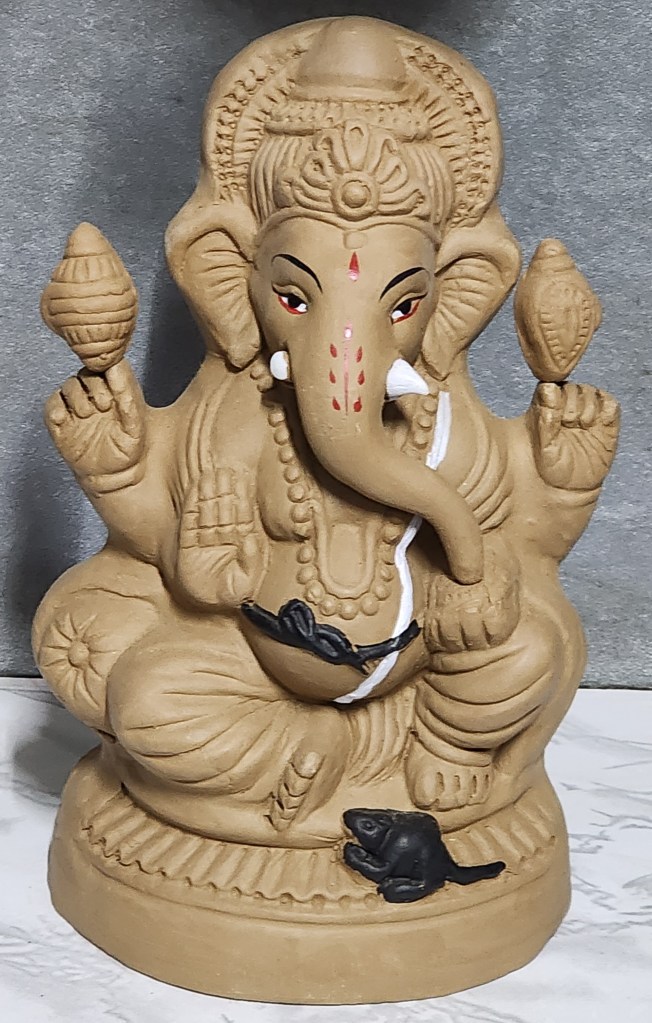
I will end by saying that in the Indian context a lot of what I mentioned holds true for elephants as well. And sure enough, we have a God who is depicted with the head of an Elephant! This is the most frequently worshipped Lord Ganesha! Lord Ganesha is worshipped as “Vighnahartha”, the “remover of obstacles”. Lord Ganesha is also worshipped as “Vidya Ganapati”, “the one how enables learning”. “Vidya” can also be translated, in common parlance, as “education” or “knowledge”. Removal of obstacles requires knowledge as well! And that shows how yet another animal which is vitally important in Indian history is also used to represent divinity.
An image of Lord Ganesha

Interestingly, there is sweet dish made in parts of India called “Hayagreeva”. 😊It is prepared during festivals, but not any specific festival. It is more likely to be made during the Dasara (Dussehra) festival, one of the days of which, in my community, is dedicated to Lord Hayagreeva! The dish is made of gram, jaggery, ghee and grated coconut. I have no idea how the dish came to be named after a God! 😀

The delicious sweet dish, Hayagreeva.

The New 8-fold Path

A few years ago, I had written an article about the “Ashtha Siddhi”. “Ashtha” means eight and “Siddhi” means achievement. So, “Ashtha Siddhi” means “eight achievements”. The link to the article is seen below.

The 8 achievements can be applied brilliantly to the martial arts. They can also be applied to any conflict management situation any of us faces in daily life. These 8 traits could be explained in magical terms, but they can be as down to earth as necessary. I go into all of this in the article linked above. Do read the article for details.

This article, a much shorter one, is about how the “Ashtha Siddhi” seem to be the exact set of rules that are being applied in the various conflicts that are in the headlines these days. The war in Gaza is still on, the war in Ukraine is still on, a war seems to be brewing in Iran, a near war occurred in Venezuela, all of the Sahara is under military rule, a civil war is on in Myanmar & in Syria and Pakistan is constantly fighting Afghanistan. There is a potential of military conflict in a large part of the world!

The 8-fold path is related to Buddhism. From the little that I know, this is part of the teachings from the Buddha. The 8-fold path describes the way one should live life, in order to escape the many sorrows life throws at an individual.

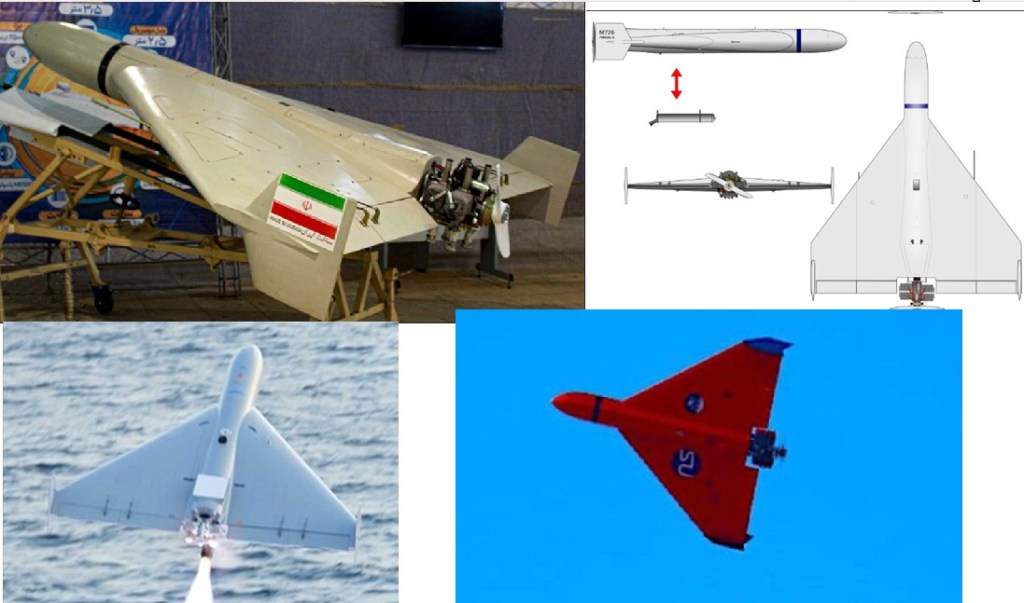
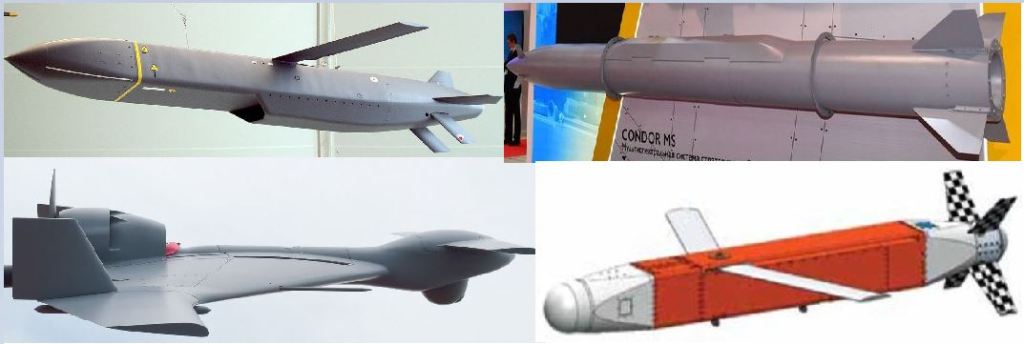
Above image shows a collage of SCALP EG cruise missile (top left), Rampage missile (top right), SAAW bomb (bottom right) and the Harop loitering munition (bottom left). All images are from Wikipedia. All of these were used during Op Sindoor.

The 8-fold path and the “Ashtha Siddhi” have 8 tenets. But considering the conflict-ridden world we live in, it seems to me that the “Ashtha Siddhi” are currently more applicable, at least at the level of military and political manoeuvring. In that sense, the “Ashtha Siddhi” can, in my opinion, be called “The new 8-fold path”.

Seen below is a table which mentions the “Ashtha Siddhi” with some details. Each “Siddhi” is mentioned with its meaning, how it is achieved in a military conflict and an example of the same from Operation Sindoor, when India stole a march over Pakistan, in May 2025. These are just observations of mine, from a layman who has no military or political experience. The observations are based on the little I know from information available in the public domain and my experience in the martial arts.

Sl. No.SiddhiDefinitionActivity/ObjectiveExample
1AnimaBe as small as necessaryAchieve absolute superiority in the chosen or all domains/theatres of a given conflictDestruction of specific terrorist bases or specific airfields.
2MahimaBe as large as necessaryDestroy a large number of targets with multiple precision missiles/guns/drones at the same time or use one powerful missile to cause damage over a large area.Destruction of airfields across the length of Pakistan.
3LaghimaBe as light as necessaryUse attack teams/launchers/guns/drones that are highly mobile and scoot after the attack. The time for set up of the weapon should not be too long.Use weapons that only target AWACS or specific buildings in a civilian area.
4GarimaBe as heavy as necessaryUse a large enough number of attack systems (launchers/guns/drones) that can coordinate and saturate an enemy’s position with firepower or attack a large enough number of enemy positions to break an enemy’s will. Have weapons that can cause very heavy damage either underground or across a horizontal area.Use weapons that strike deep underground and eliminate the command-and-control structure of the enemy. At the same time destroy the officer’s mess to eliminate the people who man air assets.
5PraaptiBe able to receive everything or anything that is needed, from information to attacks of the enemy.Be able to receive all information from and about an enemy, from the psychology of the enemy leaders to the technical abilities of the opposition. Know all this, at all times and in real time. This includes AI to analyse data, ELINT, HUMINT, satellites and real time LEOs (Low Earth Observation).
Be able to receive any attack with any weapon the enemy throws at you, with minimal or no damage, like with extraordinary air defences (which will not bankrupt you!)
Use AI to predict Pakistani deployments and the decision-making patterns of the enemy military leadership.
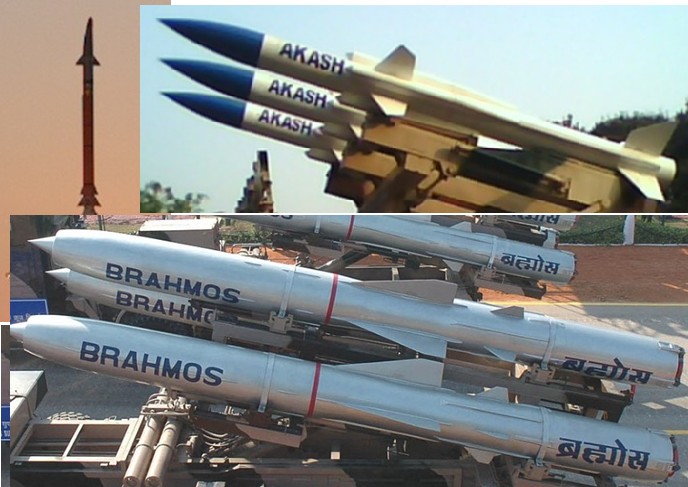
6PrākāmyaBe able to take anything you need to, at any time (from the enemy in this case)Be able to take out any enemy, enemy position or target with the right weapon needed for the target. Possess all types of weapons from sniper rifles to energy weapons to non-lethal weapons to artillery to drones to missiles to delivery platforms in a large enough quantity to never let the enemy recover.Use different types of weapons from cold war era guns to indigenous Aakash missiles to Brahmos to S-400 to French and Israeli missiles for defence and offence as needed.
7VashitvaBe able to control everythingControl the battlefield and the escalation matrixDestruction of terrorist bases without SEAD & DEAD operations initially and later, to show the enemy its place, nullify its ability to see and launch (by destroying AWACS, radar, airbases and air defence systems respectively).
8EeshitvaBe like a God (or “achieve Godhood”)Achieve absolute superiority in the chosen or all domains/theatres of a given conflictForce the Pakistani establishment to sue for a ceasefire which they refused 3 days earlier.

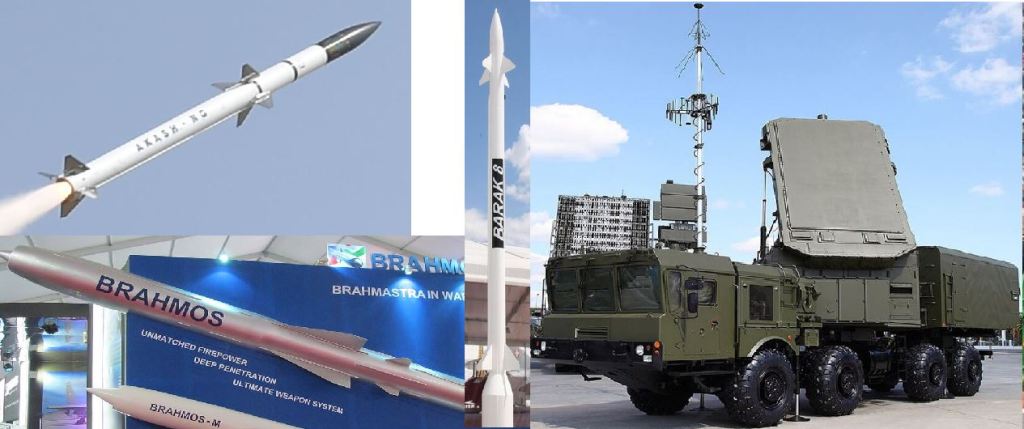
Above image shows a collage of the Akash missile (top left), Barak 8 missile (MRSAM/LRSAM – centre), Brahmos cruise missile (bottom left), S-400 Radar (right). All images are from Wikipedia. All of these were used during Op Sindoor.

Celebrate the Weapons!

26th January is celebrated as “Republic Day” in India. It is the day on which the Constitution was adopted in 1950 and India became a republic. Every year, there is a parade on Kartavya Path (formerly Raj Path) to celebrate this event. The event is presided over by the President of India and is accompanied a guest, who is generally a leader of another nation or a bloc of nations.

The Republic Day parade has cultural displays from many Indian states and Union Territories. Also a part of the event are marching contingents and bands from several units of India’s armed forces, police services and reserve troops. But the highlight of the event is always the display of several weapon systems, from the Army, Navy and Air Force.

The weapons and weapon systems displayed include not just offensive weapons like missiles and aircraft, but also defensive systems and force multipliers. These include radar and electronic warfare systems and also the AWACS and air to air refueling aircraft.

A little over 5 years ago, I had made a video that looks at historical weapons from an Indian perspective. That was the time of the pandemic, and we were all working from home. So, all celebrations that used to take place in the office as part of employee engagement were conducted virtually.

One of the celebrations that was done virtually was the Independence Day, on 15th August. The video I had created was as part of that event. But considering that the video was all about weapons and the display of modern Indian weapons is a part of the Republic Day parade, I am sharing that old video as a part of this post.

Wish you all a pride filled Republic Day! 😊

Devi Ambika and the Kiai

Sound is a weapon, a very effective one. The application of sound is a fascinating exploration of how we humans interact with each other and the natural world. Let me begin with a story from Hindu culture. The story I am sharing forms a part of the Devi Mahatme (sometimes written as Devi Mahatmya).

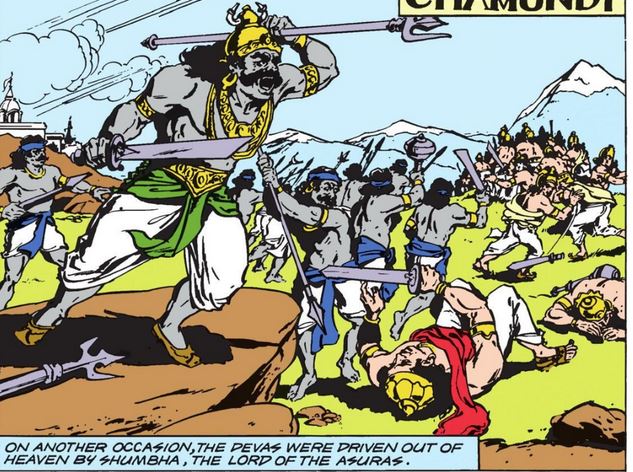
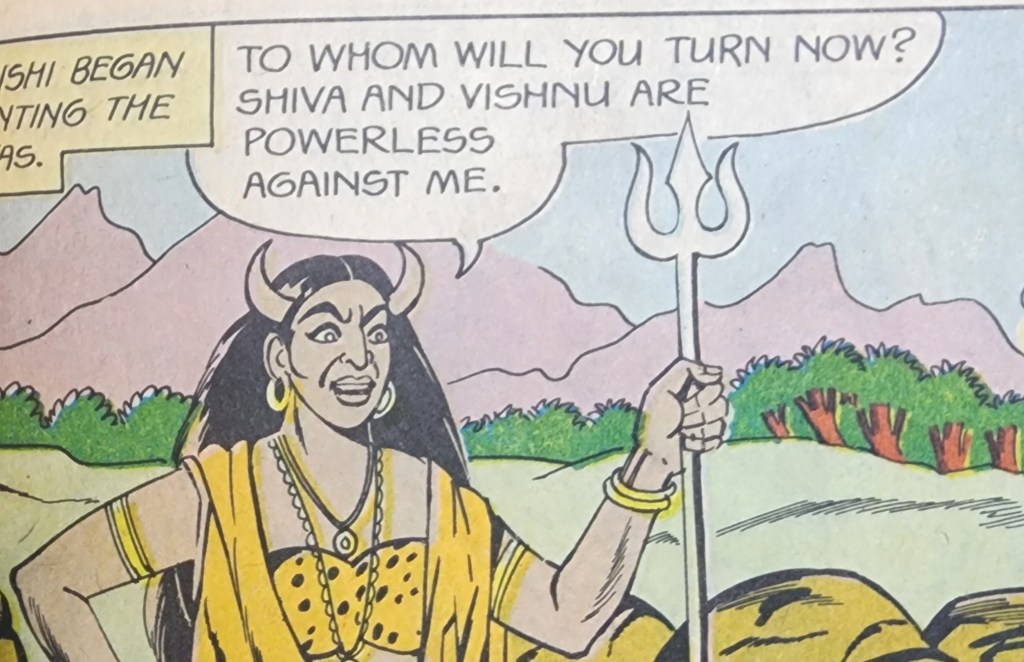
There was a time when two Asura brothers, Shumbha and Nishumbha ruled the Earth. They were mighty warriors who led great armies. Even the Devas had been defeated by these brothers. Some of the famous Generals who served under Shumbha and Nishumbha were Raktabeeja, Chanda, Munda and Dhumralochana.

Once, a few Asura soldiers spotted an incredibly beautiful woman. This was the Goddess, Devi Ambika. They reported back to their rulers about the beauty of the woman. Shumbha decided that he had to have the Devi for his wife. So, he sent his General, Dhumralochana, to the Devi with the proposal of marriage. She replied that she could only marry an individual who had bested her in combat.

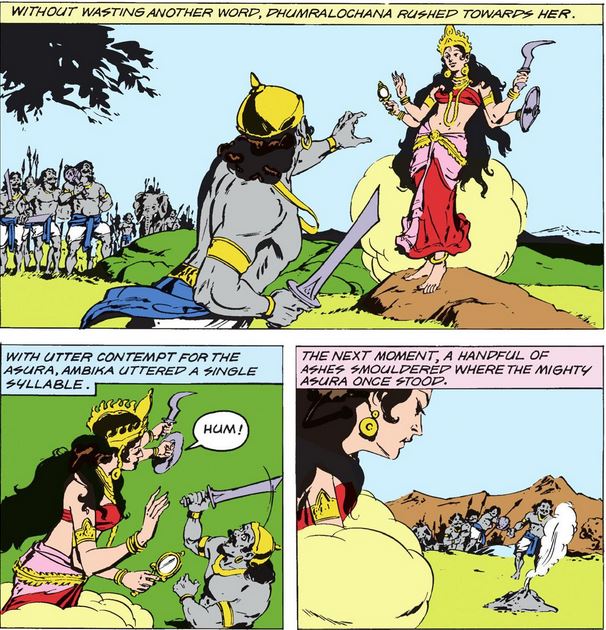
Dhumralochana believed she was a weakling as she was a woman. In his arrogance, he attempted to seize the Devi and take her back to his king. But he was sorely unaware of Devi Ambika’s abilities. When he attempted to capture her, she uttered a single syllable, “HUM”. As soon as this syllable was uttered, Dhumralochana caught fire and was burnt to death. The Asura host he had brought with him fled in terror.

Devi Ambika burns Dhumralochana with a single syllable (Kiai!). Image credit – “Tales of Durga” (Kindle edition), published by Amar Chitra Katha.

The Devi’s abilities are demonstrated by the fact that she did not even need to move to destroy the Asura General. She did not even speak. She uttered a single syllable! And her opponent was toast, literally! This story is used to show how powerful the female Divinity is. A lot more happens in this story, when the other Generals and eventually the ruling Asura brothers themselves attack. Other representations of the Devi emerge and the scourge of this ruling coterie of Asuras is eliminated for good.

We only need the part of the story where Devi Ambika uses sound as a weapon. She utters just ONE syllable, but it is sound, nevertheless. Of course, mortal humans cannot burn anyone to death with sound, much less with just one utterance. But this does indicate that humans have always known that sound can be a weapon. Let us explore this further.

In the Bujinkan system of martial arts, we learn what is called a “Kiai”. Sometimes this is pronounced as “Kiyai”. The Kiai is a short simple shout. It is more a sharp, possibly loud expulsion of a sound than a scream. It is a single sound, much like a single syllable. It could be loud but need not be. The sound occurs when one is exhaling. The concept of the Kiai is not limited to the Bujinkan. It is found in many other martial arts around the world.

An example of a Kiai (audio only)

When we utter the “Om”, we are supposed to begin the utterance from the belly, from the core of one’s being. It is pretty much how animals utter a sharp cry or a bark. If one observes a parrot utter a sharp cry or a dog bark, one will see that their core is sucked in as the sound is expelled. This is the same for a Kiai.

The word “Kiai”, as I have heard it explained by my teacher, stands for, “a unification of energy”. In other words, there is a concentration of energy at our core, the abdominal region, that bursts forth in one instant. This “burst forth” is an expulsion of sound. In this way, the Kiai resembles a bark or any other animal sound that is delivered in a short burst.

I personally opine that what Devi Ambika is said to have used in the story, to kill Dhumralochana, is also a Kiai, with Divine attributes layered onto it. Of course, this is possible only in a story as far as normal humans are concerned, for we are not Gods, and we cannot reduce people to ashes with a sound.

Recently, we were discussing the Kiai in class and my teacher Shiva, mentioned that there are 3 types of Kiai. My teacher suggests that a Kiai could be to induce bravery or power in the person who performs the Kiai or to affect the opponent. My own classification varies slightly, as seen below.

The Kiai is of two types with one having a subcategory as I understand it. These are mentioned below and elucidated further down the article.

  1. Internal Kiai – Kiai to affect the self
    1. To generate power
    1. To let go of fear
  2. External Kiai – Kiai to affect the opponent

Imagine a weightlifter walking up to the weights on the podium or on the verge of lifting the weights. There are instances when you will hear them utter a sharp cry. This is to pump themselves up, raise self-confidence and to focus themselves. This is an example of a Kiai to generate power in the self. This is an example my teacher gave. Even when an MMA fighter walks into the cage, he or she is often times seen using a Kiai as part of the preparation routine. This is also an internal Kiai to generate power or to build oneself up.

Now imagine a situation where one is facing a wild animal. I have heard experts suggest not running from bears, boars, gaurs, tigers or even dogs to avoid triggering the chase instinct in the predator or large herbivore. They suggest making a loud noise, like a shout or a cry. In some cases, they suggest making oneself appear larger to deter an attack. The shout or loud noise they suggest is the Kiai to let go of fear, or at least to trigger the instinct of preservation.

Many years ago, I had attended a seminar conducted by Daishihan Arnaud Cousergue and Daishihan Sven-Erik Bogsater. During the seminar, Daishihan Sven-Erik had suggested using a Kiai to let go of one’s own fear. This sounded similar to using a loud voice and even saying something as simple as “Hey!” or “Stop!” to a potential attacker on the street.

The External Kiai is just a counterpart of the Internal Kiai. The same Kiai could affect both the self and the opponent. That said, it could be different. In the earlier example I mentioned an MMA fighter use a Kiai to pump oneself up. Many a time, the core team of the fighter who accompanies the fighter also use a Kiai, a shout, or a loud whoop, like “Come on!” or “You got this!”. This is a Kiai intended to affect their teammate. So, it would be an external Kiai.

In the example of using a shout to deter an animal from charging, it would be an internal Kiai when it stops the individual from panicking and turning tail to run. But the Kiai also, hopefully, stops the animal from attacking. Here, the same Kiai would be an external Kiai, as its effect was on the opponent.

This same idea also holds true when a potential attacker is deterred on the street. A shout might stop the attacker in his or her tracks, as an external Kiai. But the Kiai might also diminish the fear in the would-be victim, when it would have served as an internal Kiai.

There is another Kiai that I have experienced. This is a “Soundless Kiai”. In my experience, this is tied to one’s intuition. From time to time, while training, one of the two practitioners facing off, senses that an opponent is about strike or carryout a move that should be escaped. This makes the one who senses this to back off and put some distance between the two fighters. This happens when one “feels” that a decision has been taken by the opponent to attempt something or to change tack, which could be being more aggressive or passive.

This affecting the self or the opponent without any sound is generally more visible after years of training, where experience enables one to be more “aware” of what is going on in a fight, and if there are multiple threats. Also, if the two practitioners have trained with each other for a long time, they can read the opponent better due to sheer experience with the other, and a “soundless Kiai” is likely to be more apparent in this situation.

There is one important aspect about a Kiai that must be emphasized though. IT IS NOT MAGIC. A KIAI WILL NOT CAUSE YOUR OPPONENT(S) TO BE INCAPACITATED OR TO FAINT. A Kiai gives a short opening. This opening can be a fraction of a second or a bit longer at best. This short duration can be an opportunity to survive. The survival could be the result of,

  • One being able to escape
  • Putting the opponent(s) at a disadvantage with any move
  • Simply preventing/deterring the opponent from attacking. This deterrence could even be a result of the attention of bystanders being drawn to the situation going down.

So, it is important to learn and practice the Kiai for 2 reasons. Firstly, it is not easy for many people to make a loud noise due to a modern upbringing and simple worry about drawing attention to oneself. This could be due to avoid scrutiny. So, one needs to learn how to generate a Kiai. It might start as a simple shout or a scream. But it does get refined over time, with breath control and experience.

Secondly, one will learn with practicing a Kiai, when it is effective, and for how long. This dispenses any false notions of the Kiai being a magic pill in a dangerous situation or doubts about it ever being useful. This experience is specific to individuals, and they will hopefully apply it as applicable to their unique abilities in a given situation.

The use of a Kiai to “create an opening” is best demonstrated by its technological equivalent, a “Flashbang” grenade. These are grenades used to disorient targets and not necessarily maim or kill them. The loud bang in the flashbang could be loosely equated to a Kiai. Of course, there is no bright light in a Kiai. These grenades are used to temporarily disorient opponents, which prevents them from causing harm to an attacking force, at least for a short duration. This short duration when the opponents are temporarily incapacitated is used to gain an advantage over them by the attacking force.

Beyond a Kiai or a flashbang, which are effective for short durations, there are other cases where sound can be a weapon, or at least an effective tool. At the most mundane end, we all know how parents, teachers and guardians raise their voice to either discipline or stop mischief by kids. The change in the volume and tone of the voice causes a change in the behaviour of kids.

An extension of this is the use of whistles. PT (Physical Training) Masters, security personnel and traffic police use whistles to attract attention and initiate a change in activity. The sound of the whistle is the tool that indicates that all is not normal. On the other hand, brightly coloured whistles are used in survival kits. Rescuers can use whistles to attract the attention of people they are looking for. Similarly, people in trouble can use whistles to attract rescuers to themselves. This works as the sound of a whistle carries farther in certain environments.

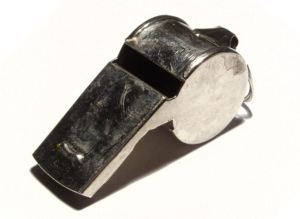
A traditional whistle. Image credit – Wikipedia

On the other side of the spectrum, sound has been used as a weapon. I remember seeing mentions of the use of sound in psychological warfare in documentaries about the First Gulf War (Kuwait Liberation War). Loudspeakers mounted on vehicles were used to play the sounds of vehicular movement and weapons. This caused confusion among Iraqi troops, who were uncertain of the numbers of the enemy they were facing and where the attack was coming from. On the darker side of things, loud music, especially of the heavy metal kind, has been used in torture and sleep deprivation, as part of enhanced interrogation methods.

Since ancient times, war cries have been a part of human warfare, where a battle cry of a unit has acted as a fillip to fighting units and caused terror on the receiving end when a savage reputation is associated with a specific battle cry. I recently watched a video on Instagram where the war cries of various tribes of the state of Nagaland are demonstrated. I am sharing that video for the sheer variety that humans are capable of!

Even music proper has been used in warfare! This includes the supposed use of drums on rowing galleys to give a rhythm to the rowers and the use of music while armies were on the march. But the most beautiful use of music, in my personal opinion, is the sound of the Carnyx, an instrument that was supposedly used by the Celts at war. Opposing troops, including Romans are supposed have been terrified of that sound emerging from misty fields on the eve of battle. Listen for yourself and tell me if you love the sound of this ancient weapon as well. Some 10 years ago when I first heard of this instrument, there was supposedly only one person in the world, John Kenny, who could play this instrument!

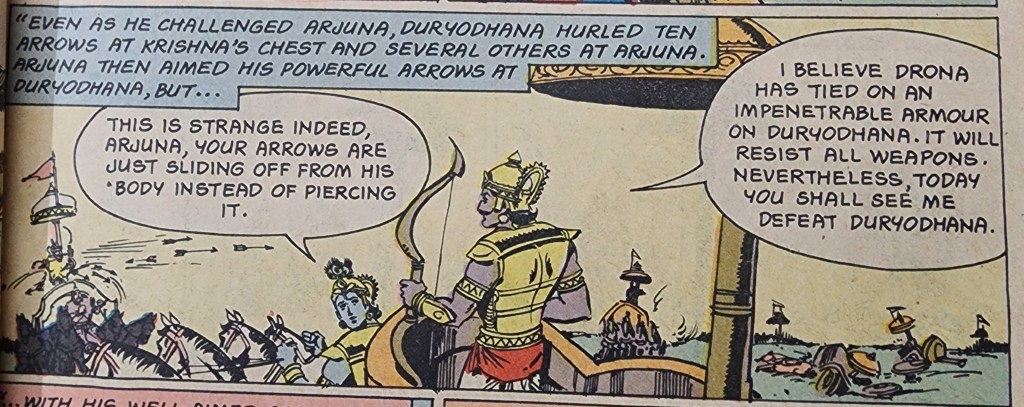
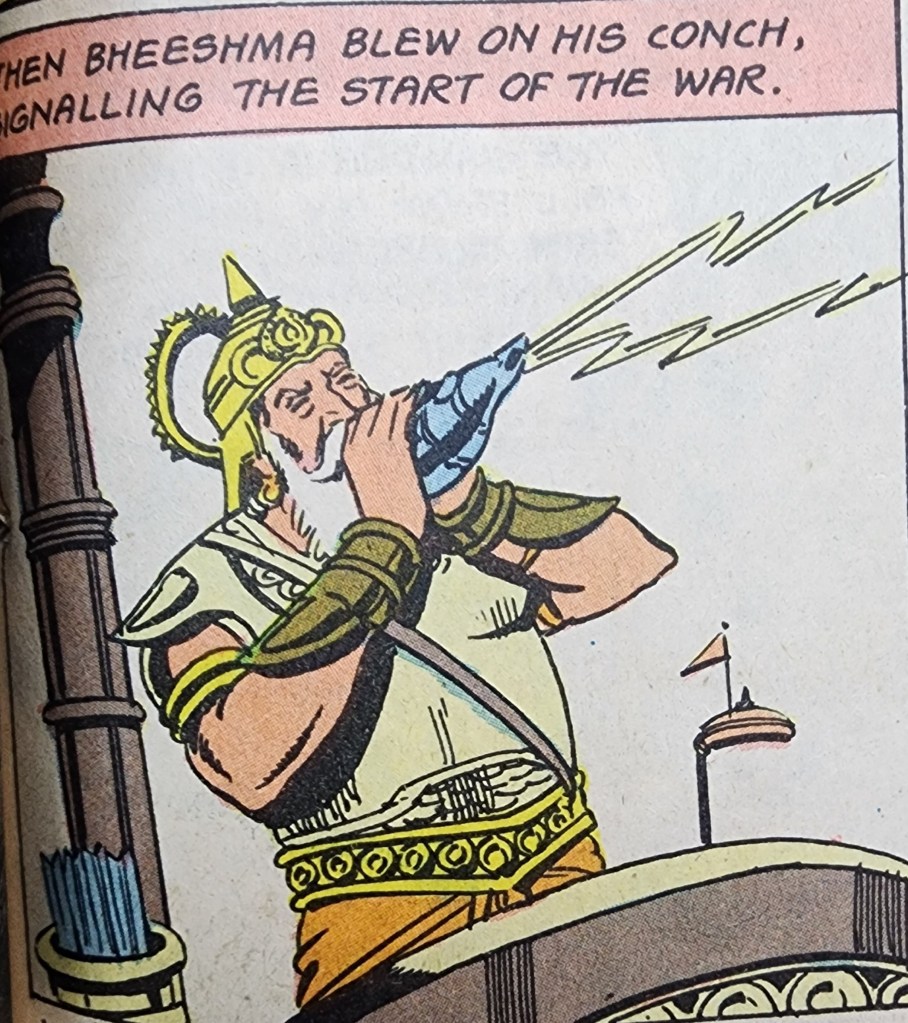
In the Mahabharataha, different warriors carried different conch shells. Some of these had names. The sound of these conch shells was used to identify the warrior coming forth. Krishna’s conch was called Panchajanya and the Arjuna’s conch was called Devadutta. Conch shells were also supposedly used for signalling and communication on the battlefield.

Use of the sound of a Shankha (conch shell) in the Mahabharata. Image credit – “Mahabharata – 30, The War Begins”, published by Amar Chitra Katha.

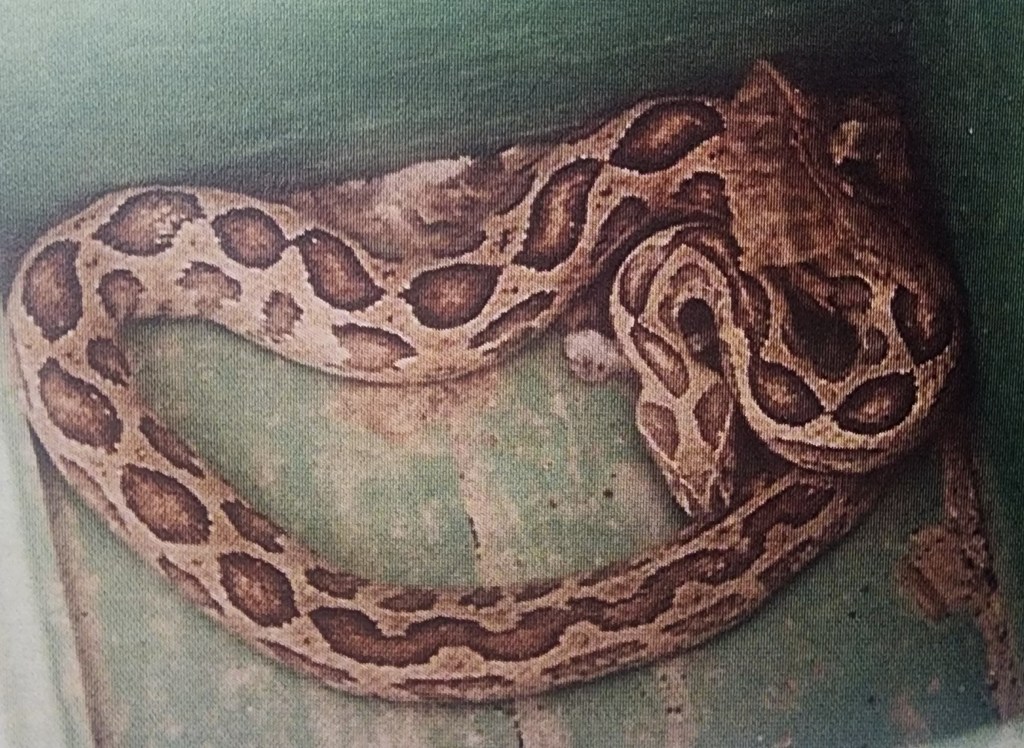
Sound is so primal that it has been used in the natural world for millions of years. Everyone knows that snakes use sound to warn predators and potential threats to warn them of their presence. Rattlesnakes with their rattles are the most popular in this category. Anyone who has heard a Russel’s Viper hiss like a pressure cooker about to go off can never forget that “stay away or else” sound. The Saw Scaled Viper rubs its scales together to cause a saw-like sound in warning.

A Russel’s Viper. Image credit – “Menagerie Memoirs” by Dr. M K Shashidhar, published by Notion Press.

Beyond snakes, sound is used in mating calls and warnings against predators. Birds are most recognizable in the use of sound simply because humans find a lot of bird song extremely pleasant. Anyone who has been on safari in India knows to keep an ear out for the warning calls of langur and spotted deer (chital) to sense the potential for a sighting of a leopard or a tiger! And then there are the champions – elephants use infra sound to communicate over long distances, with humans being none the wiser, and blue whales are supposed to have a call louder than turbo jet engines, so loud that it travels across oceans.

I cannot conclude without referring to the depiction of sound as a weapon in folklore and pop culture. This is just to show that the use of sound as a weapon has always fascinated us humans. The most extreme use of sound as a weapon is with the Marvel Comics’ character, Black Bolt. This character’s voice is so dangerous that even a whisper of his can kill a person and a shout from him can cause a lot of destruction, like a bomb! This renders the character practically mute. And then there is the DC Comics’ character, Black Canary, whose scream can cause physical harm in her opponents.

In Irish folklore there is a spectral entity called the “Banshee”. This refers to a female spirit who causes a sound like a wail. This wailing sound is supposed to herald the death of someone in a family. So, it is like a warning or a precursor to a tragedy. In this vein, I must mention a 1981 movie called “The Monster Club”. This film is an anthology with tales of different supernatural entities. One of these stories refers to an entity called the “Shadmock”. This entity’s power is a whistle! Its whistle can cause the death of an individual! This seems like a connection between folklore and pop culture.

Lastly, and perhaps my current favourite depiction of sound as a weapon, is from the Dune series of books. It is the use of the “Voice” by the women who are members of the Bene Gesserit organization. This is more a case of voice modulation than specifically the use of sound, but it is close enough to the use of sound as a weapon, because their ability clearly involves frequency modulation.

The members of the Bene Gesserit can modulate their voice in a such a way that the words they utter become a command to anyone the utterance is targeted towards. The target cannot refuse the command; it is like they are held in thrall and moved like a puppet when the “Voice” is heard. The reason I like this ability is because it is very close to a martial art. It requires years of dedicated training to master. It also has its weaknesses, like does the Kiai. If it is used too often, individuals and entire populations can develop immunity to the “Voice” and render it useless. 😊

I will end with this one reference. In the Harry Potter series, in the later books, Harry learns that spells can be cast without uttering them, while he and most others he has seen have been vocalizing the spells. Is this ability to cast spells without sound similar to a soundless Kiai?

The Bones of the Vajra

The weapon wielded by Indra, the King of the Devas, is the Vajra, also referred to as the Vajrāyudha. The latter term is a combination of “Vajra” and “Āyudha”, where āyudha means “weapon”. Āyudha could also mean a tool, but in this case, it refers to a weapon. “Vayrāyudha” thus means, “the weapon Vajra”.

Indra is also the Guardian of the East and the God of Thunder and Lightning. In the latter form, Indra is similar to Thor, Zeus and Jupiter, from the Nordic, Hellenic and Roman pantheons respectively. Since Indra wields lightning, the Vajra is also analogous with lightning. The word vajra is also most commonly used to denote diamonds in some Indian languages. So, Vajra could mean both a diamond and lightning.

The diamond is the hardest substance in the world based on Scratch Hardness, which is measured on the Moh scale. Being the hardest substance, diamonds are very hard to abrade. Hence, diamond tips or diamond coating is used in machining of other hard materials. Lightning is a powerful natural force. High rise buildings have lightning conductors to protect themselves. These conductors take the electricity, or the power of lightning, away from the structure and into the ground (Earth).

Considering the act of conducting lightning away from the building, it can be said that the power of lightning is deflected more than resisted. In this way, lightning is an unstoppable force. At the same time, diamonds being the hardest substance, it is analogous to an immovable object. So, I have heard it said that the Vajra is, simultaneously, the unstoppable force and the immovable object! Thus, Indra, the King of the Devas, wields the greatest weapon!

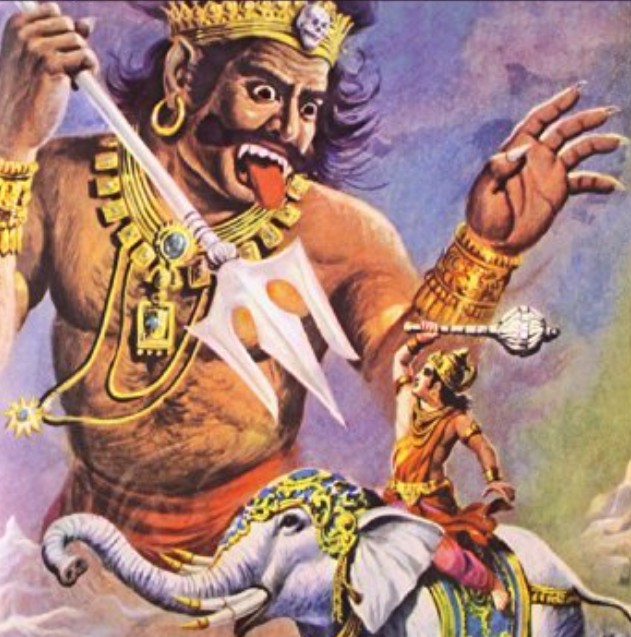
The Vajra or Vajrāyudha was originally made from the energy of the Sun. But this Vajra is rendered incapable at times. Later, another Vajra is crafted from the backbone of the Rishi (Sage) Dadichi. Indra has to defeat an Asura called Vrtra (also spelled Vritra). But this Asura is invulnerable to all manner of weapons. At the same time, the Rishi Dadichi has bones that are invulnerable to all forces in the universe as well.

Cover image of “Indra and Vritra”, which shows Indra fighting Vritra. In this case, Vritra is not depicted as a large snake. Image credit – “Indra and Vritra”, published by Amar Chitra Katha.

So, Dadichi offers up his bones as material from which weapons can be crafted to defeat Vrtra. Dadichi gives up his life for this cause as Vrtra has captured all waters and rain bearing clouds, causing a draught that is killing life on the planet. One weapon created from Dadichi’s bones is the Vajra. The Vajra was created using the backbone or vertebral or spinal column of Dadichi.

Vrtra is usually depicted as a large snake or Naga. There are people who suggest he is representative of a Dragon, and Indra is a dragon slaying God like in many other world religions. There are 2 stories that I have heard related to the battle between Indra and Vrtra. One is supposed to be from the Rig (Rg) Veda and the other, from the Puranas.

The story from the Veda is supposed to be a story denoting natural forces, where the Snake or Asura of draught is defeated by the God of Thunder and Lightning to release life sustaining waters as rain. The story from the Puranas shows Indra in a poorer light. He has to kill Vrtra who is created by Twastha, a great Rishi, whose son Indra has killed. But in both stories, Indra uses the Vajra to kill Vrtra. And the Vajra is a weapon of incredible power. In both cases, the Vajra is made from the backbone of Rishi Dadichi.

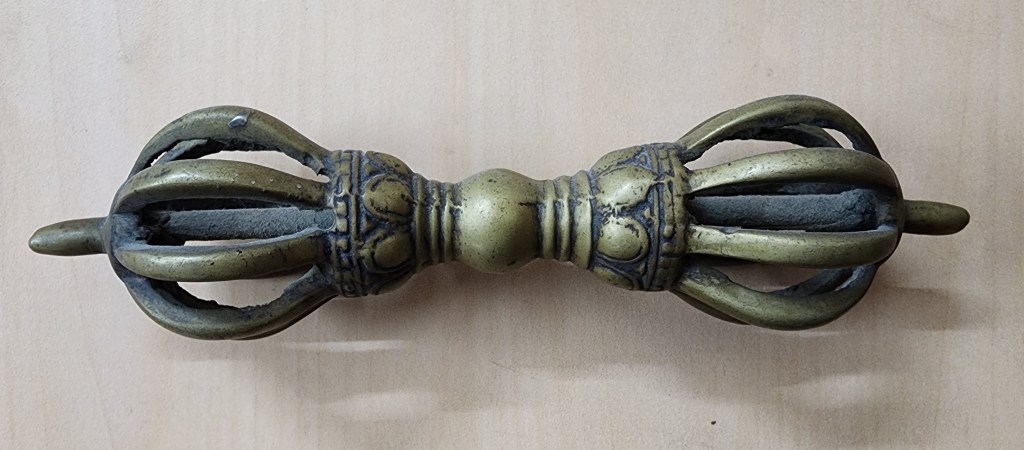
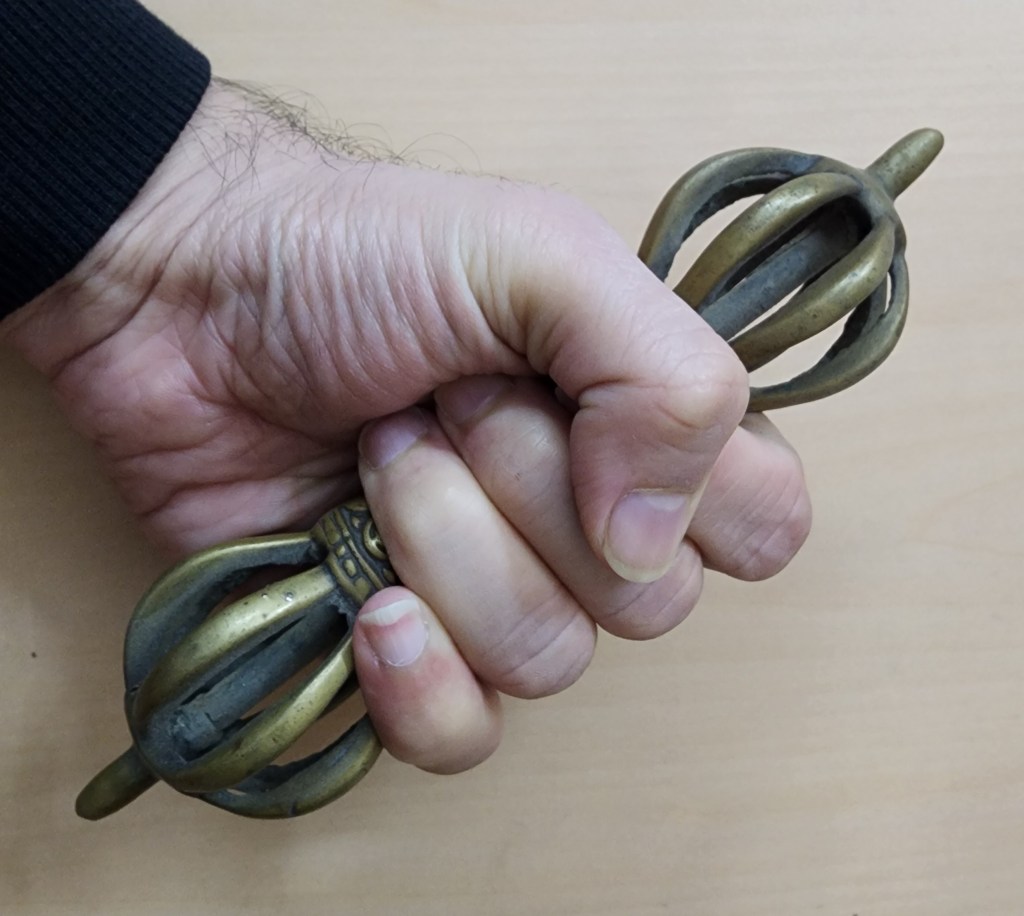
The most common visual depiction of the Vajra is common to both Hinduism and Buddhism. It is shown as a small weapon that resembles a dumbbell. It is like a short stick with symmetrical bulbous ends. The stick sits in the palm of a wielder while the bulbous ends stick out beyond the palm. By modern standards, we would call this a close quarter weapon.

Seen below is an example of a Vajra. This is more a representation of the Vajra in Buddhism than Hinduism. I personally see the former as a progression of the latter and do not care for the origin of the representation.

Representative images of a modern-day Vajra

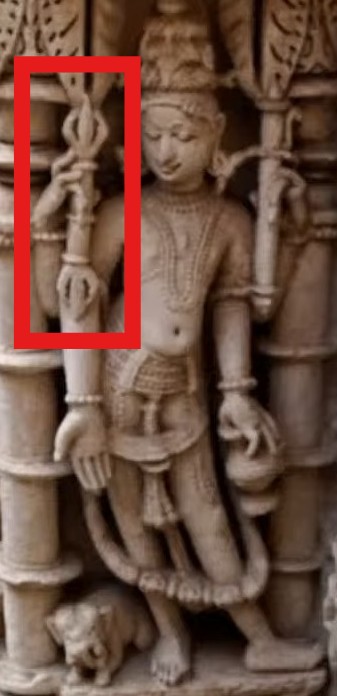
Seen below is a depiction of Indra holding the Vajra. This depiction is one of the many wonderful carvings at the Rani Ki Vav in Patan, Gujarat. The carving is from the 11th century CE. The previous and next representations are similar, though not identical. They are both two headed symmetrical weapons that are small and are held in the palm of the hand.

Image of a carving depicting Indra from “Rani ki Vav”, at Patan, Gujrat. The Vajra is seen at the top left of the image. Image credit – https://www.youtube.com/watch?v=gxT3VIH71dwDay – 1/3 Devalaya Samskruti hagu Murthyshilpa – GIPA Live Events – 10th April 2024

Consider the human backbone. It is a series of vertebrae one on top of the other. Now look at the images above, and the tradition that the Vajra is made from a backbone. Based on these, the following statement holds true for me. I had always imagined that the Vajra was two Lumbar Vertebrae attached to each other with a short stick, which could be made of any material. Of course, the vertebrae would be “facing away from each other”, for lack of a better description.

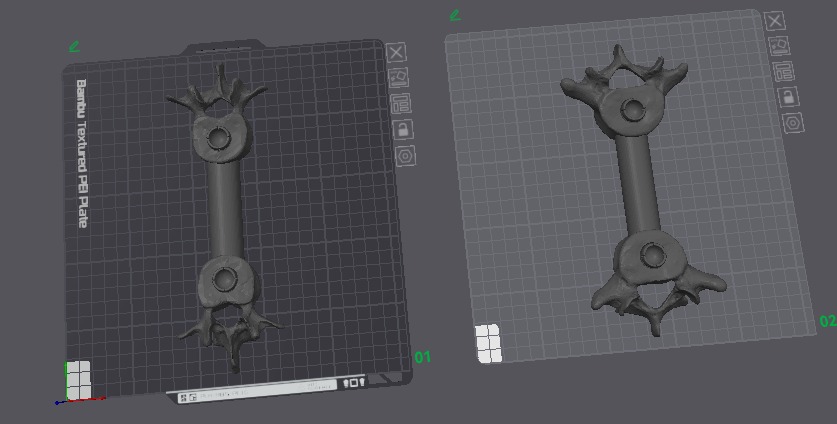
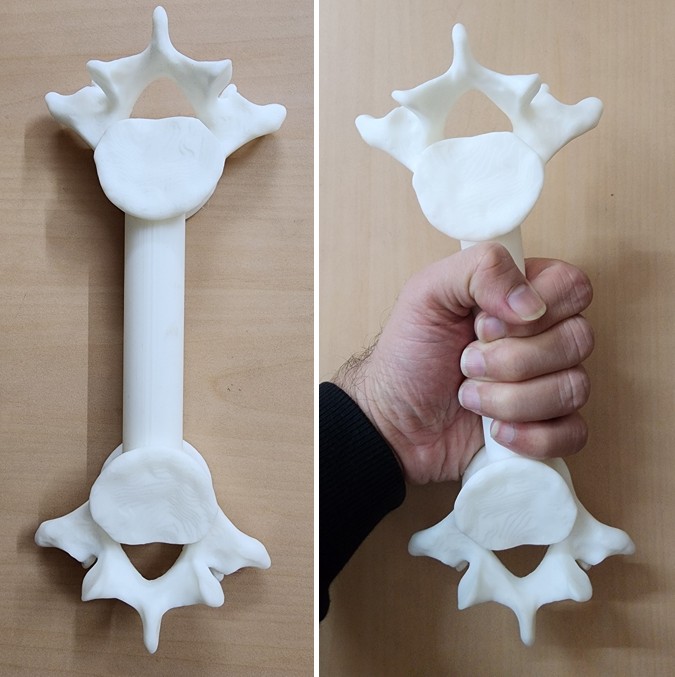
Thanks to the magic of 3D printing, a friend of mine, Siddhant Raju was able to print a Vajra as I had imagined it. We used the L5 vertebra as the best option to make the Vajra, as we felt that seemed the most robust. Of course, Rishi Dadichi would have only one L5. We decided that if we had to be accurate, we would use one L2 and one L5 to make a Vajra. As we see it, the L5 seems most robust of all the Lumbar vertebrae while L2 gives the best point to strike with.

The images below show the options with the L2 and L5 vertebrae for 3D printing, and the final Vajra that was made. We felt that the Vajra seemed very similar to the one depicted in the carving at Rani ki Vav.

The above image shows the options for 3D printing, with the L2 and L5 vertebrae.

The final Vajra that was made using 3D printing

A short video showing the 3D printing of the Vajra.

This design of the Vajra to me implies that Indra would be a master of very close quarters combat. It is almost as if he would get inside the range of any weapon an opponent would wield, to effectively deploy the Vajra depicted by tradition. I am sharing a video below that hopefully elucidates this idea.

I had created a video a few years ago that depicted the potential use of the weapons of the Guardians of the 10 directions. Along with my friend Nirvigna, we had depicted the possible use of the Vajra as well, as part of this video. Watch between the 2:02 and 3:03 minute marks of the video shared below, to see possible uses of the Vajra. We had used the Vajra seen in the image earlier in this article for the demonstration. The same moves can definitely be replicated with the design seen in the 3D printed version seen above.

All this experience suggests to me that the Vajra could definitely have been a real weapon, and it could have indeed been made with a backbone, or at least the vertebrae that make up a backbone. Of course, I cannot comment on the mystical or divine prowess of the Vajra that Indra would wield, what with his being the King of the Devas.

Since I have touched upon the Vajra being a real and practical weapon, let me share some real-world weapons similar to the Vajra, and their applications.

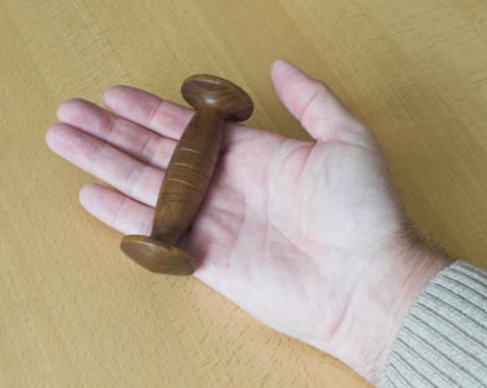
The Vajra is quite similar to a Yawara or Yawara Stick. The Yawara Stick, an example of which is seen in the image below also resembles a small dumbbell. It is used to strike opponents at very close quarters.

An image of a yawara stick. Image credit – Wikipedia

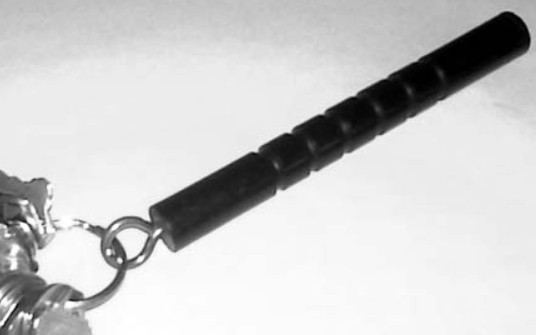
A weapon similar to the Yawara Stick is the Kubotan. Examples of this are seen in the images below. This weapon is sold as part of a keychain on many commercial e-commerce sites.

An image of a kubotan. Image credit – Wikipedia

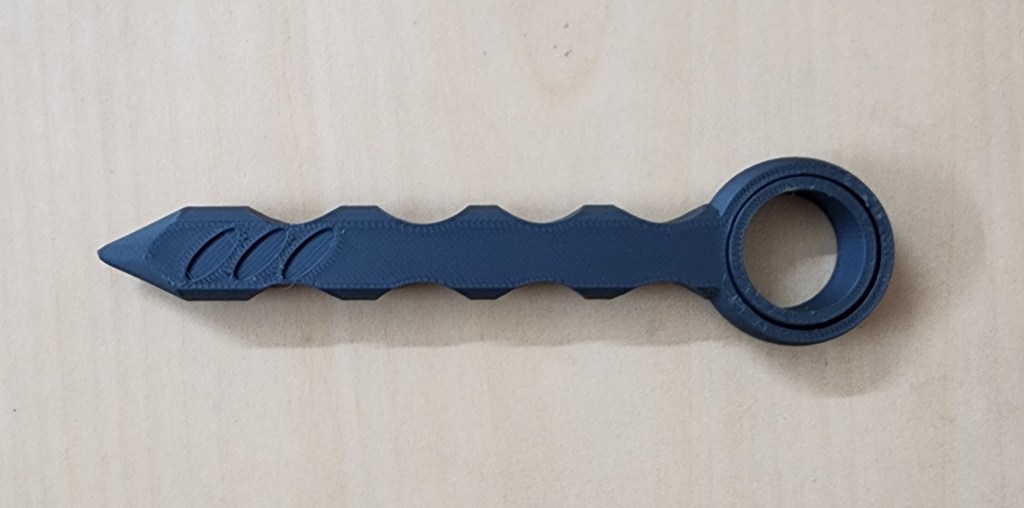
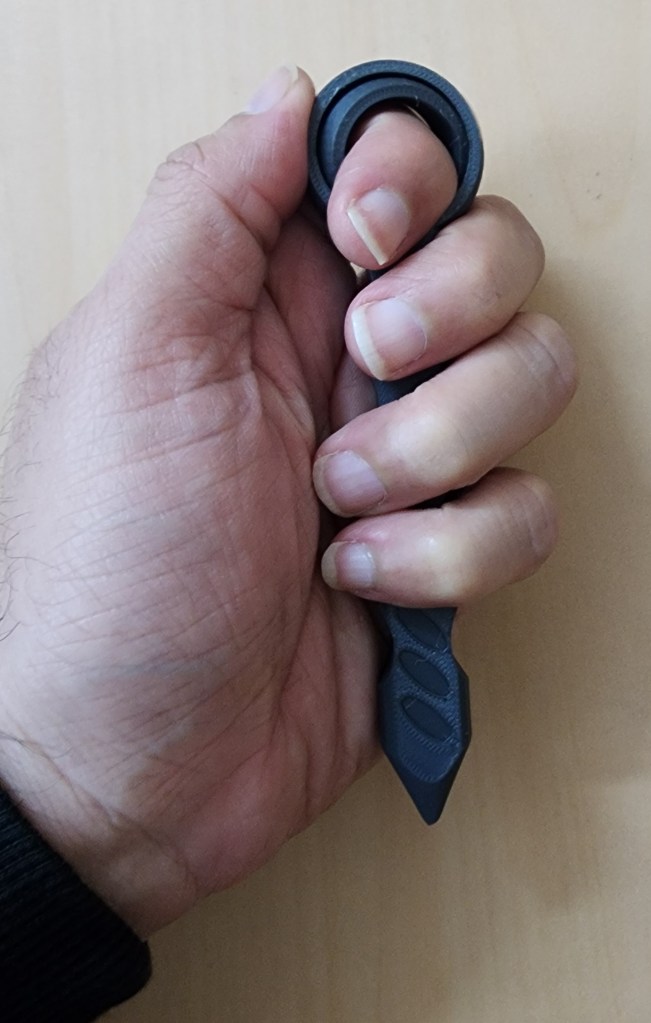
3D printed variants of the kubotan, that are only meant for training

A weapon called a Kobo Stick is also available online. An example of this is seen in the image below. From what I have heard the Yawara Stick, Kubotan and Kobo can be made of several different materials, ranging from bamboo, wood, metal and hard plastic. All of them can be used in a similar manner against opponents.

Images of a Kobo Stick

In the Bujinkan system of martial arts, we study a weapon called the tānbo (sometime pronounced tāmbo). This is nothing but a short stick. It can be used in a manner similar to the Vajra. The “tān” in the “tānbo” means “small”. “Bo” is a “staff”. So, a “tānbo” is a small stick/staff. This is not unlike a “tānto”, which refers to a knife. “To” is a bladed weapon, while “tān” is small. So, a small, bladed weapon signifies a knife.

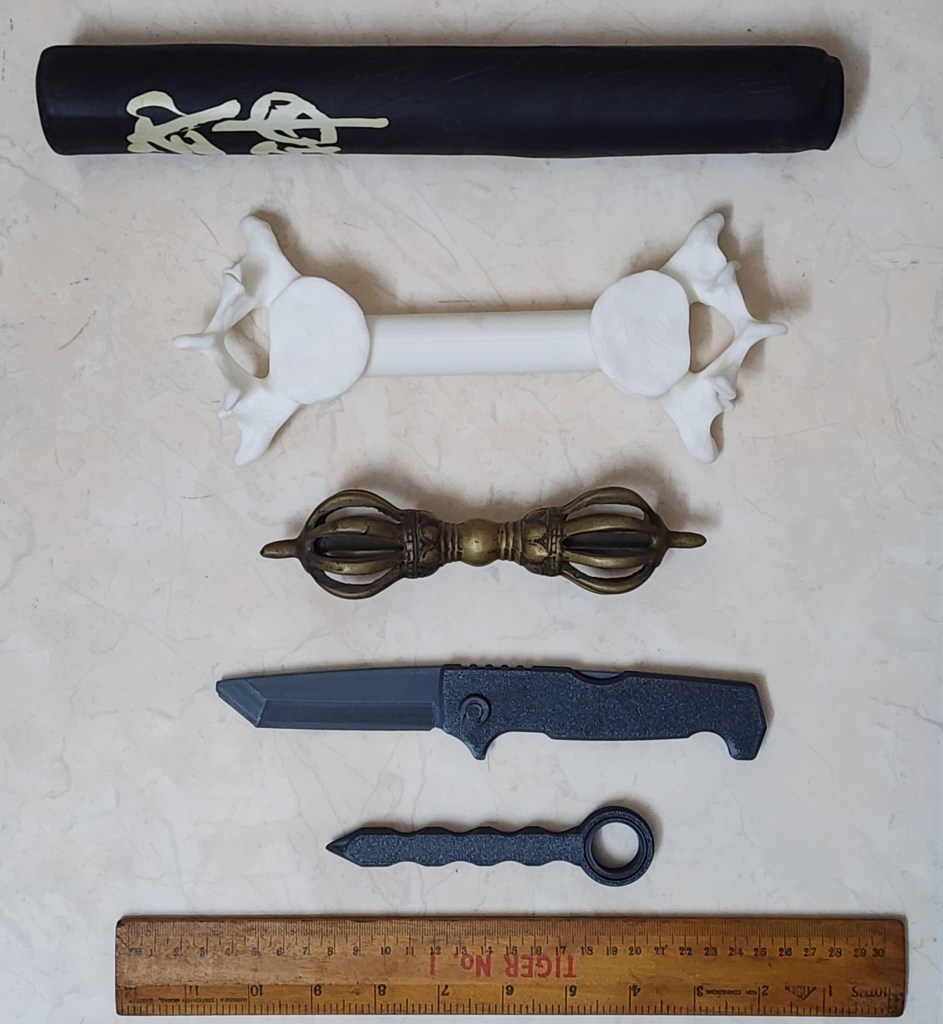
Seen in the above image from top to bottom are, a Tānbo, the 3D printed Vajra, a traditional Vajra, a training Tānto and a training version of a Kubotan variant. The Tānbo is also a padded training version. The real weapon would be a lot leaner, the length can be variable, it is not standardized.

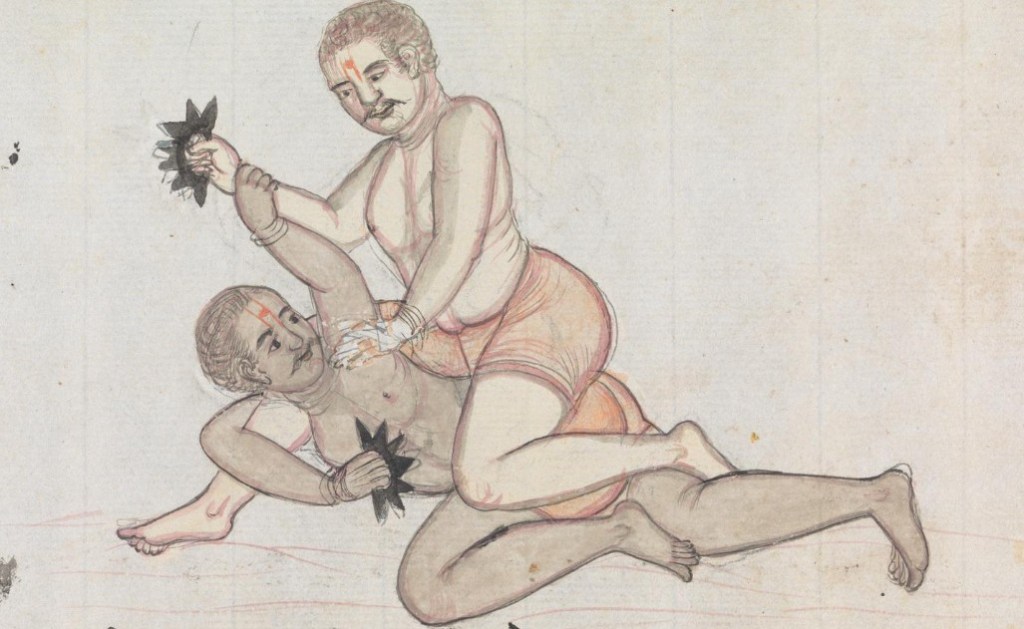
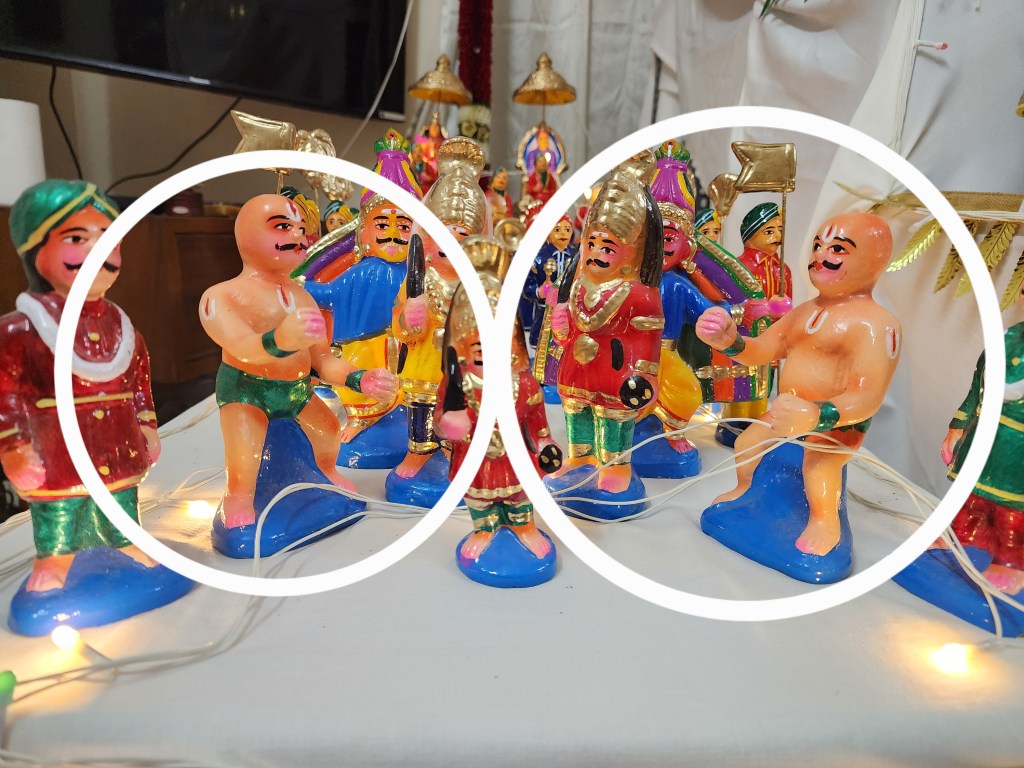
In India, there is a traditional martial art called “Vajra Mushti”. Here, “mushti” means “fist”. So, “Vajra Mushti” could mean “a fist like a vajra”, in other words, “a devastating fist”. Vajra Mushti is a close quarters martial art. The vajra in this case is closer to a knuckle duster than the traditional vajra. Vajra Mushti is demonstrated every year during the famous Dasara festival in the city of Mysore, in Karnataka.

A representative image of Vajra Mushti, from the late 18th century. Image credit – Wikipedia

The above image is from a traditional display of dolls during the Dasara festival. The two encircled individuals are the “Mallas” (roughly translated as wrestlers) who demonstrate Vajra Mushti in Mysore during the celebration of the Dasara festival.

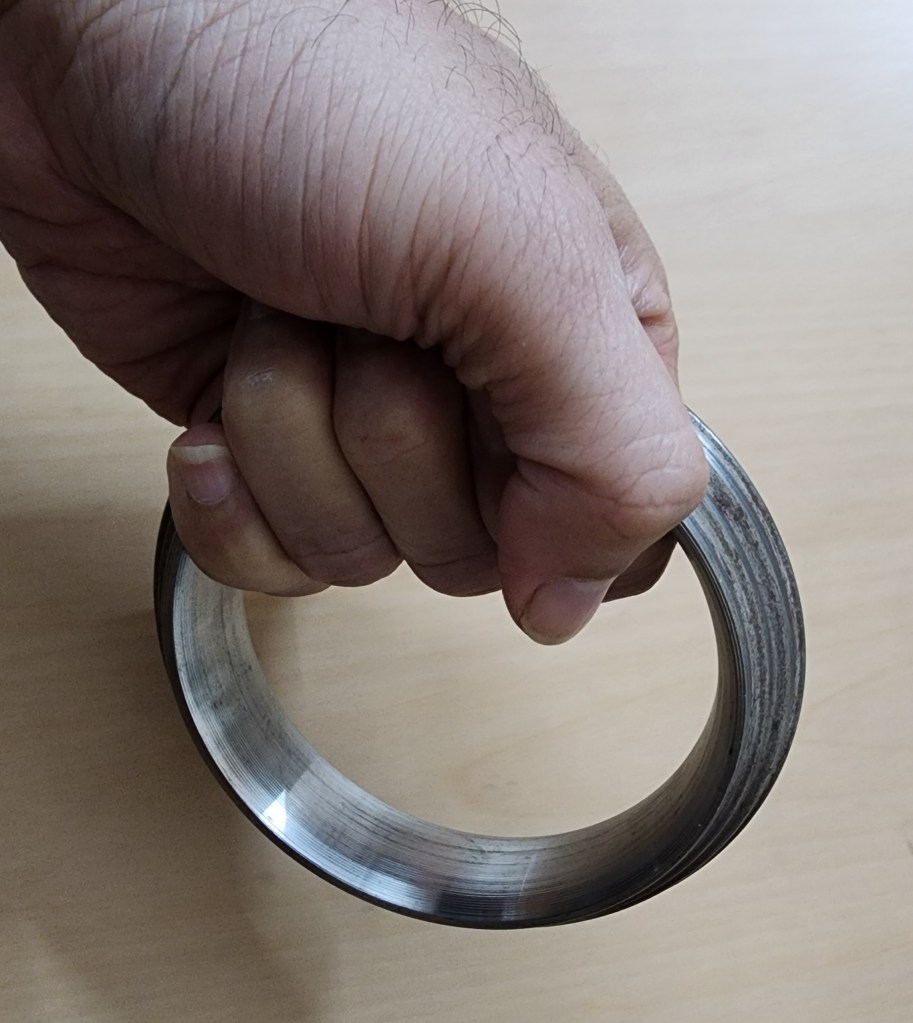
Similar to Vajra Mushti is another martial art called “Loh Mutthi”. “Loh” means “iron” and “mutthi” means “fist”. So, “Loh Mutthi” means “iron fist”. Here again, the “iron” comes from a knuckle duster used by a practitioner. Sikh troops wore (and still do wear) a “kada”, which is a metal ring akin to a bracelet on their wrists. These kada vary in dimensions. Supposedly, if all else failed, a soldier slipped off the kada and held it in his fist like a knuckle duster and used it in much the same manner.

A Kada held in a manner that enable its use as a knuckle duster. The shape and size of the Kada can vary greatly.

Since the Vajra is equivalent to a Yawara stick, which is a weapon used for fighting in very close quarters, I will share a question. The Vajra is also considered a lightning bolt, which strikes from far away, across a large distance, electrocutes and fries the lifeform it strikes. How do these two attributes fit in together? How can there be a feeling like an electric shock while fighting in close quarters with a small weapon?

I do not have a clear answer to this question, but I will hazard a guess as to how this is feasible. Imagine the feeling one goes through when one gets hit on the funny bone at the elbow. It is a jolt, something that can be said to be similar to an electric shock. There are multiple points in the human body, the striking of which can result in debilitating pain, sufficient to cause an individual to stop fighting for short durations, as small as a few seconds in some cases.

These points can be called “pressure points”. They are referred to as “marma points” in some Indian martial arts and Kyusho points in the Bujinkan system of martial arts.  These points cannot always be targeted in a dynamic fight. But the knowledge of these points is important, for when an opportunity presents itself, these points should be struck to gain an advantage.

Further, the effort needed to cause pain while striking these points is not great, this could partially be the reason martial arts around the world identify these points as known weaknesses in a human body. If one is wielding a Vajra or a Yawara stick or a Tānbo, a strike in close quarters with just a little effort will be magnified to a certain extent by the weapon. And this strike is sufficient to cause pain in the opponent.

Perhaps this pain caused by the small weapon in close quarters was considered akin to the feeling of suffering due to an electric shock, an analogue of a lightning strike! This is, in my opinion, a possible cause for the smallish Vajra being considered the lightning bolt! But does this mean that there was, sometime in the deep past, a real Indra who was a master of close quarter fighting? And does it mean he used a small striking tool? I have no idea if these are true, but there is a chance they might, considering how long the tradition of Indra wielding the Vajra has endured.

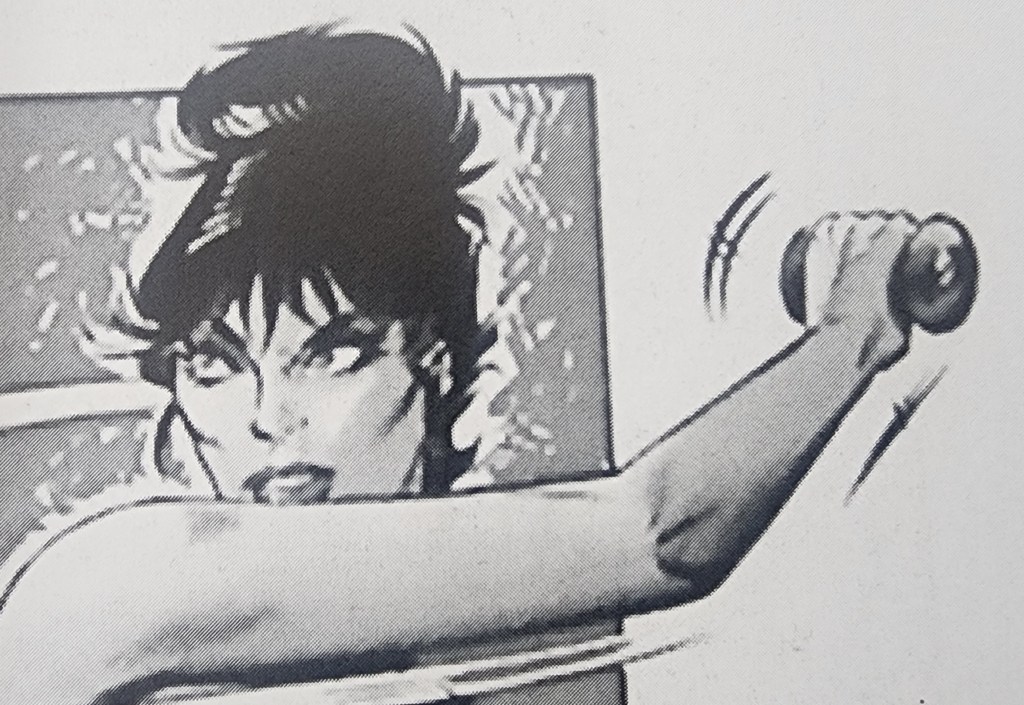
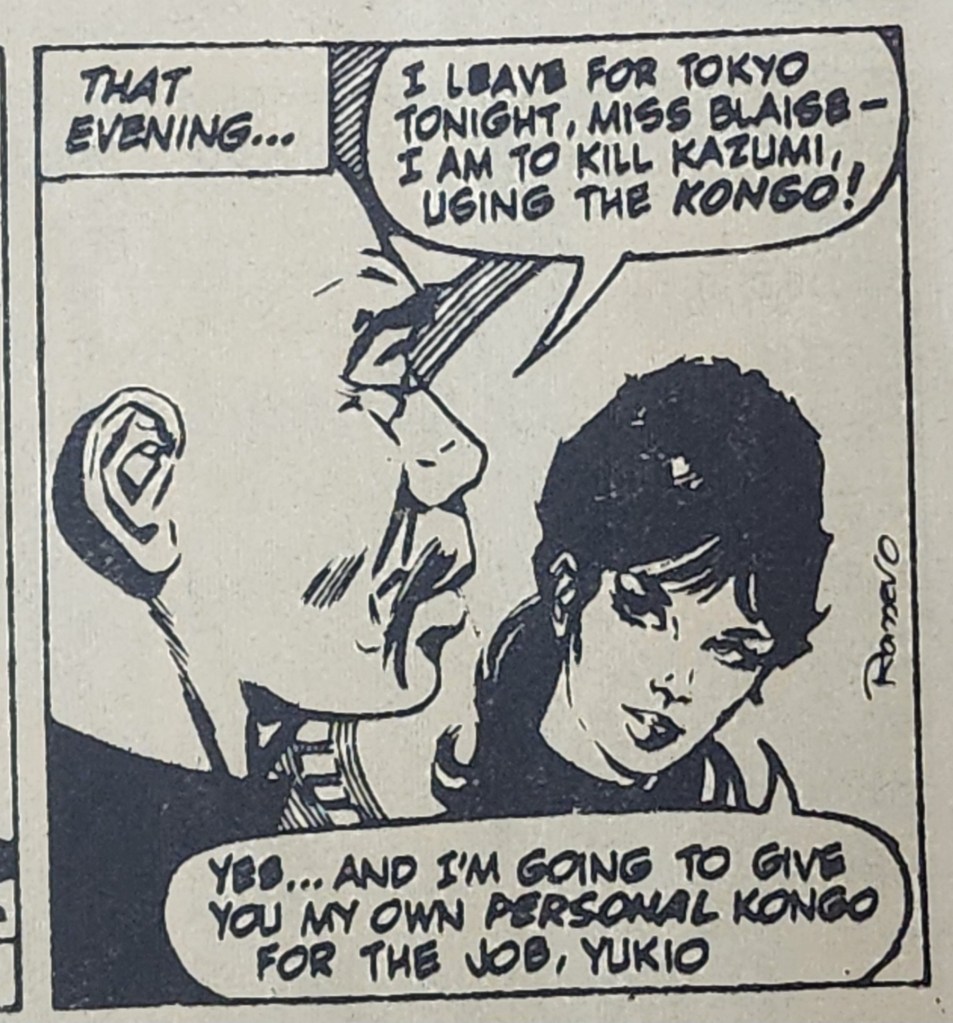
The vajra or yawara stick is also depicted in fiction. The fictional character Modesty Blaise, created by Peter Odonnel uses a weapon she calls the “Kongo”. This is Modesty’s favourite weapon. The kongo is nothing but a fictionalized version of the yawara stick. Modesty Blaise appears in 13 novels and 96 stories that achieved fame as newspaper comic strips. Modesty uses the kongo as a non-lethal weapon in close quarters. Her kongo is hollow and can also be used to hide messages if need be.

Modesty Blaise wielding the Kongo, which is a fictionalized version of the Yawara stick. Image credit – “The Art of Modesty Blaise”, published by Book Palace as part of the “IllustrationArtGallery.com presents” series.

The Kongo is Modesty’s favourite weapon. This picture is an image of a clip in an old edition of the Kannada newspaper, “Prajaa Vaani”.

The Vajra, beyond being a weapon also has cultural significance in India and beyond. The significance of the Vajra in Hinduism is through Indra as discussed earlier. The Vajra is also a revered icon in Buddhism. But apart from these historical aspects, the Vajra also has great significance in modern India, specifically in a martial or military context.

The Param Vir Chakra (PVC) is the highest gallantry award in wartime in modern India. The recipients of the PVC are held in high regard all over India. There are 21 recipients of the PVC in India. The award is a medal made of bronze. One face of the medal shows 2 Vajras which are perpendicular to one another. In this manner, the Vajra is a depiction of bravery to this day in India.

An image of the Param Vir Chakra. Image credit – Wikipedia

The Vajra is culturally significant in Japan as well. I am specifically referring to Japan because it is the country of origin of the Bujinkan system of martial arts, of which I am a practitioner. One of the deities in Japan is Fudo Myō. He is considered a very important deity for the martial arts according to the previous grandmaster of the Bujinkan, Soke Hatsumi Masaaki.

An image of Fudo Myō from an old training t-shirt we used back in the day. Observe the sword in the right hand and the noose in the left hand. Also observe the hilt of the sword, it is a Vajra.

From what I have heard, Fudo Myō can be called, in Sankskrit, Achala or Maha Achala. This can be roughly translated to “Immovable” (Achala) or “The Great Immovable One” (Maha Achala). Fudo Myō wields a noose and a sword in each of his hands. In my opinion, these two objects make him a personification of the first 2 lines of the Sanskrit shloka, “Asotōma Sadgamaya”.

The first line says, “Asotōma Sadgamaya” which translates to “move from untruth (ignorance) to truth (wisdom)”. The second line says, “Tamasōma Jyothirgamaya” which translates to “move from darkness to light”. Fudo Myō is supposed to use his sword to cut through the darkness of ignorance and use the noose to pull one into the light of wisdom. Thus, he is a personification of the two lines just mentioned!

The sword that is depicted in the hand of Fudo Myō is interesting by itself! The blade of the sword is broad at the tip and resembles what is called in India, a “Khanda”. A Khanda is a straight sword with a broad tip, which lends itself very well to cutting. The blade is double edged, though the back edge need not be sharp all the way through. It is sharp only for about the top half of the blade.

A representative image of a Khanda. Image credit – Wikipedia.

The hilt of the blade wielded by Fudo Myō is a Vajra. The blade is mounted on a Vajra. This makes Fudo Myō a “Vajra Hasta” or a “Vajra Paani”. “Hasta” and “Paani” refer to the palm. Thus, a “Vajra Hasta” or a “Vajra Paani” is someone who holds a Vajra in her or his palm. Indra is also a Vajra hasta as he wields the Vajra as well.

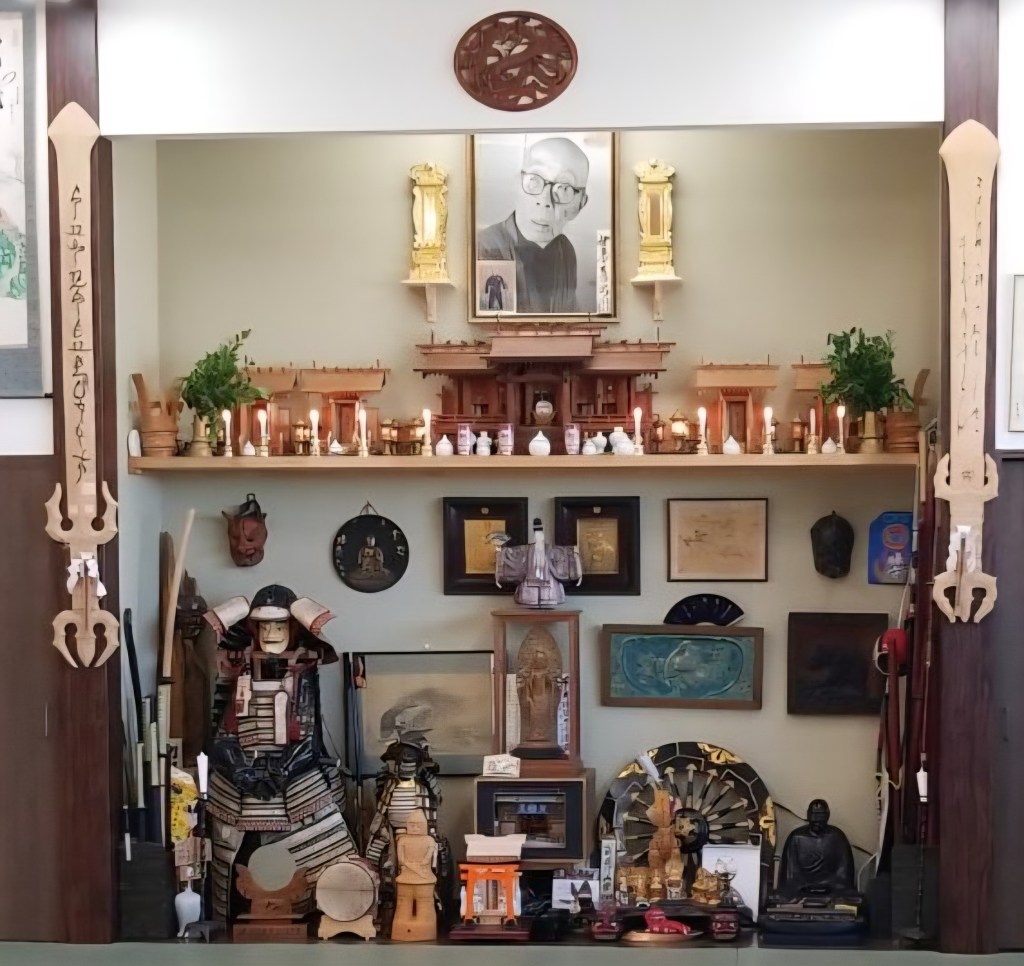
Fudo Myō and his significance was constantly discussed in 2013 when the theme of the year in the Bujinkan required us to study the Tsurugi or Ken. The Tsurugi or Ken is the straight Japanese sword which predated the famous Tachi and Katana, both of which are iconic curved swords emblematic of Japan in the modern day. In 2013, we trained with the Ken a lot.

This is a picture of the Hombu Dojo (headquarter dojo) of the Bujinkan. Observe the two Tsurugi (straight sword) on either side of the Kamidana. Also observe the hilt of the two swords, they are Vajras.

This concludes the main focus of this article, the potential of the Vajra being a weapon made of vertebrae, it being a real weapon, a demonstration of its use and its cultural significance in the martial arts. But there are additional points relating to its cultural significance outside India and its depiction in modern Indian pop culture that I would like to share. If the article is too long or boring, one can choose to ignore the rest of this post.

If one searches for “Zeus” on Wikipedia, as of now, the first image seen on the page is the one seen below. This is supposedly called “Jupiter de Smyrna”. It is supposed to represent Zeus or his rough Roman equivalent, Jupiter. This statue was supposedly discovered in Smyrna, in modern day Turkey, missing an arm. It was restored by the French sculptor Pierre Granier in 1680, to show Zeus holding the Thunderbolt.

Zeus/Jupiter of Smyrna. Image credit – Wikipedia.

The Thunderbolt seen in the statue, as far as I know, is similar to older representations of the same weapon. From what I know, the Thunderbolt is representative of the lightning bolt as well. Zeus and Jupiter are both roughly equivalent to Indra in this aspect, both being Gods of Thunder and Lightning.

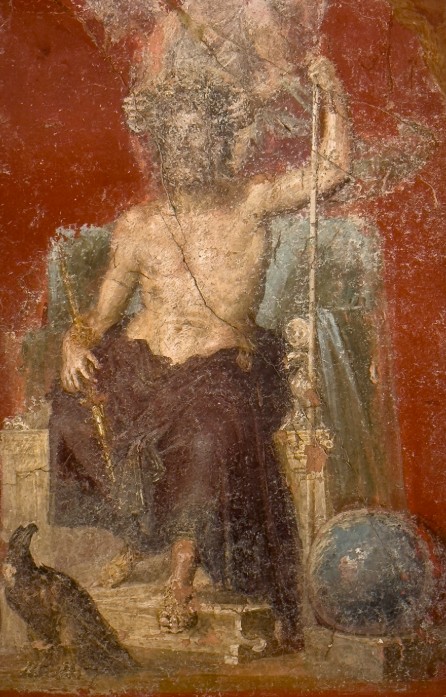
I have seen the Thunderbolt being depicted as a spear in some representations. In this form, it supposedly follows a kind of logic with respect to the brothers, Zeus, Hades and Poseidon. The weapon wielded by Zeus has a single point, so it is a spear. The weapon wielded by Hades has 2 points, making it something like a tuning fork or man-catcher from later centuries. This is also supposed to have influenced the “Pitchfork” wielded by the Devil in Christian tales, as that has 2 points as well. Poseidon has a weapon that has 3 points; hence he wields a Trident, or Trishoola as we Hindus refer to it. In this representation of the weapons, all of them wield pole arms.

This is an image of Zeus from Pompeii. Here the Thunderbolt that is wielded by Zeus is depicted as a spear. Image credit – Wikipedia.

But the Thunderbolt seen in the statue above does not depict a spear. It supposedly depicts a clutch of lightning bolts that Zeus can hurl at whomever he chooses. So, it could be that Zeus is so large that a lightning bolt seems small in comparison. If a normal human was depicted wielding the same, it would perhaps be as long as a spear.

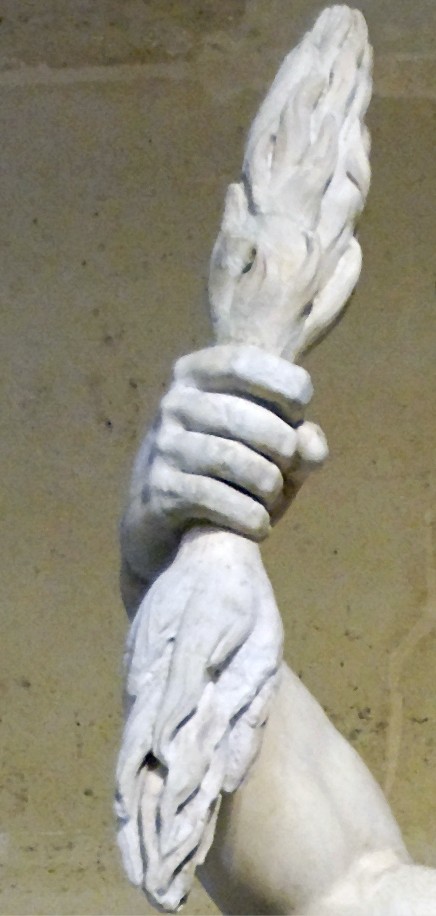
Either way, consider the depiction in the statue, a closeup of which is seen below. Does this not seem like a Vajra? The 2 ends are symmetric and wider than the centre, which is held in the palm of Zeus. Is the shape not similar to the one on the right? Does this not look like a large Yawara stick with slightly points ends? I opine that it does. With this observation, we can say that Zeus wields a Vajra as well!

That said, if the Thunderbolt was depicted as a spear, that would not, in my opinion, suggest that the Vajra could be depicted as a spear. This is because, by Hindu tradition, the weapon associated with Agni, the God of Fire and the Guardian of the Southeast, is the Shakti. The Shakti is always depicted as a spear.

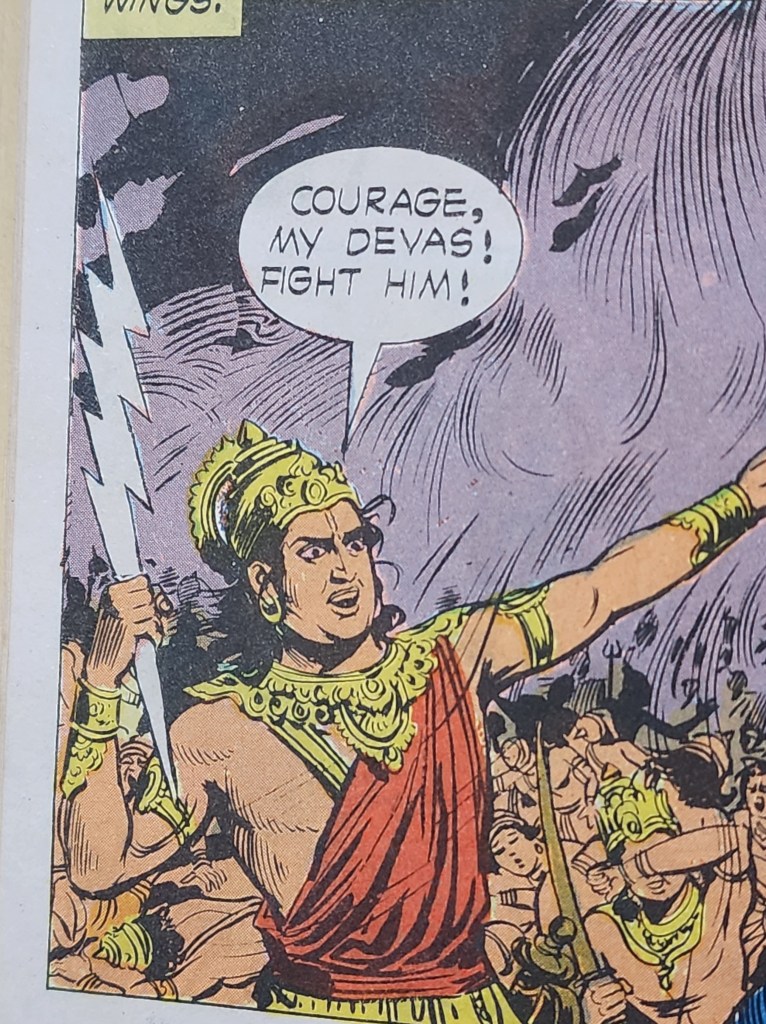
I will conclude with another question to which I have no answer. I wonder why the depiction of the Vajra in modern pop culture in India is so very different from the traditional depiction. Sometimes, the Vajra is depicted like a “Z”, almost like the symbol of the DC comics superhero, The Flash. In come extreme cases, Indra is shown wielding the backbone with all the ribs still attached! I wonder how one would fight with that! 😀

The Vajra wielded by Indra being depicted as a “Z”. Image credit – “Garuda”, published by Amar Chitra Katha.

The “Z” like depiction is seen in many Amar Chitra Katha publications. This publication has always drawn inspiration from historical depictions, and temple carvings. But I wonder why they chose a different one in the case of the Vajra, especially since there are so many depictions of the Vajra in temple carvings.

This holds true considering one of their early depictions of the Pushpaka Vimāna in the Ramayana (the aerial vehicle of Kubera stolen by Ravana and eventually passed on to Lord Rama) is remarkable similar to the depiction of the same in an approximately 1300-year-old carving in a Chalukya temple at Pattadakal in Karnataka.

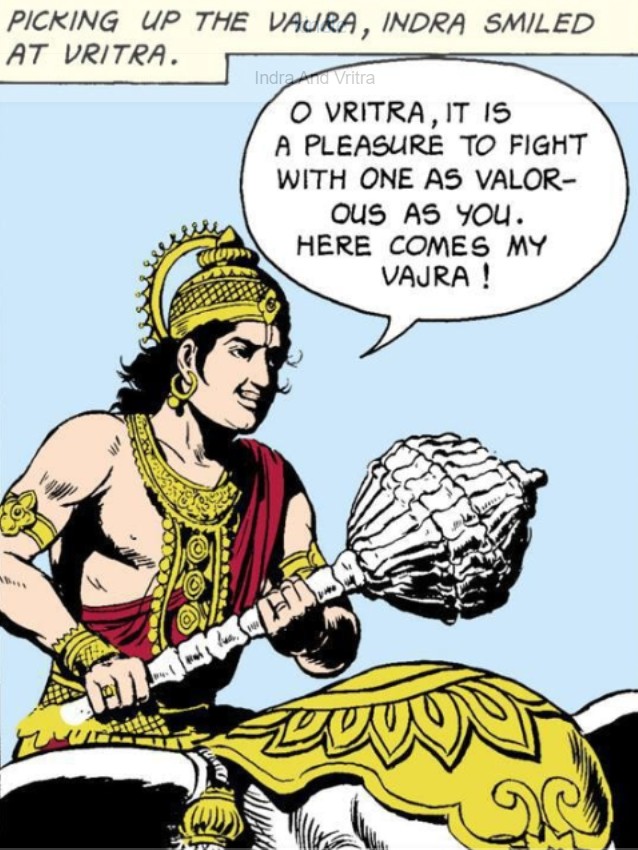
In another depiction of the Vajra, they have depicted it as a mace or a gada made from bones. This seems a far better depiction, since there is some engineering of the bones of Rishi Dadichi to convert them into a weapon. Considering that Vishwakarma, the engineer of the Devas, crafted the Vajra, this “value addition” seems necessary, at least to a modern mind like mine, that is accustomed to engineering in every aspect of life.

The Vajra depicted as a Gada (mace) made from the backbone of Rishi Dadichi. Image credit – “Indra and Vritra”, Kindle edition, published by Amar Chitra Katha.

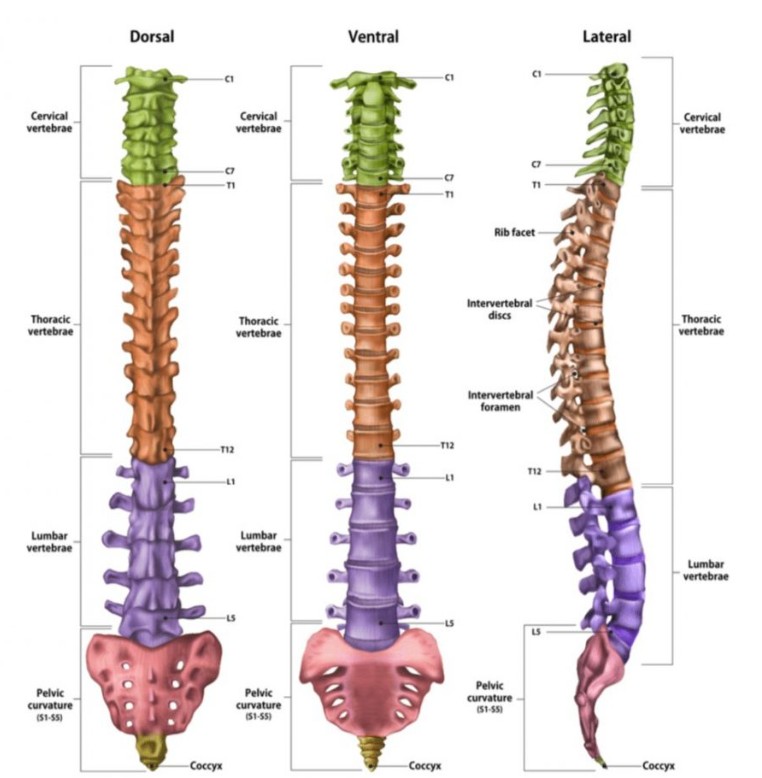
If I were to consider a very pop culture depiction of a primitive, barbarian like Vajra, since it is from a forgotten past, I would likely make it look like an axe, a two headed axe no less. 😛 Consider the human back bone. It includes the pelvic girdle. So, if one reversed the backbone to hold up the girdle, with the rest of backbone being the handle, we would have an axe. 😊And the axe handle would have a natural curvature and a pointy end at the tip (sacrum) as well! I will end here before I run away with my imagination. 😀

Seen above is an image of the human backbone. Observe the Dorsal and Ventral images. Do they not look like a stylized axe a barbarian would use??!! 😊 Image credit – https://spinehealth.org/article/spine-anatomy/

Kantāra and the Loris at war! 😊

Animals have always been used in war. Horses, elephants, dogs and pigeons come to mind readily as examples. Horses were used with chariots and cavalry, elephants were used for logistics and as weapons of war. Dogs were used for fighting, as sentries and as guides for scouts. Dogs are still used by several armed forces. They are a key component of counter insurgency operations in India to this day.

Pigeons were used as messengers. Mules were and still are used as pack animals. Camels were used as mounts for mobile light artillery in the past! They are still used as pack animals and as mounts for patrols in the desert regions of India. Raptors have also been used in war. Kites are still used in some instances to take down drones. If strange projects are to be considered, there were attempts to use dolphins as tools of the navy! And if we consider folklore, monitor lizards were also used in war, specifically as grappling hooks*!

Apart from pack animals and fighting animals, there are also animals that historically have provided chemical weaponry! Humans have used secretions from animals and plants for hunting and in warfare. Secretions from the skin of multiple species of Arrow Poison frogs have been used in South America for hunting. Snake venom has supposedly been used as poison on projectiles, though I cannot recall specific examples at this time. Venom from certain species of snails is also supposedly extremely potent and can be used as poison.

This brings me to a recent and interesting experience. I watched the movie “Kantāra: A Legend – Chapter 1” a few days ago. The rest of this article holds spoilers for the movie. So, if anyone reading has not watched the movie and plans to do so, please decide if spoilers are fine by you. The movie depicted the use of the Loris as a weapon of war! :-O 😊

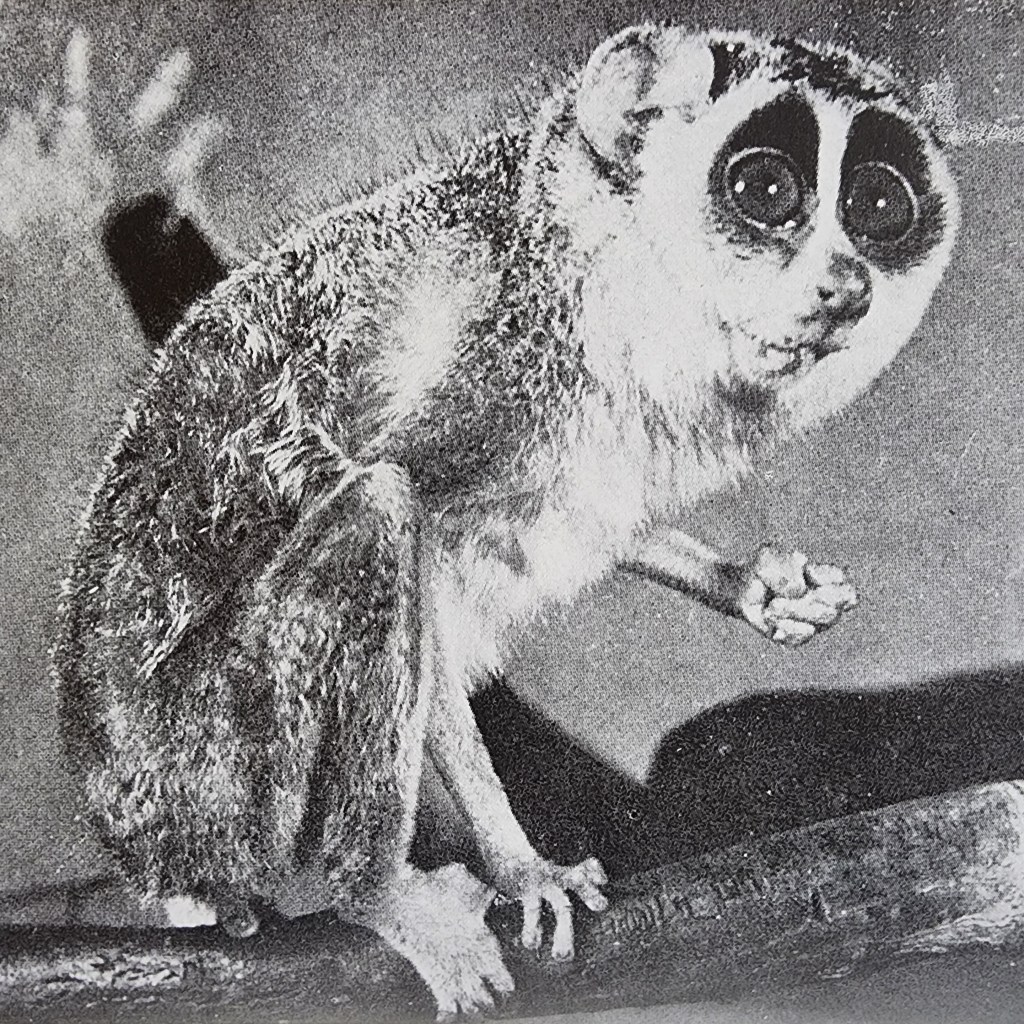
A Slender Loris. Image credit – “The Book of Indian Animals”, by S H Prater, published by Bombay Natural History Society.

There is a tribe depicted in the movie that utilizes the loris as a weapon. This tribe also uses the blood of the loris in magic rituals, which they supposedly use to render the Gods revered by other tribes, powerless. This is absolutely the very first time that I have seen the loris have a starring role in any form of media or storytelling!

Granted, the loris depicted is not as accurate as it could have been. The movie is set in Tulu Nadu, a part of the coastal region of the state of Karnataka in India. The species of loris native to this region is the Gray Slender Loris. This animal is small, nocturnal, omnivorous, has large, beautiful eyes, and is not well known. It has rarely been seen by most people, and rarely, if ever, encountered in the wild+.

The loris seen in the movie appears more like a species of Slow Loris. A species of Slow Loris, called the Bengal Slow Loris is native to the Northeastern parts of India. This animal is larger and furrier than the Slender Loris, though both are arboreal creatures. The animal depicted in the movie hisses when threatened. This is correct, as I can attest from personal experience with a Gray Slender Loris.

But the greatest drawback with the depiction of the Loris in the movie is in relation to its locomotion. The lorises on screen move very fast, and at times seems like a lemur or a meerkat. Of course, this speed can be attributed to magic in the movie, but that is not specifically explained on screen. So, I find the speed of movement of the lorises in the movie unsettling.

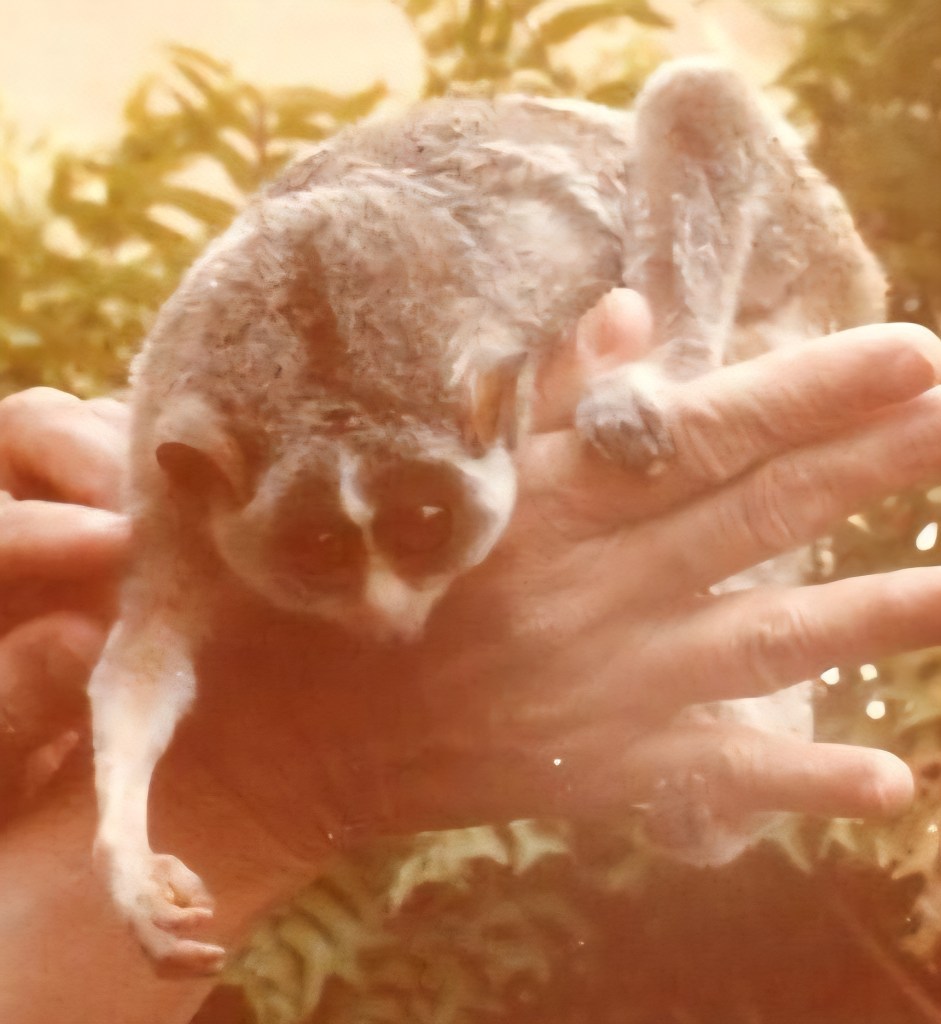
A Slender Loris I had the privilege of observing at close quarters. Image credit – “Menagerie Memoirs” by Dr. M K Shashidhar, published by Notion Press.

In reality, the Slender Loris has a slow, deliberate, cautious way of locomotion. This is part of why it is incredibly hard to spot in its natural habitat. This protects it from predators in the wild. The movement of the loris could remind one of the movements of the sloth, which inhabits South America. I personally feel the sloth is more deliberate and slower than the loris, based on my experience with the loris and what I have seen of the sloth in documentaries.

The Slender Loris used to be hunted in the past. This is supposed to have reduced considerably since the 1990s. From the 1980s through to the early 2000s, I have had the good fortune of observing closely a few Gray Slender Loris specimen. These were all rescued from attempted poaching/hunting activity or from the exotic pet trade.

One story I had heard back in the day was that there was a superstitious belief in relation to the eyes of the loris. It was supposedly believed (wrongly) by some that if one added the eyes of a loris to a potion and consumed it, one would be reunited with one’s lost love! I have not been able to ascertain if this tale is just hearsay or if there is any evidence to this belief in any local folklore.

But this potential (and untrue) attribution of a mystical quality to a loris is tangential parallel to the movie. In the movie, the tribe mentioned earlier, uses the blood of the loris as part of their magic ritual, almost like a magic potion, to capture and subdue the deities of other tribes. So, a mystical quality is attributed to the loris, to its blood if not to its eyes.

The loris is called the “Kaadu Paapa” in Kannada. “Kaadu” means “forest” and “Paapa” means “baby”. The loris is literally called “the baby of the forest”, a name this is apt, considering the cuteness of the animal. The name also exacerbates the tragedy of poaching the animal, for it is akin to abusing a child, which is what the loris is called in Kannada.

This image of a Slender Loris shows its size, in relation to a human hand. The animal is really small, much smaller than how it is depicted in the movie. Image credit – “Menagerie Memoirs” by Dr. M K Shashidhar, published by Notion Press.

The fact that the loris, a small, slow species has survived on the planet gives it a tenuous connection to the martial arts. No, there is no “Loris Style” of fighting that I am aware of. Nor is there any modern military technology that is specifically inspired by the Loris, again, as far as I know. The connection is more in the form of a bit of advice we once received.

Sometime between 2017 and 2019, a few of my Buyu (fellow practitioners of the Bujinkan system of martial arts) were attending a class by Nagato Sensei in Japan. Nagato Sensei is among the most senior teachers of the Bujinkan system and the Soke** of the Shinden Fudo Ryu. During the class, Nagato Sensei spoke of how the loris can be an inspiration during training.

Sensei was speaking of how the urge to move fast during training is not always beneficial. Speed and strength are always important in the martial arts, at least in the sport versions of martial arts, where two individuals are fighting each other. But Sensei was suggesting that one only needs to move as fast as is necessary. If one is moving to avoid an attack, moving too fast might lead to overcompensation, which can then lead to a potential opening.

Also, when training, moving slowly enables one to study one’s own movements and improve or fine tune one’s form or technique. Taking the two aspects together, he said that one must move like a loris – I think he specifically said Slow Loris – though I am not sure if he used the word “slow” to refer to the type of loris or to just drive home the point that speed is not panacea.

Sensei was referring to how a loris moves slowly and deliberately and still survives successfully. It is able to hunt and stay protected from predators. In this same manner, one needs to move just as fast as is necessary to survive, which is not slow or fast, it is just deliberate. At the same time, moving slowly, except until the last instant of the attack prevents an opponent from being defensive and overly alert. This is what I understood from what I heard of the exchange between Sensei and those who attended that class. This in a way feeds into the saying, “Slow is smooth, smooth is fast”. This then is the link between the loris and the martial arts. 😊

I will return to the reference about venom and the movie Kantāra to conclude. I recently learnt that Slow Lorises have venom glands, making them the only primates in the world to be venomous. The venom glands are on the insides of their elbows. The Lorises supposedly lick the glands to secrete the venom and mix it with their saliva. They then lick their hands and apply the now toxic saliva on their bodies. This protects them from potential predators. Also, the toxic saliva is transferred to a prey when the Loris bites it, as the saliva is transferred with the bite.

A Slow Loris. Image credit – “The Book of Indian Animals”, by S H Prater, published by Bombay Natural History Society.

Venom is a chemical weapon; there is no doubt about that. That is part of the reason why a lot of people fear snakes, and that is also why poison arrows have always existed. In the movie “Kantāra: A Legend – Chapter 1”, the lorises are controlled by the sorcerers of a tribe, and they direct the lorises to attack as a group. This more like a special forces raid than open warfare as the lorises simply do not have the strength or numbers to overwhelm large numbers of enemies.

As I mentioned earlier, the lorises depicted in the movie, due to their size, look like Slow Lorises. And if we assume that is the case, a new dimension comes into play. The sorcerers now have a number of animals that can deliver a toxic bite! They can direct the lorises to attack specific individuals to deliver a bite that will either kill or at least incapacitate high value targets, given a sufficient number of bites! This is not unlike people dying when they are subjected to a large enough number of bee stings. And this is exactly how the lorises are used in the movie!

Thus, the lorises are indeed weapons by themselves. And this is something I have never seen in any form of storytelling ever! And that made the movie experience simply fantastic. 😀

This remaining part is just an aside, not an essential part of the article. I am just sharing another observation relating to animals and warfare. We all know that horses were used in war over several centuries. In India, in the past, a yajna called the Ashwamedha Yajna used to be performed. This involved letting loose a horse which traversed many lands over the course of a year.

A representation of the horse from the Ashwamedha Yajna in the Ramayana. Image credit – “The Sons of Rama”, published by Amar Chitra Katha.

If the horse passed through the lands of a neighbouring kingdom, the king or leader of that kingdom could either let the horse pass or stop it from going further through his lands. If he let it pass, he would have to accept the suzerainty of the king performing the Ashwamedha Yajna, or at least accept some form of treaty, likely an unequal one.

If however, he chose to stop the horse, he would have to fight the king performing the Yajna. An army followed the horse and would fight the army of the kingdom through which the horse was passing. The war would have a natural conclusion. If the army of the king performing the yajna won, the other kingdom would be annexed. If it lost, the yajna would be over, as a failure.

The horse from the Ashwamedha Yajna being stopped by a king whose lands it has wandered onto, triggering a war. Image credit – “Uloopi”, published by Amar Chitra Katha.

A representation of the horse from the Ashwamedha Yajna in the Ramayana. Image credit – “The Sons of Rama”, published by Amar Chitra Katha.

In popular depictions of the Ashwamedha Yajna, the horse that is let loose is always a WHITE HORSE. In the movie Kantāra – A Legend: Chapter 1, there are 2 sequences with white coloured horses. One on the port and another in the forest (the Kantāra).

On the port, a white Arab horse runs amok. This horse is subdued by the hero of the movie, a leader of the people of the forest. In this manner, the horse could be said to be his, as he is the one who restrained it. Later, the people of the forest, under the leadership of the hero capture the port. The horse is also slain by the villain of the movie. In this manner, the entire sequence is reminiscent of the Ashwamedha Yajna!

A white horse is let loose, it belongs to the leader of the people of the forest, the horse wanders to the port controlled by a different king, and the port is conquered. Add to this, the horse is killed, like in the sacrificial part of the Yajna. Thus, the Ashwamedha Yajna has been successfully completed by the hero, the leader of the people of the forest!

A representation of the horse from the Ashwamedha Yajna in the Mahabharata. Image credit – “The Ashwamedha Yajna – Mahabharata 41”, published by Amar Chitra Katha.

The king from whom the port was conquered, later invades the forest. He causes a lot of carnage but is eventually defeated and killed. He also rides a white horse! Of course, the horse is not let loose, but the parallel is close. In this case, the Ashwamedha Yajna fails as the king is killed, and the invasion is defeated.

The White Horse that is let loose during an Ashwamedha Yajna is an instrument of war by itself, as it can cause kings to fight and lose or accept defeat without fighting. In that way, the horse is an incredible martial tool! One that can lead armies to their death or a people to increased prosperity. Of course, this aside could be just me overthinking things. The interpretation could be completely wrong and not what the filmmakers meant at all.

Notes:

* Swaraj and the Lizard (and Ninjas?!) – Mundane Budo

+ There was a time when group walks were allowed in protected areas. This provided an opportunity to encounter and observe smaller wildlife, like gerbils, lorises and invertebrates. But as far as I know, walks are no longer allowed in forests if elephants are known to inhabit the area. So, the opportunity to spot the smaller creatures has diminished greatly.

** Soke – Grandmaster is a good understanding of this word, though it is not a literal translation

Weapons of the Dikhpālakās (Guardians of the Directions)

Tomorrow is Naraka Chaturdashi, the first day of Deepāvali (“the Festival of Lights”). Naraka Chaturdashi commemorates the victory of Lord Krishna over Narakāsura. Narakāsura was an incredibly powerful Asura, who was the son of Bhoomi Devi and Lord Varāha. He committed atrocities across all realms and was almost invincible. It took Lord Krishna carrying out an aerial assault on his palace at night to defeat and kill him. Lord Krishna flew on Garuda with his wife Satyabhāma to carry out a surprise attack on Naraka’s citadel in Pragjyotishpura to slay the Asura.

Narakāsura had defeated the Devas, including Indra and Varuna. He had imprisoned thousands of women and looted wealth from the Devas and many other regions. The Devas were never powerless. They are the Guardians of the 8 directions, with Brahma and Vishnu being the guardians of the Zenith and the Nadir respectively. Lord Shiva, called Eesha, is the guardian of the North East.

Being the Guardians and celestial beings, the Devas are very powerful and it takes an Asura of rare abilities who only seldom appears to defeat them. Just because the stories depict Lord Vishnu coming to their protection and rescue does not mean that they are always frail and in need of help.

All the Devas, in a show of strength, carry a specific weapon which is always depicted in iconography depicting them. I am sharing a video below that depicts these weapons and possible use of the same.

This is a video I made a few years ago as part of the Indian Independence Day celebration at work. But it fits into this post pretty well in my opinion. I am not editing out the Independence Day wishes at the end, because the occasion is not important, the depiction of the use of the weapons is.

Wish you all a blessed Deepāvali! 🙂

This video was made during a mild phase of the pandemic. Hence the masks on both demonstrators in the video.

Asura Planet

In Hindu culture, the Asuras are very often seen in a negative light. Asuras, sometimes conflated with Rakshasas are, from a modern perspective, the villains in most of the stories we hear. But as we know these days, they are not villains. Some of them might end up becoming villains. More often than not, they are in opposition to the Devas.

The Asuras usually include the Daityas and Dānavas. Daityas, Dānavas and Devas are cousins. They end up battling for control of various realms often. While the stories we hear and read eventually end with the destruction of one or a few specific Asuras, it does not mean that they always end up on the losing side. They end up being the victors quite often.

It must also be remembered that while the Asuras are seen conquering the realm of the Devas (Swarga and its capital Amarāvati), and the realms of humans or Mānavās, the Asura realm is shown as being attacked or conquered by the Devas (never the Mānavās) only a few times. The Asuras regroup time after time under different leaders and attempt a new conquest. They succeed in their conquests quite often and subdue the realms of Devas and Mānavās. This conquest leads to an avatāra of Vishnu or Devi or Shiva to be responsible for saving the Devas and Mānavās.

The Asura Shumbha conquers Swarga. Image credit – “Tales of Durga” (Kindle edition), published by Amar Chitra Katha.

This sequence of events leads to interesting observations. Firstly, if the Asuras were rarely invaded and only defended against, it seems that they were too powerful to face offensive action. Only one of the Trimurthy or Devi could attack them and succeed. The two instances that I am aware of when the Devas attacked and defeated the Asuras was when Vrtra was slain and then when Viprachitti was defeated.

Secondly, it seems that the Asuras were the definition of resilience, innovation and perseverance. Every time they were defeated, they held out to rise in strength again. This is resilience. The next Asura leader performed great meditative penance (tapasya) to achieve a great boon from Lord Brahma. This boon nullified the advantage provided by the Amrita in the possession of the Devas. This is innovation. This process took years on end. But after this gap, the Asuras invaded again with the new leader and his or her powers and generally succeeded in defeating the Devas. They ruled Swarga for a long time after the victory before a divinity defeated them. This is perseverance.

Mahishi taunts the Devas after acquiring her Boon. Image credit – “Ayyappan”, published by Amar Chitra Katha.

I mentioned the Amrita in the possession of the Devas in the previous paragraph. Amrita gave the Devas great health and immortality. This was an unbeatable technological advantage. To overcome this advantage, the boons the Asuras acquired were vital. This mitigated the advantage provided to the Devas by the Amrita, at least to a certain extent.

An aside – I have heard that this is a likely origin of the word “Asura”. During the Vedic Age when Yajnas were widely prevalent, two sacred drinks are mentioned as being offered to the Gods, Soma and Sura. These were not offered to some Gods. These Gods came to be “Asura” as “Sura” was not offered to them, the “A” indicating the lack of the offering. I am not sure if this is accepted by everyone or if it is just another theory.

The martial art I practice is the Bujinkan system of martial arts. The Bujinkan is sometimes referred to as “Ninjutsu”. But Ninjutsu, or Ninpo, is one of the facets of the martial arts practiced as part of the Bujinkan system. The “Nin” in both Ninjutsu and Ninpo, refers to “Perseverance”. So, Ninjutsu is “The Art of Perseverance” and Ninpo is “The Way of Perseverance”. And if the Asuras are the exemplars of perseverance, they are the true practitioners of Ninjutsu!

Historically speaking, the Devas in their primary roles are representative of the natural elements. Indra, the king of the Devas, is the God of Thunder and Lightning and Storms. This means that he is a personification of these natural forces. Similarly, Agni represents Fire, Vayu represents the Wind and Varuna represents water and water-bodies. Surya represents the Sun, Chandra or Soma the moon and one of the Vasus represents the Sky.  The Ashvins represent healing properties, speed (horses) and safety during voyages. It seems to me like they represent the natural intelligence of humans to protect themselves.

Humans have striven from time immemorial to survive the elements. Over millennia they achieved mastery over the elements and learnt to thrive despite the elements. Now we have reached a stage where human actions are causing chaos in the elements in the form of climate change and devastating the natural world.

This flow of events over the last several thousand years suggests to me, that we are the Asuras. The Devas are nothing but the natural world as mentioned earlier. Humans initially cowered before the elements, but showed resilience to survive all ecosystems. This resilience and human expansion was facilitated by the continuous innovation demonstrated by humankind. The innovation took centuries in many instances, like the domestication of livestock, crops and most importantly, fire. The continuous flow of innovation is only possible through rugged survival. This is the perseverance of the human species as a whole.

So, humans have over several centuries demonstrated resilience, innovation and perseverance. With these traits, humankind has conquered the natural world, in other words, the Devas. This checks two boxes for humans to be the real Asuras. The third box relates to the Asura trait that led to their defeat time after time.

The Asuras after their successful conquests, gradually descend to being despots and cruel dictators. They end up throwing the natural order into chaos. It is at this stage that the avatāra appears to defeat the mighty Asura leader and drive the Asuras out of the realms of Devas and Mānavās. The Asuras go from being conquerors to destroyers, which leads to their downfall.

Mashisa goes full despot. Image credit – “Tales of Durga” (Kindle edition), published by Amar Chitra Katha.

Humans, as mentioned earlier are supposedly throwing all ecosystems of the Earth out of whack. All species are suffering and even among humans, there are several that are living lives whose quality is far lower than those of the rest. All of this seems like humankind is the Asura nation that has gone full despot. This is the third box to check for humans to transcend into being Asuras. This is also the event that should trigger the arrival of an avatāra.

Mahisha imposes monotheism. Image credit – “Tales of Durga” (Kindle edition), published by Amar Chitra Katha.

But is the natural world itself going to be the avatāra aided by conflict within the human nations? I have no idea. But the fact that humans are the real Asuras seems clear. Perhaps humans are like Asuras on steroids. Humans strive to succeed, acquire knowledge and build technology. This is not unlike severe tapasya over a long time. This technology, which is the equivalent of the boons from the stories lets humans harness technology and change geographies, in the form of construction, mining and pollution. This is the equivalent of a conquest and its subsequent subjugation.

Let me elucidate with an example. Hiranyakashipu, when he became all powerful, imposed monotheism (or at least forced Viashnavās to give up their religion). He forbade the worship of Vishnu and forced people to worship him instead. This is the same as the powerful nations expecting everyone to conform to their own education, values and lifestyle. The most powerful nations can achieve this through the boons of wealth and technology. This leads me to this, we are on the cusp of becoming the Asura Planet.

Let me backtrack to the struggle between the Devas and the Asuras for a bit. I had mentioned that the Asuras were rarely invaded by the Devas and this was due to how powerful the Asuras were. Of course, it could be that the Devas did not attack the Asuras or eliminate them out of the goodness of their hearts. The Devas could have been satisfied with the life they had achieved through the use of Amrita. But then, they were all cousins and if the Devas had turned conquerors, especially after being in possession of Amrita the Asuras and Devas would simply be swapping roles, at least in the stories. That said, Devas were not entirely content with their lot and fought among themselves too.

Hiranyakashipu becomes a dictator. Credit for both images – “Prahlad”, published by Amar Chitra Katha.

Some examples of the Devas being in conflict among themselves are the following.

  • Indra and Agni seem to have been in conflict multiple times. Agni took the help of Krishna and Arjuna to stop Indra from interfering when he consumed the Khāndava forest. Indra wanted to stop Agni as his Naga friend Takshaka lived in that forest.
  • The Asura Rambha was saved by Agni when Indra wanted to kill him as he was meditating. Indra had already killed Rambha’s brother Karambha through deceit. Thanks to Agni’s actions, Rambha eventually reincarnated as Raktabeeja to protect his son Mahishāsura.
  • The Asura Jalandhara was raised in the ocean, the abode of Varuna. Jalandhara attacked the Devas to retrieve the treasures of his adoptive father Varuna. In this manner, Varuna and Indra seemed adversarial even though they were not out to fight each other. Varuna had raised the Asura who would attack the Devas.
  • The Devas and Asuras fought a war call the Tārakāmaya War in the Puranas. This war occurred because the wife of Brihaspati, Tara was either abducted by Chandra (Soma) or she eloped with him. Brihaspati was the preceptor of the Devas. This incident led to a war where the Devas sided with their Guru while the Asuras sided with Chandra.

Based on these instances, it is quite likely that the Devas were not entirely peaceful or docile. It is therefore not necessary that they did not invade the Asuras out of the goodness of their hearts.

Since we spoke of Brihaspati, I must mention Shukrācharya. Shukra or Shukrācharya was the Guru or preceptor of the Asuras. He is the personification of perseverance and innovation, which could make him the ultimate expression of Ninjutsu!

Shukra found a way to defeat death itself! He performed tapasya with Lord Shiva as the focus. Once Lord Shiva was pleased, Shukrācharya learned the “Sanjeevini Vidya (Kriya)” from the Lord. This led to his being able to resurrect Asuras who were dead! This was essentially the same as being immortal. It seems to me that the Devas had no choice but to acquire Amrita to counter the Sanjeevini Vidya!1

In the Bujinkan, we learn of the 5 Gojo (roughly translatable as “pearls of wisdom”). These are five important concepts that, taken together, can be a guide to life. The 5 Gojo are,

  • Fumetsu no fusei – translatable as “give and give” or “endless giving”
  • Mamichi no jikai – translatable as “following/staying on the right path”
  • Shizen no niniku – translatable as “the perseverance of nature”
  • Shizen no choetsu – translatable as “the transcendence of nature”
  • Komyo no satori – translatable as “the light of wisdom”

I will not go into the detail about the Gojo here. I have written a separate article describing these as I understand them, the link to which is seen in the notes below*. I would however, draw an analogy between the Asura and modern human way with the Gojo.

The tapasya (meditation / penance / continuous effort) performed by the Asura and the human quest for knowledge is an outstanding example for “fumetsu no fusei”. One has to give oneself to the endeavour incessantly. This focus is the “right path”, which is tread over long periods of time. One needs perseverance to stay this path and continue the tapasya. When the tapasya reaches fructification, one transforms or transcends the current state. This could be as simple as being able to apply the newly acquired knowledge or technology as a consequence of the tapasya. These form the first four of the five Gojo.

Then comes the fifth, the one hardest to practice. At a high level, it could mean that the knowledge acquired or technology developed as a result of the tapasya is applied in the “correct” manner. Here, the term “correct” is incredibly hard to define in reality. Who can define, what is the correct way to do anything? I opine that it is nearly impossible, except at a personal level. This is why it takes “wisdom” to do the right thing with the new knowledge or technology. And if the application seems “correct” in a “given context”, one could have seen “the light of wisdom”.**

If one follows the right path with perseverance and is transformed after a long time on the path, wisdom could be the outcome of the experiences on the path. This could be another way to interpret “Komyo no satori” or “the light of wisdom”. But if the objective on the path was never “wise” or “correct”, both of which are subjective, could the outcome be any “good” of display “wisdom” in a positive manner? I have no idea. Similarly, we tend to assume “wisdom” to result in a positive outcome. But wisdom could also reveal ways and means to achieve negative outcomes.

Hiranyakashipu transforms with great abilities through perseverance and steadfast focus after overcoming great travails, but fails to gain wisdom. Image credit – “Prahlad”, published by Amar Chitra Katha.

These conundrums are perhaps what led to the defeat of many famous Asuras. They are also what cause the problems we modern humans face. The Asuras practiced the first 4 of the Gojo and became great. They defeated the Devas and made the Asura realm great. This also made them responsible for the “natural order”, which they inherited when they defeated the Devas.

Perhaps some of them failed at this responsibility. Imposing monotheism, like Hiranyakshipu did, or turn a predator of women and molester of Rishis, like Ravana did are examples of failing to protect the natural order. This is also an example of failing the 5th Gojo after passing the first 4. These Asuras actually attempted to snuff out wisdom, let alone be guided by its light!

Ravana, despite great abilities, boons and knowledge, was a great tormentor of people and molester of women. Image credit – “The Ramayana”, published by Amar Chitra Katha.

Something similar is seen in the challenges we face in our lifetimes. Between 1900 and 2000, humans went from dreaming of flight to landing on the moon to exploring the solar system! Between 1950, when horse and bullock drawn carts were still prevalent in most parts of India, we have gone to having trouble with parking spaces for cars in most urban areas! This is a fantastic representation of a collective achievement of the first 4 Gojo.

That said, pollution and supply chain issues have come to haunt us all. Sustainable development is at loggerheads with the desire for great levels of comfort and convenience. Armed conflict is back in a big way, not that it ever went away completely. Inequality in wealth levels across the world are not diminishing as fast as citizens of the world would prefer.

But all points of view that cause these problems are correct and valid, at least to those who hold them. And this is another demonstration of how “wisdom” is hard to come by. And this is not unlike the problem with the Asuras, who failed to sustain the “natural order” (Rta). Natural Order is not too different from the climate, the change in which is yet another example of a failure of the practice “Komyo no satori”.

This again leads me to my opinion, we humans, or Mānavās, are the Asuras. This is not self-deprecation. It is just an identification of how we want to be the Devas or higher yet, the great Trinity that can fix everything. That is perhaps why we have so many stories of warning to the self, with Asuras as the antagonists!

Notes:

1 The Devas used Kacha, the son of Brihaspati, to obtain the Sanjeevini Kriya. The story of this event is incredible by itself. It has romance in a “honey pot” espionage operation. That also means, once technological parity had been achieved, the boons were the next technological disruptor.

* The Gojo – A personal understanding – https://mundanebudo.com/2023/03/16/the-gojo-a-personal-understanding/

Devi Durga and the Ishizuki

Vijayadashami is the last day of the Dasara (Dussehra) festival. One story associated with Vijayadashami is the victory of Devi Durga over Mahishāsura. Vijayadashami is the 10th day of the Dasara festival. The 9th day is celebrated as “Āyudha Pooja”. Devi Durga could wield all weapons expertly and this is part of the reason for the festival of “Āyudha Pooja”. Āyudha can be translated as “weapon” and this festival is all about showing gratitude to the tools that enable us to live and prosper.

Mahisha was an Asura (more specifically a Dānava) who had shape shifting abilities. He had acquired a boon from Lord Brahma after a severe penance that ensured that he could only be killed by a woman. This meant that none of the Devas or Lord Vishnu or Lord Shiva could kill him. He believed no woman, including the female personifications and consorts of the Devas could ever defeat him, let alone kill him, and hence his choice of the boon.

Mahisha gains a boon, which allows only a woman to defeat and kill him. Image credit – “Tales of Durga” (Kindle edition), published by Amar Chitra Katha.

Armed with his boon, Mahisha defeated the Devas, conquered Swarga (loosely translated as Heaven) and its capital Amaravati and enforced monotheism on all humans in the world. This caused chaos and threw the natural order (Rta) out of balance. The Devas are the guardians of the 8 directions and natural phenomenon and could no longer perform their duties. To remedy this situation, Devi Durga was born. She was granted the use of all the weapons of the Trimurthy and the Devas. This is why Devi Durga is associated with weapons as she is the only who possesses and expertly wields all of them.

Mahisha imposes monotheism. Image credit – “Tales of Durga” (Kindle edition), published by Amar Chitra Katha.

Eventually Devi Durga fought Mahishāsura and killed him, restoring peace to the entire world. She used all the weapons she had access to while fighting Mahisha and his army. The actual act of Durga killing Mahisha is the subject of art and iconography in all parts of India. This has been the case for close to about 2 millennia or more now. The act of Durga killing Mahisha is called “Mahisāsura Mardhini”. The crux of this article relates to the depiction of how exactly Durga killed Mahishāsura as seen in different representations of the “Mashishāsura Mardhini”.

Durga beheads Mahisha. Observe the sword, it is not a typical talwar, it is a dedicated chopping sword. Image credit – “Tales of Durga” (Kindle edition), published by Amar Chitra Katha.

The depiction of Durga killing Mahisha that I came across as a child was in the Amar Chitra Katha comics. Here, she is depicted as killing Mahisha with a sword. She beheads with him with a sword. The sword shown in the comic was a chopping sword and not the typical talwar. The most interesting aspect of the artwork in Amar Chitra Katha is the depiction of Durga using a noose to subdue Mahishāsura! The noose, called a “Paasha”, is the weapon associated with Varuna, the Lord of the waters and oceans. He is also the Guardian of the West.

Devi Durga subdues Mahisha in the form of a buffalo, with a noose (Paasha). Image credit – “Tales of Durga” (Kindle edition), published by Amar Chitra Katha.

But in the past, Durga is seen subduing Mahisha with a Trishoola (trident). She is also depicted fighting the Dānava with archery. For the purposes of this article, I will specifically refer to the depictions of the Mahishāsura Mardhini in the architectural marvels of the Vatapi Chalukyas in Karnataka and those of the Pallavas in Tamil Nadu. The carvings of the Chalukyas I will refer to are those from Badami, Aihole and Pattadakal. The creations of the Pallavas referred to are in Mahabalipuram. The sculptures from both states are from roughly the 6th to the 8th centuries.

Durga fighting Mahisha, as depicted in the famous panel at Mahabalipuram. Image credit – Wikipedia.

The carving at Mahabalipuram depicts Durga seated on a lion and fighting with a bow. Here Mahishāsura is shown in an anthropomorphic form. He has the head of a buffalo (which is what Mahisha means) and the body of a man. He wields a large club. A version of this carving is also seen in Pattadakal. It is seen on a small panel in one of the temples at the Pattadakal temple complex.

A depiction in Pattadakal similar to the one in Mahabalipuram.

In Aihole, there is a cave temple called “Ravana Phadi” (in some sources it is referred to as “Ravala Phadi”). In this cave, there is a stunningly beautiful depiction of the Mahishāsura Mardhini. In this sculpture, Mahishāsura is depicted as a buffalo. Durga has subdued him with one knee and speared his body with a Trishoola. There are similar depictions in both Pattadakal and Badami. There is yet another depiction of the Mahishāsura Mardhini in Aihole, at the temple complex.

Mahishāsura Mardhini depicted at the Ravana Phadi cave temple in Aihole. Observe the area encircled in white. The spike at the rear end of the Trishoola is used to stab Mahisha.

This is a closeup of the area encircled in the previous image. The spike of the rear end of the Trishoola going through the buffalo is clearly visible.

In the depiction at Pattadakal Mahisha is depicted in an anthropomorphic form, but different from the one made popular by the depiction at Mahabalipuram. Here the sculpture is partially damaged, and Mahisha seems to me like a man with small horns. Here, Durga has run through the Asura not only with her Trishoola, but also with her sword.

Mahishāsura Mardhini depicted at Pattadakal. Mahisha has been stabbed with the sword and also the rear end of the Trishoola. The trident of the Trishoola is encircled in white; this shows that the rear end is doing the stabbing.

In the Badami museum, situated within the cave temple complex, there is a small panel, which shows Mahisha as a buffalo proper. Here again, the Asura is speared by Durga’s Trishoola. In the depiction at the Aihole temple complex as well, Mashisha is a buffalo and has been slain by Durga’s Trishoola.

Mahishāsura Mardhini in a carving at the Badami museum. This also shows the rear end of the Trishoola doing the damage. The trident and rear spike are seen in the highlighted boxes.

The most interesting part in the depictions at Aihole, Badami and Pattadakal is the part of the Trishoola with which Mahishāsura is speared! Devi Durga has thrust through Mahishāsura with the rear end or the butt of her Trishoola! As a martial artist, this is an incredibly interesting aspect!

Mahishāsura Mardhini as seen in the bas relief at Chabimura, Tripura. This also shows the rear end of the Trishoola being used. This carving is from the Northeastern part of India, while the others were from the South. This carving is supposedly from the 15th or 16th century. This shows that the rear end of the Trishoola being used was shown across a vast geography over at least a 1000 years!

The bas relief at Chabimura seen in its entirety. The carving itself is over 20 feet tall and is situated on a cliff face on the river Gomati. The carving is over 20 feet off the ground.

This depiction of course is not always used. There is a carving in the Aihole museum where Mahishāsura is being stabbed with the trident part of the Trishoola. But that seems to be exception at this time and in this part of the world, based on the depictions I have seen. And the fact that the rear end of the Trishoola is used as the part that is causing the damage is what inspired this article.

A carving at the Aihole museum of the Mahishāsura Mardhini depicts the use of the trident instead of the rear spike as seen in the encircled area above. The rear end of the Trishoola is damaged and not clearly visible.

The Trishoola is a pole arm. Pole arms are weapons that are mounted on a shaft or haft, usually made of wood. They are generally as tall as or taller than the individual wielding it. The length of the weapon gave a great range/reach advantage when the weapon was used, either for hunting or in war. Some well-known pole arms are, the spear in its various forms, the glaive, the poleaxe, the halberd in its various forms, the pike, and even the man-catchers!

In the Bujinkan system of martial arts which I practice, the commonly practiced pole arms are the Naginata and the Yari. The naginata is the Japanese equivalent of a glaive or a halberd. The yari is the term used for different forms of the spear in Japan. The man-catcher is called a “Sasumata” in Japanese. Another example of a Japanese pole arm is the “Sodegarami”, which was a pole arm used against Yoroi (Japanese armour).

Historically, many pole arms have used a butt cap at the end of the shaft or haft. This added a bit of weight at the rear end of the weapon. The two commonly used forms of the butt cap was a spike or a sheath, like a cladding. The main function of the spike or the cladding was to reinforce the wood that made up the shaft, to protect the end from splitting and other like damage. The weight that a spike or cap possessed could act as a counterweight. In this role it helps maintain the centre of gravity of the weapon and balance the weight of the blade, spearhead, hammer, billhook or anything else at the business end of the weapon.

Representative Naginata and Yari (spear). The Yari has a simulation of the Ishizuki, while the Naginata does not. This is seen within the boxes in red.

In the case of a Yari or a Naginata, the weight (likely metallic) at the end of a Yari or Naginata can be of two kinds. One is the “Ishizuki” and the other is the “Hirumaki”. The “Ishizuki” can be translated as a “weight with a point”. It is essentially a spike. “Hirumaki” can be translated as “Big Roll”. Here the “Roll” in “Big Roll” is something that is used as a wrapping. The “Hirumaki” is essentially a cladding or a sheath of metal which adds weight.

The above images show Lord Shiva slaying Andhaka with his Trishoola. In the image on the left, observe the rear end of the Trishoola, encircled in white. It is not a spike as seen in the earlier depictions of the Mahishāsura Mardhini. The rear end here is like a cladding or a pommel. This is a representation of the “Hirumaki”. The close up on the right shows that Andhaka has been stabbed with the trident (encircled in white). Could this indicate that of there was a spike or Ishizuki on the Trishoola, it was the offensive part, but if there was a Hirumaki or pommel on the Trishoola, the trident was the offensive part?

So, it is likely that the Trishoola too, being a pole arm, had a weight at the end of the shaft. This weight was quite likely a spike. The spike at the rear end of a pole arm was not the primary weapon. But it was definitely used in fighting, simply because the rear end of any pole arm can be used to strike an opponent or to block an attack. This happens when the attack from the spearhead or blade or trident is blocked and disengaging from the opponent’s weapon is not immediately possible.

A representation of a spike or Ishizuki on a Trishoola (inside the box in red).

A representation of a Hirumaki/cladding/pommel/wrap/sheath on a Trishoola (inside the box in red). Image credit – “Tales of Durga” (Kindle edition), published by Amar Chitra Katha.

In the Bujinkan system of martial arts, when we practice with either the yari or the naginata, it is fairly common to strike the opponent with the rear end of the weapon. In a European context, with a pole axe, which is generally shorter than spears and halberds, the spike at the rear end is used quite often. So, it would be no surprise if the spike at the end of a Trishoola was used in a fight.

A poleaxe with a cladding or sheath or pommel on the rear end, encircled in white. This would be a Hirumaki.

A closeup of the Hirumaki equivalent on the poleaxe from the previous image.

But in the examples I shared from Japanese and European history, the spike at the end of a pole arm is not, as far as I know, the part of the weapon executing a kill. In this sense, the depiction of the spike at the end of a Trishoola being used as the primary weapon is very interesting, if not unique, especially since there are so many of them!

A wonderful demonstration of the use of the poleaxe in a duel. The poleaxes used here have a spike (Ishuzuki) at the rear end, not a Hirumaki.

Could this mean that the Trishoola really had two primary weapons? Was there a spear head at the other end of a Trishoola? And if there was, how was it wielded? And how was the weapon managed and rested while on campaign? Was there a protective sheath/scabbard for either or both ends that was taken off only during fighting, to protect them from the rain, mud and other elements? I have no idea.

Beyond all this, how was a Trishoola used in a fight? Be it a duel or a battle? And was it used often? Or at all? I am not aware of any manuscripts or set of carvings that give us an idea about fighting with a Trishoola in a historical context. Could it be that the spike was the weapon and the trident the defensive part of the weapon? This seems counterintuitive to a modern Hindu mind but need not be ruled out entirely.

The depictions of the Trishoola in the Mahishāsura Mardhini I have referred to are from a period when urban life was prevalent in large parts of India and cultural expression was thriving. Wars were being fought in all parts of the country as well. The trident beyond being associated with Lord Shiva in India and Poseidon in Greek mythology, does see use as a weapon in history. In ancient Rome, the gladiator of the type Retiarius did use a trident as a weapon, even if this only shows that it was used in duels & games, and not in battles.

So, the Trishoola as depicted in the hands of Devi Durga slaying Mahishāsura is indeed a weapon and not just a hunting/fishing tool. This makes the Trishoola and its use in combat, because we know so little about it, simply fascinating! Wish you all a Blessed Vijayadashami!

Teachers are Weapons

In 1991, there was TV series telecast on Doordarshan called “Chanakya”. Doordarshan is the state broadcaster of India and back in 1991, there was no other TV channel in most of India. The 4 metro cities had one other channel. The serial “Chanakya” was incredibly popular when it was first broadcast. It is still very popular and has great recall. The series was based on the life of Vishnugupta Chanakya, also called Kautilya, who was among those responsible for the creation of the Mauryan Empire in India in the 4th century BCE, and also the author of the “Arthashāstra”.

The series was 47 episodes long. By episode 10, the ruler of Gandhāra, Āmbhi, has submitted to Alexander of Macedon and this is not acceptable to a lot of the ruling class and the general populace. Chanakya is a teacher at the University of Takshashila (capital of Gandhāra) at this time and is worried at the turn of events. The leader of the university mentions to him at this time that if the administration is incapable of leading the society, that job falls to the teachers. This conversation is fiction of course. But Chanakya was a teacher and he did go on to cause major political upheavals in Indian history.

Watch between the 16 and 17 minute marks to see the conversation I referenced earlier.

Chanakya causes major changes by creating a capable set of people who can administer. These are led by a student of his called Chandragupta. Chandragupta Maurya is mentored to be a good ruler. An army to support Chandragupta is created, as is a political alliance, who are willing to take on the ruler of Magadha. In summary, Chanakya, is a teacher and an extraordinary intellectual who could take on the mightiest empire of its time and reset the administrative system, which echoes in Indian society and politics to this day.

Fast forward some 2300 years and we see that universities are still at the centre of attention. In India, the Jawaharlal Nehru University (JNU) is in the news often for espousing views that seem to be that of the Left. It is accused of being anti-India in some the thoughts it seems to express. These ideas seem to stem from both students and the teaching staff, particularly in the Social Sciences and Humanities areas like history, economics and political science.

In the USA, famous universities like Harvard and Columbia were in the limelight recently for causing disruptions in support of Gaza, against the actions of Israel. These universities, including both students and teaching staff were accused of being anti-Semitic. Professors from these universities and the JNU are popular in both social media and legacy media which are considered to be “Left leaning”. In the case of the JNU at least a few alumni of the JNU have tended to influence administrative policy both from within and without the Government.

So, a situation where professors are involved in politics and are shaping (or at least attempting to) national policies continues from the times of Chanakya through to contemporary times. These educators carry out their activities by shaping the minds of students over many years and decades. They can create a large section of the population that votes for governments that enact the policies vouched for by the university teachers. Barring this, they can influence a section of the population through intellectual output like papers, books, podcasts etc. to expect a government to enact policies the professors taught them to think are right.

In India, some intellectuals including professors have been branded “Urban Naxals” due to their perceived support for the Naxal movement. The Naxal movement is a violent Leftist movement that wanted to replace India’s government with a Socialist administration. The Naxal movement is currently almost over in India, having been defeated by India’s security apparatus. The “Urban” part of the pejorative comes because these intellectuals live in urban areas and sympathize with or support Naxals, who mainly operated out of rural areas.

I just mentioned that professors influence the populace through content that includes books. The main audience for teachers from primary education to universities are their students and the main tools used to influence students are textbooks. “Influencing” students can be called “Conditioning” (perhaps with a negative connotation). Students can be conditioned to think in a certain manner and accept certain events as true or concepts as correct if their textbooks say so. This is especially easy if knowledge is imbibed through rote learning.

This means that a textbook is weapon in the arsenal of teachers that can be applied against impressionable minds. It is not unlike drugs and gases than can make individuals susceptible to suggestions. But the textbooks act gradually over longer periods of time. And this has resulted in the strong opinions and heated discussions taking place in India currently, about the content in text books.

This is especially true of history textbooks. These days, people are questioning which administration is introducing what change in a history textbook for any given class. Questions are also raised about the motivations behind the changes introduced and the individuals nominated to the committees that propose or make the changes to the textbooks.

In this video, Michel Danino, the current head of the committee that is writing History textbooks for the NCERT, speaks about the process and controversy surrounding the same.

The entire conversation around history textbooks is because both the Right and the Left in our country are concerned about whose way of looking at history will be more influential with kids. In other words, the crux of the matter is, whose weapon (textbook) will be used in the conditioning of young minds?

In the Bujinkan system of martial arts, we lean of a concept, which in Japanese, is called “Jokin Hansha”. “Jokin Hansha” refers to “conditioned responses”, or the way we humans behave and react to situations as a result of the conditioning we experience in our lives. Consider a situation where someone looks at another and extends their right hand with the fingers outstretched, the other person will extend his or her own hand to shake the hand that was offered. This is not something that we think of too much. It is something that we are all conditioned to do. It has become a part of our natural behaviour. This is an example of “Jokin Hansha”.

Belief in a “certain narrative” or a specific “memory of history” is much the same. It is a “Jokin Hansha”. Every conditioned behaviour can be used to manipulate individuals and groups of individuals. Consider this, one person throws a punch at another, the person on the receiving end, will invariably move or throw up her or his own hands in defence. If the punch was a feint, the attacker can use the defensive movement of the defender to change the attack to a hand grab or move into the space vacated by the other individual in defending against the fake punch.

In this situation, the default defensive behaviour of one person was used by another person to her or his own advantage. A feint was used to capture space or an arm. This is an application of Jokin Hansha. This same situation can be replicated with textbooks.

Seen above are a series of rough sketches that depict how one individual’s movement is used to the benefit of the other. Sketches by Keane Amaral.

If a student has been conditioned to believe that members of one community are disadvantaged due to a lack of financial resources and education by the vagaries of history, any action by a member of that community which could be derogatory towards another community, might be forgiven as “they do not know better”, irrespective of what the motivations of the individual might have been.

If however, a student has been conditioned to believe that members of said community have historically been conquerors and plunderers, and a member of that community behaves in a manner derogatory to another, the situation could be different. Irrespective of the economic and financial condition of the community, the feeling will be, “this is how they have always been, and deserve to be retaliated against”. This difference in response is what scares people. It is the “Jokin Hansha” of a society that is at stake! Textbooks are the weapon in making or breaking the responses of a society to future scenarios!

That said, weapons are useless without the will of the one wielding the weapon. Teachers can mitigate the success or failure of any attempt at conditioning. Which way the teachers who impart the knowledge from the textbooks direct the mind-set of kids depends on the personal brand of politics they believe in. From this point of view, the teacher is the weapon, a living one, who in turn deploys a lifeless weapon in the form of a textbook.

The notion of conditioning can be considered at a more personal level. In Eastern cultures, the teacher is greatly respected and in some cases, considered a second parent. Many kids in India start school with a prayer that explicitly equates a teacher with the Gods*. All of this is conditioning.

This results in students putting a teacher on a pedestal. This is even more so in the physical arts, like sports, dance, martial arts, music, spirituality and the like. The sense of respect is so great that students never consider that a teacher might be wrong, or might not know everything! This means that there is no questioning of what a teacher mentions or asks of the students.

But in reality, teachers are just humans who are experts (hopefully) in the subject whose knowledge or experience they are sharing. Some teachers will have human frailties and weaknesses. Put together the conditioning which results in devotion towards the teachers and teachers who are not perfect, and the creation of a cult is possible.

Teachers can exploit students. Teachers can prevent students from moving on to study with other teachers or study subjects and art forms that they are not teaching. It is also likely that teachers might not identify cases where they are of no use to a student. A student might not really enjoy what the teacher is sharing or not have an aptitude for the same.

In cases of such a mismatch, a teacher should be able to let go of a student, and encourage a student to explore other options. Not doing any of these is a failure. Numbers of students could lead to a sense of importance for a teacher which could lead to exploitation and act as an incentive to hold on to them. In the same vein, more students could mean more wealth for teachers and that is an incentive to control students as well. And then there are the horrible cases of sexual exploitation and other forms of control that a cult could possibly lead to.

All of this means that a student must find the right teacher. This is especially true in a world where education is an expensive proposition and also a business, with a lot of challenges for those involved in it. The teacher-student match needs to work for both, at least for a short duration. Let me share a few statements I have heard while training at my dojo that emphasize the need for a productive teacher-student relationship.

  • I have heard from my teacher and mentors that Hatsumi Sensei, the Soke (Grandmaster) of the Bujinkan, said that one should find the RIGHT teacher. He is supposed to have mentioned this in the context of there being a lot of teachers and not all of them are a right fit for all students.
  • I have heard it said that, just as teacher is present when the student is ready to learn, a student is present when the teacher is ready to teach.
  • It is supposedly said that, a teacher appears when a student is ready, and when a student is really ready, the teacher disappears.

All of the above statements mean that a teacher has a huge responsibility. He or she should be able to impart knowledge and share experience, but not PRESUME responsibility for the journey that is a student’s life.

Now that I have outlined how teachers can be instrumental in making, rewiring and possibly wrecking individual lives and also affect the fate of societies and nations, I will share a story where teachers played a pivotal role in directing the fate of entire societies. The story of the Narasimha avatāra, in its nuances, explains beautifully, how teachers work in the background to affect events that change the world forever.

While Lord Narasimha and Hiranyakashipu are the main characters in the story of the Narasimha avatāra, I opine that Maharishi Nārada and Shukrachārya (the Guru of the Asuras) are the two individuals who shape the story to be what it ended up being. Both of them were teachers of Prahlad at different times and hence shaped events as they unfolded.

When Hiranyakashipu was meditating upon Lord Brahma to attain a boon that would make him an equal of Lord Vishnu, or the Devas at least, his kingdom was attacked. The Devas saw an opportunity to destroy Hiranyakashipu’s kingdom while he was away. Without Hiranyakashipu to lead them, the Asura kingdom was defeated. Indra, king of the Devas, took Hiranyakashipu’s wife Khayadu hostage. Khayadu, the queen, was pregnant with Prahlad at that time. Indra even entertained thoughts of killing Hiranyakashipu’s son as soon as he was born.

Indra decides to abduct Prahlad’s mother Khayadu, but is dissuaded by Maharishi Nārada. Image credit – “Prahlad”, published by Amar Chitra Katha.

But Maharishi Nārada intervened and prevented Khayadu from being taken hostage. He also saved Prahlad’s life by this action. Khayadu lived at the āshrama of Sage Nārada until Hiranyakashipu returned after successfully attaining the boons. Prahlad was born after his father had returned from his venture. But according to the story, while at the ashram, Sage Nārada explained the virtues and greatness of Lord Vishnu to Khayadu. Prahlad is supposed to have imbibed this knowledge while still in his mother’s womb. In this manner Maharishi Nārada was Prahlad’s first teacher.

Khayadu at the āshrama of Maharishi Nārada. Image credit – “Prahlad”, published by Amar Chitra Katha.

This knowledge gained from the Sage stayed with Prahlad after he was born, during his childhood years and even as an adult. Prahlad was a devotee of Lord Vishnu even after he became the king of the Asuras. Hiranyakashipu was outraged that his son was a devotee of someone he considered his greatest enemy, and whose worship he wanted to stamp out.

Prahlad being sent to Shukrachārya as a student. Image credit – “Prahlad”, published by Amar Chitra Katha.

Prahlad was put under the tutelage of Shukrachārya as he was the Guru of the Asuras. But Shukrachārya was unable to diminish in any manner Prahlad’s devotion towards Lord Vishnu. In fact he was concerned as Prahlad was sharing with his other pupils the knowledge received from Nārada. Since Shukrachārya failed, Hiranyakashipu attempted to kill Prahlad through various means, all of which failed. These attempts led to the arrival of Lord Narasimha to protect his devotee, Prahlad, and to the death of Hiranyakashipu.

Shukrachārya fails to diminish Prahlad’s Bhakti for Lord Vishnu. Image credit – “Prahlad”, published by Amar Chitra Katha.

Since it was Prahlad’s devotion to Vishnu that led to the arrival of Narasimha, I suggest that Nārada was the cause for the avatāra. Nārada was the one who inculcated devotion** towards Vishnu in Prahlad and hence set up the events that culminated in Narasimha killing Hiranyakashipu. At the same time, is it possible that if Prahlad had been weaned away from Bhakti towards Vishnu by Shukrachārya, the Narasimha avatāra would have been different, or been postponed, or not occurred at all? It seems possible, but the story would certainly have been different.

Prahlad sharing his thoughts about Vishnu with other Asura students. Image credit – “Prahlad”, published by Amar Chitra Katha.

Thus, it was Narada’s actions and Shukrachārya’s failure that led to the Narasimha avatāra occurring as it did. It was a contest between two teachers. On this occasion, Narada’s action were the ones that led to the story we know. Shukrachārya had many other successes, they are just not relevant to this article. In this manner, the actions of two teachers determined the events that led to one of the most important stories in Hindu culture.

Prahlad confirms that Nārada is his  teacher. Image credit – “Prahlad”, published by Amar Chitra Katha.

Before I conclude, I must add another point. Maharishi Nārada ensured that Indra released Khayadu. In doing so, he ensured that Indra would not be committing the same crime that Kamsa, Lord Krishna’s uncle would commit much later. Kamsa killed all of Vasudeva’s children with his sister Devaki as soon as they were born. Also, by ensuring that Prahlad was not killed before he was born, he ensured that Indra did not commit the same crime that Ashwatthāma would commit in the future, at the end of the Kurukshetra war in the Mahabharata. Both Kamsa and Ashwatthāma suffered severe consequences for their actions. Indra would be eligible for the same fate had he carried through with his impulsive plans.

If Indra had been deserving of divine retribution, would the Devas be eligible for Vishnu’s protection, in the form of Narasimha? Perhaps not. Thus, by ensuring Indra did not commit actions worthy of punishment, and Prahlad was a devotee of Lord Vishnu, Maharishi Nārada literally laid the groundwork for the coming of Narasimha.

Maharishi Nārada prevents Indra from committing a grave crime. Image credit – “Prahlad”, published by Amar Chitra Katha.

Based on the above points, teachers shaped the future of empires and ensured the Gods could protect the world in the past. In current day, teachers can shape the future of individuals AND societies for better or worse as we saw in the case of university professors, creators of textbooks and martial arts instructors. Conditioning, which is one of the outcomes that actions of teachers eventually lead to, is thus a weapon. And that makes me suggest, TEACHERS ARE WEAPONS.

As some of you might have guessed, the idea for this post comes from tomorrow, September 5th, being celebrated as “Teacher’s Day” in India. September 5th is the birthday of Sarvepalli Radhakrishnan, former President of India. He was a preeminent intellectual, author and educator, whose life is celebrated by recognizing the contribution of teachers to the country.

Notes:

* The shloka (loosely translated as prayer) where teachers are equated with Gods, is seen below.

Gurur Brahma Gurur Vishnuhuh

Gurur Devo Meshwarahah

Guruhuh Sākshāt Parabrahma

Tasmai Shree Guruve Namahah

It translates to,

Guru is Brahma, Guru is Vishnu

Guru is Maheshwara (Shiva)

Guru is literally the Supreme Being

I bow/salute that Guru

** I use the words Bhakti and devotion interchangeably, though “devotion” is not a perfect translation for the word “Bhakti”.