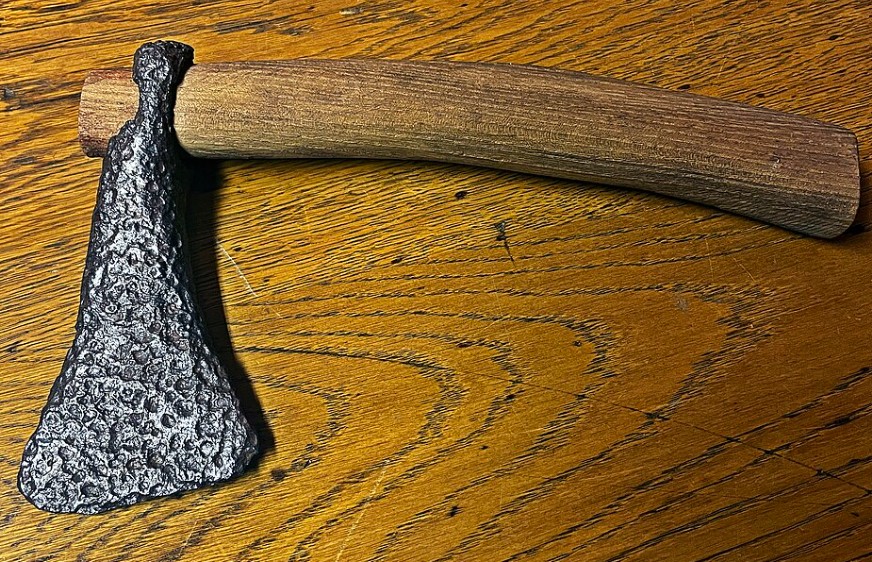
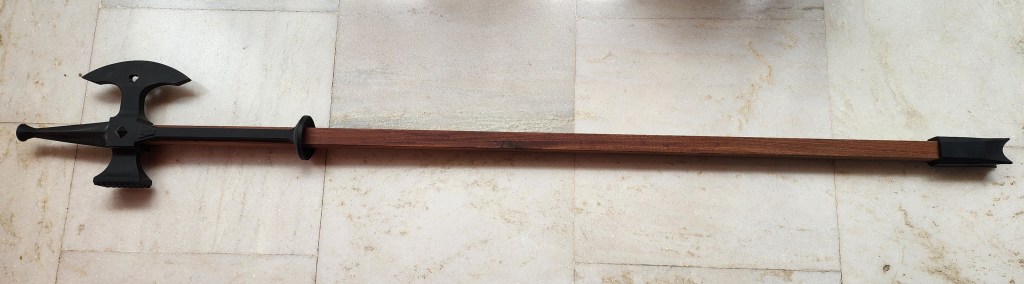
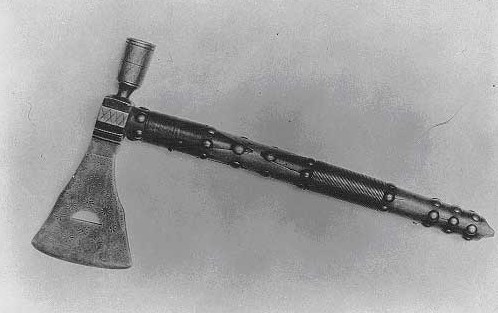
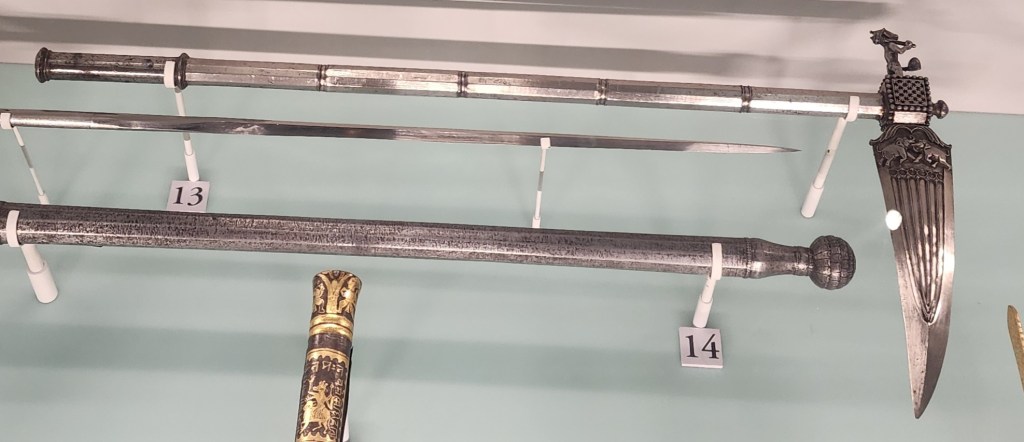
This is the concluding article in this series of 3 posts where I share images and observations about various spears I have come across over the last few years. I continue in this article from where I had left off in the previous post. In this post we will continue looking at more spears, spearheads and spearpoints and consider their attributes, with a slightly greater focus in this one on spearpoints from cultures beyond India.
In the last 2 posts, we looked at images of parts of spears starting from about a thousand years ago. We also looked at the spear wielded by Maharana Pratap. While this post can be read as a standalone, I would highly recommend readers to go through the previous two articles in this series for a better appreciation of this one.
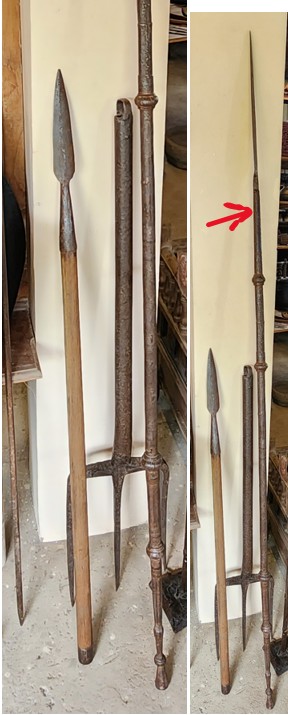
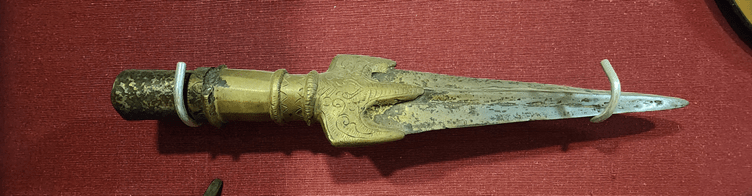
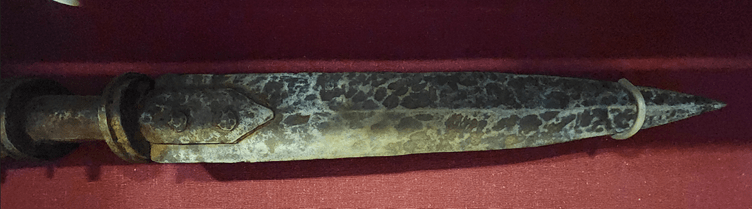
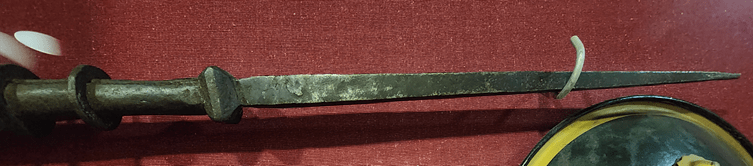
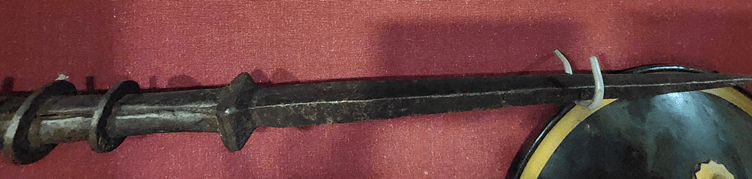
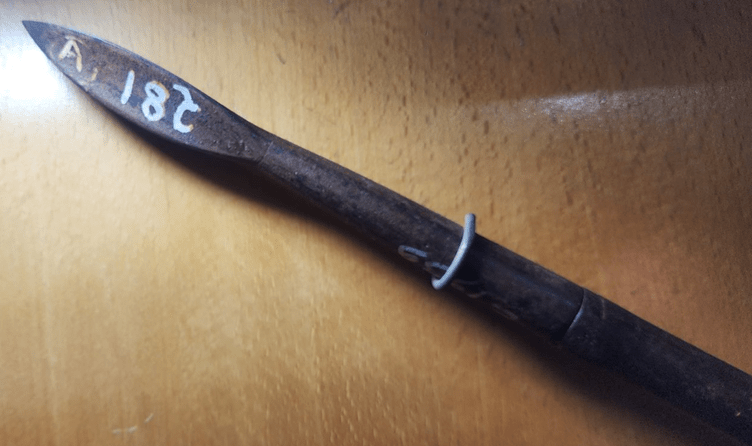
Images 1 (L) and 2 (R) – Image 1 shows a spear from the Kumarakom Heritage Museum, Vembanad, Kerala. Image 2 shows the spear in image 1 in comparison with the spear in image 14 in the previous post. This spear is also shown with a red arrow pointing to it in image 2.
We had left off in the previous article, the previous part to this post (Spears, Spearheads and Spearpoints – Part 2), with an image of a long spear (image 14 in the previous post) from the Kumarakom Heritage Museum in Kerala. We continue now with an image of another spear from the same museum. This is the one in image 1 above. The same spear from previous post is seen in image 2, with a red arrow pointing to it.
The spear in image 1 is very short, between 3 and 4 feet long. Image 2 shows this spear in comparison with the long spear (it is the same spear in image 14 in the previous article). The shorter one is less than half the length of the longer one. I am not sure if the shaft and the butt cap are the original ones that were mounted with this spearhead.
The most interesting thing about this spearhead is that it is remarkably similar to the spearheads the Vikings are supposed to have used. The image below will illustrate this point.
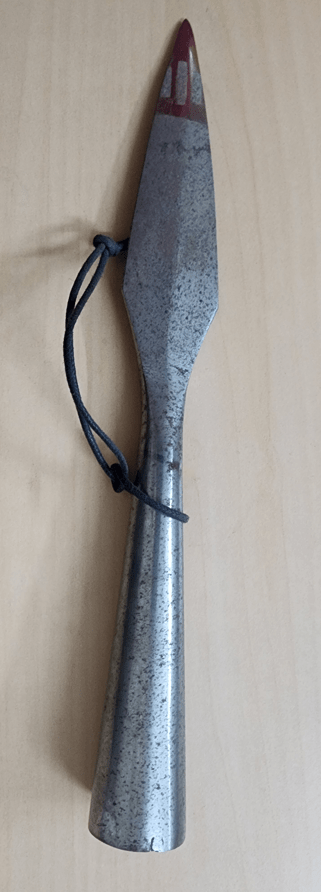
Image 3 – A replica of a Viking spearhead
I bought the spearhead seen in image 3 in Sweden, in the Old Town of Stockholm, at a store called “The Viking Store”! 😊This piece is supposed to be a replica of the regular spearheads that Viking soldiers used. It is about a foot long, with the spearpoint and the socket both being about 6 inches in length.
Now compare this spearhead with the one on the spear in image 1, displayed in the museum in Kerala. I think the 2 spearheads are very similar. This again goes to show how robust and versatile this design of spearhead was! The Viking era is considered to be from the 8th century to the 11th century. I suspect the example from the Kumarakom museum is from the 19th century. So, this design lasted for 1,200 years! Of course, in reality it lasted a lot longer than that!
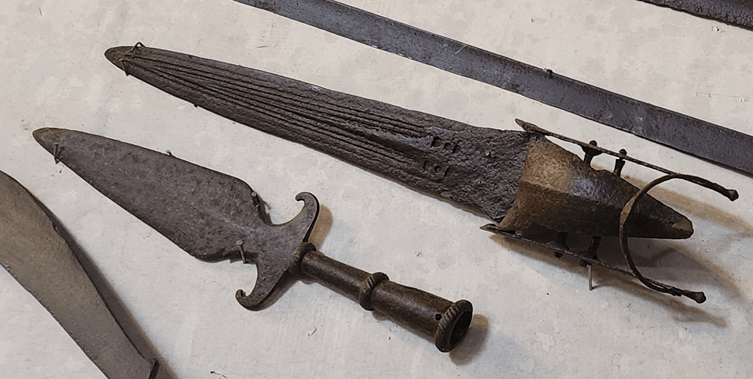
Image 4 – A spearhead displayed at the Kumarakom Heritage Museum, Vembanad, Kerala.
The image above shows another spearhead displayed at the Heritage Museum in Kerala. It has a flattened diamond section and 2 small wings between the spearpoint and the socket. The weapon above the spearhead is a hooded katar. It is a regular katar that has a “hood” to protect the knuckles and wrist of the wielder.
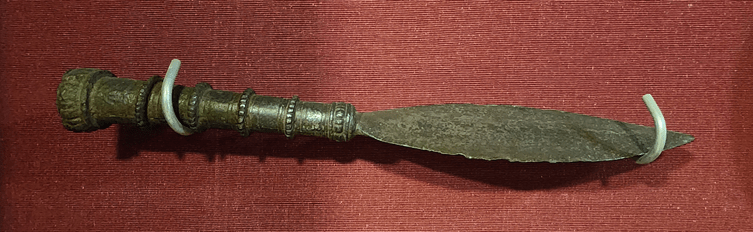
Image 5 – A spearhead displayed at a dojo.
Many years ago, our dojo rescued a set of antique arms. They were with a local antique dealer who was going to scrap them all as no one seemed interested. So, the dojo pooled resources and rescued the antiques which would otherwise likely have been melted as scrap. A set of these could be restored for display and study by martial artists. We do not know the age of any of these, or the actual metals used in their construction. We think they are from the 18th and 19th centuries and are mostly made in India.
Images of a few spearheads from this set are seen here, starting with the one in image 31. This spearhead has a leaf shaped point. The point and socket are both about 6 or seven inches long. The edge has come damage and is pretty thin. It is completely flat and has no pronounced increase in thickness towards the centre of the spearpoint.
Image 6 – A spearhead displayed at a dojo.
This spearhead seems to have a point made of steel affixed to a socket made of brass. I am not sure if the joint is with a weld or with glue. The spear point is triangular in shape and about 9 inches long. It has a substantial midrib that contributes to the rigidity of the spearpoint.
Image 7 – A spearhead displayed at a dojo.
This spearhead is large. The spearpoint itself is more than a foot long. The socket is another 10 or so inches long. The point is attached to the socket with 2 rivets as seen in image 7. This spearhead could be considered a short sword by itself. The spearpoint has 2 sharp edges that can cut if need be. The point also has a bit of reinforcement for effective thrusting against heavy clothing or chainmail.
The surface texture of this spearpoint keeps the hammered look. It is not polished to give a smooth finish. I wonder how long the actual spear on which this was originally mounted would have been?
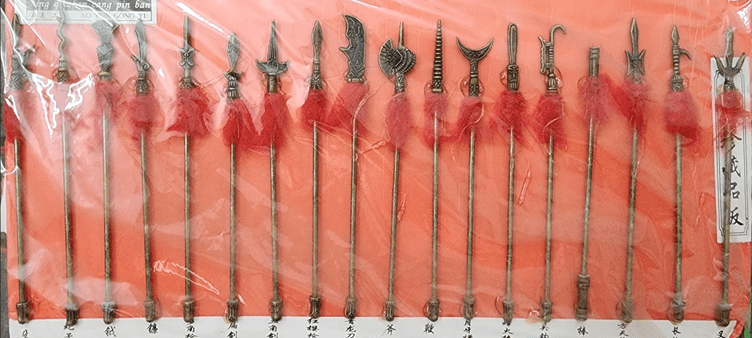
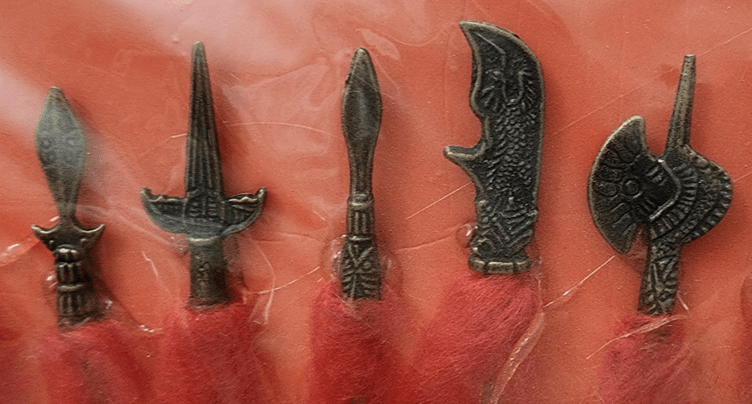
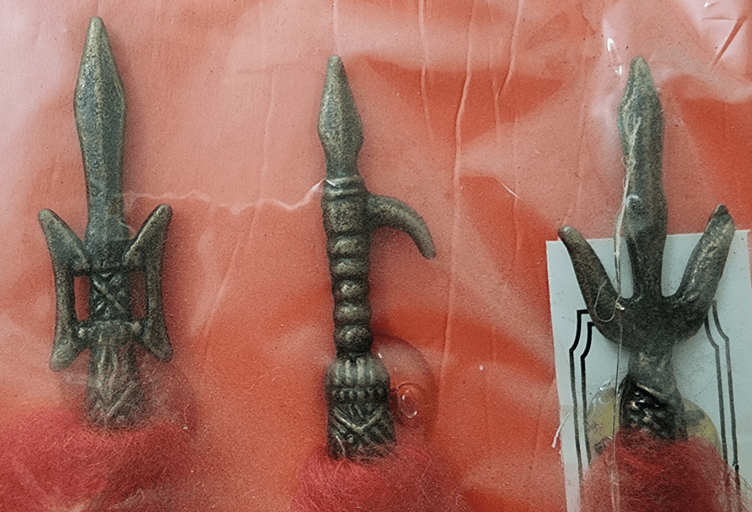
Image 8 – The 18 Arms of Wushu
The internet tells me that the above image depicts “The 18 Arms of Wushu”. Many years ago, I bought the set seen above as a souvenir from China. At the time I didn’t know this specific name and bought it as it depicted different polearms which are Chinese in origin. Apparently, this is a common souvenir that is also available online these days. Each of the pieces is about 6 inches in length.
Not all of the 18 are spears as we think of them in the conventional sense, but they are all polearms. Some are designed for cutting or hacking and some are even designed for digging, so they cannot be called spears as they are not thrust centric weapons.
I am not sure of the specific name for these. A search on the internet, even with AI, was not satisfactory. So, I shall only mention the names of the ones I know and just describe the rest.
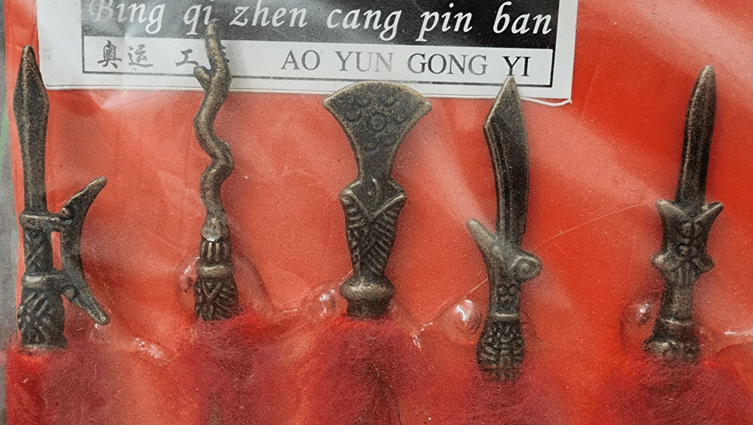
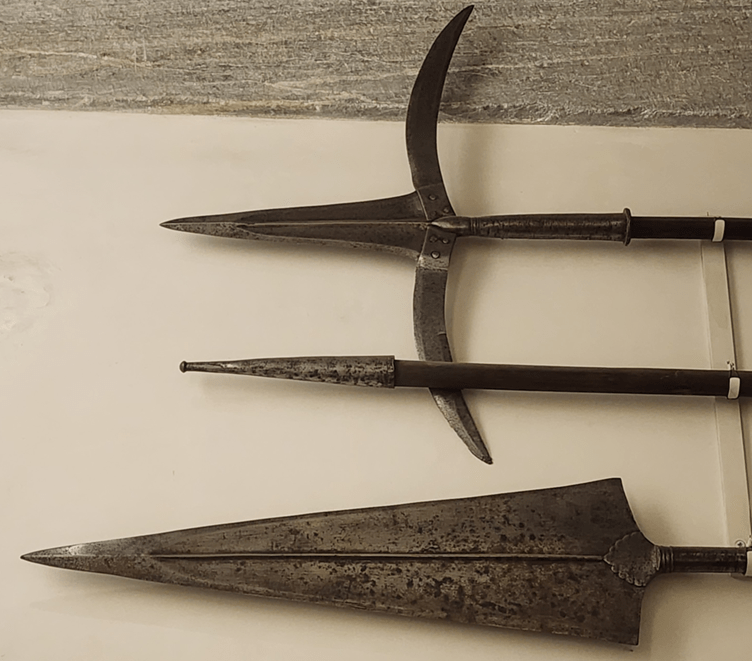
Image 9 – A close-up of 5 of the heads of the “18 Arms of Wushu”.
The weapon on the far left is certainly a spear. It has a crescent shaped cutting tool on its right, which could be an axe. The second weapon from the left has a spearhead resembling a snake, or perhaps an antler. I think of an antler as there is a single prong towards the tip that deviates from the sinuous point.
The weapon in the middle is what I believe is called the “Monk’s Spade”, for it was used by martial monks both as a spade and as a weapon. To the right of the Monk’s Spade is what I think of as a Kwan Dao. This is similar to the Japanese Naginata or a Glaive from other cultures. It is essentially a curved sword blade atop a spear shaft.
To the far right of the image is another spear. I am not aware if it has a specific name. It has what seem like wings below the spearpoint. I am not sure if they are wings or 2 small crescent blades just below the point.
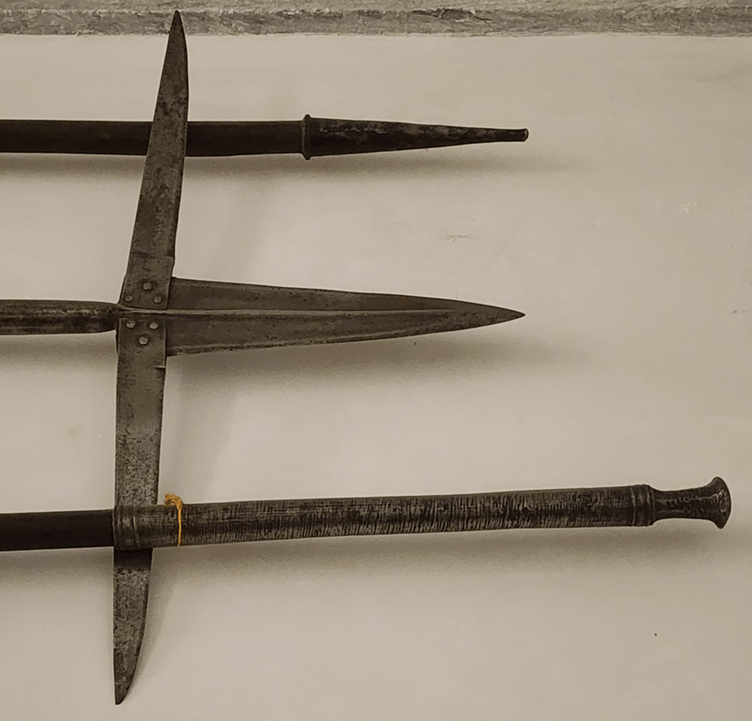
Image 10 – A close-up of another 5 heads of the “18 Arms of Wushu”.
The spear at the far left of image 10 resembles the spearhead in image 4, displayed at the museum in Kerala, India. It has a leaf shaped spearpoint and 2 wings below the point. The spearhead to its right reminds me of the European Partisan spear. In sheer size it also similar to the large Rajput spearpoints seen in images from part 1 of this series of articles. I am sharing that image here again. The spear in the middle seems like one with the classic leaf shaped spearpoint seen all over the world. I am not aware of the Chinese names of any of these.
The large polearm that is second from the right also looks a Kwan Dao to me, but his one seems a lot bigger than the one seen in image 9! I would say that this resembles the Japanese Bissento (horse cutter). To the far right is what seems an equivalent of the Farsa seen in an image in part 2 of this series of articles, which I am sharing again. It is a combination of an axe and a spearpoint on a pole. I am not sure what its Chinese name is.
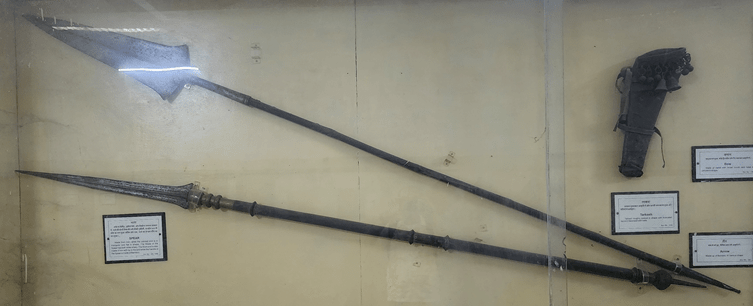
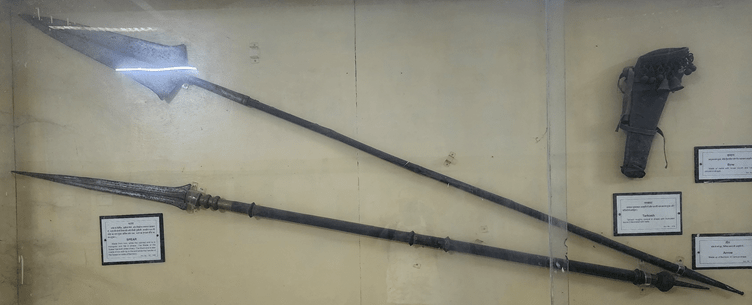
Image 11 – Display of two spears from the Government Museum, City Palace, Udaipur, Rajasthan.
The spearhead from image 10, that is second from the left, reminds me of the spearpoints on the 2 spears seen in image 11.
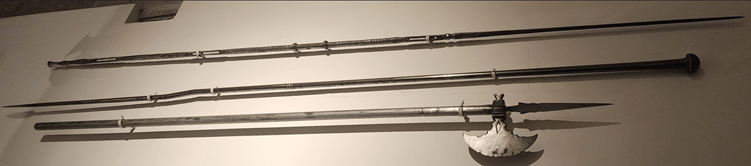
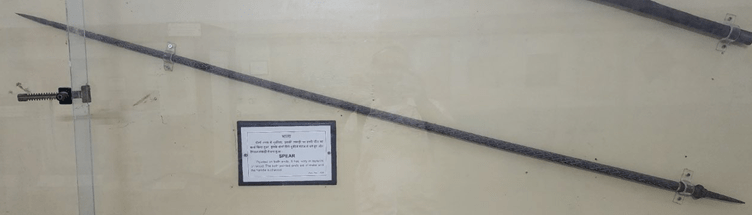
Image 12 – Display of two spears and a farsa (halberd) from the City Palace Museum, Udaipur, Rajasthan.
The combination weapon at the bottom of image 12 is the Farsa (halberd), which is what the weapon at the far right of image 10 reminds me of.
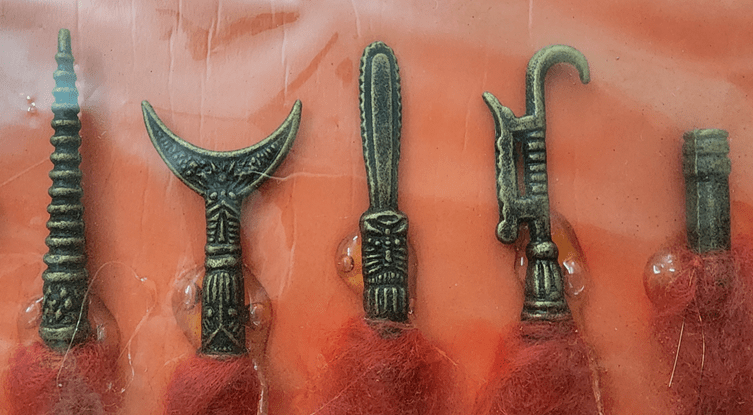
Image 13 – A close-up of 5 more heads of the “18 Arms of Wushu”.
I am not aware of the Chinese names of any of the polearms in image 13 either. The spearhead on the far left in image 13 is intriguing! It resembles a tapering spindle. I am not sure if it was purely a thrusting weapon or used for both thrusting and blunt force strikes with the lower parts of the spearpoint. The weapon that is second from the left is a crescent. I am not sure if is a blade or not. I can only imagine how this was wielded or deployed.
The weapon in the centre seems like a short sword at the top of a pole to me. To my eyes it resembles the spearpoint from image 7, but this one does not seem to have a point. The weapon that is second from the right seems like an anti-cavalry weapon as it has a hook at the tip. This would be useful in pulling riders off their horses, or in tripping horses. The other side of the hook seems to have a blade, though I cannot be sure.
The weapon on the far right is a double-sided weapon. It has the same head on both ends of a pole. It seems like a pole with a bludgeon on its two ends.
Image 14 – A close-up of the last 3 heads of the “18 Arms of Wushu”.
Again, I am not aware of the original Chinese names of the 3 weapons in the above image. The spear one on the far left seems like a variant of the spear on the far left of image 9. Here, there seem to be crescent blades on both sides of the spearpoint, unlike the one in image 9, where there was only one crescent blade with the spearpoint.
The weapon in the centre has a spearpoint with a hook to its right. The hook I guess could be used to parry the weapons of opponents and pull people off horses, if not just trip them. The last of the 18 arms, on the far right of image 14, seems like a trident where the central point is longer than the two prongs on the sides. To my eyes, this also seems like an Okinawan Sai mounted atop a spear shaft. The central spearpoint seems to flare and narrow along its length. I wonder what purpose that design serves?
If anyone knows details of “The 18 Arms of Wushu” and the weapons depicted in the above images, including their names, please do share the same with me, in the comments to this post. It would be great knowledge.
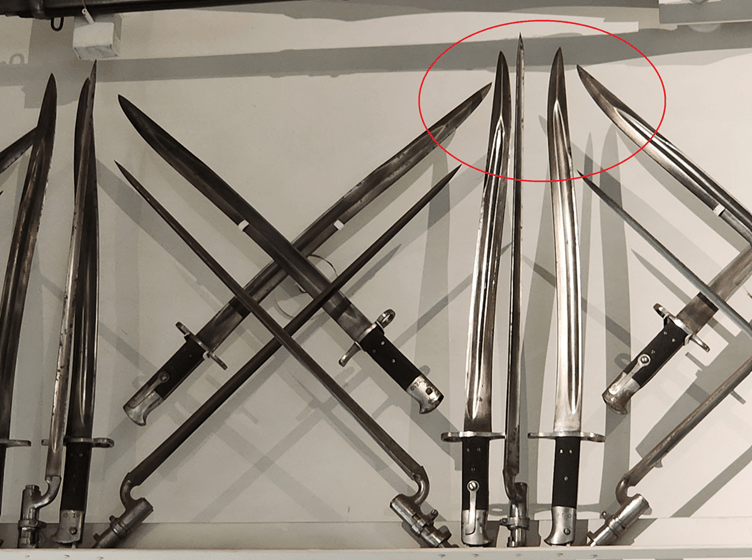
Image 15 – Display of bayonets from the City Palace Museum, Udaipur, Rajasthan.
Bayonets when fitted to rifles make the rifles modern equivalents of spears. This makes bayonets, in my opinions the last iteration of the spear in world history. Image 15 above shows a collection of bayonets of different kinds, all likely from the end of the 19th century.
In the above image, some weapons displayed look like swords, but they really are bayonets. Some bayonets were functional short swords. The swordlike bayonets in the above image have a forward curve with a recurve towards the tip. This type of blade was called the Sosun Pata in Maratha culture. In the British Army of that time, I believe it was called the “Yataghan Bayonet”. The Yataghan was a short Turkish (Ottoman) sword similar to the Maratha Sosun Pata and was used in the same time period. Instead of a conventional cross guard, a socket is added to these swords which make them bayonets. Th socket is used to fix the blade to the end of a rifle barrel.
Observe the 2 points encircled in red in the above image. Both points are reinforced. While the use of armour had disappeared by the time these bayonets were used, soldiers used heavy clothing and bayonet points had to be strong enough to get through these layers.
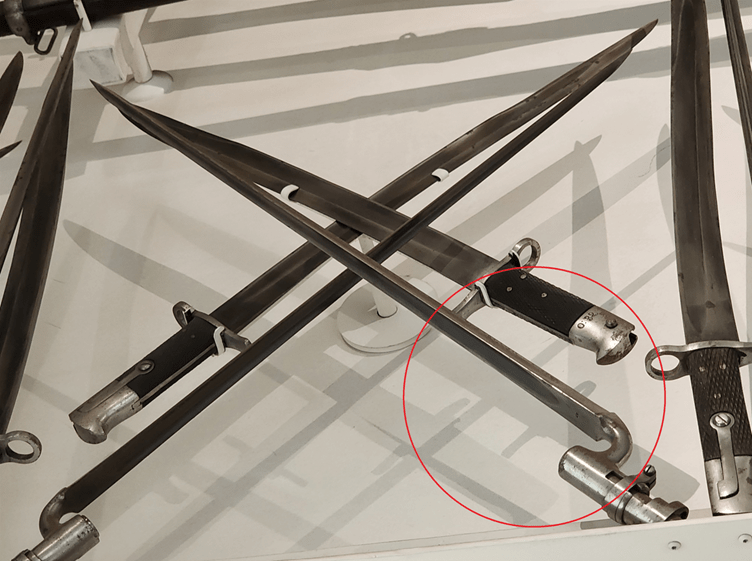
Image 16 – Display of bayonets from the City Palace Museum, Udaipur, Rajasthan.
Observe the bayonet encircled in red in image 40. It has a triangular section which tapers down to a fine point. It has no cutting ability but would thrust very well due to its rigidity. It has the famous offset design where the spearhead is parallel to the rifle barrel. The socket at the bottom is fixed to the end of the rifle and even if one were to shoot while the bayonet wat fixed, the point would not be in the path of the bullet.
Observe the swordlike bayonet above the one just described. In this image the hole in the cross guard is clearly visible. This hole is the socket which was used to affix this bayonet to the rifle.
This concludes this article and this series of 3 posts in which I shared images of spears and observations regarding their attributes, especially their spearpoints and spearheads.
I will continue this article from where I left off in the previous post. We will look at more spears and consider their attributes, with specific focus on the spearheads and spearpoints. In the previous post I had shared a brief introduction regarding spears. We had also looked at images of parts of spears from over a thousand years ago. We also looked at the spear wielded by Maharana Pratap. While this post can be read as a standalone, I would highly recommend readers to have a look at the previous article in this series for a better appreciation of this one.
Image 1 – A Rajput spear displayed at the Hall of Heroes, Maharana Pratap Smarak, Moti Magri, Udaipur, Rajasthan.
This exhibit is labelled as a “Javelin”, but I would just call it a spear. This is not behind a wall of glass, so I got some good images of this one. The age of the exhibit is not shared. The spearhead is fairly long and looks like it has a flattened diamond section.
The shaft is all metal in this spear. I am not sure if it is a hollow shaft, but I would suspect that it is, to keep its wight low. Also, considering it is classified as a javelin, the weight of a hollow shaft would enable easier throwing of this weapon.
The rear end has a ball and a spike. This weapon also has rings at different places along the shaft. The centre of the shaft has a section that does seem to exist as the place to hold if this weapon was being hurled. I am sharing a short video of this weapon which shows it in greater detail.
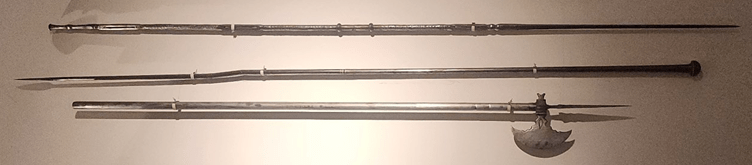
Image 2 – Display of two spears and a farsa (halberd) from the City Palace Museum, Udaipur, Rajasthan.
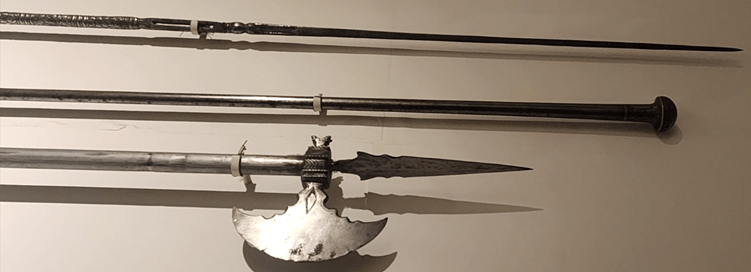
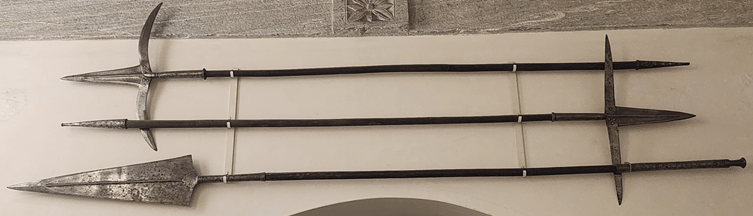
In image 2, the two weapons on top are spears, the one at the bottom is a combination weapon, called a Farsa (halberd), which combines an axe and a spear. The age of these weapons is also not mentioned in the display, but all 3 are very interesting in construction! All three weapons have steel shafts (I am assuming it is steel, but it is metal for sure). The top spear is about 8 or 9 feet in length while the one in the middle is longer than the one on top. The halberd I estimate to be about 7 feet long.
The spear on top has a very long spearpoint! The shaft is pretty narrow, an inch or lower in diameter. The shaft is decorated with engraving or something like filigree. The spearpoint is close to 3 feet long! It seems to have a hollow ground triangular section for rigidity and tapers down to a very fine point. This is one my favourite weapons among all the pictures I am sharing. 😊
The spear in the middle has crook in the upper third of its length! It almost seems modelled on a bayonet from the early flintlocks!The bayonet in many designs is slightly offset from the barrel of the rifle, and this spear seems to be doing something similar. There is no description in the exhibit explaining the reason for this offset design.
Image 3 – Close-up of the spearhead of the “offset” spear and the rear ends of the spear and farsa seen in image 2.
The “offset” spear has a rather short leaf shaped spearpoint with a midrib. The rear end of the spear at the top is blunt and also narrow, like the rest of the spear and its point. The rear end is similar to the one seen in the spear wielded by Maharana Pratap, seen in the video of the same.
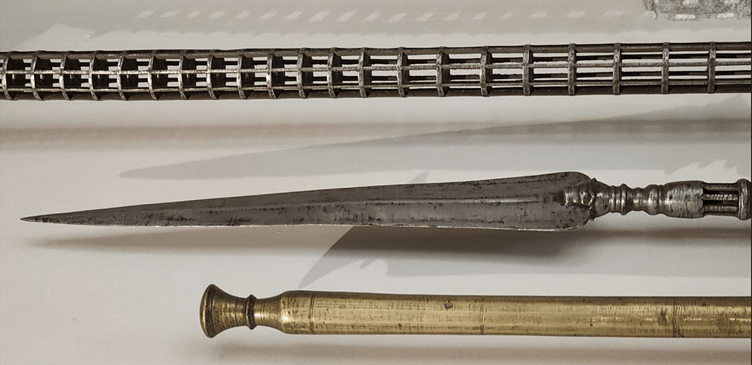
Image 4 – Close-up of 2 spearheads and of the rear end of the “offset” spear seen in image 2.
The very long spearpoint of the spear at the top is almost 3 feet in length. It tapers down to a very narrow point that would be extremely effective in thrusting, given that it has a triangular section. I can almost imagine this to be a lance!
The rear end of the spear with the “offset” in image 14 is large and bulbous. It is the very definition of a Hirumaki I mentioned in the previous post. I am not sure if it is hollow or solid in nature. The Farsa (halberd) has a spearhead like any other spear.
Image 5 – Display of spears from the City Palace Museum, Udaipur, Rajasthan.
The 3 spears seen in image 5 are the most fascinating of all the images in my opinion. Like all the rest, their age is unknown. These exhibits are labelled, “Spears with a channel design”. 😊These are all clearly hollow. It seems that the shafts of these spears are made from a wireframe! My initial thought was that this is to reduce the weight of the weapons as whole. But I have no idea what the real intent behind this design was. It is not mentioned in the museum either.
I also cannot guess how comfortable wielding these weapons would be. Are the shafts smooth and nimble due to a lower weight? Or do the open slots affect the handling characteristics? Do the slots affect the ease with which one can slide the hands and fingers along the shaft? I have no idea.
The spear at the top in this image is 9 or more feet in length in my opinion, while the lower 2 are about 6 or 7 feet long. Observe the rear end of the spear at the top. This is at the far left of the image. It has a double ball and spike configuration. This makes me this think that this would be heavy in the rear, as the spearhead here is quite small (image seen further down).
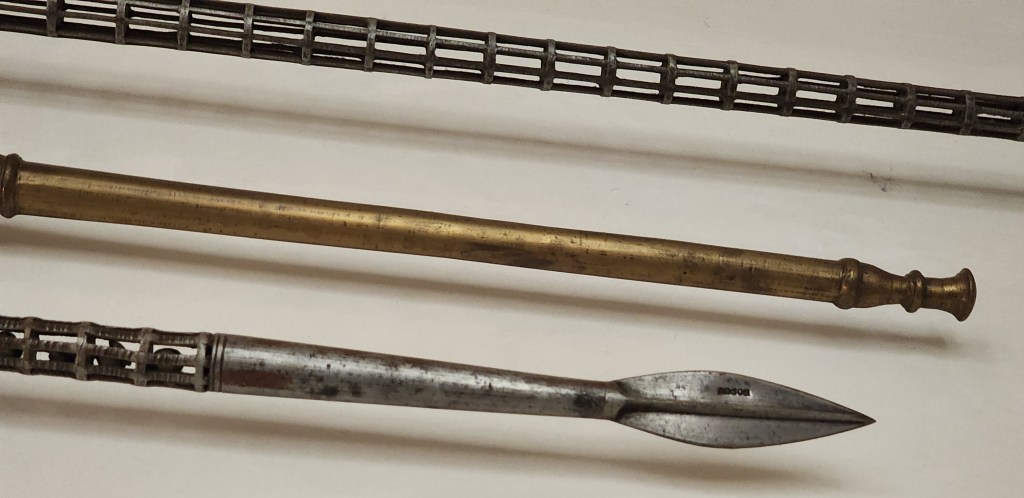
Image 6 – Close-up of various parts of the spears seen in image 5.
Image 6 shows the hollow shaft of the top spear from image 5 up close. The slots are clearly visible. The size of the slots do not seem to be uniform along the length of the shaft. Also seen in image 6 is the spear head of the spear in the middle and the rear end of the spear at the bottom.
The spearpoint is leaf shaped and about 10 to 12 inches in length. It has a midrib for rigidity. The rear end of the bottom spear is similar to ends of the spear wielded by Maharana Pratap and the top spear seen in image 2. The rear end seems to be made of brass based on the colour.
Image 7 – Close-up of the spearhead and rear end of one of the spears seen in image 5.
Image 7 shows the spearhead of the spear at the bottom and the rear end of the spear in the middle. The spearpoint is leaf shaped and small, about 6 inches in length. It has a pronounced midrib. The rear end of the middle spear is almost identical to the end of the spear at the bottom, as seen in image 6.
Image 8 – Close-up of the spearhead of the spear seen at the top in image 5.
Image 8 shows a close-up of the spearhead of the top spear in image 5. The spearhead is very small compared to the length of the spear. The spearpoint itself is smaller still, seeming just like an arrowhead. The point is reinforced, being robust at the tip to enable better penetration.
Image 9 – Display of spears from the City Palace Museum, Udaipur, Rajasthan.
The exhibit seen in image 9 is an interesting one indeed! The spears here have an increasing number of spearpoints. 😊The lowest one has a single point, the one in the middle has 2 points and the one at the top has 3 points. That makes the spear at the top a trident or a trishoola and the one in the middle a bident or a pitchfork. I am guessing Poseidon, Hades and Zeus would be proud of this display! :-P
The age of any of the spears in this display is not mentioned. The lowest one about 6 feet long, and ones above are about 7 and 8.5 feet long respectively. The shafts of these spears seem to be bamboo or rattan to me. It is possible that the shafts are not the original ones on which the spearheads were mounted. The trident has no butt cap. The spear and the bident both have a ball and spike for a butt cap.
Image 10 – Close-up of the spearhead of the spear at the bottom in image 9.
Image 10 shows the spearpoint on the lowest spear from image 9 up close. This is a robust spearpoint! It has a triangular section which tapers down to a point. This makes it really stiff for effective thrusting. There is also a hollow grind on the triangle to reduce weight.
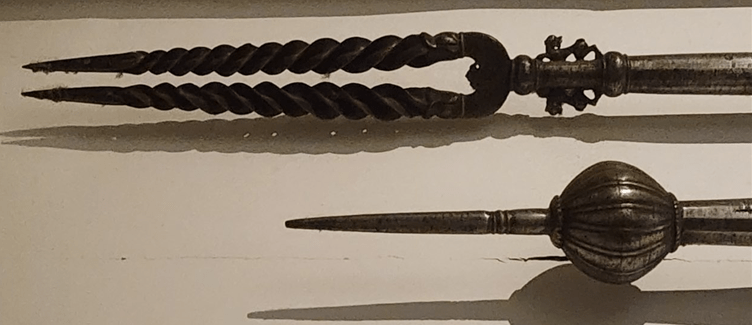
Image 11 – Close-up of the spearhead and rear end of two of the spears seen in image 9.
The image above shows the 2 points of the bident from image 9. It has 2 spearpoints and is constructed to give the appearance of a twisted cord or vine. This would also make the spearpoint robust. The end of the spearhead just below the two spearpoints has a decoration. There are 2 small lions (in my opinion) just before the spearpoints begin.
Seen in the lower part of image 11 is the butt cap of the lowest spear from image 9. It shows the ball and spike clearly. There is a chance that the ball is hollow.
Image 12 – Close-up of the spearhead of the spear at the top in image 9.
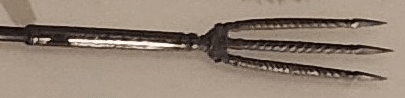
Image 12 shows the 3 points of the trident from image 9. The 3 points are maybe 6 to 8 inches long while the spearhead including the socket is about a foot long. The 3 points also give the appearance of a twisted cord. This also likely gives robustness to the points. The tips of the points seem to be triangular in section and look wicked!
Image 13 – Katar from the City Palace Museum, Udaipur, Rajasthan.
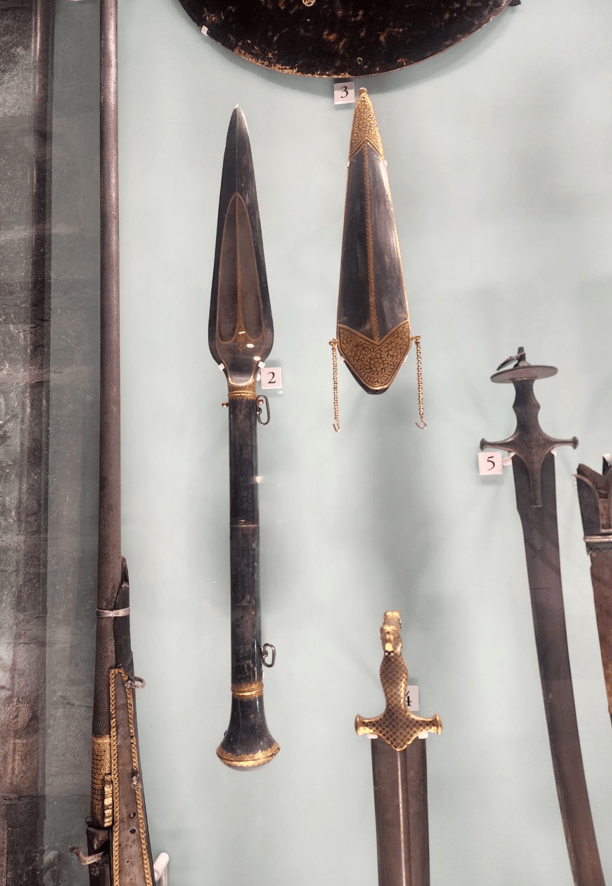
Observe the exhibit numbered “2” in image 13. The label calls it a “Katar”. A Katar is a punch dagger that was popular in many parts of India from the 14th through the 19th centuries, first as a fighting weapon and later as a part of regal attire. This could be a katar, the blade shape does resemble that of a katar. The blade is about 10 inches or a bit more in length and quite broad. The age of this exhibit is not mentioned.
But to my eyes this is a short spear. It is definitely capable of thrusting. The length including the short shaft (should we call it a handle in this case?) is about 2 feet, making the weapon between 2.5 and 3 feet in length. It could definitely cut well, but the length of the handle makes me think it is better at thrusts then cuts. Maybe this was a case where a short spear could double up as a short sword.
The beauty of the weapon makes me think this was likely used as a status symbol, for it exudes wealth and power! This exhibit also brings to mind the Aiel culture from the “Wheel of Time” novel series by Robert Jordan. In the books, the Aiel are a culture that abhors swords. They use spears of different lengths and some of them are short, for close quarters combat. This could easily be one of the short spears used by an Aiel clan chief! 😊
Image 14 – A spear from the Kumarakom Heritage Museum, Vembanad, Kerala.
The Kumarakom Heritage Museum is not a usual museum. It is a small private museum run by small group of people who preserve things from the last 150 to 200 years. The number of visitors is also small. So, many of the exhibits can be touched, felt and handled by visitors under the supervision of a guide, who accompanies every group of visitors. This gives a wonderful tactile experience!
One of the exhibits was the spear seen in image 14. I suspect it is from the late 19th century. It is an all-metal construction, between 7 and 8 feet in length. The shaft is lean and solid, not hollow. The shaft tapers towards the rear end. The spearhead is leaf shaped and about a foot in length. The spearhead reminds me of pop culture versions of the Assegai that was used in parts of Africa.
This spear has the rings at different points along its length. The rings are not placed at even lengths. I am not sure why they are placed at the points they are placed at. But the design with rings is similar to the spear of Maharana Pratap seen in the previous article and the other Rajput spear from image 1. The rear end of this spear is similar to Maharana Pratap’s spear and two of the spears in image 5.
This series on spears will conclude with the next post. I will share more images of spears and observations regarding their attributes. The next article will have more images of spears from cultures beyond India.
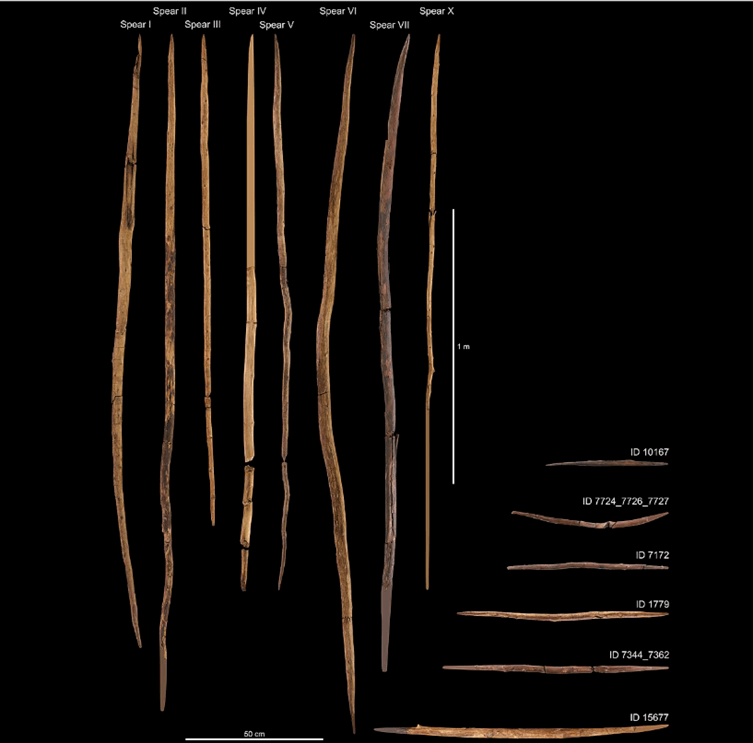
Spears have been used by modern humans, human ancestors and close relatives of homo sapiens for a very long time. The oldest known spears are supposed to be 400,000 years old, made by a sister species. Some of the best-preserved spears made entirely of wood, including sharpened points, are supposedly 300,000 years old, found in Schöningen in Germany. The oldest identified spear points made of stone are supposed to be around 500,000 years old.
Schöningen spears. Image credit – Wikipedia
Spears likely started out as tools for hunting and evolved into weapons of war. Spears, in their various forms have been in use since pre-historic conflicts all the way through to the 20th century. It is only in the current century, with long range weapons becoming the mainstay for all conflicts, that spears are not in use. The bayonet, that was used all through the 20th century on all kinds of automatic rifles was perhaps the last iteration of the spear.
Spears have varied from simple wooden staves to handheld spears, to javelins to very long pikes to lances of various types. They have been used on foot, on chariots and from horseback. Spearpoints became a part of various combination weapons, like halberds and poleaxes. Long spear points could double up as short swords, as happened in African cultures.
The shafts of spears went through several iterations too, in terms of material, length, decoration and girth. Shafts could be narrow and light, comprising of rattan or wider and stiff, being made of wood or metal. The metal shafts could be hollow as well, to keep the weight of the weapon down. The shaft could be long or short as the situation required.
The points of spears could be made of anything from stone or obsidian to copper, bronze, iron and steel. They could be long or short, sturdy or fragile (for a single use), wide or lean (depending on the opponent it expected to tackle).
In a series of 3 posts, I will share a few images of spears, spearheads and spearpoints I have come across over the last few years. Most are from India, while a few are images of representations of spears from cultures outside India. These 3 articles will be more of images with some observations from me.
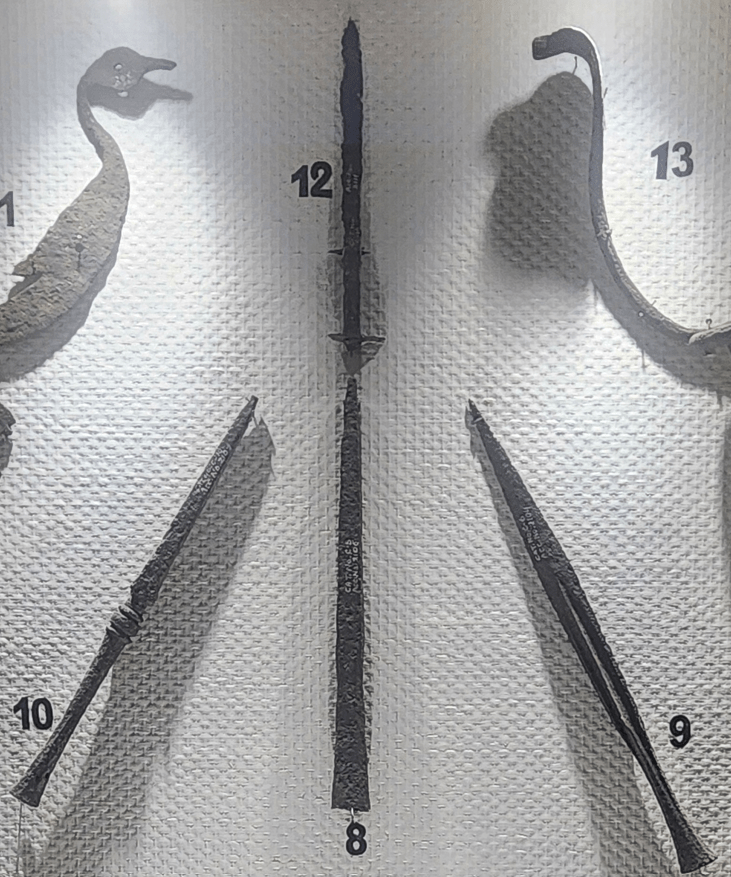
Image 1 – Display of spearheads from the Sanchi Museum, Sanchi, Madhya Pradesh. All of these are from the 11th century CE.
In the above image, through the exhibits labelled 8, 9, 10 and 12, 4 different spearpoints or spearheads are displayed. The exhibit labelled 8 looks like a long triangular spearpoint. The one labelled 12 seems to have two sets of “wings” or barbs sticking out perpendicular to the spearpoint itself. The spearhead labelled 10 has a square cross-section, tapering down to a point. The exhibit labelled 9 is a long leaf shaped spearhead with a groove down the middle in the lower half of the point. Each of these, based on what I estimated when I saw them, is between 12 and 18 inches long.
Image 1a – A spearhead displayed at a dojo.
This is an antique spearhead that was rescued from scrapping by our dojo. It is about 18 inches in length and the spearpoint is about 10 inches long. The spearpoint is square in section and tapers down to a point. I am not sure of the metal used in making this spearhead. I suspect that this spearhead is from the 19th century, though the exact age of this exhibit is not known.
Image 1b – Another view of the spearhead from image 1a.
Image 1b shows the same spearhead from image 1a, from a different angle. This shows the square section of the spearpoint more clearly. The profile of the spearhead in image 1a is remarkably similar to that of the exhibit labelled “10” in image 1. This means that the same type of spearhead was in use for about a thousand years, if not more! That is quite some consistency in human history!
Images 2 (L) & 3 (R) – Display of spearpoints from the Sanchi Museum, Sanchi, Madhya Pradesh. Both are from the 11th century CE.
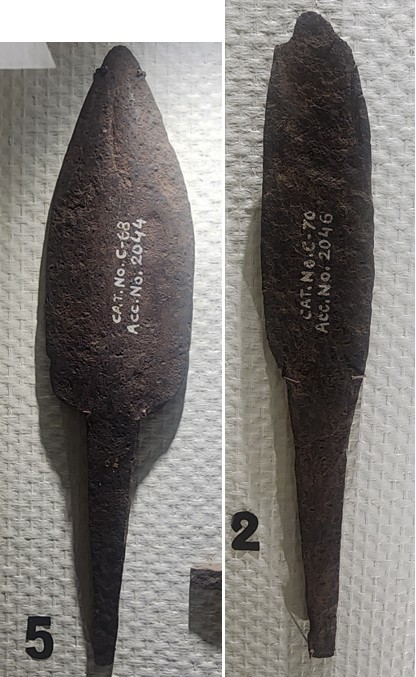
Seen in the above 2 images are leaf shaped spearpoints. These are much shorter and wider than the specimen seen in image 1. In both the above exhibits, one side is convex (as seen in image 2) and the other side is flat (as seen in image 3). The length of both of these is about 8 inches according to my estimate. The material used in the spearpoints in the 3 images above was not mentioned, but they seem to be either iron or steel.
Image 4 – Display of spears from the City Palace Museum, Udaipur, Rajasthan.
Each of the spears seen in image 4 is about 8 feet in total length. The shaft seems to be rattan and about an inch in diameter. I am not sure if the shafts are the original ones on which the spearheads were historically mounted. The age of the shaft and spearheads was not mentioned as part of the display. A close-up of the spearheads is seen in the following 2 images.
Image 5 – Close-up of the spearheads and butt spike of the spears seen in image 4.
The spearhead at the bottom is big. It is well over a foot long and very wide as well. The point is reinforced to enable better thrusts, which might go through chainmail. This spear with its large head reminds me of Renaissance era European Partisan spears.
The butt spike/cap of the middle spear is seen. The conical shape reminds me of what is called in Japanese spears (yari) as an Ishizuki.
The spearhead on the top spear has 2 wings on the side. The spearhead as a whole reminds me of a Japanese Jumonji Yari, which also have a central spearpoint with 2 wings on the side. The two wings enable with parrying weapons of opponents and also in hooking opponents, whether to trip them or to pull them off horses. The central point is about 10 inches in length while the total length of the two wings combined is 18 inches or more.
Image 6 – Close-up of the spearheads and butt spike of the spears seen in image 4.
The spearhead in the middle again resembles a Japanese Jumonji Yari. If there was only one blade instead of 2, it would be akin to the Japanese Kama Yari (Kama is the sickle in Japan, which looks a Crow’s Beak axe or an ice axe of modern times). The butt spike at the top is similar to an Ishizuki. The butt cap of the lowest spear, which is the rear end of the one with the large spearhead (reminiscent of the European Partisan) is not entirely conical, but has a blunt, slightly bulbous head. O a Japanese spear, this would likely be called a Hirumaki, which is also a protective counterweight at the rear end of a spear. But unlike the Ishizuki which resembles a spike, the Hirumaki resembles a ball.
Image 7 – Display of spears from the Government Museum, City Palace, Udaipur, Rajasthan.
Image 7 shows 2 more spears. These are a bit shorter than the ones seen in image 4, maybe 6 to 7 feet in length. The one on top is similar to the one with the single large spearpoint, seen in the previous image. The one below has a narrower, slightly shorter spearhead. It has a proportionately more robust construction due to the robust midrib combined with a narrow profile. The age of these 2 exhibits was not available. My personal belief is that these are likely from the 18th and 19th centuries.
The lower spear brings to mind what is depicted as an “Assegai” in popular culture. The assegai is a spear used in Eastern Africa. Observe the rear end of this spear. The Ishizuki and Hirumaki are combined here! The spike at the end also has the counterweight for improved balance in handling the weapon. This weapon also has rings or bands along its length, which divides the shaft into segments, which are not of equal length. This will be seen in further examples. I will also write a separate article about what I think the purpose of these was.
Image 8 – Spear on display at the Government Museum, City Palace, Udaipur, Rajasthan.
The spear in image 8 is also about 6 feet in length. It has a pronounced taper even in the shaft, almost like a needle! Due to the taper in the shaft and a small narrow point, this resembles the prehistoric Schöningen spears. This exhibit seems to have been a prestige piece. It has ivory inlay all along the shaft, though this is not visible in the picture. The butt cap again has both a ball and a spike integrated together.
Image 9 – Display of spear and spear shaft from the State Museum, Bhopal, Madhya Pradesh.
In the above image, both exhibits are referred to as spears, though I personally believe that the one on the left is just the butt cap on the shaft. The one on the right is over 7 feet long as I see it. A close up of the spear head is seen below.
Image 9 – Close-up of the spearheads seen in image 8.
In this spearhead the point itself is pretty short, just a few inches long. The spear head including the socket used to attach it to the spear shaft is about 10 inches or so in length, but the actual spearpoint is about 5 inches only. The spearpoint seems to have a triangular section with a hollow grind as seen in the close-up above.
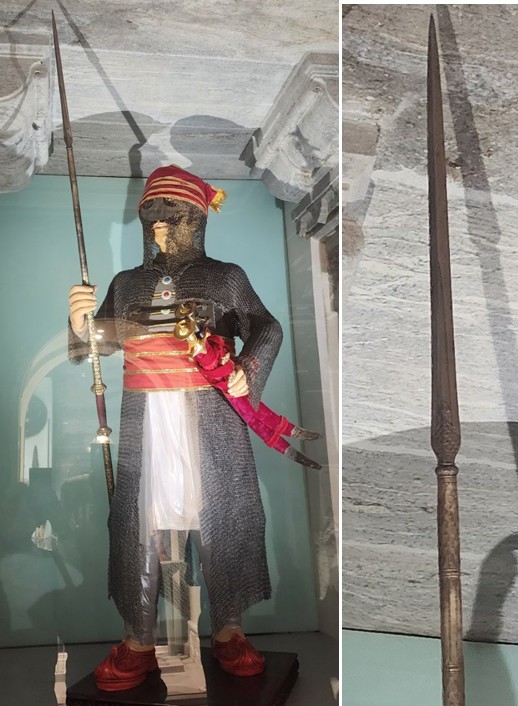
Images 10 & 11 – The image on the left shows the armour, swords and spear used by Maharana Pratap! The image on the right shows a closeup of the spearpoint and a part of the spearhead. This display is from the City Palace Museum, Udaipur, Rajasthan.
Maharana Pratap was supposed to have been 6 feet tall. So, I presume that this spear is around 8 feet long. The spearpoint itself is about a foot long. It is a narrow point, with a flattened diamond section and a bit of hollow grind towards the socket. The socket that attaches the point to the shaft is itself about a foot in length.
The spear shaft is richly decorated as befits a king. This spear also has the rings along its length that I mentioned in reference to the exhibit seen in image 7. This spear also has a distinct section near the centre similar to the ones seen on javelins used in the modern Olympic sport of javelin throwing. The spear and the javelin were supposed to be Maharana Pratap’s favourite weapons. So, if this spear could double up as a javelin there need be no surprise.
A video of the spear is seen below which shows the different sections in greater detail. The rear end of the spear has a cap which is similar to the one seen in image 6. The image and video are not of the best quality due to the reflection from the protective glass and museum lighting. ☹
The above video shows Maharana Pratap’s armour, two swords and spear.
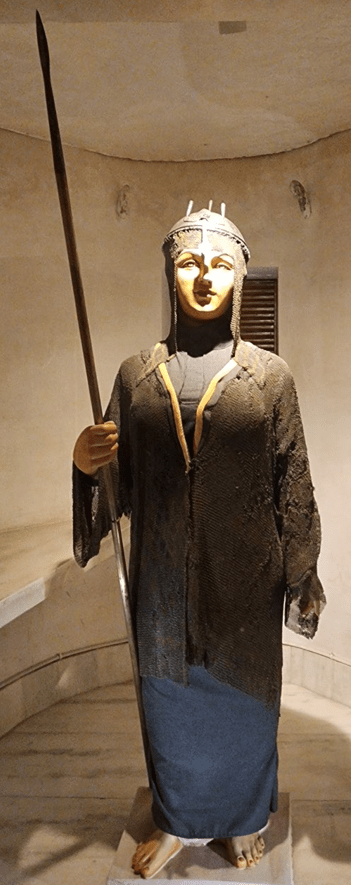
Image 12 – A representation of a female guard of the Zenana, including the chainmail armour and spear she is likely to have worn and wielded respectively. This display is from the City Palace Museum, Udaipur, Rajasthan.
I am sharing this image just to show that women were participants in the trade of arms as well. They wore armour and wielded weapons. The spear seen in this image is similar to the one in images 8 & 9. This exhibit is from the actual Zenana (women’s quarters) of the Udaipur City Palace.
I will continue this series of articles in 2 further posts. I will share more images and observations of spears and their attributes from other cultures in the upcoming posts.
I am sharing the cover image of this article above, just to share information about it.
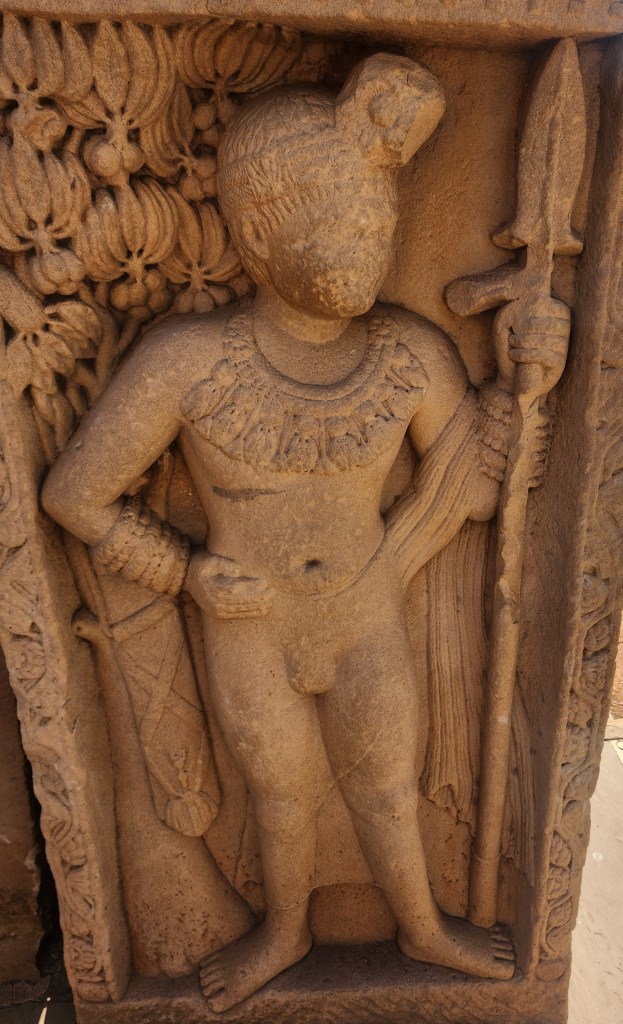
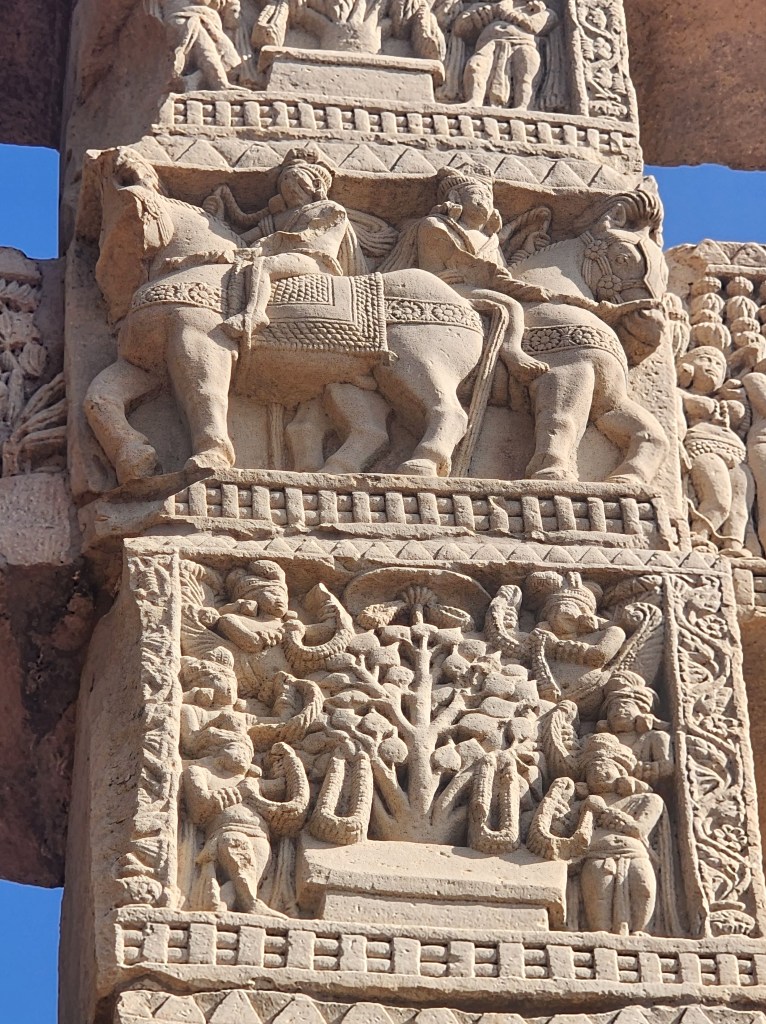
This image shows an armed doorkeeper, wielding a spear. This carving is from the one of the Torana (Gateways) at the Great Stupa in Sanchi. This individual is wielding a spear taller than himself, with a leaf shaped spearpoint with 2 wings at the bottom. This I think, is the oldest image in my collection of the use of a spear. Hence its choice as the cover image.
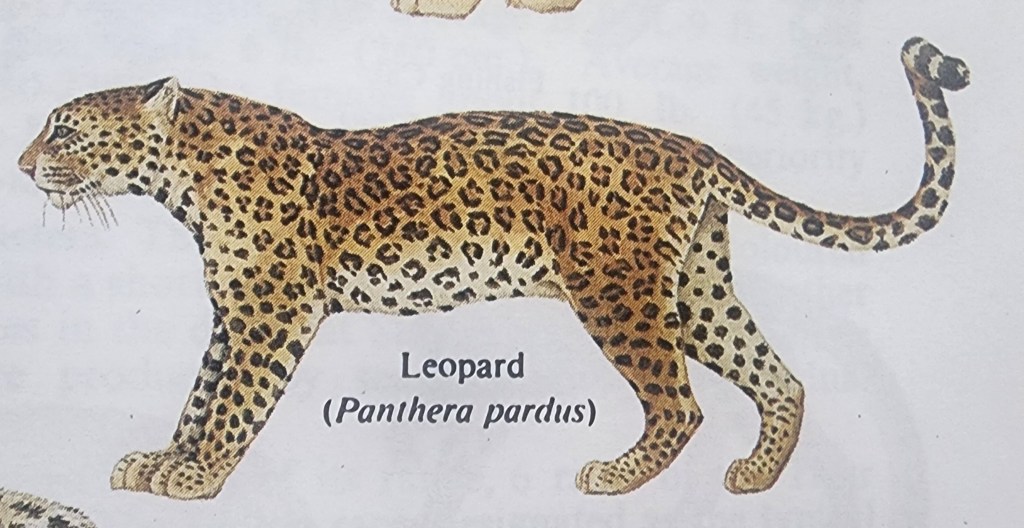
3rd May was International Leopard Day! Learning this was a pleasant surprise, for it gives me an opportunity to share a few observations about the martial arts that relate to leopards. 😊
Image credit – “The Book of Indian Animals” by S H Prater, published by the Bombay Natural History Society
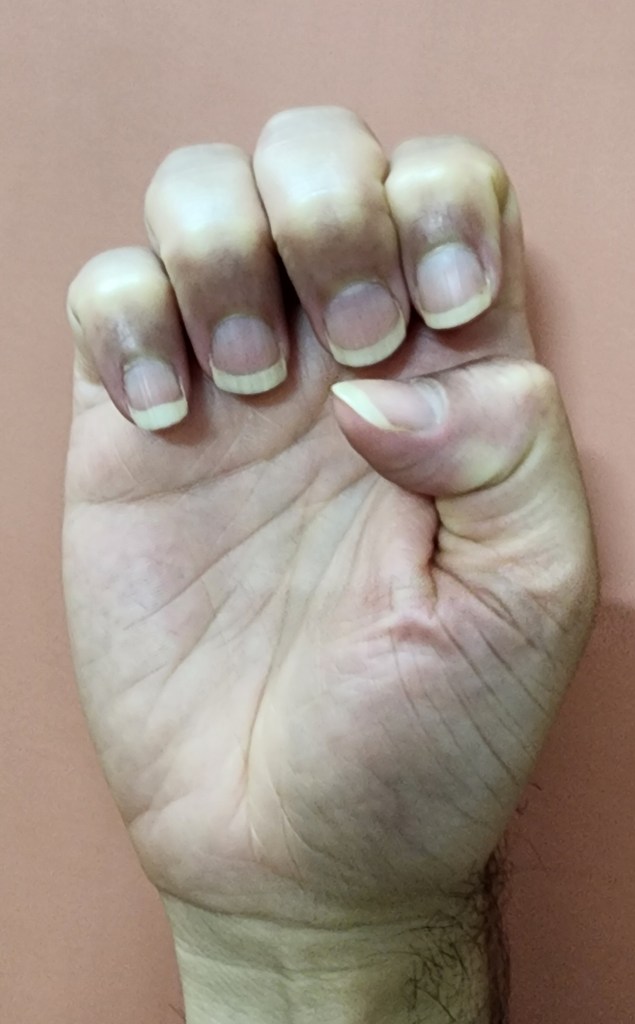
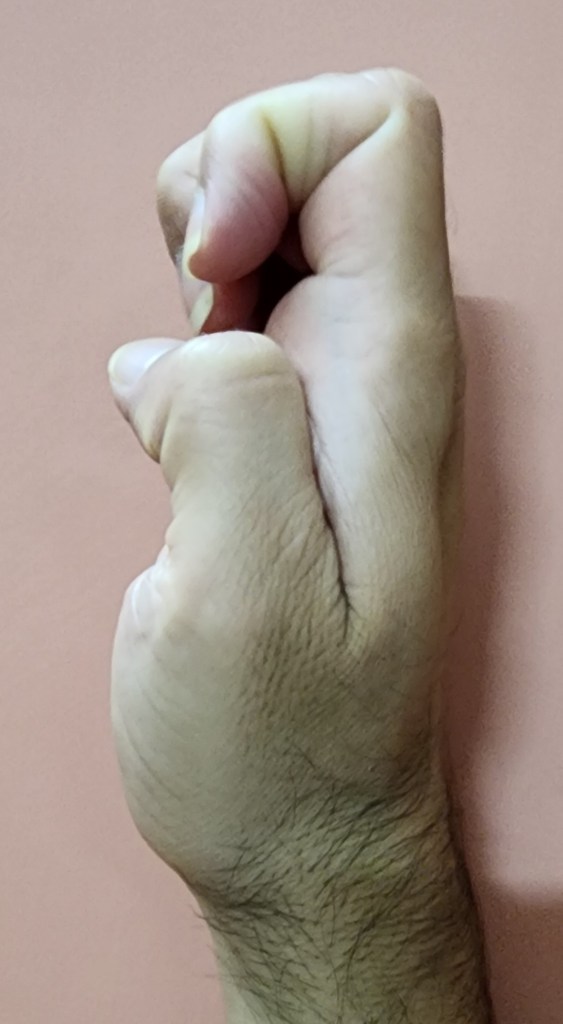
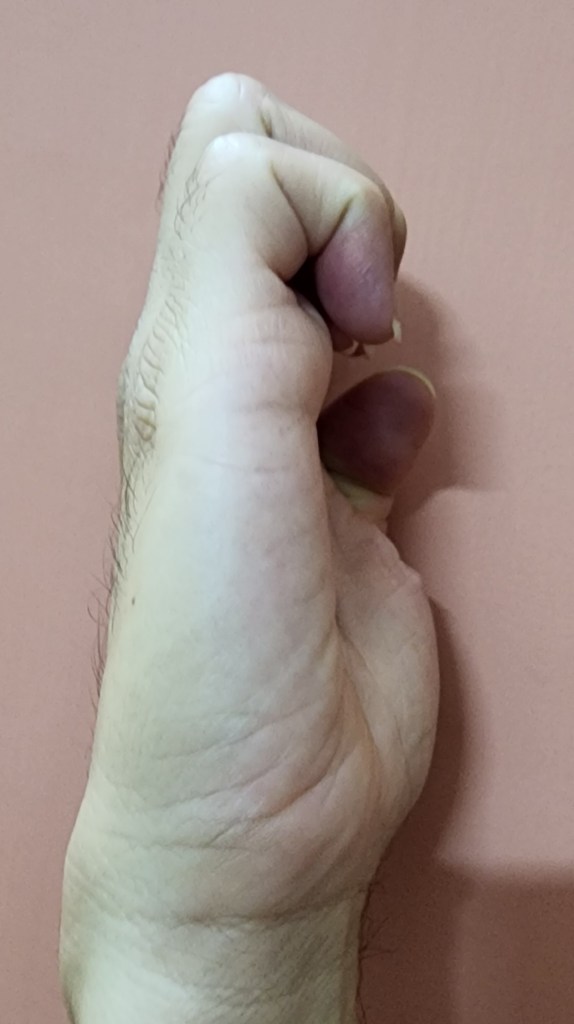
In Chinese Martial Arts, there is the “Leopard Fist”, just as there is a “Tiger Fist”. The Tiger Fist seems larger, for it uses an open palm with the fingers bent at an angle, imitating the claws of a tiger. The Leopard Fist is smaller in comparison. This fist has the fingers bent at the first joint from the base. This is in contrast to a regular fist where the fingers are best at the base.
In the Bujinkan system of martial arts, practitioners learn the basics called the “Ten Chi Jin Ryaku no Maki”. In this set of basics, there is a segment called the “Hiken Juroppo”. This section teaches students 16 (Juroppo) ways of using their fists, fingers, elbows, knees and feet to strike opponents. One of these 16 is called the “Shikan Ken”. It roughly translates to “secret spear”. The way a fist is made for the Shikan Ken is identical to the Leopard Fist.
Shikan Ken, front view
I remember being told that the Shikan Ken was used to strike narrow gaps while fighting armoured opponents. The Bujinkan has a heritage of systems that were developed to fight while wearing and against opponents wearing the Yoroi (Japanese armour). Armour has certain gaps that could potentially be exploited. The Shikan Ken is narrower than the regular fist (Fudo Ken) and this made it better suited against the small gaps that exist between plates and pieces of the Yoroi. It is also extremely effective in striking the neck of unarmoured opponents.
Shikan ken, profile views
The relative “smallness” of the Shikan Ken or the Leopard Fist, in a roundabout way circles back to the success of the Leopard itself. The Leopard (Panthera Pardus) belongs to the “Panthera” group, wild cats which are called the “Big Cats”. Big Cats, unlike all the other wild cats, can roar. There are 5 big cats, the tiger, the lion, the jaguar, the leopard and the snow leopard. Of these 5, the leopard is only larger than the snow leopard. Even pumas, which are not classified as big cats, could outweigh leopard. So, the leopard is on the smaller side when it comes to the big cats.
But this “smallness” seems to have served in its success as a species. The Leopard is the big cat with the largest distribution. From all ecosystems in Africa, to the arid regions of West Asia, to the frigid forests of Siberia to most of India and Sri Lanka, leopards inhabit a very large range and consist of some 11 sub-species.
My Uncle who was a naturalist by profession, used to tell me a statement he had heard, “a leopard can hide its body where a tiger can hide its head”! This elucidates how much larger a tiger is, when compared with a leopard. This “smallness” allows a leopard to survive on smaller prey, with a smaller territorial range. The smaller size also allows a leopard to hide in places a tiger could never hope to fit in.
Leopards, due to this advantage, have expanded to sub-urban regions around many large cities in India. In these environments, they survive on dogs, pigs and smaller livestock. Leopards have started entering apartment complexes at night to prey on pets. This has led to greater conflict with humans, but India has always been tolerant of wildlife. This is an evolving situation and how leopards adapt in the coming decades is yet to be seen.
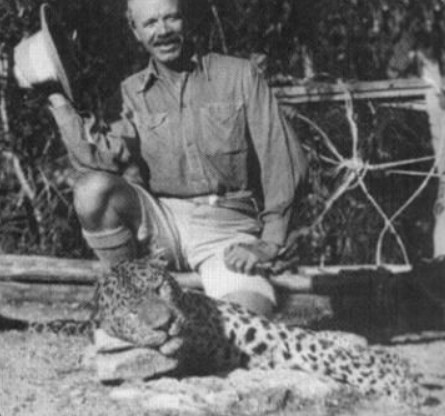
Man-eating Leopard of Rudraprayag. Image credit – Wikipedia.
But the fact that leopards have remained resilient and highly adaptable as a species is beyond question. This fact along with the afore mentioned smaller size led to the unfortunate success of leopards as man-eaters in the past. Man-eating leopards are exceedingly rare these days. But in the past there have been many documented individuals that did prey on humans.
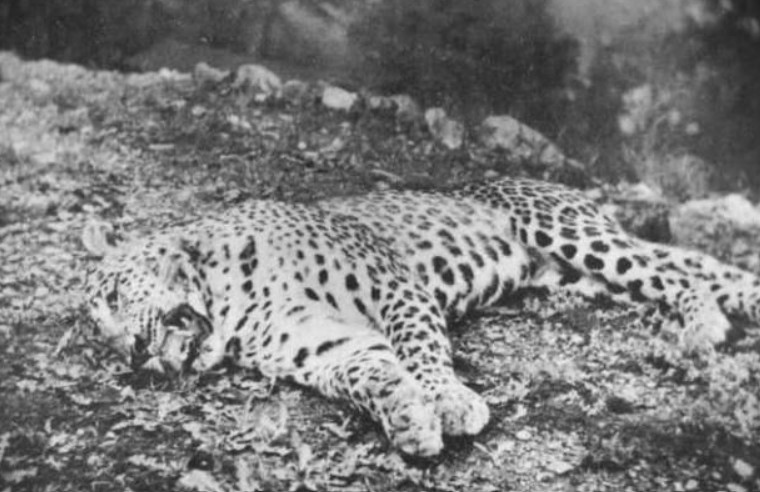
The deadliest man-eater in history is the Tigress of Champawat, who is considered to be responsible for 436 human deaths in India and Nepal in the first decade of the 20th century. But a close second is the Leopard of Panar, who is considered responsible for the death of 400 humans! An even more infamous man-eater is the Leopard of Rudraprayag, which preyed on humans between 1918 and 1926. The number of victims of this man-eater is supposed to be 125 with other undocumented cases. All these man-eaters were shot by Jim Corbett.
Man-eating Leopard of Panar. Image credit – Wikipedia.
Returning to the “smallness” and the exploitation of gaps in armour, there is one weapon which, in my opinion, exemplifies the “Leopard Fist”. This is the famous Katar, a punch dagger with its origins in India. This dagger is not held in either the ice pick or sabre grips. It is held in a manner where the dagger seems to extend from the fist. The grip is either the traditional fist or the Leopard Fist. Looking at it from the perspective of the Bujinkan, the Katar would be held with a Fudo Ken or a Shikan Ken.
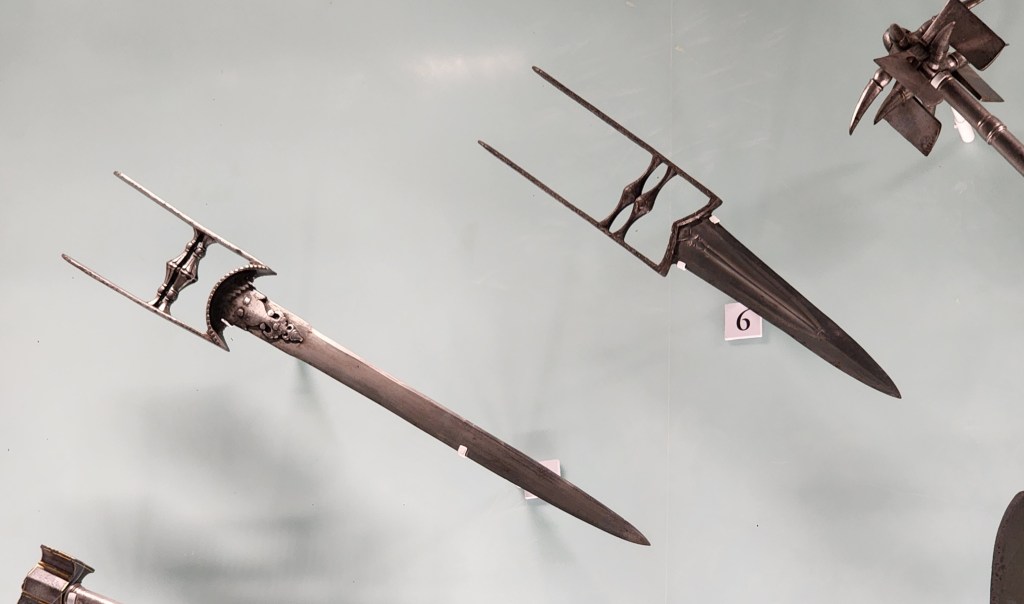
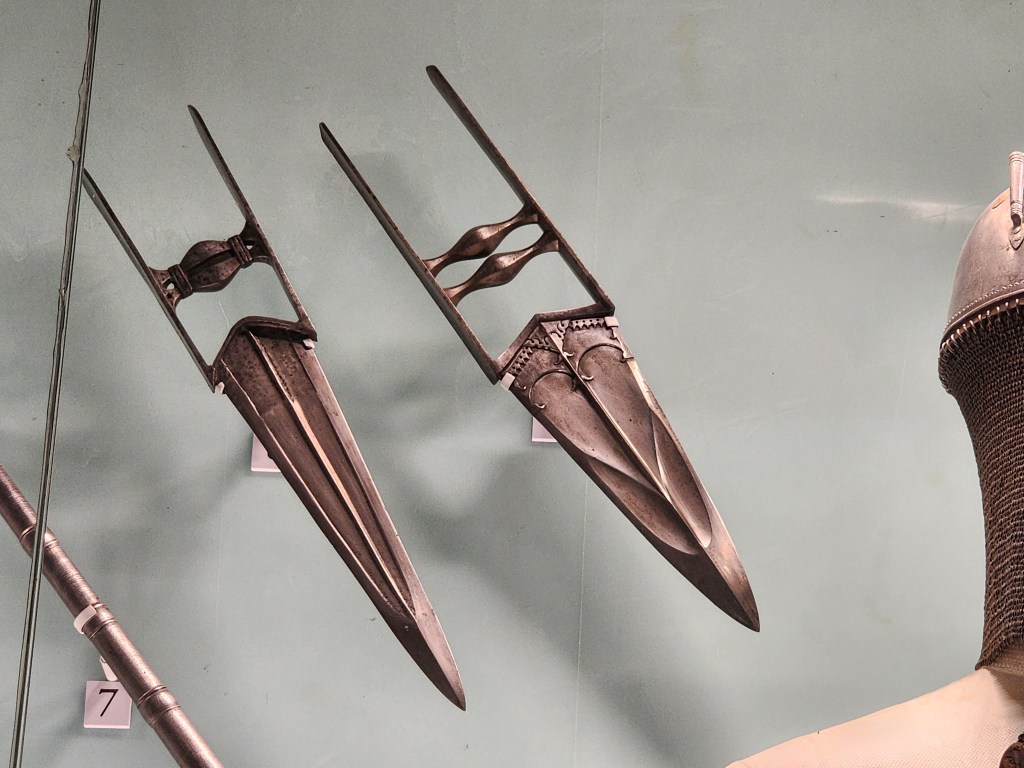
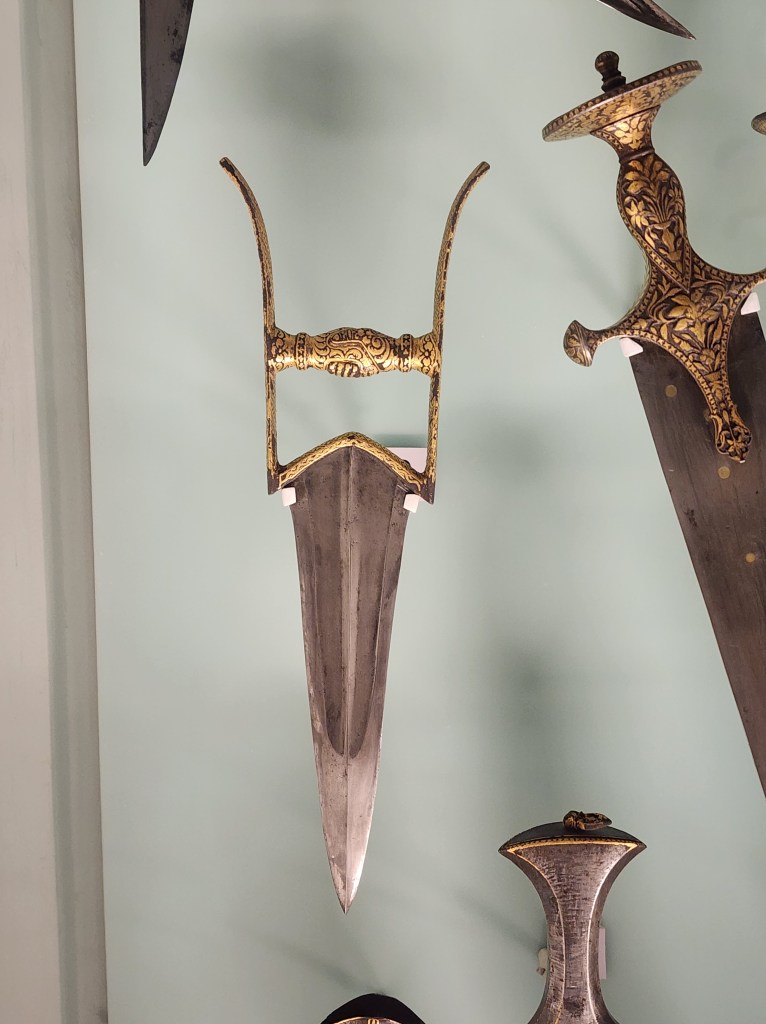
2 Katar displayed in the City Palace Museum, Udaipur, Rajasthan. Observe the Katar on the left, the blade is pretty long, but the 2 prongs of the “H” shaped handle are not long, they are of normal length. On the Katar on the right, the 2 prongs of the handle are much longer, to protect the hands of the wielder. The blade on the Katar on the right is of normal length.
The Shikan Ken is useful against narrow spaces. Given the manner in which the kater is held, it is an extension of the fingers in the Shikan Ken. The blade of the katar becomes an extended, sharper, pointed version of the Shikan Ken. This makes its effective against the same gaps in armour.
2 more Katar displayed in the City Palace Museum, Udaipur, Rajasthan. Observe the one on the right, it has a reinforced point for piercing chain mail.
In the Indian historical context, chain mail was prevalent a lot longer than in the west. So, many katar had reinforced points to pierce through the rings of chain mail. The blade of the katar in some cases was considerably longer, in which case it was more a chopping weapon than a punching/piercing weapon. The two prongs on the sides of the hand guard of a guard were longer in some examples, to protect the hand better.
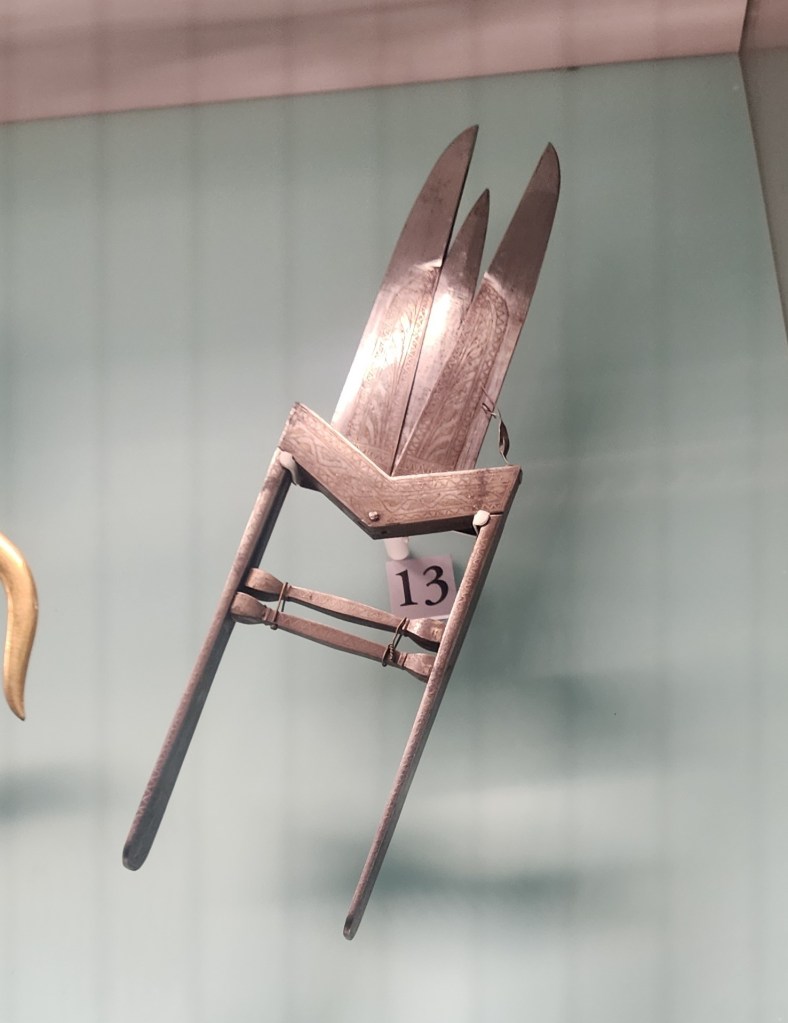
A Katar displayed in the City Palace Museum, Udaipur, Rajasthan. This is a Katar that has the sheath and blade combined. The two cross bars on the handle can be pressed to open the sheath and reveal the blade. It is wonderful engineering which is supposed to be why these examples were prestige pieces.
Beyond the core functional aspects, the Katar was also a part of regal attire and used as a prestige piece for power projection. In this avatar of the weapon, it had beautiful ornate hilts and blades. There were a lot of examples where the blade had a sheath that would separate to the sides to reveal the blade inside!
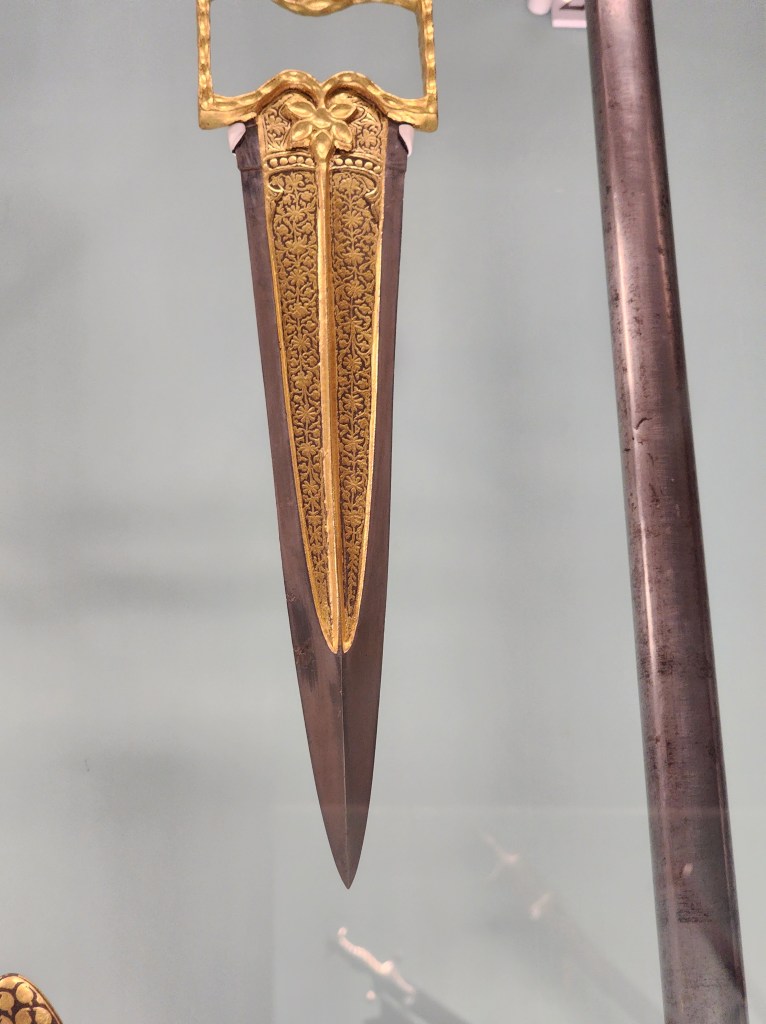
Another Katar displayed in the City Palace Museum, Udaipur, Rajasthan. Look at the beauty of the blade! Imagine the prestige this would add to royal attire!
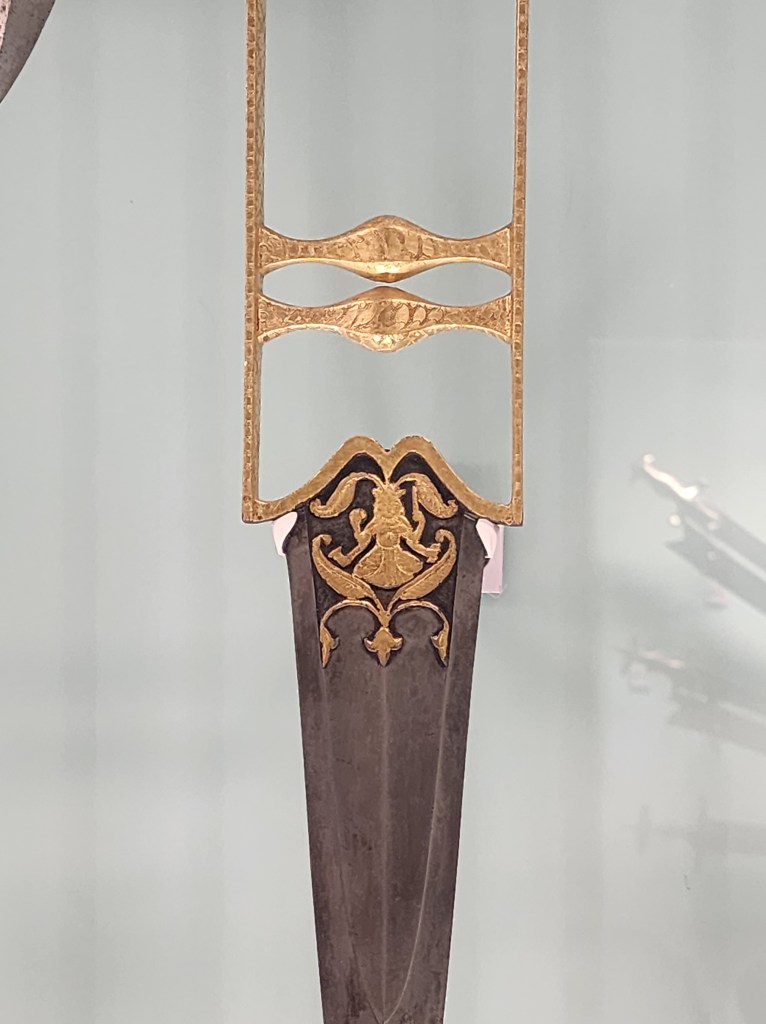
Yet another Katar displayed in the City Palace Museum, Udaipur, Rajasthan. The Devi herself resides on this blade!
Yet another Katar displayed in the City Palace Museum, Udaipur, Rajasthan. Look at the handle of this specimen! Two Golden Hands are clasping each other. :-)
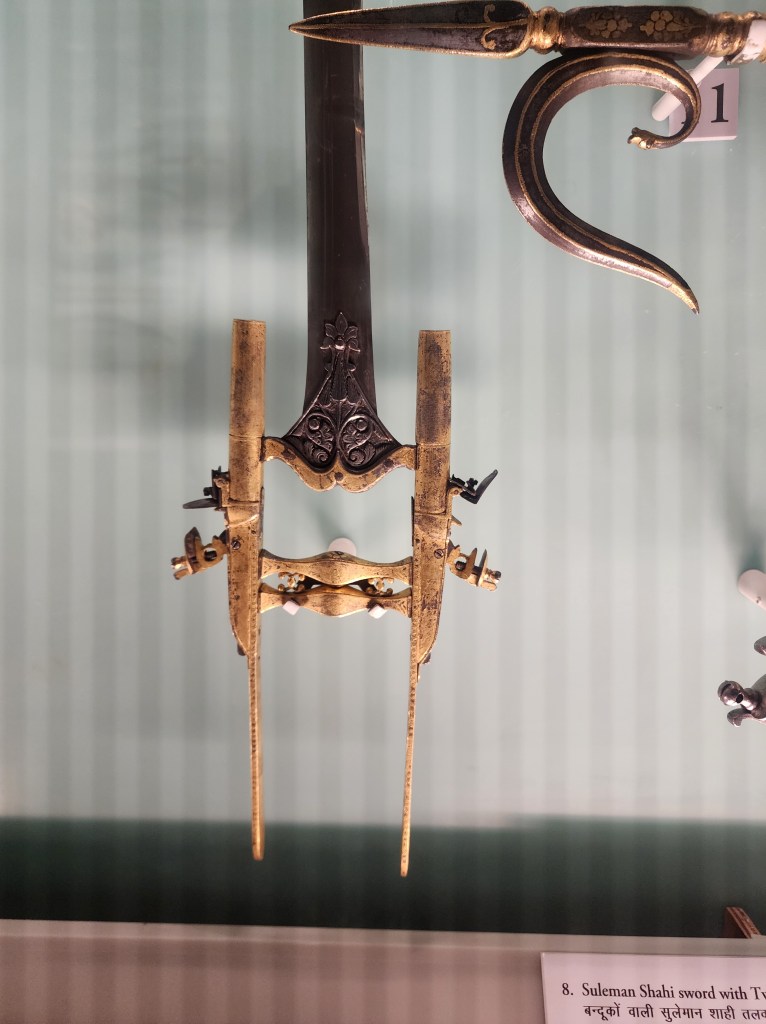
There are also instances of the Katar being a combination weapon. Flintlock pistols were incorporated into the hilt of the Katar, which would presumably fired off before the blade would be deployed. The Katar has many other forms I cannot go into here, including the “Hooded Katar”, which some consider to be an older form. In this version there is a protective shell for the knuckles of the wielder. Perhaps there will be an opportunity to explore the katar in greater detail sometime.
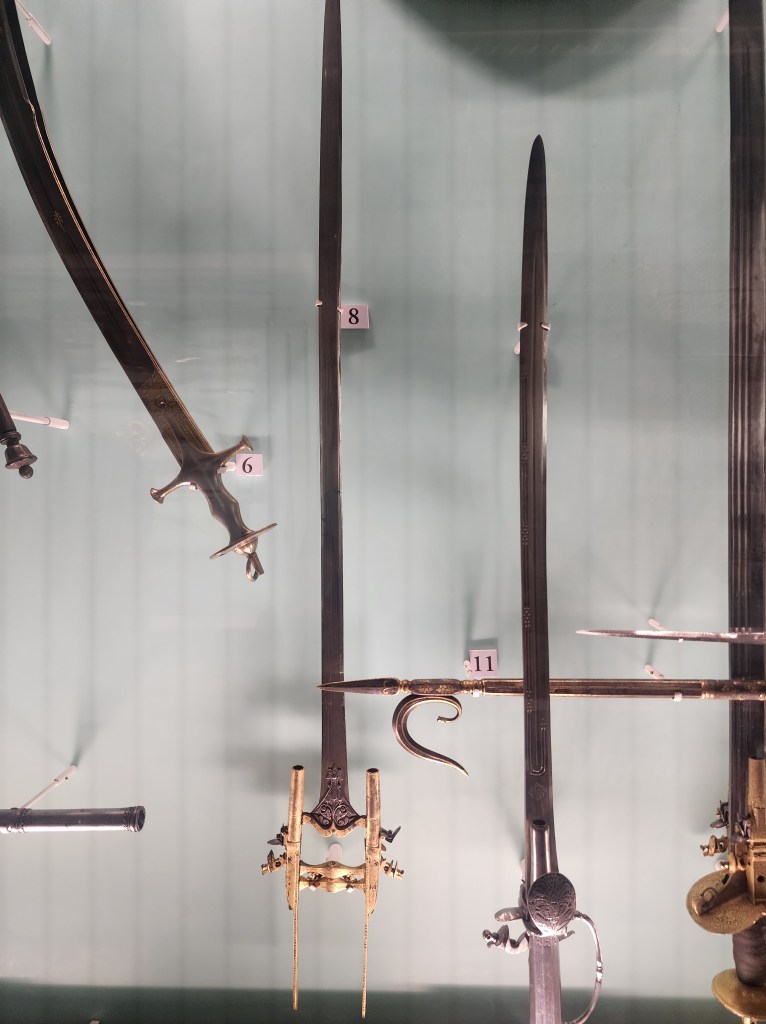
A Katar displayed in the City Palace Museum, Udaipur, Rajasthan. In this example, the two prongs of the handle have flintlock pistols built into them! They are fired by a mechanism similar to the one that opens the sheath from the earlier example.
The pictures of the Katar used in this article are mostly from Rajasthan. This seems apt as I conclude this post, for the Jawai hills are in Rajasthan, and the rocky scrublands of Jawai are one of the best places to spot and appreciate leopards in India.
This is a zoomed-out view of the Katar handle from the previous image. This Katar handle had a full-length sword blade attached to it! :-D
19th of April of 2026 is Parashurāma Jayanthi, celebrated as the birth anniversary of Lord Parashurāma. Lord Parashurāma is the 6th avatāra of Lord Vishnu in the Dashāvatāra (dasha – 10, avatāra – incarnation). Lord Parashurāma is perhaps the ultimate representation of an “epitome of the martial arts”. He represents the progression of learning and development of abilities in the martial arts; starting with old fashioned physical abilities to the development of a martial system that resonates in India to this day.
His abilities expanded from close quarters combat to long distance combat. Over time, he became a repository of all the divine weapons that could cause incredible destruction at long distances and over large areas. He created divine weapons of his own! He became a martial arts teacher to the greatest warriors of his age. He played a vital role in both the Ramayana and the Mahabharata!
He was an avatāra of Lord Vishnu for only a portion of his life. Yet he could only ever be contained by either in battle by his own students or another avatāra of Lord Vishnu! He literally went from a vengeful young man to a wise sage! I hope to delve into the great martial prowess of Lord Parashurāma in this article, to identify how these abilities are still practiced in real world martial arts, which almost always have real life applications beyond the dojo.
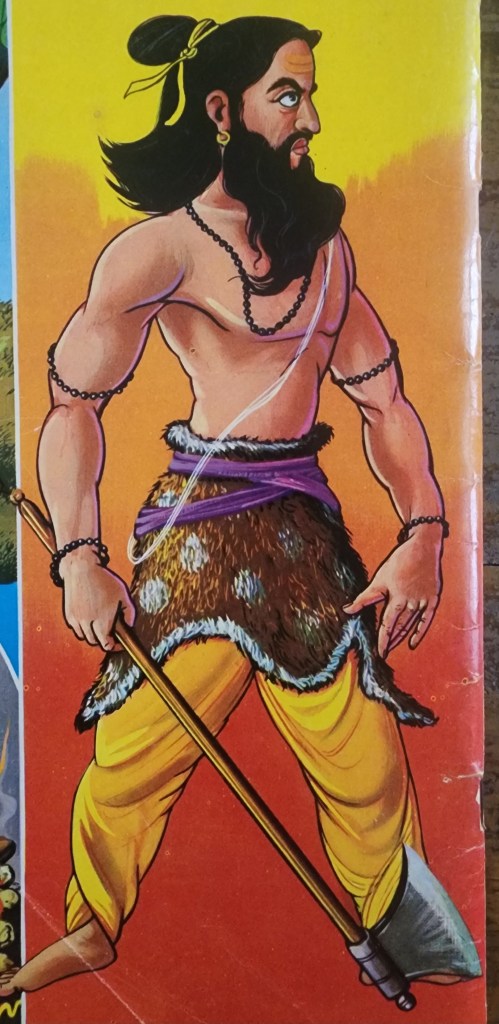
My favourite image of Lord Parashurāma. Image credit – “Bhagavatha”, published by Anada Prakashan.
The “Parashu” in Parashurāma’s name itself describes his martial abilities. Lord Parashurāma’s name is Rama. He was the son of the Rishi Jamadagni and Renuka. Since he was a descendant of Rishi Bhrigu, his name would be “Bhargava Rama”, the Rama in the line of Bhrigu. But he is always known as “Parashu Rama”, or “Rama of the Parashu”.
“Parashu” is the Sanskrit word for an axe. So, when we say Parashurāma, we mean “Rama of the Axe”, or “Rama who wields the Axe”. This is because the weapon most associated with Lord Parashurāma is the AXE. The axe is the weapon that made Lord Parashurāma a feared individual and the weapon he wielded as he fulfilled his purpose as an avatāra. The axe or Parashu wielded by Parashurāma was bestowed upon him by Lord Shiva.
Bhargava Rama, before he became Parashurāma, meditated on Lord Shiva. Being pleased with Rama’s efforts, Lord Shiva instructed him in the martial arts and also handed him the axe that made Rama, Parashurāma. This instruction in the martial arts also resulted in Parashurāma becoming the greatest warrior of his age!
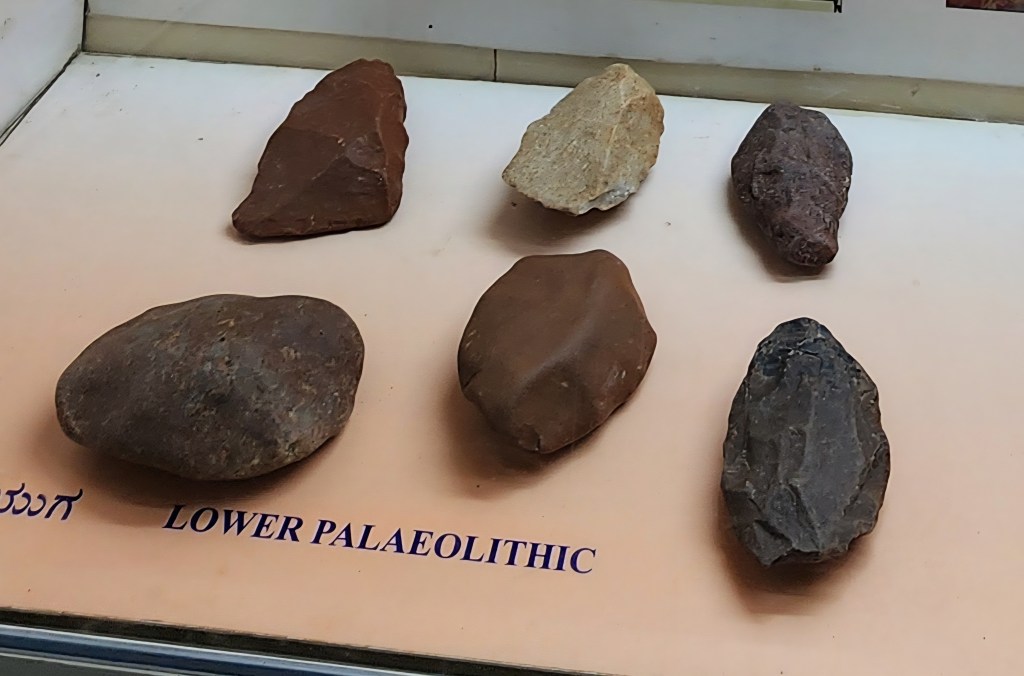
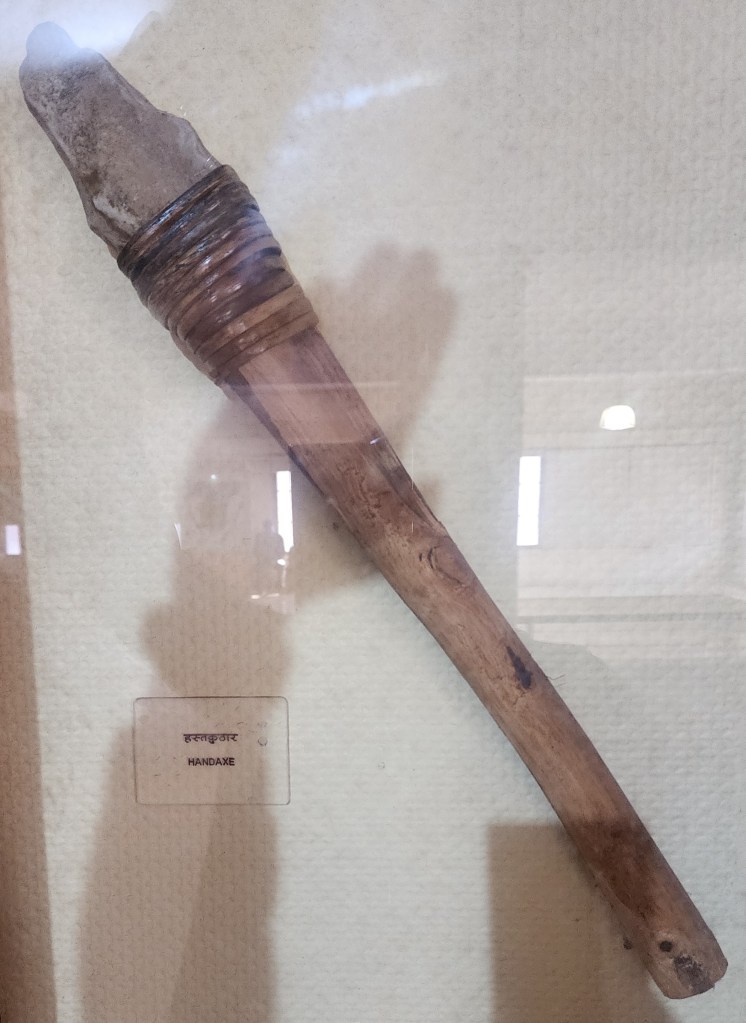
The axe has been used as a tool first and then as a weapon for millennia, perhaps from the early stone age or the Paleolithic age, which lasted from 3.3 million years before present till about 12,000 years before present. Ever since, the axe has never not been in use in human history. It is still used extensively, mainly in working wood and as a tool used by firefighters and other rescue personnel.
Stone hand axes from the Lower Paleolithic era, displayed at the museum in Aihole, Karnataka
A representation of a stone hand axe from the State Museum, Bhopal
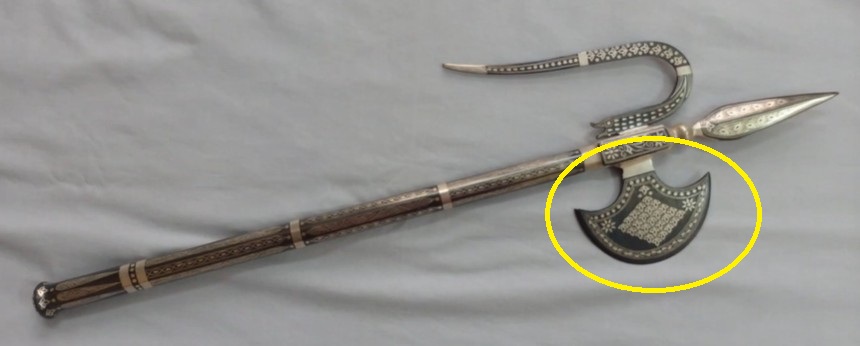
The axe has been used as a weapon in various cultures all over the world. In Japan, a large battle axe was used and referred to as the “Ono”. This seems to have been used to break into buildings or other structures while breaching enemy strongholds. In India, apart from the Parashu, the axe used to fight was called the “Tabar” in Indo-Persian culture and in the regions that is influenced.
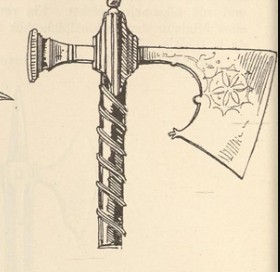
A representation of a tabar. The part encircled in yellow is the axe. The other side of the head is an “Ankusha” (elephant goad). This is a combination weapon.
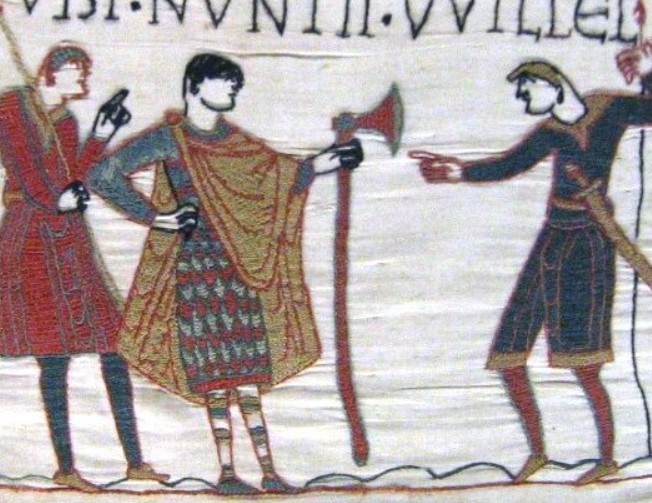
In Europe, thanks to more historical research than in many other parts of the world, several examples of axes used for fighting are known. The most famous use of the axe that comes to mind, thanks to depiction in pop-culture, is by the Norse cultures, or Vikings. The Vikings used axes of all sizes, from one handed versions to the large “Dane Axe”, which is sometimes claimed to have been able to take down horses!
A Dane axe seen on the Bayeux tapestry. Image credit – Wikipedia.
The Dane Axe was the signature weapon of Housecarls, the elite warriors of Norse armies. The Norse expanded their cultural presence all over Europe from the British Isles to France to modern day Russia and Ukraine to even the Byzantine empire that occupied parts of Anatolia, modern day Turkey. The elite royal guard of the Byzantine Emperor, called the Varangian Guard, were mostly Norsemen, between the 10th and 14th centuries. They also carried the Dane Axe. So, this large axe, which stood some 4 to 6 feet tall, was used all across Europe from the North-West to the South-East!
There were other variants of the axe used in Europe. The Francisca, a one-handed axe was used by the Franks (in regions that later became France). This was a weapon what could be used in-hand or thrown at the enemy. Apparently, the Francisca was optimized for throwing. The word for axe in French was “hache”, which gives the modern word “hatchet”, which is a synonym for “axe”.
A historic Francisca. Image credit – Wikipedia.
The axe even came to be included in polearms, which were called “Halberds”. Halberds of various shapes came to be in late-medieval and renaissance Europe. Many of these came to include a variant of the axe. A variant of the halberd, called the “Farsa” was also used in India around the time of the Mughal Empire. The halberd almost always included a spear point. This allowed a long weapon to not just pierce efficiently but also have sufficient hacking ability.
A Farsa, from the City Palace Museum in Udaipur, Rajasthan. This is an Indian version of the halberd.
It was the development of the full plate harness (full plate armour) that led to the development of perhaps the most iconic axe in history, the Pole Axe. I have heard it said that this weapon can also be called the “Poll Axe”. Since it was impossible to cut through the plate of the armour of men-at-arms and knights, weapons that caused blunt force trauma through the armour and pierce the gaps in the armour were developed.
This combination weapon was about the height of a man, some 5 to 6 feet tall. It included a wooden shaft and a head that included an axe, a hammer and a spear point. The axe head here could be similar to a conventional axe head we are used to seeing or a “crow’s beak”, which resembles an ice pick.
A training version of the Pleaxe
Further west, in the Americas, the Tomahawk used by the Native Americans is another pop-culture icon. This was a small axe or hatchet that could be used single handed, as a tool or as a weapon. It was supposedly thrown as well. Interestingly, there were supposedly tomahawks which could be used as smoking pipes!
An antique Tomahawk. Image credit – Wikipedia.
Since I have mentioned different types of axes, it must be mentioned that the design and construction of axes vary based on whether it is intended for use as a tool or as a weapon. Of course, an axe designed as a tool can be used as a weapon and vice versa, but there was design optimization. Axes used as weapons were lighter for easier wielding while those used as tools were robust for endurance.
A Crow’s Beak in the City Palace Museum, Udaipur, Rajasthan
The axes used as tools were further segregated as splitting axes and chopping axes. This distinction allowed the wedge of the axe head to be modified suitably. Axes used as weapons were leaner. They tended to be thinner towards the centre and thickened towards the cutting edge for better force transfer. Further, the profile of the axe head also changed based on the application.
There were “bearded axes”, which had the front cutting edge be considerably longer than the rear end or the eye of the axe. This enabled them to hook the weapons and shields of opponents better. There were even axes which had the cutting edge elongated towards the opponent, to allow for thrusting with the same axe head!
A representation of a Bearded Axe. Image credit – Wikipedia.
I am not sure if there is a description of the specific axe or axes that Lord Parashurāma used. I am also not aware of any specific description of the techniques Parashurāma used to wield his axe effectively. Parashurāma also possessed various celestial weapons that he has acquired from Lord Shiva apart from his Parashu. I am not sure if he used these in conjunction with his axe while he vanquished his enemies. By common sense, It seems likely that he used the axe for close quarters combat while he deployed his Divyāstras (divine weapons) for ranged attacks against larger numbers of enemies.
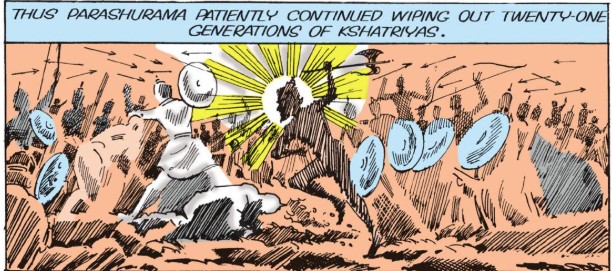
Parasurāma conducted 21 campaigns against corrupt Kshatriyas, likely rulers who were corrupt or considered unworthy. In these wars he decimated entire ruling families! The bloodletting is supposed to have been so immense that the blood of his enemies filled up 5 lakes! The land where these lakes existed was called the Samantapanchaka. It was later the battlefield of Kurukshetra, where the great war took place during the Mahabharata.
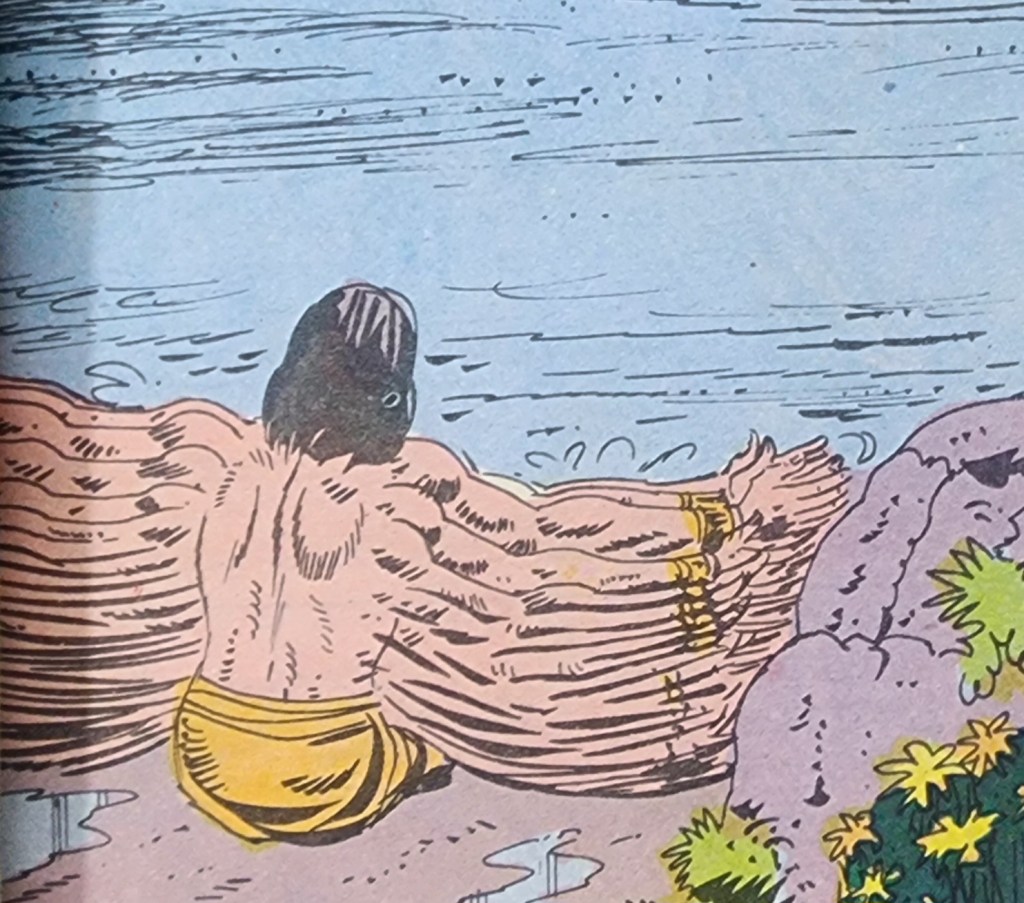
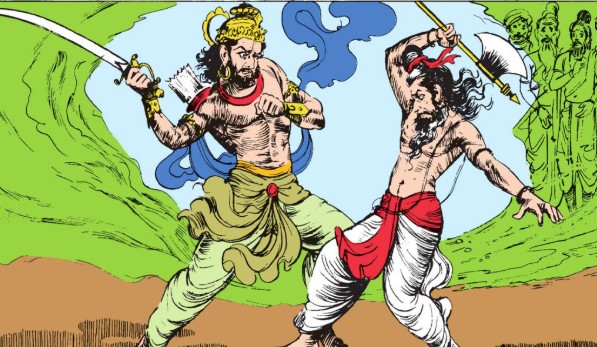
Of the 21 campaigns, the first one is truly remarkable. Kartaveerya Arjuna was a ruler of the Haihaya clan who ruled from Mashishmati, a city on the banks of the river Narmada. He was also called Sahasra Arjuna. Sahasra means thousand. Arjuna was supposed to be “Sahasra Bāhu”. Bāhu means arm. So, “Sahasra Bāhu” means “thousand arms”. Sahasra Arjuna was called so because he supposed to have had a 1000 arms! This is generally taken to mean that his might was immense, comparable to an individual with a 1000 arms.
Kartaveerya Arjuna or Sahasra Arjuna was a great devotee of Lord Dattatreya, due to whose blessings he became a mighty human and a great king. But with time he became an arrogant individual and an unworthy ruler. He and his sons were responsible for the death of Parashurāma’s father, the Rishi Jamadagni. This led to Parashurāma going to war single handedly against Arjuna and his many sons.
Sahasra Arjuna depicted literally with a 1000 arms, stopping the flow of the river Narmada. Image credit – “Ravana Humbled”, published by Amar Chitra Katha.
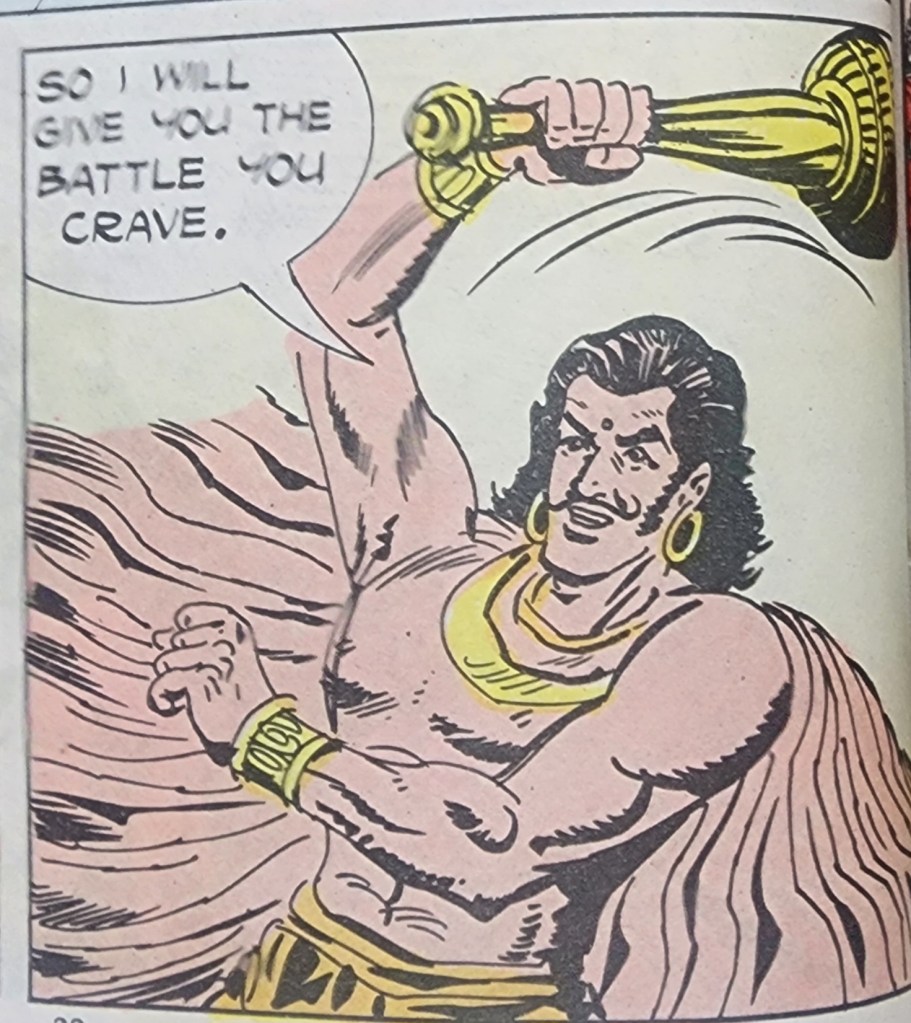
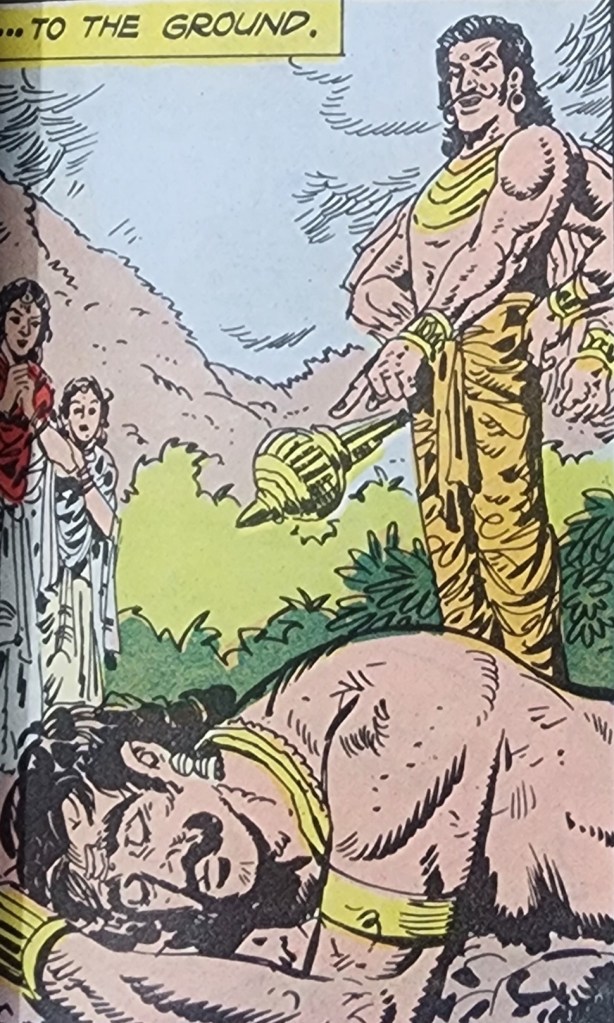
Sahasra Arjuna’s fighting abilities are demonstrated by his defeat of Ravana. This is the same Ravana who had conquered all before him and later fought Lord Rama in Lanka after he abducted Devi Sita. Arjuna imprisoned Ravana after the latter lost a duel against him. Ravana was eventually released agreed to a peace with Arjuna. This was after Rishi Pulastya, Ravana’s grandfather, interceded on his behalf.
The might of Kartaveerya Arjuna. Image credit – “Ravana Humbled”, published by Amar Chitra Katha.
While common knowledge attributes the adjective “Sahasra Bāhu” for Arjuna to signify might, I differ in my opinion. A great warrior, even while just considering one’s fighting abilities and not tactical or strategic brilliance, is not measured by just physical might. They are also respected for their skill with weapons and in unarmed combat. They can also be great due to speed and agility, apart from just strength.
Arjuna knocks out Ravana. Image credit – “Ravana Humbled”, published by Amar Chitra Katha.
So, is it likely that Arjuna was a rare warrior who could wield all manner of weapons with consummate skill? Was he able to move with such ease and grace that an opponent felt like he was fighting several opponents at the same time? I opine that this is likely. Arjuna could move and use multiple weapons with such skill and ability (speed, agility and strength) that it seemed like he had a 1000 arms! Hence, Sahasra Bāhu!
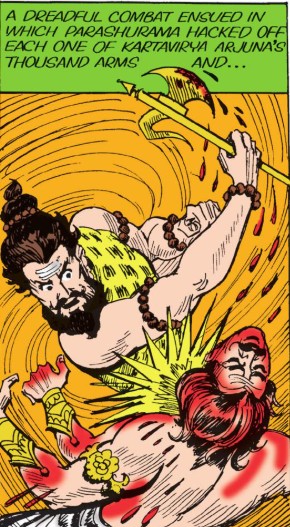
It was this great Arjuna that Parashurāma defeated in his first battle. Parashurāma defeated and killed Arjuna and his sons to avenge his father. After this, he went on a rampage that constituted his 21 campaigns and led to the slaughter of a very large number of people! This act of his was the purpose of the Parashurāma avatāra. He was an avatāra only during this time. But that was not the end of his life’s purpose.
Lord Parashurāma slays Kartaveerya Arjuna. Image credit – “Parashurama” (Kindle edition), published by Amar Chitra Katha.
Lord Parashurāma’s 21 campaigns against the Kshatriyas. Image credit – “Parashurama” (Kindle edition), published by Amar Chitra Katha.
Lord Parashurāma is counted among the immortals in Hindu culture. He is believed to be still alive. His next task on this Earth is to be the mentor for the Kalki avatāra, an incarnation of Lord Vishnu that is yet to appear. But between his slaying of Kartaveerya Arjuna and the coming of Kalki, he was instrumental in the happenings of both the Ramayana and the Mahabharta. He is even supposed to be responsible for the current geography of the Indian peninsula! And the creator of one of modern India’s most popular martial arts!
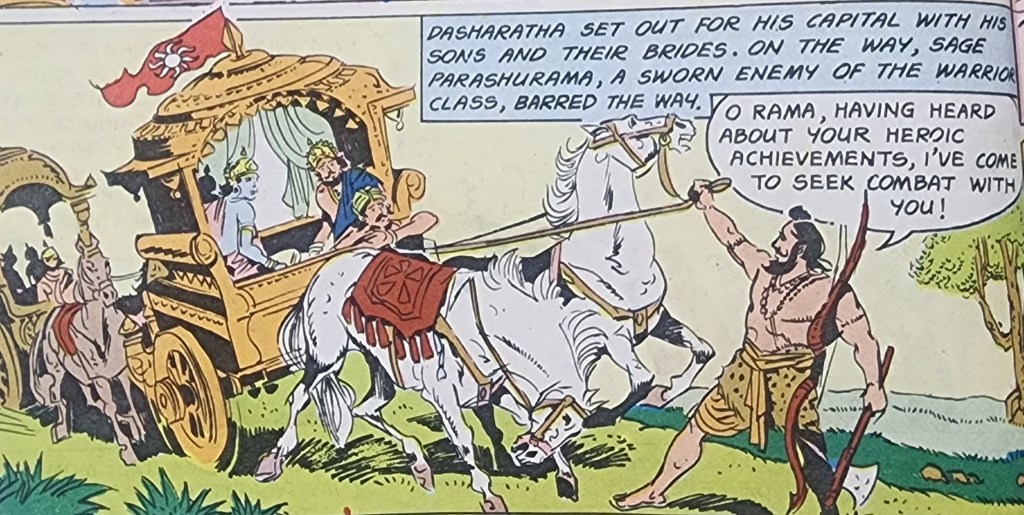
Lord Parashurāma seeks combat with Lord Rama. Image credit – “The Ramayana”, published by Amar Chitra Katha.
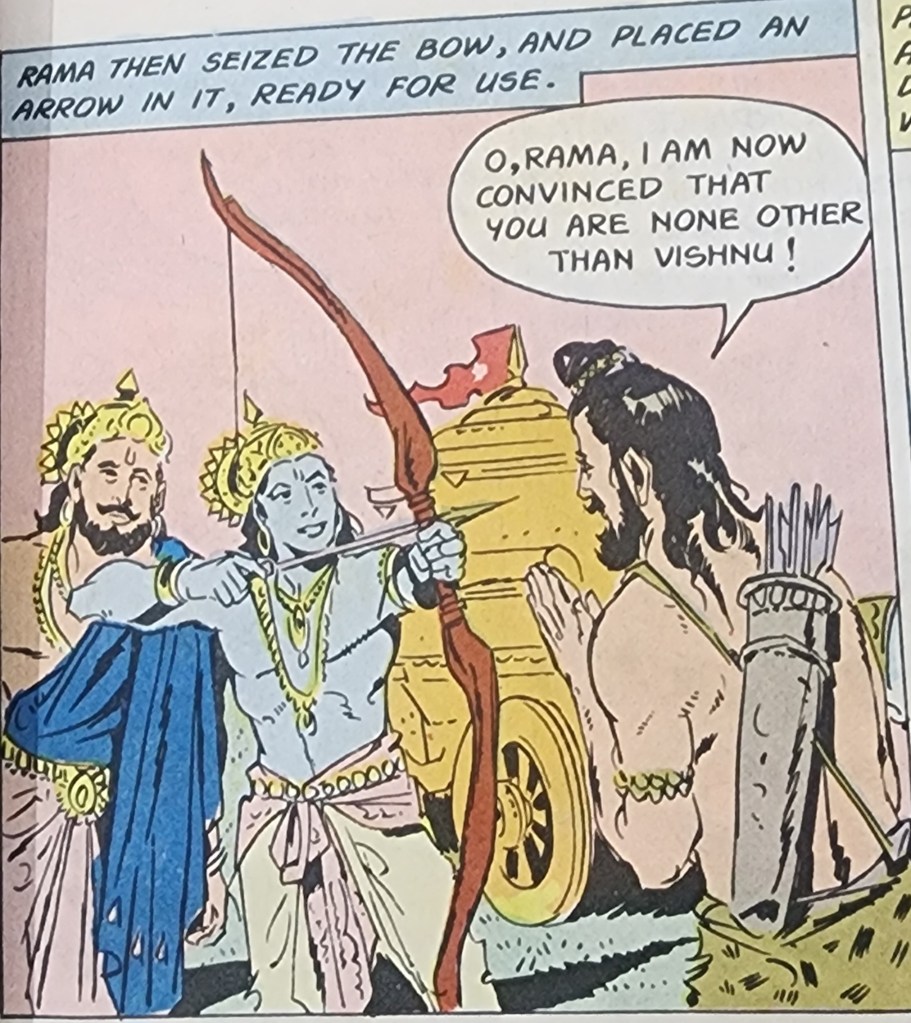
Lord Parashurāma’s stature and abilities as a warrior are reflected by the people he interacted with during the Ramayana and the Mahabharata. Parashurāma’s campaign against Kshatriyas ended when he faced Lord Rama. During the swayamvara of Devi Sita, Lord Rama broke the bow of Lord Shiva. Parashurāma, being a devotee of Lord Shiva, was angered by this act and faced off against Lord Rama. But there was no fight. Parashurāma recognized the next avatāra of Lord Vishnu in Rama and withdrew.
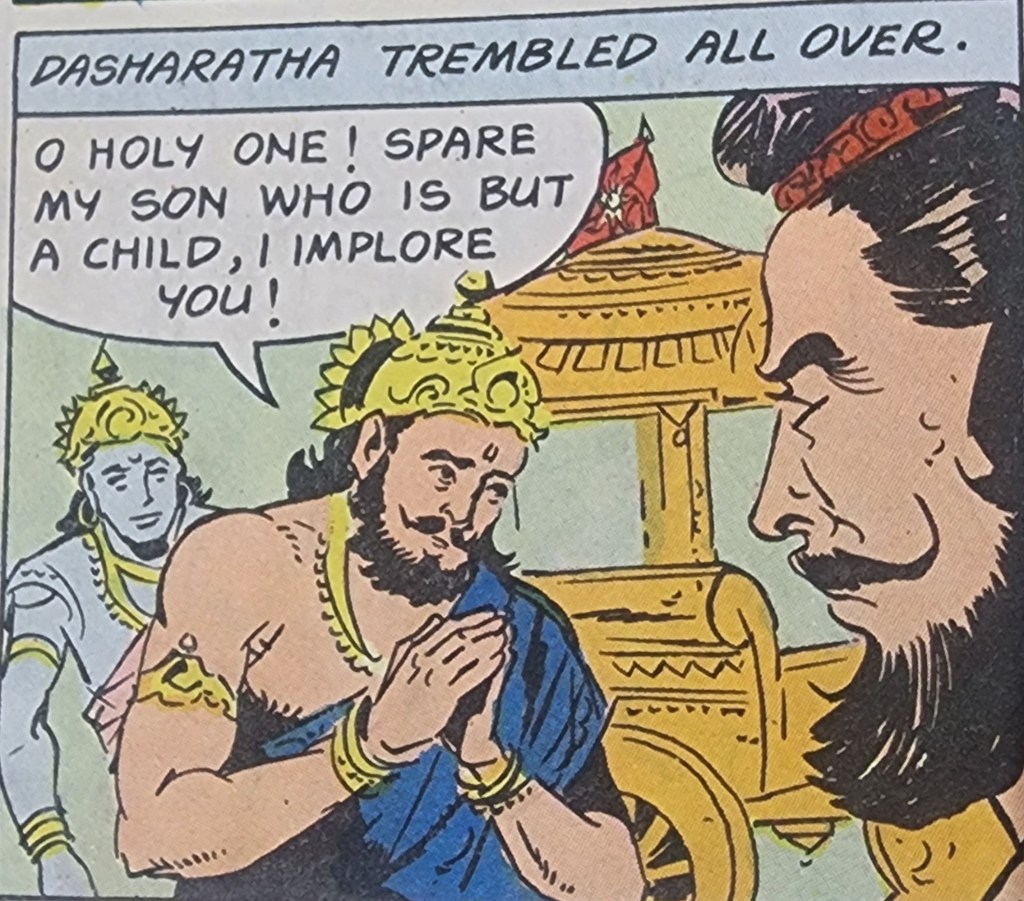
Dasharatha, father of Rama, is extremely worried by the prospect of his son facing Lord Parashurāma in a fight. Image credit – “The Ramayana”, published by Amar Chitra Katha.
Parashurāma was invincible. Rama’s father Dasharatha knew this and was worried when Rama faced off against this great warrior of old. Parashurāma’s withdrawal shows that it took another avatāra of Lord Vishu to stop him from fighting, let alone defeat him! That shows how great a warrior, in other words, martial artist Parashurāma was, even after he was no longer an avatāra!
Parashurāma recognizes Rama as an incarnation of Lord Vishnu. Image credit – “The Ramayana”, published by Amar Chitra Katha.
Parashurāma’s encounter with Rama also made him realize that rulers who were committed to Dharma were back in the world. This meant that he could stop his campaign against corrupt Kshatriyas. Parashurāma now focused on yajnas and meditation to atone for the many deaths he had caused. He also gave away all his possessions.
Parashurāma needed land to meditate on and share his knowledge and possessions. To this end, he got the sea to retreat! He is supposed to have hurled his axe into the western sea (today called the Arabian Sea). The sea retreated beyond the point where the axe landed. The land that was reclaimed by the retreating of the sea is supposed to be India’s western coast, all the way from Goa through Karnataka and Kerala. This coast is also called “Parashurāma Kshetra” for this reason.
Parashurāma, after his interaction with Lord Rama went on to become a great martial arts teacher. He was the teacher to 3 of the greatest warriors in the Mahabharata. Bheeshma, the general of the Kaurava armies and the greatest warrior of the era was a student of Lord Parashurāma. Karna, the lost brother of the Pandavas and the king of Anga, was also a student of Parashurāma. Drona, the martial arts teacher of both the Pandavas and Kauravas acquired the knowledge of divine weapons from Lord Parashurāma, which he passed on to his students.
The greatness of Parashurāma as a martial artist is again highlighted by his 3 illustrious students. Bheeshma had to fight his Guru as Princess Amba of Kashi had approached Parashurāma after she had faced great injustice due to Bheeshma. Bheeshma and Parashurāma fought each other to a standstill with their divine weapons. So, another instance where Parashurāma could be contained, came about because of an individual Parashurāma himself had trained! It took a student to stop the teacher, no one else could do it!
Bheeshma fights his Guru Parashurāma to a standstill. Image credit – “Bheeshma” (Kindle edition), published by Amar Chitra Katha.
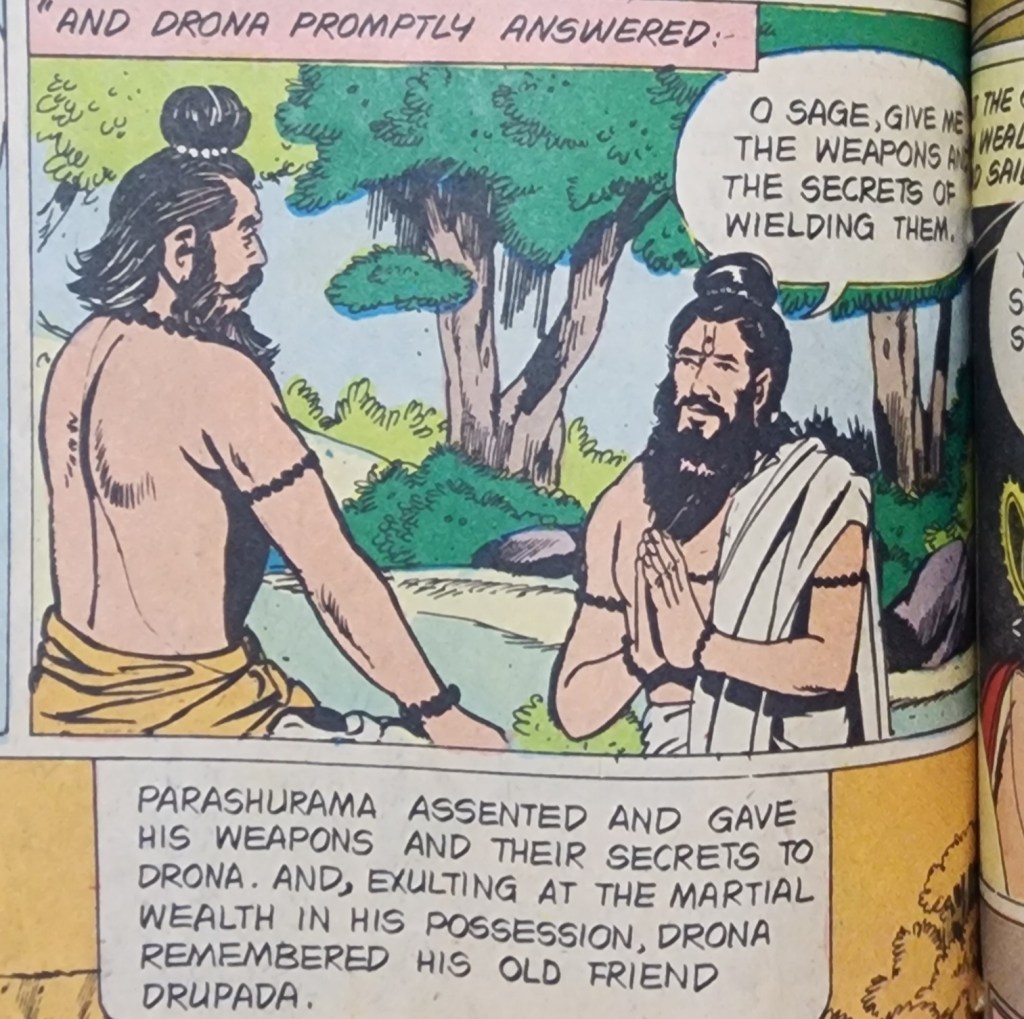
Guru Dronācharya acquired all the celestial weapons and learned the means to use them from Lord Parashurāma. He used these with such devastating impact that the Pandavas had to resort to deceitful means to kill him on the 15th day of the Kurukshetra War! With the knowledge acquired from Parashurāma, Drona was invincible, in the same mould as his great teacher! This necessitated the deceit employed against him.
Drona acquires weapons from Lord Parashurāma. Image credit – “Mahabharata – 5, Enter Drona”, published by Amar Chitra Katha.
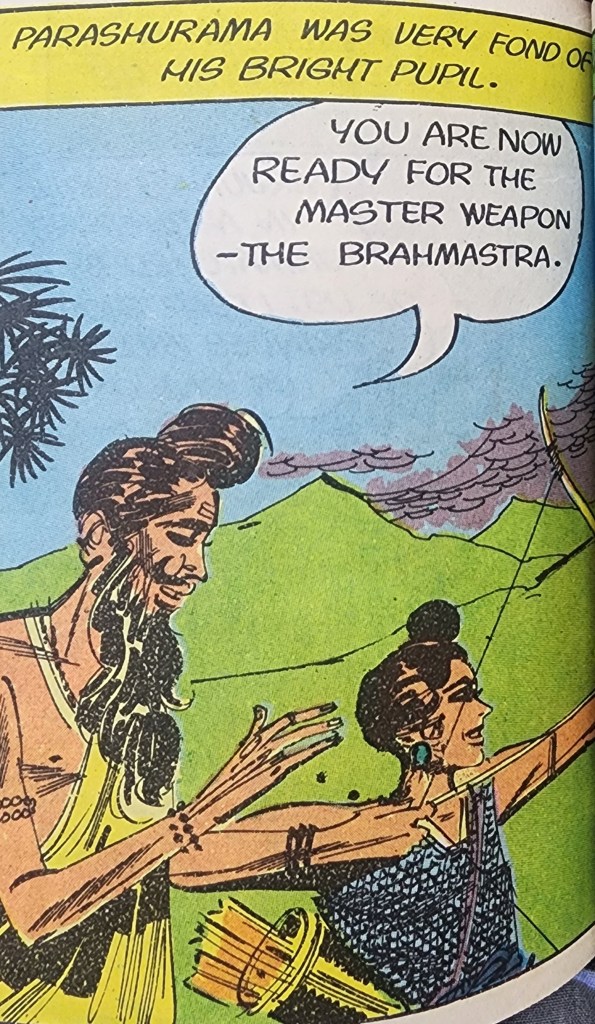
Most of the divine weapons described in the Mahabharata come from the various Devas, like Indra, Agni, Vāyu, Varuna, Kubera, Lord Shiva, Lord Brahma, Lord Vishnu and the like. But Lord Parashurāma created his own divine weapon! Such was his ability! He created the Bhargavāstra, a weapon of great destructive power, which he bestowed upon his student Karna. Parashurāma also gave Karna his bow, called the Vijaya, which rivalled Arjuna’s (the Pandava) Gandeeva in fame. Karna used both the Vijaya and the Bhargavāstra to devastating effect against the Pandavas before his death on the 17th day of the Kurukshetra War.
Karna learns from Parashurāma. Image credit – “Karna”, published by Amar Chitra Katha.
The journey of Lord Parashurāma, from a student of Lord Shiva, to an avatāra of Lord Vishnu to his becoming a martial arts teacher of great renown is remarkable. It signifies what is called “Shugyo” in the Bujinkan system of martial arts, and Japanese martial arts in general. “Shugyo” refers to “martial journey”. It is the journey in life through the practice of martial arts that a student of the same goes through.
Lord Parashurāma went through the ultimate Shugyo! He started off as a student of the greatest teacher, Lord Shiva, and acquired mastery over the greatest weapons of his age. He applied his learning to eliminate the greatest threats of his age to Dharma. He then went on to become the greatest martial arts teacher of his age and created the greatest warriors of the next age! He went from student to grandmaster of a martial lineage, while being undefeated all the while!
This act of Lord Parashurāma being a grandmaster brings us to the modern day. He is considered the preceptor of Kalari Payattu, one of India’s most popular martial arts in current times. This is a martial art system that originates in the Southern Indian state of Kerala, which is a part of the Western Coast, the Parashurāma Kshetra referred to earlier. I have heard it said that Kalari Payattu has 2 lineages, a northern and southern lineage.
Maharishi Agastya is considered the creator of the southern lineage while Lord Parashurāma is credited with creating the northern lineage. Kalari Payattu is a complete system, like the Bujinkan system of martial arts that I am a student of. It comprises of armed and unarmed combat and a healing system. The weapons trained include short, medium and long-range weapons.
This brings me to the concluding point of this article. It relates to the application of martial arts in day-to-day life. It was mentioned to me a few weeks ago, by someone close to me, that a practitioner of the martial arts, specifically of the ones with origins in the eastern hemisphere, do not feel anger. In my opinion, this is a fallacy. The practice of the martial arts might lead to effective and consistent anger management, but not a lack of the emotion of anger.
This is a good place to discuss anger management, as Lord Parashurāma was feared for his anger. This was perhaps because he could fly into a rage, especially during his 21 campaigns against corrupt rulers. And his rage could lead to entire armies being slaughtered. But even the great avatāra changed over time. He gained control and atoned for the lives he had taken. He even gave back to society through his students and his creation of martial arts practiced to this day.
I have always felt that martial arts are a synonym for conflict management. The conflict could be internal, due to one’s own emotions, or external, due to interactions with other people and systems of society.A lot of the time, there is no clear solution to the problems or conflicts we face, like traffic or process management in offices, hospitals or anything we might come in contact with. It might also have to do with neighbours, pollution and family.
Violence can never be used to solve problems in a democratic country. And other solutions, if any, might take an inordinate amount of time, not to mention financial expenditure. These situations will invariably lead to any individual feeling anger, routinely.
Now consider training in a dojo or any other setting. A lot of the time, during practice, one might face an opponent with greater physical skills – speed, strength or just sheer size. One might even be up against multiple opponents. And then there are situations with weapons and multiple opponents with weapons!These are situations where one feels anger at the sheer lack of options to survive even in a practice situation. And this invariably leads to fear and then to anger. The anger is at the unfairness of the situation and at oneself, for not being able to deal with it or at being angry after years of training! 😊
These are situations during which one trains to be able to control oneself. That is conflict management and anger management at the same time. One controls oneself to find options to survive and thus influence the situation. When one feels anger in a routine situation, hopefully the martial training comes to the fore to keep a check on it. It is like thinking, “if I could survive a physical attack, this situation where there is no physical threat cannot be worse, can it!”
So, the practice of the martial arts leads to improved self-control. The control a practitioner can achieve depends on the duration of training and the circumstances life has put one through. There is no formula for this. With self-control, it might seem with some people that they never feel anger. But that cannot be a universal expectation.
In about 20 years of training, the only Budoka I have felt feel no anger at all are among the senior most Sensei in the Bujinkan system of martial arts. These are people with over 50 years of martial experience! They are also people who have overcome great travails in life and are over 70 years of age! So, age and wisdom (which is dependent on life experience) are likely to play a big role here.
All the other Budoka I have had the fortune of interacting with, even those training since the 1980s, are not beyond anger. They definitely feel the emotion, but they also have terrific self-control. They never let anger dictate their movements or actions, and almost definitely never their words. They have mastered the martial art to better themselves, not to leave behind a part of themselves (which is what anger is). This at least, is my experience at this point in life.
This concludes this article, where we went from celebrating Lord Parashurāma to appreciating axes from all over the world to considering anger and the martial arts.
Remember the event during the swayamvara of Draupadi in the Mahabharata, when Arjuna shoots an arrow through the eye of a model fish that is rotating above a pool of water, while looking at the reflection of the fish in the pool? It was an incredible feat of archery! A similarly incredible use of technology was seen in July 2022 when a variant of the Hellfire missile, the R-9X was used to assassinate the then leader of the Al Qaeda.
Watch between the 32 and 34 minute mark in the above video
This variant of the missile called “AGM-11R-9X” is supposedly called the “ninja missile”. It has no explosive warhead. 6 blades extend from the sides of the missile when it is striking the target that it destroys. The lack of explosives minimizes collateral damage. In effect, it is a modern-day arrow! The archer need not be Arjuna though, or even a human! The missile can be fired from a drone, from a considerable distance.
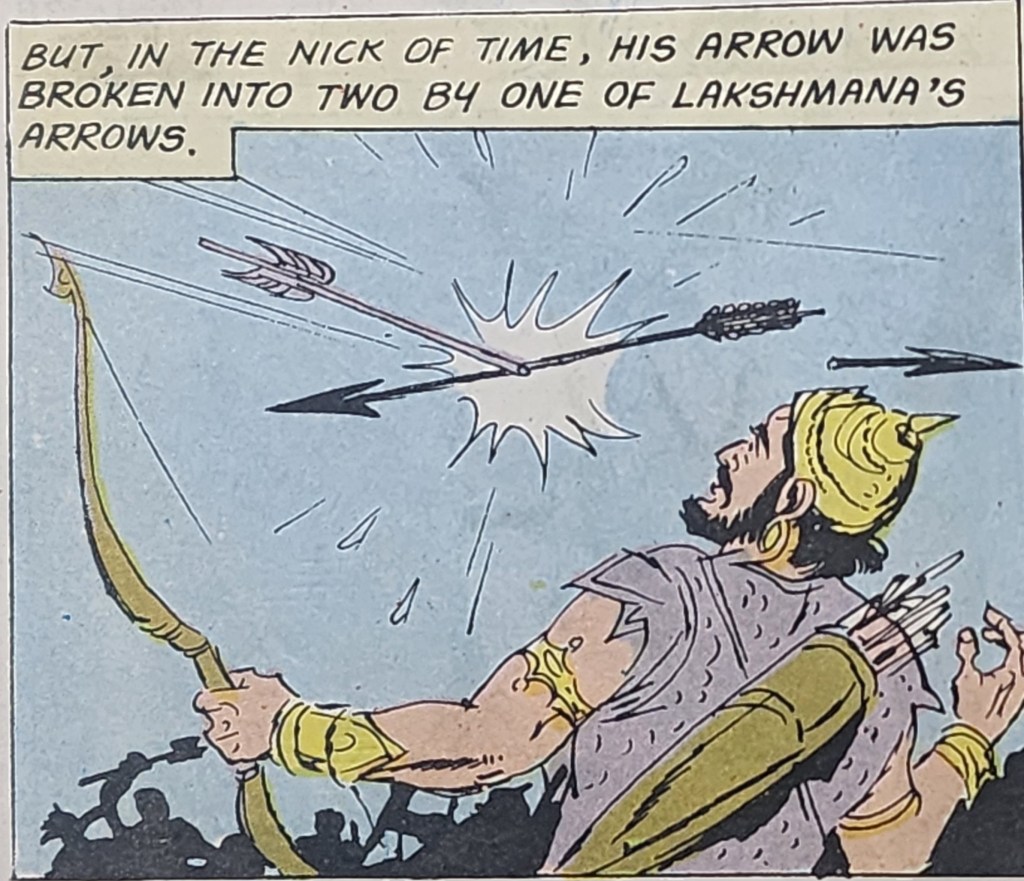
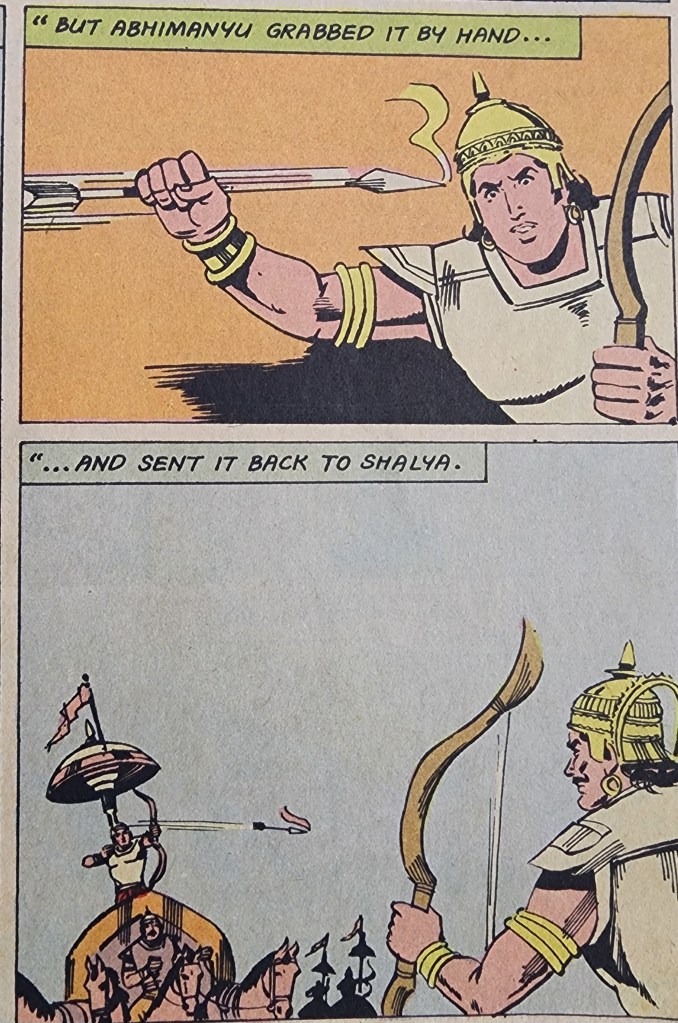
Now consider this event from the Ramayana. When Rāvana shot an arrow at Vibheeshana, Lakshmana shot that arrow out of the sky. This is an impressive feat of archery as well, intercepting a fast-moving arrow with another one. And this feat is seen over and over in our modern world. One just needs to look at the news these days and all one sees are missiles being intercepted other missiles.
Lakshmana’s arrow intercepting Rāvana’s arrow. Image credit – “Ramayana”, published by Amar Chitra Katha.
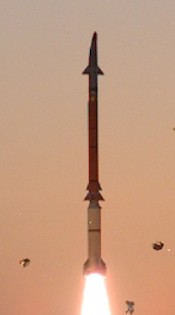
The ability to intercept incoming missiles, whether they are ballistic missiles, cruise missile, drones or drone swarms seems key to surviving modern day warfare. One of the missiles that comes close to replicating Lakshmana’s feat is likely the Stunner missile that is used by Israel as part of its David Sling air defence system. This missile also carries no warhead.
It uses a “kinetic warhead” to destroy the incoming threat, be it a rocket or aircraft or drone or cruise missile. “Kinetic warhead” means that the missile physically strikes the target it is supposed to destroy. In this sense, it is exactly like an archer shooting down an arrow.
Image of Stunner missile. Observe the unusual “Dolphin Nose” on the missile. Image credit – Wikipiedia.
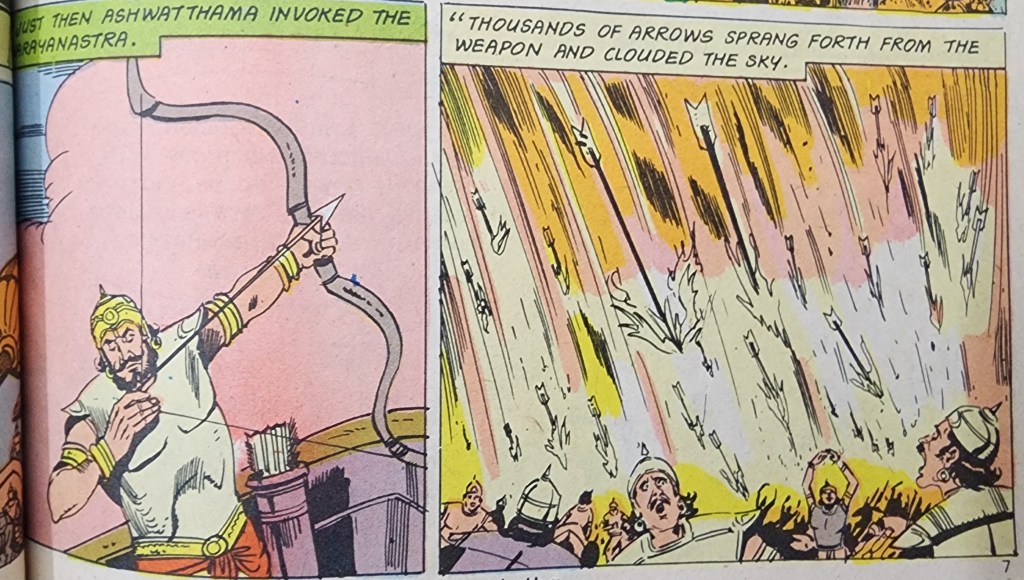
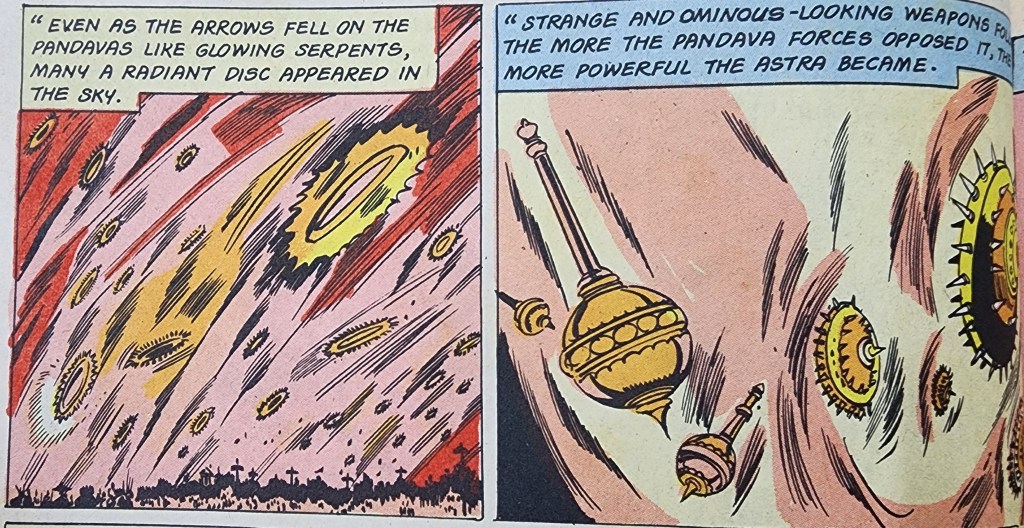
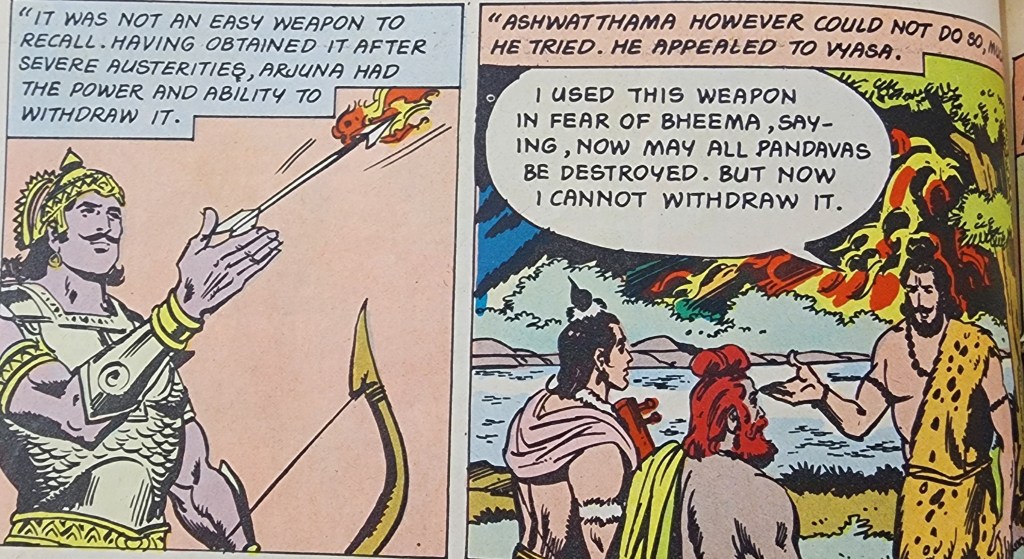
Now consider the use of the Narāyanāstra by Ashwatthama on the 15th day of the Kurukshetra War in the Mahabharata. The use of this celestial weapon causes weapons of all forms to rain down on the Pandava forces, including maces, chakras and flaming arrows. It is literally an inescapable rain of death from the sky. And this scary occurrence is something we see happening routinely in the wars being waged all around.
The above 2 images show the Nārayanāstra being invoked by Ashwatthama and the effects of the Astra. Credit for the images – “Mahabharata 37 – Karna in Command”, published by Amar Chitra Katha.
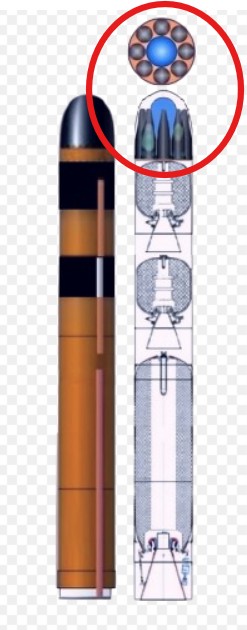
Ballistic missile these days have MIRV capability. MIRV stands for “Multiple Independent Re-entry Vehicle”. It means that each missile carries multiple warheads. This causes one missile to strike multiple targets! Again, a rain of destruction over a large area from the sky.
The above image shows the use of MIRV, where multiple warheads are present in the same missile. Image credit – Wikipedia.
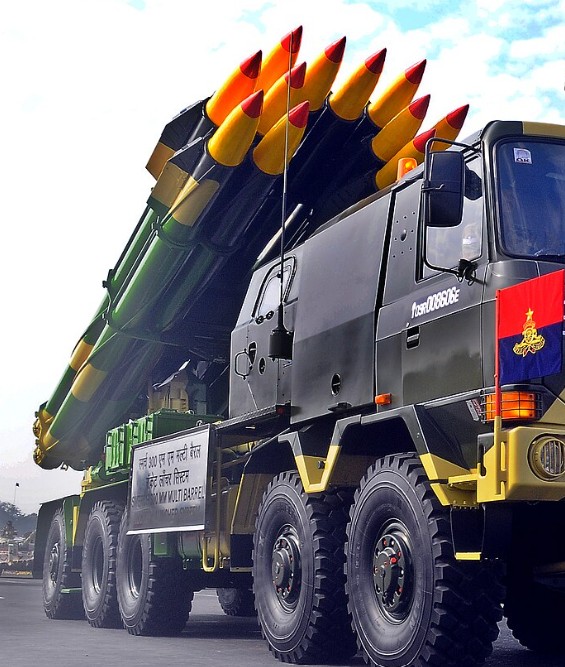
Even at a much lower technology level, this has been happening for decades. Consider rocket artillery. A barrage of rockets is fired at targets several kilometres away, to flatten the target area. The Indian version of this weapon is called “Pinaka”. Pinaka is the bow wielded by Lord Shiva, a weapon that can wreck incredible destruction.
The above image shows the Indian version of the Smerch multi-barrel rocket launcher. This is similar to the Pinaka system. Image credit – Wikipedia.
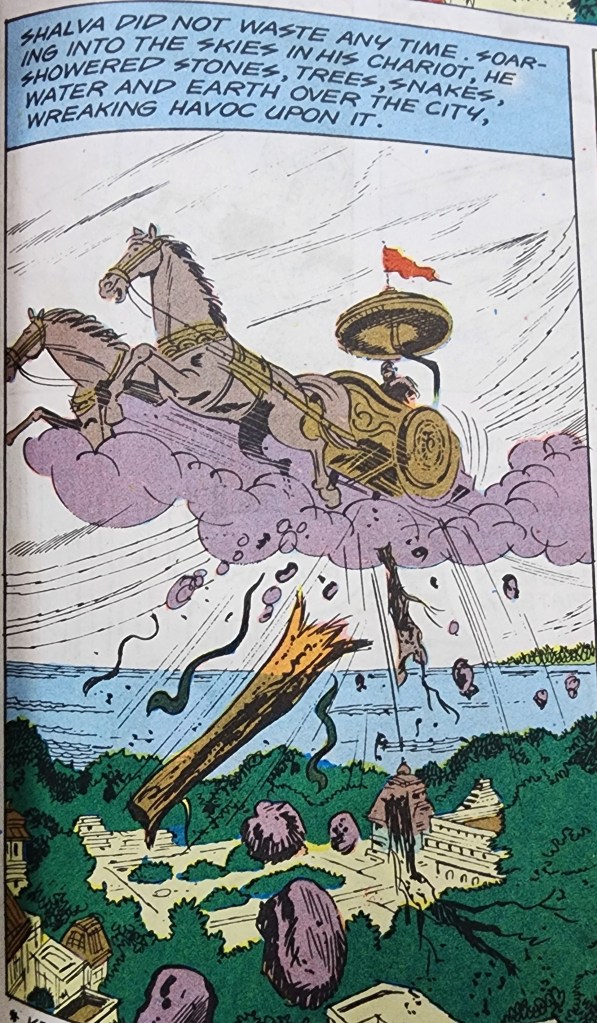
Consider the attack by King Sālva against the city of Dwaraka, the city of Lord Krishna. Sālva obtains a chariot that can fly as a boon. He uses it to carry out aerial attacks on the city. The ability to launch attacks from the air gives him a great advantage. He is safe, far away from the reach of the defenders of the city. This situation from the Hindu epic seems to have come true in the times we live in.
Sālva attacks Dwaraka with his flying chariot. Image credit – “Krishna and Rukmini”, published by Amar Chitra Katha.
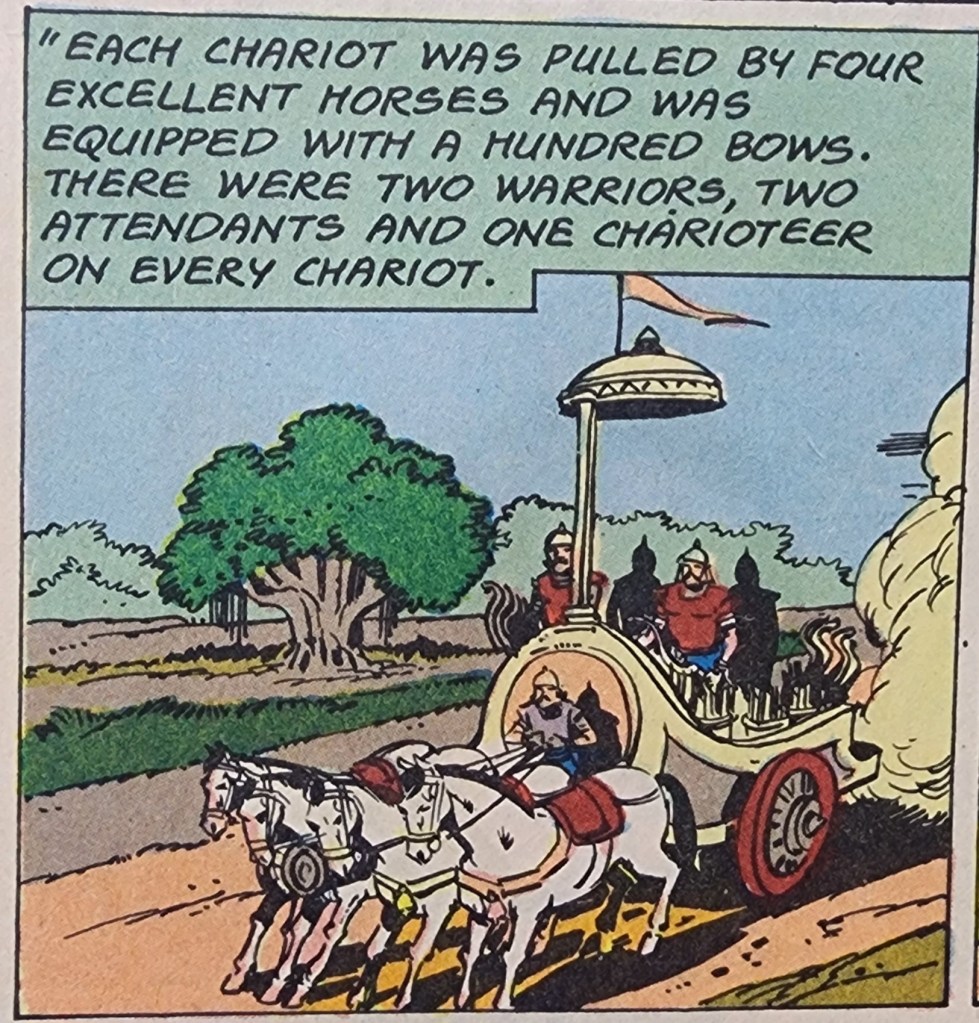
While we know that archers shot arrows in the past, the platforms that carried the archers to the place where they launched the attack were vitally important. In the past, the platform was the horse and even before that, it was the chariot. And modern-day aircraft are the equivalent of chariots of the past.
A chariot was a platform with a large store of weapons. Image credit – “Mahabharata 30 – The War Begins”, published by Amar Chitra Katha.
With the increasing range of beyond visual rage missiles and the development of stand-off range weapons, aircraft these days have become delivery platforms for weapons. They stay away from the target, away from any anti-aircraft defences the target might possess. And the range of missiles means that aircraft no longer need to get stuck in dogfights. So, the aircraft of today and perhaps of the near future will derive an advantage by being capable of having large payloads of weapons. Chariots of old carried a lot of weapons and in this aspect, modern aircraft are the concept of the chariot reach its current pinnacle.
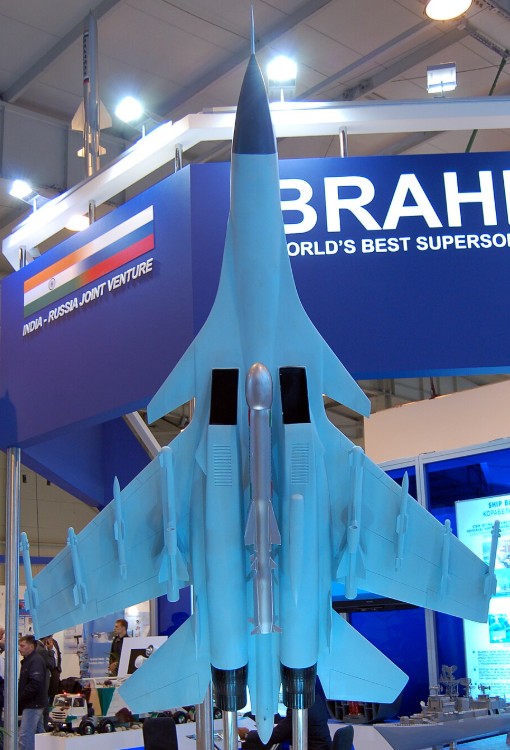
A modern Indian Su 30 MKI, with a large payload of weapons. Image credit – Wikipedia.
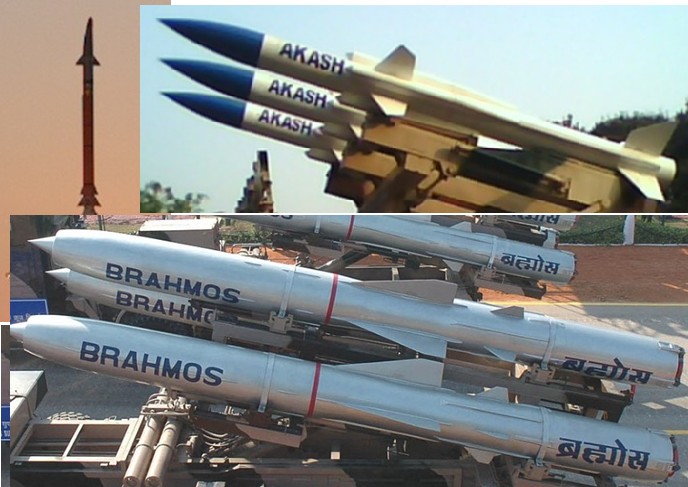
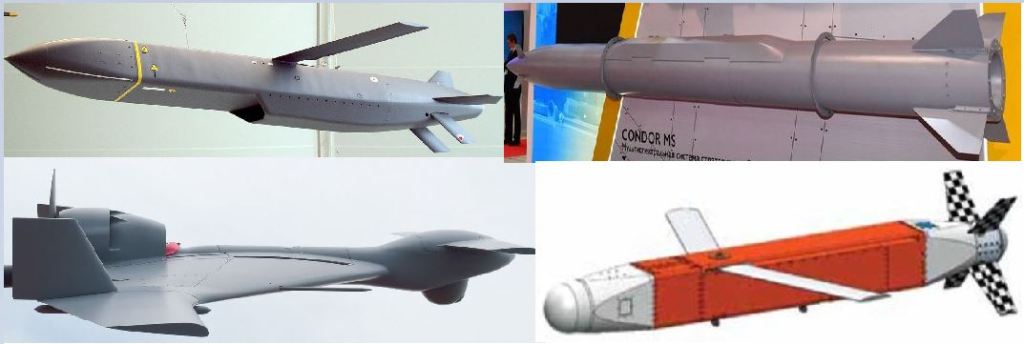
Let me return to the Stunner missile I mentioned earlier. Observe the tip of this missile. It does not have the usual tip that looks like a spear point, which is seen in many missiles. The Stunner missile has what is referred to as a “Dolphin Nose”. The nose of the missile has this unique design due to the sensors it supposedly uses to track and strike the incoming missiles it is targeting. Similarly observe the tip of the Brahmos missile developed by India & Russia. Its tip is different as well; due to the way its ramjet engine is utilized.
The above image shows the different types of nose cones of different missiles. Credit for all images – Wikipedia.
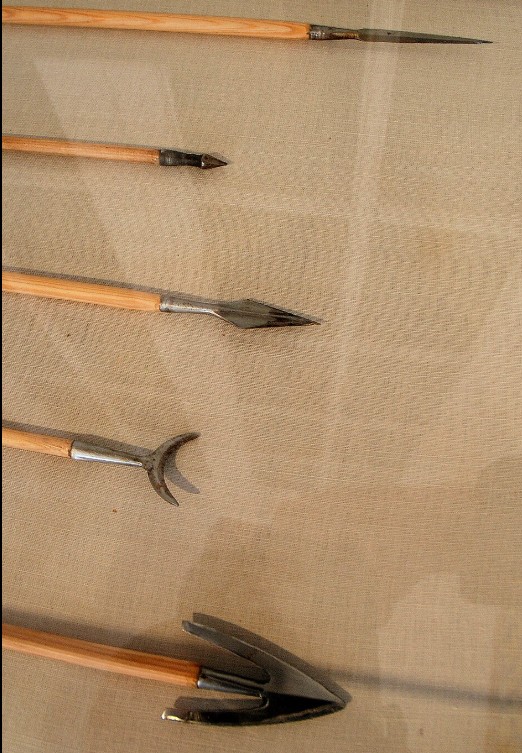
This is not unlike the past, where arrowheads of different types were used for different purposes. There were broad heads, bodkins, swallowtails, crescent shapes and these arrowhead types were used for different purposes. Bodkin heads were used for armour penetration, swallowtails for hunting and crescent shapes for hunting birds. If missiles are the gigantic arrows of the present, humankind is doing just what it did in the past.
Different arrowheads – the one at the bottom is a swallowtail, the one at the top is a bodkin, the above the swallowtail is a crescent and the one in the middle is a broadhead. Image credit – Wikipedia.
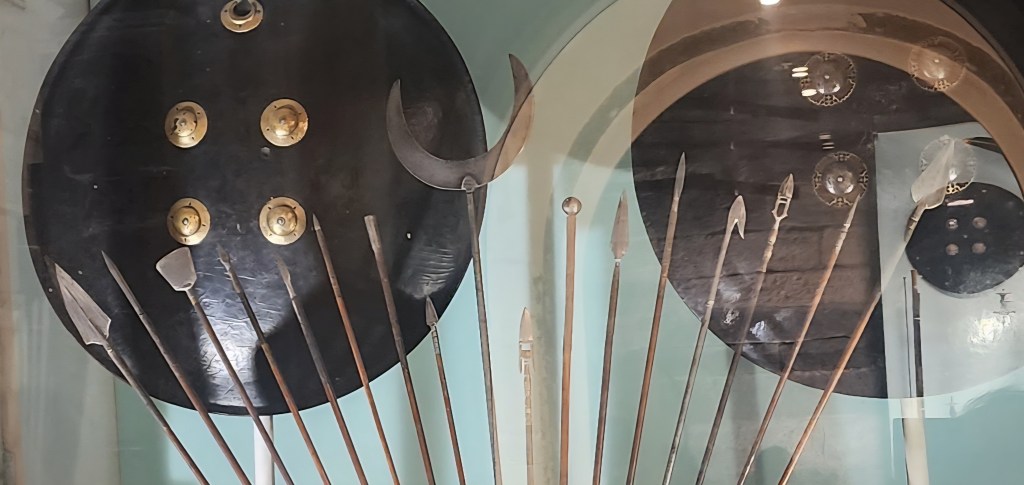
An assortment of arrowheads as used during the time Maharana Pratap, late 16th century CE. This is an image from the museum at the City Palace, Udaipur, Rajashtan.
Today’s missiles have a measure of accuracy called CEP (circular error probable), which is measured in mere metres. This is the measure of the radius within which 50% of the fired missiles will strike. If the target is the centre of the circle with the defined radius, the smaller the radius, the more accurate the missile. Cruise missiles tend to be more accurate compared to Ballistic missiles.
The accuracy of some missiles is such that they can strike individuals standing on a balcony to avoid collateral damage! This is what happened in the initial example I had shared, with the “Ninja Missile”. This also a culmination in modern times of a skillset always cherished by humanity, that of accuracy.
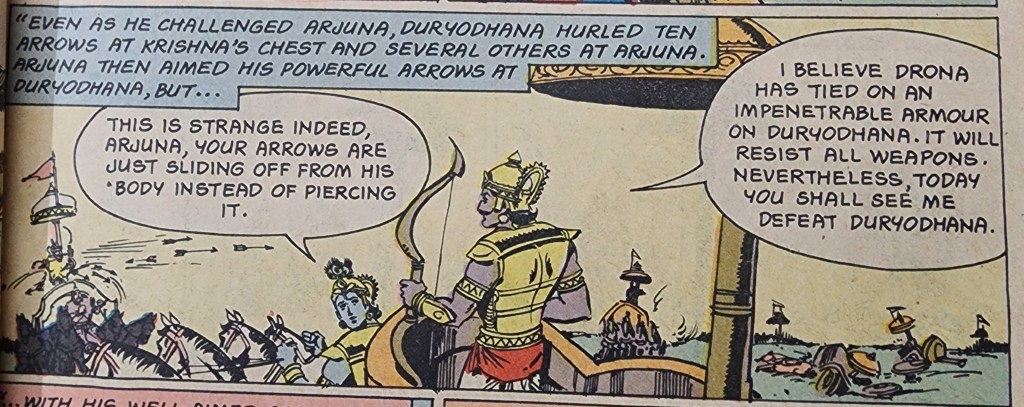
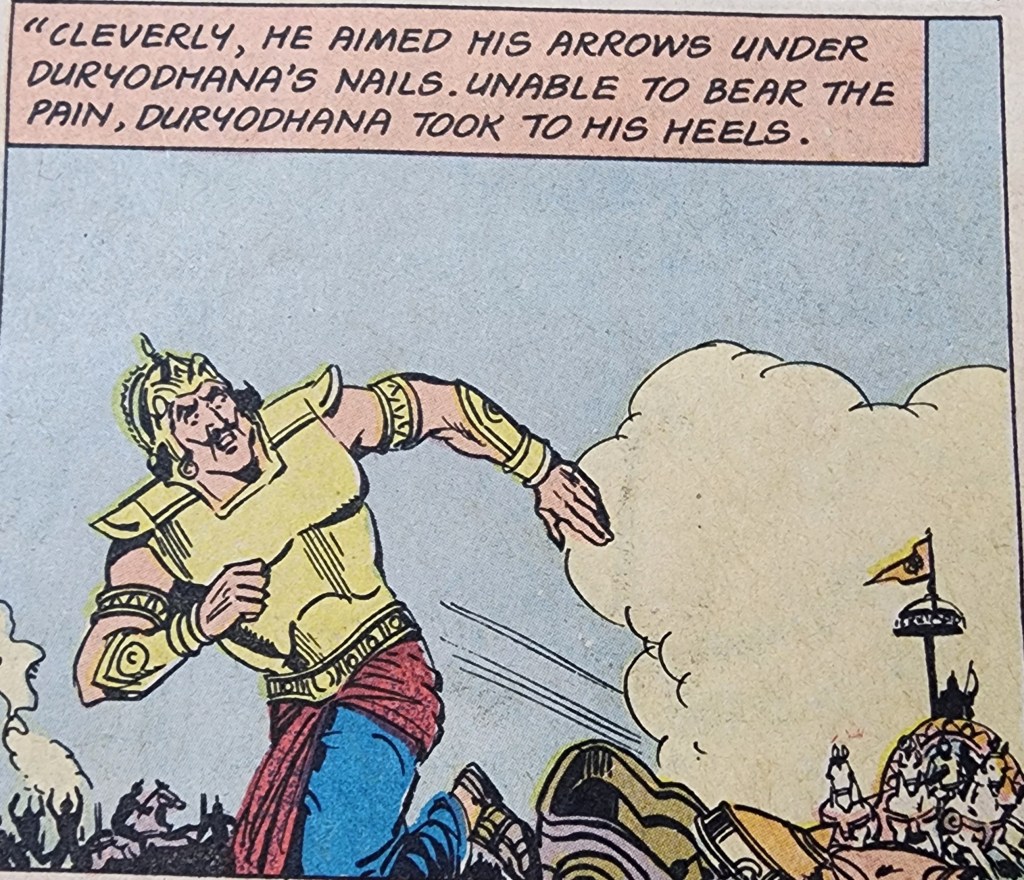
An example of this is again seen in the Kurukshetra War of the Mahabharata. Duryodhana dons an impenetrable armour given to him by Drona. So, Arjuna targets Duryodhana’s fingernails as they are not protected by the same armour! Imagine striking targets as small as an opponent’s fingernails from a moving chariot, who is also on a moving chariot! The skill of the archer would be a marvel to this day! And modern missiles can achieve something equivalent, that is an even greater wonder!
The above 2 images depict Arjuna targeting Duryodhana’s fingernails. Image credit – “Mahabharata 33 – Drona’s Vow”, published by Amar Chitra Katha.
For decades now, a lot of us Indians, born in the 20th century, have been used to a specific representation of archers fighting each other due to what was shown on TV and even on the big screen. In the mid-80s the Ramayana was telecast on Doordarshan (India’s state broadcaster) during prime time. It was supremely successful and defined fantasy combat using bows and arrows for multiple generations. The visual effects were very poor by today’s standards, but back then the joy it generated is indescribable.
In that serial and many others televising stories from Hindy culture, archery was always shown one on one. Almost all the time, these archers would use “Divyāstras”, which are celestial weapons. Sometimes these weapons, in the form of arrows, appear on the utterance of a mantra. At other times, an archer utters a mantra, which invokes the divine weapon onto the arrow that he or she is about to shoot.
Once the celestial weapon has been invoked and shot as an arrow, the opposing archer would invoke a counter astra, to overcome the effect of the astra coming at him or her. The two arrows fly through the air or space and face off against each other, when one arrow is defeated, signifying a loss for the archer who shot the same. This would continue until one archer was killed.
The above 2 videos are from the old Ramayana TV serial from the mid-80s. This clarifies what I was trying to describe in the previous paragraphs.
This was fantasy back in the day, but modern combat seems remarkably similar to what was depicted in old TV serials! Modern combat seems to be all about missiles and drones targeting locations on the ground while trying to survive other missiles or drones launched to destroy the same. It is missile vs missile, missile vs gunfire, drone vs missile, drone vs drone and drone vs gun.
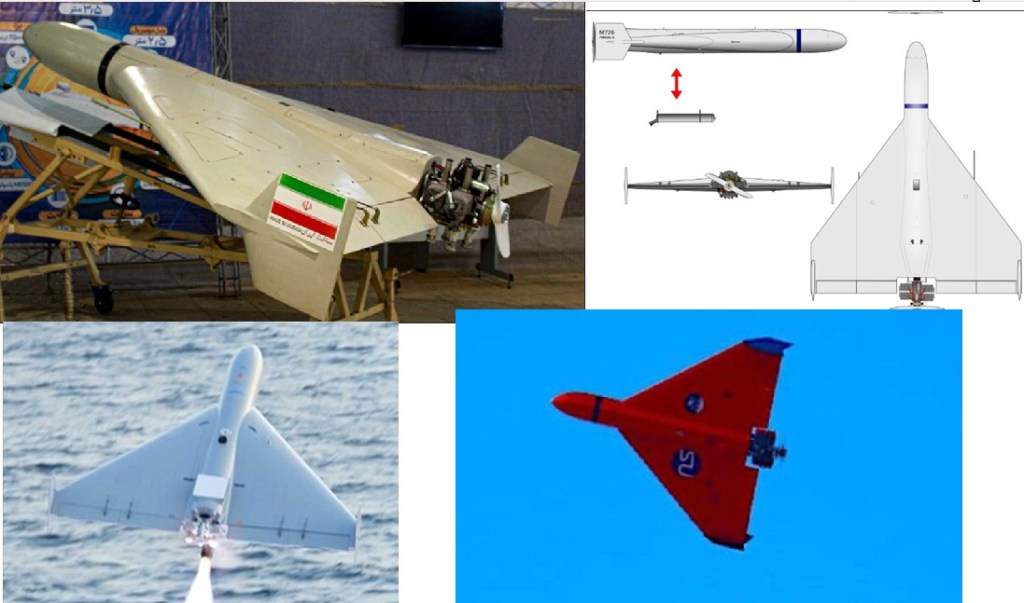
Of course, there are other methods like electromagnetic pulses that are used to take down drones and drone swarms, which are called “soft kill” options. As I have been mentioning all along, drones and missiles are the arrows of today, and when they fight each other, it is exactly like the arrows facing off in old tele serials!
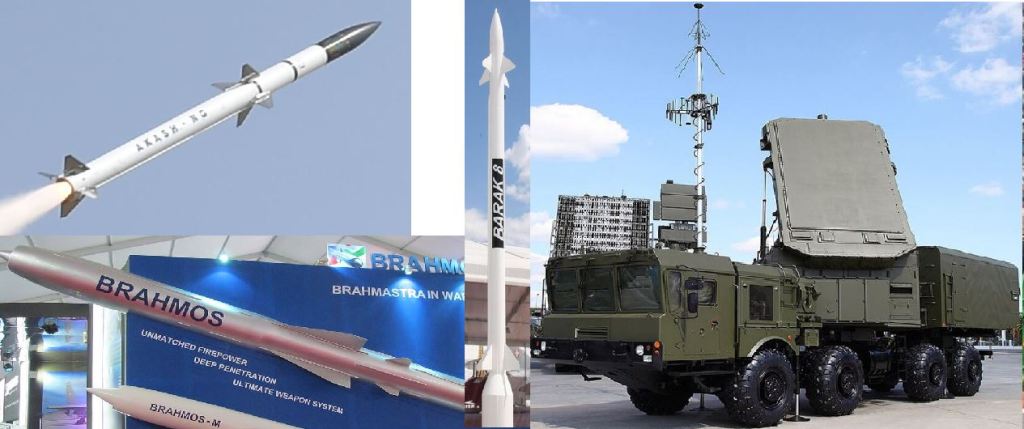
Examples of this are seen everyday on TV in the war currently being waged all over West Asia. Missiles and drones are being shot down everyday with other missiles, guns, lasers (!) and other methods. These defences are being overcome with the sheer number of drones in specific instances. In an Indian context, in May 2025, India defeated Pakistani attempts to attack India with missiles and swarms of drones during Operation Sindoor. India shot down a Fatah 2 missile with an MRSAM (medium range surface to air missile) and took down over a thousand drones over 3 nights with guns, missiles, jamming devices and other soft kill options.
On the 12th day of the Kurukshetra war, Abhimanyu, the son of Arjuna, is fighting Shalya, the king of Madra. During the fight, Abhimanyu catches an arrow shot at him by Shalya with his bare hands and then shoots the arrow back at Shalya, to great effect! This has still not happened. We do not have giant Mecha that can “catch a flying missile” and redirect it at the point of launch. But there is an interesting parallel to this situation in modern warfare.
Abhimanyu captures Shalya’s missile and sends it back at him. Image credit – “Mahabharata 33 – Drona’s Vow”, published by Amar Chitra Katha.
During Operation Sindoor, Pakistan launched several PL15E missiles at Indian aircraft. Most or all of these were rendered useless by the defensive abilities of Indian aircraft, including electronic countermeasures. Some of these PL15E missiles were retrieved from the ground in a largely intact condition. This recovery meant that India could study these missiles and refine counter measures to the PL family if missiles used by China. The parameters of the missiles like the radar it used, its fuel, its electronics would be valuable data to use in a future conflict. I think the term many in the defence circles use is acquisition of electronic signatures and adding to threat libraries to counter future threats with the capture of these missiles.
I will add an aside here. India’s primary family of beyond visual range (BVR) air to air missiles is the “Astra” family of missiles. The Astra Mk1 is operational. Astra Mk2 is about a year away becoming operational. Astra Mk3 has been renamed Gandiva and is under development. The Gandiva is an Indian equivalent of the European Meteor, being a Solid Ducted Fuel Ramjet (SFDR) driven missile.
A few months ago, it was revealed that the range of both the Astra Mk1 and Mk2 have been improved significantly. After this revelation it was mentioned by some on social media that this range extension was due to the data gathered by studying the captured Chinese missile! Apparently, a fuel called CL20 was used in the PL15E, which was replicated by Indian defence research agencies and using this new fuel helped increase the range of the fuel.
Adi Achint, the host of this channel has quite astute observations on many aspects military and geopolitical. This seems like a rare misstep (in my personal opinion), where it is mentioned that the captured Chinese missile led to the improvement in the Indian missile.
The story was later mentioned as being flawed. The range improvement was indeed due to an improved fuel for the Astra missile, with a better Octane Rating. But this improvement was a completely indigenous achievement. It had nothing to do with the data from the downed Chinese missile.
This video explains that the improvement in the Indian missile was entirely due to the efforts of Indian Defence Research Agencies.
Another example of “capturing a missile and sending it back”, in my opinion, is with the Shahed 136 drone developed by Iran. The Shahed 136 drone is a low-cost attack (kamikaze) drone with a turbo prop engine developed by Iran. The low cost meant that it could be produced in very large numbers. Russia imported these drones for use in its war with Ukraine. Russia called this drone, “Geran”. Russia made its own improvements to the “Geran family” of drones, including adding a turbojet engine.
After the Iran-Israel conflict that occurred during Operation Rising Lion in July 2025, a few Shahed drones were acquired by the USA. The USA produced its own version of the Shahed design, called “Lucas”. Now, India has produced a drone with its own improvements, including swarming capability, based on the design of the Shahed. India’s version is called the “Sheshnaag 150”. This is a classic version of “capturing a missile and sending it back”. Everyone now seems to have a variant of the Shahed drone which they can use against each other!
The above images shows the Iranian Shahed 136 (Top Left), The Russian Geran 2 (Top Right), the US LUCAS (Bottom Left) and the Indian Sheshnaag 150 (Bottom Right). Image credit for all images except that of the Sheeshnaag 150 – Wikipedia. Image credit for the Sheshnaag 150 image – NDTV.
If one reads the graphic novel rendition of the Mahabharata published Amar Chitra Katha over 42 issues, it will be evident that the greatest warriors are the ones who fight mostly from chariots or sometimes from elephant back. Warriors who fight from chariots even had a classification system to determine how great a warrior was (Rathi, Atirathi and Maharathi). One of the most commonly used methods to disable these great warriors was to destroy their weapons or chariots.
The bow of an opponent being targeted. Image credit – “Mahabharata 31 – Bheeshma in Command”, published by Amar Chitra Katha.
Perhaps it was difficult to defeat the warrior. So, their bows, shields and chariots were targeted. A warrior without a bow to shoot arrows from diminishes as a threat except in close quarters. In a chariot, the charioteer and horses were prime targets to disable the mobility of a warrior. Barring these 2, the wheels of a chariot were targets. All of this again, helps diminish the threat of a warrior by affecting his or her mobility.
The chariot was a prime target. Image credit – “Mahabharata 31 – Bheeshma in Command”, published by Amar Chitra Katha.
This seems remarkably similar to targeting missile launchers and weapons stores to weaken enemy nations. Similarly, aircraft and runways are targeted to take air power off the board in a war. Further command centres are targeted to eliminate leadership and trained personnel who can coordinate a war. All of this significantly reduces the ability of a defence force to be a threat.
This is true for defensive system as well. An air defence system like the S-400 Triumf, Akash or the HQ16 consists of mobile units which shift their position after firing at enemy assets in the air. This is to survive any attack from other aircraft that might attack that position after the coordinates of the threat are identified and relayed back. This mobility is, if I am not wrong is called “shoot and scoot”.
The defensive formations possess multiple radars operating at different frequencies. These radar waves can be detected and hence reveal the location of the air defence units. Anti-radiation missiles that lock onto the source of the radar waves are used to target these radars.
Even loitering munitions that stay in the air just waiting for a radar to be turned on are used to target air defence units. The moment a radar comes on, the loitering munition, which is nothing but a suicide (kamikaze) drone attacks the radar and blinds the air defence system. It also creates a hole in the overall air defence web that can be exploited by enemies.
In a slightly twisted manner, there is something vaguely similar to a loitering munition in the Mahabharata. After Arjuna slays Jayadratha in the evening of the 14th day of the Kurukshetra war, he cannot allow the severed head of Jayadratha to fall on the ground. Jayadratha has a boon of protection from his father, due to which, anyone who causes the lifeless head of his son to fall on the ground will have his or her own head explode!
Jayadratha’s father is mediating far away from the battlefield. So, Arjuna has to keep shooting arrows into the head to make it travel all the way to where Jayadratha’s father is sitting in meditation and make the severed head fall into the lap of the father. When the shocked father stands up, the head falls onto the ground and his own head explodes! This is because the father was responsible for his own son’s lifeless head to fall to the ground, as it fell from his lap. So, with a lot of hand waving, the head could be a loitering munition, for it was in the air until it found its target, which was Jayadratha’s father!
Arjuna ensures that Jayadratha’s head lands on the lap of his father, by keeping the head flying for a while. Image credit – “”Mahabharata 35 – Arjuna fulfills his vow”, published by Amar Chitra Katha.
One thing that loitering munitions and swarms of drones cannot destroy are assets and people protected in hardened shelters and buried in bunkers underground. To reach and destroy these assets, bunker buster bombs and missiles with penetrative tips are required. This again is not unlike developing arrows that can penetrate armour. Modern bunkers are like protective armour on steroids.
Armour penetration is the reason bodkin tipped arrows were developed, for normal broad heads could not penetrate many forms of armour used in the past. This was a problem that was confronted all through history. In medieval Indian history there is a popular example of the use of a javelin to great effect.
Amar Singh, the son of Maharana Pratap, hurled a javelin with such force that it went right through an armoured Sultan Khan and his horse! Sultan Khan was the leader of the Mughal forces during the battle of Dewair in 1582, which Maharana Pratap won and retook most of Mewar from the Mughals.
A painting depicting Sultan Khan being impaled by Amar Singh at the Battle of Dewair in 1582. Photo of the painting a the Pratap Vijay Memorial in Dewair, Rajasthan.
On the other hand, a drone swarm is like a rain of arrows. This was a technique used in history by many cultures. The English used massed archers to great effect against the French at the Battles of Crecy and Agincourt. Here, armoured knights were protected from the arrows, but their horses were not, and the volume of arrows caused severe problems in mobility on a sodden battlefield.
In Indian history, in 1192, during the 2nd Battle of Tarain, the armies of Prithviraj Chauhan could not contend with the “Parthian Shot” used by the cavalry of Mohammad of Ghor. The “Parthian Shot” is a circular formation used by Turkic armies to pepper enemy armies with arrows to prevent them from getting into close quarter combat.
The legionnaires of Rome used the turtle (testudo) formation to protect themselves from arrows of enemy archers as they closed the distance. The turtle formation involved soldiers building a protective enclosure for themselves using their own shields. So, a swarm of arrows or any projectile was always a known threat to armies and their assets. Modern armed forces use multiple innovations to protect themselves from modern rains of arrows, which are drone swarms.
A reenactment of the Testudo formation. Image credit – Wikipedia.
Tanks have, since the Ukraine war started in early 2022, evolved to have “Cope Cages”. These are metal grills added on to the top of tanks. This innovation has come about because drones started attacking the top of tanks, where their armour is the weakest. This metal grill acts as a net to stop the drone or the ordinance it drops from impacting the tank directly.
Apart from this, defence against drones and drone swarms has evolved rapidly into many forms. There are the usual interceptor missiles. These days there are also lasers that take down drones and missiles as well. And then there are the soft kill options like jamming a drone or a swarm that knocks them all out of the sky. A fantastic example of jamming a drone swarm is by another drone!
The Raytheon Coyote Block 3 drone uses a High-Power Microwave emitter to jam drone swarms. It flies past a swarm and knocks them all to the ground! The short video linked below demonstrates the same. Interestingly one of the systems India will soon use against drone swarms is named after a person from Hindu tradition. The system is called the “Bhargavastra”.
This video shows the Raytheon Coyote Block 3 drone in action.
The Bhargavāstra is a celestial weapon deployed by Karna during the Kurukshetra War. It caused a lot of damage to the Pandava forces. It was a weapon created by Karna’s guru, Lord Parashurāma. Parashurāma is descended for Maharishi Bhrigu, which makes him a Bhārgava, hence the weapon he created was called the “Bhargavāstra”.
One of the multiple options that the modern Bhargavastra will use to take down drones is a set of “micro missiles”. These are supposedly missiles that will explode in close proximity to a drone swarm. This explosion will create a cloud/curtain of shrapnel perpendicular to the direction of flight of the missiles. The drone swarm will have to fly through this barrier of shrapnel, which will shred the drones! The micro missiles used here seem to use a proximity fuse which results in their exploding before close to the swarm.
The above video from the channel “Alpha Defense” describes the working of the Bhargavastra.
I must mention a pop-culture reference here, from the book and TV series, “The Expanse”. In the series, large spaceships fight each other. All of these ships possess several “Point Defence Cannons” (PDCs). These are gatling guns that fire tungsten bullets to take down incoming missiles. Most of these rounds do not strike any target and keep flying through space without slowing down, as there is no friction in the vast emptiness.
In book 6 of the series, “Babylon’s Ashes”, the main character Naomi Nagata carries out a fantastic maneuver. She fires off lots of PDC rounds into space. Then she makes an enemy ship fly into the swarm of tungsten bullets by some interesting tactics! It is fantastic to read this sequence. This entire solution seems very reminiscent of what the Bhargavastra will do to drone swarms.
The cover of Book 6 of The Expanse novel series, titled “Babylon’s Ashes”. Image credit – Wikipedia.
Considering that drones are preferred these days due to their low cost and low technological input, there seems to be another parallel from history for this. Drones can affect all manner of assets and human lives, and can be manufactured in very large numbers by organizations that do not have large quantities of resources like money, manpower and technology. This makes them the weapon of choice in all manner of modern conflicts including asymmetric ones.
During the 2nd and 3rd centuries CE, the Chinese developed the repeating crossbow. This weapon was smaller and had a shorter ranger than conventional crossbows. But they made up for this deficiency with a larger rate of fire. A large number of small bolts could be fired even by a soldier without too much training. This weapon was supposedly used to defend specific points like gateways and ships. This is like a modern-day machine gun perhaps, but with arrows/bolts instead of bullets. These days drones are becoming bullets, with a focus on low cost, low manufacturing time and a requirement in very large numbers.
The one thing that has remained constant is the development of technology over many millennia. This continuous development has literally made the concepts in stories from Hindu culture come alive in current times. Projectile weapons went from sharpened sticks to sticks with flint points. The atlatl was invented to increase the range of the javelin.
The invention of bows and arrows increased range further. Archery technology never ceased to stop improving, from optimized wood to composite bows (which needs the right glue, right sinew etc.) to variation is arrowheads and fletching. Even channels (called nalika in India) to shoot arrows that shorter than the draw length of a bow were developed!
The above video is a fantastic exploration of historical Indian archery, from the channel “Sangam Talks”. The “nalika” is seen between the 31 and 32 minute mark.
With the domestication of horses came chariots and these, over time, gave way to just cavalry, with the invention of the saddle and stirrup. Cavalry stayed a constant in warfare until the First World War! Projectiles became musket balls and then bullets and now we are back to the age of projectiles, just scaled up from the past exponentially!
The range and precision of the new missiles have been made possible by an increase in intelligence and communication technology! Network centric warfare and an ability of countries with low earth observing satellites added to electronic and human intelligence have made every missile as deadly as the Divyāstras from the tales!
The aircraft or launcher that fires the missile no longer needs to be guided from the point of launch. Other radars and satellites can guide them along to targets that move constantly! And drones can return to base to be reused if the target is not available! This is exactly like withdrawing an astra for later use! Like Arjuna did and Ashwatthama did not, at the very end of the Kurukshetra war!
Arjuna can withdraw the weapon, but not Ashwatthama. Image credit – “Mahabharata 39 – After the war”, published by Amar Chitra Katha.
The ability to know everything that is happening on any given battlefield even allows today’s battle management systems which are laced with AI, to match the ideal weapon for a given target! This level of knowledge is reminiscent of Sanjay’s Divyadrishti during the Kurukshetra War! He could see and hear everything that happened on all parts of the battlefield while being far away, thanks of course to divine abilities. This ability lasted him only for the duration of the war and for purposes of narrating the happenings to Dhritarashtra, not to actually fight.
Sanjaya can see and hear everything happening far away, thanks to his temporary “Divyadrishti”! Image credit – “Mahabharata 30 – The War Begins”, published by Amar Chitra Katha.
In conclusion, we seem to have truly entered the age of Divyāstras! The celestial weapons and abilities described in the Mahabharata, Ramayana and other stories might be fictional, but certainly suggest that these weapons and abilities were aspirational for humans since times immemorial. We have always wanted to achieve the destruction these weapons are said to be capable of. And now, with human ingenuity, and centuries of technological development, these aspirations of destruction have become real.
February 17th is the Chinese New Year. This year is the year of the Horse, specifically, the Fire Horse. A search on the internet will reveal several pages and AI responses that mention several traits and attributes that a Horse, and more specifically a “Fire Horse” represents. But as a Hindu and a martial artist, the things that come to my mind when I think of a Horse as a symbol, are Knowledge and Martial culture.
When I think of a horse as an animal, things like speed, grace, strength, symbiosis come to mind, apart from history and, wait for it… confusion. Speed is of course synonymous with horses due to their ability to run over long distances. Modern horses, thanks to selective breeding practices, can be pretty large and therefore remind us of strength – think Shire Horses! Anyone who has watched any dressage or equestrian event will tend to agree that the gait of a horse is grace personified.
Horses have worked with humans for many millennia now and we have grown up on a staple of historical epic films and books showing horses and humans bond and participate in war and overcome travails – thus Symbiosis and History. Confusion is a trait specific to horses in Indian history I suppose. 😊There is a debate about when the horse was first present in India and if it was present during the Harappan civilization.
Now, when I think of the Horse as a symbol, the first thing that comes to mind is Lord Hayagreeva (sometimes spelled Hayagriva). “Hayagreeva” means “with the head of a horse”. Lord Hayagreeva is an avatāra of Lord Vishnu who is depicted with the head of a horse. Lord Hayagreeva, based on what I know, is always linked to Knowledge.
An image of Lord Hayagreeva. I unfortunately do not know who the artist of this image is.
This avatāra is not one of the well know Dashāvatāra. But Hayagreeva seems to be closely linked to the Matsya avatāra, which is the very first avatāra. The Matsya avatāra is the one when Lord Vishnu incarnated as a fish to save King Manu from the great flood at the end of a Kalpa. Some other important people, flora and fauna needed for the revival of civilization after the flood were also saved. This story is similar to other flood myths around the world.
The Fish imparted knowledge to the Rishis who were saved along with Manu so that they could use it in reestablishing civilization once the flood subsided. I have heard it said that this exchange of knowledge also became the origin of the Matsya Purana. Now there are 2 Hayagreevas I know of from the stories related to Age of the Flood.
One is a an Asura named Hayagreeva, who also has the head of a horse. Hence, he can be referred to as Hayagreevāsura. The great flood was the time when Lord Brahma was resting before beginning the work of creating the new world after the flood. As he was resting, Lord Brahma yawned, and when he did so, the Vedas escaped his being. The watching Asura captured the escaped Vedas and hid himself in the waters.
The Asura Hayagreeva. Image credit – “Dasha Avatar”, Kindle edition, published by Amar Chitra Katha.
The Vedas represent knowledge and wisdom. These are invaluable and can cause havoc in the wrong hands. The Matsya that saves King Manu also kills Hayagreevāsura, ensuring that the Vedas are safe. This is one case where Vedas, or Knowledge, are associated with the Horse.
In another story, Lord Vishnu is in Yoganidra, the rest between epochs, during the time of the great flood. Two Asuras, Madhu and Kaitabha are born from his ear wax. There is a variation of this story where the 2 Asuras are created by Vishnu himself from a drop of water each. This is a callback to the fact that there is water everywhere at this time.
The Asura Madhu represents Tamas or darkness, supposed to be inertia that resists change. Kaitabha represents Rajas, the state of activity that represents restlessness tinged with darkness. These 2 Asuras gain a boon that they can only be killed when they so choose. With this protection, they go on to steal the Vedas and hide in the flood waters.
Lord Vishnu then takes the form of Lord Hayagreeva, the one with the head of a Horse to retrieve the Vedas. Even Lord Hayagreeva cannot defeat the Asuras due to the protection from their boon. In one story it is said that Lord Hayagreeva takes advice from the Devi, the original female deity on how to defeat the Asuras. Lord Hayagreeva praises the Asuras saying they are so great they even he cannot defeat them and hence would like to offer them another boon in appreciation.
But the prideful Asuras decline the offer and state that they would like to offer Hayagreeva a boon of their own. Using this opportunity, Lord Hayagreeva asks them Asuras how they can be slain. The Asuras are trapped and reveal that they can only be killed in a place where there is no water. This seems impossible to them since it was the time of the Great Flood and there was water everywhere.
But Lord Hayagreeva grows to a large size, lifts his leg out of the water, places the 2 Asuras on his thigh which is dry, and kills them. Thus, the Vedas are saved. In this story, it is again clear that the flood waters are a key component. Also, Lord Hayagreeva uses intelligence to defeat the Asuras. He tricks them to their doom, as physical effort alone will not suffice. Thus, the Horse (Hayagreeva) is again associated with Knowledge (Vedas), intelligence (get the enemy to reveal their weakness) and wisdom (ask for advice when actions are not working).
Seen above is a video from the YouTube channel, “Project Shivoham”. This video shares a lot of information about Lord Hayagreeva. There are several other videos on this channel which are very informative.
It must be noted that while knowledge is a key aspect, physical action is also vitally important in the two stories above; the Asuras have to be physically fought and defeated, there is no magic to circumvent that. And this point brings us to the other, very popular reference to the Horse in Hindu culture, that of the Ashwamedha Yajna.
The Ashwamedaha Yajna is translated as “Horse Sacrifice”, but this seems simplistic. It is an activity that kings could use to expand territory and establish their superiority over other kingdoms. This Yajna was also a major economic activity! It involved having an excellent administration, supply chain, economy and military in place.
A large starting capital was needed to even consider the Ashwamedha. A military was needed to follow and protect the horse. A supply chain was needed to equip the military and conduct the Yajna. To manage the supply chain, an efficient administration was inevitable. So, the Ashwamedha Yajna, was a culmination of all civilizational activities! Which are the consequence of the Vedas that Matsya and Hayagreeva fought to protect!
Thus, the Horse (the Ashwa in Ashwamedha) is again associated with major civilizational activity, the centrepiece of which is war! And war is decidedly a martial activity, making the Horse reminiscent of the martial arts in Hindu culture.
An image representing the Ashwamedha Yajna. Image credit – “Sons of Rama”, published by Amar Chitra Katha.
The Ashwameda Yajna is part of the last segments of both the Ramayana and the Mahabharata. If we go back to a time before the 2 Itihāsās (Ramayana and Mahabharata), there are a couple more references to the horse that ties it to the idea of knowledge and wisdom. These relate to the Rishi Dadichi and the Ashwini Devatas.
Rishi Dadichi is referred to as one with the “head of a horse”, or “Ashwashira” (Ashwa – horse, shira – head). This is supposed to be because he taught the Ashwini Devatas some secret knowledge. The association with knowledge and the horse is stark once again!
There is a one story where Indra, King of the Devas had decreed that anyone who passes on this knowledge will have their head explode. The Ashwini Devatas, wanted to learn this knowledge and Dadichi was the only one who was willing to risk Indra’s wrath. So, the Ashwins replaced Dadichi’s head with that of a horse. Once the knowledge was transmitted, his head exploded as per the decree.
But the head that exploded was that of the horse. The Ashwins, then attached the original head of the Rishi and Dadichi was brought back to life. This again shows the link between the horse, knowledge and sacrifice (like in the Ashwamedha Yajna, where the horse is sacrificed), which is a vital part of martial endeavours. In modern times, time, effort, money and other resources are expended in pursuit of the martial arts. In ancient times, all of these were still true, but more importantly, life and limb were on the line as well!
An image of a horse-headed Rishi Dadichi.Image credit – “Indra and Vritra”, Kindle edition, published by Amar Chitra Katha.
The Ashwini Devatas were twin Devas. They are considered the physicians/doctors of the Devas. This is why they were the ones that could replace the head of Rishi Dadichi with that of a horse and back. These twins, also referred to as “the Ashwins” were also historically associated with horses. I have heard it said that the “Ash” in the “Ashwins” is related to “Ash-wa”, which is the word for horse in Sanskrit, though I am not certain of this.
There is also a story from the Vedas, where the Ashwins device a prosthetic leg for Vishpala. Vishpala is generally considered a great female warrior, but there are some who say that Vishpala was a horse. Either way, they are supposed to have created a prosthetic leg all those millennia ago! And the reference is back again! 😊All of this adds to the fact that the Ashwins were indeed doctors. Doctors possess medical “knowledge” and the skills to save lives.
There is also a story where an individual on a voyage prays to the Ashwins when his ship sinks. The divine twins save his life and he returns home. Based on this story I had thought that the Ashwins were also the Gods of voyages. But the internet tells me that the Ashwins were more the deities associated with “a safe return home”! This does make sense, at least to me. The Ashwins were doctors and thus life savers, which dovetails nicely into “returning home safely”. The Ashwins, always associated with horses, possess the knowledge to save lives and get one home safely.
One last reference to horses that comes to mind from Hindu culture, considering that it is the year of the “Fire Horse” is that of Lord Surya, the Sun God. Lord Surya. Lord Surya is supposed to traverse the sky over the course of every day in a chariot. This chariot is drawn by 7 horses. These horses, drawing the fiery Lord that is the Sun, would represent the Fire Horse!
The charioteer of Lord Surya is Aruna, who is the brother of Garuda. Garuda is in turn the vāhana of Lord Vishnu. Vāhana can be translated as “vehicle” or “mount”. And we are back full circle to Lord Vishnu who we started with as Lord Hayagreeva. A horse is also a mount, either as the driving force of a chariot or as the momentum for cavalry. This detail gives a segue to the next part, where we consider the martial arts and history.
An image of Lord Surya on his chariot drawn by 7 horses, with the charioteer Aruna. This image is from Aihole, Karnataka.
What seems clear from the observations made above is that the horse is strongly associated with knowledge, and even wisdom, science and technology. But why would this be? I opine that this is because of the trait I mentioned early in this article in relation to horses – symbiosis.
When I use the word “symbiosis” here, it is more figurative than literal. I do not mean symbiosis like in the case of a lichen, where fungi and algae work together biologically. I mean symbiosis in the way a horse and its rider or handler work together as a team. Consider a show jumping event in the Olympics, where a horse, its rider and their teams work together as a single unit; that is what I am referring to.
Consider the history of the partnership between humans and horses. Horses have supposedly been domesticated for over 4000 years now. In that time horses have been used for a lot more than meat and milk unlike cattle. Horses, like oxen have also been used as beasts of burden in agriculture.
But arguably, the thing about horses that comes to mind for everyone is their use in war. Horses have been used with war chariots perhaps since the third millennium BCE. It is claimed by some that the oldest chariot found is from Sinauli in Uttar Pradesh, which dates back to between 2100 and 1900 BCE. Chariot warfare takes the centrestage in the Kurukshetra war of the Mahabharata.
Warriors are ranked as “Rathi”, “Athirathi” and “Maharathi”, the last one being the highest rank! Ratha is the term in Sanskrit for chariot and a Rathi is one who fights in a chariot! So, the ability to fight from a chariot was a core requirement to be considered a great warrior! Charioteers were called “Sārathi”. Charioteers were held in high regard and some ended up being close confidants and advisors of the kings and nobles they served.
Image showing the categorization of warriors. Image credit – “Mahabharata 30 – The War Begins”, published by Amar Chitra Katha.
Chariots were also a key component of warfare in Mesopotamia, Egypt, Anatolia and in Europe. This is shown by the chariots of the Assyrian empire and the chariots mentioned in the Battle of Kadesh, fought between the Hittites and the Egyptians. Chariots were also used by the Celts when they fought the Romans.
An image of Lord Krishna as a charioteer. Image credit – “Mahabharata 32 – The Fall of Bheeshma”, published by Amar Chitra Katha.
Then comes the use of the cavalry, which started around the same time as the use of chariots, but lasted until the First World War! Cavalry was an active fighting force for 4000 years! Chariots diminished in importance by the beginning of the Common Era. The importance of cavalry kept increasing with the development of the saddle and the stirrup.
From the little that I know, the stirrup could have its origins in India around 200 BCE, in the form of a “toe stirrup”. The earliest visual representation of the stirrup is supposedly from the Toranas (gateways) of the Great Stupa at Sanchi in Madhya Pradesh, India.
Two images from the Toranas (gateways) of the Great Stupa at Sanchi, that could be representations of stirrups. The first image could be “toe stirrup”. The second image could depict a stirrup, or a person relaxing his feet, I am not sure.
With the importance of cavalry growing, the selective breeding of horses improved and developed continuously, with horses reaching the massive sizes they reach today! The combination of the composite bow with cavalry made the Central Asian peoples a superpower for more than a millennium, starting with the Scythians (Shaka in India) and gong all the way to the Mongols and then the Mughals of India.
One of the most impactful examples of the use of cavalry from Indian history is from the Second Battle of Tarain in 1192 when Prithviraj Chauhan was killed and the Delhi Sultanate was seeded. The armies of Ghori who won this battle, are supposed to have succeeded, partly due to their cavalry tactics, which they used to avoid close quarter battle against the Rajputs, which led to their defeat a year earlier in 1191, in the First Battle of Tarain.
The armies of Ghori were Turkic people (not Turkish) who used the Central Asian way of fighting. They supposedly used something called the “Parthian Shot”. Units of Turkic cavalry used to run in circular formations at the distance of a bow shot from enemy formations and rain arrows down on the enemy. This was used to grind down the enemy while denying the opportunity to close distance and engage in hand-to-hand combat. This tactic was something the Rajput army supposedly did not have a response to.
This link leads to a YouTube video which gives a lot of detail about the Second Battle of Tarain; a part of the video describes the “Parthian Shot” – https://www.youtube.com/watch?v=uHMMwLGI0xM
The last cavalry charge in world history also involved Indians. The Mysore and Jodhpur Lancers played an instrumental role in the Battle of Haifa in 1918, when Haifa was captured from Ottoman control during the last part of the First World War. I have heard that the cavalry became a ceremonial unit after this last hurrah.
The little information about cavalry in the previous paragraphs brings me to the point about the relationship between knowledge and the horse. Think of all that needs to happen for a cavalry to exist.
Horses are needed in considerable numbers. So, they need to be bred.
Horses need to be raised and cared for.
Horses need to be trained.
Even if states in the past expected cavalrymen to provide their own horses, raising a cavalry would require a sufficient number of the populace to have the knowledge and skills to breed, raise, train and equip horses. Each of these activities needs knowledge and experience to be accumulated over generations and passed on, even improved over time.
Let me reinforce this with an anecdote. A senior practitioner in the Bujinkan and friend of mine used to be an equestrian. He had competed at the European level and was considered a very good horse rider. He was asked how he trained the horses he rode. He said that he does not train horses. This was a surprising answer for a lot of us who had never worked with horses.
We then asked how the horses were trained. He then said that he does not know! Seeing our surprise, he explained with an analogy. He said that a great Formula 1 driver, say Michael Schumacher, would not be able to service his F1 car by himself. He would most certainly not be able to build his own car! In the same manner, a horse rider would learn to bond with, work with and achieve great feats with a trained horse, but he would not be able to train the horse by himself or herself. He would not be able to care for it by himself or herself either! The knowledge and skills required in each of the activities is extensive and always needs experience and teamwork.
I think the above anecdote demonstrates how knowledge and experience are key to working effectively with horses. This would have been far more important in the past when cavalries were vital on battlefields.Was this the reason horses came to be associated with knowledge? I would say yes, even though I do not know what mainstream history says.
I mentioned what it takes to have horses available to be a part of a cavalry. Now consider what it takes to be a cavalryman or woman.
One needs to ride a horse
One needs to be able fight on horseback
Be able to stand in the stirrup when needed
Shoot an arrow while riding
Twist in the saddle to shoot at different angles (imagine shooting backwards while riding full tilt!)
Use a lance while riding
Use a sword while riding
Use weapons while keeping formation with fellow cavalrymen! And this could be with Heavy Cavalry or Light Cavalry!
Lest we forget, these soldiers had to be able to use their weapons on foot if they were to lose the horse! And the manner of using a lance or a sword on foot and on horseback is vastly different!
An image of a horse archer (likely Turco-Mongol)twisting in the saddle to shoot backward while riding forward. Image credit – Wikipedia.
Each of these aspects, over time, developed with variations in cultures and geographies. So much so that different schools and methods formed over time. This shows how knowledge and experience coalesced over centuries in the ability to fight as a cavalry unit. I have not even touched upon the creation and use of armour and shields for the soldier and the horse when they fight as a unit! This should lend further credence to the idea that the need for knowledge to work with horses led to the horse being a symbol for knowledge.
In the Bujinkan system of martial arts we do not train horse riding or fighting from horseback as part of the curriculum. But Bājutsu, which refers to cavalry techniques, is historically one of the 18 segments of Ninjutsu. There is another concept that is reinforced regularly in the Bujinkan – “Shu Ha Ri”. This idea also reinforces why I opine that the horse was associated with knowledge in India.
“Shu” roughly translates to diligently learning techniques, ideas and concepts
“Ha” refers to training what was learnt until it is completely assimilated and works for the individual
“Ri” refers to the phase when an expert goes on explore new possibilities with the expertise that was gained through long experience
This is true for the martial arts, when a student repeats the same movement until it becomes second nature. The student then goes back to the basics, every once in a while, iteratively, while going on to add more to her or his repertoire. After a considerable period of indulging in this cycle, the student goes on to explore different expressions of the abilities gained through the years of training.
This cycle of “Shu Ha Ri” is applicable for most skills learnt over the course of one’s life. If one considers the points I mentioned relating to cavalry earlier, there would be a “Shu Ha Ri” cycle to creating a horse ready for war and another “Shu Ha Ri” cycle to create a warrior who can work with the horse!
The “Nin” in Ninjutsu refers to “perseverance”. The “Shu Ha Ri” mentioned above is all about endurance. One needs to be able to expend time, effort and money over years to become a good martial artist; or to be good at anything. This again shows how knowledge is earned over time with great effort, not unlike how humankind achieved great things while working with horses. Is it then any surprise that Indians have a God who is represented by a Horse?
I will end by saying that in the Indian context a lot of what I mentioned holds true for elephants as well. And sure enough, we have a God who is depicted with the head of an Elephant! This is the most frequently worshipped Lord Ganesha! Lord Ganesha is worshipped as “Vighnahartha”, the “remover of obstacles”. Lord Ganesha is also worshipped as “Vidya Ganapati”, “the one how enables learning”. “Vidya” can also be translated, in common parlance, as “education” or “knowledge”. Removal of obstacles requires knowledge as well! And that shows how yet another animal which is vitally important in Indian history is also used to represent divinity.
An image of Lord Ganesha
Interestingly, there is sweet dish made in parts of India called “Hayagreeva”. 😊It is prepared during festivals, but not any specific festival. It is more likely to be made during the Dasara (Dussehra) festival, one of the days of which, in my community, is dedicated to Lord Hayagreeva! The dish is made of gram, jaggery, ghee and grated coconut. I have no idea how the dish came to be named after a God! :-D
A few years ago, I had written an article about the “Ashtha Siddhi”. “Ashtha” means eight and “Siddhi” means achievement. So, “Ashtha Siddhi” means “eight achievements”. The link to the article is seen below.
The 8 achievements can be applied brilliantly to the martial arts. They can also be applied to any conflict management situation any of us faces in daily life. These 8 traits could be explained in magical terms, but they can be as down to earth as necessary. I go into all of this in the article linked above. Do read the article for details.
This article, a much shorter one, is about how the “Ashtha Siddhi” seem to be the exact set of rules that are being applied in the various conflicts that are in the headlines these days. The war in Gaza is still on, the war in Ukraine is still on, a war seems to be brewing in Iran, a near war occurred in Venezuela, all of the Sahara is under military rule, a civil war is on in Myanmar & in Syria and Pakistan is constantly fighting Afghanistan. There is a potential of military conflict in a large part of the world!
The 8-fold path is related to Buddhism. From the little that I know, this is part of the teachings from the Buddha. The 8-fold path describes the way one should live life, in order to escape the many sorrows life throws at an individual.
Above image shows a collage of SCALP EG cruise missile (top left), Rampage missile (top right), SAAW bomb (bottom right) and the Harop loitering munition (bottom left). All images are from Wikipedia. All of these were used during Op Sindoor.
The 8-fold path and the “Ashtha Siddhi” have 8 tenets. But considering the conflict-ridden world we live in, it seems to me that the “Ashtha Siddhi” are currently more applicable, at least at the level of military and political manoeuvring. In that sense, the “Ashtha Siddhi” can, in my opinion, be called “The new 8-fold path”.
Seen below is a table which mentions the “Ashtha Siddhi” with some details. Each “Siddhi” is mentioned with its meaning, how it is achieved in a military conflict and an example of the same from Operation Sindoor, when India stole a march over Pakistan, in May 2025. These are just observations of mine, from a layman who has no military or political experience. The observations are based on the little I know from information available in the public domain and my experience in the martial arts.
Sl. No.
Siddhi
Definition
Activity/Objective
Example
1
Anima
Be as small as necessary
Achieve absolute superiority in the chosen or all domains/theatres of a given conflict
Destruction of specific terrorist bases or specific airfields.
2
Mahima
Be as large as necessary
Destroy a large number of targets with multiple precision missiles/guns/drones at the same time or use one powerful missile to cause damage over a large area.
Destruction of airfields across the length of Pakistan.
3
Laghima
Be as light as necessary
Use attack teams/launchers/guns/drones that are highly mobile and scoot after the attack. The time for set up of the weapon should not be too long.
Use weapons that only target AWACS or specific buildings in a civilian area.
4
Garima
Be as heavy as necessary
Use a large enough number of attack systems (launchers/guns/drones) that can coordinate and saturate an enemy’s position with firepower or attack a large enough number of enemy positions to break an enemy’s will. Have weapons that can cause very heavy damage either underground or across a horizontal area.
Use weapons that strike deep underground and eliminate the command-and-control structure of the enemy. At the same time destroy the officer’s mess to eliminate the people who man air assets.
5
Praapti
Be able to receive everything or anything that is needed, from information to attacks of the enemy.
Be able to receive all information from and about an enemy, from the psychology of the enemy leaders to the technical abilities of the opposition. Know all this, at all times and in real time. This includes AI to analyse data, ELINT, HUMINT, satellites and real time LEOs (Low Earth Observation). Be able to receive any attack with any weapon the enemy throws at you, with minimal or no damage, like with extraordinary air defences (which will not bankrupt you!)
Use AI to predict Pakistani deployments and the decision-making patterns of the enemy military leadership.
6
Prākāmya
Be able to take anything you need to, at any time (from the enemy in this case)
Be able to take out any enemy, enemy position or target with the right weapon needed for the target. Possess all types of weapons from sniper rifles to energy weapons to non-lethal weapons to artillery to drones to missiles to delivery platforms in a large enough quantity to never let the enemy recover.
Use different types of weapons from cold war era guns to indigenous Aakash missiles to Brahmos to S-400 to French and Israeli missiles for defence and offence as needed.
7
Vashitva
Be able to control everything
Control the battlefield and the escalation matrix
Destruction of terrorist bases without SEAD & DEAD operations initially and later, to show the enemy its place, nullify its ability to see and launch (by destroying AWACS, radar, airbases and air defence systems respectively).
8
Eeshitva
Be like a God (or “achieve Godhood”)
Achieve absolute superiority in the chosen or all domains/theatres of a given conflict
Force the Pakistani establishment to sue for a ceasefire which they refused 3 days earlier.
Above image shows a collage of the Akash missile (top left), Barak 8 missile (MRSAM/LRSAM – centre), Brahmos cruise missile (bottom left), S-400 Radar (right). All images are from Wikipedia. All of these were used during Op Sindoor.
26th January is celebrated as “Republic Day” in India. It is the day on which the Constitution was adopted in 1950 and India became a republic. Every year, there is a parade on Kartavya Path (formerly Raj Path) to celebrate this event. The event is presided over by the President of India and is accompanied a guest, who is generally a leader of another nation or a bloc of nations.
The Republic Day parade has cultural displays from many Indian states and Union Territories. Also a part of the event are marching contingents and bands from several units of India’s armed forces, police services and reserve troops. But the highlight of the event is always the display of several weapon systems, from the Army, Navy and Air Force.
The weapons and weapon systems displayed include not just offensive weapons like missiles and aircraft, but also defensive systems and force multipliers. These include radar and electronic warfare systems and also the AWACS and air to air refueling aircraft.
A little over 5 years ago, I had made a video that looks at historical weapons from an Indian perspective. That was the time of the pandemic, and we were all working from home. So, all celebrations that used to take place in the office as part of employee engagement were conducted virtually.
One of the celebrations that was done virtually was the Independence Day, on 15th August. The video I had created was as part of that event. But considering that the video was all about weapons and the display of modern Indian weapons is a part of the Republic Day parade, I am sharing that old video as a part of this post.
Sound is a weapon, a very effective one. The application of sound is a fascinating exploration of how we humans interact with each other and the natural world. Let me begin with a story from Hindu culture. The story I am sharing forms a part of the Devi Mahatme (sometimes written as Devi Mahatmya).
There was a time when two Asura brothers, Shumbha and Nishumbha ruled the Earth. They were mighty warriors who led great armies. Even the Devas had been defeated by these brothers. Some of the famous Generals who served under Shumbha and Nishumbha were Raktabeeja, Chanda, Munda and Dhumralochana.
Once, a few Asura soldiers spotted an incredibly beautiful woman. This was the Goddess, Devi Ambika. They reported back to their rulers about the beauty of the woman. Shumbha decided that he had to have the Devi for his wife. So, he sent his General, Dhumralochana, to the Devi with the proposal of marriage. She replied that she could only marry an individual who had bested her in combat.
Dhumralochana believed she was a weakling as she was a woman. In his arrogance, he attempted to seize the Devi and take her back to his king. But he was sorely unaware of Devi Ambika’s abilities. When he attempted to capture her, she uttered a single syllable, “HUM”. As soon as this syllable was uttered, Dhumralochana caught fire and was burnt to death. The Asura host he had brought with him fled in terror.
Devi Ambika burns Dhumralochana with a single syllable (Kiai!). Image credit – “Tales of Durga” (Kindle edition), published by Amar Chitra Katha.
The Devi’s abilities are demonstrated by the fact that she did not even need to move to destroy the Asura General. She did not even speak. She uttered a single syllable! And her opponent was toast, literally! This story is used to show how powerful the female Divinity is. A lot more happens in this story, when the other Generals and eventually the ruling Asura brothers themselves attack. Other representations of the Devi emerge and the scourge of this ruling coterie of Asuras is eliminated for good.
We only need the part of the story where Devi Ambika uses sound as a weapon. She utters just ONE syllable, but it is sound, nevertheless. Of course, mortal humans cannot burn anyone to death with sound, much less with just one utterance. But this does indicate that humans have always known that sound can be a weapon. Let us explore this further.
In the Bujinkan system of martial arts, we learn what is called a “Kiai”. Sometimes this is pronounced as “Kiyai”. The Kiai is a short simple shout. It is more a sharp, possibly loud expulsion of a sound than a scream. It is a single sound, much like a single syllable. It could be loud but need not be. The sound occurs when one is exhaling. The concept of the Kiai is not limited to the Bujinkan. It is found in many other martial arts around the world.
An example of a Kiai (audio only)
When we utter the “Om”, we are supposed to begin the utterance from the belly, from the core of one’s being. It is pretty much how animals utter a sharp cry or a bark. If one observes a parrot utter a sharp cry or a dog bark, one will see that their core is sucked in as the sound is expelled. This is the same for a Kiai.
The word “Kiai”, as I have heard it explained by my teacher, stands for, “a unification of energy”. In other words, there is a concentration of energy at our core, the abdominal region, that bursts forth in one instant. This “burst forth” is an expulsion of sound. In this way, the Kiai resembles a bark or any other animal sound that is delivered in a short burst.
I personally opine that what Devi Ambika is said to have used in the story, to kill Dhumralochana, is also a Kiai, with Divine attributes layered onto it. Of course, this is possible only in a story as far as normal humans are concerned, for we are not Gods, and we cannot reduce people to ashes with a sound.
Recently, we were discussing the Kiai in class and my teacher Shiva, mentioned that there are 3 types of Kiai. My teacher suggests that a Kiai could be to induce bravery or power in the person who performs the Kiai or to affect the opponent. My own classification varies slightly, as seen below.
The Kiai is of two types with one having a subcategory as I understand it. These are mentioned below and elucidated further down the article.
Internal Kiai – Kiai to affect the self
To generate power
To let go of fear
External Kiai – Kiai to affect the opponent
Imagine a weightlifter walking up to the weights on the podium or on the verge of lifting the weights. There are instances when you will hear them utter a sharp cry. This is to pump themselves up, raise self-confidence and to focus themselves. This is an example of a Kiai to generate power in the self. This is an example my teacher gave. Even when an MMA fighter walks into the cage, he or she is often times seen using a Kiai as part of the preparation routine. This is also an internal Kiai to generate power or to build oneself up.
Now imagine a situation where one is facing a wild animal. I have heard experts suggest not running from bears, boars, gaurs, tigers or even dogs to avoid triggering the chase instinct in the predator or large herbivore. They suggest making a loud noise, like a shout or a cry. In some cases, they suggest making oneself appear larger to deter an attack. The shout or loud noise they suggest is the Kiai to let go of fear, or at least to trigger the instinct of preservation.
Many years ago, I had attended a seminar conducted by Daishihan Arnaud Cousergue and Daishihan Sven-Erik Bogsater. During the seminar, Daishihan Sven-Erik had suggested using a Kiai to let go of one’s own fear. This sounded similar to using a loud voice and even saying something as simple as “Hey!” or “Stop!” to a potential attacker on the street.
The External Kiai is just a counterpart of the Internal Kiai. The same Kiai could affect both the self and the opponent. That said, it could be different. In the earlier example I mentioned an MMA fighter use a Kiai to pump oneself up. Many a time, the core team of the fighter who accompanies the fighter also use a Kiai, a shout, or a loud whoop, like “Come on!” or “You got this!”. This is a Kiai intended to affect their teammate. So, it would be an external Kiai.
In the example of using a shout to deter an animal from charging, it would be an internal Kiai when it stops the individual from panicking and turning tail to run. But the Kiai also, hopefully, stops the animal from attacking. Here, the same Kiai would be an external Kiai, as its effect was on the opponent.
This same idea also holds true when a potential attacker is deterred on the street. A shout might stop the attacker in his or her tracks, as an external Kiai. But the Kiai might also diminish the fear in the would-be victim, when it would have served as an internal Kiai.
There is another Kiai that I have experienced. This is a “Soundless Kiai”. In my experience, this is tied to one’s intuition. From time to time, while training, one of the two practitioners facing off, senses that an opponent is about strike or carryout a move that should be escaped. This makes the one who senses this to back off and put some distance between the two fighters. This happens when one “feels” that a decision has been taken by the opponent to attempt something or to change tack, which could be being more aggressive or passive.
This affecting the self or the opponent without any sound is generally more visible after years of training, where experience enables one to be more “aware” of what is going on in a fight, and if there are multiple threats. Also, if the two practitioners have trained with each other for a long time, they can read the opponent better due to sheer experience with the other, and a “soundless Kiai” is likely to be more apparent in this situation.
There is one important aspect about a Kiai that must be emphasized though. IT IS NOT MAGIC. A KIAI WILL NOT CAUSE YOUR OPPONENT(S) TO BE INCAPACITATED OR TO FAINT. A Kiai gives a short opening. This opening can be a fraction of a second or a bit longer at best. This short duration can be an opportunity to survive. The survival could be the result of,
One being able to escape
Putting the opponent(s) at a disadvantage with any move
Simply preventing/deterring the opponent from attacking. This deterrence could even be a result of the attention of bystanders being drawn to the situation going down.
So, it is important to learn and practice the Kiai for 2 reasons. Firstly, it is not easy for many people to make a loud noise due to a modern upbringing and simple worry about drawing attention to oneself. This could be due to avoid scrutiny. So, one needs to learn how to generate a Kiai. It might start as a simple shout or a scream. But it does get refined over time, with breath control and experience.
Secondly, one will learn with practicing a Kiai, when it is effective, and for how long. This dispenses any false notions of the Kiai being a magic pill in a dangerous situation or doubts about it ever being useful. This experience is specific to individuals, and they will hopefully apply it as applicable to their unique abilities in a given situation.
The use of a Kiai to “create an opening” is best demonstrated by its technological equivalent, a “Flashbang” grenade. These are grenades used to disorient targets and not necessarily maim or kill them. The loud bang in the flashbang could be loosely equated to a Kiai. Of course, there is no bright light in a Kiai. These grenades are used to temporarily disorient opponents, which prevents them from causing harm to an attacking force, at least for a short duration. This short duration when the opponents are temporarily incapacitated is used to gain an advantage over them by the attacking force.
Beyond a Kiai or a flashbang, which are effective for short durations, there are other cases where sound can be a weapon, or at least an effective tool. At the most mundane end, we all know how parents, teachers and guardians raise their voice to either discipline or stop mischief by kids. The change in the volume and tone of the voice causes a change in the behaviour of kids.
An extension of this is the use of whistles. PT (Physical Training) Masters, security personnel and traffic police use whistles to attract attention and initiate a change in activity. The sound of the whistle is the tool that indicates that all is not normal. On the other hand, brightly coloured whistles are used in survival kits. Rescuers can use whistles to attract the attention of people they are looking for. Similarly, people in trouble can use whistles to attract rescuers to themselves. This works as the sound of a whistle carries farther in certain environments.
A traditional whistle. Image credit – Wikipedia
On the other side of the spectrum, sound has been used as a weapon. I remember seeing mentions of the use of sound in psychological warfare in documentaries about the First Gulf War (Kuwait Liberation War). Loudspeakers mounted on vehicles were used to play the sounds of vehicular movement and weapons. This caused confusion among Iraqi troops, who were uncertain of the numbers of the enemy they were facing and where the attack was coming from. On the darker side of things, loud music, especially of the heavy metal kind, has been used in torture and sleep deprivation, as part of enhanced interrogation methods.
Since ancient times, war cries have been a part of human warfare, where a battle cry of a unit has acted as a fillip to fighting units and caused terror on the receiving end when a savage reputation is associated with a specific battle cry. I recently watched a video on Instagram where the war cries of various tribes of the state of Nagaland are demonstrated. I am sharing that video for the sheer variety that humans are capable of!
Even music proper has been used in warfare! This includes the supposed use of drums on rowing galleys to give a rhythm to the rowers and the use of music while armies were on the march. But the most beautiful use of music, in my personal opinion, is the sound of the Carnyx, an instrument that was supposedly used by the Celts at war. Opposing troops, including Romans are supposed have been terrified of that sound emerging from misty fields on the eve of battle. Listen for yourself and tell me if you love the sound of this ancient weapon as well. Some 10 years ago when I first heard of this instrument, there was supposedly only one person in the world, John Kenny, who could play this instrument!
In the Mahabharataha, different warriors carried different conch shells. Some of these had names. The sound of these conch shells was used to identify the warrior coming forth. Krishna’s conch was called Panchajanya and the Arjuna’s conch was called Devadutta. Conch shells were also supposedly used for signalling and communication on the battlefield.
Use of the sound of a Shankha (conch shell) in the Mahabharata. Image credit – “Mahabharata – 30, The War Begins”, published by Amar Chitra Katha.
Sound is so primal that it has been used in the natural world for millions of years. Everyone knows that snakes use sound to warn predators and potential threats to warn them of their presence. Rattlesnakes with their rattles are the most popular in this category. Anyone who has heard a Russel’s Viper hiss like a pressure cooker about to go off can never forget that “stay away or else” sound. The Saw Scaled Viper rubs its scales together to cause a saw-like sound in warning.
A Russel’s Viper. Image credit – “Menagerie Memoirs” by Dr. M K Shashidhar, published by Notion Press.
Beyond snakes, sound is used in mating calls and warnings against predators. Birds are most recognizable in the use of sound simply because humans find a lot of bird song extremely pleasant. Anyone who has been on safari in India knows to keep an ear out for the warning calls of langur and spotted deer (chital) to sense the potential for a sighting of a leopard or a tiger! And then there are the champions – elephants use infra sound to communicate over long distances, with humans being none the wiser, and blue whales are supposed to have a call louder than turbo jet engines, so loud that it travels across oceans.
I cannot conclude without referring to the depiction of sound as a weapon in folklore and pop culture. This is just to show that the use of sound as a weapon has always fascinated us humans. The most extreme use of sound as a weapon is with the Marvel Comics’ character, Black Bolt. This character’s voice is so dangerous that even a whisper of his can kill a person and a shout from him can cause a lot of destruction, like a bomb! This renders the character practically mute. And then there is the DC Comics’ character, Black Canary, whose scream can cause physical harm in her opponents.
In Irish folklore there is a spectral entity called the “Banshee”. This refers to a female spirit who causes a sound like a wail. This wailing sound is supposed to herald the death of someone in a family. So, it is like a warning or a precursor to a tragedy. In this vein, I must mention a 1981 movie called “The Monster Club”. This film is an anthology with tales of different supernatural entities. One of these stories refers to an entity called the “Shadmock”. This entity’s power is a whistle! Its whistle can cause the death of an individual! This seems like a connection between folklore and pop culture.
Lastly, and perhaps my current favourite depiction of sound as a weapon, is from the Dune series of books. It is the use of the “Voice” by the women who are members of the Bene Gesserit organization. This is more a case of voice modulation than specifically the use of sound, but it is close enough to the use of sound as a weapon, because their ability clearly involves frequency modulation.
The members of the Bene Gesserit can modulate their voice in a such a way that the words they utter become a command to anyone the utterance is targeted towards. The target cannot refuse the command; it is like they are held in thrall and moved like a puppet when the “Voice” is heard. The reason I like this ability is because it is very close to a martial art. It requires years of dedicated training to master. It also has its weaknesses, like does the Kiai. If it is used too often, individuals and entire populations can develop immunity to the “Voice” and render it useless. 😊
I will end with this one reference. In the Harry Potter series, in the later books, Harry learns that spells can be cast without uttering them, while he and most others he has seen have been vocalizing the spells. Is this ability to cast spells without sound similar to a soundless Kiai?