The Ashta Siddhi and Budo

The Ashta Siddhi are regarded with great reverence in Hindu culture. “Ashta” means eight, “Siddhi” is an ability or skill, but could also be termed as a power. Siddhi is something that is achieved through Saadhana, which is thorough and sustained practice. Many of the great Gods and Goddesses from Hindu scripture and the epics are said to have achieved the Ashta Siddhi. These include various forms of the Devi, Ganesha, Krishna, and most popularly, Lord Hanuman had all mastered the Ashta Siddhi.

The Ashta Siddhi are as defined below.

  1. Anima – The ability to make one’s self very small
  2. Mahima – The ability to make one’s self very large
  3. Laghima – The ability to make one’s self very light
  4. Garima – The ability to make one’s self very heavy
  5. Praapti – The ability to get or obtain whatever one wants
  6. Praakaamya – The ability to acquire or achieve anything one wants
  7. Vashitva – The ability to control anything or everything
  8. Eeshitva – The ability to be superior to everything or attain Godhood

From a cursory look at the eight abilities mentioned above, it is easy to notice how they are related in pairs and complement each other.

  • Anima and Mahima are related to the physical volume of the person with the ability.
  • Laghima and Garima are related to the physical mass of the person with the ability.
  • Praapti and Praakaamya go hand in hand since one has to be able to acquire to obtain something and one should be able to receive something that is acquired.
  • Vashitva and Eeshitva are related because to be able to control everything is to be a God, and to be a God requires the ability to control everything.

Another aspect to consider with relation to the Ashta Siddhi is the fact that these abilities are associated with the Gods in Hindu culture. This generally suggests two things. One is that these abilities are not attainable by normal mortal humans. The second is that these are fantastical and since they are associated with religion and the Gods, they are all fantasy. Both of these are valid.

Some of the definitions used for Anima mention that it is the ability to shrink one’s self to atomic sizes and the Mahima is to be able to expand one’s self infinitely. An example of Anima is when Hanuman shrank himself to the size of a fly when he slew Mahiravana to save Rama and Lakshmana from being sacrificed. Similarly an example of Mahima is when Hanuman expanded his size to be able to lift a mountain to save Laskhmana during the war in Lanka. This definitely is beyond what normal humans can ever do.

Similarly, one of the definitions of Laghima is to be able to make oneself as light as air! Praapti and Praakaamya by definition seem magical. How can one obtain anything one wants or acquire anything one wants! All normal humans have limitations and constraints. The last two abilities again, by definition are to achieve divinity and thus, are beyond normal humans.

Of course, there are people who do say that these are abilities that can be and are achieved through prolonged and intense yoga and yogic practices. I am not aware of anyone who has ever been able to demonstrate these abilities as defined in the absolute superhuman sense. If there are people with such abilities, they have kept themselves from the public eye.

With this introduction, I would like to look at a few concepts from Budo and the martial arts which explain the eight abilities in a more mundane manner. These concepts are analogous to the Ashta Siddhi, but only as they would be used in a fight between humans or in a situation needing conflict management among normal humans.

Fair warning, these concepts from Budo are very simple in some cases and relevant only in a fight, not even remotely are they magical, but are certainly based on common sense. Also, the analogues from Budo might not pair up as neatly as the original eight, nor would they be as neatly flowing from one to the other like the original eight. They just go to show that the same (or at least similar) concepts exist in both cases, while one is preserved with magical stories, the other through living martial art forms that have a long history and lineage. Perhaps the use of stories is what allowed the Ashta Siddhi to be so neatly flowing from one to another? One can only speculate.

Anima and Garima

The concept of Anima and Garima go hand in hand in reality. When one lowers her or his core (essentially one’s centre of gravity), the person feels heavier to anyone trying to dislodge them from that specific posture. This is true in all martial arts and sports and it is common sense for all humans. This is also at the root of all kamae, or physical posture in the basics of Budo.

What one has done in lowering her or his core is most likely widen one’s stance, by increasing the distance one’s feet and bent the knees, thus also reducing the height. So, the “size” of the person has reduced in one of the 3 axes (consider it the Z axis) while also seemingly increased the weight with the same mass. So, in effect, one has become smaller and heavier at the same time.

Thus, these two are really easy to understand. If a martial artist trains her or his core and leg strength and the ability to move her or his feet easily irrespective of physical size, both Anima and Garima are achieved. The speed of movement of the legs also depends on the martial artist not resting on the heels and instead learning to use the ball of the feet and the toes to hold their weight.

Image credit – “The Ramayana” published by Amar Chitra Katha

Of course, reducing one’s size also includes being able to go down on the knees, falling and getting up, sitting down and getting up as well. It also includes being able to change the angle of one’s self in relation to the attacker. For example, turning one’s side to the attacker exposes a far smaller surface area open to the attack (this is making one’s self smaller in either the X or Y axes). This is like a primary tenet of the “Totoku Hyoshi no Kamae” (the posture to protect oneself by making oneself as small as possible to use whatever one’s weapon is, as a shield).

There are a few other concepts that come to mind as going hand in hand with the Siddhis of Anima and Garima. One relating to Garima is the concept of Fudo, which translates to “Immovable”. To be immovable one needs to be of great mass, or more realistically, be able to manoeuvre one’s size and weight as required by the situation to prevent one’s footing or balance from being taken by the opponent. Here, I am not considering the use of Fudo in relation to one’s spirit or attitude.
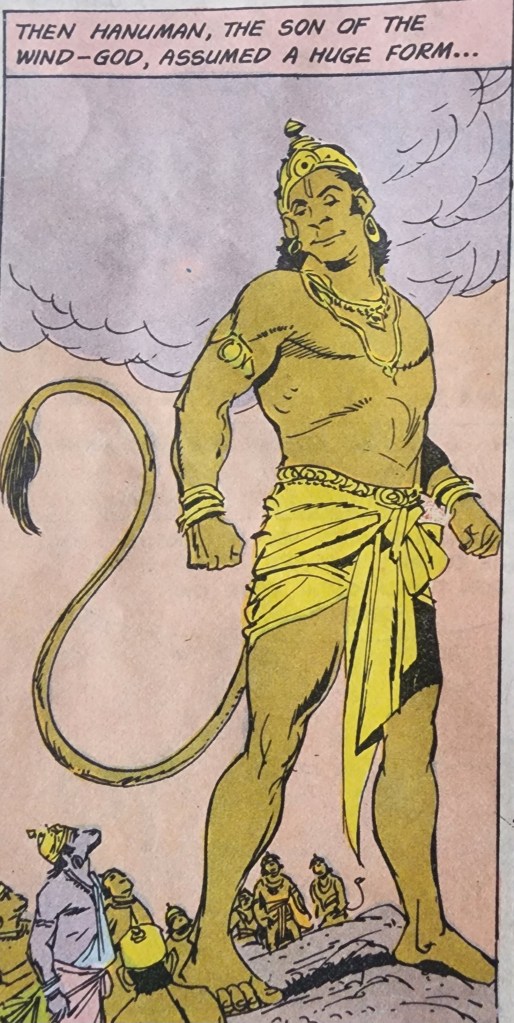
Image credit – “The Ramayana” published by Amar Chitra Katha

In the Bujinkan, we study the Gyokko Ryu. The origin of this school is supposedly by a Chinese princess and was to be applied by a small person for defence in the somewhat smaller confines of an indoor setting. Complementing this, the theme of the year for the year 2015 in the Bujinkan, was “Goshinjutsu”. This translates as “self-protection” (NOT self-defence). One of the things taught as part of this theme was to be able to protect one’s self while not being big and strong. Soke Hatsumi Masaaki emphasized that all practitioners should learn to move and fight like women; he meant that one should learn to be able move and fight like a generally smaller and less strong person against any size of opponent. This concept holds true irrespective of whether one is a man or a woman, young or old. The Gyokko Ryu, by virtue of its origins emphasizes that one should be able to keep one’s size small and heavy (when necessary). This is to not only present a smaller target (bundle of opportunities) to the opponent, but also to not be constrained by one’s size in any space (a large person might not be able to move freely indoors). This also means that any attack on an opponent will require generating power with a shorter strike range.

Mahima and Laghima

Mahima and Laghima, as a converse of Anima and Garima, go hand in hand, though not exactly. While lowering one’s core or centre of gravity increases stability, this is detrimental to quick movement. Stability generates an inertia against movement and so adds a little extra effort to move. This is great for training though, and with time, it might be mitigated to quite an extent.

But then, one needs to understand Mahima not as an opposite of Anima, but as a transformation of the body. If one needs to perform a roll, a human being has to reduce her or his size in the vertical direction or Z axis and increase size in the horizontal direction, at the beginning of and during the roll, depending on how far the roll needs to be. So, in a real scenario where there is no magic and no spontaneous shrinking or expanding happens at a cellular level, Mahima and Anima are complementing each other, where a reduction is size in one axis results in an increase in another.

Laghima on the other hand is not really about a change in the size or shape or even posture, but more about control of one’s own body. This again relates to the extent of, duration of and quality of training a martial artist has put in. The ability to use the toes and ball of the feet as against the heels, the strength in the core and control of the same, ability to move the entire body as one, control of the facea, all of these play a role in the ability of the martial artist to achieve Laghima in her or his movements.

One of the definitions of Laghima is to be very light and be able to float, like on air***. In Budo, there is a concept called Ishito Bashi. This refers to the stones skipping on water. This concept captures the essence of Laghima very well. Stones being heavier than water should skink, but then, when they strike the surface at a specific angle and velocity, they can and do bounce off the surface multiple times. This does not mean the skipping stone is lighter than water, but can surely behave that way under the right circumstances. In this same manner, a martial artist is taught to be able to be extremely responsive to an attacker’s movements, and even intentions.
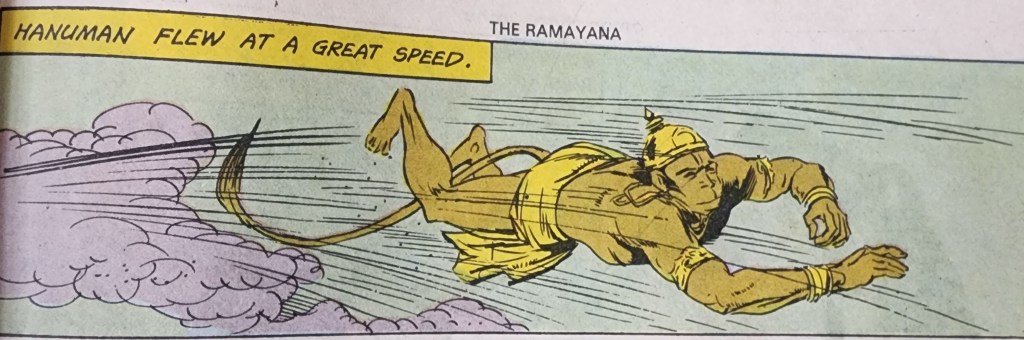
Image credit – “The Ramayana” published by Amar Chitra Katha

This concept means a martial artist (Budoka) should not be stiff in the body and fixated in her or his intended movements. But instead, should be able to respond to the opponent (not just react). This requires being light on the feet and flexible in the body and mind. This also leads to additional concepts like “listening with the whole body” and training one’s intuitive abilities in a conflict management scenario. In other words by not being tied down by a stiff body and preconceived notions in the mind, one is extremely light and able to respond almost instantaneously to an opponent, making it seem like one is impossible to hit or respond to, for the opponent gets no feedback at all to form an attack. To put it in a poetic manner, a Budoka can, with lots of good training, “float on the intentions of the opponent”, just as a stone can skip on water. This is just a practical application to someone saying you should be light as the air and impossible to either catch or hit.

Having considered the concept of rendering oneself incapable of being attacked by being light, it must be understood that the same can be achieved through armour. This is using technology to augment physical abilities or making up for the lack of the same, or both in some cases. Armour protects the body and can allow one to get away with not being able to be light and move very efficiently. But armour also makes one heavier, and also larger. Think of all the body armour used in the past; samurai armour, full plate harness, or even modern day body armour. All of these make a person larger (in volume). Add a helmet to this and even the height is increased. Overall, a person appears more substantial in armour.

In the Bujinkan, we train the Kukishinden Ryu, a martial school which traditionally used armour. The use of the same necessitates a physical posture with any weapon to be larger than one when not using armour. For this reason, there is even a kamae (physical posture) called “Daijodan no kamae” which translates to “large high level posture”, the key here being the prefix “Dai” (large).
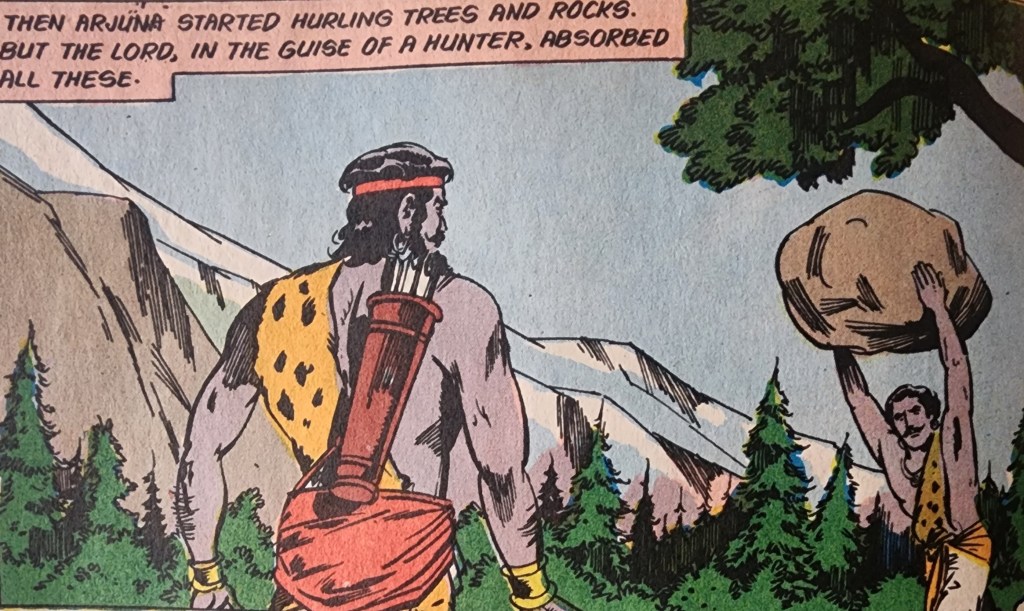
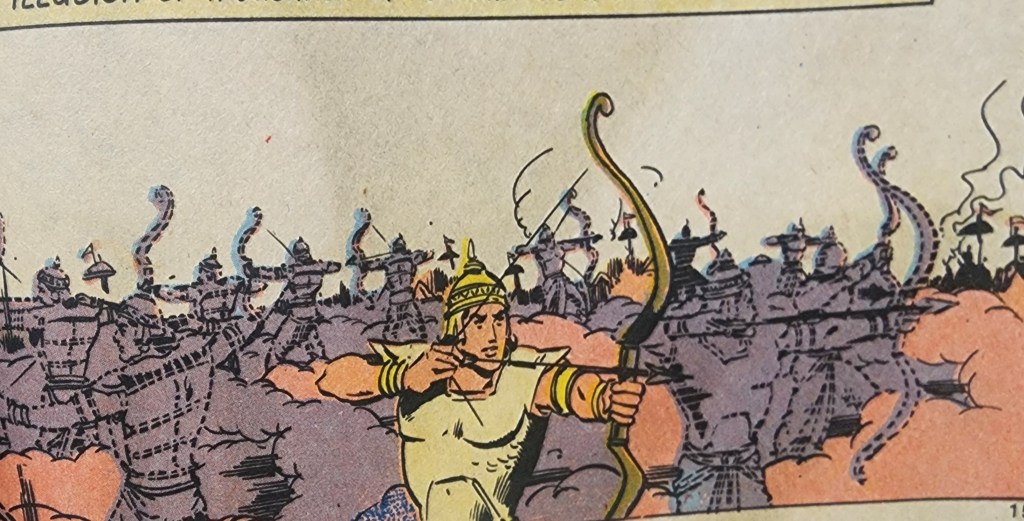
Image credit – “Mahabharata 20 – Arjuna’s Quest for Weapons” published by Amar Chitra Katha

This also shows how being large, or using Mahima, can also refer to just occupying greater space, like in armour. Hence, adding a weapon to the mix also achieves the same. This seems pretty similar to a country being considered powerful in the modern sense if it has the ability to strike far from its shores due to standoff range weapons and long range missiles. Or possess the ability to cripple other nations with armies of hackers in the cyberspace. The country can be small, but the “space” it controls (exercise influence over), geographical or cyber is “large”.

Praapti

The word “Praapti” and its forms are still used pretty often, compared to the terms for the other seven Siddhis. In Kannada for example, it could be “Avanige yenu praapta aayithu?” or “What did he get?” and in Hindi an example could be “Tumne kya praapt kiya?” or “What did you obtain?” As seen in these two examples, in common parlance “Praapti” means “get” or “obtain”. In either case, it boils down to “receiving” something.

The concept of “receiving” is literally the foundation of both the basics and advanced stages of the martial arts in the Bujinkan system. Ukemi and Uke Nagashi are the first things taught in the basics of the Bujinkan. Ukemi refers to “receiving the ground” and hence involves rolls and break falls. It has everything to do with how to injure oneself the least when one has to fall. Uke Nagashi refers to “receiving the uke (opponent)”. This deals with the different ways one can absorb, block, counter, deflect or evade an attack whether the attack is from a higher, lower or any other angle. So, literally, how one can obtain safety while being attacked or falling is the crux of this “receiving” and reiterates how one should be able to have “praapti” of safety.
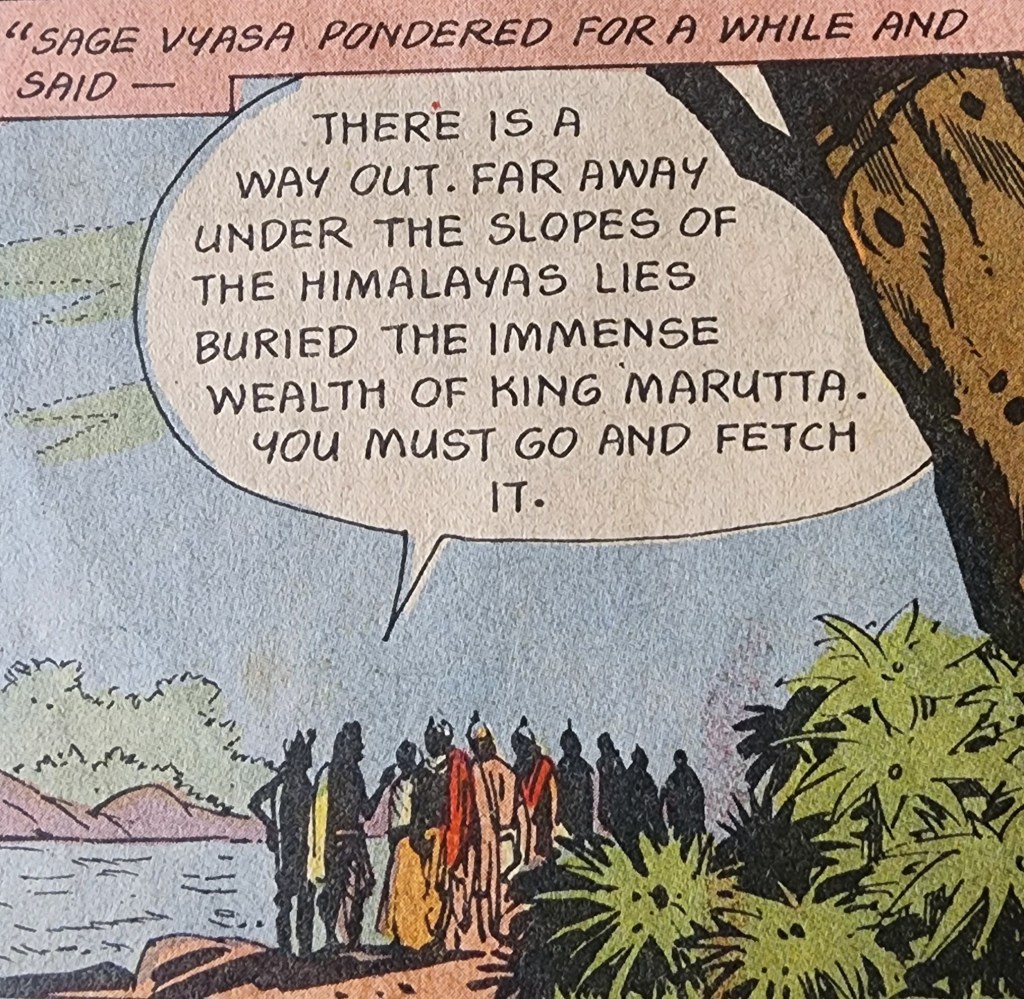
Image credit – “Mahabharata 41 – The Ashwamedha Yajna” published by Amar Chitra Katha

At a more advanced level, as Nagato Sensei (One of the senior most teachers in the Bujinkan) says, everything begins with Sakkijutsu. Sakkijutsu is about developing the intuitive ability in a fight (or any conflict management situation in daily life) to be able to move pre-emptively to either cause the opponent(s) to be in a disadvantageous position or to put one’s self in the safest or most advantageous position in relation to the opponent.

In order to be able to use intuition to one’s advantage, there are two things that are needed. First, one must have a lot of experience in training, of trusting one’s intuition and facing the consequences of failing to do so. The second relates to what we discussed with respect to Laghima, to be able to listen to the opponent and her or his surroundings to be able to intuit their intention and moves. The first of these two is about receiving knowledge and experience (Gyan aur anubhav “praapt” karo – in Hindi). The second is about receiving information from the opponent and surroundings, even when it is not explicit. Here, Praapti is all about obtaining the ability to survive, through safety and perhaps success. This is something everyone does at all times in life. We use experience to be great in any field and usually this is because we can read the situation and be in the right place at the right time. Perhaps this is a precursor to being lucky.

Praakaamya

This is the Siddhi that, from my perspective, belies any direct correlation with a concept in Budo. Praakaamya means the ability to acquire anything. Because this article is in English, there is one question that would surely come up. What is the difference between “obtain” and “acquire”? The general understanding would be that “acquire” implies more effort on the part of the person who gets something, as against “obtain” which could be either effort or any other means, like finding, being gifted and such. This is why I have understood “Praapti” to mean “receive” more than to “obtain”. So, by my interpretation, while “Praapti” is to receive, “Praakaamya” is to be able to take. So, with respect to “Praapti”, the person receiving is, to an extent passive, while with “Praakaamya” the person taking is, to an extent, active. Also, like Praapti, Praakaamya also relates to life in general, not specifically to a fight.

With this basic detail about Praakaamya Siddhi, let us look at some concepts from conflict management, war strategies and a situation where individuals are fighting. In any conflict, if one has all the information about the abilities, numbers and position of an opponent(s), and also knows everything about one’s own strengths, skills, numbers and positions, the opponent can always be overcome. This is true if the same information is not available to the opponent.

In Budo, we learn two concepts, one called “Yoyu” and another called “Kurai Dori”. Yoyu refers to having a surplus of everything. Kurai Dori refers to strategic positioning. If one has a surplus of information, experience and skill, once can always achieve a favourable strategic position against an opponent, and cause the opponent to be in a disadvantageous situation or maybe defeated. Also, if one is able to achieve favourable a strategic position, gathering surplus information might become easier. These two are thus, complementary.
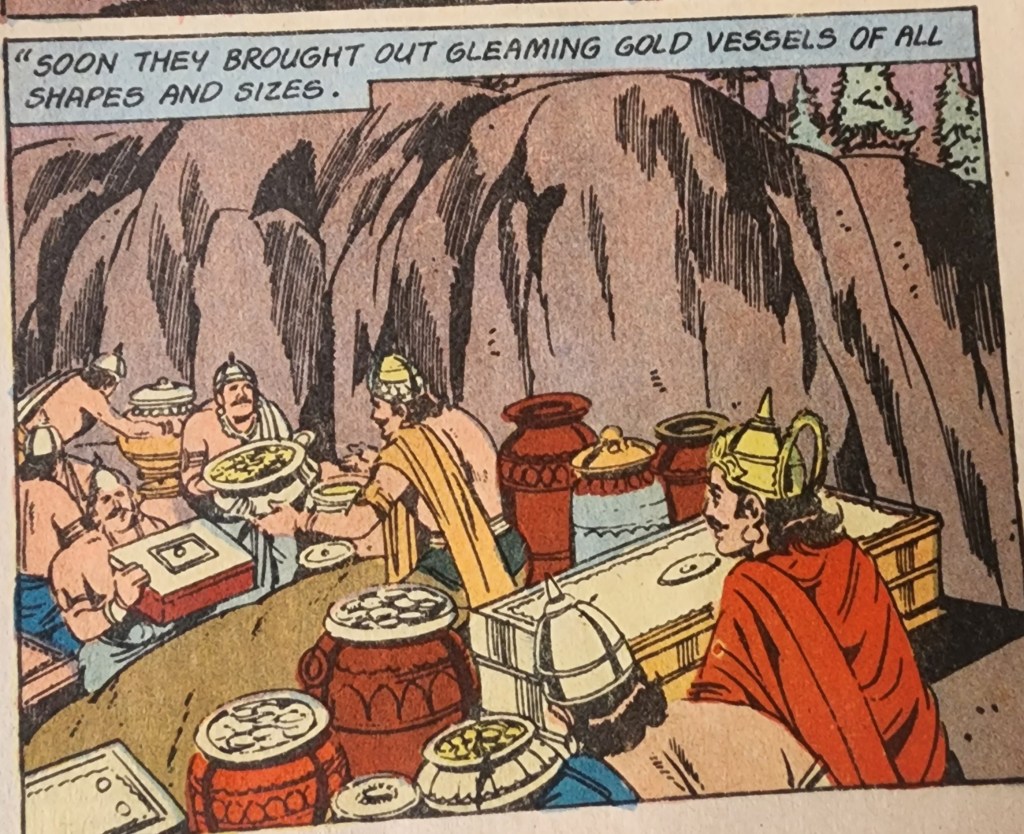
Image credit – “Mahabharata 41 – The Ashwamedha Yajna” published by Amar Chitra Katha

With the Siddhi of Praapti, one has all the skills, experience and also all the information about the opponent. With the trained intuitive** abilities, if the opponent knows or plans somethings (or even thinks it!), so does the one defending. So, with Praapti achieved, one has everything needed to always achieve a successful strategic position against an opponent. Thus, Kurai Dori is a variant of Praakaaamya in a conflict. If one can “acquire” a strategic position, once can acquire a surplus of everything, including information, so “Yoyu” is achieved. With these two concepts applied in practice, anything can be achieved, and thus anything can be acquired. In this way “Praapti” and “Praakaamya” form a virtuous cycle, as do “Yoyu” and “Kurai Dori” Thus, “Yoyu” and “Kurai Dori” are a fair approximation of Praakaamya. Of course, this needs a foundation in Praapti, represented by Sakkijutsu, Ukemi, Uke Nagashi and other layers of training.

Vashitva

Before delving into Vasitva and its antecedents in Budo, I need to clarify something here. As I have been writing this article, I realize that I have to clarify the progression of the eight Siddhis. They are not acquired linearly. It is at best circular. The eight Siddhis complement and enable each other. It is not like eight different weapons being acquired. It is more akin to having a weapons platform, like a fighter aircraft, whose sensor package, weapons array and engine behaviour are variable and mission specific. The airframe with its stealth abilities is like one of the Siddhis, while what this platform carries are the rest.

The above point was important as we discuss the last two Siddhis. I have seen some mention Vashitva first, and some others mention Eeshitva. Personally, I feel Vashitva should be before Eeshitva for reasons I hope will be clear in a bit.

In Indian vernacular languages, “Vashikarana” means to be able to hypnotize and thus control someone. “Vasha” means control. Thus “Vashitva” means “to be able to control”. So, the seventh Siddhi is to be able to control an opponent(s) or just about anything on the planet, like plants, birds, insects and animals. When speaking of control, it is vital to mention that one should not let oneself be controlled and also ensure the following two. One should not let on that he or she is not being controlled and if possible, also make the opponent believe that they are in control.
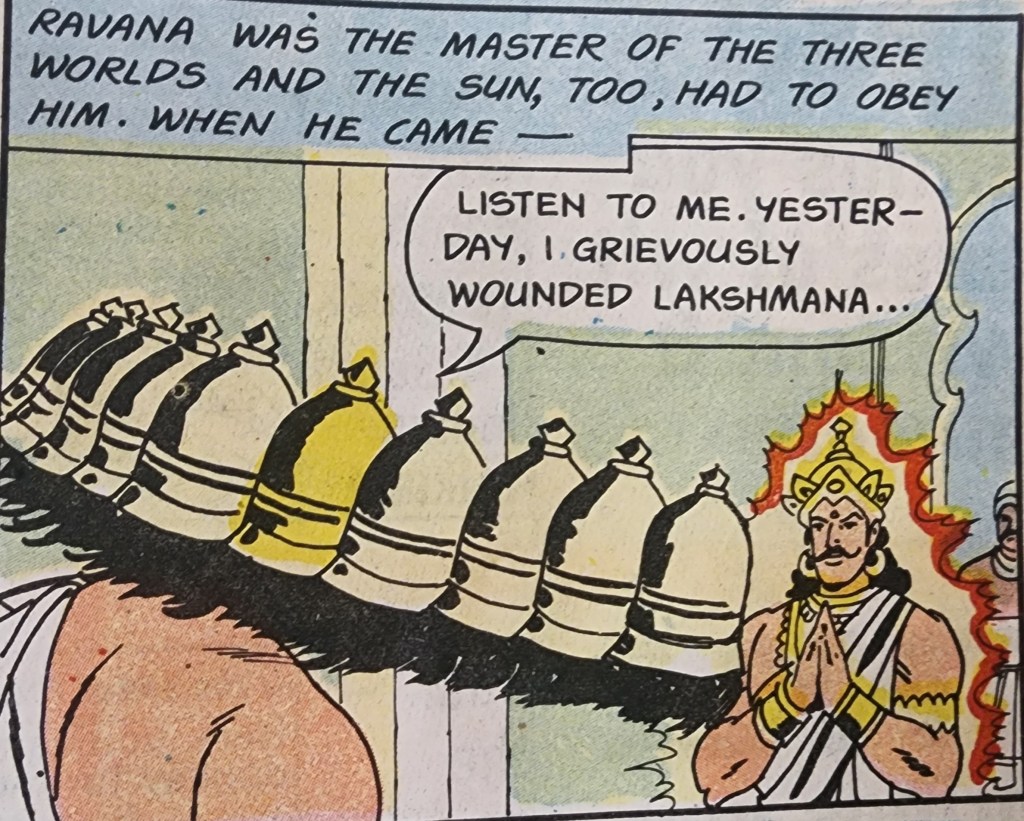
Image credit – “Hanuman to the Rescue – Tales of Hanuman” published by Amar Chitra Katha

In the Bujinkan, there is a trinity of concepts, “Toatejutsu”, “Shinenjutsu” and “Fudo Kana Shibari”. “Toatejutsu” refers to “striking from a distance”, “Shinenjutsu” refers to “capturing the soul/spirit of the opponent” and “Fudo Kana Shibari” refers to “an unshakable iron grip”. The three used together refers to “Striking from a distance to capture the soul/spirit of the opponent in an unshakable iron grip”. The soul or spirit here refers to the fighting spirit or the will to fight of the opponent(s). If this is achieved, Vashitva is as well.

The path to achieving the three concepts mentioned above and therefore Vashitva, is found in some of the themes of the year in the Bujinkan in the past 20 years. The themes I am referring to are, “Kasumi no Ho”, “Kuki Taisho” and “Menkyo kaiden”. “Kasumi no ho” refers to the “way of fog”, “Kuki taisho” refers to “the smile of the ninth demon” and Menkyo Kaiden refers to “confusing the opponent with conflicting signals”.

“Kasumi no ho” means moving in a way that causes confusion to the opponent, and hence affects either the will to fight of the opponent or causes the opponent’s plan of action and therefore the intent to falter due to induced self-doubt. “Kuki taisho” is about being so confident in one’s own ability and exuding menace without any action. This is an attitude to cultivate in oneself. This attitude is supposed to actively deter a fight or conflict from occurring because the opponent’s will to fight wilts before the fight ever begins. “Menkyo kaiden” is about messing with the opponent’s mind. This is roughly “kasumi no ho” with the will of the opponent (Kasumi no ho itself was related to physical movement). It can also be called “kuki taisho” applied repeatedly at varying intervals for varying durations. Of course, all these are layers added on top of one another, first achieve the physical and add the intellectual and emotional aspects to embellish the physical. As must be obvious by the objective of these three concepts, they lead to controlling the opponent’s will and his or her means to fight (this includes the plan of action). This is “Vashitva” 101.

I have to add here, specifically in relation to the Bujinkan system. The focus on “control” has been paramount since Hatsumi Sensei started his focus on Muto Dori from around 2018. Everything he has been teaching focuses on control. First, try to achieve complete control on oneself and then this will likely lead to control of the opponent(s). Of course, this is a wonderful concept, but frightfully hard to achieve, even just the first part about self-control. So, achievement of “Vashitva” is literally what Soke has been driving towards over the last few years.

I have one last point to consider with regard to “Vashitva”. If one can control one’s shape and size, weight and volume through the achievement of Anima, Mahima, Laghima and Garima, the first four Siddhis, one should be able to go anywhere and reach anywhere (specifically in the context of the martial arts or a fight, but in general as well). Then, that person should be able to obtain or receive anything and hence acquire anything. If one can have anything that is needed at will at and all times, through the achievement of the Siddhis of Praapti and Praakaamya, one has already achieved self-control and hence should be able to control everything and all opponents, thus achieving Vashitva. If one can control everything, then one can continue to obtain and acquire anything and thus perpetuate the ability to control one’s own mass and volume (it just means that newer means to achieve the first four Siddhis can always be discovered). This is what I was referring to when I suggested that the Siddhis are more circular rather than linear. They feed off and add to each other, completing the virtuous cycle. And this leads us to the eighth Siddhi.

Eeshitva

I have seen the meaning of this Siddhi as “the ability to force or influence anyone” or “absolute superiority” and even “the ability to restore life to the dead”. Personally, I feel all of these are underwhelming. Of course, if one can control everyone and everything, that person can indeed force or influence those under control. This is obviously absolute superiority. I will refer to the restoring of life later in this section. Also, I use the spelling as Eeshitva and not Ishitva like in many sources, as I feel that is more accurate in comparison with the spelling in vernacular Indian languages.

Eesha is another word for God. It is very similar to the word Eeshwara. Eeshwara could specifically refer to Lord Shiva or generally mean God. Eesha is also the Guardian of the North-Eastern direction. So, however it is seen, Eesha refers to God. So, Eeshitva is about achieving the ability to be like God, be it in a fight or conflict or any situation in general. In other words, to be able to lord over all problems, if not simply, everything.

The definition of Eeshitva makes it clear that it will always be a work in progress for all humans. No mortal can become a God for there is no definition of Godhood. I cannot think of any examples for Eeshitva from either daily life or the martial arts/sports worlds. Of course, one can think of martial artists like Miyamoto Musashi who never lost a duel, or Venus Williams at her peak or Dhirubhai Ambani when he grew his company with seemingly no end, to have achieved Eeshitva for a time in a given context. But this is very similar to achieving Vashitva where the aforementioned people could control all variables in a duel or on a tennis court or in the business ecosystem, for they definitely seemed to be in complete control of their respective environments. But none of them could be Godlike since they were all specialists in their respective fields, as are most people on Earth. No human can claim control on everything and hence Godhood.

The above clearly shows how Vashitva in all areas, automatically leads to Eeshitva. This is why I had mentioned earlier that I prefer to place Eeshitva as the eight Siddhi, after Vashitva, as this is a stepping stone to being Godlike.

Even though no human can likely achieve Godhood, I would to refer to concepts from Budo, which show that the pursuit of improvement and accepting natural principles are universal and guide one to at least be able to be a conduit to divine inspiration and action, even if not actual Gods.

In Budo there is a concept called “Kami Waza”. This means the technique of the Gods. It refers to moving a fight in a way that seems like one is being guided by or moved by the Gods themselves. You could say, the person who seems Godlike, has let the Gods let her or himself be controlled by the Gods. By removing oneself from the situation, space has been made in their body, mind and spirit to allow the Gods to be in control. This is to cause the opponents to no longer be able to be an opponent. The choice of words here are deliberate, I am saying the opponent no longer being able to be one, not that the opponent is defeated, hurt or affected by any malicious intent. So, for normal humans allowing for a space where Godlike movement can be achieved, that is Eeshitva on a small scale in a given context.
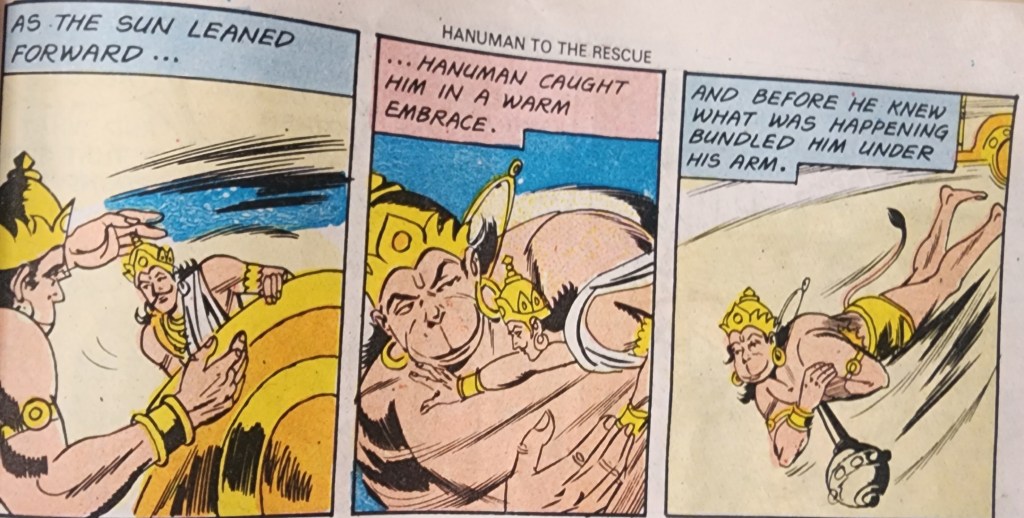
Image credit – “Hanuman to the Rescue – Tales of Hanuman” published by Amar Chitra Katha

Here is where I would to refer to defining Eeshitva as being able to bring people back from the dead. In reality, for humans, this is similar to protecting people from death. If one can end a conflict with the least harm to people and minimal or no loss of life, with the help of Gods if necessary, this is close to being Godlike. Weapons of deterrence in the modern world could arguably, in a twisted way, be an example of this. If one is extremely good in the context of a fight and the opponent cedes without fighting, it is a step towards Eeshitva.

In the Bujinkan, like with Vashitva, there were a couple of themes studied a few years ago that could be stepping stones towards Kami waza, or Eeshitva. One is “Jin ryu kaname omamuru” and the other is “Shingin budo”. “Jin ryu kaname omamuru” refers to being able to see the essence with the eyes of the Gods. It means being able to perceive the crux of anything almost instantly, like the Gods can. “Shingin budo” refers to moving in a martial way while being guided by the brilliant artistry of the Gods. This means one’s martial movement seems to be awesome like that of the Gods or at least like one is guided by them.

Both of the above emphasize that one can be Godlike only by allowing the Gods to either control them or more appropriately by one allowing oneself to be a conduit for the Gods. This means that one’s perception is so on the dot or martial movement is that incredibly good, that it seems they are a vessel for the Gods. This begs the question how does one allow oneself to be a conduit for the Gods?

The Bujinkan system, time and again has emphasized that advanced practitioners should learn to unlearn, and strive to achieve self-control to control Uke (opponent). This means one should not be fixated on techniques and how they are done and should learn to adapt the same to the scenario. There is no need to be traditional and one should not celebrate a collection of techniques for their own sake. These should be a guide to natural movement. Natural movement just means doing the best thing that can be done in a given situation. This in turn means, one should be able to let go of intentions, plans, ego and emotions relating to a given scenario. This allows “Natural movement”. And when one is fully able to move naturally, one can hopefully find the best solutions at great speed, and this is akin to being guided by the Gods.

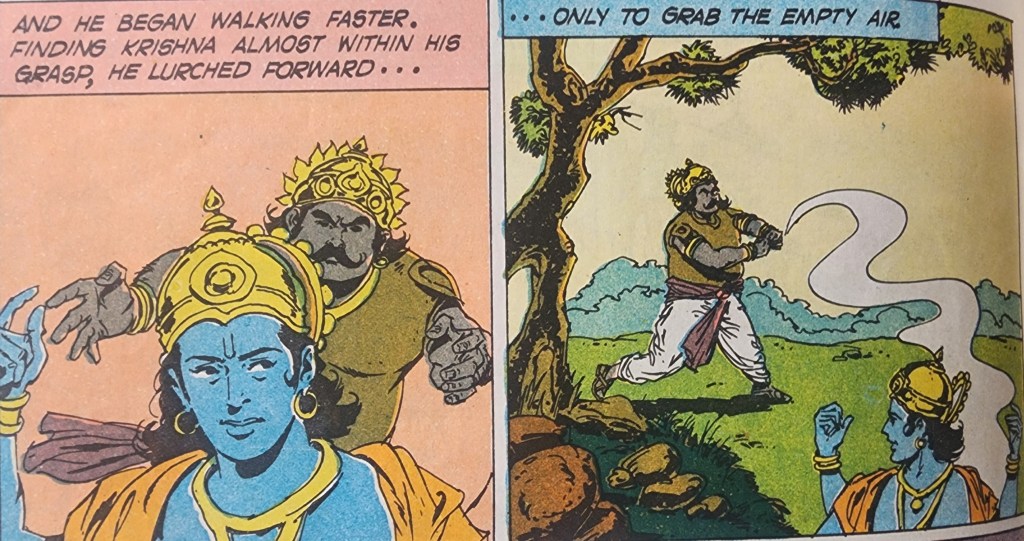
An example from Indian culture for letting go of oneself is how Lord Krishna does the only thing that is possible in his wars against Jarasandha. He did not fear disrepute when he ran away from the battlefield against Kaala Yavana, who in turn followed him to his death in a cave (this is a story beyond this article). He also decided to move his entire city state far away from Jarasandha’s neighbourhood and eventually Jarasandha was also slain off the battlefield. Using his ego against him was a big part of this, but again, this story is beyond the scope of this article.

Of course, just because the concepts exist, does not mean the path does. These concepts are difficult to practice to the point of impossibility, let alone achieve. And that brings me to end of this long winded look at the connections, from a personal perspective, between the classical Ashta Siddhi from Hindu culture and the concepts of Budo, specifically the Bujinkan system of martial arts.

Notes:

1. I sometimes use Bujinkan and Budo interchangeably. It is not really correct. But it is pretty representative. Apologies for this and a big thanks to my readers for bearing with me on this.

2. **Intuitive abilities are pretty synonymous with “mindfulness”

3. *** An example of this would be when Hanuman flew across the sea to Lanka and then to the Himalayas and back. Of course, this is an example of a God displaying a fantastic act, and not something that can ever be expected of humans.

4. I cannot think of any direct examples from stories in Hindu culture for Praapti and Praakaamya, without some personal interpretation being added. Praapti could be when Hanuman received the revelation of his forgotten powers from Jambawan exactly when he needed to be able to cross the sea to Lanka. Another example of Praapti that comes to mind is, when Yudishtira was distraught at not having starting capital for performing the Ashwamedha Yajna after the Kurukshetra war, Sage Veda Vyasa easily solved his problem by revealing the location of buried treasure that could pay for the entire enterprise. Thus, in both cases, Hanuman and Yudishtira had put themselves in a position where they could “receive” (obtain) exactly the solution they needed at the exact time when they needed it.

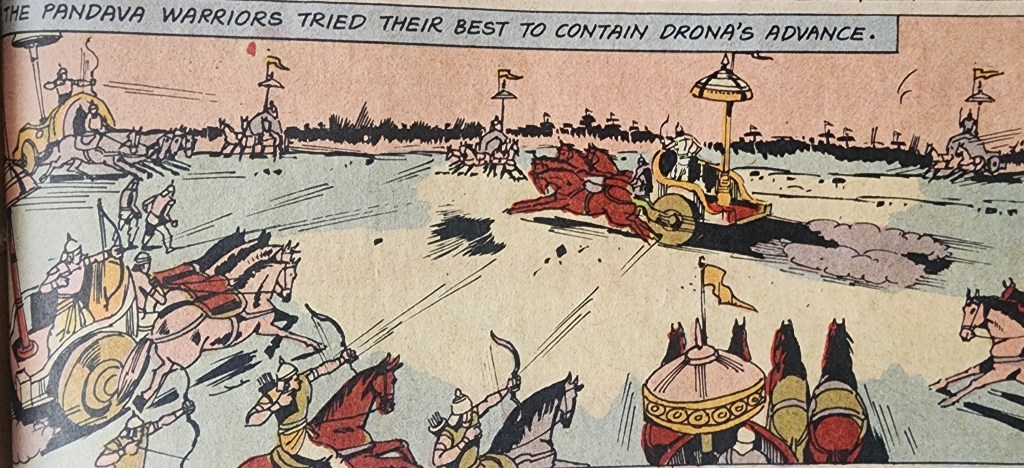
5. An example of Vashitva that comes to mind is that of Ravana. His capabilities were such that he could order the Sun around! When Hanuman was on his mission to bring the Sanjeevini plant to heal Lakshmana before the morning of the next day, Ravana ordered the Sun to rise earlier! Presumably to cause the temperature change to kill Lakshmana. This is control on a GRAND scale! But then, Hanuman, imprisoned the Sun temporarily to foil that! That is Eeshtiva, if ever there was an example of one.

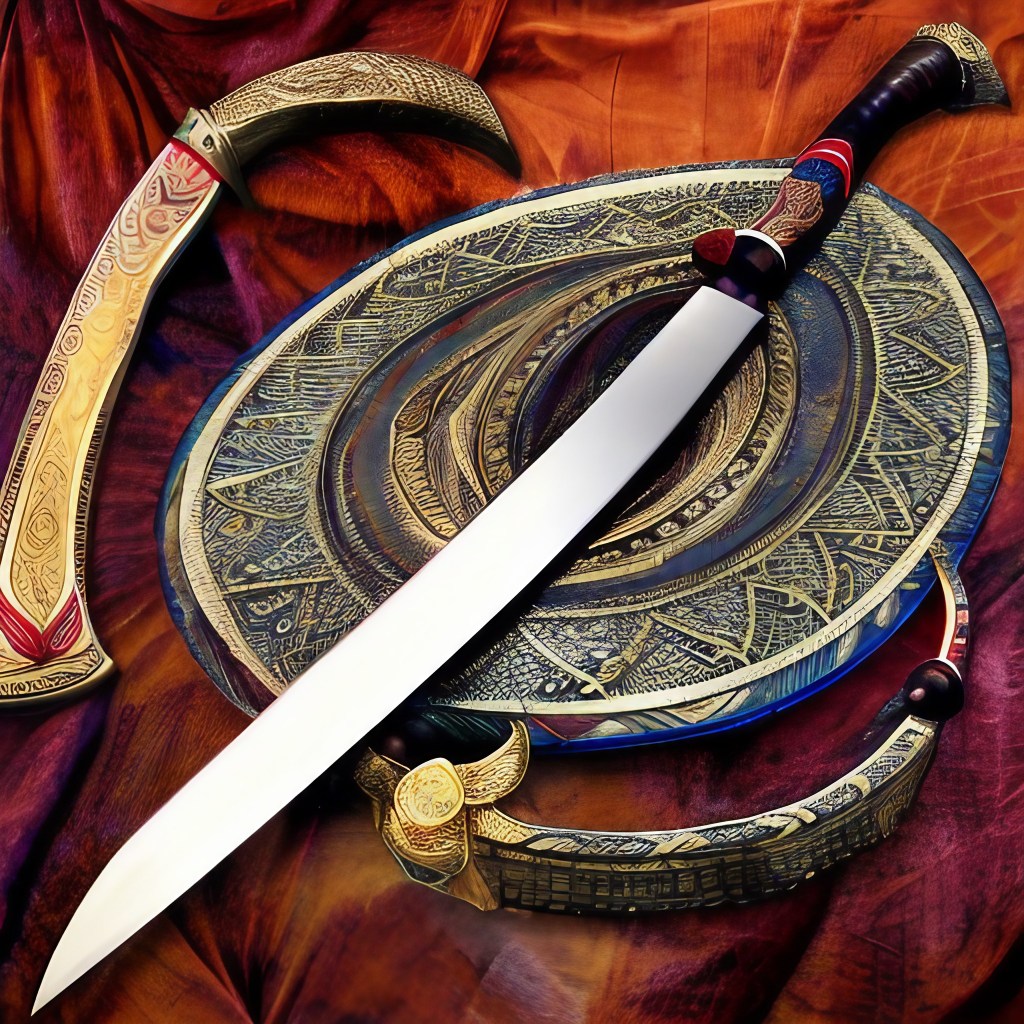
The Purpose of a Sword

A sword is a weapon. It is often said that, of all historical weapons, the sword is the only one which is specifically designed to be used only against other humans. All other weapons also double up as tools. A knife, an axe, a spear, a staff, bow and arrows, all of these are tools, which can be repurposed or “specialized” to be weapons. Even a serrated blade can be used as a saw. If you put a sword on top of a staff, the staff stops being a tool and gets relegated to being a weapon; as in the case of the glaive, naginata, kwan dao and such. Even if the sword blade is made long and flexible, it is only a weapon and not a tool, like with the aara or urumi, unless one can consider that wearing it as a belt (as it apparently was at times in history) is its use as a tool!

But then, if one changes the blade shape and makes it extremely curved and top heavy, or very wide and specialized for chopping, the sword takes a different name, a sickle in the former case and a machete in the latter. Of course, this name can differ with cultures. Either way, in this avatar, a sword does indeed become a tool, but it no longer is unambiguously just a sword anymore.

This being said, there is a very definite case where a sword becomes a tool. Consider all the very beautiful and ornate swords in the world. I do not mean the swords with very ornate, or bejeweled scabbards or hilts, made of precious materials, be it gold or silver or a combination. Hilts made of jade, quartz or rock crystal with jaw dropping carvings are also very prevalent.

The beautiful swords I consider here are the ones which have fully functional blades and can cut perfectly well but can also be considered as works of art at first glance. These might be swords that have blades with a mirror polish, blades with elegant “Damascus” (Wootz) patterns, blades with blue and gilt, and all the blades with intricate engravings, or all the blades with various combinations of the above.

Marry this sword art with the magnificent but functional hilts that bear elegant scroll work in gold or silver and then the shine of an enameled scabbard, and the sword transforms into a tool, Yes it is now undoubtedly a work of art, but it is also a tool.

This is the kind of sword that is gifted to a fellow king, a vital aristocrat or an opposing party at the signing of a treaty. This is the kind of artwork, once given as a gift, shows the honour that is being bestowed upon the recipient, for this is a sword that is one in a million, that took efforts and resources far beyond the ordinary to create (not make, but create). Add to the sheer beauty the fact that it can be used a weapon, and it is a weapon that is to be preserved and passed on an heirloom, something that comes to define the prestige of a family or clan!

Once this value is established in terms of honour and prestige, the sword becomes a tool. It is a tool that buys you an army, an alliance, or peace! This is not me stating it; I am borrowing a part of the above sentence from Ilya Alelseyev, on the “That Works” YouTube channel. Yes, you can call it currency since it “buys” you something, but then, it really is not. It is like a bottle opener, which opens the bottle of jointmanship, maybe camaraderie and even friendship. Thus, a sword becomes a tool through the realm of art. Perhaps when a blade smith works with a gold smith, the weapon becomes a tool. Perhaps this tool becomes a path to peace! An army or an alliance or a treaty acquired might lead to the prevention of or to the end of a conflict, by tilting the scales heavily in one’s favour, and discouraging another from considering a violent solution. And thus, the sword becomes a tool for peace. And this has been true for so much technology and art across human evolution. This perhaps is also the purpose of a sword. To be a tool for peace.

All the above images are created with Jasper AI

“Saino Tamashii Utsuwa” and Shekhar Gupta’s Bell Curve theory of insurgent violence in India

Shekhar Gupta (currently the Editor-in-Chief at “The Print”), a very experienced and eminent (according to most) journalist of India has a theory regarding the lifecycle of violence due to insurgencies. He calls it the “Bell Curve theory”. This theory of his is a part of the inspiration behind this article.

Of course, as the title suggests, this write-up is also inspired by the term “Saino Tamashii Utsuwa”. This was the “Theme of the year” in the Bujinkan system of martial arts, for the year 2009. Saino Tamashii Utsuwa translates as “Expand (or add on to – Tamashii) the vessel (Utsuwa – referring to the capacity of the vessel) of your abilities (Saino)”. In simpler terms it means expand your abilities or skill sets. Considering the Bujinkan is mainly a system of martial arts, this meant, improve your skills or fine-tune your skills, or increase your skill set. It also could mean improve your ability to withstand or endure anything (this could relate to the soul which might represent endurance, patience and other abilities that cannot be objectively measured, but subjectively assessed).

The “Bell curve” Mr.Gupta uses as part of his theory is the normal bell curve used in statistics. He observes, based on his several years of reporting on various insurgencies in India in its different parts that the violence due to these insurgencies follows a Bell Curve. These insurgencies include the ones in the North-East – in Nagaland, Tripura, Mizoram and Assam, in the North – in Punjab and Kashmir and in the South, Centre and East of the country – in the Naxal affected states.

He observes that all these insurgencies start small, when they are not yet a matter of concern for the State (central and state governments). They then grow larger and more violent and eventually a peak of their violence is reached corresponding to the peak of the Bell curve. This is when the State has recognized the threat and trouble of the insurgency but the response to it has not yet reached the peak of its efficiency and effectiveness.

The next stage is when the response of the State, with its military, paramilitary, police, intelligence agencies, media narrative, revenue enforcement and logistics deprivation through all of the above, becomes overwhelming for the insurgents to handle. This forms the falling part of the bell curve, corresponding to the reduction and tapering of the violence. It also corresponds to the State and insurgents beginning a dialogue which eventually results in the end of the bell curve, when violence ends, and a political process begins with a permanent solution taking hold over time.

Sensei Hatsumi Masaaki, Soke of the Bujinkan system of martial arts (he has since handed over the 9 schools of martial arts that comprised the Bujinkan to different and new Sokes) had a system where he would announce a theme for every year. This indicated what the focus of training would be for the next year. This was a practice from around 1993 all the way till around 2016. After 2016, the generic focus has been “Muto Dori” until the pandemic disrupted normalcy.

Some of the themes were tangible and external, like a weapon (Bo, Yari, Naginata etc.) or a style of fighting (taihen jutsu, koppo jutsu, kosshi jutsu etc). But sometimes the theme was more abstract, a concept more than a physical aspect (Saino Tamashii Utsuwa, Rokkon Shoujo, Kihon Happo etc). The theme for the year 2009 was “Saino Tamashii Utsuwa” (sometimes also called “Saino Konki”).

The expectation for the year based on the theme was that the practitioners of Bujinkan improve their skills, in scale and scope. For example, if someone was good with the sword and not the spear, he or she was expected to improve with the spear while fine-tuning their skills with the sword and also to not let it diminish while the other skill is being enhanced. It was also expected that everyone also brush-up on to what they already knew but had lost partially over time. In other words, if the practitioner of Bujinkan is a vessel and that vessel is full to a point with certain skills, they were expected to not only add to the vessel, but also ensure that the size of the vessel increases and is added to, at the same time.

There is an obvious and simplistic observation to be made here. The bell curve looks like a mountain, but when it is turned around, it looks like a vessel. And any vessel is representative of potential or opportunity, as represented by the space in a vessel which can be filled.

This vessel that is represented by the “Utsuwa” in the theme, is also representative of the ability of the Indian State to always increase and improve its own capacity, in its soul and its abilities to deal with challenges of any nature as the State grows, ages and gains collective experience and wisdom. The challenges can be anything; economic, social, political, military or climatic. But here we look at this concept with reference to the insurgencies that Mr. Gupta refers to in his theory.

One should watch the videos on the YouTube channel of “The Print”, where Mr. Gupta explains the bell curve theory. He does a wonderful job of elucidating the same very eloquently. I will try and capture the key points from the theory here.

The early part of the bell curve is one where the State is not reacting to the insurgency as it does not seem much of a problem. But the problem and violence grow in brutality and in the number of incidences of violence. Eventually it reaches a peak when it seems that there will be no end to the increase in the violence. When things are at this peak, the State has already started responding, but while successful in many instances, it does not seem to be successful in reducing the instances of violence or mitigating the cause of the insurgency. This is true in all the following examples of insurgency against the Indian State.

The militancy in Punjab started in the early 1980s and was unabated all through that decade and it peaked in the years of 1991 and 1992. But it waned to being insignificant in the years after 1993. The militancy in the erstwhile J&K state started in 1989 and was unabated through the early 1990s. After this, the violence has diminished greatly. While it still exists today, it is a single burning home (a tragedy nonetheless) compared to the conflagration of the early 1990s.

The insurgencies in the Northeast started in late 1940s and are not yet completely over. But each state in the region had separate peaks and mitigation of the violence. Each state in the region also dealt with the local issues differently and at different periods of time. The insurgency in Mizoram peaked in the 60s and 70s and ended in the 80s. The same in Tripura ended in the 2000s. The insurgency in Assam was at its peak in the late 1990s and early 2000s and has abated to a large extent since. The insurgency in Nagaland has timelines similar that in Assam.

The greatest internal security threat as described by Dr. Manmohan Singh, the activities of Naxals, is also still going on, but is much diminished from the last decade. Though extremely brutal acts still do occur against CRPF personnel, these are reducing in number. The scale of the Naxal problem is vastly greater than the other insurgencies. It encompasses several states. In the words of Mr. Modi, Naxal activities extend from Tirupati (in Andhra Pradesh) to Pashupati (the Pashupatinath temple in Nepal). But the number of districts affected by Naxal activities has reduced significantly in the 2010s.

Mr. Gupta explains that all of these have followed the bell curve and are at various stages on the downward trend currently. The reasons for this are many. Mr. Gupta explains a few of the reasons and some are evident from various media reports over the last few decades, which show the strategies deployed by the Indian State.

In many insurgencies, the Army was deployed initially to deal with the surging violence. The army itself was not trained to deal with insurgents as against conventional enemies. The Army itself had to learn the skills to deal with the problems and also put in place procedures and mechanisms to deal with the problem in different geographies of the country. This also meant they had to start schools in different parts of the country to train troops to deal with the different types of scenarios, in some cases learning from and sharing knowledge with Armed Forces of other countries. Overtime, State Police forces learned specialized skills to deal with the different types of insurgencies and the Central Reserve Police Force (CRPF) also gained a lot of the skills to free up the Army for their more conventional roles.

All of this was backed by learning, building and putting in place structures and resources for continuously improving Intelligence Agencies which led to reducing casualties in the armed response units and reducing collateral damage in any operation. This also led to a greater understanding of what steps could be taken to mitigate the causes of the militancy and also open channels of communication with the insurgents.

With this started a virtuous cycle. The Indian State started with better transport and communication infrastructure which not only helped the armed units but also started off development opportunities in the areas affected by insurgencies. It helped affected communities, specifically tribals (adivasis), interact more with their fellow citizens. It brought better primary education to areas previously left behind. And this led to a greater understanding of the causes of the militancy and a fine tuning of the strategy to counter the same.

With better infrastructure, education and out-reach came the opportunity for more commercial development in underdeveloped areas, especially in the case of Naxal areas, where mining was always a huge opportunity. With development came the challenges of equitable distribution of the benefits, which is still a work in progress, but definitely forward progress.

Another area of the fight (skill set if you will) that the Indian State had to learn and fine tune all the time was the narrative battle and the response to it on many fronts (now there is a stream of economics called “Narrative Economics”!). The State had to firstly counter the narrative of grievances that the insurgency was peddling in almost all examples. This was to break the support the militant received from the locals, who would only do that if they saw examples of development and bought into the path of progress promised by the State. Also, the State had to convince its other citizens, who lived far away from the insurgency affected areas and were not affected by violence, that they were firstly not the villains of the story and that they were taking the right steps as the situation warranted.

An aside – Could the entire arena of narrative combat be akin to the concept of “Kyojitsu Tenkan Ho” that we train in the Bujinkan?

 Once the State had better prepared armed units, intelligence gathering, infrastructure and narrative combat skills, it could choke the logistics of the militants, mainly because the support of locals in the supply chain diminished.

With all the above additions to a State’s abilities, the insurgency was now on the receiving end. This opened the door to creating amnesty and rehabilitation opportunities for militants that would surrender, give up arms and revert to the mainstream of the nation’s citizenry. Once the option of giving up arms without consequences was opened, the virtuous cycle gathered pace and led to greater interaction with inhabitants of the insurgency affected areas, and gave greater momentum to back channel communications which became full-fledged talks to end the insurgency. *This is like allowing an Uke the option of ukemi and disengagement from the fight.

Now that bringing people back from militancy has been mentioned, Mr. Gupta makes a very interesting observation. Apparently, the Indian state avoids killing the top leadership of an insurgency. It does eliminate lower level operatives when necessary, but does not go after the top leadership, because they are the ones who can be negotiated with and convinced to join mainstream politics. This method has apparently resulted in insurgent leaders in the North East, J&K and Punjab joining electoral politics and becoming ministers or even chief ministers in rare cases. Once this happens, the insurgency ends and political processes can take over. When a political process takes over, leaders are held responsible for development. This apparently leads to a populace getting addicted to peace, so long as there is a “peace dividend”.

The “peace dividend” refers to development that improves the quality of life and increases prosperity for a populace over time. This requires actions of the State that are not specific to countering an insurgency, but activities that are of great benefit to all the people in the country as a whole.

This includes activities where schemes of the State are delivered with not much leakage of benefits, and to the sections of a population that need them most. And if there is specific development like mining in an area with Naxal influence, the benefit from the mining should be visible and reach the locals of the area specifically. Of course, if this sounds like a welfare state, then the State needs continuous and large economic growth to have the resources to distribute. This should go hand in hand with protection of local cultures and the inhabitants should not be inundated with a migrant population, to alleviate fears of a way of life being threatened. This is true whether it is the North East, Punjab or J&K, for all parts of the country have a lot of pride in their respective ways of life.

These general development activities bring to mind two other concepts from the Martial Arts. One is “Rokkon Shoujo”, which means “clear laughter is the greatest reward”. This essentially means the focus should be on happiness, and the focus of a State’s activities should focus on the happiness of a populace. So, this is not specific to counter insurgency, but to general development as a whole.

The second is “Kaitatsu Gairoku”. This means “doing things indirectly”. It refers to a feint in the martial arts that could lead to creating an opening against an opponent. So, The State focuses on economic development, and its equitable distribution and this weakens insurgencies by its very nature. This is weakening an insurgency by focusing on something else. This is a classic example of defeating an insurgency with indirect actions.

Of course, Rokkon Shojo and Kaitatsu Gairoku are deeper concepts that need to be explored with separate articles with more clear examples. Nevertheless, these actions of the State go on to show that a State not only adds to its learning and experience with specific aspects relating to dealing with a violent insurgency, but also incorporates concepts that affect the solution to the violence without direct measures. This is similar to learning a concept in the martial arts as against a technique and applying it with any other weapon or technique.

In conclusion, each of the above points, is an ability learnt by a government, expanded upon with the past experience and knowledge (of previous administrations), by successive governments. To simplify, the Indian State can be considered the budoka and each of the strategies applied against an insurgency represents an increase in its Utsuwa of responses. The soft and hard strategies are the Saino, both of which are always being increased (tamashii).

Of course, all the learnings and techniques of the Indian State is not to imply that these are the only ones out there. Several countries have faced and either defeated or mitigated armed insurgencies of varying scales in the last century. These insurgencies were of both right and left wing extremists, a small number of examples of this are the Red Brigades in Italy, the Red Army Faction (Bader Meinhof Group) in West Germany, the OAS in France and the Provincial IRA in the UK. But the scale and number of violent insurgencies faced by the Indian State is vastly greater, as is its resolve (more space in the Utsuwa) to never give in, take all hits it has to (in lives, in the media, narratives, economy growth etc.) but always survive and emerge stronger – a much larger and accommodating vessel. Just living in this country, and knowing this history is a great walk through the concept of “Saino Tamashii Utsuwa” and motivation enough to practice the same, at least in the dojo.

*As mentioned in the article “Ahimsa and the Martial Arts – Part 3”

Ahimsa and the Martial Arts – Part 3

Indian Independence & the Revolutionary Movement – The Gift of Ukemi

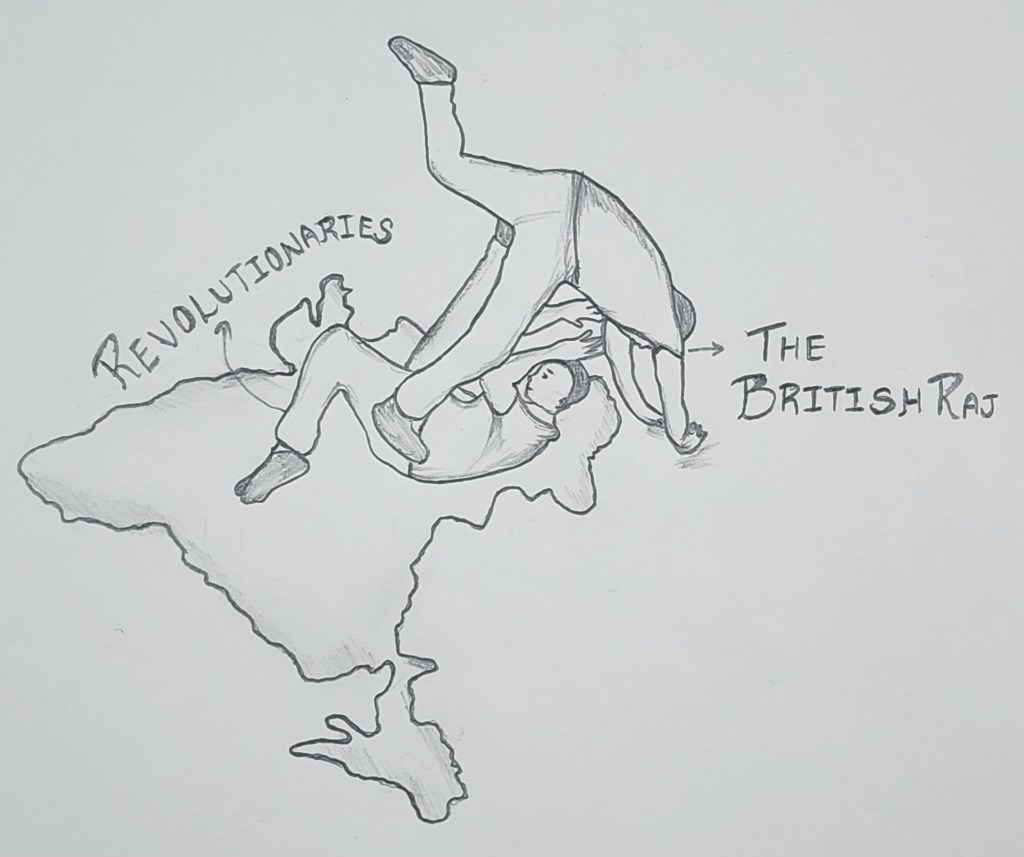
Artwork by Shushma N

In the previous two write-ups in this series I have opined that Ahimsa is about not letting the opponent realize that he/she/they are being countered and making them retreat or just give up the fight/aggression that was initiated by the opponents’ side. I also opined that this concept can be applied not only to a one on one fight, but also to a large scale conflict spread across a vast geography (the example used was the Indian Freedom Struggle).

In this part of this series, the last one for now, I shall express a few of the remaining thoughts I have had over time with regard to Ahimsa in the martial arts and how the same is also evident ( at least to me) in the struggle for Indian independence from the British Raj. Of course, I need to reiterate here, the application of martial arts concepts is from my own perspective and with the benefit of hindsight.

When we train in the Bujinkan, after a considerable amount of training, we begin to realize that a lot of the times we support the opponent. This is very true in the Nage Waza or “throwing” related movements. “Support the opponent” here means that the opponent is not only being held up by the tensions in one’s (defender’s) own body, but also by being able to sense where the threat to him or herself is likely to come from based on the same. Here, “tensions in one’s own body” refers to the strength all of us use in defending against or resisting the attack of an opponent. Specifically, with relation to the Nage Waza and related concepts (maybe movements), when an opponent is being thrown, he or she can stop him or herself from falling by sensing (feeling) the resistance from the person executing the throw and latching onto the person based on that feedback. This is why we are taught that in the Nage Waza, we need to learn to “let the opponent fall” and how that should be enabled by gravity, not individual strength.

Once we understand (or at least say/accept) that a lot of throwing of opponents happens by letting the opponent fall, we need to learn what position and space we need to occupy in relation to a specific attack from an opponent. A specific set of movements might be needed to occupy the space and posture in relation to an attacker to take his or her balance and make them fall. This is the whole purpose of Nage Waza training.

Now, when seen from the perspective of an attacker, when he or she is falling, he or she will fall in a manner that will be least painful and causes least bodily harm due to the same. This is what we call Ukemi or “receiving the ground”. In common parlance, an attacker executes a break-fall or a roll while falling to come out of the fall unhurt or at least with minimal injury.

Consider a situation where an attacker either cannot perform a good ukemi or has only the option of an ukemi that will result in significant physical injury (or worse). This situation delays the attacker (Uke) from performing an ukemi to retreat from the attack he or she initiated. Often enough, in the absence of a good fall-back option like a break-fall or roll, the attacker will fight harder and try to force a tension in the defender’s body to latch on to, thus mitigating or nullifying the need for an ukemi. Therefore, the defender (Tori), by disallowing an ukemi for the attacker, might extend the fight by not allowing the Uke to retreat with an ukemi.

An aside – It can also be argued that the Tori becomes Uke in such a situation (denial of ukemi), especially if the Tori has to resort to use of physical strength that reverses the gained advantage with the earlier movement. Of course, very skilled practitioners can deny an ukemi and also prevent a fightback from the uke (this is a deserving discussion for different time). Here, at least in a practice scenario, the tori physically stops uke from falling, thus gaining the gratitude of the uke for the life-saving move. This “saving the uke” is an act of benevolence and also results in the ending of the current attack.

With this introduction in the background, I would like to recall a sentence I had read in a newspaper op-ed back when Operation Parakram was going on. This was the massive military build-up that India had used to retaliate against the attack on the Indian parliament back in December 2001. I do not recall the newspaper name, but I think it was The Hindu. The sentence said that one of the things that the Indian Government and the Military leadership was cognizant of was that they did not want to push the then Pakistani Dictatorship to think they did not have any wriggle room in the discussions with India. This feeling along with a belief that a massive invasion was imminent would push them to the wall. And the knowledge that Pakistan would not be able to win a conventional war against India along with no faith in negotiations would drive them towards the nuclear option in the war. This was something that India did not want, for it would adversely affect India and also not result in the scaling down of terrorism which was the objective of the military mobilization in the first place. In hindsight, India succeeded, to a limited extent, in getting Pakistan to act on terrorism emanating from its soil and there was no war. Op Parakram was called “gun-boat diplomacy” as well by some, for this reason.

But the key here is that the option of negotiation was the ukemi that the attacker could use to disengage and end the fight. The lack of this option would have resulted in a military conflict with unforeseeable consequences which need not have been favourable to either the attacker or defender.

I have used the above example because it perfectly encapsulates the use of diplomacy with military capabilities to achieve a strategic or geopolitical objective, with minimal or no use of the kinetic military option. And all this in a short time frame of less than a year.

If we can look back towards the Indian Freedom Struggle with the above example and the use of ukemi in mind, some wonderful revelations are likely. This is especially true if we consider the work of a lot of new historians who are beginning to opine that Indian Independence from the British Raj was not just due to the Ahimsa (supposedly “non-violent”) and movement of the Indian National Congress (INC), but also due to the work of the armed Revolutionary Movement, the pinnacle of which was the Indian National Army (INA) under Netaji Subhash Chandra Bose.

It is well documented, and these days, pretty widely mentioned, that Clement Atlee, the PM of Britain when India won independence, stated that Gandhiji and the movement led by him (I suppose we could say the movement spearheaded by the INC?) was of very little relevance in the final British decision to leave India and acquiesce to Indian Independence. This statement is supposed to have been made when he was on a visit to India in 1956, when he was staying at the residence of the then Chief Justice of Bengal. Further, Clement Atlee is supposed to have credited the British decision to leave India to the spark lit by Netaji and the rebellion in the then Royal Indian Armed Forces (the greatest of which was the rebellion by the Royal Indian Navy in 1946).

So, Indian Independence was a consequence of the well-known Freedom Struggle and also loss of control of the armed forces in India. The rebellion in the armed forces after the end of the Second World War itself was triggered by the trials in the Red Fort of the prisoners of the INA. The INA being a product of the armed revolutionary movement, it is clear that the objective of this movement was always to turn the British Indian Army against the British. With the Army being staffed mostly by Indians with British leadership, the loss of control of the army was always going to be the end of the British Raj.

This idea of throwing the British out by subversion of the British Indian Army had been the same since the First War of Independence in 1857, which also occurred due to troops of the then East India Company (EIC) rebelling against the Company. After the failure in 1857, the idea was revived in the early 20th century with many events working towards the same goal, during the First World War which were not successful. Eventually, the same idea came to fruition after the Second World War. In the interim when the idea of subverting the army was on the back burner post the failed Mutiny of 1857, the INC was born in 1885 and initiated the parallel struggle for freedom through a political process, which is the better known “non-violent” movement.

For greater details about the revolutionary movement, I strongly suggest looking for and watching the talks given by Mr. Sanjeev Sanyal*. There are several of those on YouTube, all very interesting. This is one of my own main sources of knowledge about these aspects. There are others out there as well sharing the happenings of these times in differing ways**.

So, the armed revolutionary movement was instrumental in taking away the Indian Armed forces from the British, while Gandhiji and the INC were responsible for breaking the British moral high ground and belief in their own responsibility to civilize India after a Western model.

I have mentioned my thoughts on the use of the Ahimsa movement in using British moral superiority against themselves in a previous article***. In that article I have also mentioned that the Ahimsa movement provided a safety valve and a face saving exit out of India, for the British. This is exactly like keeping negotiations on during Op Parakram. In other words, the Ahimsa movement was the Ukemi allowance to the Nage Waza of the armed revolutionary movement.

The British were financially weak after the Second World War and the training and knowledge of weaponry they had imparted to Indian troops during the same had mitigated their technological superiority. And thus, with the loss of the Indian Armed Forces, their last tool to hold the country they had occupied over the last two centuries was taken away from them. This was them being subjected to an absolute bad-ass Nage Waza, a literal being “thrown out”!

This left them with taking the Ukemi option provided by the INC, for a face saving retreat, thus ending the struggle India had not asked for. The British were forced to negotiate earnestly with the INC about complete Independence and not just spare concessions like they had in the earlier decades. This allowed them to survive the “fall” due to the “Nage” of the revolutionary movement. They could hold on to the face saving belief in being civilized by acquiescing to the call for Indian Independence and over time sweep from the mind the fact of being “thrown” out.

So, the twin use of the revolutionary movement and the political movement of the INC were the Nage Waza and “allowed” Ukemi that showed the British the path of retreat, and nullified the aggression that led to the Freedom Struggle in India****.

Notes:

*Mr. Sanyal is the Principal Economic Advisor to the Govt. of India and a member of the PM’s Economic Advisory Council. He is also a wonderful historian who has written multiple books.

**One very recent book called “True to Their Salt” by Ravindra Rathee comes to mind. I have not read this book, only watched an interview with the author, about the book.

***Ahimsa and the Martial Arts – Part 2

****Does this have a parallel in the IRA / Sinn Fein tandem movement? Perhaps this is something to look at, for if true, would be a second use of the same Nage – Ukemi combination against the same colonizer.

Ahimsa and the Martial Arts – Part 2

Ahimsa & Indian Independence – Through the Eyes of Budo

I have opined in the previous part of this series, that Ahimsa is a martial arts concept where “one does not trouble the opponent”. It is a way of saying do not use force against an opponent. This is especially true if the opponent is stronger than oneself. Here strength includes access to greater resources, technical superiority, greater numbers or just greater physical strength and skill.

An extension of not using strength against a stronger opponent is generally using the opponent’s strength and skill against her or him. This generally means if an opponent is taller and larger, and thus generally stronger, one does not resist his or her strength and instead tries to maneuver to a position from where the opponent’s balance can be taken or a vulnerable opening accessed.

The same is true when one is fighting with non-projectile weapons, whether they are cut, thrust or bludgeon oriented. Here, the skill, speed, reach and favoured attack are points to consider as against strength. If the opponent uses a longer weapon, one tries to get in close to negate the reach and if the opponent favours a cut over a thrust, one tries to get to an angle where the cut becomes ineffective (or less effective at least). But if the opponent favours a thrust, one tries to get him/her to over reach or over commit or get out of line of the thrust, and thus try to get them off balance or leave an opening in the act of recovering one’s balance.

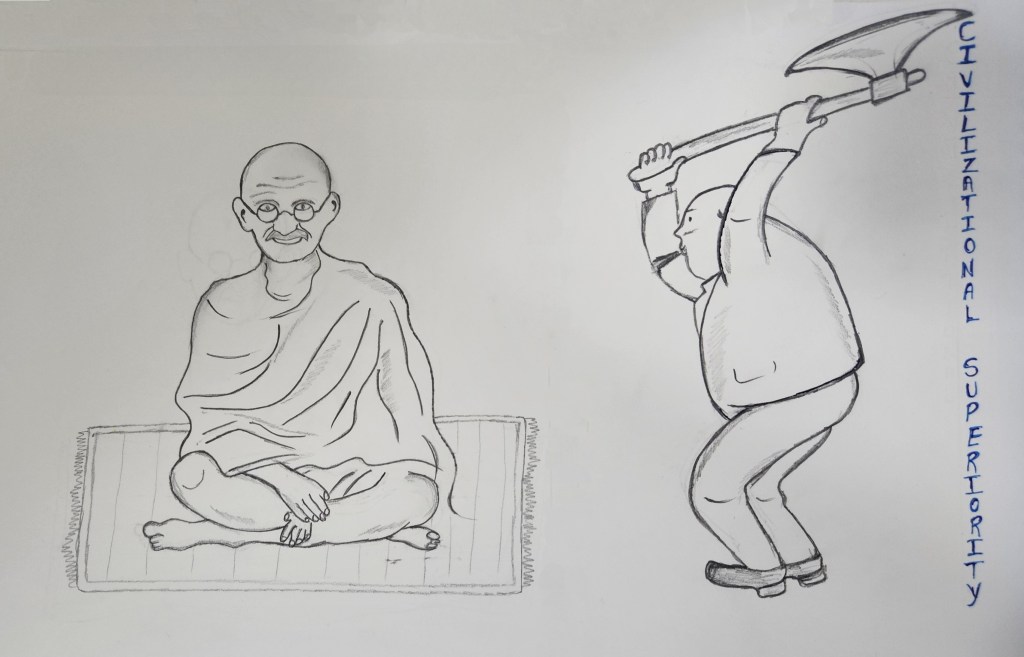
Could this way of dealing with opponents explain how Ahimsa works brilliantly as a weapon? Consider the Indian freedom struggle, the British Raj is the opponent. This opponent enjoys superiority in resource availability, economic prowess and technology. So, the opponent is “stronger” or “superior”. There was one other superiority that the Raj believed it enjoyed – moral or civilizational superiority. How does one use the opponent’s strength against itself?

Here the Raj’s knowledge of its civilizational superiority is the opening to its vulnerability. The Raj’s belief in its superiority in this sphere was so complete that it believed that it had a “duty” to civilize the Indian colony as evidenced by Kipling’s poem, “The White Man’s Burden”, among many other things.

Artwork by Shushma N

All martial manoeuvres, whether with a weapon or unarmed, require a specific type of movement. Similarly, nurturing a belief in civilizational superiority requires behaviours that reinforce this belief and thus makes them similar to any martial maneuver. Once a specificity is identified, a counter can be identified or devised. And this counter was Ahimsa, to break the belief in civilizational superiority, mainly by breaking any possibility to believe in moral superiority.

Ahimsa hinged on breaking specific rules, like not paying taxes or gathering in large numbers and disrupting some simple activity like flow of traffic on roads. It might just be gathering in large numbers and showing that some activity of the Raj is wrong. Thus, the first move is actually not Ahimsa in that one causes at least a minor inconvenience (though not trouble the opponent much). This triggered the Raj into a violent reaction to disrupt the gathering. But interestingly, the violence in the reaction is what is seen as the attack, not the provocation of the gathering!

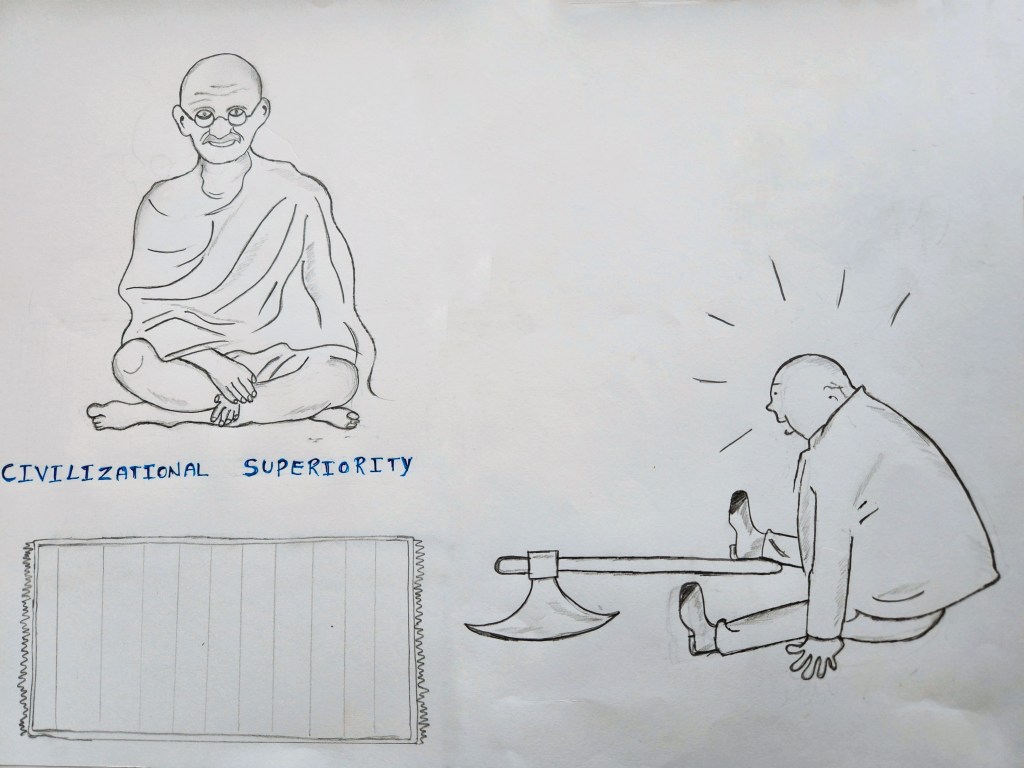
So, the gathering following Ahimsa puts the opponent, the Raj, in a quandary. Do not react and let people around the world believe that it did not care about the points being aired by the gathering and seem insensitive and thus dictatorial, or disrupt the gathering quickly with violence believing that its civilizational superiority meant the grievances aired by the crowd was inherently wrong. Over time, this violence, when repeated often enough, will trigger the same observation that the Raj is uncaring and dictatorial as all they do is resort to violence! Thus, without realizing it, the very belief in civilization superiority leads to behaviour that breaks the same belief. The strength has now become the weakness!

This is the strength of Ahimsa! The Raj was not really troubled at all. It came and occupied a land, a sacred geography, a thriving civilization, and imposed itself on it. And this mistake was shown to it by gathering in numbers that did not trouble the Raj in any way, specifically not with violence, and thus not strength or any other parameter where the Raj held superiority. The gathering just occupied a space, and it turned out to the right space, for the Raj, despite overwhelming superiority, succumbed to a weakness created by itself.

An additional observation I think is true, is that the Indian National Congress (INC) and its Ahimsa based movements acted as a safety valve and an out for the Raj in the face of growing armed resistance over the course of the Second World War (WW2) and the subsequent mutiny in the Royal Indian armed forces. This armed resistance had never stopped since almost the beginning of the 20th century.

Consider this; the British Army faced a mutiny by the Royal Indian Navy in 1946. There were similar, but smaller mutinies by the other wings of the armed forces as well. The Indian wing of the Royal Armed Forces was larger than the same from Britain itself. Additionally, the Indian forces, being trained by the British themselves, were as capable militarily and technologically as the British troops themselves. So, the larger number and home ground advantage now mattered more than in the previous century. Also, the British Raj and the Empire in general was now severely weakened economically as well. It could no longer call on resources to hold on to the Indian colony like it managed until the first couple of decades of the 20th century. Thus, British superiority in military, technological and economic terms was also no longer present or was severely degraded to the point where it did not matter anymore.

(This is actually also a martial arts concept where one matches the opponent so closely that over time the opponent does not realize where he/she is being controlled by the one he/she was attacking. This is achieved by not troubling the opponent and following his/her movements so closely as to actually learn in the moment and use it against the opponent. This then translates to Ahimsa even in armed struggle! Perhaps this concept deserves a write up of its own for deeper exploration.)

Now that their superiority no longer existed, their belief in civilizational superiority allowed the Raj a graceful exit, a face-saving if ever there was one. The Raj negotiated an exit from India by dealing with the INC and Ahimsa practitioners, thus making it appear that they were only giving in to the popular call of the people of the country. This though, never fooled anyone, only allowing the Raj alone to retain its belief in civilizational superiority. Reiterating again, this belief in civilizational superiority was the weakness exploited to make them leave in the first place! Their strength was broken without them realizing that it was broken! This is the epitome of martial arts’ abilities. To make the opponent lose without realizing that he/she has lost and achieving the objective by making the opponent retreat by their own volition, not by an act of the defender.

Artwork by Shushma N

Thus, Ahimsa was indeed a weapon of extraordinary abilities; a true Weapon of Mass Destruction (WMD)! It brought a global empire to its knees. It exploited the time and space with great precision (the world wars, railway technology, print media, global opinion, public opinion).

The sheer genius of this great WMD is the ability of Mohandas Karamchand Gandhi to bring in a critical mass of people in India to join in the Ahimsa movement against the Raj, making them just be in the right place at the right time to cause the Raj to react and thus damage itself a little more, until it could do nothing more than retreat. This is nothing short of an invulnerable Vyuha from the Hindu epics where the opponent gets trapped hopelessly with no hope of victory or even survival. It is exactly the same as getting into a position to expose an opponent’s vulnerability. It is almost a textbook example of using an opponent’s strength against him/herself.

Just imagine a martial arts concept designed to be demonstrated in a one on one duel being executed on a scale of the Indian population, which was around 350 million or so at the time of Indian Independence. The scale boggles the mind no end!

Add to this the fact that one man (at least in popular conception) could make a number as large as 350 million believe in one concept! Is this not social engineering on the grandest of scales? And this was done 70 odd years before social media, which brought the concept of social engineering to the fore.

In conclusion, Gandhiji, who is considered to the epitome of Ahimsa was perhaps an extraordinary martial artist! Of course, this is a statement made with the benefit of hindsight and perhaps Gandhiji did not ever consider himself a martial artist, but the notion is nevertheless worth considering. He fought and defeated the most powerful enemy ever, an evil empire that believed it was the greatest good ever. He facilitated the defeat of the empire by using the strength of empire against itself. He made the first move, but all that mattered was the empire’s counter, which, for all practical purposes became the first move that led to a devastating counter that was never sensed. The first move was a trap so effective and smart that no one ever realized that it was a martial manoeuvre at all!

Ahimsa is indeed the greatest WMD ever.

Ahimsa and the Martial Arts – Part 1

AHIMSA – THE MARTIAL WAY

This article will attempt to expound on why Ahimsa can be truly understood with the practice of the martial arts, specifically armed combat. It will attempt to analyze why Ahimsa has nothing to do with either a lack of violence or a lack of fighting (combat). This article will in essence try to show how Ahimsa can be practiced and expressed most effectively through fighting and how it is a “state of existence during a fight”.

Ahimsa is sometimes translated as “non-violence”. But this seems an inadequate translation. If one is well versed in the vernacular in India, it is easy to realize that “Ahimsa” is the description of a situation which DOES NOT involve “Himsa”. “Himsa” is not “violence”. It is any situation that involves discomfort or any situation that puts you in trouble. Thus, “Ahimsa” becomes “not causing or giving trouble” to anyone.

The popular expression, “Ahimsa paramo dharma”, based on the above definition of “Ahimsa” boils down to “Ensuring you do not cause trouble to others is an important responsibility”. This of course is not a direct translation, more like something that captures the essence of the expression. Martial Arts in its truest form is about strategic positioning (Kurai Dori in Japanese). Being in the right position, in both space and time is what exposes an opening in the opponent or reveals a new weakness in the opponent. The importance of strategic positioning is of course heightened in armed combat considering the human effort needed to cause harm to an opponent is outsourced to a weapon.

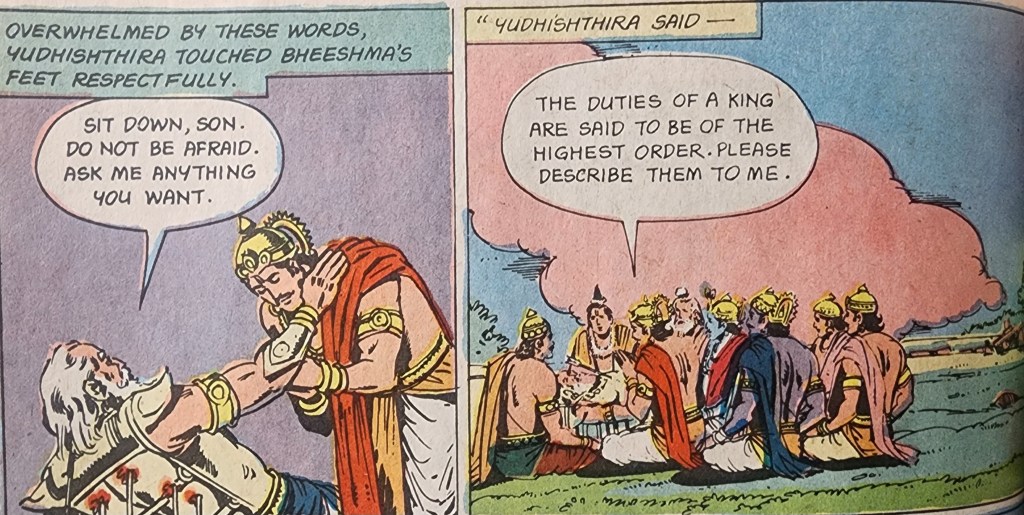
Yudishtira learning from Bheeshma. A question asked by Yudishtira during this episode is where the phrase “Ahimsa Paramo Dharma” originally comes from, to the best of my knowledge. Image credit – “Mahabharata 4 – Yudishtira’s Coronation” published by Amar Chitra Katha.

Strategic positioning is in turn a consequence of consistent and concurrent response generation to an opponent. One needs to remember that we consider a “response” and not a “reaction” to what an opponent does. However, it is a response that involves experience and “mindfulness”, and not a result of analysis (which leads to a “full mind” and not “mindfulness”).

To be in the right position is what strategic positioning means. To be in the right position, one must of course MOVE. This movement of the entire body to put it in the most advantageous position in a given situation is what is called Taihenjutsu in Japanese (Taijutsu is slightly different).

Taihenjutsu when layered with strikes (either with fists or blades or anything else), locks, breaks and throws leads to other forms like Daken Taijutsu (any martial art that involves hitting or striking) and Jutai Jutsu or Kosshi Jutsu (any martial art that involves restraining, locking, choking or throwing). Of course Koppo Jutsu is a specialization of Daken Taijutsu. As any martial arts practitioner would know none of these art forms exist by themselves and are always used together, except in sports where specific rules prevent the same for safety reasons. Thus, Taihenjutsu is the base on which martial art forms are built. It is the absolute core.

It is also true that as martial artists advance in age and experience, reliance on strength and speed reduces both due to the aging of the body and the realization through experience that expending any energy more than what is absolutely necessary in a combat situation is wasteful. Only the energy needed to survive a situation and escape might be needed in most situations of conflict. Also, with age, the glee or “high” of a fight generally reduces.

With a reduction in strength and speed, the necessity for a focus on Taihenjutsu increases. It is an inverse proportion. With greater focus on Taihenjutsu, one learns to stay in the safest possible position and thus reduce the probability of physical harm. It also causes opponents to expend more energy while revealing chinks in their armour that can be exploited. This further reduces the need for speed and strength even more (a virtuous cycle).

A key aspect of the martial arts as one learns from highly experienced masters and practitioners is to not try to fight the opponent. This is not to be construed as not doing anything. It is just a reiteration that Taihenjutsu is to be relied upon, until an opening is revealed. It is also a reiteration that Taihenjutsu saves you, even if it does not defeat the opponent.

This tenet of “not fighting” is usually also accompanied by “do not use strength or power”. It is essentially the same thing, focus on Taihenjutsu. But this is easier said than done. Taihenjutsu as stated earlier is about responding to the opponent, not reacting*. So, what does Taihenjutsu entail? And how can one “respond” to the opponent? And how do these two result in not fighting or not being strong? The answers to these above questions will lead us to the notion of Ahimsa we started this article with.

In order to not fight an opponent, one can either get away from the opponent, maybe by running away. Alternatively one can stay in the fight and purely survive the fight, while not doing anything to harm the opponent. The latter helps us explain things better and hence will be our focus going further in this article.

In order to stay out of harm’s way, one needs to move expertly and evade all of the attacks of an opponent. Once this can be done, the next step is to move to a position that causes the opponent a disadvantage. This disadvantage can be the opponent losing balance, getting tired, losing focus or accidentally getting injured or worse. Any of the four outcomes mentioned lead to the opponent eventually losing the fight. Thus, one will have achieved a favourable outcome (not necessarily winning) by letting the opponent defeat herself or himself. Taihenjutsu of course, can be embellished to let the opponent “strike oneself”, “trip oneself” or in any general manner “cause harm to oneself”. But this aspect is not necessary for the purposes of this article and will be left out.

Thus, as seen above, it is possible to achieve the upper hand purely with Taihenjutsu. There is another overarching statement that encompasses both “do not fight” and “do not harm the opponent”. This is, “do not do interfere with the opponent”. In other words, let the opponent do whatever she or he wants. You just stay safe and on the lookout for openings with Taihenjutsu. This statement can be reworded to “do not cause any trouble for the opponent” with the same essence as earlier. Thus, we have the definition of Ahimsa that we started with. But we have seen how it is achieved with Taihenjutsu.

Krishna allowing Kaala Yavana put in all the effort, not getting in his opponent’s way, and yet leading him to his doom. Image credit – “Krishna and Jarasandha” published by Amar Chitra Katha.

The next question is, how does one achieve Taihenjutsu with Ahimsa? The answer lies in the fact that one should respond to an opponent and not react. With considerable experience in the martial arts one learns to “be aware of an opponent” or to be “mindful of one’s surroundings including the opponent” (this is Sakkijutsu in Japanese). This is not easy and requires many years of practice. But when one achieves the ability to be mindful at all times in a fight (preferably at all times in life). Once one is mindful of all of one’s surroundings, staying in the safest position in a dynamic situation even as an opponent is attacking is easier (never just “easy”), as there are in reality only a handful of actions open to any opponent at a given instant.

Once a martial arts practitioner can achieve mindfulness, it gradually becomes easier to read an opponent. Once an opponent can be read, his or her attacks can be responded to, sometimes even with accurate prescience. The need to react to an attack diminishes. Thus, an attack and a threat from an opponent can be nullified. This explains how to switch from reacting to being responsive. The next question that comes up is how does one achieve mindfulness and learn to be responsive and not just react. The answer to this can only truly be understood with experience and a lot of practice. It becomes evident as a revelation while training and not as a worded understanding. But an attempt will be made here to elucidate this in words.

To be mindful, the starting point is to not have a “mind that is full”. A mind is full, in the context of a fight, when one has an agenda or objective, specifically towards the opponent. This is especially true when one has a need to defeat an opponent and not “let the opponent stop being the opponent”. Also, generally, when one conceives of an opponent, the need to overcome an opponent has connotations with the EGO. One needs to achieve objectives in a fight to be satisfied with oneself, sometimes irrespective of the outcome of the fight itself.

The drive to achieve the ego driven and result oriented objective, especially with increasing time in a fight results in focusing on the objective rather than the actual reality of the opponent. This results in the mind being full and prevents mindfulness. This reduces the ability to read the opponent and thus potential opportunities in a fight. This also creates openings for an opponent to exploit. This last point leads to reactions instead of responses. Thus, there is no Taihenjutsu, only a fight.

Based on the above observation, the simple means to achieving mindfulness is to let go of all ego and individuality in a fight. Have no desire or emotion towards the opponent. Just accept the opponent, the space around (terrain) and all other factors. Have no complaints for the situation one is in, have no plan or desire for after the fight. Do not complain when the opponent seems successful in attacks. Accept hits and pain. Do not consider and worry about humiliation and reputations. When all of this is done, the mind is empty and capable of mindfulness. Control your mind to prevent these thoughts. In other words, achieve SELF CONTROL to achieve mindfulness. Self-control is the beginning of the path to efficient and effective Taihenjutsu. Self-control includes both mind and body, but generally begins with the mind as anyone who perseveres in any crisis knows.

We have now seen how Taihenjutsu leads to and is improved by Ahimsa. Also, the path to good Taihenjutsu, is self-control, starting with the control of the mind. Thus, Ahimsa is also a state of mind. One can be in a fight, which might result in a grievous and injurious outcome for the opponent, but that is not due to your intent to cause harm to the opponent. The bad outcome for the opponent is a consequence of his or her ill will which started the fight in the first place. Finally, this means that Ahimsa does not require one to suffer in a fight and definitely does not require one to shy away or run from a fight (except for survival, which is a tactical retreat). The notion of “turn the other cheek” is a fallacy with our understanding (It is only a good strategy in asymmetric warfare where one wants to shame the person slapping. But asymmetric warfare is beyond the scope of this article.).

In essence, “Ahimsa paramo dharmaha” only means that is always right not to have malicious intent towards anyone at any time, not because harming others is wrong, but because it maximizes the chances of the opponent causing harm to herself or himself. This way the chances of one starting a fight diminish considerably and the chances of effective conflict management increase exponentially. In conclusion, survival of life and life styles is of paramount importance and should never be held hostage to a false notion of non-violence, which has nothing to do with the concept of Ahimsa.

Notes:

This article is written with the example of a small one on one fight. But it applies to larger conflicts as well. All of the points above apply to any conflict management (conflict resolution is a bad joke) situation in all walks of life.

*- A reaction is thoughtless, mostly driven by conditioning (Jokin Hansha in Japanese). A response is based on the situation and mostly a “considered” action.

One can replace the word “mindfulness” with “awareness” if that makes one more comfortable reading this article. They are used in the exact same context here.

Expression through obstacles – An exploration of the “ART” in the Martial Arts

The martial arts are a passion for many. This passion is expressed in a multitude of ways; combat sports, gymnastics, dance & choreographed performances, weight training, obstacle races, through movies, TV & YouTube (watching, making videos), through books (reading, writing, fan fiction, narration), through video games, study of history, craftsmanship (smithy, engineering, cosplay) and of course, actual training of the martial arts (with or without weapons, with and without rules1, with physical or spiritual primacy2).

There might be several dichotomies in the range (perhaps limited) of expressions mentioned above. The means of expression of one’s passion for the martial arts by itself will create an opposition or derision for the means of expression of the same passion by another. And this is even before we even consider the range of negative opinions practitioners of one martial art form sometimes display towards the practitioners of another martial art form. We shall return to this aspect of opposition and dichotomy in a bit.

Beyond all this, each of the means of expression mentioned above itself is an offshoot of or root of another art form altogether. By this I mean that writing stems from literature and poetry, dance lends itself to music & song, video gaming stems from a multitude of visual & aural arts, spiritual martial arts are meditation with matter over mind and many other such examples.

But the one thing that is common to all of the above is that they are all forms of expression, with a myriad of objectives. And the flow of expression from inception to objective is the “ART”. This FLOW, is unique to a given space and time3, considering all the human abilities, memories, experiences and their concurrent environment (not necessarily physical). It would be appropriate to call it EPHEMERAL, to emphasize how incredibly unique an expression and the flow of the same is.

This ephemeral nature of the creation and expression of an art for is what brings us to the definition of ART. It very simply could be that “anything that once done can never be replicated (not repeated) is art”. This is one definition that my teacher Shiva once used in class that has stuck with me ever since.

This definition of art means that with each rendering of any piece of art, be it martial, musical, visual (architecture, painting, sculpture etc.) physical (dance, drama, cinema, watching a sport), even if experienced or consumed (food & beverage) multiple times, will result in the consumer or the one experiencing the art form have a different FEEL OR FEELING each time the experience occurs. The feeling itself is a melding of feedback from all human senses.

Thus, art is ephemeral at both source and sink. This opens the door to further generation of art and its experience (or consumption).

To consider the “sink” side of the arts, we see that the “feel” or “feeling left behind” due to the artwork is vital. The fact that a feeling is involved means that the senses need to be triggered, and any sensory trigger is essentially eliciting a reaction. This then could be described as the purpose of existence of any artwork. The purpose of art is to elicit a reaction. This again is something I saw a contributor to the Tor.com blog mention and it has stuck with me ever since.

With all the above in mind it should be quite clear that if we are to consider something a martial art, we need to find the “art” in it. This is circular logic, where we set out from an assumed understanding of martial artists in terms of their ways of expressing their passion, to understanding what is essential to being a martial artist.

We have seen above that all artists (practitioners of art) express themselves and elicit reactions. A painter expresses his or her vision of a snapshot in time & space, an architect designs and creates an expression of devotion, power, grandeur, passion etc. (each a subjective term) in his or her work.

A group of musicians attempt to trigger specific emotions in response to their use of sound and words with specific tones melded in harmony. Dancers, either alone or in groups attempt the same, with or without music. Writers attempt the same by allowing readers to create stories in their minds in response to words strung together in harmony. Film makers do the same using all the above! As do video game designers and gamers themselves!

Clearly then, martial artists are expressing themselves and trying to elicit a reaction, because they are creating “works of arts”, as they are practicing an “art”.

Here, we need to define the tools of the trade for martial artists (or practitioners of martial art), else all works of art they produce gets shoved under a generic term called “FIGHTING” which might lead to a reaction not different from the reaction to the word “VIOLENCE” (the rasa “BHEEBHATSA” or disgust, as the elicited reaction for a large part of the populace, comes to mind).

A martial artist begins his or her expression as a “reaction” to the attack or just any “threatening movement” of another (attacker or UKE4). The initiation of the movement could be by a single or multiple individuals.

He or she goes on to continue a series of movements, until the threat of the attacker or attackers (UKE) is nullified. The fact that no two attacks can ever be the same due to human nature, means that no two expressions of threat nullification can ever be the same! Thus, the “Art” is discovered!

Here then, comes the slight difference in the “expression” aspect where the martial arts are concerned. A martial artist with increasing experience and knowledge of the art form, is to express himself or herself seamlessly, while multiple impediments are triggered by one or many individuals to upset said expression!

Drona moving towards his objective despite all the obstacles from the Pandava Army. Image credit – “Mahabharata 33 – Drona’s Vow” published by Amar Chitra Katha

A martial artist expresses his or her movement seamlessly despite every attempt by the attacker or attackers. The attackers try to prevent the expression as that means they have achieved their objective.

The more seamless the expression, the more AWE INSPIRING the feeling. The less seamless the expression, the more the potential of said expression being classified as “fighting”.

Thus, “seamlessness” is the objective, and hence the art itself.

Abhimanyu in seamless flow despite being severely outnumbered. Image credit – “Mahabharata 34 – The Slaying of Abhimanyu” published by Amar Chitra Katha

Now then, we ask ourselves, how is one seamless movement distinct from another similar movement, when the end result is the same (nullification of the threat)? This in turn allows us to define the tools of the trade for a martial artist.

We saw that the initiation of expression comes from not the martial artist but from an external source, here the attacker (Uke). The response to this attack is the seamless movement. The movement can use a multitude of tools by itself. These are the environment the movement occurs in, use of implements (arms and armour) and the flow of movement (and intent) of the attacker or attackers.

The environment is nothing but the terrain and climate (indoor, outdoor, floor inclination, stairs, water, mud, rain, heat, cold, plants etc.). Terrain and climate can easily be “space and time”. Arms and armour of course include any and all weapons and their countermeasures. The last part is the use of the attacker’s/attackers’ strength, speed, desire for a specific attack and outcome, urgency, hubris and the like.

A variation in the environment, implements and attacker intent is what completes the artwork of a martial artist. It is what can be called the “flavour” or “essence” of any art work by a martial artist.

If a set technique is performed in a specific location, at night, with weapons against multiple attackers, as against the same technique in a different location, without weapons and in broad daylight, the art work comes to life! Nothing complicated there!

A secondary aspect of the art generated by a martial artist is that the feeling of awe it elicits is experienced differently by the attackers, other martial artists and everyone else. The very subtle and nuanced expressions of the movement can only be experienced by the attacker/attackers, and none other. Those who are not martial artists still do feel something, but maybe not the same as that felt by other martial artists, again bringing forth the “arts” in the martial arts!

In order to make the experience more accessible, martial arts can be choreographed, lending themselves to dance and gymnastics, but limiting the awe factor with a lack of belief as in movie, TV and video game action sequences. Alternatively, they can be bound by rules to ease the experience, as in most sports, combat or otherwise.

In both the above “constructs”, the ones creating the experience are still enduring the same awe as ever, even if to enable others to partake of the same, albeit to a considerably limited degree.

Thus then, like all arts, the greatest awe can only be truly experienced by the artist himself or herself, leading one to understand, given the ephemeral nature of all art, that there is only fresh creation, no room for derision. Also then, with enough time and experience (call the two together WISDOM) the need for any dichotomy, that was define earlier, with should itself be nullified. This closes this circle of thought and expression of wordy movement. J

Footnotes:

1 – Martial arts that are converted to sports and those that are not

2 – Consider Tai Chi and Kalari Payatt as examples at either end

3 – No speaker will ever use the same words in the same sequence in two separate renderings of the same thoughts.

No painter or sculptor can ever replicate the same colour or stroke or vision in two separate attempts.

No singer or dancer or gymnast will ever replicate the same tone or move in even consecutive attempts.

No writer will ever use the same words in the same combination in two separate renderings of the same story or situation. 4 – A reference for Bujinkan practitioners