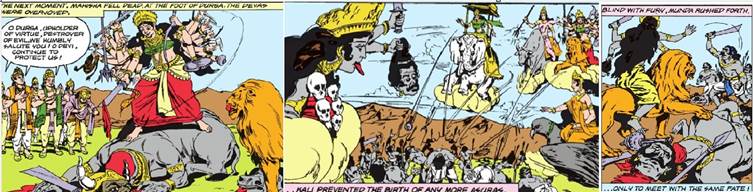
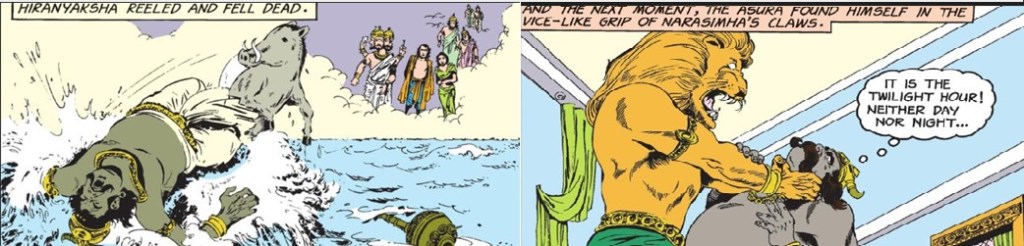
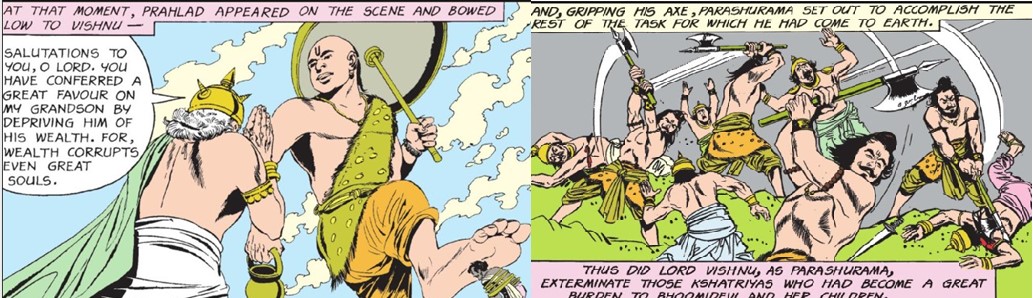
Thoughts from Op Sindoor, Part 3 – Money matters!

India did not have a strong martial arts culture in the last few decades, until recently. Even now, it is not prevalent in all parts of the country. In places with higher disposable incomes, interest in and practice of the martial arts is growing. In parts of the country that have a strong continuation of historical traditions, martial arts are present as well, but more as a performance art. This is not true historically though. Martial arts were a vital part of Indian culture for many centuries before diminishing in importance in the latter half of the 19th century.

Now that martial arts are making a comeback, an interesting aspect is visible. There is a cost associated with practicing the martial arts. The costs include time, effort and money. Financial costs include, tuition fees of teachers, membership fees of gyms or dojos, cost of apparel and training equipment*. Training equipment includes protective gear and training tools, which include practice weapons. Beyond this, time is spent in traveling to the place of practice and in practice itself. And then there is the effort that it takes to make time and financial resources available for martial arts practice.

The costs mentioned above were present in the past as well. For some professions, this cost was valid as it directly impacted the earning of a livelihood. This is true in modern times as well. But for individuals who are not working with law enforcement, first responders and the defence services, this cost is not necessary. The payback is not necessarily monetary. Hence, there comes a point when martial arts practice becomes discouragingly costly. This was true in the past and is true in contemporary times as well.

The cost of martial practice extends to nations too. Here the cost is justified as a nation’s sovereignty and territorial integrity are dependent on the expenditure on its martial wings, in other words, defence forces, intelligence agencies and law enforcement services. As this is vital at a national level, all nations have defence budgets.

But the defence budgets of all nations are not the same. The defence budget of the USA is almost a trillion USD! The defence budget of China is about 350 billion USD. The defence budget of India is 78 billion USD (in 2025). The cost of defence preparedness might be the defence budget but that is not the same as the cost of war.

The cost of war, depending on how long it lasted and the devastation it caused can be varying. The cost in terms of loss of life and limb of citizens is incalculable. It renders a section of the population unable to participate in any economic activity and in many cases dependent on the state, which is a necessary drain on the economy. There is also a cost associated with reconstruction and rebuilding of the economy. This is exclusive of the opportunity cost and the uncertainty of real recovery.

Unlike the cost of war, defence preparedness can have a positive effect. Over time, increasing defence budgets can lead to the creation of a military-industrial-academic complex. This complex leads to better education for large sections of a society and development of a manufacturing ecosystem. This leads to more jobs, development of advanced technologies and improved innovative abilities of a society. Defence preparedness also involves having great infrastructure in perpetuity. And then there is the boost to the economy through the export of weapons and weapon systems. All this is without even considering the benefits of the development of dual use technologies. Beyond all this there is the saying “If you want to have peace, prepare for war” (from the original Latin, “Si vis pacem, para bellum”).

It could perhaps be said that preparation for war can lead to restarting and rebuilding of a flagging or destroyed economy. A perfect example of this is the Ashwamedha Yajna in the Mahabharata, which occurs years after the end of the Kurukshetra War. The reason the epic gives for the event is that Yudishtira performs this yajna to atone for the sins committed during the Kurukshetra war. But I opine that the reason for this yajna was to kick-start the economy of the kingdoms of Hastinapura and Indraprastha.

A very large number of males had died in the Kurukshetra war. If the numbers from tradition are considered, somewhere between 3 and 4.5 million men died in the war. This meant that a large part of the working population in Northern India was dead. The coffers of all the kingdoms that participated in the war were empty due to the logistics of the war. This meant that the economy of all the participants was in the doldrums.

The Ashwamedha Yajna requires a large investment to perform and conclude successfully. To start with, a large quantity of gold is needed in the performance of various rituals and all the participating Brahmanas have to be compensated for their part in the yajna. A strong army is needed to protect the horse, the Ashwa of the yajna.

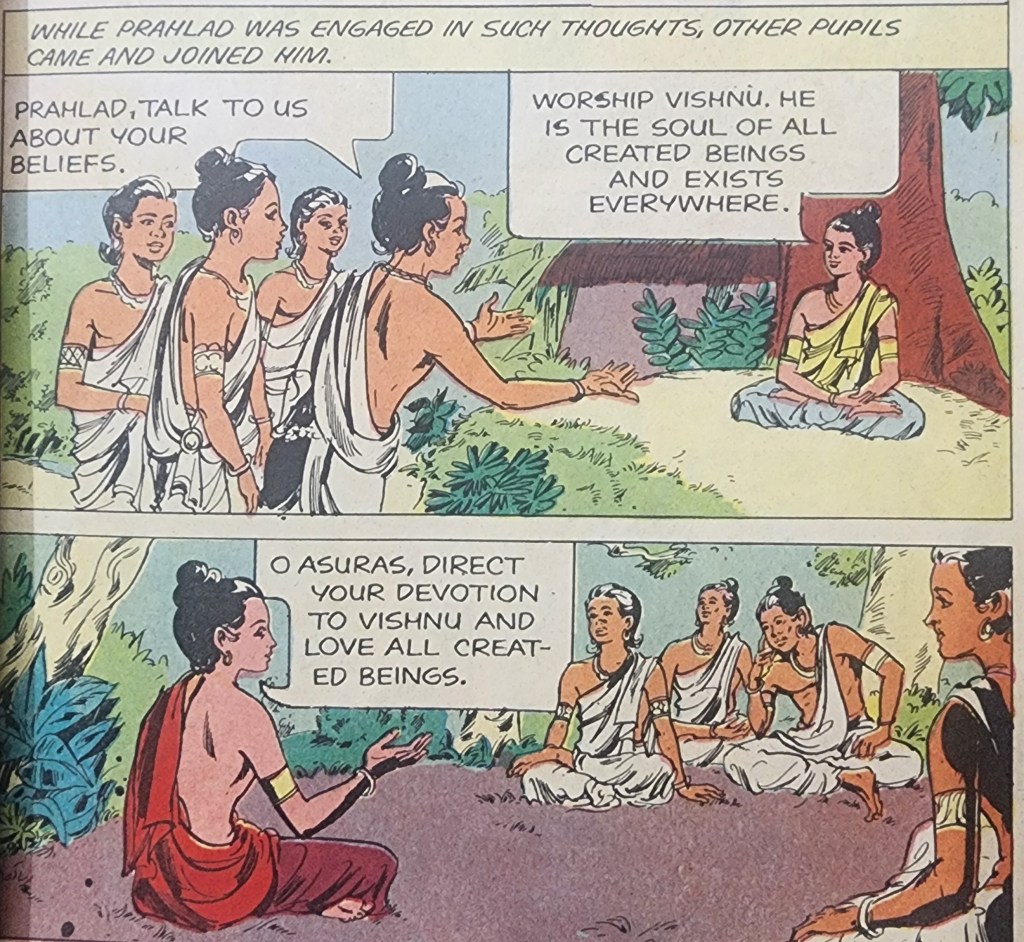
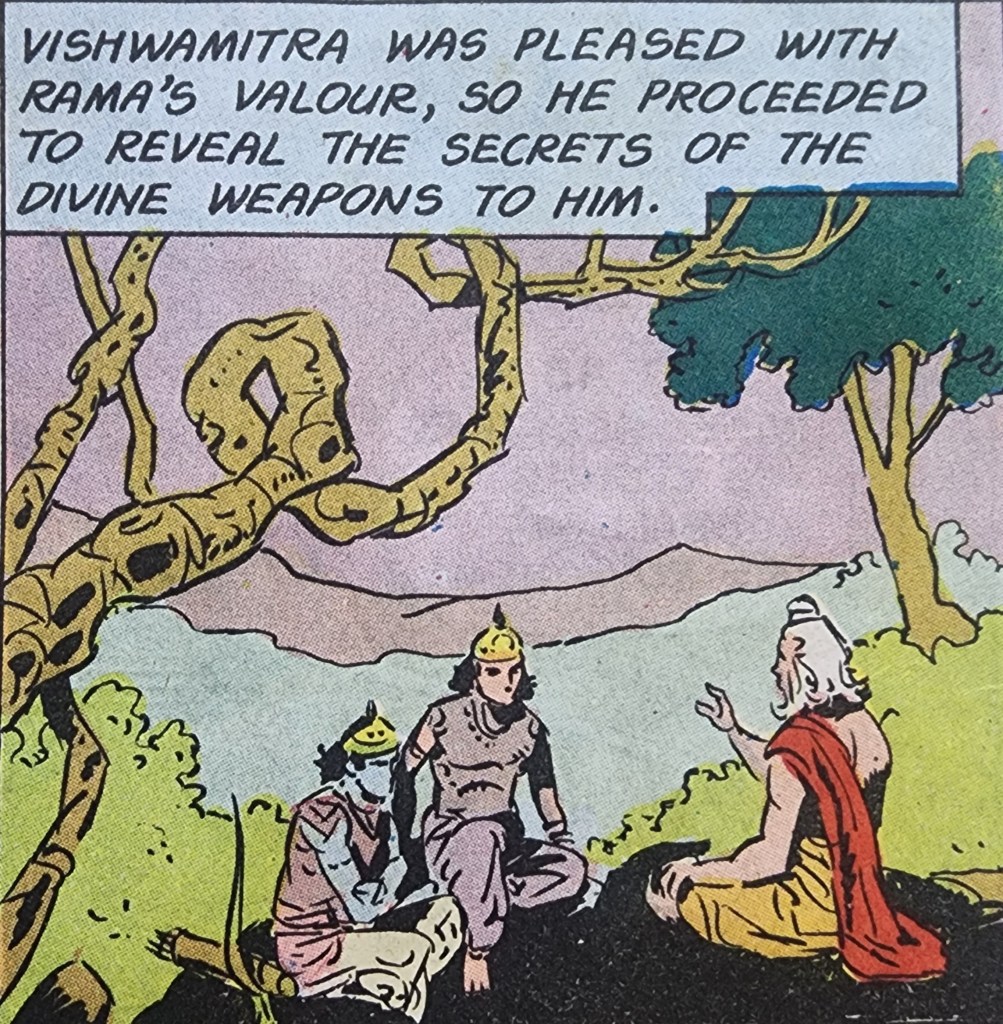
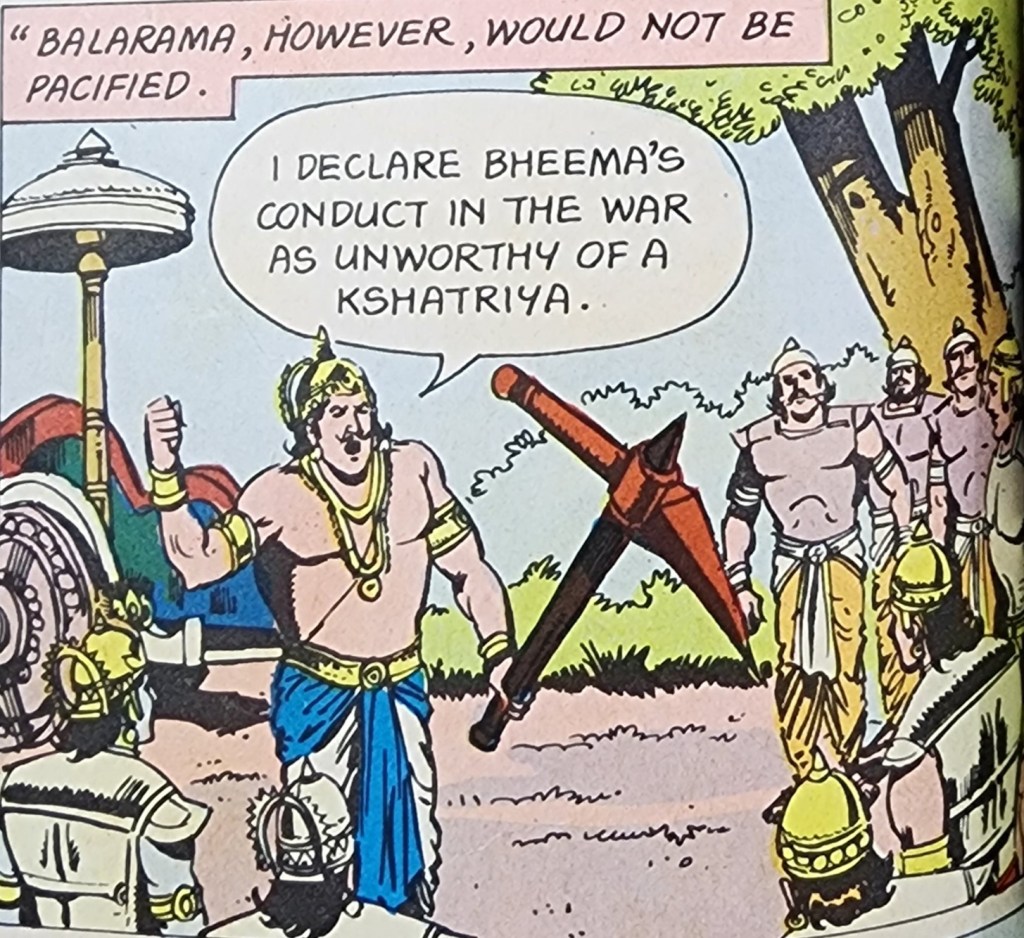
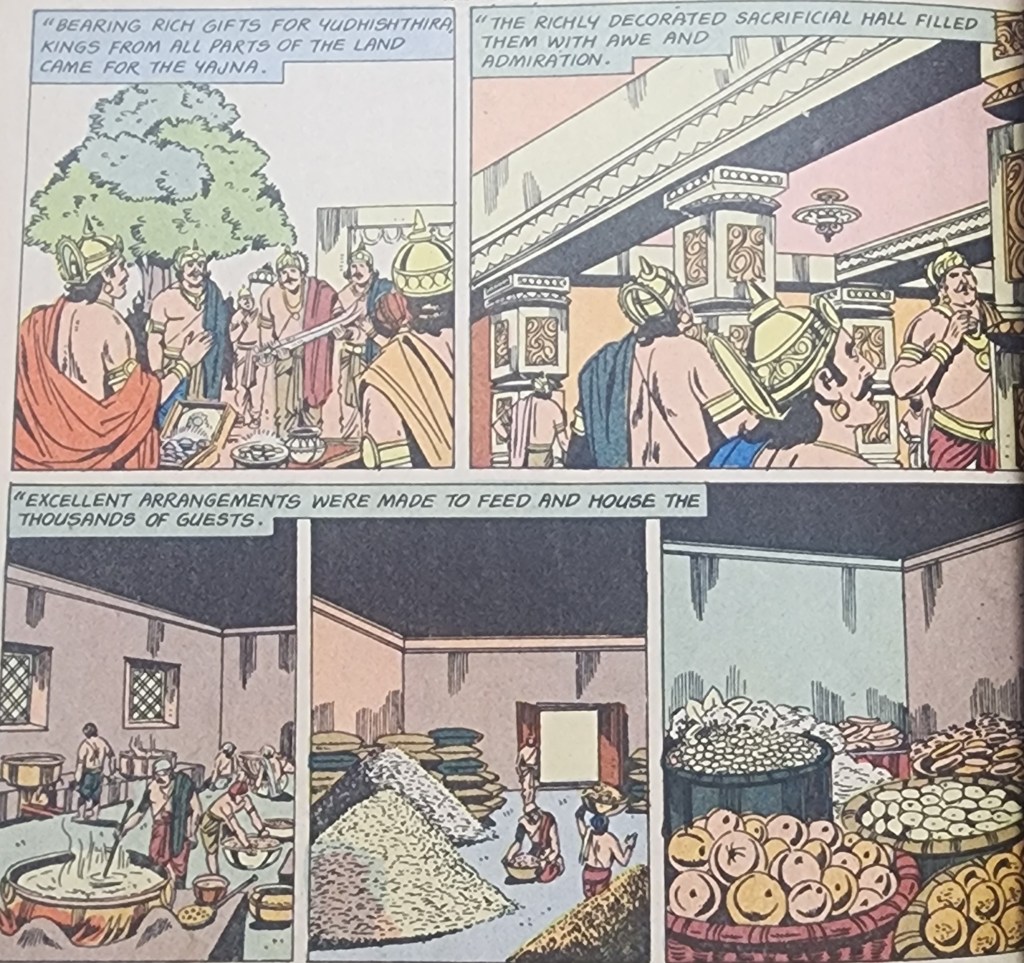
The economy does not allow for an Ashwamedha Yajna. Image credit – “The Mahabharata, Part 41 – The Ashwamedha Yajna”, published by Amar Chitra Katha

The horse would wander around for a year in various kingdoms. These kingdoms could stop the horse or let it pass through. If they let it pass through, they had to offer tribute or sign a treaty with the army of the king whose horse it was. If they stopped the horse, they kingdom that stopped the horse had to fight the army protecting it. The fact that an army was involved meant that a functioning supply chain was needed, apart from soldiers and their training.

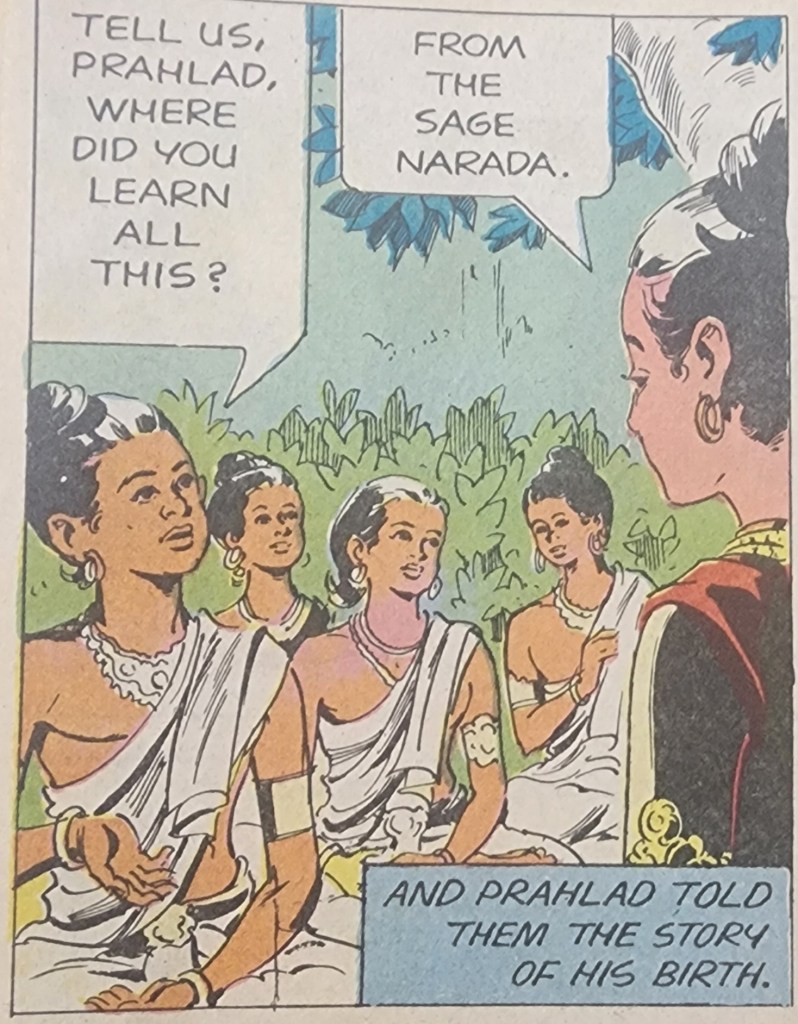
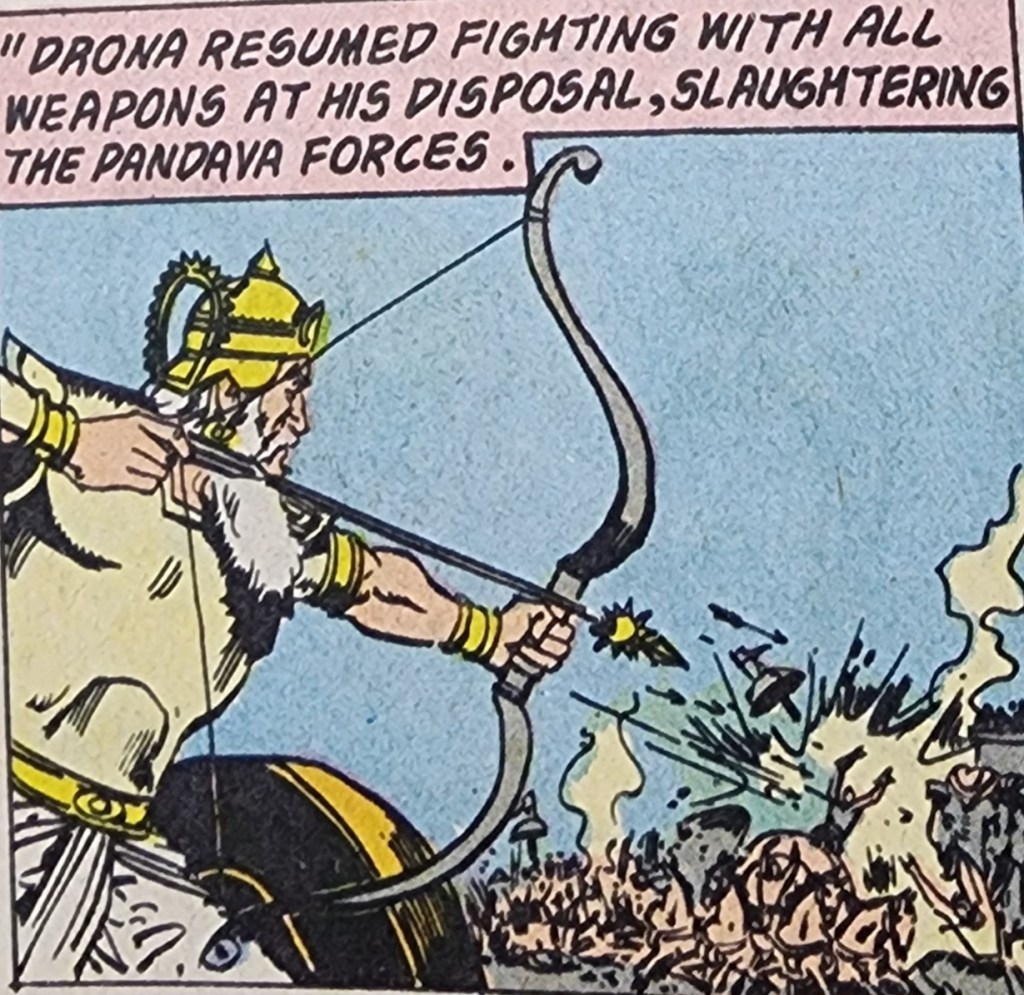
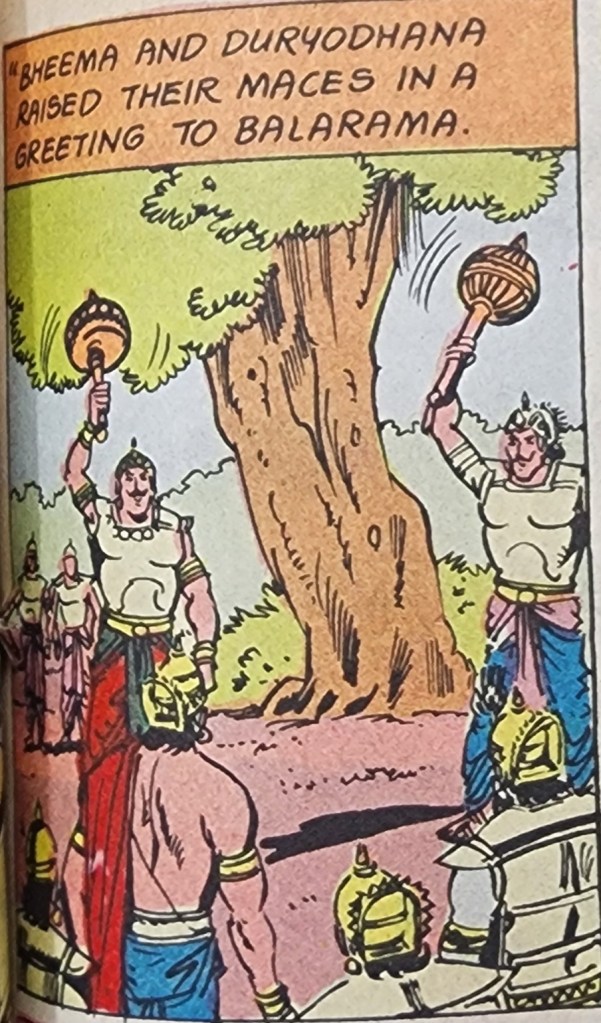
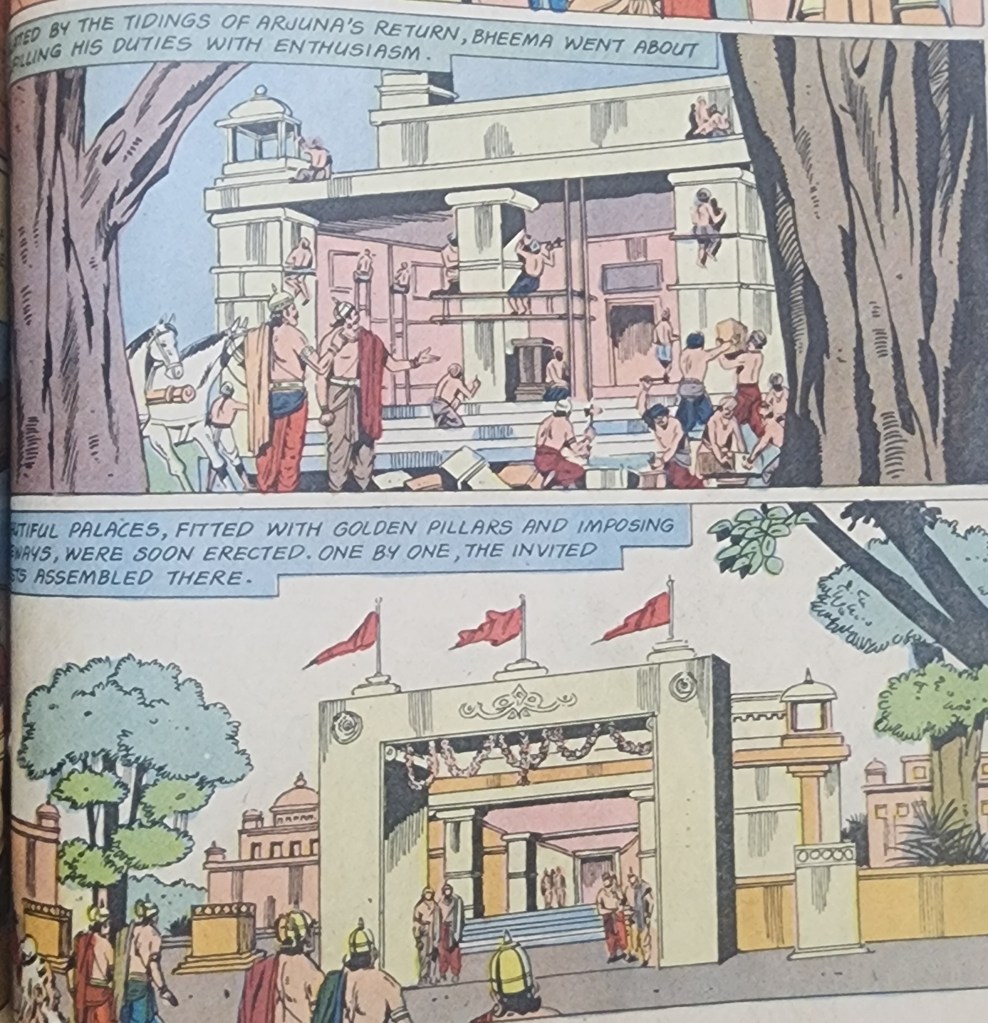
The massive logistics effort needed for the Yajna. Credit for the images- “The Mahabharata, Part 41 – The Ashwamedha Yajna”, published by Amar Chitra Katha

So, all parts of the economy have to contribute to the Ashwamedha Yajna. Food production is needed to feed the army. Industry is needed to equip the army and carry out the yajna itself. Administrative and financial bureaucracies have to be put in place to coordinate the logistics of all the activities. With all this coming up, the economy gets a jolt to restart. The tribute from the successful performance of the yajna ensures capital flows for growing the economy further.

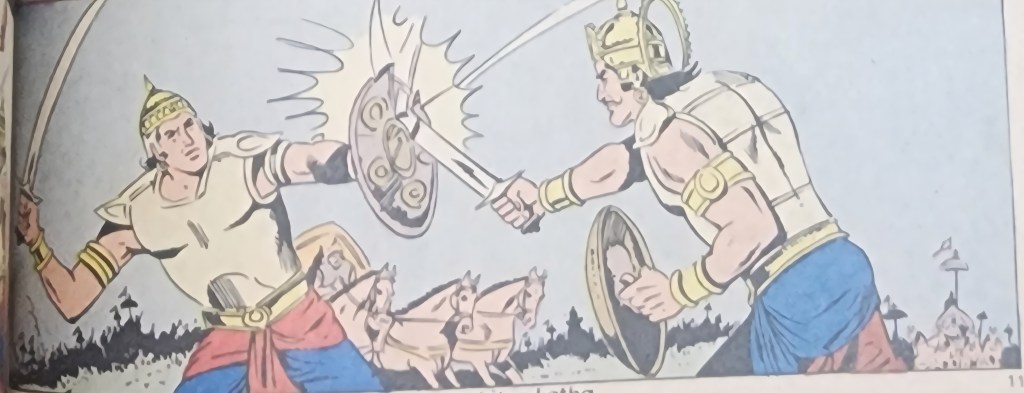
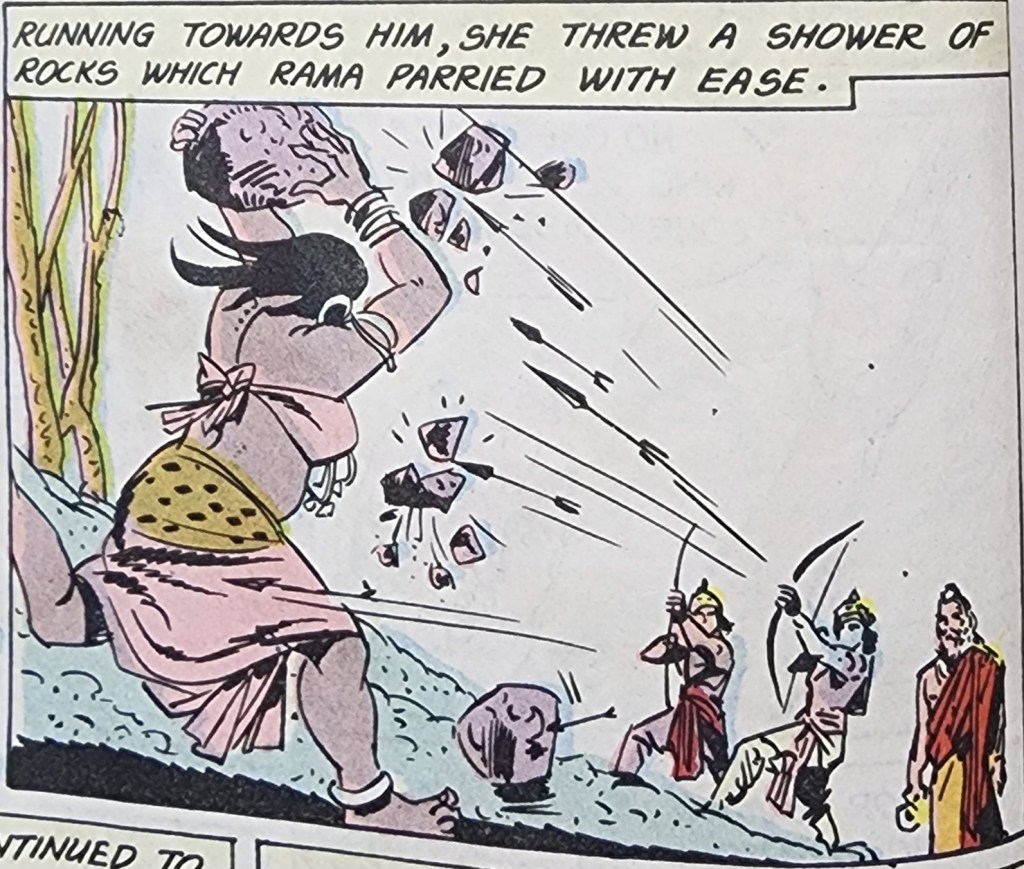
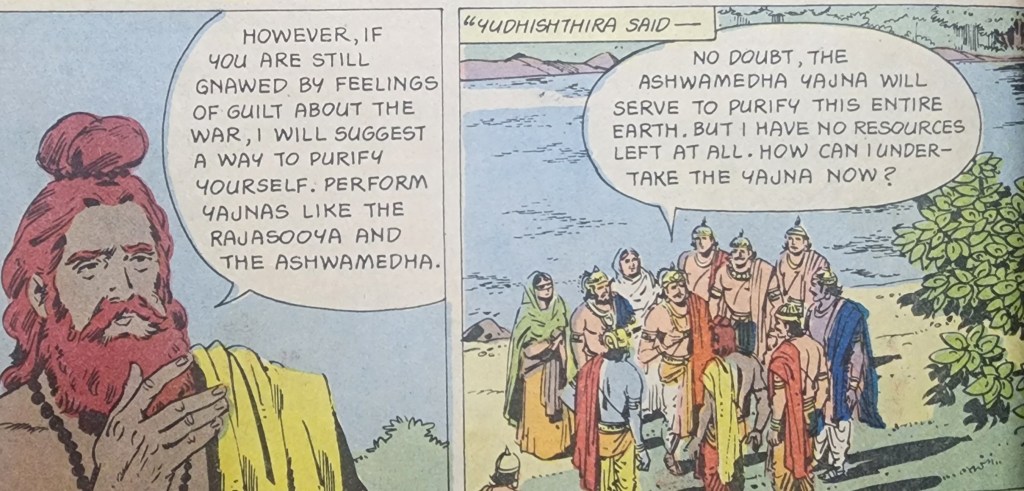
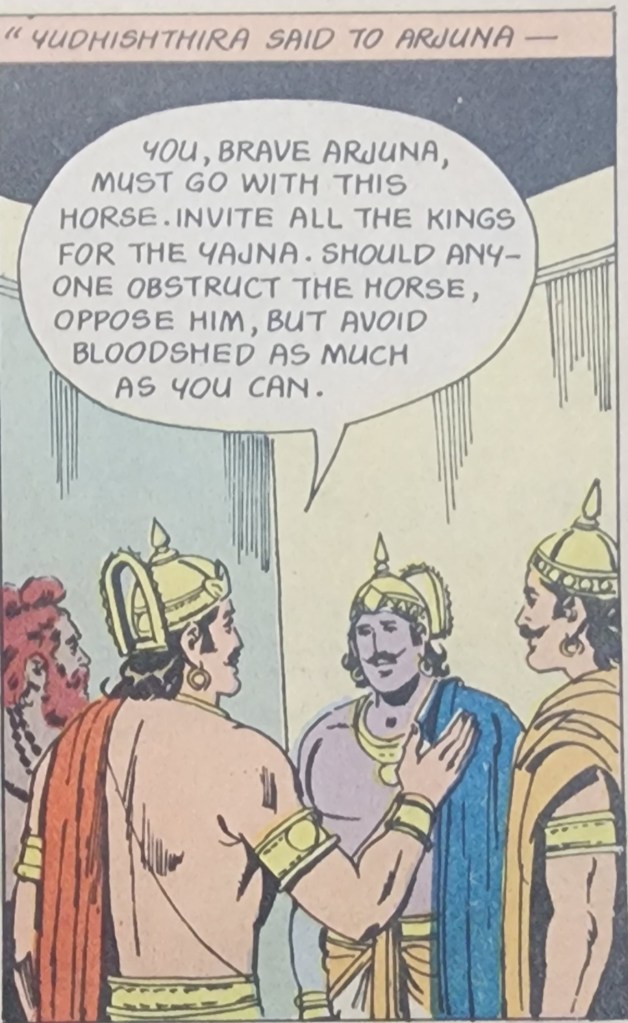
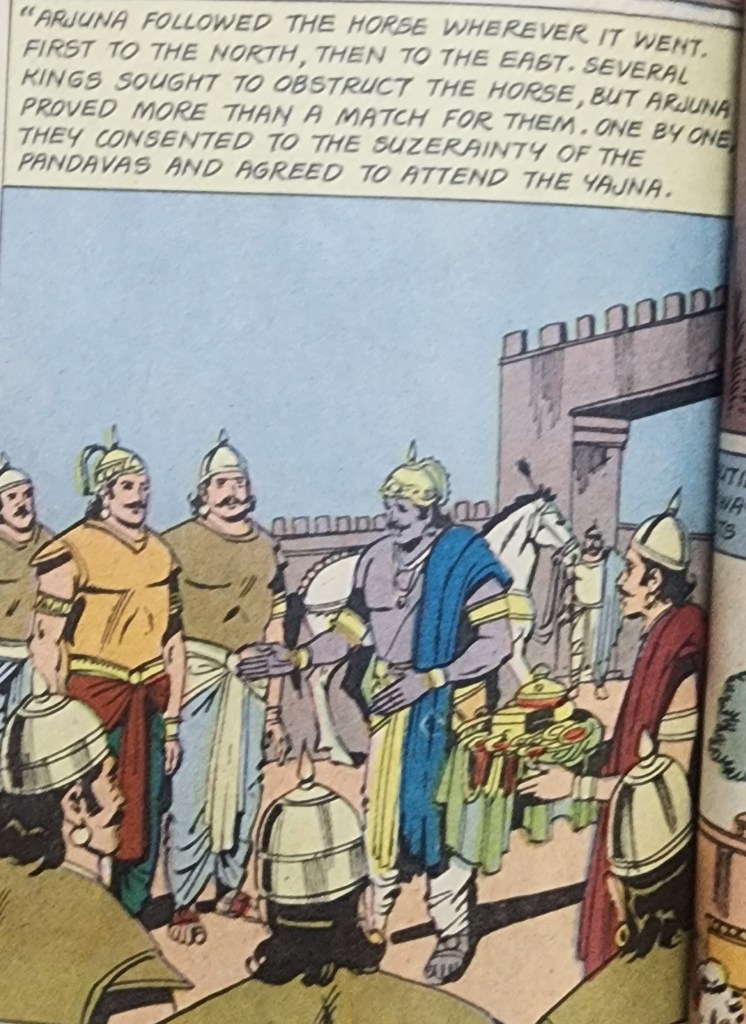
A strong military is needed and military conflict is inevitable during the Ashwanedha Yajna. Credit for the images- “The Mahabharata, Part 41 – The Ashwamedha Yajna”, published by Amar Chitra Katha

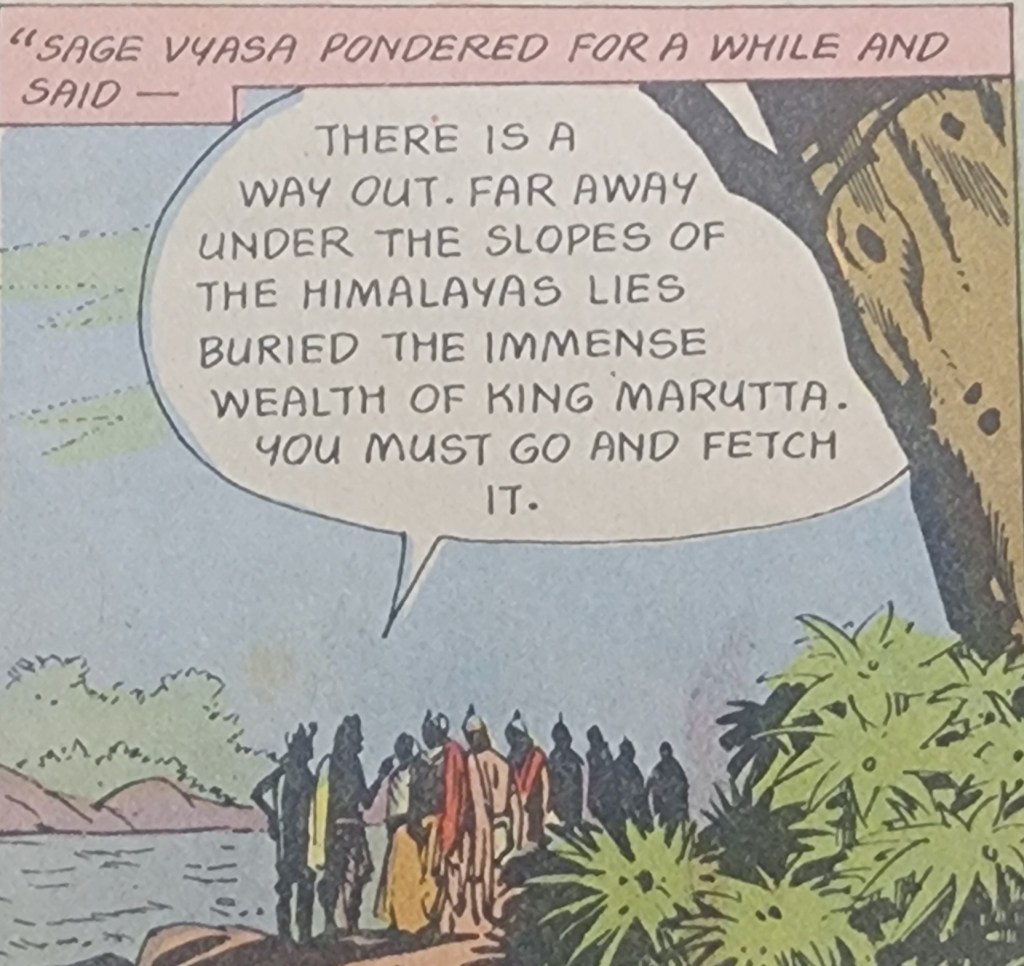
But, for a faltering/failed economy to be able to do this, an initial capital infusion is needed. This could be a loan. But in the Mahabharata, there was no institution or fellow kingdom that could afford to hand out a loan post the Kurukshetra War. So, the Pandavas dug up buried treasure. Maharishi Veda Vyasa directed them to the treasure. The treasure, a vast hoard of gold became the seed capital for the Ashwamedha Yajna and the prosperity it eventually led to.

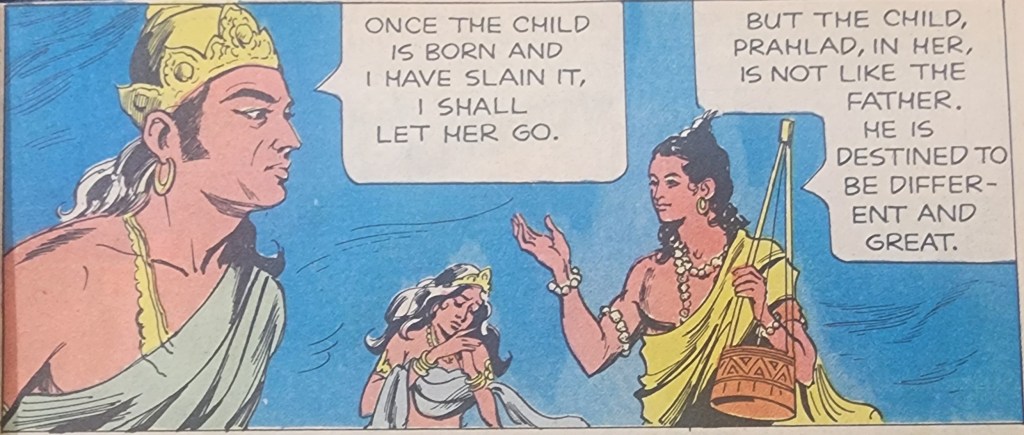
Buried treasure is initial investment! Credit for the images- “The Mahabharata, Part 41 – The Ashwamedha Yajna”, published by Amar Chitra Katha

This wonderful segment of the Mahabharata shows how preparation for a war could lead to economic recovery. But the Kurukshetra war itself caused untold devastation. The epic is in this sense a wonderful case study for both war and its consequences and the economic recovery preparation for war can lead to (even if the defence preparedness is disguised in a sacred yajna).

Thus, it has always been about availability of resources for martial preparedness, and martial preparedness to protect and enhance economic resources and their availability. But, and it is a BIG but, this only holds where there is a democratic or a Dharmic society. A Dharmic society as I am referring to the word, is one that is defined by a clear understanding of responsibilities of the administration, even if the head of government is a king or queen who holds power due to heredity.

Wealth distribution is a must during and after the Yajna. Image credit- “The Mahabharata, Part 41 – The Ashwamedha Yajna”, published by Amar Chitra Katha

Defence preparedness is unlikely to function in the case of Palace Economies. A palace economy is one where the leader or king or dictator or the family of the same, controls all resources and distribution of the same. This control could be arbitrary, based on the will of the leadership, with no link to real world performance, hardships, challenges or threats.

A fantastic example of a palace economy is the Delhi Sultanate in India, specifically under the Mamluk dynasty and the Khaljis. All the Turkic invasions of Northern India were by palace economies. From the little history we were taught, there was no doctrine of administration that these invaders followed.

After the fall of the Delhi Sultanate, the Mughals controlled the regions of Punjab. The later Mughals, after the death of Aurangzeb, struggled to defend this region. When Ahmed Shah Abdali of the Durrani Empire centred in modern day Afghanistan invaded Punjab repeatedly, they were unable to protect the populace of this region.

Abdali was a wonderful example of a palace economy as well. He took over the regions of Afghanistan after the death of Nadir Shah of Persia, under whom he had previously served. The later Mughals were also a palace economy, but with a much smaller resource pool to go around. Abdali, on the other hand, invaded Punjab and northern India several times to acquire wealth, which was then distributed as he desired, further strengthening his palace economy. The invasions of Northern India continued until 1761 and the 3rd battle of Panipat and the invasions of Punjab continued for a few years even after that seminal event.

Abdali won the 3rd battle of Panipat, but the cost of the victory dissuaded him from ever returning to the plains of Northern India. His ravaging of Punjab is chillingly captured in the following Punjabi saying. “Khada peeta lahe da, baki Ahmed Shahe da”. It means that only what one has eaten and drunk is one’s own, the rest belongs to Abdali. It refers to the loot that ensued when Abdali attacked; people lost everything. And this kind of loot was important to keep a palace economy functioning.

The lack of this functioning in the later Mughal court required the Marathas to fight the 3rd battle of Panipat. Though they lost the battle, they successfully diminished further Afghan invasions. All further battles between Indians and the Afghans, beyond Punjab, occurred when Afghanistan was invaded by the East India Company or the British Raj. By this time, the Afghan palace economy had faltered and become dysfunctional as well. This is classic of nations where economic development did not kick off in the early modern era.

There is however a trap of exhausting one’s economy with an excessive focus on defence preparedness. I have heard a lot of people say that the USA defeated the USSR by outspending them on defence. The USSR failed economically and could not keep up with the USA. In the quest to keep itself on par with the US in defence spending, the USSR bankrupted itself.

Economic growth and development are a vital part of being able to spend on defence. The overall economy of a nation must grow continuously. When this happens, a part of the growth can benefit the defence budget. If the economy does not grow, but the defence budget keeps increasing, the country eventually ends up being a basket case. This focus on overall economic development is the reason the Ashwamedha Yajna ends up rejuvenating the national economy, because it focuses on supply chain as a whole and not just on the armed forces.

In the modern Indian context, we Indians have a threat on two fronts. Pakistan on one and China on the other. Pakistan is gradually becoming a client state of China and is being used by the latter to prevent India from becoming a competitor on the global stage for various resources. The events in Galwan in 2020 and in Pahalgam in 2025 clearly reveal that ignoring the threats will not make them go away. India will have to always be ready to militarily confront the twin threats. I include threats in the cyber and space domains when I use the term “military” here.

So, increasing defence spending is a foregone national imperative for perhaps the coming decade. This is likely what both adversaries want, to slow down India’s economic growth. China is banking on what was mentioned in my previous post, make the Indians fight themselves to keep them occupied and weakened – Pakistanis are Indians by a different name, remember**?

Will their expectation of a weaker India come to pass? Will this spending take us the way of the USSR or make our economy grow faster and become more robust? This is a question the answer to which will only become apparent in maybe 10 or 15 years. If we go about only importing technology and weapon systems, we could go either way. But if an academic, industrial military complex is developed locally, we could become a far greater economy with a stronger military and overall national power.

Notes:

* Let me elaborate with an example. We needed training katana for practice at the dojo. We could by them online, in a sports store, get a carpenter to make it or make training katanas ourselves. Back in the middle of the 2000s, an online purchase or a purchase at a sports store was out of the question. E-commerce was just beginning for only books and sports stores did not stock much martial arts equipment other than karate and taekwondo apparel and training pads. Getting a carpenter meant having a sample to go by. All of this had one serious impediment, MONEY. We did not have disposable incomes to consider this purchase lightly. We had to seriously consider if we would train the martial arts for years to come, to consider the investment feasible. Chances of continuing were always small, so the investment was unlikely as well.

That left the option of making our own training katanas. This was done with building scrap available at home, mainly small diameter PVC pipes, which were wrapped with fabric tape and held together with cellophane or insulation tape. The hardest things to make were the scabbard or saya of the sword and the tsuba or disc guard on the katana. Because these were difficult to make, the saya was given a skip and the tsuba was a piece of thermocol (polystyrene). These worked to an extent.

The drawback with the handmade equipment was twofold. The lack of a saya meant that any technique that required the drawing of a sword could never be accurately practiced. It was always an approximation. The flimsy tsuba came apart often and that led to either injured fists or to a lack of understanding of how to use the tsuba to lock the opponent’s position. So, there was pain and poor training. Both these were due to a lack of financial resources.

Our teacher back then had said that in the past, good weapons were expensive and the same was true in contemporary times as well. This was a lesson well learnt. It was as clear an elucidation of the importance of money in martial arts as any. Money leads to technology and training and both improve chances of survival.

** https://mundanebudo.com/2025/06/19/thoughts-from-op-sindoor-part-2-nothing-has-changed/

Bhrāmari Devi, Bees and Martial Arts

20th May was “World Bee Day”. In India, Bhrāmari Devi is a form of the Devi, the Female Principle or Goddess, worshipped in many forms. “Bhramara” means a bee in some Indian languages. So, Bhrāmari Devi is the Goddess of Bees or Goddess with attributes of bees. Like with all forms of Gods and Goddesses, Bhrāmari Devi is also credited with slaying an Asura who had upended the natural order and thrown the doors open to chaos. And this brings the aspects of martial arts into the story which I shall explore further in this post.

The Asura Aruna like many other Asuras gained a boon (vara) from Lord Brahma. According to the boon, he could not be defeated or killed by any creature that was a biped or a quadruped or a combination of the two. This meant that he was invulnerable to all humans, Gods, Goddesses, other humanoid entities and also the large beasts that could harm most humans as we understand them now. This boon seems to be one that compensated for the Varāha and Narasimha avatāras. Varāha was a boar and Narasimha was a combination of man and lion.

I am making one assumption about this boon. If a biped, in other words Devatas, Mānavas (humans), Vānaras, Rkshyas (Jambavan’s kind – sometimes written as Rikshyas) and the like are prevented by the boon from killing Arunāsura, that includes any weapons wielded or discharged by them. So, a human shooting an arrow at the asura would not kill Arunāsura, nor would a warrior wielding a sword. If this was a boon in modern times, a bullet or missile fired by humans would not kill Arunāsura, nor would an AI system with human programming or input.

With this boon, Arunāsura dominated the three worlds and threw natural phenomena, the guardians of which were the Devas, into chaos. This required that he be stopped, even if it meant killing him. Since no weapon or massive beast of prey would have any success, other options needed to be explored. This is where bees and Devi Bhrāmari help resolve the problem.

Bhrāmari Devi, image credit – Wikipedia

Devi Bhrāmari unleashed a swarm of bees that stung Arunāsura. The Asura’s own attacks against the Devi were successfully defended by her. Arunāsura could not fight the bees. He eventually succumbed to the venom in the bee stings. The boon held and Arunāsura was defeated and killed by Hexapeds (creatures that walk on 6 legs), not bipeds or quadrupeds! Also, the mighty Asura was laid low by insects, among the smallest of creatures!

It is possible that Arunāsura did not include insects and other hexapods in his request for the boon since he did not consider them a threat to worry about. In this sense, a lack of awareness or incomplete threat perception did him in. He “expected” insects to not be a threat! This was an assumption, and in a conflict, assumptions and expectations are dangerous things.

I have heard a joke that has been around for at least a few decades now. A few Japanese swordsmen are competing to determine who among them is the best. The contest is to cut a fly! This joke works because everyone realizes that a sword is not what one fights a fly with. It is extremely difficult to hurt a fly with a sword. This fact holds true for bees as well!

There is a proverb I have heard, “You cannot fight smoke with a sword”. This aptly explains the situation anyone faces against a swarm of bees. When one is attacked by a swarm, all creatures know that getting away is the only option, one cannot stand and fight the swarm, unless one specifically came prepared for that eventuality. The fact that Arunāsura did not include protection from insects in his boon, shows that he was not prepared for this attack at all.

From what I know, it takes a couple of thousand or more stings to kill an adult human. Of course, if one is allergic to the venom, the number required is a lot lower. Considering we are currently in the “year of the snake”, it is apt that we are discussing a story where venom is the weapon! Venom is poisonous and fatal when injected beyond certain doses. In the case of Arunāsura, thousands of bees would have injected small doses, the sum of which was sufficient to kill him. It is a case of applying a large quantity of small solutions to a very big problem (the world ending kind!). It is the natural world equivalent of the classic adage “death by a thousand cuts”.

The story of Arunāsura is one in a long line where natural phenomena and animals are used to defeat threats to the natural order/humans and the Devatas. The stories of Varāha, the boar and Narasimha, the man-lion are well known. Another story that is pretty well known is when King Pareekshith was killed by the bite of a venomous snake. A less well-known story is Indra murdering a meditating asura by the name of Karambha. Indra committed this murder in the form of a crocodile. Indra paid for this subterfuge and assault on an innocent victim (Indra was worried that the meditation would lead to a boon which could make Karambha a threat to him in the future – a “Minority Report” kind of “pre-crime” situation).

A more interesting story of using a natural phenomenon as a weapon is that of Namuci and Indra. Namuci was an Asura of great renown and an enemy of Indra, the king of the Devas. Indra had promised Namuci that he would not attempt to kill him with anything that was either wet or dry. This seemed like a fair promise. But Indra smothered Namuci with foam on a seashore. Foam, supposedly being neither wet nor dry, allowed him to kill Namuci without breaking his promise. Indra had to face the consequences of his treachery of course.

In Hindu tradition, we celebrate a festival called “Āyudha Pooja”. This festival is celebrated on the ninth day of the 10-day long Dasara (Dussehra) festival. On this day, various tools of various trades are cleaned and receive gratitude from their users, for aiding them in living a good life. The tools that are worthy of respect in this festival include agricultural implements, weapons of war, machines in industries and even the laptops we use in the service sector.

The term “āyudha” means weapon. But it also means “tool”. Any tool that aids in life is an “āyudha”. Weapons are just tools that are used in war or any physical fight/conflict. And of course, in many cultures around the world, agricultural tools have doubled up as weapons on several occasions in history. A great example of this in Hindu culture is Balarama, the elder brother of Lord Krishna. The weapon associated with Balarama is the plough, which is most definitely an agricultural implement.

Animals have been used as tools and also as weapons of war for ages. Elephants, horses, pigeons and dogs are well known to have been used in war. If conspiracy theories are considered, even dolphins and chimps have been used as potential weapons in the 20th century, during the cold war and the 2nd world war before that. The story of Bhrāmari Devi is just an extension of this well-known teaming of humans and animals during times of conflict.

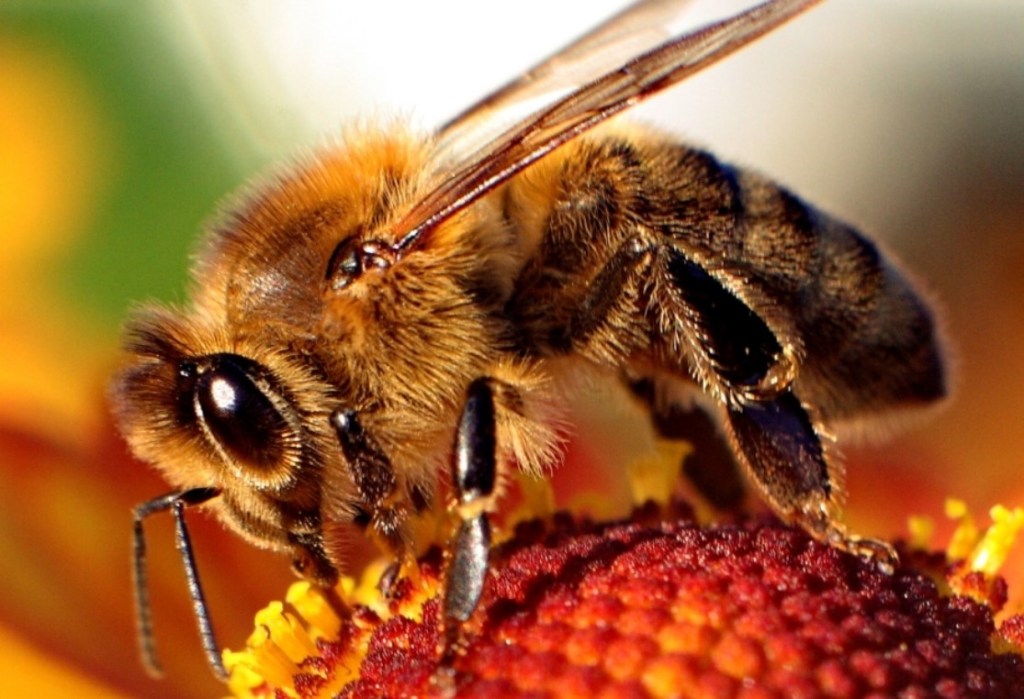
Honey Bee, image credit – Wikipedia

One instance of an animal being a tool to end a war while NOT being a weapon is the story of how Lord Muruga/Skanda/Karthikeya came to have the peacock as his vāhana. Vāhana can be translated as “vehicle” or “mount”. Most Gods we Hindus revere have animal companions, most of whom are vāhanas. The vāhana of Lord Muruga is the peacock.

Lord Muruga defeated and killed the Asura Tāraka. He also defeated another asura named Surapadman. I have heard in some stories that Surapadman is the younger brother of Tārakāsura. Surapadman eventually surrendered to Muruga. He asked for forgiveness and wanted to make amends for the harm he had caused. In return for his surrender, Lord Muruga spared his life. Surapadman then became a peacock and would serve Muruga as his vāhana. The peacock in this case is more like a peace treaty which led to the end of a war. Here, the peacock is not a weapon, but a tool, which led to peace.

This same aspect is true for bees in reality as well. That bees can kill is well known. I remember reading an article in the Reader’s Digest in the early 90s, which featured an attack by a swarm of bees. It was part of the magazine’s “Drama in real life” segment. That was the first time I read of a situation where an individual’s life was at risk due to an attack by bees. Even though we knew that bees and wasps are potentially dangerous, this article brought home to me the threat to life that they can pose. A similar article was also available in the same magazine, more recently, in 2021. I am sharing the link to that article in the notes below*.

Despite the threat bees pose, they are widely respected in the modern world. They are well known for the vital role they play in the ecosystems they inhabit and also for the wealth they can generate. The pollination services bees provide make them a keystone species in the ecosystems they have evolved to inhabit. Similarly, honey and beeswax are both sources of income for people around the world. Beeswax is used in cosmetics and honey as most would know has some medicinal properties.

Bees deploy chemical weaponry, in the form of the venom from their stings. The same biochemical abilities of the bees, results in the beeswax for the hives they build and for the honey, that is created from the nectar of flowers they visit.

I must mention a few pop culture references that come to mind due to this article. The point about bees being extremely useful and vital to the environment while being capable of threatening life has a hilarious parallel in the movie “Ninja” (2009). The movie stars Scott Adkins who is a great martial artist. The move itself is a fun watch. In the movie, the hero’s girlfriend is poisoned. The hero has inherited a katana from his teacher. The hilt of the katana has a secret chamber which has the antidote to the poison killing his girlfriend! He uses it to save her, and the antidote in the vial is the exact quantity needed to save her life! 😊

The hero does not know that there is a vial of antidote hidden in the structure of the sword until his girlfriend is poisoned. One of the teachings he has received from his teacher is that the katana of the ninja can take a life and also save a life. The hero recalls this teaching at the end and realizes that the teaching was literal! He then deduces that the antidote must be hidden in the sword! 😀 The whole scenario reeks of plot armour for the girlfriend!

The other reference has wasps** as the stars and not bees. But I am including it here since wasps are close relatives of bees and the scenario is far too amazing to ignore. There is a novel called “The Impossible Virgin” be Peter O’Donnel. It is one of the novels by the author in a series that stars the character “Modesty Blaise”. Modesty Blaise appears in 11 novels, 2 short story collections and 96 stories that appeared as newspaper comic strips.

Modesty Blaise and her friend Willie Garvin are extremely competent individuals. And they are both extraordinary martial artists with skills in unarmed combat and proficiency in many weapons, both historical and modern. In the novel “The Impossible Virgin”, they face off against a large number of gangsters while being outnumbered. This fight happens in a valley called “The Impossible Virgin” as people avoid entering it. Yes, the name is corny by modern standards, but the novel was published in 1971.

The Modesty Blaise novel, “The Impossible Virgin”, authored by Peter O”Donnel, published in 1971

Modesty and Willie are stuck without firearms against opponents who are carrying guns. But their opponents cannot use guns due to the valley. The valley is home to hundreds of active wasp nests. The sound of any gunshot will echo across the valley and trigger the wasps to attack. So, the fight is now against the machetes carried by the gangsters. Modesty and Willie use quarterstaffs to fight and defeat the gang. Fighting with a quarterstaff is basically bojutsu as we practice it in the Bujinkan system of martial arts. The sequence of bojutsu in the book is wonderful. And the reason for fighting with a staff is the presence of the wasps! The insects here are a shield without intending to be so! 😊

I included this sequence here since the wasps are responsible for some wonderful bojutsu action. But the sequence reminds us of another martial aspect of bees. Bees are quite militaristic! They have various roles and specialize in their tasks, just as modern militaries with high technology have specialists for different roles. And in conclusion I must add, a swarm of bees sounds a lot like a modern-day drone, at least the ones used by photographers at weddings and other ceremonies. So, perhaps quadcopters and similar military drones also sound like a swarm of bees on the attack! 😛

Notes:

* https://www.readersdigest.in/true-stories/story-a-thousand-stings-127356

** “World Wasp Day” is on 24th September

Lord Narasimha – A treasure trove of martial concepts

Narasimha Jayanthi was on the 11th of May this year (2025). Lord Narasimha was the 4th of the Dashāvatāra (dasha – 10, avatāra – incarnation). Lord Narasimha is a representation of incredible martial prowess. It is this prowess that I delve into in this article, to identify how his abilities are still practiced in real world martial arts, which in turn almost always have real life applications beyond the dojo.

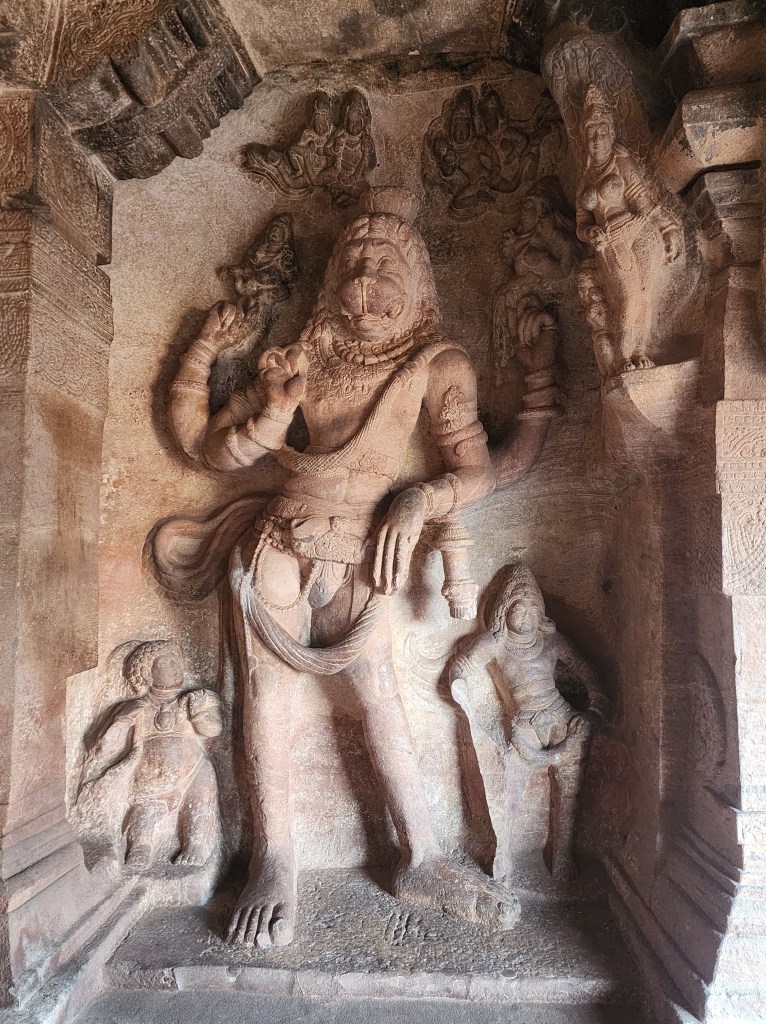
A depiction of Lord Narasimha from the 6th century CE, Badami, Karnataka, India

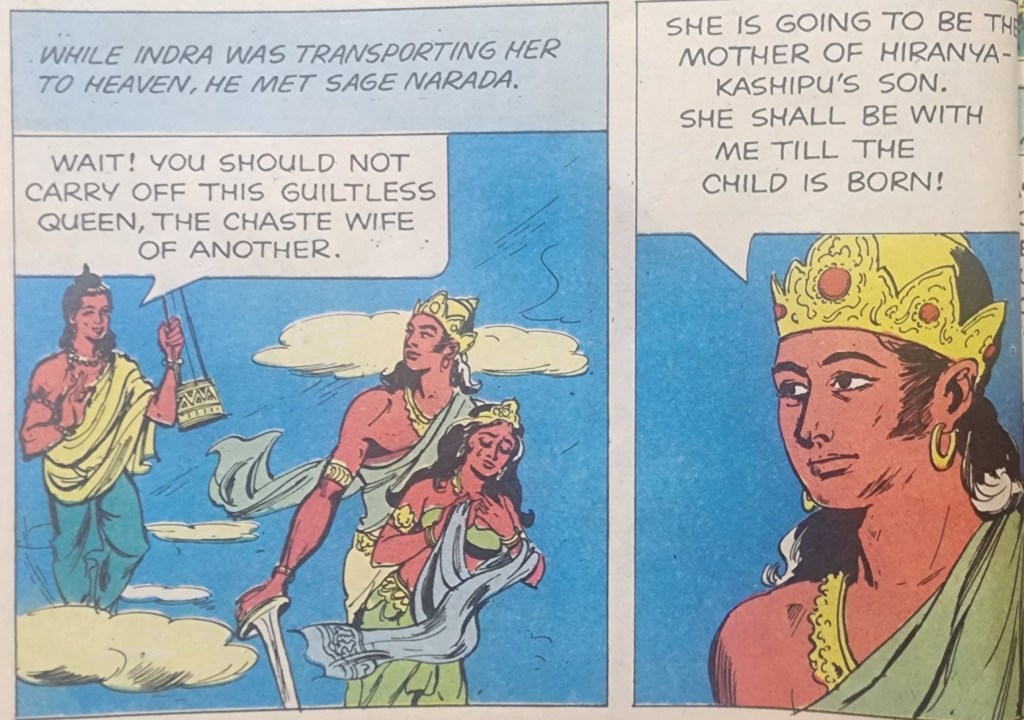
Lord Narasimha came to be, to specifically counter one Asura, Hiranyakashipu. Hiranyakashipu had a vara (boon) from Lord Brahma which made him impossible to kill and thus functionally immortal. Hiranyakashipu’s boon conferred the following protections on him.

  • He could not be killed by a human or a beast
  • He could not be killed during the day or during the night
  • He could not be killed indoors or outdoors

I am now going to extrapolate a bit. I presume that Hiranyakashipu could not be killed by any weapon wielded by or controlled by a human. Otherwise, arrows would have been able to kill him in an age before gunpowder, an age when there existed “celestial weapons”, or astras of various kinds which could wreak unimaginable damage. Further, we will have to overlook the notion that humans are also beasts, just a different species. I have no idea if the boon took into consideration some specific definition for “human”.

I also presume that he was invulnerable to diseases that were cause by any biological vector, for they would constitute beasts. Considering the protection from the first point, the subsequent 2 points seem like an add-on package in case someone found a loophole in the first one. And as was the case, that is exactly what happened.

Beyond the boon itself, Hiranyakashipu was an incredible warrior, on par with the Devas. He wanted to be on par with Lord Vishnu before going out and conquering the world! This was the motivation for his gaining the boons. Further, he forced people in the lands he conquered to worship him instead of Vishnu. When I say worship, I mean in offerings at pooja, yajna and homa that are performed. There is a lot more nuance to every aspect of this story, which I cannot go into in this article*. I strongly recommend that everyone read the story in detail. Not only is it incredibly entertaining, but it is also full of conundrums and ways of overcoming the same. The connections to various happenings around the world is simply fantastic.

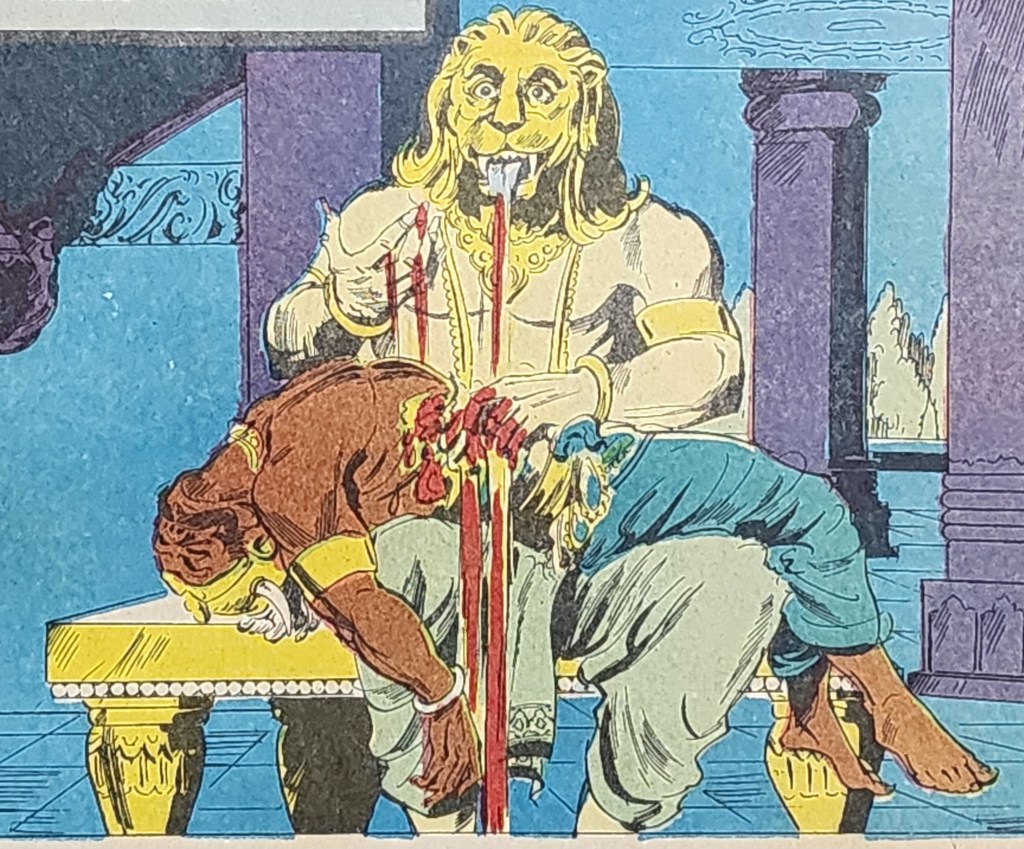
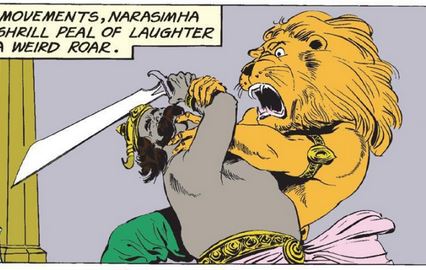
A common depiction of Lord Narasimha and his slaying of Hiranyakashipu in modern times. Image credit – “Prahlad”, published by Amar Chitra Katha

In the end, Vishnu incarnates as Lord Narasimha to destroy Hiranyakashipu. He bursts forth from a large pillar and fights Hiranyakashipu, eventually slaying him. There is a great fight between Hiranyakashipu and Narasimha, at the end of which Hiranyakashipu is disembowelled on the threshold. The end occurs by circumventing each aspect of the boon protecting Hiranyakashipu. These are as mentioned below.

  • Narasimha was neither man nor animal, but both. Hence Hiranyakashipu’s boon did not protect him from Narasimha. Nara means “man” and Simha means “lion”, literally “Man-Lion”.
  • Narasimha fought and killed Hiranyakashipu at twilight, which is neither day not night.
  • Narasimha killed Hiranyakashipu on the threshold, which is neither inside nor outside. I do not know if the threshold was that of his throne room or that of his palace.

From all the iconography I have seen of Lord Narasimha, he used no weapons other than his claws while fighting the mighty Hiranyakashipu. The same were used to disembowel and kill the Asura king. This same pattern is seen even in modern days comics depicting the story of the Narasimha avatāra. At the same time, Hiranyakashipu is depicted as using a sword or mace (gada), sometimes a sword along with a shield. I must add, I guess that the claws of Lord Narasimha were exempt from being classified as a weapon as Narasimha was neither man nor beast.

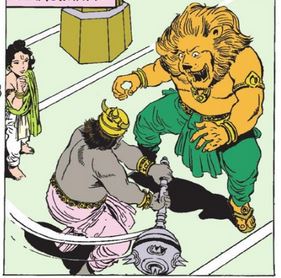
Lord Narasimha fighting Hiranyakashipu who wields a mace and a sword. Image credit – “Dasha Avatar”, published by Amar Chitra Katha

I will now extrapolate again. Based on the way the fight between Lord Narasimha and Hiranyakashipu is depicted, I think of this as a fight between a great warrior who was wielding weapons and another warrior, who was fighting unarmed. Of course, the fact that Lord Narasimha is a God evens out the odds of going up unarmed against an armed warrior. And the fact that a God had to fight at all and needed weapons (!) shows the martial prowess of Hiranyakashipu.

Now that the details of the fight are clear, let me look at the aspects of the same which, while fantastic, can highlight aspects of real-world martial arts and conflict management.

I will start with the simplest and most obvious one. The use of claws. In the Bujinkan system of martials, among the historical weapons we learn of, there are two interesting ones, which are worn on the fingertips. One is called the “Nekote” and another is the “Kanite”. Nekote means “cat claws” and Kanite means “crab claws”. Visually, to me at least, the two seem very similar.

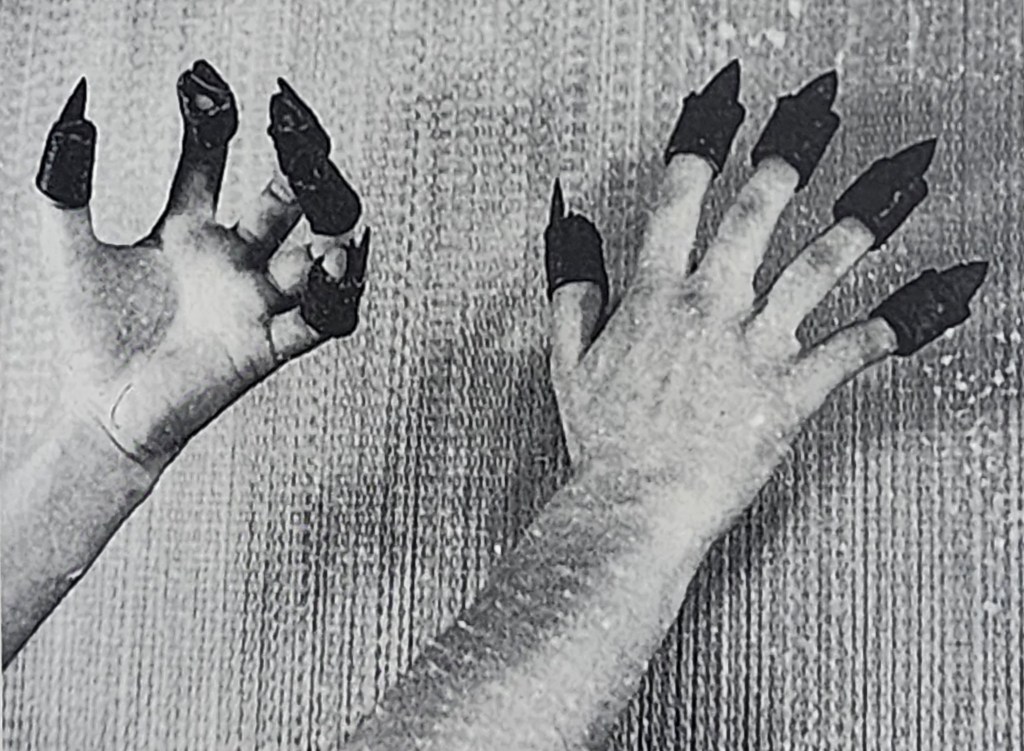
Both the Kanite and the Nekote are pointed metal tips worn on the fingertips, much like thimbles. The points on these can be used to cause damage to the opponent with a shallow stab or rakes across the body. An image is seen below of the Kanite. These are reminiscent of the claws used by Lord Narasimha to kill Hiranyakashipu.

Kanite (crab claws/finger). Image credit – “Unarmed Fighting Techniques of the Samurai”, by Sensei Hatsumi Masaaki.

Even without the metal attachments, practitioners learn to use the tips of the fingers as weapons. There is a way of striking called “shako ken”. The fingers are used as claws to rake an opponent. Obviously, this is not meant for use against armour or any protected surfaces. It can be used to hook and pull the apparel of opponents. This strike is very similar to using the weapon called the “shuko”. The “shuko” in turn is very similar to a historical Indian weapon called the “bagh nakh”. I had written in greater detail about the bagh nakh and the shuko in a previous post, where I had discussed the martial prowess of Chhatrapati Shivaji Maharaj. A link to that article is seen below+.

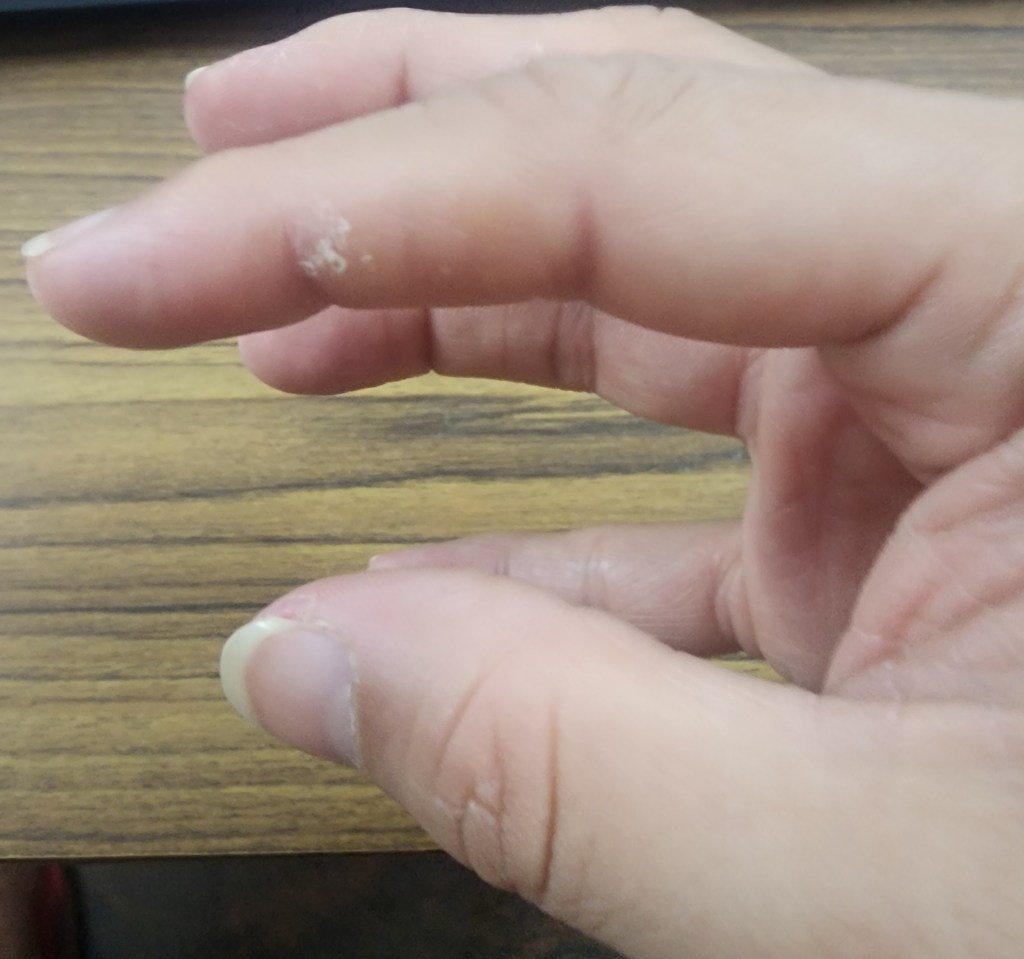
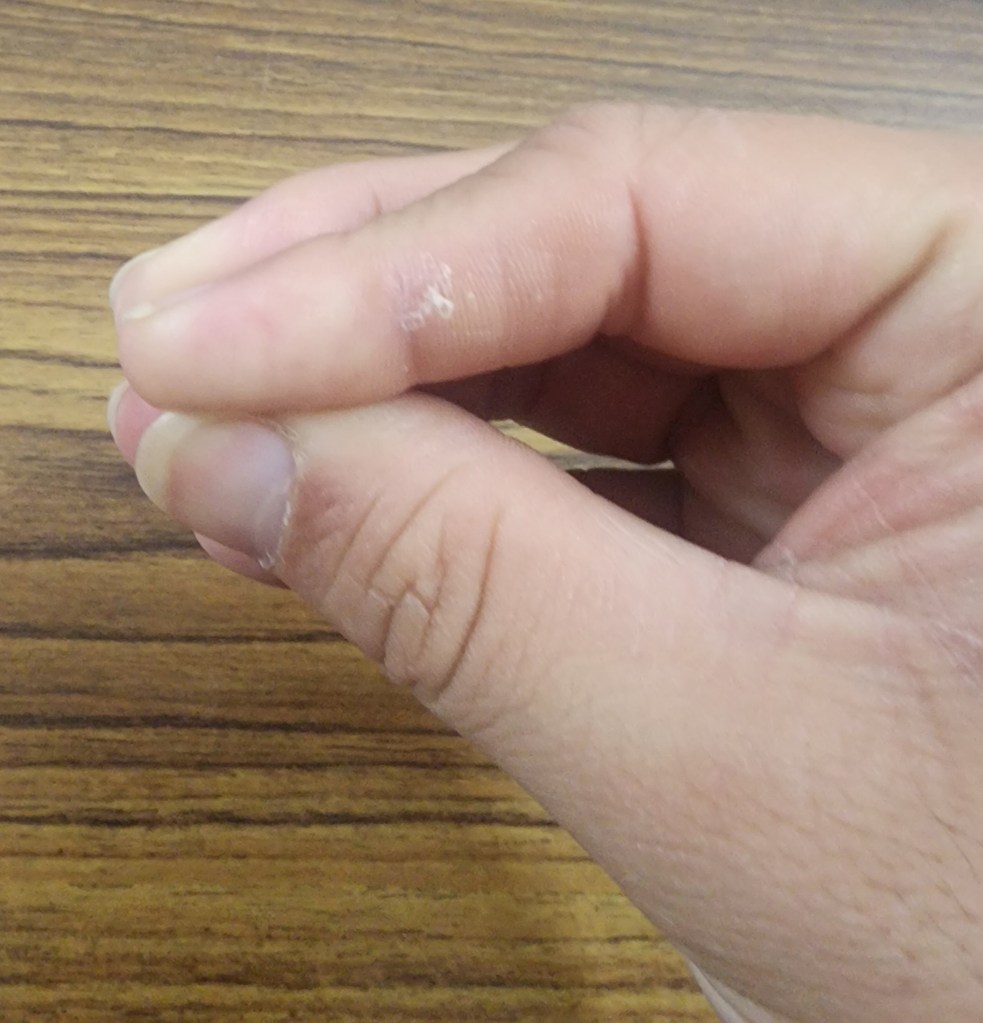
Another way of striking with the fingertips is with the “Go Shitan Ken”. “Shitan Ken” is to strike with the fingers. “Go” refers to the number 5. So, “Go Shitan Ken” means “five finger strike”, in other words, to strike with the fingertips. This strike involves stabbing at the face or any other part of the opponent with the fingertips. It is not necessarily a strike or stab; it could be a push as well. To increase the force of impact of this strike, the five fingertips could be held together (like while eating). An image of each variant of Go Shitan Ken is seen below.

Two ways of using the fingers to strike (shitan ken). The fingers can be kept apart or held together for the strike.

Considering we are discussing claws here, there is a category of weapons one is taught about in the Bujinkan, called “Shizen Ken”. This refers to “natural weapons”. This in turn refers to weapons one is born with. Shizen Ken includes nails, teeth and even spit, that can be used to cause pain or discomfort to opponents with pinches, rakes, bites and just old-fashioned disgust**. 😛 The claws used by Narasimha would be called a “Shizen Ken”. But if a God that is neither man nor animal uses claws, would that then be a “natural” weapon? I am not sure. 😊

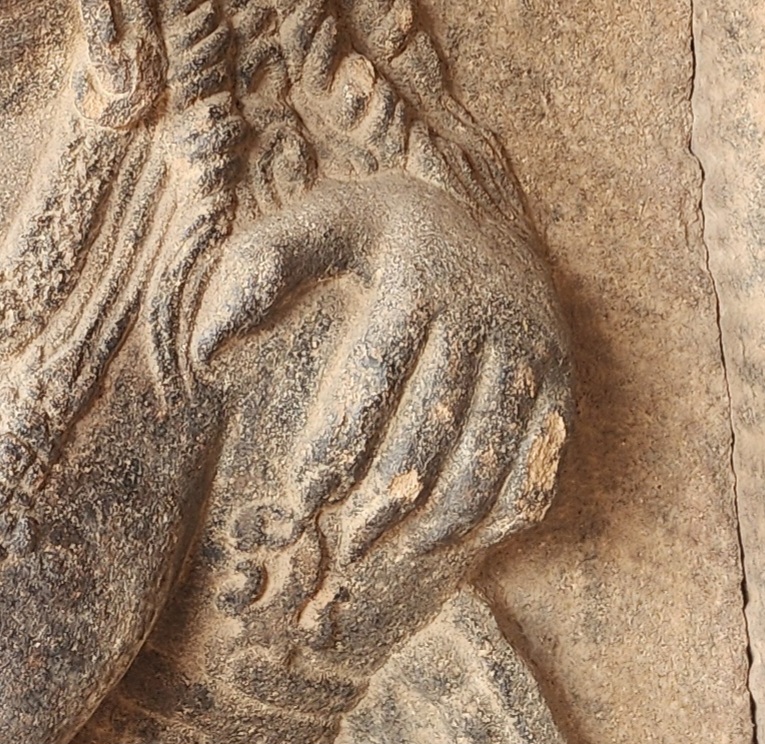
A closeup of Lord Narasimha’s claws. Image on the left is from Pattadakal, Karnataka. Image on the right is from Badami, Karnataka. The depictions are from the 6th and 7th centuries CE respectively.

Form around 2015 to 2020, Hatsumi Sensei, the Soke (inheritor/grandmaster) of the Bujinkan, focused a lot on the concept of “Muto Dori”. We learnt from our teachers, mentors and seniors that this was a very important concept, that included not just physical aspects but also ones relating to the attitude and a spirit of calmness, self-control and of course, breathing. “Muto Dori” in its simplistic form can be translated as “capturing without a weapon”. It means that an unarmed individual can take on and perhaps defeat an opponent wielding weapons, and not just survive.

Needless to say, it is extremely difficult and needs a lot training to achieve this successfully even in the dojo, let alone a real fight. The chances of survival and success diminish considerably if there is more than one opponent with weapons. But the training of this concept is very beneficial in terms of learning one’s weaknesses, achieving a modicum of self-control and in fine tuning one’s extant abilities. Hence, the practice of this concept lasts a lifetime, if not just during one’s time as a budoka.

If we think back to the fight between Lord Narasimha and Hiranyakashipu, Narasimha was demonstrating Muto Dori all through. Hiranyakashipu was a warrior of great prowess and wielded weapons against him. Despite this, Narasimha successfully disarmed and defeated him. Narasimha would have had one goal all through the fight. Hiranyakashipu had to be either manoeuvred towards the threshold, or he had to be moved to the threshold. This means Muto Dori with an objective! Anyone who has ever gone up against an opponent with a weapon while being unarmed would realize how mind boggling an achievement this is!

I am not going into details of how muto dori is practiced because it has to be experienced. No volume of words or even videos will transmit what it entails. So, suffice it to say that as a martial artist, Lord Narasimha’s abilities, for his demonstration of Muto Dori, should be the epitome one can aspire towards.

The above 2 images, the one on the right is a close up of the one on the left, are my favourites. This is a depiction of Narasimha actually fighting Hiranyakashipu in a doorway, with the threshold below them. This image actually shows a fight! Narasimha has locked both arms of Hiranyakashipu, rendering his ability use the sword and shield useless! And he is tackling the legs of the Asura king with his own! This is such a wonderful snapshot of fight in progress! This absolutely is a depiction of MUTO DORI! The image is from Pattadakal, Karnataka, from the 7th century CE.

Now I will look at some martial concepts that relate to conflict management as a whole, which also become apparent from the story of the Narasimha avatāra.

We have all been taught that to make any argument or a counter to any proposal or point raised against oneself or a team, we need to have all the necessary data. Making a point or a counter to one, without necessary and relevant information is almost foolhardy. This is something all of us are taught and practice regularly at work and in various aspects of life.

This same concept is stated in the Bujinkan, mellifluously I must add, as “Tsuki and Suki”. This is something I have heard mentioned a few times during training. Tsuki is a punch or a stab, a thrust in essence. Suki is a hole, more like an opening in armour or a gap in the same. It is a point when a thrust can be applied to cause harm to the opponent. So, one needs to “tsuki” a “suki”. One should attack an opening.

To attack an opening, one first needs to find an opening. To find an opening, one needs to know the opponent and how she or he is moving. Knowing the opponent includes the armour, weapons and objectives of the same. All of this adds up to “having all the necessary information”***. Simply put, having information is a precursor to “identifying the suki to tsuki”. The tsuki itself is the equivalent of counter a point in an argument. In a fight, an attack is a point raised, which is “countered” by a tsuki, which is a counter argument, and all of this is facilitated by information.

This flow of events in the various avatāras of Lord Vishnu is as follows. A great Asura acquires a vara (boon) from Lord Brahma. This boon ensures the invincibility of the Asura as he or she cannot be killed, though he or she is not immortal. This invincibility causes havoc in the world and the Devas, who are the guardians of the world, to lose power and go into hiding. The Devas and people of the world after failing to protect themselves despite all efforts, beseech Lord Vishnu for succour. Lord Vishnu incarnates in an avatāra to end the terror of the Asura and restore balance.

In the flow of events mentioned above, for any avatāra, I suggest that information is key! Lord Vishnu, when he appears as an avatāra, tailors the specific incarnation to circumvent all aspects of the boon the Asura possesses. In other words, the Asura creates the avatāra. Every aspect of the boon is understood, the loopholes are identified and exploited by the avatāra. This is the same as “tsuki to suki”. An opening is identified in the armour provided by the boon and a tsuki is applied to this suki. The avatāra is a tsuki and the loophole in the boon is the suki!

Hiranyakashipu realizes that the chink (suki) in his boon has been identified and is being used to attack (tsuki) him. Image credit – “Prahlad”, published by Amar Chitra Katha.

All this does make one wonder, when the boon is granted, what is the confidentiality around it? Does the Asura announce to the world that he has acquired a set of powers due to the boon? Or is this gradually identified as people lose fights against the Asura? Does Brahma reveal details of the boon he has granted to the Asura, to the Devas who then report it to Lord Vishnu to device a counter? Or does Lord Brahma communicate the details to Lord Vishnu directly? Or does Brahma, who granted the boon, already know the loopholes which he reports to Lord Vishnu? If the answer to these is a “No”, does the duration of an avatāra depend on how long it takes to identify the loopholes? Or is there time taken to identify the “suki” in a boon before an avatāra incarnates? I do not have answers to any of these. Perhaps these are stupid thoughts. We are talking of Gods after all, and time does not have the same meaning in such circumstances, and I could be rambling. 😛

But these questions do lead to an appreciation of the Asuras and how they craft the boon they settle upon. I will explore this through a few examples. Many Asuras asked Brahma to grant them immortality. Lord Brahma could not grant that boon as all that was created had to end. So, the Asuras asked for boons that made them near immortal and definitely invincible, at least for long durations.

  • The Asura Tāraka asked that he be invincible and killed only by a son of Lord Shiva. This was a really smart move as Lord Shiva was a yogi and in deep meditation and unlikely to ever have children. Also, he was in deep mourning after the loss of Devi Sati. Tārakāsura was eventually killed by Lord Kartikeya, the son Lord Shiva and Devi Pārvati (a reincarnation of Sati).
  • The Asura Mahisha asked that he be unkillable by any male, as he was certain that no woman could best him. Devi Durga ended up killing him.
  • Rāvana asked that he be unkillable by most creations of Brahma. But he did not include humans in the list of beings he would not be killed by, as he assumed that humans would never be capable of defeating him. Lord Vishnu incarnated on Earth as Lord Rama, a human, to defeat Rāvana. What is interesting is that Rāvana was defeated by the Vānara king Vāli (Bāli) and the human king Kartaveerya Arjuna, but neither of them killed him.
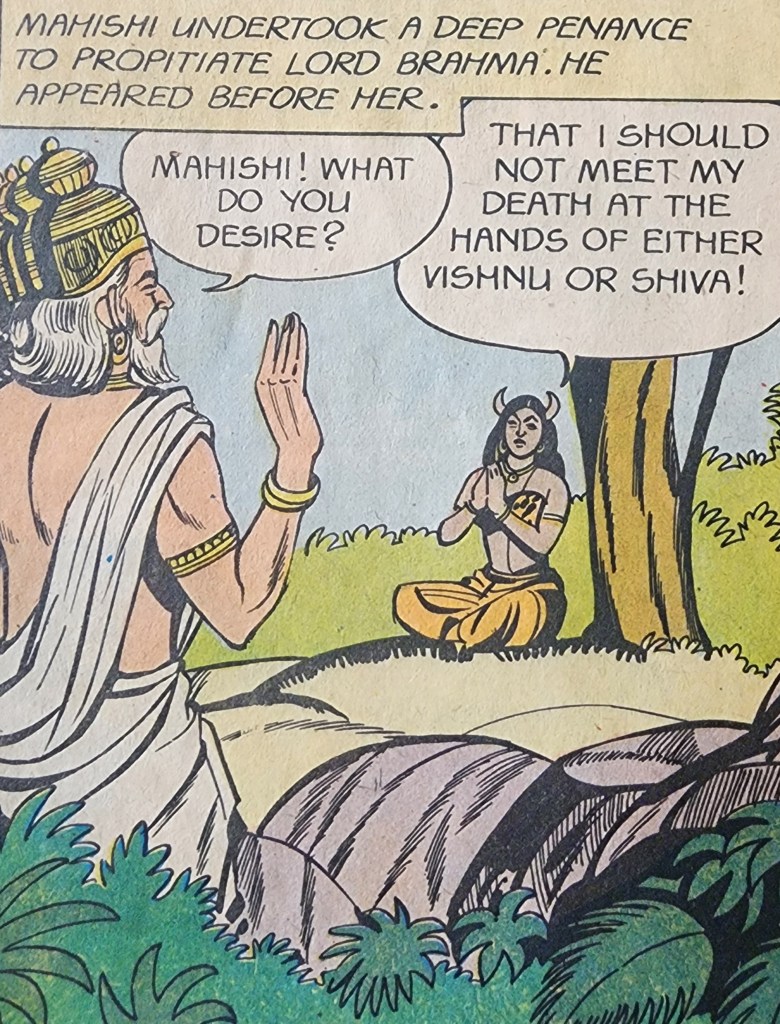
  • Mahishi, the wife of Mashishāsura asked that she be vulnerable only to a son of Lords Vishnu and Shiva, both male Gods! Eventually, Lord Ayyappa killed Mahishi. Lord Ayyappa was the son of Devi Mohini (the female form of Lord Vishnu) and Lord Shiva.

There are more examples, but the ones mentioned above adequately illustrate the points I am going to make. Asuras were incredible, despite going against Dharma and attempting to upend the natural order of the universe, which would result is the suffering of vast numbers of beings. In all the examples above, the Asuras clearly had a great deal of intelligence. Their awareness of how the world existed at a given time, informed how they crafted their requests for boons.

The consequence of all these boons was that the Devas routinely lost power and the ability to perform their duties as the guardians of the 8 directions and natural phenomena (natural order). The Asuras lorded over the Earth during the time when an avatāra was yet to arrive to reestablish the natural order. Beyond the ability for great information gathering, the Asuras had great presence of mind in wording the request for a boon. The boon is no different from an inviolable contract in modern day parlance. So, their awareness of the strength of language was incontestable. All these observations together indicate that the Asuras were warriors of both physical and intellectual prowess.

Beyond all the above points, the Asuras were rewarded for another aspect. The path to achieving a boon from Lord Brahma was a torturous one. A very long time had to be spent in meditating on Brahma, in unimaginable conditions with all earthly needs overcome. This perseverance deemed one worthy of a boon. Hence, the effort ensured that the boon was inviolable and necessitated the presence of a God on earth to overcome.

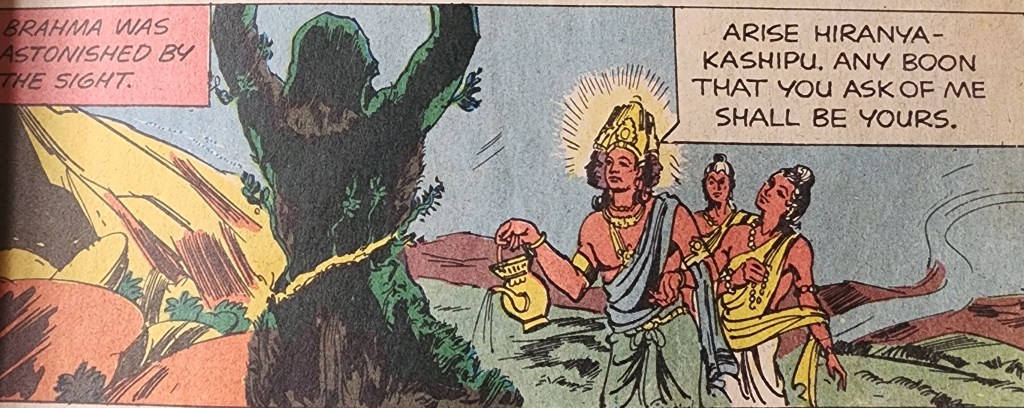
The meditation of Hiranyakashipu was brutal on his body. It resulted in him almost dying and plants and anthills growing over him. Image credit – “Prahad”, published by Amar Chitra Katha.

In my opinion all of this seems like what in modern day parlance is termed “Lawfare”. It could also be called “the process is the punishment”. “Lawfare” refers to “warfare through laws”, where the actions of specific peoples are either limited or given free rein through laws of a land. “Process is punishment” is when a person is highly unlikely to be convicted of any wrongdoing under given laws, but needs to work through the due process to get oneself acquitted nevertheless. A lot of resources and time is lost in this process, which has a massive opportunity cost. This cost is the punishment, not the actual one that the law might prescribe, as a conviction is almost certainly not on the cards.

These concepts were used by the Asuras and the avatāras both, with success on both sides. The process of proving oneself as being worthy of a boon ensured that most creatures, including Asuras, Devas, humans, Vānaras and other entities, would NEVER prove themselves eligible. The process was simply too hard to complete and the punishment too much to bear!

I called the boon an inviolable contract earlier. This was despite it bending natural rules and leading to the natural order being threatened. So, it was like a law that no one could violate. The Devas, despite having consumed Amrita, were incapable of overcoming the powers bestowed by the Vara. Even Lords Vishnu and Shiva, despite being the ultimate power in the Universe, were not allowed violate the restrictions of the boon, even if they could. This is why Lord Vishnu, as preserver of the natural order, had to incarnate with specific abilities to nullify the abilities bestowed by a boon. This is undoubtedly “lawfare”, where a law is created by a boon to benefit specific individuals or groups of individuals. Eventually, the law is NOT violated and yet the beneficiary of it is destroyed by identifying the loopholes in the law!

Mashishi asking for a boon, and thus indulging in “Lawfare”. Image credit – “Ayyappa”, published by Amar Chitra Katha.

If one considers the contemporary Indian context, the abrogation of Article 370, the amendment to the Waqf Act and not repealing the laws that curtail the financial freedom of temples are considered “lawfare” by people of different political leanings. There is one interesting aspect about laws in relation to this post which I have added in the notes, simply because it tangential and redundant to the idea already explained. I do recommend that people read it++.

That brings me to the end of this article. The Narasimha avatāra should, beyond the traditional significance and symbolism, open our eyes to knowledge that is not commonly known. This avatāra sheds light on the traditional martial arts and modern conflict management. And if one is not a practitioner of the martial arts, the story of the avatāra can open one to the idea that it is not a fantasy of old, the aspects holding it together are very real. Similarly, the story should hopefully reveal that conflict management is not magic and has no “silver bullet”. Intelligence, effort, time and perseverance are always required.

Notes:

* The last sukta (hymn) of the Rig Veda, as far as I know is called the Aikamatya sukta. Aikamatya roughly translates to “common opinion”. It could also mean, according to the little that I have read, “unity”. But this is not unity through homogenization. It is more like accepting all opinions and coming together. It is something like the modern Indian refrain, “Unity in Diversity”.

This sukta invites everyone to come together around the sacred fire and also states that all the Gods (essentially Gods of everyone) will be given offerings through the fire. I have heard two wonderful interpretations of this sukta. One by Mr. Sanjeev Sanyal, who is the Principal Economic Advisor to the Govt. of India and also a historian and author. Another is by Mr. Abhijit Iyer Mitra, who is a strategic affairs analyst, a Senior Fellow at the IPCS. Both are very well known in Indian media (both traditional media and social media).

Abhijit Iyer Mitra says that this sukta I am referring to is akin to the Treaty of Westphalia, which ended the 30 years war in Europe. The treaty of Westphalia allowed citizens to follow any form of Christianity that they chose. It also ensured that the state or ruler cannot mandate the religion to be followed by its citizens. It separated religion and state. It also made all forms of Christianity equal as one could not persecute the other. This is pretty much what the Aikamatya sukta states, that all Gods will be accepted and prayed to and people will come together. The sukta of course, is a few thousand years older than the treaty.

Sanjeev Sanyal expands on this idea by showing what happens if this “agreement” made through the sukta is violated. He uses the stories of King Daksha and Hiranyakashipu (referred to in this article) to explain the same. King Daksha conducted a yajna where all Gods were invited to receive offerings, except Lord Shiva. Daksha’s daughter Devi Sati was married to Lord Shiva and Daksha was against the union. In opposition to her father’s decision, Sati disrupted the yajna by immolating herself in the sacred fire. This angered Lord Shiva and King Daksha was slain.

Hiranyakashipu forced people to abandon their worship of Lord Vishnu. He further demanded that people worship him in Vishnu’s stead. This is the same as King Daksha’s actions. Both Daksha and Hiranyakashipu violated the agreement of the sukta that all Gods would be worshipped. This violation resulted in their being punished. It is like there being a consequence for violating the treaty that mandates freedom of worship and equal respect to all Gods. This is the notion that Sanjeev Sanyal has put forth. I am not aware if others have also suggested the same.

+ https://mundanebudo.com/2025/02/19/chattrapati-shivaji-maharaj-the-bagh-nakh-and-the-shuko/

** In Hindu culture there are “Navarasas”. Nava is nine and Rasas are emotions. One of these is “beebhatsa”. This is “disgust”. It is one of the nine emotions that can be evoked in an audience by any performance. The manner in which Hiranyakashipu is killed, by disembowelment, evokes a sense of disgust, or beebhatsa in the person experiencing the story. This same emotion is evoked by the manner in which Bhima kills Duhshāsana, in the Kurukshetra War in the Mahabharata.

*** In a martial arts context, “knowing the opponent” and “gathering information about the opponent” happens in the flow of the fight. It is not necessarily an activity that happens in a separate time from the fight. One needs to identify aspects of the opponent as the fight is happening. This seems esoteric, but anyone who has done any sparring knows that this happens all the time during training.

One needs to know oneself – one’s own abilities, weaknesses and objectives. And also, all these details about the opponent. In Hindu culture, knowing oneself is called “Swayambodha” and knowing the opponent or enemy is called “Shatrubodha”. I had written an article about these 2 concepts in a previous article, the link to which is seen below.

++ The guru of the Asuras, Maharishi Shukrācharya created the “Sanjeevini Vidya” by meditating on Lord Shiva. The Sanjeevini Vidya allowed him to bring back to life Asuras who were slain in battle. And they came back as they were before death, not like zombies from modern day pop culture. This was an effective counter to the Amrita that the Devas had in their possession. Amrita conferred immortality on the Devas, (for the duration of a Manvantara, if I am not wrong).

I presume that Hiranyakashipu and other Asuras who asked Brahma for the boon of immortality did so before the Sanjeevini Vidya was created. If not, there would be no need for such a boon. (And if it was later, would the boon hold if they were brought back after death? I have no idea). Anyway, the Asuras used Brahma’s boons to counter the Devas who had Amrita.

Eventually of course, the Devas gained the ability of Sanjeevini Vidya through subterfuge and a honey trap operation. Why they needed it though, I have no idea, as they already had access to Amrita. Was it to find a counter to the Vidya? Again, I have no idea. In my opinion, this conflict between the Devas and Asuras ended when Bali Chakravarthy was confirmed as the next Indra after the Vāmana avatāra. That’s another treaty by itself, something I have written about in other articles of mine, the links to which I am sharing below. All of these events can be considered technological warfare and “lawfare”.

https://mundanebudo.com/2023/11/24/dashavatara-budo-part-1-issho-khemi/

https://mundanebudo.com/2023/12/07/dashavatara-budo-part-2-katsujiken-satsujiken/

The Magic of the Feet, from Bhakti to Budo, Kamae to Tradition

In large parts of India, among Hindus, touching the feet of elders and teachers or bowing down to them, is a common practice. It is an extension of bowing down before the Gods and Divinities. When I say bowing down, it is not the Japanese bow, or one seen in a historical European context.

We do what is called a “Shāstānga namaskāra” or “Dheerga Danda namaskāra”. Men do a full prostration in front of Divinities. Women sit on their knees touch their foreheads to the floor in front of the Gods. The same is done in the presence of our Gurus, some teachers and elders in the family, community or society based on the situation.

Two depictions of the “Dheerga Danda Namaskaara”. Image credits – (L) “Mahabharata 23 – The Twelfth Year”, published by Amar Chitra Katha, (R) “Mahabharata 20 – Arjuna’s Quest for Weapons”, published by Amar Chitra Katha

Touching the feet is not something generally performed with the Gods. This is done mostly with humans we revere. In this case, one bows down and touches either the feet or the ground in front of the feet. This is an abbreviation of the prostration described earlier, performed in the interest of space and time. A further simplified version is just bowing down and touching the knees of the person*.

Irrespective of the exact nature of the “bow”, the act denotes showing respect to the Gods or to the person before whom the same is performed. It is not exactly an act of deference or subservience, it is purely one of respect, and maybe bhakti (loosely translated as “devotion”). It could be an act of deference, but that was not, as far as I know, the original intent and is not the intent in most parts of modern India today.

The key point of the “bow” is to touch or be in front of the feet of the individual(s) towards whom respect is being shown. The Feet are, in this sense, the most important aspect. This extends to the point where we consider the ground that is trod by the feet of great people and Gods as sacred ground.

It was common practice, perhaps it still is, for elders who accompany younger folk to any temple, to tell them to look at the feet of the idol of the deity. This is a constant reminder and is passed on from generation to generation. In Kannada, it is called, “Paada nodu”. In Hindi it would be, “Pair dekho”. It literally translates to “look (nodu/dekho) at the feet (paada/pair)”. In this vein, touching the feet is “Paada muttu” in Kannada and “Pair chuo” in Hindi. “Muttu” and “Chuo” translate as “touch”.

So, the focus of Bhakti and the act of showing respect always involves THE FEET.

The other field where the focus on the feet is vitally important is the Bujinkan system of martial arts; I daresay this is the case with all martial arts.

Among the first things that a student learns on starting in the Bujinkan is “Kamae”. “Kamae” could be considered “posture”, of the physical body. It could also refer to “attitude”, which is the “posture of the mind”, which in turn refers to displays or the exuding of non-physical aggression, confidence, fear and the like. For the purposes of this article, I am referring to the physical posture.

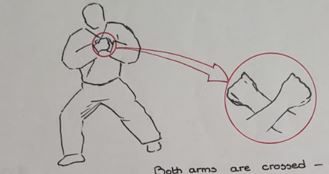
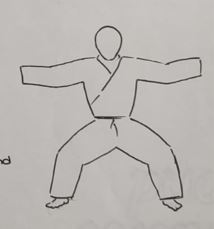
Two depictions of Kamae (physical posture). Sketches by Vishnu Mohan.

Kamae, when seen by an onlooker, predominantly shows the posture of the hands and the legs as a whole. But the kamae as experienced by the budoka (practitioner of budo), has greater focus on the core and the feet. The core because it holds the upper and lower halves of the body together. And the feet because it ensures balance and determines potential movements the body can perform, from said kamae. I will focus only on the key aspects regarding the feet in this article.

One of the key things that I have learnt from my teacher, mentors and seniors in the Bujinkan is that the weight should be towards the front half of the feet, i.e. towards the ball of the feet and the toes. The weight of the body should NOT be on the heels in any kamae. This holds true even for the most basic of the kamae, Shizen no Kamae, which can be translated as “Natural posture”. For those not in the know, this kamae just involves standing naturally in a relaxed posture.

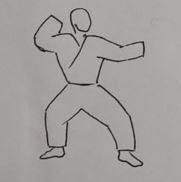
Two more depictions of Kamae (physical posture), one with a weapon. Sketches by Vishnu Mohan.

The distribution of the body weight on the feet is absolutely crucial in the Bujinkan! To reiterate, it must be on the front half of the feet. This is vital because, making any movement from any given kamae, is faster with the weight on the ball and toes of the feet. Triggering any movement if one had loaded one’s heels is definitely slower. This is because the body is a lot more stable and rooted if one is standing on one’s heels. This in turn means that the inertia that needs to be overcome to initiate a movement is greater if one is on the heels.

When I say the “time taken to initiate a movement”, it is not too much, it could be a fraction of a second. But this time difference makes a definite difference during training and most certainly in a conflict situation that involves real harm. It could be termed “a split-second difference which makes all the difference”. This difference need not be distinctly visible to an onlooker, but any practitioner of the martial arts, certainly a practitioner of the Bujinkan, experiences this time and time again, perhaps in every class.

The distribution of the weight on the feet brings us full circle, back to the feet in Hindu culture. Specifically, to the depiction of the feet in sculpture produced by Hindu culture.

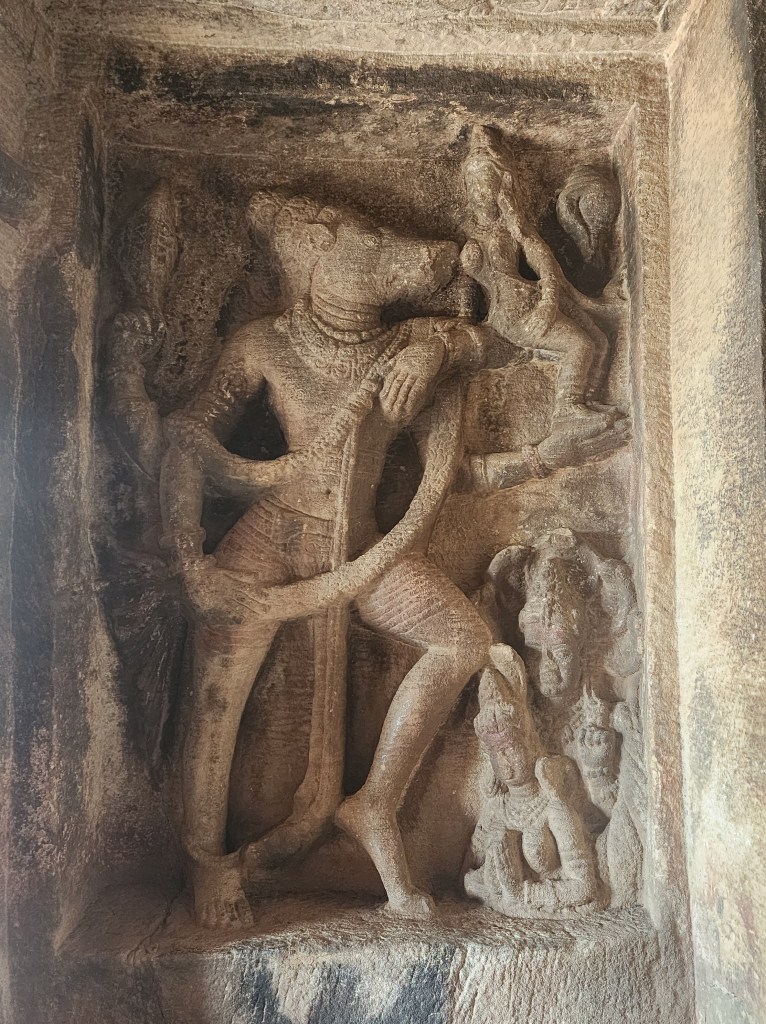
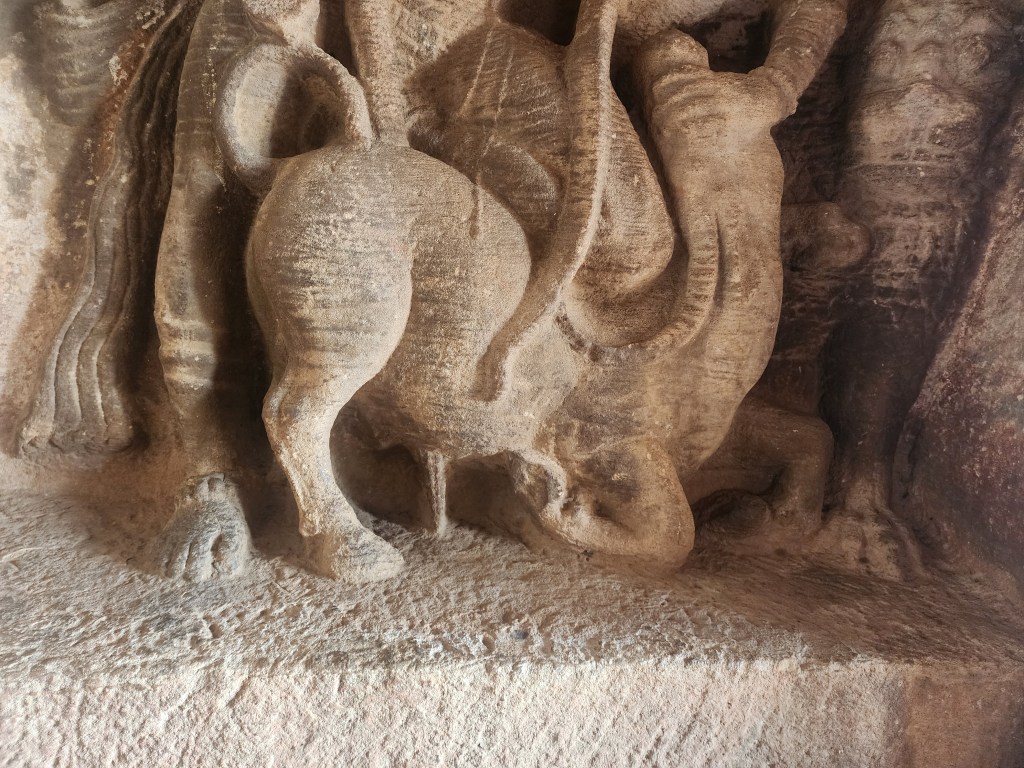
Lord Varaha saving Bhoodevi – carving in Cave 3 in Badami, Karntaka, India. The image on the right is a close up of the feet in the image on the left. Observe that the weight is either on the front half of the feet or on the side of the feet. Photograph by the author.

Consider any architectural or sculptural marvel from Indian history. It could the temple in Madurai, the sculptures in Mahabalipuram, the carvings on the magnificent temples at Halebeedu, Hampi or Badami, the marvels at Ellora or the historical monuments around Sanchi and Vidisha, or the many many others I have not mentioned here. All of them depict stories from Hindu culture. These include stories from the Mahabharata and Ramayana and the deeds of Lord Vishnu, Lord Shiva and Devi Durga. Many sculptures and bas reliefs depicting these stories show the human form in martial action. This includes the use of weapons and unarmed combat. Apart from the stories themselves, almost all temples have guardians carved on either side of the entrance to the Garbha Griha (literally “home or abode of the womb”), or sanctum sanctorum. These guardians always bear weapons.

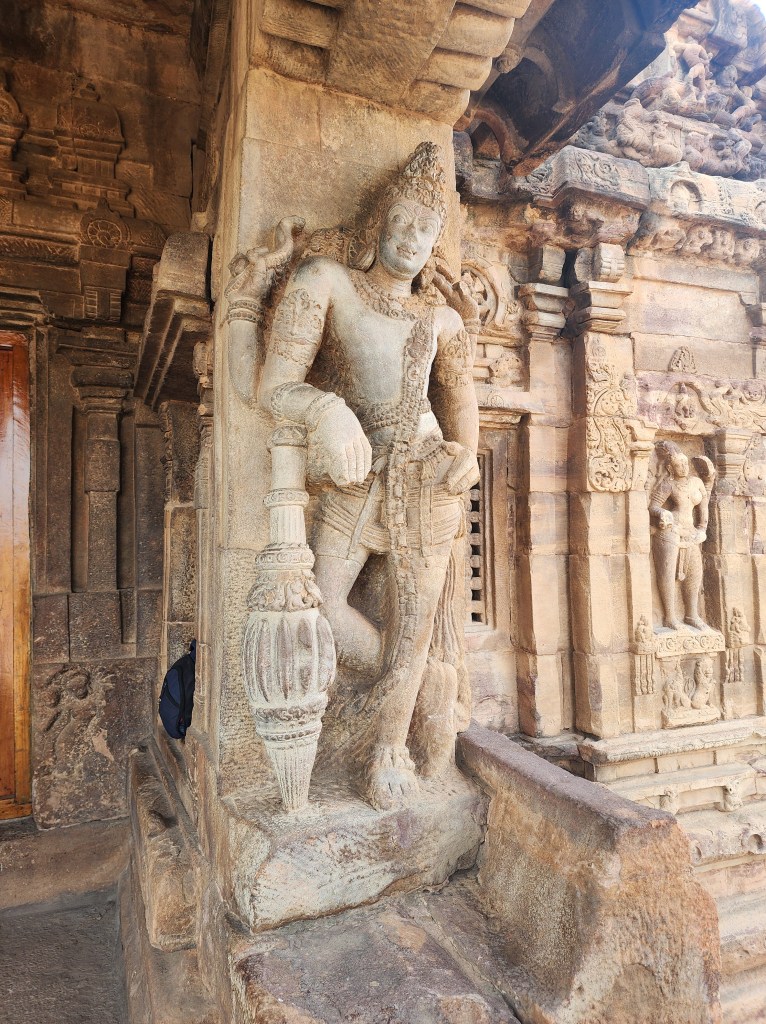
The image on the left shows Lord Shiva destroying the Asura Andhaka (Aihole, Karnataka, India). Observe that the body is leaning forward and hence the weight will be on the front half of the feet. The image on the right from Pattadakal, Karnataka, India, shows a “Dwaarapalaka” (Guardian at the door). Observe that the individual is leaning on the weapon (mace/gada) and the weight is either on the front or the side of the foot. The weight of the body is not on the heels in either image. Photographs by the author.

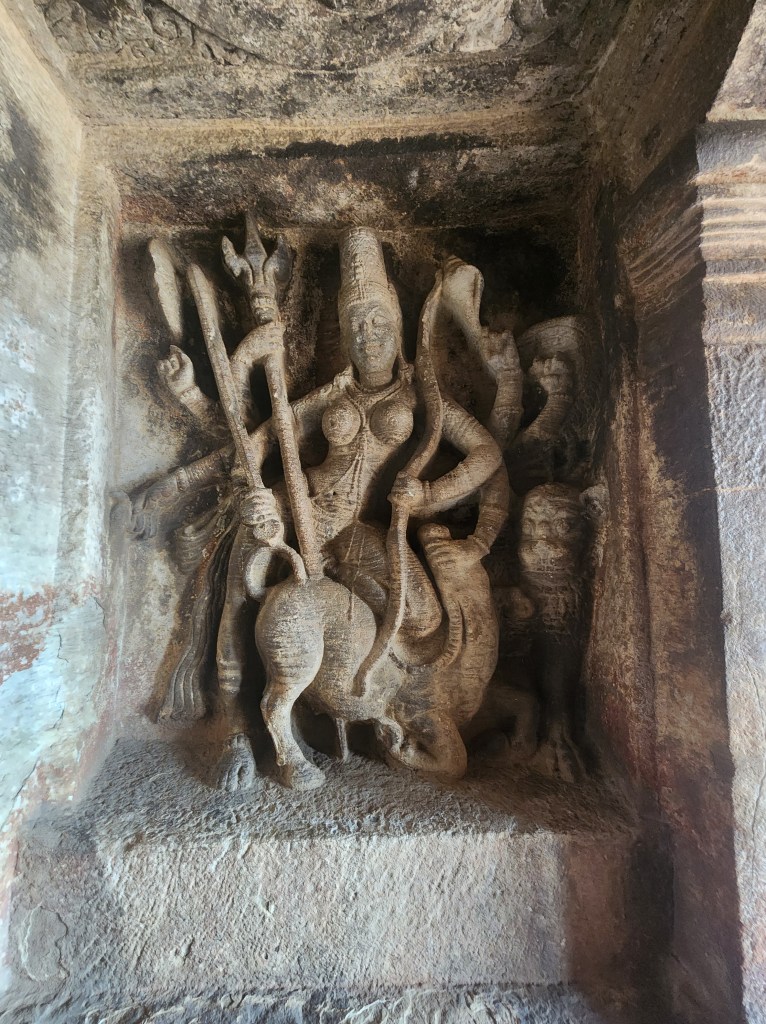
Now consider the depiction of the feet in the sculptures showing martial action. Almost all of them show the body weight on the front half of the feet, irrespective of the kamae or posture depicted in the sculpture. This also extends to the posture of the guardians at the doorway to the Garbha Griha. Individuals might be shown leaning on the weapon they wield but are never depicted with the weight on the heels.

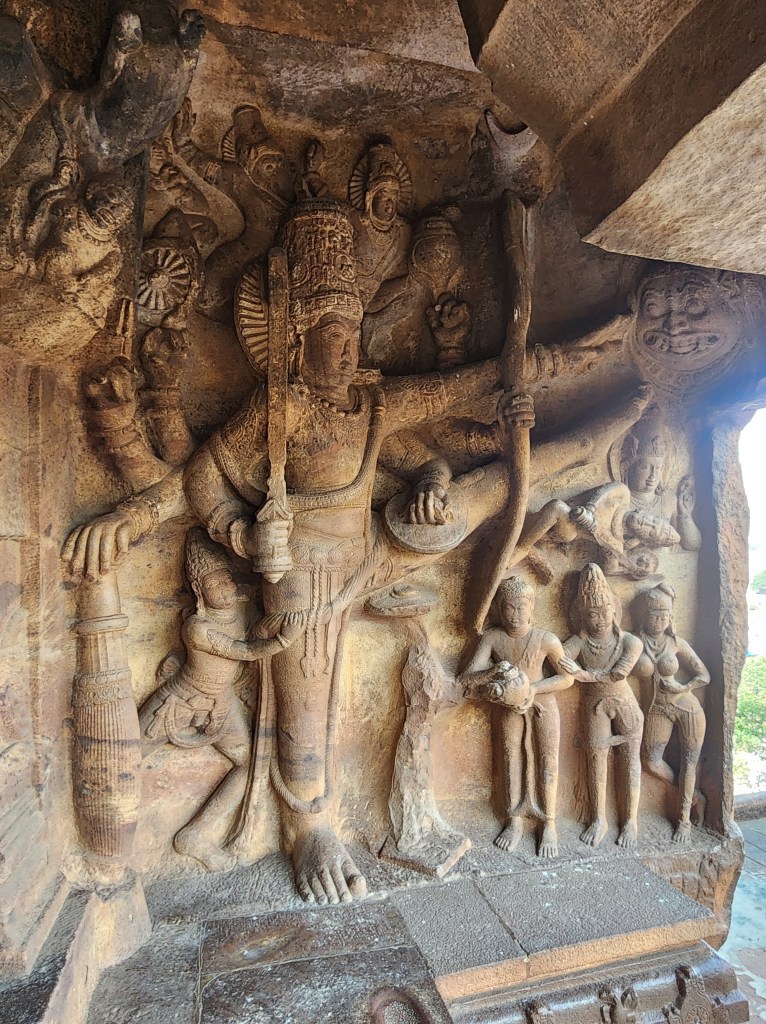
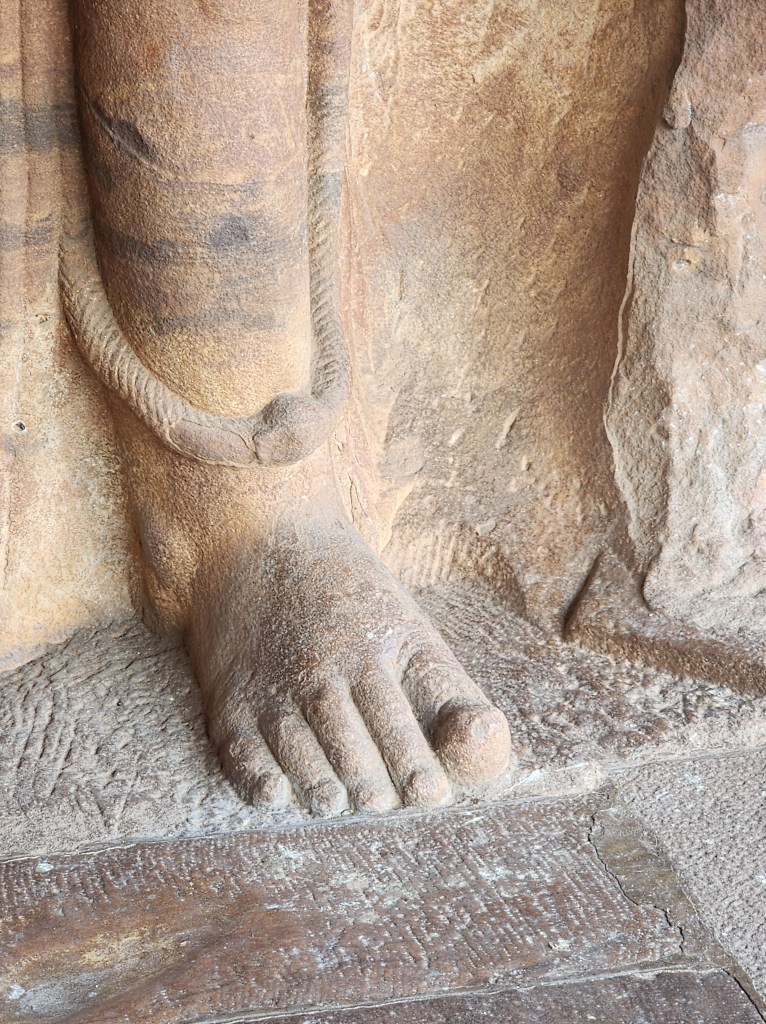
I am sharing multiple images with this article, that show the posture of the feet from a few different temples. One of them even shows the crimping of the little toe when the foot is lifted as if in a potential axe kick!

The image on the left, from Cave 3 in Badami, Karnataka, India, shows the Trivikrama form of Lord Vamana. Observe that he is standing on one leg. The image on the right is a close up of the left foot in the image on the right. Observe the crimping of the last 2 toes, as the weight is distributed to the front and side of the foot. Photograph by the author.

It is well known that temples in India have historically been more than just places of worship. They have been cultural centres, malls, schools/training centres, banks and treasuries, apart from just places of worship. The carvings on the temple walls were intended as teachings and storytelling features, sometimes both. Everything from tales from history and ethics to practices of intimacy were carved on temple walls. This was, according to some, because a lot of this knowledge was not taught directly.

Temples were thus a means to learn what was not yet in books and was not taught specifically as a subject in schools. So, considering this intent, in my opinion, what is carved in the temples are depicting what is, in all likelihood, the correct way one is supposed to load one’s feet. Therefore, the depictions of feet of warriors, even if they are deities, is showing how the weight distributions on the feet works, in marital arts in India.

The image on the left, from the Ravanaphadi Cave in Aihole, Karnataka, India, depicts the Mahishaasuramardhini. The image on the right is a closeup of the left foot of Devi Durga. Observe that weight is clearly on the side and front of the foot. Photograph by the author.

This continuum of importance of the feet and more importantly, the weight distribution on the feet is awesome indeed, at least to me. If one is a Hindu, it will be well known that feet are important to Bhakti and if one is a budoka practicing the Bujinkan the importance of weight distribution on the feet would be a key learning. The two come together in the depiction of the feet in sculpture seen in Hindu temples. Perhaps the best place for a budoka to appreciate the kamae of the feet is in a sculpture in a Hindu architectural marvel and being a Hindu, it is impossible to miss the kamae of the feet, for the feet is what one is culturally conditioned to observe. An absolute win-win combination. 😊

Notes:

* When a person touches the feet of another, the person whose feet is touched, almost always offers āshirwāda, which can loosely be translated as blessings. So, there is a responsibility placed on the person receiving the respect. It is not just to foster an air of superiority. A person being shown respect must have the humility to know that āshirwāda is due, even if not expected.

Shashti and the Sixties

This post is a series of observations in hindsight. It is an identification of a set of coincidences that seem important to me personally. There is no great significance to the observations but for the experience of having them.

This article will be my 65th post. This number is what brought about the observations that are documented below. Not specifically the number sixty five, but the numbers in the “sixties” in general. My posts are about the intersection I see between Hindu culture and the martial arts, specifically the Bujinkan system of martial arts. So, here are the series of thoughts I have had, as of now.

In India, the 60th birthday of an individual is considered very special. It is called “Shashtyabdha Poorthi” or “Shashti Poorthi”. “Poorthi” means “completion”. “Shashti” is “sixty”. “Shashtyabdha” means “cycle of 60 years”. Both terms refer to the completion of sixty years of life. The significance of the 60 year cycle comes from astronomy.

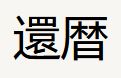
Shashtyabdha Poorthi – written in Kannada (left) and in Devanagari (right) script

The cycle of 60 years refers to the time taken by three important celestial bodies, according to Hindu tradition, to cycle through the sky from and to the constellation Mesha (Aries). When Surya (Sun), Chandra (Moon) and Guru (Jupiter) are in the constellation Mesha (Aries), it is considered the year zero. The three celestial bodies move across the night sky to cycle through the 12 zodiacal constellations multiple times before all of them are in Mesha at the same time again. Since the three bodies move across the night sky at different rates of time, they do not meet in Mesha often. It takes 60 years for Surya, Chandra and Guru to meet in Mesha once they start their cycle and move away from each other.

This is the reason the 60 year cycle is considered very important. Hence, when a person turns sixty, a pooja or homa is performed at home. If nothing else a visit to the temple is almost always guaranteed when an individual turns 60. Also, in the Hindu calendar (panchānga), a year is called a “Samvatsara”. There are 60 samvatsaras, each with a specific name. There are 60 samvatsaras because they are designed to coincide with the alignment of the Sun, the Moon and Jupiter in Aries.

The Bujinkan is a system of martial arts with its origin in Japan. And interestingly, the 60 year cycle is of importance for the Japanese as well! The 60th birthday of an individual is considered important even in Japan. From what I know, this is called “Kanreki” in Japanese. The word means “return of the calendar” according to Google. So, what is “Shastyabdha Poorthi” in India is “Kanreki” in Japan.

Kanji for “Kanreki”

The Japanese follow the Chinese zodiac. This zodiac has twelve animals and five elements. The five elements are Earth, Water, Fire, Wood and Metal. Every twelve year cycle is associated with an element. So, one twelve year cycle has one year for each animal and is associated with one element. For example, this year is the “Year of the Wood Snake”, wood being the element and snake being the zodiacal animal. So, a multiplication of 5 and 12 gives 60, 5*12 = 60.

Thus when a person turns 60, he or she would have lived through all the 60 years as a combination of the animals and each of the five elements. And hence, they have “returned in the calendar” to the year which is a combination of the animal and element at the time of their birth. Thus, a full cycle is complete and is a cause for celebration. The measurement of the cycle is different, but interestingly, both the Indian and Japanese (and of course Chinese) methods lead to a sacred time span of 60 years!

Even in the Western way of thinking, the 60th anniversary of an institution or an event, is considered the “Diamond Jubilee”. An individual is supposed to have entered one’s “Golden Years” when he or she turns sixty or perhaps 65 by some points of view. This seems tied to the fact that one is retiring from a regular job and has more time for leisure. It therefore seems that in many parts of the world, a sixty year cycle is considered important, if not sacred.

But can the importance of the number 60 have a reference to the martial arts? Specifically the Bujinkan system of martial arts? It seems possible, as I elucidate below.

The link with the Bijinkan is not specifically to the number 60, but more to the numbers in the sixties. This is something like the definition of the “golden years of one’s life”. Also, this absolutely is me cherry picking data to suit an idea. It could also be a case of Frequency Bias or the wonderfully named “Baader-Meinhof Effect”*. Either way, I am writing this because I enjoyed doing so and it makes sense to me. This is not an attempt to connect things for anyone else.

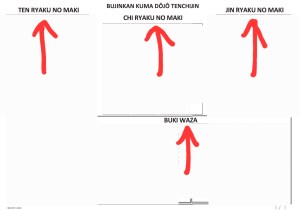
The core of the Bujinkan consists of the Ten, Chi and Jin Ryaku no Maki and the Buki Waza. The Buki Waza refers to training with weapons of varying lengths. “Buki” is “weapon” and “waza” is “technique”, literally, “techniques with weapons”. The Ten, Chi and Jin Ryaku no Maki (Ten Chi Jin for short) consists of training unarmed combat and in some ways is a precursor to training with weapons, for one needs to learn body movement before adding a weapon into the mix.

My mentor Arnaud Cousergue once referred to the Ten Ryaku no Maki as the “ryaku” of the Bujinkan. He also referred to the Chi Ryaku no Maki as the “waza” and the Jin Ryku no Maki as the “kata” of the Bujinkan system respectively. “Ryaku” is “principle”, “waza” is technique” and “kata” is “form”. So, a student of the Bujinkan learns the principles and techniques of the Bujinkan, followed by the forms. The forms are designed to be able to apply the principles and techniques in various combinations. These are carried on to training with weapons, with modifications where applicable.

Now for the numbers.

  • The Buki Waza consists of 67 forms across 9 weapons. This is exclusive of the kamae (postures) and kotsu (key points).
  • In the Ten Ryaku no Maki, 60 kyusho are listed. Kyusho are weak points or “pressure” points on the human body.
  • In the Ten Ryaku no Maki, apart from the kyusho there are 61 points (or ryaku), apart from the variants for some of these.
  • In the Chi Ryaku no Maki, there are 67 waza including the variants of some. If one disregards the variants, there are 57 waza.
  • In the Jin Ryaku no Maki, there are 59 kata including the variants of a few, which is just short of 60.

The above chart has the entire Ten Chi Jin and Buki Waza syllabus. It is a chart created by our mentor Arnaud Cousergue. I have only shown the headings for reference and hidden the actual forms and techniques, for they have to be learnt in a dojo. Also, I do not own the rights to the above chart.

As can be seen, pretty much each segment of what a student of the Bujinkan learns as part of the basics consists of roughly 60 forms/techniques/concepts. The Ten Chi Jin and Buki Waza are key learnings every practitioner has to imbibe before earning the black belt or before being considered a real student of the system.

Since we are looking at similarities between and Japan and India, there is one point that must be mentioned. And this one involves a number in the sixties as well. In ancient India, a cultured or learned individual was expected to be skilled at 64 kalas**. A kala is an art or in this case, a skill. These 64 include, singing, dancing, conversation, flower arrangement and a host of others. These are separate from the 14 vidyas, or “forms of knowledge”, which include the 4 vedas, 4 upavedas (subsidiary vedas) and 6 shāstras (branches of knowledge)***. The 64 kalas/art forms are discussed in the famous ancient Indian text, the “Kāmasutra” (yes, it has information beyond just the “positions”).

A folio of the “Kamasutra” written in Devanagari script. Image credit – Wikipedia

Now, before concluding, I would like to descend further into the rabbit hole of numbers. 😛

In the Bujinkan, there are 10 kyu levels, or more correctly, 9+1 kyu levels. Kyu levels are like standards or grades in schools, like 1st standard, 2nd grade and the like. They are levels or stages a student passes through before achieving a black belt or “shodan” level, which is a 1st dan or 1st degree black belt. After earning a black belt, there are 15 levels, which are called Dan ranks. So, before a black belt, there are kyu ranks and after a black belt, there are dan ranks.

When a student begins her or his budo journey in the Bujinkan, she or he is considered a “mu kyu”. “Mu” is “empty”. So a “mu kyu” is someone who does not have a kyu or any rank at all. This is the first level. When a student with a “mu kyu” passes the first test, she or he earns the “9th kyu”. This is the first of the numbered ranks. Over the course of training, the kyu levels reduce in descending order. So, when a student with a “1st kyu” earns the next rank, he or she becomes a “1st dan black belt” or a “shodan”.

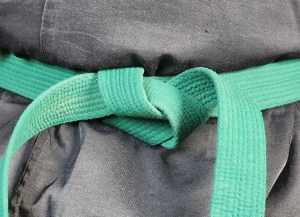
A male student wears a green belt before earning the black belt (while holding the kyu ranks). Female students wear a red belt before the black belt is earned.

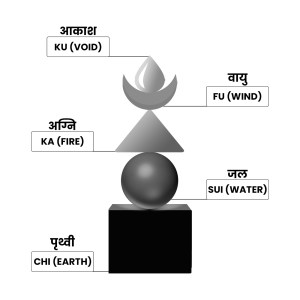
In the Bujinkan, there is a concept of the “Goho Sanshin no Kata”. Here, the word “goho” refers to “five ways”. These five ways correspond to the five elements. Here though, the five elements are, Earth, Water, Fire, Wind and Space (wood and metal are not a part of this set of five). These elements are the same as those seen in Hindu culture. In Hindu culture the five elements are called “Pancha Bhoota”. “Pancha” is five and “bhoota” is element. The five elements in many Indian languages are called, “Prithvi (Earth), “Jala (Water)”, “Agni (Fire)”, “Vāyu (Wind)” and “ākāsha (Space/Sky)”.

The forms related to the Goho are trained over and over all through one’s life as a practitioner of the Bujinkan. The learning from the training of these 5 forms is applied in armed and unarmed combat in various ways. The Goho is pretty much a foundational aspect of the Bujinkan. Hatsumi Sensei, the previous Soke or Grandmaster of the Bujinkan system, had once said that there is a sixth element beyond the five we train regularly. This is something I have heard from my teacher Shiva and other mentors.

A representation of the Godai (the five elements). Artwork by Adarsh Jadhav.

Hatsumi Sensei had said that the 6th element is “Consciousness”. The Japanese term he used to refer to “consciousness” was “Shiki”. This could also be referred to as “being aware” or “being mindful”. From what I have learnt and experienced of this concept of Shiki, this is supposed to be something that one can experience when the experience with the other 5 elements are imbibed with many years of training.

Hatsumi Sensei is also supposed to have remarked upon this idea of “Shiki” in reference to the famous book “Go Rin no Sho” authored by Miyamoto Musashi, the master swordsman who lived during the 16th and 17th centuries in Japan. “Go Rin no Sho” means “The Book of Five Rings”. It is quite a popular book even in modern times in corporate circles where it supposedly teaches strategies to overcome challenges.

The five rings in the title of the book refer to the five elements that we mentioned a little earlier in this book. Sensei supposedly said that he has moved beyond the five elements referred to by Musashi, and into the sixth one, that is Shiki or consciousness. This was supposedly mentioned as a further evolution from the past and an improvement as well. He also mentioned that he was teaching this to his students and that they should imbibe Shiki as well.

Thus, there are 6 elements, the five which are analogous to the Pancha Bhoota in Hindu culture and Shiki, which is a layer on top of the five. I cannot help but think of the old cartoon series “Captain Planet” here. In the series, there were five parts to the eponymous superhero, 4 elements (earth, water, fire, wind) and “heart” (because it is what unites the other 4 elements or something like that, I cannot recall). In real world martial arts training though, Shiki enables the effective application of Chi, Sui, Ka, Fu and Ku (Earth, Water, Fire, Wind and Space).

So, there are 10 kyu levels and 6 elements. There are several other concepts and sets of concepts with different numbers in the Bujinkan. But why did I look at the two sets that had 10 and 6 respectively. Simply because this article is about 60 and the sixties. Six time ten is sixty, 6*10 = 60. 😀

Notes:

* Baader-Meinhof effect – A phenomenon where one seems to encounter a word or concept often after coming to know of its existence.

** https://artudio.net/14-vidya-techniques-64-kala-art-forms/

*** https://artudio.net/14-vidya-techniques-64-kala-art-forms/

The Bujinkan, as I see it – Series 1, Part 5 (of 5)

Learning from oral transmission and experiences in the training spaces

The purpose of this series of posts is multi-fold. Firstly, it is a resource I can share with people who are not practitioners of the martial arts. For most of us, a majority of the people we interact with do not practice any form of martial art. Sharing ideas and practices about martial arts might require some “first principles” like definitions, overarching themes and ideas and objectives of the art form. Hopefully this series will be that resource.

Secondly, it is an opportunity for me to look back at my own thoughts about the Bujinkan. The thoughts are a document I can refer in the future to see if I my thinking has changed or evolved.

Lastly, practitioners of the Bujinkan who are relatively new to the system and long-time practitioners who might need a look back at aspects from earlier years could use this as a starting point for further discovery. There are several practitioners and Sensei of the Bujinkan with a lot more experience compared to me, who share content about the art form and the system. I strongly recommend that everyone consume the content from those sources. This series is possibly an index to search further in those sources.

So, this series in not a deep dive, it is more like a primer of my thoughts with scope for expansion in each aspect. Most importantly, whatever knowledge can be gleaned from this series is a conversation starter or direction pointer at best; it does not in any way replace actual training in a dojo with fellow budoka and a teacher who can help one progress.

In the first post of this series, I had given an introduction to this series and defined some basic concepts that would be revisited during subsequent posts. In the second post, I had looked in greater detail at the “Ten Chi and Jin”, which is considered the “basics” of the Bujinkan. In the third post, I discussed in brief the 5 styles of fighting and the 9 schools that make up the Bujinkan system of martial arts. In the fourth post I discussed the use of weapons as a part of training in the Bujinkan and martial arts in general, which in my opinion is the most important aspect of the martial arts. In this part, I will discuss how learning occurs in the Bujinkan and perhaps in most martial arts around the world. This is last of the aspects I had referred to as the “physical aspects” of the Bujinkan. These are seen in the screenshot below. The topic highlighted is the focus of this article.

This post refers to the actual training, learning, experience, expression and realization that happens in the space where martial arts training occurs. The space of training can be called dojo, akhada, kalari, garadi mane, gym or by any other name depending on the part of the world one is training in. The finer points of the various concepts, forms, weapons and their use, and the nuances of the movement and its flow; all of these can only ever be assimilated when one actually trains physically with a teacher and fellow practitioners (hopefully both senior and junior in martial experience).

It is because of the experiential nature and perpetual flow of learning that it is impossible to document it all. It is documented at a personal level and in most cases, perhaps never. Most individuals just use the martial arts to generate wisdom and lead a good life, and never bother to document their learning and journey. This aspect will be expanded upon later in this post.

A representation of experiential learning. Credit for the images – Left & Centre – “Mahabharata 5 – Enter Drona”, published by Amar Chitra Katha, Right – “Mahabharata 16 – Pandavas conquer the World”, published by Amar Chitra Katha

The words spoken by the teacher and fellow practitioners and experiences shared while training form the oral transmission part of the training. Each person hears everything differently and develops a system of movement that works for her or him individually. This works over years of training because the objective is learning and not teaching.

A representation of learning with a teacher. Credit for the images – “Mahabharata 5 – Enter Drona”, published by Amar Chitra Katha

Again, because there are as many variations of learning as there are people, it is impossible to document in any media. To give an analogy from Hindu culture, it is said that there are 300 versions of the Ramayana. But since every person who consumes any version experiences some part of the epic differently from every other person who consumes the same, a new personalized version is created for that person. So, there are in reality, as many versions of the Ramayana as there are people who experience the same in any media. And this changes every time there is another experience depending on the media of experience or the situation of the person, in terms of age and physical, intellectual, emotional and spiritual states. So, there literally are infinite versions of the Ramayana. This same is true of actual martial arts training.

This nature of learning is why most of the training is called “Kuden”, in the Bujinkan system. The “ku” in kuden is refers to empty space and “den” comes from the word “densho”. Densho refers to the scroll or book of teachings which is more like a syllabus. So, kuden means learning that is not contained in or cannot be obtained from a written document. In the modern world, densho can extend to videos or any other media available through social media and digital technology. Thus, literally everything that is learnt ONLY from experience can be classified under kuden.

A representation of learning by practice. Sketch by Vishnu Mohan.

Another analogy here from Hindu tradition is the difference between Shruthi and Smriti. Shruti refers to that which is heard and hence is analogous to the kuden mentioned above. Smriti refers to that which is documented (in the past it was books). Many a time, Shruthi could be some knowledge created due to a wonderful revelation that has occurred in a moment of great inspiration. This adds to one’s own and also to the learning of others. Of course, the inspiration in that special moment itself could be due to earlier experiences, learning, wisdom, or exposure to some Shruthi or Smriti. Also, over time, some Shruthi could become Smriti, if it becomes commonplace and can be documented to the advantage of many practitioners. This is when a densho gets created to supplement or replace kuden. Even this article could be considered a personal Smriti of years of Shruthi on my part.

A representation of “Shruthi”, or learning from the spoken word in the presence of a teacher. Image credit – “Mahabharata 1 – Veda Vyasa”, published by Amar Chitra Katha

Going by this analogy and the defined concept, all the other 4 parts before this one, where I discuss my understanding of the Bujinkan, where I have discussed the physical aspect of martial arts training, are a broad documentation that can be used to “learn about” the Bujinkan and maybe about martial arts in general. But the information there cannot be used to “learn” either the Bujinkan or the any other martial art. It is information about the martial art form, but not a guide to learning the martial art.

A representation of “Densho” or “Smriti”, a manual a student can use for practice. Sketch by Vishnu Mohan.

An aside here – I am adding a bit of personal opinion. I think learning happens through the skin, by means of osmosis while training in the dojo or an equivalent space. Many a time one is confused in the mind and hence learning is not active. Seeing and hearing lead to a semblance of imitation, but not learning. Also, I have never heard of anyone learn through smell and taste. Therefore based on what I have experienced and seen, learning seems to be through the skin, and passive. Maybe someone can share more details based on their knowledge & experience.

Considering that the martial arts lend themselves to learning through personal experience and not all of it is documented, an important concept takes shape. The one of the “martial journey” or “Shugyo” as it is referred to in Japanese. Over the years of training any martial art, one likely trains with multiple teachers and their respective students. These teachers contribute one’s experience and realizations through their own expressions of the art forms. These teachers might be from different countries, cultures and backgrounds, all of which adds to the learnings.

Then there is the exposure to knowledge from other media that is available today, like YouTube, books, and any other media. There are also online workshops and conferences that while not great for starting one’s martial journey, are great tools to share knowledge. All of this leads to one’s growth as a martial artist. Due to the long time this takes and perhaps the journey across many geographies, it is a journey in a very real sense. This journey is where one finds expressions of kuden by different individuals. Also, every time one finds a new set of documented experiences of kuden from a martial artist one has not trained with before, that is a new station in one’s martial journey as well.

One last point about the martial journey is that it is not necessarily a linear one. It helps one buttress one’s existing learning and add layers to one’s own experience. It also, more importantly, allows one to remember concepts that have been forgotten, basics that have not been revisited and practices that have been discontinued to one’s detriment. In this sense, it is a reminder and hence a circular journey to reconnect with basics or roots and make them stronger.

Word of caution – All of the above is my personal experience from class. It could be different from those of others, and I could be wrong in some of my perceptions. For details of specific concepts, techniques and forms, I recommend people train and experience the art form on their own. Barring that, there are several books and videos by the Soke (Hatsumi Sensei) himself, and then there is content in various media by people who have trained from around the time I was born or even before that. So, there is a lot of experience to immerse oneself in.

This is the last post that delves into physical aspects of the Bujinkan. The next series of 5 posts will deal with the non-physical aspects of the Bujinkan. These are seen in the screenshot seen below. I will start this series of posts in late March or April ’25.

Year of the Snake – An Indian perspective through Budo

A young Spectacled Cobra

Today, 29th January, 2025, is the Chinese New Year. This year is the “Year of the Snake”. More specifically, it is the “Year of the Wood Snake”, “wood” being the element associated with the animal of the zodiac this year. Due to historical cultural connections between China & Japan, we use the zodiac animal associated with the year as inspiration for training, every now and then, in the Bujinkan (which is of Japanese origin). This is not a norm, but something that is not uncommon either. Snakes are animals that have a strong presence in Hindu culture. So, me being a Hindu, a Budoka, and someone who has a deep respect for snakes, inspired me to write this article.

Everyone knows of the main aspects that are considered advantages in the martial arts. These generally are strength, speed and agility. Skill and experience can offset some of these. But weapons mitigate the advantage physical prowess provides. This includes both offensive and defensive weapons. In my previous post, from last week, I had discussed the importance of weapons in the martial arts*. This seems like a nice follow-up. One advantage that weapons additionally provide is reach, or how far away an attack can be carried out. Modern weapons of course also have “range” which is how large an area can be affected (of course, “range” can also be used interchangeably with “reach”, when it comes to modern weapons).

While training the Bujinkan system of martial arts, one story that everyone learns is that of Ishikawa Goemon. Ishikawa Goemon is a legendary character from the Sengoku Jidai (warring states period) of Japan, which is the second half of the 16th century. Ishikawa Goemon is a shinobi from Iga who tries to assassinate either Oda Nobunaga or Hideyoshi Toyotomi, using poison. I have been told that there are stories which describe him as trying to assassinate one or the other, though neither of them are supposedly strictly historical. In both stories, the attempted assassination fails. Goemon is supposed to have been executed along with his family according to some tales while some supposedly say that he escaped.

Chains that guide rain water into a harvesting area – something like Goemon used to guide poison into his quarry’s mouth?

Despite the failure of the attempt, the means he used in the assassination is fascinating! He gained access to the bed chamber of his target and hid in the rafters overhead. When the quarry was asleep, he let poison drip into the mouth of the sleeping individual over a thin rope. Think of this as the chains used to guide water into a harvesting tank below. The poison only made the target sick but was insufficient to kill the person. This legend was used in a sequence in the James Bond movie “You Live Only Twice” starring Sean Connery.

Another story related to “Ninja” using poison is something I saw in the old Discovery Channel series “Ancient Warriors”. This series showed how various groups of historical warriors fought and lived. This series ran between 1994 and 1995. One episode of this series focused on the Ninja and was titled, “The Ninja: Warrior of the Night”! This series has not aged well. The “facts” shown in the series are questioned and not considered entirely accurate.

In this episode about the “Ninja” a situation is narrated where the ninja assassinate a warlord by sprinkling poison powder on flowers in his garden. The ninjas observe that the warlord takes a stroll in his garden every morning smelling the flowers. They use this behaviour of his to kill him. Even in the episode, the name of the warlord is not mentioned, nor is any context given for the assassination. So, I am not sure if this is historical, and if it is just a story, I would request anyone else who might have heard the same, of its antecedents. Who is being referred to in the story and in what quasi-historical situation? I am attaching a link to a video of this episode in the notes below**.

Irrespective of the provenance of the second story, the two stories mentioned above show that the use of poison is certainly attributed to Shinobi. And this links the Shinobi/Ninja to snakes. Many creatures on our planet have developed “Venom” as a survival strategy. These include molluscs (e.g. snails), arthropods (e.g. scorpions), insects (e.g. wasps), amphibians (e.g. frogs) and reptiles (snakes and lizards). But snakes are undoubtedly “top of mind” when it comes to creatures that use chemical weaponry, namely venom (many a time referred to as “poison’).

An old photo of a Saw Scaled Viper

A small tangent here. Venom is poisonous. I have heard a beautiful explanation regarding when the terms venom and poison should be used. I will repeat the same here. If a snake bites a person and the person dies, the snake is VENOMOUS. If a person bites a snake and the person dies, the snake is POISONOUS. In contrast, if a snake bites a person and the snake dies, the person is POISONOUS. If a person bites a snake and the snake dies, the person is VENOMOUS.

This is why there exist frogs referred to as “Arrow Poison Frogs”. These frogs secrete a venom from their skin. So, if any animal bites these frogs or tries to eat them, the frog is POISONOUS and hence they learn to not consider the frog food. Similarly, there are “poisonous” mushrooms, which if eaten, can kill the individuals who eat them. Now, we go back to the main article.

One of the things that a practitioner of the Bujinkan system learns in the first few months of training is the “Hi Ken Juroppo”. This refers to the 16 ways of striking/hitting an opponent, without weapons. This includes the use of the fists, fingers, elbows, knees, feet etc. Apart from this, a concept called “Shizen Ken” is taught. Shizen Ken can be translated as “natural weapons”. This generally refers to nails, teeth and spit in humans. In other words, one can scratch or bite or spit at opponents. These are not trained as a part of “striking” an opponent as these are considered to be more “natural” or something we do due to our evolutionary past.

When it comes to animals, shizen ken would be horns, claws, fangs, tongues (think chameleons), beaks, and of course, VENOM. Obviously, when we consider weapons, we need to consider defensive weaponry as well, the examples mentioned earlier being exclusively offensive in nature.

Defensive weapons in animals include armours (carapace, cuticle, shell ec) in the case of crocodiles, tortoises and crabs, secretions (like the ink used by squids and octopi and the stink raised by skunks), spikes in porcupines and of course the wide range of camouflage that exists in nature. Beyond these, we can include the warning mechanisms used by animals under shizen ken. This includes the warning sounds used by various animals and the bright display colours that poisonous animals like frogs and caterpillars sport.

If we consider protection developed by various creatures against the heat, cold and the natural elements, this list of “natural weaponry” deployed by life on earth increases manifold! Of course, the development of weaponry is not limited to the animal kingdom. Weapons, mainly defensive ones are seen even in the plant kingdom, like thorns, resins, hard shells and of course poison.

Considering just snakes, they have developed a natural weapon that gives them a huge advantage in the battle for survival. Venomous snakes are distributed all across the world, but not all snakes are venomous. Venom is one of the weapons that snakes have evolved apart from size, speed, camouflage, agility and flexibility, which are seen in many species of snakes, sometimes in conjunction with venom.

An old photo of a young Common Krait. I could be mistaken here, this could be a Wolf Snake, which looks very similar to a Common Krait.

One factor about weapons is that they nullify the advantage proffered by size and strength. This is true in all species. This means that venomous snakes can afford to evolutionarily be smaller in comparison to many other snakes. This also means that they can be ambush hunters and minimize the risk they face from prey, struggling or otherwise. Of course, nature being nature, not all venomous snakes are small. Some rattlers and bushmasters in the Americas grow pretty large. Gaboon Vipers in Africa are large as well, and then there is the King Cobra, which is a very big snake by all standards, by length if not weight and girth. But most venomous snakes can be small or medium sized. In India, the Saw Scaled Viper, the Common Krait and many of the Pit Vipers tend to be on the smaller side according to common parlance. Cobras and Russel’s Vipers are medium sized snakes.

A majestic King Cobra

I have seen on some nature documentaries, the afore mentioned African Gaboon Vipers described as “docile”. This is in relation to its behaviour vis-à-vis humans. Of course, every snake has a different temperament and this is only a general characterization that I have heard. I am not even sure if this observation is correct. But assuming what I have seen is correct, I make the following observation. The Gaboon Viper has very large fangs to deliver venom, the largest of any extant snake. It can deliver a large dose of venom in a single bite. So, if I anthropomorphize the Gaboon Viper, it is so certain of its natural abilities and of course weapons, it has no need for any aggression. It knows its opponents will stay away due to fear or evolutionary knowledge of its weapons. Thus, it can AFFORD to be docile!

The Gaboon Viper also has a fantastic camouflage pattern that resembles the leaf litter on a forest floor. Lastly, it is an ambush hunter. Now consider the following traits. The Gaboon Viper can inject sufficient venom to kill its prey in a single bite – it is therefore armed with lethal weapons. Due to its camouflage, its quarry cannot see it coming. Being an ambush hunter, it can lie in wait for long durations. Consider these traits together – it is literally an Ishikawa Goemon from another species! Of course, there are several other snakes that have the same combination of traits and I am just using this as an example.

A Gaboon Viper amidst leaf litter. Image credit – “1000 Wonders of Nature”, published by Reader’s Digest

In India, in the stories from Hindu culture, there are entities called the “Nagas”. Nagas are depicted as part human and part snake in many representations. They are also depicted exactly as snakes in others. I have heard some people distinguish between Nagas and snakes. Snakes are also referred to as “sarpa” in many Indian languages. Some people suggest that Nagas are different from “sarpa” or snakes since they have traits that far exceed those of snakes, traits that far exceed those of humans as well. But the Nagas are definitely linked to snakes and in modern Indian culture, the difference is hardly ever considered. Nagas are also prevalent is South-East Asian culture.

A representation of a Naga as depicted in South East Asia

The Nagas, based on my knowledge have three traits that most Hindus are commonly aware of.

  • Firstly, they are symbolic of fertility, in humans and of the land itself.
  • Secondly, Nagas and snakes in general, are considered guardians. They are depicted as guardians of material wealth, like ancient and hidden treasure. They are also symbolic of wisdom and spiritual prowess.
  • Lastly, Nagas are considered technologically superior as cultures go, which is perhaps an offshoot of their being associated with wisdom.

I will share a couple of examples of this technological superiority. In the Mahabharata, during the Ashwamedha Yajna after the Kurukshetra War, Arjuna is killed by own son Babruvāhana. He is healed and brought back to life by his wife Uloopi, who is a Naga princess. Uloopi uses a “Naga Mani” to heal Arjuna. The “Naga Mani” is a popular trope in modern Indian entertainment as well. It again links treasure (Mani is a gemstone) with the Nagas. This story shows Nagas possessing technology or knowledge that allows them to perform tasks that are beyond normal humans. It brings them closer to the divinities in this sense.

Uloopi summoning the “Naga Mani” or the Gem of the Nagas. Image credit – “Uloopi”, published by Amar Chitra Katha

The other example is the “Sarpāstra” or the “Nagāstra”. “Astra” can be translated as an arrow or a projectile weapon. Astra can be used to depict any weapon that is discharged, with a bow or any other device (the air-to-air missile developed by India for its fighter aircraft is also called “Astra”). This is a special arrow used in both the Ramayana and the Mahabharta. This arrow is supposed to never miss, unlike other arrows. Further, an adversary who is struck by this arrow is either sure to die, with no hope of recovery, or be bound for all time, as one can never escape the weapon’s clutches. In essence, this Naga weapon is more capable compared to those used by humans.

A representation of the “Sarpastra” being superior to a normal human arrow. Image credit – “Uloopi”, published by Amar Chitra Katha

These positive traits associated with Nagas results in names associated with Nagas being widely prevalent in India even today! Names like “Nagaraj”, “Nagaswamy”, Nageshwar (male version) and Nageshwari (female version) and many others associated with Nagas are encountered by all of us regularly. All of these names translate to “King / Lord/ Chief” of the Nagas. I am sure all of us can recall at least one friend or relative who has a name associated with the Nagas. This is not to mean that snakes are not feared in modern India. There is a healthy respect for snakes all across India. The association with the Nagas, and hence snakes, is not new. Many royal lines from the times of Ramayana and Mahabharata to historical times link themselves to Naga ancestry.

It might seem that Nagas, who are part of legend and folklore in India are the ones who have positive traits. It is not snakes that have positive traits. I beg to differ on this point. I will share my personal opinion on this point. Let us begin with venom again. Earlier, I mentioned the astra named after snakes or Nagas. This is literally true in snakes! Snakes have developed the mechanism to deliver venom at a “stand-off” distance. There are multiple species of Spitting Cobras that have evolved a fang with an opening through which they can spray venom on an adversary, and keep them at bay. This is a true astra indeed!

Let us now consider aspects of snakes beyond the use of venom. Let us begin with the physical trait of snakes that everyone recognizes – the forked tongue that snakes possess and flick in and out of their mouth every now and then. Snakes use their tongue to analyse the environment around them. Snakes have an organ on the roof of their mouths, on the inside, called the “Jacobson’s Organ”. The tongue collects samples from the air and deposits it onto the Jacobson’s Organ, which in turn determines what the surrounding atmosphere is like. This is like snakes carrying around a lab inside their heads that can analyse their surroundings! This is miniature technology like no other!

The forked tongue of a snake

Of course, this is not limited to snakes. Other species have evolutionary senses that seem like magic,  or at least marvels of technology, thanks to modern science. Some raptors (birds of prey) can see in the ultraviolet spectrum, sharks can detect the electrical signals in water to find food and elephants can communicate using infra sound. These are just a few examples from the natural world, without even considering the plant kingdom.

Considering evolutionary senses, one cannot ignore “the Pit” used by snakes. Pit vipers and some pythons have an organ called the “Pit” at the top of their heads on the outside. This pit is a sensory organ that allows the snakes that possess them to perceive their surroundings through something like “heat vision”. They can identify temperature differences to identify prey and track them.

So, considering just the two examples above, snakes carry in their heads, heat vision equipment and a lab to study their surroundings! 😛 This does indeed seem like high technology to us humans, in hindsight of course. Therefore, Nagas, who are linked to snakes and sometimes are nothing more than anthropomorphized forms of snakes, are no doubt considered wise and technologically advanced.

Nagas represented as part human and part snake. Image credit – “Uloopi”, published by Amar Chitra Katha

Even if one considers humans before modern science revealed all the “super senses” that snakes possess, we can still explain the fascination with snakes. In a previous article of mine***, titled “Ashta Siddhi and Budo”, I had discussed what are considered the “8 achievements” of a warrior and how they can be understood through modern budo practice. The fifth of these five achievements is called “Praapti”.
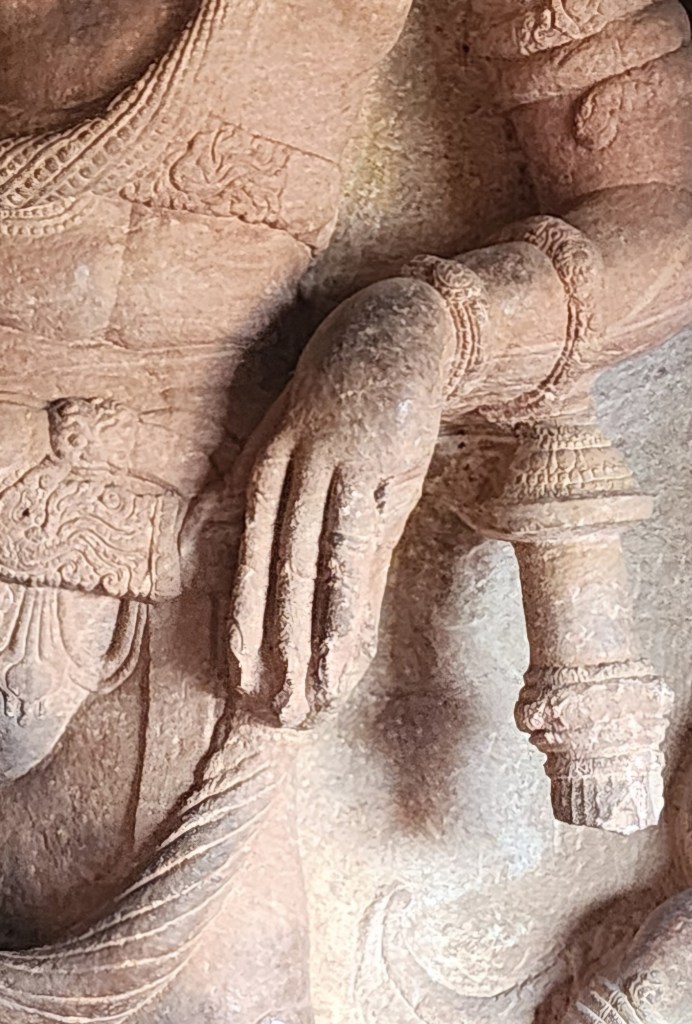
“Praapti” can be considered to be “able to receive everything”. This in modern parlance, in my opinion, refers to being able to perceive all the information in a given time and space, which in turn aids in conflict management and hopefully conflict mitigation. For practitioners of the Bujinkan, this would, again in my opinion, be nothing other than “Sakkijutsu”. Sakkijutsu, put simply, is one’s intuitive ability, which could also be termed as “awareness”, “situational awareness” or “mindfulness”.

The sensory abilities of snakes described earlier would be apparent to people in historical times, for they were keen observers of the natural world as well. The senses of snakes might not have been explained, but it would not be something unknown either. So, in a culture where, the ability to perceive the surroundings is celebrated as one of the “8 achievements” and the ability of snakes would be known, would snakes and therefore the Nagas, not be deeply respected as well? I would say that they definitely would be.

All of the above aspects I have mentioned are beyond the usual symbolism attached to snakes – that of growth. The act of moulting has made snakes a symbol of “growth” and therefore “transcendence”. The points shared above are from the perspective of a Hindu in modern India, who is also a practitioner of the Bujinkan (an expression of Budo).

I had started this post with a couple of quasi historical stories from Japanese history. I will now revert to Japan to make yet another point. During my training the Bujinkan, I have learnt from a mentor of ours, Arnaud Cousergue, that the Togakure Ryu, one of the schools of Ninpo Taijutsu (sometimes referred to as Ninjutsu) that we learn, is divided into 18 segments. Only a few of these 18 segments are trained in dojos these days. One of these 18 segments is “Kayaka Jutusu”. This refers to training the use of explosives. There is no segment that is attributed to the practice and use of poisons. But Ninjas did use poison as evidenced by the two stories mentioned earlier. So, could it be that a segment for poisons was not present in just the Togakure Ryu? Or was it subsumed under “unconventional weapons”, the chief of which was gunpowder and explosives in later centuries? I am not a historian and have no answer to this question.

In my personal opinion, this segment, “Kayaka Jutsu”, could perhaps be considered to refer to the use of unconventional weapons. A theory about the origin of the Togakure Ryu states that it originates in the 12th century. This was before Japan’s first encounter with gunpowder and explosives, which was during the Mongol invasion, in the late 13th century. So, maybe this segment among the 18 was added later during the evolution of the Togakure Ryu? Or, as mentioned earlier, was it that this segment referred to “unconventional weapons” in general and later became specific to explosives as that was the primary new weapon? I am assuming it was so. If anyone knows otherwise, please do share your knowledge with me.

While considering “unconventional weapons”, there is one trait of snakes that is truly staggering, the very definition of “unconventional”. Snakes have no ears and do not hear like other animals. Snakes sense vibrations through the bones in their head. But their “hearing” or perception of sound in comparison to humans and other animals is poor. But snakes use sound to warn potential threats.

Russel’s Viper

The best example of this are rattle snakes. They have evolved a rattle to warn creatures who intrude on their habitats. Similarly, in India, if anyone has heard the warning hiss of a Russel’s Viper, it sounds like a pressure cooker about to go off! In both these cases, sound is used as a warning device. This means that snakes use a medium of perception to warn creatures, that they themselves do not possess! Snakes cannot hear but know other creatures can! And they use that sense for the benefit of both! How cool is that! It is baffling and “unconventional” to say the least.

Of course, the ability to use a medium one cannot perceive well is a product of evolution over millions of years. And evolution itself brings to mind two aspects that are expressed in the Bujinkan. These are Kami Waza and the fourth of the Gojo, “Shizen no choetsu”.

Kami Waza is a concept where one moves during a fight in such an amazing manner that it seems like one was being moved by something divine. This is exactly what evolution is! The outcome of evolution seems truly magical in hindsight. I had referred to Kami Waza in my article about the Ashta Siddhi, which is linked here. “Shizen no choetsu” could be translated as “the transcendence of nature”. It is the fourth of the 5 Gojo that is oft quoted in Bujinkan dojos. I had written an article some time ago where I have discussed my understanding of the five Gojo. The same is linked here+.

Evolution that is seen in nature is about continuous and incremental changes to overcome challenges in ways that are inconceivable at any given time. The ability of a creature that does not use sound to ward off creatures that do use it, without knowing the experience of sound is exactly that! Transcendence in its essence! First an animal realizes that other animals perceive something that it does not, and then devices a means to use that perception to its advantage, but without developing that perception in itself! 😀 I know, I am saying this a lot, because it boggles the mind!

There is another Gojo, the third of the five that goes, “Shizen no Ninniku”. This can be translated as “the forbearance of nature”. This refers to how one needs to persevere through any activity, just like nature has an abundance of ability to take any challenge and over time overcome the same. I have discussed this also in my previous article. I will use a personal experience of mine to show this trait in snakes.

My family used to run a rescue and rehabilitation centre for wild animals within the city many years ago. This centre functioned from the late 1970s through the late 2000s. Sometime in the late 90s of the early 2000s, an interesting incident took place. We got a call from a local timber yard about a snake in one of the logs at their premises. It was a log that had been transported from Malaysia to India. In the log was a clutch of eggs that had not been noticed earlier and had somehow survived the processing of the tree before transportation.

One of the eggs hatched and a live Small Banded Kukri Snake emerged from the same. It was a Malaysian species of Kukri Snake which hatched in India. Unfortunately the snake did not survive long. But this does show how snakes can survive and extend their territories. In this case an egg travelled from Malaysia to India and hatched. We hear many stories of how Burmese Pythons have successfully created a habitat for themselves in Florida, the other side of the ocean.

A large Indian Rock Python

Snakes can endure habitat destruction, disturbances to their nests and dwellings, human trade in exotic pets and still find new habitats to inhabit. This is a wonderful example of how nature perseveres, its forbearance is infinite. This is not unlike how one needs to spend years to train the martial arts. It is a gradual process, demanding time, effort and many resources to be expended.

That is a roundup of the fascinating connections between snakes, the martial arts and Indian culture. In conclusion, snakes are like a living breathing sensor package, much like modern day fighter aircraft and other weapons systems. This is like “Praapti” in Hindu culture and Sakkijutsu in the Bujinkan. This is also the key behind modern day 5th generation warfare, where conflicts are not kinetic and information gathering is of paramount importance and technology is a vital ingredient. Technology of a natural kind is what snakes also deploy, chemical weaponry, or venom, in a world where strength, speed and size matter. This leads back to the martial arts, where unarmed combat might be basic, but weapons are the true expression of the art. And we have not even spoken about flying snakes or the world of the sea snakes…

Acknowledgements – All images unless mentioned, were taken over the course of many years by various members of my family. I share my deep gratitude to my uncle, Dr. Shashidhar for sharing many images of the many creatures that shared our home over the decades.

This post would be incomplete without sharing a couple of images of another uncle of mine, the late Srinath. He had an innate understanding of all wild creatures and a knack for working with snakes that was, to say the least, intuitive. He could sense the temperament of any snake, or any animal for that matter, in an instant. Watching him work with wildlife will be something that I will never not miss!

Left – With a King Cobra. Right – With a Spectacled Cobra.

Notes:

* https://mundanebudo.com/2025/01/23/the-bujinkan-as-i-see-it-series-1-part-4/

** https://www.dailymotion.com/video/x6ch45c – watch between the 10 and 12 minute mark

*** https://mundanebudo.com/2022/12/22/the-ashta-siddhi-and-budo/

+https://mundanebudo.com/2023/03/16/the-gojo-a-personal-understanding/

Budo, prosperity and the Elephant Festival (Aane Habba)

A majestic tusker in the Nagarahole Tiger Reserve

Nine years ago, on a trip to Japan one of our mentors made a very interesting statement. It was a trip to train at the Bujinkan Hombu1 dojo with some of the senior most teachers in the system. At that time, a lot of us had passed the Sakki2 test to receive the 5th Dan just a few years previously. Many more of our buyu3 passed the test and achieved the 5th Dan during that trip. The 5th Dan is a requisite to receive a “Shidoshi”4 certificate, which is a prerequisite to start teaching the students of the Bujinkan.

During that trip, one of our mentors, Sensei Darren Horvath, said something very interesting. Sensei Darren has always considered the teachings in the dojo as applicable to human life as a whole, and not just as those applicable in a physical altercation.

He said that the achievement of the rank of “Shidoshi” means that the person who achieves this should be able to, in the near term, at least double her or his income, as a result of the learning achieved so far. This was in the context of how the learning from becoming a Shidoshi should lead to a considerable improvement in the quality of life of the Shidoshi. Considering how monetary wealth is vitally important in modern day life, there should be a surplus of it, which allows for other pursuits important to one’s life. It was in light of this opinion that the earlier statement was made.

To put it simply, personal prosperity is supposed to be an outcome of the training put in, to achieve the Shidoshi certification. This could be classified under the personal or self-development that results from training the martial arts. The Sakki test that needs to be passed on the way to a Shidoshi certification requires development of trust in one’s own intuitive abilities. This can also be called mindfulness or awareness of any situation. This development of an individual is expected to help one advance in aspects of life that have nothing to do with physical combat or the martial arts.

As a Hindu and an Indian, the idea of prosperity is an intersection between Budo and Hindu culture that stands out. This idea inspired this post. Personal prosperity (including monetary wealth), as I understand it, is a vital aspect of Hindu culture. One of the Goddesses we routinely pray to is Lakshmi, who is the Goddess of wealth and also the consort of Lord Vishnu. Another divinity, who is not prayed to as much is Kubera, who is considered the God of Prosperity & Wealth. Kubera is also the lord of the Yakshas.

The wealth of Kubera represented by his loan to the wedding of Lord Venkateshwara. Image credit – “Venkateshwara Taanada Chitragalu”, published by Pioneer Publications

In a previous article of mine, I had shared a sutra* from the Arthashastra, one line of which says “Dharmasya moolam arthaha”. This means that “artha”, or wealth, is the root of Dharma. Wealth is vitally important for Dharma to exist and permeate all walks of life. Dharma, as I understand it, is “that which sustains”. This means that Dharma is doing what needs to be done to sustain a good life. This is why Dharma is sometimes referred to as “doing the right thing” or “doing the best thing possible in a given situation”. Thus, wealth, or prosperity, is very important for a good life by doing the right things. Personal prosperity is the root!

One symbol of prosperity in India, since a very long time, is the elephant. This is perhaps because people or institutions who owned an elephant(s) in India were prosperous, for owning an elephant was expensive, not to mention maintaining several of them. One of the eight forms of Devi Lakshmi is titled, “Gaja Lakshmi”, where Gaja means an elephant. The elephant is associated with Lakshmi as she is the Goddess of Wealth/Prosperity, and the elephant is a symbol of the same.

A representation of the arrangement during the celebration of Aane Habba (Elephant Festival)

15th of December, 2024 was celebrated as “Aane Habba” or “The Elephant Festival”. The date of the festival changes every year as it is based on the Tamil Solar calendar. This is a festival specific to my community and not a festival that is widely observed in India, or elsewhere. But the day on which the Aane Habba is celebrated is observed variously by different Hindu communities. The day on which the festival falls is the Poornima (full moon day) of the Kartika month according to the Tamil Solar calendar. It is an auspicious time and hence is celebrated under different names by different groups.

Devi Lakshmi on the white elephant above

One of these is “Kiru Deepavali” or “Little Diwali”. Another is “Vishnu Deepam”. Yet another festival that occurs a day or two earlier is “Karthigai Deepam”

The Kartika month itself is very important for historical reasons. The “Bali Jatra” festival happens in the state of Odisha during this month. Historically this was the beginning of the voyage from India to South East Asia (Bali in particular) for trade. Bali Jatra is associated with the Kartika Poornima festival. This occurred on 15th November in 2024. This voyage generated enormous wealth historically for the merchants involved and for the nations along the coast. This is the Poornima based on the Lunar calendar, hence the difference in the date of the festival.
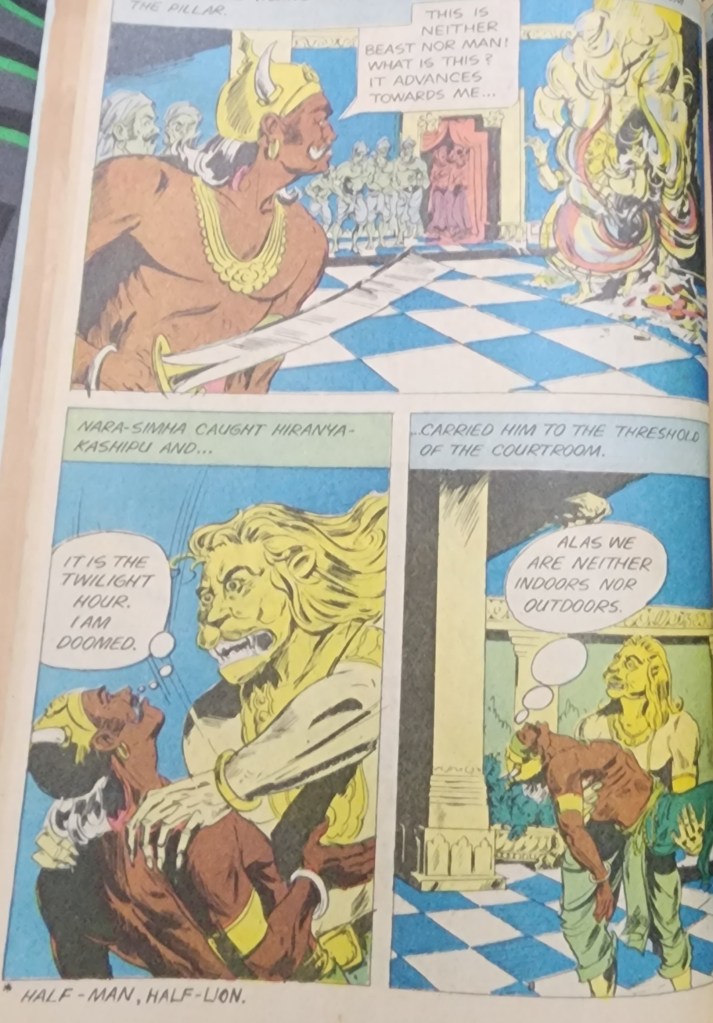
The Aane Habba itself is specifically celebrating the elephant, which is another way of saying that we celebrate prosperity and wish for more of it, and in perpetuity. This specific aspect of the festival brings us back to the same idea in Budo which I started with. The notion of personal prosperity seems vitally important, if one is a Hindu. The same idea being reflected as an objective for Budo practice, makes it a wonderful reason to train the same. 😊

Notes:

1 Hombu – headquarter

2 Sakki – intuition

3 Buyu – martial family

4 Shidoshi – Master Instructor

* https://mundanebudo.com/2024/01/18/maryada-purushotham-rama-and-the-martial-arts-control-is-the-key/

The Way of the Tree

A majestic mango tree in Diwar Island, Goa

In martial arts around the world, wood is used a lot for practice weapons. These days weapons made of various polymers like nylon and polypropylene have started to replace wood as the material of choice for practice weapons. But this is not ubiquitous yet. In India, we almost never get training weapons made of anything but wood. It is too expensive due to a lack of demand. Polymer weapons need to be imported, again resulting in great costs. So, wood it is for us for now.

Recently we had a batch of wooden training weapons made and that is where the idea for this article came from. Wood comes from trees. And trees and plants have always played a major role in cultures all over the world from times immemorial, as weapons of both offence and defence. Trees are present in modern day speculative fiction, everyday news and in daily conversations as well. But I have never heard of a “Way of the Tree”.

Let us consider the presence of trees in stories from our tradition, myths from extinct religions, pop culture and modern day conversations.

  • One the most popular fantasy series of recent times is “The Wheel of Time” written by Robert Jordan and later by Brandon Sanderson. In the series there is a community of nomadic people called “The Traveling people” or “Tuatha’an”. This community follows what is called the “The Way of the Leaf”. It is a completely pacifistic way of living with absolutely no violence at all. This people reminds me of some Jain groups in India, who also follow a way living which abhors violence of all sorts.
  • An opposite of “The Wheel of Time” is “A Song of Ice & Fire” written by George R R Martin. In this series there is a kind of tree called a Weirwood. This tree is partially magic and has human faces carved into it. These trees might have a hive mind and also accept sacrifices, including human sacrifices!
  • Who can forget the Huorns and Ents in the Lord of the Rings! The Huorns are literally trees that move! In numbers, they are a forest that moves like an army. And the Ents are called shepherds of the forest, though in my opinion, they are like Generals to the Huorns.
  • In Norse mythology, mistletoe is a weapon. It is used to kill the God Baldur.
  • The plant Sanjeevini is used as a medicine in the Ramayana, to save Lakshmana from a weapon deployed by Indrajit (Meghanath), the son of Ravana.
  • Plant and tree produce are used for healthcare in India, as seen in the ancient Indian science of Ayurveda.
  • There are Gods for wine-making in many cultures. In old Vedic rituals, sacred Soma or Somarasa, which is believed to be an intoxicating drink made from a plant, is used.

I am a Hindu, and trees are all over our culture. We celebrated the festival of Dasara (Dussehra) a few weeks ago. On the last day (10th day) of the Dasara festival, which is Vijayadashami, a tree takes centre stage. The Banni or Shami tree is worshipped on this day. “Banni Mara” is the name in Kannada and “Shami Vruksh” is the name in Hindi. Both of these supposedly refer to Prosopis Cineraria.

Shami/Banni leaves given as “prasada” after a pooja on the occasion of Vijayadashami

In a lot of folklore in India, ghosts are associated with the Banyan tree. On the positive side, trees are worshipped during marriage ceremonies by some communities. The Peepal tree, called the “Ashwath Mara” in Kannada receives prayers by womenfolk during a marriage ceremony. Of course, the Buddha is supposed to have achieved enlightenment under a Peepal tree. This specific tree was called the Bodhi tree.

Social gatherings under Peepal trees were important for local discussions in India and hence the place under the tree was called a “Katte”, which is the Kannada word for a platform where people can sit and discuss. This was specifically called the “Ashwath Katte” or the “Peepal Platform”! Literally a platform for people under the Peepal! Sandalwood is used to make a paste, called “Chandana” and is offered to Gods. This is also applied on the neck of devotees after the offering, as a blessing from the Gods.

A Peepal tree

If we consider martial aspects, we can go back to the Ramayana. The bow used by Lord Rama was called the “Kodanda”. I have heard that a bow made of bamboo was called “Kodanda”. The bow of Rama was supposed to have three curves, in other words, it was a recurve bow made of bamboo. Just to expand on this point, consider the bow of Lord Vishnu. It is called the “Shāranga”. “Shāranga” is supposed to mean “horn”. So, the bow of Vishnu was made of animal horns. So, does that mean that Vishnu used a composite bow? I am not sure. I am basing this on the fact that when horn is used a material for a bow, it is usually a composite bow where sinew, glue and other materials are used to make the bow.

Representative image of Lord Rama with his bow, “Kodanda”. Image credit – “The Ramayana” published by Amar Chitra Katha.

There is a martial art with its origins in the modern day state of Tamil Nadu, called “Silambam”. The main weapon used in Silambam is a staff made of bamboo or rattan. I have seen it said that Silambam literally means “a staff of bamboo” or a “staff from the hills” which again refers to bamboo. And if the staff is not made of bamboo, it is made of a wood from different trees. There is a martial art called “Lathi Khela”, which focuses specifically on fighting with a staff. This martial art is famous all over the country.

Staff fighting is present in multiple martial art forms originating in India. Even as late as the 19th and early 20th century, the staff was the weapon of the enforcers employed by Landlords or Zamindars. These Zamindars used the enforcers for rent seeking and are considered “villains” in contemporary thinking. The staff is called a “Lathi” and the people who used the staff were called “Lathaith”.

Of course, staff fighting is popular all over the world. From the knobkerrie or rungu used in parts of Africa to the shillelagh in Ireland to the bo in Japan, staffs of various lengths are used in fighting all the time. Robin Hood fighting Little John is a popular story and in modern fantasy there is Matrim Couthon in the Wheel of Time series, who can defeat swordsmen with a quarterstaff.

If we consider defensive weaponry, armour made of fabric, like layers of cotton and the billowing cape used by Japanese cavalrymen to protect against a single arrow are well known examples. A cloth turban to protect the head was present in historical India. Another form of protection is the shield. Shields made of wicker were present in historical China while wooden parrying sticks were used in parts of Africa.

We can even use trees in a metaphorical or philosophical sense to expound on martial concepts.

Training the martial arts is a long term activity. It takes years of training to achieve mastery over the forms. It takes even longer to develop the expertise needed to share the knowledge / experience / wisdom gained. It requires commitment and passion for the art form. Conviction is also needed in the benefits of practice of the martial art to motivate an individual to keep at it.

This is not unlike the life of a tree. A tree takes years to grow, especially the large trees, which create a sense of awe in anyone who beholds them. Some trees live for over a thousand years! They grow from a seed or kernel or acorn into a sapling into a small tree into a giant of epic proportions. A great tree is a treasure because of the sheer time it has taken to get there, which could be centuries if not years! This is not unlike the time taken to master the martial arts, scaled down to a human lifetime of course.

Also consider the numbers game in the martial arts and trees in their early life. A very small fraction of all the students who start training reach the higher levels of any martial art. I am not sure if anyone has carried out a study on this, but a popular saying in the dojo I train with, is that less than 1% of all the students who walk into the dojo last for 10 years. Consider the trees now. How many seeds or saplings survive to grow into the giants we see? It is supposed to be a small fraction again, especially in the tropics where the evergreen forests cut-off most of the sunlight from ever reaching the ground. The fight for light space for a sapling on the forest floor in the tropics is same as the effort it takes a student to make time to practice the martial arts.

Another way of looking at this is the manner in which a forest, through its trees, reclaims land which was inhabited by humans for ages, even with monumental construction. There is the famous photo of the ruins in Cambodia, where the tree has literally taken over what was formerly a human dwelling. This is like sustained siege warfare, that is never let up! The trees are always there, surviving, waiting for an opening to take back what was likely lands they once occupied.

The above two images show trees taking over abandoned settlements at Ta Prohm in Cambodia. Image credit – My cousins

This is like incessant training, making time however possible. It is also like surviving against opponents without trying to win, only focusing on self-protection and self-preservation. Maybe an opening will appear in time, to mitigate the threat of the opponent. One of the senior most teachers in the Bujinkan system of martial arts, Nagato Sensei has a saying which is very popular. He says, “Leave no opening”. This saying of his has actually been put on training t-shirts! 🙂

What Sensei means by his statement, as I understand it, is that one should focus on first ensuring that one has moved to a position against an attack that fully protects oneself. There should be no opening the opponent can exploit or an opportunity to further the attack without revealing an opening in himself or herself. Unless this is achieved, looking to counterattack is counterproductive, as that might in turn give the opponent more opportunities for further attacks.

The above statement by Nagato Sensei is beautifully exemplified by how trees exploit gaps in masonry! If a sapling is not removed in the early stages when it is spotted on masonry, it can go on to crack walls over time and even spread its roots through pipes laid down for wires and plumbing.

Consider how saplings spring up with rains and sunlight in places where there is no soil at all! On concrete terraces with a little debris or construction waste. They are always there, looking for openings and opportunities to grow. This is akin to surviving a fight and to finding time and space to train. It could also be considered a metaphor in negative terms. Could the springing up of saplings on construction waste be more like the retinue of students who pass through a dojo? Like the many that are never really able to stick around to achieve any useful training? After all, a lot of the saplings that spring up are like weeds that do not last very long. Either way, “The Way of the Tree” seems a fine metaphor for the martial arts.

A representation of how flora reclaims gaps in masonry and construction debris.

There are several ways in which the martial arts are described. This includes the martial art systems as a whole, specific forms, weapons used in the art forms and the metaphors used to describe the martial arts as a whole. Top of mind to me for these descriptors are usually reminiscent of animals or geography (including metals, rocks and such), but not really based on flora, either trees or plants. Consider the following examples.

The animal forms of Shaolin Kung Fu have been made famous by the Kung Fu Panda franchise. The Tiger style, Snake style, Monkey style, Crane style, Eagle style, Mantis style are well known.

Metaphors of natural forces like water and wind are also well known, like “flow like water around your opponent”. Responding to the situation metaphorically becomes “water takes the shape of the container”. In India, strength is associated with Vayu, the God of Wind. Vayuputras (sons of the God of the Wind) Bhima and Hanuman are the epitome of strength and martial prowess.

There are representations of metals related to martial prowess as well. Consider Excalibur, which combines metal and water to bestow greatness, which includes martial skill. Another example is the “Sword of Mars” wielded by Attila the Hun. This sword is supposed to have been made of meteor iron and a marker of greatness. Of course, Attila was a great warrior king as well.

Coming to pop culture, in the world of Conan the Cimmerian (Barbarian) written by Robert E Howard and brought to life famously by Arnold Schwarzenegger, is “the riddle of steel”. Again, a metal exemplifies the martial skill embodied by Conan. Even in the world famous “Crouching Tiger Hidden Dragon”, dedication to the martial arts is called “The Iron Way” due to how hard it is and the sacrifices it supposedly entails.

There are examples of trees and plants used, but a lot fewer, and none in pop culture as I can recall. In the Bujinkan, one of the schools studied is the “Takagi Yoshin Ryu”. The name of this school translates to “School of the Weeping Willow”. Here the willow tree is representative of being flexible yet strong. I opine that it is apt, because the Takagi Yoshin Ryu is an expression of jutaijutsu. Jutaijutsu, as I understand it, could be considered a super set that also includes, wrestling, judo, malla yudha, kushti etc. All of these martial arts do need flexibility and strength.

The first 2 techniques trained with the kunai also have tree based names, though not very representative of the martial style as a whole. The first technique is called “Kiri no hito ha” which translates to “cutting the paulownia leaf”. The second technique is called “Rakka” which translates to “falling petals”!

Beyond the above examples, other plant or tree based names and metaphors in the martial arts escape me at this time, at least as “top of mind” examples. If anyone is aware, do share the same with me. This seems strange to me, considering how ubiquitous trees are in our lives. It seems strange that there is no “Way of the Tree” in the martial arts. Is it likely that we might have such a system in the future? Perhaps, as I have tried to make the case for one above.

Considering the importance of the Peepal tree for us Indians, we once had a Bujinkan training t-shirt that had an image of a Peepal tree leaf on it.

Diwali (Deepavali) with Tom Sawyer and the Bujinkan

Image credit – “The Adventures of Tom Sawyer” by Mark Twain, Illustrated Classic Edition published by Moby Books

In my community, Deepavali used to be a 5 day festival until electric water boilers and modern plumbing became commonplace. That would mean the 1970s and 1980s and even the 1990s in many Indian cities. One can add modern transportation to the mix here. This is something I have heard from my parents and grandparents.

We all know of Deepavali being a 3 day festival. The first day is Naraka Chaturdashi, the second day is Amavāsya (not a festival, more like connective tissue between 2 festivals) and the third day is Bali Pādyami. This nomenclature and observance of course, is specific to my community. Every community could observe the days of the Deepavali with different festivals. The number of days celebrated as part of Deepavali could also be different among different groups of people. I am just sticking to what I know with respect to my own community.

So, I mentioned 3 days of the festival. What are the other 2 days celebrated as? Also, the 3 days I mentioned are the second, third and fourth days in the five day festival. Naraka Chaturdashi being day 2, Amavāsya day 3 and Bali Pādyami day 4. Day 1, the first day, was celebrated as “Neeru Tumbō Habba”. Day 5, the last day, was celebrated as “Varsha Todaku”. As I understand these two festivals today, they are both “trick festivals”. Let me elucidate further, starting with the “Neeru Tumbō Habba”.

“Neeru” means “water” in Kannada. “Tumbō” means “filling” or “to fill” in the same language. The filling here is like one fills a vessel or a bucket with water. “Habba” means “festival”, again in Kannada. So “Neeru Tumbō Habba” in Kannada means, “Water filling festival”. Now come the questions, why and where should water be filled and why is this “filling” a festival?

Remember that I stated early on that this was a festival at a time before modern plumbing and electric water heaters were common in Indian homes? This is the key to this festival. Naraka Charurdashi celebrations started early in the day. This required everyone to wake up early, bathe (not shower, bathe), dress in new clothes (or at least fresh ones) and be ready for pooja activities or to have fun bursting firecrackers.

Back then, joint families were a lot more common compared to current times. Also, families were larger, with more than 10 people living under the same roof being common. Imagine that all of these people have to bathe and be ready early, all using the same bathroom (again, not shower!). This takes a lot of water! Early bathing also means that hot water for bathing could be desirable.

How was water heated for bathing? In large vessels over a fire, using wood as fuel. This large vessel, in Kannada, was called “Hande” and was made of a metal that was a good conductor of heat, generally a copper alloy. These were not vessels out in the open. A vessel, the “Hande”, was built into a fireplace in the bathroom. This fireplace was kept burning continuously until everyone finished bathing. So, water was filled in the “Hande” every few minutes. People took water needed for bathing, added cold water to achieve a comfortable temperature and went about their business. This process was repeated for everyone in the family. And this meant a lot of water was used.

The design of a well from 80s and 90s urban India

Where did all this water come from? It is not from a tap, for modern plumbing was not yet a thing. Water was drawn from a well, usually within the household and used for the bathing. Since many people have to bathe one after the other early in the morning, several buckets and vessels were filled with water ready to be used. And this leads to the origin of the “Water Filling festival”.

An exaggerated representation of carrying water. Image credit – “The Invaluable Treasure” from “Jataka Tales – Stories of Wisdom”, published by Amar Chitra Katha

Since everyone had to bathe early in the morning, the many vessels (called “koda” in Kannada) and buckets including the “Hande” were filled up with water the previous day or night, for immediate use the next morning. This activity took quite some time and human effort as all the water had to be drawn from a well and moved to the bathroom and wherever else it was stored for use the next day. This activity was common for the entire community and everyone knew what one would be doing on the day before Naraka Chaturdashi. So, it became a festival in its own right! And this is where Tom Sawyer comes into the picture.

“The Adventures of Tom Sawyer” is a very famous novel written by the American novelist Mark Twain (Samuel Langhorne Clemens) in 1876. Tom Sawyer is in his early teens in the novel. At the beginning of the novel, Tom is tasked with whitewashing a fence as punishment, on a beautiful summer day when he should be having fun. Tom is worried that his friends will make fun of him for working when he should be reveling in fun and leisure. But Tom overcomes this problem with ingenuity.

Image credit – “The Adventures of Tom Sawyer” by Mark Twain, Illustrated Classic Edition published by Moby Books

Tom, with clever use of words, convinces his friends that whitewashing the fence is “the thing to be doing”. This leads to his friends wanting to try their hand at the whitewashing. Tom makes them trade him apples and trinkets for the opportunity. In the end, Tom gets his friends to do his chore, makes a profit in trinkets and gets the whitewashing completed well ahead of time! So, he is also left with a large part of the day for fun and games, while he was originally going to spend all of it at whitewashing.

Tom Sawyer made drudgery seem like fun and everyone participated in it enthusiastically! In my opinion, this is exactly what the “Neeru Tumbō Habba” does! Call the chore of drawing and filling water a festival and everyone is enthusiastic about it! Add to this, once it is called a festival, the activity becomes a responsibility and everyone participates in it actively. Naraka Chaturdashi was always the first day of Deepavali, but some clever ancestors of ours added a day “minus one” to the festival and made sure everyone is clean and ready on the first day! Genius indeed. 😀 I am sure Tom Sawyer would flip in approval.

Image credit – “The Adventures of Tom Sawyer” by Mark Twain, Illustrated Classic Edition published by Moby Books

A small aside here. When I was in school, we had a textbook for English called the “Gulmohar English Reader”. These textbooks were used from the first standard to the sixth (I think it would be called “sixth grade” these days). If I recall right, in the Gulmohar textbook for the third standard, the story of Tom Sawyer tricking his friends was a lesson called “Work can be fun” or something like that. If I am wrong about this and anyone recalls differently, please share your information with me.

Now let us have a look at the other festival, the last day of Deepavali, called “Varsha Todaku”. “Varsha” in many Indian languages denotes “year”. “Todaku” in a dialect of Tamil means “continues”. So, “Varsha Todaku” means “The year continues”, in a dialect of Tamil. It is interesting that the first festival “Neeru Tumbō Habba” is in Kannada, while the last festival, “Varsha Todaku”, is named with a word that seems more Tamil than Kannada. This is perhaps because my community originated in what is modern day Tamil Nadu, but have lived for centuries in what is modern day Karnataka, specifically the region that formed the Old Mysore State.

Coming back to the festival, what does “The year continues” mean? How can this be a festival? What is it a celebration of? I do not have clear answers to any of these questions. I have spoken about this to the older members of my family and have no answer that is satisfying to me. I am sharing what I think is the reason for this festival.

Deepavali is an awesome time! It involves holidays filled with visiting and hanging out with family and friends. It involves new clothes, great fun with firecrackers and great food! So, the end of Bali Pādyami leaves one with a heady feeling that one does not want to let go of, and prolong if possible. Back in the early 20th century, would this feeling be more special? Perhaps, I cannot be sure. Either way, getting back to normal life would be hard, or at least leave one with a wistful feeling. Add to this, the cleaning up that might be needed after the celebrations and visitors, a tinge of “I want more” might linger. So, we make the return to normalcy yet another festival!

So, one gradually returns to normal life, starting with cleaning up and maybe a little regular work on the day of “Varsha Todaku”. This is followed by a complete return to normalcy on the next day. Thus, “the year continues”. “Varsha Todaku” then becomes a bridge to come off the festival high and ease back into the routine. If this activity is a festival, it must be important, right? And so must be the letting go of the holidays. This is what I think explains the existence of this festival. Again, if anyone knows differently, please do share what you know with me.

Very few people even in my own family seem to remember or hark back to these two festivals. And Deepavali is now not a 5 day, but a 3 day festival. I feel that this 5 day pattern might not have been followed for very long, maybe a few decades in the first half of the 20th century. If it had been a practice for longer, I opine that its memory would be more prevalent. But I could be wrong here. I request anybody who knows otherwise to please enlighten me.

These days, families are a lot smaller, early starts are not important and hot water is easily made available at all times. So, there is no need to celebrate filling water, “Neeru tumbuvudu”. Similarly, there is so much opportunity to celebrate life these days. There is not even a need to wait for a festival. So, the need of a festival to ease one back to drudgery does not exist. There is no hankering for a festival and hence, no need for a “Varsha Todaku”.

I now have to connect all of the above to the martial arts, for this blog wouldn’t exist without Budo.

Years ago, my teacher shared an anecdote from the Bujinkan. One of the people he was training with, while in Japan, was an ex-paratrooper from France. This person was well built, about 6’3” tall, fit and strong, not to mention a very experienced martial artist. He in turn was training with another individual who was larger than he was. This person was about 6’5” or 6’7” tall. He was as experienced as the paratrooper in the martial arts, specifically the Bujinkan. Most importantly, he was a lot more muscled and in general stronger than the smaller (relatively speaking) individual.

The Bujinkan is not a sport and hence has no weight categories or rules. It is an exploration of real life combat and movement. Due to this and the size difference, the ex-paratrooper had trouble dealing with the larger person in offence and defence. So, he asked one of the senior Japanese teachers, what one can do against opponents that have a considerable physical advantage. The Japanese Sensei is supposed to have said that the way to do this is to make the other, larger person your friend and use his abilities to benefit you, instead of treating the other person as an opponent.

This response is about seeing a problem in a new light, or from a different perspective. Maybe the new perspective will show one how to use the situation which is a problem to one’s own advantage. This is exactly what I think my ancestors did when the festivals of “Neeru Tumbo Habba” and “Varsha Todaku” were added to Deepavali! They changed the perspective and made drudgery fun!

Image credit – “The Adventures of Tom Sawyer” by Mark Twain, Illustrated Classic Edition published by Moby Books

In Hindi, there is a phrase, “aapada mein bhi avasar hai”. It means “there is opportunity in a crisis”. “Aaapada” is crisis and “avasar” is opportunity in Hindi. This is identical in spirit to the English phrase “Never let a crisis go waste”. This phrase usually means that one should use a crisis to make changes for the better. Perhaps these phrases also arise from situations that gave rise to new festivals and the response from our Sensei in the Bujinkan.

Deepavali (also called Diwali) is the celebration of “Light” and the triumph of Dharma over Adharma (very poorly translated as triumph of good over evil). The “light” is almost always associated with knowledge, wisdom and new experiences that help one benefit oneself in life. I guess when we throw “light” on a problem, the change in perspective leads to a solution, which might or might not have anything to do with the problem in the first place.

And finally we have the word “enlightenment”. My teacher once told me that one feels “light” when a weight is dropped. If you are carrying a heavy backpack and you set it down, you feel “enlightened”. By this definition, letting go of an existing or fixed notion is perhaps enlightenment, for the notion was a burden! And the lack of a burden allows a new perspective, which might show the lack of a problem where one previously existed. 🙂

And this perhaps allows for joyous participation in boring chores and the creation of new festivals – opportunities for the celebration of life!

Wish you all a Bright, Blessed Deepavali!