Guru Poornima – The many “Sensei” in Hindu culture

Today is Guru Poornima. And I guess some of you will have received a post on WhatsApp that says there are 6 or more words for “teacher” in Sanskrit*. Some of these words are “Achārya”, “Shikshaka”, “Adhyāpaka” and of course, “Guru”. But in common parlance, the word “Guru” is perhaps the most commonly used word to denote a teacher in many parts of India.
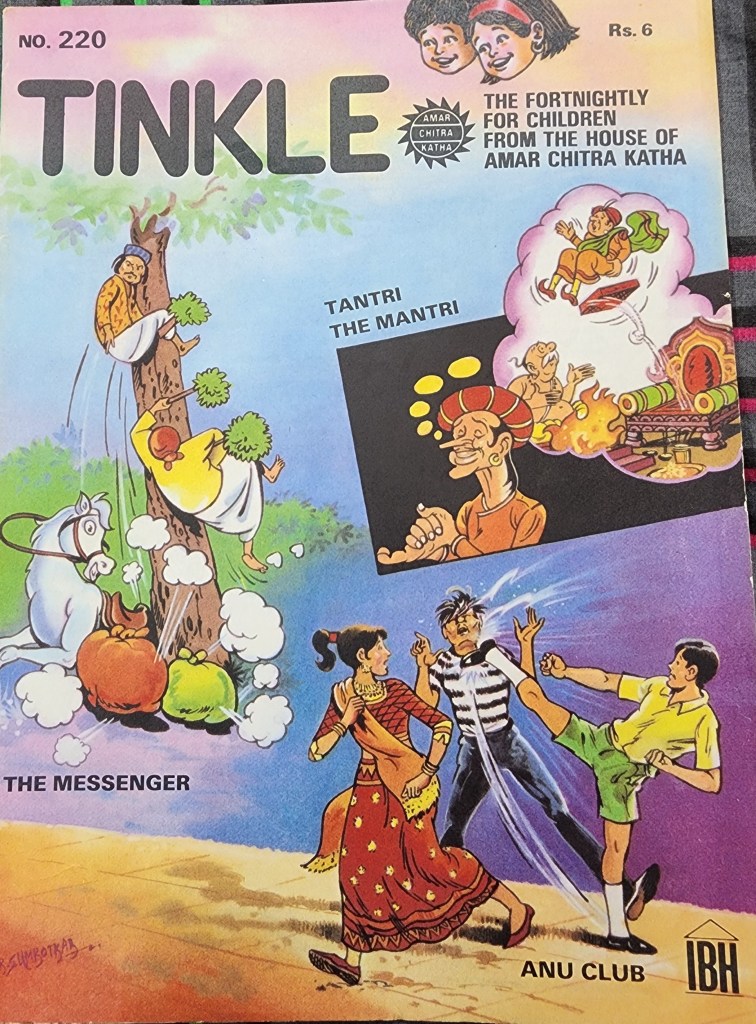
Karate featured on the cover of Tinkle No. 220. This cover was published in March 1991.

A zoomed in part of the cover from the earlier image. Tinkle comics is published by Amar Chitra Katha.

Another word that many of us in India have heard and also denotes a teacher is the Japanese word “Sensei”**. Anyone who had watched the original “The Karate Kid” (1984) surely knew the word. So did anyone who either trained karate as a kid or had a friend who trained the same. There was even an issue of the popular comic “Tinkle”, published by Amar Chitra Katha, which discussed Karate and how it used physics to perform great physical feats (this was a tale featuring the “Anu Club”).

Like most people, I too knew that the word “Sensei” can definitely be used to denote a teacher. This is not wrong. But very early during my years as a student of the Bujinkan system of martial arts, I learned that the word had a slightly different meaning, which did lead to its meaning a “teacher”.

The term “Sensei” as used in Tinkle comics. Image credit – Tinkle No. 220, published by Amar Chitra Katha (India Book House – IBH).

The word “Sensei” as I understand it, literally means “someone who was there earlier”. This is why elders and people with great expertise arising out of experience are also referred to as “Sensei”. I have also heard that “Sensei” means “someone who has gone earlier”. This phrase, as I understand it, could mean “pioneer”.

In a martial arts context, a teacher is one who has more experience than the student. The experience is because that individual walked the path of learning that the student is just starting on. In this sense, the teacher was a pioneer on this path, as far as the student is concerned. This does not mean that the teacher is a pioneer who created a new martial art system, it just means that the teacher has traversed the path before the student and hence can guide the student on the same.

This leads to an interesting outcome. Since students walk the same “path” as a teacher, or learn in a manner similar to their Sensei, they become “similar to” their teacher in the way they move. This is a common occurrence. If a martial artist who knew the teacher saw just the student move, he or she would be able to tell who the student’s Sensei was.

This is how lineages get created in the martial arts. A lineage could lead to the development of a style or school (Ryu or Ryuha (plural)) or system of martial arts. The lineage could be specific to an extended family or to a region. An example of this is the “Togakure Ryu”, one of the 9 schools studied as part of the Bujinkan. The “Togakure” in the name is supposed to be in reference to a village in the Iga province of Japan.

The concept of a lineage extends beyond the martial arts, into other art forms and sports as well. Cricket is the most popular modern sport in India. There are 3 “schools” of batting recognized in India. These are the Bombay school, the Deccan school and the Delhi school. Each of these has produced great batters.

Similarly, in Hindustani music, in north India, we hear the term “Gharana”. A Gharana refers to a lineage. The word “Ghar” in modern day Hindi also means “home”. So, a Gharana could refer to a lineage literally, as it comes from a family in a home. But then, the Gharanas are associated with regions. Some examples are the Delhi Gharana, the Lucknow Gharana and the Benaras Gharana. As the names suggest, each of these is named after a region. This concept of lineage extends to architecture, painting, weaving, pottery and any number of other arts.

The festival of Guru Poornima is observed on the first full moon day (Poornima) of the month of Āshāda (coincides with a part of July). It is observed to mark the birth anniversary of Maharishi Veda Vyasa. Veda Vyasa is also called Krishna Dwaipāyana and Bādarāyana. He is truly the ultimate Guru! This is obvious once the corpus of knowledge that is attributed to him is recognized.

Veda Vyasa is most well known as the composer of the Mahabharata (or at least the Jaya, which is the core of the 3 nested dialogues which form the Mahabharata). He is also credited with compiling the Vedas into the form we know today (hence the word “Veda” in his name). The 18 Mahapuranas are also attributed to Veda Vyasa’s authorship or compilation. In other words, according to tradition, a large volume of texts from Hindu culture owes its existence to this greatest of Gurus!

That said, it is not just teachers of knowledge that are revered in Hindu culture. There are great Gurus for the martial arts as well. I will mention just four that are top of mind for me. There are several other great Gurus, from history and culture, all of whose stories I would strongly recommend everyone to visit.

The 4 Gurus who are top of mind for me, from the Mahabharata and the Ramayana, are,

  • Parashurāma
  • Vishwāmitra
  • Drona
  • Balarama

The first 3 of the 4 mentioned above form a lineage of sorts. Let’s look at a few points about these great Gurus.
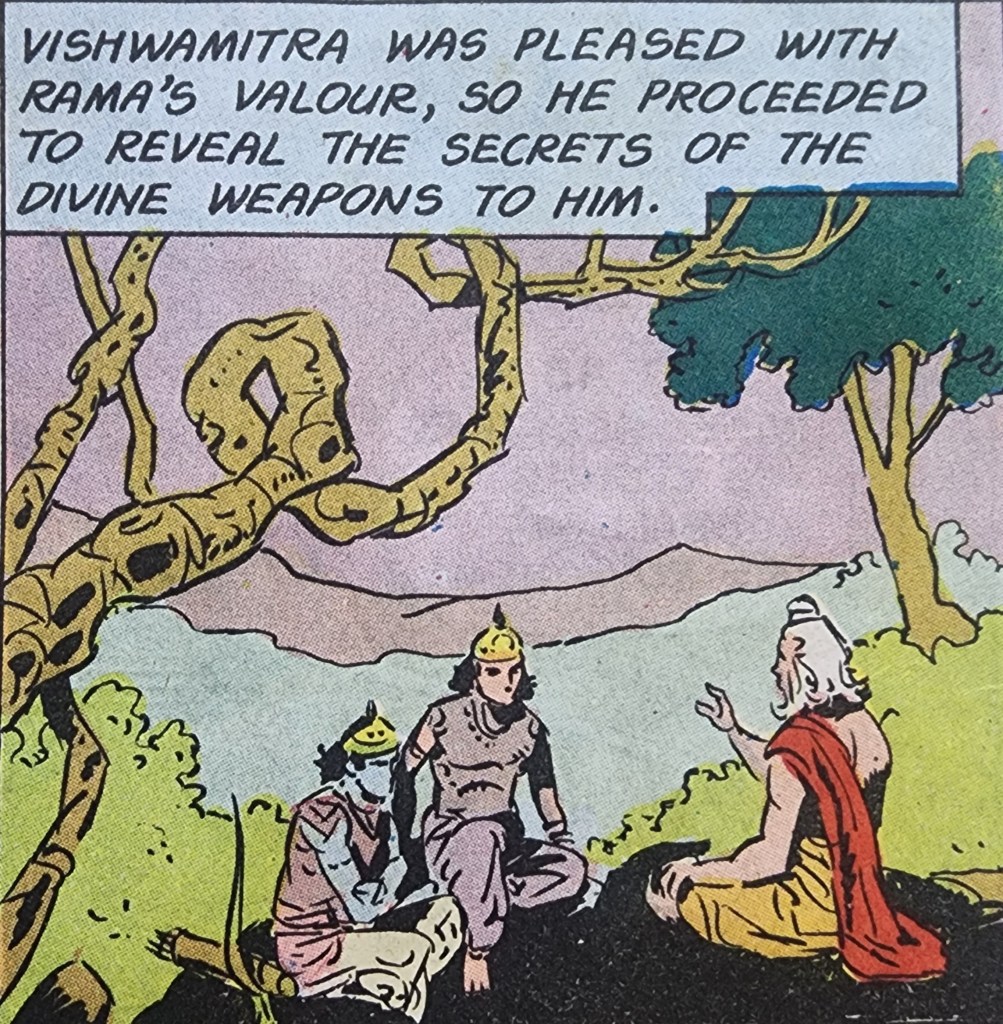
Brahmarishi Vishwāmitra imparts knowledge of celestial weaponry to Rama and Lakshmana. Image credit – “The Ramayana” published by Amar Chitra Katha.

Vishwāmitra was the Guru who was a martial arts instructor of Lord Rama. It was from Vishwāmitra that Lord Rama received a lot of the celestial weapons that he would use later. Vishwāmitra, before he became a Brahmarishi, was an egotistical king named Kaushika. Kaushika obtained powerful celestial weapons to use against Vasishta, who was Rama’s first Guru at Ayodhya! Of course, the weapons were of no use against Vasishta, but they were successfully used by Lord Rama, who was a student of both Vishwāmitra and Vasishta. Vishwāmitra of course had long overcome his rivalry with Vasishta by this time.
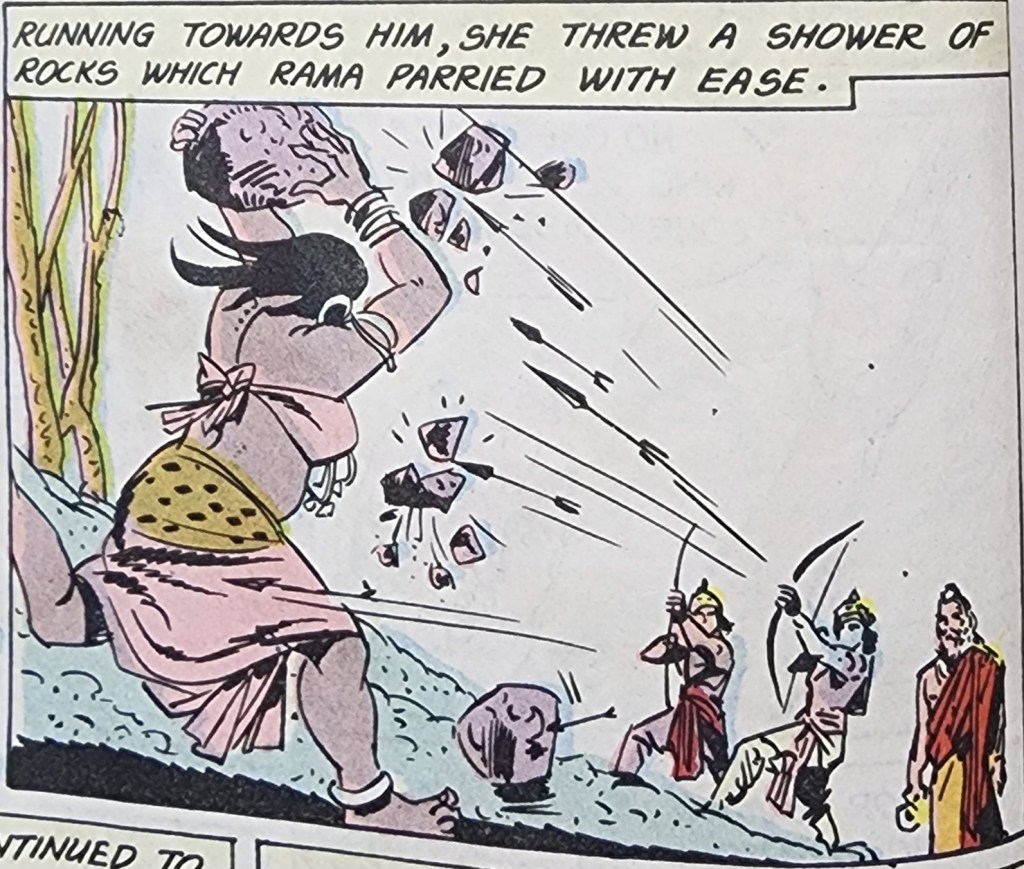
Brahmarishi Vishwāmitra guiding Rama & Lakshmana in their fight against Tataka. Image credit – “The Ramayana” published by Amar Chitra Katha.

Parashurāma was Vishwāmitra’s grandnephew (the story of their birth is fantastic!). He was one of the greatest warriors of his time, of any time. He is also one of the 7 Chiranjeevis (immortals) who are supposedly still around during modern times, but not accessible to normal humans. Lord Parashurāma is the sixth avatāra of Lord Vishnu and the future Guru of Kalki, the tenth avatāra of Lord Vishnu expected to manifest in the future.
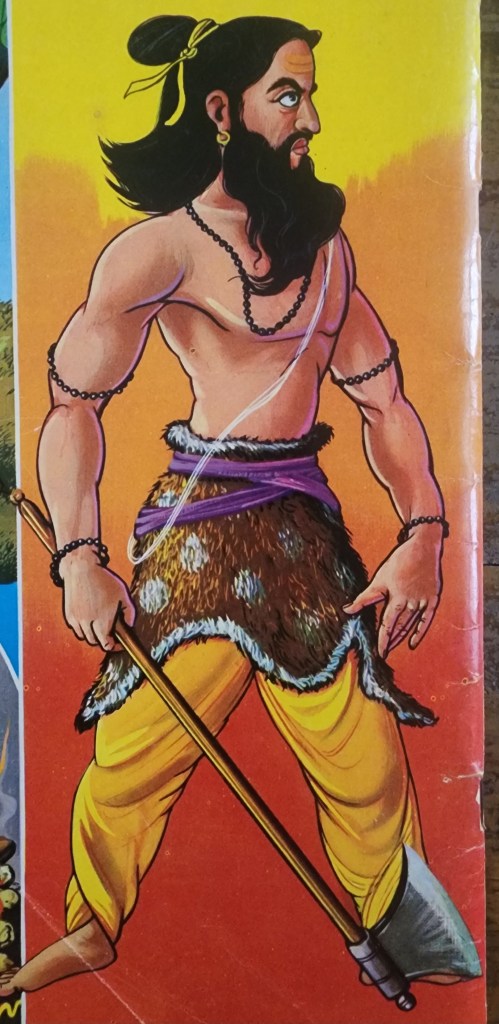
My favourite depiction of Lord Parashurāma. Image credit – “The Bhagavat for Children”, published by Anada Prakashan.

While Lord Parashurāma is best known for his mastery of the Parashu (axe), he was also a wielder of all celestial weapons. Parashurāma was the teacher of both Bheeshma and Karna, two of the greatest warriors who fought on the side of the Kauravas in the Kurukshetra War (the climactic war in the Mahabharata). He was also the Guru through whom Drona achieved his mastery of all weapons. Lord Parashurāma is someone whose legacy extends to modern India as well. He is considered the origin of the martial art of Kalari Payatt, which is famously practiced in the southern Indian state of Kerala!

Lord Parashurāma confronting Lord Rama early in the Ramayana. Image credit – “The Ramayana” published by Amar Chitra Katha.

Drona, also called Dronācharya was the teacher of most of the main characters who fought in the Kurukshetra War. The “Acharya” in his name is because he was a Guru to all the Kuru princes. Drona was also one of the warriors who was invincible. He was eventually killed by a trick, which forced him to drop his weapons and give up fighting. In this sense, he is the same as Bheeshma and Karna. Both of them were also warriors of such incredible prowess that the only way to defeat them was when they either chose to or could not fight!

Drona receiving knowledge of weaponry from Lord Parashurāma. Image credit – “The Mahabharata 05 – Enter Drona”, published by Amar Chitra Katha.

Based on the described prowess of Lord Rama, Vishwāmitra was a great Guru! His grandnephew Parashurāma was a God, whose students were among the greatest warriors ever, some being invincible. One of Parashurāma’s students, Drona, became a great Guru in his own right. So Parashurāma’s school was a dream for any martial artist! Considering he and Vishwāmitra are from the same family, they could be considered to be from the same lineage.
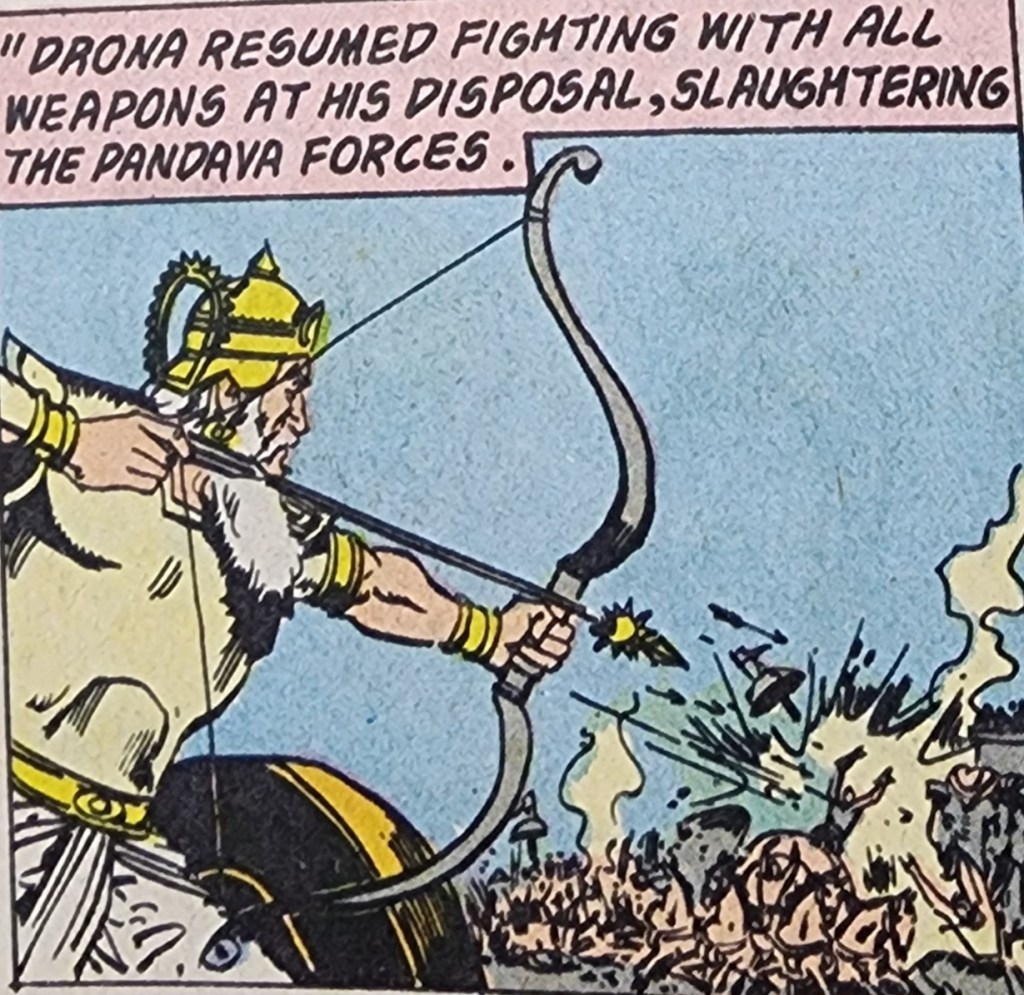
Drona being terror incarnate towards the Pandava army. Image credit – “The Mahabharata 36 – The Battle at Midnight”, published by Amar Chitra Katha.

The last of the great martial Gurus I mentioned above is Balarama. He is the older brother of Lord Krishna. Balarama is considered an avatāra of Ādishesha, the serpent on whom Lord Vishnu rests. He was the greatest gada (mace) fighter ever. This was despite the weapon he is most associated with being the plough! He was the teacher to both Bheema and Duryodhana. Bheema and Duryodhana fought on opposite sides in the Kurukshetra War. Both Bheema and Duryodhana were disciples of Drona as well. They went to Balarama for specialized training in the mace (gada).
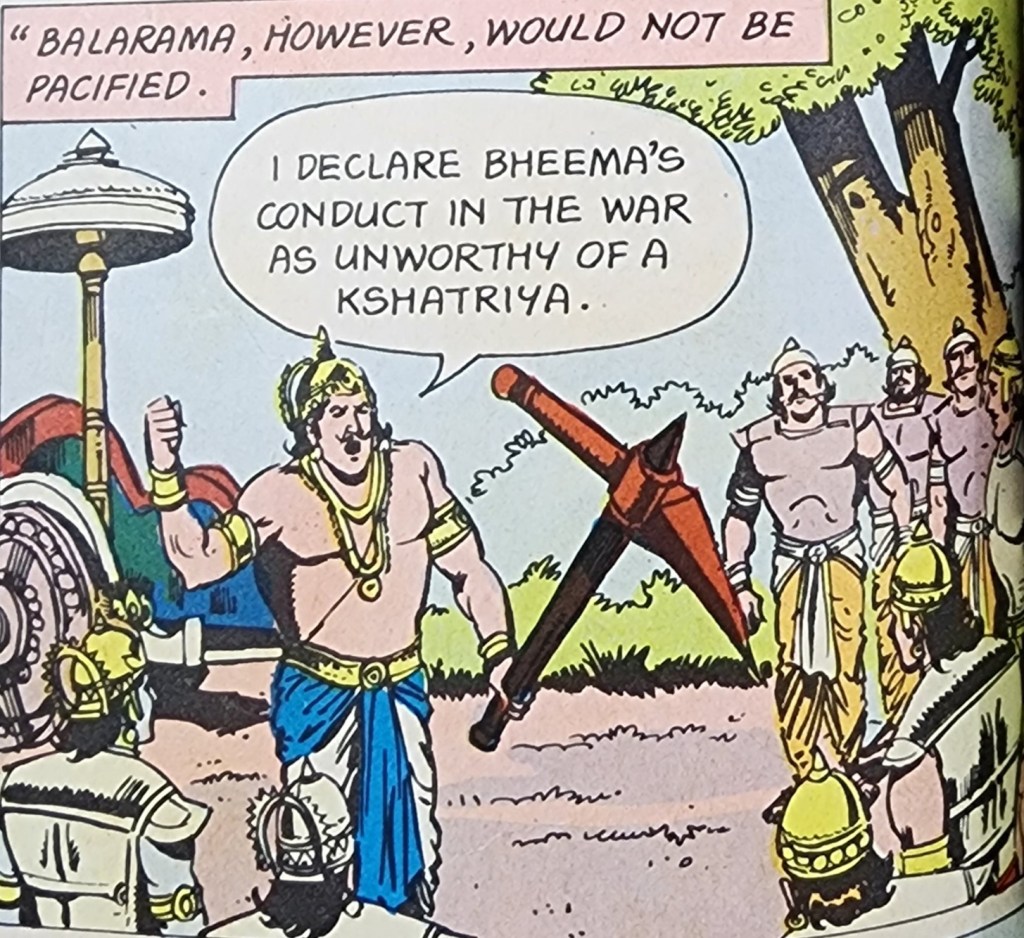
Balarama wielding the plough! Image credit – “The Mahabharata 39 – After the War”, published by Amar Chitra Katha.

Considering that all these Gurus were teachers of the martial arts, I suppose they could be considered Sensei as we understand the word today, specifically considering the lineage they were from and the one they perpetrated.
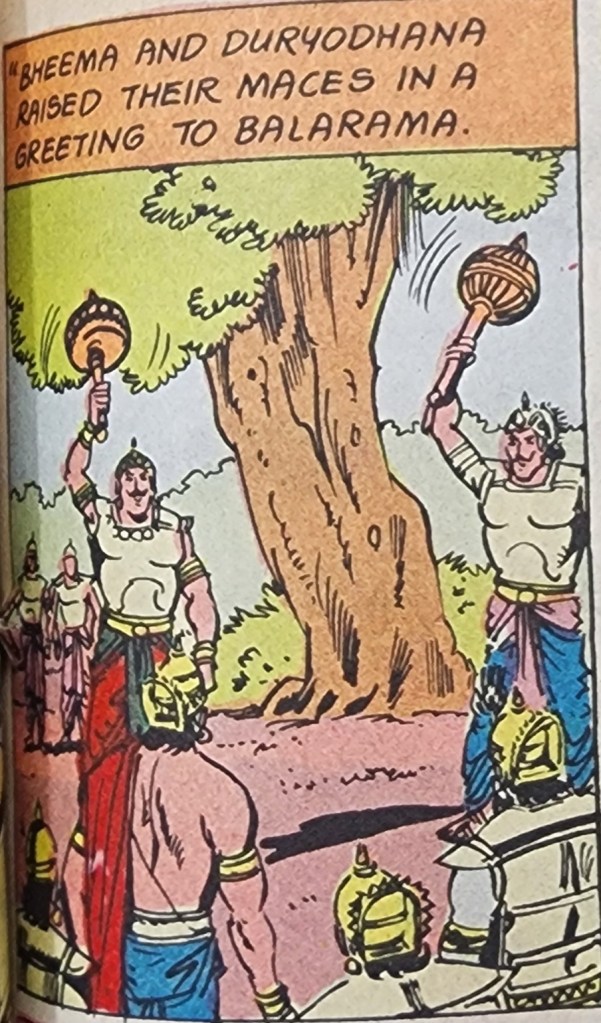
Balarama was the Guru for the Gada, for both Bheema and Duryodhana. Image credit – “The Mahabharta 38 – The Kurus Routed”, published by Amar Chitra Katha.

We in India have a culture where a Guru, or a teacher is deeply respected and that comes from listening to stories passed down in our traditions. But the fact that some of these Gurus were martial arts teachers is not specifically recognized, even though it is well known. The word Sensei, in modern times is one that inspires great respect too, thanks to Japanese culture, where expertise, experience and teachers are deeply respected as well.

Looking at the two cultures, it should be possible to recognize that we always had many Sensei in India, who were Gurus of the martial arts. And they were as respected as a Guru from any other field of knowledge or expertise. The identification of this aspect was the purpose of this article. I hope I have been successful in highlighting the martial aspect of our culture and its extension to our respect for Gurus.

Notes:

* The many words for “teacher” according to the much forwarded WhatsApp message.

The teacher who gives you information is called Adhyapak.

The one who imparts knowledge combined with information is called: Upadhyaya.

The one who imparts skills is called Acharya.

The one who is able to give a deep insight into a subject is called Pandit.

The one who has a visionary view on a subject and teaches you to think in that manner is called Dhrishta.

The one who is able to awaken wisdom in you, leading you from darkness to light, is called Guru.

** Another word for teacher that many Indians know these days is “Sifu”, thanks to movie, “Kung Fu Panda” (2008).
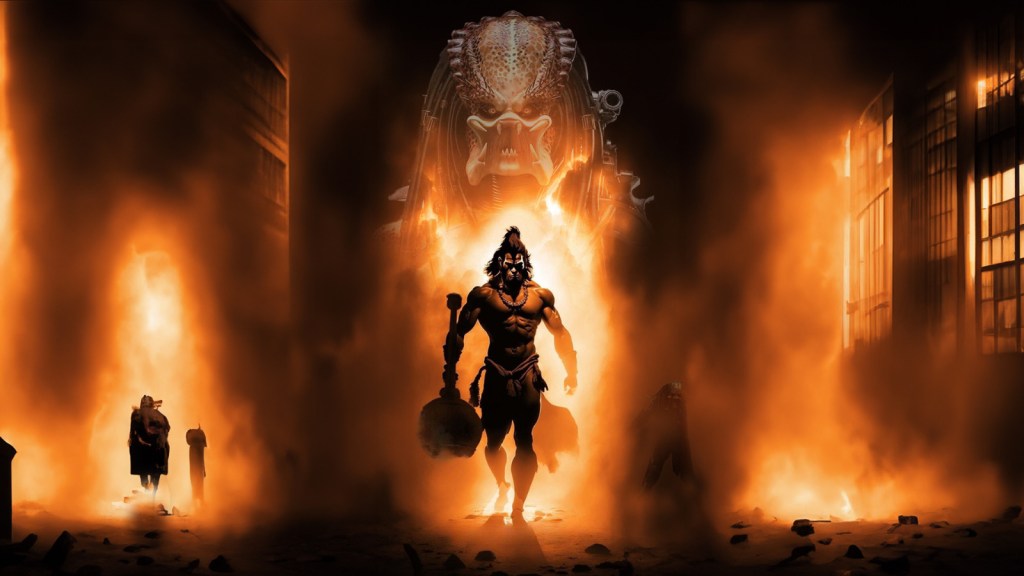

HANUMAN Vs PREDATOR, PART 2 of 6

Chapter 2 – The Ambush

Artwork by Adarsh Jadhav (with use of AI)

Disclaimer: The following story is a work of fan fiction. It is purely meant for entertainment purposes and not for any commercial or profit related purposes. I do not own any of the characters mentioned in the story. The Gods and characters from stories of Hindu tradition and not owned by anyone for they are living divinities. The character of the Predator is the one from the Predator movies, distributed by 20th Century Fox. The character of the Predator was created in the film “Predator” (1987) directed by John McTiernan.

The three awoke at the same time. The anger and malevolent intent they felt this time around was incredible! As they awoke, they swiftly leapt out of where they lay sleeping. Garuda flew straight up. Hanuman and Jambavan leapt high off the ground. Garuda kept a hover some distance up in the air. Hanuman and Jambavan landed several body lengths from where they had taken off and immediately went into a low crouch. All three were on high alert, all senses primed and probing the surroundings for the threat sensed.

The raised javelins in the hands of the invisible creatures around never left their hands. The moment they had decided to attack, their quarry has disappeared.

The three now had no intention of waiting for the attack. The time for waiting for an enemy to reveal intentions and to try and avoid bloodshed was past. This time, the threats were several and all around. They had to eliminate them to prevent any major harm to themselves.

They had never been threatened in a long time, a very long time, not in this manner. This was a threat that challenged their immortality. They were immortal only because nothing could kill them. This time it was different. These creatures were a threat on a whole different plane, the kind the three had not encountered in more than a thousand years. The kind of malice emanating from the enemies came only with an extraordinary confidence in one’s own abilities to kill adversaries. That meant either supreme physical ability or access to knowledge, yantras and astras (weapons that are discharged, ranged weapons) akin to those in an age long past.

These creatures were all invisible and hence all three of them were uncertain of the exact places to strike. They could only sense and evade attacks. A counter attack was as yet very difficult to execute. Earlier it had been one attacker and they were three. Hence, locating the source had been easy.

Jambavan, the oldest, assumed leadership, and said to Hanuman as they landed, “We do the same thing as earlier, hurl objects in any direction a threat is sensed from, or strike out with your weapons. Try and make them visible. Then kill them. Using any means at our disposal. That’s all we can plan for now. We will have to play things by ear. Let’s split up and assemble from time to time. Convey this to Garuda.” All this was said without looking at each other. When Jambavan had finished saying this, he leapt away from his location.

Hanuman leapt high in the air and spoke out the plan. Garuda, with his superlative hearing, heard the plan as he kept up his aerial survey to locate the creatures.

Hanuman landed and immediately set about executing the plan. Jambavan and Garuda did the same. Jambavan struck tree trunks, hurled stones and small rocks and fallen branches. All this while randomly changing directions without thought and moving with great speed.

Hanuman, did one better, He used his tail as a flail with a mace at one end, while simultaneously doing all that Jambavan did. He also used his other mace to strike tree trunks. Smaller trunks shattered with just one blow and collapsed.

Garuda, dived into the canopy, broke off branches as he flew and hurled them in random directions. At times, he flew close to the ground and struck into trees as well. Or picked up fallen objects to hurl around.

The result was that there was a great whirlwind of flung objects in the night. Birds and animals called out and evacuated the area at the sudden disturbance. The result was a wonderful cacophony and confusion over a large area.

And the desired effect was triggered. As soon as the three started moving there were bursts of light emanating in spurts. Places where the bursts of light seemed to strike exploded and threw up bits of earth, wood and stone all around, adding to the confusion. There were locations where there was a clear shimmering in the air, other locations where creatures were revealed as their invisibility failed. But none of the bright astras fired by the creatures struck the warriors as there was no pattern to their movements and they were moving incredibly fast.

Garuda circled back towards where he had observed the creatures being revealed and struck out with his wings, rearranging his feathers as he did so. He caved in the chest of one in an explosion of luminescent green and crushed the head of another as he smashed it against the trunk of a tree to leave a bright green smear.

Hanuman’s tail snaked out with a mace gripped in its end in a loop. The spike at the end of his mace pierced through the abdomen of one creature and it shimmered into visibility as it died impaled on the mace. He swung his tail to free the mace and as he did so, an astra shot out of the dead creature’s shoulder, from what seemed to be a cylinder. This astra seemed to burn out a leg of another which became visible with a screech of pain. He leaped down right in front of this asura as he pulled his tail and mace back to him. He crushed the head of the creature with his other mace. Its life faded with just one blow.

Jambavan had noticed a shimmer from the corner of his eye as he was leaping through the forest. He picked up a rock as he landed and leaped back towards the shimmer. He landed right next to the shimmer, perhaps a failing of the invisibility these asuras possessed. On landing he swung with the rock in his hand. The creature blocked with the extended blade on its wrist. He could see a cylinder on its shoulder turn toward his head as it did so. He swiveled around the block and kneed the creature in the abdomen and the invisibility failed with sparks as the creature doubled over. He dropped the rock in that instant and snapped the wrist with the blades while he simultaneously crushed the cylinder with his other hand.

The creature screeched as the wrist snapped. He released the wrist and the creature relaxed, with the sudden easing of pressure on its destroyed wrist. As it started to straighten up, he twisted the wrist towards itself and stabbed its own blade into the exposed abdomen. The creature screeched again and went still.

He now snapped off the blade on its wrist and threw it behind him as he dropped down low, with awareness of an imminent threat to himself. A fiery astra shot past where his head had been and slammed into a tree in a shower of flame. But the blade he had thrown buried itself in the head of the creature that had unleashed the astra, right through the tough mask it wore. Jambavan leaped away. He had been in one place for less than 10 kshanas.

There were no more astra blasts anymore. The asuras seemed to have gone quiet in order to reassess and perhaps regroup. All three of them leaped high up and reported in. Each reported the number he had taken down and Garuda added that he had seen 4 other creatures dead by their own astra strikes. By now, Hanuman and Jambavan were almost back on the ground. Hanuman pushed off a tree branch while Jambavan did so against the ground. Garuda stayed aloft, looking about and awaiting the other two in the air again. When they were all airborne again, Jambavan suggested, “Split up and destroy these asuras. Meet again in a few minutes. In the air again”. And he descended again with gravity. The other two did not respond, they didn’t have to. Jambavan was the elder and they would follow without question. And each could work alone, none of them had to watch the other’s back.

Next chapter – Caves, on 18th July 2024

Post No. 43 – Ninja, Mummy, Lawyer, Hiker

This is my 43rd post. I was going to call this “Post No. 42” but changed it to 43. The post is inspired by the focus on a “42-year cycle” in the Bujinkan in 2014-15. I am a practitioner of the Bujinkan system of martial arts, which is Japanese in origin. The number 42 is also considered unlucky in Japan. So, out of respect to the country of origin of the martial art which has given me so much, I changed it to “43”. “43” is after the end of bad luck, so, “All is well”. 😊 The rest of this post is just some rambling on my part, for fun. I hope readers are entertained; else they can skip this altogether.

Back in 2014 the Soke of the Bujinkan, Sensei Hatsumi Masaaki released a watch to commemorate 42 years since the passing of his teacher, Sensei Takamatsu Toshitsugu. Takamatsu Sensei passed away in 1972 at the age of 84. Hatsumi Sensei was 42 at that time. Also, Hatsumi Sensei turned 84 in 2014 and that marked 42 years since he had started training on his own and had taken over from his teacher as the Soke (inheritor) of the 9 schools of the Bujinkan system of martial arts. ++

So, it was a play on numbers and an important occasion for Hatsumi Sensei. It was important to other practitioners of the Bujinkan as it was important to their Grandmaster. An image of the watch is seen below. It has the number 42 engraved on the back.

However, the number 421 is considered unlucky in Japan as the pronunciation of the same sounds similar to “to die”. I recall that in early 2015, Hatsumi Sensei had created an artwork to signify “a good harvest” as the bad luck of “42” was now past. So, the beginning of the 43rd year was like the start of a new 42-year cycle, apart from just the symbolism of the unlucky 42 being in the past now.

The number 42 brought to mind the short story by Arthur Conan Doyle, called “Lot No. 249”. It was published way back in 1892. The story is set in the University of Oxford. It involves one student reanimating a Mummy and using the same to terrorize people he dislikes. The student acquires the Mummy by purchasing it in an auction. If I recall right, the Mummy was a part of “Lot No. 249” in the auction. I was first acquainted with this story a few years ago, when I heard it on radio as a play, in Hindi, while on a drive. The play was great fun to listen to.

An illustration of “the Mummy” from “Lot No. 249”, by Martin Van Maele. Image source – Wikipedia

The reason the story came to mind is convoluted to say the least. In the number “249” in the title of the story, the first two numerals 2 & 4 form “24”, which is a reversal of “42”. The last two numerals 4 and 9 form “49”, which is also considered an unlucky number in Japan. The pronunciation of the number is supposedly similar to “a painful death”.  No wonder the reanimation of the Mummy caused such trouble, it was part of a story whose title references two unlucky numbers! Yes, all this is conjecture and an extreme stretch as far as connections go! 😀

Now, we move on to the next convoluted connection..

In the Bujinkan, we train iteratively. 6 of the 9 schools that make up the Bujinkan have defined forms/techniques. There is the Ten Chi Jin, which is the core of martial art. There are the various weapons to train with. Then there is the collective knowledge of various seniors that practitioners are exposed to. Lastly, there is personal experience from past training. All of these are trained over and over. Considering the large volume of options to train, each of those gets a turn only once in many months. Every time any of these is trained is an iteration.

Every iteration has new insights and revelations coming forth. There is refinement and fresh learning. So, every time we bring a specific school or weapon back to life in the dojo with training, there is an upgrade in the experience and addition to knowledge. This happens over and over. It is something like the Yuga cycle in Hindu tradition. Practitioners go through the same definition of the motion, but the movement that it results in is similar to the last time or the one before that, never the exact same one. This is why it is a martial art*.

This is where the convoluted connection comes forth. In the story from earlier, the Mummy is reanimated multiple times. But nothing good comes of it. There is only misery caused with every iteration of its coming to life, for the people who come in contact with it (no idea what the Mummy itself felt, or if it could feel anything at all). And hence it has to be burnt and destroyed at the end of the story, so that there is no more terror, no more iterations.

This is the exact opposite of the iterative process in the martial arts. Every reanimation of the previously experienced forms is an improvement, a rediscovery, a new series of “aha” epiphanies. So, even though “42” is not lucky, the end of it is the beginning of a new cycle, so seeing the back of it is a good thing. This brings me to the last, very happy, and much more popular reference in pop culture to “42”.

“42” is the answer to “Life, the universe, everything”. This is what Douglas Adams has shown us in the immensely popular novel series “The Hitchhiker’s Guide to the Galaxy”**. In the novel, this is the answer to the ultimate question, provided by the “greatest computer with an exception”, “Deep Thought”. But for the purposes of this article, there is reincarnation, after a fashion, in the Hitchhiker’s Guide as well.

At the beginning of the story, the Earth is destroyed. But in a later part of the story, a new Earth is made available! I cannot recall exactly, but I think it is found in the folds of space and provided by the Dolphins to Humans. This new Earth is a different one from that which was destroyed. In this aspect, it is like training iteratively. We end with up with an understanding of the martial art which is new and slightly different from the one we started with at the beginning of the iteration.

That’s all for the twisted connections. Hope you enjoyed this post. In case you did not, I will end with yet another reference. Just as the title of the post was a reference to Conan Doyle’s “Lot No. 249”, I end with a reference to the message from God as seen in Adams’ “Hitchhiker’s guide to the Galaxy” – Sorry for the inconvenience! 😛

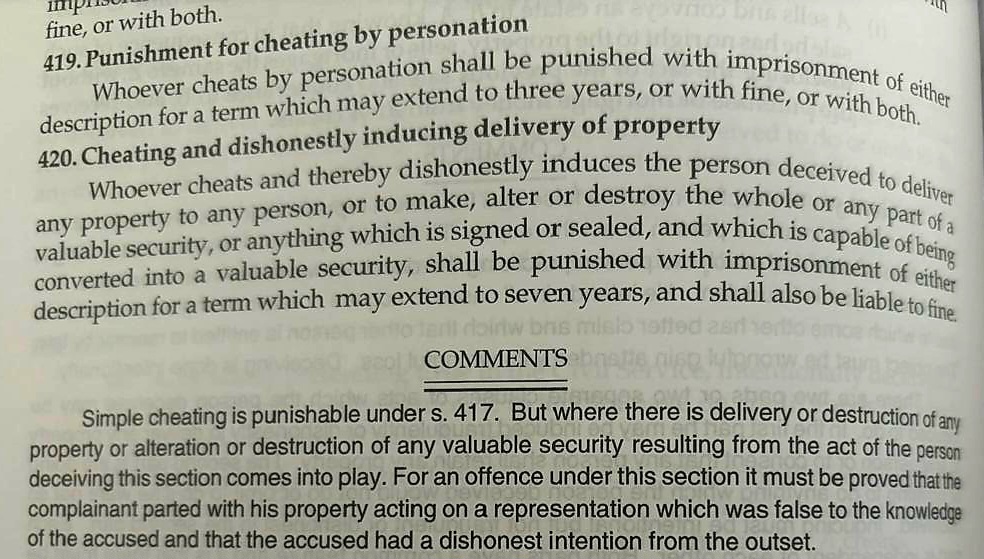
Considering that I am apologizing for the inconvenience, I will conclude for the second time, with one last connection with 42 and Indian laws. In the Indian Penal Code, there is Section 4202. It deals with cheating and deceiving a person and the punishment for the same. Four hundred and twenty is commonly pronounced “four twenty” and this is essentially 42 multiplied by 10. This seems about right, given that it is bad luck times 10! If someone is being deceived, it means that that person is really down on her or his luck! Therefore someone really needs to be sorry for that individual’s inconvenience. 😛

An image of Section 420

Notes:

++ A big thanks to my friend and buyu Santosh Nagasamy for the wonderful conversation where we were trying to relive 2014, 2015 and 2016 in our training while attempting to recall and relive the significance of the 42 year cycle.

1 The term “Shinigami” made popular by the Anime series “Death Note” shows why the number 42 is considered unlucky. “Shinigami”, as I understand it, is made up of 2 words, “Shini” and “Kami”. Kami is similar to “Deva” or “Devata” from Hindu culture. In English, I guess it could only be translated as “God”. Shinigami is thus, “God of Death”. But from the way the character is shown in the series, it is more like the “Yama Doota” in Hindu culture.

“Yama Doota” are those that work for Lord Yama, who is the God of Justice/Death (judgement after death). They are the ones that escort the soul when their time in a physical manifestation is at an end. Lord Yama is also the Guardian of the South.

“Shi” is 4 and “Ni” is 2. So, 4 and 2 like in 42 could be pronounced “Shini”, which is also death. Hence the association with bad luck.

* This definition of the Martial “Art” was discussed in an earlier post of mine, the link to which is seen below.

** It was a radio series before it was a series of novels.

2 Thanks a lot to my friends Sandeep Kumar and Keane Amaral for helping me with details and images of Section 420, and no, they did not cheat me. 😛

Extra note – There is an old Hindi movie called “Shree 420” (1955). The tile is a reference to Section 420 which deals fraud in the Indian Penal Code. The journey of the protagonist in the movie apparently leads him from being a fraudster to a reformed do-gooder. I have not seen this movie and hence have not considered it as one of the connections.

An afterthought – “Luck” and “being lucky” are important factors in the Bujinkan. “42” is unlucky and therefore the end of “year 42” is to be celebrated. It is like entering an era of good luck after one of potential bad luck. It is like coming back to a good life, and that is the same as destroying the reanimating mummy in “Lot No. 249” and putting it to rest, for a good life in the afterlife. 😛