The renowned author Salman Rushdie won the Peace Price of the German Book Trade for 2023. He started his award acceptance speech, in Oct ’23, with a reference to a story from the Panchatantra. The Panchatantra is a work of literature from ancient India which was used for the education of princes and contains several tales/fables that are an exploration of human nature. Mr. Rushdie refers to a tale about two jackals. The characters in many stories in the Panchatantra are anthropomorphized animals. A link to the video of the full speech is seen below.
In the speech he specifically mentions why he finds the Panchatantra special. He says that the text does not moralize and that the supposed “good guys” need not win in the stories therein. In the above video, watch between the 1:20 and 5:00 minute mark to listen to the same. This notion of morality not being relevant to a conflict or a difference of opinion and its potential resolution is what inspired this article. Also, this post will be a culmination of ideas flowing through the last two posts, the links1 2 to which are seen in the notes below.
The Panchatantra is supposed to have been compiled around 200 BCE with the specific stories therein being older still. Many stories deal with how to deal with conflict on various levels. There are other Hindu scriptures which are as old or older that do the same and these also depict debates and duels. These were topics of the previous two articles I posted. It is nice to see that we as a species have not changed in this aspect over many millennia.
In the Tamil movie “Saraswati Sabatham” (1966), there is a small segment where the lack of morals is clear as is the absence of any labeling as “good guy” or “bad guy”. The movie is about a contest between the three principal Goddesses, Lakshmi, Saraswati and Parvati, when they try to determine whose blessing can take their respective devotee farthest in life. The movie ends with all being shown to be equal. The segment I am referring to has absolutely no bearing on the main story. It just sets up the beginning of the story of the person who receives the blessing of Goddess Parvati. A link to the movie is seen below. One only needs to watch between the 1:04:00 and 1:09:00 mark to see the segment I am referring to.
In the segment I am referring to, a wrestler who holds the title of the “Court Wrestler” is worried. He has to fight against another wrestler who was formerly his student. His student has surpassed him in ability and he feels he will lose, and more importantly, lose the title of “Court Wrestler” (Aasthaana Mallan). His sister gives him an idea on how to win the wrestling bout. He turns up at the venue of the fight with a ladle and a plate. His student who is cocky and sure of victory asks what his former teacher is doing with kitchen utensils. The master responds saying that he has taught his student everything he knows except the skill with the utensils he is carrying.
The student is flustered and loses his confidence instantly. He says that he cannot challenge him anymore, for he has to learn this last skill before going up against his teacher. He thus concedes defeat and the teacher keeps his tile as “Court Wrestler”. Let us consider the “good and bad” and “morality” in this situation.
The teacher is most interested in keeping his title. He is also concerned because he is not capable of defeating his student. He is not concerned by the lesser wrestler (himself) keeping the title of “Court Wrestler”; only the best should have the title for that person takes on the best from other states. So he is likely letting down his king, court and country here. Also, a teacher should be proud of his student surpassing him due to his teaching! This trait is missing in this teacher! So, is he a good guy? Likely not. But is he a bad guy because he is attached to the privileges that come with his position at court? Likely not. It is no different from any senior in a modern day organization or a sporting team holding on to a post or position beyond the time when they still deserve it. They are messing with the dreams and career progression of many that might be deserving. So, the teacher is not a bad guy right? Most likely. The teacher is just a normal guy, not specifically good or bad.
Now consider the student. In the little that we see of him, he was cocky and was looking forward to showing down his teacher. Even if his teacher was an opponent, disrespect was possibly not the right attitude, especially in a place in ancient Bharat, where a teacher is considered a form of God. So is the student as good guy? Likely not.
If he was so sure of himself, should he not have tried to match his skills against those of his former teacher even if there was one single skill he was not trained in? One that would have seemed suspect to anyone watching? He fell for the deception. It seems like he was more worried about not losing rather than about achieving the title of “Court Wrestler”. Does this make him a less deserving martial artist? Likely not, or does it? So, the student is not a good guy, nor is he a totally deserving winner/martial artist. Again, this makes him just another normal guy, not a good guy or a bad guy.
So, both of them are normal guys. One gets lucky in that he has a sister who helps him win through deception. This is exactly like in the Panchatantra, deception is possible and so it is used, it does not matter if the one who loses out due to its use is the more deserving wrestler. The fact that a position was attached to the match made it more than a wrestling match. The prestige and privilege of the position of “Court Wrestler” triggered the use of deception.
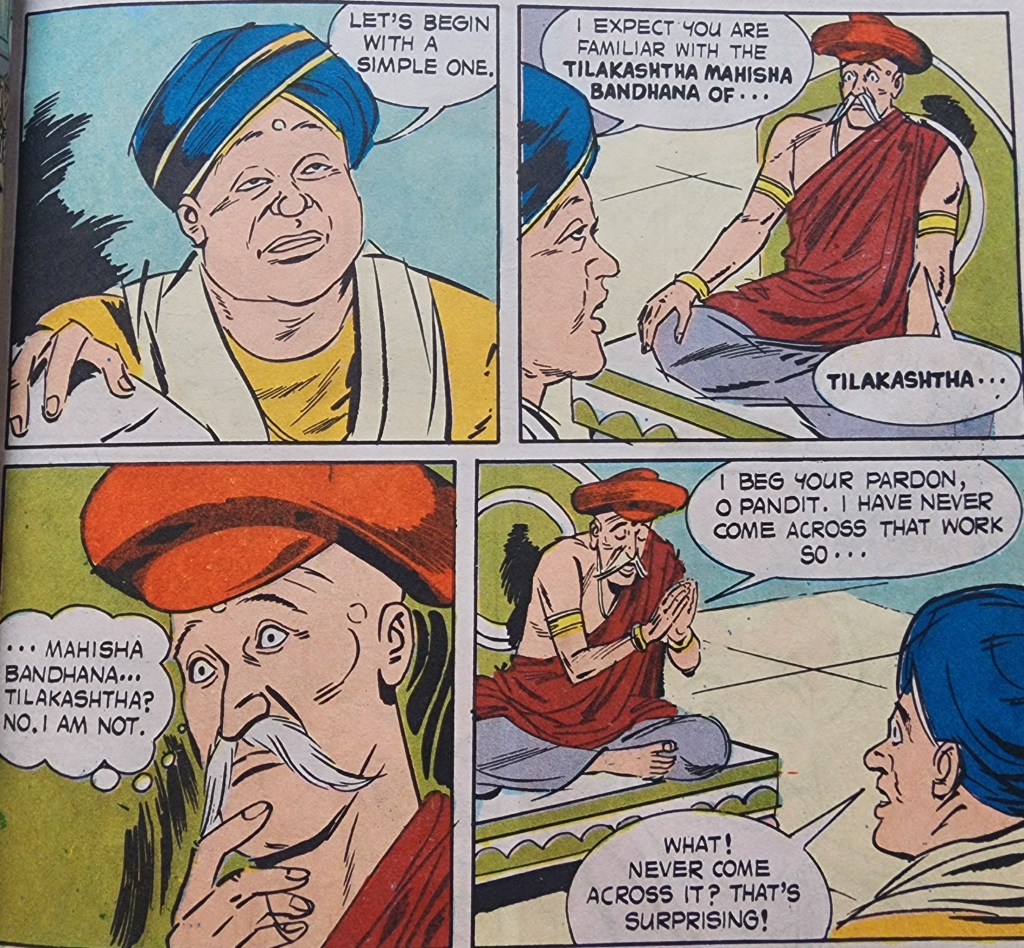
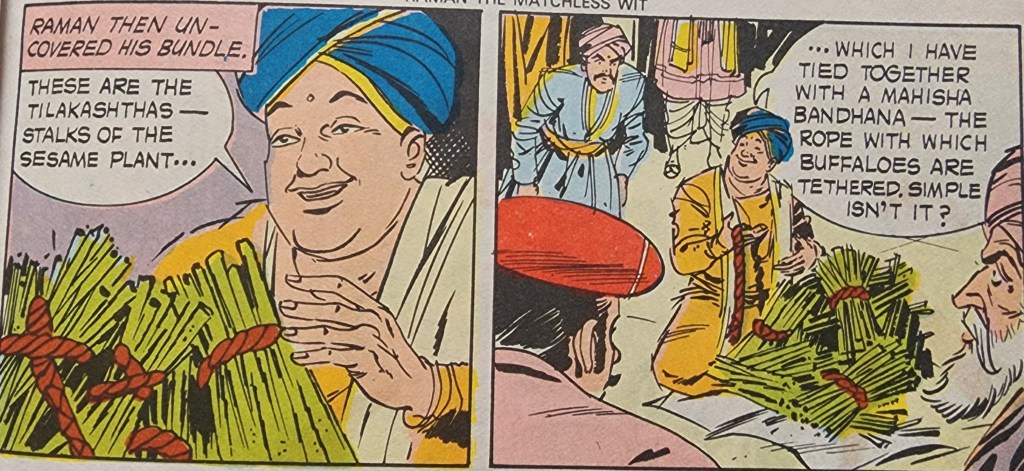
The stakes, be it in a duel, a debate, an argument or any other conflict, drive the use of deception. This in turn means that a biased opinion with information that is not entirely true takes centre stage and creates a supporting narrative. In my previous two articles, honour of the court/king was one motivating factor that led to deception being used. I had shared a few examples of debates from Indian history in my article related to “Tilakāshta Mahisha Bandhana”1. I am not going to reiterate the same here. With hindsight the end result of these debates show that the stakes of the same were very high at times. This perhaps increases the attractiveness of the use of deception.
When deception is used, it is quite likely that it is to overcome something that is lacking. Add the stakes or motivation to win and the drive to use deception is magnified manifold. If one is going to gain wealth or power or influence or comfort or convenience, reputation or the improvement/security of one’s own or that of one’s family as a result of a victory, deception is absolutely the right way to go. These factors in the negative, if one is going to lose something, either material or abstract (pride, reputation and such), the urge to overcome a disparity with deception is perhaps even greater, and impossible to overcome.
In the case of the debate, what was lacking was knowledge/wisdom and experience. In the duel it was perhaps a disparity in strength or speed or skill or a decrease in skill/ability due to a lack of experience or practice or age. This disparity in the duel and therefore the martial arts sheds light on two aspects.
One is the objective of the martial art and the other is the reason for the practice of the martial art. These two are very important in the practice of the martial arts and also in a discussion regarding the attributes and benefits/drawbacks of the same. While looking at these two aspects, it needs to be reiterated that there is no right or wrong in these debates. They are just opinions. There is no moralizing or good or bad guys here, just like the idea we started with.
When I say “objective of the martial art”, this can be further divided into two parts. The first part involves the history and tradition of the martial art and the application of the same either as applied in the original timeframe or in contemporary times. The second involves the interpretation of the previous point and its application by the specific teacher or dojo/akhada/kalari/gym teaching the art form. The “reason for practice of the martial art” is specific to the individual who is either training a specific martial art or is looking to begin practicing one.
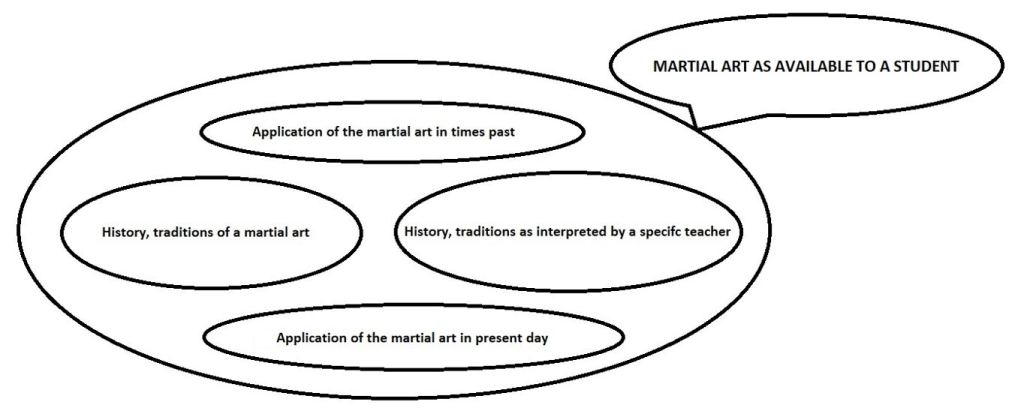
Every martial art, however old, has a history and a tradition. This has an influence on what is taught and shared. It also affects what is can be used for. The change in application and addition to the art form over time impacts the same as well. The other part of this is the teacher. A teacher can choose to focus more on the historical and traditional aspects or adapt these as she or he chooses to contemporary times as one sees fit. This could also mean that a teacher focuses on specific aspects of a given martial art form and either lets the others go or teaches very little of those.
The history, tradition and geography of origin could inform,
- Use of weapons & armour
- Focus on striking or grappling or their combination
- Speed of movements
- Focus on hands or legs or a combination
- The agility or gymnastic ability of the art form
- Any others…
The following are also a result of the history and tradition of the art form.
- The focus on spiritual and meditative aspects as an aid to development in the martial art
- If the art form can be or has developed into a duelling friendly version
- If the martial art is a modern day sport (with defined rules, weight and gender categories)
Different people train the martial arts for different reasons. These reasons could change or stay the same over time, with experience and with age. The reasons for training could vary from,
- A need for self-defence or self-protection
- Sporting skill development
- Fitness of mind, body or both
- Improvement in focus and balance
- Self-discipline
- Ability to fight
- Develop aggression
- Develop self-control
- Overall self-development
- Develop gymnastic ability
- To look cool and impressive
- Beat the shit out of someone
- Meditation
- Sporting excellence
- Ability to choreograph and enact action sequences on stage or film or book
- Create art in video games or paint and draw action and characters performing the same
- Just for fun!
- Who knows how many more!
All the reasons for training are valid, as are the awareness, interpretation and teaching styles of the art form. WHAT IS KEY IS THE FIT BETWEEN WHAT IS TAUGHT AND ITS OBJECTIVE AND WHAT THE PERSON TRAINING IS LOOKING FOR. A student of the martial arts needs to realize from time to time why she or he is training. This objective should match with what is being taught. If it does, keep training. If it does not, quit and find a different art from or a different teacher, or both.
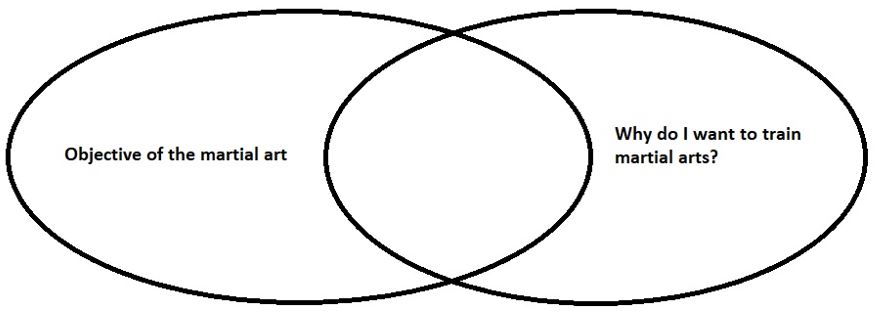
In the above image, the greater the area of intersection, the better it is for a student
The other side of this is that a teacher needs be able to communicate what she or he is teaching and what the application of that teaching is likely to be, for a student in contemporary times. This communication could be needed from time to time as well, for what the teacher is teaching and the reasons for the same are likely to change over time. A part of being a martial arts teacher is to be able to communicate this to students.
Both of these require effort. And this effort is part of the martial training. I opine that it is a part of the martial journey (musha shugyo) that has always been a part of the training of the martial arts. This journey is both external and internal to an individual. Identifying the reason for training and for teaching what is being taught, is likely part of the internal journey while finding and training with the right teacher is external. People still travel across countries to train with teachers of their choice. At the same time, people spend a lot of time trying to figure out why they train and what various art forms and specific teachers have on offer.
Once this is part of an iterative process, whether or not one choose to listen to the fans or critics of specific martial art forms or teachers is irrelevant. Both can be a positive experience to add to one’s own learning and progress. Knowing the answers to why one trains and whether what one is training matches the same informs a practitioner of what aspect of one’s training needs to tested, and changed if need be.
On some YouTube channels, I have heard the term “pressure testing” used for checking if one is capable of fighting. The fighting could refer to a real situation, a street fight, sport combat, knife attack or any other situation requiring self-defence. This means checking if one’s training works when an attacker with real intent goes all out to harm you, even in a controlled training environment. For a lot of practitioners, a failure at this could mean that the martial art or the teacher might not be the right fit for the practitioner. They are correct, if “self-defence” was the only criterion being considered.
If the objective was any of the others that I referred to earlier, then the test for the efficacy of the art form has to change as well. Even while just considering the “real fight” simulation, factors other than those considered earlier have to be factored in. These include the socio-cultural aspects of the geography where the practice is occurring, and whether the art form is focusing more on traditional aspects.
Based on these parameters, a martial artist will have to recognize if the “pressure test” being applied is relevant at all. The test and art form need to match as well. If they do not, and the practitioner still wants to try a test that does not fit the art form, then suitable changes have to be made to the art form being practiced; otherwise just train the art form from which the test originates.
Martial arts are evolving all the time. Newer art forms like MMA specialize in close quarters fighting. So, if one wants to test herself or himself in a situation for which MMA was fine-tuned, the first step is to check if that scenario is what one was training for, and if the art form one has been practicing is geared for the same. If the art form is designed for armed and armoured fighting in either a melee or a duel, or if the art form is geared for military use or if it is for fitness only, the practitioner should perhaps reconsider – do not fight an MMA practitioner when one has not trained the forms requisite for the same!
If the test was known and the questions mentioned earlier were answered, perhaps the traditional martial art masters in China would have known to not fight Xu Xiaodong, an expert at MMA. This was something I referred to in my article about Tilakāshta Mahisha Bandhana1. The masters of the traditional forms should have been able to answer what the application of their teaching is and whether it is applicable in a test set for MMA. Perhaps an inability to answer this is why they were defeated, in all likelihood causing more harm to their reputation than to their physical selves.
But there is a counter to this observation. Was it the worry of the loss of reputation that led them to accept the MMA challenge in the first place? Were their students expecting their teaching to work in a modern day unarmed duel which is the MMA? Would their students have moved to other art forms if they realized that it could not? If yes, then the stakes for this “martial debate” was reputation and a loss of business. When stakes like these are present, how can a practitioner not accept the challenge?
The masters could have the explained the application to the students and to themselves, if those were indeed the questions. If the application was not MMA, they could have simply refused the challenge. Or should they not have used deception to win the fight? What the deception should have been is anyone’s guess. More importantly, did the masters of the traditional art forms deceive themselves by getting into the duel in the first place? If they did, is it not likely that they did not ask the questions regarding the applications of their art form earlier? These questions can be pondered, and answers sought at an individual level.
It is said that Xu Xiaodong faced trouble with the authorities for defaming Chinese traditions, after his victories. So, was this a smart deception used by other masters of traditional art forms to prevent him from challenging them? 🙂 Was this deception not wonderful? Bringing in an opponent (the authorities) to a duel he could never counter? After all, when Musashi was facing a long sword, he created for himself a bokken that was even longer1. He asked about and found his own disadvantage before the duel. Remember, there is no judgement or moralizing here as we stated earlier. Just survival, considering the stakes (life or death).
The process of questions and answers with oneself for reasons of understanding the self is part of “Swayambodha”. The process of knowing the opponent is called “Shatrubodha”. These are terms from Sanskrit and other Indian vernacular languages. They are vitally important in all conflicts, from duels between individuals all the way to those between nations and civilizations. I have discussed these in detail in a dedicated article, the link to which is seen in the notes below5.
I personally am of the opinion that martial arts are all about conflict management. Knowing this is as much a mind-set or mentality as any. The questions martial artists ask of themselves form a part of the mind-set as well. Adapting to a situation, identifying the strength & shortcomings of the self and the opponent(s) – making these a habit with training is part of the development of the mind-set/mentality. Adapting to a situation includes determining when deception is applicable. It is just another tool to be used as and when required, to adapt successfully.
Once a mind-set is identified, relentless effort is spent in internalizing and training the same. The same is true when a habit has to be unlearned. To give examples of mentality, I will share two video links. The first is from the YouTube channel Hard2Hurt. It is driven by Icy Mike**, who I believe is a former law enforcement professional and an avid MMA practitioner. He speaks of the mentality to cause maximum damage when possible, as part of his MMA training, in the link seen below. Watch between the 7:30 and 9:30 mark for the specific statement about the mind-set.
Lynn C Thompson is the founder of the knife and weapon making company Cold Steel. He is a lifelong martial arts aficionado with a background in Filipino martial arts. He had a big role in designing many of Cold Steel’s iconic knife designs. He sold the company in 2020. Lynn Thompson refers to the advantages of carrying large knives over smaller ones. He says this specifically because he feels many people carry smaller knives to be “politically correct”. If one listens to him in the video linked below, it is pretty clear that the need to stop worrying about carrying a large knife is more of a mind-set change. I believe this video is addressing an American audience, where carrying knives is a part of the culture. It would not really matter in India, where hardly anyone of us carries knives. But the ideas expressed hold in either cultural context.
I am neither endorsing nor warning against either mind-set expressed in the two videos. They are just illustrative of how martial art practitioners form a mentality as part of their training. These mind-sets are a product of asking questions of oneself and identifying answers one knows will work for oneself. They are the end result of a lot of discussions and training, both internal and external.
Once (or if) a practitioner can accept that martial arts is about conflict management, identifying what “test” to set for oneself and one’s art form is also affected. It is not limited to the test set by the mind-set of a practitioner of a different art form. I will use two examples to illustrate the same.
A few months ago, there was a discussion across multiple YouTube channels about what would happen if rapier met katana in 16th century Japan in a duel. The YouTubers partaking of the discussion were experienced martial artists (usually in HEMA – Historical European Martial Arts). One thing most agreed upon is that there is no evidence in primary sources of this duel happening. So, this was a speculative duel. There was discussion about the advantage or disadvantage due to the length of the two weapons and of the rapier being a one handed weapon while the katana is usually used with two hands. Even the side arms like the dagger with the rapier and the wakizashi with the katana were considered.
Many good points were put forth about what a potential duel of this nature would result in. The outcome of the discussion is not important, nor is the “who would win most times” aspect of this discussion. The entire exercise was awesome fun, but counter factual with no way of being certain of a specific outcome. I am sharing the link to two videos on this topic by Matt Easton of the YouTube channel Scholagladatoria. It is a fantastic channel with a lot of information on a wide variety of martial aspects. He has more videos on just the topic of rapiers vs katana. I am not sharing all the links here, but I would recommend everyone to have a look at those.
I would add one point to the list of counter factuals of this discussion. If adaptation was a key aspect of martial arts around the time of Musashi, when this speculative duel was set, would the odachi or nodachi not come back into vogue? Both the odachi (very long tachi) and the nodachi (a long tachi that can be used in an open field) were older than the katana. If the rapier had a reach advantage due to its greater length (as it was specialized for dueling), would that not have led to a resurgence of, or at least, made more commonplace, the use of longer blades on Japanese swords, like the odachi or nodachi? We will never know, but perhaps it would, due to the adaptation/deception mind-set. After all, to reiterate, Musashi did adapt to overcome Sasaki Kojiro’s longer blade. Musashi is also credited with wielding two swords, which would be the counter to the use of the rapier and dagger, as the YouTubers also recognized.
The other example comes from the term “Coup de Jarnac”3. This term is used to refer to an attack that is “barely legal” (perhaps unfair) and therefore unexpected. In other words, this is deception for certain. The term comes from a judicial duel that occurred in 1547 in France. The Baron of Jarnac, Guy Chabon fenced Francis de Vivonne, Lord of La Chataigner in a duel. De Vivonne was a very good fencer and Guy Chabon supposedly stood no chance of winning. So he trained with an Italian fencing master to achieve an attack which was legal but looked down upon. Due to this nature of the attack (it was to the leg) it was not going to be expected and gave Guy Chabon the best chance of victory.
With the effort put in to perform this attack, Chabon won the duel against all odds. Due to this victory an unexpected attack which may be unfair but still legal, came to be called a “Coup de Jarnac”, after the Baron of Jarnac. This shows that the Baron put in effort in identifying his weakness, the strength of his opponent and found a teacher who could help him overcome his shortcomings. He put in further effort to train the move suggested by his teacher and eventually won the duel. Of course, one has to understand that for all these things to have fallen in place perfectly, he had luck on his side. Guy Chabon had in effect adapted to the situation by applying deception successfully. This episode perfectly encapsulates the aspects of the mind-set of adaptation, use of deception and being lucky*.
It is this development of a mind-set as part of training that lends the concepts of martial arts for application in the corporate world. This is perhaps why the “Go Rin no Sho” (The Book of Five Rings) by Miyamoto Musashi is popular in some circles as learning for corporate leadership4. While on the topic of Musashi, I will share something that I was told by my teacher and mentors in the Bujinkan. This was something they were told by Soke Hatsumi Masaaki of the Bujinkan system of martial arts.
Hatsumi Sensei apparently said that Miyamoto Musashi was very lucky, apart from being a great swordsman. His luck was more in the manner of the era in which he lived. Musashi fought his duels after the Battle of Sekigahāra when the Edo period had begun and large battles were no longer a matter of course. This meant that he lived in an era of peace and hence could stick to duels, one on one. He could write about his experiences later in life and achieve fame. There were likely practitioners of the swords before Musashi who were as good as or better than he was. They lived in an age of constant warfare and hence did not have an opportunity to compile their thoughts and achieve the fame they perhaps deserved, if at all they lived long a long life. A surfeit of war all over Japan meant that any swordsman likely would not live long enough to be well known, unlike Musashi.
Musashi became a great martial artist through his efforts and achieved fame by way of the luck that came his way. Perhaps his luck was a manifestation of the efforts that went into his training. There is a similar example of Hatsumi Sensei being lucky in a duel against an accomplished Sumo wrestler. Sensei is supposed to have said that his chances of winning were small. But the duel never occurred as his opponent was injured in an attack in a bar before the scheduled fight and passed away due to the injuries incurred. Sensei never had to endure the fight due to luck6.
In these cases, there was no lack of effort. Luck was a final piece of the puzzle, layered over the mentality developed to constantly learn and adapt to the situation as it evolves. This leads to the final point I have in this article. In my previous article I had shared examples of a host of stories which emphasize the superiority of brain over brawn2. Many of these stories are targeted towards children. These are very revealing.
When we try to instill values in a child through stories and ensure that they imbibe the fact that intelligence is more important compared to physical abilities, what is the objective? Could it be that we do not want young people to focus on anything competitive that requires physical attributes? This includes sports and definitely the martial arts. Further, most of the examples I shared were from the late 80s and the first half of the 90s. Could the value systems of Indian society at that time be responsible for this?
I opine that the answer is yes. That was a time when the unquestioning following of rules was greatly appreciated. Being a follower was a preferred trait in school and in large families. It was a time when “sacrifice” was appreciated. Not “trade off”, but sacrifice. Expecting a reward was never a thing to do; enduring pain and suffering was the way to go. It was a time when making do with less that was needed was celebrated. Curtailing of or not having dreams beyond the raising of one’s own family was an appreciable quality. That was a time of lower technology and far lower economic strength in India.
With the mind-set mentioned above, it was but natural to not do anything out of the ordinary, especially not anything that was competitive, like sport, which needed one to learn to win. Also, sport needed investment beyond regular schooling which was beyond many, and worst of all, it meant time away from studies (horror of horrors!). What if marks reduced (horror on a cosmic scale!) due to sports which had no future in India? With this being the situation, martial arts, even martial sports, were to be stayed away from, and the best way to do this was to condition kids from a young age against physical culture. Just say that physical abilities are useless, work only on your intelligence, to get good marks. Build a mind-set to against physical activities.
Contrast this with contemporary India. This mind-set is not gone, but has diminished greatly. All attributes are celebrated, aggression and the ability to be assertive is aspired to (even if in secret many a time). This is a classic case of learning to adapt, to survive in a world that has always respected strength. It was believed if everyone was weak and meek, peace and stability is possible. But once it was realized that anyone who breaks this rule has the greatest advantage, mind-sets changed in a few decades. Now, strength must be achieved and controlled to earn respect. Strength leads to respect leads to the ability to set rules for a prosperous, peaceful society. India is waking up to its martial past and various reasons for training the same are being realized. Train, adapt, evolve and hopefully, stay lucky, and don’t moralize! 😀
Notes:
2 https://mundanebudo.com/2024/02/29/brain-over-brawn-deception-laced-with-luck/
** Icy Mike and a few other martial artists participated in a “Self-defence championship”, which can be watched on the YouTube channel, Martial Arts Journey with Rokas. I am sharing a link to a small part of this below. All of the participants, to the best of my knowledge, believe the ability to fight is all a martial art is about, and have strong opinions about various art forms. This video is only indirectly relevant to this article, hence I am sharing it in the notes section.
3 I am sharing the Wikipedia link to the article on “Coup de Jarnac”. It is in French, but can be translated to English.
https://fr.wikipedia.org/wiki/Coup_de_Jarnac
* I am not discussing the climactic duel between Bhima and Duryodhana in the Mahabharata as the factors to describe in that are a lot more. But that duel could be used for the same purpose as the one I have used the term “Coup de Jarnac” for.
4 The Book of Five Rings for Executives by Donald G Krause – I am sharing the link as an example, not as a recommendation, for I have not read it.
5 https://mundanebudo.com/2023/07/06/connect-control-part-1-connect-control-shatrubodha-in-flow/
6 The article in the link seen below explains Hatsumi Sensei’s potential challenge with Rikidozan, the highly accomplished wrestler.
https://bujinkansantamonica.blogspot.com/2011/12/hatsumi-sensei-vs-pro-wrestler.html


 Mundane Budo