Image credit – “The Adventures of Tom Sawyer” by Mark Twain, Illustrated Classic Edition published by Moby Books
In my community, Deepavali used to be a 5 day festival until electric water boilers and modern plumbing became commonplace. That would mean the 1970s and 1980s and even the 1990s in many Indian cities. One can add modern transportation to the mix here. This is something I have heard from my parents and grandparents.
We all know of Deepavali being a 3 day festival. The first day is Naraka Chaturdashi, the second day is Amavāsya (not a festival, more like connective tissue between 2 festivals) and the third day is Bali Pādyami. This nomenclature and observance of course, is specific to my community. Every community could observe the days of the Deepavali with different festivals. The number of days celebrated as part of Deepavali could also be different among different groups of people. I am just sticking to what I know with respect to my own community.
So, I mentioned 3 days of the festival. What are the other 2 days celebrated as? Also, the 3 days I mentioned are the second, third and fourth days in the five day festival. Naraka Chaturdashi being day 2, Amavāsya day 3 and Bali Pādyami day 4. Day 1, the first day, was celebrated as “Neeru Tumbō Habba”. Day 5, the last day, was celebrated as “Varsha Todaku”. As I understand these two festivals today, they are both “trick festivals”. Let me elucidate further, starting with the “Neeru Tumbō Habba”.
“Neeru” means “water” in Kannada. “Tumbō” means “filling” or “to fill” in the same language. The filling here is like one fills a vessel or a bucket with water. “Habba” means “festival”, again in Kannada. So “Neeru Tumbō Habba” in Kannada means, “Water filling festival”. Now come the questions, why and where should water be filled and why is this “filling” a festival?
Remember that I stated early on that this was a festival at a time before modern plumbing and electric water heaters were common in Indian homes? This is the key to this festival. Naraka Charurdashi celebrations started early in the day. This required everyone to wake up early, bathe (not shower, bathe), dress in new clothes (or at least fresh ones) and be ready for pooja activities or to have fun bursting firecrackers.
Back then, joint families were a lot more common compared to current times. Also, families were larger, with more than 10 people living under the same roof being common. Imagine that all of these people have to bathe and be ready early, all using the same bathroom (again, not shower!). This takes a lot of water! Early bathing also means that hot water for bathing could be desirable.
How was water heated for bathing? In large vessels over a fire, using wood as fuel. This large vessel, in Kannada, was called “Hande” and was made of a metal that was a good conductor of heat, generally a copper alloy. These were not vessels out in the open. A vessel, the “Hande”, was built into a fireplace in the bathroom. This fireplace was kept burning continuously until everyone finished bathing. So, water was filled in the “Hande” every few minutes. People took water needed for bathing, added cold water to achieve a comfortable temperature and went about their business. This process was repeated for everyone in the family. And this meant a lot of water was used.
The design of a well from 80s and 90s urban India
Where did all this water come from? It is not from a tap, for modern plumbing was not yet a thing. Water was drawn from a well, usually within the household and used for the bathing. Since many people have to bathe one after the other early in the morning, several buckets and vessels were filled with water ready to be used. And this leads to the origin of the “Water Filling festival”.
An exaggerated representation of carrying water.Image credit – “The Invaluable Treasure” from “Jataka Tales – Stories of Wisdom”, published by Amar Chitra Katha
Since everyone had to bathe early in the morning, the many vessels (called “koda” in Kannada) and buckets including the “Hande” were filled up with water the previous day or night, for immediate use the next morning. This activity took quite some time and human effort as all the water had to be drawn from a well and moved to the bathroom and wherever else it was stored for use the next day. This activity was common for the entire community and everyone knew what one would be doing on the day before Naraka Chaturdashi. So, it became a festival in its own right! And this is where Tom Sawyer comes into the picture.
“The Adventures of Tom Sawyer” is a very famous novel written by the American novelist Mark Twain (Samuel Langhorne Clemens) in 1876. Tom Sawyer is in his early teens in the novel. At the beginning of the novel, Tom is tasked with whitewashing a fence as punishment, on a beautiful summer day when he should be having fun. Tom is worried that his friends will make fun of him for working when he should be reveling in fun and leisure. But Tom overcomes this problem with ingenuity.
Image credit – “The Adventures of Tom Sawyer” by Mark Twain, Illustrated Classic Edition published by Moby Books
Tom, with clever use of words, convinces his friends that whitewashing the fence is “the thing to be doing”. This leads to his friends wanting to try their hand at the whitewashing. Tom makes them trade him apples and trinkets for the opportunity. In the end, Tom gets his friends to do his chore, makes a profit in trinkets and gets the whitewashing completed well ahead of time! So, he is also left with a large part of the day for fun and games, while he was originally going to spend all of it at whitewashing.
Tom Sawyer made drudgery seem like fun and everyone participated in it enthusiastically! In my opinion, this is exactly what the “Neeru Tumbō Habba” does!Call the chore of drawing and filling water a festival and everyone is enthusiastic about it! Add to this, once it is called a festival, the activity becomes a responsibility and everyone participates in it actively. Naraka Chaturdashi was always the first day of Deepavali, but some clever ancestors of ours added a day “minus one” to the festival and made sure everyone is clean and ready on the first day! Genius indeed. 😀 I am sure Tom Sawyer would flip in approval.
Image credit – “The Adventures of Tom Sawyer” by Mark Twain, Illustrated Classic Edition published by Moby Books
A small aside here. When I was in school, we had a textbook for English called the “Gulmohar English Reader”. These textbooks were used from the first standard to the sixth (I think it would be called “sixth grade” these days). If I recall right, in the Gulmohar textbook for the third standard, the story of Tom Sawyer tricking his friends was a lesson called “Work can be fun” or something like that. If I am wrong about this and anyone recalls differently, please share your information with me.
Now let us have a look at the other festival, the last day of Deepavali, called “Varsha Todaku”. “Varsha” in many Indian languages denotes “year”. “Todaku” in a dialect of Tamil means “continues”. So, “Varsha Todaku” means “The year continues”, in a dialect of Tamil. It is interesting that the first festival “Neeru Tumbō Habba” is in Kannada, while the last festival, “Varsha Todaku”, is named with a word that seems more Tamil than Kannada. This is perhaps because my community originated in what is modern day Tamil Nadu, but have lived for centuries in what is modern day Karnataka, specifically the region that formed the Old Mysore State.
Coming back to the festival, what does “The year continues” mean? How can this be a festival? What is it a celebration of? I do not have clear answers to any of these questions. I have spoken about this to the older members of my family and have no answer that is satisfying to me. I am sharing what I think is the reason for this festival.
Deepavali is an awesome time! It involves holidays filled with visiting and hanging out with family and friends. It involves new clothes, great fun with firecrackers and great food! So, the end of Bali Pādyami leaves one with a heady feeling that one does not want to let go of, and prolong if possible. Back in the early 20th century, would this feeling be more special? Perhaps, I cannot be sure. Either way, getting back to normal life would be hard, or at least leave one with a wistful feeling. Add to this, the cleaning up that might be needed after the celebrations and visitors, a tinge of “I want more” might linger. So, we make the return to normalcy yet another festival!
So, one gradually returns to normal life, starting with cleaning up and maybe a little regular work on the day of “Varsha Todaku”. This is followed by a complete return to normalcy on the next day. Thus, “the year continues”. “Varsha Todaku” then becomes a bridge to come off the festival high and ease back into the routine. If this activity is a festival, it must be important, right? And so must be the letting go of the holidays. This is what I think explains the existence of this festival. Again, if anyone knows differently, please do share what you know with me.
Very few people even in my own family seem to remember or hark back to these two festivals. And Deepavali is now not a 5 day, but a 3 day festival. I feel that this 5 day pattern might not have been followed for very long, maybe a few decades in the first half of the 20th century. If it had been a practice for longer, I opine that its memory would be more prevalent. But I could be wrong here. I request anybody who knows otherwise to please enlighten me.
These days, families are a lot smaller, early starts are not important and hot water is easily made available at all times. So, there is no need to celebrate filling water, “Neeru tumbuvudu”. Similarly, there is so much opportunity to celebrate life these days. There is not even a need to wait for a festival. So, the need of a festival to ease one back to drudgery does not exist. There is no hankering for a festival and hence, no need for a “Varsha Todaku”.
I now have to connect all of the above to the martial arts, for this blog wouldn’t exist without Budo.
Years ago, my teacher shared an anecdote from the Bujinkan. One of the people he was training with, while in Japan, was an ex-paratrooper from France. This person was well built, about 6’3” tall, fit and strong, not to mention a very experienced martial artist. He in turn was training with another individual who was larger than he was. This person was about 6’5” or 6’7” tall. He was as experienced as the paratrooper in the martial arts, specifically the Bujinkan. Most importantly, he was a lot more muscled and in general stronger than the smaller (relatively speaking) individual.
The Bujinkan is not a sport and hence has no weight categories or rules. It is an exploration of real life combat and movement. Due to this and the size difference, the ex-paratrooper had trouble dealing with the larger person in offence and defence. So, he asked one of the senior Japanese teachers, what one can do against opponents that have a considerable physical advantage. The Japanese Sensei is supposed to have said that the way to do this is to make the other, larger person your friend and use his abilities to benefit you, instead of treating the other person as an opponent.
This response is about seeing a problem in a new light, or from a different perspective. Maybe the new perspective will show one how to use the situation which is a problem to one’s own advantage. This is exactly what I think my ancestors did when the festivals of “Neeru Tumbo Habba” and “Varsha Todaku” were added to Deepavali! They changed the perspective and made drudgery fun!
Image credit – “The Adventures of Tom Sawyer” by Mark Twain, Illustrated Classic Edition published by Moby Books
In Hindi, there is a phrase, “aapada mein bhi avasar hai”. It means “there is opportunity in a crisis”. “Aaapada” is crisis and “avasar” is opportunity in Hindi. This is identical in spirit to the English phrase “Never let a crisis go waste”. This phrase usually means that one should use a crisis to make changes for the better. Perhaps these phrases also arise from situations that gave rise to new festivals and the response from our Sensei in the Bujinkan.
Deepavali (also called Diwali) is the celebration of “Light” and the triumph of Dharma over Adharma (very poorly translated as triumph of good over evil). The “light” is almost always associated with knowledge, wisdom and new experiences that help one benefit oneself in life. I guess when we throw “light” on a problem, the change in perspective leads to a solution, which might or might not have anything to do with the problem in the first place.
And finally we have the word “enlightenment”. My teacher once told me that one feels “light” when a weight is dropped. If you are carrying a heavy backpack and you set it down, you feel “enlightened”. By this definition, letting go of an existing or fixed notion is perhaps enlightenment, for the notion was a burden! And the lack of a burden allows a new perspective, which might show the lack of a problem where one previously existed. 🙂
And this perhaps allows for joyous participation in boring chores and the creation of new festivals – opportunities for the celebration of life!
A pesiosaurid. Image credit – “The Animal World – from the Knowledge Quest series by Reader’s Digest”
I visited Lake Vembanad in Kerala some time ago. It is one of the largest lakes in India. It is extremely beautiful and allows for some great cruises. The lake is host to several species of birds which make great subjects for photographs. Considering we have great cameras on mobile phones these days, one can take a lot of snaps, which will not be of professional quality, but make for great memories. Combine this with the image search feature on Google, one can also identify the species of bird or animal photographed, which adds to the entire experience. But the identification is not perfect, and depends on the photograph. Sometimes we would expect that photo is clear enough for an identification, but Google seems to disagree, and the search result is surprising. One such surprising result is what drives this article.
While out the lake, I took a short video of a bird swallowing a fish. I also captured an image. I thought it was a purple heron or a darter (snake bird), but was not certain. To confirm, I used the image search on Google. Aaaaaannddd, Google suggested that the creature in the image was…….wait for it……drumrolls…..
A PLESIOSAUR!!!! 😀 😀 😀
It was like I had discovered the local Loch Ness Monster (Nessie)! The image I used to search and result from Google are seen in the images seen below.
The image on the left was what was used for the search. The search result is seen on the right.
Now look at another image I took of the same bird. It definitely bears a passing resemblance to the famous, and very FAKE, Surgeon’s photograph of Nessie*.
The image on the left is the one used for the search. The image on the right is another image of the same bird. The image is the centre is the famous “Surgeon’s photograph” of Nessie. Image credit for the image in the centre – “Myths, Legends and Folktales – from the Knowledge Quest series by Reader’s Digest”.
Here is a video of the bird, just to confirm that it is not a dinosaur.
This incident goes to show how, even in current times, when we have a surfeit of information and access to the knowledge of the Internet, we are saddled with information that is wrong, glaringly and obviously so. And this with absolutely no intent on anyone’s part of deceit, malice or even mischief. And if this can happen, how often can it be that the information and we have is wrong and we are oblivious to the fact? Now, if there is a deliberate intent to pass misinformation or deceive, how incredibly difficult is it to overcome the wrong knowledge emanating in such a situation? Expand this further and if the knowledge is wrong due to a case of delusion, is there any way to escape at all?
Consider the use of deception and misinformation in the world with the few examples seen below.
The most expansive example is perhaps Operation Fortitude, the large scale endeavour carried out during World War 2, before the Normandy invasion (Operation Overlord) to hide the actual location of the landing.
The Indian army used the fear in Pakistani soldiers of being burnt to death in tanks to get them to abandon their armoured vehicles on the western front in the war of 1971.
Sounds of weapons were used as psychological warfare during the first Gulf War (Kuwait liberation war) to induce Iraqi soldiers to surrender.
This last example is not historical, but is aitihāsic. In the Mahabharata, Krishna uses a solar eclipse (or magic) to get Jayadratha to reveal himself and be slain by Arjuna.
Credit for the 2 images above – “Arjuna fulfills his vow – Mahabharata 35”, published by Amar Chitra Katha
The last example above just goes to show how misinformation has always been used by humans. Could this be an evolution of ambush hunting of animals adapted to attack humans?
Now consider how we look at the use of technology in modern day democracies.
In India, specifically during the elections, we discuss how there is a “tool kit”, which is a euphemism to suggest that specific organizations (mostly foreign with Indian allies) and foreign deep states are indulging in narrative warfare to affect the development of India and to control its regime.
In the USA and now in Canada, there is talk of election interference and manipulation by foreign powers.
National governments are increasingly identifying mechanisms to regulate and control digital and social media as these are the front lines in information manipulation and narrative control, 5th generation warfare, as it is called.
So, there has always been an attempt to achieve superiority through either a denial of information or through the use of misinformation. The counter to this would be to identify misinformation and the acquisition or gathering of authentic information, which might translate to knowledge. Both of these are continuous and incremental processes, not unlike the gradual application of misinformation.
This is perhaps why we have so many festivals in Hindu culture that are attributed to the celebration of knowledge. Consider the previous and coming month. There is a surfeit of opportunities to realize “knowledge is everything”.
22nd August, 2024 was World Folklore Day. Folklore, in many cultures, was a means of passing on knowledge, especially with oral traditions.
24th August, 2024 was Hayagreeva Jayanthi. Lord Hayagreeva is the incarnation of Lord Vishnu where he is depicted with the head of a horse. Lord Hayagreeva is considered the God of knowledge.
26th or 27th August, 2024, was Krishna Janmashtami. Lord Krishna imparted knowledge on several aspects, including through the Bhagavad Gita.
5th September is always Teacher’s Day in contemporary India. It is the birthday of former President Dr. S Radhakirhsnan. It is a day to celebrate teachers who impart knowledge.
7th September, 2024 was Ganesha Chaturthi. One of the epithets for Lord Ganesha is Vidya Ganapati. Vidya is knowledge.
10th October, 2024 will be Sapthami, the 7th day of Dasara. On this day, some communities celebrate Saraswati Pooja. Devi Saraswati is the Goddess of learning.
12th October, 2024 will be Navami, the 9th day of Dasara. On this day, apart from Āyudha Pooja, some communities perform pooja of Lord Hayagreeva as well. As mentioned earlier, Lord Hayagreeva is the God of knowledge.
So, knowledge is a key theme in several festivals of Hindu culture. Another aspect of knowledge that is celebrated in Hindu culture is the time and effort that goes into acquiring knowledge. This includes the development of expertise as well.
The time and effort in developing knowledge or expertise goes into training (including studying, practicing, interacting, experiencing etc.). In the Bujinkan system of martial arts, two Japanese terms are used in relation to training. One is Genjitsu and the other is Genjutsu. Genjitsu refers to reality or the actual truth. Genjutsu refers to using illusions or misinformation, mostly to weaken or negatively affect opponents.
Genjutsu however, could be turned inward; it then becomes a delusion. This is a result of training going bad or being in a silo for too long, when one does not realize that the training one is going through is either not of any benefit or actively detrimental to oneself or others. A mentor of mine, Arnaud Cousergue, has written about this in an article which I am linking below+. He refers to some practitioners choosing to only practice what is termed “cosmic stuff” without a firm grounding in hard training and technical aspects.
I had earlier mentioned how folklore is a means of transmitting knowledge in oral traditions. I personally feel urban legends are modern day folklore, but are not designed to transmit any knowledge. Consider the following two examples to illustrate the same.
Around the year 1990, there was a story doing the rounds in Bangalore of “Nāle Bā”. “Nāle” is “tomorrow” and “bā” is “come” in Kannada. The story was that a supernatural entity was going around parts of the city and causing harm to the residents. The entity’s means of gaining entry to a residence was to knock on the door and speak in the voice of a resident. The easiest way to deter this entity was to ask it to “come tomorrow” or “nāle bā”. This could even be achieved by putting up a board at the gate or write on the main door or the compound the same words (in Kannada). There were several homes which had done this.
In 2001, there was the menace of the “Monkey Man” in Delhi. A creature(s) or an individual(s) in the garb of a monkey/ape was attacking people on the streets of Delhi at night. In this case, there were some people who suffered injuries. These varied from serious to minor ones. There were even a few deaths reported due to the “Monkey Man”. But it was never clear if the cause of death was the attack or an accident caused out of fear and panic. There were also suggestions that some of the incidents were misreported. In the case of “Nāle Bā”, I am not aware of any case of real threat or harm of a grievous kind to anyone.
Both of these are urban legends, but did not serve to transmit any knowledge. It was just a story that gripped a city for a short duration. This is analogous to a delusion in training. One reacts to a situation that is not real or believes that the training one is indulging in is very useful, while it really is not.
So, in the world we live in, with deep fakes, fake news and “narrative setting/engineering”, it is extremely difficult to acquire or develop knowledge with real and accurate information. It is a continuous process to develop one’s ability to sense if a piece of information could be fake or partially false. It is exactly like continuous training with an awareness of whether or not it is relevant. It is the development of the ability to spot the Genjitsu and not be overcome by Genjutsu, whether it is delusions or external illusions.
Sensei Masaaki Hatsumi, the soke (inheritor) of the Bujinkan system of martial used to have themes to focus on for every year of training. This was a tradition that lasted from the 90s to the beginning of the pandemic. The theme for the year 2008 was “Menkyo Kaiden”. This phrase from Japanese can be used to illustrate how changes in the way a word is spoken and the spelling is changed can result is vastly different meanings.
Most of the times, “Menkyo Kaiden”, as far as I know, means that a person has received or learned everything a teacher has to offer, and is ready to add to that body of knowledge. One “receives a menkyo kaiden” after she or he has learnt everything a teacher has to transmit and has imbibed the same to the satisfaction of the teacher.
But when theme was mentioned as Menkyo Kaiden in 2008, Hatsumi Sensei, as far I know, wrote the theme in such a way that, while the pronunciation would remain the same, meant “transmitting falsehoods to the mind”. In practice, it meant, “confuse the opponent” or “mess with the opponent by confusing her or him”. This was all about feints and movements that caused the opponent to react in a manner that put her or him at a disadvantage.
This is literally the opposite of the original meaning! In the first case it was about giving all the knowledge possible. In the second, it is all about confusing a person with information and intentions that could be false or true, the truth of which that person is not supposed to be able to discern!
This is similar to another concept called “Kyojitsu tenkan ho”. This means that truth and falsehood are like a revolving door. It could be faking an attack or the intention to attack or the nature of the attack. The attack might be real, or a feint, which could be an opening to something else. This is something that all martial arts and martial sports teach. So, it is commonplace to want the opponent to be unsettled at all times so one can achieve an objective, which could be detrimental to the opponent.
This in itself would be a wonderful elucidation of how one needs to develop an instinct to determine if information received and knowledge gained are correct, relevant and beneficial. This aspect is also taught in the martial arts. Practitioners of the martial arts are expected to, apart from the physical techniques and abilities, also develop their intuition, awareness of situations and mindfulness of the opponent and factors like the surroundings and the atmosphere/environment of a place.
All of these are intangibles that are related to the instinct that is needed to survive a fight, or a conflict in general (like in the office where there is no physical threat). In the Bujinkan, this is taught as “Sakkijutsu” and is very important to develop over years of practice. This roughly leads to a practitioner having “a feel” of the situation, which includes the opponent, the place, the situation and most importantly, the potential for danger. This hopefully leads to either minimal conflict or hopefully the nullification of one, but in either case, the key is to escape/avoid any harm to the self.
This concept is not specific to the Japanese language either. In many Indian vernacular languages, the term for “experience” and “feeling” is the same. The word “anubhava” in Kannada and “anubhav” in Hindi are used to express this. “Anubhava” could mean quantum of experience, or what one is feeling. In the first case, the sentence in Kannada would be, “ninage yeshtu anubhava ide?” which translates to “how much experience do you have?” In the second it would be, “neenu yenu anubahisuttiddiya?” which would translate as “what are you feeling/experiencing?”
The word for expertise is “parinati”. In other words, while expertise is something that is recognized as a consequence of effort over time, the words for experience and feeling are the same, which could mean that an experience is the feeling that one can receive or gather. And when one is able to “get a feel” for anything, easily or nonchalantly, that is a sign of long experience, which is the root of expertise.
In conclusion, in contemporary times, when information is in surplus and easily accessible, knowledge, which is processed information, is not easy to come by, for the veracity of the information is hard to ascertain. With experience, one can perhaps get a feel for the correctness of information, and this skill could be knowledge unto itself.
I recently saw a video on Instagram where Eminem was discussing chemistry like a pro! It was an AI generated video**. If the maker of the video had not mentioned this, one would be left wondering if Eminem is a chemist by profession! But the video certainly “feels” off and anyone who knows of Eminem will check if this video is fake or not.
We recently had a training session with Daishihan Alex Esteve of the Bujinkan. During the class, Alex mentioned that the knowledge of biomechanics is accessible for anyone who needs it these days. But about 200 years ago, the knowledge of the use of biomechanics in martial arts would be a closely guarded secret, for the knowledge of the same was an advantage to the ones who possessed it, and this knowledge was not available to most of the populace. Go back further, by about a thousand years and the knowledge of biomechanics would have seemed mystical knowledge, for the number of people possessing the same would be a handful in any society and the effect of its use on any individual would perhaps be seen as magical.
In the case of the Eminem video I mentioned, the ability or skills to identify the video as AI generated is not commonplace, not all of us can do it. So, it does seem mystical, if someone can nonchalantly identify it, especially if that person does not know who Eminem is. But the regulation of the use of AI is beginning and an option is now provided on platforms to mark something as AI. This is likely to be the beginning of more people developing the skill to identify AI handiwork. So, as more methods to identify AI are developed, those are likely to be kept secret simply for IP reasons. Now this skill or ability is not mystical, but carefully guarded. And perhaps the ability to identify the involvement of AI without being told so will become second nature in the future. Until then, it is good to have a “feel” for something that doesn’t seem quite right, or all real.
As a last word, I will share a link to a video by Praveen Swamy, on the YouTube channel of the media organization, The Print. In the video he discusses how the conflict between cryptographers and cryptanalysts has been going on since millennia. The context in the video is about hiding information, but it is not that different from misinformation and the hiding of authentic information. This conflict between real knowledge and its duplicitous variants is eternal, all one can do is flow through this battle safely.
+https://kumablog.org/2014/07/ – The cosmic stuff that is referred to in the article is the belief that training only soft movements against slow attacks has prepared one for a real fight without having undergone rigorous training in the basics and hard training.
** The video was on the Instagram account of “yourchemistrypal.sg”, who had made the video using Parrot AI.
Today is Ganesha Chaturthi. As everyone knows, Lord Ganesha is most commonly referred to as “Vidya Ganapati” and as “Destroyer of Obstacles”. In the first epithet, Lord Ganesha is recognized and celebrated as someone who enables the gaining of knowledge. The titles, Vighneshwara (one who lords over obstacles), Vighnaharta (one who defeats obstacles) and Vighnaraja (one who rules over obstacles) are the ones that lead to “Destroyer of obstacles”. Lord Ganesha or Lord Ganapati is thus extremely important to us, as he is the one who facilitates the gaining of wisdom and the ability to overcome any obstacle on the path to achieving any objective.
Martial Arts, as I understand it, is about 2 things, self-preservation and conflict management. Both aspects require both physical and non-physical abilities. The non-physical abilities include intellectual and emotional abilities. All of these abilities feed into and off each other, and require practice. This is perhaps why Sensei Masaaki Hatsumi of the Bujinkan system of martial arts has said that one of the 5 points that form the essence of budo is to pursue both martial and literary skills. This statement is seen in the preface of the book “Japanese Sword Fighting – Secrets of the Samurai”. The phrase in Japanese for the pursuit of martial (physical) and literary (intellectual) abilities is the very mellifluous “Bun and Bu”. Bun is the literary or intellectual aspect and Bu is the martial/military aspect; Pen and Sword, if you will.
Image credit – “Japanese Sword Fighting – Secrets of the Samurai” by Soke Masaaki Hatsumi
Self-preservation obviously requires physical abilities to be able to move, if nothing else, and some knowledge (leading to experience) of how to be aware or mindful of the situation to survive. Conflict Management might require physical abilities, if the conflict can lead to physical harm, but always requires knowledge and experience of how to deal with the situation at hand and the path to the objective, even if the objective is just to manage said conflict from exacerbating.
In both cases, there is an obstacle, either to physical well-being or to the achievement of an objective. And Lord Ganesha enables both the overcoming of the obstacle(s) and the gaining of knowledge needed to do the same. This is where we see the links between Lord Ganesha and the practice of the martial arts. I shall attempt to describe both with one story respectively.
The most common story of Lord Ganesha’s birth is that Devi Parvati created a statue of a boy from saffron paste and gave life to it. This boy became Lord Ganesha. The circumstances around Lord Ganesha’s birth lead to his battling all the major Gods in Hindu culture. I am not going into the details of the story as it is quite long. But the story is fascinating and I would encourage everyone to read the same. There are comic versions of this story that bring to life the tale in a wonderful manner*.
Lord Ganesha is an incredible warrior from the get go. He can go toe to toe with all the Gods. Young Ganesha can not only fight Gods one on one, but can also take on multiple opponents effortlessly. He fights with a staff and a club and overpowers all who dare come against him. Even his brother, Karthikeya cannot defeat him.
An aside – Lord Karthikeya is usually depicted with a pole weapon, the vel or spear. Lord Ganesha also initially uses a pole weapon, the staff. Further, tile of this article begins with the word “martial”. If one keeps the pronunciation and changes the spelling, we get the word “marshal”, which is a way of referring to “Field Marshal”, the highest military rank, even above General. This is fascinating, as Lord Karthikeya is the commander of the armies of Swarga (loosely translated as Heaven), the abode of the Devas (whose king is Indra). In other words, Lord Kartikeya is Field Marshal of the Deva army. It is “Marshal Kartikeya” and “Martial Ganesha”. 🙂
Credit for the images – “Ganesha”, published by Amar Chitra Katha
Young Ganesha is eventually defeated by Lord Shiva and Lord Vishnu by the use of subterfuge. He is beheaded by Lord Shiva during the fight and eventually gets the head of an elephant to gain the form we all know him in. Thus, Lord Ganesha was a warrior, a martial artist of the highest order! He could subdue his opponents without having to kill any of them; the story shows the defeated Gods retreat in the face of a superior opponent.
Another popular story relating to Lord Kartikeya and Lord Ganesha is the one where they compete for a mango. Lord Narada offers a mango to Lord Shiva. Lord Shiva in turn sets up a contest between his two sons, Karthikeya and Ganesha, the winner is to get the mango. The one who traverses all 3 words and returns first will win the mango. Lord Karthikeya sets off on his peacock and believes he can win. Lord Ganesha cannot hope to compete against the peacock on his mouse.
But Lord Ganesha employs wisdom to win the contest. Lord Ganesha declares that his parents signify the 3 worlds and completes a perambulation around his parents. Considering that his parents are Lord Shiva and Devi Parvati, this is literally true in his case! So, Lord Ganesha has traversed the 3 worlds without ever leaving home! He thus wins the mango.
This tale of the mango is the setting for the Tamil movie “Thiruvilayaadal” (1965). I urge everyone to watch between the 11 and 15 minute mark in the link seen below. It depicts the story mentioned above.
These two stories depict the “Bun and Bu”, or physical and intellectual abilities mentioned earlier. In the first case, Lord Ganesha deployed his formidable martial abilities to achieve the objective of defeating the Gods. In the second story, Lord Ganesha employed wisdom to win the mango. The objective was to win a contest. He could not match the physical speed of his brother and his peacock. So, he used wisdom to change the nature of the game and achieve the objective.
In the first case, the obstacle was the physical attack of the Gods and in the second, it was speed of his brother. Both obstacles were overcome, but with entirely different means!
Speaking of weapons – Even though Lord Ganesha as a boy is shown using a staff and a club, the weapon depicted very often in Lord Ganesha’s imagery is the “Ankusha”. The ankusha is the goad used by mahouts to guide elephants. This is perhaps apt. A great beast of immense power is guided by a stick with a hook on it! This requires the knowledge and experience of working with elephants, “vidya” in other words”. The word “ankusha” is also used to denote control (including over the self). The ankusha is also the weapon associated with Vayu, the Lord of the Wind. An image of one form of the ankusha is seen below.
Disclaimer: The following story is a work of fan fiction. It is purely meant for entertainment purposes and not for any commercial or profit related purposes. I do not own any of the characters mentioned in the story. The Gods and characters from stories of Hindu tradition and not owned by anyone for they are living divinities. The character of the Predator is the one from the Predator movies, distributed by 20th Century Fox. The character of the Predator was created in the film “Predator” (1987) directed by John McTiernan.
Hanuman landed back among the trees as Jambavan and Garuda split off. He landed on a branch and then dropped onto the ground softly, making no noise and creating no vibration. He then rolled to the base of a different tree and hauled himself slowly and noiselessly up onto a branch with his tail acting as a winch, holding one of his maces in one hand. As he started hauling himself up, he threw his other mace to land with a gentle plop a short distance away hoping to distract any of the asuras nearby. He was testing their abilities here, their sight, their hearing, and their sense of smell. He then hugged the tree and stayed still. Only his tail slowly crept down to the base of the tree increasing its length. It also carried down his second mace with it to the base of the tree.
He had barely stayed still for a few kshanas when a host of bright astras streaked towards him. He dropped off the branch the moment he felt the attack coming. The trunk and branch he had been on were blown to smithereens.
Hanuman now moved as a blur as soon as he dropped off the branch. Like earlier he moved in all directions at random while using the mace in his tail to flail about and scatter detritus on the ground, shake trunks, break branches. He leapt up on to trees, ran on the ground on all fours, ran on two legs, remained stationary for kshanas and only caused destruction with his tail. He even swung through the branches to higher levels of the canopy and between greatly separated trees.
Clearly the asuras were not deceived by stillness or distracting sounds. They likely could smell their quarry with great precision or see with absolute clarity in the dark. But his own abilities were not ordinary. He had a versatile fifth limb in his tail. It could change length to a considerable extent, change density at will and was perfectly prehensile. Also, just like his elders Garuda and Jambavan, his observational and warrior skills were unmatched, honed to perfection and beyond over millennia.
An observer with divine perception might have noticed that though Hanuman’s movement seemed random, the strikes with the mace in his tail were rarely so. He registered the point of origin of every astra flare and every deliberate malicious movement, and struck at that location with the mace. But none of the strikes were direct like with an arm. The flexibility of the tail allowed his mace to strike at impossibly acute angles and around objects like trees. His hits snaked up parallel to tree trunks, swung around trees, looped though gaps in the arboreal cover and dropped branches onto concealed enemies. So great was his training with his tail as a weapon, he could tell from the strike if he hit an asura or something else.
When he felt the asuras even begin to sense that he was not doing any of the striking with his discernible four limbs, he reversed tactics and used his tail to swing and move about while he thrashed about with the mace in his hands. The mace flew from hands to tail like it knew the path of its own volition. In less than three nimishas thus he had determined that he had twenty adversaries. Two were dead and none were now invisible. One was crushed under a falling tree and another had had its chest caved in by Hanuman’s mace. Most were visible and a few had failing yantras with clearly noticeable shimmers.
He now shortened his tail and flicked the mace into his left hand. He had sensed a reluctance to continue the attack from the ones hunting him. He let the lull extend kshana by kshana. He walked over to where he had dropped his other mace and curled the tip of his tail over it. He turned and took a few relaxed and uncaring steps. The creatures hunting him seemed to realize that he felt no threat from them, given that they had lost the invisibility. All of them now had their blades mounted at the wrists extended. Hanuman clearly saw all of them for the first time in this lull in the battle.
All of them seemed to have chakras, but none cared to use them. After all, what good would those do if the astras proved useless. Some also seemed to be carrying spears, which they had discarded in favour of the wrist blades. In the stillness of the forest, he also heard the faint whir of the cylinders on their shoulders which seemed to track his movements. He had noticed earlier that that was the source from which they fired their incendiary astras.
None of the asuras moved to retreat and that decided things for him. This was a fight to the finish. In that instant he heard Garuda’s roar and that gave him the opening to go on the attack. The asuras were, for a fraction of a kshana, distracted by the sound. He crushed the cylinder on the shoulder of one of the creatures at one extreme of their spread with a flick of his extending tail while at the same time he rushed the other extreme and crushed the cylinder on the shoulders of other asuras, one with his mace and another with his right fist. He then somersaulted over the shoulder of the asura whose cylinder he had crushed with his hands and flung the mace at the head of another from behind their cluster now. The head became a smear of glowing green.
His tail now shortened and snaked back towards him on the ground. It tripped up one of the creatures as it slid rapidly on the ground. None of his remaining opponents could unleash any astras for fear of taking down one of their own, for he was now behind their crude line. As the asura fell, the mace in the tail was raised high and almost came down hard on the head of another of the asuras. But this asura stepped forward while looking up to evade the strike as the mace came down. But the mace stopped its strike and stabbed into the creature’s abdomen instead, with the top spike, killing it.
The spike embedded itself so deep in the creature that Hanuman wasted no time trying to pull it out. His tail now wrapped around the ankle of the asura next to the impaled one. His tail now stiffened and extended, and it seemed like the asura was now strung upside down from a short pole. As this happened Hanuman had grabbed the asura whose cylinder he had broken, by the neck, from behind. The tail now relaxed and resembled a rope once again. It smashed the asura stuck in it on to the one who had been tripped by the mace earlier. The asura in the tail had its neck broken and the fallen creature, though alive seemed to have been severely injured. As this was happening, Hanuman snapped the neck of the asura he had grabbed. All of this happened in the space of a few kshanas.
All the remaining asuras had turned around to face him by now. So Hanuman dropped down low on to all fours and leap-rolled forward diagonally between two of the creatures. As he started the roll, his tail looped around the neck of yet another asura and stiffened to be a staff. As he ended the roll, the tail released the asura who was flung several tree lengths away. It landed with a crunch, and had clearly died of a broken back.
Hanuman stood up straight even as the asura was sailing through the air. He switched tactics from weapons and straight up punched an asura in the chest on the armour plate it was wearing. It collapsed in a heap, likely having had its heart stopped.
The remaining twelve asuras now retreated with great haste, again leaping and running away. Two were helping the injured asura move fast as well. They had lost eight of their fellows in a few nimishas and it was clearly time to retreat, regroup and rethink their next tactics. Hanuman let them leave, just like Garuda and Jambavan had done. He would not look to kill opponents who posed no threat and had no malicious intent, even if temporarily. It was time to check back with the other two and he leaped away.
Above image was generated by AI on WordPress. Its imagination of a Predator with a broken spear.
In a previous article of mine where I was extolling the relevance of the festivals of Aayudha Pooja and Vijayadashami*, I had described the concept of “Shinken Gata” in the Bujinkan system of martial arts. The Shinken Gata is also a test students of the Bujinkan go through in some dojos. Shinken Gata can be roughly translated as “The Form (Kata) where the Spirit (Shin) in the Weapon (Ken)”. The test involves facing multiple opponents who attack at the same time from different directions, while attempting to perform specific forms.
In my experience, some of the learnings from this test for a student are,
Fatigue sets in really fast
Multiple opponents cause disorientation
Techniques and forms fail routinely and cannot be relied upon
Fear sets in when there are multiple opponents, even in a safe simulation
The objective of the test was never to check the form. It was to show that the spirit (“Shin”) is the true weapon. One keeps going until there is no life left.
Failure will occur. One strives despite this awareness. It is sometimes possible to prepare to avoid failure, not always.
This test is in some ways similar to the “Kobayashi Maru” test in the Star Trek franchise. This test will always result in the individual being tested failing. Its objective is to test character and also to teach that one has to do one’s best despite the knowledge of impending and certain failure.
The Shinken Gata in the dojo where I train is usually administered before a student starts training weapons. In the past, there used to be many of dropouts post the test, but this has reduced in recent years. Individuals did not always drop out because the test was too hard or because they failed. Many a time people left AFTER they passed. I am not certain why, but one reason I have come to expect is that the passing of this test is very satisfying, euphoric even; hence the person who has passed is satisfied with what has been achieved and no longer has a drive to train further.
Those that pass the test and continue training have renewed vigour and train harder for a while. But the learnings from the test remain for a very long time. Those that do not experience the Shinken Gata test always want to. It is like not having tested oneself. Add to this the feeling that one has never experienced a real fight (fortunately) and has not even endured it in simulation, and one always feels deficient.
The simulated reality of the Shinken Gata makes one better prepared for a real conflict, even ones not physical, with an acceptance of reality and its unexpected nature. This experience in most cases helps one endure and survive, if not thrive. Shinken Gata even as a simulation shows what might be needed in the face of death, while facing overwhelming odds. One does everything one can, until the very last instant (the proverbial throwing of the kitchen sink or burning the boats). Hopefully this drive will enable survival and perhaps victory or achievement of an objective.
In my opinion it is something similar to this feeling of Shinken Gata that is part of the moulding of individuals who successfully become leaders. What they do with the leadership once it is achieved is a different matter altogether. This idea is the focus of this article. At the time of writing this article, we are still in the course of the 2024 Indian election to the Lok Sabha; there is still one last phase of voting to go. Hence, me being as political as any other Indian, am sharing some thoughts on why the Lord of the Congress cannot be the PM, at least not yet.
Consider the following well-known rulers/leaders/administrators from various points in Indian history and their struggle to attain the throne/leadership.
Left to Right – Ashoka, Chandragupta 2nd Vikramaditya, Harshavardhana. Credits for all 3 images – Wikipedia
Ashoka Maurya had to fight and kill his brothers to achieve the throne of Maghada in the third century BCE.
Chandragupta 2nd Vikramaditya had to dethrone his brother Ramagupta to achieve kingship of the Gupta Empire in the 4th century CE.
Harshavardhana’s brother Rajyavardhana was the Pushyabhuti king. He was killed treacherously. Harsha had to fight King Shashanka of the Gauda kingdom to protect his family and kingdom in this uncertain time. His limited success in the war protected his kingdom and he took the throne of Thanesar in the early 7th century CE.
Pulakeshi 2nd had to fight against his uncle Mangalesha who was the regent and had usurped the throne. This victory in the internecine conflict resulted in his taking the throne of the Chalukya kingdom in the early 7th century CE.
Raja Raja Chola had to fight off enemies from within the Chola Empire and also fight external enemies before becoming the king in the late 10th century CE.
Left to Right – Pulakeshi 2nd as depicted in a statue in Badami, Karnataka, Raja Raja Chola depicted in a bronze sculpture. Credits for both images – Wikipedia
Rana Sanga had to survive his elder brother’s enmity to become the king of Mewar early in the 16th century CE.
Rana Pratap had to survive attacks from the Mughals and also intrigue by his brother before claiming the throne of Mewar in the latter half of the 16th century.
Left to Right – Rana Sanga, Rana Pratap. Credits for both images – Wikipedia
Akbar had to fight and win the 2nd battle of Panipat against the forces of Hemu to win the throne of Delhi, during the middle of the 16th century CE.
Aurangzeb killed his brothers and jailed his father on his way to becoming the Mughal emperor during the middle of the 17th century CE.
Peshwa Madhav Rao had to overcome his uncle Raghunath Rao before taking over as Peshwa of the Maratha Confederacy and restoring its glory after their defeat in the third battle of Panipat. This was in the latter half of the 18th century CE.
Left to Right – Akbar as depicted in the Amar Chitra Katha publication “Birbal The Wise”, Peshwa Madhav Rao as depicted in a statue in Maharashtra. Credit for the image on the right – Wikipedia
In the 20th century PM Indira Gandhi had to split the Congress party on the way to becoming the powerful leader that she came to be.
Lastly, in the current century, consider PM Narendra Modi. When he was the new CM of Gujarat in 2002, the tragedy of Godhra and the following riots occurred. After this incident, he had to survive opponents within the party, endure international ignominy and be acquitted by the enquiries and judicial processes that followed over the years. He then had to overcome challenges from within the BJP before becoming the PM candidate before the 2014 Lok Sabha elections.
In all of the above cases, the individual who became ruler or leader had to face serious, almost existential threats to their selves or at least to their leadership ambitions. The leaders either faced very serious external threats or, in most cases, had to fight internecine conflicts before becoming the ruler or leader. I opine that this struggle early in their careers, is akin to the Shinken Gata, but with vastly greater consequences. It is likely this relentless fight to achieve the top post that stood them in good stead later, as they achieved success in keeping the top post against all challenges and also added more fame to their time as the ruler/leader.
This is not to say that those who do not survive a civil war or severe external threats will not become rulers or leaders and be successful thereafter. The examples of Bindusara, Samudragupta and Rajendra Chola demonstrate this. These rulers inherited kingdoms which were not on the brink of war and did not fight family on the way to the throne. Yet they are remembered as successful monarchs, even great ones, in the case of the latter two.
I am suggesting that when one fights hard to achieve the top post, and especially when one fights a civil war to achieve the same, even if it is not bloody and only full of intrigue, the chances of becoming a great leader is higher. Even if one is not yet fighting for the top post of PM or monarch, but has had to fight to achieve the highest post or any objective one aspired to, the struggle and endurance is likely to stand that individual in good stead should she or he aim higher, maybe for the top post.
Conversely, if the highest post one has held is handed to that individual on a platter, and that person aims higher, for the post of PM in today’s context, the lack of struggle to achieve the previous highest position could come as a handicap. The experience of a fight or conflict of any kind would lend itself to the strife that needs to be endured to win an election against a powerful opponent. And any fight to be PM would indeed involve powerful (skillful, wily, ruthless, choose your adjective) opponents.
Apply this to the principal challenger for the post of PM in the current elections, Rahul Gandhi. He has not had to fight against his own party members to become the leader of the Congress party. But he has been fighting for the post of PM for ten years now. Of course, it can always be said that he is not keep on the post of the PM, but if one chooses to believe that, that is their choice.
Rahul Gandhi is facing current PM Narendra Modi, who is as incredible an opponent as there can be. Rahul Gandhi was going up against a seasoned political and electoral warrior forged over the course of many past conflicts without any such history on his side. If Rahul Gandhi had had to fight hard to become Congress President, would that experience have changed his fortunes against Narendra Modi? I suspect that would indeed have been the case. This lack of past conflicts did him in, in both 2014 and 2019.
But things have changed in the last year. Since 2023, Rahul Gandhi is a much different political warrior compared to the one he was in both 2014 and 2019. The fight and defeats of the last two elections have been experience after all. Add to this the urgency or desperation to win or at least not lose as badly as the last two times have made him a stronger competitor. He is more fiery, applying greater effort and using all means that he can perhaps consider. In my limited observation, this includes building a coalition of limited strength and using the skill sets and resources of individuals and organizations outside India.
The drawback to these efforts will likely turnout to be the late start. The improved efforts will not result in the leader of the Congress becoming PM in 2024. The experience gained has not translated into successful application of the same to overcome the current PM. Hence, the Prince cannot be the PM. But, the struggles of the 2024 elections will translate into ability, if the effort is sustained. And hence, the Prince is not the PM, yet. His struggles could have put him on the long road to eventual success. But that, the future will tell, perhaps in 2029.
Disclaimer – I am not a historian, nor a specialist in the social sciences, and I could wrong about all the above points.
“Naruto” is an awesome manga and anime series. Similarly, “Mortal Kombat” is an awesome video game franchise which has spawned series and movies. One of the most enduring memories of both Naruto and Mortal Kombat is the use of the “Kunai”. The kunai as used by characters in Naruto is not unlike a knife, a throwing knife in many instances. The kunai in the hands of the Mortal Kombat character Scorpion is more like a rope dart, with a chain replacing the rope and the kunai being the dart. In both cases, the kunai is used as a ranged weapon, which is thrown at opponents.
The above image is of a harmless replica kunai. The shape seen is iconic, from several manga, anime and video games.
The kunai is learnt as part of the Bujinkan system of martial arts. Naruto and similar characters inspire individuals to train the martial arts. Of course, no one believes the fantastical elements and abilities of the characters in these fictional worlds. But when new students realize that the kunai is indeed a real weapon that they will get to train as practitioners of the Bujinkan, there is an unmistakable glimmer of joy in their eyes!
But the kunai as trained in the Bujinkan is not a ranged weapon, it is instead a close quarter short distance weapon. As I understand it from my teacher and mentors, the forms of the kunai we currently train were adopted from those of the jutte many years ago by Sensei Masaaki Hatsumi. Further, the kunai, is a glorified little shovel, which could be used in one’s garden!
Can the kunai be thrown? Sure it can, but in as much as any weapon can be thrown. The shovel, which is the kunai, is not designed to be thrown at opponents. But as we see with training, it definitely can double up as a small weapon when in a tight spot.
The image above shows a possible representation of a real kunai. Even a bricklayers trowel could be a kunai substitute, in my opinion.
The training version of the kunai we use in the dojo looks very much like a fish. It could be made of wood and be padded to enable safe training. So, the pop culture version of the kunai, while it could exist, is not the super-weapon it is made out to be in manga and anime. That version is imaginary, an illusion.
The above image shows a training version of the kunai. It is quite different from the pop culture version of the same. Note the fish like appearance. I have heard a mentor of mine say that the word kunai, could mean a fish or death! But the more common meaning I have heard for the word kunai is “no suffering” or “hardship being nil”*.
That said, the illusion is the reality when the word “kunai” in mentioned to most people. The first image that comes to mind is the one from pop culture, not the trowel or the gardening implement! So much so, that the kunai could be associated with stories for young adults or even kids and hence training the kunai would lead to the martial art form itself being considered with scepticism! For it is fictional and not be taken seriously! This potential for illusions to overshadow reality and warp the way we as individuals and large social groups perceive ideas and process information drives the ideas expressed further in this article.
**
All of us are citizens of one country. Some have citizenship of more than one country, but no one is a “citizen of the plant Earth”. This is despite all of us knowing that the borders are artificial and we are all inhabitants of the plant, specifically one of its many ecosystems at any given point in time in our lives.
The one thing that reminds us most glaringly these days about how borders of nations are artificial is climate change. Consider El Nino; the warming of the Pacific Ocean throws the weather out of whack in different ways in several countries. Similarly, even though the carbon footprint of specific parts of the world is much larger than the rest, the effects of the same are endured by all countries of the world. A simpler way of looking at this would be wild life.
All of us have always known that animals do not respect national borders. This is sometimes remarked on wistfully when we humans have to put in the effort to secure passports and visas. These days, multiple countries work together to create wild life corridors to enhance conservation efforts and preserve genetic diversity in endangered species. The tiger or elephant corridors that are under consideration between Nepal, India and Bhutan could be examples of this.
So, it is clear that all of us are citizens of Earth. But one area where this knowledge always takes a back seat is politics, specifically that which makes the need for passports and visas paramount – identity politics.
Hindus are a majority in modern day India. They are supposed to comprise about 80% of the total population. But look at the world as a whole and Hindus are a distant third as numbers of practitioners of major religions go. Hindus are still a massive majority compared to Buddhists, Jains, Sikhs, Jews and several other religions in the world. But they are only about a half of the total practitioners of Christianity and Islam.
Even more glaring is the spread of the practitioners of the two major faiths. Practitioners of the Hindu faith are concentrated predominantly in India, with very small numbers in all other countries they live in. In comparison, practitioners of Christianity and Islam inhabit a far larger number of countries, which occupy a much larger area of the planet compared to India.
Now consider the phrase that is used fairly often. “Hindus have a minority complex”. I recently learned that this phrase is a variation of a statement made by a Sri Lankan scholar, Stanley Tambiah, who said of South Asian communities, that they are majorities with a minority complex3. This phrase is used to remind Hindus that they are a massive majority in India and should not have any worries about their culture being under threat, within India. It sometimes is used to suggest that Hindus need not “work to maintain their culture against threats from other religious minorities”. Is this statement correct? Or fair? Perhaps, or could it be an illusion?
**
I opine that there is a flaw in this concept of “minority complex” that is felt by Hindus. The flaw that I suggest in the above concept is that people who repeat it all the time (in my opinion) assume that Hindus always confine their identity to be in relation to the CURRENTLY EXTANT boundaries of the Republic of India.
As discussed above, all individuals in this day and age are global citizens. Considering the inextricably linked supply chains, financial systems and continuously fluid political relationships, what happens in one part of the world invariably affects every other. What is also true is that what happens in some parts of the world affects the rest more visibly and with greater impact than those in other parts of the world.
This is evidenced by how oil prices rise and affect all our lives every time there is potential military escalation in West Asia. Also, we all remember how wheat supplies to several countries were affected due to the war between Russia & Ukraine. This war also affected the supply of essential military hardware to India like the remaining units of the S-400 air defence systems. A conflict that potentially created a business opportunity for India is the one between Armenia and Azerbaijan. Armenia has procured a lot of military hardware from India and this has improved India’s prospects of acquiring a greater share of military exports in the world. At the same time Indian tourists visiting Azerbaijan has also increased2.
Beyond all this, all of us distinctly remember the pandemic that not only affected every aspect of our lives, but also caused supply shortages of chips in many industries, due to the crippling effect of the pandemic on supply chains. Also, the current war in Gaza has the potential to cause friendships between people to breakdown in parts of the world that have no stake in the conflict at all. If one individual posts a lot in support of Gaza and her or his friend cannot agree with the sentiment, the rift that this disagreement causes can cause harm to their relationship. This despite both individuals living faraway, in India or the USA. Considering the USA, the manner in which the protests on many university campuses is affecting the life of several individuals is another example of how we are Global Citizens, despite being citizens of one or a few more countries.
With the rise of the internet and the age of information overload, a very large number of people in this integrated world have access to news and opinions from all over the world. With this information access, it is very easy to realize, which parts of the world wield the ability to affect the other parts more strongly and not be as affected in return. This makes these specific parts of the world more powerful than some others. Also, these parts or regions of the world can easily be associated with specific countries or nations. And nations can always be associated with a majority or in most cases a dominant religion.
The key facets that affect this power of some nations are military might, cultural might, economic might and numerical (population size) might. There could be more, but these are top of the mind for me, as of now. Military, economic and technological might are mostly related to each other. Let us consider each of these.
The two nations that are unequivocally more powerful than India militarily are the USA and China. The USA is culturally a Judeo-Christian nation even though it is technically a secular country. China is actively anti-religion and also anti-culture unless it is its own (this “culture” includes the middle kingdom belief). Many other western nations and Israel though smaller in terms of the size of their military forces are far superior when it comes to the technological prowess of the military forces. These nations include Russia, France and the UK. One could include Israel in the western ambit. Of these nations, all are Christian by culture while Israel is Jewish. This is despite the fact that most of them have secular constitutions. Also, the ability of minority religions and cultures to affect the majority in these nations was very small and is only now beginning to change.
Culturally, the only nation that could be argued to be more powerful than India would be the USA. Many other nations in the Middle East, Western Europe and China and Japan could be equal to India’s cultural power, but are not necessarily superior. Here again, most of the nations that are either India’s equals or superior are all either Christian or Islamic by either religion or culture.
We could look at “culture” in different ways as well. While Indian culture is original and vast in its variety, its audience is primarily the people who already live in India or form a part of its diaspora. While Indian art and culture is appreciated in different parts of the world, and this number is increasing in the last few decades, this is not influencing the culture in other parts of the world in a significant manner, as far as I know.
However, the culture of many other countries influences the life of Indians and those of many other parts of the world as well. Considering the past of Islam and Christianity in India, it is easy to see that these religions are a strong part of the cultural export of the countries that espouse these. Both religions practice proselytization and hence, the religion itself is a cultural export. Similarly, the Marxist ideology that controls Indian academia is a western export and has influenced everything in India from Government policy to cinema.
Compare this with Indian cinema, music, spirituality, religious literature and architecture. How many societies around the world are affected by the same? As far as I know, the influence of these is very small, even if the appreciation for the same might be fairly large. Bollywood simply does not compare with religion in its ability to influence lifestyle and culture. So, while India might be equal to many other countries in cultural quality and output, it would be less influential anywhere outside the Subcontinent.
When it comes to economic might, specifically when per capita GDP is considered, several nations in the Americas, Europe, West Asia, East Asia and South East Asia are all a lot more powerful when compared with India. Most of these are again, Christian, Islamic, Jewish or Judeo-Christian by culture or religion. Consider the videos below. It is from the YouTube channel of the media outlet “The Print”. The Editor-in-Chief of The Print, Shekhar Gupta explains how Qatar, which is really tiny and has a small population exudes an influence on the world which is way above its weight. This is simply because of its economic might.
In terms of technological might the situation is similar to that of economic might, but there are fewer nations that are superior to India. In this case again, the nations that are ahead of India are mainly Christian, Jewish or Judeo-Christian.
Consider the following article from the Eurasian Time website, the link to which is see below. The article considers three rankings. One is a global ranking by US News and Media. The second is an Asian ranking by the Lowy Institute of Australia, and the last is a global military ranking of countries by Global Firepower. The links to all three rankings are seen in the notes below+. I would suggest that everyone have a look at the original data available there.
The US News and Media ranking ranks India 12th in the world, below the UAE, Saudi Arabia, Japan, South Korea and of course China as countries in Asia go. Consider how much smaller in area and population compared to India the UAE and Saudi Arabia are, and yet are considered more powerful. I have to add one caveat here. In the past I have suggested that global rankings and reposts of this kind could be weapons that act over time and not distance. This is based on the motivations behind the organizations and sponsors of these rankings. A link to the article where I mention this is seen in the notes below1. That said, these reports do show how we are considered by a certain kind of external gaze. These rankings would also allow us to see what others possess in terms of resources which translate into power, and hence cannot be ignored altogether.
We now come to the size of population. It is easy to think, India has a superiority in this aspect. But when one looks at the size of the practitioners of specific religions we see a different picture. One can say that the Hindus outnumber all other religions in India as they are somewhere between 75 to 80% of the populace. But herein lie several problems.
Hinduism unlike Christianity or Islam is not a monolith. It is more an umbrella term which could be easily replaced by “Dharmic” or “Indic” religions. Hinduism is a set of all those cultural and religious practices in the Indian Subcontinent where interaction with the divine is not about fear or obedience or adherence to a book, but a transactional faith based belief system, where most individuals have specific personal relationships with their divinities. Hinduism consists of all the smaller tribal, community based practice systems. Thus, despite being large as an umbrella organization, each of the groupings that make up this super set are pretty small.
Consider the remarks made a few months ago by the heir apparent of the DMK, where he compared “Sanātana Dharma” with a host of diseases and said that it should be exterminated just like those diseases. His party further explained the statement saying they only refer to the “Brahmanical” aspects when they refer to “Sanātana Dharma”. So, they classify Sanātana Dharma as Brahmanism and suggest that Hinduism is not the same or maybe they mean, it is a small subset of Hinduism which needs to be destroyed.
For several Hindus, Hinduism and Sanātana Dharma are synonymous. In this vein, another statement in late 2022 had caused consternation. Tamil filmmaker Vetrimaaran had suggested that the great Chola king Raja Raja was not a Hindu. Raja Raja Chola was responsible for the construction of the Brihadeshwara temple in Thanjavur in Tamil Nadu. It is a place of great importance for Hindus. Raja Raja was an ardent of Lord Shiva as far as I know. There are people in the political and movie industry circles in Tamil Nadu who suggest that the people of Tamil Nadu are not Hindus but are Shaivaites or Vaishnavites. Both Shiva and Vishnu are at the heart of the Hindu faith.
So, from the little that I understand, all of this seems to suggest that there is an attempt to split Hinduism as it exists today into multiple faiths. In Karnataka, there is an attempt from time to time to call the people of the Lingayat community separate from Hinduism. When I was younger, Lingayats were an integral part of Hinduism, to the best of my knowledge.
There is also the idea of the caste census these days, considering it is election season. The idea is not wrong, if it is purely to further progressive affirmative action. But the suspicion of this proposed exercise is that it is another attempt to split Hinduism and cause its component communities to be at odds with one another. One hears often in Indian media that the idea has been to split Hindus along caste and community lines while uniting the non-Hindus, to further vote bank politics.
This is contrast to some who consider all the practitioners of the faiths that had their origin in India, including Sikhism, Buddhism and Jainism as Hindus4. But there are many who choose to disagree with this, which seems to be in keeping with the attempt to split Hinduism into smaller components. And then there are the anti-religion groups like the Marxists, who will prefer the end of any religions as part of their ideology (religion? 😛 ).
Let us now get back to the total populations of each of the big 3 religions that are prevalent in or inform the cultures of each of the nations we considered earlier. Even when Hinduism is considered as a whole, the total number of practitioners of this religion is far smaller in number as compared with the practitioners of either Islam or Christianity. This holds true even if one considers just Sunni Islam or Roman Catholic Christianity. There is in Islam the concept of an “Ummah” or “Ummat”, which means all Muslims constitute a single state and existing national boundaries are irrelevant. Granted, the number of Muslims who believe in this might be small. But it is not small enough for anyone who chooses to worry about them to ignore this aspect altogether. Thus, even if superficially Hindus seem to have sufficient numerical might and this might be true to a certain extent within India, they are just another minority at a global level.
What should be obvious is that the spread of Islam and Christianity in the world is so large that their density in specific countries might be low when compared with that of Hindus (as a monolith, not its components) in India. But the actual population is considerably larger. And the area available for these populations to develop is larger still! Simply because there are more countries they inhabit, unlike Hindus, who can only depend on the area available in modern India for any development. This availability of area for development, in my opinion, is like the ability to scale up industrial capacity. It is a great boon that can be used as necessary.
Of the three religions that inform the culture of the nations that are superior to India as seen above, Judaism is not a proselytizing religion and consequently no religion or culture in India feels threatened by the Jews or their culture.
Christianity and Islam on the other hand are proselytizing religions. They actively believe in converting people of other religions and cultures into their own. They seem to have no qualms either today or in the past about the extinction of all beliefs and traditions of the religions they want folk to convert out of. This activity might not be as mainstream in India as the previous few centuries, but it has not stopped either. Even in cases where practitioners of these two faiths and general populace of the nations whose culture is informed by the same, do not actively support proselytization in other nations, they do not actively denounce this activity either. No Christian or Islamic organization or people of majority Christian and Islamic nations, as far as I know, actively call for a proactive ban on the conversion of peoples into either of these religions.
Consider the video below. The speaker here is looking at Indians as potential converts into Christianity and India as fertile ground to “spread the word” as he sees fit. He exhorts people to put in greater effort to achieve the same. He further adds that one should study and understand Indians to be able to convert them. He does not seem to have any malicious intent. It appears that he genuinely believes that he is doing the “right thing”. But when one looks at it from the eyes of a Hindu, who is the target of his attempts, in my opinion, there is no option but to feel fear, apprehension. He is nothing but a threat, for what he is advocating, is not needed, and what he thinks about all this in not relevant, if it is indeed a free world his country of origin believes in.
We saw earlier how we are all global citizens and how India is inferior to many other nations on the economic and technological fronts. Add to this the fact that we are not superior in cultural power terms compared to many other nations. As we also saw, most of the nations more powerful than India are either Christian or Islamic. Now further observe that Hindus are not really even possessing of numerical might on a global level. This indeed makes one realize that as expression of power or even confidence in holding power goes, Hindus are fairly low on the ladder and are justified in being aware of this imbalance, even if they are not actively afraid.
Further, the numerical superiority that exists within India itself, when even remotely threatened only adds to the concern which might push one towards being more afraid. This is especially true when one remembers that there is absolutely no evidence of either Christianity or Islam, in the last thousand years, of carrying out any activity to preserve the culture of even converted populations. What is left over is that which did not threaten the new religion into which the peoples converted or proved useful in the conversion in the first place!
Now consider the fact that there is an active movement within Hinduism itself to split it into its component parts which are not in harmony with one another. And then there are the anti-religion movements. Past-Hindus, actively denounce Hindu practices, suggest that Hindus should not denounce either the denouncers of their religion or the practices of other religions, nor denounce active conversion out of Hinduism or even suggest why someone should not convert! These folk also never state the positives of Hinduism, while they wax eloquent about its supposed problems.
This above group can draw on technological, economic and cultural might from not only within the country, but also from nations that are superior to India, which creates a genuine power imbalance against Hindus.
Considering all the above aspects, Hindus feel outnumbered not in India (yet!), but within the Global ecosystem where we all live today. This will continue until Islam and Christianity give proactive and well enforced declarations that they will never convert anyone to their religions, at least within the existing political boundary of India. This declaration will have to be in perpetuity and not time bound. Additionally they should allow an audit of the practice of this declaration by Hindus. Lastly, they cannot oppose any attempts to reconvert Christians and Muslims within India into any other Dharmic faith. In short, Islam and Christianity cannot have objections to reducing their own number in the civilizational Hindu homeland of India**. When all of this comes to pass, the “Majority” of Hindus will be become real from the current notional. After this perhaps, the “Minority complex” can be ridiculed and the Illusion of a Hindu Majority will have been shattered.
Since this is a long and wordy article, let me reinforce in conclusion. Hindus live in a country that is not overly powerful in the world. The size of their population is not an advantage as is expected and even this is not unchallenged, and faces threats. The geographical spread of Hindus is very limited as well. So, any factor of comfort that arises based on superficial conventional wisdom might not be relevant. The minority complex is relevant, considering this is with relevance to the whole world, not just India. The “majority” is just an illusion and the majority would do well to not have the “illusions” of a majority!
4 I have heard it said that there is a definition from either the Supreme Court or in the Constitution, where there is supposed to be a definition of Hindus as the people of India who are not Christians, Muslims and Parsis. I personally am not sure where this definition is from and have not been able to find it. So, I am mentioning this point in the notes. If anyone know where this definition is from, kindly help me by sharing the source of the same.
**Every sentence in this paragraph is fantastical to say the least. How any of this can be done and the part about the audit specifically – I have no idea this is feasible in reality without causing problems, even if the words make it seem plausible (like faster than light propulsion).
This is my 43rd post. I was going to call this “Post No. 42” but changed it to 43. The post is inspired by the focus on a “42-year cycle” in the Bujinkan in 2014-15. I am a practitioner of the Bujinkan system of martial arts, which is Japanese in origin. The number 42 is also considered unlucky in Japan. So, out of respect to the country of origin of the martial art which has given me so much, I changed it to “43”. “43” is after the end of bad luck, so, “All is well”. 😊 The rest of this post is just some rambling on my part, for fun. I hope readers are entertained; else they can skip this altogether.
Back in 2014 the Soke of the Bujinkan, Sensei Hatsumi Masaaki released a watch to commemorate 42 years since the passing of his teacher, Sensei Takamatsu Toshitsugu. Takamatsu Sensei passed away in 1972 at the age of 84. Hatsumi Sensei was 42 at that time. Also, Hatsumi Sensei turned 84 in 2014 and that marked 42 years since he had started training on his own and had taken over from his teacher as the Soke (inheritor) of the 9 schools of the Bujinkan system of martial arts. ++
So, it was a play on numbers and an important occasion for Hatsumi Sensei. It was important to other practitioners of the Bujinkan as it was important to their Grandmaster. An image of the watch is seen below. It has the number 42 engraved on the back.
However, the number 421 is considered unlucky in Japan as the pronunciation of the same sounds similar to “to die”. I recall that in early 2015, Hatsumi Sensei had created an artwork to signify “a good harvest” as the bad luck of “42” was now past. So, the beginning of the 43rd year was like the start of a new 42-year cycle, apart from just the symbolism of the unlucky 42 being in the past now.
The number 42 brought to mind the short story by Arthur Conan Doyle, called “Lot No. 249”. It was published way back in 1892. The story is set in the University of Oxford. It involves one student reanimating a Mummy and using the same to terrorize people he dislikes. The student acquires the Mummy by purchasing it in an auction. If I recall right, the Mummy was a part of “Lot No. 249” in the auction. I was first acquainted with this story a few years ago, when I heard it on radio as a play, in Hindi, while on a drive. The play was great fun to listen to.
An illustration of “the Mummy” from “Lot No. 249”, by Martin Van Maele. Image source – Wikipedia
The reason the story came to mind is convoluted to say the least. In the number “249” in the title of the story, the first two numerals 2 & 4 form “24”, which is a reversal of “42”. The last two numerals 4 and 9 form “49”, which is also considered an unlucky number in Japan. The pronunciation of the number is supposedly similar to “a painful death”. No wonder the reanimation of the Mummy caused such trouble, it was part of a story whose title references two unlucky numbers! Yes, all this is conjecture and an extreme stretch as far as connections go! 😀
Now, we move on to the next convoluted connection..
In the Bujinkan, we train iteratively. 6 of the 9 schools that make up the Bujinkan have defined forms/techniques. There is the Ten Chi Jin, which is the core of martial art. There are the various weapons to train with. Then there is the collective knowledge of various seniors that practitioners are exposed to. Lastly, there is personal experience from past training. All of these are trained over and over. Considering the large volume of options to train, each of those gets a turn only once in many months. Every time any of these is trained is an iteration.
Every iteration has new insights and revelations coming forth. There is refinement and fresh learning. So, every time we bring a specific school or weapon back to life in the dojo with training, there is an upgrade in the experience and addition to knowledge. This happens over and over. It is something like the Yuga cycle in Hindu tradition. Practitioners go through the same definition of the motion, but the movement that it results in is similar to the last time or the one before that, never the exact same one. This is why it is a martial art*.
This is where the convoluted connection comes forth. In the story from earlier, the Mummy is reanimated multiple times. But nothing good comes of it. There is only misery caused with every iteration of its coming to life, for the people who come in contact with it (no idea what the Mummy itself felt, or if it could feel anything at all). And hence it has to be burnt and destroyed at the end of the story, so that there is no more terror, no more iterations.
This is the exact opposite of the iterative process in the martial arts. Every reanimation of the previously experienced forms is an improvement, a rediscovery, a new series of “aha” epiphanies. So, even though “42” is not lucky, the end of it is the beginning of a new cycle, so seeing the back of it is a good thing. This brings me to the last, very happy, and much more popular reference in pop culture to “42”.
“42” is the answer to “Life, the universe, everything”. This is what Douglas Adams has shown us in the immensely popular novel series “The Hitchhiker’s Guide to the Galaxy”**. In the novel, this is the answer to the ultimate question, provided by the “greatest computer with an exception”, “Deep Thought”. But for the purposes of this article, there is reincarnation, after a fashion, in the Hitchhiker’s Guide as well.
At the beginning of the story, the Earth is destroyed. But in a later part of the story, a new Earth is made available! I cannot recall exactly, but I think it is found in the folds of space and provided by the Dolphins to Humans. This new Earth is a different one from that which was destroyed. In this aspect, it is like training iteratively. We end with up with an understanding of the martial art which is new and slightly different from the one we started with at the beginning of the iteration.
That’s all for the twisted connections. Hope you enjoyed this post. In case you did not, I will end with yet another reference. Just as the title of the post was a reference to Conan Doyle’s “Lot No. 249”, I end with a reference to the message from God as seen in Adams’ “Hitchhiker’s guide to the Galaxy” – Sorry for the inconvenience! 😛
Considering that I am apologizing for the inconvenience, I will conclude for the second time, with one last connection with 42 and Indian laws. In the Indian Penal Code, there is Section 4202. It deals with cheating and deceiving a person and the punishment for the same. Four hundred and twenty is commonly pronounced “four twenty” and this is essentially 42 multiplied by 10. This seems about right, given that it is bad luck times 10! If someone is being deceived, it means that that person is really down on her or his luck! Therefore someone really needs to be sorry for that individual’s inconvenience. 😛
An image of Section 420
Notes:
++ A big thanks to my friend and buyu Santosh Nagasamy for the wonderful conversation where we were trying to relive 2014, 2015 and 2016 in our training while attempting to recall and relive the significance of the 42 year cycle.
1 The term “Shinigami” made popular by the Anime series “Death Note” shows why the number 42 is considered unlucky. “Shinigami”, as I understand it, is made up of 2 words, “Shini” and “Kami”. Kami is similar to “Deva” or “Devata” from Hindu culture. In English, I guess it could only be translated as “God”. Shinigami is thus, “God of Death”. But from the way the character is shown in the series, it is more like the “Yama Doota” in Hindu culture.
“Yama Doota” are those that work for Lord Yama, who is the God of Justice/Death (judgement after death). They are the ones that escort the soul when their time in a physical manifestation is at an end. Lord Yama is also the Guardian of the South.
“Shi” is 4 and “Ni” is 2. So, 4 and 2 like in 42 could be pronounced “Shini”, which is also death. Hence the association with bad luck.
* This definition of the Martial “Art” was discussed in an earlier post of mine, the link to which is seen below.
** It was a radio series before it was a series of novels.
2 Thanks a lot to my friends Sandeep Kumar and Keane Amaral for helping me with details and images of Section 420, and no, they did not cheat me. 😛
Extra note – There is an old Hindi movie called “Shree 420” (1955). The tile is a reference to Section 420 which deals fraud in the Indian Penal Code. The journey of the protagonist in the movie apparently leads him from being a fraudster to a reformed do-gooder. I have not seen this movie and hence have not considered it as one of the connections.
An afterthought – “Luck” and “being lucky” are important factors in the Bujinkan. “42” is unlucky and therefore the end of “year 42” is to be celebrated. It is like entering an era of good luck after one of potential bad luck. It is like coming back to a good life, and that is the same as destroying the reanimating mummy in “Lot No. 249” and putting it to rest, for a good life in the afterlife. 😛
Let me start by sharing 3 anecdotes. The first is something I heard from a colleague of mine. This colleague is also someone I consider a good friend and I respect his opinions and observations. The anecdote goes thus.
My friend is a Manager and leads a team 60 to 70 strong. Many of his team interact and report directly to clients. One such member of his team put in her papers. While discussing the reasons for her resignation, she said that the pressure of work was too much and the client she was working with had too many demands in too short a duration. She simply could not keep up and the client could not understand the same. The client was not Indian, she was from a European nation.
My friend made a suggestion to the lady who had put in her papers. He suggested that she start saying “NO” to any work she could not do at a given time. She was also told to give exact timelines about when she could take up anything new and tell the client how long the existing work would take. This included the delays due to personal responsibilities. She could do this without any worry as she was on the notice period and had 90 days to experiment with this new way of working. Additionally, my friend, the manager, would protect her from any blow-back. In simple terms, he told his teammate to stop saying “YES” to everything the client asked for; specifically on the timelines she expected.
The client had no problem at all with the lady saying “NO” many a time and accepted the timelines she was provided based on realistic expectations. The lady took back her resignation and continued working for the team. At the risk of sounding racist, here is an additional detail. The client was White.
This is a common problem when Indians work with Europeans (and likely other cultures as well). Indians, especially the ones that work in salaried jobs are raised to be averse, if not afraid, to say “No”. One is raised at home, at school, at work and society in general to be ashamed to say “No”. Saying “No” when one is asked “Do you know this/how to do this?” or “Can you do this (or within a given time)”? is anathema. One assumes that it is a shame to not know something and there will be adverse consequences career-wise if one cannot do everything, even if this means always being overworked.
So, when the ability to say “NO” is realized and experienced, it is a wondrous experience, even cathartic! In reality, saying “No” is not a big deal and most people, including clients have no problem being told “No”. It is just a start to new direction in a conversation. But for many Indians, letting go of old conditioning and changing the mind-set to be able to say “No” is a very big deal. And it is a matter of pride to have made the mind-set switch that makes “No” a commonplace answer. This is especially true when the person to whom “No” is said is a foreigner, and even more so, if the foreigner is White.
Now consider the next anecdote. A close friend of mine and a fellow black belt in the Bujinkan system has been running his own company (“start-up”) for about 10 years now. A fellow martial artist from France was in India training with us, some 7 years ago. This Frenchman decided to intern with my friend’s company.
One day a visitor made his way to their office for the first time. This visitor had not met anyone in my friend’s office earlier. On that day both my friend and the Frenchman were at the office, apart from other regular staff. I need to add here, the Frenchman, is White. The first person the visitor decided to approach for queries and instructions was the Frenchman.
It is by default assumed that one who is White is the boss. If not, the White is at least someone who knows better, if not best, in any given situation. This again comes as no surprise to many of us. Being a country with a history of colonization, even though most of us are born long after the British left, this behaviour is obvious and expected.
This though is changing, as evidenced in the first anecdote, with greater interaction with people from around the world and due to greater travel by Indians. The change again is in the mind-set. This change has made many Indians surer of themselves and assertive with respect to their ideas, opinions and experiences.
Now for the third anecdote. Back when I started training the Bujinkan two decades ago, we had a rule while training with women. We could not hit women or hurt them. We trained to take their balance with no force and with effective movement. This rule was used, as far as I know, in a few other countries in Europe, but most other dojos from outside India did not have this rule and I recall some women practitioners from abroad being surprised by this rule we practiced.
The rule was completely valid in the Indian context. The number of women practicing the martial arts was small in India back then (so was that of men, but this was more pronounced in the case of women). The number of both men and women practicing the martial arts has increased in the last 2 decades, proportionally. Back then, even the women who did train were a lot more concerned about physical pain and felt vulnerable. So, to create a safe environment, only once a women attained a black belt could she choose to ask men to hit, but with lower power if necessary. Women could gradually increase the intensity and speed of the attacks they encountered during training.
This notion of all women being vulnerable in the dojo has changed. The female practitioners who have started at our dojo more recently seem to not feel vulnerable, or at least feel a lot less so than years ago. The young women who have joined us recently are not worried about physical pain and train just like the men. One of them even said that she expects to feel pain and overcome it with time! This is a marked change. It is not that they are not worried anymore, they are a lot more comfortable communicating how they would like to train. They are also far more certain of their own abilities and the reasons for their training in the dojo.
While this is true of young women, we have a fellow budoka who is in her fifties and started training a couple of years ago. Even she seems a lot more comfortable with pain, to the extent of coming back to class after recovering from a fractured leg. So, the self-confidence and self-awareness of practitioners, specifically women, has changed and is becoming similar to those of women from other parts of the world.
All the 3 anecdotes above, in my opinion, demonstrate the same thing. Indians and therefore India is a much-changed nation over the course of the last decade and a half, thanks to much greater interaction with the rest of the world, increasing income levels and to a large extent, the internet revealing new (and old) ideas that were not widespread earlier.
Indians are now a lot more confident and assertive. This awareness of the newfound confidence and assertiveness and the fact that they can be that way and earn respect across the world is a vitally important aspect in the lives of many Indians. Perhaps this was always true about Indians and the respect they earned across the world, but the number of Indians who are aware of this is vastly greater of late, thanks to various media platforms. This change is lovingly acknowledged at all levels of social interaction – at work, in the family, among friends and any other that one can think of.
Granted, all of this is anecdotal experience, and the sample size is small. The concurrence about these opinions of mine is also from the set of people I interact with regularly at work, in the family and in the dojo, and the set of friends I interact with often. This is not a large number and could be the experience and opinion set of a bubble or an echo chamber. But considering that this is being spoken of at a national level on various fora, I opine that it is a larger trend. I would be glad to be proved wrong.
With this introduction, I would say that one major “REAL ISSUE” for many Indians was the need to have self-confidence and develop the traits in life that lead to the same. The ability to be assertive, to say “NO” and to in general be confident of oneself and one’s background and identity is a HUGE positive and fulfillment of a desire for Indians. And if a government is seen to either facilitate or help improve the development of the mind-set needed for self-confidence, then that government will be seen to have done a great deal for the people, or at least to the section of society that feels an improvement in its mind-set. If this section is large enough, it is likely to sway the result of elections.
Confidence is a part of one’s identity. Self-Confidence, despite a background that is not a driver of confidence is an even greater and cherished part of one’s identity. And this mingles with the other aspects of what defines an identity, which could include religion, heritage, traditions, community affiliations, family background, employment, hobbies, life experience, education, wealth, prosperity, skill sets (including physical abilities) and any other one can think of.
Any aspect of identity that gets enhanced due to government actions, due to any of the various affiliations of an individual, will boost the chances of that individual voting for the government. This leads us to yet another aspect we see in India, considering that it is election season.
**
We hear a phrase a lot these days on the “News” on Television, in all the English news channels in India. This phrase is, “to distract from the real issues”. This phrase is used by many from the opposition political parties and also from people inclined to be aligned with that is referred to as the “leftists”. These individuals use this phrase mainly when they refer to the various temple-mosque or conversion related issues that are high in the mind space of Indians. Consider the reactions to the inauguration of the temple at Ayodhya or the telecast to “The Kerala Story” on Doordarshan to get an idea of the same.
A modified photo of a news story on TV on April 17, 2024. This day was Rama Navami, a major festival, in 2024. On this day, there was a lot of talk about the “Surya Tilak” on the vigraha/murthy (statue in a simplified sense) of Lord Ram Lalla in the new temple at Ayodhya. As expected, when this was a major new item, the statement that highlighting this event was a “diversion” from “real” issues was making rounds as well.
They claim that the current central government is not improving the quality of life of Indians and to distract from this fact they resort to polarizing Hindus from followers of the Abrahamic faiths by making them want a restoration of old temples as against a “better quality of life”.
Now, this makes one ask, what is a “real issue”? In my opinion, a real issue is anything that a voter thinks the government should do for her or him if they are to expect her or him to vote for them (either as a repeat vote or for the first time). That said, one needs to know what any voter wants. When a large enough number of voters want something, that becomes an important issue for the government or a government wannabe to address to the satisfaction of the maximum number of voters wanting the same.
A large number of voters want better employment opportunities, better health care, education that can help aspiration fructification. There are also still many in our country who would want easier access to cooking fuel, shelter, clean water, good roads and healthy meals. Thus, these are “real issues”, no doubt there. Now consider the issue of access to and potential reclamation of temples, or at least the Gyanvapi mosque and Shahi Idgah in Kashi and Mathura respectively. Are these “real issues” or not? Let’s attempt a break down.
There is definitely a large section of the population in our country which has access to good quality food, water, shelter, roads, healthcare, education and employment opportunities. This is not to say that they do not aspire for cheaper healthcare or better roads, better education and better paying employment opportunities. They certainly do, but they are not deprived of any of these at the current moment. Of course, inflation is a problem for this set of citizens as well and they do wish for it to be controlled. But they also know that they are better off compared to crores of others. They also realize that inflation in its current form is a global problem the government can only do so much about. They also realize that the government is trying and doing things for the better, albeit slower than what can be desired and not to the expected levels. This same holds true for the problem of youth underemployment. But in my personal opinion, every government in our country has improved upon its predecessors and hence we are definitely progressing.
This progress has improved the lives of crores over time, while crores more are yet to be beneficiaries at the same level as the rest. Those that have been beneficiaries of reasonably good governance over the last several decades know that, and with that knowledge their definition of “issues” have also changed.
If one has a country to live in where one’s life and livelihood are not under threat of extinction and one can lead a life without active government support, then one of the things citizens might wish for is pride in their own country and in themselves. Pride in one’s country is not uniformly defined. For several communities that that have existed for millennia longer that the modern nation of India, pride in the nation extends to its civilizational history and not just to the republic and its supposed values.
So, these people might feel that they have what is needed for a good life and now aspire for civilizational pride by having a temple where it is known that an external aggressor built a place of prayer to humiliate those that revered the temple. Does this then not become a “real issue”? If snob value can be an attribute of a brand, why can yearning for pride in civilizational history not be one? Is this need to have pride in one’s culture/civilization not an extension of one wanting to be self-confident and assertive? I would opine that it is.
Are psychological or emotive desires not real issues? If yes, then this Gyanvapi issue is a real issue and there is no distraction at play. The distraction might be to underplay the emotive desires of an electorate. A clever government would obviously identify an emotive need that other governments chose to not identify and tap into it as a means to achieve adulation from citizenry, and hence electoral success.
Now, if this is a real issue as suggested above, what does that say about those saying this is “distraction from real issues”? Are they not saying that until everyone in our country has the same standard of living, those that have a good standard of living currently should put all their aspirations on hold until those whose lives are not as good as their own match what they currently have? Is this anything more than clumsy ideology considering that an “issue” might have to be on hold for years? They are saying, “your desire is not a real issue because there are other issues that we consider as real issues, and you should listen to us”. They are also saying that many people need to consider as real issues, only those that are issues of others and those less unfortunate, irrespective of what they consider as real issues for themselves.
In summary, they are saying they know better, and many people do not. Also, this line of thinking means that many people should not want what they do because others have less. So, should they be happy with what they have for indeterminate times? And be at risk of being shamed, as what they want do not constitute “real issues”? It certainly seems so. This leads me to the last part of the aspects I wanted to share.
**
There were two interviews recently on the YouTube channel “Mojo Story”, run by the well-known journalist Barkha Dutt. One was with journalist Neerja Chowdhary in early January 2024 and another was with yet another journalist, Vir Sanghvi in late February 2024. I am sharing links to both below.
The two interviews show diverging views about the current Prime Minister of India, Narendra Modi. Vir Sanghvi agrees that one major plus point attributed to PM Modi is that he has improved India’s stature on the global stage. This extends to Indians being seen with greater respect abroad and Indians at home feeling more confident due to the same. But Mr. Sanghvi also ridicules this idea saying nothing much has changed abroad, meaning Indians were respected earlier as well and that the stature of India while it has improved has not changed greatly. He is an experienced journalist, and his observations could be right. But this does not take away from the fact that the mind-set among many Indians has changed and they might just be seeing the respect more clearly and hankering for more, and pondering actions to get the same.
Ms. Chowdhary expands on the idea of the change in the mind-set of many Indians. In the interview she shares her experience and states that specifically Hindus are seeing a resurgence in cultural pride. This is seen as an extension of confidence and greater aspirations. There is also no diffidence or guilt about being Hindu and the purported weaknesses with their religion among those who identify as Hindu. Ms. Chowdhary shares how she has seen the number of devout visitors in Kashi increasing manifold and at the same time being younger, indicating a hunger to connect with the ancient culture of the land.
She goes on to say that the phenomenon of PM Modi is not yet understood well in India. She also states that she is not sure if the consistent popularity and approval of PM Modi is a consequence of a changing India or if the change in India is a consequence of the NDA Government led by PM Modi. The change in India she refers to, as I understand it, is related to the aspirations and change in mind-set that we discussed earlier, apart from just increasing disposable incomes and awareness of one’s standing in the world.
I personally think that election of PM Modi is a reflection of the changing mind-set in India and not the other way around. The increasing number of people sharing the mind-set in a short duration of a decade might be partly attributable to the Government, but not its initial rise to power and continuing popularity. I believe that there is a large enough section of the electorate in India whose basic physical needs are met and now the psychological/emotive needs of cultural affinity and pride in one’s civilization, history and identity is what is desired. The culture and narrative debates in India on all media platforms likely fuels this desire to greater urgency than in the past.
The points in the above few paragraphs, in my understanding, explain why the need to retell Indian history and highlight the positives of the same are now very REAL issues. They are not just “distractions” as some sections of the media and others would like everyone to agree.
I am currently reading a book titled “Sword and Soul” by Hindol Sengupta**, the link to which is seen below. The book is about the history of and potential near future of Political Hinduism. I am only a third of the way through the book. The author walks the journey of political Hinduism from roughly the time of the Company Raj, through the time Ananda Math was written through Veer Savarkar, the Revolutionary movement and the interaction of all of these with the INC of old. Based on what I am reading, it seems that the yearning for civilizational pride that is seen and spoken of today is pretty much the same as that expressed over the last 125 years. It also seems that this yearning was suppressed post-independence for some five decades and then it came back with renewed vigour, with improving circumstances of a considerable section of Indian citizens. This further lends credence to the fact that any issue related to identity, pride in the same and the mind-set change of a people will likely always be a REAL ISSUE, until it is fully satisfied.
**
In a previous article, I had shared some thoughts on the various opinions of western content creators on YouTube, regarding the practice and effectiveness of different martial art forms. The link to the article is seen in the notes below*. One common theme among a section of martial artists is that one should focus on training ONLY fighting styles that prepare one for self defence in a modern context (they are mainly referring to western scenarios, but are not limited to the same). Some of them are disparaging with regard to traditional martial arts which focus on fighting as it existed in the past.
These opinions are absolutely correct. But, there is another side to this line of thinking. Their opinions assume that everyone who trains the martial arts, does so ONLY to learn self defence. In other words, their opinions regarding the reason for training is ONLY physical. This again is a valid assumption for a large section of practitioners of the martial arts. To be fair some of the content creators I am referring to only have a problem with martial artists who claim to be teaching self defence without actually testing the same in a tough simulation.
There could however be several other reasons for people to train the martial arts. In the article I wrote I came up with some 16 reasons, some of which had nothing to do with physicality of any sort. Some of these involved reasons of recreation, meditative attributes of the martial arts, self-development and the like. These are reasons that are PSYCHOLOGICAL and not really physical, despite have a physical component to the training.
This divergence in opinion for the reasons of training the martial arts is exactly like the Leftists suggesting that any “real issue” has to do with the physical needs of citizens alone, and anything that has to do with matters of cultural confidence or civilizational pride is a distraction from the real issues they define. Could this partly be due to the lesser focus in India on matters of mental health? Or is there a lack of focus on mental health due to psychological needs not being considered real? I do not have an answer; perhaps someone who knows can shed some light on this.
I feel that it is precisely because the current government of India has a focus on both the physical and psychological needs of the electorate that they continue to enjoy a high rate of approval. The physical needs of the citizens are addressed in the form of the free rations, better toilets, access to cooking gas, electricity and drinking water and the digital platforms for ease of doing business for small traders. The psychological/emotional needs are addressed in the actions on the temple building, CAA and other activities that emphasize civilizational pride and a decolonization of the Indian mind.
We live in a time when debates do not result in any change of position or opinion. In such an environment, I suppose the “real” in what one considers is a real issue is purely personal. It depends on the political leaning and convictions of every individual, and that in turn depends on the social circles one chooses and the narratives those emphasize. Perhaps the only real issue was that we considered that there was a shared reality which everyone could agree on. There are likely as many “REAL ISSUES” as there are people. Perhaps this need for a “real” and personal reality is what led to there being 300 versions (supposedly) of the Ramayana, each of which are likely undergoing personalization with every reading and retelling.
The renowned author Salman Rushdie won the Peace Price of the German Book Trade for 2023. He started his award acceptance speech, in Oct ’23, with a reference to a story from the Panchatantra. The Panchatantra is a work of literature from ancient India which was used for the education of princes and contains several tales/fables that are an exploration of human nature. Mr. Rushdie refers to a tale about two jackals. The characters in many stories in the Panchatantra are anthropomorphized animals. A link to the video of the full speech is seen below.
In the speech he specifically mentions why he finds the Panchatantra special. He says that the text does not moralize and that the supposed “good guys” need not win in the stories therein. In the above video, watch between the 1:20 and 5:00 minute mark to listen to the same. This notion of morality not being relevant to a conflict or a difference of opinion and its potential resolution is what inspired this article. Also, this post will be a culmination of ideas flowing through the last two posts, the links1 2 to which are seen in the notes below.
The Panchatantra is supposed to have been compiled around 200 BCE with the specific stories therein being older still. Many stories deal with how to deal with conflict on various levels. There are other Hindu scriptures which are as old or older that do the same and these also depict debates and duels. These were topics of the previous two articles I posted. It is nice to see that we as a species have not changed in this aspect over many millennia.
In the Tamil movie “Saraswati Sabatham” (1966), there is a small segment where the lack of morals is clear as is the absence of any labeling as “good guy” or “bad guy”. The movie is about a contest between the three principal Goddesses, Lakshmi, Saraswati and Parvati, when they try to determine whose blessing can take their respective devotee farthest in life. The movie ends with all being shown to be equal. The segment I am referring to has absolutely no bearing on the main story. It just sets up the beginning of the story of the person who receives the blessing of Goddess Parvati. A link to the movie is seen below. One only needs to watch between the 1:04:00 and 1:09:00 mark to see the segment I am referring to.
In the segment I am referring to, a wrestler who holds the title of the “Court Wrestler” is worried. He has to fight against another wrestler who was formerly his student. His student has surpassed him in ability and he feels he will lose, and more importantly, lose the title of “Court Wrestler” (Aasthaana Mallan). His sister gives him an idea on how to win the wrestling bout. He turns up at the venue of the fight with a ladle and a plate. His student who is cocky and sure of victory asks what his former teacher is doing with kitchen utensils. The master responds saying that he has taught his student everything he knows except the skill with the utensils he is carrying.
The student is flustered and loses his confidence instantly. He says that he cannot challenge him anymore, for he has to learn this last skill before going up against his teacher. He thus concedes defeat and the teacher keeps his tile as “Court Wrestler”. Let us consider the “good and bad” and “morality” in this situation.
The teacher is most interested in keeping his title. He is also concerned because he is not capable of defeating his student. He is not concerned by the lesser wrestler (himself) keeping the title of “Court Wrestler”; only the best should have the title for that person takes on the best from other states. So he is likely letting down his king, court and country here. Also, a teacher should be proud of his student surpassing him due to his teaching! This trait is missing in this teacher! So, is he a good guy? Likely not. But is he a bad guy because he is attached to the privileges that come with his position at court? Likely not. It is no different from any senior in a modern day organization or a sporting team holding on to a post or position beyond the time when they still deserve it. They are messing with the dreams and career progression of many that might be deserving. So, the teacher is not a bad guy right? Most likely. The teacher is just a normal guy, not specifically good or bad.
Now consider the student. In the little that we see of him, he was cocky and was looking forward to showing down his teacher. Even if his teacher was an opponent, disrespect was possibly not the right attitude, especially in a place in ancient Bharat, where a teacher is considered a form of God. So is the student as good guy? Likely not.
If he was so sure of himself, should he not have tried to match his skills against those of his former teacher even if there was one single skill he was not trained in? One that would have seemed suspect to anyone watching? He fell for the deception. It seems like he was more worried about not losing rather than about achieving the title of “Court Wrestler”. Does this make him a less deserving martial artist? Likely not, or does it? So, the student is not a good guy, nor is he a totally deserving winner/martial artist. Again, this makes him just another normal guy, not a good guy or a bad guy.
So, both of them are normal guys. One gets lucky in that he has a sister who helps him win through deception. This is exactly like in the Panchatantra, deception is possible and so it is used, it does not matter if the one who loses out due to its use is the more deserving wrestler. The fact that a position was attached to the match made it more than a wrestling match. The prestige and privilege of the position of “Court Wrestler” triggered the use of deception.
The stakes, be it in a duel, a debate, an argument or any other conflict, drive the use of deception. This in turn means that a biased opinion with information that is not entirely true takes centre stage and creates a supporting narrative. In my previous two articles, honour of the court/king was one motivating factor that led to deception being used. I had shared a few examples of debates from Indian history in my article related to “Tilakāshta Mahisha Bandhana”1. I am not going to reiterate the same here. With hindsight the end result of these debates show that the stakes of the same were very high at times. This perhaps increases the attractiveness of the use of deception.
When deception is used, it is quite likely that it is to overcome something that is lacking. Add the stakes or motivation to win and the drive to use deception is magnified manifold. If one is going to gain wealth or power or influence or comfort or convenience, reputation or the improvement/security of one’s own or that of one’s family as a result of a victory, deception is absolutely the right way to go. These factors in the negative, if one is going to lose something, either material or abstract (pride, reputation and such), the urge to overcome a disparity with deception is perhaps even greater, and impossible to overcome.
In the case of the debate, what was lacking was knowledge/wisdom and experience. In the duel it was perhaps a disparity in strength or speed or skill or a decrease in skill/ability due to a lack of experience or practice or age. This disparity in the duel and therefore the martial arts sheds light on two aspects.
One is the objective of the martial art and the other is the reason for the practice of the martial art. These two are very important in the practice of the martial arts and also in a discussion regarding the attributes and benefits/drawbacks of the same. While looking at these two aspects, it needs to be reiterated that there is no right or wrong in these debates. They are just opinions. There is no moralizing or good or bad guys here, just like the idea we started with.
When I say “objective of the martial art”, this can be further divided into two parts. The first part involves the history and tradition of the martial art and the application of the same either as applied in the original timeframe or in contemporary times. The second involves the interpretation of the previous point and its application by the specific teacher or dojo/akhada/kalari/gym teaching the art form. The “reason for practice of the martial art” is specific to the individual who is either training a specific martial art or is looking to begin practicing one.
Every martial art, however old, has a history and a tradition. This has an influence on what is taught and shared. It also affects what is can be used for. The change in application and addition to the art form over time impacts the same as well. The other part of this is the teacher. A teacher can choose to focus more on the historical and traditional aspects or adapt these as she or he chooses to contemporary times as one sees fit. This could also mean that a teacher focuses on specific aspects of a given martial art form and either lets the others go or teaches very little of those.
The history, tradition and geography of origin could inform,
Use of weapons & armour
Focus on striking or grappling or their combination
Speed of movements
Focus on hands or legs or a combination
The agility or gymnastic ability of the art form
Any others…
The following are also a result of the history and tradition of the art form.
The focus on spiritual and meditative aspects as an aid to development in the martial art
If the art form can be or has developed into a duelling friendly version
If the martial art is a modern day sport (with defined rules, weight and gender categories)
Different people train the martial arts for different reasons. These reasons could change or stay the same over time, with experience and with age. The reasons for training could vary from,
A need for self-defence or self-protection
Sporting skill development
Fitness of mind, body or both
Improvement in focus and balance
Self-discipline
Ability to fight
Develop aggression
Develop self-control
Overall self-development
Develop gymnastic ability
To look cool and impressive
Beat the shit out of someone
Meditation
Sporting excellence
Ability to choreograph and enact action sequences on stage or film or book
Create art in video games or paint and draw action and characters performing the same
Just for fun!
Who knows how many more!
All the reasons for training are valid, as are the awareness, interpretation and teaching styles of the art form. WHAT IS KEY IS THE FIT BETWEEN WHAT IS TAUGHT AND ITS OBJECTIVE AND WHAT THE PERSON TRAINING IS LOOKING FOR. A student of the martial arts needs to realize from time to time why she or he is training. This objective should match with what is being taught. If it does, keep training. If it does not, quit and find a different art from or a different teacher, or both.
In the above image, the greater the area of intersection, the better it is for a student
The other side of this is that a teacher needs be able to communicate what she or he is teaching and what the application of that teaching is likely to be, for a student in contemporary times. This communication could be needed from time to time as well, for what the teacher is teaching and the reasons for the same are likely to change over time. A part of being a martial arts teacher is to be able to communicate this to students.
Both of these require effort. And this effort is part of the martial training. I opine that it is a part of the martial journey (musha shugyo) that has always been a part of the training of the martial arts. This journey is both external and internal to an individual. Identifying the reason for training and for teaching what is being taught, is likely part of the internal journey while finding and training with the right teacher is external. People still travel across countries to train with teachers of their choice. At the same time, people spend a lot of time trying to figure out why they train and what various art forms and specific teachers have on offer.
Once this is part of an iterative process, whether or not one choose to listen to the fans or critics of specific martial art forms or teachers is irrelevant. Both can be a positive experience to add to one’s own learning and progress. Knowing the answers to why one trains and whether what one is training matches the same informs a practitioner of what aspect of one’s training needs to tested, and changed if need be.
On some YouTube channels, I have heard the term “pressure testing” used for checking if one is capable of fighting. The fighting could refer to a real situation, a street fight, sport combat, knife attack or any other situation requiring self-defence. This means checking if one’s training works when an attacker with real intent goes all out to harm you, even in a controlled training environment. For a lot of practitioners, a failure at this could mean that the martial art or the teacher might not be the right fit for the practitioner. They are correct, if “self-defence” was the only criterion being considered.
If the objective was any of the others that I referred to earlier, then the test for the efficacy of the art form has to change as well. Even while just considering the “real fight” simulation, factors other than those considered earlier have to be factored in. These include the socio-cultural aspects of the geography where the practice is occurring, and whether the art form is focusing more on traditional aspects.
Based on these parameters, a martial artist will have to recognize if the “pressure test” being applied is relevant at all. The test and art form need to match as well. If they do not, and the practitioner still wants to try a test that does not fit the art form, then suitable changes have to be made to the art form being practiced; otherwise just train the art form from which the test originates.
Martial arts are evolving all the time. Newer art forms like MMA specialize in close quarters fighting. So, if one wants to test herself or himself in a situation for which MMA was fine-tuned, the first step is to check if that scenario is what one was training for, and if the art form one has been practicing is geared for the same. If the art form is designed for armed and armoured fighting in either a melee or a duel, or if the art form is geared for military use or if it is for fitness only, the practitioner should perhaps reconsider – do not fight an MMA practitioner when one has not trained the forms requisite for the same!
If the test was known and the questions mentioned earlier were answered, perhaps the traditional martial art masters in China would have known to not fight Xu Xiaodong, an expert at MMA. This was something I referred to in my article about Tilakāshta Mahisha Bandhana1. The masters of the traditional forms should have been able to answer what the application of their teaching is and whether it is applicable in a test set for MMA. Perhaps an inability to answer this is why they were defeated, in all likelihood causing more harm to their reputation than to their physical selves.
But there is a counter to this observation. Was it the worry of the loss of reputation that led them to accept the MMA challenge in the first place? Were their students expecting their teaching to work in a modern day unarmed duel which is the MMA? Would their students have moved to other art forms if they realized that it could not? If yes, then the stakes for this “martial debate” was reputation and a loss of business. When stakes like these are present, how can a practitioner not accept the challenge?
The masters could have the explained the application to the students and to themselves, if those were indeed the questions. If the application was not MMA, they could have simply refused the challenge. Or should they not have used deception to win the fight? What the deception should have been is anyone’s guess. More importantly, did the masters of the traditional art forms deceive themselves by getting into the duel in the first place? If they did, is it not likely that they did not ask the questions regarding the applications of their art form earlier? These questions can be pondered, and answers sought at an individual level.
It is said that Xu Xiaodong faced trouble with the authorities for defaming Chinese traditions, after his victories. So, was this a smart deception used by other masters of traditional art forms to prevent him from challenging them? 🙂 Was this deception not wonderful? Bringing in an opponent (the authorities) to a duel he could never counter? After all, when Musashi was facing a long sword, he created for himself a bokken that was even longer1. He asked about and found his own disadvantage before the duel. Remember, there is no judgement or moralizing here as we stated earlier. Just survival, considering the stakes (life or death).
The process of questions and answers with oneself for reasons of understanding the self is part of “Swayambodha”. The process of knowing the opponent is called “Shatrubodha”. These are terms from Sanskrit and other Indian vernacular languages. They are vitally important in all conflicts, from duels between individuals all the way to those between nations and civilizations. I have discussed these in detail in a dedicated article, the link to which is seen in the notes below5.
I personally am of the opinion that martial arts are all about conflict management. Knowing this is as much a mind-set or mentality as any. The questions martial artists ask of themselves form a part of the mind-set as well. Adapting to a situation, identifying the strength & shortcomings of the self and the opponent(s) – making these a habit with training is part of the development of the mind-set/mentality. Adapting to a situation includes determining when deception is applicable. It is just another tool to be used as and when required, to adapt successfully.
Once a mind-set is identified, relentless effort is spent in internalizing and training the same. The same is true when a habit has to be unlearned. To give examples of mentality, I will share two video links. The first is from the YouTube channel Hard2Hurt. It is driven by Icy Mike**, who I believe is a former law enforcement professional and an avid MMA practitioner. He speaks of the mentality to cause maximum damage when possible, as part of his MMA training, in the link seen below. Watch between the 7:30 and 9:30 mark for the specific statement about the mind-set.
Lynn C Thompson is the founder of the knife and weapon making company Cold Steel. He is a lifelong martial arts aficionado with a background in Filipino martial arts. He had a big role in designing many of Cold Steel’s iconic knife designs. He sold the company in 2020. Lynn Thompson refers to the advantages of carrying large knives over smaller ones. He says this specifically because he feels many people carry smaller knives to be “politically correct”. If one listens to him in the video linked below, it is pretty clear that the need to stop worrying about carrying a large knife is more of a mind-set change. I believe this video is addressing an American audience, where carrying knives is a part of the culture. It would not really matter in India, where hardly anyone of us carries knives. But the ideas expressed hold in either cultural context.
I am neither endorsing nor warning against either mind-set expressed in the two videos. They are just illustrative of how martial art practitioners form a mentality as part of their training. These mind-sets are a product of asking questions of oneself and identifying answers one knows will work for oneself. They are the end result of a lot of discussions and training, both internal and external.
Once (or if) a practitioner can accept that martial arts is about conflict management, identifying what “test” to set for oneself and one’s art form is also affected. It is not limited to the test set by the mind-set of a practitioner of a different art form. I will use two examples to illustrate the same.
A few months ago, there was a discussion across multiple YouTube channels about what would happen if rapier met katana in 16th century Japan in a duel. The YouTubers partaking of the discussion were experienced martial artists (usually in HEMA – Historical European Martial Arts). One thing most agreed upon is that there is no evidence in primary sources of this duel happening. So, this was a speculative duel. There was discussion about the advantage or disadvantage due to the length of the two weapons and of the rapier being a one handed weapon while the katana is usually used with two hands. Even the side arms like the dagger with the rapier and the wakizashi with the katana were considered.
Many good points were put forth about what a potential duel of this nature would result in. The outcome of the discussion is not important, nor is the “who would win most times” aspect of this discussion. The entire exercise was awesome fun, but counter factual with no way of being certain of a specific outcome. I am sharing the link to two videos on this topic by Matt Easton of the YouTube channel Scholagladatoria. It is a fantastic channel with a lot of information on a wide variety of martial aspects. He has more videos on just the topic of rapiers vs katana. I am not sharing all the links here, but I would recommend everyone to have a look at those.
I would add one point to the list of counter factuals of this discussion. If adaptation was a key aspect of martial arts around the time of Musashi, when this speculative duel was set, would the odachi or nodachi not come back into vogue? Both the odachi (very long tachi) and the nodachi (a long tachi that can be used in an open field) were older than the katana. If the rapier had a reach advantage due to its greater length (as it was specialized for dueling), would that not have led to a resurgence of, or at least, made more commonplace, the use of longer blades on Japanese swords, like the odachi or nodachi? We will never know, but perhaps it would, due to the adaptation/deception mind-set. After all, to reiterate, Musashi did adapt to overcome Sasaki Kojiro’s longer blade. Musashi is also credited with wielding two swords, which would be the counter to the use of the rapier and dagger, as the YouTubers also recognized.
The other example comes from the term “Coup de Jarnac”3. This term is used to refer to an attack that is “barely legal” (perhaps unfair) and therefore unexpected. In other words, this is deception for certain. The term comes from a judicial duel that occurred in 1547 in France. The Baron of Jarnac, Guy Chabon fenced Francis de Vivonne, Lord of La Chataigner in a duel. De Vivonne was a very good fencer and Guy Chabon supposedly stood no chance of winning. So he trained with an Italian fencing master to achieve an attack which was legal but looked down upon. Due to this nature of the attack (it was to the leg) it was not going to be expected and gave Guy Chabon the best chance of victory.
With the effort put in to perform this attack, Chabon won the duel against all odds. Due to this victory an unexpected attack which may be unfair but still legal, came to be called a “Coup de Jarnac”, after the Baron of Jarnac. This shows that the Baron put in effort in identifying his weakness, the strength of his opponent and found a teacher who could help him overcome his shortcomings. He put in further effort to train the move suggested by his teacher and eventually won the duel. Of course, one has to understand that for all these things to have fallen in place perfectly, he had luck on his side. Guy Chabon had in effect adapted to the situation by applying deception successfully. This episode perfectly encapsulates the aspects of the mind-set of adaptation, use of deception and being lucky*.
It is this development of a mind-set as part of training that lends the concepts of martial arts for application in the corporate world. This is perhaps why the “Go Rin no Sho” (The Book of Five Rings) by Miyamoto Musashi is popular in some circles as learning for corporate leadership4. While on the topic of Musashi, I will share something that I was told by my teacher and mentors in the Bujinkan. This was something they were told by Soke Hatsumi Masaaki of the Bujinkan system of martial arts.
Hatsumi Sensei apparently said that Miyamoto Musashi was very lucky, apart from being a great swordsman. His luck was more in the manner of the era in which he lived. Musashi fought his duels after the Battle of Sekigahāra when the Edo period had begun and large battles were no longer a matter of course. This meant that he lived in an era of peace and hence could stick to duels, one on one. He could write about his experiences later in life and achieve fame. There were likely practitioners of the swords before Musashi who were as good as or better than he was. They lived in an age of constant warfare and hence did not have an opportunity to compile their thoughts and achieve the fame they perhaps deserved, if at all they lived long a long life. A surfeit of war all over Japan meant that any swordsman likely would not live long enough to be well known, unlike Musashi.
Musashi became a great martial artist through his efforts and achieved fame by way of the luck that came his way. Perhaps his luck was a manifestation of the efforts that went into his training. There is a similar example of Hatsumi Sensei being lucky in a duel against an accomplished Sumo wrestler. Sensei is supposed to have said that his chances of winning were small. But the duel never occurred as his opponent was injured in an attack in a bar before the scheduled fight and passed away due to the injuries incurred. Sensei never had to endure the fight due to luck6.
In these cases, there was no lack of effort. Luck was a final piece of the puzzle, layered over the mentality developed to constantly learn and adapt to the situation as it evolves. This leads to the final point I have in this article. In my previous article I had shared examples of a host of stories which emphasize the superiority of brain over brawn2. Many of these stories are targeted towards children. These are very revealing.
When we try to instill values in a child through stories and ensure that they imbibe the fact that intelligence is more important compared to physical abilities, what is the objective? Could it be that we do not want young people to focus on anything competitive that requires physical attributes? This includes sports and definitely the martial arts. Further, most of the examples I shared were from the late 80s and the first half of the 90s. Could the value systems of Indian society at that time be responsible for this?
I opine that the answer is yes. That was a time when the unquestioning following of rules was greatly appreciated. Being a follower was a preferred trait in school and in large families. It was a time when “sacrifice” was appreciated. Not “trade off”, but sacrifice. Expecting a reward was never a thing to do; enduring pain and suffering was the way to go. It was a time when making do with less that was needed was celebrated. Curtailing of or not having dreams beyond the raising of one’s own family was an appreciable quality. That was a time of lower technology and far lower economic strength in India.
With the mind-set mentioned above, it was but natural to not do anything out of the ordinary, especially not anything that was competitive, like sport, which needed one to learn to win. Also, sport needed investment beyond regular schooling which was beyond many, and worst of all, it meant time away from studies (horror of horrors!). What if marks reduced (horror on a cosmic scale!) due to sports which had no future in India? With this being the situation, martial arts, even martial sports, were to be stayed away from, and the best way to do this was to condition kids from a young age against physical culture. Just say that physical abilities are useless, work only on your intelligence, to get good marks. Build a mind-set to against physical activities.
Contrast this with contemporary India. This mind-set is not gone, but has diminished greatly. All attributes are celebrated, aggression and the ability to be assertive is aspired to (even if in secret many a time). This is a classic case of learning to adapt, to survive in a world that has always respected strength. It was believed if everyone was weak and meek, peace and stability is possible. But once it was realized that anyone who breaks this rule has the greatest advantage, mind-sets changed in a few decades. Now, strength must be achieved and controlled to earn respect. Strength leads to respect leads to the ability to set rules for a prosperous, peaceful society. India is waking up to its martial past and various reasons for training the same are being realized. Train, adapt, evolve and hopefully, stay lucky, and don’t moralize! 😀
** Icy Mike and a few other martial artists participated in a “Self-defence championship”, which can be watched on the YouTube channel, Martial Arts Journey with Rokas. I am sharing a link to a small part of this below. All of the participants, to the best of my knowledge, believe the ability to fight is all a martial art is about, and have strong opinions about various art forms. This video is only indirectly relevant to this article, hence I am sharing it in the notes section.
3 I am sharing the Wikipedia link to the article on “Coup de Jarnac”. It is in French, but can be translated to English.
* I am not discussing the climactic duel between Bhima and Duryodhana in the Mahabharata as the factors to describe in that are a lot more. But that duel could be used for the same purpose as the one I have used the term “Coup de Jarnac” for.
4 The Book of Five Rings for Executives by Donald G Krause – I am sharing the link as an example, not as a recommendation, for I have not read it.
Deep Gratitude before I begin – I am extremely grateful to my parents and two of my maternal cousins for being instrumental in my acquiring the comics and book that are references for this article. These were acquired over many years when I was younger, at a time when books and comics were not readily available like they are today. Thank you so very much!
Also, I must express my thanks to Amar Chitra Katha, the publishers of Tinkle Comics. Without these, my childhood would be unimaginable in hindsight! The publications by Amar Chitra Katha (IBH) were a treasure trove of learning for a kid and a gateway to further reading as an adult.
In my previous article I discussed how deception is a valid and expected part of debates and the martial arts, specifically when it is a duel. Further, when there are debates about the martial arts, deception is likely to be used in those as well. The focus of that article was more on the tradition of debates and duels, and modern day debates (including about the martial arts). The link to the previous article is seen in the notes below1.
In this article, I will delve into how “deception” is an exalted concept which is used to express how wits, intelligence and intellectual capacities are superior to physical abilities. Also, the use of the mind (intelligence) is supposed to always prevail over the use of the body (muscles, strength, speed). In simpler terms, “Deception” is the key ingredient in “Brain over Brawn”.
There are several stories from cultures all over the world which celebrate “Brain over Brawn”. There is one key aspect that all these stories have in common, but is never highlighted. It is the presence of “LUCK”. The protagonist is always lucky though this is never explicitly mentioned. It does not need to be mentioned as the antagonist is usually physically very capable but generally stupid (even if this is not explicitly mentioned). The protagonist is vastly more intelligent compared to the antagonist while being an absolute weakling in terms of physical ability (comparatively speaking).
Let me share examples where brain over brawn is the key. In these stories, “brain over brawn” ONLY means that the opponent is deceived, nothing else.
Consider “The Brave Little Tailor” from the Grimm’s fairy tales. Here, a tailor kills seven flies and claims that he killed “Seven at one stroke”. Gullible people and giants mistake this statement to mean that he is a hero with great physical prowess. He goes on to use his wits to defeat several giants and a boar in tasks that prove him worthy of great reward, a marriage to the princess of the land and half the kingdom. In all these tasks, he talks his way out of situations. None of the giants ever looks too closely at what he is saying or doing. This is really lucky for him as even a little scratch at his statements would have meant that he was going to be crushed to pulp.
Image credits (L & R) – “The Brave Little Tailor” from “The Beacon Readers Book 6, William Tell”
Consider the Roma folktale “Stefan and the Dragon”. A Dragon which is talkative (as they happen to be!) threatens to eat Stefan, a farmer. The Dragon is supremely powerful and can fly, but of course, is stupid. Stefan outwits the dragon and also gets it give him its gold (dragons always have gold don’t they, with no economics involved). Stefan is supremely lucky, because the Dragon is stupid, for his ideas are simplistic in the extreme and would withstand no scrutiny at all!
Image credits (Top & Bottom) – “Stefan and the Dragon” from Tinkle Comics 184
Consider a tale of Pandit Ramakrishna of Tenāli in the court of Vijayanagar, more commonly called Tenāli Rama. A story related to Tanāli Rama was the key for the previous article and established deception as a norm. There is another story related to him which involves wrestlers, establishing a link between a debate and a “martial debate”, a duel in other words! 🙂
A very strong and capable wrestler challenges the court of King Krishnadevaraya of Vijayanagar to a duel. The court wrestlers are not sure they can prevail over the challenger. So, the honour of king and court are at stake. As usual Pandit Ramakrishna takes up the challenge to defeat the wrestler. There are multiple versions of what he does to win the wrestling challenge. I will share the two I am familiar with. Both involve deception and luck.
Tenāli Rama identifies where the challenger is staying. A day before the duel, at a place near the residence, he sets up a charade. Rama is acting like he is training for the upcoming wrestling duel. But the wrestlers he is practicing with are in on the plan. They enact elaborate displays to show that they are in serious trouble against Rama and defeating them is child’s play for him. This whole act happens at a distance where the wrestler cannot see all the details clearly, but can get an idea of what is happening. Watching this display, he feels he is outmatched and either accepts defeat or runs away before the actual duel with Ramakrishna. Either way, the honour of Vijayanagar is saved. Rama was lucky of course. If the wrestler had stayed despite the act or moved in for a closer inspection, the deception would be rendered useless and Rama would have lost. But his luck held and he won a wrestling match with his wits! This is one version of the story.
In another version, Tenāli Rama challenges the wrestler to a feat of strength on the day of the duel before the wrestling match, to prove his strength. The wrestler accepts. Rama says that since he is supposedly far stronger than Rama is, he should perform with his eyes open what Rama does with his eyes closed (or is it that Rama is so strong that he can perform with his eyes closed what the challenger will need both his eyes for? I cannot recollect). Rama then proceeds to close his eyes and pours sand over the eyelids. 😀 He then asks the wrestler to do the same with his eyes open, which of course he cannot do. Thus, Rama wins and it is a case of brain defeating brawn. The wrestler does not think to refuse the challenge to a feat of strength as it was ONLY supposed to a wrestling duel. If he had he might have won, but maybe he was so used to challenges he accepted out of habit. So, it was a case of luck again, albeit considerably less than in the other cases; it could be more about knowing your opponent here.
This version of the story leads us to another story where “feats of strength” are required before a duel. In the story “The Clever Court Jester” (the Jester is always clever and a saviour isn’t he! (I have never heard of a she as a jester)), a Giant threatens to take over a kingdom if he cannot be defeated in a wrestling match. If he is defeated though, he will give a lot of gold to the king (Giants also always have gold, maybe they are the pioneers of protection rackets 😛 ). The Jester comes to the kingdom’s rescue as expected. He challenges the Giant to 3 feats of strength and outwits the “stupid” Giant to win the gold.
Image credit – “The Clever Court Jester” from Tinkle Comics 176
The Giant then invites the Jester to his home for further challenges. The Jester accepts, outwits the Giant some more, reinforcing the stupidity of the latter and wins even more gold. All through, the Jester is lucky because the Giant is stupid and never looks closely at what is going on. Did the Jester know the Giant was stupid and was this information available to him alone and no one else in the King’s court? We do not know, but it is possible, as everyone but the Jester is worried. We are never told that the Jester knew, so we can safely attribute his victory to deception, aided very heavily by luck.
Image credit – “The Clever Court Jester” from Tinkle Comics 176
This same beat relating to a physically stronger opponent being defeated at physical challenges by a weaker individual due to the use of superior intellectual abilities goes on and on and on. I am sharing a host of additional examples below. I am not going into the details of most as the point is already made, but I would recommend reading the stories. They are short and great fun, and instructive in many ways.
In “The Dreadful Guest”, in Russia, a talkative (surprise!) and stupid (surprise surprise!) Dragon gate-crashes the Tsar’s banquet and is defeated by being outwitted (it is told a variant of “look behind you” *eye rolls*). The stupidity of the Dragon is the luck of the dragon slayer Alyosha Popovich.
Image credit – “The Dreadful Guest” from Tinkle Comics 178
In “Smudgeface”, a story based on a fairy tale, the protagonist Smudgeface, captures two dangerous animals, a boar and a bull and becomes a minister! Based on the manner in which he captures the animals, which the people and the king call “monsters”, the lack of brains here seems not of the animals but of the humans! Smudgeface got lucky in having to be an administrator for a very simple folk!
Image credit – “Smudgeface” from Tinkle Comics 299
In the Irish folktale, “The Tailor from Galway” (tailor again!), Tom, the tailor, outwits a Giant with normal siege tactics (which no one else in the Kingdom of Dublin could think of!) to build a castle in JUST THREE DAYS. 🙂 He later outwits the same Giant to scare him away from the kingdom. He receives the hand of the Princess in marriage (as one is entitled to perhaps, *eye rolls*). Tom’s luck is the stupidity of the Giant and the extreme inability of everyone else in the kingdom!
Image credit – “The Tailor from Galway” from Tinkle Comics 275
In the story, “The Resourceful Woodcutter”, Gopu the woodcutter outwits remarkably stupid bandits to escape death, gets them arrested and wins reward money. All actions happen and succeed through luck alone!
Image credit – “The Resourceful Woodcutter” from Tinkle Comics 201
Now we move on to stories where the main character does not do much, but reaps rewards. This happens due to the actions of others or a lack of ability on the part of the main character.
In the Burmese (Myanmarese) folktale “Lucky Po”, Po, a poor man, who is also hard of hearing relieves four Ogres (Giants) of their gold by scaring the living daylights out of them. He does this with no effort and due to his disability. This is perhaps the epitome of luck, as the lack of ability became an advantage compounded by the stupidity of the Ogres. Of course, where there are Giants, there is always gold to be had!
Image credit – “Lucky Po” from Tinkle Comics 189
In the story “Una and the Red Giant”, Una is the wife of Sigrun, who is the strongest Giant in the land. The Red Giant (dun dun dun) wants to challenge Sigrun, who is too gentle to fight. So, Una outwits the Red Giant with food and adjectives! Peace and gentleness reign in the end. 😀 Sigrun wins without having to fight, by literally leaving things to his wise wife (LUCKY for him)!
Image credit – “Una and the Red Giant” from Tinkle Comics 266
In the story “The Drummer”, based on a fairy tale, David, the drummer, has to rescue princesses from an evil Witch. To do so, he outwits, wait for it, Giants! But this is only a part of the story. Later he has to overcome the Witch. In this, one of the princesses he has to rescue, rescues him three times! The other princesses are supposed to exist but play no role in the story. So, David is rescued by the princess and in turn rescues them. 🙂 Of course, he is handsomely rewarded for his efforts. David is lucky because the Giants are stupid and the Princess already knows how to defeat the Evil Witch!
Image credit – “The Drummer” from Tinkle Comics 307
In the last two stories above, there is an interesting segue. Character and effort of an individual leads to luck. Sigrun is gentle and hence a loving wife rescues him. David is gentle and puts in a lot of effort at things he has never attempted before, which leads to luck and reward. This leads us to one more example.
Consider the story, “The Tailor and The Hunter”, based on a German folktale (of course the hero is a tailor, no spoilers there). A tailor and a hunter go on an adventure. The Tailor is kind hearted, while the Hunter is haughty. Due his kindness, the Tailor gets lucky in several instances including in slaying a Dragon (duh!). The Hunter goes home empty handed after trying to deceive his companion while the Tailor weds a Princess in the end! The Tailor accomplishes everything only with luck, while the Hunter, a physically more capable individual, is relegated to being a villain.
Image credit – “The Tailor and The Hunter” from Tinkle Comics 284
So, we have looked a dozen stories to see how deception is the key to great achievements. And the deception would never work but for a lot of luck. But we are not done yet. Stories never end, do they?
There is an Indonesian folktale, set in Sumatra, called “The Victory of the Buffalo”. In this tale, a village is facing an attack by the army of King Sanagara, unless they give in to his suzerainty. They do not want to surrender, but cannot fight the powerful army either. So, they choose to use their wits, brain over military brawn. They make an agreement with the King that a fight between buffaloes will decide the fate of the village, instead of a fight between the army and the villagers, thus staving off bloodshed. The deal is that if the King’s buffalo wins, the village will surrender, but if the buffalo from the village wins, the King will leave them alone.
The King obviously finds a large powerful animal which cannot be defeated. The villagers resort to their wits again to overcome the lack of a powerful buffalo. They find a buffalo calf which is a few days old, separate it from its mother and starve it for a few couple of days. They also attach sharp iron horns to its tiny ones.
On the day of the fight, the calf mistakes the large buffalo to be its mother and runs to it to suckle, as it is starving. The King’s buffalo sees no threat in the calf and makes no move to attack. The iron horns on the calf badly injure the larger animal when the former tries to suckle. So, the calf defeats the larger animal and the village retains its independence.
This is deception and luck on two fronts! The iron horns were neither detected nor objected to. The larger animal choose not to harm the calf. This behaviour is not always what can be expected. Lastly, the King agreed to a buffalo fight and on losing, kept his word. The villagers got lucky with King Sanagara being a man of his word. But the efforts of the villagers, the planning they put in and identification of their own weakness, all played a part and they could be said to have earned their luck. Additionally, this shows that luck can be factor even when animals fight, even if it is at the behest of humans!
Image credit – “The victory of the Buffalo” from Tinkle Comics 225
Considering that we are discussing deception in warfare and luck saving the day, let us look at another story. The story “How the Ohias were outwitted” is based on an African folktale which describes how the gentle and outnumbered tribe of the Lumas defeated the tribe of the Ohias in the fight for the waters of the lake Lumai. The Lumas tied torches to sheep and made the Ohias think they were outnumbered during a night attack. This convinced the Ohias to surrender and retreat. This is a classic military deception trope used in many stories across cultures. The same is shown in the Hindi movie “Bajirao Mastani” and the Telugu movie “Baahubali 2”, with cattle being used instead of sheep. The side being outwitted would have won if only they had looked a little more closely. But the effort was commendable and the luck of the winning side held out, perhaps deservedly so2.
Image credits (L & R) – “How the Ohias were outwitted” from Tinkle Comics 286
So, one important aspect of overcoming an adversary is to use deception and this idea is prevalent in so many stories because it is accepted as a common sense approach to a conflict. As observed in all the examples above, deception involves the use of wits, or intellectual abilities to counter physical abilities. I had discussed this aspect in an earlier article titled “Might is Right, always”. A link to the same is seen in the notes below3.
Why is this notion of “brain over brawn” prevalent across cultures? We get a partial answer in another story. In the story titled “The Stronger Strength”, two students of Sage Vishwamitra, Madhur and Rahul have a dispute over what one should pursue, strength or intelligence. Vishwamitra settles this with a demonstration. No one can break a branch that Rahul can. But 5 students together can do what Rahul can. However, only Madhur can answer difficult questions. No matter how many other students put their heads together, they cannot replicate the same. So, strength can be overcome with numbers, but intelligence is singular and cannot be overcome by numbers. Thus “intelligence is superior to strength”. This could be why “brain over brawn” has become a truism.
Image credit – “The Stronger Strength” from Tinkle Comics 308
The reason I mentioned that this was a partial answer is twofold. Firstly, there is a thread through all the stories that the strong individual is not very smart, to the point of having no common sense and being downright dumb. This is never true in reality. Physically capable people can be as intelligent as anyone else. Plus, being strong and physically capable requires intelligence in the real world, for that ability requires planned effort, among other things. The reason the opposite can be shown in stories is because monsters, who are born strong with no effort to build the strength, fill the role of physical superiority (Giants, Ogres, Dragons, Witches, Boars, Bulls, Big Cats, Bandits etc.).
The second reason is that in the current times we live in, technology has reached a stage where intelligence or knowledge is no longer singular. Just as brawn can be overcome with numbers, brain power can be easily overcome with technology. The story of Vishwamitra’s students might have held true in the past, but is no longer something that can be relied upon.
But one thing is true from the stories. The stories suggest deception to counter physical strength and also the strength of numbers. This is another way of saying that one should not give up and apply oneself with every ounce of knowledge (individual or collective) to overcome the adversary. This application will reveal a path that likely involves deception. It must be said, “use deception” only means doing something that the opponent(s) does not expect. If there are 10 people with a knife, bring a gun with a magazine of 15 bullets is roughly what the idea suggests. This again harks back to “Might is Right”. One needs to identify the might & weakness of the opponent and the self, then apply them appropriately to achieve the best outcome for oneself3.
There is a character named Cadsuane Melaidhrin in the popular fantasy series “The Wheel of Time” by Robert Jordan (James Oliver Rigney Jr.). In the 9th book of the series “Winter’s Heart”, this character makes an interesting observation. This observation comes after she and another of the “good” characters in the series have to be anti-heroes. Cadsuane is nearly 300 years old and worldly wise. She says something to the effect that every fight is always unfair. I do not remember the exact words she uses. But the gist of it, as I would say it is this. If a fight were fair, it would be a sport. The objective of every fight is to make it as unfair as possible to the other side, so that one’s own side wins with minimal damage to achieve what is in one’s own best interest. When this is understood, deception is par for the course. If deception is par for the course, brain and brawn become the same, for brain is just another variety of brawn. There is no difference anymore.
Once we accept that deception and intellectual abilities are just another form of strength, we can see very clearly what happens when luck is not present with the help of two stories. One story is from the Panchatantra, called “The Camel who was beguiled by his companions”. The other is a story called “The King’s Choice” from Tinkle Comics. The story from Tinkle comics is clearly inspired by the one from the Panchatantra as I see it. The ending is changed for reasons I do not know, but the two different endings perfectly demonstrate how luck is needed for deception to succeed. The “luck” might be as simple as there being no unknown factors influencing the end result. I am not stating that luck is the most important factor; just that a lack of it is detrimental to the effort that went into the deception.
In both the stories, a crow, a fox and a leopard are the close associates of their king, the lion. A camel becomes a part of their group. There comes a time when the lion cannot hunt due to an injury. This leads to all of them being close to starvation. The crow, fox and leopard conspire to make the lion kill the camel, but the lion does not like the idea. So, the trio decide to make the camel offer itself up as for the lion. To do this, they decide to offer themselves up as food, following which the camel would do the same out of propriety.
So, after the crow, fox and leopard have offered themselves up as food for the lion, the camel does the same. Here the two stories diverge. In the Panchatantra, the deception is successful. The lion accepts the camel’s offer to its horror. The camel is killed and the other four fest on it. In “The King’s choice”, the lion accepts all offers and says that he will eat them in the order in which they offered themselves up. So, the deception fails and the trio take to their feet, while the friendship between the camel and lion endures.
In the story from the Panchatantra, the fox separately convinces the lion to accept only the camel’s offer, but this detail is not there in the story from Tinkle Comics. Irrespective of this detail, the observation holds. If the camel was lucky, the conspiracy would have failed in the Panchatantra as well, if the lion had disregarded the fox even after the conversation. But luck sided with the crow, fox and leopard. The opposite happened in “The King’s choice”. Luck deserted the conspiring trio and the camel survived. This should demonstrate the importance, however limited, of luck, in the success of a deception.
Image credit – “The Camel who was beguiled by his companions” from “Panchatantra: Crows and Owls and other stories” published by Amar Chitra Katha
Image credit – “The King’s Choice” from Tinkle Comics 294
Mine is a blog about the martial arts (specifically the Bujinkan) and all things Indian. So, let me now bring in some information from the Bujinkan. I have heard from several senior practitioners of the Bujinkan that Soke (Grandmaster) Hatsumi Masaaki has emphasized on the importance of luck several times over the course of many years. He is supposed to have stated that luck is more important than skill, when it comes to saving one’s life. In military history, Napoleon is supposed to have said that he preferred lucky generals to skillful or good generals4. This is supposedly a reiteration of a statement from a 17th century Cardinal who was Prime Minister of France5, who is supposed to have said that one should ask if a General was lucky and not if a General was skillful. The same statement is also attributed to Dwight Eisenhower6, former US President and Allied Commander in Europe during WW2. Apparently, Eisenhower was so lucky in his career that it was called “Eisenhower’s luck”7.
This is not to say that the person who is lucky has nothing else going for her or him. Nor does it mean that the person has no skill. It is just an advantage that is being referred to. One senior practitioner in the Bujinkan system of martial arts once told me, “To be lucky, one needs to do something uncomfortable”. I think this statement sums it up brilliantly. Doing something uncomfortable is about putting in the effort and being in a situation where one needs luck (in case something goes wrong). This is when luck can manifest.
Effort is the key, effort is the king, in this context. I will elaborate on this with the structure of stories as the context, for this entire article is about stories. Consider storytelling in movies and then think of action movies. One part of action movies that everyone loves is the TRAINING MONTAGE, especially if it is accompanied by memorable and rousing music. Of course, I include the “preparing for war” segments as “training montage” because it is the final step before the fight, and had a lot of training behind it. It is that part of the movie that is watched over and over again. Remember the Rocky (Stallone) training montage? Remember the segment when Dutch (Arnold) readies himself to take on the Predator all alone?
The training montage is also a very short part of the film. Training and preparation is a lot of effort over a very long time. It is a process with incremental steps. And it is really boring to show in real time or even to make the primary focus of the movie. Hence, the montage is a great setup for an awesome climax fight. It is also a great outcome of the character motivations that were setup. After all, movies are about character actions, motivations and emotions, in flow and with action.
It is this slow, long and incremental effort and process of the same that leads to the manifestation of luck. This is what a martial artist thrives on. It is this effort that makes a martial artist akin to a scholar, a researcher or an academic, working on oneself and studying flow. This effort and its process is the lifeblood of the arts and what an artist really looks forward to.
It is this incredible effort that is uncomfortable more often than not, for it is in addition to everything else in life. It is an accepted burden, and this discomfort is what leads to luck. When “deception” is applied as a tool with practiced effort, “luck” is the final ingredient to iron out unforeseen variables. It is what adds the Brain to the Brawn, not just “over” it.
I will conclude this line of thought with one last reference to another set of stories. “Tantri the Mantri” is a beloved character from Tinkle Comics. He is a minister in the kingdom of Raja Hooja. Tantri wants to overthrow the king and become king himself. He makes elaborate plans, and fails every time. This makes Tantri a despicable yet funny character, something like the coyote in the roadrunner cartoon, with one crucial difference.
Image credit – “Tantri The Mantri” from several Tinkle Comics
Even though every plan of Tantri’s fails, the failure leads to Raja Hooja being saved by Tantri himself! So, every failed plan brings him closer to Hooja, who thinks of Tantri as his best friend and confidante, way more than just a minister. Perhaps this is the epitome in the play of luck we have discussed so far. Tantri is despicable, perhaps for this reason his luck deserts him, leading to Hooja being incredibly lucky. Tantri though puts in loads of effort, so he is always lucky in never being caught, and in being rewarded for efforts in the negative! Hooja is lucky because he puts in effort to appreciate Tantri and to also go out of his way to work with all of his suggestions. Tantri is always carrying out deception, which fail and work at the same time. He is incredibly lucky and unlucky at the same time! Stories of Tantri reinforce how effort leads to luck and luck is needed for a successful deception, for deception is a kind of brawn, where the brain takes centre stage.
This concludes this article, but there are a few points stemming from this and the previous article which I will delve into in a future article. They do not fit in here without breaking the flow. One of these points includes the complete absence of morality in many stories, for they are representative of reality, and are not just educational.
2 There is a beautiful story about luck written by Mark Twain, called “Thank you Mr. Shark” (I am not sure if this is the actual name or only the name of the adaptation of the story in Tinkle Comics). It does not involve a debate or a duel or a conflict. It just shows how one needs to act on the luck that has come one’s way. Indeed, this subsequent action is what shows that one was lucky, with the benefit of hindsight.
A young man in Australia catches a shark in Sydney and finds a London Newspaper in its belly, courtesy of a man it had devoured in England. This is in 1870 before the telegraph and when sharks swam a lot faster than steam ships. So, thanks to the shark and the newspaper, he is the only one in Australia who knows of the Franco-Prussian war of 1870.
He uses this information to buy Australian wool to trade in Europe, which is in high demand due to the war. So, before the newspapers in Australia can report the war in Europe, he has made a big profit for himself. Yes, there is conflict in the shape of the war in Europe, but a lucky Australian makes the most of it to further himself in life. 🙂
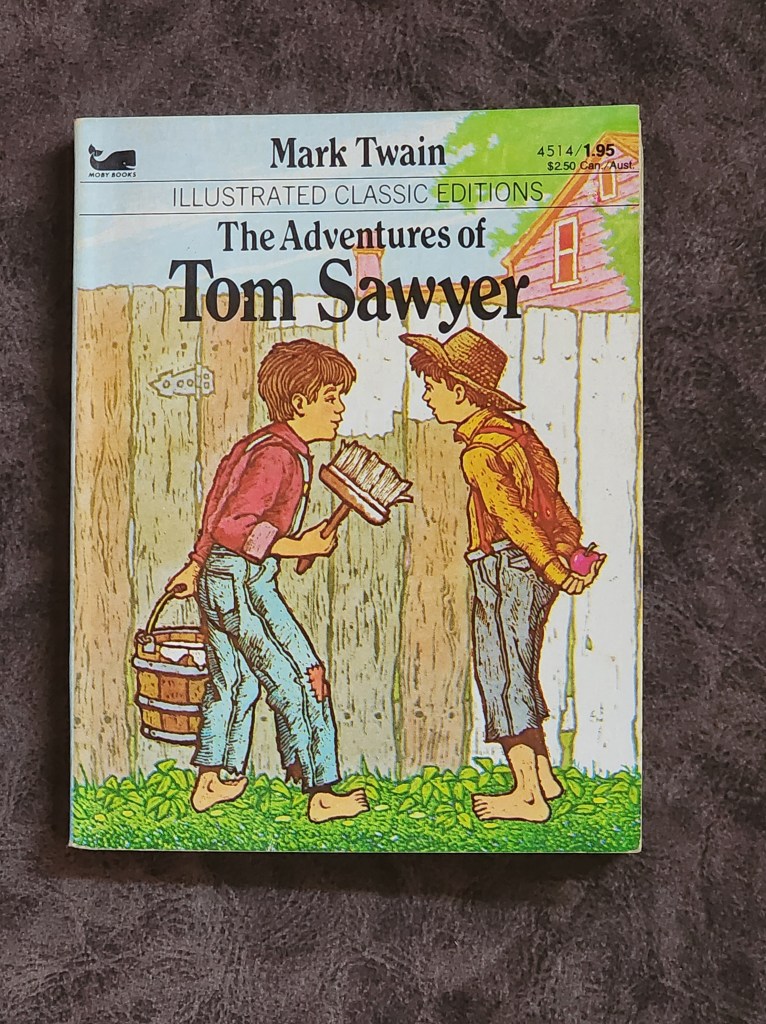

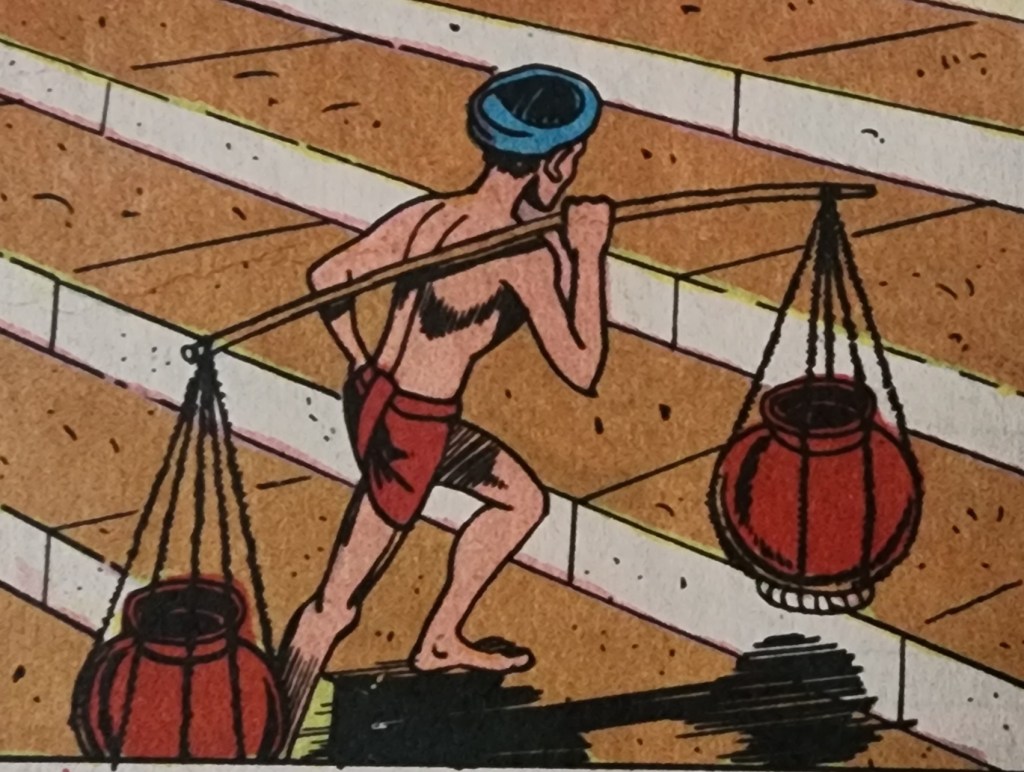
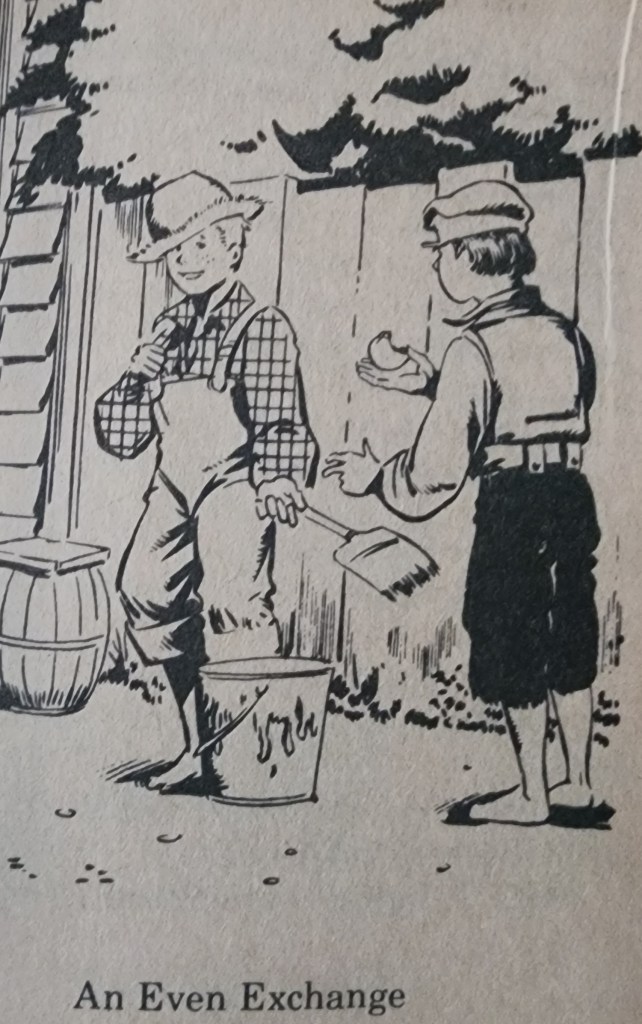




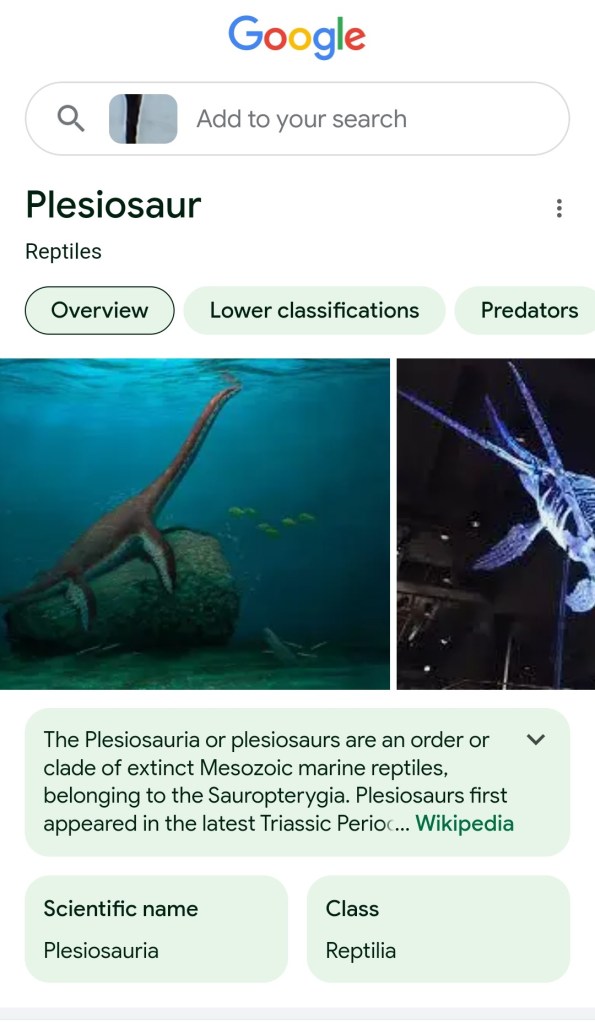



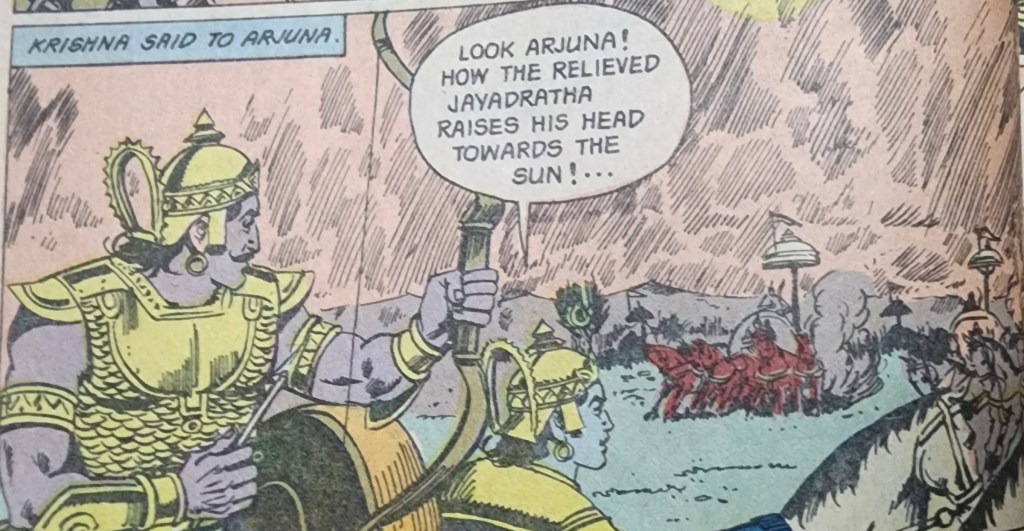

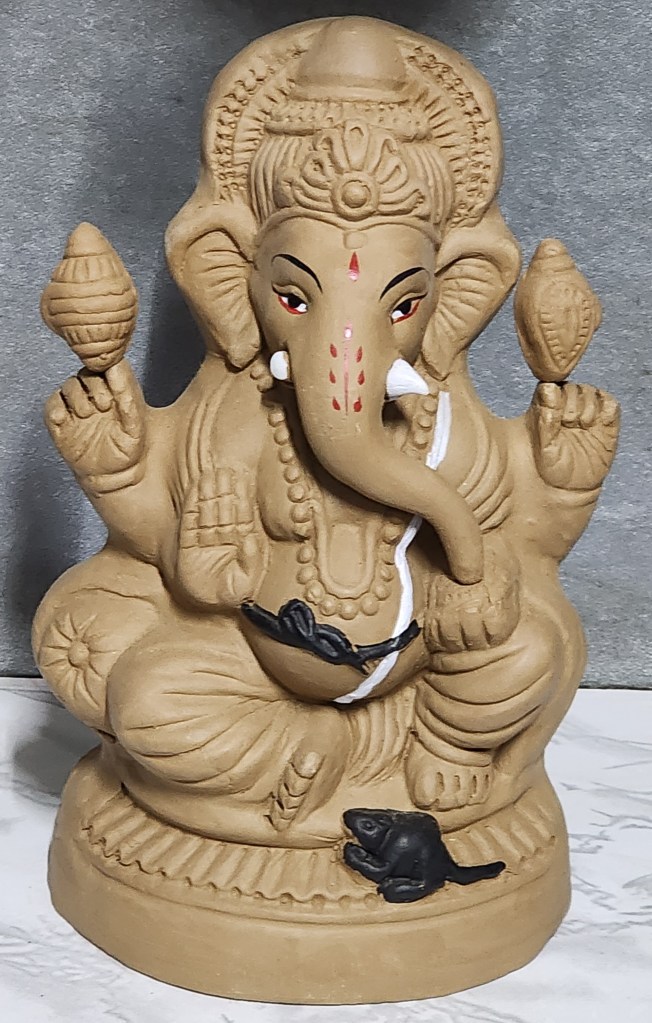
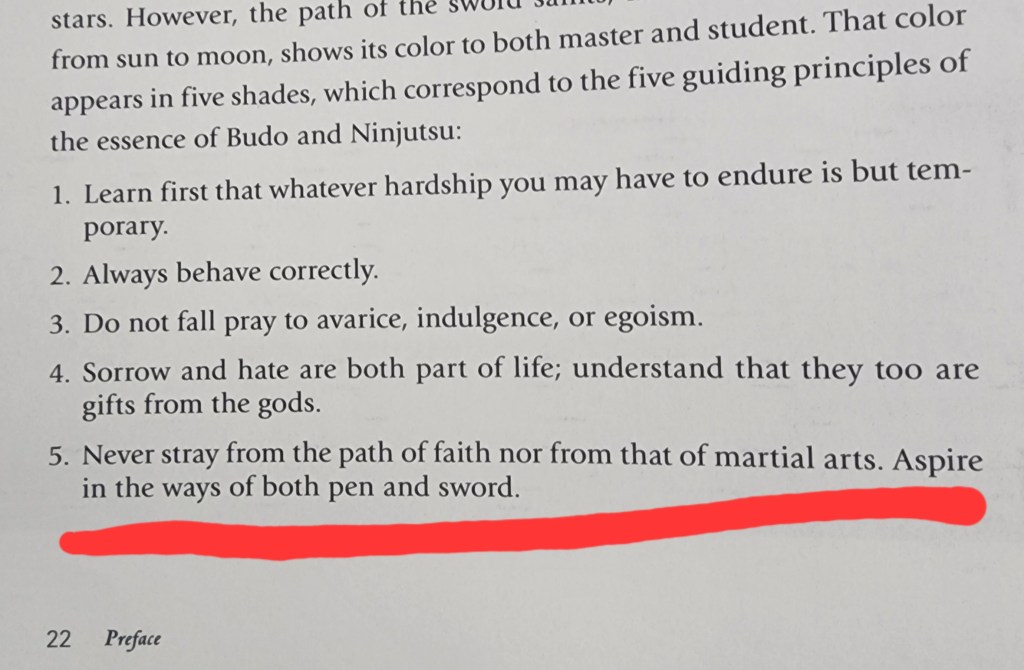
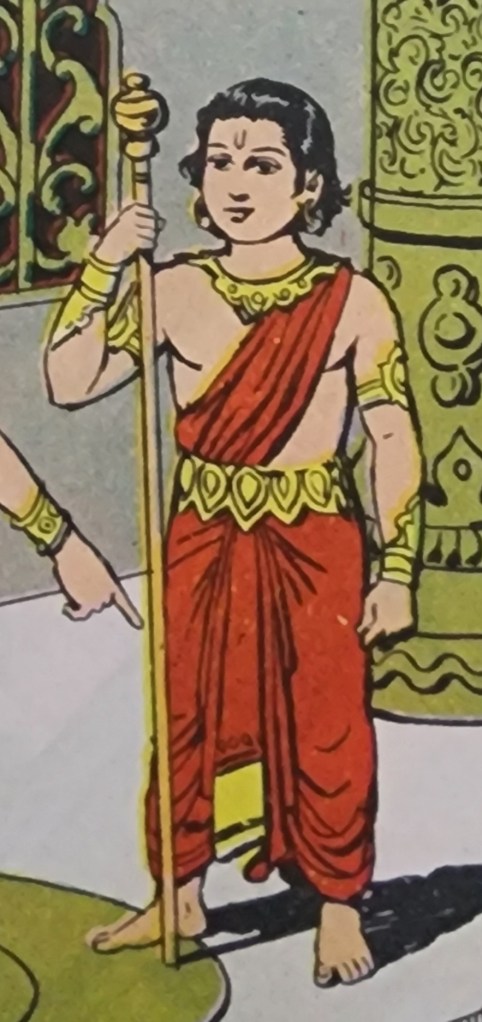
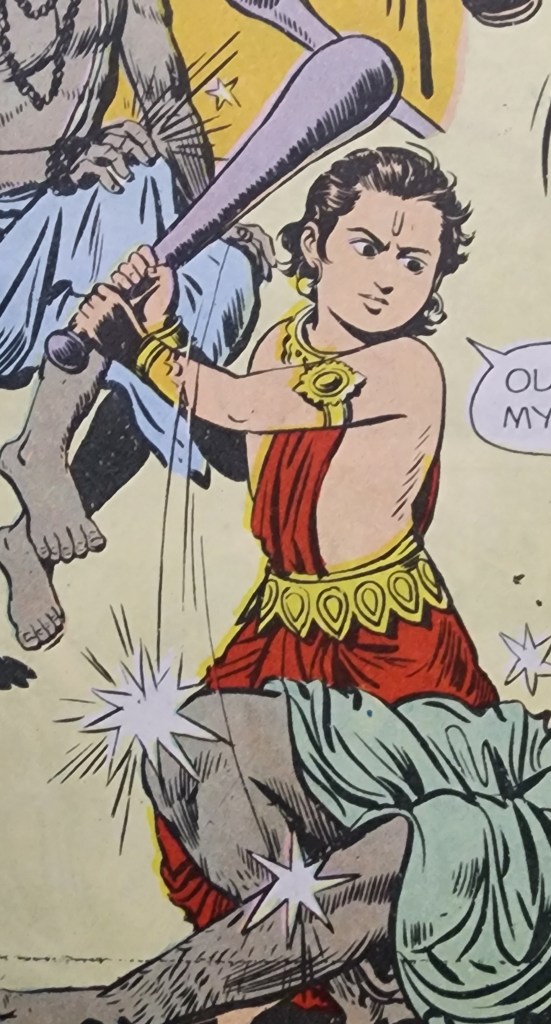

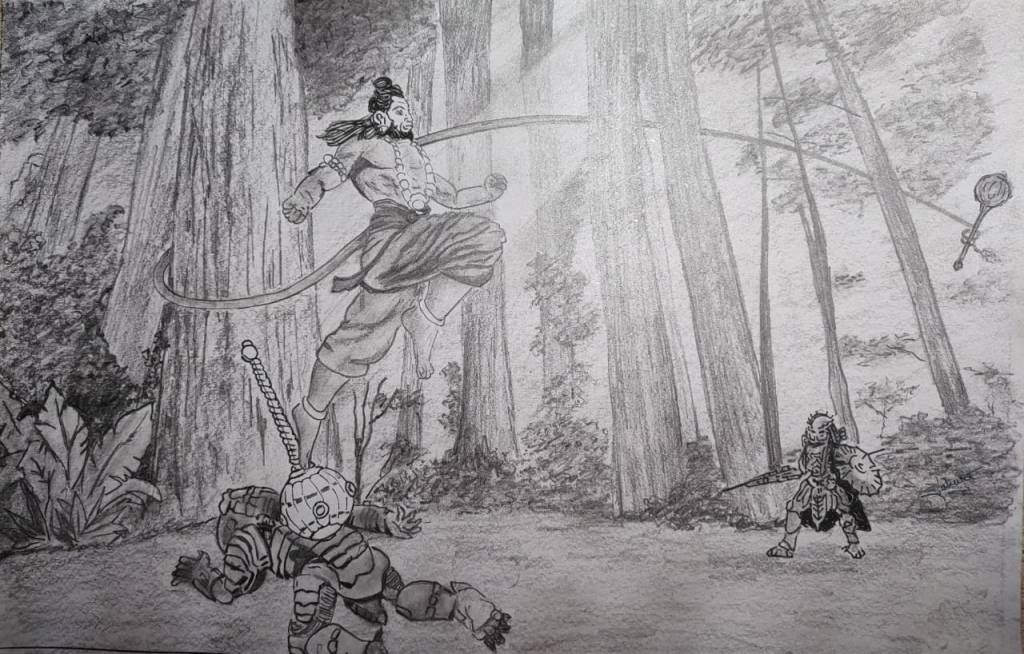
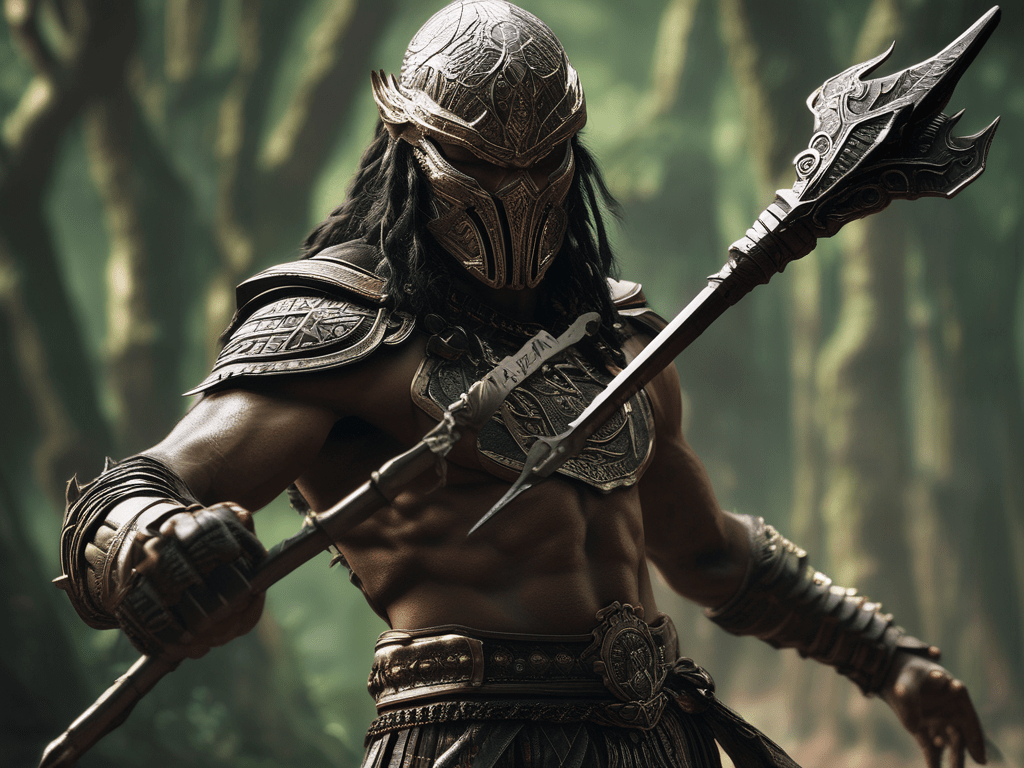
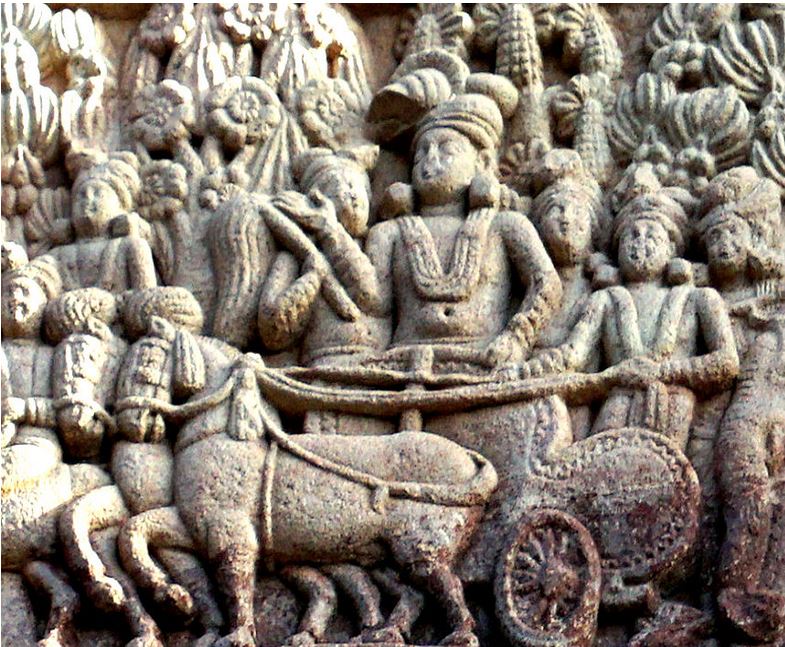
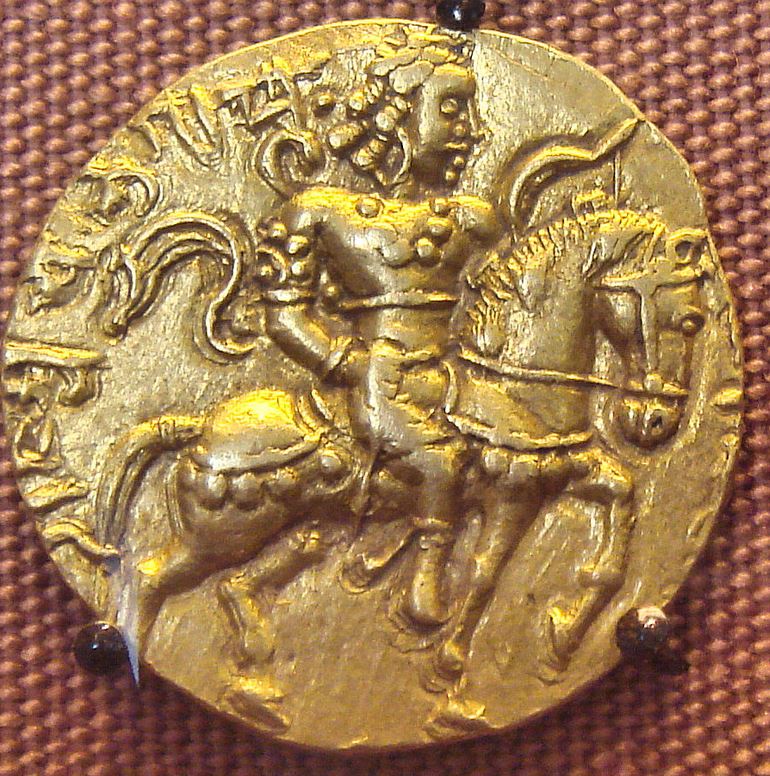
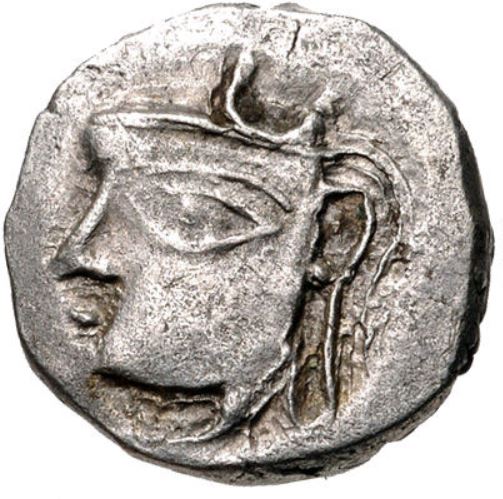

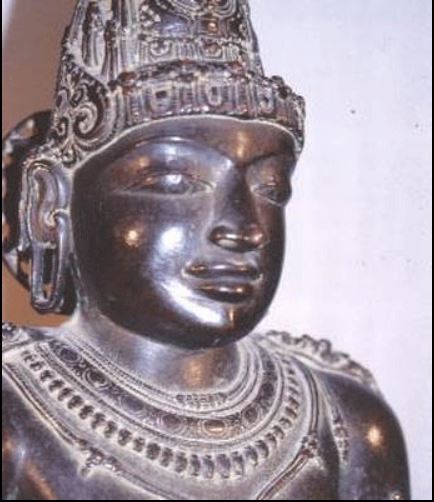
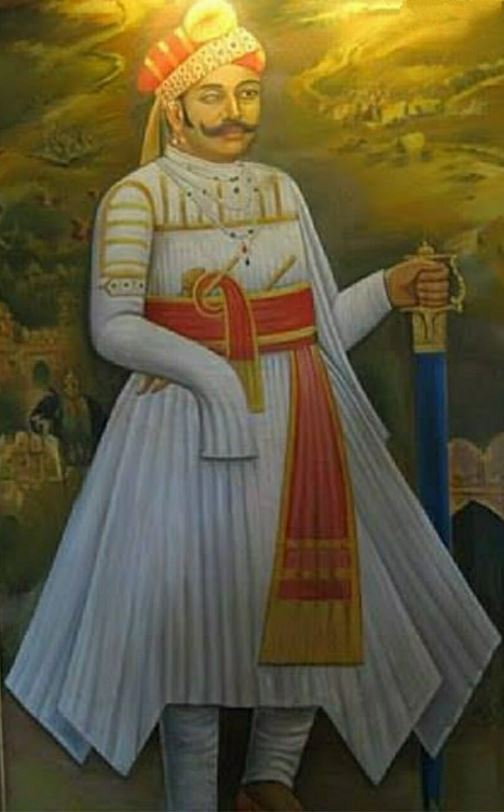
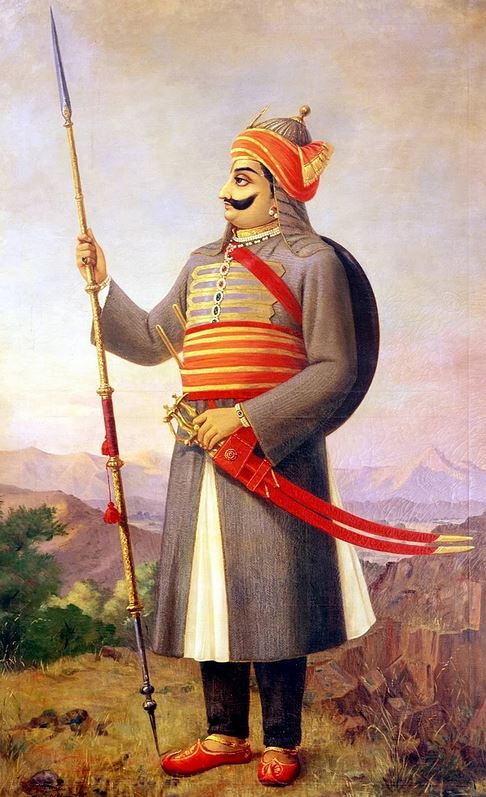
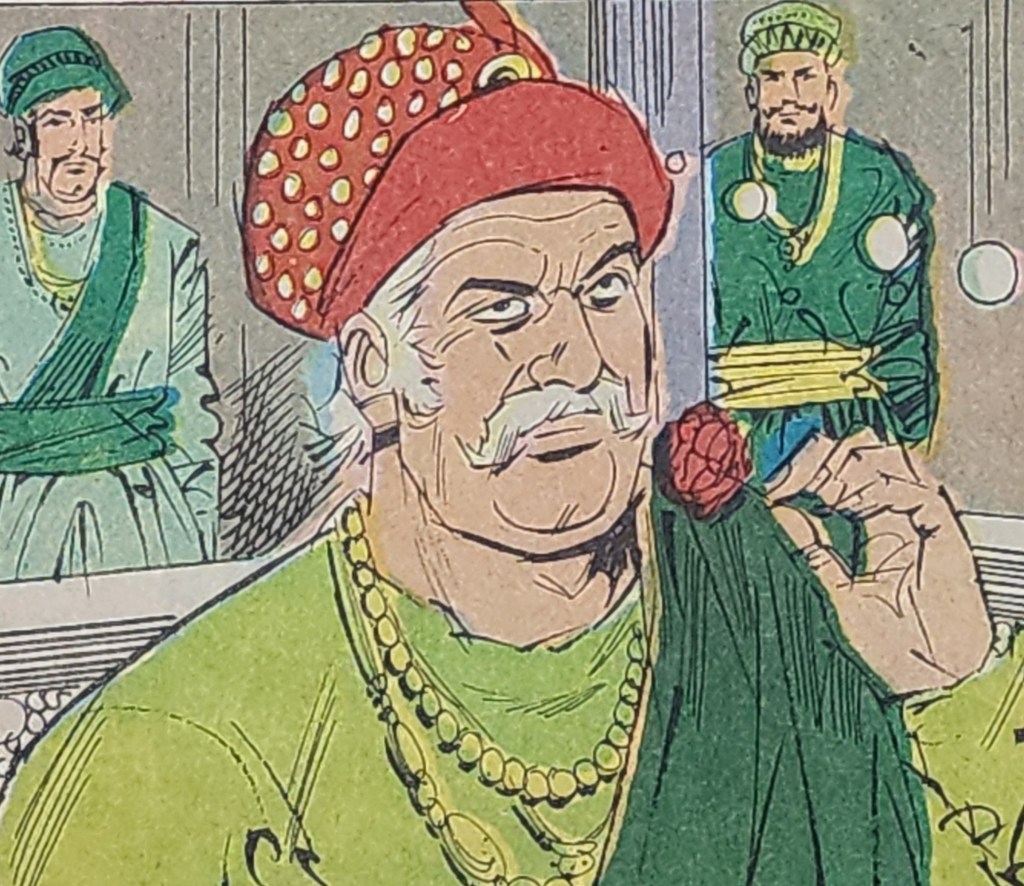
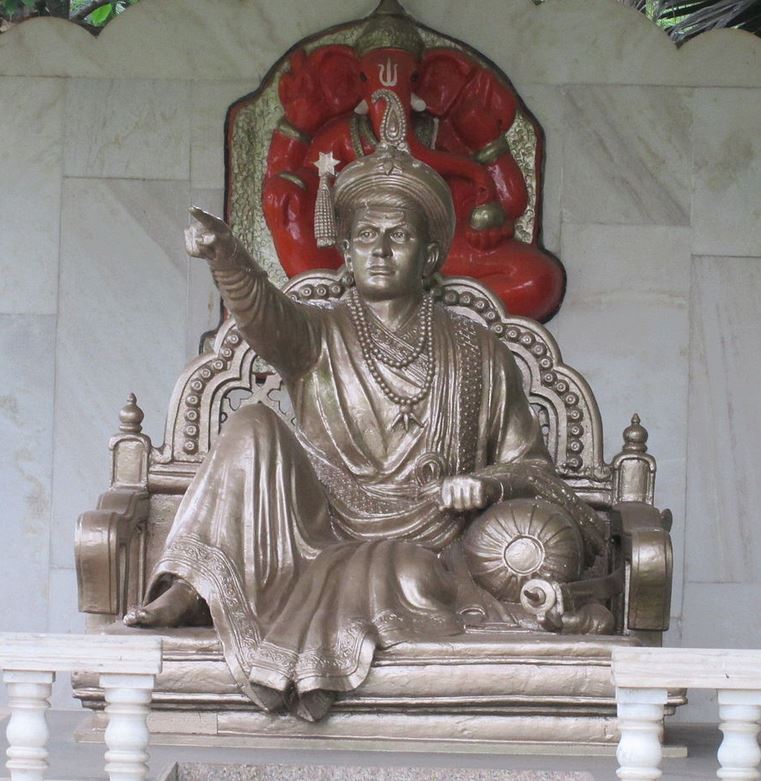
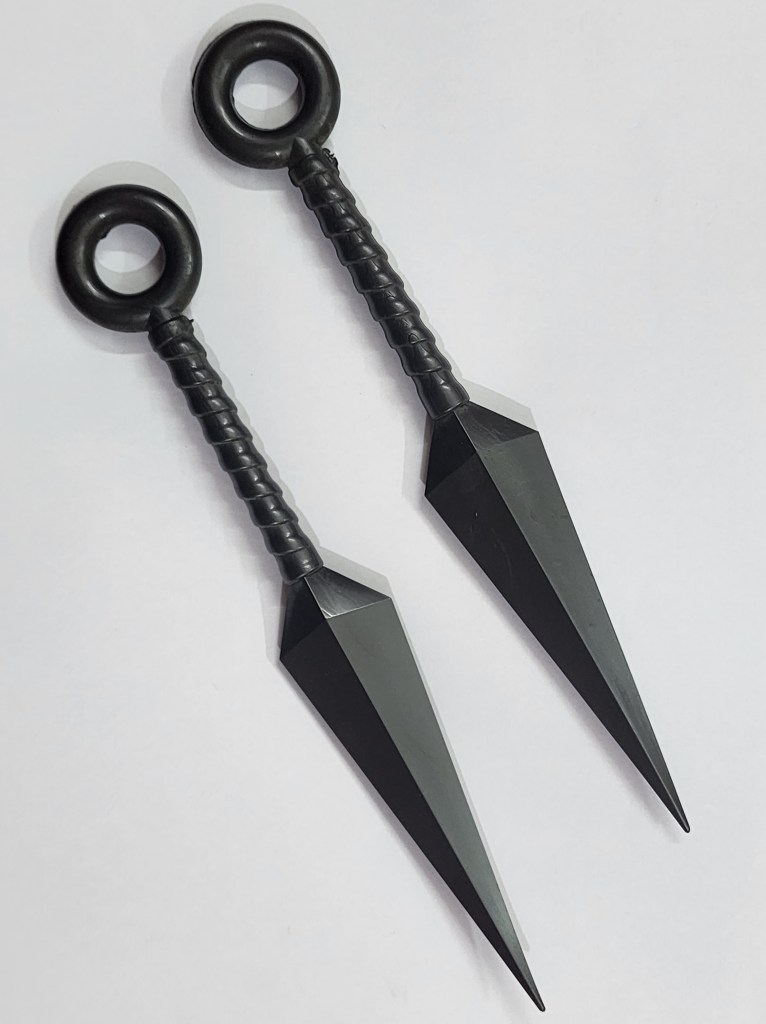







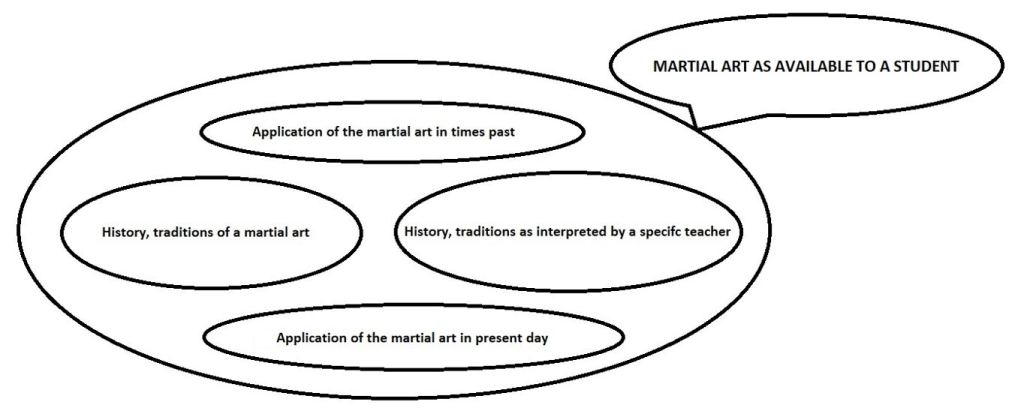
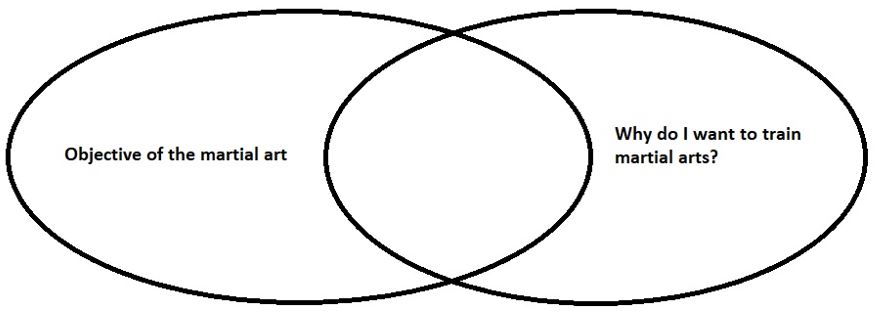
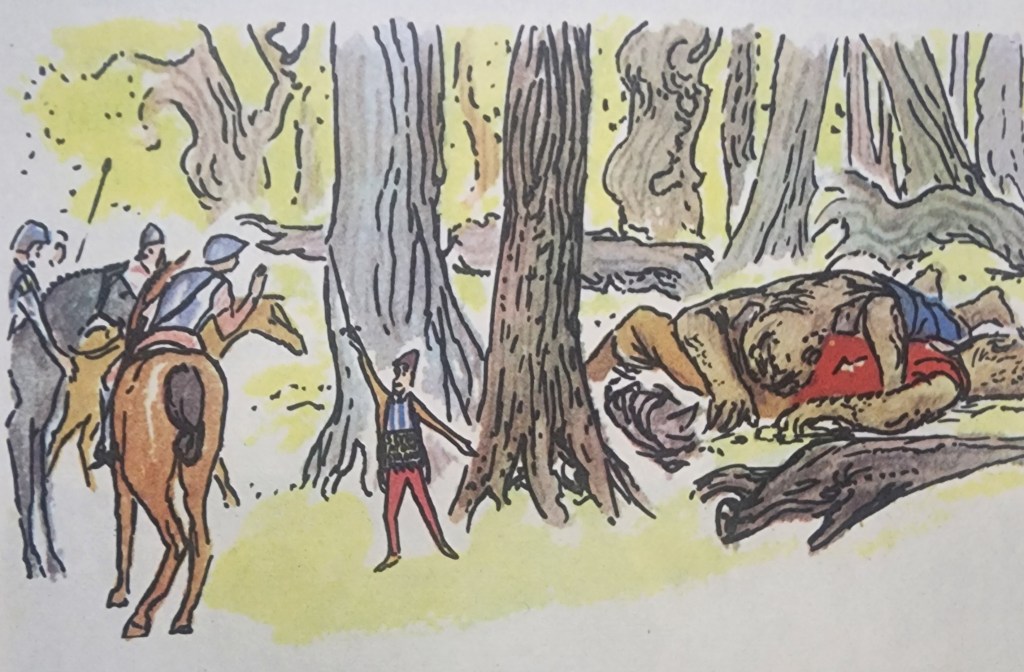

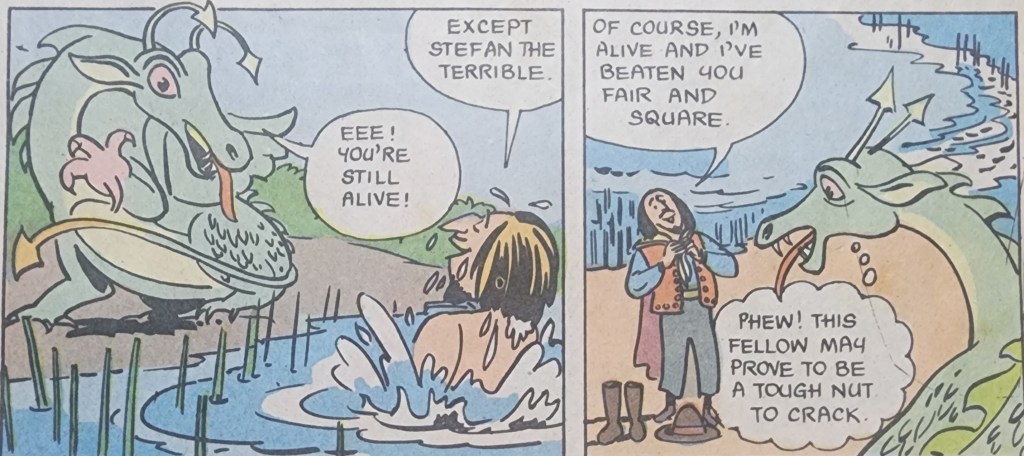
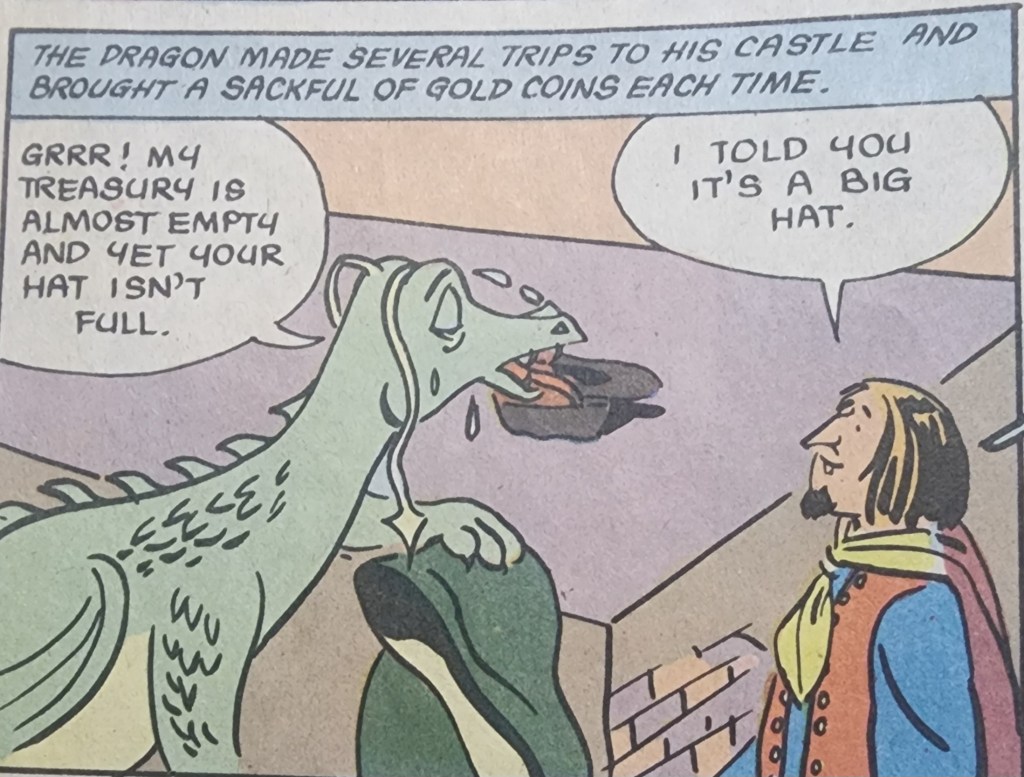
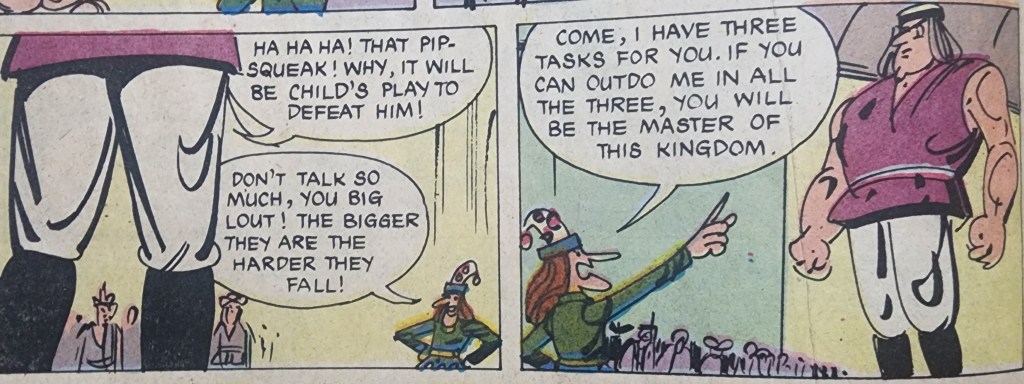
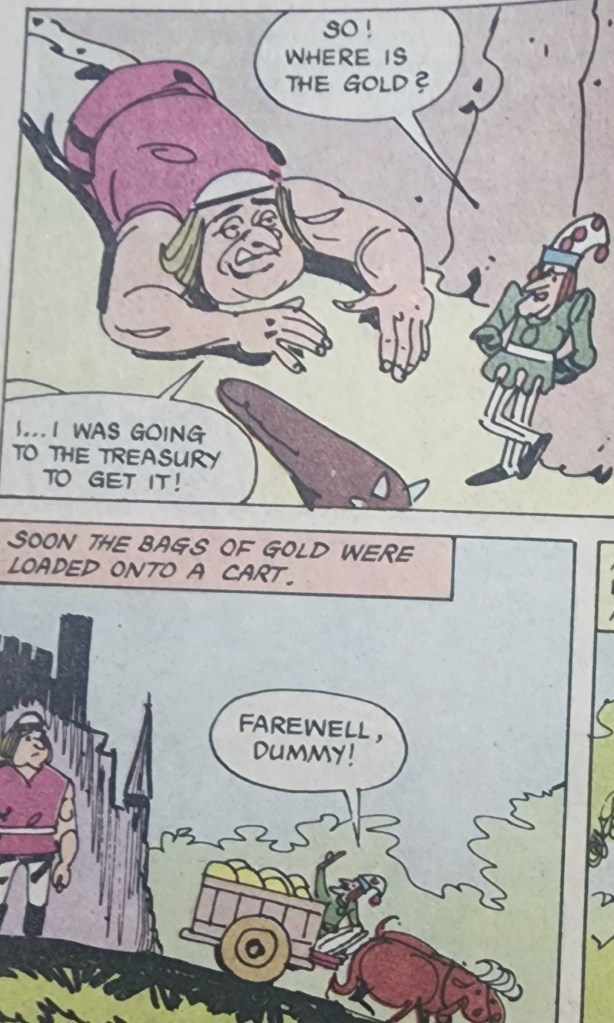
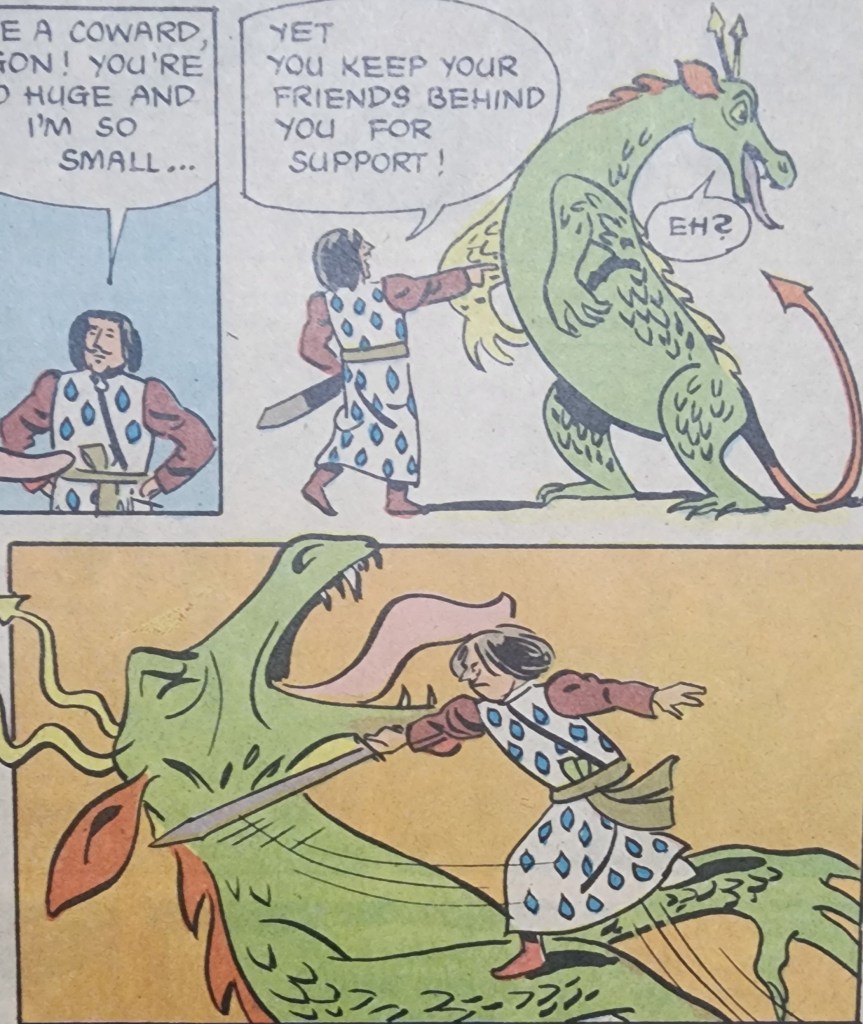
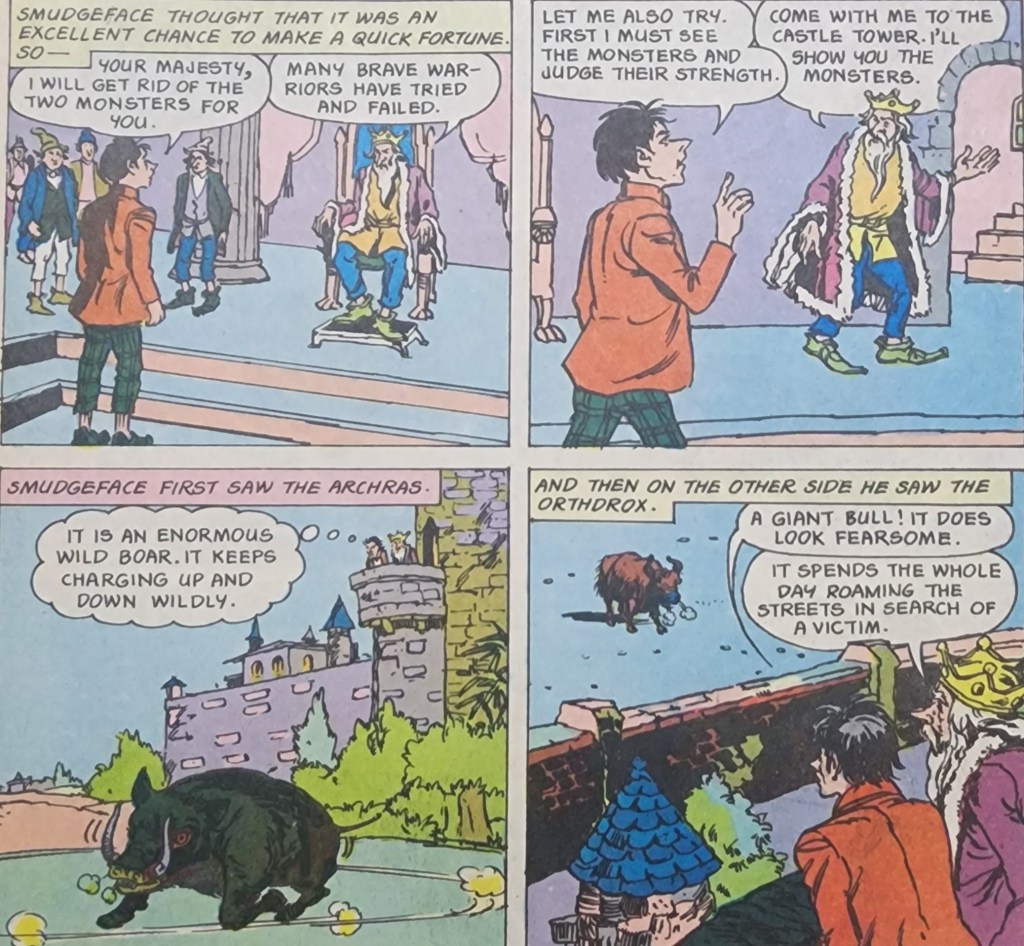


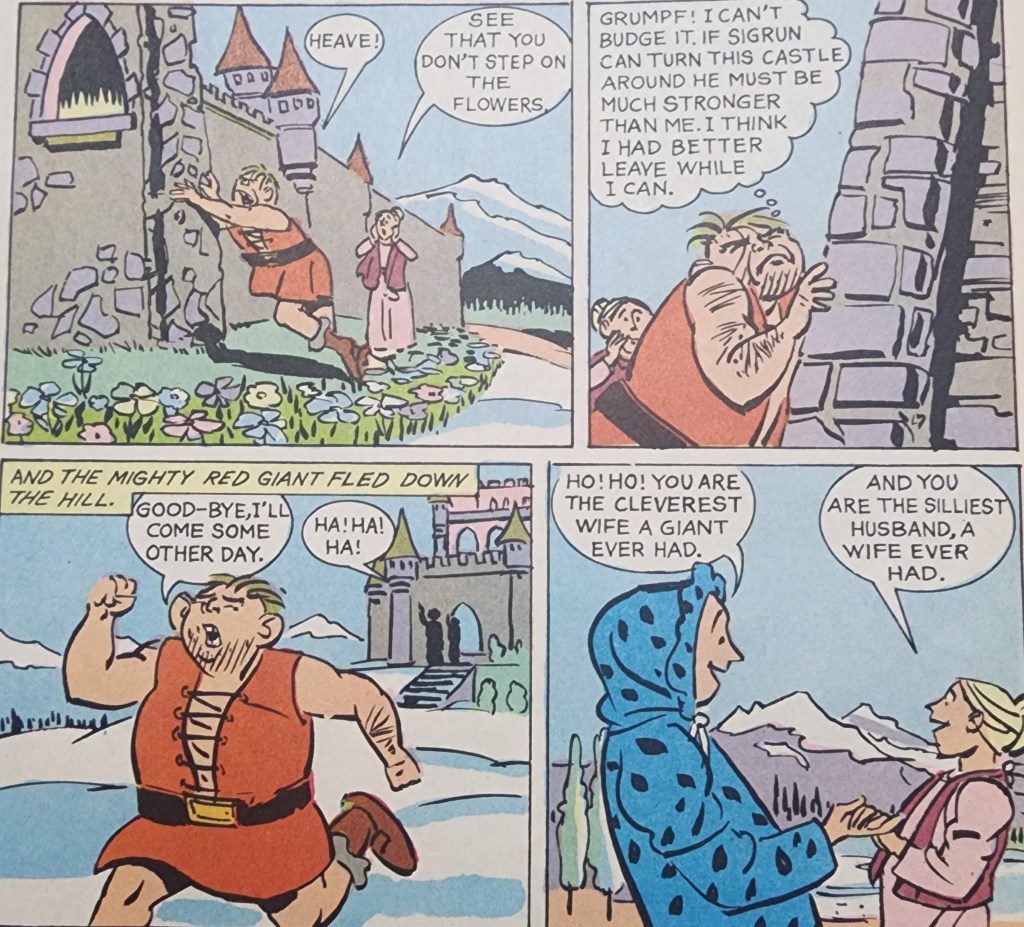
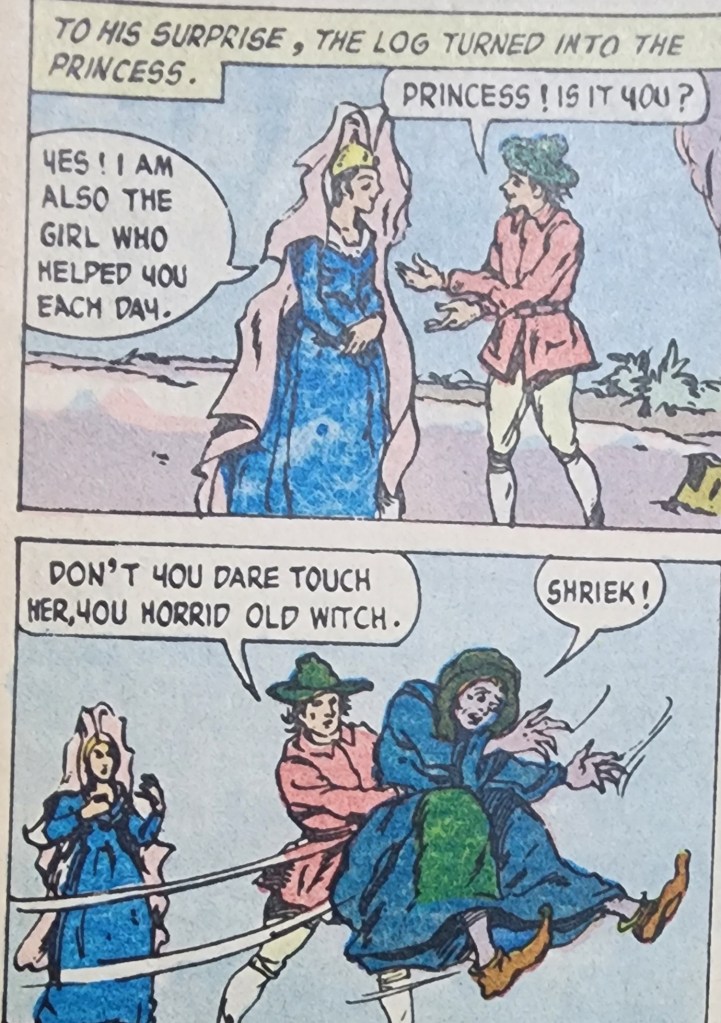

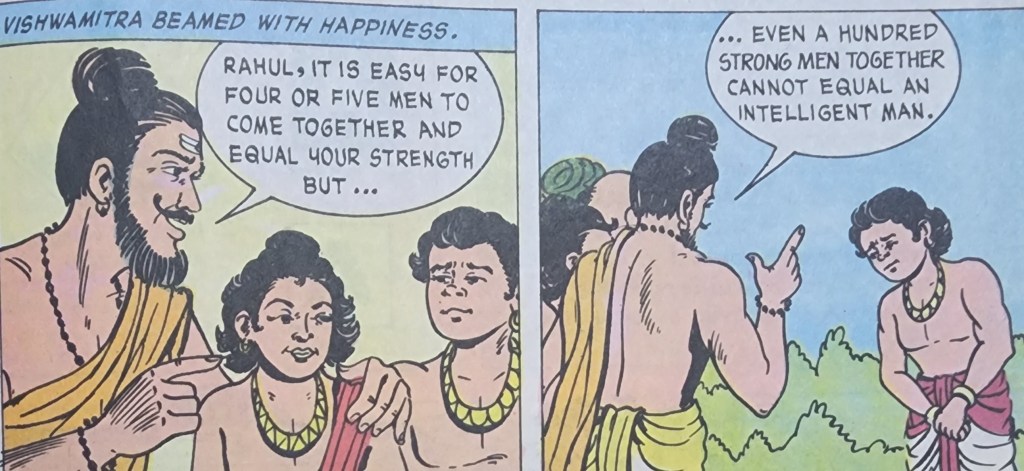
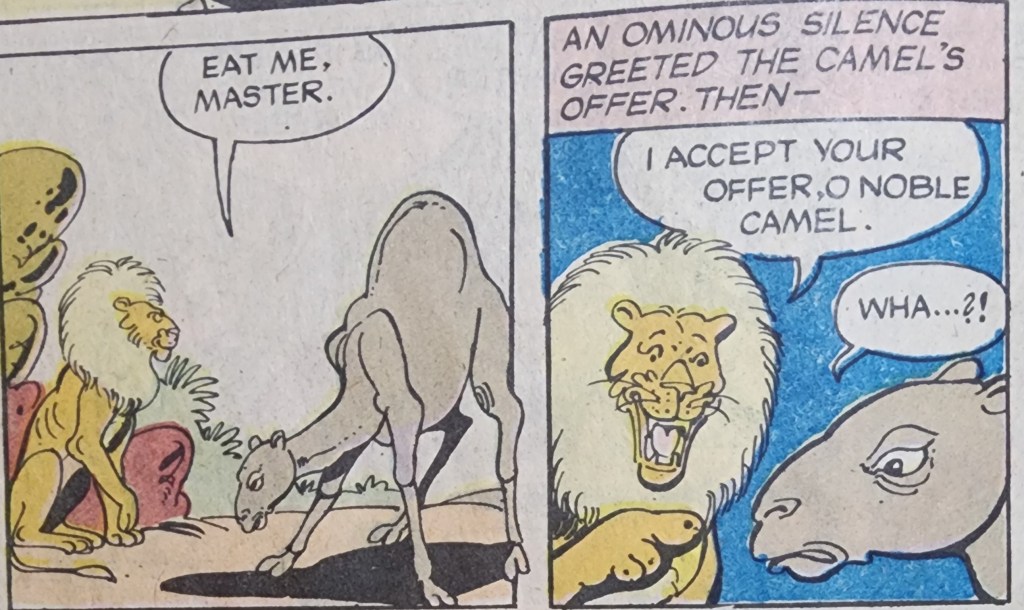
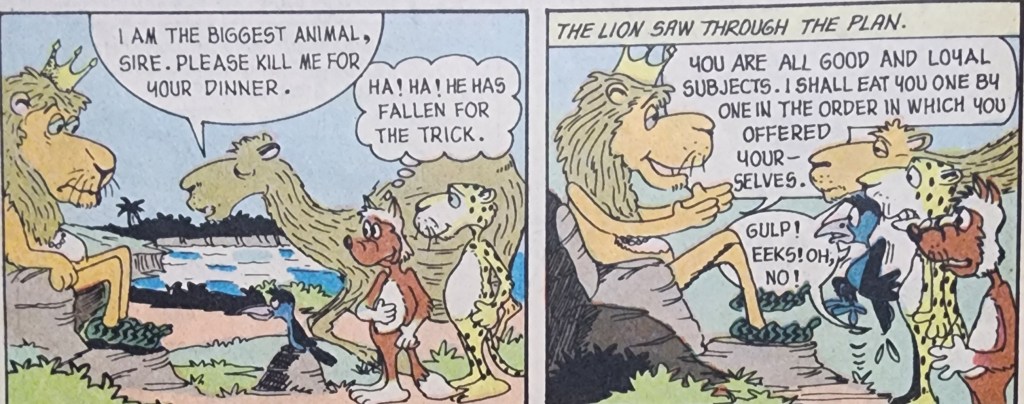

 Mundane Budo