Dashāvatāra & Budo, Part 1 – Issho Khemi

The Dashāvatāra – Balarāma is included instead of Buddha in the above image

In my previous article I attempted to explore martial art concepts that can be gleaned from the festival of Deepavali. This is a continuation of the same. Here, I will delve into the concepts that I could not consider in the earlier article as it was already very long. It might be useful to read the earlier article before getting into this one. But in case one does not, this article can be read as a standalone. The link to the previous article is seen in the notes below*.

A good starting point to delve into these concepts is the Dashāvatāra. The Dashāvatāra are the 10 incarnations (Dasha – 10, Avatāra – incarnation) of Lord Vishnu. This is not to say that there were only 10 avatāras of Lord Vishnu. The most popular list of incarnations of Vishnu is of 10 and this has been so for a few centuries based on the little that I know. If I am not wrong, there are also lists of avatāras that have 23 incarnations. The avatāras that are a part of the Dashāvatāra are not always the same.

Based on my understanding, the first 7 incarnations are the same in most lists. These are,

  • Matsya (1st), Kurma (2nd), Varāha (3rd), Narasimha (4th), Vāmana (5th), Parashurāma (6th) and Rāma (7th)

Of the remaining three, there are differences of who are considered the avatāras. I am sharing below a couple of the variations that I am aware of.

  • Balarāma (8th), Krishna (9th), Kalki (10th)
  • Krishna (8th), Buddha (9th), Kalki (10th)

The list with Buddha is the most common one that I am aware of. There are opinions where Lord Panduranga and Lord Jagannath are a part of the Dashāvatāra and not Buddha.

For the purposes of this article am going with the 10 incarnations where the Buddha is included and not Balarāma, simply because that is the one I was taught as a child and not because I am sure that that is the correct list. Also, I am sticking to only 10 avatāras and not considering the lists which have more than 10. Again, this is only because I do not have extensive knowledge about these.

Each incarnation had a specific purpose. I am adding a sentence or two about each avatāra and the purpose of the same in the notes below**. I am also adding a couple of examples from beyond the 10 incarnations where an incarnation or form of a God or Goddess eliminated a specific problem. I am going to be referring to these to make the points in the article, but the little detail is in the notes to try and keep the article to a “reasonable” length. 😊

The exact purpose of each of these avatāras is mentioned in the notes. But in general they fall into one of two categories, as far as I can tell.

  • Protect and save people from a tyrant.
  • Preserve the ecosystem, which includes the guardians of the same, which is why the Devas, who are the Lokapālas or guardians (of natural phenomena), are saved every time. If the Lokapālas are affected, the ecosystem is affected, and hence the people.

Considering the above, the objective of every avatāra has very high stakes. If the stakes are very high, how are the problems resolved? Yes, violence is one solution. But violence is neither the only solution nor the preferred one. Let us consider the other solutions that were employed by the avatāras.

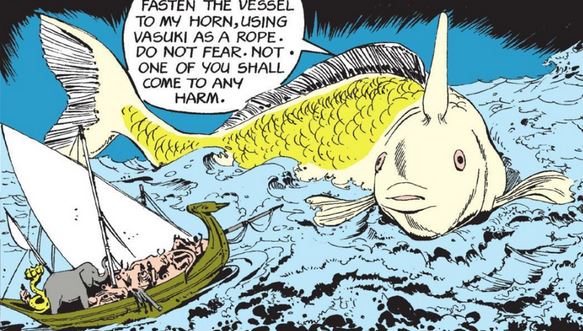
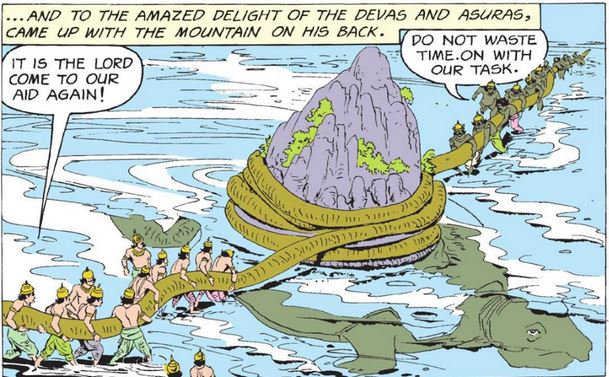
  • The solution by the Matsya and Kurma incarnations were two-fold. One involved identifying leaders who could bring people together for specific enterprising activities. The second was providing support to an engineering project of epic scale against enormous environmental adversities. So, they were perhaps Management solutions in modern day terms.

Matsya (L), Kurma (R)
Credit for the images – “Dasha Avatar”, published by Amar Chitra Katha, Kindle edition

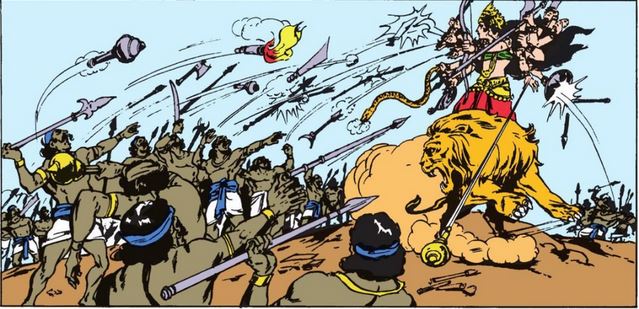
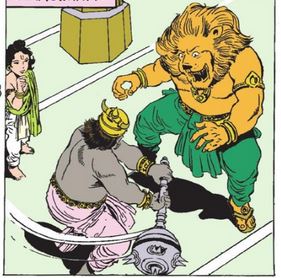
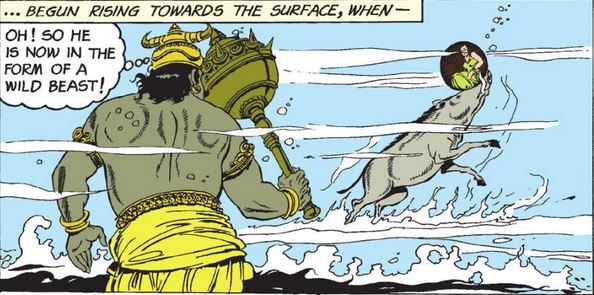
  • The Varāha, Narasimha and Parashurāma avatāras were warriors who used violence to solve problems. Varāha & Narasimha were protective warriors. Lord Parashurāma went on to spread the knowledge of the martial arts after his task as an avatar was complete.

Narasimha (L), Varāha (Top R), Parashurāma (Bottom R)
Credit for the images – “Dasha Avatar”, published by Amar Chitra Katha, Kindle edition

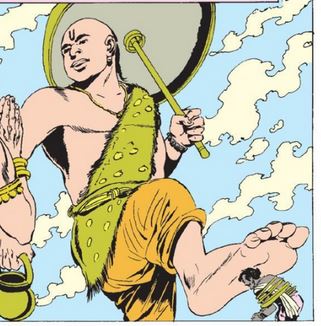
  • The Vāmana incarnation was about deception and negotiation. It specifically abhorred violence. It was, by modern day standards, the signing of an inter state agreement (peace treaty in other words).

Vāmana
Credit for the images – “Dasha Avatar”, published by Amar Chitra Katha, Kindle edition

  • The Rāma, Krishna and Buddha incarnations of Lord Vishnu lived a life that could serve as a case study. These incarnations served many purposes and hence used many solutions. During their lifetimes, they used administration, violence and negotiation to solve problems. It is almost like these incarnations combined all that was used by earlier avatāras. Their lives served as examples when they were no longer present in their mortal form. So, storytelling, entertainment and case studies were also a part of the plethora of solution types that they used. Considering that these options need documentation, add that to the list as well, as these are potential solutions that can be used by populations for centuries to come. The documents include, the Ramayana, Mahabharata (including the Bhagavad Gita) and the teachings of the Buddha.

Rama (L), Krishna (Top R), Buddha (Bottom R)
Credit for the images – “Dasha Avatar”, published by Amar Chitra Katha, Kindle edition

The above also apply to the other examples I have mentioned in the notes, which are not incarnations of Lord Vishnu. That said, the information regarding all the avatāras have also reached us through stories. And we can identify that the solution used in the stories fits into any of the categories mentioned because we still use the same in daily life. Of course, the violence in daily life refers to displays of anger and disappointment, which could constitute emotion or intellectual violence. This is a lot more common in our lives, compared to the use of physical violence.

So, if we say we use management and administrative solutions (processes), violence (non-physical), engineering and storytelling (documentation, presentations and meetings) on a daily basis, another aspect becomes clear. We use all of these without specifically thinking of the same. We use them in any combination as required, according to the situation. We do not actively classify what we do into the silos I mentioned. The classification is only in hindsight. This means that we do “whatever we need to”, “however we can” as the situation demands.

“Whatever we need to” and “However we can” are key aspects of the martial arts. This means exactly what it sounds like in the context of a physical conflict, with or without weapons being involved. One does whatever one has to, to survive however one can. All the training and experience comes down to be being able to use all the learning, intuition, learning, techniques and forms in a short duration to come out of the situation alive and with as little physical injury as possible.

There is no conception of what technique is being used in a real situation. The body reacts thanks to all the training, and does whatever it can instinctively, even if it means to escape from the place. Escaping only means that all the experience paid off in being able to identify that a fight was simply not worth it. This is especially true if one has around, people or things very dear to oneself when the fight begins. Seldom can one protect oneself and others, especially if weapons or multiple opponents, or both(!) are involved. Before the escape happens, what is done instinctively based on one’s training is never a specific technique or form, it is a variation or combination of what was learnt over the years of training.

This is true even in the case of combat sports, just that one does not need to escape. There are rules, weight categories and time limits to prevent life threatening injuries. The competitors still use variations of what they have trained. They “feel” the fight and flow with whatever can be done to win the fight.

Most martial art practitioners realize this pretty early on, if they are training regularly. My teacher and couple of my mentors repeat this incessantly in class, in case one does forget. One hears, “do whatever is necessary” and “however you can” time and time again. They in turn heard this from their teacher, all the way back to Soke Hatsumi Masaaki, who drilled in this idea for most practitioners in the Bujinkan system of martial arts.

This notion can be expanded further. I have heard this said from the same people mentioned above, “Don’t depend on the waza in a real situation. Kata will get you killed.” A simple way to put it, in my opinion, would be, “Learn the form to gain the concept. Use the concept to adapt. Adapt to do whatever is necessary. Do whatever is necessary, however it can be done. Do it however you can, to survive.”

Another statement with a similar meaning is “Don’t depend on the book. The book will not fight for you (or the book will not save you)”. The book being referred to here is the book with the details of all the waza (technique) or kata (form/set of forms) and how to perform the same. “The books” might protect you, like how Shaastra or Bun (knowledge) might protect you. It is more like saying “The library of knowledge” will save you. But one book of techniques will not! So, don’t fall in love with waza or kata, because they can’t save you. Fall in love with waza and kata as doorways or pathways to experience, awareness, knowledge; all of which enhance the probability of survival in a physically threatening situation. An extension of this is to not think any martial art or style is “the best” or to think one must support it no matter what, simply because it is the style one trains.

One Japanese phrase that I have heard from my teacher and some senpai during training is “Issho Khemi”. I have heard two translations for this phrase. The first is “do just enough” and the second is “do whatever is necessary”. The second translation is literally what we discussed earlier. When the first translation is implied, in my experience, it is used in the context of reminding one to not get bogged down in trying to use a fixed technique or movement.

In any conflict, whether physical or otherwise, the opposing sides do various things. It is extremely rare for any one side to be able to predict, read and plan for all the actions of the other side. And if this is possible by some extraordinary fluke, executing the “perfect plan” exactly as intended is as difficult and rare as the making of the same is. This is easy to see in a one-on-one fight. A given technique might work on an individual. But the same might not work on another person and the same might not work on the same individual at another time, maybe not even in the very next instant. This is true even while training that specific form, let alone in sparring or a real situation.

So, a given technique needs to be modified (applied as required) from person to person and every time it is executed. This means that if a given technique does not work, one should move on to something else and keep repeating this iterative process until something works. This means two things. First, identify when something is not working. This in turn means not expending too much effort on trying a single way of doing a specific technique. Secondly, it means that when a technique works, it usually does not require too much effort. The identification of the effective technique might be harder than getting said technique to work.

These two notions mean that one should do just enough to verify if a given technique will work, and if that is not sufficient maybe it is time to try something else that might require just sufficient effort. In either case, it is not useful to develop tunnel vision in making the execution of a technique the objective. The real motive is always to survive by doing what is necessary, however that can be done, not to determine the effectiveness of a given technique.

I remember that a few years ago Soke Masaaki Hatsumi had displayed in the dojo, calligraphy by Yamaoka Tesshu. These were acquisitions of his and he had used the writings as an inspiration for that particular class. Yamaoka Tesshu lived in the second half of the 19th century and was an advisor and teacher to the then Japanese emperor (I think it was the Meiji emperor). He was also a sword master who taught at his own dojo.

There is a book by author John Stevens, which is a biography of Yamaoka Tesshu. The book is titled “The Sword of No-Sword: Life of the Master Warrior Tesshu” (link to this book is seen in the notes below)***. In this book, as I recall, there is a very interesting observation made by the author. He says that when Tesshu was teaching his students, he always exhorted them to train harder. But he never taught or focused too much on specific techniques and forms. In other words, Tesshu wanted his students to focus on training as a whole, not consider mastering individual forms or techniques one after the other and use them as stepping stones. This idea along with the tile of the book makes me think that the focus was on the situation and what one could do in that time and space. This is the same as “Issho Khemi” and doing “whatever is necessary”, “however one can”.

So, we see that the Dashāvatāra from Hindu tradition and the martial arts have concepts that are the same. The concepts relate to problem solving and surviving a situation. Is this seen in modern life as well? I would say yes. I will share an example and my observation regarding international diplomacy and then get back to life in general.

In modern day diplomacy we hear the words, “based on shared values”. Considering that all nations only work in self-interest, the words should ideally be “based on shared interests”. But there are constituents and groups, especially in democracies, that put a great premium on “values” and expect that the leaders of their nations keep these at the forefront even when they are working towards national (self) interest, while working with other nations. If these nations do not share the value, like when democracies deal with dictators, these constituents are upset. So, realpolitik requires that the words be “values” instead of “interests”, even if it is a lie or a half-truth at best. The deal will be the same, irrespective of the words, but choosing specific words pacifies some sections of the society. So, why not use a lie to get the job done in the self-interest of a nation? After all, that is the purpose of a government, not the “promotion of values”. Has anyone ever seen the manifesto of any political party anywhere in the word state that they will work towards and allocate national resources to ensure that institutional democracy takes root successfully in a country not their own? I think not. If anyone knows otherwise, do let me know. This play of words is a case of “Issho Khemi” in statecraft.

Similarly, all of us do this in life and at work as well. How often do we vaguely agree with a client just to end a call, so that you can get back later with objections after further analysis? How often do we give a non-committal smile and a nod with close relatives when our minds are preoccupied, to get them to let us off at that moment? I would say often enough for us all to recall the last time we did it. Is this any different from the example of diplomacy, where sugar coated words that are not really meant are used to get on with real business? And is this any different from training forms only to do whatever is necessary, however one can? I would say they are the same. We are all getting on with our mundane lives, in the best way that we can. If this is something we can deduce starting with the Dashāvatāra, it adds to the notion that martial concepts are embedded in the cases studies that are the stores from Hindu tradition, apart from the life lessons that are expounded upon in many books.

Notes:

*Link to Deepavali article –

***Link to the biography of Yamaoka Tesshu –

https://www.amazon.in/Sword-No-Sword-Master-Warrior-Tesshu-ebook/dp/B00GXE93CS?ref_=ast_author_dp

**The Dashāvatāra

Sl. No.AvatāraObjectiveActivity
1MatsyaProtect people from the floodSurvive The Flood – only a divine fish could get the ship of refugees to safety
2Kurma“Support” a joint enterprise (Samudra Manthana)Support Mount Mandāra – only a divine being with attributes of an a
powerful aquatic animal could support the mountain, hence Kurma, the tortoise
2aMohiniProtect the nectar from Asuras to protect the ecosystemDeceive the Asuras – only an individual who was non-threatening and convincing could prevent the Aruras from starting a fight to steal the Amrita
3VarāhaProtect the planet from the flood & people from an AsuraEliminate Hiranyāksha – only a being that had attributes of a God, and an animal that could function in marshy areas and dig through the earth could kill him, hence Varāha (boar). I am going with the common assumption that since a boar digs through the earth, it can lift Boomi from the flood (of the cosmic ocean of milk)
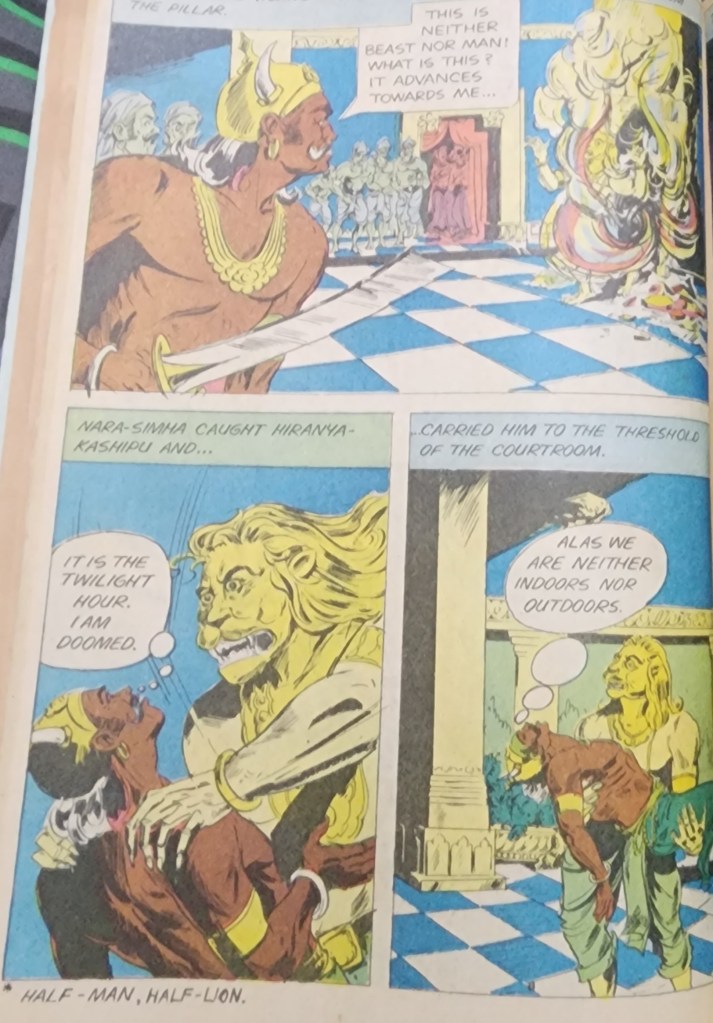
4NarasimhaProtect people from an Asura and establish peaceEliminate Hiranykashipu – only a being that was neither man not animal could kill him (among other conditions), hence Narasimha (Man & Lion)
5VāmanaProtect the guardians of the ecosystem by negotiating a peaceThwart Mahabali – only a being of divine intellect who was non-threatening could get
Mahabali to negotiate and avoid violence, hence a small built brahmana, Vāmana
6ParashurāmaProtect people from arrogant rulers, and establish the idea of
 violence as punishment and protection
Eliminate the arrogant Kshatriyas – only a divine Brahmana with the attributes of a warrior could single-handedly defeat the Kshatriyas
7RāmaEstablish a benchmark for administration, personal conduct and protect people from an Asura (a lifetime’s effort)Eliminate Rāvana – only a mortal could kill him, hence Rāma
8?BalarāmaSupport KrishnaI am not sure
8 or 9KrishnaEstablish the idea of Dharma as the foundation of administration and personal conduct, supplanting reputation (and supplementing personal conduct) – another lifetime’s worth of effortEliminate Jarāsandha – only a duel would result in his being eliminated without a devastating war
Eliminate Narakāsura – only an aerial attack would result in his being eliminated without a devastating war
Defeat Kaurava army – only a divine being could possess the abilities to guide the Pāndavas to victory
All of the above were possible through a divine being not worried about honour and inclined to the objective of Dharma.
9?BuddhaInitiate the idea of a limitation of ritual, a limitation of connections, limitation of violence and
an abundance of personal reflection – a look at aspects internal, which is an addition to a look at all external aspects from the previous avatāras
Minimize ritual and attachments – hence an individual who had it all and
renounced the same – Siddartha Gautama, the Buddha
10KalkiNot sure, as this is in the future. Supposed to be to protect people from bad rulers and hordes
 of bad people. More like a reminder of the avatārās before Buddha, for they might be forgotten in the time that has elapsed. The earlier incarnations are a perpetual activity, and they lead to conditions that allow reflections, which might lead to more Buddhas.
Yet to happen

Mohini (L), Kalki (R)
Credit for the images – “Dasha Avatar”, published by Amar Chitra Katha, Kindle edition

A few other cases where specific solutions were achieved through divine births and incarnations are mentioned below.

  • Lord Ayyappa – He was the son of Shiva and Vishnu (in his form as Mohini), born to end the terror of Mahishi, the sister of Mashishāsura.
  • Lord Karttikeya – He was the son of Lord Shiva and Devi Parvati, who was born to end the terror of Tarakāsura.
  • Devi Durga – She was a form of Devi Parvati (Shakti) who was created and armed specifically to defeat Mahishāsura
  • Devi Kāli – She was a form of Devi Parvati (Shakti) who was created specifically to defeat Raktabeeja

The Goddesses mentioned above killed Asuras other the ones I have mentioned, as did Lord Karttikeya. I would highly recommend everyone to go and read the original stories. They are wonderful; not just entertaining, but also have a lot of symbolic value if one goes into the detail and serve as case studies as well.

Aayudha Pooja, Vijayadashami – The most important festivals for the martial arts

Image credit: Original art by Vishnu Mohan (Goobe Art) , above rendition by Chirag Hasyagar (Goobe Art), art concept by Vikram M R

Today is Aayudha Pooja and tomorrow is Vijayadashami. Aayudha Pooja is celebrated on the ninth day (Navami) of the Dasara festival and Vijayadashami on the tenth (Dashami – it is built into the name) and last day of Dasara. Dasara is pronounced Dussehra by many. I use “Dasara” instead of “Dussehra”, thanks to my heritage in Karnataka. In some parts of our country the festival of Dasara has a lot of association with the Ramayana, while in others it is associated with Mahishasura Mardhini. Culturally of course, it is simply awesome; with festive fervour, great food and school holidays. If one is an adult and not in school, at least one of the two days are off, if not both. Many people go on leave on the day that is not off.

Aayudha Pooja is the day when tools and implements that either allow us to earn a livelihood or allow us to lead a comfortable life are shown the gratitude and the respect they are due. Vijayadashami is simultaneously a celebration of the victory of Lord Rama over Ravana in Lanka and of Devi Durga over Mahishasura.

The Goddess Durga had access to the weapons of all the other Gods and Devatas. She used all of these in the fight against the Asura Mahisha. The weapons include the Trishoola of Lord Shiva, Sudarshana Chakra of Lord Vishnu, the Vajra of Indra and a whole host of others. It was these weapons that aided in Durga defeating Mahishasura. Hence, the occasion when Durga’s victory is celebrated is used as an opportunity to offer prayers, gratitude and respect to the “weapons” that we use in our daily lives, which are the tools of our trade. These include our vehicles, laptops, pumps, electrical equipment, the practice weapons we use as martial artists and just about anything we think are important to us. The choice of the “Aayudha” selected for Pooja is a personal one.

Aayuda is generally used to denote “weapon”. But it also refers to tools as mentioned above, which we might not consider weapons. A “Shastra” or an “Astra” specifically denotes a weapon, where a “Shastra is a handheld weapon and an “Astra” is a weapon that is discharged. With that said, as martial artists, everything we use to train becomes an aayudha, like the training mats, punching bags, weights, practice weapons, protective apparel, the very space we train in (dojo/Kalari/akhada/gym) is something that is deserving of obeisance on the day of Aayudha Pooja.

None of this of course, is special or specific to practitioners of the martial arts. A look at any plant in the manufacturing sector or anyone in the transportation sector shows how important a festival Aayudha Pooja is. The shop floor and all machines are cleaned. The same goes for vehicles and mechanic shops as well. The cleaning might happen a day or two before the Pooja itself. Vehicles of course are decked up in the day of Aayudha Pooja.

Aayudha Pooja as a whole is a very grounded and simple act. Use the opportunity provided by the victory of Goddess Durga to appreciate and offer gratitude and respect to the inanimate objects that make our lives and livelihoods possible. If one is a martial artist, the analogy is exponentially greater, for the closeness to weaponry and their knowledge are that much greater, and the opportunity to explicitly remember/observe this fact is what the festival is all about.

Vijayadashami is an out and out celebration of victory, whether it is of Devi Durga over Mahishasura or of Lord Rama over Ravana. However, there are other aspects associated with this festival that make it all the more important. In Karnataka, a concept called “Seemollanghana” is associated with Vijayadashami. And this concept is the reason everyone is always encouraged to start something new or anything that is long pending/challenging on the day of Vijayadashami. “Seemollanghana” means “violate the border”. “Seema” is “border” or “boundary” and “Ullanghana” means to “vilolate”. This is all in a very positive sense, and just because the word “violate” is used, it is not anything negative.

From what little I know, historically, the campaign season (war campaign that is) started after the Dasara festival. It is the time when the monsoon season is tapering off. So, movement of troops becomes easier, and the winter is not far away. In southern India, at least in most parts of it, the winter is not harsh, and the weather is better for a military campaign. Summers are scorching hot, and the monsoons are muddy and wet, both of which are less conducive for supply chain management and fighting. So, the post monsoon season and the winter are better suited to military action. I am not aware if the same pattern was followed in northern India, as the weather patterns there are a little different. Either way, as part of the campaign season, geographical and political borders were crossed or violated. So, there is a literal “Seemollanghana” taking place, after the festival of Vijayadashami.

But the historical precedent is not what any of us is raised with, when the word “Seemollanghana” is used. It refers to something far more personal, not necessarily just symbolic, and definitely relates to us violating our own boundaries. We were encouraged to start something new on the day of Vijayadashami. Even if it is something we have stopped for quite a while, it would be a good time to restart the same. If there is something that we have been putting off, due to uncertainty, lack of confidence or just due to procrastination, starting that activity, even if in a small way, on the occasion of Vijayadashami is the thing to do. The general belief is that a start on this special day leads to a favourable outcome. Again, the celebration of a victory against all odds from tradition, along with historical precedent, gives an opportunity to start something new, just as Aayudha Pooja created an opportunity to give a respectful thought towards all the tools we use.

Starting something new is the same as breaking a boundary. One has to go past the jitters or second thoughts or plain old nerves. Each of these qualifies as a boundary and violating them leads to a start, which will hopefully lead to a good outcome in the future. This is why the violation of a boundary is a positive thing when considered with the festival of Vijayadashami+.

In my opinion, Vijayadashami is a constant reminder of “Shin Ken Gata”. “Shin Ken Gata” is a test some Bujinkan dojos have their students go through. This test happens at any of the kyu levels as the dojos decide. In my dojo, it was at the 6th kyu (kyu are levels before one achieves a black belt, and dan are levels after achieving the same). Shin Ken Gata in Japanese means, “form where your spirit/will is the only weapon”. This test involves performing various set techniques multiple times against multiple opponents. In all, this comes to about 15 minutes of moving, fighting and staying alive and pushing oneself, with no breaks, while incessant attacks come from multiple opponents who are all around the one taking the test. It is incredibly tiring and scary. Shin Ken Gata leaves an exhilarating feeling of having survived, after the test is done.

One great learning from the test is that, when one has to keep going continuously against multiple opponents, even if they attack one at a time, the chances of survival are zero, if it was a real situation. One realizes that one keeps going despite this becoming clear, hoping one comes out alive at the end of it. This is the will or spirit of the person driving her or him. This is why the spirit or the will to live is the only weapon; hence the name Shin Ken Gata.

When one takes the Shin Ken Gata test, one has to go past the fatigue, self-doubt, giddiness, exhilaration, rage, fear of the opponents, fear of failure and a whole host of limiting factors. Each of these is a boundary violated as the test progresses. And this is reason why “Shin Ken Gata” is a wonderful exhibition of “Seemollanghana” in real life.

I will make a pop culture reference here. I stated earlier that Shin Ken Gata makes one realize that in a real fight there is a good chance that one might not survive. Yet one strives to achieve that goal no matter what, until the very end. This is very close to the “Kobayashi Maru” test in the Star Trek franchise. The Kobayashi Maru is a test that cadets in the Star Fleet Academy have to go through. It is a test which has no success or passing. It is designed such that one will always fail. It is meant to teach cadets that despite the realization that there is no success or victory and the certainty of defeat, even death, one has to keep going and do one’s best as a leader and to save as many crew mates as possible. This objective and its realization make the Kobayashi Maru test almost identical to the experience of the Shin Ken Gata; only one of these if real though. 😊

The Shin Ken Gata test reveals two other concepts. One is Ganbatte and the other is Gaman; both are Japanese words. Ganbatte is used to mean “keep going”, “keep fighting”, “good luck”, “all the best” or “do your best”. It is used to cheer someone on in any activity of theirs. I have also heard the term “Ganbatte Kudasai”. My friend Santosh*, who knows Japanese, tells me that this is used while addressing someone senior (Senpai). So, it is a slightly more formal usage of the word. It is used to mean, “keep your spirits up”, again a form of cheering someone on.

Gaman, as I have heard it, means, “take the pain” or “endure the pain”. Santosh tell me this is used to mean “endure your suffering with patience”. Also, “gaman” is supposedly used more as a term with spiritual significance.

So, the two words signify endurance, or forging ahead however one can in the face of adversities, irrespective of whether they are internal or external. This, in my understanding, is very close to the third of the five gojo1, “Shizen no niniku”, which is “forbearance of nature”. It suggests that one should forbear troubles like nature itself does, with no complaints. This in turn leads into the term “Ninjutsu” itself, where “nin” refers to perseverance (jutsu being “art of” leads to Ninjutsu to being the “art of perseverance” or “art of persevering”)**.

Back when I was a beginner, I was advised by my teacher to consider injuries as an opportunity to learn and hence try to attend classes while nursing or recovering from injuries, irrespective of whether they were sustained while training in the dojo or outside, while going about one’s daily life. This was because, being conscious of an injury forces the body to adapt; to protect the injured part of the body and to stay safe, to avoid further aggravation of the injury or the possibility of a new one. This also inspires the body to move more efficiently, which has many revelations that can hopefully be used when one returns to normalcy. This entire exercise is nothing but violating the boundaries set by worry, fear and pain, either due to our own preconceptions or those we have imbibed from others around us.

Enduring hardships and hindrances is nothing but breaking boundaries of concern and fear and moving ahead, both of which dissuade one from doing or starting something one either needs or wishes to. In this sense, the festival of Vijayadashami addresses the very heart of what the Bujinkan represents, to keep going, enduring and achieving flow in the face of adversity. This makes Vijayadashami perhaps the most important festival for practitioners of the martial arts, as it is a reminder of all things this art stands for.

Thus, Aayudha Pooja is a reminder to be grateful to our surroundings (dojo, implements) and Vijayadashami is a reminder to respect our own selves, by going past limitations and constantly expanding our abilities.

Notes:

*I would like to thank my buyu (martial sibling) and friend, Shihan Santosh Nagasamy, for sharing his knowledge of the Japanese language with me.

**My teacher and mentors used to change the forms we used often. My teacher said that this is to enable neuroplasticity. I am no expert on this topic and hence am adding this point in the notes. When one trains the same forms multiple times, changing it and exploring it differently after a duration of time leads to new learning and fine-tuning of the same forms, with each iteration of training the same. Also, moving differently in response to the same initial attack also leads to different outcomes and the form being practiced leads to interesting revelations. This continuous change helps overcome any reliance on form and technique, while also mitigating a worry of what could happen against an unfamiliar attack or in a real situation. In other words, it helps one accept that in the real world, one needs to adapt to what is faced and not believe in the techniques as a textbook. It is fine to rely on the basics and concepts, but not to trust the forms as a religion.

+The story of Durga defeating Mahishasura itself is seen in a symbolic manner by some. Mahishasura is seen as an embodiment of animalistic tendencies (Mahisha means buffalo) in humans, like ignorance, a focus on desire and the like. So, these are boundaries that are holding back the progress of individuals as humans. And the breaking of the barriers present due to these tendencies is seen as the victory of Durga (the divine mother) over Mahishasura.

1https://mundanebudo.com/2023/03/16/the-gojo-a-personal-understanding/

Kaitatsu Gairouku and Tapasya – How to get help with influencing the Gods

Kaitatsu Gairoku means “do it indirectly”. This is just a phrase from the Japanese language. But it is also a concept that is trained in the Bujinkan system of martial arts. It is understood and applied differently based on the depth and duration of experience of a practitioner in the Bujinkan. Further, this concept is not specific to the Bujinkan. Many martial arts would have this concept with differing descriptions and nomenclature.

As a very simplistic example, consider this. One wants to punch another person in the face. If one has fists raised, the other person does the same, simply to protect one’s own face. In this situation, hitting the other person in the face is difficult, especially if the other person is purely defensive and has no intention of fighting. In case one does throw a punch, the hit might end up on the hands at best, and not on the face.

If however, in this situation, one kicks the other person in the groin, the he or she might double over and also lose focus on the defence of the face. In this situation, the person who threw the kick, might not really need to throw a punch at the face, he or she just needs to keep the fist in the right place, and the other person in the act of doubling over, smashes his or her face against the fist in space. In a way, the person punched himself or herself; it could even be that the person hit the fist with his or her face (obviously, this might never be an excuse with the law! 😛 ). In short, to punch the face, one kicked the groin – the objective was achieved indirectly, by not really attacking the face at all.

Of course, if the person defending moves out of range of the kick, the situation changes. Also, one could punch the hand of the defender and that in turn hits the defender’s face. But the example above was meant to be overly simple and not an exploration of an exact situation.

If we consider this in a more generic manner with training, beginners are taught to move their entire body to effect any movement against an opponent. This is natural where there are no weight categories or rules to control a training encounter, except one’s own awareness to avoid injuring her or his training partner. It is also important as one might be training against a larger, taller, heavier individual. Each situation is unique and requires application of learnings specifically to that encounter.

In such a training scenario, in order to affect the attacker (uke), one should strive to apply minimal strength, and use body movement to cause her or him to be at a disadvantage. This is training to ensure reliance is not only on one’s strength or speed. This is also Kaitatsu Gairoku in a roundabout way. The obvious manner to disadvantage the attacker is to counter attack with strength if necessary, but one uses movement as a substitute. This therefore is doing it indirectly, even if this seems counterintuitive at that instant. Of course, in a real situation where one is in danger, this training is hopefully useful in protecting the person with the training. Also, there is no restriction against using strength or any direct action to save or protect oneself when in real danger. It serves as an added advantage.

When an experienced practitioner is training, other aspects like kyojutsu or distraction techniques, or feints could be considered. Concepts like using timing to “cut the space” to mitigate an attack can also be used. It could even extend after many years of practice to “put something in space”. This refers to doing something, but not specifically to the opponent, it is just done in space, to see if an opening can be revealed that can be exploited. This concept of Kaitatsu Gairoku for experienced practitioners goes hand in hand with concepts like, “do not try to do a technique”, “do not finish the movement”, “keep the connection” (En no kirinai*) and others.

It is essentially a reminder that one needs to stay in the moment and do what is necessary to stay protected and nullify the attack. It is also a reminder to not fall in love with one’s own abilities and knowledge and not try anything actively. This is because an experienced attacker need not leave obvious openings, and worse, he or she might do that to set a trap! It is to remind a practitioner that there is no necessary difference between attack and defence and that one should not label things with past experiences. One only does things indirectly and incompletely at this level with staying alive being the only objective. This realization becomes exaggerated when there is more than one opponent and if weapons are involved (mainly traditional weapons that are not discharged in training, but of course firearms might be involved in real situations).

This realization leads to an iterative understanding that one needs to learn to trust one’s gut feel (Sakkijutsu+), move as necessary (Taihenjutsu) without pride or ego and assimilate the idea that there is no victory or defeat, only survival, so just stay protected (Goshinjutsu). This is doing it indirectly because, now there is no fight or opponent, just a situation to avoid at best or survive at worst. One survives by not being in a fight! This is the epitome of doing it indirectly as one survived a fight by ensuring that the fight did not happen! Not by being there and doing things to survive. Of course, this is a beautiful concept which is incredibly difficult to apply in daily life, not just in training. But it is also intuitively understood by most of us, even without martial arts experience (it also reveals that luck is important in life 😀 ).

So then, how does Kaitatsu Gairoku help with influencing the Gods? In my recent articles**, I have mentioned and discussed how stories from Hindu culture show individuals performing meditation, penances, yajnas and other activities to obtain boons, mainly from Lord Brahma. This boon (vara) grants great abilities to the individual on whom it is bestowed and also protection from various life-threatening people, weapons and situations. These “Blessed” individuals many a time give in to their egos and cause havoc on the planet. Lord Vishnu manifests on Earth in one of his avataras to exploit the “opening” or “loophole” in the Vara and puts an end to the adharmic (I feel it is simplistic to use the word ”evil” instead of adharmic or non-dharmic) activities of the individual.

The path to gaining a boon is very long, hard and even torturous at times. I have gone into this in earlier articles and will not repeat the same here. Anyone who has even a faint idea of stories from Hindu culture would be aware of this. However, there is one aspect of the whole process of Tapas performed by an individual that is not considered in my earlier articles, which I will delve into here.

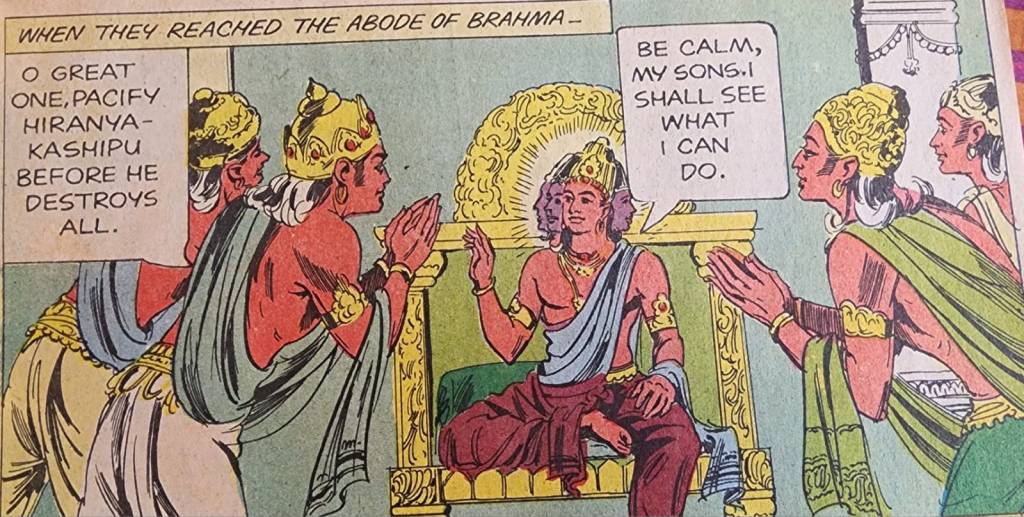
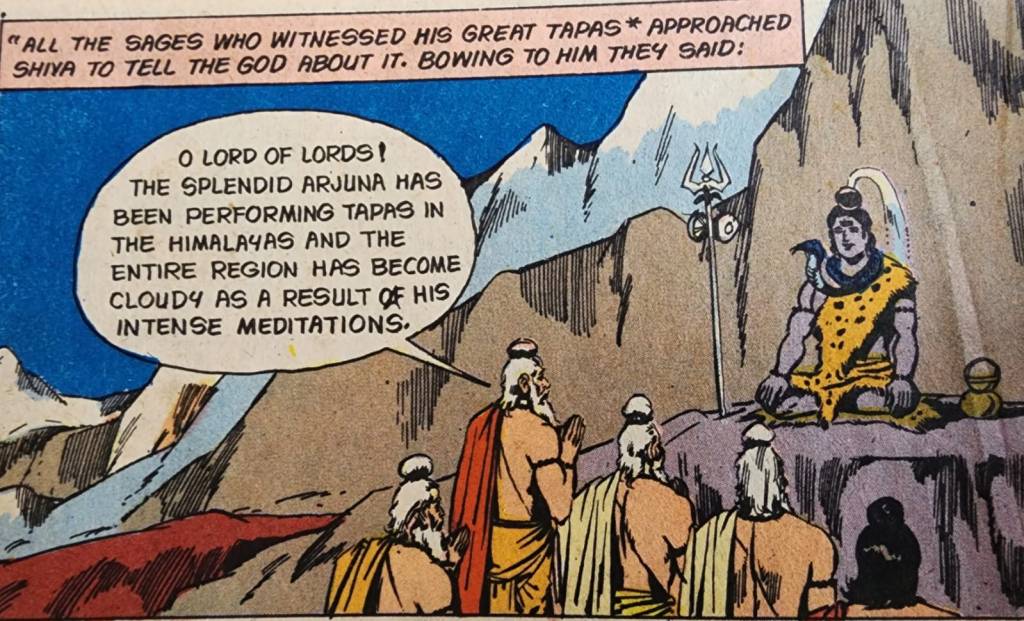
Many a time, when a determined individual performs severe tapasya (can also be called tapas) for a long period of time, the stories tell us that their efforts cause extreme weather events. Two examples of this would be the tapasya of Hiranyakashipu, father of Prahlad and that of Arjuna, the third Pandava. After Hiranyakashipu had performed tapas for a long time, the whole world started experiencing extreme heat. This caused the Devas, his mortal enemies, to request Lord Brahma to put an end to the tapasya by granting him an audience and hence the boon he desired. Lord Brahma acquiesced and granted Hiranyakashipu an audience and the boon he desired.

Image credit – “Prahlad”, published by Amar Chitra Katha

Image credit – “Prahlad”, published by Amar Chitra Katha

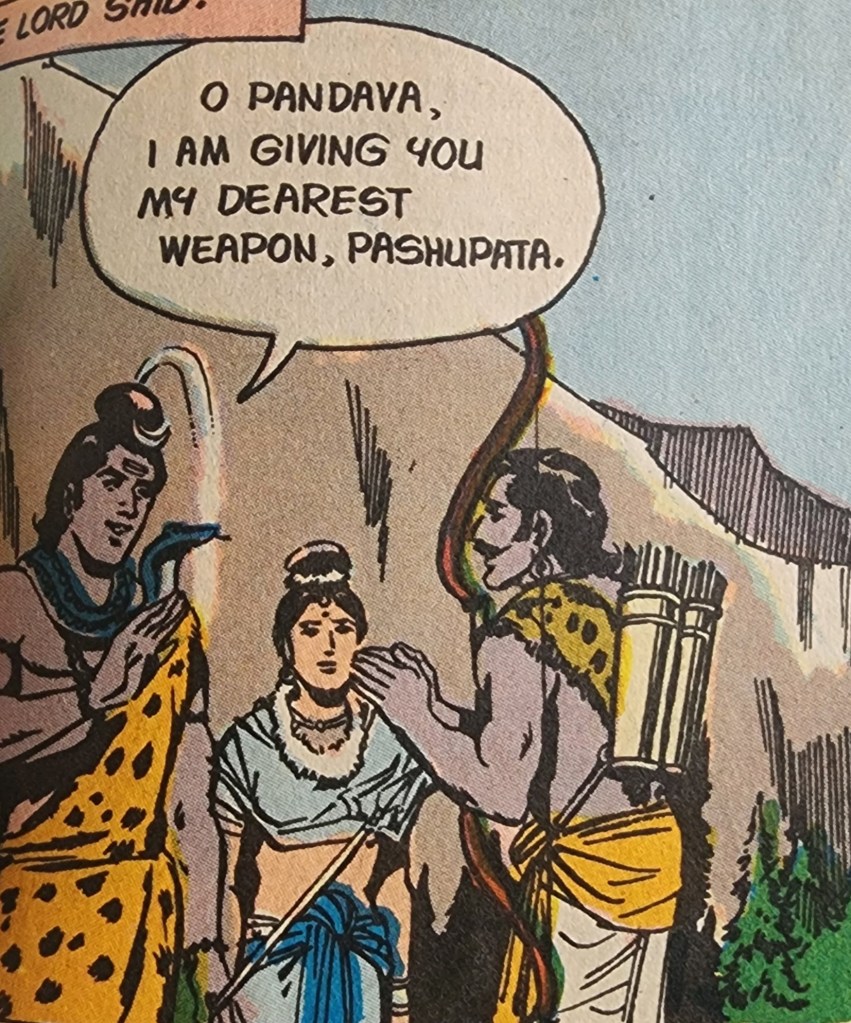
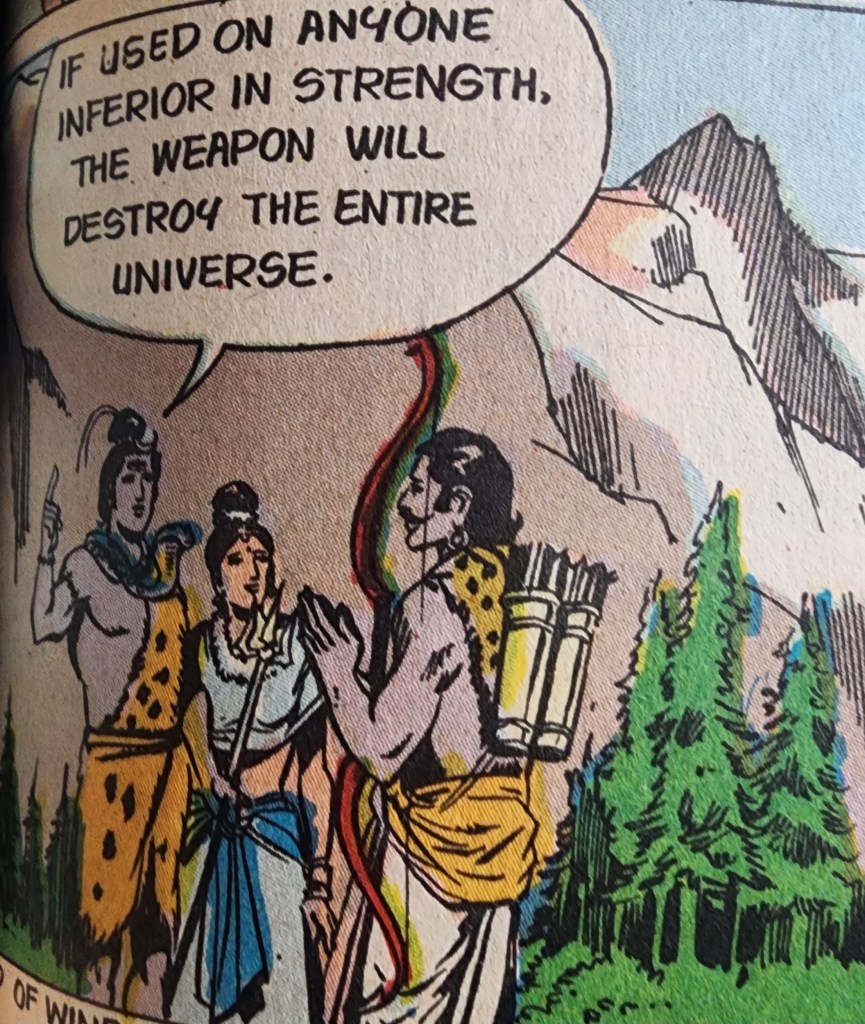
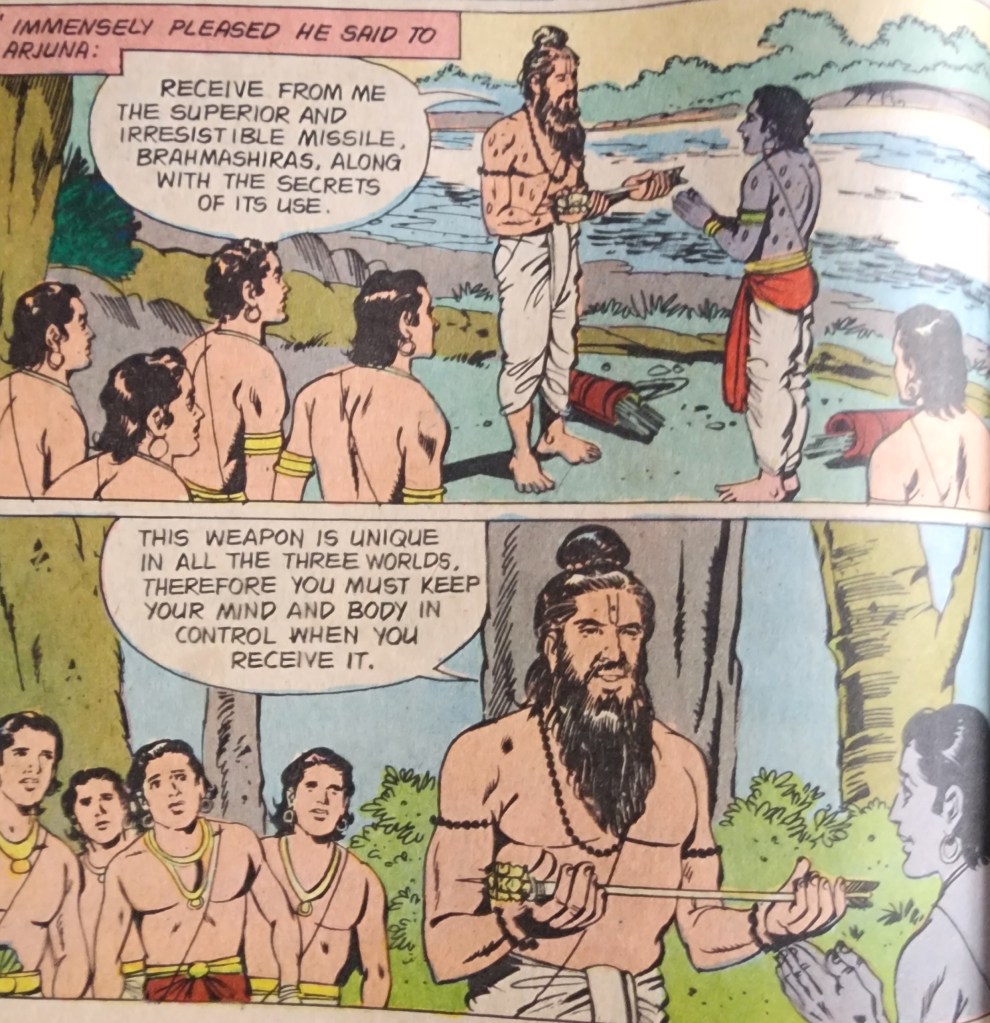
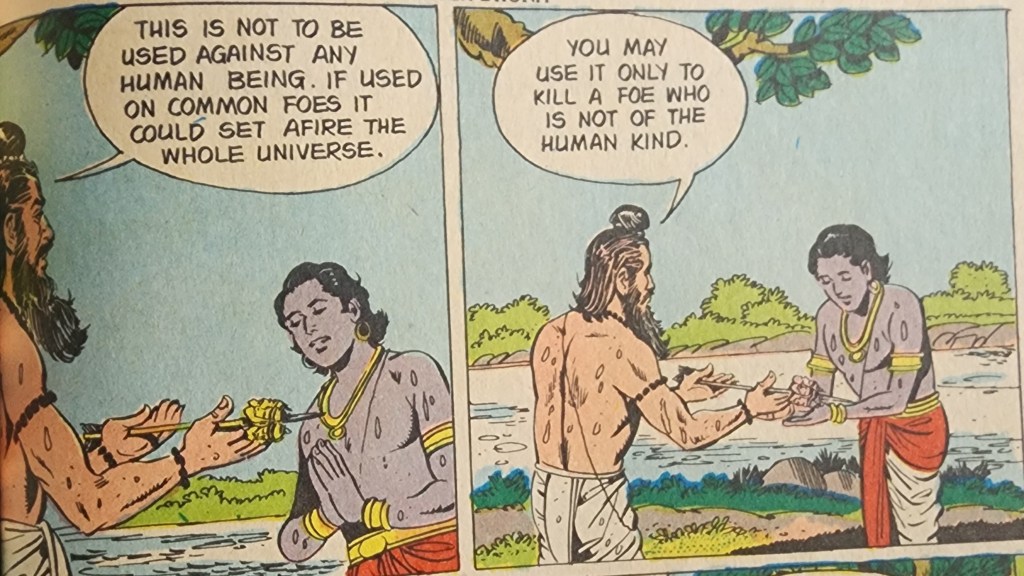
When Arjuna was meditating on Lord Shiva in his quest to attain the Paashupatastra, his meditation caused the areas around his place of tapas to become perpetually covered in clouds. This caused the Rishis who lived in the region to request Lord Shiva to end Arjuna’s tapasya by granting him an audience. Lord Shiva relented and stopped Arjuna’s penance with a physical test. The passing of the test led to Arjuna gaining access to the use of the Paashupatastra.

Image credit – “Mahabharata 20 – Arjuna’s quest for weapons”, published by Amar Chitra Katha

Image credit – “Mahabharata 20 – Arjuna’s quest for weapons”, published by Amar Chitra Katha

In both these cases, the Gods might not have been ready to appear before the individual performing the tapasya. But the effect their tapasya had on the weather caused those who were affected by the extreme weather to beg the Gods to get the tapasya to end. In other words, both Hiranyakashipu and Arjuna worked to affect the weather and thus got the Gods to grant them an audience. They even ensured that those who had regular access to the Gods to further their cause by requesting them to not test the person performing tapasya anymore. So, the tapasya, whose objective was to please the Gods, did so, by causing climate change which affected those who had access to the Gods. These individuals or groups either ratified or provided credibility to the tapasya with their own requests. Did this make the tapasya easy? Definitely not. But did it reduce the duration of the tapasya? And thus the duration of enduring great hardship? Perhaps yes, by a little bit at least. Either way, the demonstration of Kaitatsu Gairoku is clear. To impress the Gods, affect something else (weather) which will affect those with regular access to the Gods and get the tapasya fast tracked. 😀

A few additional points need to be considered regarding the examples mentioned above. The first is that the people who requested the Gods to stop the tapasya of the individuals in essence added their own tapasya to that of the person in question. Is this ability to gain the support of others without meaning to (indirectly 🙂 ) a criterion that the Gods would have considered? I have no idea. The second point is that the effect caused is on the weather, and this is one phenomenon that impacts all life on Earth. So, there is no way the Gods can ignore it and in their concern are given to acquiesce to the requests of the many and the tapasya of the one. This in itself could be a huge relief, as some individuals sacrificed their own body parts as part of the tapasya! &

Was the causing of extreme weather events a deliberate ploy in getting the Gods give the one desiring a Vara an audience? Was this a strategy to decrease the duration one spends in activities that allow one to be in the presence of the God one is trying to please? I have not seen or heard of any explanation that it was. But then, I might be overthinking this. So, I do not suggest that it was a deliberate ploy, nor can I assume that affecting the weather was a required demonstration of the powers of one’s tapas. It is just something that happened. But that does not take away from the fact that, there was a means to indirectly influence the Gods. 🙂

Now we must address the elephant in the room. An individual through human actions plays truant with the weather. This is not in any way possible for normal humans either today or in the past. So, it is possible to dismiss everything in the stories as pure fantasy. But all stories in Hindu culture, apart from the obvious entertainment and explicit transfer of knowledge, also serve as case studies, meant for discussion and assimilation of ideas generated from the same. This identification of Kaitatsu Gairoku in the stories is a case of such a realization, at least for me.

To expand further, this is not unlike the strategies in manuals of war and statecraft. Ideas of opening up a new front to cause the enemy to reduce strength in any theatre of war or waiting out the enemy for winter to damage them, and the use of allies or embedded sleeper agents to weaken enemies, are all known from history. All of these are about affecting an opponent(s) in ways other than a direct attack. So, the notion of Kaitatsu Gairoku is not just a part of stories. I have alluded to all asymmetric strengths in a previous article of mine called “Might is right, always”2.

A non-military or non-martial example of Kaitatsu Gairoku from recent Indian history would be the growth of ISKCON. This example is based on the video, the link to which is given in the notes below3. The video is from the YouTube channel “The Carvaka Podcast”, where the host Kushal Mehra has a conversation with author Hindol Sengupta about ISKCON. The conversation is about the book written by Mr. Sengupta called, “Sing Dance and Pray”1. The book is about the life of the founder of ISKCON, Shrila Prabhupada. According to the discussion, the founder of ISKCON Shri Shrila Prabupada was given a task by his Guru to take the word of Lord Krishna to the whole world. While Shri Prabhupada set about the objective, he apparently had little success in India. Later, he moved to the USA in 1966 and founded the ISKCON as we know it today. It found great success in the US and later this success replicated itself in India. The author and the host on the video agree that the success of ISKCON in India would not have occurred without the same in the USA.

In this scenario, ISKCON had to spread the word of Lord Krishna in the US for the same to happen successfully in India, which is the land of origin of the message sought to be spread and of Lord Krishna himself! This is counterintuitive, as one would expect the otherwise. The general thinking for this is that India at that time at least, sought (and maybe still seeks) Western validation and the USA was the epitome of all things Western. Of course, the USA was and still is a cultural powerhouse and wields enormous soft power the world over. So, ISKCON being embraced by the Americans was validation for Indian culture and hence was embraced here as well. This is perhaps the greatest instance of Kaitatsu Garoku I have come across. In simpler terms, Shri Prabhupada had to conquer foreign lands to conquer (for his ideas of course) his own! Plant a home grown idea far away from home, for the idea to take root at home!!

Of course, this extrapolation of mine relating to Kaitatsu Gairoku is not specific to Hindu tradition alone. I notice and expand more on it, with respect to India, is all. One of my current favourite examples about this concept is that mosquitoes evolved and became the human nemeses that they are, because of a change in the tilt of the Earth’s axis! This is beautifully explained in the short video seen in the link in the notes below++. It is a video from the Youtube channel “PBS Eons”.

The other one is from the movie “Django Unchained”. The character played by Christoph Waltz explains to Django (played by Jamie Foxx) how they cannot go to the slave owner played by Leonardo Dicaprio and say that they want to buy his wife’s freedom. He says that if one wants to buy a horse from a farmer, that might not be keen on selling the same, one does not go asking to buy a horse. For if the farmer refuses, all one can do is walk away. One needs to approach the farmer for something else and in the course of the transaction see if the horse can also be bought, maybe as transport for the individual or the commodity being bought. Buy the horse, but do it indirectly. Eventually they go the dastardly slave owner looking to buy a fighter and try to create a situation which would result in their “accidentally” buying his wife. Thus, buy something else to buy the lady in question, indirectly! (buying and selling people is horrifying even when used as an analogy!) Yes, I am using a fictional example from pop culture. This is just to illustrate that the concept of Kaitatsu Gairoku is considered the world over and in multiple walks of life.

Two personal notes –

With this post, I am completing a year of posting on this blog. I sincerely thank everyone who has read the posts, just visited, helped me with feedback & technical suggestions and just been a part of my life in general and budo practice in specific for making this possible. THANK YOU ALL! I hope I have several opportunities to express my gratitude related to this blog (and otherwise) in for a long time to come! 😀

This post will be go online close to my birthday, and I am someone that loves and appreciates gifts. So, while writing this article, I was wondering how I can indirectly (without actually discussing it) get people to give me gifts 😛 . As it happened, I got a gift I needed and a gift I wanted. A close relative of mine gifted me with an investment opportunity and a buyu identified a source to procure some training equipment I wanted. In both cases, the gifts just happened, with no active planning of the same. It was not magic, but in hindsight, a consequence of research, effort and communication on my part with the individuals concerned, though not with this outcome in mind. Guess the training, effort and luck really do pay off, indirectly. 🙂

Notes:

*https://mundanebudo.com/2023/07/06/connect-control-part-1-connect-control-shatrubodha-in-flow/

+, **https://mundanebudo.com/2023/07/20/connect-control-part-2-boons-blessings-curses-the-sakki-test/

+https://mundanebudo.com/2023/08/31/shabdavedi-sakkijutsu-and-why-charioteers-are-awesome/

&https://mundanebudo.com/2023/03/30/jibun-no-kesu-an-exploration/

2https://mundanebudo.com/2023/05/11/might-is-right-always/

3Video link – watch between the 15 and 18 minute mark.

1Amazon link to the book “Sing, Dance and Pray” by Hindol Sengupta

https://www.amazon.in/Sing-Dance-Pray-Inspirational-Founder-Acharya/dp/0670096733/ref=sr_1_1?keywords=sing+dance+and+pray&qid=1693629007&sprefix=sing+dance%2Caps%2C227&sr=8-1

++Video regarding mosquito evolution

Gogyo – Ura and Omote

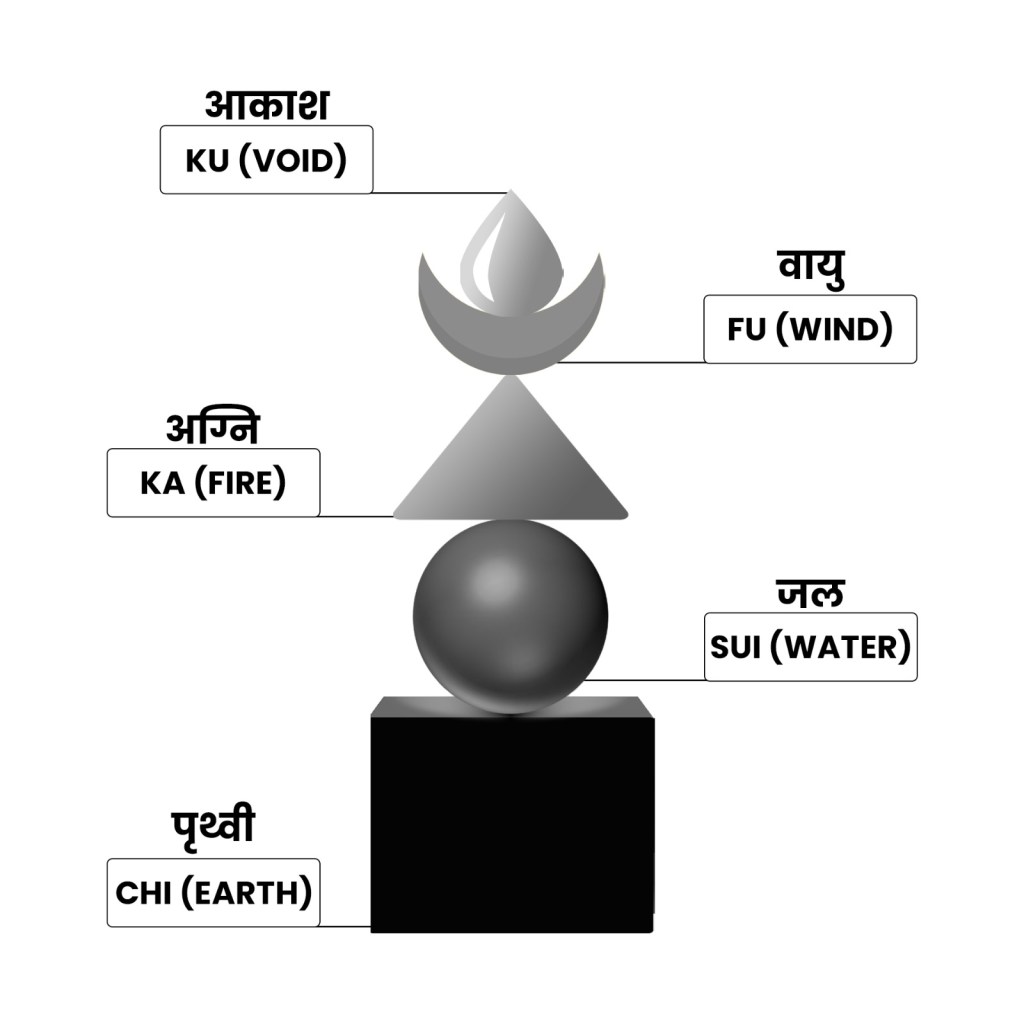
Godai – artwork by Adarsh Jadhav

During the pandemic, all of us had to deal with several changes. We all had a lot of trouble changing how we went about our regular routines due to the enforced situation and the lack of choices that allowed one to go about life without making any changes.

While living through that time, it occurred to me that just as there are five stages to handling grief, there are five stages to accepting a new normal and moving forward with that acceptance. These five stages seem to correspond with the Gogyo or the five elements that determine the five forms we practice as part of the Gogyo Sanshin no Kata (as part of the Bujinkan system of martial arts). This in turn, also seems to explain why we cannot allow emotion in a fight (perhaps also life, at least not let it be the only driving force) and how one needs to accept any situation in a fight without analysis (except in hindsight) and deal with it (the “next and the next and the next” paradigm).

A long time ago, must be sometime in 2007 or early 2008, I had asked my teacher the difference between the Ichimonji no Kata and the Sui no Kata. The answer I received was that we determine which of the two was performed based on how the Uke (attacker) is affected. This was borne out by my own later experiences. For example, Ichimonji no Kata makes the uke lose balance and maybe fall or crumple in a direction diagonally backward to the direction of the punch, while Sui no Kata causes the uke to either crumple downward or to the right of the direction of the punch.

While the above is true, I believe the Kata is also determined by the internal feeling tori (defender) has and the intent the tori has towards the uke. This relates to the earlier introduction to this article which I will try to expand on below.

Typically, the five stages of resistance to change as I see it, are as follows:

  • I cannot change my way of life/living just because this “disrupting factor” has become apparent
  • I can only change to a certain extent and that is all I can do, I am not going to change other aspects of my life
  • How dare this other person or persons ask me to change! Don’t I know what I should do for my life!
  • They may have a point, but I can’t be expected to change this way. I have been doing it differently all this time and cannot make the effort to change in this way
  • I have worked hard to get where I am and put in so much effort for a lot of things. How can the universe let this happen and screw me over? It is so unfair!

Now these five obstacles we face are not so different from the Gogyo. Consider the following rewording of the five stages of resistance.

  • I cannot move my roots (way of life)
  • I cannot change and flow as the situation requires (limited flow)
  • I cannot accept that someone else is asking me to change (my ego is hurt)
  • I cannot go the way things expect me to go! (flow with the situation)
  • How can everything in space (the universe) conspire against me!

The rewording above in my understanding is essentially the problem that the Gogyo Sanshin no Kata are designed to solve. Let us consider each of the elements separately, as seen below.

  • Stay rooted, but let them grow deeper and move as required. This is Chi no Kata, where we strengthen our stability with necessary lowering of the core/centre of gravity, to stall the attack.
  • Move and grow your roots where there is space to move it. This is Sui no Kata, where we move out of the way of the attack, to create an opening for a counterattack.
  • Burn away any obstacle to the growth, even if it is yourself (your ego). This is Ka no Kata, where we receive the attack while countering at the same time; this is acceptance of the attack and surviving the same.
  • You have roots and these are strong. So let yourself be blown away by a situation, since your roots will let you blow back. This is Fu no Kata, where we can let the attack move us to a point of safety, before we can move to affect an out of balance opponent.
  • Use all the space to your advantage and do not focus only on the points of concern. This is Ku no Kata, where opportunities are identified as the attack has made the status quo untenable; this could be an amalgamation of the earlier four.

Now if we apply the conceptual observation regarding the five elements to the five stages of resistance we first considered and see how the words can be changed when the principle of the Kata is applied, we could see the following.

  • I will change my principles to survive or use the new situation. These will be my new roots.
  • I will do whatever it takes to survive and thrive in the new normal and not mourn the old, for my roots are strong.
  • I will not let my ego or opinion of the source of information to trigger the change, stop me from changing. My roots need to be protected and allowed to flourish.
  • I can change everything now, for I know I can change to the old or something else when this situation blows over. My strong roots will anchor me.
  • The universe is what it is and I will try to see what to take from this new situation. I bear no guilt for the efforts (roots) of the past or for the fruits of the future.

After considering the solution from the Gogyo as we see above, if we apply these to the form while training the same, we will understand that the form is only the starting point and needs to be explored incessantly. It need not look a certain way.

The way it looks is the Omote of the Gogyo Sanshin no Kata. It triggers further exploration with multiple variations like terrain, weather, apparel, weapons and any other. The understanding of the concept for the self is the Ura of the Gogyo Sanshin no Kata. Perhaps this is where the “Sanshin” comes into the Gogyo no Kata!

Thus, I posit that we need to start with the impact on the uke and then shift focus to the tori (ourselves) while training, on the mats first, and whenever and wherever possible, in Life. In Life, perhaps start with hindsight and then progress to doing it in the present (without thinking about and without reservations about consequences or guilt). Hindsight is likely the Omote and the present, the Nakaima or Ura of it.

Notes:

Gogyo – the five elements (earth – chi, pruthvi; water – sui, jala; fire – ka, agni; wind – fu, vayu; space – ku, aakasha)

Sanshin – the three hearts/spirits – could be considered timing, distance, rhythm (sometimes taken as angle)

Nakaima – In the middle of now (the present – based on time)

Shabdavedi, Sakkijutsu and Why Charioteers are Awesome!

Anyone who has read stories from Hindu culture or watched TV series based on the same, would have heard of the ability called “Shabdavedi”. This is the ability of an archer (either a hunter or a warrior) to accurately strike a target purely based on the sound it makes, with no visual input at all. It is a highly revered skill and individuals who could accomplish this were considered great archers. I am not aware of how rare this skill was. It essentially means that an archer, even when blindfolded, hears a sound made by a target and shoots an arrow, which unfailingly strikes the target. This is something archers with this ability can always do, and it is not a fluke or a one off.

I am aware of three examples from stories which demonstrate this ability. Two of them are from the Epic Itihasa poems of India, one each from the Ramayana and the Mahabharata. The third is from the historical Epic poem, “Prithviraj Raso”. Interestingly, the use of Shabdavedi in all three examples is related to tragedy; in two of the examples, success with Shabdavedi leads to great tragedy in the future and in the third, it is used in an extremely tragic situation.

In the Ramayana, King Dasharatha (father of Lord Rama) is out hunting at night. He hears a sound that seems like an animal is drinking at a waterhole. As it is dark, he cannot see the animal. So, he shoots an arrow at the animal using his Shabdavedi ability. He successfully strikes the target, but then, tragedy strikes. The target he has hit is a boy named Shravana Kumara. Both of his parents are blind, and in their old age cannot move about on their own. So, being a dutiful son, he carries his parents from one place to another, like a water-carrier, where his parents are seated in two baskets tied to the ends of a pole, which Shravana Kumara carries on his shoulders.

On that day, the parents are thirsty, and the son is filling a vessel at the waterhole to quench the same. Dasharatha’s arrow kills the boy. He begs the distraught parents for forgiveness. But they curse him, stating that just as they would die pining for their son, so would Dasharatha; he would die wishing his son was with him. This curse sets up the events of the Ramayana, where Rama is exiled to the forest and Dasharataha dies unable to bear the separation and his role in all the hardships his two sons and daughter-in-law have to endure for years in the forest. The exile in the forest also leads to the several tragedies that occur in the Ramayana.

In the Mahabharatha, King Pandu is out hunting. He hears what sounds like a deer. He cannot see the animal though. But he uses his Shabdavedi skill and shoots an arrow at his target. The arrow strikes its mark, but then, so does tragedy. Pandu realizes that he has struck not one, but two deer which were in the act of mating. But it turns out that it was a sage and his wife who were being physically intimate in the form of deer. So, Pandu has mortally wounded the sage and his wife. Pandu begs for forgiveness, but the sage curses him. The curse is that if Pandu ever tries to be physically intimate with either of his wives or if he even has thoughts of the same, he will immediately lose his life.

Image credit – “Mahabharata 3 – Advent of the Kuru Princes”, published by Amar Chitra Katha

In repentance of his act, Pandu relinquishes his throne in favour of his blind older brother Dritharashtra and retires to the forest with his wives. Later, he succumbs to the curse in a moment of weakness. This act of Pandu’s sets in motion a whole chain of events, which along with the actions of his grandfather Shantanu lead to the great war of Kurukshetra which resulted in the loss of life and suffering on an unimaginable scale.

In the Prithviraj Raso, after Prithviraj has been defeated at the battle of Tarain, he is imprisoned, blinded, and taken as a prisoner to Ghazni, by Mohammad of Ghor. Prithviraj is humiliated, his armies destroyed and his kingdom is reduced to being a vassal state and has suffered great losses. While in prison in Ghazni, Prithviraj’s close friend, court poet and minister, Chand Baradai, finds him and they hatch a plot to avenge their defeat by killing Mohammad Ghori. Chand Bardai extolls Prithviraj’s ability with Shabdavedi. So, Ghori wants to see a demonstration of the same. An arena is set up and a goat is let into the arena. Prithviraj is also brought in and handed a bow and arrow. The goat is made to bleat, thus providing a target for the arrow. Prithviraj says he will only shoot the arrow on a command from Ghori. Ghori does so and this allows Prithviraj to shoot Ghori instead of the goat as his location is now revealed. Then Chand Bardai and Prithivraj both commit suicide. Thus, they have avenged their defeat despite being severely weakened by circumstances. Of course, this story is not actual history, but epic poetry.

The circumstances of all three examples above might be tragic, but the ability of Shabdavedi was coveted and deeply respected. This is obvious, because any ability to shoot targets without the use of sight is indeed extraordinary and takes a lot of practice to achieve. It is mastery despite the absence of the most vital of human senses, sight, required for archery.

In the Bujinkan system of martial arts, there is a concept called “Sakkijutsu”. This refers to “intuitive ability”. This is among the most important precepts of the Bujinkan. It is referred to most often when practitioners of the art with a lot of experience practice or teach. Sakkijutsu relates to responding to the intention of the opponent(s) and not the action of the opponent(s). Intention occurs before action and hence, responding to the intention gives an extra fraction of time to the defender, which might be vital in saving oneself (or anyone else).

There is no scientific measure that I am aware of to measure the “Sakki” or intuition. The use of intuition is also not something that is taught. It is described and demonstrated, and this allows the ability to be learnt. The ability is learnt and refined over years of training. It is purely experiential learning and requires training physically with fellow practitioners, mentors, teachers and students. But the centrality of this concept in the Bujinkan never changes, even when one is not yet able to express Sakkijutsu.

Since Sakkijutsu relates to intuition, the experience of getting a feel of the situation where the conflict (physical or otherwise) is occurring in, is very important. This includes, the context, individuals, groups of individuals and the overall atmosphere of the place (time & space). All of this adds to the abilities, past experiences, life experiences beyond the martial arts and general wisdom of the individual. These aspects inform one’s intuition, which could also be referred to as “gut feel”. This is very important as one should also realize what cannot be done in managing a conflict and should avoid acts that lead to injury (including psychological, emotional and spiritual ones) and death.

I have referred to intuitive ability and Sakkijutsu in multiple other articles as well. The test to achieve the 5th Dan in the Bujinkan is called the “Sakki test”. It involves one demonstrating intuitive ability and at the same time realizing for oneself that he or she has the ability, and it should be applied in all situations in life. I have described this test in the article related to “Boons, Blessings and Curses” *. The link to this article is seen in the notes below.

The concept of Shabdavedi is offensive in nature, as it is used by the attacker to target a hidden opponent (or quarry). I suggest that the counter to this ability is Sakkijutsu. Sakkijutsu is protective in nature, as it allows the target of the person using Shabdavedi to survive the attack, irrespective of whether it is a human or an animal. If the target can sense the malicious intent of the person shooting the arrow, at the moment when the person decides to shoot as he or she has got a target lock due to Shabdavedi, the target can move in that small instant of time. As the time between the decision to shoot and the release of the arrow is small, if the target is no longer in the same space which is targeted, it is almost impossible for the archer to track and change the targeted space, thus allowing the quarry to survive. Of course, for this to work, the target should also move only when the decision to shoot is made. If it is too early, the archer can sense the movement through Shabdavedi and change his or her target. If the movement is late, well, it doesn’t matter anymore. So, Sakkijutsu is no magic survival card. It is just one extra opportunity to survive, which can hopefully be exploited successfully.

I am not aware of the right word to use in either Sanskrit or other Indian vernacular languages (mainly Kannada in my case) for Sakkijutsu. Antahprajne, Saakshaatkaara (could also mean epiphany), Aparokshajnana, Asaamanya Prajne, Ola Arivu and one I like best, Antarbhoda are the words I found online as a translation for “intuition” in Kannada. The word I found online most often, from Sanskrit, as a translation for intuition, is “Pratibha” (apparently according to the 5th century Sanskrit scholar Bhartrihari). But this also means ability or skill in some cases. So, I will say “Antarbodha” is a counter for “Shabdavedi”, just to square off words from the same language. 😛 But I will use the word Sakkijutsu itself in the rest of the article simple because I am neither satisfied nor convinced with the other words I have found.

A couple of additional points about Sakkijutsu here. Firstly, Sakkijutsu is NOT magic. It is a natural ability which we all possess. The key in its practice is to build trust in one’s own intuition and not second guess its drive. Imagine walking alone in a dark place with no people around. We feel our senses are heightened and are very aware of our surroundings, as threat perception is high and we are in self-protection mode. Similarly, when we are driving through heavy traffic, we get the feel that we need to change speed, change gears, or avoid moving into an empty space on the road. We involuntarily slow down more at some blind turns than at others. Similarly, if there are two roads that can be taken to the same destination, we take one without analysis based on the “gut feel” in that moment. All of these are examples of us using our Sakkijutsu, even if our life is not on the line in many of these cases. There are also cases when we know of a call coming through just before the phone rings. This also happens at work when we realize that someone is looking for us or looking at us just before the person arrives. It is this ability that we apply, train, and refine. I have described this in slightly greater detail in a previous article of mine**, the link to which is seen in the notes below.

The examples of Shabdavedi with which I am juxtaposing Sakkijutsu are from the past. But the practice of Sakkijutsu and instances to elucidate the same I am using are from the present. The second point is relating to this discrepancy. In current times, while Shabdavedi still exists, the levels of technology and the availability of the same make the need for the Shabdavedi fairly unnecessary. So, if we consider an exact situation from the modern day, snipers and their modern rifles can target individuals at ranges greater than ever before. Add to this the use of drones and this range increases even further+. The drone operators need not even be on the same continent. Does Sakkijutsu work in such cases? I do not know. I have heard it said by some practitioners of the Bujinkan who are also veterans of the armed forces that in the case involving snipers, it might. This is because the weapon and its human operator are just like an archer. But I cannot vouch for this information as I have no experience regarding this.

When it comes to drones, the person with the intent to kill is nowhere near the drone. So, is there an opportunity for the quarry to sense the intention of the attacker/hunter? Again, I have no idea. Since there are so many layers of technology, is it the drone or any other form of technology doing the targeting? If yes, as it is not sentient in the same way as a human or any other animal, can it have the same intention? If not, how can Sakkijutsu work, as there is no malicious intent to sense? After all, Sakkijutsu is our ability from when we were prey animals and it is just like a herbivore at a watering hole which is skittish and ready to bolt based on Sakkijutsu, when it gets a sense of danger based on the intentions it feels, and not just based on any of the other senses. If Sakkijutsu is not of much use against drones, is the next step to train and heighten the five conventional senses? Or just start applying other principles of the Bujinkan and other martial arts with drones as the weapons (drones vs drones with martial concepts as the differentiator)? I do not have answers to these questions and would be grateful for any light thrown on the same.

But then, there are a couple of examples that come to mind from ancient times, of Sakkijutsu being applied. These again are from the Mahabharata, and both involve Krishna when he was the charioteer for Arjuna during the Kurukshetra war. Krishna had agreed to be Arjuna’s charioteer and a guide to the Pandava side. But he had sworn that he would not raise any weapon or get involved in the fighting himself.

On the 12th day of the war, the king Bhagadatta, mounted on his elephant (the most fearsome beast in the war) fought Arjuna, who was on his chariot, with Lord Krishna as his charioteer. During the fight, Bhagadatta invoked the Vaishnavaastra. This was a celestial weapon originating from Lord Vishnu. There was no way Arjuna, despite all his abilities and the assortment of astras at his disposal, could counter this weapon, let alone survive its onslaught. But Krishna realized this when the astra was released by Bhagadatta and instinctively stood up in the chariot, letting the astra strike him, thus protecting Arjuna. Of course, Krishna, being an incarnation (avatar/avataara) of Vishnu, could bear the attack of the Vaishnavaastra unlike other mortals. Thus, Krishna, while not breaking his vow of not being involved in the fighting, still saved Arjuna while not raising a weapon. He did this by putting himself in harm’s way.

Image credit – “Mahabharata 33 – Dorna’s Vow”, published by Amar Chitra Katha

I opine that this is an example of applying Sakkijutsu. Sakkijutsu is intuitively doing what needs to be done in a given situation to prevent injury or harm to oneself or anyone else. In this example, in the very short time between the astra being discharged and it striking Arjuna, Krishna intuitively realized a lot of this and acted on the same. He realized that it was the Vaishnavaastra that was invoked, and that Arjuna was helpless against the same. He also instinctively knew what he needed to do as a charioteer, to protect his warrior. He stood up and put himself in harm’s way. It would all have happened in the blink of an eye, and so, it is an instance of Sakkijutsu.

On the 17th day of the war, Karna used the Nagaastra against Arjuna. This astra was infallible and would always strike its intended target, no matter how it was countered. So, Arjuna was in great danger. In this instance, Krishna maneuvered the chariot such that the horses buckled, and the chariot was pushed down by a few finger-widths/inches. This was done at the very last instant. The astra was discharged with Arjuna’s neck as the target. When the chariot was lowered, the astra struck the base of Arjuna’s crown/helmet and knocked it off. The astra did not miss, it struck the space where it was supposed to, only that the space which was occupied by Arjuna’s neck was now replaced by his crown. Thanks to Krishna’s action, Arjuna was saved again.

Image credit – “Mahabharata 37 – Karna in Command”, published by Amar Chitra Katha

Here also, Krishna knew intuitively that he needed to intervene to save Arjuna, and the action that needed to be taken, in a an extremely small duration of time, thus making it a demonstration of Sakkijutsu. Of course, it can be said that Krishna is a God and hence his divine abilities allowed him to do what he did. Add to this, the magical aspects of the weapons involved, and the examples can be considered fantasy. But then, the nature of the actions taken by Krishna in the spur of the moment was instinctive. Plus, the same could be done with none of the magical aspects of the astra by any charioteer to protect the warrior for any number of reasons, thus making them intuitive and not divine intervention. The explanation for the actions were also given after the act, and it was not planned. These aspects make the actions of Krishna in both cases, examples of Sakkijutsu.

Speaking of Lord Krishna as a charioteer and his actions while being one, is a good segue to have a look at charioteers and their abilities during the days of the Mahabharata and maybe in general in India during ancient times. We know the names of famous charioteers and some famous individuals who excelled at charioteering, other than Krishna himself. Some famous charioteers we know of are, Sanjaya, charioteer of Dritarashtra, Daruka, charioteer of Krishna and Maatali, Indra’s charioteer. Other than Krishna, Yudishtira was a great charioteer and so was King Shalya. Shalya was the king of Madra and an uncle of the Pandavas (specifically only Nakula and Sahadeva) as he was the brother of Maadri, wife of Pandu. He was one of the greatest mace fighters of his time, on par with Bhima, Duryodhana, Jarasandha and Keechaka. His excellence as a charioteer is attested by the fact that he was requested to be Karna’s charioteer on the 17th day of the Kurukshetra war. This was when Karna was commander-in-chief of the Kaurava armies and needed a charioteer who could match the abilities of Krishna when Arjuna and Karna faced off. This shows how incredibly important charioteers were and the great regard in which they were held.

Image credit (L) – “Mahabharata 37 – Karna in Command”, published by Amar Chitra Katha

Image credit (R)- “Mahabharata 35 – Arjuna fulfils his Vow”, published by Amar Chitra Katha

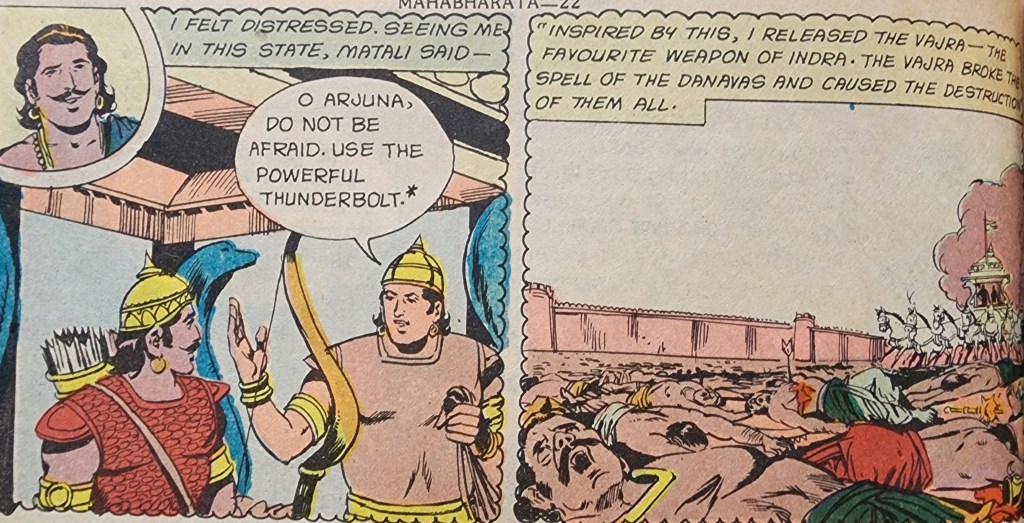
When Arjuna fought against the Nivaatakavachas and Kaalakeyas, as repayment for receiving celestial weaponry (and the knowledge for their use) from the Devas, much before the Kurukshetra war, he was granted use of Indra’s chariot, with Maatali as the charioteer. Maatali served as both guide and friend to Arjuna during this time. Daruka, Krishna’s charioteer was tasked with keeping his chariot ready for war in case Arjuna failed to fulfil his vow on the 15th day of the war. And lastly, Sanjaya, apart from being Dritarashtra’s charioteer, was a trusted confidante and advisor to the king. This is why he, of all people, was granted divine vision by Maharishi Veda Vyasa, so that Sanjaya could narrate the events of the war to the blind Dritharashtra. All of these extend the idea that charioteers were respected individuals and important members of the social circles of famous individuals.

Image credit – “Mahabharata 22 – The Reunion”, published by Amar Chitra Katha

Image credit – “Mahabharata 30 – The War Begins”, published by Amar Chitra Katha

I suggest that the reason for this deep respect that charioteers commanded in the society of the Mahabharata was their importance in warfare. I also opine that Sakkijutsu was vitally important for charioteers, or as they are called in the vernacular, Sarathis (Sarathi for singular)++.

A Charioteer and the warrior in the chariot would have been a team, not unlike a doubles team in badminton, tennis, table tennis or any other similar sport. They would need to understand each other and act in tandem, backing each other in case of a mistake by the other and allowing the other to express what he or she is best at. In a war, one of the chariot’s important advantages is its mobility. And when a chariot faces other chariots or cavalry (either horses or elephants) it faces off against other mobile enemies. Therefore, the warrior in the chariot has to strike opponents that are mobile and continuously moving. This is why the wheels of chariots, the horses and indeed the charioteers themselves were always valid targets.

While the warrior focuses on finding, tracking and attacking enemies with arrows, javelins or spears, it would fall to the charioteer to do everything else. In this sense, the warrior is like the weapons officer in a two-seater fighter aircraft. But the charioteer is more than a passive pilot or worse, a driver. He or she (Kaikeyi, Lord Rama’s step-mother, was a famous Sarathi and played the role when Dasharatha fought in battles) did not just take a chariot to a given place as commanded and park the vehicle while the warriors engaged in fighting.

Image credit – “Ramayana”, published by Amar Chitra Katha

Charioteers would need to have a sense of all the following.

  • the surroundings on the battlefield
  • the enemies targeting the chariot or the warrior in it or both
  • the condition of the structure of the chariot
  • the condition of the horses drawing the chariot
  • the targets that are feasible and the total set of available targets (like a radar on a fighter aircraft)
  • the targets the warrior is focusing on and the weapons he is using to carry out the attack

With all the above in mind, he or she has to pilot the chariot in a way that allows the most efficient attack against a specific opponent, while the risk to the warrior and the chariot itself is minimised. It is an act of continuous and dynamic optimization, while one’s own life is on the line. The charioteer needs to move the chariot to avoid an arrow or javelin from striking the warrior if he or she is targeted while the same individual is busy attacking another target on an ever-changing battlefield.

The charioteer also needs to put the chariot in the best place possible, from where a specific opponent can be targeted and attacked. This has to happen while being aware of the ground and if it is conducive to take the weight of the chariot and horses, for they should not get stuck or mired in the mud. The charioteer must also be aware of possible paths to take to either advance or retreat on the battlefield. He or she must also communicate effectively to the warrior all necessary information so he or she can do the job as effectively as possible. The charioteer must also know which targets the warrior can take out while the chariot is moving and when the chariot needs to be stopped to allow for the same. And then there will be idiosyncrasies and pride of the warrior to take into account, the communication of which cannot be allowed to impact their working together in the best possible way.

So, in a way, a charioteer of old is not unlike the smart mission system and electronics of modern-day weapon system (of course, it is OBVIOUSLY NOT an exact comparison). They have great battlefield awareness, inform about radar locks, approach of missiles and dispense flares or chaff or other defensive weapons. They allow electronic counter measures, electronic counter-counter measures and communicate when the firing solution is ready so that the weapons officer can choose to discharge the same. No wonder, a charioteer was revered in the ancient world, they were as important as, if not more important than, the warriors themselves. Imagine an adrenaline pumping chase and fight sequence in a Mission Impossible movie action sequence in the ancient world with chariots facing off to get a sense of the awe the situation can inspire.

In ancient India, there was a community called “Suta”. These days it might be considered an occupation-based caste. Sutas are born of Brahmin mothers and Kshatriya fathers. Several individuals of the Suta community excelled as charioteers. So much so that sometimes it is said that a Suta is a charioteer, even though that is not correct. Some famous Sutas include Keechaka, the great commander of the armies of King Virata of the Matsya kingdom, where the Pandavas hid during their 13th year in exile. He was a warrior on par with Bhima and others as already mentioned. His sister Sudeshna was the queen. This makes her the maternal grandmother of the future king of Hastinapura, Pareekshit, who is also a grandson of Arjuna on the paternal side.

Another revered Suta is Ugrashrava Lomarshana Sauti. He is a deeply respected bard/storyteller. His recitation of the story of Pandavas and Kauravas to Rishi Shaunaka and his students in the Naimishaaranya forest is what is today considered the Mahabharata00. Sutas also excelled as story tellers/bards and warriors as seen from the above examples.

Thus, a Suta (which can also be written Soota to be closer to the vernacular pronunciation) was a very respected and multi-skilled community of the past. But most of us associate the word with the word Sutaputra used in the televised versions of the Mahabharata. Karna, is adopted by the charioteer named Adiratha, who is a Suta. So, Karna is called a Sutaputra as he is the son of a Suta. This term is used by the Pandavas in a derogatory manner towards Karna a lot of the time in the Mahabharata TV series. I am not sure if this is a correct reflection of the original written by Veda Vyasa, in the number of times this term is used in a derogatory manner towards Karna. Considering that Karna is also made a more sympathetic character on TV than he was in the original epic, it is a possibility. This in turn makes one wonder if the Sutas not being as respected on the TV series as they were in the past, is more a result of virtue signalling in the modern-day.

It is indeed a joy to be able to move from Shabdavedi to Sakkijutsu to realizing how important this skill might have been to charioteers and to realize how virtue signalling might keep us from discovering the same.

Notes:

* https://mundanebudo.com/2023/07/20/connect-control-part-2-boons-blessings-curses-the-sakki-test/

** https://mundanebudo.com/2023/06/22/when-there-are-no-solutions/

+There are missiles today that have no explosive warheads, but blades that open out, making mincemeat of the target. This is essentially a very high-tech arrow!

++One of the many names of Lord Krishna is “Parthasarathi”. Here “Partha” is Arjuna as he is the son of Kunti, whose birth name was Pritha (son of Pritha is Partha – pronounced Paartha). “Sarathi” means charioteer. So, as Krishna is a charioteer of Arjuna’s, he is “Parthasarathi”. Also, Sarathi is pronounced “Saarathi”.

00The Mahabharata is three narrations nested one inside the other. The “Jaya” was composed by Maharishi Veda Vyasa and this contained a conversation between Dritharashtra and Sanjaya about all the events that led upto the war, while the latter is narrating the happenings on the field of battle, thanks to his divine vision, which was also granted by Veda Vyasa. The “Jaya” was narrated in a conversation, by Vaishampayana, a disciple of Vyasa’s to King Janamejaya, during the Sarpa Satra conducted by the latter. Janamejaya is the grandson of Abhimanyu, son of Arjuna. Ugrashrava Lomarshana Sauti was present at the Sarpa Satra and witness to this narration. He in turn narrated the narration that he had heard, to Rishi Shaunaka and his pupils at their ashrama in the forest, Naimishaaranya. This is what has come down to us as the Mahabharata.

Kuki Taishou and the Gaze of Nahusha

Nahusha was an ancestor of the Pandavas, who are the victors of the Kurukshetra War described in the Mahabharata. The Pandavas are something like the twenty second generation after Nahusha in the Chandravamsha++ (Lunar dynasty). Nahusha is one of the well-known ancestors of the Pandavas and an illustrious king during his time. He lived a storied life which involved great achievements, succumbing to ego, enduring a curse for long years followed by eventual redemption and an ascension to Heaven (Indra’s abode).

One of the stories related to Nahusha is about the Boon* (Vara) he received from Lord Brahma. This Boon made Nahusha incredibly powerful and pretty much undefeatable by anyone he could see or was anywhere in his field of vision. The Boon bestowed on Nahusha the ability to cow anyone he laid his eyes upon if they had any ill intent towards him. When Nahusha looked at them, they would be sapped of their strength and abilities, literally their “energy”, and they would come under his sway.

Image credit – “Nahusha”, published by Amar Chitra Katha

So, in simpler terms, if anyone had any intent to harm Nahusha in anyway, he just had to look at them to end that threat. The individuals having the ill intent would be rendered powerless and also be under the control of Nahusha as soon as they entered his field of vision. This included conspirators, not just people who would attack him physically. It is a highly desirable and badass ability even by modern standards. It is something like having drones everywhere, which know everyone’s intentions and this information can be used to control them, whether or not they know it; a very rogue AI meets 1984 type of scenario!

This Vara is bestowed on Nahusha when he is temporarily asked to be the king of Heaven (Swarga, the abode of Indra and the other Devas). This happens when Indra has lost his abilities and vitality, at a time when Nahusha is the greatest among the kings of Men (humans). This kingship of Swarga and the Vara are a reward for the virtuous life he has led until then. The Vara is a tool he can employ in his protective duties towards his kingdom and Swarga.

But like in many other cases, the great achievements and recognition goes to his head and Nahusha becomes a tyrant, turning his “Gaze” on the Devas, the great Rishis (Sages and Seers) and everyone else. He makes slaves of great people, making them do menial jobs for him simply to humiliate them and rub in the fact that they are powerless against their Lord. All these Devas and other great people are incapable of deposing Nahusha or even resisting his behaviour.

Image credit – “Nahusha”, published by Amar Chitra Katha

But, over time, a counter is devised to the “Gaze of Nahusha”. Maharishi Brighu hides in the matted locks of Maharishi Agastya, and curses Nahusha to turn into a snake and live on Earth. This causes Nahusha to lose his human form, kingship and the ability to rule. But while serving out the curse on Earth (the mortal realm) he retains the abilities of his “Gaze”. Of course, while we can think of one Rishi hiding in the locks of another as an element of fantasy, this is an ability that is possessed by great Rishis and the two Rishis involved in defeating Nahusha are two of the greatest ever. But in a more mundane situation, we can consider that the curse on Nahusha could be pronounced from any hiding place, which would keep the person uttering the curse out of sight of Nahusha.

Credits for the two images above – “Nahusha”, published by Amar Chitra Katha

In the Bujinkan system of martial arts, there used to be yearly themes. These themes were concepts or forms or systems of movement and fighting that the Grandmaster used to suggest, which used to be the focus for the duration of that year apart from other general training that practitioners of this system went through. The Soke (Grandmaster, though the word means “Inheritor”), Sensei Hatsumi Masaaki, announced these themes all the way from the early nineties till the onset of the pandemic.

The theme of the year, back in 2007, was “Kuki Taishou”. This means, “Smile of the Ninth Demon”. The “Ninth Demon” referred to, is the highest of the demons with incredible martial ability. This Demon, as I recall is not evil, but more of a guardian deity, who protects sacred spaces. Any attempt to violate the Demon or what he protects will almost certainly end in the destruction of the attacker.

The Demon will not attack, only protect. Any attacker, once she or he or they (multiple attackers), see the Demon, are dissuaded from going further with the attack or even beginning the same. This is because the abilities of the Demon are obvious at a glance, as is their own defeat. So, the fight is over before it begins. This is protection because, THERE WAS NO FIGHT.

I have also heard it said by my mentors, that the Demon just looks at the potential attackers and smiles. He is just standing or sitting nonchalantly allowing them to decide the next course of action. His smile on seeing the attacker(s) and the nonchalance exudes an extraordinary confidence and demonstrates his abilities without having to do anything. This overall experience in the presence of the Demon makes the attacker(s) realize that they stand no chance and hence the situation is diffused.

In this sense, in my opinion, the “Gaze of Nahusha” and “Kuki Taishou” are very similar, if not the same. In both cases, a person just looking at another individual or set of individuals, cows the other into submission, or at least dissuades them from initiating any violent conflict (physical conflict at least).

In the case of the Gaze, it has an element of magic as it is a Boon bestowed on an individual. In the case of the Demon, he has extraordinary martial abilities, but this could also have magical overtones as he is a Demon after all. I am not aware if the Ninth Demon became a Demon because of the martial abilities that were developed. In the latter case, “Demon” would be more a title than an entity/species denomination.

If we remove the Divine and magical aspects of these abilities, they still work, just not as elegantly or simply, as in the stories. Also, the path to achieve even a semblance of these abilities takes years of practice and experience through continuous training.

If we consider usual modern-day training in the traditional martial arts, it is one on one for the most part, with a little training against multiple opponents (just 2 or 3 opponents most of the time). The training against multiple opponents is done to understand how difficult it is to survive this situation. When we train one on one, even if one is just a beginner or is doing so for the first time, one “gets a feel” of which opponent is more dangerous, more skilled, stronger or faster. Of course, with greater experience, this feel of an opponent (what I described as “Shatrubodha** in a previous article) becomes clearer and occurs even before a physical exchange. With lesser experience, this feeling might occur after one or a few physical exchanges or maybe after an interaction (I am considering an interaction as involving multiple exchanges) or two. This ability to gain a sense of the opponent, even develops based on seeing the opponent in action against others, in videos and based on reputation, or what one has heard of her or him. This “feel of an opponent” helps us avoid injury and is a very important part of the martial arts. This reading of the opponent is what is happening in the gaps in a fight, when fighters are sizing each other up and trying to understand an opponent.

The feeling of Kuki Taishou is this ability amplified. A martial artist or fighter with great ability or strength or both, refined by lots of experience, has a natural nonchalance that comes about as a result of this experience. This is something that is grasped by others, more so by other martial artists and to a lesser extent by those that are not practitioners of the martial arts. This extends further when a martial artist is seen with one’s favourite weapon on the fighting area of one’s choice.

When this non-physical interaction occurs, the urge of the one who senses greater prowess in the other, is to mitigate the risk to oneself and it might lead to a shorter fight or hopefully a lack of a fight. This situation is true in both one against many or many against one scenarios. If the one comes off as very dangerous, even the many might choose to NOT take her or him on, and of course if one is taking on many, it is just prudent to walk away intact.

Beyond the martial arts, this is also true in other aspects of life. We know that there are experts in all fields. Based on our interaction with these experts, we know when to not argue with them on specific topics. We also accept the suggestions and guidance of certain persons more readily over those of others, whether at work or in matters relating to relationships, or anything else.

This concept of avoiding conflict with specific people due to Kuki Taishou, can also be expanded to processes. There can be processes put in place to identify root causes for failures at work. If these processes are very stringent and require a lot of effort, they succeed in making people avoid failures just to not interact with the RCA (root cause analysis) process. This perhaps makes people diligent at work. There could also be a very cumbersome visa provision process put in place by some countries vis-a vis some other nations, just to discourage visitors from specific countries. If the process is very troublesome, people might just choose to visit a different country. This could be in cases where people from a specific country might be known to overstay and violate visa guidelines.

So, making another person(s) realize that an interaction, specifically one that leads to conflict, physical or otherwise, is not worth it, with respect to another individual or a group of the same, is Kuki Taishou. The “Gaze of Nahusha” did the same, thus protecting him and as an extension, his kingdom and subjects.

Kuki Taishou and the “Gaze” are specifically tools that are preventive in nature, even though the ability to gain the same is through practice of both defensive and offensive movements (even Nahusha had several battlefield victories BEFORE he was bestowed the boon of the Gaze). This preventive aspect is what gives it its association with a guardian (like the Demon) or a protector (like Nahusha). But this does not mean that someone who has developed the ability of Kuki Taishou cannot be overcome.

Kuki Taishou is preventive because it gives pause to the opponent, who realizes that an attack is inimical to herself or himself and hence is to be avoided altogether. This pause occurs only as long as the ability of the opponent is vastly greater than that of the opponent. If ever there is a slacking in the training and the gap in the abilities or strength of the defender (demon equivalent) and attacker reduces to manageable levels, Kuki Taishou is greatly diminished or lost altogether. This will result in the attacker(s) going through with the attack. The attacker might even reverse Kuki Taishou through training and development of her or his own, when the defender is the one that needs to run to not face the attack!

Lastly, Kuki Taishou as discussed above is useful mainly in a melee like situation. This means when individuals or groups of the same face off either without weapons or with weapons that are not ranged weapons, like bows and arrows, crossbows, javelins, slingshots, chakra and the like. In Bharatiya terms, Kuki Taishou is relevant when the confrontation is with Shastra and not Astra. The same is true with the Gaze of Nahusha, which would only be effective if the person he wished to subdue was in range of and in the field of his vision.

Due to this detail, countermeasures will be developed for Kuki Taishou, just as one was developed to overcome the Gaze of Nahusha. Like all boons, there was a loophole in the abilities of this one as well. And to nullify the advantage of Kuki Taishou, subterfuge and guerrilla tactics can be employed. This includes the use of Astra, or ranged weapons, which do not allow the Demon or equivalent adversary to bring to bear their superior close quarter martial arts skills. Arrows, darts and the like could even be shot by individuals from concealment (this is exactly what was done to Nahusha, albeit with a curse and not a physical weapon – a curse could qualify as a mystical weapon). Or opponents could simply overwhelm individuals with large numbers of attackers. Subterfuge includes the use of poisoned food, accidents through engineering architectural elements to fail, and the like. Alternatively, as already discussed, opponents can put off an attack and train until the advantage is nullified and then attack, when Kuki Taishou is no longer relevant due to the absence of a gap in the abilities of the adversary.

In conclusion, Kuki Taishou, in my opinion, is very like the “Gaze of Nahusha”. It is extremely useful, specifically in (perhaps only in) a close quarters combat situation, with Shastra and not Astra. Maintenance of Kuki Taishou needs continuous training, which leads to improvement and refinement of one’s martial abilities. Of course, when this concept is applied in conflict management that is not physical in nature, like we all face at work and in life, the principles are the same and work as effectively, with the added advantage that distance does not matter, as communication through any media can lead to Kuki Taishou being apparent, though after an interaction or two, as the gut feel apparent due to physical presence might be absent.

Kuki Taishou will lead to the creation of counter measures to itself if used either indiscriminately or in ways that only serve one’s ego. This is just like the “Gaze”, and cannot be rested on as the ONE laurel that it is. The ability to use it in creative ways to overcome the inevitable counter measures that are developed is vital. This was something Nahusha in his pride failed to do and paid the price for the same.

The “Gaze” and likewise the attributes of Kuki Taishou are not an ironclad insurance against an attack. They are a mitigation mechanism and protection, not unlike a great fortress or a great set of armour. Nor are they the highest level of the martial arts; they are a stepping stone that could lead to a realization that conflict management is the most important thing to avert great injury or destruction due to violent conflict, physical or otherwise. It is not a one time achievement either. Kuki Taishou is a realization after years of training and the refinement of the same. Even its retention requires continuous training, all through one’s life, while considering the abilities gained, lost, added to and diminished with age, as one’s life progresses.

One last point regarding Kuki Taishou that strikes me is this. We learn that during the Cold War years, there was this doctrine called “MAD” or “Mutually Assured Destruction”. This was specifically applied in the context of Nuclear War, where any attack by one side would lead to retaliation by the other and both would certainly face complete destruction. Is this a situation where both sides, having equal abilities exude Kuki Taishou at each other all the time? And is this why neither side wanted to turn the cold war into a hot war? And is the “Arms Race” a consequence of having to nullify the Kuki Taishou of the other side? Perhaps it is, but I do not have a certain answer. It might not be Kuki Taishou, as one thing I have heard is that “nonchalance” is a very important aspect of the concept, and the deployment of nuclear weapons does not display nonchalance+ as I see it. And if economics is what ended the cold war, was that the countermeasure to the Kuki Taishou of one side by the other? Perhaps, again, I only have the question, not the answer.

Notes:

++ https://en.wikipedia.org/wiki/Lunar_dynasty#/media/File:LUNAR_DYNASTY_(Chandravamsha).png

* https://mundanebudo.com/2023/07/20/connect-control-part-2-boons-blessings-curses-the-sakki-test/

** https://mundanebudo.com/2023/07/06/connect-control-part-1-connect-control-shatrubodha-in-flow/

+ Nonchalance here is due to awareness of abilities mastered and not in the training that leads to the development of the same.

Connect, Control – Part 2; Boons, Blessings, Curses & The Sakki Test

The test for the fifth dan in the Bujinkan is also called the “Sakki” test. Sakki here generally refers to “intuitive ability”. For those that are not a part of the Bujinkan, I am describing the test. The test involves two people, one administering the test and another who is being tested. There are other people around who determine if the person passed the test or not. The person administering the test and those determining if the test was a pass or not are all holders of the 15th dan, which is the highest rank in the Bujinkan system (there are a couple of other higher administrative ranks).

The person taking the test sits in an approximation of the Vajrasana and the person administering the test stands behind her or him. Both the individuals have their eyes closed for the duration of the test. The person in Vajrasana is hopefully in a meditative state. The person standing behind her or him cuts down at her or his head with a padded/training sword. The expectation is that the person in Vajrasana should sense the attack based on the intent of the person cutting and move out of the way just in time (not too early either). If he or she moves in time and does not get hit, the test is a pass, else it is a fail, and the person has to try again. When it is said “move”, it could be a roll, break fall, getting up in time, or anything else. The “pass or failure” in the test is determined by the other 15h Dans who are observing the test or by the Soke, Hatsumi Sensei himself.

The key for this test is to “sense the intent of the cut”. The intent is present before the action of cut and hence the person will always survive being hit if he or she moves in response to the intent and not in response to any other of the five senses. The stimulus from these five might not allow time enough to get out of the way of the sword.

From my teacher and all my seniors and mentors, who have greater experience with the Sakki test, I am given to understand that the test is for both the person cutting and the one evading the cut. While the person who passes the test is the one who evades the cut, the true challenge apparently is for the one cutting. It is the responsibility of the person cutting to establish a connection with the one taking the test. If they can establish the connection, they are also successful in transferring the intent to the person, which triggers the movement. So, the test is more to allow the person being tested to realize that he or she has the intuitive ability and can trust the same, it is not to test the extent or timing of the same. This in turn puts the responsibility of the passing or failing on the person delivering the cut. So, if the person fails, it could mean that the person cutting did not have the connection with the person taking the cut. And this is perhaps why many people who have given many cuts to different people think it is a responsibility to “give a good cut”. I have seen people tell each other that they are sorry that they could not give a good cut as well. There are a lot of videos of the Sakki Test on YouTube, which one can look for to get a sense of the same. I am not going to link any as it is impossible to decide which one is the best representation of the same. 😊

The challenge in the test is that all external disturbances which could distract one from the task at hand, the test, is removed, as are all other stimuli like sound, sight, smell and touch. Pure instinct might be triggered if one is not thinking of the same, but just thinking about it makes it very hard and the removal of the five conventional senses acts in the same way.

Thus, the key to the entire 5th dan test is the “connection” between the tester and the tested. And this important aspect of the test led to this article. I will hopefully elucidate this key concept with what has been normal behaviour in Hindu culture over a very long period of time.

Anyone who has watched even a few episodes of the many “Mythological” serials on the various TV channels would have seen one character or the other seeking the Aashirwada (or Aashirwad) of many others. An Aashirwada can be considered a “Blessing”. The act as seen on TV would generally involve one character who is either younger by age or achievements or abilities, touch the feet of another character or perform a prostrated namaskaara at the feet of the other, either in greeting, farewell or to specifically seek the blessing of the other person. The other person obviously has greater experience or wisdom in any of the attributes just mentioned and offers blessings.

Credit for the images (left to right) – From “Enter Drona”, Mahabharata – 5 & “Hanuman to the rescue”, both published by Amar Chitra Katha

Some of the oft uttered blessings we see are (this is a very small sample set) –

  • Aayushmaan / Aayushmati Bhava – Have a long life
  • Vijayee Bhava – Be victorious
  • Yashaswi Bhava – Be successful
  • Keertiman / Keertimati Bhava – Be well known / achieve fame

These examples are from Hindi. But the same can uttered in any of the many languages in India. Most importantly, this is not an act just seen on TV or web series. Seeking the blessings/aashirwaada is an ancient practice that all of us continue with to this day. We specifically seek the blessings of elders and gurus. As we get on in our years, we might have to bless the youngsters in the family, and this need to be ready to pass on the blessings is what prompted this article.

Are the blessings just words that are uttered? Like wishing someone well? Or can they genuinely have a beneficial impact on the person who has received the blessings? And if the effect has to manifest in reality, what are the requirements on the part of the one giving the blessing and the one receiving the blessings? These are questions I do not have answers to, and any answers for the same would be welcome. But I do have some thoughts on the matter which I shall share. These are purely opinions based on personal experience, observation, and martial training.

Blessings are important to different people to varying degrees, depending on their upbringing, life experiences, association with specific individuals, association with places and objects linked to individuals and associations of many other types that people can think of. Places are considered sacred or blessed based on their association with Divinities or events that are associated with the same. Sites of old family homes are also considered blessed due to association with one’s own grandparents and ancestors. In these cases, the effort put into the journey to get to these places itself becomes achievement of an “experiential blessing”, where the experience of the journey is part of the blessing.

Either way, whether the blessing is from a person or due to a journey or a location, the connection is key. Belief is a connection, or at least the “option of giving a connection a chance”. Based on this observation, in my opinion, the blessing is no different than the ability to transmit intent in the sakki test, with the “connect” being the key aspect in both. In a conventional setting, the “intent” is the good will or desire for success of the one seeking the blessing. I opine that just as one can transmit intent in the Sakki test, the good will can be transmitted if the “connection” between the one blessing and the one seeking the same is strong. And just as the intent in the test can move a person, the will of the person blessing, can positively impact the one being blessed. This will be explored further below, with boons and curses.

Blessings of a more specific nature and perhaps of a more powerful variety can be called “Boons” and the opposite of “Boons” are “Curses”. Blessings are much simpler and seen in all human interactions where elders and teachers “wish for” or “bless” their wards, students and juniors, a favourable outcome in life. Let us consider “Boons” and “Curses” for a further exploration of connection and control.

Once again, anyone who has read stories from Hindu culture will surely have noticed the following two things. People meditate and perform penance(s) to earn “Boons” that grant them abilities beyond those of normal humans, and make the ones earning the boons almost equivalent to Gods. On the other side of the same, great Sages “Curse” people and even the Devas and Gandharvas for their indiscretions and mistakes, the consequences of which are dire and painful, and have to be endured for long periods of time.

A Boon is called a Vara in Kannada or maybe Var (if the language is closer to Hindi than to South Indian languages). Varadaana or Vardaan is the granting of a boon. A Vara is more than a Blessing in the stories. It grants the one receiving the same special abilities. These could include very long life spans, protection from harm from all but a few forms of attack, great knowledge or wisdom, incredible strength beyond that imaginable by any mortal human, or the ability to possess, use and retrieve weapons of unimaginably destructive potential.

Obtaining a Vara is no easy task. Firstly, one needs to demonstrate the eligibility to request a Vara and then also demonstrate the traits needed to wield the ability granted by the Vara. One requests the granting of a Vara by great beings that are not human or are superhuman; Varas are granted by the Devas or Lord Brahma or Lord Shiva. Even earning their presence requires expending great effort over long periods of time. Getting these divine beings to appear before one where the request for the Vara can be made is the demonstration of eligibility to ask for a Boon.

A common feature we see in many stories is that the means to request the presence of a divine being is meditation, also referred to as penance. This is shown as meditating on the God whose presence is being requested with singular focus for long durations of time, with no breaks. In the case of Arjuna when he was on a quest to acquire the Paashupataastra, Lord Shiva tested him by appearing in human form and forcing him to fight, and thus reveal his abilities, apart from just the meditation. Based on my understanding, the qualities that are demonstrated while performing Tapas (meditation) are, perseverance, dedication, focus, drive, resistance to pain, self-control and most importantly, letting go of the self **.

If the God whose presence is desired is impressed or convinced by the qualities seen, she or he appears to the person performing the meditation and grants them the opportunity to request a Vara of their choice. The letting go of the self is shown in some stories to be so complete that anthills or trees grow on the person, as if they were just a rock and not a sentient being anymore. There are also cases where there are multiple tests like with Arjuna that have to be overcome, apart from the meditation; these could be as diversions or disturbances to the meditation or something that needs to be endured in one’s life (the duration may vary).1

Image credit – “Dashaavatara”, published by Amar Chitra Katha (Kindle edition)

Many individuals request immortality and are denied the same as it goes against the natural order of things, and are told to request something else that will aid in the ambitions of their lives. A miniscule sample of Varas requested by individuals are mentioned below. Observe that these Boons could be granted to extraordinary individuals who went on to become “villains” in their lifetimes due to tremendous ego post the acquisition of the Vara.

  • Taarakaasura requesting Lord Brahma to be unkillable by anything other than a son of Lord Shiva (when Lord Shiva a widower and in deep meditation for ages).
  • Arjuna requesting Lord Shiva to grant him the ability to use the Paashupataastra.
  • Hiranyakashipu requesting Lord Brahma to be unkillable by any human, animal, weapon, during the day, at night, inside or outside any structure.
  • Mahishaasura requesting Lord Brahma to be unkillable by any male.

Credit for the images (left to right) – “Prahlada” and “Arjuna’s quest for weapons”, “Mahabharatha – 20”, both published by Amar Chitra Katha

A Curse is the opposite of a Boon. A Curse is a called a “Shaapa” in Kannada and Shraap or Shaap in Hindi. While a Vara bestows a specific ability or protection to an individual, a Shaapa or Curse causes a specific & severe problem to the individual who has been cursed. Many a time, once the curse is uttered, the person who is cursed is penitent and begs for forgiveness. When this happens, the person who has uttered the curse also states a remedy to the same. But there is definitely a long period of suffering involved before the curse is lifted.

Credit for the images – “Yayati” published by Amar Chitra Katha

In this last aspect a Shaapa is like a Vara; in one case it takes a long time of repentance with inconvenience to serve out the time of the curse and in the other, one needs to endure a long time of inconvenience to be eligible to ask for a Boon. So, in either case the qualities one must acquire and demonstrate are the same, even if the origin of the demonstration is opposite in nature. Surviving a curse has a root cause beyond oneself while the effort to gain a boon lies within oneself. In a way a curse is surviving an uke’s (opponent’s) attack while a boon is being a tori (defender), voluntarily against an uke. Striving for a boon also has an aspect of the Musha Shyugyo (warrior’s journey) in that the journey begins voluntarily and the person who ends the journey is much changed from the one who started the same, due to the trials and hardships endured during the same.

From my recollection of stories from Hindu culture, curses are uttered by great Sages or Maharishis who have several years’ worth of Saadhana (practice in the right rituals, meditation and scripture) and knowledge. They utter the curse due to a grave indiscretion or blunder on the part of the person who is being cursed. These mistakes generally stem from an inflated ego after great achievement and this mistake then messes with the natural order, or rhythm of goings on in the universe. A tiny sample set of curses are mentioned below.

  • Durvasa cursing Indra to lose his strength, ability and “Tejas” (radiance or vitality)
  • Agastya cursing Nahusha to live on Earth as a snake until he is relived of the same
  • Shukracharya cursing Yayati to perpetual old age unless one of his sons is willing to exchange his youth with him
  • Apsaras and Gandharvas are cursed on many occasions for losing a sense of space and propriety while performing the arts in the presence of others
  • Ahalya & Indra being cursed by Rishi Gautama for their infidelity

Credit for the images (left to right) – “Nahusha”, “Hanuman to the rescue”, both published by Amar Chitra Katha

A curse has consequences for both the person who utters the same and the one who is cursed. Perhaps this is true in the case of a boon as well, but may not be apparent in the stories as the entities bestowing the Vara are divine and there is no comparing such a being to a human, and so consequences are hard to identify. However, a curse, even when uttered by a Maharishi, is still by a human being acting against another human, even though the one uttering the curse is a highly evolved and accomplished human.

A case of the person cursing another and paying for the same is seen in the story of Rishi Brighu cursing Lord Vishnu for not receiving him as a good host should, when he visited Vaikunta (Lord Vishnu’s abode). Rishi Brighu, in his arrogance cursed a God! One of the Trimurthy no less! Lord Vishnu accepted the curse and touched the feet of the Rishi, but while doing so, he blinded the eye that existed in the foot of Brighu. This eye had allowed the Rishi to walk fast and almost float on the ground while not having to use his two normal eyes while moving about. But after this incident, he was forever slowed down and a great deal of his arrogance went with his extra eye.

Image credit – “Venkateshwara Taanada Chitragalu”, published by Pioneer Publications – above image depicts Lord Vishnu accepting the curse by Rishi Brighu as described earlier

I have not heard of any stories other than this one that explicitly mention the consequences of uttering a curse or bestowing a boon on anyone, for the person who delivers either the boon or the curse. When I mean consequence in this case, I refer to the ability or skill or strength that is expended in making the boon or a curse a reality. But this can be inferred from the story of the great sage Vishwamitra.
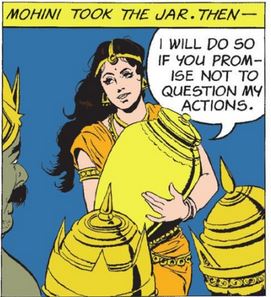
Before he became the Brahmarishi Vishwamitra, he was the king Kaushika. The king Kaushika wanted to become a Brahmarishi who would be considered an equal to the Brahmarishi Vasistha. So, he performed severe penance and meditated for years to achieve the abilities of a Brahmarishi, one of which was a complete control of one’s senses and desires. On three occasions, after developing great abilities on the path to becoming a Brahmarishi, he had to expend the gained abilities to succeed in activities he indulged in.

Once, his meditative focus was broken by the extremely beautiful Apsara, Menaka, which whom he later had a daughter. This was a case of not having mastered his senses and desires. Next, after achieving great prowess through meditation, he expended the same in creating a second Swarga (roughly translated as Heaven or the abode of Lord Indra) for the King Trishanku who wanted to enter Swarga without first dying. On the third occasion, he expended the abilities developed through austere meditative penance in trying to show low, the King Harishchandra, whose values he wanted to see broken (Vishwamitra failed and Harishchandra never strayed from his values).

In all three situations, Vishwamitra lost the abilities already developed and had to start with a great deficit on the path to becoming a Brahmarishi. He eventually did succeed, but the concept is quite clear. Acting on a boon or a curse, if we can consider the creation of a second Swarga as a boon and causing hardships to Harishchandra as a curse, results in the great Sage expending abilities developed over many years. It takes equally long to develop the same abilities again. I personally think a good analogy here could be an accident endured by a sportsperson or a martial artist. A lot of time is spent in recovering from the injury first and then even more time is spent is training the body and mind back to the peak they had once scaled, if this is at all possible.

Alternatively, it can be considered as the effort one has to spend in achieving a successful attack, like a flurry of punches and kicks at great speed or relentless grappling, both of which require a vast investment in money, time and effort to execute in the first place, and then to survive with successful execution; then there is the risk of injury and failure, which require more time and energy to overcome and try again later, if necessary. In a modern context, it is like investing in an expensive weapons platform like a drone swarm; losing it in a failed mission and then having to invest in a better platform and further resource expenditure in creating or refining doctrines for the usage of the new platform.

So, the boon or the curse, requires the person who bestows either to have already achieved complete control over the self and several other aspects of the universe. An extraordinary example of this would be the boon given by Maharishi Durvasa to Kunti. He was pleased with her attention to duty when she was in charge of his hospitality when he visited her father Kunti Bhoja. So, he granted her a boon which allowed her to summon the Deva of her choice to bestow a child on her, and she could do this 5 times! So, Maharishi Durvasa could grant the ability to summon a Deva to a human being! This means that we cannot even begin to comprehend the abilities that Durvasa possessed!
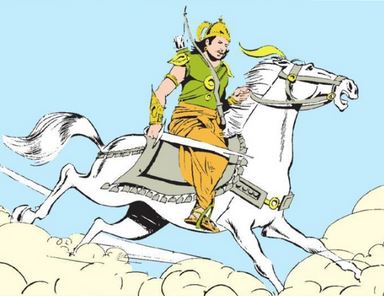
Image credit – “Bheeshma’s vow”, “Mahabharata – 2”, published by Amar Chitra Katha

This example brings into focus another aspect of a boon or a curse. The person bestowing either, on another individual, can actually control multiple aspects of the universe and get them to behave differently for specific individuals for several years at a time. This of course is impossible for mortals and the examples from the stories are all of extraordinary humans who are on par with the Gods or the Gods themselves, when they are uttering the boon or the curse.

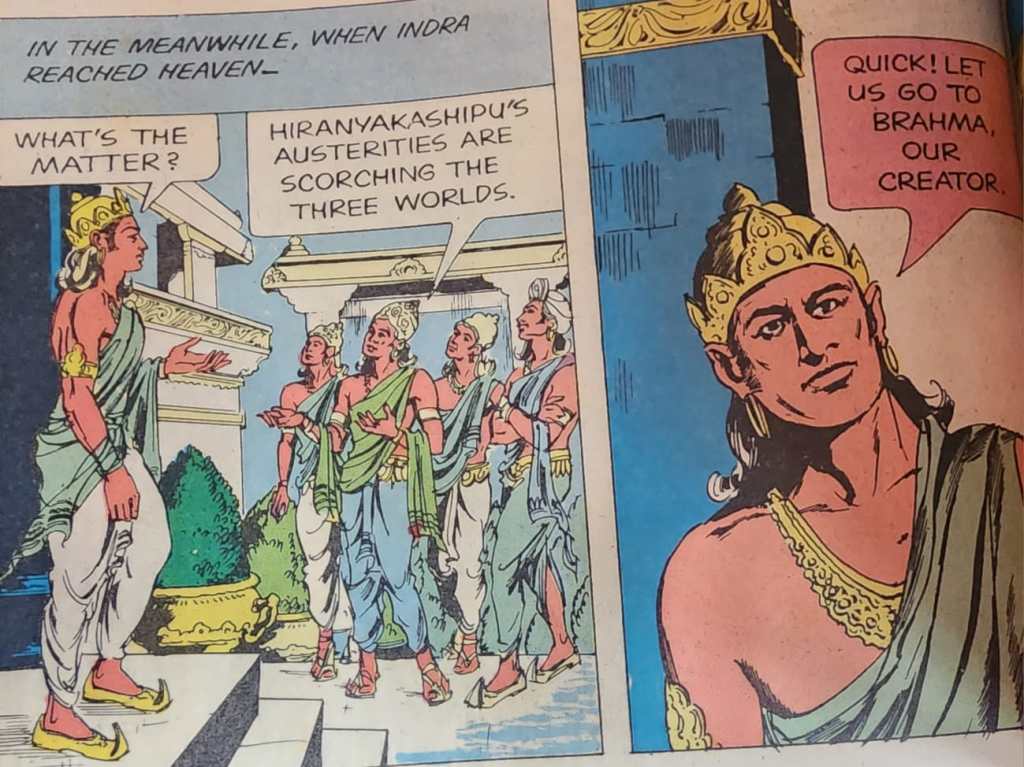
But let us look at this from a more mundane everyday aspect. But before we consider examples from our everyday life, I share an opinion of mine. Boons, curses and blessings are transactional in nature. These are received in response to specific actions. The person receiving any of these will have performed a series of actions for a duration of time, which results in the person towards whom these actions were directed, bestowing the boon, curse or blessing. But there is a difference between blessings (aashirwaada) and boons (vara). The shaapa is not something one works towards but is the result of an indiscretion and perhaps a result of not letting go of one’s ego and NOT working correctly towards whatever the objective was.

A Vara is something specific that a person wants and can be granted by a superior or divine entity. In order to gain an audience and demonstrate eligibility for the vara, she or he performs the requisite actions, which can be physical or meditative in nature. But a blessing need not be something that is specifically worked towards. One performs one’s duties or responsibilities with complete focus and attention to detail. This is a demonstration of great self-control and management of one’s reaction to given surroundings. The individual(s) who are on the receiving end of this diligent activity are greatly pleased by the same. This results in the impressed person offering a blessing as a reward in return for the services or whatever else was received.

So, an aashirwaada need not be sought after, but is received as a reaction to a job or an activity well done, where as a vara is something that is sought after and activities are performed towards that objective. Consider this, the boon bestowed on Kunti was actually a blessing. Her hospitality towards Maharishi Durvasa was not with the objective of a boon, but just a job well done. In response to this, she was blessed by Durvasa with the boon. Now consider the Tapasya performed by any great Asura, say Hiranyakashipu, this was with the specific objective of achieving a boon which bestowed great abilities on him, which would in turn allow him to defeat the Devas.

A simpler example of a blessing would be an elder blessing someone younger with a long life, when the younger person touches her or his feet. The blessing in this case is a reward for remembering that this is the right way for a youngster to greet an elder. This system is also a good positive reinforcement in preserving one’s culture and way of life.

With the above observation, we can consider a few situations from daily life, which could represent boons, blessings and curses. We have all experienced appreciations and rewards at work. These range from appreciative emails to merchandise to pictures on a “wall of fame”. These are more common compared to promotions and pay hikes. They are handed out more often as they are less expensive to organizations and also reinforce (hopefully) behaviour that is preferred. We also tip generously depending on the quality of service we receive at hotels and restaurants. These, in my opinion, are analogous to blessings as they are in response to an impressive activity.

Now consider promotions and pay hikes. These are much harder to come by and are objectives which require a plan and set activities that demonstrate eligibility. An individual spends a few years understanding what the parameters needed for either of these are, and working towards the same. It requires networking, measurable achievements and the sheer effort to achieve visible experience. So, the pay hike or promotion here is a vara/boon and the activities are the tapasya or saadhana that goes into achieving the same. This is because it is a specific objective that is worked towards.

What about shaapa and curses? The explicit situations that define these are cases where one has to leave a job or bear the cost of activity or behaviour that lead to integrity issues. These can be one misusing client data or accepting bribes at work to alter expected decisions. It is a negative consequence of errors at work. When these are inadvertent, the curse could be very minor, like a mail with an apology which smooths things over.

But a curse could also be invisible and long term, which is also realized much later. These could be situations where one’s relationships are broken due to too much self-indulgence in career related objectives, or a sportsperson suffering debilitating injury due to not enough breaks or insufficient detraining time. This is akin to the statement “the path to hell is paved with good intentions”.

A last point regarding blessings here. Many of us would have experienced situations where we receive appreciation mails or certificates and don’t really care for them and are definitely not motivated to either repeat the same kind of hard work or keep up the level of effort that resulted in the appreciation in the first place. This happens for many reasons, especially if there is a statement like “we need to do even better the next time”, which makes the appreciation more of an expectation setting. This could also be as there are blessings given when one is working towards a boon (appreciation instead of a pay hike). Why would this kind of mismatch occur? I opine that this is due to what we discussed initially about blessings, boons and curses. A distinct lack of “Connect”. Individuals know when the appreciations are just a matter of course after some time and also when they come from senior leadership who have no visible impact on their work lives. All they do is append a signature to a set of words composed by someone else. So, there is an attempt at a blessing, but the lack of connect, renders it empty of any effect. This connect I am referring to is the rapport that any leadership develops with its teams and how it is nurtured through trials and tribulations at work.

Having considered how blessings can be rendered pointless, we need to consider cases even from the stories in Hindu culture where boons could end up being curses. Remember the blessing that became a boon to Kunti by Maharishi Durvasa? Kunti after the rishi had departed, either in innocence or curiosity invoked the boon, with Lord Surya, before she was married. This resulted in the birth of her son Karna, whose life was partially responsible for the great carnage in the battle of Kurukshetra apart from being an extraordinary tragedy on a personal level. So, a blessing was a boon, the use of which with no negative intentions still became a curse not only for Kunti but for entire kingdoms!

Image credit – “Bheeshma’s vow”, “Mahabharata – 2”, published by Amar Chitra Katha

Similarly, Ashwatthama is cursed by Lord Krishna at the end of the Kurukshetra war. He is denied the release of death and is functionally immortal for the rest of the Yuga cycle. An additional point is that a wound in his forehead caused by removing a jewel that was present there would never heal. This was a jewel that always granted him good health. If one recalls, all the great Asuras asked for immortality from Brahma to compensate for the Amrita the Devas had. But when the same was not an achievable boon, they asked for other great abilities that enabled them to subjugate the Devas despite the Amrita. So, Ashwatthama was granted immortality, which was considered a desired vara by many, as a curse! An extension of this could be that the boons achieved by the great Asuras always resulted in incredible pain and hardship as a result of the wars they unleashed. So, a boon for them became a curse for many others. And this resulted in the many avataaras of Lord Vishnu to slay these Asuras. So, the line between a boon and a curse is thin, but not invisible.

The means to assuage this problem also returns to the twin concepts of connection and control. One needs to continue with the self-control one possessed before receiving the boon after the act, perhaps to a greater degree. This is because the person enhanced by the boon possesses a far greater potential to cause damage to the universe around her or him. In other words, her or his ability to control the surroundings requires an equal increase in self-control to prevent her or his boon from becoming a curse for others! And in order to keep the control of others benevolent or at least less harmful, the ability to connect with others and better feel or empathize with their motivation and desires is vitally important. So, a boon or a blessing, degenerates into a curse over time with a lack of connection and control.

A modern-day example of a boon tending towards a curse is international monetary aid. We hear terms in the media of some countries being “addicted to monetary aid from the IMF (International Monetary Fund)”. In Indian media this is used in the context of countries like Pakistan and Sri Lanka. In the case of Pakistan, the country has never developed a governance system that allows the country’s economy to expand and its populace to prosper. It has approached the IMF multiple times, every few years, to save it from economic defaults. The aid package from the IMF is a boon which is used with no connect with the needs of the country and its populace, and becomes an addiction, and this is a curse.

This observation can be expanded to the economic and military aid the USA provided to the various dictators in South and Central America, Africa and the Middle East during the Cold War years. The aid allowed friendship between the dictator (not the country) and the government of the USA, but this allowed the USA to control the dictator keep the socialist and communist rebels at bay. However, this control did not allow prevention of atrocities on the population of the countries. So, the boon of aid led to “control through benevolence”, of the dictator, but the same became a curse in the long term for the populations of several countries. This is not unlike blessings from fake spiritual Gurus who are basically conmen. They have wonderful words and can connect with people, but their intent can only generate empty blessings which are definitely not boons but could be curses, as they have no control over anything, not even themselves.

The converse of this could be true as well. And we can consider something I have heard from a very senior practitioner of the Bujinkan as an example of this. My mentor says that in all your interactions with people, try to connect with them, get a sense of their requirements, what makes them happy, what really troubles them and the like. This connect is to be done in earnest, not with an objective of studying them, like one might study bird behaviour. This kind of connection could turn to a good rapport or friendship and lead to us providing really useful suggestions while not seeming superior or overbearing. This leads to them remembering the connection and might result in their feeling responsible for helping us when we need the same. This is “control through gratitude, camaraderie and responsibility”*. The words used are the same as those used in the earlier paragraph, but the context is entirely different! My mentor says that this is an objective of all Bujinkan practitioners and should be a key goal of training. He says that one should be able to control rooms full of people with this ability to connect. But of course, a connection on this level is really hard to achieve and requires self-control abilities that sometimes seem to be just wishful thinking. 😛

One last point regarding control here, at a level simpler than the one mentioned in the previous paragraph. From being generous with tips to approving promotions to enforcing a separation from a job to sending appreciation mails, all these instances stem from a connection, but can only be enacted when there is control over multiple aspects to ensure the desired outcome, be it the situation (appreciation mails), budget (pay hikes), seniority or responsibility (promotion or separation) in organizations. When this control is employed, it could lead more connect and even better control, like a virtuous cycle.

The appreciation mail that is not of any motivational value is a case of control without connect, control of the situation where one is aware of the outcome that warrants the appreciation and the ability to send the same, but no connect that adds value to the words of appreciation.

This aspect of control is also true in the martial arts. I have discussed connect and control with respect to the martial arts in greater detail in my previous article, the link to which is seen in the notes below***.

In conclusion, it seems quite clear that the concept of self-control and connecting to others and one’s surroundings as a precursor to control over others and the environment, even in a benevolent manner is something that humans have considered and chased after for a very long time. It is something that never ends and requires perpetual reinforcement, in the form of case studies which are what the stories from Hindu culture are. And their application spans everything from fighting and conflict management to daily life.

Notes:

*One of the Gojo we are taught in the Bujinkan states “Fumetsu no fusei”. This roughly means “give and give” or “endless giving”. It could mean that one thinks of giving and not the return on investment. This is one of the paths perhaps to the point mentioned above. But then, there is also a concept called “Sente” which is roughly “not making the first move” because one might then become the Uke or attacker and present openings to the opponent/defender. These two points appear to be contradictory, but they depend on the context in which they are used. So, the intent – whether it is benevolence or malice – becomes the key factor while deciding whether “fumetsu no fusei” or “sente” is in action. I have discussed the Gojo in an earlier article, the link to which is seen below.

**I have discussed the concept of “letting go of the self” in a separate article, the link to which is seen below.

***The link to the article where I discuss in greater detail the application of connection and control in the martial arts is seen below.

1There might be other ways to achieve boons, like the story of the birth of Dattatreya. I am referring to the more common ones in this article.

Connect, Control – Part 1; “Connect, Control = Shatrubodha in flow”

An interesting connection between Budo and Bharatiya tradition

There are two concepts that are taught in the Bujinkan system of martial arts which are very simple to state but extremely difficult to express and achieve. The two concepts are “Connect” and “Control”. These concepts are mentioned to everyone practicing in the Bujinkan from their early days as practitioners and fairly often. But they are only expected to be practiced in earnest after several years of experience. Let me attempt to express what these concepts mean (at least to me), how they are intended to be understood and the context for the same.

I will start with the concept of “Connect”. There are four other concepts that have been shared as part of the training in the Bujinkan over the last seven or eight years. I have heard these from my teacher and mentors who in turn have heard the same from Soke Hatsumi Sensei back in Japan. These concepts are,

  • Do not use strength (Chikara Janai)
  • Do not fight (Tatakai wa Janai)
  • Match the Uke/opponent (Awaseru)
  • Do not sever the connection (En no Kirinai)

The original Japanese phrases that convey the idea are also mentioned above. There are several practitioners with vastly greater experience than I that have written about and explain each in detail. I would encourage everyone to read the same. I am not going into the etymology of the same and will stick to learning from my own personal training and experience.

When the statements “do not use strength” and “do not fight” are mentioned, they do not in any way denote or promote pacifism. They are referring to how one should not have an ego driving their actions in the fight. Using one’s physical strength might win an individual some fights. But it will not necessarily win all fights. One will always face opponents who possess greater physical strength. In a situation where there are multiple opponents, it is highly unlikely that one’s physical strength will match up to the combined strength of the opponents. Further, physical strength will wane to varying degrees for individuals with age. The well-known and obvious solution to this is the development of skill through a lot of training. Martial skills developed through training augment existing strength and also help overcome the strength of the opponent. It is also a means to reduce one’s own dependence on strength.

With the development of “skill” and a drop in the reliance on strength, one aspect that usually comes up in many martial arts, including the Bujinkan is to “use the opponent’s strength or intention against herself/himself”. This leads into the notion of “not fighting the opponent”. There are also statements that state, “Do not trouble the Uke (opponent)”, “Don’t do anything the opponent does not want to do”, “Let the opponent fight herself/himself”.  All of these lead to the same aspect relating to a physical conflict; “even when in a fight, do not fight”. So, what does this mean?

Based on what I have understood, this refers more to one’s state of mind in a fight than the physical actions in a fight. It has more to do with not looking to do violence against an opponent and not refraining from the same. I have delved deeper into this aspect in my older article, “Ahimsa and the Martial Arts – Part 1”, the link to which is present in the notes to this article, seen below. Not fighting an opponent, in simple terms, means that causing harm to the opponent should not be the objective, surviving the fight with as little damage to oneself is.

The moment the objective relates to the opponent, like “causing harm to the attacker” or “winning against the uke”, the ego takes over and becomes a motive which leads one to focus on a specific outcome. This is because winning or getting the opponent to fall or be locked or hit or get injured have specific definitions which need a series of actions, all of which the opponent will also strive to counter while trying to cause harm to the defender (tori). Getting these actions right is very difficult and leads to a slippery slope which might not be possible to overcome.

However, if survival is the only objective, one only needs to focus on not letting the attack succeed. This makes a lot more space available in a fight. Also, the attacker needs to do all the work, while the defender only needs to get into a safe space, albeit continuously. This moving to a safe position opens up the opportunity to gradually move in a way that causes the opponent to just wear out and stop the attacks or lose the ability to do so, which could be due to losing her or his balance, getting hit due to being open while attacking and the like. Either way, the danger due to the attack is mitigated. In short, while only the uke was attacking, the defender (tori) was only staying alive and not fighting, even if it does not appear so to an outside observer. It was all in the state of mind.

Thus, not using strength is about using skill in a conflict and not fighting is about not having an objective vis-a-vis the opponent, but instead moving to stay in the safest possible space during a conflict. Thus, the skills to develop are, to move oneself physically to a safe place and to not have malice towards the opponent.

There are two parts to developing the ability to move in a manner that allows one to be safe. The first of course, is a lot of training, years of practice and experimentation with different people of varying levels of experience in physical conflicts. This includes armed and unarmed fights with and without armour, depending on what is available. In the Bujinkan, this generally does not include modern day firearms and historical weapons which are discharged. But there are other martial arts that do include these, based on the little that I know of these artforms.

The second aspect is to move exactly when necessary and neither too early nor too late. Moving too early means the opponent can correct or change the attack and moving too late means facing the brunt of the attack. Moving at the right time, or more practically, moving as close to the right time as possible, depends on realizing when the attack is coming and having a sense of what the attack is aiming to do. This knowledge of course, is not exact and the prediction of the same is not a precise science. It is a feeling one gets by being in a conflict and over time becomes a “gut feel” or “intuition”. Thus, knowing the timing and danger of any attack is about being aware of the opponent with the experience of having been mindful of many other opponents in the past.

All of this, in concert, means that one should be able to get a read on the opponent while being in the fight. In simpler terms, one needs to be able to “connect” with the opponent to be able to identify when to move and where to move, to stay safe during a physical conflict. If one can largely be able to connect with the opponent and move as required to stay safe, one will have matched the movement of the opponent and thus mitigated the threat posed by one. This is what is meant by the third concept above, which is “Awaseru”, or, to match the opponent.

If one does achieve Awaseru, the next harder concept reveals itself. This is to keep the connection and not lose it. This concept of keeping the connection is called “En no kirinai”, which roughly translates to “do not sever the connection”. If one can connect with the opponent and match her or his movement, the realization of the same, as soon as it occurs, triggers the possibility of breaking the connection as well.

Awaseru, when it does happen, allows one to reduce risk to oneself while the opponent is expending efforts to reverse this and in all likelihood exposing herself or himself to an attack. This might happen over the course of two or three attacks. Once an opening is exposed, there are two possible situations. The first is to exploit the opening to end the fight if possible. But then, this exploitation of an opening might not work as expected because the opponent is very good or too tenacious. In either case, the fight might not end. This is the second situation.

When the fight does not end, the defender should not press the attack unless there is another clear option to do so. If the attack is pressed without a certainty of success (which is very difficult) the uke and tori have switched roles and the opponent can now exploit openings the defender offers. So, not only has the connection been lost, but the opponent can now apply awaseru!

So, if the opponent continues the fight despite realizing one is exploiting openings he or she is revealing, the connection needs to be maintained, matching needs to continue, until a time when the fight logically ends. The realization of awaseru being successful leads to a heady feeling and a possible superiority complex of being able to carry out a successful counterattack. This needs to be guarded against and awaseru needs to hold firm. This, is En no Kirinai in practice. Of course, all this is easy to put into words, but much harder to practice, for identifying when a fight starts or ends is entirely subjective and depends on the fighters and the situation (space and time) the fight is occurring in. The fight only ends when the combatants genuinely are no longer trying to cause physical harm to each other. The connection with the opponent needs to continue until this happens and even possibly after, to ensure that the lull in the fight is not the opponent regrouping for another attack.

This continuous connect with the opponent is Shatrubodha. And Shatrubodha allows control of various kinds, both on the self and the opponent(s). This is good segue to explore the concept of Shatrubodha in greater detail. A last observation before we switch though.

The first two concepts of not using strength and not fighting are not relevant in the context of sport combat. A fight as part of a sport has many rules to protect the fighters, like time limits, a referee, a scoring system, a defined space for the fight, emergency personnel on standby and most importantly weight categories and segregation between the fighters on the basis of gender*. So, the use of strength is completely valid and fighting is the objective. These aspects relate only to a situation where there are no rules protecting individuals. Of course, this does not preclude using skill in conjunction with strength and this happens all the time. The other two concepts of matching the opponent and keeping the connection is valid irrespective of whether the fight is a sport or not. Great sportspersons use these concepts to achieve great heights in their respective fields. These concepts are useful even in non-combat sports, like cricket, badminton, tennis etc, where matching with the opponent and realizing what they might do, due a connection, helps a great deal.

Shatrubodha is a word I have heard from time to time in India over the last year or so. It is generally used by the non-left way of thinking. I heard it on YouTube first and then saw it on a few sites online. It is said by some that it was used by Chanakya in his exposition on statecraft. But I am not sure of this and have not researched if he really used it as part of his work, the Arthashastra. Nor have I spent time verifying if there is anyone who has firmly linked this concept of Shatrubodha to Chanakya.

Shatrubodha, or Shatrubodh (as it might be pronounced by speakers of Hindi) means “a sense of the enemy”. “Shatru” means enemy and “Bodh” is a little harder to translate. It could mean “a sense of”, but I have also seen it translated as “knowledge” or “perception” or even as “information”. Based on these, I opine that “Shatrubodha” could be considered as “knowing the enemy”. It could also be worded as “having a perception of the enemy” or “being aware of the enemy”.

When Shatrubodha is used in the context of an enemy of a nation or a culture or a civilization, it is used to mean that one should always keep an eye on the enemy however possible. It also means that one should study and research the enemy in all possibly ways, irrespective of whether the enemy is an individual, a group of people, another country, an organization or even just a value system or way of thinking that is inimical to one’s own culture and way of life.

From the perspective of martial arts practice, based on my personal experience with the Bujinkan, “Shatrubodha” is the same as having a feeling for what attack might originate from the opponent and when the same might happen. This is what allows us to practice the angle or distance to use and timing to apply in any movement that is made in defence or to protect against any attack. Over time this is what manifests as “Sakkijutsu” (intuitive ability) in martial movements.

Apart from the timing and distance, one other thing that is used in the martial arts is “rhythm”. Any training session or a fight between individuals or between groups has a rhythm. This is visible even in sport fighting and non-combat sports as well. There are intervals when the fight or action on the field is intense and at other times, it is visibly tentative when the two sides are probing and testing each other. There are times when one fighter is aggressive when she or he senses fatigue or confusion in the other and this could lead to an end of the fight or a change of pace if the aggression fails and the other fighter also senses the change in rhythm and changes tack.

This rhythm is keenly influenced by an awareness of the opponent, by having a perception of her or his intentions and by the experience of what she or he can throw at the defender. This sense of the opponent is Shatrubodha and is a vital part of the martial arts. It could even be expanded to say that this is very important in all conflict management situations, even if it is not related to physical conflicts, like a contentious business meeting, a dispute between relatives or friends and the like.

The “sense of the opponent” is something that needs to be obtained by being open to the opponent, her or his movement, rhythm, intentions and like. This being open to the opponent is nothing but the “connection” or “connect with the opponent” that we discussed earlier. It is not being open to the attack without any protection and thus being open to physical injury or worse.

Also, like we discussed earlier with the concept of “En no Kirinai”, this connection or Shatrubodha has to be incessant, or at least until a given fight or conflict is mitigated to an extent where the probability of any physical or other harm is miniscule. Further, being able to connect also requires not having an intention of hurting the opponent, in other words having no intention of fighting or employing strength and being able to match the opponent. So, Shatrubodha is not about defeating an enemy, but about being aware of the enemy at all times and ensuring self-protection.

We can now consider the other aspect that is key in the Bujinkan system of martial arts, which is “Control”. And “Control” begins with “Self-control”. The concepts of not fighting the opponent and not using strength against the same, is about exercising self-control. Further, matching the opponent and connecting with her or him or them while they try to do one harm is self-control that is very difficult to achieve. The urge to fight back to cause the opponent harm is extremely difficult to overcome. Hence, the need for self-control. The ability to achieve this self-control being very difficult is the reason why it is referred to as an important concept. It is a concept that one chases all through one’s training life and comes close to achieving but never does do consistently to one’s own satisfaction. This last bit is based on personal experience and there might be practitioners out there for whom this is child’s play.

Extending this a little further, the advantage of self-control and connecting with the opponent is that one is supposed to be able to nullify a fight with minimal effort, as against using strength or violence against the opponent. This is not to say that one should desist from violence even if that can save one’s life and is the only option that seems to be available. In such a situation one is of course free to adopt that approach and survive. The objective is simply that, to the extent possible one should try to minimize effort in a conflict by avoiding a fight and strength. Instead try to connect with the opponent and get the conflict to dissolve (this is not the same as defeating the opponent).

So, by controlling oneself, one gains the opportunity to achieve the first concept of “connect with the opponent”. Connecting with the opponent in turn leads to the advantages discussed earlier. A little extension here with regard to “self-control”. In order to control oneself, one needs to know one’s own desires and the need to act at certain triggers. This is the origin of deciding where one needs to control one’s actions and motivations. This act of knowing oneself is called “Swyambodha” or “Swayambodh”. This is the opposite of Shatrubodha. It means “knowing oneself” or “being aware of oneself”. So, Swayambodha and Shatrubodha lead to one another. Awareness of oneself allows self-control which allows connection with the opponent which leads to Shatrubodha, which leads to control of the conflict and hopefully its mitigation.

Like we discussed earlier, when one can match the opponent by connecting with her or him or them, one can move in a manner that minimizes the potential harm to oneself. If this can be done in a dynamic and consistent manner, the opponent has to expend a lot of effort in trying to cause harm to the defender. This effort on the part of the opponent reveals openings that can be exploited. Over time and multiple moves, this danger becomes apparent to the opponent as does the lack of success in the expended effort and hopefully leads to a diminishing of the motivation to press on with the attack. Of course, there is also the option of attacking the openings that are revealed and ending the fight. So, by connecting to the opponent, one can stay safe while making the opponent work hard and unsuccessfully. This is achieving control of the conflict situation; where one is safe and can create opportunities to end the conflict. Connection leads to control and this leads to an even better connect. So, it is a virtuous cycle.

If one has heard many individuals and researchers associated with think tanks or evocative retired personnel from the defence services in India, they all emphasize on one thing. This is that people in defence planning need to, from time to time, research and document all the threats, both internal and external, to the country. Based on this assessment, they need to plan and devise strategies to counter each of these threats over time. Considering that these identified threats evolve continuously, one needs to cultivate and work with experts on each of these identified and potential threats. This is nothing but connecting with the enemies of the country to control the threats and identify ways to mitigate the same. The identification of the threat is Swyambodha here and gathering information about the threats, Shatrubodha. The fact that one studies the threats is the act of connecting with the opponent and devising mitigation plans is the control of the risk posed.

While the above is more of a strategic activity, practicing the same in one-on-one (maybe many-on-one) martial arts training sessions is tactical in nature. Of course, in the latter scenario, it has to happen during a fight while the former takes much longer and might last years or decades. The learning from the martial arts can be expanded to conflicts one faces in life, where it is well known that one should try putting oneself in the shoes of the other, to mitigate the conflict and this starts with a realization of one’s ego.

So, in conclusion, based on the above discussion,

Connect, Control = Shatrubodha (with Swayambodha as a precursor)

Notes:

  1. As part of Bujinkan tradition, we have a Kamidana in the dojo. The Kamidana is an equivalent of the “Mantapa” which many Hindus have in their Pooja Rooms at home. In the Kamidana is kept a mirror, the Japanese word for which is “Kagame”. One of the reasons for this mirror being present is to remind oneself when one bows to the Kagame at the beginning of every training session, that one is bowing to oneself, as the superior warrior (or at least the spirit of one) resides within and the attempt is always to reveal and express the abilities/qualities of that warrior.
  2. A SWOT analysis is similar to Swyambodha with a bit of Shatrubodha thrown in (The “T” in SWOT), while the model of Porter’s 5 Forces could be mainly Shatruboda with an element of Swayambodha thrown in (the aspects internal to the industry or the organization).
  3. *There are of course mixed gender events these days, though they are far fewer than segregated events.
  4. Some senior Budoka I have trained with feel that “self-control” is the only real control there is, for one can never control anything in this universe other than oneself.
  5. A couple of interesting observations relating to Shatrubodha that I have seen in works of fiction are mentioned below.
    • In the final book of the expansive Fantasy series, “The Wheel of Time”, called “A Memory of Light”, one of the main characters, called Matrim Cauthon tells another character that he needs to go out into the battlefield and be in the thick of things to get a sense of the fighting. Matrim Cauton is the finest General in the land and he says this as he feels that he needs to understand the flow of the battle to identify the best moves to be made. This is as good a depiction of “Shatrubodha in flow” as I have ever seen. This could be because the author of the series, Robert Jordan (pen name of James Rigney Jr.) was a veteran himself.
    • In a book written by Fredrick Forsyth, I currently cannot recall which one, a character states something on the lines of Israel’s foreign policy being that there are no countries that are friends, only enemy states and neutral states, and so they will spy on everyone. This is a wonderful expression of always having a keen focus on Shatrubodha!
  6. If one has heard Mr. Rajiv Malhotra (search his name on YouTube and Amazon to have a look at his vast body of work) speak, he often refers to how incredible the Shatrubodha of the USA is. He says that at any time, there are universities and think tanks in the US, which are generating what he calls “disaster literature” regarding other nations and cultures. Here, he refers to how closely institutions in the US study societies and nations other than themselves. They use these observations to generate data regarding the negatives of that civilization which can then be used for information and narrative warfare as and when needed, to further US interests. The above is perhaps similar to how the British back during the days of British Raj studied Indian culture with great interest and used that information not just to govern the country but also to control the populace, by dividing and ruling when necessary and by setting up narratives that showed British culture in a superior light compared to native traditions.
  7. Seen below is the link to the article where I discuss my ideas about Ahimsa in greater detail. https://mundanebudo.com/2022/10/13/ahimsa-and-the-martial-arts-part-1/
  8. Apologies for the wordiness of this article and repeating the same ideas over and over. The flow of a fight and the objectives therein were too important to not emphasize with repetition.

When there are no solutions..

Training with knives is scary. It is scarier than training with swords or spears or sticks. I am of course referring to traditional martial arts and not considering fire arms or even historic projectile weapons like bows and arrows, crossbows, slings and other thrown/discharged weapons. In other words, using Bharatiya terms, I mean while training with shastra and not astra.

The knife is not scarier because a knife is more dangerous than the other weapons. It is scary because, one, it can be invisible until after the attack is complete, and two, because being a close quarters weapon, a knife, even when detected gives very little time to defend or protect oneself against.

I have been told by mentors with far greater experience than I in the martial arts, and some with practical experience in fighting with and defending against knives, that the numbers bear testimony to the fear of knives.

I am going to add the numbers that I have heard, as part of the notes below. This is because I have not personally done any analysis of knife attacks. I have only read articles about the research and heard people who have done the same share their knowledge. So, what I have is secondary or tertiary knowledge at best, about the numbers and statistics related to knife attacks. Also, my personal experience is more with traditional martial arts and larger weapons that I referred to earlier in this article. Add to this the fact that there are varying views about knife attacks, and surviving the same, and that these sometimes disagree with each other, I do not want to subscribe to any one view. That decision is personal for everyone, because it involves physical injury and trauma. I apologize for this inconvenience, and also request readers to do a little back and forth scrolling while reading this article.

Another worry with knives is that a slashing attack might look ghastly but not be fatal, while a stab shows a smaller wound but is far more likely to be fatal. So, to repeat myself, knives are dangerous as everyone knows, and are scary to train with, even when they are fake (because the knowledge of the danger is real).

The numbers seen in the notes below, show that there is no clear, sure shot defence against a knife attack. So, it is a situation with no solution. What does one do in a situation like this?

What I have heard from people with knowledge and experience with the problem of the knife, state that the best solutions are one of the following. One, avoid the fight or get away from the fight, in other words, retreat and get away from the space where the knife is a threat. A large distance between the knife wielder and the potential victim is a safe solution to survive the knife. There is a drawback to this solution though. Based on what I have understood, the chances that a knife attack begins only when the assailant is very close is very high, and hence, the opportunity to either run away or put a lot of distance between oneself and the attacker might not always present itself.

The second solution is not a different one, but more an extension of the first. It is to not be in the space where a knife attack might occur. This is similar to (though may not be exactly the same) what is also called “situational awareness” by some martial art systems. Yes, this might sound philosophical. But it is based on primeval intuitive abilities of human beings, which helped avoid predators (human and otherwise).

This is not something new either. Anyone who has traveled alone and late, in the dark, will know how one’s senses and ability to expect threats are heightened. This same feeling can be accepted and hence practiced in situations that do not exude an explicit threat with atmospherics (like a pub or a festival gathering where attacks are not expected). This could also be made mundane by saying, trust your feeling and do not go someplace you do not feel like going, even if the not wanting to go is not due to a threat perception. It could be unease manifesting as fatigue, lethargy or any other “I don’t feel like going there”.

The above alternative is about trusting one’s intuition and not being afraid to retreat. It can further be said that trust in intuition is very important, not just during knife defence, but also in staying away from a situation where defence against a knife is necessary. This might seem a cop out to some because it reduces the emphasis on practice to survive against a knife. They are not wrong. Practice is perhaps the best defence. But then, several people do not have the time to expend on the requisite practice, unlike those imparting the training or those in the police, armed services and other security services.

When practice and training time is a premium for most people, focus on the ability to avoid a fight is vitally important. Also, this is not surprising, in my opinion, for this is how we deal with most problems at work as well. And work is a very important part of all our lives, while self-defence training might not be.

Consider how much all of us rely on intuition to solve problems at work. All of us, when we are applying or developing any solution to any problem at work have a “gut feel” about how difficult the development will be or how long the same will take. All planning and estimation works on this. Also, the need to be on the lookout for problems after applying said solution is also based on estimations, which are driven by intuition. After all, intuition is experience plus a sense of the context/situation/atmospherics around a problem. Hence, we know when to apply a temporary fix as against a permanent solution as well.

The use of intuition at work from what I stated above, is about not just solving problems but also about being aware of the consequences of a solution as well. Thus, we are not only working to solve a problem, but also trying to protect ourselves from the consequences of further problems that might come up due to the solution, especially if it is a temporary fix. The key phrase here is “protect ourselves”. This is using intuition and stepping back to protect oneself; not defend against a situation, but to stay protected at all times. This is akin to wearing a helmet whenever you ride a two wheeler and not only when you are on a bad road or in heavy traffic.

This is the same as trusting one’s felling about a place or situation and also about retreating when faced with a situation where there is no good defence, like against a knife. Thus, protecting oneself is as important as, if not more important than a good defence. This rings truer still when a defence might be designed with a set of assumptions (which is always the case when defensive training is based on specific situations). In other words, protecting oneself starts with trusting one’s gut feeling and the ability to retreat before the need to apply a defence.

There might be no measure to check how many times one protected oneself by not being in a place or situation where a defence against a knife might have been necessary. But then, that is the best defence anyway.

On a lighter note, at least for us Indians, retreating to protect either oneself or ones dear to any individual should come naturally. After all, one of the many names of one of our favourite Gods, Lord Krishna, is “Ranchod Das”. It means one who runs away from a battlefield. This was anathema to the warrior code of the Kshatriyas (as is common in many warrior cultures around the world). I will not go into the story here, but Krishna chose the insulting moniker over fighting an impossible battle (against Kaala Yavana). He of course, survived and won the battle as a consequence of the retreat; but the name stuck.

In conclusion then, training survival against a knife has to include training to retreat (run away) and trusting one’s intuition until a defensive solution can be found (an offensive solution might also be possible, but hurting another person brings with it a host of other problems to consider after the act).

Notes:

  • I have been told that if an unarmed individual is attacked by a knife wielding assailant, and the person being attacked knows of the attacker’s knife, the probability of surviving the attack unharmed is between 0 and 0.5%. This is if the person being attacked has no training in defence against a knife. If the person being attacked is trained in defence against a knife, the probability of surviving unharmed apparently goes up to around 2%. So, the probability of surviving unharmed against a knife is 2% AT MOST, with specific training to defend against the same. This is of course, supposedly not considering body armour to protect an individual against knife attacks. This number is undoubtedly low but 4 TIMES greater than with no training. Nonetheless, the number reinforces the worry about training with knives. Little wonder that knife training is done with fake knives only! 😛
  • A 1988 book by Don Pentecost called Put’em down, take’em out! Knife fighting from Folsom prison. – I have heard that this book is supposedly contentious and should perhaps be considered as another source of information and not as gospel truth. Also, I have not read this book myself and have only seen references to it.
  • There are many YouTube videos referring to knife attacks and what one can do in such a situation. I cannot specifically recommend any, but leave it to interested viewers to decide on the information they find most useful.
  • There are also people who opine that even screaming for help or running away need to be learnt and practiced. These two might seem to be common sense, but in a stressful situation like a physical assault, they will not manifest automatically. Practice and conditioning are what a person falls back on in such a situation and hence this suggestion. This is beyond the fact that a knife attack might not allow for the option of running away.
  • Knife training can be used for life lessons, but the vice versa need not be entirely true. This obviously, is because, a threat to life and limb is very real in a knife fight, while the same is not true at work or in others aspects of life that are not physical combat. In life and at work, the risk could be financial, to one’s health and one’s reputation. The opportunities available to fix these, can be greater for everyone, when compared with a short and intense knife fight. Hence, what I have opined here is a perspective more relevant for individuals that are not martial arts’ practitioners or students who have just begun martial arts’ training. If this was looked at from the perspective of someone who is a regular student of the martial arts, I would opine that the learnings from training the knife and protection against it, including the aspect of intuition, should be a take away to be applied in life and work.

Martial Arts demonstration? – Be Uke, not Tori

One thing that all martial artists would have experienced in their training lives is having people ask them to show “something” of what they train or have learnt. This, if I am not wrong, is more often in the early part of one’s training life when you are an oddball, for being a part of something that is not common, in one’s family or social groups. When people start associating you with martial arts over the years, this reduces, with older social groups and also with older people. But one still does get asked for a demonstration, by younger people one interacts with and newer members of one’s social and familial circles. This request is also more likely with younger folk who are possibly familiar with the more popular martial arts forms like MMA or what they have seen in movies, on OTT or in video games. It is also likely that this is a situation that comes up with folks who frequent the gym regularly; of course, the older folk at the gym might again not be the ones who make this request.

The interesting part is what a practitioner of the Bujinkan should demonstrate when asked to show “something” of what he or she knows or has learnt. I am speaking here predominantly from an Indian perspective. The answer to this can be split into two parts with two segments within each. These are as seen below.

  1. Beginner is demonstrating to
    • People with no experience in the martial arts or any other physical activity (like working out at a gym, regular sports, running, dance, yoga* etc.)
    • People with experience in either martial arts (any art form) or any other physical activity
  2. An experienced Budoka is demonstrating to
    • People with no experience in the martial arts or any other physical activity
    • People with experience in either martial arts (any art form) or any other physical activity

The table below shows the same a bit better.

DemonstratorAudienceAudience
BeginnerNo experience in martial arts or physical activityExperienced in martial arts or physical activity
Experienced BudokaNo experience in martial arts or physical activityExperienced in martial arts or physical activity

Before looking at the answer for any of the above four subsets, let me lay some groundwork for how I might arrive at the answer.

In the Bujinkan, we study the Ten Chi Jin to learn all the fundamentals. We next study the 6 styles of fighting through the study of 6 different schools respectively. The Ten Chi Jin has concepts, kata and waza originating from the schools put together to allow practitioners to learn and familiarize themselves with various important concepts and movement requirements. Also, we study the weapons in the Buki Waza part of the Ten Chi Jin. We also study weapons from mainly the Kukishinden Ryu and some other schools.

In all this training, there is one common thread. In all the forms we study, there is a defined attack. Later, when we have many years of experience, we move to studying concepts and unlearn the set forms to be able to survive with attack, which need not be defined or expected. But for the initial years, for safety and to understand the martial art and our own movement, there are set forms and these set forms have defined attacks. The attacks are taught as part of the training. Even the techniques as written, from the schools have as their first line, a statement of how Uke attacks the Tori. So, first there is an Uke (attacker, for simplicity) and then there a Tori (defender, for simplicity). If there is no Uke in these forms, there is no need for a Tori (of course, there are exceptions which will referred to later).

Perhaps because we are graded as Tori and not as Uke, we think what we have learnt is the response or reaction to an attack; after all, that is what the names and forms refer to. And hence, when asked to show something or demonstrate what we know, we default to being a Tori and here begins the problem. With this background, we can get back to the four subsets defined earlier.

Let us start with a beginner demonstrating what they know. As a beginner, one might not be very comfortable with the waza or kata. This problem might be exacerbated with attacks that one is not yet familiar with. So, if the demonstration is for or on someone who is not familiar with the attacks that have been used to train the basics, one might have to end up showing someone from outside the Bujinkan, how to attack. This leads down the rabbit hole of endless “what happens if” questions regarding attacks that are not being demonstrated. And this might lead to a situation one is not sure of being able to handle.

One solution to his situation is to stop being the Tori in the demonstration and start being the Uke. We learn a plethora of attacks, ranging from punches to kicks to throws to chokes (there is a cornucopia called the Hi Ken Juroppo). Attack them and show them that this is how you can attack effectively. One does not have to be violent with the attack, it just needs to be shown that a threatening situation can be created. Also remember, the attack need not be from the front, a choke from behind or a side kick are completely legitimate, as are the kyusho points including stomping of toes and attacks to fingertips. This is a demonstration all by itself!

If this can be done, the demonstration can be switched around. You can tell the other person to respond to your attack and you can offer to attack at low speeds. Of course, make sure that there is no malice in the attack. Now, we can differentiate between the two types of audiences we considered earlier, for the demonstration of what has been learnt.

If the person you are demonstrating to or on, has no background in the martial arts or in any other physical activity, you can show them how the attack can be received and go on to show one of the simple basic waza. This is experiential demonstration. And since they cannot generally get it, you can then ask them to attack as you did and show how the waza works. You have now overcome the issue of unexpected attacks and also set the context for a waza in the demonstration by starting with and controlling the attack.

If the person you are demonstrating to has experience in a different martial art the onus is now on that person who asked for a demonstration to defend effectively against your attack. This attack will be the unexpected attack for that person and the opportunity to go with multiple attacks is open for you. You can go with the “what happens if the attack changes” conversation with that person and shift the onus for a successful demonstration onto that person. If that martial artist has specific rules about how not to attack, then the conversation moves onto the context of the attack and you can go with explaining how the Bujinkan is a battlefield martial art and has no rules. This then, can allow you to repeat what you did with the person with no martial arts background. Show the other person how to defend and demonstrate the waza in that way. All of this also can lead to a good conversation about the heritage (history, geography, technology) of different martial arts and better understanding in that way of the Bujinkan, maybe more than the waza demonstration itself.

If the other person is not a martial artist but has experience in some other form of physical activity, the way to demonstrate the waza by starting with attacking that person will fall somewhere between the method used for a fellow martial artist and someone who is not into physical activities.

If as a beginner, one has learnt the use of weapons, specifically the smaller weapons like the knife or jutte or kunai, movements with those weapons can also be considered as a valid attack to demonstrate as well. We also have the concept of kakushi buki (hidden weapons) that can be used for setting a context here. Keys and key chains are good magnification devices for boshi ken (thumb knuckle strike) and a lot of house hold devices like pens and spoons act as yawara sticks or tanbo to magnify basic shutos. And kunai movements can be wonderfully replicated with kitchen implements like rolling pins, pans, skillets and the like. On the defensive side, a bag, a helmet or a biking jacket helps reduce the effectiveness of attack, akin to armour studied in the Bujinkan. This is also a good aspect to use in an attack, by either changing the direction of attack to account for the presence of one or using these objects as additional hand holds for a choke or grabbing attack.

While being the Uke and using an attack as the initiation of a demonstration, one needs to identify and keep in mind the attitude of the person who wants the demonstration. This is apart from the martial arts background of the people who might be asking for a demonstration. The different types of people who might ask for a demonstration, based on attitude, that come to mind, are seen below.

  • It could be someone who carries fear due to some unfortunate experience, who wants to know how to defend herself or himself (telling them that self-protection is more important would be preferable to any demonstration).
  • It could be people who want to check you out, maybe people who are larger than you or just people with big egos, might be looking at the demonstration as an interview or an interrogation.
  • It could be people who like the theory and concepts from the martial arts.
  • It could be people with no ego issues and have no intention of training, but are genuinely interested in something they have no idea about; these people are glad to have someone who might be able to satisfy their curiosity.

In all of these cases except the second one above, the attack needs to be actively non-threatening and without any malice. The person consuming the demonstration should be absolutely sure that there is no risk of any injury. In the second case, the one demonstrating should be aware of protecting herself or himself.

Apart from the above, one also needs to consider the gender, size and age of the person who wants to see a demonstration. The attack, and specifically its speed, needs to be tailored based on whether the person interested is a woman, a kid, an older person, a person who is differently abled or a person physically smaller than the demonstrator.

There is one other advantage of choosing to begin a demonstration by being the Uke. There is a prevalent notion among quite a few that martial arts are all about defence. There is also a notion that martial arts are about honour. By choosing to attack first and maybe from an unexpected angle and using deception while doing the same dispels both these notions. This is a great opening to start a conversation about how the Bujinkan is a battlefield (“battlefield” can be defined in many ways) martial art and has no explicit rules, except ones based on common sense for protection in the dojo. This also helps elucidate why sport martial arts have strong rules for protection of the participating martial artists.

This in turn helps explain why self-protection is a good concept to adopt over self-defence, since the former is self-centred and perpetual while the latter tends to be more reactive and situational. It also helps explain how it is reflective of real life, where there are no rules either. Any deception you might demonstrate in an attack is how real fights and wars happen. One only needs to search about 4th generation warfare, stand-off weapons and such to see the similarities between modern warfare and deception. Deception is a concept we train called Kyojitsu. This concept brings us to the situation where an experienced Budoka demonstrates the Bujinkan to either of the two audiences defined earlier.

When an experienced Budoka is requested to demonstrate knowledge from the Bujinkan, she or he can choose to be Uke or Tori. The experience will likely guide this decision. All the above points are still valid, but the added experience gives a lot of leeway in doing something different. If one chooses to be the Tori and there is an unexpected attack/situation the same will have to be dealt with however possible. In case the Budoka faces injury, she or he can only blame herself or himself. The reason for this and the solution are the same, Sakkijutsu.

Sakkijutsu refers to intuitive abilities.  This is perhaps the most important concept to study, train, learn and experience in the Bujinkan, after years of basic training. So, if a Budoka is able to access and apply Sakkijutsu, the risk of injury due to unexpected situations while being a Tori is supposed to be mitigated. This is because using Sakkijutsu is all about being able to move to achieve safety due to an intuitive understanding of the situation. Experience also allows a demonstration to happen without a defined waza or kata. Any movement can be used to explain aspects of the Bujinkan.

Another reason an experienced Budoka can start as Tori is because he or she is expected to also be able to use Kyojitsu to achieve a favourable outcome in a demonstration. Kyojitsu is about being able to use deception in movements and intents. This also allows switching between Uke and Tori as they are not roles set in stone. Thus, Kyojitsu with Sakkijutsu is a potent mix when applied by an experienced Budoka that allows her or him to demonstrate effectively with safety to the one demonstrating and the one being demonstrated on, or to.

There are techniques in some of the schools we study, like the Takagi Yoshin Ryu and Koto Ryu, where the attacker is just walking past or just coming towards you. There is no explicit attack. You still take them down. These are techniques used when one is supposed to know that the person is the enemy or Sakkijutsu suggests there is a threat from that person. Here, the Tori is Uke because he or she initiates the movement set, and Uke is Uke just by existing! In these cases, Kyojitsu can also be applied to confuse the person being taken down to create an opening that can be exploited. Also, these are cases where the attack is the kata and there is no need for an Uke doing an expected attack for a demonstration. So, this is an option even beginners can use if they know the kata.

One final point about Kyojitsu. The very fact that even a beginner can choose to be Uke to become Tori is already an application of Kyojitsu, for by switching the onus of defence onto the person requesting the demonstration, you have already created confusion in the person, who might have expected to see you perform the same. So, becoming the Uke in the situation itself is an act of deception, which leads to great conversations as we already looked at earlier.

This is all I have on this topic at the moment. Hope I have conveyed why being an Uke, when someone asks you to “show something you have learnt in the Bujinkan”, is a good start, especially if you are not experienced and unsure of how to go about the same.

Notes:

*Here I am referring to Yoga mainly as the physical activity and not all the other aspects that are a part of it.